Google Cloud Next 2026 was the event where Google placed its entire cloud around AI agents. The two headline launches were the Gemini Enterprise Agent Platform, which grows Vertex AI into one place to build, scale, govern and optimize agents, and the eighth-generation TPUs, split into TPU 8t for training and TPU 8i for inference. Google also announced an Agentic Data Cloud, a cross-cloud Lakehouse and a security push built with Wiz. This recap explains each announcement in plain language, shows what it means for teams on Google Cloud Platform, and covers where a Web Hosting Company in India fits when you plan Google Cloud Hosting in India or wider cloud hosting services in India, and which projects can stay on Affordable Cloud Hosting India plans.
Every year, one cloud event sets the direction of enterprise IT for the following twelve months. This year, Google Cloud Next 2026 did that job. Held in Las Vegas, with the main keynote on April 22, 2026, it told one story from start to finish: software is moving from tools that wait for a prompt to agents that plan, act and report back. For CTOs, developers and founders in India, that story arrives with real product names, real chip specifications and real cost questions. Throughout this recap of Google Cloud Next 2026, we also point out where cloud choices meet the practical hosting decisions that Indian teams face.
This guide is built from Google’s own keynote post and its technical deep dive on the new chips, both published on April 22, 2026, along with Gartner’s 2026 cloud research. We kept the language simple, and we mark clearly what is confirmed and what still depends on regional rollout. When a feature has no confirmed date, we say so instead of guessing. If you want a faster read, the numbered sections each cover one theme from Google Cloud Next 2026, and the checklist near the end helps you act on them.
If your company already runs on Google Cloud Platform, or is deciding where to host its next AI workload, Google Cloud Next 2026 gives you a clear list of what changed. If you are comparing Affordable Cloud Hosting India options for smaller projects, the same announcements help you decide which workloads need hyperscale AI services and which can stay on simpler plans. A trusted Web Hosting Company in India can help you make that split without overspending. Cloudminister works with teams that need Google Cloud Hosting in India, and the same team can advise on cloud hosting services in India when a lighter setup is enough.
Table of Content
- 1. What Happened at Google’s Las Vegas Cloud Event
- 2. Gemini Enterprise Agent Platform: The Headline Launch
- 3. How the Four Pillars Work: Build, Scale, Govern and Optimize
- 4. Models on the Platform and the Cost of Tokens
- 5. Eighth-Generation TPUs: TPU 8t and TPU 8i
- 6. AI Hypercomputer: Storage, Networking and Compute Around the TPUs
- 7. Agentic Data Cloud and the Cross-Cloud Lakehouse
- 8. Agentic Defense: Securing Agents With Wiz and Google Threat Intelligence
- 9. Why Google’s Cloud Event Matters for Indian Businesses
- 10. Google Cloud, AWS or Azure: Where the Agent Platform Fits
- 11. Cost Planning and Right-Sizing for Agent Workloads
- 12. How a Hosting Partner Helps: A Practical 30 Day Plan
- Key Takeaways
- Conclusion
- Frequently Asked Questions
1. What Happened at Google Cloud Next 2026
Google Cloud Next 2026 was the first Next event where Google described its whole portfolio as one stack for the agentic enterprise. Thomas Kurian, CEO of Google Cloud, said in his keynote that the agentic enterprise is no longer a concept but something already running in production. Instead of showing one flagship model, Google grouped its news under a few clear themes: an agent platform, the infrastructure under it, data, security and employee-facing agents. The bullets and the table below give you the quick map before we go deeper into each area. For readers on Google Cloud Platform, the later sections turn each theme from Google Cloud Next 2026 into practical steps.
- Date and place: the keynote took place on April 22, 2026, in Las Vegas, and Google published its detailed announcement posts on the same day, so every figure about Google Cloud Next 2026 in this guide can be traced to a dated source.
- Platform news: the Gemini Enterprise Agent Platform was announced as the new home for building and governing agents, and it carries forward the model and tuning services that Vertex AI customers already used. This matters to anyone who already buys Google Cloud Hosting in India for AI work.
- Silicon news: TPU 8t for training and TPU 8i for inference were introduced as the eighth generation of Google’s custom AI chips.
- Data news: the Agentic Data Cloud added a cross-cloud Lakehouse, a Knowledge Catalog and a Data Agent Kit.
- Security news: Google combined its threat intelligence and security operations products with Wiz to form what it calls Agentic Defense.
- Adoption numbers: Google said nearly 75% of its customers use its AI products, and its first-party models now process more than 16 billion tokens per minute through direct API use, up from 10 billion in the previous quarter.
- Heavy users: over the past 12 months, 330 customers each processed more than one trillion tokens, and 35 of them passed ten trillion.
- Employee tools: the Gemini Enterprise app gained Agent Designer, Inbox, Skills, Projects and Canvas, which put agent building within reach of non-developers. If your internal tools run on cloud hosting services in India, check how they will connect to any agent before you start.
| Announcement area | Key product or feature | Who should care |
| Agents | Gemini Enterprise Agent Platform | Developers, product teams and CTOs |
| Chips | TPU 8t and TPU 8i | ML engineers and platform teams |
| Data | Agentic Data Cloud and Cross-Cloud Lakehouse | Data engineers and analytics leads |
| Security | Wiz AI-APP and Agentic Defense | Security and compliance teams |
| Employee tools | Gemini Enterprise app and Workspace Intelligence | Operations, sales and support leads |
2. Gemini Enterprise Agent Platform: The Headline Launch
Of everything shown at Google Cloud Next 2026, the Gemini Enterprise Agent Platform will touch the most development teams. Google describes it as a platform to build, scale, govern and optimize agents, and it brings the best of Vertex AI together with new agent features. In simple terms, Vertex AI customers keep model selection, model building and tuning, and gain a full toolset for running agents in production. The timing matters, because Gartner expects 40% of enterprise applications to be integrated with task-specific AI agents by the end of 2026, up from less than 5% in 2025. If you work with a Web Hosting Company in India on your Google Cloud Platform setup, bring this platform into your next architecture review.
- Naming: Google presents the platform as the evolution of Vertex AI, so existing Vertex AI models and tuning workflows sit inside the same product family. Anyone who plans Google Cloud Hosting in India for AI projects should map current Vertex AI use to this new name.
- Agent Studio: a low-code interface where developers can build, test and publish agents using natural language.
- ADK: the Agent Development Kit now offers a graph-based framework to define how several agents work together on one problem.
- Agent Registry: a single index of every internal agent and tool, so each one can be discovered and governed.
- Agent Marketplace: ready-made partner agents from companies such as Atlassian, Box, Oracle, ServiceNow and Workday can be deployed from Gemini Enterprise.
- MCP support: the platform can connect to any Model Context Protocol server, and Google Cloud services are exposed as MCP tools so agents can work with the cloud directly.
- Gemini Enterprise app: this is the employee-facing front door where agents built on the platform reach staff. A business that serves customers from cloud hosting services in India can still let its staff use these agents internally.
- Momentum: Google reported 40% quarter-over-quarter growth in paid monthly active users for Gemini Enterprise in the first quarter, a figure Google shared at Google Cloud Next 2026 as evidence of demand.
Before you open the console, list the three business processes where an agent would save the most manual work, such as ticket triage, invoice matching or lead follow-up. Teams that start from a process instead of a model reach production faster and find it easier to measure results after Google Cloud Next 2026. Your Web Hosting Company in India can then size the supporting servers around that single process.
3. How the Four Pillars Work: Build, Scale, Govern and Optimize
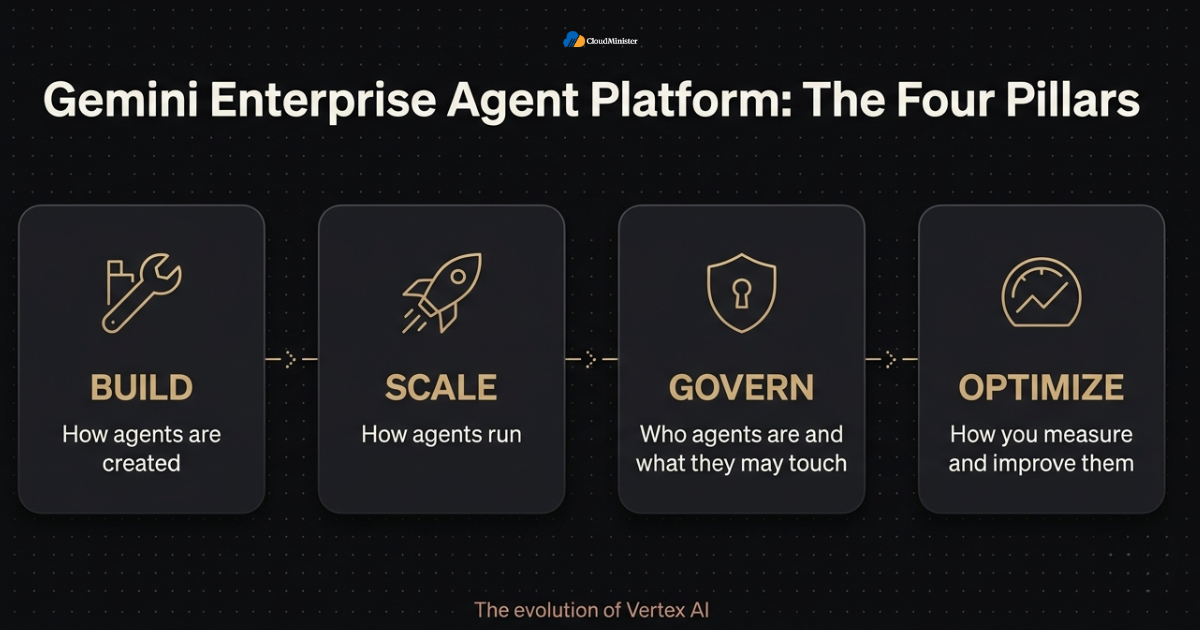
The platform is organized around four pillars, and they read like a lifecycle checklist for any production system. Build covers how agents are created, scale covers how they run, govern covers who they are and what they may touch, and optimize covers how you measure and improve them. For teams planning work on Google Cloud Platform, this structure is useful because it mirrors the questions a security reviewer and a finance reviewer will ask after Google Cloud Next 2026. The same four questions are useful when reviewing any managed setup, including simple cloud hosting services in India plans.
- Agent-to-Agent Orchestration: agents can hand tasks to one another, using both generative and deterministic patterns so compliance-critical flows follow a fixed path every time.
- Runtime: Google describes sub-second cold starts and the ability to provision new agents in seconds, which also reduces the cost of idle infrastructure. That matters to anyone comparing Affordable Cloud Hosting India against a premium AI platform.
- Long-running agents: agents can sustain multi-step work over long periods instead of ending when one chat session closes, and long-running support was a recurring theme at Google Cloud Next 2026.
- Memory Bank and Memory Profiles: persistent long-term memory lets agents recall user details and project history across months.
- Secure sandboxes: isolated environments where agents can run model-generated code or use a browser without touching host systems. Customers on Google Cloud Hosting in India should ask how those sandbox limits are applied.
- Agent Identity and Agent Gateway: every agent gets a unique cryptographic ID with traceable authorization policies, and the gateway enforces policy on agent traffic, including MCP and A2A protocols. Ask your Web Hosting Company in India how identities and network rules will be separated in your environment.
- Model Armor: inline protection at the gateway that guards against prompt injection, tool poisoning and sensitive data leakage. These risks are why Google Cloud Platform governance features deserve early testing.
- Agent Observability, Simulation and Evaluation: OpenTelemetry-compliant telemetry, stress tests with synthetic interactions, and autorater scoring of live traffic complete the optimize pillar.
4. Models on the Platform and the Cost of Tokens
A platform is only as useful as the models you can run on it. The Agent Platform offers first-class access to Gemini 3.1 Pro, which Google calls its most advanced model for complex workflow orchestration, along with models from Anthropic. For Indian teams, the practical question after Google Cloud Next 2026 is not which model is best in general, but which model is good enough for each task at the lowest token cost. If your team already pays for Google Cloud Hosting in India, check how model calls and hosting costs add up together.
- Gemini 3.1 Pro: positioned for complex workflow orchestration and the natural choice for agents that must plan across many steps.
- Nano Banana 2: the name for Gemini 3.1 Flash Image, aimed at generating high-fidelity user interfaces and visual assets.
- Lyria 3: Google’s model for professional-grade audio and music generation.
- Claude models: Anthropic’s Opus, Sonnet and Haiku families are available on the platform, and Google added support for Claude Opus 4.7 at the event. Having more than one model family in one console is a practical point for anyone reading Google Cloud Next 2026 announcements.
- Model choice per task: use a smaller and cheaper model for routing and classification, and keep the largest model for steps that truly need deep reasoning. Teams that buy cloud hosting services in India will recognize this as sizing the resource to the job.
- Token growth: with Google’s own models handling more than 16 billion tokens per minute through the API, usage-based billing becomes a major line item, so track tokens per workflow from day one.
- Surrounding compute: for containers, databases and other steady infrastructure around your agents, committed use discounts can lower the bill. This is also where Affordable Cloud Hosting India plans can keep the supporting bill low.
- Evaluation before switching: run the same test set on two models, compare quality and cost per task, and only then change your default model.
Related Reading: Google Cloud cost optimization with CUD vs SUD.
5. Eighth-Generation TPUs: TPU 8t and TPU 8i
The biggest hardware story at Google Cloud Next 2026 was the split of Google’s eighth-generation TPUs into two chips. TPU 8t is built for large-scale training, while TPU 8i is built for sampling, serving and reasoning. Google made this split because the needs of pre-training and real-time serving have drifted apart. Training wants huge, tightly coupled clusters, while serving millions of agents wants low latency and large memory close to the compute. If your workloads run on Google Cloud Platform, the practical takeaway from Google Cloud Next 2026 is that you can now match chip type to job type.
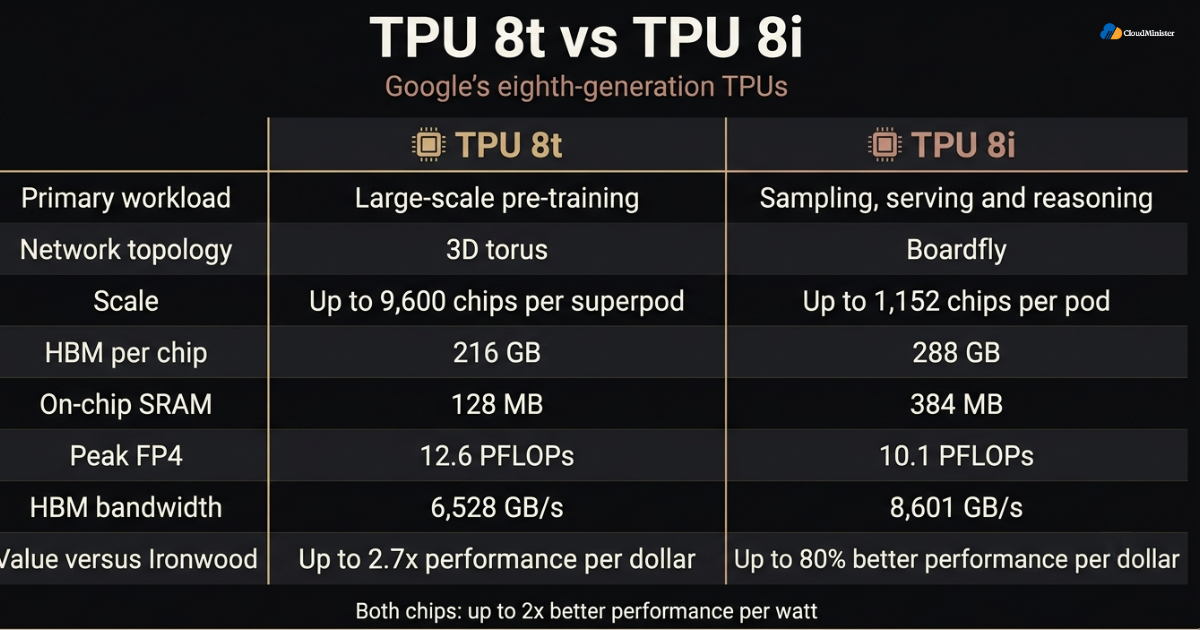
- TPU 8t scale: up to 9,600 chips and 2 PB of shared high-bandwidth memory in a single superpod, with about 3x the processing power of the seventh-generation Ironwood.
- TPU 8t design: it keeps a 3D torus network, adds a SparseCore for embedding lookups, and introduces native 4-bit floating point (FP4) to ease memory bandwidth limits.
- Training value: Google cites up to 2.7x better performance per dollar than Ironwood for large-scale training. Most small teams will never train at this scale and can rely on Affordable Cloud Hosting India for everyday needs.
- TPU 8i scale: a new Boardfly topology connects up to 1,152 chips in a single pod, which Google says improves latency by up to 50% for communication-heavy workloads. Anyone planning Google Cloud Hosting in India for inference should ask when this scale reaches Indian regions.
- TPU 8i memory: three times more on-chip SRAM than the previous generation, so larger KV caches can stay on the chip during long-context decoding.
- Collectives Acceleration Engine: it cuts the on-chip latency of collective operations by 5x, which helps during autoregressive decoding and chain-of-thought reasoning.
- Inference value: up to 80% better performance per dollar than the prior generation for inference, and both chips offer up to 2x better performance per watt.
- Software: JAX, PyTorch, Keras, vLLM, XLA and Pathways are supported, and native PyTorch on TPUs is in preview. Portability across frameworks lowers the risk for teams already on Google Cloud Platform.
- Host design: Arm-based Axion CPU headers feed the chips so data preparation does not stall them. Smaller teams on cloud hosting services in India will not buy chips like these directly, but the design shows where AI hosting is heading.
| Feature | TPU 8t | TPU 8i |
| Primary workload | Large-scale pre-training | Sampling, serving and reasoning |
| Network topology | 3D torus | Boardfly |
| Scale | Up to 9,600 chips per superpod | Up to 1,152 chips per pod |
| HBM per chip | 216 GB | 288 GB |
| On-chip SRAM | 128 MB | 384 MB |
| Peak FP4 | 12.6 PFLOPs | 10.1 PFLOPs |
| HBM bandwidth | 6,528 GB/s | 8,601 GB/s |
| Value versus Ironwood | Up to 2.7x performance per dollar | Up to 80% better performance per dollar |
Do not read TPU numbers as a promise of your own results. Peak figures describe the chip under ideal conditions, and real performance depends on your model, batch size and how well your code maps to the hardware. Google has opened an interest form for the eighth-generation TPUs, so confirm availability for your region and run a small benchmark before you plan a move after Google Cloud Next 2026. Your Web Hosting Company in India can help you test on a small footprint first.
6. AI Hypercomputer: Storage, Networking and Compute Around the TPUs
Chips alone do not make an AI system fast. Google groups hardware, storage, networking and software into what it calls the AI Hypercomputer, and Google Cloud Next 2026 added upgrades at every layer. For most Indian companies the relevant parts are not the frontier training clusters but the instance types and storage options that make everyday inference and data pipelines cheaper. Teams buying cloud hosting services in India can use these specifications as a yardstick when comparing offers.
- Virgo Network: a new data center fabric with a flat, two-layer, non-blocking design that Google says can link over 134,000 TPU 8t chips in a single fabric.
- Training scale: with JAX and Pathways, Google says training can now scale beyond one million TPU chips in a single cluster.
- Managed Lustre: now delivers 10 TB per second of throughput, and TPUDirect Storage moves data between storage and the TPU without detouring through the host CPU.
- Rapid Storage: throughput improved from 6 TB per second to 15 TB per second for AI training and inference workloads.
- Smart Storage: it adds semantic meaning to unstructured data, which supports Google’s Knowledge Catalog.
- Axion N4A instances: Google says they deliver 100% better price-performance than comparable x86 instances, which matters for teams running always-on agents on Google Cloud Platform. Always compare against Affordable Cloud Hosting India options for steady, low-intensity jobs.
- C4N and M4N machines: network-optimized series, with C4N offering almost 4x more network bandwidth per vCPU than standard C4.
- NVIDIA GPUs: Google plans to be among the first to offer NVIDIA Vera Rubin NVL72, alongside Blackwell and Hopper based instances that are already available. If you plan GPU capacity through Google Cloud Hosting in India, ask which of these instance families are offered in Indian regions.
- GKE: new agent sandboxes can deploy 300 sandboxes per second per cluster, with sub-second time to first instruction. Container-based agent platforms benefit directly, which is why Google Cloud Next 2026 gave GKE its own agent-focused updates.
7. Agentic Data Cloud and the Cross-Cloud Lakehouse
Agents are only as good as the data they can reach. The Agentic Data Cloud is Google’s answer, and it turns the data layer from a passive archive into something agents can read, understand and act on. For Indian businesses that keep data across more than one cloud, this is one of the more practical announcements from Google Cloud Next 2026, because it reduces the need to copy data before using it. If your applications run on Google Cloud Hosting in India while your data sits elsewhere, this cross-cloud approach deserves a close look.
- Cross-Cloud Lakehouse: standardized on Apache Iceberg, it lets teams query data that stays in other clouds without moving it, although Google said part of this access is still coming later this year.
- Zero-copy access: Google lists partners including Databricks, Snowflake, Salesforce Data360, SAP, ServiceNow and Workday. Buyers weighing Affordable Cloud Hosting India against large platforms should note that avoiding copies also avoids extra storage bills.
- Lightning Engine for Apache Spark: a serverless engine that Google says is up to 4.5x faster than open-source Spark and offers up to 2x better price-performance than the leading competitor on large datasets.
- Indian adopters: Flipkart and Meesho were named among the companies speeding up Spark workloads with Lightning Engine. Their example shows why the data announcements at Google Cloud Next 2026 carry real meaning for large Indian platforms.
- Knowledge Catalog: it builds a context graph of business data so agents work from trusted definitions, helped by Smart Storage and the Object Context API.
- Data Agent Kit: a Gemini-powered authoring experience across IDEs, notebooks and terminals for Python, Spark and SQL work. It suits teams that already build data pipelines on Google Cloud Platform.
- Deep Research Agent: it connects to platforms such as BigQuery so it can answer business questions using both structured and unstructured data, with citations.
- Practical first step: list the tables an agent will need, confirm each has an owner and clear column definitions, and fix gaps before you connect any agent. A Web Hosting Company in India can help document these owners and connection points.
Related Reading: Serverless data warehouse with BigQuery.
8. Agentic Defense: Securing Agents With Wiz and Google Threat Intelligence
Security was not an afterthought at Google Cloud Next 2026. As companies give agents access to sensitive data, the attack surface grows, and attackers are also using AI. Google responded by combining its threat intelligence and security operations with Wiz, the cloud and AI security platform. The message to buyers is that agents need the same discipline as any privileged user: identity, least privilege, monitoring and a way to stop them quickly. Teams hosting customer-facing sites on cloud hosting services in India should apply the same thinking to those systems.
- Wiz AI Application Protection Platform: covers infrastructure, data, access, models, agents and applications from code to runtime across environments. It also supports Databricks and several agent studios, so it is not limited to Google Cloud Platform.
- Wiz agents: the Red Agent tests web apps and APIs for exploitable risk, the Blue Agent investigates threats, and the Green Agent analyzes root cause and suggests fixes.
- Triage and Investigation Agent: Google says it has processed more than 5 million alerts and cut a typical 30-minute manual analysis to 60 seconds. Results like these shaped the security story at Google Cloud Next 2026.
- Threat Hunting and Detection Engineering agents: built to search for novel attack patterns and generate persistent detection rules.
- Agent Anomaly Detection: it flags tool misuse, unauthorized data access and reasoning drift by analyzing the intent behind agent actions.
- Agent Security dashboard: built on Security Command Center to map relationships between agents and models and scan for vulnerabilities.
- Google Cloud Fraud Defense: the evolution of reCAPTCHA, meant to tell apart humans, bots and agents. Online stores hosted on Affordable Cloud Hosting India plans can benefit from this kind of check.
- Regulated industries: Google announced support for the latest Gemini 3 models in both air-gapped and connected environments. If you are weighing Google Cloud Hosting in India for a regulated project, ask where each security component runs.
Treat every agent like a new employee with its own account. Give it a separate identity, grant only the permissions its task needs, log every action, and require a human approval step for anything that moves money or deletes data. A Web Hosting Company in India or cloud partner should be able to explain how these controls are applied in your setup.
9. Why Google Cloud Next 2026 Matters for Indian Businesses
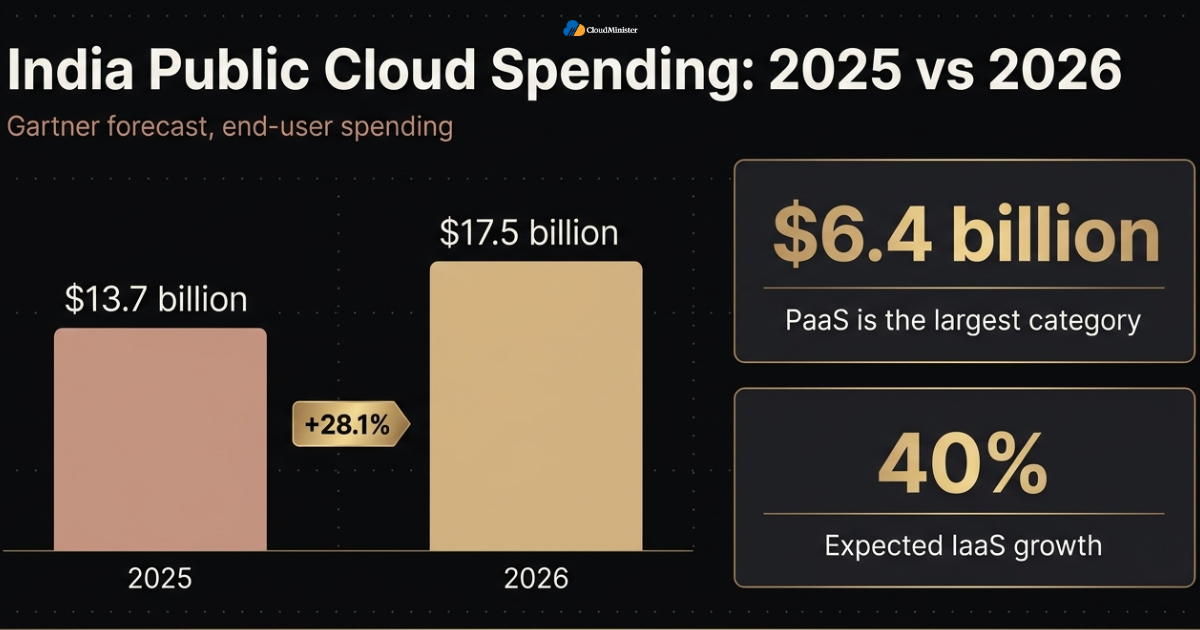
India is one of the fastest growing cloud markets, and the numbers show why Google Cloud Next 2026 deserves attention here. Gartner forecasts that end-user spending on public cloud in India will rise 28.1% to $17.5 billion in 2026, compared with $13.7 billion in 2025. The same forecast says PaaS is the largest category at $6.4 billion, while infrastructure as a service is expected to grow 40%. Those two figures match the themes of the event, since agent platforms are PaaS and the chips and instances underneath them are IaaS. For readers deciding on Google Cloud Hosting in India, this growth is a good local reason to plan early.
- Reliance: the retailer is using a Shopping Agent that builds carts from a simple request such as planning a birthday party, with Gemini-powered catalog enrichment analyzing millions of images in minutes. It is a clear example from Google Cloud Next 2026 of agents serving millions of Indian shoppers.
- Tata Steel: Google listed it among customers deploying unified agentic AI across a global value chain.
- Flipkart and Meesho: both are named users of Lightning Engine for faster Apache Spark workloads.
- Systems integrators: TCS, HCLTech, Infosys and others are part of Google’s partner ecosystem, and Google is sending forward-deployed engineers to work with teams from partners such as TCS and HCLTech.
- Skills pool: Google says more than 330,000 consultants have been trained on its AI technologies worldwide. A large trained pool lowers the hiring risk for anyone adopting features from Google Cloud Next 2026.
- Regions: Google Cloud has regions in Mumbai and Delhi, which helps latency and residency planning, but you should check which services run in each region before designing. A Web Hosting Company in India in India can also advise on residency, so involve yours early.
- Data residency: regulated Indian sectors should check where data, backups and logs live for every agent service, including model calls. This applies equally to Google Cloud Platform projects and to cloud hosting services in India setups.
- Governance gap: Gartner notes that governing hybrid, multicloud and AI-enabled environments is one of the biggest cloud challenges of 2026.
- Smaller companies: not every project needs a hyperscale AI platform, and Affordable Cloud Hosting India plans still suit websites, APIs and databases.
Plan Your Google Cloud Setup in India
Want to run AI agents, data pipelines or web workloads on Google Cloud? Cloudminister helps you size, deploy and manage Google Cloud hosting in India with the right balance of performance and cost.
10. Google Cloud, AWS or Azure: Where the Agent Platform Fits
No single cloud wins every workload, and Google Cloud Next 2026 did not change that. What it did was make Google’s position clearer: a vertically optimized stack with its own chips, its own models, an agent platform and a data layer, while still hosting models from partners. If you already use another cloud, the Cross-Cloud Lakehouse is designed so you do not have to move everything to test Google’s tools on Google Cloud Platform. Buyers who compare Affordable Cloud Hosting India offers with hyperscale clouds should apply the same logic.
- Where Google is strong: custom TPU silicon, Gemini models and an integrated data and analytics layer built around BigQuery. These strengths shaped much of what Google presented at Google Cloud Next 2026.
- Openness: the platform supports MCP and A2A, hosts Claude alongside Gemini, and connects to third-party agents from partners. That openness is part of the pitch Google made at Google Cloud Next 2026.
- Multicloud reality: many Indian companies already run workloads on AWS or Azure, so test interoperability before you commit to a migration. Whichever cloud you pick, cloud hosting services in India from a local provider can host the parts that do not need AI services.
- Decision factor one: where your data already lives, because moving large datasets costs time and money.
- Decision factor two: which skills your team already has, since retraining people is a real cost.
- Decision factor three: compliance and data residency needs for your sector. Ask whether Google Cloud Hosting in India can meet them.
- Decision factor four: total cost, including data egress, support and the engineering hours a migration takes. Ask your Web Hosting Company in India for a written quote that includes each of these items.
- Pilot approach: run one agent for 30 days on each candidate platform with the same test set and compare results, not marketing claims.
Related Reading: AWS vs Azure vs Google Cloud.
11. Cost Planning and Right-Sizing for Agent Workloads
Agents can quietly become expensive because they make many model calls, keep memory and run for long periods. The announcements at Google Cloud Next 2026 lower unit costs in several places, but they do not remove the need for planning. Teams that choose Affordable Cloud Hosting India plans for supporting services, and keep premium AI services only for the steps that need them, usually control spend better. A Web Hosting Company in India can also help you review monthly bills and spot waste.
- Track cost per task, not just monthly spend, so you can see when a workflow becomes more expensive than the manual work it replaced. This habit keeps the value promised at Google Cloud Next 2026 measurable.
- Set token budgets and timeouts on every agent so a reasoning loop cannot run unchecked.
- Cache repeated context and reuse results where the answer does not change between runs.
- Right-size the virtual machines and containers around your agents after two weeks of real traffic data. This applies whether you use cloud hosting services in India or services on Google Cloud Platform.
- Separate steady and bursty workloads, and match each one to a suitable pricing model. Ask your provider how this split works for Google Cloud Hosting in India specifically.
- Review idle resources every week, because agent pilots often leave test environments running.
- Place supporting services such as websites, APIs and small databases on Affordable Cloud Hosting India plans when they do not need AI-specific hardware.
- Watch data egress charges whenever agents read data across clouds. Egress is easy to miss when you compare Affordable Cloud Hosting India offers with large clouds.
Tag every agent project with an owner and a cost center label from the first day. Without labels, you cannot tell which team caused a spike in the bill once pilots that started after Google Cloud Next 2026 begin to scale.
Related Reading: Cloud rightsizing for instances
12. How a Hosting Partner Helps: A Practical 30 Day Plan
Announcements become value only when someone turns them into a running system. A Web Hosting Company in India that works with Google Cloud Platform and other clouds can help you size environments, set up backups and monitoring, and keep the non-AI parts of your stack stable while your team experiments. Cloudminister provides Google Cloud Hosting in India and cloud hosting services in India, so you can discuss both the AI platform side and the supporting infrastructure with one team.
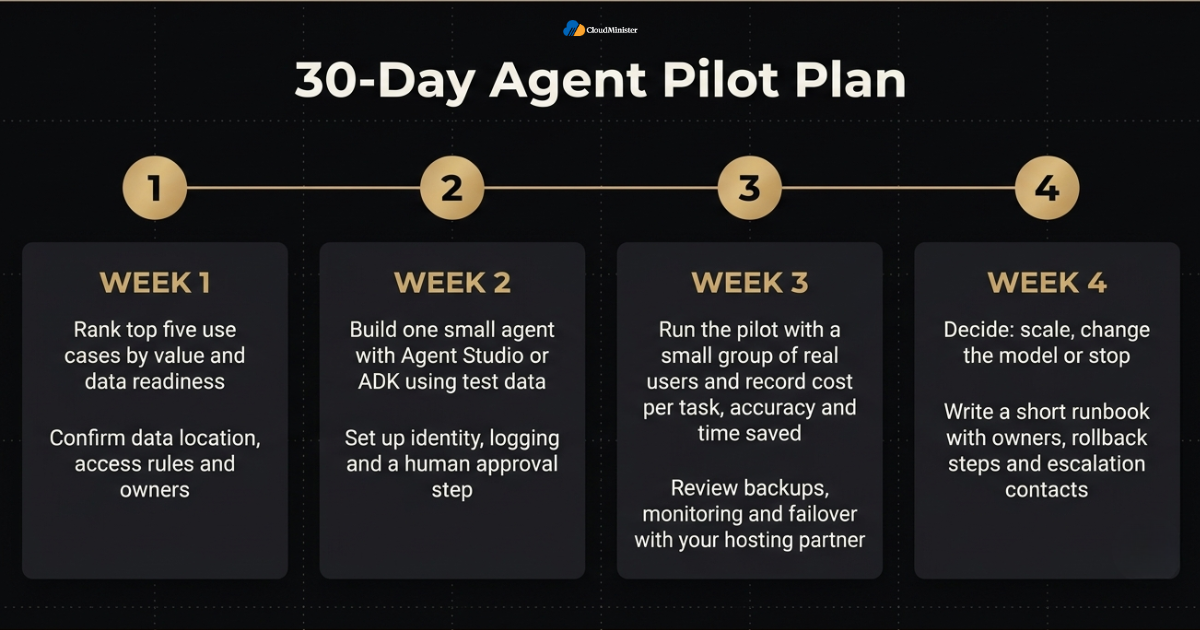
- Week one: list your top five candidate use cases for agents and rank them by business value and data readiness. A Web Hosting Company in India can supply an inventory of the servers and storage you already run.
- Week one: confirm data location, access rules and owners for each dataset an agent would touch.
- Week two: build one small agent with Agent Studio or ADK using test data, and write the success numbers down before you start.
- Week two: set up identity, logging and a human approval step before connecting any real system. Apply this before any pilot on Google Cloud Hosting in India touches production data.
- Week three: run the pilot with a small group of real users and record cost per task, accuracy and time saved.
- Week three: review the architecture with your hosting partner for backups, monitoring and failover, including any cloud hosting services in India you already use.
- Week four: decide whether to scale, change the model or stop, based on the numbers you recorded. Compare the result with Affordable Cloud Hosting India alternatives before you expand.
- Week four: write a short runbook covering owners, rollback steps and escalation contacts, and note which Google Cloud Next 2026 features earned a place in your stack.
Pilot for 30 days, not 3 days. Many agent problems appear only after repeated use, such as memory drift, rising token use or tool errors. A short demo hides all of them, so judge any Google Cloud Next 2026 feature by how it behaves in week four, not on day one.
Checklist: Agent Platform Readiness Review
- Top use cases ranked by value and data readiness
- Data owners, locations and access rules documented
- Separate identity and least-privilege access for each agent
- Human approval step set for risky actions
- Token budgets, timeouts and cost labels in place, with Affordable Cloud Hosting India options compared for non-AI services
- Logging and monitoring turned on before real users arrive
- Backups tested and restore time recorded with your Web Hosting Company in India
- Data residency and region choices reviewed for Google Cloud Hosting in India and Google Cloud Platform projects
- Success numbers agreed before the pilot starts
- Runbook written with owners and escalation contacts
Key Takeways
- Google Cloud Next 2026 centered on the agentic enterprise, with the Gemini Enterprise Agent Platform as the main developer launch.
- The platform covers four pillars, build, scale, govern and optimize, and it grows from Vertex AI rather than replacing its model and tuning services, which is how Google Cloud Next 2026 presented it.
- TPU 8t targets training and TPU 8i targets inference, with Google citing up to 2.7x and up to 80% better performance per dollar over Ironwood at Google Cloud Next 2026.
- The Agentic Data Cloud and Cross-Cloud Lakehouse help teams use data without copying it first.
- Agents need identity, least privilege and monitoring, and Agentic Defense with Wiz targets exactly that need.
- Gartner forecasts India public cloud spending at $17.5 billion in 2026, which makes the topics from Google Cloud Next 2026 relevant to Indian teams.
- Teams on Google Cloud Platform should pilot one agent, measure cost per task and scale only when the numbers hold.
- A Web Hosting Company in India offering cloud hosting services in India can keep supporting infrastructure stable while your team experiments.
- Hosting choices still matter, because Google Cloud Hosting in India and cloud hosting services in India remain the base for most web workloads while AI platforms handle specialized work.
- Simple workloads can stay on Affordable Cloud Hosting India plans, while heavy AI work uses the specialized services.
Need Help Turning These Announcements Into a Plan?
Talk to the Cloudminister team about your 30-day pilot, data residency, cost planning or cloud migration. We’ll help you choose the right setup for each workload.
Conclusion
The clearest lesson from Google Cloud Next 2026 is that AI is moving from demos to operations. Google is betting that companies will want one stack for chips, models, data, security and agents, and it backed that bet with specific products and measurable claims. Whether you adopt the whole stack or only parts of it, the questions to ask stay the same: where does my data live, who controls each agent, and what does each task cost. Reading Google Cloud Next 2026 through that lens keeps the excitement grounded in cost and control.
For Indian businesses, the smart path is steady and measured. Start with one use case, keep data residency in view, and use the right level of infrastructure for each job. If you want help sizing a project on Google Cloud Hosting in India or comparing plans for cloud hosting services in India, a capable Web Hosting Company in India can turn the ideas from Google Cloud Next 2026 into a plan your team can actually run. Not every project needs premium AI services, so keep Affordable Cloud Hosting India plans in your toolbox for simpler jobs, and teams already on Google Cloud Platform have a head start.
Google Cloud Next 2026 is the start of a long adoption cycle, not the end of one. Keep notes on what worked in each pilot, share them with your Web Hosting Company in India, and revisit your plan every quarter, because models, prices and regional availability keep changing.
Frequently Asked Questions
What was announced at Google Cloud Next 2026?
Google announced the Gemini Enterprise Agent Platform, the eighth-generation TPUs (TPU 8t and TPU 8i), the Agentic Data Cloud with a cross-cloud Lakehouse, new security capabilities built with Wiz, and new features in the Gemini Enterprise app. Together, these make up what people usually mean by Google Cloud Next 2026 news.
What is the Gemini Enterprise Agent Platform?
It is Google’s platform to build, scale, govern and optimize AI agents. It brings together the best of Vertex AI with new agent tools such as Agent Studio, Agent Registry, Agent Identity and Agent Gateway.
What are TPU 8t and TPU 8i?
They are Google’s eighth-generation Tensor Processing Units. TPU 8t is designed for large-scale training, and TPU 8i is designed for serving, sampling and reasoning with low latency.
When can Indian customers use the new TPUs?
Google’s launch posts did not give a general availability date for every region, and it opened an interest form for the eighth-generation TPUs. Check Google’s documentation or ask your cloud partner before you plan around them. This matters to anyone planning Google Cloud Hosting in India around AI chips.
Do I need Google Cloud Platform to benefit from these announcements?
Not always. The Cross-Cloud Lakehouse is built to work with data that stays in other clouds, and simpler workloads can run on Affordable Cloud Hosting India plans. Move to Google Cloud Platform services where the AI features give you a clear gain.
How does a Web Hosting Company in India help with Google Cloud?
A hosting partner can size environments, set up backups and monitoring, review costs and keep supporting systems stable. It gives your team a second pair of eyes during a pilot. Providers of cloud hosting services in India can also manage the non-AI parts of a project.
Is the Gemini Enterprise Agent Platform secure?
It includes controls such as Agent Identity, Agent Gateway and Model Armor, but security still depends on how you set it up. Use least privilege, logging and human approval for risky actions. A Web Hosting Company in India can add monitoring and backup review on top.
What are MCP and A2A?
MCP, the Model Context Protocol, connects agents to tools and data. A2A, the Agent2Agent protocol, lets agents delegate tasks to one another. The platform supports both.
Should small businesses care about Google Cloud Next 2026?
Yes, but with care. Small teams can learn from the cost and governance ideas, while keeping websites and standard applications on Affordable Cloud Hosting India plans or cloud hosting services in India until an AI workload truly needs more.
What should I do first after reading about Google Cloud Next 2026?
Pick one process, define success numbers and run a 30 day pilot. Then ask a Web Hosting Company in India to review your hosting, whether you use Google Cloud Hosting in India, cloud hosting services in India or Affordable Cloud Hosting India plans.