The SSL Certificate Lifetime for publicly trusted certificates dropped to 200 days on March 15, 2026. It falls to 100 days on March 15, 2027 and to 47 days on March 15, 2029. At the same time, browsers already use hybrid post-quantum key exchange, and Chrome has published a new certificate model for the quantum era. This guide explains the official dates, the 2026 statistics, ACME renewal automation, hybrid post-quantum TLS setup, and a practical plan for the weeks left in Q4 2026. It also shows where a Web Hosting Company in India, Server Management Services in India, and cybersecurity solutions fit into that plan, and how Cyber Security services and Server Management Services support the daily work.
Most website owners used to treat HTTPS as a yearly chore. You bought a certificate, installed it, set a reminder, and forgot about it for twelve months. That habit has become a risk, and good cybersecurity solutions start with exactly this kind of basic discipline. The SSL Certificate Lifetime has entered a multi year reduction that turns renewal from an annual task into a continuous process, and the final weeks of Q4 2026 are the right time to build that process before the next reduction arrives.
Two changes are landing together. First, the maximum SSL Certificate Lifetime is shrinking in fixed steps, so every site needs reliable renewal without manual work. Second, the encryption inside TLS is being upgraded to resist future quantum computers, and your web server, load balancer, and CDN must be ready for it. A capable Web Hosting Company in India can handle much of this through its Server Management Services, but you should still know what to ask, what to check, and what to test.
This guide uses plain language and short points. You will learn the official dates, real 2026 statistics, how ACME automation works, how to renew safely across many servers, and how to turn on hybrid post-quantum key exchange. Whether you run one website or one hundred, the steps are the same: know every certificate, automate every renewal, and track every SSL Certificate Lifetime deadline, with help from Cyber Security services and Server Management Services in India where your own team needs it.
1. What Changed: The New SSL Certificate Lifetime Timeline
The CA/Browser Forum, the industry body that sets baseline rules for publicly trusted certificates, approved Ballot SC-081v3 in April 2025. The ballot replaced the long standing 398 day limit with a three step schedule. Since March 15, 2026, the maximum SSL Certificate Lifetime for new public certificates is 200 days, and the next two steps are already fixed on the calendar. Some certificate authorities issue 199 day certificates to stay safely inside the limit, so always check the exact validity printed on your own certificate.
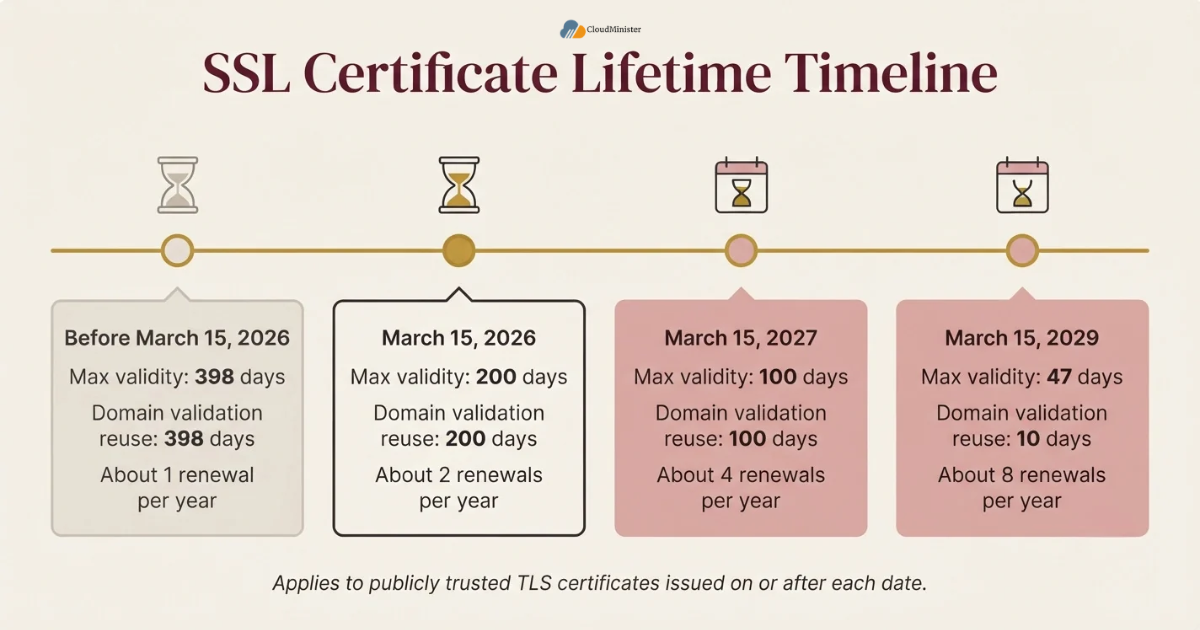
| Effective date | Max certificate validity | Domain validation reuse | Approximate renewals per year |
| Before March 15, 2026 | 398 days | 398 days | About 1 |
| March 15, 2026 | 200 days | 200 days | About 2 |
| March 15, 2027 | 100 days | 100 days | About 4 |
| March 15, 2029 | 47 days | 10 days | About 8 |
- The SSL Certificate Lifetime limit applies to certificates issued on or after each date. Certificates issued earlier stay valid until their own expiry, so some 398 day certificates can remain in service until about April 2027.
- It covers publicly trusted TLS certificates of every validation type. Private CA certificates and self signed certificates sit outside the rule, although good cybersecurity solutions shorten those lifetimes too.
- Domain validation reuse shrinks alongside the SSL Certificate Lifetime. A CA may reuse a successful domain check for 200 days now, 100 days from March 2027, and only 10 days from March 2029.
- For OV and EV certificates, the reuse period for organization details drops from 825 days to 398 days for certificates issued on or after March 15, 2026. Cyber Security services teams should note this when planning validation work.
- The word SSL is a habit. Modern certificates are used with TLS, but the industry still says SSL Certificate Lifetime, so this guide uses the familiar phrase.
- Multi year plans sold by vendors are now billing packages. You still receive a fresh certificate each cycle, so ask your Server Management Services provider how reissuance is handled.
- Let’s Encrypt plans to reach 45 day certificates in 2028, which is ahead of the Forum’s 47 day date in 2029, so ask your Server Management Services in India partner whether its renewal tooling is ready.
Do not count days by hand. Put March 15, 2027, March 15, 2029, and every certificate expiry date into one shared calendar that your whole team and your Web Hosting Company in India can see.
2. Why the Industry Is Shrinking SSL Certificate Lifetime
Shorter certificates are not a punishment for website owners. They are a security control. When a private key leaks, or a certificate is issued by mistake, the damage lasts only until the certificate expires, and revocation has never been fully reliable in real browsers. Reducing the SSL Certificate Lifetime limits how long a bad certificate can be abused, and it pushes the web toward automation that removes human error. Strong cybersecurity solutions follow the same idea, which is to shrink the time an attacker can use a stolen credential.
- Revocation is weak in practice. Browsers do not always check live revocation status, so a shorter life is the most dependable way to retire a compromised certificate.
- Domains change hands. A certificate can outlive the moment a domain was sold or transferred, and shorter validity closes that gap sooner. A good Server Management Services in India partner checks domain ownership records during routine audits.
- Validation data goes stale. Reusing an old domain check for 398 days meant a certificate could be issued on proof that was more than a year old. Regular Server Management Services audits catch this kind of drift.
- Automation becomes the default. A shorter SSL Certificate Lifetime pushes every site toward ACME or a similar process, which removes forgotten renewals from the picture.
- Cryptographic agility improves. When the SSL Certificate Lifetime is only a few weeks, certificates rotate often, so changing algorithms later, including post-quantum ones, becomes a smaller job.
- Apple pushed for the 398 day limit in 2020, and Google proposed 90 day certificates in 2023, so the direction of travel was visible years ago.
- Professional Cyber Security services teams track certificate expiry as a measurable risk, in the same way they track patching and password rotation.
- A reliable Web Hosting Company in India will usually raise this topic during infrastructure reviews, because DNS, storage, and network design decide how easy automation will be.
A short SSL Certificate Lifetime reduces exposure only when the private key is also protected. Generate a fresh key pair on renewal where your tooling allows it, keep key files readable only by the service account that needs them, and never send private keys by email or paste them into tickets.
3. What the 2026 Statistics Say About Certificate Failures
Numbers make the case better than opinions. A global survey of 1,001 IT and cybersecurity decision makers, run in May 2026 and published in September, shows how often certificates fail in real organizations. DigiCert’s September 2026 Certificate Management Outlook reports that more than one third of surveyed organizations had a service outage caused by an expired certificate in the past year, and nearly one in four said their worst certificate incident cost more than 250,000 dollars. Only 10 percent said they already had automation in place when asked about barriers, which shows how far the average SSL Certificate Lifetime plan still has to travel.
- Nearly three quarters of respondents reported at least five hours of certificate related downtime, and one in five reported 25 hours or more. Round the clock Server Management Services in India coverage can shorten such outages.
- More than half classified certificate outages as infrastructure issues, which shows the SSL Certificate Lifetime problem is no longer only a concern for the security team.
- Thirty percent were not actively preparing for shorter certificate lifecycles, even though the first reduction had already taken effect. Server Management Services can close that gap quickly.
- Legacy system incompatibility was the leading barrier to automation at 25 percent, followed by budget constraints at 21 percent. Cyber Security services teams can often help remove those legacy blockers.
- The research estimates that an enterprise with 1,000 public certificates could face roughly 8,000 issuances and 40,000 domain validations each year once the SSL Certificate Lifetime reaches 47 days in 2029.
- Figures like these explain why a Web Hosting Company in India that includes monitored renewals can be more useful than one that only sells a certificate.
- Treat the percentages as survey data from larger organizations, not as a forecast for your own site. The direction matters most: more certificates, shorter lives, and less room for manual work, which is why modern cybersecurity solutions now include certificate lifecycle control.
Expired certificate outages rarely start on the main website. They usually start on forgotten hostnames such as an API subdomain, a staging load balancer, a mail server, or a payment callback host. Inventory first, automate second.
4. How a Shorter SSL Certificate Lifetime Affects Your Website Stack
A certificate is rarely used in just one place. The same domain name may be served by a web server, a CDN, a load balancer, a mail server, an API gateway, and a control panel. Each place holds its own copy, and each copy must be renewed and deployed. A shorter SSL Certificate Lifetime multiplies the number of deployments, which is why experienced Server Management Services teams start with an inventory instead of a tool.
- With a shorter SSL Certificate Lifetime, web servers such as Nginx, Apache, and LiteSpeed need a reload after a new certificate file is written, otherwise they keep serving the old certificate from memory.
- CDNs and reverse proxies often manage their own edge certificates, but the origin server certificate behind them still needs its own renewal.
- Load balancers and Kubernetes ingress controllers keep certificates in separate secret stores, so a renewed file on disk does not update them automatically. Server Management Services in India teams usually script this step.
- Mail servers use TLS too. A lapse on SMTP, IMAP, or webmail can break delivery or make email clients show warnings to every user, so mail belongs in Cyber Security services reviews.
- Control panels such as cPanel and Plesk, which any Web Hosting Company in India typically offers, include automatic certificate features, but those only cover domains that still pass validation from that server.
- Wildcard and multi domain certificates need DNS based validation, which means your automation needs safe, limited access to DNS.
- Client certificates used for mutual TLS are changing separately. New public leaf certificates carry only the server authentication purpose from March 15, 2027, so client authentication should move to a private CA.
- Old devices, payment gateways, and partner systems may pin certificates or expect manual updates, so your cybersecurity solutions inventory should list them early and contact their owners.
Related Reading: cPanel and WHM CVE-2026-41940 authentication bypass
Run a discovery pass this week. List every hostname in your DNS zone, then check each one on ports 443, 465, 993, and 8443 for certificate expiry dates. Anything you did not expect is the first place an outage will appear.
5. Domain Validation Reuse and Choosing the Right Challenge
Every public certificate begins with proof that you control the domain. That proof is called domain control validation, and its reuse period is shrinking together with the SSL Certificate Lifetime. As reuse drops to 10 days in 2029, your automation must prove control again and again, without a person clicking an email link. Choosing the right validation method now saves difficult rework later.
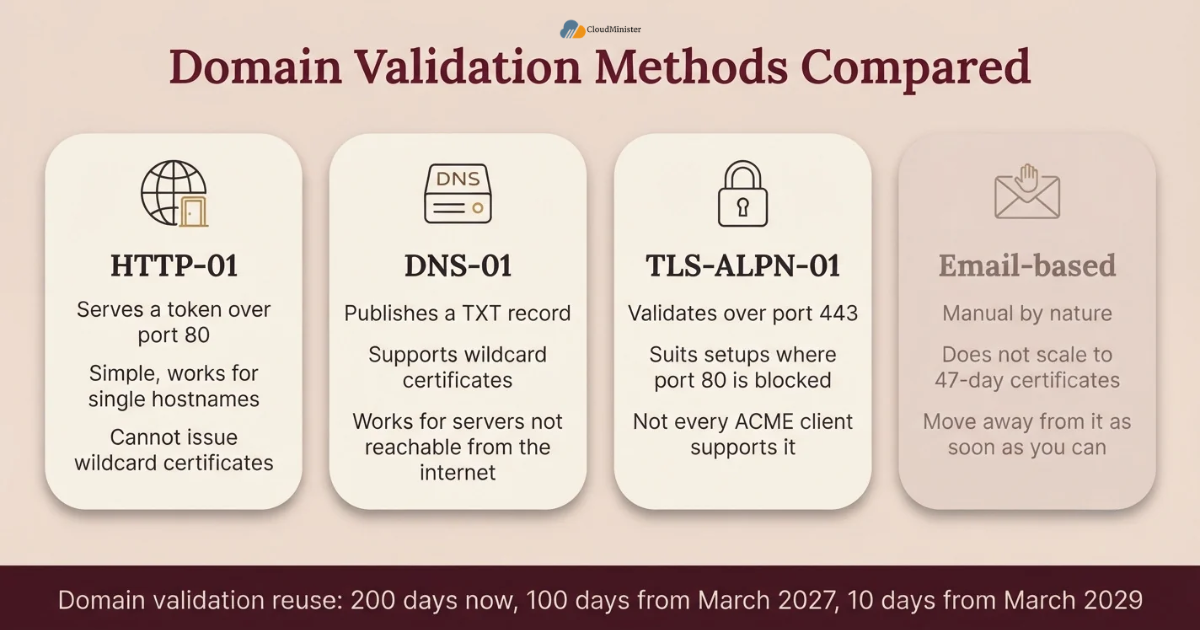
- HTTP-01 proves control by serving a token over port 80. It is simple and works for single hostnames, but it cannot issue wildcard certificates.
- DNS-01 proves control by publishing a TXT record. As the SSL Certificate Lifetime shrinks, it is a popular choice, because it supports wildcard certificates and servers that are not reachable from the internet.
- TLS-ALPN-01 validates over port 443 and suits setups where port 80 is blocked, though not every ACME client supports it.
- Email based validation is manual by nature and does not scale to 47 day certificates, so move away from it as soon as you can. Any modern Web Hosting Company in India should support ACME based validation.
- Use CNAME delegation for DNS-01. Point the challenge record to a separate zone so the automation never touches your main DNS records, which fits well with layered cybersecurity solutions.
- Use scoped DNS API tokens that can edit only the challenge zone, never full account keys, a rule that Cyber Security services reviewers always check.
- Add CAA records that name the certificate authorities allowed to issue for your domain. CAA can also bind issuance to a specific ACME account, and Server Management Services teams can audit these records monthly.
- Test validation in a staging environment first, because firewalls, CDNs, and redirect rules often break challenge requests. Ask your Server Management Services in India provider who owns each DNS credential.
Treat DNS API tokens like passwords. Store them in a secrets manager, rotate them on a schedule, and restrict them by zone and by source address wherever your DNS provider allows it.
6. Automating Renewals with ACME: A Practical Workflow
ACME, defined in RFC 8555, is the protocol that lets software request, validate, and install certificates without human steps. Almost every serious certificate authority supports it. A good SSL Certificate Lifetime strategy does not depend on remembering dates. It depends on a client that runs on a schedule, a deploy hook that reloads services, and an alert that fires when anything fails. This work sits at the heart of Server Management Services for busy production sites.
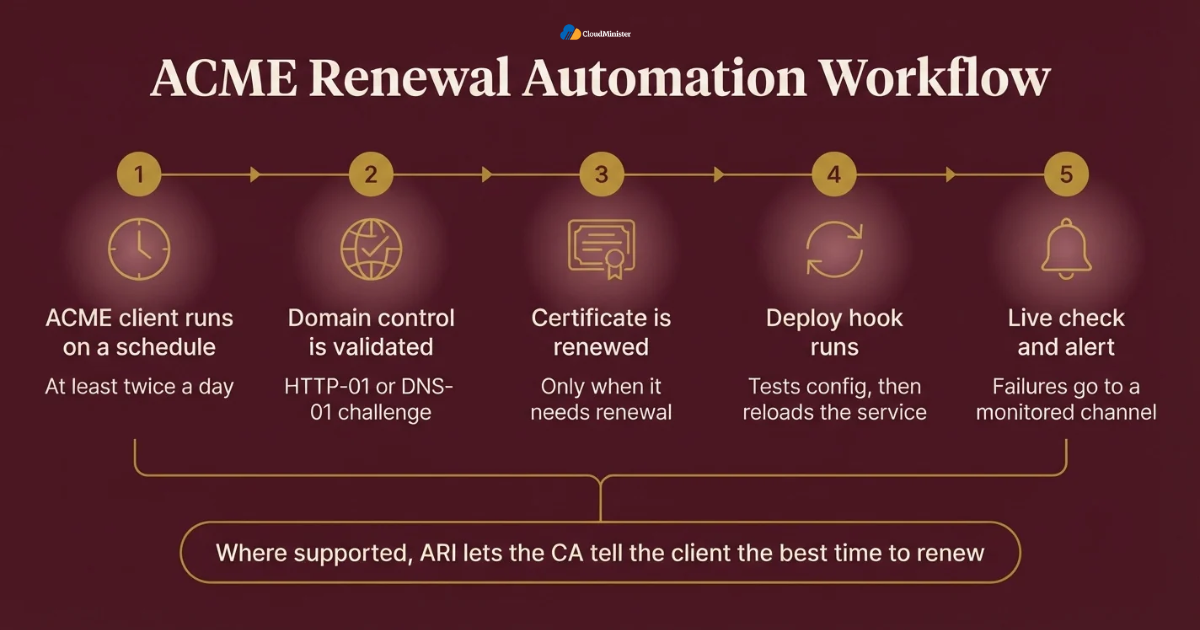
- Choose a maintained ACME client such as Certbot, acme.sh, Caddy, Traefik, or lego, and match it to your server software. Ask your Web Hosting Company in India which client it supports.
- Run the client at least twice a day. It renews only when a certificate needs it, so frequent checks are cheap and give you many chances to recover from a fault.
- Prefer clients that support ACME Renewal Information, known as ARI. The CA tells the client the best time to renew and can move that time earlier if certificates must be replaced.
- Search cron jobs and scripts for hard coded day counts. Numbers written for 90 day certificates will misbehave as the SSL Certificate Lifetime moves to 64 days and then 45 days.
- Use deploy hooks to reload Nginx, Apache, Postfix, or Dovecot only after a successful renewal, and test the configuration before every reload, a habit that Cyber Security services auditors like to see.
- Test against the staging endpoint. Let’s Encrypt has issued 64 day certificates in staging since October 14, 2026, so you can see how your jobs behave before the production change on February 10, 2027.
- Use a separate ACME account for each environment, so a mistake in staging or development never touches production, which is basic hygiene for cybersecurity solutions.
- Keep the previous certificate and key for a short rollback window, then delete them securely.
- Log every run to a central place and send failures to a monitored channel, not to an unread mailbox. Many teams use Server Management Services in India for this round the clock watch.
Related Reading: Zero trust security guide for India.
Renew early and renew often. A client that tries every day gives you dozens of chances to recover from a temporary DNS or network fault before expiry. A client that tries once, near the deadline, gives you only one.
7. Renewing Safely Across Many Servers, Panels, and Mail Systems
Automation that works on one server can still fail on ten. When several servers, a load balancer, and a mail system share a hostname, you must decide where the certificate is requested and how it reaches every other place. The wrong design causes rate limit errors, mismatched certificates, or silent expiry on one forgotten node. A Web Hosting Company in India that manages your infrastructure can standardize this, which is one reason managed hosting is popular with growing teams. Without a clear plan, the shorter SSL Certificate Lifetime simply multiplies mistakes.
- Request each certificate in one central place and distribute it, instead of letting every node request its own copy of the same name. This avoids duplicate requests and rate limits.
- Distribute certificates through a secrets store or configuration management tool, and reload services in a controlled order, as Server Management Services runbooks usually describe.
- On cPanel or Plesk servers, keep the built in automatic SSL feature enabled, and confirm it still passes validation after any DNS, redirect, or firewall change. Strong cybersecurity solutions depend on this step.
- Reload mail services such as Postfix, Dovecot, Exim, and webmail front ends after renewal, then test a real mail client.
- Keep webmail and panel software patched. An expired certificate is an inconvenience, but an unpatched mail or panel service is an open door that Cyber Security services teams work hard to close.
- Use a health check that connects from outside and reads the live certificate, because a file on disk can be new while the running service still uses the old one.
- Stagger renewals across hosts so a single faulty change cannot break every site in the same minute, even as the SSL Certificate Lifetime keeps shortening.
- Write down who owns each certificate. If you use Server Management Services in India, record which tasks belong to the provider and which belong to you.
Related Reading: Roundcube CVE-2026-48842 SQL injection patch
Test the whole chain, not only the website. After every renewal, check HTTPS, SMTP on port 465 or 587, IMAP on port 993, and your API hostnames from a network outside your own.
8. Monitoring, Alerts, and Incident Response
Automation reduces risk but never removes it. A DNS provider can change an API, a firewall rule can block validation, or a server can run out of disk space. Monitoring is the safety net that tells you about trouble while there is still time to fix it. With every cut in the SSL Certificate Lifetime, the window for fixing a failed renewal gets smaller, so alerts must arrive earlier and say more. Good Cyber Security services include certificate expiry in monitoring from the start, in the same way they watch failed logins and unusual traffic.
- Set alerts as a share of the lifetime, such as one third, one fifth, and one tenth remaining, plus a final one day warning.
- Monitor the certificate that is actually served on the live port, not only the file on disk or the dashboard of your CA, because a falling SSL Certificate Lifetime leaves little time for guessing.
- Watch Certificate Transparency logs for your domains. Unexpected certificates can reveal shadow IT, a compromised account, or an attacker, and many cybersecurity solutions use this feed.
- Track renewal job exit codes and alert on any failure immediately, instead of waiting for an expiry threshold. This is routine work for Server Management Services teams.
- Keep a written runbook with the exact commands to renew by hand, force a deploy, and roll back to the previous certificate. Agree the runbook with your Server Management Services in India partner.
- Define who is on call. A certificate outage at 2 a.m. should reach a person who can act, not a shared inbox. A Web Hosting Company in India with a 24×7 support desk can cover this gap.
- Practice a failure drill once a quarter by letting a test certificate expire in a safe environment.
- Review each incident without blame, then fix the process that allowed it, whether that is a missing alert, a stale credential, or an unclear owner.
An outage caused by an expired certificate teaches visitors to click through browser warnings. That habit is dangerous because it makes real attacks harder to notice. Fixing expiry quickly also protects the security awareness of your users.
Secure Every Certificate Before the Next Deadline
Expired certificates, weak key exchange, and unmonitored hostnames are easy targets. CloudMinister’s Cyber Security services help you protect your servers, automate renewals, and stay audit-ready. New clients get a free consultation.
9. Compliance, Key Custody, and the India Context
For Indian businesses, certificates connect to legal and contractual duties as well as technical ones. India’s Digital Personal Data Protection Act expects data fiduciaries to apply reasonable security safeguards, and encryption is widely treated as a baseline safeguard. Payment, banking, and healthcare customers often add their own audit requirements. A well run SSL Certificate Lifetime process produces the records auditors ask for, such as issuance history, owner names, and renewal logs. A trusted Web Hosting Company in India with local data centres can also simplify questions about where keys and logs are stored.
- Keep an inventory with the certificate name, issuing CA, expiry date, owner, deployment locations, and validation method. This one table answers most audit questions about SSL Certificate Lifetime.
- Store private keys on systems that match your data residency policy. Some organizations also keep keys in a hardware security module or a managed key vault.
- Limit who can issue certificates. Use role based access, multi factor authentication on CA accounts, and an approval step for new wildcard certificates, in line with common Cyber Security services practice.
- Retain renewal and deployment logs for the period your policy or customer contracts require. Server Management Services can archive them automatically.
- Use organization or extended validation only where a contract or regulator asks for it. Domain validated certificates give the same encryption strength.
- Match certificate handling to your wider cybersecurity solutions, including patching, access control, backups, and incident reporting.
- Ask providers of Server Management Services in India how they record changes, because auditors may request the trail of who changed a certificate and when.
- Check contract terms for data location, support hours, and escalation paths before you rely on any partner for renewals.
Related Reading: Data residency requirements in India
Auditors rarely ask whether you use ACME. They ask whether you can prove control. A simple inventory, a named owner for every certificate, and dated logs usually satisfy the request.
10. Post-Quantum TLS Explained for Website Owners
Quantum computers powerful enough to break today’s public key cryptography do not exist yet, but the risk is taken seriously because of an attack called harvest now, decrypt later. An attacker can record encrypted traffic today and decrypt it years later when quantum hardware matures. NIST published its first post-quantum standards in August 2024, and browsers have already started using them. This matters for SSL Certificate Lifetime planning because the same automation that renews certificates will help you roll out cryptographic changes. IT Brief UK’s report on DigiCert’s July 2026 survey found that 87 percent of organizations are planning, testing, or implementing post-quantum projects, yet only 7 percent have quantum-safe or hybrid cryptography on most of their certificates.
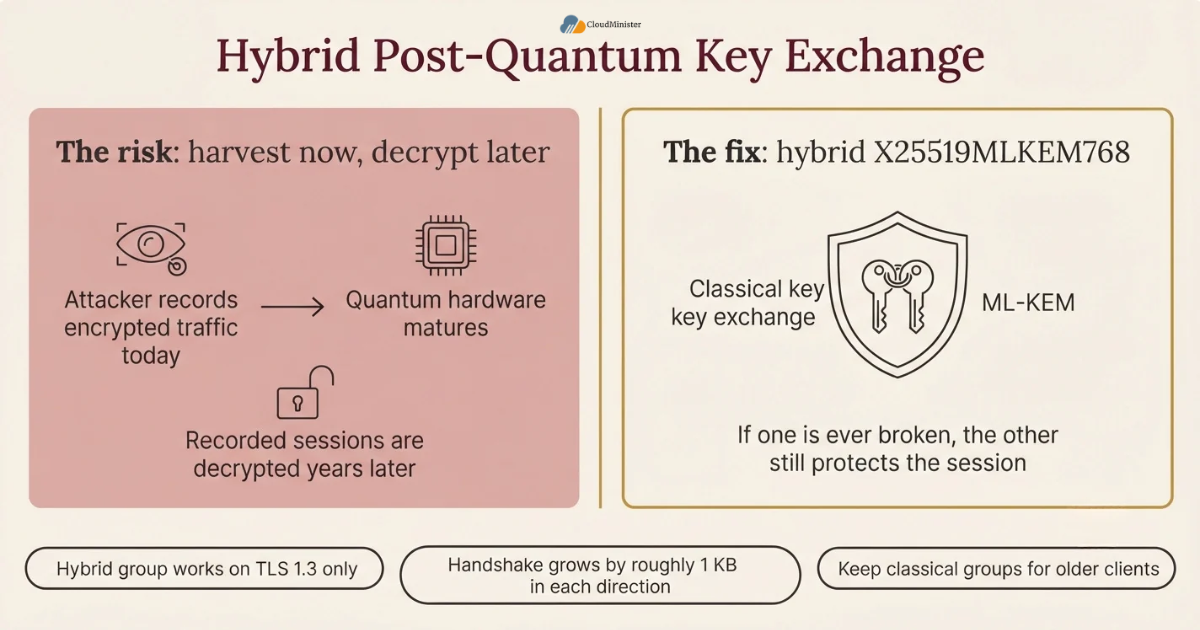
- Key exchange is the urgent part. It protects the secret that encrypts your session, and recorded sessions stay exposed to future decryption if that exchange used only classical methods.
- Certificate signatures are less urgent today. Forging a signature needs a quantum computer at the moment of the connection, so authentication has no harvest now, decrypt later problem.
- NIST finalized FIPS 203 (ML-KEM) for key establishment, plus FIPS 204 (ML-DSA) and FIPS 205 (SLH-DSA) for digital signatures, in August 2024. That milestone now sits beside the SSL Certificate Lifetime changes.
- ML-KEM is the standardized form of the algorithm earlier known as Kyber. Chrome moved from the draft Kyber group to the final ML-KEM group in late 2024.
- Hybrid mode combines a classical exchange with ML-KEM. If one is ever broken, the other still protects the session, which is why X25519MLKEM768 is the common choice. Server Management Services teams can enable it in a single change.
- AES-256 and SHA-384 are not the weak point. Symmetric encryption and hashing need only larger parameters, while RSA and elliptic curve key exchange are the algorithms at risk, a point that Cyber Security services advisers often repeat.
- NIST’s transition draft, IR 8547, proposes deprecating RSA 2048 and similar algorithms after 2030 and disallowing them after 2035, so ask your Web Hosting Company in India for its migration timeline.
- Post-quantum cryptography does not need a quantum computer on your side. It is ordinary software running on ordinary servers, and your cybersecurity solutions should treat it that way.
Write down which systems protect data that must stay secret for ten years or more, such as health records, legal files, or financial history. Those systems should get hybrid key exchange first, ideally planned with your Server Management Services in India partner.
11. How to Enable Hybrid Post-Quantum Key Exchange on Your Servers
For most website owners this is an upgrade and configuration task, not a redesign. Current versions of Chrome, Edge, and Firefox already offer the hybrid X25519MLKEM768 group, so the browser side is largely finished. The remaining work is on the server side, where the TLS library must support the group. OpenSSL 3.5, a long term support release published in April 2025, includes ML-KEM and lists X25519MLKEM768 among its default key shares. Review your Server Management Services stack against that baseline, and keep your SSL Certificate Lifetime automation separate from this change so each one can be tested alone.
- Check your TLS library first with openssl version, and run ldd against your web server binary, because Nginx may link a different OpenSSL than the system one. Ask your Server Management Services in India provider to check this on every host.
- If you run OpenSSL 3.5 or later with default settings, hybrid key exchange may already be active. Test before changing anything.
- In Nginx, set ssl_ecdh_curve X25519MLKEM768:X25519:prime256v1; and keep classical groups in the list for older clients.
- A hardening line that lists only classical curves silently turns post-quantum key exchange off, so review old configuration files and templates, as a Cyber Security services review would.
- In Apache, the equivalent is SSLOpenSSLConfCmd Groups X25519MLKEM768:X25519:prime256v1 on builds linked to OpenSSL 3.5 or newer.
- Verify from outside with openssl s_client -connect example.com:443 -groups X25519MLKEM768 and read the negotiated group in the output.
- Keep TLS 1.3 enabled, since modern cybersecurity solutions expect it. The hybrid group is a TLS 1.3 feature, and TLS 1.2 connections will not use it.
- Expect slightly larger handshakes. The hybrid key share adds roughly 1 KB in each direction, and some old firewalls have mishandled large ClientHello messages, so test through your real network path.
- If a CDN or managed platform ends TLS for you, ask your Web Hosting Company in India whether hybrid key exchange is on at the edge and on the origin connection, and how it handles each SSL Certificate Lifetime renewal.
Never remove classical key exchange to look modern. Hybrid mode exists so that a flaw in either algorithm does not expose your traffic. Keep both until standards bodies and your compliance team say otherwise.
12. Post-Quantum Certificates and Chrome’s Merkle Tree Plan
Key exchange is available now, but quantum-safe certificates are a different story. Post-quantum signatures such as ML-DSA are much larger than the signatures used today, and a normal certificate chain full of them would make every handshake heavier. For that reason, Google announced in February 2026 that Chrome has no immediate plan to add traditional X.509 certificates with post-quantum algorithms to its root store. Chrome is working on Merkle Tree Certificates instead, a compact design developed in the IETF PLANTS working group. For you, the SSL Certificate Lifetime still matters here, because these new certificates are expected to be short lived and issued through ACME.
- Browsers do not yet rely on post-quantum signatures in public web certificates, so treat vendor claims of quantum safe certificates with care and ask what is actually inside the certificate, because cybersecurity solutions should be judged on facts.
- Merkle Tree Certificates replace a long chain of signatures with a small proof that the certificate is included in a signed tree. Early tests point to roughly 700 bytes of authentication data.
- Chrome’s published plan has an experiment phase now, a phase for inviting log operators in Q1 2027, and the onboarding of additional CAs into a new quantum-resistant root store in Q3 2027.
- ACME is expected to be the issuance method for these certificates, which is another reason to automate now with Server Management Services.
- Chrome has said it expects to support traditional X.509 certificates with quantum-resistant algorithms in private PKI, so internal services are a good place to experiment.
- Non browser clients such as mobile apps, API consumers, and embedded devices may need updates to understand new certificate formats, so add them to your inventory and ask your Web Hosting Company in India which clients it manages.
- No action is needed today to switch certificate types. The practical step is to keep renewal automation flexible so a future switch is a configuration change that any Cyber Security services team can review.
- Choose providers of Server Management Services in India who follow standards work and can explain these changes in plain terms.
Crypto agility is the real goal. If you can renew a certificate, change a TLS group, and redeploy within an hour without panic, you are already most of the way to post-quantum readiness.
13. Common Mistakes That Cause Renewal and TLS Problems
Most certificate outages come from a short list of repeatable mistakes. None of them needs advanced skills to fix. They need an inventory, a schedule, and an owner. As the SSL Certificate Lifetime falls, each of these mistakes shows up faster, which makes them cheaper to fix now than during an outage.
- Renewing the main domain but forgetting subdomains, mail hostnames, and API endpoints that carry their own certificates. Ask your Web Hosting Company in India for a full hostname list.
- Leaving hard coded 90 day logic in scripts, so jobs wait too long and then miss the shorter SSL Certificate Lifetime window.
- Renewing successfully but never reloading the service, so the old certificate stays active until it expires, which Server Management Services in India checks catch early.
- Blocking port 80 or redirecting challenge paths to a different host, which breaks HTTP-01 validation.
- Letting a DNS API token expire or lose permissions, which stops DNS-01 validation without any visible website error, a gap that Cyber Security services audits often reveal.
- Sending alerts to one person’s inbox. When that person leaves, the warnings go nowhere. Use a team channel and a Server Management Services runbook.
- Assuming a CDN covers the origin server, when the connection between them still needs a valid certificate.
- Ignoring the client authentication change, so mutual TLS breaks at the first renewal after your CA’s cutoff, which weakens cybersecurity solutions that rely on mutual TLS.
After each fix, add a check that would have caught the problem. A mistake that is turned into a monitor does not return.
14. A Practical Q4 2026 Action Plan
Several dates are close, which makes the end of Q4 2026 the right time to finish the groundwork. Let’s Encrypt’s staging service already issues 64 day certificates, the production default follows on February 10, 2027, and the 100 day limit for all public CAs starts on March 15, 2027. Use the remaining weeks of the quarter to inventory, automate, test, and monitor. A trusted Web Hosting Company in India can take on the repetitive parts, while your team keeps ownership of decisions. This plan keeps the SSL Certificate Lifetime changes from turning into a January emergency.
- Week one: inventory every hostname, certificate, issuer, expiry date, owner, and deployment location, including mail, API, and staging systems.
- Week one: mark every certificate that is still bought or installed by hand, and set a date to automate each one with your Server Management Services provider.
- Week two: pick ACME clients and challenge methods, publish CAA records, and create scoped DNS tokens.
- Week two: test renewals against the Let’s Encrypt staging environment, including the 64 day SSL Certificate Lifetime.
- Week three: add deploy hooks, live certificate checks, and alerts based on a share of the lifetime, as part of your cybersecurity solutions.
- Week three: move mutual TLS client certificates to a private CA before March 15, 2027.
- Week four: check TLS library versions, enable X25519MLKEM768 in a test environment, and measure handshake behavior.
- Weeks five and six: run a failure drill, finish the runbook, and review the whole plan with your Server Management Services in India partner and your Cyber Security services contact.
Keep a one page summary of this plan with owners and dates. It takes ten minutes to write and saves hours during an incident or an audit.
Checklist: SSL Certificate Lifetime and Post-Quantum Readiness Review
- Inventory of every hostname, certificate, issuer, owner, and expiry date is complete and current.
- The next two SSL Certificate Lifetime dates, March 15, 2027 and March 15, 2029, are on a shared calendar.
- Every public certificate renews through ACME or a managed process, with no manual steps.
- Renewal clients run daily, support ARI where possible, and contain no hard coded 90 day values.
- DNS tokens are scoped, stored in a secrets manager, and rotated on a schedule.
- CAA records are published, and Certificate Transparency logs are monitored.
- Live certificate checks and tiered alerts reach a team channel and an on-call person at your Server Management Services in India provider.
- Mutual TLS client certificates are planned to move to a private CA before March 15, 2027.
- Hybrid key exchange is tested, verified, and kept alongside classical groups, with support from cybersecurity solutions reviews.
- Your Web Hosting Company in India has confirmed in writing what it monitors and what remains your responsibility.
Key Takeaways
- The SSL Certificate Lifetime is 200 days today, 100 days from March 15, 2027, and 47 days from March 15, 2029.
- Let’s Encrypt moves to 64 day defaults on February 10, 2027 and 45 days in 2028, so renewal logic must never rely on fixed numbers.
- ACME clients, ARI, deploy hooks, and live monitoring turn a shorter SSL Certificate Lifetime into a routine background job.
- DNS-01 with CNAME delegation and CAA records gives safe, scalable validation for wildcard and multi server setups.
- Hybrid X25519MLKEM768 key exchange is available now and is the practical first step toward post-quantum TLS.
- Post-quantum certificates will arrive through Merkle Tree Certificates, so keep your automation flexible instead of buying early.
- A Web Hosting Company in India that offers Server Management Services in India gives your team monitoring, renewals, and on-call cover without extra hiring.
- Strong cybersecurity solutions treat certificate expiry, patching, and key protection as one connected discipline.
- Server Management Services and Cyber Security services should share one inventory, so the SSL Certificate Lifetime, patching, and key protection are tracked together.
Get a Free Consultation for Your SSL and TLS Setup
Not sure where to start with shorter SSL Certificate Lifetime rules or post-quantum TLS? Talk to our team about ACME automation, monitoring, and Server Management Services in India. We offer free consultancy to all new clients.
Conclusion
Throughout this guide one pattern holds. Shorter certificates and post-quantum cryptography are not two separate emergencies. They are two sides of the same shift toward faster, automated, and more flexible security. Sites that already renew without human steps will find the SSL Certificate Lifetime changes boring, which is exactly the goal. Sites that still rely on spreadsheets and reminders will feel each reduction as a new risk.
The best next step is small. Build the inventory, automate one hostname, add one monitor, and test one hybrid key exchange setting. Then repeat. If your team needs support, choose a partner that can explain each step in plain words and put responsibilities in writing, whether that partner provides hosting, Server Management Services, or Cyber Security services. The next SSL Certificate Lifetime deadline will arrive on schedule, and preparation done today will make it uneventful.
Frequently Asked Questions
What is the maximum SSL Certificate Lifetime right now?
For publicly trusted TLS certificates issued on or after March 15, 2026, the maximum is 200 days. It drops to 100 days on March 15, 2027 and to 47 days on March 15, 2029.
Did my existing certificate stop working in March 2026?
No. The new limit applies to certificates issued on or after the effective date. An older certificate stays valid until its own expiry, but its replacement will carry the shorter lifetime.
Does the new SSL Certificate Lifetime apply to private or self signed certificates?
No. The Forum rules cover publicly trusted certificates. Private CA and self signed certificates are outside the schedule, although shorter lifetimes are still good practice for internal systems, and strong cybersecurity solutions treat internal certificates seriously.
Do I need to pay for a certificate to stay compliant?
No. Free ACME certificates from authorities such as Let’s Encrypt follow the same rules. Paid certificates add features such as organization validation, warranty, and vendor support, not stronger encryption. Many hosting plans from a Web Hosting Company in India also include free automatic certificates.
Will a shorter SSL Certificate Lifetime affect my search rankings?
Not directly. A valid HTTPS setup is a lightweight signal, but an expired certificate shows browser warnings that can send visitors away. Reliable renewal protects traffic and trust.
Do I need post-quantum TLS today?
You do not need new certificates, but you should enable hybrid key exchange where it is easy and safe, especially for data that must stay private for many years. Start by checking your OpenSSL version, and let Cyber Security services teams help you rank which systems need it first.
Will hybrid post-quantum key exchange slow my website?
The handshake grows by roughly 1 KB in each direction, which is small for most connections. Test through your own firewalls and load balancers, because some older network devices handle large handshake messages poorly. Your Server Management Services in India team can run this test.
Can one certificate be used on many servers?
Yes, but distribute it securely. Request it in one place, store the private key in a protected location, and reload every service after deployment. Wildcard certificates also need DNS-01 validation. A Server Management Services team usually handles this distribution.
How can a hosting partner help with certificate automation?
A strong Web Hosting Company in India can run ACME renewals, monitor live certificates, and keep servers patched. Pair that with Server Management Services in India for round the clock response, and with Cyber Security services for key protection and audits.
What should I ask a provider before handing over certificate management?
Ask who owns DNS credentials, how renewals are monitored, how failures are escalated, and what is included in Server Management Services. Also ask how the provider supports cybersecurity solutions such as patching and access control, and get the answers in writing.

Pritam Kumar is a DevOps Engineer at CloudMinister Technologies, where he manages a multi-datacenter fleet of 100+ servers and architects end-to-end CI/CD pipelines and infrastructure automation using Kubernetes, Terraform, and Ansible. He holds an AWS Certified DevOps Engineer Professional certification and has served as a Google Cloud Mentor, reflecting both hands-on cloud expertise and a track record of mentoring others in the field. His work spans disaster recovery architecture, security incident response, and hosting infrastructure across Proxmox, cPanel/WHM, and Linux systems. Notably, Pritam led the design of Cloud Kavach, a self-hosted DC/DR SaaS portal, and directed remediation efforts for large-scale hosting security incidents involving webshells and command-and-control malware. He brings this depth of real-world infrastructure and security experience to the technical content he writes.