Most Google Cloud bills do not spiral because of one bad decision. They spiral because nobody treats Google Cloud Cost Optimization as an ongoing responsibility, so automatic discounts go untracked and decision based discounts never get evaluated at all. Two mechanisms sit at the center of this discipline in 2026, Committed Use Discounts and Sustained Use Discounts, and most businesses only understand one of the two. This guide breaks down how each one works, which workloads fit each category, and how they stack together. It also covers what a practical Google Cloud Cost Optimization plan looks like for a business running production infrastructure in 2026.
Cloud spend rarely grows in one dramatic jump. It creeps up month after month as workloads scale, teams add new services, and nobody circles back to check whether the bill still matches actual usage. Google Cloud Cost Optimization exists to close that gap, and it becomes more important every year as businesses run larger and more complex environments on Google Cloud Platform. The teams that stay ahead of their bills are not the ones with the biggest budgets. They are the ones that treat discount planning as a routine part of running infrastructure rather than a task they get to eventually.
This guide walks through the two discount layers that matter most in 2026, Committed Use Discounts and Sustained Use Discounts, and shows how they work together rather than competing with each other. Understanding both is the difference between paying full on demand pricing out of habit and actually capturing the savings Google Cloud Platform already makes available. For businesses that want this handled without building an internal team around it, working with a Web Hosting Company in India that already manages this kind of review can shorten the learning curve considerably.
A good partner does not just provision servers and walk away. They keep an eye on billing patterns, flag missed discount opportunities, and help size commitments against real usage rather than guesswork. That kind of ongoing attention is what turns Google Cloud Cost Optimization from a one time exercise into a lasting habit. The sections that follow break down exactly how CUDs and SUDs work, when each one fits, and how to build a plan around both.
Table of Contents
- 1. What Google Cloud Cost Optimization Actually Means in 2026
- 2. Why Every Business Running Google Cloud Platform Needs a Discount Strategy
- 3. Committed Use Discounts Explained: The Deepest Savings Layer
- 4. Sustained Use Discounts Explained: The Automatic Savings Layer
- 5. CUD vs SUD: How the Two Discount Layers Actually Compare
- 6. Building a Practical Savings Strategy for 2026
- 7. Practical Steps to Reduce Google Cloud Platform Spend in 2026
- 8. Governance and Ownership Around Discount Strategy
- 9. Measuring Whether Your Savings Efforts Are Actually Working
- 10. Choosing the Right Partner for This Strategy
- Key Takeaways
- Conclusion
- Frequently Asked Questions
1. What Google Cloud Cost Optimization Actually Means in 2026
For most finance and engineering teams, this conversation usually starts the same way, often while comparing notes with a Web Hosting Company in India about why last month’s Google Cloud Platform invoice looked nothing like the forecast. Someone opens the billing console, sees a number that does not match expectations, and asks whether the organization is actually using every discount it is entitled to. Google Cloud Cost Optimization is the discipline of matching what an organization actually pays for compute, storage, and network resources to what those resources are genuinely worth to the business, rather than defaulting to full on-demand pricing out of habit. It is not a single tool or a single setting. It is a combination of pricing model selection, usage forecasting, and ongoing review.
- This process starts with visibility, since a team cannot optimize spend it has not actually measured across every project and every billing account.
- A mature Google Cloud Cost Optimization program treats discount selection as a recurring decision, not a one-time setup task completed during initial deployment.
- Many businesses assume this work is purely an engineering concern, when in practice finance, procurement, and infrastructure teams all need a seat at the table.
- These efforts frequently stall because nobody owns the decision between a Committed Use Discount and a Sustained Use Discount for a given workload.
- Businesses that already work with a provider offering cloud hosting services in India tend to formalize Google Cloud Cost Optimization earlier, since an outside partner brings a structured review cadence that internal teams often lack the bandwidth to maintain.
- This discipline is not about spending the least amount possible. It is about spending the right amount for the actual usage pattern of each workload.
- A capable Web Hosting Company in India will usually treat this planning as a standing agenda item during account reviews, not a one-time cost audit performed at signup.
- Teams that have never formally discussed Google Cloud Cost Optimization with their hosting or infrastructure partner often assume the topic is covered by default, when in practice it usually needs to be raised directly.
- These decisions, made once during initial architecture planning, quietly go stale as workloads grow, shrink, or migrate between regions.
Related Reading: EKS vs GKE vs AKS
- A growing number of teams evaluating Google Cloud Hosting in India specifically ask about discount coverage before signing, rather than treating pricing strategy as a conversation for later.
- Businesses that lean toward Affordable Cloud Hosting India as a search term are often really looking for disciplined discount management rather than a lower base rate alone.
Cloud hosting services in India that include billing review as a standard offering are one of the more effective ways to catch missed discount opportunities before they compound across a full fiscal year.
Before assuming Google Cloud Cost Optimization only matters for large enterprises running thousands of virtual machines, pull last month’s Compute Engine invoice and check how much Sustained Use Discount was actually applied. SUDs apply automatically to eligible usage, so the discount itself is never “missed” — but a surprising number of small and mid-sized teams running steady workloads never verify the size of that automatic savings, and as a result stay unaware of how much runtime-based discounting they’re already getting versus what a Committed Use Discount could add on top.
2. Why Every Business Running Google Cloud Platform Needs a Discount Strategy
Many business owners first encounter this topic while already researching a Web Hosting Company in India for their broader infrastructure needs, and a capable partner will usually raise this planning early in that conversation, since pricing strategy and infrastructure strategy are rarely separate discussions in practice.
- Cloud spend has become one of the largest recurring line items for growing businesses, and Google Cloud Cost Optimization is frequently the fastest way to reduce that line item without touching architecture or performance.
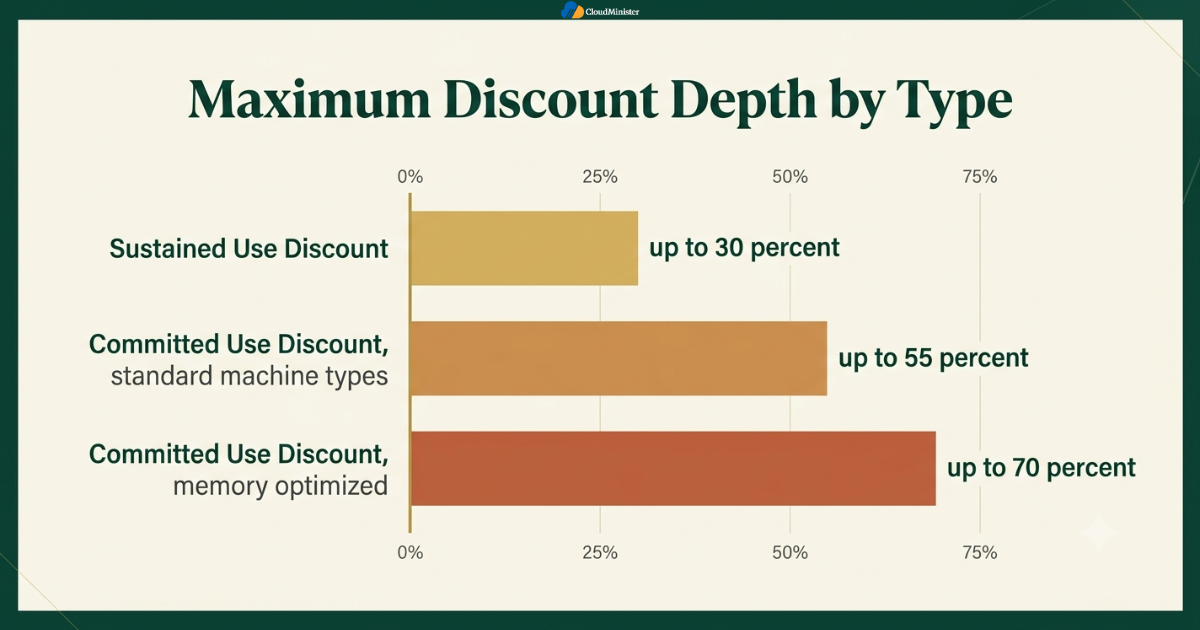
- Committed use discounts on Google Cloud Platform can reduce compute costs by up to 57 percent compared to on demand pricing once a one year or three year commitment is in place, with memory optimized machine types reaching the deepest discount tier, according to a detailed pricing breakdown published by Usage.ai.
- Sustained use discounts apply automatically without any contract, reaching roughly 30 percent in blended savings once eligible Compute Engine usage runs for a large share of the billing month, based on 2026 pricing analysis from Spendbase.
- Without a structured approach to this work, different teams inside the same company commonly assume someone else is monitoring discount eligibility, producing gaps that only surface once a quarterly finance review flags an unexplained spike.
- Businesses that have moved discount and billing oversight to a team offering cloud hosting services in India often report catching missed Sustained Use Discount eligibility within the first review cycle, before any advanced tooling is even introduced.
- A disciplined Google Cloud Cost Optimization program centralizes commitment decisions at the platform or finance team level, rather than leaving each engineering team to purchase its own commitments independently.
- Businesses without any formal process for this often discover a stranded commitment only when a workload migrates region and the discount silently stops applying, which is far later than ideal.
- The most effective programs combine automated discount tracking with a human reviewer who understands which workloads are genuinely stable enough to commit against.
- Businesses that outsource day to day infrastructure oversight to a team running mature cloud hosting services in India tend to catch discount misalignment faster than teams relying on occasional internal spreadsheet reviews.
Related Reading: cloud cost governance policy guide
- Teams searching for Google Cloud Hosting in India providers should treat discount literacy as a basic qualifying question, in the same way they would ask about uptime guarantees or support response times.
- A provider positioning itself around Affordable Cloud Hosting India should be able to explain exactly how that affordability is achieved, whether through discount stacking, right-sizing, or genuinely lower base infrastructure costs, since that transparency matters more than the headline number.
A Committed Use Discount is a financial commitment, not a technical control, so purchasing one does not change who can access the underlying resources or how those resources are secured. An organization that focuses entirely on cost savings while ignoring identity and access management around the same compute resources is solving only half the problem. Discount planning and access control review deserve the same level of attention during any infrastructure planning cycle.
3. Committed Use Discounts Explained: The Deepest Layer of Google Cloud Cost Optimization
Before working through the detailed comparison in this guide, it helps to understand exactly what a Committed Use Discount is and how it fits into a broader Google Cloud Cost Optimization strategy, since it behaves very differently from the automatic discount most teams already receive without realizing it. A Committed Use Discount, or CUD, is a contractual agreement where an organization commits to a specific level of Google Cloud Platform usage, either measured in resources or in spend, for a fixed term of one or three years. In exchange, Google Cloud Platform applies a significantly lower rate than on demand pricing for that committed portion of usage.
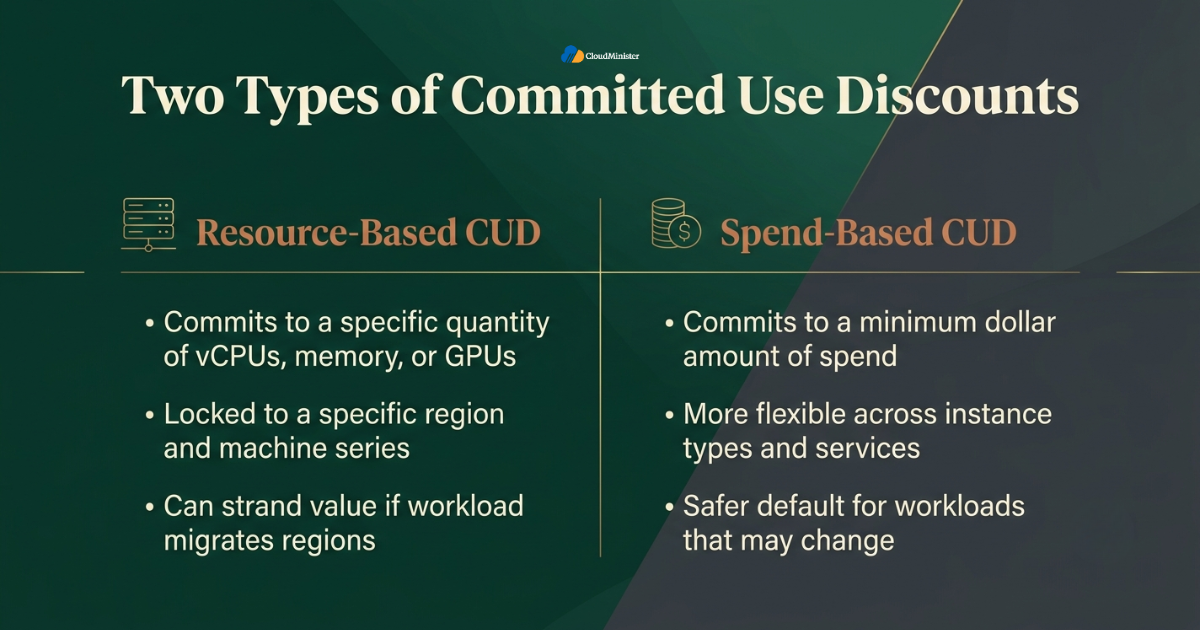
- Resource based CUDs commit an organization to a defined quantity of vCPUs, memory, or GPUs within a specific region and machine series, and they apply only to Compute Engine usage within that scope.
- Resource based commitments can reach discounts of up to 70 percent for memory optimized machine types and up to 55 percent for most other machine types, making them one of the strongest levers inside any serious savings plan for genuinely stable workloads.
- Spend based CUDs commit an organization to a minimum dollar amount of eligible spend rather than a specific resource quantity, offering more flexibility across instance types and services as part of a broader Google Cloud Cost Optimization approach.
- The commitment runs for the full term regardless of actual usage, meaning a Committed Use Discount purchased against a workload that later shrinks or gets decommissioned becomes a fixed cost rather than a variable one.
- Resource based CUDs are locked to the region where they were purchased, so a workload that migrates to a different region during the commitment term strands that portion of the investment.
- A well-informed Web Hosting Company in India typically keeps a running view of which workloads in a customer’s environment are genuinely stable enough to justify a resource based commitment, since past usage patterns are often the clearest signal for future stability.
- Committed Use Discounts stack with Sustained Use Discounts in some scenarios, but the two should never be modeled as simply additive, since Sustained Use Discounts apply to usage that falls outside the committed portion.
- Choosing between a one year and a three year term is one of the more consequential decisions inside any Google Cloud Cost Optimization plan, since the deeper three year discount only pays off if the underlying workload is genuinely durable across that entire window.
- Teams evaluating this category of savings for the first time are often surprised to learn how much of the standard advice defaults to maximizing three year resource based commitments without first confirming the workload will actually stay in the same region that long.
Cloud hosting services in India that include commitment planning as part of a broader infrastructure review are one of the more reliable ways to avoid overcommitting to a discount tier the organization cannot fully use. A team offering genuine Google Cloud Hosting in India will typically walk a customer through exactly this kind of sizing exercise before recommending a specific commitment term.
The organizations that get the most value out of Committed Use Discounts are rarely the ones that commit to the deepest available discount tier immediately. They are the ones that size the commitment to a genuine usage floor, the level of usage that has not dropped below a certain point across a full year of billing history, and leave everything above that floor on demand or under a smaller, more flexible spend based commitment.
4. Sustained Use Discounts Explained: The Automatic Layer of Google Cloud Cost Optimization
Sustained Use Discounts work on a completely different principle than Committed Use Discounts, and understanding that difference is central to building an accurate savings strategy on Google Cloud Platform. A Sustained Use Discount is an automatic price reduction that Google Cloud Platform applies to eligible Compute Engine usage once a resource runs for a significant portion of the billing month, with no contract, no commitment, and no action required from the customer. This is one of the reasons Google Cloud Platform is often described as more forgiving for teams that have not yet built a formal discount strategy compared to providers where every discount requires an upfront purchase decision.
- Sustained Use Discounts scale with actual runtime within the month, so a virtual machine running roughly 25 percent of the month receives a smaller automatic discount than one running close to 100 percent of the month.
- The maximum blended Sustained Use Discount available in 2026 sits at approximately 30 percent for eligible full month Compute Engine usage, according to 2026 pricing data published by Spendbase.
- Sustained Use Discounts require zero planning, zero forecasting, and zero commitment, which makes them the most accessible entry point into Google Cloud Cost Optimization for teams that have not yet built out a formal review process.
- Because Sustained Use Discounts apply automatically, a common mistake in this kind of planning is forgetting to account for them before modeling the incremental benefit of adding a Committed Use Discount on top.
- Sustained Use Discounts are limited to specific eligible services, primarily Compute Engine, which means they do not extend the same automatic benefit across every Google Cloud Platform product a business might be running.
- A business relying entirely on Sustained Use Discounts without ever evaluating Committed Use Discounts is typically leaving the deeper savings tier of Google Cloud Cost Optimization completely unused.
- Cloud hosting services in India that monitor billing data on a recurring basis are well positioned to confirm that Sustained Use Discounts are actually being applied correctly across every eligible project, since misconfigured resource scheduling can sometimes interrupt the qualifying runtime.
- Sustained Use Discounts reward workloads that run continuously rather than being shut down and restarted repeatedly within the same billing cycle, which matters for any plan involving scheduled scaling.
- A genuinely useful Google Cloud Cost Optimization checklist should always confirm Sustained Use Discount eligibility as step one, before spending time evaluating whether a Committed Use Discount makes sense for the same workload.
- Businesses comparing Google Cloud Platform against other providers often find that automatic discounting, without any purchase decision, is one of the more underrated advantages when a team is still early in its cost management maturity.
If a workload is deliberately shut down during off hours to save cost, check whether the resulting interruption in runtime is actually reducing the Sustained Use Discount tier by more than the shutdown itself saves. For some steady, moderately utilized workloads, running continuously and collecting the full Sustained Use Discount produces a better outcome than a scheduling script that looks efficient on paper.
5. CUD vs SUD: How the Two Discount Layers Actually Compare
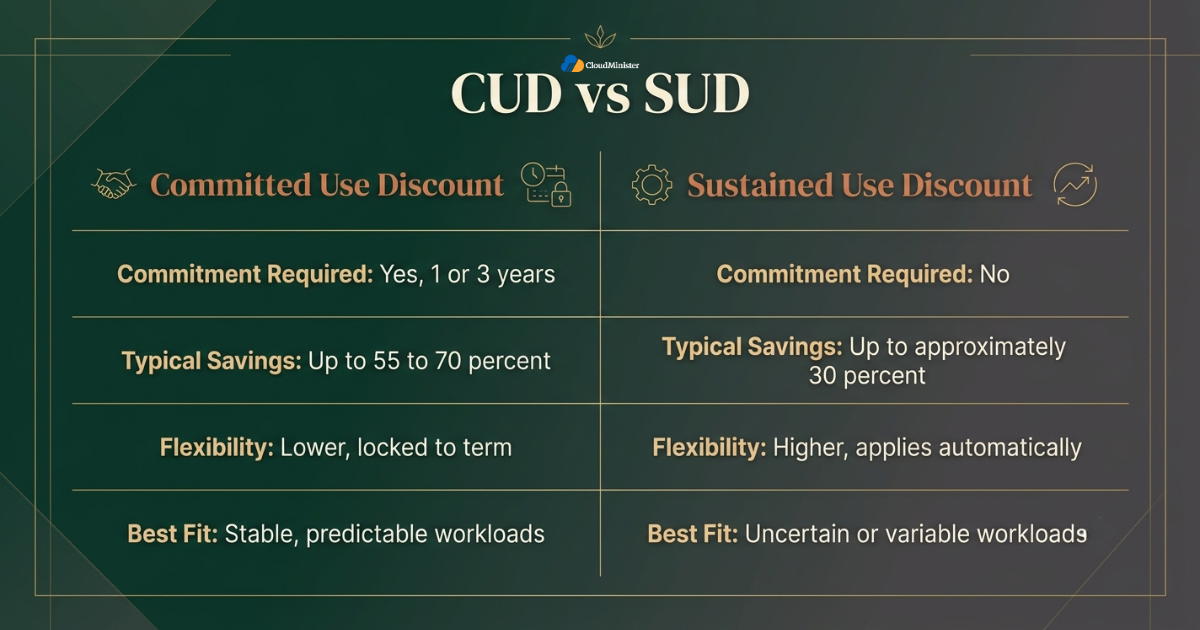
Below is a direct comparison of how Committed Use Discounts and Sustained Use Discounts behave against each other, since most confusion around Google Cloud Cost Optimization comes from treating them as competing options rather than complementary layers.
| Factor | Committed Use Discount (CUD) | Sustained Use Discount (SUD) |
| Commitment required | Yes, one or three year term | No |
| Typical savings depth | Up to 55 to 70 percent | Up to approximately 30 percent |
| Flexibility | Lower, locked to term and sometimes region | Higher, applies automatically |
| Best fit | Stable, predictable baseline workloads | Uncertain or moderately variable workloads |
| Risk profile | Underuse waste if usage drops | Minimal, since there is no contract |
| Setup effort | Requires forecasting and purchase decision | None, applies automatically |
- The core decision here is not which discount is objectively better, since they serve different usage patterns and are not mutually exclusive within the same environment.
- A workload that is genuinely predictable, running at a stable baseline every single day of the year, is a strong candidate for a Committed Use Discount as the primary lever in a Google Cloud Cost Optimization plan.
- A workload that fluctuates meaningfully, scaling up during business hours and down overnight, often benefits more from relying on the automatic Sustained Use Discount than from locking in a commitment that could go partially unused.
- Most production environments actually contain a mix of both patterns, which means a mature strategy applies Committed Use Discounts to the stable floor and lets Sustained Use Discounts cover everything above it.
Related Reading: cloud pricing model types explained
- A Web Hosting Company in India that already manages a client’s broader infrastructure is well positioned to identify which workloads fall into each category, since that judgment depends on actual usage history rather than a generic rule of thumb.
- Businesses that switched to a Web Hosting Company in India specifically for Google Cloud Platform management often report that the categorization step, not the discount purchase itself, was the part they were missing internally.
- Businesses new to this discipline frequently default to Committed Use Discounts across the entire environment because the headline discount percentage looks better, without checking whether every covered workload is actually stable enough to justify the term.
- The safest entry point for most businesses beginning a formal Google Cloud Cost Optimization program is to confirm Sustained Use Discount eligibility first, then layer in a conservative Committed Use Discount only against the confirmed usage floor.
Ready to Cut Your Google Cloud Costs
Get expert help sizing CUDs and SUDs the right way, backed by a hosting team that reviews your billing every single month.
6. Building a Practical Google Cloud Cost Optimization Strategy for 2026
Even a well-researched discount strategy underperforms if it is not supported by an ongoing review process. Building a layered approach matters as much as understanding the individual discount mechanics.
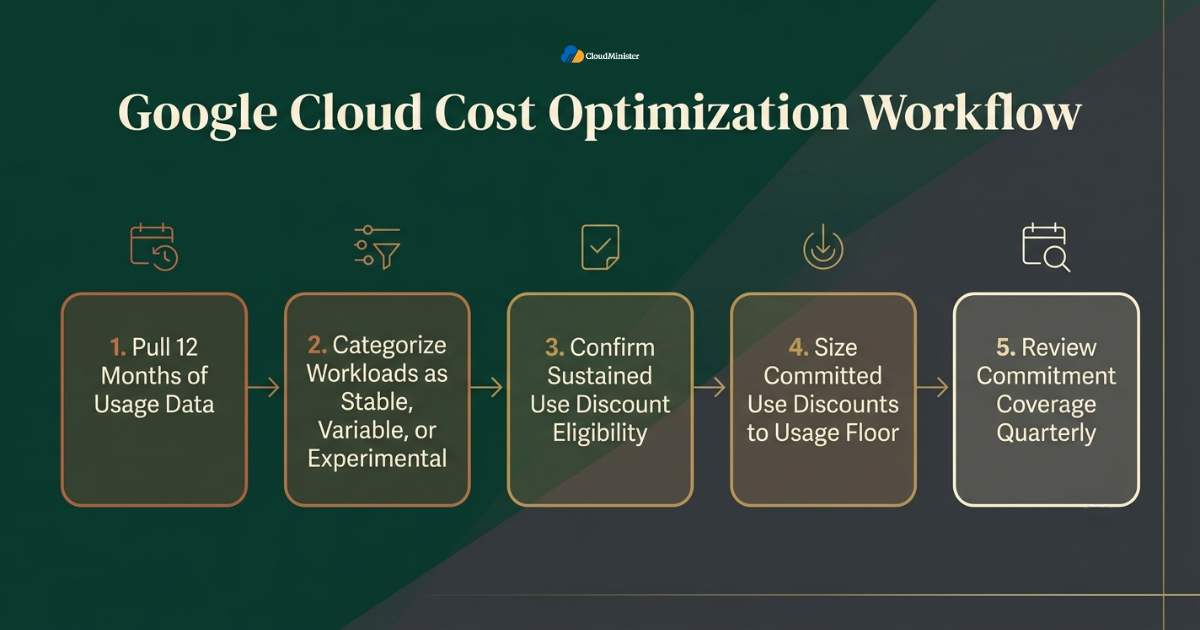
- Start every effort with a full year of usage data, since a shorter window is unlikely to reveal true seasonal patterns or genuine usage floors.
- Separate workloads into stable, variable, and experimental categories before deciding which discount mechanism applies to each one, since treating every workload the same is the most common mistake in Google Cloud Cost Optimization planning.
- Confirm Sustained Use Discount eligibility across the entire environment before purchasing any Committed Use Discount, since overlooking the automatic layer leads to inflated projections of how much a commitment will actually save.
- Size any resource based Committed Use Discount to the confirmed usage floor rather than current peak usage, so the commitment does not sit partially idle during quieter periods.
- Favor spend based CUDs over resource based CUDs for workloads that might migrate region or change machine series during the commitment term, since resource based commitments are far less forgiving of that kind of change.
- Reserve three year commitment terms for workloads with a genuinely multi-year track record of stability, and default to one year terms everywhere else until that track record exists.
- Businesses without an internal finance or platform team dedicated to this task should treat a partnership offering genuine cloud hosting services in India as the foundation of a working Google Cloud Cost Optimization plan rather than an optional add-on.
- Review committed use coverage on a recurring quarterly schedule, since workloads that were stable during initial purchase can drift meaningfully within a single year.
Related Reading: IoT cloud integration
- A team delivering cloud hosting services in India should be able to show a documented commitment inventory on request, not just a verbal summary of what is covered.
- Businesses comparing cloud hosting services in India across providers should weigh discount transparency as heavily as raw pricing when making a final decision.
- Businesses that describe their goal as Affordable Cloud Hosting India should expect their provider to treat discount planning as a core service, not a paid add-on billed separately.
- A hosting relationship marketed around Affordable Cloud Hosting India but with no visible discount strategy is usually optimizing the base rate rather than the actual bill.
- Google Cloud Hosting in India providers that publish their own commitment sizing methodology tend to be more transparent partners than those offering only a flat discount promise.
- Teams comparing Google Cloud Hosting in India options should ask directly whether resource based or spend based commitments are the default recommendation, since the answer reveals a lot about how carefully that provider actually models usage.
- A Google Cloud Hosting in India provider that cannot explain the difference between resource based and spend based commitments in plain terms is unlikely to size either one correctly for a client.
- Businesses researching Google Cloud Hosting in India specifically for cost reasons should request a sample commitment analysis before committing to any managed service agreement.
- Migrating to Google Cloud Hosting in India without first mapping existing usage patterns is a common reason initial discount coverage ends up smaller than expected.
- A Google Cloud Hosting in India account manager who proactively flags a missed discount, rather than waiting for the customer to notice, is a strong signal of an actively managed relationship.
- Confirm whether Google Cloud Hosting in India pricing quotes already assume discount coverage or reflect on demand rates, since the two numbers can differ substantially.
- Businesses evaluating Google Cloud Hosting in India for a first migration should ask how quickly commitment recommendations get revisited once real usage data becomes available.
- Track discount utilization as a specific, visible metric during every infrastructure review, rather than assuming a purchased commitment is automatically delivering its expected value.
- Confirm that whichever team or partner manages ongoing infrastructure also reviews billing anomalies as a standard part of this process, not as a separate, occasional exercise.
A dependable Google Cloud Hosting in India partner that already manages the surrounding infrastructure is well positioned to fold Google Cloud Cost Optimization into routine account reviews, rather than treating it as a separate annual project. Businesses evaluating a new Google Cloud Hosting in India partner should ask specifically how often this kind of review actually happens, since an annual mention is far weaker than a quarterly practice.
When consolidating billing accounts or restructuring commitments as part of a broader savings initiative, review who has permission to purchase, modify, or cancel a Committed Use Discount. A commitment purchased without proper approval controls in place can lock an organization into a multi-year cost with no corresponding review, which turns a savings mechanism into an unmonitored liability.
7. Practical Steps to Reduce Google Cloud Platform Spend in 2026
Achieving meaningful Google Cloud Cost Optimization is not about a single sweeping change. It comes from a series of specific, repeatable actions applied consistently across the environment.
- Pull twelve months of billing data before making any commitment decision, since a shorter sample window regularly misrepresents genuine seasonal usage patterns.
- Identify every workload currently receiving zero discount, since these are usually the fastest wins available in any cost review of this kind.
- Confirm that Google Cloud Hosting in India resources tied to predictable, always-on services are actually covered by either a Sustained Use Discount or a Committed Use Discount, rather than running on unnecessary on demand pricing.
- Right-size compute instances before committing to a discount tier, since committing to an oversized machine type locks in wasted capacity for the full term.
- Use committed use discount recommendations inside the Google Cloud Platform console as a starting point, then validate those recommendations against actual usage history rather than accepting them automatically.
- Set a calendar reminder ahead of every commitment renewal date, since an expired or auto-renewing commitment that no longer matches actual usage is a common source of avoidable spend.
- Confirm that any provider delivering Google Cloud Hosting in India as part of a managed service explicitly includes discount review, since this detail affects how quickly a stranded commitment actually gets caught.
- Audit idle and underutilized resources separately from discount planning, since this kind of optimization only works on resources that are actually needed in the first place.
- Apply committed use coverage incrementally rather than all at once, starting with the most confidently stable workloads and expanding coverage only after confirming the initial commitment is delivering expected savings.
- Maintain a documented record of every active commitment, including term length, resource scope, and renewal date, so nothing expires or auto-renews without a deliberate decision.
- Treat Affordable Cloud Hosting India as an achievable outcome of disciplined Google Cloud Cost Optimization, not a separate pricing tier that requires sacrificing performance or reliability.
- Businesses searching specifically for Affordable Cloud Hosting India options often find that the biggest cost reductions come from correcting discount misalignment rather than switching providers entirely.
- Affordable Cloud Hosting India, done properly, is really the visible result of consistent discount hygiene applied over several billing cycles, not a one-time negotiation.
- A provider claiming to deliver Affordable Cloud Hosting India without ever discussing CUDs or SUDs is likely referring only to the sticker price, not the actual delivered cost.
- Compare the promised Affordable Cloud Hosting India rate against what a workload would actually cost with correct discount coverage applied, since the gap between the two numbers is often larger than expected.
- Google Cloud Hosting in India partners that publish real commitment case studies tend to back up their Affordable Cloud Hosting India claims with evidence rather than marketing language alone.
- The phrase Affordable Cloud Hosting India means little without a clear breakdown of which discounts, if any, are already reflected in the quoted rate.
- Businesses that evaluated several vendors under the banner of Affordable Cloud Hosting India often found the cheapest quoted rate was not the cheapest actual bill once discount coverage was compared.
- A genuine Affordable Cloud Hosting India outcome typically combines right-sized infrastructure with correctly applied CUDs and SUDs, not a discount on the list price alone.
- Small businesses chasing Affordable Cloud Hosting India sometimes skip commitment planning entirely, assuming it only applies at enterprise scale, which is rarely true once usage becomes predictable.
- Affordable Cloud Hosting India is achievable at almost any company size once Sustained Use Discounts are confirmed and a conservative Committed Use Discount is layered on top of a genuine usage floor.
- When comparing providers on Affordable Cloud Hosting India claims, ask for a real invoice example showing discount line items rather than a generic percentage promise.
- Affordable Cloud Hosting India searches often surface providers competing purely on sticker price, so it is worth asking directly how CUD and SUD coverage factors into their quoted numbers.
- Businesses that treat Affordable Cloud Hosting India as a one-time vendor decision, rather than an ongoing discount management practice, tend to see costs creep back up within a year.
- A realistic path to Affordable Cloud Hosting India combines a transparent provider, accurate usage forecasting, and a willingness to revisit commitments as workloads evolve.
Checklist: Google Cloud Cost Optimization Readiness Review
- Twelve months of billing and usage data pulled and reviewed
- Every workload categorized as stable, variable, or experimental
- Sustained Use Discount eligibility confirmed across all Compute Engine usage
- Committed Use Discount coverage sized to the confirmed usage floor, not peak usage
- Commitment renewal dates documented with calendar reminders set
- Discount utilization tracked as a visible, recurring metric
8. Governance and Ownership Around Google Cloud Cost Optimization
Standardizing a mature program introduces a governance layer on top of the technical discount mechanics already covered in this guide.
- Commitment purchase decisions should route through the same review process as any other significant infrastructure spend, ideally with input from both finance and the team managing day to day infrastructure.
- Smaller organizations without a dedicated cloud finance function often find that outsourcing this entire review process to a partner offering cloud hosting services in India is more practical than building the capability internally from scratch.
- A single point of accountability for this discipline, whether that is an internal team or an external partner, prevents the kind of finger-pointing that slows down correction once a stranded commitment or missed discount is discovered.
- Centralized commitment and discount standards, coordinated across the organization rather than left to individual teams purchasing commitments independently, prevent the inconsistent coverage that undermines most efforts at Google Cloud Cost Optimization.
- A documented policy should specify who can approve a commitment, what usage history is required before approval, and how often existing commitments get reviewed.
- Third party tools that automate parts of this process should still be reviewed periodically by a human who understands the actual business context behind each workload, since automation alone can miss workloads scheduled for decommissioning.
- Confirm with any team delivering cloud hosting services in India exactly how commitment decisions get documented, since a short or informal record can quietly erase the reasoning behind a purchase made months earlier.
- A documented commitment inventory, tracking term length, resource scope, and renewal date across every active Committed Use Discount, gives a finance team the audit trail needed to demonstrate due diligence during any budget review.
- Larger organizations running workloads across multiple Google Cloud Platform regions should confirm their governance around Google Cloud Cost Optimization covers every region consistently, since a gap between regions is a common place for a stranded or underused commitment to go unnoticed.
9. Measuring Whether Google Cloud Cost Optimization Efforts Are Actually Working
Building a good process here is not the finish line, whether the environment is managed internally or through an outside partner offering broader cloud hosting services in India. Long-term results depend entirely on how the program is measured and adjusted afterward.
- Track discount utilization rate as a specific percentage, comparing committed spend against actual eligible usage, since a commitment sitting at sixty percent utilization is quietly wasting the remaining forty percent.
- Ask whichever provider handles infrastructure to walk through a recent example of a missed discount they actually caught, since a concrete example demonstrates real capability far better than a general description.
- Compare projected savings from each commitment against actual billed savings on a quarterly basis, a discipline that matters equally for teams focused on overall Google Cloud Platform spend, since real-world results often diverge from initial modeling once usage patterns shift.
- Review commitment renewal decisions with the same scrutiny as the original purchase decision, rather than allowing an existing commitment to auto-renew without a fresh look at current usage.
- Cross-reference discount coverage against the organization’s broader budget cycle, particularly where savings from Google Cloud Cost Optimization need to be reported alongside other infrastructure cost lines.
- Maintain a change log for every new commitment purchased or allowed to expire, shared with the broader finance and operations team, so the reasoning behind each decision remains traceable.
- Ask any partner providing cloud hosting services in India to share their own discount tracking metrics on a recurring basis, since transparency here is one of the clearest signals of a genuinely mature partnership focused on Google Cloud Cost Optimization.
Network layer usage and Compute Engine consumption patterns have continued shifting industry-wide heading into 2026, underscoring why ongoing review matters just as much as the initial commitment decision, and why a dependable partner earns its keep long after the first purchase is made.
10. Choosing the Right Partner for Google Cloud Cost Optimization
Not every hosting relationship is built to support disciplined savings work, and this is exactly where the difference between an average Web Hosting Company in India and a genuinely cost-focused one becomes visible.
- A dependable Web Hosting Company in India that already manages a team’s broader infrastructure is well positioned to advise on discount strategy without introducing unnecessary complexity into an already functioning environment.
- Businesses evaluating providers should specifically ask whether the provider has direct experience helping customers with Google Cloud Cost Optimization, not just provisioning individual virtual machines under a generic hosting plan.
- A newer Web Hosting Company in India may offer a competitive base rate but lack the account history needed to advise confidently on multi-year commitment decisions.
- Ask any prospective Web Hosting Company in India how many active Google Cloud Platform commitments they currently manage across their client base, since scale often correlates with process maturity.
- A Web Hosting Company in India that treats every client’s discount strategy as identical is usually applying a template rather than genuinely reviewing usage data.
- A track record of correcting real billing inefficiencies is a far better signal of genuine capability than a marketing page listing every discount type a vendor happens to mention.
- A genuinely experienced Google Cloud Hosting in India partner will be able to describe, in specific terms, how a past client’s commitment strategy was restructured to eliminate waste.
- Teams that want to move quickly without designing every layer of their discount strategy themselves often gravitate toward a Google Cloud Hosting in India partner that comes with clear documentation on how commitments are sized, tracked, and reviewed from day one.
- Business leaders who have not yet reviewed their hosting partner relationship specifically around Google Cloud Cost Optimization should treat this guide as a natural trigger point to do so, and to ask their provider directly about discount utilization.
- A capable partner offering both deep expertise in cloud hosting services in India and broader Google Cloud Platform account management gives growing businesses a coherent roadmap for this strategy instead of stitching together advice from multiple vendors.
- Businesses researching Affordable Cloud Hosting India options for internet-facing workloads should confirm that a prospective partner understands both the mechanics of CUDs and SUDs and the surrounding infrastructure needed to apply them correctly.
- A provider that bundles cloud hosting services in India with genuine billing oversight, rather than treating discount review as a purely mechanical task, is generally better positioned to catch an emerging cost issue early.
- A genuinely capable Web Hosting Company in India will also be transparent about which parts of a Google Cloud Cost Optimization strategy it owns directly and which parts depend on the customer’s own internal usage decisions.
- A Web Hosting Company in India experienced across multiple client environments often has a clearer sense of what a genuine usage floor looks like than a business reviewing only its own historical data for the first time.
- Reviews and references matter more than a homepage promise when choosing a Web Hosting Company in India for anything beyond basic uptime.
- Businesses switching their Web Hosting Company in India specifically over cost concerns should confirm the new partner’s approach to CUD sizing before signing, rather than assuming it will simply be better.
- The right Web Hosting Company in India treats Google Cloud Platform billing transparency as a baseline expectation, not a premium feature reserved for enterprise accounts.
- A Web Hosting Company in India that shares real commitment utilization numbers during a sales conversation is demonstrating exactly the kind of transparency that supports long-term Google Cloud Cost Optimization.
When comparing quotes or advice from different partners on this topic, ask each one to walk through a real commitment sizing exercise using a sample of your actual usage data rather than a generic case study, since the right recommendation depends entirely on your specific workload patterns. A provider offering genuine cloud hosting services in India that understands both the discount mechanics and your organization’s actual usage profile will consistently give more actionable guidance than a purely theoretical comparison.
Key Takeaways
- Google Cloud Cost Optimization depends on understanding two distinct discount layers: Committed Use Discounts, which require a term commitment in exchange for deeper savings, and Sustained Use Discounts, which apply automatically with no contract at all.
- Committed Use Discounts can reach up to 70 percent for memory optimized machine types and up to 55 percent for most other machine types, while Sustained Use Discounts typically cap around 30 percent in blended savings.
- The most effective strategy confirms automatic Sustained Use Discount eligibility first, then layers a conservative Committed Use Discount on top of a confirmed usage floor.
- Resource based commitments are locked to a specific region and can strand value if a workload migrates, making spend based commitments a safer default for workloads that might change over the commitment term.
- Governance, documented ownership, and recurring review matter just as much as the initial discount decision, and this holds whether the environment is run internally, through a Web Hosting Company in India, or through broader cloud hosting services in India.
- Partnering with a capable provider experienced in both Google Cloud Hosting in India and cloud hosting services in India meaningfully reduces the risk of a stranded commitment or a missed automatic discount, and this is worth raising directly in the next infrastructure planning conversation.
Not Sure Which Discount Strategy Fits Your Workloads
Talk to our team and get a real commitment sizing review based on your actual usage data, not a generic recommendation.
Conclusion
Throughout this guide, one pattern holds regardless of company size, industry, or whether the environment runs on a single project or a larger multi region footprint. Google Cloud Cost Optimization is not a single purchase decision. It is an ongoing discipline built around understanding two distinct discount mechanisms, Committed Use Discounts and Sustained Use Discounts, and applying each one to the workloads it actually fits. Businesses that treat this as a one time setup task almost always end up leaving savings on the table within a year, simply because usage patterns shift and nobody revisits the original plan.
The organizations that get the most value from this approach share a consistent pattern. They confirm Sustained Use Discount eligibility before purchasing anything, they size Committed Use Discounts to a genuine usage floor rather than current peak demand, and they review commitment coverage on a recurring schedule instead of setting it once and forgetting about it. This kind of discipline does not require a large internal team. It requires a clear owner and a habit of checking in on the numbers regularly, whether that owner sits inside the company or works through a trusted infrastructure partner.
For teams weighing this decision alongside a broader look at their infrastructure, or comparing pricing models across their environment, the same underlying principle applies every time. Understand the usage pattern first, match the discount mechanism second, and revisit the plan as workloads change. Working with a capable Web Hosting Company in India throughout this process, one experienced across both Google Cloud Hosting in India and broader cloud hosting services in India, meaningfully reduces the risk of a stranded commitment or a discount that quietly goes unclaimed.
Frequently Asked Questions
Can a business use Committed Use Discounts and Sustained Use Discounts at the same time?
Yes. Sustained Use Discounts apply automatically to eligible Compute Engine usage that falls outside any committed portion, so the two mechanisms work together rather than competing. The key to accurate Google Cloud Cost Optimization is modeling them as separate layers rather than assuming their savings simply add together on the same hours of usage.
Is a three year Committed Use Discount always better than a one year term?
Not necessarily. A three year term offers a deeper discount, but it only delivers real value if the underlying workload remains stable in the same region and machine series for the full term. A workload with a shorter, less certain track record is often better matched to a one year term or a spend based commitment as part of a cautious approach to Google Cloud Cost Optimization.
Do Sustained Use Discounts require any setup or configuration?
No. Sustained Use Discounts apply automatically to eligible Compute Engine usage once it runs for a sufficient portion of the billing month. There is no purchase, contract, or console configuration required, which makes them the simplest starting point for anyone new to Google Cloud Cost Optimization.
Why do businesses end up overcommitting to Committed Use Discounts?
Overcommitment usually happens when a team sizes a commitment to current peak usage rather than a confirmed usage floor based on historical data. Recent analysis of enterprise Google Cloud Platform estates found that region locked resource based commitments frequently strand a meaningful share of their value once a workload migrates before the term ends, according to Redress Compliance’s 2026 negotiation guidance, which is exactly why conservative sizing matters in any serious plan built around Google Cloud Cost Optimization.
What is the single most effective first step toward Google Cloud Cost Optimization?
There is no single step that captures every available saving, but confirming Sustained Use Discount eligibility across the full environment before evaluating any Committed Use Discount consistently produces the fastest, lowest-risk starting point, especially when supported by a partner offering genuine cloud hosting services in India and ongoing billing review.
Does Google automatically notify a business when a Sustained Use Discount applies?
No separate notification is sent. The discount shows up directly as a reduced line item on the Compute Engine portion of the bill once eligible usage crosses the qualifying threshold for the month. The only way to confirm how much was applied is to review the itemized billing report, since there is no alert or dashboard flag calling it out specifically.
Can a Committed Use Discount be canceled partway through the term if a workload changes?
Generally no. A Committed Use Discount is a binding agreement for the full one year or three year term, and Google Cloud Platform does not offer a standard cancellation path once it is active. This is exactly why sizing the commitment to a confirmed usage floor, rather than current peak demand, matters so much before signing on to either term length.