This guide is the definitive 2026 technical comparison of aws vs azure vs google cloud for Indian businesses — from early-stage startups in Bengaluru to regulated enterprises in Mumbai and government-facing workloads in Delhi-NCR. It covers Indian region availability, pricing in INR, DPDPA 2023 compliance posture, RBI alignment for fintech and NBFC workloads, performance benchmarks, and the architectural decisions every Indian CTO, founder, and IT leader must finalise before committing to a hyperscaler in 2026.
The cloud decision is no longer a technical preference — it is a commercial commitment that shapes engineering velocity, regulatory exposure, and unit economics for the next five years. Indian businesses evaluating aws vs azure vs google cloud in 2026 are entering a market where the three hyperscalers together control roughly 68% of global enterprise cloud spending, where AI-related cloud consumption has jumped to 19% of total cloud spend, and where India’s domestic cloud market is on track to cross USD 26 billion this year.
This blog gives you the technically accurate, India-specific comparison of aws vs azure vs google cloud that lets you make the call with confidence — including the regional footprint, compliance posture, pricing pattern in rupees, and the operational trade-offs that separate hyperscaler marketing claims from real production behaviour.
1. What the aws vs azure vs google cloud Decision Actually Means in 2026
Before any cost spreadsheet is opened, the framing requires precision. The aws vs azure vs google cloud comparison is not a question of which platform is “best” in absolute terms — every hyperscaler can run almost every workload. The real question is which platform best fits your:
- Workload profile: Compute-heavy, data-heavy, AI/ML-heavy, or balanced
- Compliance perimeter: DPDPA 2023, RBI IT Framework, NDHM, SEBI obligations
- Data residency: Mumbai, Hyderabad, Pune, Chennai, or Delhi-NCR proximity
- Existing technology stack: Microsoft 365 estate, Google Workspace footprint, or open-source heavy
- Talent pool you can hire: AWS engineers, Azure architects, or GCP data specialists
- Total cost of ownership over 3–5 years, not just sticker price
According to Synergy Research Group’s Q1 2026 data, AWS leads global cloud infrastructure at approximately 30% market share, Microsoft Azure holds 25%, and Google Cloud Platform sits at 13% — a distribution that materially affects partner ecosystems, hiring availability, and managed-service depth available in India. Treat the aws vs azure vs google cloud decision as a five-year commercial commitment, not a technology shopping exercise.
Before you compare a single instance price across aws vs azure vs google cloud, write down your top three workload patterns — for example, “stateless API behind a load balancer”, “transactional MySQL with 200 GB working set”, “nightly batch analytics over 2 TB”. Price the same three workloads on each hyperscaler’s Indian regions. Sticker comparisons mislead; workload-pattern comparisons reveal the real cost picture. Indian businesses that skip this exercise routinely overspend 30–45% on the wrong platform for their workload mix.
2. Indian Region Availability: Where Each Hyperscaler Actually Operates
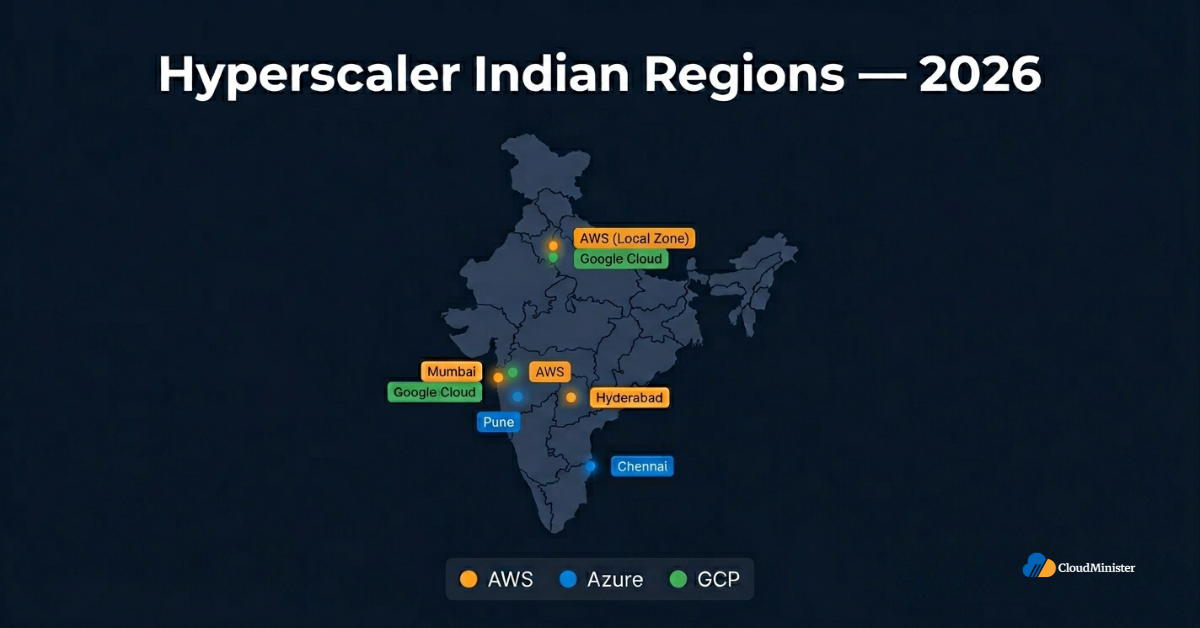
Data residency is not a marketing claim — it is a deployment constraint. The aws vs azure vs google cloud decision for Indian businesses begins with mapping which hyperscaler has compute, storage, and managed services available in the Indian region closest to your users and your compliance perimeter.
AWS in India
- Two full regions: Asia Pacific (Mumbai) — ap-south-1, and Asia Pacific (Hyderabad) — ap-south-2
- Multiple Availability Zones in each region for HA architectures
- Local Zone in Delhi for ultra-low-latency workloads
- AWS Outposts available for on-premise extension into customer data centres
- Most comprehensive AWS hosting service catalogue active in India — over 200 services
- AWS pledged USD 8.2 billion in additional Indian data centre investment over the medium term
Microsoft Azure in India
- Three regions: Central India (Pune), South India (Chennai), and West India (Mumbai) — this region has been officially retired by Microsoft and is no longer available for any deployments. All new deployments should target Central India (Pune) as the primary region.
- Central India (Pune) is the recommended primary region for most new Azure deployments in 2026
- South India (Chennai) is the paired DR region for Central India
- Microsoft committed USD 3 billion to expand Azure and AI infrastructure in India
- Strongest hybrid integration with on-premise Windows Server and Active Directory estates
Google Cloud in India
- Two regions: Mumbai (asia-south1) and Delhi-NCR (asia-south2)
- Delhi-NCR region added specifically to address public-sector proximity and Northern India latency
- Strong network edge presence through Google’s global private backbone
- Smaller managed-services partner ecosystem in India compared to AWS and Azure
- Strongest positioning for AI/ML workloads via Vertex AI, BigQuery, and TPU availability
For workloads requiring proximity to BFSI clusters around Mumbai, both AWS and Azure offer Mumbai-region deployments. For Northern India enterprises and government workloads, Google Cloud’s Delhi-NCR region and AWS Local Zone in Delhi provide the lowest-latency options. The aws vs azure vs google cloud regional footprint is the first non-negotiable filter in your evaluation.
Under DPDPA 2023, Indian data fiduciaries must implement appropriate technical safeguards for systems processing personal data. The Act specifies outcomes — access controls, audit trails, breach prevention — rather than mandating a specific hyperscaler or geographic boundary. However, sector-specific guidance from RBI (for fintech and NBFC), SEBI (for capital market participants), and IRDAI (for insurance) may impose stricter localisation rules that effectively require deployment within Indian regions. The aws vs azure vs google cloud choice must be made with qualified legal counsel familiar with your sector’s specific obligations — not on the basis of generic compliance marketing.
3. Head-to-Head Comparison Table
The 2026 comparison across the dimensions most Indian buyers ask about — built on current region data, market-share data, and partner-ecosystem reality.
| Dimension | AWS | Microsoft Azure | Google Cloud |
| Indian regions (2026) | Mumbai, Hyderabad + Delhi Local Zone | Pune, Chennai (West India/Mumbai retired) | Mumbai, Delhi-NCR |
| Service catalogue depth | 200+ services — broadest | ~200 services — enterprise focus | ~150 services — strong in data/AI |
| Global market share Q1 2026 | ~30% | ~25% | ~13% |
| Strongest workload fit | General-purpose, web apps, broad SaaS | Microsoft-integrated enterprise, hybrid | Data analytics, AI/ML, Kubernetes-native |
| Indian compliance certifications | MeitY, RBI guidelines, ISO 27001, SOC 2 | MeitY, RBI guidelines, ISO 27001, SOC 2 | MeitY, RBI guidelines, ISO 27001, SOC 2 |
| Pricing model | Per-second EC2; granular but complex | Per-minute most VMs; transparent for enterprise | Automatic sustained-use discounts; simpler |
| Free tier (2026) | 12-month + always-free across 100+ services | 12-month + always-free across 25+ services | 90-day USD 300 credit + always-free tier |
| Indian partner ecosystem | Largest — most consulting partners | Strong — deep enterprise partner base | Growing — strongest in data analytics |
| Talent availability India | Largest — 35,000+ Bangalore postings | Second-largest — strong in BFSI | Smallest — concentrated in startups, AI |
4. Workload-Fit Analysis: Which Hyperscaler for Which Workload
The honest answer to aws vs azure vs google cloud depends on the workload — not on hyperscaler loyalty. Here are the workload patterns and the hyperscaler that genuinely fits each best in 2026.

4.1 General-Purpose Web Applications and SaaS Platforms
- Best fit: AWS
- Why: Broadest managed services for web apps (Elastic Beanstalk, App Runner, ECS, EKS, Lambda)
- Indian ecosystem: Largest partner base, deepest hiring pool in Bangalore, Hyderabad, Pune
- AWS console management workflows are the most mature, with the broadest CloudFormation and CDK template library available publicly
- Indian SaaS unicorns disproportionately run on AWS — Zerodha, Freshworks, and Razorpay being notable examples
- For teams new to AWS, structured AWS console management training accelerates onboarding significantly
Power your web apps on India’s most trusted cloud
From SaaS platforms to high-traffic e-commerce, CloudMinister deploys and manages your AWS workloads across Mumbai and Hyderabad — with full support from India’s largest AWS partner ecosystem.
4.2 Microsoft-Integrated Enterprise Workloads
- Best fit: Microsoft Azure
- Why: Native integration with Active Directory, Microsoft 365, Dynamics, Power BI, and GitHub Enterprise
- Microsoft Azure Cloud Hosting is the path of least resistance for enterprises already operating Windows Server, SQL Server, and Microsoft licensing agreements
- Bring-your-own-license (BYOL) for Windows Server and SQL Server provides material cost reduction on Microsoft Azure Cloud Hosting compared to running the same workloads on AWS
- Azure Arc enables consistent management across on-premise, edge, and multi-cloud — a feature genuinely differentiated versus AWS and GCP
- Strong BFSI presence in India — Azure cloud hosting is widely deployed across Indian banks, insurance companies, and NBFCs
Extend your Microsoft estate to the cloud — without the friction
Already running Windows Server, Microsoft 365, or Active Directory? CloudMinister’s Azure hosting keeps your enterprise stack connected, compliant, and optimised from day one.
4.3 Data Analytics, AI, and ML Workloads
- Best fit: Google Cloud
- Why: BigQuery is genuinely best-in-class for petabyte-scale analytics with serverless pricing
- Vertex AI provides a unified platform for ML lifecycle management
- TPU availability for large language model training and inference — a hardware option not available on AWS or Azure. (Note: TPUs are not available in Google Cloud’s Indian regions (asia-south1 or asia-south2). Indian businesses requiring TPU access must route training workloads to us-central1 or europe-west4, which may conflict with DPDPA data residency obligations for personal data.)
- google cloud web hosting paired with BigQuery is a common architecture for data-intensive SaaS applications
- For AI-first Indian startups, google cloud hosting offers the cleanest data-to-model-to-API pipeline among the three hyperscalers
- google cloud web hosting also benefits from automatic sustained-use discounts that reduce TCO for predictable workloads
Build smarter, faster with India’s leading Google Cloud partner
From BigQuery pipelines to Vertex AI deployments, CloudMinister helps Indian businesses unlock the full power of Google Cloud — with hands-on support and cost-optimised architecture.
4.4 Containerised and Kubernetes-Native Workloads
- Best fit: Google Cloud (GKE), with AWS (EKS) as a strong second
- Why: Kubernetes originated at Google — GKE has the deepest Kubernetes-native features
- GKE Autopilot mode handles node management automatically — operationally simpler than EKS or AKS for small teams
- For Indian teams already on AWS hosting, EKS is the pragmatic choice; switching purely for GKE rarely justifies the migration cost
- All three hyperscalers support managed Kubernetes — the differences are in operational nuance, not core capability
4.5 GPU-Intensive AI Training and Inference
- Best fit: Depends on GPU availability in your Indian region
- AWS offers G5, P4d, P5 instances with NVIDIA A100 and H100 GPUs in Mumbai/Hyderabad
- Azure offers ND A100 v4 and NC A100 v4 series in Central India
- Google Cloud offers A2/A3 instances with NVIDIA A100/H100 in Mumbai (asia-south1). TPU v4/v5 are not available in Indian regions and require workload routing to US or European GCP regions.
- For sustained heavy GPU training, a dedicated GPU server India deployment from a specialised provider often delivers better unit economics than hyperscaler hourly pricing — the hyperscalers price GPUs at a premium that compounds quickly on long-running training jobs
- Indian businesses comparing aws vs azure vs google cloud for AI training workloads should benchmark against a dedicated GPU server India option before committing — the savings on sustained workloads can be 40–60%. Based on typical 3-year colocation pricing versus on-demand hyperscaler GPU hourly rates for NVIDIA A100/H100 — actual savings vary significantly by GPU model, utilization rate, and negotiated pricing. Always obtain current quotes before making this comparison.
Related reading — AWS Cost Optimization Strategies for Reducing Your AWS Bill
5. Pricing in INR: What Indian Businesses Actually Pay in 2026
Sticker pricing comparisons across aws vs azure vs google cloud mislead more often than they inform. The honest comparison requires identical workload sizing, identical region (Mumbai for like-for-like), identical commitment level, and identical data transfer assumptions.
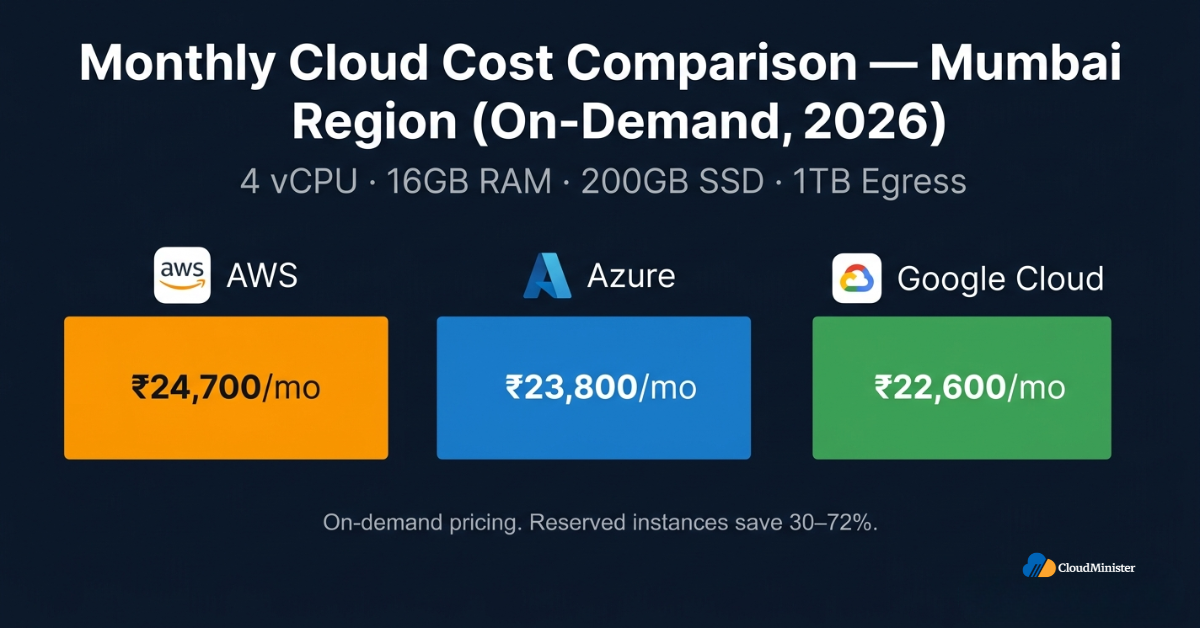
Indicative 2026 monthly pricing for a comparable mid-tier production workload — 4 vCPU, 16 GB RAM general-purpose VM, 200 GB SSD, 1 TB monthly data transfer out, Mumbai region, on-demand pricing in INR:
| Hyperscaler (Mumbai) | Compute (VM) | Storage 200GB SSD | Egress 1TB | Monthly Total |
| AWS (m6i.xlarge) | ~₹14,500 | ~₹2,400 | ~₹7,800 | ~₹24,700 |
| Azure (D4s v5, Central India) | ~₹14,000 | ~₹2,300 | ~₹7,500 | ~₹23,800 |
| Google Cloud (n2-standard-4) | ~₹13,200 | ~₹2,200 | ~₹7,200 | ~₹22,600 |
Pricing caveats every Indian buyer must understand:
- Reserved Instances (AWS) and Savings Plans (AWS) reduce on-demand pricing by 30–72% over 1–3 year commitments
- Azure Reserved VM Instances offer similar 30–72% savings over equivalent commitments
- Google Cloud Committed Use Discounts deliver 25–55% savings, with automatic sustained-use discounts on top
- Data transfer out (egress) to internet is the most commonly underestimated cost across all three hyperscalers
- GST at 18% applies on top of all hyperscaler invoices for Indian customers — factor this into TCO calculations
- INR–USD exchange-rate movement directly affects monthly bills since all three hyperscalers bill in USD with INR conversion at invoice date
The single biggest pricing trap in aws vs azure vs google cloud comparisons is comparing only compute cost. Compute is typically 40–55% of a real production bill. The remaining 45–60% is storage, data transfer, managed database, load balancer, NAT gateway, observability, and security services — and the relative cost ranking across hyperscalers reverses on several of these line items. Always price your full architecture, not just the VM.
Related reading: — How AWS Cloud Hosting Enhances Website Performance and Security
6. Compliance Posture: DPDPA 2023, RBI, SEBI, and NDHM Alignment
For Indian businesses operating in regulated sectors, the aws vs azure vs google cloud decision is shaped at least as much by compliance posture as by technical capability.
6.1 DPDPA 2023 Alignment
- All three hyperscalers offer Indian-region deployments that satisfy the most common interpretation of DPDPA data residency expectations
- DPDPA specifies outcomes — access controls, audit trails, breach prevention — not specific tools
- Each hyperscaler offers native audit logging: AWS CloudTrail, Azure Monitor / Activity Log, Google Cloud Audit Logs
- Encryption at rest and in transit is available by default across AWS, Azure, and Google Cloud Indian regions in 2026
- Verify your specific data-processing scope and obligations with qualified legal counsel — DPDPA enforcement guidance is still developing
6.2 RBI IT Framework (Fintech, NBFC, Banking)
- AWS, Azure, and Google Cloud all publish RBI-aligned compliance documentation for their Indian regions
- All three are listed as approved cloud providers by multiple Indian banks under RBI’s IT outsourcing framework
- Azure has the deepest pre-existing footprint in Indian BFSI — most large banks already operate Microsoft estates that integrate naturally with Azure cloud hosting
- AWS has the broadest fintech footprint — most Indian fintech startups, NBFCs, and payment platforms run on AWS hosting, supported by Mumbai and Hyderabad region availability
6.3 SEBI and Capital Market Participants
- All three hyperscalers offer the necessary data-residency and audit-trail controls
- Mumbai region proximity to exchange infrastructure is a latency advantage for AWS, Azure, and Google Cloud equally
6.4 NDHM and Healthcare Workloads
- DPDPA 2023 (not HIPAA) governs personal health data in India
- All three hyperscalers offer the encryption, audit, and access controls needed to support NDHM data fiduciary obligations
- Verify specific NDHM-aligned controls with qualified legal counsel based on your processing scope
Storing AWS, Azure, or GCP credentials in source code, environment variables on a developer laptop, or any version-controlled file is a DPDPA-reportable security failure for any system processing personal data. In 2026, the correct pattern across aws vs azure vs google cloud is: AWS Secrets Manager / Systems Manager Parameter Store for AWS, Azure Key Vault for Microsoft Azure Cloud Hosting, and Google Cloud Secret Manager for google cloud web hosting. Never store secrets outside these services. Every Indian business operating in a regulated sector must enforce this as a hard rule with no developer-level exceptions.
Related reading — A Comprehensive Guide to Picking the Best Cloud Hosting Provider in India
7. Performance Benchmarks: What the Indian Regions Actually Deliver
Performance differences in aws vs azure vs google cloud are real but workload-dependent. The 2026 benchmark picture for Indian regions:
Compute Performance
- All three hyperscalers offer current-generation Intel Xeon Scalable, AMD EPYC, and ARM/Graviton (AWS only) options in Mumbai
- AWS Graviton 3 instances (M7g, C7g, R7g families) deliver approximately 20–40% better price-performance for ARM-compatible workloads in Indian regions. Graviton 4 (R8g) is available in select AWS regions but has limited availability in ap-south-1 and ap-south-2 as of 2026 — verify availability before architecture decisions.
- Azure offers Cobalt 100 ARM instances, but availability in Indian regions is limited in early 2026
- Google Cloud’s Tau T2D instances offer competitive AMD-based price-performance
Storage Performance
- AWS gp3 SSD: 3,000 baseline IOPS included at no extra cost, independently provisionable up to 16,000 IOPS regardless of volume size — the key gp3 advantage over gp2, which tied IOPS to capacity — most flexible storage tier
- Azure Premium SSD v2: configurable IOPS and throughput independent of size — best for workloads needing high IOPS on small volumes
- Google Cloud Hyperdisk: independently scalable IOPS, throughput, and capacity — most granular storage configuration
Network Performance
- Google Cloud’s network — Premium Tier routes traffic over Google’s private global backbone — historically the lowest cross-region latency among the three, which directly benefits google cloud web hosting deployments that serve users across multiple geographies
- AWS Global Accelerator and Azure Front Door provide comparable global edge acceleration
- For intra-India traffic, all three deliver sub-10ms latency between AZs within the same region
Database Performance
- AWS Aurora and Azure SQL Database (Hyperscale) consistently outperform vanilla managed PostgreSQL/MySQL on transactional workloads
- Google Cloud Spanner is the only purpose-built, globally-distributed, externally-consistent SQL database among the three hyperscalers. While AWS Aurora Global Database and Azure Cosmos DB offer multi-region configurations, Spanner’s TrueTime-based external consistency is architecturally distinct and unmatched for globally-distributed transactional workloads — relevant for SaaS targeting global users from India
- All three offer managed Redis, Memcached, and MongoDB-compatible options
Never benchmark aws vs azure vs google cloud only on synthetic CPU or storage tests. Run your actual application’s representative load on a small instance in each hyperscaler’s Indian region for at least 72 hours before committing. Three-day production-shape benchmarks reveal noisy-neighbour issues, throttling behaviour, and steady-state pricing that 60-minute test runs miss entirely. This single discipline saves Indian businesses 15–25% on their first-year cloud bill.
8. The Multi-Cloud Question: Should Indian Businesses Use More Than One?
According to the latest Flexera 2026 State of the Cloud report, 87% of organisations globally now operate a multi-cloud strategy (Note: Flexera’s definition of multi-cloud includes the use of any services across providers — including SaaS tools like Microsoft 365 or Google Workspace alongside an IaaS provider. Pure infrastructure multi-cloud — running production workloads across two or more hyperscalers — is far less common, particularly among Indian SMBs.), but the practical reality for Indian businesses is more nuanced than that headline suggests.
When multi-cloud across aws vs azure vs google cloud genuinely helps
- Regulatory requirement for cloud-provider redundancy (some BFSI sub-sectors)
- Workload-specific best-of-breed — for example, primary on AWS with BigQuery on Google Cloud for analytics
- Negotiating leverage on enterprise commitments
- Geographic coverage where no single hyperscaler has the right regional presence
When multi-cloud across aws vs azure vs google cloud actively hurts
- Small engineering teams that lack the operational bandwidth to manage two control planes
- Cost optimisation suffers — committed-use discounts apply per hyperscaler, fragmenting commitment value
- Identity, networking, and observability complexity grows non-linearly with each added hyperscaler
- Skills depth dilutes — Indian engineers strong on AWS hosting may be mediocre on Azure cloud hosting and weak on google cloud hosting if asked to operate all three
The honest 2026 default for most Indian businesses below 200 engineers: pick one hyperscaler as primary, use SaaS for everything that does not require platform integration, and add a second hyperscaler only when a specific workload justifies the operational cost. Multi-cloud as a default architecture is overrated for Indian SMBs. Multi-cloud as a deliberate, workload-driven choice is sound. The aws vs azure vs google cloud answer is rarely “all three” for organisations below enterprise scale.
9. Talent and Hiring in India: Who You Can Actually Hire
The aws vs azure vs google cloud choice is also a hiring decision — and in India, the talent supply is meaningfully different across the three platforms.
- AWS: Largest available talent pool in India. Naukri and LinkedIn show 35,000+ active AWS-skilled postings in Bangalore alone as of mid-2026. Hiring AWS engineers in Hyderabad, Pune, and Chennai is straightforward.
- Azure: Second-largest. Strong in BFSI cities — Mumbai, Bangalore, Pune. Azure architects with hybrid-cloud experience are in particular demand. Microsoft Azure Cloud Hosting expertise is concentrated in enterprise consulting firms.
- Google Cloud: Smallest pool, concentrated in startup-heavy Bangalore and data-intensive teams. GCP engineers command a 10–15% premium versus AWS engineers at equivalent seniority.
Practical implication: if your hiring plan calls for adding 5+ cloud engineers in the next 12 months, AWS gives you the widest hiring funnel. If your existing team is Microsoft-stack-heavy, Azure cloud hosting onboarding is faster than retraining the team to AWS. If you are building an AI/ML team from scratch, Google Cloud’s smaller-but-deeper specialist pool may actually be the right hiring profile.
Related reading — Why Google Cloud Hosting Is the Best Choice for Indian Enterprises
10. Cost Optimisation Techniques That Apply Across aws vs azure vs google cloud
Cost discipline matters more than hyperscaler selection in determining your three-year cloud spend. These techniques apply across all three platforms:
- Right-sizing: 30–50% of VMs in typical Indian deployments are over-provisioned at month two of operation — review utilisation monthly through AWS console management dashboards or equivalent native tooling on Azure and GCP
- Committed-use discounts: Apply 1-year reserved capacity for steady-state workloads — savings of 30–55% across AWS hosting, Azure cloud hosting, and google cloud web hosting.
- Spot/preemptible instances: For fault-tolerant batch workloads, spot pricing delivers 60–90% savings on all three platforms
- Storage tiering: Move infrequently-accessed data to S3 Glacier / Azure Archive / GCS Coldline — savings of 60–80% versus standard storage
- Idle resource elimination: Unattached EBS volumes, idle load balancers, and orphaned snapshots accumulate silently across all three hyperscalers
- Data transfer optimisation: Same-region traffic is free; cross-region and internet egress is where bills explode
- Tag governance: Enforce mandatory tags (Environment, Owner, CostCenter) — without this, cost allocation is impossible at scale
11. Vertical-Specific Recommendations
The right answer to aws vs azure vs google cloud differs by industry. Here is the 2026 pattern across Indian sectors:
11.1 E-Commerce and D2C
- Recommended primary: AWS
- Why: Auto Scaling Groups, CloudFront, RDS Aurora, ElastiCache, and Lambda combine into the most mature elastic e-commerce stack
- AWS console management workflows for traffic surges (festive sales, flash drops) are battle-tested across Indian D2C unicorns
11.2 BFSI (Banks, Insurance, NBFC, Fintech)
- Recommended primary: Azure for banks and insurance with existing Microsoft estate; AWS for fintech and NBFC startups
- Why: Azure’s hybrid integration is a near-default for existing on-premise BFSI estates; AWS’s broader managed services suit cloud-native fintech
- Compliance posture: Both Azure and AWS have strong RBI-aligned documentation; verify with your compliance team
11.3 SaaS and Software Product Companies
- Recommended primary: AWS for general-purpose SaaS; Google Cloud for AI-first SaaS
- Why: AWS offers the broadest set of building blocks; Google Cloud’s BigQuery and Vertex AI accelerate analytics-heavy and AI-heavy SaaS
- Indian SaaS scaling globally must factor in cross-region replication costs early
11.4 Healthcare and HealthTech
- Recommended primary: AWS or Azure, based on existing application stack
- Why: Both offer the encryption, audit, and access controls needed for DPDPA-aligned health data processing
- NDHM-aligned configurations are documented for both AWS and Azure
11.5 Manufacturing and Industrial IoT
- Recommended primary: Azure
- Why: Azure IoT Hub, Digital Twins, and integration with existing Windows-based industrial control systems is the path of least resistance
- Microsoft Azure Cloud Hosting integrates with on-premise SCADA and PLC infrastructure more cleanly than AWS or GCP
11.6 AI/ML, Data Analytics, and Research
- Recommended primary: Google Cloud
- Why: BigQuery, Vertex AI, TPU access, and the cleanest data-pipeline tooling — combined with google cloud web hosting capabilities that integrate natively with these data services
- For sustained GPU training workloads, supplement with a dedicated GPU server India deployment — the unit economics on long-running training jobs improve materially versus hyperscaler hourly pricing
- Indian AI startups regularly combine google cloud hosting for analytics with a GPU server India deployment for model training to balance flexibility against sustained-workload cost
12. The Indian Hosting-Provider Angle: When a Local Provider Makes More Sense
Not every workload belongs on a hyperscaler. The aws vs azure vs google cloud comparison only covers the hyperscaler segment — but for many Indian businesses, an established Web Hosting Provider in India delivers better unit economics, simpler operations, and equivalent reliability for specific workload classes.
A managed Web Hosting Provider in India should be evaluated on the same dimensions as a hyperscaler — uptime SLA, support response time, data centre location, backup posture, and security certifications — not just sticker price.
Workloads where a managed Web Hosting Provider in India is the rational choice
- WordPress, Joomla, Drupal, Magento, and Shopify-equivalent CMS-based websites
- Small-to-medium static and marketing websites
- Single-region applications with predictable traffic patterns
- Email hosting, DNS, and basic backup workloads
- Bootstrapped startups optimising for fixed monthly costs over elastic scale
- Workloads where INR-denominated billing matters (no USD–INR exchange exposure)
For most Indian SMBs running standard web workloads, a quality Web Hosting Provider in India provides the right balance of cost, performance, and operational simplicity. Migrating these workloads to a hyperscaler often increases both bill and operational complexity without meaningful performance benefit.
The pragmatic 2026 Indian architecture for many growing businesses: a Web Hosting Provider in India for the marketing site, blog, and standard web properties; AWS, Azure, or Google Cloud for the product, application, and analytics workloads that genuinely benefit from hyperscaler elasticity. This hybrid posture is operationally rational and cost-efficient — and it lets you avoid the trap of running an entire static marketing website on a hyperscaler when a competent Web Hosting Provider in India would deliver the same outcome at a fraction of the cost.
13. Five Warning Signs You Picked the Wrong Hyperscaler
Whether you have recently committed to an aws vs azure vs google cloud decision or inherited one, these signals indicate your platform choice may be misaligned with your actual needs.
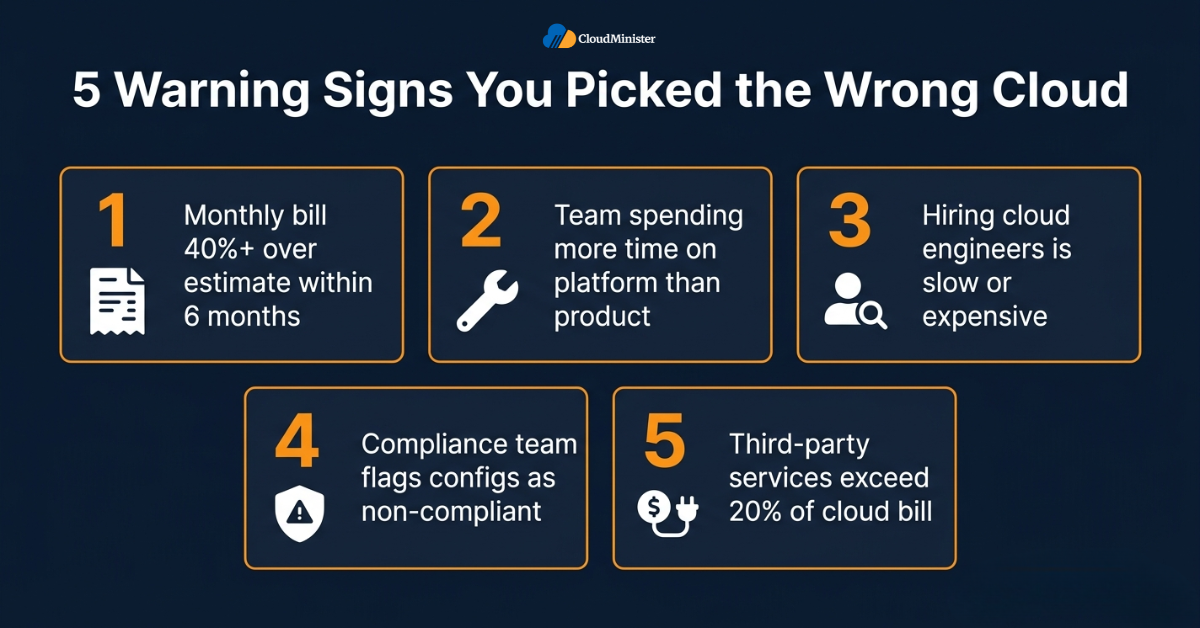
Warning Sign 1: Your monthly bill is 40%+ higher than your initial estimate within six months
Indicates either over-provisioning, missed committed-use discounts, or a workload pattern that fits a different hyperscaler’s pricing model better.
Warning Sign 2: Your engineering team is spending more time on platform plumbing than on product
If the hyperscaler’s managed services and AWS console management workflows (or equivalent on Azure and GCP) do not cover your common patterns, the wrong hyperscaler was selected for your workload profile.
Warning Sign 3: Hiring qualified engineers is consistently slow or expensive
If you cannot reliably hire AWS, Azure, or GCP engineers in your city, your hyperscaler choice does not match the local Indian talent supply.
Warning Sign 4: Your compliance team consistently flags configurations as non-compliant
Indicates the wrong hyperscaler-default-configuration was selected for your regulatory environment — re-evaluate Azure for Microsoft-heavy BFSI; AWS for fintech-native NBFCs.
Warning Sign 5: You routinely need third-party managed services to fill capability gaps
Acceptable for narrow gaps; problematic when the third-party bill exceeds 20% of the hyperscaler bill. Consider whether a different hyperscaler closes the gap natively.
Not sure you’re on the right cloud? Let’s find out.
If any of the warning signs above sound familiar, our cloud architects can audit your current setup, identify the misalignment, and map a clear path forward — at no cost.
14. The 2026 aws vs azure vs google cloud Readiness Checklist
Before you sign a multi-year hyperscaler commitment, verify these are in place.
AWS vs Azure vs Google Cloud — READINESS CHECKLIST
☐ WORKLOAD MAPPING: Top 5 workloads documented with traffic pattern, compute shape, storage profile, and data residency requirement
☐ REGION SELECTION: Primary and DR regions selected based on user proximity and compliance, not vendor preference
☐ PRICING VALIDATION: 72-hour production-shape benchmarks run on all three hyperscalers’ Indian regions
☐ COMPLIANCE MAPPING: DPDPA 2023, RBI, SEBI, NDHM obligations cross-referenced against hyperscaler service controls
☐ COST GOVERNANCE: Tag policy, budget alerts, and rightsizing review cadence defined before workload migration
☐ TALENT PLAN: Hiring funnel for the chosen hyperscaler validated against your city and salary band
☐ SECRETS MANAGEMENT: AWS Secrets Manager / Azure Key Vault / GCP Secret Manager standard adopted before first production deployment
☐ BACKUP AND DR: RPO and RTO targets defined; cross-region replication strategy validated
☐ OBSERVABILITY: CloudWatch with AWS console management integration / Azure Monitor / Cloud Operations standardised on day one — not added later
☐ COMMITMENT STRATEGY: 1-year reserved/committed-use coverage targeted at 60–70% of steady-state baseline within month six
Conclusion: Making the aws vs azure vs google cloud Decision With Confidence
The aws vs azure vs google cloud question does not have a universal answer — and any vendor or consultant offering one without examining your workload, compliance posture, talent plan, and Indian regional requirements is selling, not advising.
For most general-purpose Indian businesses in 2026 — SaaS, e-commerce, fintech, D2C — AWS hosting remains the rational primary choice on the strength of service breadth, partner ecosystem, and Indian talent availability. For Microsoft-heavy enterprises, BFSI incumbents, and manufacturing organisations with existing on-premise Windows estates, Azure cloud hosting delivers faster time-to-value and lower retraining cost. For AI-first, data-intensive, and analytics-heavy organisations, google cloud hosting offers genuinely differentiated capability in BigQuery, Vertex AI, and TPU availability that the other two cannot match without compromise.
The right aws vs azure vs google cloud decision is the one that matches your workload, your team, your compliance perimeter, and your three-year operational reality — not the hyperscaler with the loudest 2026 marketing campaign. Indian businesses that approach this decision with technical rigour, commercial discipline, and honest workload mapping will build cloud foundations that compound value for the next five years. Those who pick on brand alone will spend the next eighteen months unwinding configuration debt.
Key Takeaways
- The aws vs azure vs google cloud decision is a five-year commercial commitment, not a technology preference — map workloads to platforms, not the other way around
- AWS leads in Indian region depth (Mumbai + Hyderabad + Delhi Local Zone), Azure leads in Microsoft-integrated BFSI, Google Cloud leads in AI/ML and data analytics
- All three hyperscalers can satisfy DPDPA 2023, RBI, SEBI, and NDHM obligations when configured correctly — verify specific obligations with qualified legal counsel
- Compute is only 40–55% of a real cloud bill — never pick a hyperscaler on VM pricing alone
- Multi-cloud is overrated as a default for Indian businesses below 200 engineers — pick one primary, add a second only for a specific workload reason
- For sustained AI/ML training, a dedicated GPU server India deployment often delivers 40–60% better unit economics than hyperscaler hourly GPU pricing
- For standard web, CMS, and marketing workloads, a competent local hosting provider remains more cost-efficient than any hyperscaler
- Reserved capacity / committed use discounts of 30–55% should be applied within month six of any production hyperscaler deployment
Frequently Asked Questions
What is the best answer to aws vs azure vs google cloud for an Indian startup in 2026?
For most Indian startups, AWS remains the rational primary choice — broadest free-tier, largest partner ecosystem, deepest Indian hiring pool, and the most mature managed services for common SaaS, e-commerce, and fintech workload patterns. Exceptions: AI-first startups should evaluate Google Cloud as primary; Microsoft-stack-heavy enterprises should evaluate Azure.
Is google cloud hosting cheaper than AWS in Mumbai?
On like-for-like compute, google cloud hosting is typically 5–10% cheaper than AWS on on-demand pricing in Mumbai, with sustained-use discounts widening the gap further for predictable workloads. However, total bill comparison depends on data transfer, managed databases, and observability — Google Cloud is not uniformly cheaper across every line item.
Which is best for AI workloads — aws vs azure vs google cloud?
For pure AI/ML, Google Cloud has a structural advantage through Vertex AI, BigQuery integration, and TPU availability. For sustained GPU training, a dedicated GPU server India deployment from a specialised provider often delivers better unit economics than any of the three hyperscalers on hourly pricing.
Does DPDPA 2023 require me to use only Indian-hosted cloud?
DPDPA 2023 specifies outcomes (access control, audit trails, breach prevention) rather than mandating specific cloud providers or regions. Sector-specific guidance from RBI, SEBI, or IRDAI may impose stricter localisation rules. Confirm specific obligations with qualified legal counsel — generic compliance marketing should not drive the aws vs azure vs google cloud decision.
How long does it take to migrate to a hyperscaler?
A straightforward lift-and-shift of a single application typically takes 4–8 weeks. A full data centre migration to AWS, Azure, or Google Cloud typically takes 6–18 months depending on application count, dependencies, and refactoring required. Plan for at least 90 days of parallel running before decommissioning legacy infrastructure.
Should I use multiple hyperscalers from day one?
No — not for most Indian businesses below enterprise scale. Multi-cloud increases operational complexity, dilutes committed-use savings, and stretches engineering teams thin. Pick one primary hyperscaler, run the business on it for 12–18 months, and add a second only when a specific workload genuinely requires it.
Is Microsoft Azure Cloud Hosting better than AWS for Indian banks?
Often yes, for banks with existing Microsoft estate and Active Directory dependencies. Azure’s hybrid integration and BYOL licensing materially reduce migration cost for Microsoft-heavy environments. For cloud-native fintech and NBFCs, AWS typically remains the better fit.

He is the CEO and Founder with over a decade of experience in cloud infrastructure, DevOps, and server optimization. With a strong vision and hands-on leadership approach, he has built scalable, secure, and high-performance cloud solutions trusted by businesses across industries.