


Cloud cost efficiency has become one of the most urgent priorities for engineering and finance teams running workloads on Google Cloud Platform in 2026. As compute, storage, and AI workloads scale, an unmanaged bill can silently outgrow the value it delivers. This guide breaks down the practical techniques, discount models, and monitoring habits that make GCP Cost Optimization a repeatable process rather than a one-time cleanup, and explains how the right hosting and cloud partner supports that process long term.
This cost discipline is the question every finance and engineering leader eventually has to answer honestly: is the bill you are paying actually proportional to the value your infrastructure delivers. It sounds straightforward until you look at how a modern Google Cloud Platform account actually grows. Compute instances, persistent disks, load balancers, BigQuery datasets, and Kubernetes clusters multiply across projects, and very few teams have a complete, current picture of what each resource costs and whether it is still needed. That gap between assumption and reality is exactly where waste accumulates, and it is exactly why GCP Cost Optimization has moved from a quarterly finance exercise to a continuous engineering discipline.
For a long time, many companies treated billing review as something to worry about only when an invoice looked unusually high. That approach no longer works. Industry research shows that public cloud spending grew 21.5% in 2025, yet managing cloud spend remains the top challenge for the large majority of organizations surveyed, which means this savings process is not a niche concern reserved for large enterprises. It applies equally to a five-person startup running a single Compute Engine instance and to an enterprise operating hundreds of GCP projects across multiple regions.
The shift has been driven partly by scale and partly by complexity. Teams today are not managing a handful of virtual machines; they are running Kubernetes clusters, serverless functions, managed databases, and increasingly, GPU-backed AI training pipelines, and each of these layers has its own pricing model. What used to be a simple monthly invoice has become a detailed ledger of dozens of SKUs, and founders who once assumed a reasonable starting configuration was good enough are discovering that costs quietly compound as usage grows. This is one of the reasons teams increasingly evaluate Google Cloud Hosting providers not just on uptime, but on how actively that provider helps control ongoing spend.
This guide walks through the practical building blocks of GCP Cost Optimization, explains how each technique affects a real Google Cloud Platform bill, and gives founders, DevOps engineers, and finance leads a working framework they can apply directly to their own infrastructure, regardless of company size or industry.
1. Why GCP Cost Optimization Has Become a Board-Level Priority
GCP Cost Optimization used to be a task assigned to whichever engineer had free time at the end of a sprint. That is no longer the case. As companies scale their usage of Google Cloud Platform, cost has moved from an operational footnote to a topic discussed alongside product roadmaps and fundraising conversations.
Part of the reason this cost review process now sits so high on the priority list is that cloud infrastructure is unusually easy to over-provision. A single oversized virtual machine, an orphaned disk, or an idle load balancer can run unnoticed for months, quietly adding up. Getting this wrong is not just a budgeting inconvenience; it can directly affect a company’s runway or profit margins.
- A single unattended GPU instance can cost more in a week than an entire month of properly scheduled compute.
- Every additional project in an organization multiplies the surface area that needs GCP Cost Optimization review.
- Cost overruns rarely happen through one dramatic mistake; they accumulate through dozens of small, unreviewed decisions.
- Engineering teams that are not measured on cost efficiency have little incentive to prioritize this cost management practice on their own.
Before scaling any production workload, map every resource type currently running in your Google Cloud Platform account, including forgotten test projects and orphaned storage buckets. This map becomes the foundation of your entire GCP Cost Optimization strategy.
2. What GCP Cost Optimization Actually Means for a Modern Cloud Bill
In the simplest terms, GCP Cost Optimization refers to the ongoing practice of aligning what you pay for on Google Cloud Platform with what your applications actually need to run reliably. For most teams, it spans far more than trimming a single line item: right-sizing compute, choosing the correct discount model, cleaning up storage, and continuously monitoring for drift.
It is worth being precise, because this efficiency effort is often confused with simply cutting costs at any expense. True GCP Cost Optimization is not about starving infrastructure of resources; it is about matching capacity to demand so that performance and reliability are preserved while waste is eliminated. Cutting corners without data is a shortcut that usually creates outages, not savings.
- Choices about instance sizing determine whether you are paying for capacity you never use.
- The pricing model you select, whether on-demand, sustained use, or committed use, changes your effective hourly rate significantly.
- Storage class selection is frequently overlooked, even though stale data sitting in an expensive tier carries ongoing cost.
- Commitments made without usage data can lock in spend that later becomes difficult to unwind.
3. Type 1: Compute Engine GCP Cost Optimization
Compute Engine is usually the single largest line item on a Google Cloud Platform invoice, which makes it the natural starting point for any GCP Cost Optimization initiative. Instances that were sized for a launch-day traffic spike often continue running at that size long after traffic has normalized.
As detailed in recent industry benchmarking on cloud spend, a fifty-person company spends roughly eighteen times more on cloud infrastructure than a ten-person company, even at similar revenue levels, and cloud spend efficiency at that scale requires structured right-sizing rather than ad hoc adjustments.
- Right-sizing tools built into GCP compare requested resources against actual utilization and recommend smaller machine types where appropriate, which matters whether you are on a shared cloud hosting plan or a dedicated one.
- Idle instances that sit powered on outside business hours are one of the fastest wins available under any cloud hosting plan.
- Preemptible and Spot VMs offer deep discounts for fault-tolerant workloads such as batch processing or CI or CD runners.
- Custom machine types let you match vCPU and memory ratios precisely instead of paying for a fixed, pre-defined shape baked into a rigid cloud hosting plan.
Never assume that downsizing a production instance is purely a cost decision. Always confirm that a smaller machine type still meets your application’s memory and CPU headroom requirements before making the change, since undersized instances can create their own reliability and security exposure during traffic spikes.
4. Type 2: Discount Models That Directly Affect GCP Cost Optimization
Beyond right-sizing, Google Cloud Platform offers several native discount mechanisms that materially change the outcome of any cloud hosting plan. Choosing the correct mix of these mechanisms is often responsible for a larger percentage reduction than infrastructure changes alone.
4.1 Sustained Use Discounts
Google automatically applies Sustained Use Discounts when a virtual machine runs for a meaningful portion of the billing month, without requiring any upfront commitment. This makes this cost strategy easier for smaller teams that are not ready to commit to long-term contracts.
4.2 Committed Use Discounts
Committed Use Discounts reward predictable, long-running workloads with substantial reductions in exchange for a one or three year commitment. Teams pursuing serious GCP Cost Optimization typically apply these only to baseline workloads that are unlikely to change in the near term.
4.3 Spot VMs for Fault-Tolerant Workloads
Spot VMs offer some of the deepest discounts available on Google Cloud Platform, making them a favorite lever in any cloud hosting plan for workloads that can tolerate interruption, such as rendering jobs or large-scale data processing.
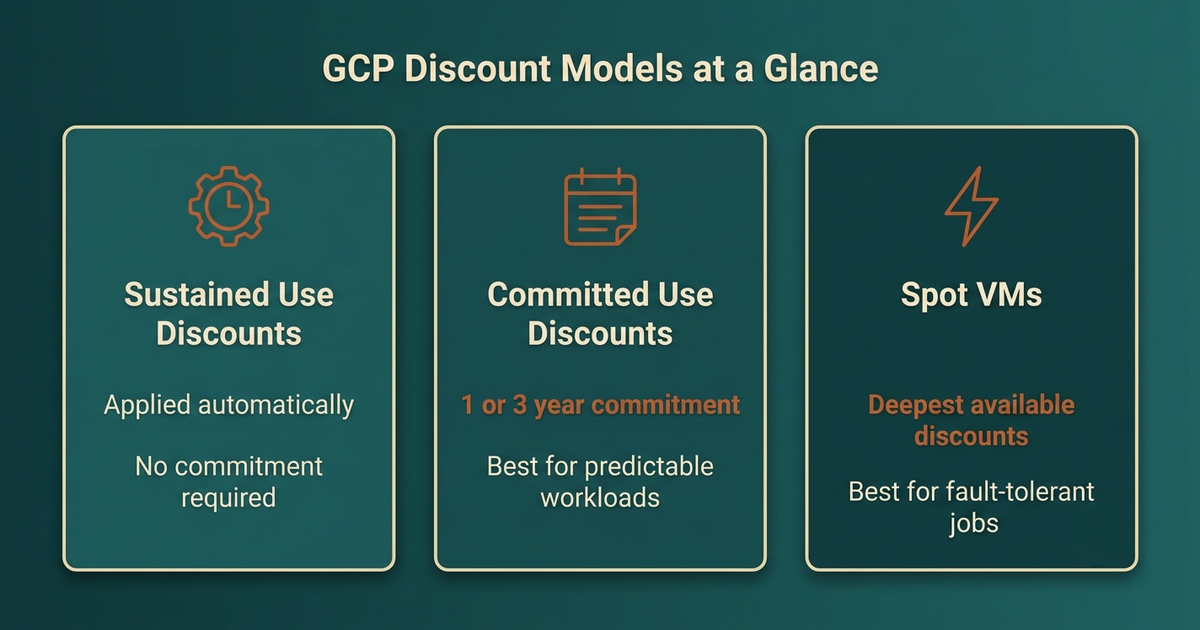
- Sustained Use Discounts apply automatically and require no planning, making them the easiest starting point for GCP Cost Optimization.
- Committed Use Discounts should be sized against actual historical usage, not optimistic growth projections.
- Spot VMs are not appropriate for stateful, latency-sensitive services without proper checkpointing.
- A blended strategy combining all three discount types typically outperforms relying on any single mechanism alone.
5. Type 3: Storage and Data Lifecycle GCP Cost Optimization
Even where compute is well managed, storage costs can quietly climb if left unreviewed. This is often called a silent leak, since storage bills rarely trigger the same urgency as a spike in compute spend.
- Cloud Storage buckets should use lifecycle policies to automatically transition infrequently accessed data to cheaper storage classes.
- Persistent disks attached to deleted virtual machines often continue billing until someone notices and removes them.
- Snapshots and backups accumulate over time and are one of the most commonly forgotten cost centers in GCP Cost Optimization reviews.
- BigQuery storage and query costs should be reviewed separately, since long-table scans can be far more expensive than the storage itself.
If you are trying to understand how the right infrastructure partner factors into these decisions, our earlier breakdown of Google Cloud Hosting walks through what a well-managed Google Cloud Platform environment actually looks like in practice, which is often the same lens teams apply when evaluating a GCP Cost Optimization vendor. A dependable Google Cloud Hosting provider should be transparent about which storage tiers and lifecycle rules it applies by default.
6. Type 4: Kubernetes and GKE GCP Cost Optimization
A uniquely modern challenge for teams running containerized workloads is that GKE clusters can silently over-provision nodes even while individual pods appear efficient. Autoscaling settings that were never tuned after initial deployment are a common source of unnecessary spend.
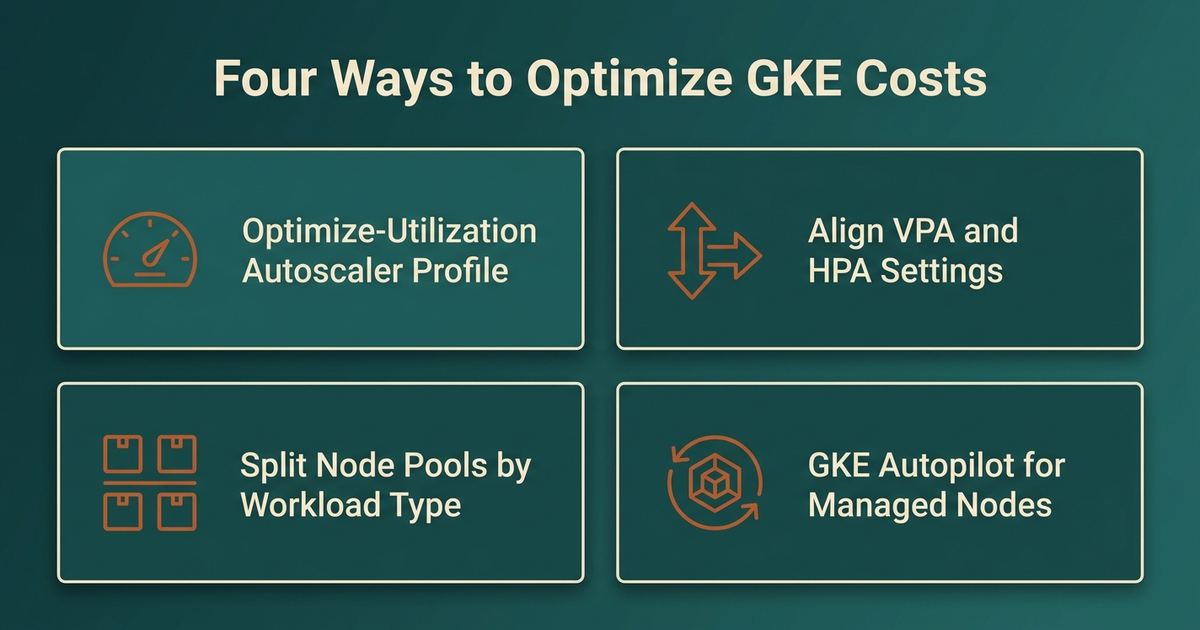
- Switching the GKE cluster autoscaler profile from the default setting to an optimize-utilization profile can meaningfully reduce unallocated vCPU and memory waste.
- Vertical Pod Autoscaler and Horizontal Pod Autoscaler settings should be reviewed together, since conflicting rules between the two can cause thrashing and wasted capacity.
- Node pools running mixed workloads often benefit from being split by workload type to enable more precise cloud cost efficiency.
- GKE Autopilot removes node-level management entirely, which can simplify GCP Cost Optimization for teams that prefer a managed experience.
If your GKE cluster is running a fixed number of nodes around the clock regardless of traffic, that alone is usually the single fastest opportunity to improve this cost discipline outcomes without touching application code.
7. Type 5: Monitoring, Budgets, and Alerts
One of the most commonly missed gaps in GCP Cost Optimization involves the absence of proactive monitoring. Teams often build a reasonably efficient architecture, only to discover months later that a misconfigured job or forgotten test environment has been running at full scale the entire time.
- Budget alerts should be configured at multiple thresholds, such as fifty, eighty, and one hundred percent of the monthly target for your cloud hosting plan, to prevent invoice shock.
- Billing data exported to BigQuery enables detailed SQL-based analysis that native dashboards cannot always provide.
- Labels and tags applied consistently at provisioning time make it possible to attribute cost accurately by team, project, environment, or cloud hosting plan.
- Anomaly detection tools can flag a sudden cost spike within hours instead of waiting for the next billing cycle.
This is exactly the kind of gap that continuous oversight is designed to catch early. Our detailed guide on Cloud hosting in India explains how ongoing infrastructure visibility, including budget tracking and resource monitoring, helps teams catch a cost anomaly before it becomes a quarter-ending surprise rather than after.
For a broader look at how emerging workloads are reshaping infrastructure planning, our earlier article on AI in Cloud Computing is a useful companion read alongside this guide, since AI workloads are increasingly one of the largest drivers of unplanned spend.
8. Type 6: AI and Machine Learning Workload GCP Cost Optimization
AI workloads are reshaping how teams think about GCP Cost Optimization just as quickly as everything else in the cloud landscape this year. Training and inference pipelines behave very differently from traditional web applications, and applying the same cost discipline requires new habits.
- Vertex AI serverless predictions help avoid paying for always-on infrastructure when inference traffic is spiky or unpredictable.
- Batch prediction jobs should be used for non-latency-sensitive workloads to lower the effective unit cost of inference.
- Caching embeddings and repeated responses reduces redundant compute for similar inputs across a training or inference pipeline.
- Token and GPU-hour tracking should be instrumented from day one, since AI spend can grow unpredictably without close monitoring.
Recent industry data illustrates just how significant this shift has become: AI workloads are now the primary driver of cloud spending growth in 2026, and one in five organizations miss their AI spend forecasts by more than fifty percent. That single statistic is enough reason for any team running AI workloads to treat this savings process as a continuous discipline rather than a one-time setup task.
9. Comparing the Major Levers of GCP Cost Optimization
| Lever | Primary Mechanism | Key Risk if Ignored |
| Right-sizing | Compute Engine recommendations | Paying for unused vCPU and memory |
| Discount models | SUDs, CUDs, Spot VMs | Missing automatic or committed savings |
| Storage lifecycle | Lifecycle policies, class tiering | Stale data sitting in expensive tiers |
| Kubernetes tuning | Autoscaler profiles, node pools | Over-provisioned clusters running idle |
| Monitoring and budgets | BigQuery export, budget alerts | Cost spikes discovered too late |
| AI and ML workloads | Vertex AI batch and serverless | Unpredictable, unmonitored GPU spend |
10. How Cloud Hosting Support Strengthens GCP Cost Optimization
GCP Cost Optimization and reliable infrastructure support are closely linked, even though they are often managed by different teams. Knowing where the waste is hiding is only half the picture; a team also needs the operational discipline to act on those findings consistently, since identifying a savings opportunity means little if nobody implements it. A strong Google Cloud Hosting partner treats this as an ongoing responsibility rather than a one-time onboarding task.
- Ongoing infrastructure support that includes regular utilization reviews reinforces a company’s this cost review process posture by catching drift before it compounds.
- Access control and resource governance are core parts of a mature GCP Cost Optimization program, preventing waste caused by unmanaged test environments left running indefinitely.
- Regular architecture reviews, a standard part of good infrastructure management, help confirm that a cost-efficient setup is not quietly undermined by a forgotten resource.
- Choosing the right infrastructure partner is as important as choosing the right discount model for GCP Cost Optimization.
- A well-managed hosting relationship gives finance teams confidence that savings claims are backed by real operational discipline.
- Many mature organizations now expect infrastructure oversight and GCP Cost Optimization to be reviewed together, not separately.
- Modern infrastructure partners increasingly include automated reporting that maps directly onto cost optimization documentation.
- Investing early in disciplined infrastructure management is far cheaper than untangling runaway spend after the fact.
Related Reading: AWS vs Azure vs Google Cloud
For teams that want a dedicated partner handling this layer, working with a capable Web Hosting Company in India is a practical way to align GCP Cost Optimization with day-to-day infrastructure operations, rather than treating the two as separate workstreams handled by different teams.
- Choosing an infrastructure partner with experience across Google Cloud Platform makes it easier to align technical controls with cost objectives.
- Support that includes continuous resource monitoring helps teams catch waste before it becomes a quarterly finance escalation.
- Teams without dedicated infrastructure support often discover cost gaps only after a finance review flags them.
- Reliable infrastructure support also helps smaller teams meet enterprise-grade this efficiency effort expectations without building an internal FinOps function from scratch.
- Support covering incident response and capacity planning is especially valuable for teams running variable, spiky workloads.
- Evaluating infrastructure support should be part of any vendor selection process, not an afterthought.
- Infrastructure partners that offer regular reporting give leadership visibility into cost risk without requiring deep technical expertise.
- Partnering with an established infrastructure provider reduces the operational burden on engineering teams already focused on product development.
- Support focused on cloud-native environments is particularly relevant for teams running distributed, containerized workloads.
- Comprehensive infrastructure support typically bundles monitoring, patching coordination, and cost reporting into a single engagement.
11. The Role of Server Management in Sustaining GCP Cost Optimization
Even the most carefully designed cloud spend efficiency plan falls apart without consistent operational execution. This is where dependable server management becomes essential, since cost discipline is not a one-time architectural decision but an ongoing operational commitment that must survive patches, migrations, scaling events, and staff turnover.
- Server management ensures infrastructure changes, such as adding a new node pool, do not silently undo an existing GCP Cost Optimization configuration.
- Patch management, a core part of good server management, keeps infrastructure secure without requiring resources to be temporarily over-provisioned for remote diagnostics.
- Detailed audit logging makes it far easier to produce evidence of savings during an internal or client cost review.
- Teams relying on responsive server management can correct a cost-related misconfiguration faster, since local support does not require escalation through an international queue.
- Server management also helps smaller teams maintain a level of operational discipline that would otherwise require a dedicated in-house function.
- Choosing server management with clear SLAs gives finance teams confidence that infrastructure will not silently drift out of an optimized state.
- Server management that specializes in cloud-native workloads understands the unique storage and compute patterns involved in modern applications.
- Regularly auditing server management performance is a useful habit for any team scaling its cloud footprint.
For companies that would rather not manage this operational layer internally, dedicated support can handle the day-to-day discipline of keeping infrastructure patched, monitored, and aligned with this cost strategy goals, freeing engineering teams to focus on the product itself. Reliable Cloud hosting in India that bundles this kind of operational discipline with Google Cloud Platform expertise removes one more variable from an already complex stack.
Related Reading: Multi-Cloud Strategy for Indian SMBs
12. Choosing a Hosting Partner That Understands GCP Cost Optimization
Not every hosting provider treats GCP Cost Optimization with the seriousness it deserves. Many platforms advertise support for Google Cloud Platform without clearly documenting how they actually help reduce waste, monitor budgets, or right-size infrastructure. Teams comparing Cloud hosting in India options need a partner that can answer these questions with specifics, not marketing language.
- A dependable Web Hosting Company in India should be able to walk through exactly which cloud cost efficiency levers it actively manages on a client’s behalf.
- A Web Hosting Company in India with transparent billing practices simplifies the cost conversation with finance and leadership teams.
- Choosing Cloud hosting in India with clear architecture documentation makes cost audits faster and less stressful.
- A provider offering both infrastructure and cloud advisory services under one roof reduces the coordination overhead of maintaining GCP Cost Optimization across multiple vendors.
- Founders comparing options should shortlist a provider with a proven uptime and support track record before signing a long-term contract.
- A Web Hosting Company in India with India-based data centres directly addresses latency and cost predictability at the same time.
For teams evaluating this decision, CloudMinister positions itself as a Web Hosting Company in India built around efficient, well-managed Google Cloud Platform infrastructure, giving teams a straightforward path to serious this cost discipline without piecing together a patchwork of global tools.
- A provider that supports GPU and AI-specific workloads is increasingly valuable as training pipelines grow more demanding on any cloud hosting plan.
- Teams negotiating a long-term cloud hosting plan should confirm that their Web Hosting Company in India offers clear escalation paths during a cost anomaly.
- Cloud hosting in India with predictable INR billing removes one of the most common sources of budgeting uncertainty for Indian companies.
- Startups in their earliest fundraising stages often select a Web Hosting Company in India specifically because of its transparent cost documentation.
- A well-structured cloud hosting plan that publishes clear SLAs gives engineering teams confidence when planning production workloads on Google Cloud Platform.
- Working with a hosting provider that understands both traditional hosting and modern cloud-native workloads is increasingly valuable.
- Offering a clear upgrade path from a shared cloud hosting plan to a dedicated cloud hosting plan supports teams as they scale their cloud footprint.
- Reviews and case studies are a useful way to evaluate any cloud hosting plan before signing a long-term contract.
- A Web Hosting Company in India with responsive account management reduces the operational overhead of running production infrastructure.
- Finance teams often prefer Cloud hosting in India with extensive cost documentation readily available on request.
- Many companies standardize on a single cloud hosting plan specifically to simplify their GCP Cost Optimization conversations.
- A Web Hosting Company in India that combines hosting, advisory, and management services under one invoice significantly simplifies procurement.
Related Reading: IoT Cloud Integration
13. The Growing Scale of Cloud Waste in 2026
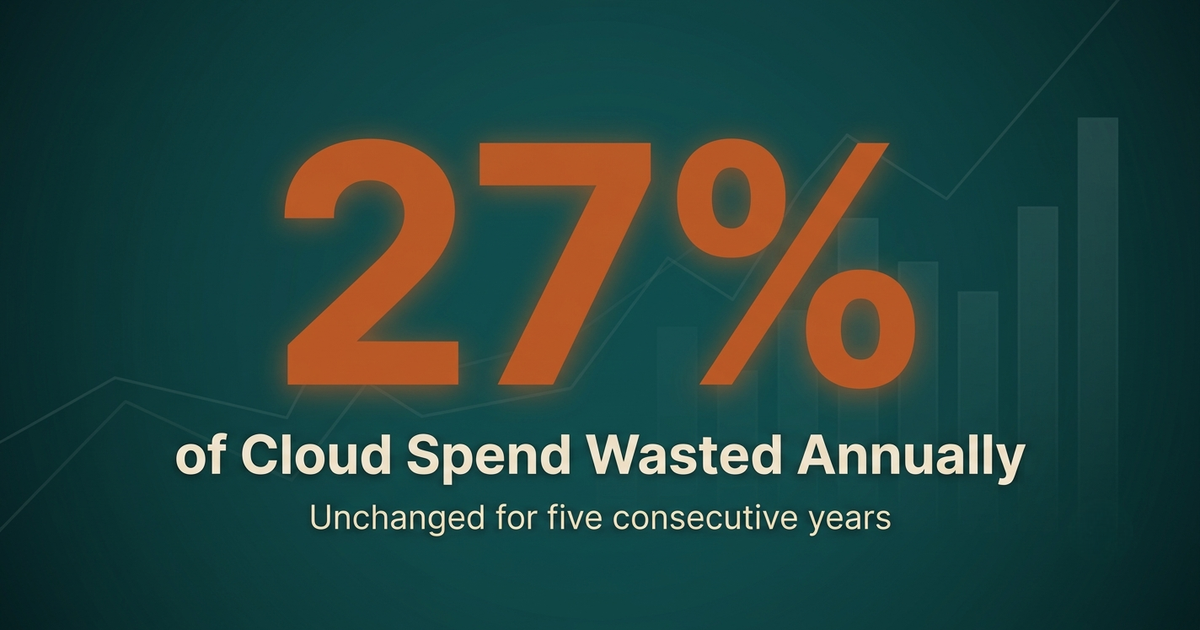
The pressure behind GCP Cost Optimization is not abstract. According to a 2026 analysis of enterprise cloud spending patterns, organizations waste an estimated 27 percent of their cloud spend annually, a rate that has remained essentially unchanged for five consecutive years, which means the opportunity for disciplined this cost review process has not shrunk even as tooling has matured.
As enforcement of internal budgets tightens and finance teams demand more accountability, companies that treated GCP Cost Optimization as a one-time setup task are discovering that the opportunity keeps evolving. New pricing models, updated discount structures, and a deepening reliance on AI workloads all mean this is an area requiring ongoing attention rather than a single audit checkbox.
Ready to Optimize Your Google Cloud Platform Spend?
Get started with expert-managed Google Cloud Hosting in India today and experience proactive cost monitoring, right-sizing support, and reliable server management
14. Building a Practical Framework for Your GCP Cost Optimization Strategy
A useful way to approach GCP Cost Optimization is to treat it as a recurring operational discipline rather than a static project to complete once.
- Start by mapping every resource currently running across your Google Cloud Platform projects, including forgotten test environments and orphaned storage, to establish your current baseline.
- Classify workloads by criticality and predictability, since production databases and experimental sandboxes require very different treatment under this cost management practice.
- Document your cost architecture in a form that can be shared with finance leaders and stakeholders without exposing sensitive implementation details.
- Review your GCP Cost Optimization posture at least quarterly, since pricing models, discount structures, and workload patterns all continue to evolve.
- Pair your architecture decisions with strong monitoring and reliable server management, since a good cloud hosting plan alone does not guarantee sustained savings.
- Building internal awareness around this efficiency effort ensures engineering teams treat cost as part of everyday development, not a separate afterthought.
- Combining cost reviews with regular infrastructure audits keeps both layers of savings working together instead of drifting apart.
- Teams that invest early in choosing the right cloud hosting plan typically spend far less unwinding runaway spend later in the product lifecycle.
- A quarterly review involving both engineering and finance helps confirm nothing has silently changed since the last audit of your cloud hosting plan.
Treat your cloud spend efficiency documentation as a living artifact your finance and engineering teams update together, not a one-time spreadsheet created for a single review and then forgotten.
15. Common Mistakes Teams Make With GCP Cost Optimization
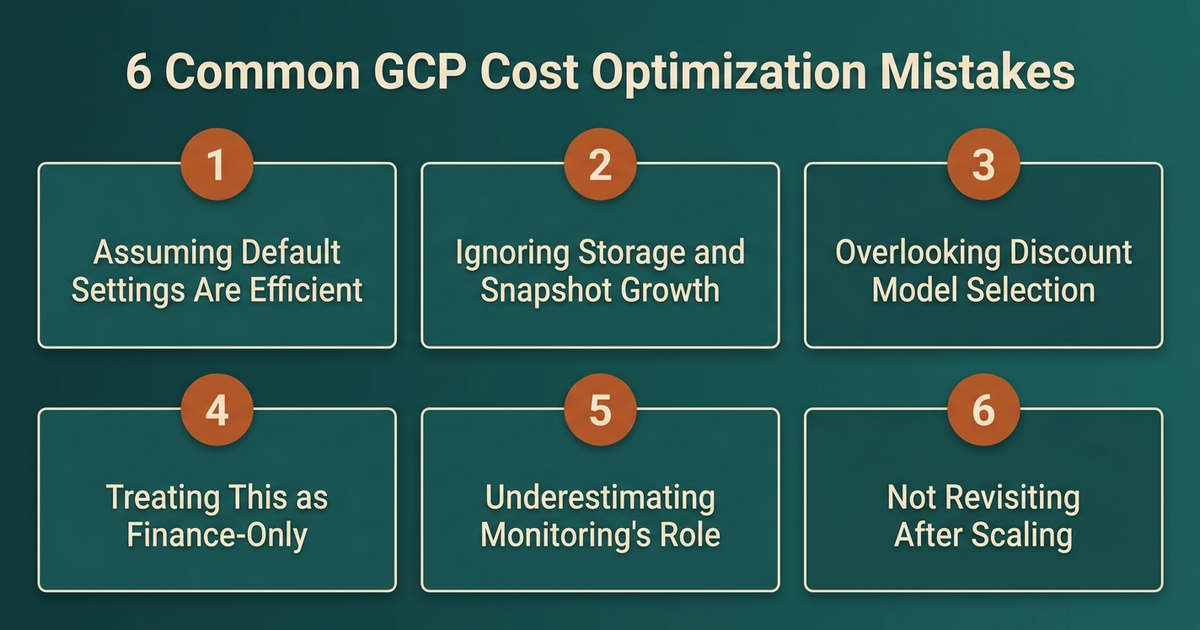
Mistake 1: Assuming Default Settings Are Already Efficient
Provisioning a virtual machine or cluster with default settings does not automatically guarantee an efficient configuration. Always verify actual utilization against what is provisioned.
Mistake 2: Ignoring Storage and Snapshot Growth
Snapshots and backup jobs are among the most common places where this cost strategy gaps quietly appear, since they are often configured separately from the primary workload and rarely reviewed.
Mistake 3: Overlooking Discount Model Selection
Running predictable, long-lived workloads entirely on-demand pricing is one of the most expensive mistakes in GCP Cost Optimization, since committed and sustained use discounts exist specifically to reward that predictability.
Mistake 4: Treating This as a Finance-Only Concern
Cloud cost efficiency is as much an engineering and operational challenge as a financial one. Without server management actively enforcing the architecture, and without monitoring protecting it, even a well-designed cloud hosting plan can drift out of alignment. Cost discipline, in practice, is upheld by daily operational habits far more than by a document sitting in a finance folder.
Mistake 5: Underestimating How Monitoring and GCP Cost Optimization Intersect
Some teams treat monitoring and this cost discipline as entirely separate workstreams owned by different people. In practice, the two constantly overlap, since visibility is what makes a savings target achievable in the first place.
Mistake 6: Not Revisiting After Scaling
A setup that worked for a small pilot project can break down entirely once a company scales to multiple regions, more services, and larger production workloads. This is precisely the stage where dedicated server management and updated GCP Cost Optimization reviews become necessary rather than optional.
Key Takeaways
- This savings process spans right-sizing, discount model selection, storage lifecycle management, and the operational discipline of continuous monitoring.
- Sustained Use Discounts, Committed Use Discounts, and Spot VMs each solve a different problem, and combining them typically outperforms relying on any single mechanism.
- AI and machine learning workloads introduce new, often unpredictable cost dynamics that require dedicated GCP Cost Optimization attention.
- Storage, snapshots, and orphaned resources are common blind spots where waste quietly accumulates.
- Reliable server management and strong monitoring are essential to keeping a cost-efficient cloud hosting plan intact over time, not just at initial setup.
- Choosing a Web Hosting Company in India that understands Google Cloud Platform in detail removes significant operational risk for teams operating at scale.
Have Questions About Your Cloud Infrastructure?
Talk to our team today and get expert guidance on hosting, cost optimization, and infrastructure support tailored to your business
Conclusion
This cost review process is no longer a peripheral finance exercise; it is core to how modern cloud infrastructure is architected, operated, and scaled. Understanding the different levers available, from right-sizing and discount models to storage lifecycle policies and AI workload management, gives engineering and finance teams the clarity needed to build systems that stay efficient under real-world growth.
What makes this topic genuinely difficult is that it sits at the intersection of engineering, finance, and vendor management, and very few companies have a single team responsible for all three. A finance team might understand the monthly invoice in detail but have little visibility into which workloads are actually driving it. An engineering team might have full control over infrastructure but no clear picture of which discount commitments are underutilized on their current cloud hosting plan. Closing that gap is what separates companies that keep their cloud bill predictable from those that scramble to explain a sudden spike when leadership finally asks.
As cloud adoption deepens through 2026 and beyond, companies that pair a clear GCP Cost Optimization framework with reliable server management and a capable hosting partner will be far better positioned to protect margins, plan confidently, and avoid the kind of quiet drift that turns into an expensive year-end surprise. Treated seriously and revisited often, this cost management practice becomes a competitive advantage rather than a recurring source of anxiety.
Ultimately, the companies that get ahead on this front are not the ones that treat GCP Cost Optimization as a one-time cleanup, but the ones that build ongoing habits around it: mapping resource usage regularly, choosing infrastructure partners who understand the nuances involved, and revisiting their architecture as pricing models and workload patterns evolve. Approached this way, this efficiency effort stops being a recurring source of last-minute panic and becomes simply part of how a well-run cloud operation works.
Frequently Asked Questions
What is GCP Cost Optimization and why does it matter?
Cloud spend efficiency refers to the ongoing practice of aligning Google Cloud Platform spending with actual application needs. It matters because compute, storage, and AI workloads can silently over-provision, turning a reasonable initial setup into an expensive one over time.
Is GCP Cost Optimization only relevant for large enterprises?
No. Any team running production workloads on Google Cloud Platform benefits from this cost strategy, regardless of size. Smaller companies often face the same budgeting pressure as larger competitors, just at a different scale.
What is the difference between Sustained Use Discounts and Committed Use Discounts?
Sustained Use Discounts apply automatically based on how long a virtual machine runs within a billing month, with no commitment required. Committed Use Discounts require a one or three year commitment in exchange for a deeper discount, making them better suited to predictable, long-running baseline workloads.
How does server management help with GCP Cost Optimization?
Server management ensures that ongoing changes to infrastructure, such as patches, scaling events, and new deployments, do not silently undo an existing cloud cost efficiency configuration over time.
Can AI workloads affect GCP Cost Optimization differently than traditional applications?
Yes. AI training and inference pipelines often involve GPU-backed compute with usage patterns that are harder to predict than traditional web applications, which means this cost discipline for AI workloads requires dedicated monitoring of token usage and GPU hours rather than standard compute metrics alone.

Related posts:
 How to Set Up your website on Google Cloud Hosting in India: A step-by-step Guide
 Why Google Cloud Hosting Is the best Choice For Indian Enterprises in 2025
 Google Cloud Hosting Management Tools: Features and Benefits for Indian Users
 Top Features of Google Cloud Hosting: Are they Worth the Price for Indian Users?