As engineering teams scale, cloud bills stop being a finance afterthought and start becoming a genuine business risk. That is exactly why Cloud Cost Governance has become essential rather than optional for any team past its first few engineers. This guide walks through what Cloud Cost Governance actually means, why growing teams need it earlier than most founders expect, and how to design a policy that engineers will actually follow instead of ignoring. Whether your team runs on cloud hosting services in India, is evaluating a Web Hosting Company in India for the first time, or is weighing Dedicated Server Hosting in India for predictable workloads, a structured governance framework is what keeps growth from turning into an unmanageable bill.
Every engineering team eventually hits the same uncomfortable moment: someone pulls up the monthly cloud invoice, and nobody can fully explain where the spend actually went. This is usually the exact point at which Cloud Cost Governance stops being an abstract best practice and becomes an urgent operational need. What started as a handful of instances spun up during a sprint quietly turns into dozens of untracked resources, orphaned staging environments, and oversized instances nobody remembers provisioning. The problem is rarely a single bad decision; it is the absence of a system that catches small decisions before they compound.
Cloud Cost Governance exists precisely to close that gap, giving engineering and finance a shared, structured way to track, attribute, and control spend as the team scales. Rather than reacting to a budget overrun after the fact, a well-designed governance policy builds accountability directly into how resources are provisioned, tagged, and reviewed from day one. It replaces guesswork and tribal knowledge with clear ownership, defined thresholds, and automated guardrails that work quietly in the background. The goal is not to slow engineers down but to make responsible spending the default path rather than an afterthought.
This guide breaks Cloud Cost Governance down into six practical stages that any growing team can implement, regardless of size or current infrastructure maturity. It also addresses a decision most teams underestimate early on: how the choice between cloud hosting services in India, Dedicated Server Hosting in India, and other infrastructure options shapes how easy or difficult governance becomes later. Whether your team is just starting to think about cost discipline or already has a policy that has started to slip, this framework offers a clear, repeatable path forward. By the end, you should have a practical blueprint you can put into action this quarter, not just theory to revisit someday.
Table of Contents
- 1. Why This Discipline Matters More as Teams Grow
- 2. What the Policy Actually Covers
- 3. Stage One: Ownership and Accountability
- 4. Stage Two: Budgets, Alerts, and Thresholds
- 5. Stage Three: Tagging and Resource Allocation Standards
- 6. Stage Four: Choosing the Right Infrastructure Mix
- 7. Stage Five: Review Cadences and Approval Workflows
- 8. Stage Six: Automating Enforcement So It Scales
- 9. Infrastructure Decisions That Make This Sustainable
- 10. Common Mistakes That Derail the Policy
- 11. The Complete Governance Checklist
- 12. Comparing Infrastructure Options for the Program
- 13. Budgeting for a Policy Rollout
- Key Takeaways
- Conclusion
- 14. Frequently Compared Infrastructure Terms Explained
- 15. Final Checklist Before You Roll Out the Policy
- Frequently Asked Questions
1. Why Cloud Cost Governance Matters More as Teams Grow
A five-person engineering team can usually track cloud spend in someone’s head, but that habit does not scale. A fifty-person team cannot, which is roughly the point where Cloud Cost Governance stops being a nice-to-have and becomes a survival requirement.
According to Flexera’s 2026 State of the Cloud Report, wasted cloud spend rose to 29 percent this year, ending five straight years of decline, and the reversal is attributed to the cost complexity AI workloads and newer infrastructure services have introduced. That single statistic makes the case for Cloud Cost Governance clearly: even mature organizations are losing control of spend, and teams without a formal policy are almost certainly losing more.
For a growing team, this discipline means knowing exactly which group owns which resource, which environment can run which instance size, and which spending decisions need approval versus which an engineer can make freely mid-sprint. Without it, a forgotten staging environment or an oversized instance left running overnight can quietly cost more than an engineer’s monthly salary. A mature policy is the difference between spend growing in line with revenue and spend growing faster than the business can support.
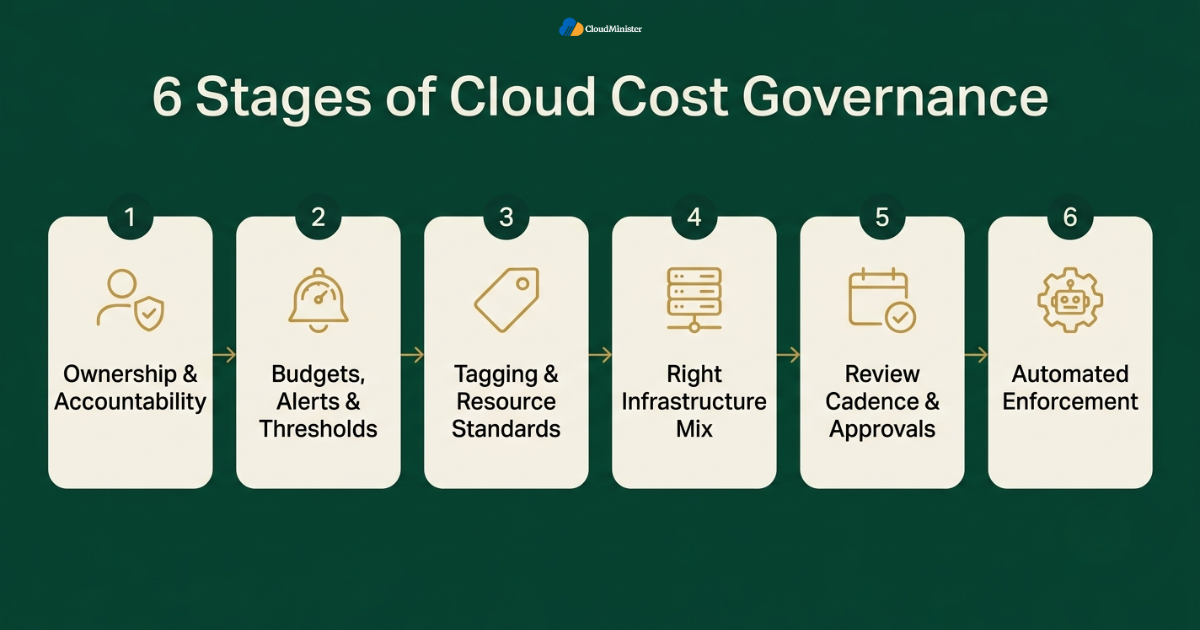
This guide organises the Cloud Cost Governance process into six practical stages:
- Establishing ownership and accountability before any policy is written
- Setting budgets, alerts, and spending thresholds by team and environment
- Defining tagging and resource allocation standards everyone must follow
- Choosing the right infrastructure mix across on-demand and dedicated resources
- Building review cadences and approval workflows into engineering practice
- Automating enforcement so the policy does not depend on manual policing
Do not wait for a budget crisis to start. A basic habit formed early, even a shared spreadsheet with simple tagging rules, is far easier to scale than a full policy bolted on after costs have already spiralled.
2. What the Policy Actually Covers
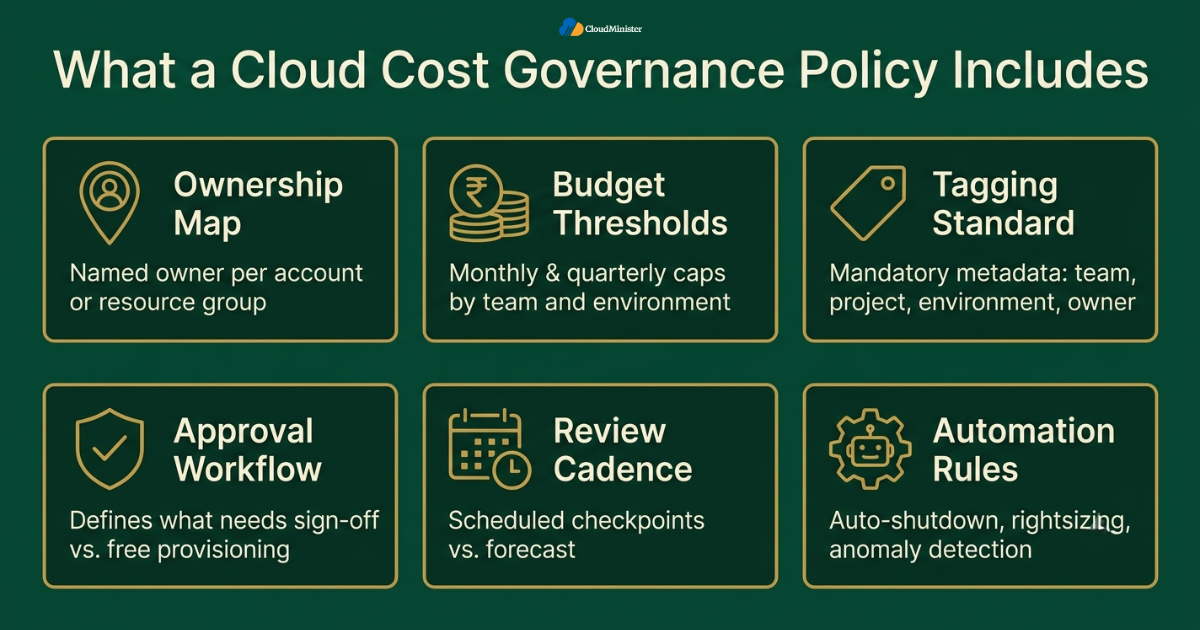
Before working through the framework, it helps to understand what components a solid Cloud Cost Governance policy is made of, since every piece needs to hold together for the whole thing to work.
| Component | What It Contains | Why It Matters |
| Ownership map | Which team or person owns each account or resource group | Without clear ownership, no one enforces the rules |
| Budget thresholds | Monthly and quarterly caps by team, environment, and service | Prevents one team from silently consuming the whole budget |
| Tagging standard | Mandatory metadata: team, project, environment, owner | Makes cost attribution possible, the backbone of the discipline |
| Approval workflow | What spend needs sign-off versus what an engineer can provision freely | Balances engineering speed with financial control |
| Review cadence | Scheduled checkpoints comparing spend against forecast | Keeps the policy a living process, not a one-time document |
| Automation rules | Auto-shutdown, rightsizing alerts, anomaly detection | Removes reliance on someone remembering to check manually |
Most engineering leaders assume writing the document is the hard part, but tagging discipline is usually where Cloud Cost Governance efforts quietly fail. Untagged resources cannot be attributed to a team, so a policy built on incomplete tagging data only ever gives a partial picture of real spend. This holds true whether the underlying infrastructure runs on shared cloud hosting services in India, a dedicated setup through Dedicated Server Hosting in India, or a mixed environment through a trusted Web Hosting Company in India.
Never grant provisioning permissions without tying them to the tagging and budget rules in your policy. An engineer with unrestricted access to spin up resources, with no guardrail attached, can accidentally trigger both a cost overrun and a shadow-IT security gap at the same time.
3. Stage One: Ownership and Accountability
3.1 What Belongs in the Ownership Phase of Cloud Cost Governance
- Assign a named owner, not just a team, to every cloud account and major project
- Identify a FinOps or platform lead responsible for maintaining the policy itself
- Document which engineering leads can approve spend above defined thresholds
- Clarify whether contractors fall under the same rules as full-time employees, especially when they provision resources directly on cloud hosting services in India
- Confirm who is notified first when a budget alert fires
- Record escalation paths for repeated threshold breaches by the same team
3.2 Choosing the Right Infrastructure Mix Before Governance Day
A large part of getting Cloud Cost Governance right is decided before the document is even finalised, at the point the underlying infrastructure mix is chosen. Engineering teams in India moving away from unpredictable overseas billing increasingly choose cloud hosting services in India because domestic infrastructure simplifies budgeting in INR and removes the currency-fluctuation risk that complicates long-term planning. A well-supported Web Hosting Company in India also matters, since local support teams that understand regional workload patterns make later stages considerably easier.
Teams running predictable, steady-state workloads often find that Dedicated Server Hosting in India fits more naturally into a governance model than fully elastic capacity, since a fixed monthly cost is simpler to forecast than variable, consumption-based billing. Pairing Dedicated Server Hosting with elastic capacity for bursty workloads is a common pattern in mature frameworks, since it applies predictable rules to the baseline while reserving flexible controls for the variable portion.
Run a two-week cost trial comparing an Affordable Cloud Hosting India plan against a dedicated option for your most predictable workload. Testing this against your draft budget model shows which workloads genuinely benefit from elasticity and which are better served by fixed-cost infrastructure.
Related Reading: how AI is reshaping cloud computing
4. Stage Two: Budgets, Alerts, and Thresholds
4.1 Why Budgets Are the Foundation of Cloud Cost Governance
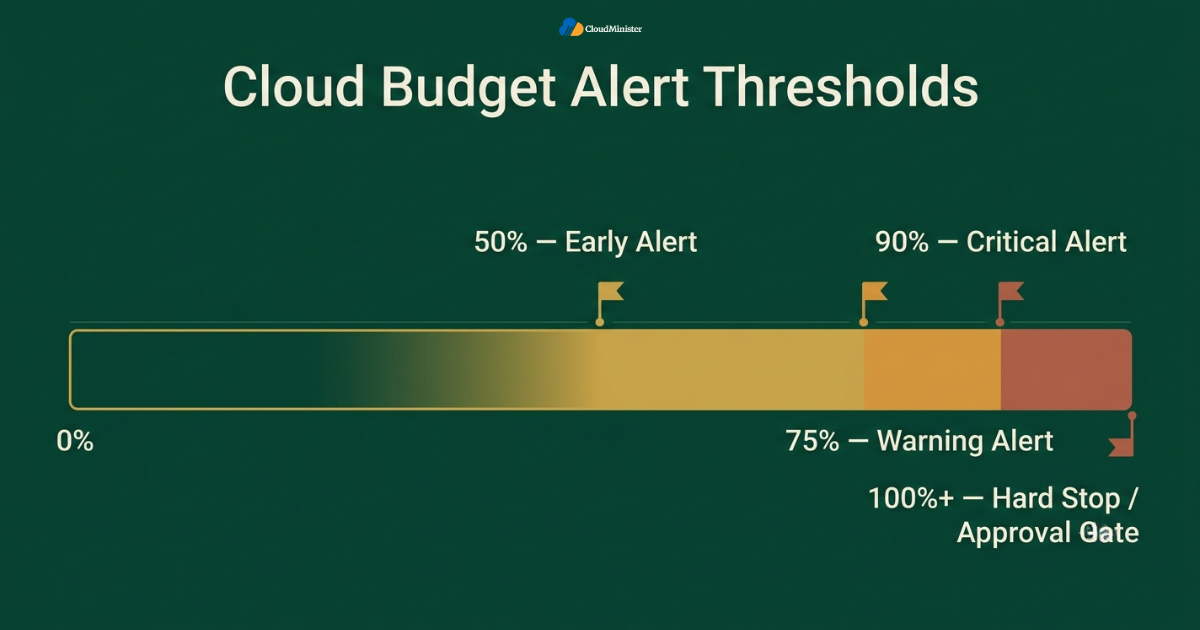
- Set a monthly ceiling for every team, broken down by environment: production, staging, development
- Configure automated alerts at 50 percent, 75 percent, and 90 percent of each threshold
- Define a hard stop or approval gate for spend exceeding 100 percent of the allocated budget
- Store budget history in a shared dashboard so decisions rest on trend data, not guesswork
- Route alerts to both the engineering lead and the policy owner, not just finance
4.2 Manual Tracking Versus Automated Tooling
- Manual spreadsheet tracking gives full visibility and works for smaller teams still building the habit, whether their workloads run through a Web Hosting Company in India or on Dedicated Server Hosting
- Native provider budgeting tools automate alerts as needs grow
- Dedicated FinOps platforms offer the most granular, real-time data for complex, recurring workloads
- Provider-level anomaly detection, where available, adds an early warning layer to whatever is already in place
Never let dashboard access or alert credentials sit with a single person who might leave without handover. A policy that depends entirely on one inbox is not really a policy, and losing that visibility even briefly can let real overspending go unnoticed for weeks.
5. Stage Three: Tagging and Resource Allocation Standards for Cloud Cost Governance
- Mandate a minimum tag set on every resource: team, project, environment, owner, regardless of whether it sits on Dedicated Server Hosting in India or an Affordable Cloud Hosting India plan
- Enforce tagging through provisioning templates or infrastructure-as-code rather than manual discipline
- Flag or reject any resource that launches without complete tags
- Reconcile tags against the billing export monthly to catch drift early
- Map tags directly to the ownership list built in stage one so attribution stays consistent
Teams evaluating cloud hosting services in India at this stage often find that providers with clear resource-grouping features make tagging enforcement considerably simpler to build in. A properly configured Web Hosting Company in India account also gives direct visibility into per-resource billing, which speeds up reconciling tags against actual spend when something does not line up on a Web Hosting Company in India dashboard.
Teams evaluating Affordable Cloud Hosting India plans for this stage should confirm the provider supports cost allocation tags natively. Enforcing tagging on a provider without native support takes far longer, since every attribution effort must be reconstructed manually after the fact instead of captured automatically at provisioning time.
Related Reading: multi-cloud strategy for Indian SMBs
6. Stage Four: Choosing the Right Infrastructure Mix for Cloud Cost Governance
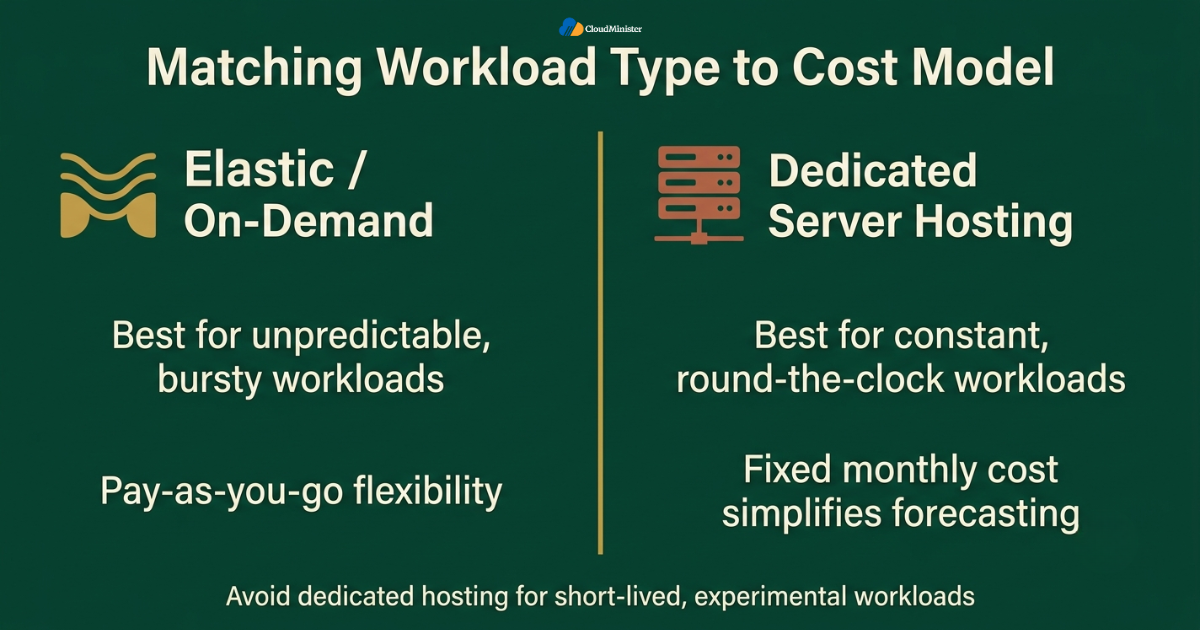
6.1 Matching Workload Type to Cost Model
- Use elastic, on-demand resources on cloud hosting services in India for unpredictable or bursty workloads that benefit from pay-as-you-go flexibility
- Reserve or commit to discounted capacity once usage patterns for a steady service are well understood, an approach that often runs alongside Dedicated Server Hosting for the always-on baseline
- Consider Dedicated Server Hosting in India for constant, round-the-clock workloads where a fixed cost on Dedicated Server Hosting in India simplifies forecasting
- Avoid running short-lived, experimental workloads on Dedicated Server Hosting, since fixed capacity works against the flexibility variable demand needs
Ready to Move to Reliable Cloud Hosting in India?
Get scalable, high-performance cloud infrastructure with NVMe SSD storage, 99.99% uptime, and full OS flexibility, built to grow with your workloads.
6.2 Comparing Providers Within One Framework
- Pull billing data from every provider into a single reporting layer so visibility does not fragment across accounts
- Run one consistent tagging and budgeting standard across all providers, not just the primary one
- Use a dedicated cost-allocation tool rather than spreadsheets once resource count grows past a few dozen
- Confirm every provider’s billing export format is compatible with your central dashboard before committing long-term
This is the stage where an incomplete Cloud Cost Governance policy causes the most visible damage, because a mismatched infrastructure choice leaves a team either overpaying for elasticity it never uses or underprovisioning a workload that genuinely needed dedicated capacity. Teams operating across cloud hosting services in India, Dedicated Server Hosting in India, and a broader Web Hosting Company in India relationship, or comparing more than one Dedicated Server Hosting in India provider, typically script this comparison against one shared cost model so the same benchmark applies to every decision.
Always model the fully loaded cost of a workload, including support, backup, and bandwidth, before comparing Dedicated Server Hosting against elastic pricing. This one habit prevents an incomplete comparison from quietly skewing infrastructure decisions.
7. Stage Five: Review Cadences and Approval Workflows in Cloud Cost Governance
- Schedule a monthly review meeting with representation from engineering, finance, and platform teams
- Compare actual spend against forecast every cycle and log the variance
- Require lightweight approval for any single resource that exceeds a defined cost threshold before provisioning
- Rotate ownership of the review meeting so it does not depend on one person’s availability, even for workloads sitting on Dedicated Server Hosting
- Re-evaluate budget thresholds quarterly as the team and its workloads grow
Leaders running teams on Affordable Cloud Hosting India plans sometimes report that review cadences slip simply because no one owns the recurring invite once the initial rollout excitement fades. Treating this as a standing commitment, rather than assuming the habit sustains itself, is one of the simplest ways to keep the policy from stalling after the first quarter.
Restrict who can approve budget overrides, and log every override with a timestamp and reason. Skipping this is common, but an unlogged override history makes it nearly impossible to identify which decisions actually drove a budget breach months later.
Related Reading: AWS versus Azure versus Google Cloud
8. Stage Six: Automating Cloud Cost Governance Enforcement So It Scales
8.1 Automating Without Slowing Engineers Down
- Configure auto-shutdown schedules for non-production environments outside working hours, coordinating with your Web Hosting Company in India where needed
- Set up rightsizing alerts that flag consistently underutilised instances for review
- Automate anomaly detection so an unusual spend spike triggers a notification within hours, not at month end
- Use policy-as-code tools to enforce tagging and budget rules automatically at provisioning
- Build a lightweight self-serve dashboard so engineers can see their own team’s spend directly
8.2 Keeping the Policy Current as the Team Scales
- Revisit the whole document every two quarters, since rules written for a fifteen-person team rarely fit a fifty-person one unchanged
- Bring new engineering managers into the review process during onboarding, not months after they join
- Retire tagging categories and budget lines that no longer reflect how the team actually organises its work
- Treat each update as a small, documented change rather than a full rewrite every time
According to the FinOps Foundation’s State of FinOps 2026 survey, the share of practitioners actively managing AI spend jumped from 31 percent two years ago to 98 percent today, the fastest adoption curve recorded in the survey’s six-year history. A figure like that is a strong argument for investing seriously in automation rather than treating it as an afterthought. Even a small team will feel the impact of AI workloads on its bill sooner than expected, which is exactly what a disciplined policy is built to anticipate.
A common mistake at this stage is automating shutdown rules without first confirming which workloads are genuinely safe to pause. Test automation rules in staging first, since accidentally shutting down a production dependency causes exactly the kind of outage the policy was meant to prevent.
Related Reading: IoT and cloud integration
9. Infrastructure Decisions That Make Cloud Cost Governance Sustainable
9.1 Why the Foundation Matters as Much as the Document
- Oversold or unpredictable hosting, whether Dedicated Server Hosting in India or an Affordable Cloud Hosting India plan, makes cost forecasting unreliable no matter how well the policy is written
- Limited billing granularity on generic providers can silently undermine the tagging discipline the policy depends on
- Inconsistent uptime erodes confidence in the cost-versus-value tradeoffs the whole exercise is meant to inform
- Unclear data residency on anonymous overseas hosting can complicate audits, contractual data-handling commitments, and due diligence for Indian businesses, even though current DPDPA rules do not mandate India-only data storage
This is precisely why more Indian engineering teams are moving toward dependable cloud hosting services in India rather than staying on generic overseas plans that make cost tracking harder to reason about. A trustworthy Web Hosting Company in India gives growing teams guaranteed resources, transparent per-resource billing, and predictable INR-denominated invoicing that simplifies budget planning at every stage.
9.2 When Dedicated Infrastructure Fits the Model
Teams running steady, resource-intensive services benefit from standardising part of their footprint on Dedicated Server Hosting in India, since a predictable core workload under one fixed monthly cost is considerably easier to fold into a budget than variable consumption billing. Instead of forecasting elastic usage for every service, a team layering Dedicated Server Hosting under its policy applies the same fixed-cost logic consistently, which shortens the budgeting cycle.
- A predictable fixed cost that simplifies the budget threshold stage
- Consistent resource availability that makes rightsizing decisions more straightforward
- A clear cost baseline against which elastic spend can be measured on the same dashboard
- Scalable resource allocation as core, always-on workloads grow over time
Teams comparing Affordable Cloud Hosting India plans against Dedicated Server Hosting should confirm each option supports the billing granularity their dashboard requires. CPU limits, bandwidth caps, and invoicing frequency vary considerably even among plans marketed as similar tiers.
10. Common Mistakes That Derail Cloud Cost Governance
- Writing the document once and never revisiting it as the team shifts between Dedicated Server Hosting and cloud hosting services in India
- Setting budget thresholds without involving the engineers who will actually work within them
- Skipping enforcement automation and relying entirely on manual review, which quietly erodes discipline over time
- Assuming tagging compliance instead of verifying it
- Treating this as a finance-only initiative instead of a shared engineering and finance responsibility
- Applying identical rules to every team regardless of workload type, when a data team and a marketing site rarely share the same cost profile
Cost visibility often degrades within a few months if dashboard access and alert routing are not actively maintained as team membership changes. A well-run policy includes a final step confirming every alert, dashboard, and approval path is still routed to an active team member, not someone who has since changed roles.
11. The Complete Cloud Cost Governance Checklist
Use this consolidated Cloud Cost Governance checklist as a final pass while building or auditing your policy.
- Ownership map completed, naming a responsible owner for every account and major project across every Web Hosting Company in India relationship and Dedicated Server Hosting cluster
- Budget thresholds defined by team and environment, with alerts at 50, 75, and 90 percent
- Mandatory tagging standard enforced through infrastructure-as-code, not manual discipline
- Infrastructure mix reviewed, balancing elastic capacity, Affordable Cloud Hosting India, and Dedicated Server Hosting where each fits
- Monthly review meeting scheduled with engineering, finance, and platform representation
- Approval workflow documented for spend above the defined threshold
- Automation configured for auto-shutdown, rightsizing alerts, and anomaly detection across every Web Hosting Company in India account in use
- Policy document scheduled for review every two quarters as the team scales
- Alert and dashboard access audited to confirm routing stays current
- Every decision logged with reasoning for future reference
12. Comparing Infrastructure Options for a Cloud Cost Governance Program
Once a Cloud Cost Governance policy reaches its final stages of design, many teams start comparing infrastructure options more carefully, since the underlying environment will carry the team’s workloads for years. Choosing between elastic cloud plans, cloud hosting services in India, and Dedicated Server Hosting in India is worth deciding early rather than after the policy is already written.
- Elastic cloud hosting keeps upfront costs low but requires strong discipline to avoid runaway consumption
- Cloud hosting services in India gives guaranteed resources and consistent performance for growing teams
- Managed plans from a reliable Web Hosting Company in India bundle server maintenance and support into predictable pricing
- Dedicated Server Hosting is a strong fit for teams running constant, resource-intensive workloads that benefit from fixed-cost predictability
Growing teams evaluating Affordable Cloud Hosting India often start modest and scale up as workloads grow, which works well as long as the policy is documented clearly enough to extend to a larger plan later without starting from scratch. The same logic applies to teams weighing Affordable Cloud Hosting India against building dedicated infrastructure from the ground up.
For teams that value predictable INR billing and local data residency, cloud hosting services in India consistently comes out ahead of routing workloads through an overseas region.
A Web Hosting Company in India with data centres inside the country also shortens support response times, which matters most in the early weeks of a new rollout when quick answers save the most planning time.
Teams standardising part of their stack around Dedicated Server Hosting in India often report the biggest benefit is not raw cost but predictability. Every workload on Dedicated Server Hosting inherits the same fixed billing pattern, so the same forecasting logic applies cleanly across that portion of the infrastructure instead of needing constant recalculation.
When comparing Affordable Cloud Hosting India and Dedicated Server Hosting side by side, request a detailed resource allocation sheet from each provider rather than relying on marketing copy. CPU limits, bandwidth caps, and support response times vary considerably even among plans marketed as similar tiers, and this detail directly affects forecast accuracy.
13. Budgeting for a Cloud Cost Governance Rollout
Budgeting is often the least discussed part of Cloud Cost Governance, yet it shapes how quickly a growing team can put the policy into practice. Teams weighing Affordable Cloud Hosting India against a more premium dedicated option should factor in the cost of overspend avoided, not just the monthly infrastructure fee.
- Infrastructure cost on the chosen environment, whether elastic cloud, cloud hosting services in India, or Dedicated Server Hosting in India
- Engineering or platform time required to build and maintain the policy properly
- Cost of any dedicated FinOps or cost-allocation tooling purchased specifically to support it
- Training time required to bring every engineer up to speed on the new workflow
For agencies and platform teams, the calculation looks different. Standardising part of the stack on Dedicated Server Hosting in India and comparing it against a custom elastic-only setup usually favours the dedicated route once workload count passes a handful of steady services, since the forecasting savings compound with every additional workload brought under the same policy.
A well-planned budget also accounts for the fact that cloud hosting services in India pricing tends to be more predictable than overseas alternatives subject to currency fluctuation, which is one more reason a domestic Web Hosting Company in India is worth prioritising when scoping out a rollout from the start.
Key Takeaways
- A complete Cloud Cost Governance framework covers six stages of Cloud Cost Governance: ownership, budgets, tagging, infrastructure mix, review cadence, and automation
- Wasted cloud spend rose to 29 percent in 2026 after five years of decline, which is why this discipline matters at a scale far beyond individual teams
- Tagging discipline, not just the policy document, is where most efforts quietly break down
- Reliable cloud hosting services in India and a responsive Web Hosting Company in India reduce risk at every stage of a rollout
- Layering Dedicated Server Hosting in India under predictable workloads keeps forecasting simple within a broader Cloud Cost Governance policy
- Teams comparing Affordable Cloud Hosting India and Dedicated Server Hosting options should prioritise billing granularity, tagging support, and response times
- AI-driven cost complexity is making Cloud Cost Governance more urgent, not less, as adoption of AI spend management jumped from 31 to 98 percent among FinOps practitioners
- Reviewing the policy every two quarters is the simplest safeguard against it going stale
Need Help Building Your Cloud Cost Governance Policy?
Talk to our infrastructure experts to find the right mix of cloud hosting, dedicated servers, and support for your growing team’s budget and workload.
Conclusion
Building a Cloud Cost Governance policy for a growing engineering team does not have to be a stressful, reactive exercise, and Cloud Cost Governance itself is best treated as a habit rather than a document. A structured framework turns what feels like an overwhelming, ever-growing cloud bill into a sequence of small, accountable decisions, each one owned by someone and reviewed on a schedule. Teams that treat Cloud Cost Governance as an ongoing discipline rather than a one-time document consistently come out the other side with their budgets, their engineering velocity, and their finance relationships intact.
The path forward is straightforward even if it takes discipline to execute properly. Assign clear ownership before writing a single budget number, define tagging standards that are enforced automatically, choose an infrastructure mix that matches actual workload patterns, and give review cadences the same seriousness as any other recurring engineering ritual. Teams that build this into every quarter consistently avoid the budget surprises and finance friction that derail teams that skip it.
Cloudminister supports this entire journey with dependable cloud hosting services in India, a responsive Web Hosting Company in India trusted by growing businesses across the country, and flexible Dedicated Server Hosting in India for teams running predictable, resource-intensive workloads. Whether the goal is a first Cloud Cost Governance policy for a five-person team or maturing an existing one across dozens of engineers, working with the right infrastructure partner keeps every rollout predictable, well documented, and ready to scale with confidence.
14. Frequently Compared Cloud Cost Governance Infrastructure Terms Explained
- Affordable Cloud Hosting India typically refers to entry-level and mid-tier plans priced for small and growing engineering teams rather than large enterprises
- Dedicated Server Hosting describes fixed-capacity infrastructure priced for predictable, steady-state workloads rather than bursty demand
- Both terms sit under the broader umbrella of infrastructure options available from established Indian providers
- A genuine Web Hosting Company in India should be transparent about which tier, Affordable Cloud Hosting India or a premium dedicated plan, best fits a team’s needs
Teams often ask whether Affordable Cloud Hosting India is powerful enough to support a properly governed workload with moderate, growing traffic. In most cases it is, provided the policy was followed carefully and the workload was not carrying unnecessary provisioned capacity left over from an earlier, less disciplined phase. As traffic grows, upgrading from an entry plan to a higher cloud hosting services in India tier is usually a simple resize rather than an overhaul.
Teams asking the same question about Dedicated Server Hosting usually find the predictability comes from fixed-capacity infrastructure rather than reduced feature access, meaning support, backup, and monitoring remain available even on entry-level Dedicated Server Hosting in India tiers. This makes it realistic for a small engineering team to run a professional Cloud Cost Governance policy across a mixed environment without enterprise-level infrastructure spend from day one.
Whichever mix a team lands on, the underlying logic does not change. The same ownership, budgeting, tagging, and review steps apply whether the environment is an entry-level Affordable Cloud Hosting India plan or a fully dedicated Dedicated Server Hosting cluster, and the same discipline that makes a small team’s Cloud Cost Governance policy succeed is what keeps a large one from becoming an unmanageable budget problem.
15. Final Cloud Cost Governance Checklist Before You Roll Out the Policy
- Budget dashboards and alerts are live and routed to the correct owners on the new cloud hosting services in India environment
- Tagging enforcement is active in provisioning templates, not just documented in a wiki page
- Team leads understand which spending decisions require approval under the new workflow
- Dedicated Server Hosting in India accounts are reflected accurately in the shared dashboard
- Pricing tiers, whether Affordable Cloud Hosting India or a higher plan, are documented for future renewal conversations
An environment that passes every item above is genuinely ready to support a mature Cloud Cost Governance program. A Web Hosting Company in India that supports this level of visibility without extra cost is worth prioritising for future decisions, and Dedicated Server Hosting in India that scales cleanly as the team grows saves leadership from repeating painful budgeting decisions later.
Teams that started this project comparing Affordable Cloud Hosting India against premium plans, or evaluating Dedicated Server Hosting against custom infrastructure, should revisit that decision roughly once a year as part of the standing review. Traffic and team size change, and a mix that was right during the initial rollout may need revisiting as the organisation matures.
In short, cloud hosting services in India handles the raw performance side of a growing team’s workloads, a responsive Web Hosting Company in India handles support and reliability, and well-chosen Dedicated Server Hosting in India handles predictability for the always-on core. Together with sensible choices around Affordable Cloud Hosting India pricing tiers, these decisions round out the infrastructure side of any Cloud Cost Governance program.
Frequently Asked Questions
What is Cloud Cost Governance and why does a growing team need Cloud Cost Governance?
It is a documented set of rules covering ownership, budgets, tagging, and review cadences that together keep cloud spending accountable as an engineering team scales. Without it, spend typically grows faster than a team’s ability to track or justify it.
How long does it take to roll out a policy?
A lightweight version can be drafted and reviewed with engineering leads within a couple of weeks. Full automation, including tagging enforcement and anomaly detection, typically takes four to eight weeks to configure properly across every environment.
Can a small engineering team benefit from Cloud Cost Governance this early?
Yes. Even a five or six person team benefits from a lightweight habit, since a costly mistake like an oversized instance left running is just as damaging proportionally to a small budget as to a large one.
Does Cloud Cost Governance slow engineers down?
Not when designed well. A policy that automates tagging and alerts, rather than requiring manual approval for every small decision, adds accountability without meaningfully slowing engineering velocity.
Is entry-level cloud hosting enough to support a team practicing Cloud Cost Governance?
Yes, Affordable Cloud Hosting India plans are generally sufficient for small to mid-sized teams, and teams running predictable, resource-heavy services often pair this with Dedicated Server Hosting once workload patterns are well understood.
Should a growing Indian engineering team choose Indian hosting?
Teams serving Indian users or requiring predictable INR billing generally see simpler forecasting with cloud hosting services in India compared to overseas hosting subject to currency swings. A responsive Web Hosting Company in India also means faster support during the early, sensitive weeks of a new rollout.

Ajay Singh Raghav is a Senior Linux System Administrator at CloudMinister Technologies, where he has spent over 4 years installing, configuring, maintaining, and troubleshooting Linux servers for hosting and cloud environments. He specializes in AWS cloud computing alongside core Linux server administration, with hands-on expertise across server management, backup and restore systems, and cPanel-based hosting environments. His day-to-day experience keeping production servers stable and secure gives him a practical, ground-level understanding of the infrastructure he writes about.