IoT cloud integration connects physical devices — sensors, machines, meters — to cloud infrastructure for real-time data processing and automated action. This guide covers the complete IoT cloud integration architecture, including protocols, platforms, security controls, and vertical-specific considerations for Indian businesses. The global IoT integration market is projected to reach USD 7.75 billion in 2026, growing at a 28% CAGR, with India and South Asia accounting for USD 13.3 billion in projected IoT spending. Choosing the right web hosting provider in India, along with appropriately sized storage and middleware infrastructure, plays a major role in determining whether an IoT cloud integration deployment scales reliably or runs into performance bottlenecks.
IoT cloud integration — connecting Internet of Things devices to cloud platforms for data ingestion, processing, storage, and automated action — has shifted from pilot experiment to board-level infrastructure mandate across Indian manufacturing, logistics, healthcare, agriculture, and retail. The commercial case is clear: India and South Asia are projected to generate USD 13.3 billion in IoT spending by 2026, with over one billion connected device endpoints. Businesses that implement structured IoT cloud integration on the right cloud hosting India infrastructure are measurably more competitive than those managing IoT devices without cloud integration. This guide explains exactly how IoT cloud integration works and how Indian businesses can implement it at production scale.
1. What Is IoT Cloud Integration?
IoT cloud integration is the architectural process of establishing secure, reliable connectivity between IoT devices — sensors, actuators, gateways, controllers — and cloud-hosted services that collect, store, process, and act on device data. In practical terms, IoT cloud integration transforms raw telemetry into actionable business intelligence and automated workflows.
Effective IoT cloud integration requires three layers working in concert:
- Connectivity layer: Protocols that move device data to the cloud — MQTT, AMQP, HTTP, CoAP, or industrial protocols such as OPC-UA.
- Processing layer: Cloud-side message brokers, stream processors, and edge compute nodes that receive, validate, and route device data in real time.
- Application layer: Dashboards, ERP integrations, ML inference engines, and alerting workflows that consume processed data and produce business value.
What IoT cloud integration is NOT: it is not simply connecting a device to Wi-Fi, not a single platform purchase, and not independent of your hosting infrastructure. The quality of your cloud hosting India environment — compute, storage tier, and network isolation — directly determines the throughput and reliability of your IoT integration deployment.
IoT cloud integration is only as strong as its weakest layer. Investing in premium sensors and advanced analytics while running them on HDD-backed shared hosting introduces I/O bottlenecks that appear as data gaps and delayed alerts. Every layer — device, protocol, compute, and storage — must be sized for your fleet’s data velocity.
2. The IoT Cloud Integration Market in India — 2026 Context
The commercial context for IoT cloud integration in India in 2026 is defined by scale and competitive urgency. According to Mordor Intelligence, the global IoT integration market reaches USD 7.75 billion in 2026 growing at a CAGR of 28.05% toward USD 26.68 billion by 2031 — driven by 5G rollouts, edge-cloud architectures, and digital transformation mandates that require structured IoT cloud integration to extract value from connected device fleets. Indian enterprises deploying IoT cloud integration today on properly provisioned cloud hosting India infrastructure gain compounding competitive advantage over those still managing IoT integration on-premises or without structured pipelines.
| Metric | Figure | Relevance |
| Global IoT integration market (2026) | USD 7.75 billion | Mature ecosystem; tooling is production-ready |
| Global CAGR (2026–2031) | 28.05% | Early IoT cloud integration delivers competitive advantage |
| India + South Asia IoT spending (2026) | USD 13.3 billion | Domestic scale justifies infrastructure investment |
| Cloud-based deployment share | 54.3% of IoT solutions | Cloud-first IoT cloud integration is the dominant architecture |
| Asia-Pacific IoT CAGR | 35.20% | India is in the fastest-growing regional market globally |
Ready to Power Your IoT Cloud Integration?
Get started with our NVMe-backed Cloud Hosting in India today and experience high-sustained IOPS, VPC-isolated infrastructure, and DPDPA-aligned data security built for high-velocity device fleets
3. IoT Cloud Integration Architecture — The Five Core Layers
A production IoT cloud integration stack is not a single connection from device to cloud. It is a layered architecture where each component depends on the one below it. Underinvesting in any layer creates failures that are expensive to diagnose retroactively.
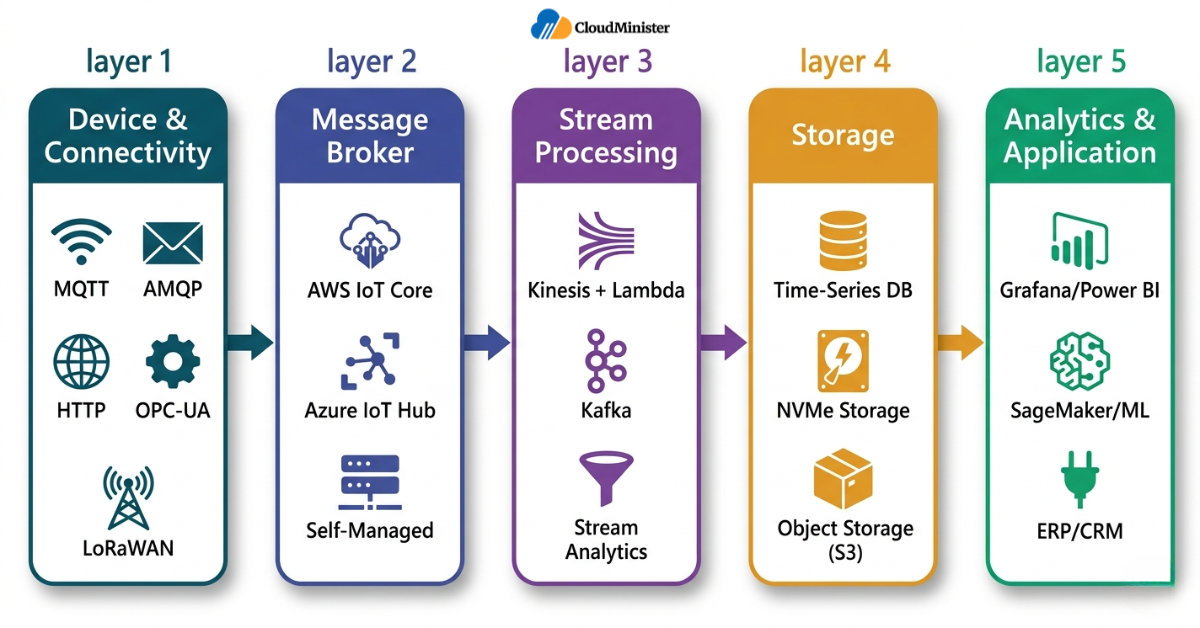
Device and Connectivity Layer
Sensors, actuators, edge gateways, and microcontrollers form the base. The protocol choice must match your deployment’s data velocity, power constraints, and security requirements:
| Protocol | Best For | Indian Deployment Context |
| MQTT | High-frequency, low-bandwidth telemetry | Manufacturing sensors, agricultural monitors, smart meters |
| AMQP | Enterprise message queuing with delivery guarantees | Logistics platforms, fintech device integrations |
| HTTP/HTTPS | REST-based web-connected devices | Consumer IoT, retail POS systems |
| OPC-UA | Industrial automation protocol | SCADA integration, manufacturing IoT cloud integration |
| LoRaWAN / NB-IoT | Low-power long-range rural devices | Remote agricultural and smart city IoT integration |
Message Broker Layer
Every IoT cloud integration needs a broker that receives device payloads, validates them, and routes them to downstream consumers:
- AWS IoT Core: Managed MQTT broker handling billions of messages with per-device X.509 authentication and a configurable Rules Engine routing to Lambda, Kinesis, DynamoDB, or S3.
- Azure IoT Hub: Supports MQTT, AMQP, and HTTP with device twin synchronisation and native Event Hubs integration for stream processing.
- Self-managed brokers: Eclipse Mosquitto or EMQ X on VPS Hosting in India for low-latency IoT cloud integration where managed service costs are prohibitive at fleet scale.
Stream Processing Layer
- AWS Kinesis + Lambda: Sub-second processing for high-velocity IoT cloud integration — anomaly detection, predictive maintenance triggers, geofence alerts.
- Apache Kafka on cloud hosting India: Distributed event streaming for multi-consumer fan-out — one device event consumed simultaneously by analytics, alerting, and storage.
- Azure Stream Analytics: SQL-based time-windowed aggregations over device fleet data in IoT cloud integration pipelines.
Storage Layer
Device data storage has fundamentally different requirements from transactional databases. IoT cloud integration storage must handle sustained high write throughput and time-indexed queries:
- Time-series databases (InfluxDB, Amazon Timestream): Optimised for high-frequency writes and time-windowed reads — the dominant IoT integration query pattern.
- NVMe cloud hosting India: Delivers 10x–50x higher sustained IOPS than standard SSD, eliminating the storage I/O bottleneck that causes data gaps and dashboard latency at fleet scale. NVMe cloud hosting India is well suited to high-velocity IoT deployments where sustained write IOPS exceed what standard SSD can handle — the right tier depends on message frequency and payload size, not device count alone.
- Object storage (S3, Azure Blob): For raw telemetry archiving and ML training datasets. The performance of your NVMe cloud hosting India object storage directly affects ingestion latency.
Before provisioning storage for an IoT cloud integration deployment, benchmark your expected write IOPS. A fleet of 5,000 sensors writing every 10 seconds generates 500 sustained writes per second. Benchmark your expected write IOPS before provisioning. NVMe-backed storage offers significant headroom for high-velocity workloads, while standard SSD may be adequate for lower-frequency or smaller fleets — size the tier to your actual data velocity.
Analytics and Application Layer
- Descriptive analytics: Grafana, AWS QuickSight, or Power BI dashboards visualising device state and fleet-level trends in real time.
- Predictive analytics: ML models trained on device telemetry to forecast equipment failures and operational inefficiencies — AWS SageMaker, Azure ML, and Vertex AI are the production platforms.
- Application integration: REST API and webhook connections linking IoT cloud integration outputs to ERP, CRM, SCADA, and MES systems to close the sensor-to-business-process loop.
4. Implementing IoT Cloud Integration — Phase-by-Phase Roadmap
Implementing IoT cloud integration is a structured programme — typically 12–18 months for a full multi-vertical deployment, or 8–12 weeks for a focused single-use-case pilot.
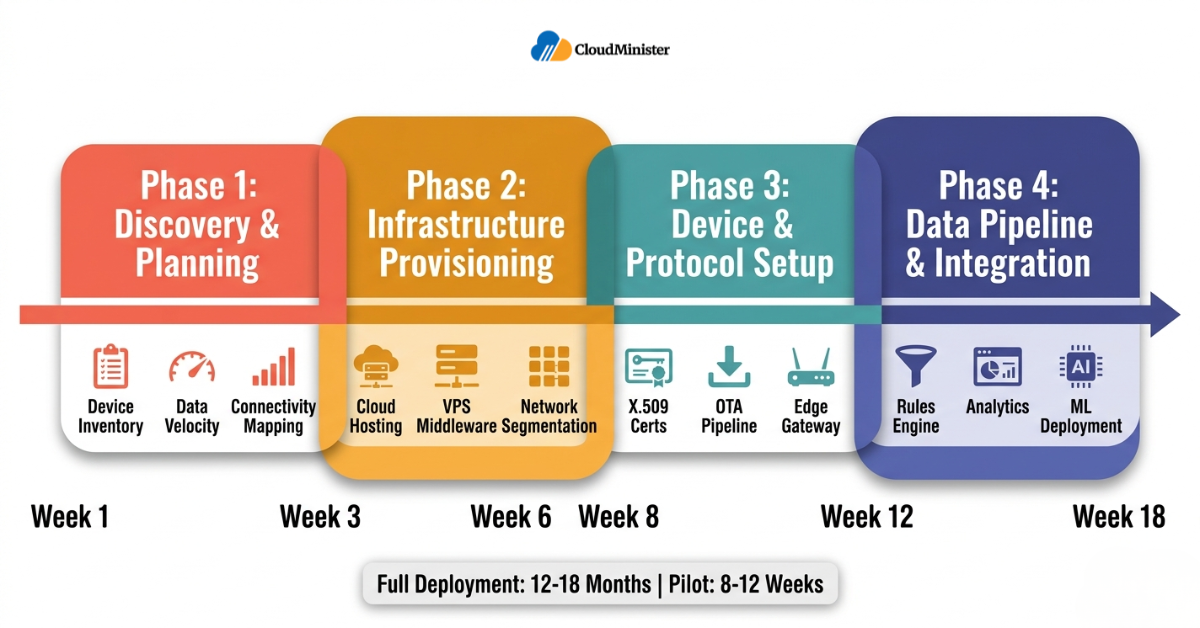
Phase 1: Discovery and Planning (Weeks 1–3)
- Device inventory: Catalogue all devices — sensor type, protocol, data format, transmission frequency, power source. Cloud architecture cannot be correctly sized without a complete inventory.
- Data velocity estimation: Calculate messages-per-second from the full fleet. This figure determines broker scaling, stream processor configuration, and NVMe cloud hosting India storage tier requirements.
- Connectivity mapping: Confirm 4G LTE, 5G, Wi-Fi, or LoRaWAN coverage at all device locations. Gaps require edge gateway deployment before IoT cloud integration can proceed.
- DPDPA 2023 pre-assessment: Identify whether any device data includes personal information of Indian citizens. Document technical safeguard requirements, including any sector-specific or contractual data residency obligations, before architecture is finalized.
Phase 2: Infrastructure Provisioning (Weeks 3–8)
- Platform selection: Choose AWS IoT Core, Azure IoT Hub, or a self-managed broker based on team competency, ecosystem fit, and compliance requirements.
- Cloud hosting India provisioning: Provision compute and storage on a cloud hosting India provider supporting VPC isolation, NVMe cloud hosting India storage, and private connectivity. Public-only cloud hosting creates security gaps that application-layer controls cannot compensate for.
- VPS Hosting in India for middleware: Self-managed MQTT brokers, protocol translators, and device provisioning services require dedicated isolated compute. VPS Hosting in India eliminates the noisy-neighbour risk of shared hosting for these latency-sensitive IoT cloud integration components.
- Network segmentation: IoT device traffic must be isolated from application and user traffic in separate VPCs or VNets — the IoT cloud integration equivalent of network micro-segmentation.
Related Reading: Cloud hosting innovations shaping IoT cloud integration infrastructure — Azure capabilities that matter for IoT workloads.
Phase 3: Device Provisioning and Protocol Configuration (Weeks 6–12)
- Per-device X.509 certificates: Every device receives a unique cryptographic identity. Fleet provisioning scripts automate issuance — manual assignment is infeasible above 100 devices.
- MQTT topic structure: Define a hierarchical topic schema — {org}/{site}/{device-type}/{device-id}/{metric} — enabling per-device routing and granular access control.
- OTA firmware pipeline: Over-the-Air update mechanisms must be built into the IoT cloud integration architecture from day one. Devices without OTA are permanently vulnerable to firmware-level exploits.
- Edge gateway configuration: For legacy PLCs, MODBUS instruments, and 4–20mA sensors without native cloud connectivity, AWS Greengrass or Azure IoT Edge bridge the protocol gap without hardware replacement.
Phase 4: Data Pipeline, Analytics, and Application Integration (Weeks 8–18)
- Rules engine: AWS IoT Core Rules Engine or Azure IoT Hub message routing filters and routes device messages to Kinesis, DynamoDB, and S3 on NVMe cloud hosting India.
- Dashboard provisioning: Deploy Grafana, AWS QuickSight, or Power BI with live connections to your time-series database and stream processor outputs.
- ERP and business integration: REST API connections link IoT cloud integration outputs to SAP, Oracle, or custom ERP systems for work order generation, energy billing, and supply chain event triggers.
- ML model deployment: Deploy trained models to AWS SageMaker or Azure ML inference endpoints with automated retraining pipelines triggered by data drift detection.
Device authentication is the most critical security control in IoT cloud integration. A single compromised shared credential can enable malicious telemetry injection — corrupting ML training data, triggering false maintenance alerts, and creating fraudulent operational records. Enforce per-device X.509 certificates and topic-level policy isolation for every device in your IoT integration fleet. Never use shared credentials.
5. IoT Cloud Integration Security
IoT cloud integration security is more complex than application security because the attack surface spans physical devices, wireless protocols, edge hardware, and cloud infrastructure simultaneously. The following controls are baseline requirements — not optional enhancements.
5.1 Device Identity and Encryption
- Per-device X.509 certificates: Unique cryptographic identity per device with automated rotation on a defined schedule. Certificates older than 12 months without rotation are a policy violation in production IoT cloud integration.
- TLS 1.3 in transit: All MQTT over TLS (port 8883), HTTPS, and WebSocket connections enforce TLS 1.3 minimum. Unencrypted IoT integration traffic is not acceptable in any production deployment.
- AES-256 at rest: All time-series databases, object storage, and message queues on NVMe cloud hosting India must be encrypted at rest using customer-managed keys in AWS KMS or Azure Key Vault.
5.2 Network Isolation
- VPC isolation: IoT ingestion infrastructure operates in dedicated VPCs or VNets — segregated from application, analytics, and user-facing infrastructure.
- IoT-specific security groups: Allow only port 8883 and 443 inbound from device network ranges. No 0.0.0.0/0 inbound rules in any IoT cloud integration infrastructure.
- Private connectivity: Industrial deployments route device traffic through AWS Direct Connect or Azure ExpressRoute, not public internet, eliminating internet-exposed attack surface for manufacturing IoT cloud integration.
The most common IoT cloud integration security failure is not a sophisticated attack — it is misconfigured device policies that allow devices to subscribe to topics outside their authorised scope. Audit every device policy quarterly and automate compliance scanning monthly using AWS IoT Device Defender or Azure Defender for IoT.
5.3 DPDPA 2023 Compliance
For Indian businesses deploying IoT cloud integration where device data includes personal information — health wearables, employee location tracking, customer behaviour sensors — DPDPA 2023 obligations apply directly:
- Data minimisation: Collect only what the declared IoT integration purpose requires.
- Purpose limitation: Data collected for one purpose cannot be repurposed without fresh consent.
- Data residency: DPDPA 2023 does not impose a blanket data localisation mandate; it restricts cross-border transfers only to government-notified countries. However, many Indian businesses choose India-based storage for latency, contractual, or sector-specific reasons (e.g., RBI rules for payment data). Where residency is a business requirement, confirm contractual data centre locations with your hosting provider. Any web hosting provider in India engaged for IoT cloud integration must be able to demonstrate data centre locations within India.
- Audit logging: All access to personal IoT integration data must be logged — who accessed it, when, and for what purpose.
6. IoT Cloud Integration by Industry — Indian Business Verticals
6.1 Manufacturing
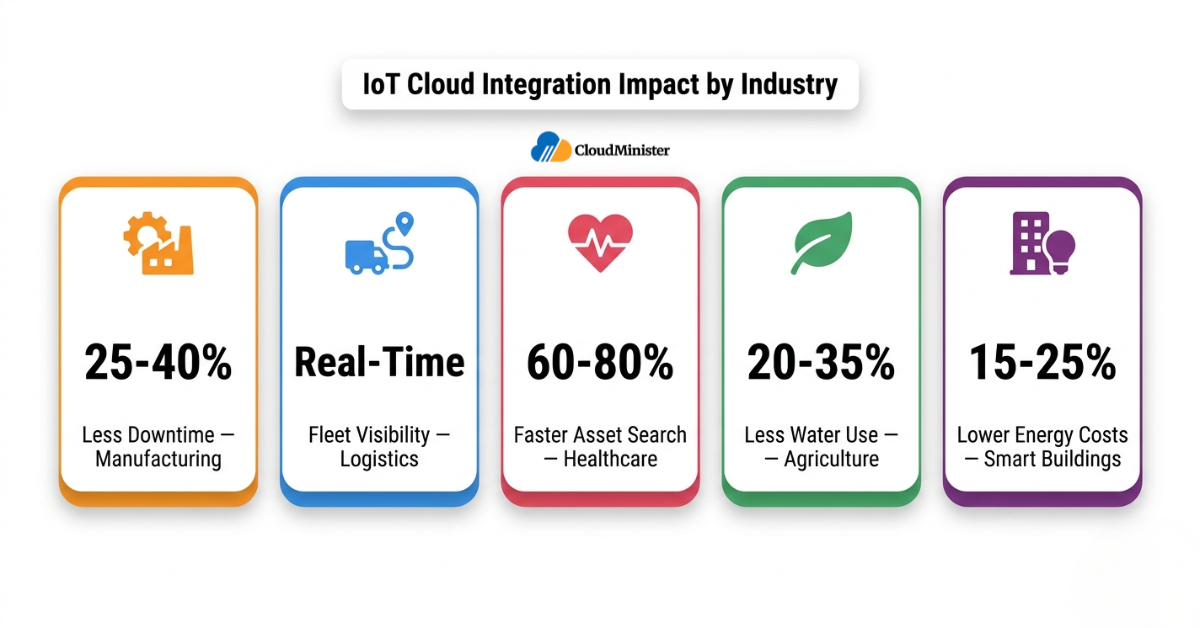
- Predictive maintenance: Vibration, temperature, and acoustic sensors feed IoT cloud integration pipelines detecting bearing wear 2–4 weeks before failure — reducing unplanned downtime by 25–40%.
- OEE optimisation: Real-time cycle time and machine availability data from production line IoT integration enables shift-level OEE calculation, replacing manual data collection with 4–8 hour reporting lags.
- NVMe cloud hosting India requirement: Manufacturing IoT cloud integration generates 1,000+ sustained writes per second from sensor fleets. Storage considerations: Manufacturing IoT deployments with high sustained write rates should evaluate NVMe-backed storage to avoid I/O bottlenecks. Actual requirements depend on sensor count, sampling frequency, and architecture.
Related Reading: Critical features separating production-grade cloud hosting providers from basic hosting services for IoT workloads.
6.2 Logistics and Fleet Management
- Real-time GPS and telematics: Vehicle IoT integration connecting GPS units, driver behaviour sensors, and cargo monitors to cloud dashboards for live fleet visibility and SLA compliance across pan-India operations.
- Cold chain monitoring: Temperature and humidity sensors in refrigerated trucks feeding IoT cloud integration pipelines — automated alerts for temperature excursions trigger cargo quarantine workflows before compliance violations occur.
- VPS Hosting in India for middleware: Logistics IoT integration platforms require dedicated isolated compute for message transformation and route optimisation engines. VPS Hosting in India ensures resource isolation during peak logistics processing windows.
6.3 Healthcare
- Remote patient monitoring: Wearable ECG monitors, SpO2 sensors, and continuous glucose monitors feed IoT cloud integration pipelines enabling clinicians to monitor patients outside hospital settings — supporting India’s telemedicine expansion under PM-JAY.
- Hospital asset tracking: RFID and BLE-based IoT integration tracking infusion pumps, ventilators, and wheelchairs reduces equipment search time by 60–80% and improves utilisation of high-cost capital equipment.
- Failover requirements: Medical IoT cloud integration supporting clinical decision-making must implement active-active failover across cloud hosting India availability zones. RPM alerts cannot tolerate data gaps from single-AZ deployments.
6.4 Smart Agriculture
- Precision irrigation: Soil moisture and micro-weather station IoT integration generates irrigation schedules that reduce water consumption by 20–35% in documented Indian agricultural deployments.
- Crop health monitoring: Drone multispectral imaging and NDVI sensors feed IoT cloud integration pipelines detecting disease and nutrient deficiency at field level.
- NVMe cloud hosting India for agronomic data: Multi-season IoT integration datasets are the training data for crop yield prediction models. NVMe cloud hosting India ensures query performance on these large time-series datasets does not degrade as historical data accumulates.
6.5 Smart Buildings and Energy
- BMS IoT cloud integration: HVAC, lighting, and access control sensors feeding cloud platforms that optimise energy consumption and predict maintenance — reducing building energy costs by 15–25%.
- Smart metering: Electricity and water meters reporting in 15-minute intervals for granular billing, demand forecasting, and theft detection.
- NVMe cloud hosting India for BMS: Buildings with 10,000+ sensor points generate continuous high-frequency telemetry. NVMe cloud hosting India ensures IoT integration data ingestion and dashboard performance are not limited by storage I/O.
Before selecting an IoT cloud integration platform for a specific vertical, define the three most time-critical events your deployment must detect. Trace the full data path from sensor to alert action and measure the maximum acceptable latency. Manufacturing bearing failure may tolerate 30 seconds; cold chain excursion needs under 60 seconds; medical device alarm must be under 5 seconds. Latency requirements determine whether your IoT cloud integration needs edge processing, stream processing, or standard batch architecture.
7. Hosting Infrastructure Requirements for IoT Cloud Integration
Your IoT cloud integration is only as reliable as the infrastructure it runs on. Choosing the right web hosting provider in India — one with VPC isolation, NVMe cloud hosting India storage, and managed operations — is as important as choosing the right IoT platform.
7.1 NVMe Cloud Hosting India — Storage That Matches IoT Velocity
Standard SSD-backed storage is the most common infrastructure bottleneck in IoT cloud integration deployments. NVMe cloud hosting India delivers 10x–50x higher sustained IOPS, directly translating to higher device message ingestion rates, lower time-series query latency, and more responsive dashboards for IoT integration operators.
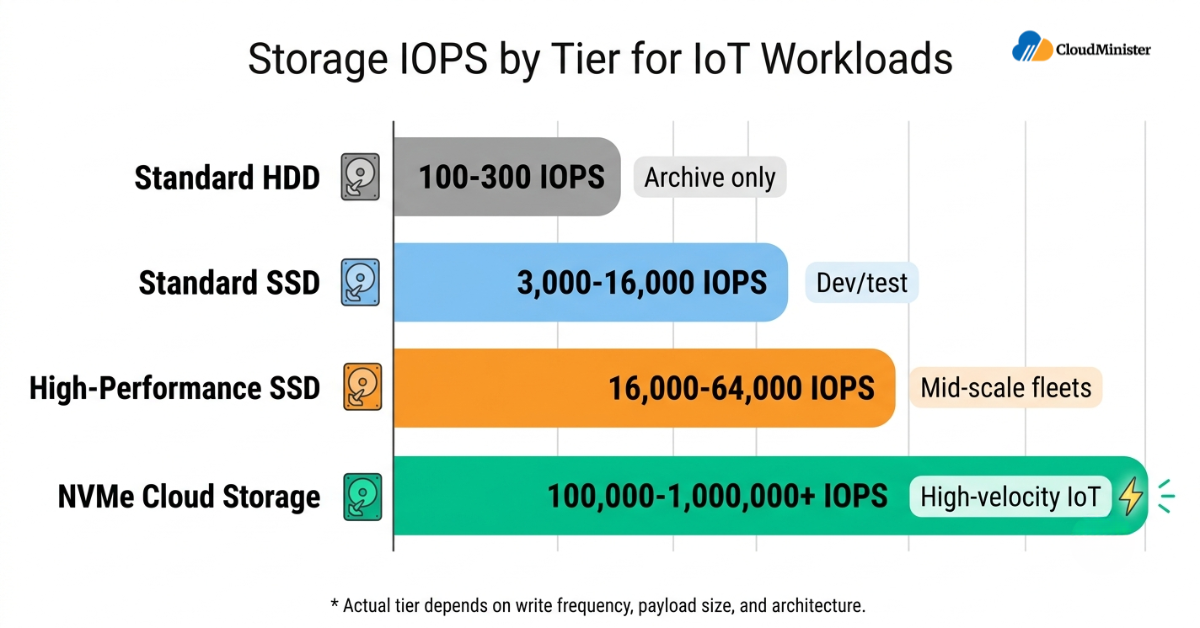
| Storage Type | Sustained IOPS | IoT Cloud Integration Fit |
| Standard HDD | 100–300 | Not suitable — archive only |
| Standard SSD | 3,000–16,000 | Dev/test only — throttles at fleet scale |
| High-Performance SSD | 16,000–64,000 | Typical Fit ~10,000 devices |
| NVMe cloud hosting India | 100,000–1,000,000+ | Purpose-built for high-velocity IoT cloud integration |
7.2 VPS Hosting in India for IoT Middleware
Self-managed MQTT brokers, schema registries, device provisioning services, and protocol translation layers require dedicated, isolated compute. VPS Hosting in India provides the resource isolation that shared hosting cannot deliver for production IoT cloud integration middleware workloads. VPS Hosting in India with private network connectivity to your device fleet also reduces the attack surface compared to routing IoT integration middleware traffic over the public internet.
7.3 Network Isolation and Managed Operations
- VPC-equivalent isolation: IoT cloud integration broker infrastructure in dedicated network segments — separated from application, analytics, and user-facing tiers.
- Private peering: Direct connectivity options for on-premises IoT integration deployments that cannot route device data over public internet.
- 24/7 managed operations: IoT cloud integration platforms require round-the-clock infrastructure monitoring, automated OS patching, and capacity planning. A web hosting provider in India offering managed NVMe cloud hosting India services delivers this without consuming your engineering team’s capacity.
- DDoS protection: MQTT brokers are primary targets for volumetric attack campaigns. Any web hosting provider in India powering IoT integration infrastructure must offer network-layer DDoS mitigation as standard.
Before engaging a web hosting provider in India for IoT cloud integration, verify four prerequisites: NVMe cloud hosting India storage availability, VPC-equivalent network isolation with private peering, SOC 2 or ISO 27001 certification, and 24/7 managed operations with IoT workload experience. Infrastructure gaps at this layer surface as reliability incidents as your IoT integration fleet scales.
8. AWS vs Azure vs Self-Managed — IoT Cloud Integration Platform Comparison
| Dimension | AWS IoT Core | Azure IoT Hub | Self-Managed (VPS Hosting in India) |
| Device scale | Billions of devices | Millions of devices per hub | Limited by provisioned infrastructure |
| Protocol support | MQTT, HTTP, WebSocket | MQTT, AMQP, HTTP | Any protocol with custom broker |
| Indian data residency | AWS Mumbai (ap-south-1) | Azure Central/South India | Guaranteed with cloud hosting India |
| Edge computing | AWS Greengrass | Azure IoT Edge | Custom Docker/K8s on edge nodes |
| DPDPA 2023 alignment | Strong with residency config | Strong with residency config | Full control; depends on provider |
| Operational overhead | Low (fully managed) | Low (fully managed) | High (team manages infrastructure) |
| Cost model | Pay-per-message | Per-device per-day tiered | Fixed infra cost; variable ops |
| Best for IoT integration | Large enterprises, managed scale | Microsoft-stack organisations | Cost-sensitive; full protocol control |
Related Reading: Is cloud hosting infrastructure the right foundation for IoT cloud integration?
9. IoT Cloud Integration Readiness Checklist
Before committing to a full IoT cloud integration programme, verify readiness across these prerequisites:
- Device inventory complete: All devices, protocols, data formats, and transmission frequencies documented.
- Data velocity modelled: Messages-per-second from the full fleet calculated; IOPS requirements mapped to NVMe cloud hosting India specifications.
- Platform selected: AWS IoT Core, Azure IoT Hub, or self-managed broker chosen based on competency and compliance requirements.
- NVMe cloud hosting India provisioned: VPC-isolated infrastructure with encrypted storage and private connectivity active before any device connects.
- VPS Hosting in India for middleware: Dedicated isolated compute provisioned for MQTT brokers, protocol bridges, and device provisioning services.
- Web hosting provider in India verified: SOC 2 / ISO 27001 certification confirmed; India data centre locations verified; data residency contractually guaranteed.
- Device identity strategy active: Per-device X.509 certificate issuance, fleet provisioning automation, and rotation schedule documented.
- DPDPA 2023 scope assessed: Personal data in IoT integration identified; applicable cross-border transfer and sector-specific obligations reviewed with legal counsel.
- Security baseline in place: TLS 1.3 enforced, VPC isolation deployed, broker policy audit scheduled quarterly.
- OTA update pipeline tested: Firmware update mechanism validated before go-live — devices without OTA are permanently vulnerable.
Ready to Build Your IoT Cloud Integration Architecture?
Talk to our DevOps & IoT team today and get expert guidance on protocol selection, NVMe storage sizing, VPS Hosting in India for middleware, and DPDPA-aligned compliance for your device fleet
Conclusion
IoT cloud integration in India in 2026 is an operational necessity for any business deploying connected devices at scale. The implementation sequence in this guide — device discovery, protocol selection, broker configuration, NVMe cloud hosting India storage provisioning, security controls, analytics deployment, and application integration — is the production framework that CloudMinister’s engineering team applies across manufacturing, logistics, agriculture, healthcare, and smart infrastructure engagements.
Indian businesses that implement structured IoT integration today — on properly provisioned cloud hosting India infrastructure with VPC isolation, dedicated VPS Hosting in India middleware, and managed security controls — will be measurably more competitive and more DPDPA-compliant than those still managing connected devices without cloud pipelines. CloudMinister’s IoT cloud integration team provides architecture, implementation, and managed operations tailored to your device fleet, vertical requirements, and compliance obligations. Partner with a web hosting provider in India that understands every layer of the IoT stack — from NVMe cloud hosting India storage to device-level certificate management.
Key Takeaways
| IoT cloud integration spans five layers: device/connectivity, message broker, stream processing, storage, and analytics/application integration. |
| The global IoT integration market reaches USD 7.75 billion in 2026 at 28% CAGR — India and South Asia account for USD 13.3 billion in IoT spending. |
| Per-device X.509 authentication, TLS 1.3 in transit, AES-256 at rest, and VPC-isolated brokers are the four non-negotiable security controls for IoT cloud integration. |
| NVMe cloud hosting India is the correct storage tier for high-velocity IoT cloud integration — standard SSD creates I/O bottlenecks that degrade dashboards and data completeness at fleet scale. |
| DPDPA 2023 applies to IoT cloud integration deployments processing personal data — purpose limitation, data minimisation, and access logging are direct compliance requirements; data residency is relevant mainly where sector-specific rules or cross-border transfer restrictions apply. VPS Hosting in India provides the isolated middleware compute layer IoT integration platforms require for MQTT brokers, protocol bridges, and schema registries. |
| A full-scale IoT cloud integration deployment takes 12–18 months; a single-use-case pilot can be production-ready in 8–12 weeks. |
| NVMe cloud hosting India storage must be provisioned before any device connects — mid-deployment storage migration from SSD costs significantly more than the initial tier upgrade. |
Frequently Asked Questions
What is the difference between IoT integration and IoT cloud integration?
IoT integration is the broad concept of connecting IoT devices to other systems — on-premises, cloud, or hybrid. IoT cloud integration specifically refers to connecting devices to cloud infrastructure: managed message brokers, cloud-native stream processors, cloud-hosted time-series databases, and cloud analytics platforms. IoT cloud integration enables scale, geographic distribution, and managed service economics that on-premises deployments cannot match.
Why does NVMe cloud hosting India matter specifically for IoT cloud integration?
High-velocity IoT workloads generate sustained write IOPS that standard SSD storage cannot reliably handle. NVMe cloud hosting India delivers 10x–50x higher IOPS compared to standard SSD, eliminating the storage bottleneck that causes data gaps, dashboard latency, and time-series query degradation at fleet scale. NVMe-backed storage becomes increasingly valuable as sustained write IOPS grow. Rather than a fixed device-count threshold, the right tier depends on your fleet’s actual write frequency, payload size, and query patterns — benchmarking your workload is the reliable way to decide. Confirm that your cloud hosting India provider offers NVMe-backed block storage before provisioning IoT cloud integration infrastructure.
When should I use VPS Hosting in India versus managed cloud for IoT cloud integration?
Managed cloud platforms (AWS IoT Core, Azure IoT Hub) are the right choice for most large-scale deployments where operational overhead is a constraint. VPS Hosting in India is the correct choice for self-managed MQTT brokers, schema registries, protocol translation middleware, and device provisioning services where you need full protocol control, dedicated resource isolation, or cost predictability at high message volumes. Many production IoT cloud integration deployments use both: managed cloud for device connectivity and VPS Hosting in India on a cloud hosting India provider for middleware and transformation layers.
What should I look for in a web hosting provider in India for IoT cloud integration?
Four non-negotiable criteria: (1) NVMe cloud hosting India storage availability, (2) VPC-equivalent network isolation with private peering support, (3) SOC 2 Type II or ISO 27001 certification, (4) 24/7 managed operations with IoT workload experience. A web hosting provider in India that cannot meet all four creates infrastructure gaps that no application or protocol-layer control can compensate for. Additionally, if data residency is a business or sectoral requirement, verify the provider’s India data centre locations and contractual guarantees — note this is a business/compliance choice rather than a universal DPDPA mandate. VPS Hosting in India with these capabilities is the foundation for reliable IoT cloud integration middleware.
How long does IoT cloud integration implementation take?
A focused single-use-case deployment — predictive maintenance for one production line or cold chain monitoring for a logistics fleet — can be production-ready in 8–12 weeks with a complete device inventory and clear use case definition. Full-scale multi-vertical IoT cloud integration across multiple sites typically requires 12–18 months. The most common cause of schedule overrun is starting cloud infrastructure provisioning before the device inventory is complete — the cloud architecture cannot be correctly sized for an unknown fleet.

He is the CEO and Founder with over a decade of experience in cloud infrastructure, DevOps, and server optimization. With a strong vision and hands-on leadership approach, he has built scalable, secure, and high-performance cloud solutions trusted by businesses across industries.