



Most startups don’t run out of runway because of one bad month, they run out of it because cloud cost optimization gets treated as a someday task while the cloud bill quietly compounds in the background. Cloud cost optimization is not about panicking and shutting down servers the week before a board meeting, it is about knowing exactly what is running, why it is running, and whether it still deserves to be on the bill at all. This guide walks through what a founder or a lean engineering team should cut first when spend needs trimming, what should be trimmed carefully, and what should almost never be touched even under pressure. Along the way, the discussion also touches on how cloud cost optimization fits inside broader server management decisions, and how it connects to whether a startup is running on cloud hosting or a dedicated server setup for its core workloads.
Every founder eventually opens the cloud billing dashboard and feels a small jolt of confusion, the number on screen does not match what they expected to see, and the instinct is usually to blame one specific service or one bad decision. In reality, the story behind most inflated cloud bills is far less dramatic and far more common. Cloud cost optimization is not something that fails because of a single mistake, it fails slowly, through small decisions that nobody circled back to fix. A test environment that was supposed to run for a week keeps running for six months. A virtual machine sized for a traffic spike stays that size long after the spike is over. None of these choices feel urgent in the moment, which is exactly why they add up.
For a startup, runway is not just a financial metric, it is time, and time is the one resource that cannot be bought back once it is gone. Cloud cost optimization matters because every rupee spent on infrastructure that nobody is actually using is a rupee that could have gone toward hiring an engineer, running another marketing experiment, or simply buying the team another month to find product market fit. The challenge is that cloud infrastructure is built to make adding resources effortless, provisioning something new takes seconds, while removing something unused requires someone to notice it, question it, and take responsibility for shutting it down. That imbalance is what allows cost to drift upward even when nobody made a single bad call.
This guide exists to bring structure to a process that most teams handle reactively. Instead of waiting for a scary invoice to force a panic driven cleanup, cloud cost optimization works best as a habit, one that separates the safe wins from the changes that need real testing, and clearly protects the parts of the infrastructure, like security and backups, that should never be touched just to save a few dollars. The sections ahead walk through exactly where to start, what deserves more caution, and how to build a review process that keeps the bill honest month after month, not just the one time a founder finally sat down to look closely.
Table of Contents
- 1. Why This Matters for Startup Runway
- 2. What to Cut First: The High Impact, Low Risk Layer
- 3. The Middle Layer: Cuts That Need a Little More Thought
- 4. What Not to Cut: Protecting Reliability
- 5. Choosing the Right Infrastructure Foundation
- 6. Building a Repeatable Process, Not a One Time Cleanup
- 7. Common Mistakes Startups Make Under Runway Pressure
- 8. Governance and Operational Discipline Around Spend
- 9. Measuring Whether It’s Actually Working
- 10. Choosing the Right Hosting Partner
- 11. A Practical Scenario: Picking Between the Two Foundations
- 12. How a Hosting Partner Typically Guides This Decision
- 13. A Note on Migration Timing
- Key Takeaways
- Conclusion
- Frequently Asked Questions
1. Why cloud cost optimization becomes urgent for startups
For founders and early engineering teams, this conversation usually starts the same way, often while comparing notes with a Web Hosting Company in India about why the monthly invoice keeps climbing faster than the user base. Someone opens the billing dashboard, sees a number that does not match expectations, and asks whether this problem should have been caught three months earlier. Cloud Cost Optimization is the ongoing practice of aligning what a company actually pays for cloud infrastructure with what its workloads genuinely need, without compromising uptime or product experience. For a startup trying to extend runway, this is not a nice to have. It is often the difference between reaching the next funding round on the team’s own terms or reaching it from a position of weakness.
- Runway is the single most important number in an early stage company, and trimming waste directly extends it by cutting recurring spend that was never delivering proportional value in the first place.
- Cloud bills tend to grow silently because provisioning a new resource takes thirty seconds while decommissioning an unused one requires someone to notice it, investigate it, and take responsibility for removing it, which is exactly the discipline Cloud Cost Optimization is built to enforce.
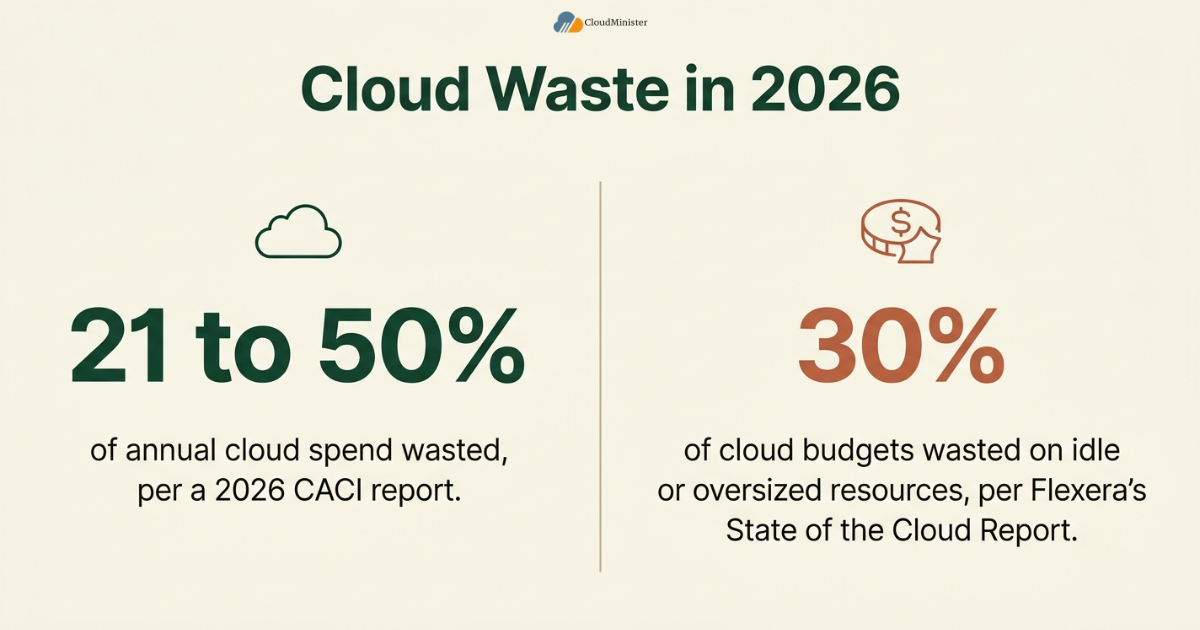
- A recent industry study found that companies waste between twenty one and fifty percent of their annual cloud spend, according to a 2026 report from CACI, which means even a modest startup can realistically recover a meaningful chunk of monthly burn without touching product velocity.
- Startups without a structured approach commonly discover, months later, that a staging environment has been running at production scale the entire time, quietly eating into runway that should have gone toward hiring or product development.
- A disciplined approach to Cloud Cost Optimization centralizes spend visibility at the founder or engineering lead level, sometimes in partnership with a Web Hosting Company in India, rather than leaving every provisioning decision to whichever engineer needed a resource fastest.
Before starting a full Cloud Cost Optimization pass, pull the last three months of billing data and sort it by service, not by date. Startups that look at spend service by service, rather than as one lump total, consistently find the same pattern: two or three services are responsible for the overwhelming majority of the bill, and that is exactly where trimming should begin.
2. What to cut first: the high impact, low risk layer
Before working through the deeper layers of this guide, it helps to understand that not every cost cutting decision carries the same risk. Cloud Cost Optimization works best when a team starts with changes that are almost impossible to get wrong before moving toward changes that require more judgment.
- Idle and orphaned resources are the first target of any spend review, since unattached storage volumes, unused static IP addresses, and forgotten load balancers cost real money every single day without serving a single user.
- Non production environments left running twenty four hours a day are a classic win, since a staging or development environment that only needs to exist during working hours can often be scheduled to shut down overnight and on weekends.
- Over-provisioned compute instances, where a virtual machine is sized for a traffic spike that happens twice a year, represent one of the fastest wins in Cloud Cost Optimization because rightsizing them down rarely affects the user experience at all.
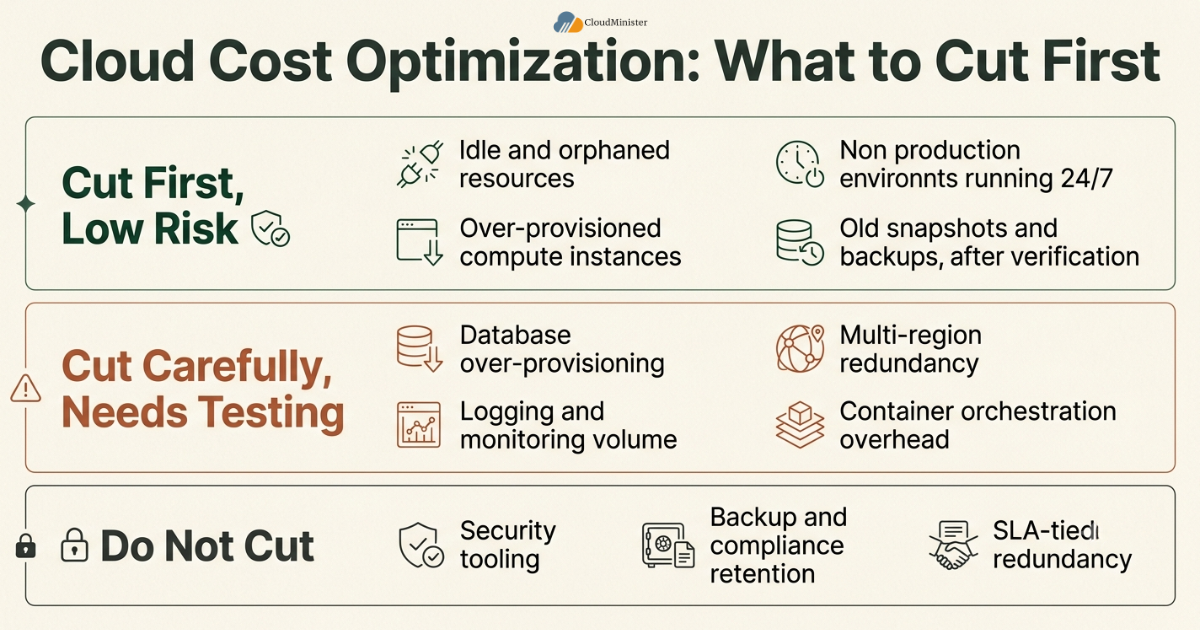
- Redundant storage snapshots and old backups that nobody has referenced in months quietly accumulate cost, but they should be verified against disaster recovery, compliance, and retention requirements before deletion, since an old backup that looks unused can still be the only copy required for those purposes.
- Unused reserved capacity or unmatched savings plans, where a company pays for committed usage it never actually consumes, is exactly the kind of gap a Server Management Company is trained to catch during a routine review.
Related Reading: cloud cost governance policy
Cutting idle resources changes what exists in an environment, not how it is protected, so a team should always confirm a resource is truly unused, not simply quiet, before deleting it. An orphaned volume that still contains a customer data backup is not safe to remove without a documented retention check, and skipping that step turns a good Cloud Cost Optimization habit into a compliance problem.
3. The middle layer: cuts that need a little more thought
Many startups first encounter this next layer while already researching a Web Hosting Company in India for their broader production needs, and a capable Web Hosting Company in India will usually raise these exact trade offs early in that conversation, since a good partner rarely separates cost advice from architecture advice.
- Database over-provisioning is a common target for this stage of Cloud Cost Optimization, but downsizing a production database instance requires actual load testing first, since a database that looks idle at 2 a.m. may still be handling the busiest hour of the entire day.
- Multi-region redundancy built for a scale the company has not reached yet is worth revisiting, since running a full standby environment in a second region before there is any regulatory or reliability requirement for it can quietly double infrastructure spend.
- Third party monitoring, logging, and observability tools often bill by data volume, and progress here usually means reducing log retention windows or sampling rates rather than removing visibility entirely.
- Container orchestration overhead, where a small startup runs a full Kubernetes cluster sized for hundreds of services when it is running a dozen, needs careful migration planning rather than an overnight switch.
- Data transfer and egress fees between cloud regions or between a CDN and origin servers are frequently overlooked, even though they can represent a meaningful line item once traffic grows past a certain point.
Related Reading: cloud pricing model types explained
The pattern that separates a genuinely effective Cloud Cost Optimization effort from a fragile one is sequencing. A team that tackles the middle layer changes with proper load testing and a rollback plan in hand typically preserves reliability while still recovering meaningful spend, rather than a team that treats every cut with the same urgency regardless of the actual risk involved.
4. What not to cut: protecting reliability while pursuing cloud cost optimization
Aggressive cost cutting done carelessly can quietly undo years of product trust in a single outage, so a mature approach to Cloud Cost Optimization draws a clear line around what should almost never be the first thing touched.
- Security tooling, including intrusion detection, vulnerability scanning, and identity access management services, should stay outside the scope of aggressive trimming, since the cost of a breach almost always dwarfs whatever was saved by disabling the tool that would have caught it.
- Backup frequency and retention for genuinely critical data should not be the first place a team looks, since restoring from a three month old backup after a data loss event costs far more in trust and engineering time than the storage fees ever would have.
- Redundancy for systems with an active service level agreement tied to real customer contracts should be reviewed carefully rather than cut reflexively, since breaching an SLA to save on infrastructure spend usually costs more in credits and churn than it saves.
- Performance headroom for the core product experience, the actual paths a paying customer touches every day, deserves more caution than a rarely used internal admin tool or an experimental feature flag.
- Compliance related infrastructure, particularly for startups in regulated spaces like fintech or healthtech, should be evaluated by someone who understands the regulatory requirement before any changes are made, since a Server Management Company handling compliant workloads will usually flag this distinction early.
Related Reading: IoT cloud integration
4.1 A quick comparison: cloud hosting solutions in India vs dedicated servers in India
Before deciding what to cut, it helps to understand the two broad infrastructure families most startups choose between. Cloud Hosting Solutions in India and Dedicated Servers in India solve the same underlying goal, running an application reliably, but they get there in very different ways.
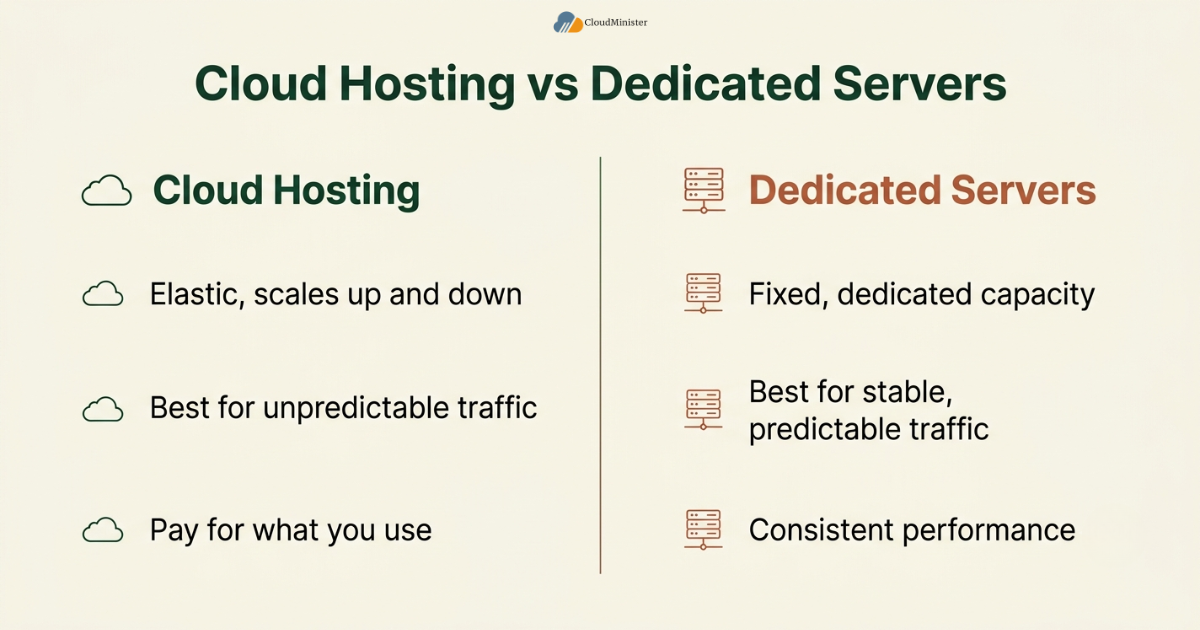
- Cloud Hosting Solutions in India are built around elasticity, letting a startup scale compute up during a traffic spike and scale it back down once demand fades, which suits workloads that genuinely fluctuate.
- Dedicated Servers in India hand a startup an entire physical machine with no resource sharing, which suits workloads that need consistent, predictable performance without the variability that comes from a shared multi tenant environment.
- Startups evaluating Cloud Hosting Solutions in India should confirm that their workload actually needs elasticity, since paying a premium for scaling flexibility that never gets used is one of the most common forms of waste a review uncovers.
- Startups evaluating Dedicated Servers in India should confirm their traffic is genuinely stable, since committing to fixed capacity for a workload that later spikes unpredictably can force an expensive emergency migration.
- Many growing companies eventually run both Cloud Hosting Solutions in India and Dedicated Servers in India side by side, placing each workload on whichever foundation actually matches its behavior rather than defaulting everything to one option out of habit.
- A knowledgeable Web Hosting Company in India can walk a founding team through this exact trade off using real usage data rather than generic marketing claims, which tends to produce a far more durable infrastructure decision.
5. Choosing the right infrastructure foundation for cloud cost optimization
Cloud Cost Optimization is not only about what a startup cuts after the fact. It is also about whether the underlying infrastructure choice was right from the beginning. Many teams over-index on public cloud elasticity for workloads that are actually steady and predictable.
- Cloud hosting services in India have become a standard starting point for early stage startups because they scale up quickly during unpredictable growth phases, which makes cost discipline easier to apply gradually rather than through a disruptive migration.
- For workloads with a stable, predictable baseline, such as a core application server that runs at roughly the same load every day, a Dedicated Server Hosting in India setup can often deliver better Cloud Cost Optimization outcomes than constantly right sizing elastic cloud instances.
- Startups running a mix of unpredictable and predictable workloads increasingly adopt a hybrid pattern, keeping bursty, customer facing services on cloud hosting services in India while moving steady background workloads to Dedicated Server Hosting in India, a split that meaningfully improves Cloud Cost Optimization outcomes over time.
- Cloud Hosting Solutions in India that include built in monitoring and rightsizing recommendations give founders a head start on Cloud Cost Optimization without needing a dedicated platform team from day one.
- Choosing between Dedicated Servers in India and elastic cloud capacity should be driven by the actual traffic pattern of the workload in question, not by which option sounds more modern, since the wrong default in either direction quietly undermines Cloud Cost Optimization months later.
- Teams sizing their infrastructure correctly from day one tend to get more predictable bills than teams that default every workload onto the most flexible and most expensive option available, which is one more reason a properly scoped Server Management Company matters before spend becomes a crisis.
Before committing to a single infrastructure pattern, map every workload against two questions: how predictable is its load, and how sensitive is it to latency. Workloads that are both predictable and latency sensitive are usually the best candidates for Dedicated Server Hosting in India, while workloads that are unpredictable but tolerant of some latency are the best fit for cloud hosting services in India, and getting this split right early makes every future Cloud Cost Optimization pass dramatically easier.
Not Sure If Cloud Hosting Fits Your Workload
See how CloudMinister’s cloud hosting plans scale with your traffic while keeping your infrastructure spend predictable.
6. Building a repeatable process, not a one time cleanup
Even a well executed first pass at Cloud Cost Optimization can lose all its value within two quarters if there is no supporting structure around it. Building a repeatable process matters as much as making the right cuts the first time.
- Set a recurring monthly or biweekly review specifically for spend, since a bill that looked efficient in January can quietly drift by March once new services get switched on without anyone revisiting the earlier decisions.
- Assign clear ownership for Cloud Cost Optimization to a specific person or small team, even at a five person startup, since spend that belongs to everyone in theory tends to belong to no one in practice.
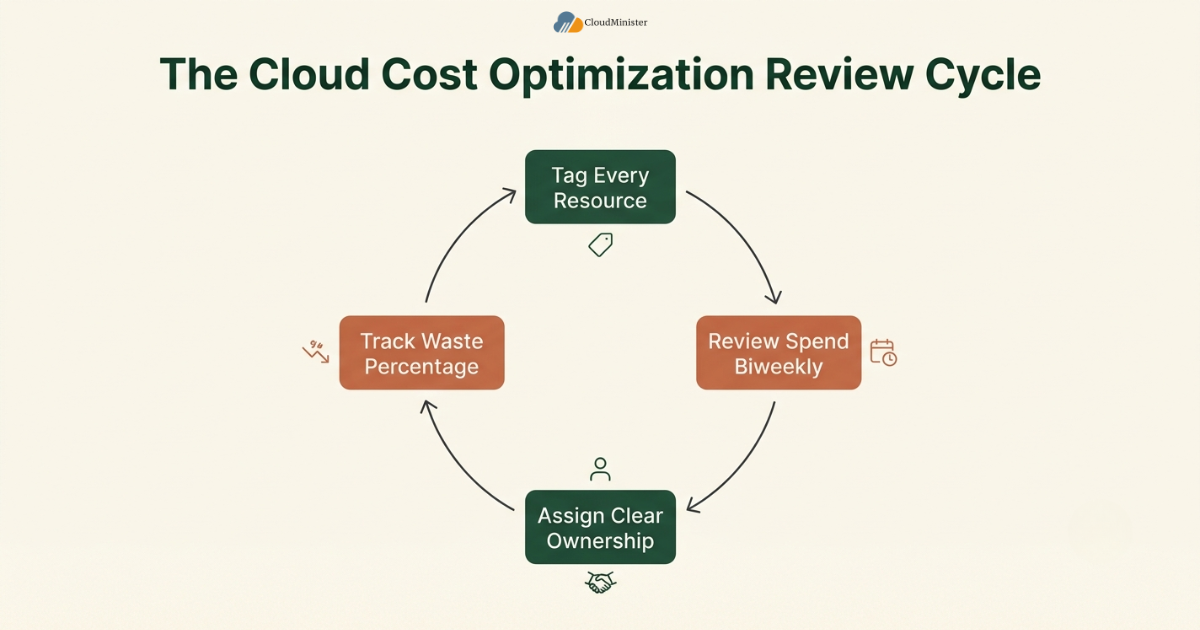
- Tag every resource by team, environment, and purpose from the moment it is created, since untagged infrastructure is the single biggest reason cost reviews take far longer than they should.
- Track a small set of metrics consistently, including cloud spend as a percentage of revenue, month over month cost growth, and the percentage of spend flagged as waste, rather than trying to track everything at once.
Related Reading: cloud cost governance policy
- Reassess infrastructure choices on a fixed schedule, ideally as part of routine Server Management Services in India reviews, since a workload that made sense on a Dedicated Server Hosting in India setup a year ago may have since outgrown it and now needs elastic cloud hosting services in India instead.
7. Common mistakes startups make under runway pressure
Even founders who understand Cloud Cost Optimization conceptually, including those already working with an established Web Hosting Company in India, can still fall into avoidable mistakes when the pressure to extend runway becomes acute.
- Cutting security or backup spend first simply because it is easy to disable, rather than starting with genuinely idle resources that carry zero operational risk when removed.
- Treating this work as a one time event tied to a fundraising deadline instead of an ongoing discipline, which means the savings evaporate within a few months once the pressure eases and old habits return.
- Migrating an entire workload from cloud hosting services in India to Dedicated Servers in India, or the reverse, without first benchmarking actual usage patterns, which can turn a well intentioned effort into a costly migration that does not even solve the underlying problem.
- Ignoring engineering time as a real cost when planning any spend reduction, since spending three weeks of an engineer’s time chasing a modest infrastructure saving is not actually optimization if the equivalent hours would have generated more revenue elsewhere.
- Not communicating changes across the team, leaving other engineers confused when a resource they expected to be running has been shut down or resized without warning, a coordination gap a responsive Web Hosting Company in India would normally help prevent.
Related Reading: EKS vs GKE vs AKS
Across real startup environments, the gap between a team that sustains its savings and one that quietly drifts back to bloated spend within two quarters is rarely about which specific cuts were made first. It is a difference in ongoing review discipline. Teams that assign clear ownership over infrastructure spend and revisit it on a fixed schedule, often with a Server Management Company handling the recurring checks, report far fewer instances of the kind of quiet cost creep that an unmanaged environment eventually produces.
8. Governance and operational discipline around cloud cost optimization
Standardizing Cloud Cost Optimization at a growing startup introduces a specific governance layer on top of the standard technical considerations that come with running production infrastructure.
- Spend related decisions should route through the same lightweight review process as any other production change, ideally with input from DevOps specialists, since an unreviewed cut can quietly remove a safeguard nobody remembered was load bearing.
- Centralized cost standards, coordinated with a single Server Management Company rather than allowing individual engineers to make provisioning decisions independently, prevent the kind of duplicated infrastructure that undermines Cloud Cost Optimization over time.
- Spend patterns should be reviewed on a recurring basis, ideally with support from a Web Hosting Company in India that already monitors the account, so that any unexpected cost growth gets flagged before it turns into a genuine budget crisis.
- Infrastructure decisions between cloud hosting services in India and Dedicated Server Hosting in India should be tracked explicitly, since knowing exactly which workloads sit on which foundation is far more useful during a review than discovering the mix while investigating a surprise invoice.
- A documented spend inventory, tracking which services run on Cloud Hosting Solutions in India and which have been deliberately placed on Dedicated Servers in India instead, gives a founding team, and any supporting Server Management Services in India partner, the audit trail needed to justify decisions to investors later.
Checklist: Readiness Before Standardizing Cloud Cost Optimization at Scale
- Current infrastructure spend mapped across every running service and environment
- Idle and orphaned resources identified and verified against retention/compliance needs, then scheduled for removal
- Workload predictability assessed to decide between cloud hosting services in India and Dedicated Server Hosting in India
- Ownership assigned for ongoing review and reassessment
- Backup, security, and compliance spend explicitly excluded from aggressive first pass cuts
- Monitoring configured to flag unexpected spend growth before the next invoice arrives
9. Measuring whether cloud cost optimization is actually working
Making the first round of cuts is not the finish line, whether the workload sits on a self managed environment or with an outside partner offering Server Management Services in India. Long term value depends entirely on how the changes are monitored and adjusted afterward.
- Track cloud spend as a percentage of revenue month over month, since a startup that is growing revenue faster than infrastructure cost is proving that its Cloud Cost Optimization effort is actually compounding rather than simply delaying the next spike.
- Compare actual resource utilization against what the architecture assumes, a discipline that matters equally for teams focused on long term efficiency, since real world usage often turns out lower than the original provisioning plan once it is properly audited.
- Review infrastructure allocation quarterly, flagging any workload still sitting on premium elastic capacity that no longer has a clearly documented burst requirement, a review many teams now delegate to their Web Hosting Company in India or a dedicated Server Management Company.
- Enterprises managing infrastructure at meaningful scale are not managing this challenge in isolation, and organizations globally are projected to waste roughly thirty percent of their cloud budgets on idle or oversized resources in 2026, according to Flexera’s State of the Cloud Report, underscoring why structured Cloud Cost Optimization matters just as much for a ten person startup as it does for an enterprise.
- Maintain a change log for every cost decision made, shared with the Server Management Company where relevant, so a founding team can trace exactly why a given configuration was chosen and whether the assumptions behind it still hold months later.
10. Choosing the right partner for cloud cost optimization
Not every hosting relationship is built to support disciplined Cloud Cost Optimization, so matching a provider’s capability to actual startup needs matters more than brand recognition alone, whether that provider delivers Server Management Services in India, cloud hosting services in India, or Dedicated Server Hosting in India.
- A dependable Web Hosting Company in India that already understands early stage constraints is well positioned to advise on cost discipline without pushing a startup toward infrastructure it does not yet need.
- Startups evaluating providers should specifically ask whether the provider has direct experience helping early stage customers with Cloud Cost Optimization at a meaningful scale, across cloud hosting services in India, Dedicated Server Hosting in India, or both, not just provisioning individual virtual machines.
- Teams that want to move quickly without designing every layer of their cost strategy themselves often gravitate toward a Server Management Company that comes with clear documentation on how spend interacts with existing infrastructure from day one.
- Founders who have not yet reviewed their hosting partner relationship specifically in the context of Cloud Cost Optimization, workload placement, or scaling readiness should treat this guide as a natural trigger point to do so, and to ask their Web Hosting Company in India directly.
- A Web Hosting Company in India that combines cost expertise with broader Server Management Services in India experience gives growing startups a coherent roadmap for scaling their infrastructure instead of stitching together advice from multiple vendors.
When comparing quotes or advice from different partners on Cloud Cost Optimization, whether they specialize in cloud hosting services in India, Dedicated Server Hosting in India, or a Server Management Company built around a specific stack, ask each one to walk through a real infrastructure audit from your own environment rather than a generic case study, since the right recommendation depends entirely on actual workload patterns and current burn rate.
11. A practical scenario: picking between the two foundations
Consider a startup running a customer facing web app alongside an internal analytics pipeline. The two workloads behave very differently, and treating them the same is a common mistake teams make before they build real cost discipline.
- The customer facing app sees unpredictable spikes tied to marketing campaigns, so Cloud Hosting Solutions in India is usually the right fit since it absorbs bursts without the team having to provision for the worst case year round.
- The internal analytics pipeline runs the same batch job every night at a predictable hour, which makes it a strong candidate for Dedicated Servers in India, since fixed capacity costs less over a year than paying an elastic premium for a workload that never actually varies.
- A startup that puts both workloads on cloud hosting services in India by default is often paying for flexibility the analytics pipeline never uses, while a startup that puts both on Dedicated Servers in India risks getting overwhelmed the first time a campaign drives an unexpected surge.
- Running this kind of workload by workload audit, ideally with a Web Hosting Company in India that can benchmark both Cloud Hosting Solutions in India and Dedicated Servers in India options, usually surfaces a hybrid setup that neither option alone would have suggested.
- A Dedicated Server Hosting in India provider with strong Server Management Services in India experience can usually run this audit alongside the startup’s existing cloud hosting services in India account rather than requiring a full switch to only one model.
- Startups that skip this exercise and instead pick a single Web Hosting Company in India offering and apply it uniformly across every workload tend to leave savings on the table that a short audit would have caught.
Getting this workload level decision right is, in many cases, the single highest leverage move a lean team can make, because it changes the baseline cost of every future month rather than producing a one time saving.
12. How a hosting partner typically guides this decision
Startups rarely need to make the choice between Cloud Hosting Solutions in India and Dedicated Servers in India entirely on their own. A partner who already understands both models can shorten the evaluation considerably.
- An experienced Web Hosting Company in India typically starts by reviewing the last quarter of traffic and resource utilization data before recommending Cloud Hosting Solutions in India, Dedicated Servers in India, or a specific blend of the two.
- A Dedicated Server Hosting in India provider that also offers Cloud Hosting Solutions in India under the same account makes it far easier to shift a workload between the two models later without a disruptive vendor migration.
- Teams asking a prospective Web Hosting Company in India about Dedicated Servers in India should also ask how quickly they can provision Cloud Hosting Solutions in India for the same account if a workload’s traffic pattern changes unexpectedly.
- A Server Management Company that manages both Dedicated Server Hosting in India and cloud hosting services in India for the same client tends to give more balanced advice than one that only sells a single product line.
- This is also where a startup can confirm whether its chosen Web Hosting Company in India offers proactive monitoring on both Dedicated Servers in India and Cloud Hosting Solutions in India, rather than reactive support that only responds after something breaks.
13. A note on migration timing
Switching between Dedicated Servers in India and elastic capacity is rarely something to rush, and the timing of that switch matters just as much as the decision itself.
- A workload should only move to Dedicated Servers in India once at least two or three months of consistent traffic data confirms the pattern is genuinely stable, rather than making the call off a single quiet week.
- A workload should only move onto Cloud Hosting Solutions in India ahead of an anticipated launch or campaign, giving the team enough lead time to test autoscaling behavior before real traffic arrives.
- Any Dedicated Server Hosting in India migration should be scheduled during a low traffic window and paired with a documented rollback plan in case the new baseline capacity turns out to be undersized.
- A trustworthy Dedicated Server Hosting in India partner will walk a team through a staged cutover rather than a single all at once switch, reducing the risk that a mis-sized machine causes downtime during the transition.
- Teams migrating away from Cloud Hosting Solutions in India toward fixed capacity should keep a small elastic buffer available in parallel, so an unexpected demand spike does not immediately overwhelm the new Dedicated Servers in India setup.
- Conversely, teams migrating away from Dedicated Servers in India toward Cloud Hosting Solutions in India should confirm autoscaling limits are configured correctly, since a misconfigured ceiling can silently cap growth at the worst possible moment.
- Documenting the reasoning behind every move between Cloud Hosting Solutions in India and fixed capacity, including the traffic data that justified it, gives a founding team a clear record to revisit if the pattern changes again later.
- Startups new to Cloud Hosting Solutions in India should also confirm billing alerts are configured before go live, since autoscaling without a spend ceiling can turn a successful launch into an unexpectedly expensive one.
- Teams that treat Cloud Hosting Solutions in India as a permanent default without ever revisiting the decision are the ones most likely to be paying for elasticity a workload stopped needing months ago.
Key Takeaways
- Cloud Cost Optimization for a startup should always begin with idle and orphaned resources, a fast win once each one is verified against disaster recovery, compliance, or retention needs before deletion.
- The middle layer, including database rightsizing and redundancy trimming, needs real load testing and a rollback plan rather than an overnight decision.
- Security tooling, genuine backup retention, and compliance infrastructure should almost never be the first target of cost cutting, since the cost of getting this wrong far exceeds the savings.
- Choosing correctly between cloud hosting services in India and Dedicated Server Hosting in India based on actual workload predictability is itself a form of Cloud Cost Optimization, not a separate decision.
- Governance, recurring review, and clear ownership matter just as much as the initial round of cuts, and this holds whether Cloud Cost Optimization is run internally, through a Server Management Company, or through broader Server Management Services in India.
- Partnering with a capable Web Hosting Company in India experienced in Cloud Cost Optimization, and comfortable discussing both cloud hosting services in India and Dedicated Servers in India in the same conversation, meaningfully reduces the risk of an unmanaged, sprawling infrastructure bill.
Want a Free Infrastructure Audit
Talk to our team and find out exactly where your cloud spend is being wasted, with no obligation attached.
Conclusion
Throughout this guide, one pattern holds regardless of company size, funding stage, or whether the surrounding environment runs on a single managed host, a larger cluster, or a mix of both. Cloud Cost Optimization keeps a startup’s burn rate honest, protects the runway that gives a founding team room to actually build the product, and forces a level of infrastructure discipline that pays off well beyond the current funding round. Choosing what to cut first is not really a question of which line item looks biggest on the invoice. It is a question of which spend is genuinely disconnected from value and which spend is quietly protecting the business from a much larger cost down the line.
By 2026, treating Cloud Cost Optimization as a continuous operational discipline rather than a one time panic response has become close to standard practice for any startup managing meaningful cloud infrastructure, often guided by a trusted Server Management Company along the way. The startups that get the most value from this approach share a consistent pattern. They start with idle and orphaned resources, move carefully through workloads that need real load testing, protect security and compliance spend from reflexive cuts, and revisit the entire picture on a fixed schedule rather than only when the bill becomes alarming. For teams weighing this decision alongside a broader look at Server Management Services in India, or comparing cloud hosting services in India against Dedicated Server Hosting in India for specific workloads, the same underlying principle applies. Match the infrastructure to how the application actually behaves, cut deliberately rather than reflexively, revisit the decision as the company grows, and Cloud Cost Optimization becomes a genuine competitive advantage rather than another fire drill nobody enjoys, ideally with a capable Web Hosting Company in India involved throughout.
Frequently asked questions
Does Cloud Cost Optimization always mean moving to cheaper infrastructure?
Not necessarily. It is about matching spend to actual need, which sometimes means moving a predictable workload from elastic cloud hosting services in India to a more cost efficient Dedicated Server Hosting in India setup, and sometimes means staying on cloud infrastructure because the workload genuinely benefits from elasticity. The right answer depends entirely on the traffic pattern of the specific workload in question.
How much can a startup realistically save through Cloud Cost Optimization?
Industry research consistently shows that organizations waste somewhere between twenty seven and fifty percent of their cloud spend on idle or oversized resources, so a startup running its first structured review can often recover a meaningful percentage of monthly burn, though the exact figure depends heavily on how much waste had already accumulated before the review started.
Should a startup pause Cloud Cost Optimization once the bill looks reasonable again?
No. It is not a project with a finish line, it is an ongoing operational discipline. A bill that looks efficient today can quietly drift within a few months as new services get switched on, which is why recurring review matters as much as the first pass of cuts.
Is Dedicated Server Hosting in India actually cheaper than cloud hosting services in India for a startup?
It depends entirely on the workload. For steady, predictable traffic, a Dedicated Server Hosting in India setup can outperform constantly right sized elastic cloud capacity from a pure cost standpoint. For unpredictable or bursty traffic, cloud hosting services in India usually wins because paying only for what gets used avoids the cost of provisioning for a peak that may never arrive.
Who should own Cloud Cost Optimization at an early stage startup?
Even without a dedicated platform team, a specific person, often a technical founder or engineering lead, should own this explicitly rather than leaving it as an unassigned shared responsibility. Startups that assign clear ownership consistently sustain their gains longer than those that treat it as everyone’s job and therefore no one’s job.
Does cloud cost optimization require hiring a dedicated cloud engineer?
Not at the early stage. A technical founder or an existing engineering lead can usually own cloud cost optimization part time, especially if the team starts with the low risk cuts like idle resources and non production environments. A dedicated hire or an external partner usually becomes worth it once infrastructure spend grows complex enough that reviewing it eats into time better spent building the product.
How often should a startup actually revisit its cloud cost optimization decisions?
A monthly or biweekly review is usually enough for an early stage team, since cloud bills tend to drift gradually rather than spike overnight. The key is consistency rather than frequency, a startup that reviews spend every month will almost always catch drift earlier than one that only checks in whenever the invoice feels unusually high.

Related posts:
 Top 10 Features to Look for in Cloud Hosting Providers in India (2026 Guide)
 Top Features of Google Cloud Hosting: Are they Worth the Price for Indian Users?
 How to Set Up your website on Google Cloud Hosting in India: A step-by-step Guide
 Top 10 Cloud Hosting Platforms for Scalable Business Growth in 2026