Most engineering teams do not fail at cloud migration because they picked the wrong platform. They fail because their Application Migration Strategy never answered one basic question first: which application actually moves first. Teams often build a detailed Application Migration Strategy around cost savings or a vendor deadline, then discover halfway through execution that the first application they picked was the most complex one in the entire portfolio, sometimes without a Web Hosting Company in India ever being consulted on sequencing. A sound Application Migration Strategy treats application selection as a scoring exercise, not a guess, and separates low risk, high value workloads from the tangled, business critical systems that should move later. This guide walks through how to build an Application Migration Strategy that sequences work correctly, which applications typically belong in wave one, which belong in the later waves, and how this decision fits inside a broader Cloud Hosting Plan.
Cloud migration rarely fails because of a bad platform choice. It usually fails because nobody sat down and decided, in a structured way, which application should move first and why. An Application Migration Strategy is meant to answer exactly that question, yet most teams skip straight to tooling, timelines, and budget conversations without ever scoring the applications sitting in front of them. The result is a plan that looks organized on paper but falls apart the moment the first complex, tightly coupled system runs into an unexpected dependency. Getting sequencing right at the outset is what separates a migration program that builds momentum from one that stalls after the first difficult cutover.
This guide breaks the decision down into something a platform team can actually act on. Instead of treating application selection as a gut call or a response to whichever stakeholder is asking the loudest questions that week, it walks through a scoring model built around three factors: complexity, dependency count, and business risk. Applying that model consistently is what allows a team to separate stateless internal tools that can move early from business critical, deeply integrated systems that need more preparation, testing, and review before they are touched. The goal is not to avoid risk altogether, since every migration carries some, but to sequence that risk deliberately instead of discovering it by accident mid cutover.
Every section that follows builds toward a practical Application Migration Strategy that a team can put into practice this quarter, not a theoretical framework meant only for a slide deck. It covers how to score applications, which application types typically lead a migration wave, which are better suited to later stages, and how data heavy or legacy systems need their own sequencing logic entirely. It also covers the governance layer that keeps a migration program honest over time, along with the common mistakes that quietly turn a well designed plan into a stalled one. By the end, the aim is a repeatable, defensible process for deciding what moves first, what waits, and why.
Table of Contents
- Why Sequencing Matters More Than Tooling
- Why Scoring Applications Comes Before Any Migration Wave
- The Scoring Model Behind a Reliable Migration Plan
- Which Applications to Migrate First
- How to Decide Which Application Moves First
- Building a Phased Migration Approach
- Common Sequencing Mistakes Teams Make
- Governance and Operational Considerations
- Measuring Whether Your Plan Is Actually Working
- Choosing the Right Migration Partner
- Key Takeaways
- Conclusion
- Frequently Asked Questions
1. Why Application Migration Strategy Starts With Sequencing, Not Tooling
For engineering leaders and platform teams, this conversation usually starts the same way, often while comparing notes with a trusted hosting partner about why an ambitious migration plan stalled six weeks after launch. Someone opens a spreadsheet listing forty internal applications and asks which sequencing model actually gets the organization moving without breaking anything critical on day one.
An effective Application Migration Strategy begins with sequencing rather than tooling, because the order in which applications move determines whether early wins build momentum or early failures kill executive confidence in the whole program. Unlike a plan built purely around which cloud platform to use, an Application Migration Strategy forces a team to score every application for complexity, dependency count, and business risk before a single workload actually moves.
- A properly scored strategy usually starts with stateless, low dependency applications, since these validate tooling and process without threatening a business critical system if something goes wrong, which makes it one of the more capable starting points inside any Cloud Hosting Plan, regardless of whether the budget leans toward Affordable Cloud Hosting India or a more premium managed tier.
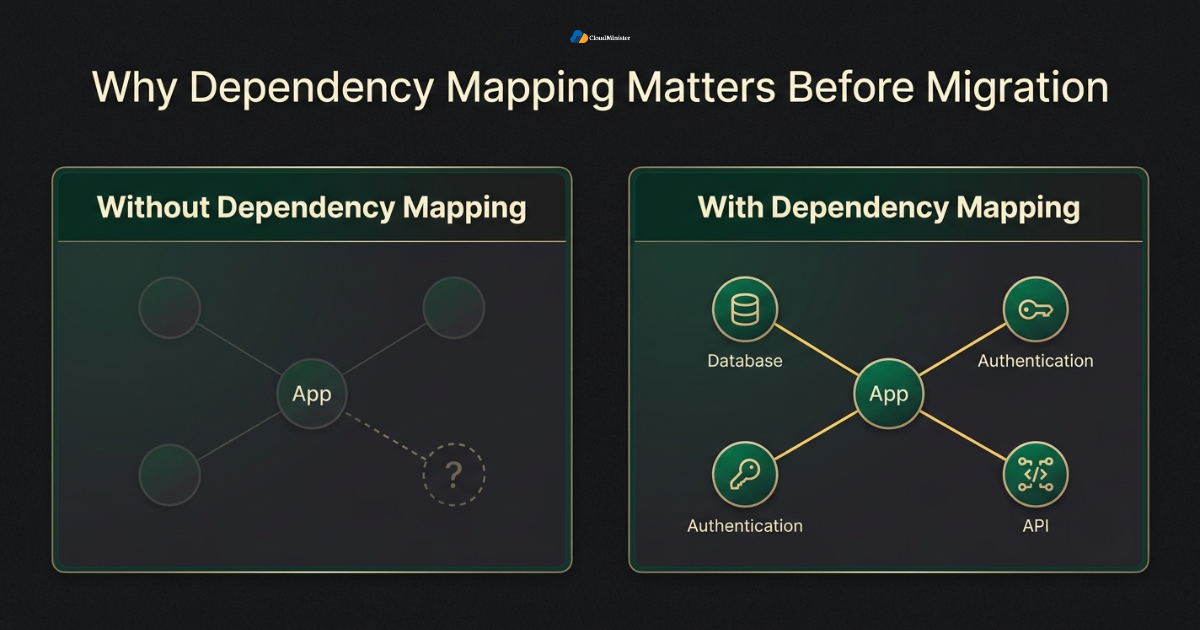
- Dependency mapping lets a team see that an internal reporting tool depends on nothing else, while a core billing application touches six other systems, something a rushed plan built on gut feeling was never designed to catch.
- An early wave built this way usually includes internal tools, dev and test environments, and simple websites, which most teams evaluating a Cloud Hosting Plan discover only after they nearly migrated a production database first.
- A realistic timeline, a risk tier for every application, and a rollback plan can be documented at the start of the process, which matters for teams running several applications behind one shared environment, especially when infrastructure is also being managed nearby by a provider of cloud hosting services in India.
- Teams sequencing correctly from day one tend to get more predictable outcomes than teams that discover dependency chains only after a failed cutover, which is one more reason a properly scoped Cloud Hosting Plan matters before an application reaches production.
A migration plan changes how and when workloads move, not how those workloads are secured once they land in a new environment, so an application migrated ahead of a proper access review can carry old credentials, unpatched dependencies, or an exposed configuration straight into a new environment where nobody is watching for it yet. A migrated application that retains its original public facing weaknesses is one of the more common ways an otherwise successful Application Migration Strategy quietly reintroduces the exact risk the migration was meant to reduce, so this step deserves the same review discipline as any other production access control decision.
Related Reading: pre migration checklist
Ready to Build a Migration Ready Cloud Environment
A well sequenced Application Migration Strategy only works if the environment it lands in can actually support it. Explore reliable, scalable Cloud Hosting built for teams running phased migrations.
2. Why Teams Need to Score Applications Before Building a Migration Wave
Many engineering teams first encounter this decision while already researching a Web Hosting Company in India for their broader production needs, and a capable partner will usually raise the question of application sequencing early in that conversation, since a good partner rarely separates migration timing from migration risk. For teams without a dedicated platform engineering function, scoring every application correctly before building a migration wave is often the fastest way to avoid a stalled Application Migration Strategy that looks like a tooling problem but is actually a sequencing failure.
- Enterprise investment in this kind of planning has reached a point where sequencing genuinely changes outcomes at scale, with the global cloud migration services market projected to reach roughly 330 billion dollars in 2026 at a compound annual growth rate above 23 percent, according to industry data reported by Research and Markets.
- Without a structured scoring model, different teams inside the same company commonly default to migrating whichever application a stakeholder complained about most recently, producing a program shaped by internal politics rather than actual technical readiness.
- A disciplined scoring approach centralizes sequencing decisions at the platform or DevOps team level, sometimes in partnership with a provider of cloud hosting services in India, rather than leaving wave planning to whichever team shouts loudest, an approach agencies reselling Reseller Hosting In India to their own client base tend to adopt early.
Related Reading: 6 Rs of cloud migration strategy
- Teams that already run on a well structured Cloud Hosting Plan tend to catch sequencing mistakes faster, since routine monitoring surfaces unexpected dependency chains before they derail an Application Migration Strategy already in motion. Choosing the right operational partner from the outset is, in practice, the first real step toward catching these issues early.
Before locking in a full Application Migration Strategy wave, run the scoring model against five representative applications first, ideally the simplest ones already on the list, and involve a Web Hosting Company in India early if one already manages part of the environment. Teams that validate real dependency behavior before committing an Application Migration Strategy to a fixed timeline consistently avoid the most common mistake, which is assuming every application will migrate as cleanly as the one used in the original pilot.
3. The Scoring Model Behind a Reliable Application Migration Strategy
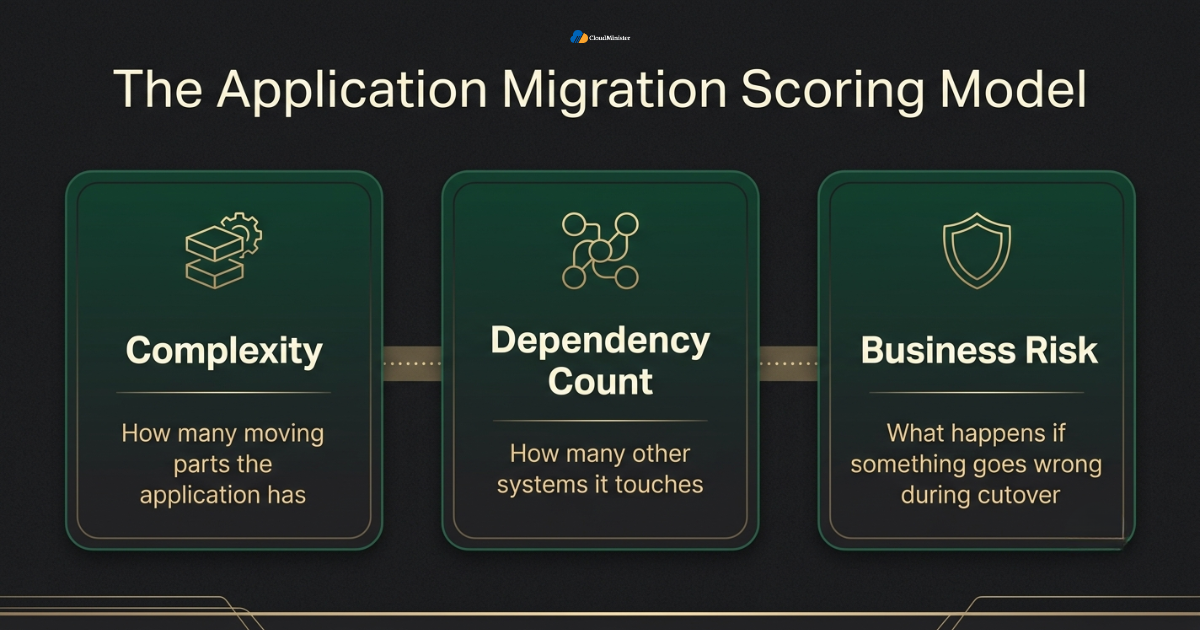
Before working through which applications belong in which wave, it helps to understand that a reliable strategy scores every candidate against the same three factors every single time. Complexity measures how many moving parts an application has. Dependency count measures how many other systems it touches. Business risk measures what happens if something goes wrong during cutover.
- An application with low complexity, few dependencies, and low business risk suits the very first wave, since a failure here costs little and teaches the team exactly how their new environment behaves under real traffic.
- An application with moderate complexity but high business risk suits a middle wave, once the team already has one or two successful migrations behind them and has proven the rollback plan actually works under pressure.
- An application with high complexity, deep dependency chains, and high business risk generally belongs in a later wave of any properly built plan, migrated only after every process, tool, and team involved has been tested on lower stakes systems first, unless it is a shared or foundational system whose dependencies require it to move earlier.
- Where an application sits between these tiers, many teams run a short discovery sprint specifically for that application, whether that discovery sits entirely within a single Cloud Hosting Plan, an Affordable Cloud Hosting India setup, or spans a larger multi environment footprint typical of cloud hosting services in India.
- Running a real dependency mapping exercise before locking any Application Migration Strategy timeline, a step most established hosting partners will help set up, confirms exactly which applications genuinely belong early and which need more preparation first.
Related Reading: avoiding data loss during migration
- Teams building out their first serious migration program often benefit from starting with this scoring exercise before touching a single server, since an immature plan rarely has the discovery data yet to justify a fixed wave schedule.
4. Which Applications to Migrate First: The Core Decisions Every Team Should Know
Below is a breakdown of how different application types typically get sequenced inside a properly built Application Migration Strategy, and how that sequencing fits the surrounding Cloud Hosting Plan a team has already put in place.
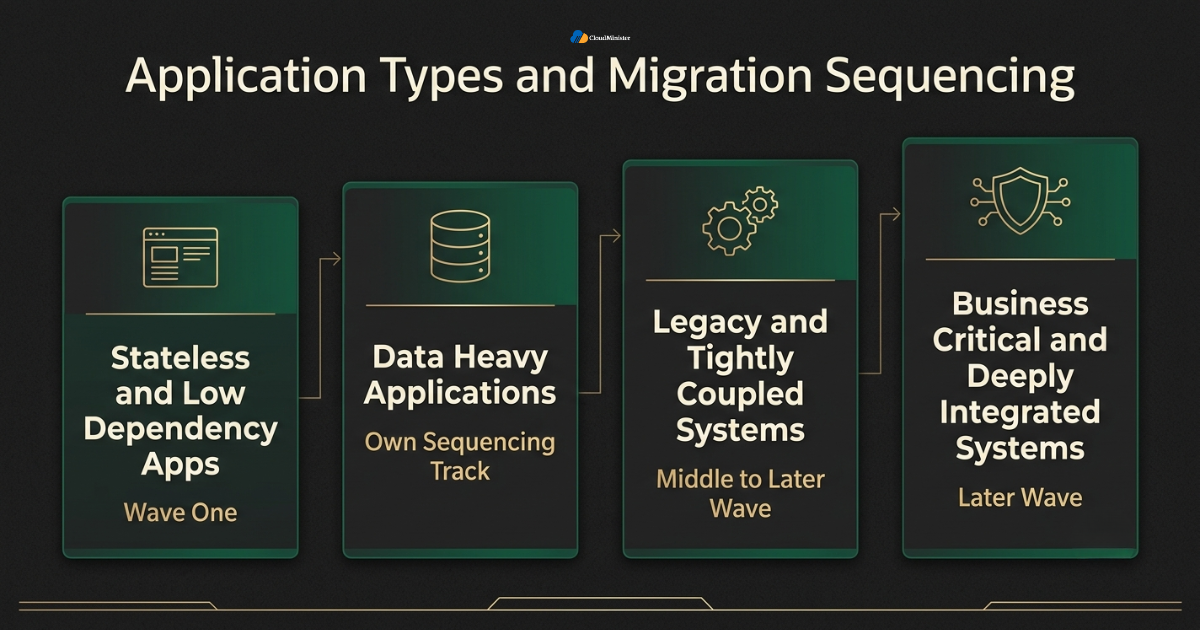
4.1 Stateless and Low Dependency Applications Usually Move First
This pattern holds equally on Affordable Cloud Hosting India, Reseller Hosting In India, and larger enterprise environments.
- These applications hold little or no persistent state locally, meaning they can be duplicated, tested, and cut over with minimal coordination, giving them a level of migration simplicity that a tightly coupled legacy system simply does not have.
- Internal dashboards, marketing sites, and dev or staging environments typically fall into this category, so a first wave built around them delivers a visible early win without threatening revenue generating systems.
- Applications in this tier also tend to have the fewest stakeholders, meaning a rollback decision can be made quickly if something does not behave as expected, without needing sign off from five different department heads, a benefit teams on Affordable Reseller Hosting and Reseller Hosting In India plans notice just as much as larger enterprises.
- The gap between this tier and everything else widens the more an organization has allowed shadow IT to spread, since an Application Migration Strategy built without a full inventory often discovers small unmanaged tools only after the main wave has already started, a limitation any team offering serious cloud hosting services in India, or reselling capacity as Reseller Hosting In India, runs into quickly with a growing environment.
- For a team running its very first Application Migration Strategy, starting here often replaces what used to be a vague, anxiety driven planning process with a concrete, low risk proof of concept, which is exactly the kind of sequencing a Web Hosting Company in India will usually recommend during a discovery review, whether the surrounding stack runs on a Cloud Hosting Plan or something more distributed.
4.2 Business Critical and Deeply Integrated Systems Generally Belong in a Later Wave
This holds true whether the environment runs on Reseller Hosting In India or a dedicated enterprise stack.
- These applications sit at the center of daily operations, such as core billing platforms, primary customer databases, and authentication systems, and any downtime here directly affects revenue or customer trust in a way an internal tool never does. They typically belong in a later wave, though foundational or widely depended upon systems in this category may need to move earlier if other applications rely on them.
- Applications in this tier typically touch five, ten, or more downstream systems, so a change to one integration point can ripple outward in ways that are difficult to predict without a completed dependency map.
- These systems also tend to carry the most regulatory or compliance weight, meaning the migration window itself must be planned around audit requirements, not just technical convenience, especially for organizations already leaning on cloud hosting services in India for compliance sensitive workloads, or on Affordable Cloud Hosting India tiers that still need enterprise grade controls.
- A rollback plan for this tier needs to be tested in a staging environment that mirrors production closely, since discovering a rollback gap during a live cutover of a business critical system is one of the more expensive mistakes any Application Migration Strategy can make.
- Applications that genuinely cannot tolerate any downtime, such as a payment processing gateway, are the cases where a phased, parallel run migration approach remains the right and sufficient choice rather than a single cutover weekend, a judgment call any solid Cloud Hosting Plan should already account for.
4.3 Data Heavy and Storage Intensive Applications Need Their Own Sequencing Logic
This is a consideration on Affordable Reseller Hosting just as much as on premium tiers.
- Applications built around large data volumes, such as media archives, analytics warehouses, and document repositories, are constrained more by transfer time and bandwidth than by application complexity itself, which changes how sequencing should work for them, regardless of whether they sit on Affordable Cloud Hosting India, Reseller Hosting In India, or a dedicated enterprise tier.
- Some providers of cloud hosting services in India, including those built around Affordable Reseller Hosting for agency clients, will recommend offline or bulk transfer methods for extremely large datasets rather than attempting to move everything over a live network connection during a fixed maintenance window.
- Application layer downtime and data transfer downtime are not the same problem, so this tier of any Application Migration Strategy often separates the two, migrating the data ahead of time while keeping the application itself live against the old environment until cutover.
- Data heavy workloads have become a genuine planning concern, with data transfer and egress costs alone accounting for roughly six to twelve percent of total migration budgets according to a 2026 roundup of enterprise migration statistics, which is precisely the category of cost this tier needs to plan for early.
- Teams running anything data intensive without a dedicated transfer plan, whether the underlying infrastructure sits with an outside hosting partner or a broader multi region setup, are carrying a measurable and avoidable amount of schedule risk that a properly sequenced plan specifically addresses.
4.4 Legacy and Tightly Coupled Applications Stay the Slowest to Move
This holds regardless of Reseller Hosting In India or Affordable Reseller Hosting arrangements downstream.
- Legacy applications built on outdated frameworks or unsupported operating systems require the most operationally involved migration path, since they often need refactoring or a compatibility layer before they can run in a modern environment at all.
- These applications sit in the middle operationally within a wider Application Migration Strategy, requiring a proper understanding of what the application actually depends on before any lift and shift attempt is even considered, whether the destination is Affordable Cloud Hosting India, Affordable Reseller Hosting, or a larger managed environment.
- For teams just getting started, standardizing on early wins for low complexity workloads and deliberately isolating legacy systems for a dedicated modernization track tends to keep the overall Application Migration Strategy timeline realistic, a sequencing a Web Hosting Company in India will often recommend by default.
Related Reading: Moving from shared hosting to a VPS without downtime
5. How to Decide Which Application Actually Moves First
This applies whether you run on Reseller Hosting In India, Affordable Reseller Hosting, or a larger enterprise stack. Choosing which application leads a migration wave inside any Application Migration Strategy is not a matter of picking whichever system sounds the most impressive to modernize. It depends entirely on how complex the application is, how many other systems depend on it, and how much the business can tolerate if something goes wrong.
- Start by confirming whether the application is stateless and lightly connected, since that single fact usually qualifies it for the earliest wave of any Application Migration Strategy in most cases, a starting question any team evaluating cloud hosting services in India, or comparing Affordable Cloud Hosting India against a premium tier, should ask before touching a single server.
- If the application is internal facing, has few dependencies, and carries low business risk, it is almost always the right starting point, and delaying it should require a specific, documented reason.
- If the only real complication is data volume rather than application logic, a data first sequencing approach may be sufficient, though many teams still choose a fuller discovery pass for the consolidated visibility it provides across an entire Cloud Hosting Plan.
- If the application sits at the center of daily revenue generating operations and touches many downstream systems, it becomes the natural candidate for a later wave, and moving it early without a tested rollback plan would introduce risk without a corresponding benefit, unless dependency mapping shows other applications rely on it, in which case it may need to move sooner despite the added risk.
- Document the assumptions behind every wave, including expected growth and any known architecture changes on the roadmap, so the Application Migration Strategy can be revisited with context later.
The pattern that separates a genuinely well sequenced Application Migration Strategy from a fragile one is treating application selection as an ongoing scoring exercise rather than a single upfront decision. A team that scores every application on complexity, dependency count, and business risk, migrates in deliberate waves starting with the lowest risk systems, and revisits the scoring as new applications appear typically ends up with a migration program that is both predictable and easy to reason about, rather than a team that forces every application into the same fixed timeline regardless of what each one actually needs.
6. Building a Phased Approach Around Your Application Migration Strategy
Even a well scored migration wave can underperform if the surrounding Application Migration Strategy has no supporting structure around it. Building a phased approach across an entire application portfolio matters as much as picking the right applications for any single wave.
- Use the lowest complexity, lowest dependency applications as the default first wave for the overwhelming majority of new migration programs, since early wins build the internal confidence a larger program needs to keep executive support.
- Reserve later waves specifically for business critical and deeply integrated systems, rather than moving them early out of impatience, except where dependency mapping shows they must move sooner to unblock other applications, a distinction worth documenting as part of any Cloud Hosting Plan review.
- Introduce a dedicated modernization track only when legacy applications genuinely cannot be lifted and shifted as they are, since forcing an unsupported legacy system into a standard timeline without refactoring can outgrow what the underlying infrastructure can reasonably support.
- Reassess the wave plan on a recurring schedule, ideally as part of routine infrastructure reviews, since an application that looked like a middle wave candidate six months ago may have since grown new dependencies that push it toward a later wave instead, a shift equally worth tracking for teams sourcing cloud hosting services in India or managing client sites through Reseller Hosting In India.
Related Reading: pre migration checklist
For teams also weighing how these decisions interact with broader deployment strategy, understanding how sequencing fits inside a real production workflow can clarify which applications are genuinely worth moving first. An application that runs comfortably inside a single environment today does not automatically need to be first in line the moment a company begins planning, since operational overhead and genuine business risk vary considerably between one workload and the next. Teams building a genuinely reliable migration program alongside their broader infrastructure practice, whether hosted through a Web Hosting Company in India, distributed across cloud hosting services in India, or supported by Reseller Hosting In India for downstream client environments, should treat sequencing as an ongoing decision rather than a one time planning exercise.
7. Common Mistakes Teams Make When Sequencing an Application Migration Strategy
Even teams that understand the scoring model correctly, including teams already working with an established provider of cloud hosting services in India, can still fall into avoidable mistakes if application sequencing is treated as a one time planning task rather than an ongoing practice.
- Migrating the most visible or politically important application first specifically because a stakeholder is watching, rather than because it genuinely scored well for an early wave, which turns an early milestone into an unnecessary risk.
- Skipping dependency mapping for an application that looks simple on the surface, only to discover mid migration that it silently depends on an internal authentication service nobody documented, a gap a responsive hosting partner typically flags early.
- Mixing unrelated applications into the same migration weekend for convenience, which increases the number of rollback plans that must be maintained together and expands the blast radius if any single cutover is misconfigured.
- Treating every application as if it needs the same migration approach, or assuming a pattern that worked for a stateless internal tool will transfer unchanged to a business critical database, rather than reassessing the sequencing deliberately as each application profile becomes clear.
- Not revisiting the wave plan after a significant architecture change, leaving a strategy built around dependency data that is now months out of date, a gap a responsive Web Hosting Company in India would normally catch during a routine review.
- Skipping a review of overall sequencing logic before scaling an Application Migration Strategy significantly, even though a properly structured plan meaningfully affects how systems get secured and monitored across an organization using cloud hosting services in India, Affordable Cloud Hosting India, or a mix of both.
Across real production migrations, the gap between a team that gets consistent, predictable outcomes from its Application Migration Strategy and one that quietly accumulates sequencing debt is rarely about which specific application was chosen first. It is a difference in ongoing review discipline. Teams that assign clear ownership over dependency mapping and revisit it on a fixed schedule, often with a Web Hosting Company in India handling the recurring checks, report far fewer instances of the kind of unexpected cutover failure an unmanaged plan eventually produces.
8. Governance and Operational Considerations Around Application Migration Strategy
Standardizing a phased migration approach at scale introduces a specific governance layer on top of the standard technical considerations that come with moving production workloads.
- Sequencing decisions should route through the same review process as any other production infrastructure change, ideally with input from teams experienced in both dependency mapping and Cloud Hosting Plan design, since a poorly sequenced wave can quietly expose a business critical system before it is actually ready.
- Centralized scoring standards, coordinated with a single operations partner rather than allowing individual teams to define their own wave order independently, prevent the kind of inconsistent risk assessment that is difficult to untangle later inside a large migration program.
- Dependency data should be reviewed on a recurring basis, ideally with support from a partner that already monitors the environment, so that any newly formed integration gets flagged before it turns into a genuine cutover surprise.
- Legacy application inventory should be tracked explicitly, since knowing exactly which systems still need refactoring versus which are already migration ready is far more useful during planning than discovering it while a wave is already underway, and a good partner will usually maintain this inventory as a matter of course under any serious Cloud Hosting Plan, whether it runs on Affordable Cloud Hosting India or a larger enterprise footprint.
- A documented sequencing record, tracking which applications moved in which wave and why, gives a platform team, and any supporting Web Hosting Company in India, the audit trail needed to justify the program during a compliance review, whether that review also touches parallel infrastructure managed through Reseller Hosting In India for client facing environments.
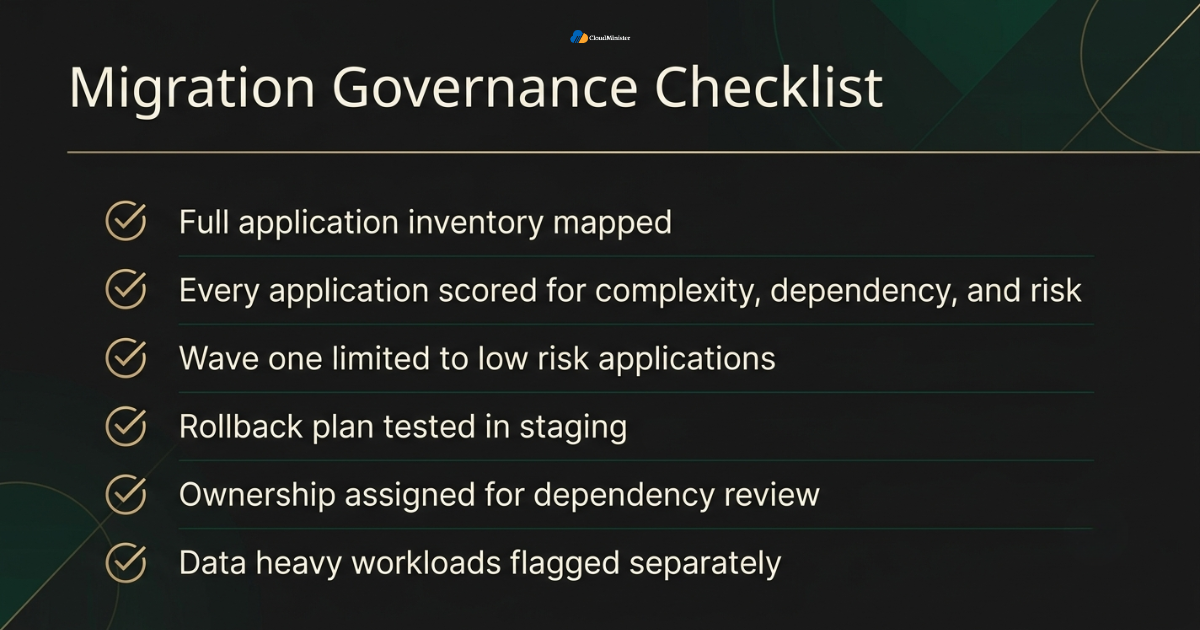
Checklist: Readiness Before Locking an Application Migration Strategy Wave Plan
This applies equally on Affordable Cloud Hosting India, Reseller Hosting In India, and Affordable Reseller Hosting environments.
- Full application inventory mapped, including shadow IT tools discovered during audit, whether hosted on Affordable Cloud Hosting India or Reseller Hosting In India
- Every application scored for complexity, dependency count, and business risk
- Wave one populated exclusively with stateless, low dependency, low risk applications
- Rollback plan tested in a staging environment that mirrors production for every tier
- Ownership assigned for ongoing dependency review, ideally shared with an outside hosting partner
- Data heavy workloads flagged separately with their own transfer timeline documented, including any that live on Affordable Reseller Hosting infrastructure
9. Measuring Whether Your Application Migration Strategy Is Actually Working
This section applies on Affordable Cloud Hosting India, Affordable Reseller Hosting, or beyond. Locking in a good wave plan is not the finish line of a migration effort, whether the workload sits on a self managed environment or with an outside partner offering broader cloud hosting services in India. Long term value depends entirely on how the sequencing is monitored and adjusted afterward.
- Track which applications completed migration on schedule versus which slipped, since a consistent pattern of slippage in one tier usually signals that tier’s scoring criteria need to be revisited rather than assuming each delay was a one off.
- Compare actual dependency behavior discovered during migration against what the original mapping assumed, a discipline that matters equally for teams focused on overall Cloud Hosting Plan spend or Affordable Reseller Hosting margins, since real world dependency chains often turn out broader than the original diagram suggested once each cutover is reviewed.
- Review the legacy modernization track quarterly, flagging any application that has quietly become more business critical without a corresponding move up the sequencing priority list, a review many teams now delegate to their Web Hosting Company in India.
- Cross reference the completed sequencing record against a team’s broader Cloud Hosting Plan, and against any secondary environment supported through Reseller Hosting In India, to confirm the wave order still matches how the business actually depends on each system.
- Maintain a change log for every wave decision made, revised, or reprioritized inside the Application Migration Strategy, shared with the broader operations team where relevant, so a team can trace exactly why a given choice was made and whether the assumptions behind it still hold.
Organizations running migration programs at meaningful scale, whether the underlying infrastructure runs on a dedicated Cloud Hosting Plan, distributed cloud hosting services in India, or a mix supported through Reseller Hosting In India for downstream clients, are not managing this challenge in isolation. Sixty six percent of organizations have already adopted hybrid models specifically to balance legacy systems against cloud native environments during exactly this kind of phased migration, according to 2026 enterprise cloud migration research, underscoring why disciplined sequencing matters just as much as the initial application scoring, and why a dependable Web Hosting Company in India earns its keep long after the first wave is already live.
10. Choosing the Right Partner for Your Application Migration Strategy
Not every hosting relationship is built to support disciplined migration sequencing, so matching a provider’s capability to actual team needs matters more than brand recognition alone, whether that provider delivers Affordable Cloud Hosting India, broader cloud hosting services in India, or Affordable Reseller Hosting for agencies managing client environments.
- A dependable Web Hosting Company in India that already manages a team’s broader infrastructure is well positioned to advise on how an Application Migration Strategy should fit into an existing environment without introducing unnecessary complexity.
- Teams evaluating providers should specifically ask whether the provider has direct experience helping customers score, sequence, and phase a full migration program at meaningful scale, not just provisioning individual virtual machines under a generic Cloud Hosting Plan.
- Agencies and resellers managing several client environments at once often look specifically for Affordable Reseller Hosting paired with genuine migration expertise, since Reseller Hosting In India that cannot support a phased plan for downstream clients quickly becomes a bottleneck rather than a convenience.
- Teams that want to move quickly without designing every wave of their sequencing plan themselves often gravitate toward a Web Hosting Company in India that comes with clear documentation on how an Application Migration Strategy interacts with existing infrastructure from day one, including Affordable Cloud Hosting India options for teams watching budget closely during a multi wave rollout.
- Engineering leaders who have not yet reviewed their hosting partner relationship specifically in the context of migration sequencing, dependency mapping, or rollback readiness should treat this guide as a natural trigger point to do so, and to ask their Web Hosting Company in India directly.
- A capable partner offering both deep expertise in this area and broader cloud hosting services in India gives growing teams a coherent roadmap for scaling their Application Migration Strategy instead of stitching together advice from multiple vendors, whether the underlying budget leans toward Affordable Cloud Hosting India or a more premium managed tier.
- Teams researching Affordable Reseller Hosting specifically for internet facing client workloads should confirm that a prospective partner understands both application sequencing mechanics and the surrounding Cloud Hosting Plan, since the two decisions are closely linked for anyone reselling Reseller Hosting In India to their own customer base.
- Budget conscious teams comparing Affordable Cloud Hosting India against a more premium tier should weigh that decision against how many migration waves are actually planned, since Affordable Reseller Hosting and standard Cloud Hosting Plan options both support a phased Application Migration Strategy equally well when the sequencing itself is sound.
When comparing quotes or advice from different partners on Application Migration Strategy planning, whether they specialize in Affordable Cloud Hosting India, Affordable Reseller Hosting, or a general Cloud Hosting Plan built around a specific stack, ask each one to walk through a real application inventory from your own environment rather than a generic case study, since the right sequencing depends entirely on how many dependencies are involved and how much risk the business can actually tolerate. A provider offering genuine cloud hosting services in India that understands both the scoring mechanics and a team’s actual application portfolio will consistently give more actionable guidance than a purely theoretical comparison.
Key Takeaways
- An effective Application Migration Strategy starts with scoring every application for complexity, dependency count, and business risk before a single workload moves, a baseline any competent partner supporting a Cloud Hosting Plan should already be recommending.
- Stateless, low dependency applications belong in the first wave, since they deliver a visible early win without threatening revenue generating systems.
- Business critical and deeply integrated systems generally belong in later waves, making rollback testing and compliance timing the correct priority specifically for this tier rather than migration speed, though foundational systems with heavy downstream dependencies may need to move earlier to unblock the rest of the sequence.
- Data heavy applications need their own sequencing logic, since transfer time and bandwidth constrain them more than application complexity itself.
- Governance, dependency monitoring, and a documented sequencing record matter just as much as the initial wave decision, and this holds whether the environment is run internally, through a Web Hosting Company in India, or through broader cloud hosting services in India, Affordable Cloud Hosting India, Reseller Hosting In India, or Affordable Reseller Hosting.
- Partnering with a capable Web Hosting Company in India experienced in structured migration planning, and comfortable discussing both enterprise environments and Affordable Reseller Hosting for agencies, meaningfully reduces the risk of an unmanaged, poorly sequenced program, and this is worth raising directly in the next planning call with that partner.
Need Help Planning Your Application Migration Strategy
Scoring applications, mapping dependencies, and sequencing waves gets easier with the right team behind you. Talk to our experts and get a migration plan built around your actual environment.
Conclusion
Throughout this guide, one pattern holds regardless of company size, application portfolio, or whether the surrounding environment runs on Affordable Cloud Hosting India, a broader Cloud Hosting Plan, or infrastructure resold through Affordable Reseller Hosting. A well built Application Migration Strategy keeps early waves low risk and high confidence, sequences business critical systems only after every process has been proven on smaller stakes, and treats legacy applications as their own dedicated track rather than forcing them into a timeline they were never built for. Choosing which application moves first is not really a question of which system is most exciting to modernize. It is a question of how much risk the business can tolerate and how many other systems quietly depend on the one being considered.
By 2026, treating an Application Migration Strategy as a scored, phased program rather than a single either or decision has become close to standard practice for any team managing meaningful application portfolios, often guided by a trusted Web Hosting Company in India along the way. The teams that get the most value from this approach share a consistent pattern. They start with stateless, low dependency applications unless there is a specific, documented reason not to, they revisit the wave plan on a fixed schedule, and they treat sequencing as one part of a broader infrastructure practice rather than a one time planning step. For teams weighing this decision alongside a broader look at their Cloud Hosting Plan, or comparing options across cloud hosting services in India, Affordable Cloud Hosting India, Reseller Hosting In India, and Affordable Reseller Hosting, the same underlying principle applies. Score every application honestly, sequence deliberately, revisit the plan as the portfolio changes, and the strategy becomes a genuine, dependable foundation rather than another spreadsheet nobody fully trusts, ideally with a capable Web Hosting Company in India involved throughout, including one experienced across the broader landscape of cloud hosting services in India.
Frequently Asked Questions
Does an Application Migration Strategy always start with the cheapest application to migrate?
Not necessarily. Cost is one input into a sound plan, but complexity, dependency count, and business risk usually matter more than raw migration cost when deciding what moves first. An inexpensive migration that carries high business risk still belongs later in the sequence, which is exactly the kind of tradeoff worth confirming as part of a broader Cloud Hosting Plan review rather than assumed by default.
Can legacy applications be included in an early wave of an Application Migration Strategy?
Generally no, unless the legacy application has already been refactored or wrapped in a compatibility layer that removes its unsupported dependencies. Most legacy systems belong in a dedicated modernization track rather than the same timeline used for stateless, low dependency applications, since forcing them into an early wave usually introduces avoidable schedule risk.
What happens if a business critical application is migrated before its dependencies are fully mapped?
An incomplete dependency map is one of the most common causes of a failed cutover inside any Application Migration Strategy. Unless every downstream and upstream connection is documented ahead of time, a migration can break an integration nobody realized existed until the application is already live in its new environment. Completing dependency mapping before migration is one of the most common gaps a Web Hosting Company in India catches during a routine planning review.
Does every application need the same rollback plan inside an Application Migration Strategy?
No. A stateless internal tool with no persistent state may only need a basic redeploy as its rollback plan, while a business critical database needs a fully tested parallel run and a defined cutover window. Teams that need meaningful downtime protection for revenue generating systems should build a tier specific rollback plan rather than assuming a single generic process covers every application equally.
How should a team decide which application leads its very first wave?
The decision should be based on a combination of low complexity, few dependencies, and low business risk, not simply on which application a stakeholder happens to be asking about that week. A system that is technically easy to migrate but carries high business risk usually costs a team more in unnecessary exposure by moving early than it would have saved in schedule time, which is exactly the kind of tradeoff a Web Hosting Company in India or any established provider of cloud hosting services in India is well placed to evaluate.
How long does a typical Application Migration Strategy take to execute across all waves?
There is no fixed timeline, since it depends on portfolio size, dependency complexity, and how much legacy modernization is required alongside the migration itself. A team with a small, mostly stateless application set can often complete several waves within a few months, while a larger enterprise portfolio with deep legacy dependencies may spread the same process across a year or more. What matters more than the total duration is that each wave is only started once the previous one has been validated, since compressing the timeline artificially tends to reintroduce the exact sequencing risk the strategy was built to avoid.
Should a team pause an Application Migration Strategy if a wave uncovers an undocumented dependency?
Yes, at least for the specific application involved. Discovering an undocumented dependency mid wave is a sign that the original mapping was incomplete, and continuing the cutover without addressing it risks the same kind of failure the scoring model was designed to prevent. The better response is to pause that application, update the dependency map, and reassess whether it still belongs in the current wave, while allowing the rest of the wave to proceed if those applications remain unaffected.

Ajay Singh Raghav is a Senior Linux System Administrator at CloudMinister Technologies, where he has spent over 4 years installing, configuring, maintaining, and troubleshooting Linux servers for hosting and cloud environments. He specializes in AWS cloud computing alongside core Linux server administration, with hands-on expertise across server management, backup and restore systems, and cPanel-based hosting environments. His day-to-day experience keeping production servers stable and secure gives him a practical, ground-level understanding of the infrastructure he writes about.