Choosing the right Cloud Pricing Model is one of the most consequential financial decisions a growing business makes once it moves workloads to the cloud. This guide breaks down all major pricing option businesses rely on in 2026, from flexible on-demand billing to deeply discounted committed use plans and matches each one to the workload pattern it fits best. Getting the model wrong does not just inflate a monthly invoice; it can quietly erode margins for years before a FinOps review ever catches it. Whether a business is running a lean startup workload or a large enterprise estate, understanding each Cloud Pricing Model is now a prerequisite for sustainable cloud spending.
Setting up business email sounds simple until you’re staring at a DNS control panel wondering which of the six different TXT records belongs to your domain. Zoho Mail for Business is a genuinely capable platform, but “capable” and “correctly configured” are two different things, and the gap between them is usually where businesses lose hours, or worse, end up with mail silently landing in spam because DKIM was never verified.
That gap is exactly what this guide closes. Rather than a quick overview of buttons to click, it walks through the full sequence a proper Zoho Mail for Business deployment actually requires, starting with choosing a plan that fits your team size, moving through domain verification and DNS authentication, and ending with a tested, migrated, fully functional mailbox setup. Each step exists for a reason, and skipping one rarely saves time; it just delays the problem to a moment when it’s harder to fix.
This guide is written for exactly the kind of business likely to be reading it: one that wants email that simply works, without babysitting DNS records every few weeks or discovering a spoofing attempt only after it’s already caused damage. Follow the sections in order below, and by the end you’ll have a Zoho Mail for Business setup that’s secure, properly authenticated, and ready to scale as your team grows.
1. Why the Cloud Pricing Model You Choose Determines Your Cloud Bill
Cloud spending has moved from a line item finance glanced at once a quarter to a board-level metric reviewed monthly, and the Cloud Pricing Model underlying that spend is the single biggest lever available to control it. Public cloud now accounts for 45 percent of enterprise IT spending in 2026, up from just 17 percent in 2021, and average large-enterprise cloud spend has climbed to 14.3 million dollars per year, a 9 percent year-over-year increase, according to recent industry research. That scale of spending means a poorly chosen pricing structure is no longer a rounding error, it is a material line item that finance teams now track as closely as payroll.
Wasted cloud spend actually rose in 2026 after five years of steady decline, driven largely by AI workloads adding cost complexity faster than teams could optimize their billing choices. This reversal matters because it shows that even sophisticated organizations with mature FinOps practices can lose control of cloud costs when the model does not match actual usage patterns. A business running a steady, predictable workload on an on-demand plan is effectively paying a premium for flexibility it never uses, while a business running unpredictable, bursty workloads on a rigid commitment risk paying for capacity that sits idle.
For a small or mid-sized business exploring cloud infrastructure for the first time, understanding the Cloud Pricing Model landscape means knowing which billing structure matches a short-term project versus a long-term production workload. A narrowly scoped marketing campaign might only need a flexible on-demand plan for a few weeks, while a core application running twenty-four hours a day calls for something built around long-term commitment and predictable discounting. Getting this choice right early avoids the common trap of overpaying for flexibility that is never used, or underpaying attention to a growing bill that could have been discounted from day one.
Picking the wrong Cloud Pricing Model for a given workload is one of the most common reasons cloud budgets spiral out of control before anyone notices. Teams frequently default to whichever option was easiest to set up initially, usually on-demand, and never revisit that decision even as the workload matures into something predictable enough to qualify for a steep discount. This guide exists to prevent exactly that mistake. It walks through every major pricing category, how each one works, where it delivers the most value, and the infrastructure decisions, including choosing reliable cloud hosting services in India and a trustworthy Server Management Services in India partner, that make running these workloads cost-effectively at scale possible.
This guide organizes the available pricing options into four broad categories:
- On-demand pricing that charges by the hour or second with no upfront commitment
- Reserved pricing that trades a one to three year commitment for a steep discount
- Spot pricing that uses spare capacity at the deepest discount but with interruption risk
- Committed use pricing that guarantees a discount in exchange for a spending commitment rather than a fixed instance type
Do not default to whichever billing option was easiest to click through during setup. The right choice depends entirely on workload predictability, fault tolerance, and how far in advance a business can commit to its infrastructure needs. A workload running on the wrong Cloud Pricing Model can cost two to five times more than the same workload running on the right one.
2. Understanding What Actually Drives Cloud Costs Before Comparing Models
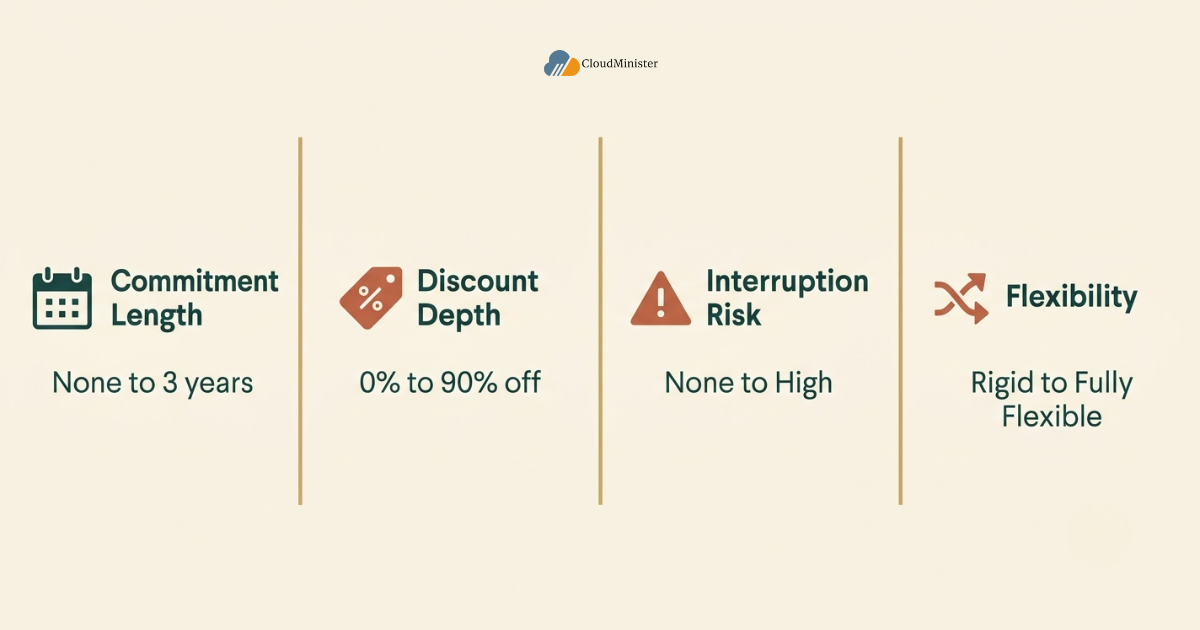
Before comparing each Cloud Pricing Model in detail, it helps to understand what actually determines the price a business pays for compute, storage, and networking. Every option is built around the same core variables, but how each variable is weighted is what defines each category.
| Variable | What It Determines | How It Differs Across Models |
| Commitment length | How long a business agrees to pay for capacity | On-demand has none, reserved and committed use span one to three years |
| Discount depth | How much cheaper the rate is versus list price | Spot offers the deepest discount, on-demand offers none |
| Interruption risk | Whether the resource can be reclaimed by the provider | Spot carries the highest risk, reserved and committed use carry none |
| Flexibility | Ability to change instance type or region mid-term | On-demand is fully flexible, reserved is the most rigid |
Most businesses new to cloud infrastructure assume the cheapest advertised rate always represents the best deal, but the true cost of any Cloud Pricing Model only becomes clear once workload behavior, interruption tolerance, and commitment risk are all factored in together. This holds true whether the underlying workload is deployed through cloud hosting services in India or run through an overseas hyperscaler region. Related reading: our earlier piece AI in Cloud Computing covers how AI-driven workloads are forcing businesses to rethink which pricing structure actually fits their new compute patterns.
Ready to Choose the Right Cloud Pricing Model?
Get flexible, transparent cloud hosting in India with billing options built around how your workload actually runs.
3. On-Demand Pricing
3.1 What On-Demand Pricing Actually Does
On-demand is the most flexible Cloud Pricing Model available today. Under this model, a business pays for exactly the compute, storage, or networking resources it consumes, billed by the hour or even by the second, with zero long-term obligation and the ability to stop paying the moment a resource is shut down.
- Instant provisioning with no upfront payment or long-term contract required
- Billing calculated strictly by actual consumption, typically per hour or per second
- Resources can be scaled up, scaled down, or terminated at any time without penalty
- The highest per-unit rate among every pricing category, since flexibility itself carries a cost
Do not default to whichever billing option was easiest to click through during setup. The right choice depends entirely on workload predictability, fault tolerance, and how far in advance a business can commit to its infrastructure needs. A workload running on the wrong Cloud Pricing Model can cost two to five times more than the same workload running on the right one.
Because on-demand resources can be spun up instantly without procurement review, this billing model is also the easiest one for cloud sprawl to hide inside. When relying on on-demand billing for customer-facing workloads, strict tagging and cost-allocation policies are essential to prevent forgotten instances from quietly inflating the bill.
3.2 When On-Demand Is the Right Choice
- Short-term projects with a clearly defined end date, such as a marketing campaign or a proof of concept
- Unpredictable workloads where usage patterns are not yet understood well enough to commit
- Development and testing environments that are spun up and torn down frequently
- Sudden traffic spikes that need to be absorbed immediately without a procurement delay
Among all four categories covered here, on-demand is also the easiest Cloud Pricing Model to start with, since it typically requires no negotiation or minimum spend commitment, and works well alongside dependable Server Management Services in India for teams that do not want to manage scaling manually.
4. Reserved Instance Pricing
4.1 What Sets Reserved Pricing Apart
Reserved pricing is a significant step toward cost predictability among the available options. Under this model, a business commits to using a specific instance type in a specific region for a fixed term, typically one or three years, in exchange for a substantial discount compared to on-demand rates.
- Requires a one-year or three-year commitment to a defined instance family and region
- Delivers discounts that commonly range from thirty to seventy percent versus on-demand pricing
- Payment can usually be structured as all-upfront, partial-upfront, or no-upfront depending on the provider
- Locks in the discount rate for the full term regardless of whether the resource is used every hour
Reserved pricing is a strong fit for steady-state workloads like a company’s primary database or a core application server that runs continuously and predictably. Among the Cloud Pricing Model categories available today, this option strikes a useful balance between meaningful savings and manageable commitment risk.
4.2 Common Business Applications for Reserved Pricing
- Production databases that run continuously with predictable resource needs
- Core application servers supporting a business’s primary customer-facing product
- Baseline capacity for a business that already understands its minimum steady-state usage
- Long-running batch processing jobs that follow a consistent, predictable schedule
Related Reading: Multi-Cloud Strategy for Indian SMBs
5. Spot Instance Pricing
5.1 How Spot Pricing Reasons Differently About Capacity
Spot pricing represents the most aggressive discount among every Cloud Pricing Model because it is built on spare, unused capacity that a cloud provider is not currently selling through other channels. In exchange for accessing this spare capacity at a steep discount, a business accepts the risk that the provider can reclaim the resource with little or no warning.
- Prices fluctuate based on real-time supply and demand for spare capacity in a given region
- Discounts routinely reach sixty to ninety percent below on-demand pricing for the same resource
- The provider can terminate or reclaim the instance with minimal notice, often just a few minutes
- Best suited to workloads that can checkpoint progress or restart cleanly without data loss
RELATED READING: IoT Cloud Integration
5.2 Where Spot Pricing Delivers the Most Value
- Batch processing jobs that can checkpoint progress and resume after an interruption
- Big data analytics pipelines that run distributed jobs across many disposable nodes
- Rendering and video transcoding workloads that can be retried without significant cost
- Machine learning model training jobs that use checkpointing to survive instance reclamation
Spot pricing typically demands more engineering discipline than other Cloud Pricing Model categories, since applications must be built to tolerate sudden interruption gracefully. This is one of the reasons spot-based systems are frequently paired with strong Server Management Services in India to handle failover and re-provisioning automatically, so an interrupted job restarts without manual intervention.
6. Committed Use Pricing
6.1 What Makes Committed Use Different From Reserved Pricing
Committed use pricing extends the reserved approach by shifting the commitment away from a specific instance type toward an overall spending level. Among the four categories, this option is built for businesses that know roughly how much compute they will consume but do not want to lock themselves into one specific instance family for the full term.
- Commits to a minimum dollar amount of spend over a one or three year term, not to a specific machine type
- Applies the discount automatically across any eligible resource usage that counts toward the commitment Offers more flexibility than reserved pricing to shift workloads between instance types during the term
- Typically requires forecasting overall usage rather than predicting the exact resource configuration needed
Committed use pricing is especially useful for businesses running a diverse mix of workloads, where locking into one specific instance type under reserved pricing would be impractical. Businesses evaluating this option for a growing, varied infrastructure footprint should look closely at this category first.
6.2 Business Use Cases for Committed Use Pricing
- Growing businesses with diverse compute needs that shift month to month across instance families
- Enterprises consolidating spend across multiple departments under a single negotiated discount
- Organizations that want predictable, discounted billing without sacrificing instance-level flexibility
- Businesses migrating gradually from on-premises infrastructure that need budget certainty during transition
Among these options, committed use spending tends to require the most careful forecasting at the outset, since committing to too little spend leaves savings on the table while committing to too much creates a use-it-or-lose-it risk, which makes right-sized planning through experienced cloud hosting services in India a practical foundation to build on.
7. Comparing All Four Cloud Pricing Model Options Side by Side
7.1 How the Four Approaches Stack Up
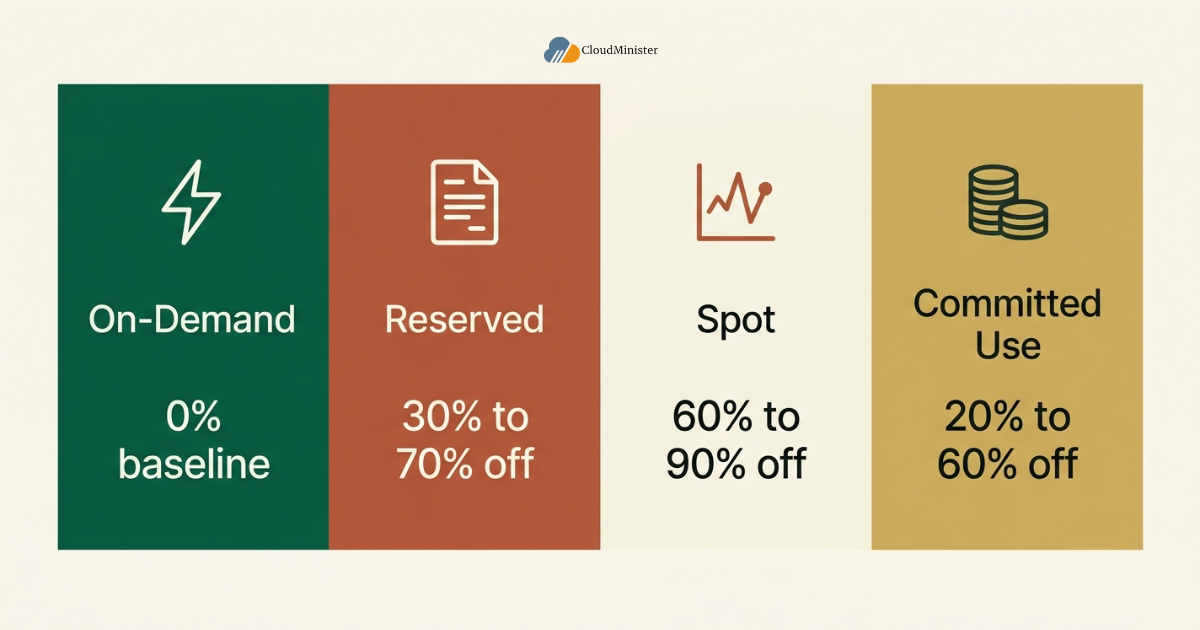
Understanding each option individually is useful, but most businesses need to see how they compare directly before making a final infrastructure decision. Each approach trades a different combination of flexibility, discount depth, and risk.
- On-demand pricing offers full flexibility and zero commitment but carries the highest per-unit cost of any Cloud Pricing Model
- Reserved pricing offers strong, predictable discounts in exchange for locking into a specific instance type and region
- Spot pricing offers the deepest possible discount but introduces real interruption risk that must be engineered around
- Committed use pricing offers a middle ground, trading a spending commitment rather than an instance commitment for meaningful savings
Regardless of which Cloud Pricing Model a business selects, cost governance needs to extend beyond the initial contract. Workloads shift over time, and a billing structure chosen a year ago may no longer match current usage, so periodic review against actual consumption data is non-negotiable for keeping any cloud budget under control.
7.2 Why Most Mature Businesses Blend Multiple Models
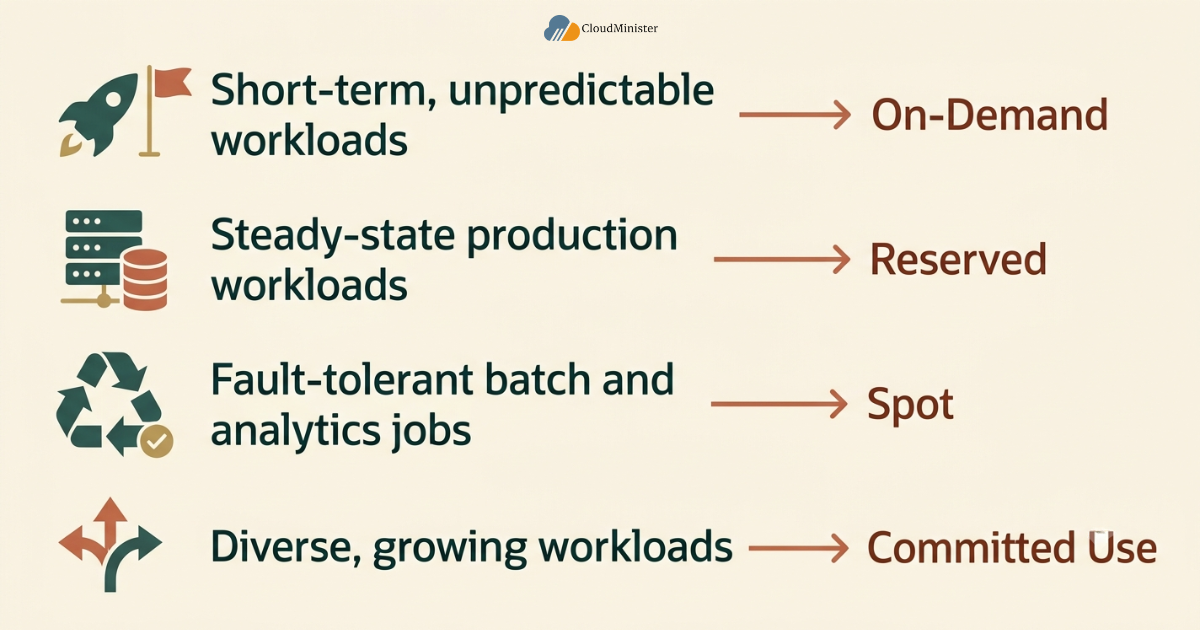
- Running steady-state core infrastructure on reserved or committed use pricing for predictable savings
- Running unpredictable, bursty, or experimental workloads on on-demand pricing for flexibility
- Running fault-tolerant batch and analytics jobs on spot pricing for the deepest possible discount
- Reviewing the blend quarterly as workloads mature from unpredictable to steady-state and back again
Most large enterprises today are not choosing a single Cloud Pricing Model exclusively, they are blending two or three approaches deliberately based on how predictable each workload has become, a strategy that is far easier to execute well when supported by dependable Server Management Services in India that can monitor usage and flag when a workload has outgrown its current pricing tier.
8. Matching Cloud Pricing Model Choices to Business Workloads
Choosing correctly among the available options requires mapping billing structure to actual workload behavior rather than defaulting to whichever option was configured first. The table below summarizes how each Cloud Pricing Model lines up against common workload characteristics. Industry data shows multi-cloud environments increase cost-management difficulty by roughly 27 percent, which makes this mapping exercise even more valuable for businesses running infrastructure across more than one provider.
| Cloud Pricing Model | Commitment Required | Discount Range | Best Fit Workload |
| On-demand | None | 0 percent baseline | Short-term, unpredictable, or experimental workloads |
| Reserved | One to three years | 30 to 70 percent | Steady-state production workloads with known configuration |
| Spot | None, but interruptible | 60 to 90 percent | Fault-tolerant batch, analytics, and rendering jobs |
| Committed use | One to three years, spend-based | 20 to 60 percent | Diverse, growing workloads without a fixed instance type |
A common mistake businesses make when evaluating pricing options is assuming that whichever option offers the deepest headline discount is automatically the best choice. Spot pricing applied to a mission-critical, always-on database will cause outages the moment capacity is reclaimed, while on-demand pricing applied to a workload that has run unchanged for two years wastes money that reserved or committed use billing would have saved from day one.
9. Infrastructure Decisions Behind Running Any Cloud Pricing Model Reliably at Scale
9.1 Why the Underlying Provider Matters as Much as the Pricing Model Itself
- Billing transparency: Some providers make it genuinely difficult to see which pricing structure applies to which resource, burying discounts inside confusing line items
- Regional availability: Not every option is available in every region, which matters for businesses with data residency requirements
- Support responsiveness: A change in billing structure, such as moving from on-demand to reserved, should not require days of back-and-forth with support
- Migration flexibility: Businesses need the ability to move between models as workloads mature, without punitive penalties for switching
9.2 Choosing Cloud Hosting Services in India for Predictable Billing
Indian businesses evaluating any Cloud Pricing Model for their own operations have specific reasons to choose infrastructure hosted domestically rather than routing every request through an overseas billing structure.
- Lower latency to Indian end users compared to routing workloads through an overseas region, which matters most for latency-sensitive applications regardless of the pricing structure chosen
- Simpler alignment with India’s Digital Personal Data Protection Act (DPDPA) for any Cloud Pricing Model processing personal data of Indian citizens, since cloud hosting services in India operating domestic data centres can support in-country data residency as part of a broader DPDPA compliance approach
- INR-denominated billing removes currency volatility from budget planning, a benefit that makes forecasting under any pricing model significantly more predictable for growing businesses
- Local support teams who understand India-specific compliance and billing requirements that an overseas provider often cannot match as quickly
- Businesses that switch to domestic cloud hosting services in India for these workloads often see clearer, more predictable billing within the first cycle, well before any deeper evaluation begins
Cloudminister, as a Web Hosting Company in India, provides exactly this combination of domestic hosting, transparent pricing options, and dedicated support for businesses evaluating which billing structure fits their operations. Related reading: startups weighing regional providers against global hyperscalers should also review our guide:
which covers how domestic availability zones change the cost and latency equation for early-stage teams.
9.3 Server Management Services in India as the Operational Layer Behind Every Model
Choosing the right Cloud Pricing Model is only half the equation, since even the most cost-efficient billing structure can be undermined by poor operational execution. This is where dependable managed operations become essential, regardless of which option a business ultimately selects.
- Continuous monitoring that flags when a workload has outgrown its current pricing tier and should move to a more cost-effective one
- Automated failover handling for spot-based workloads, so an interrupted instance restarts without manual intervention
- Right-sizing recommendations that prevent a business from over-committing under a reserved or committed use plan
- Security patching and updates that keep infrastructure compliant regardless of which billing model underlies it
A reliable Server Management Services in India partner functions as the operational backbone that makes any Cloud Pricing Model actually deliver its promised savings in practice, rather than looking good on paper but underperforming once real-world usage patterns emerge. Businesses without an in-house infrastructure team benefit most from this kind of managed arrangement, since a dedicated operations partner absorbs most of the day-to-day burden a self-managed setup would otherwise require.
9.4 Affordable Cloud Hosting India and the Server Management Company Relationship
Businesses researching infrastructure for any Cloud Pricing Model will encounter providers positioning themselves around Affordable Cloud Hosting India, and it helps to understand what that positioning should actually deliver in practice.
- Affordable Cloud Hosting India should mean transparent, predictable billing across every model offered, not just a low headline rate that hides fees elsewhere
- A genuine Server Management Company pairs its hosting plans with proactive monitoring, so cost savings from any pricing structure are not offset by downtime or performance issues
- Businesses comparing Affordable Cloud Hosting India providers should confirm that reserved, spot, and committed use options are all genuinely available, not just on-demand billing dressed up as flexibility
- A trustworthy Server Management Company should be able to walk a business through exactly how each Cloud Pricing Model applies to its specific workload before any contract is signed
- Affordable Cloud Hosting India does not have to mean a trade-off on reliability, provided the underlying Server Management Company has the operational maturity to back its pricing claims
- Businesses that outgrow a basic Affordable Cloud Hosting India plan should be able to scale into dedicated infrastructure with the same Server Management Company rather than migrating providers entirely
- A Server Management Company that also brands itself around Affordable Cloud Hosting India should still be transparent about where the affordability actually comes from, whether that is shared infrastructure efficiency or genuine operational discipline
- The best Affordable Cloud Hosting India providers pair low entry pricing with a Server Management Company capable of supporting a business well past its earliest, smallest deployment
- A business searching for affordable, low-cost hosting should also ask how the Server Management Company handles scaling, since affordability that disappears the moment a workload grows defeats the purpose
- The right Server Management Company treats its entry-level pricing as a way into a longer relationship, not a one-time promotional rate designed to win a first contract
- Long-term customers typically report that the deciding factor was not price alone but how responsive the Server Management Company remained after onboarding, and how well that Server Management Company communicated during incidents
Not every provider marketing itself as Affordable Cloud Hosting India actually backs that claim with real operational depth, and this is exactly where a genuine Server Management Company distinguishes itself from a reseller offering Affordable Cloud Hosting India in name only. A business should treat the phrase Affordable Cloud Hosting India as a starting filter, not a final decision, and dig into whether the underlying Server Management Company can genuinely support growth. The strongest Server Management Company partners publish clear documentation showing exactly what Affordable Cloud Hosting India includes at each tier, rather than leaving pricing details buried in a sales call. A Server Management Company worth signing with will also explain openly where its Affordable Cloud Hosting India positioning comes from, whether that is shared infrastructure efficiency, automation, or simply leaner overhead than larger global competitors. Ultimately, the value of any Affordable Cloud Hosting India plan is only as strong as the Server Management Company standing behind it once a workload is actually live in production.
When evaluating Affordable Cloud Hosting India options, ask the provider to walk through exactly how billing changes under each available model, and confirm whether a dedicated Server Management Company handles day-to-day operations or whether that responsibility falls back on the business itself.
10. A Step-by-Step Framework for Choosing the Right Cloud Pricing Model
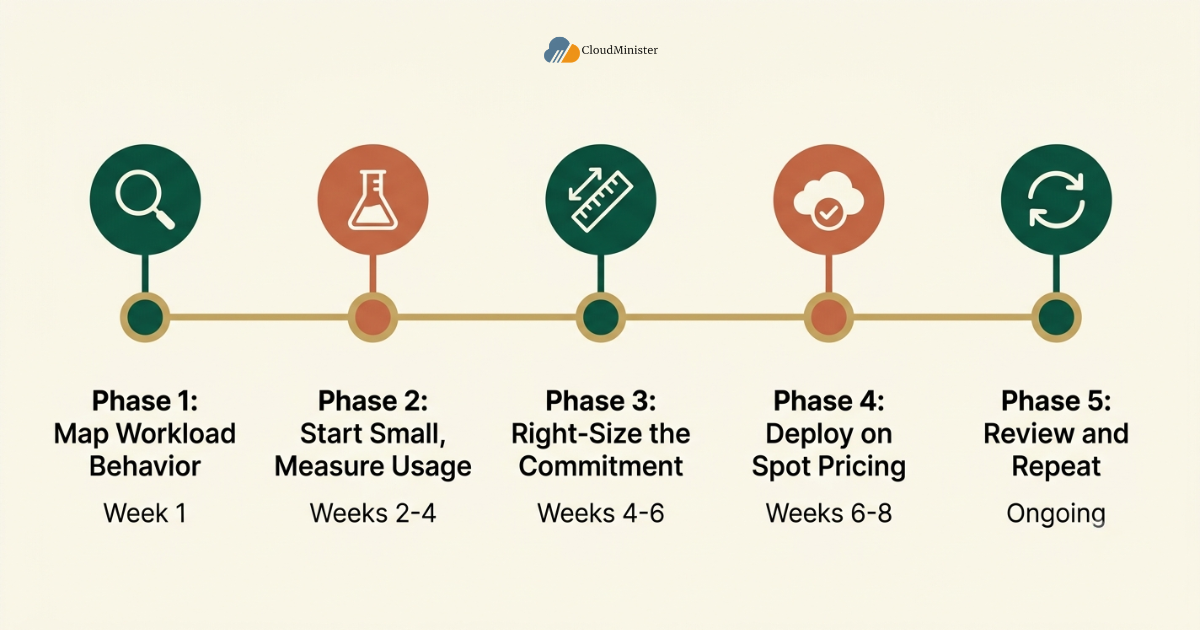
Phase 1: Map Workload Behavior Before Choosing (Week 1)
- List every candidate workload and classify it by predictability, fault tolerance, and expected duration
- Match each workload against the comparison table in Section 8 before signing any contract
- Segment workloads by criticality, since mission-critical, always-on systems generally call for a more conservative option with no interruption risk
Phase 2: Start Small and Measure Actual Usage (Weeks 2 to 4)
- Run new or uncertain workloads on an on-demand plan initially to gather real usage data
- Track actual hourly and monthly consumption rather than estimating it from planning documents
- Involve the finance team early, since real billing patterns often reveal which Cloud Pricing Model genuinely fits the workload
Phase 3: Right-Size the Commitment (Weeks 4 to 6)
- Move steady-state workloads from on-demand billing onto a reserved or committed use plan once usage patterns are confirmed
- Choose a commitment term matched to actual business planning horizons, since a three-year commitment on an uncertain workload creates unnecessary risk
- Confirm the hosting provider offers the flexibility to adjust the Cloud Pricing Model as the business scales
Phase 4: Deploy Fault-Tolerant Workloads on Spot Pricing (Weeks 6 to 8)
- Identify batch, analytics, and rendering jobs that can tolerate interruption without data loss
- Build checkpointing into any application moved onto a spot-based plan
- Set up automated fallback to on-demand capacity if spot instances become unavailable during a critical window
Phase 5: Review and Repeat (Ongoing)
- Revisit which billing structure each workload is running under on a quarterly basis, since usage patterns evolve quickly
- Reassess whether a workload has outgrown its current Cloud Pricing Model, for example a workload that started on-demand but is now steady enough for reserved pricing
- Treat this as a standing FinOps review item rather than a one-time decision
Teams that get the most value from cloud infrastructure treat the Cloud Pricing Model decision the same way they treat any other major operating expense, as something to be measured, reviewed, and adjusted continuously rather than locked in permanently at the start of a project.
11. Common Mistakes When Choosing a Cloud Pricing Model
- Defaulting to on-demand indefinitely: Businesses often leave steady-state workloads running on the most expensive option simply because nobody revisited the decision after initial setup
- Over-committing too early: Locking into a three-year reserved plan before usage patterns are actually understood often leads to paying for unused capacity
- Ignoring interruption tolerance: Deploying a mission-critical application onto a spot-based plan without proper failover handling can cause real business disruption
- Underestimating forecasting effort: Committed use pricing requires genuine usage forecasting, and businesses that skip this step frequently under-commit or over-commit
- Splitting vendor relationships unnecessarily: Managing hosting and support across two different providers adds unnecessary coordination overhead when evaluating a Cloud Pricing Model
- Treating the decision as permanent: Workloads change, and the pricing structure chosen a year ago is rarely still the optimal choice today
12. Readiness Checklist for Choosing the Right Cloud Pricing Model
- Workload mapped: Every candidate workload classified by predictability, fault tolerance, and expected duration before any option is chosen
- Usage data gathered: Actual consumption tracked on-demand for long enough to confirm whether a workload is genuinely steady-state
- Commitment right-sized: Reserved or committed use terms matched to realistic planning horizons rather than best-case projections
- Interruption handling built: Any workload considered for spot pricing has checkpointing and automated fallback in place
- Governance in place: A recurring review scheduled to reassess whether each workload’s current Cloud Pricing Model still matches its actual usage
- Hosting provider verified: Confirmed that the chosen cloud hosting services in India provider offers transparent documentation across every billing option
- Review cadence set: A recurring quarterly review scheduled to reassess whether the current mix of pricing models still matches actual business workloads
Key Takeaways
- The Cloud Pricing Model options available today span a spectrum from fully flexible on-demand billing to deeply discounted committed use plans, and matching the right option to the right workload is the single biggest factor in controlling cloud spend
- Public cloud now accounts for 45 percent of enterprise IT spending in 2026, and average large-enterprise cloud spend has reached 14.3 million dollars annually, making Cloud Pricing Model decisions a board-level concern rather than a purely technical one
- On-demand pricing remains the right starting point for short-term or unpredictable workloads, despite carrying the highest per-unit rate among all four categories
- Reserved and committed use pricing suit steady-state and diverse growing workloads respectively, but both require genuine usage forecasting to deliver real savings
- Spot pricing offers the deepest discount of any Cloud Pricing Model but demands engineering discipline to handle interruption gracefully
- Most mature businesses blend two or three pricing models deliberately rather than committing to a single Cloud Pricing Model across their entire infrastructure footprint
- Reliable cloud hosting services in India and dependable Server Management Services in India together form the operational foundation that makes any chosen Cloud Pricing Model actually deliver its promised savings
- Affordable Cloud Hosting India should never mean opaque billing, and a genuine Server Management Company should be able to explain exactly how each option applies before a contract is signed
- Governance and quarterly review are non-negotiable, since the optimal Cloud Pricing Model for any given workload shifts as that workload matures
- This is a continuous evaluation process, not a one-time billing decision, and businesses that revisit their pricing mix regularly consistently spend less than those that do not
Not Sure Which Pricing Model Fits Your Workload?
Talk to our team and get a clear recommendation based on your actual usage, not just a sales pitch.
Conclusion
Understanding the Cloud Pricing Model landscape is no longer optional for any business planning its cloud infrastructure in 2026. As cloud spending climbs toward record levels industry-wide, the companies that correctly match each workload to the right billing structure, backed by dependable operational support, will spend less and scale more predictably than those still running every workload on whichever option was easiest to set up. Businesses that skip this evaluation step and default to on-demand pricing indefinitely tend to discover the cost of that inertia only after months of avoidable overspending have already passed.
The path forward is clear even if the execution takes discipline. Map workload behavior honestly before signing any contract, start new or uncertain workloads on flexible on-demand billing while gathering real usage data, right-size commitments once patterns are confirmed rather than guessing at the outset, and revisit the decision regularly as workloads mature and business needs evolve. Businesses that build this review cycle into their standard operating rhythm, the same way they already review application performance or headcount, consistently spend less on infrastructure than those still treating their Cloud Pricing Model as a one-time setup decision.
Cloudminister supports this entire journey with reliable cloud hosting services in India, transparent billing across every available option, and dependable Server Management Services in India for businesses that want predictable costs without sacrificing performance. Whether a business needs flexible on-demand capacity for a short-term project, a reserved commitment for a steady production workload, or spot capacity for fault-tolerant batch processing, working with a single Web Hosting Company in India for all of it keeps the transition simple and the billing predictable. As cloud spending continues to climb through 2026 and beyond, businesses that pair the right Cloud Pricing Model with the right infrastructure partner will be the ones turning cloud cost management from a constant headache into a genuine competitive advantage.
Frequently Asked Questions
What are the main types of Cloud Pricing Model available today?
The main categories are on-demand, reserved, spot, and committed use. Each differs in commitment length, discount depth, and interruption risk, and each suits a different range of workload patterns, from short-term experimentation to long-running production infrastructure.
Which Cloud Pricing Model should a business start with?
Most businesses see the lowest risk starting with an on-demand plan while gathering real usage data, since this category requires no upfront commitment and makes it easy to observe actual consumption before locking into a longer-term plan. More predictable workloads can then move to reserved or committed use pricing once usage patterns are confirmed.
Is spot pricing safe to use for production workloads?
Spot pricing can be safe for production use, but only for workloads specifically engineered to tolerate interruption, such as batch processing or analytics jobs with checkpointing built in. Using this option for a mission-critical, always-on application without proper failover handling creates real risk of service disruption.
How often should a business reassess its Cloud Pricing Model choices?
Businesses should reassess their mix of pricing models on a quarterly basis, and whenever a workload’s usage pattern, criticality, or scale changes materially. Treating the decision as permanent rather than a continuous evaluation process is one of the most common mistakes businesses make when managing cloud spend.
Does choosing the right Cloud Pricing Model require managed support?
It is not strictly required, but businesses without an in-house infrastructure team benefit significantly from dependable server management support, since ongoing monitoring and right-sizing are what actually make any billing structure deliver its promised savings in practice rather than just on paper.
Should a business rely on a single provider for hosting and support?
Most businesses benefit from working with a single provider for both cloud hosting services in India and ongoing operational support, since a unified relationship simplifies billing, reduces coordination overhead, and gives the business one point of contact for adjusting its Cloud Pricing Model as workloads evolve.
Is Affordable Cloud Hosting India actually reliable for production workloads?
Affordable Cloud Hosting India can absolutely be reliable, provided the Server Management Company behind it has genuine operational maturity rather than just a low advertised rate. The safest approach is to ask any Affordable Cloud Hosting India provider for references or uptime data before committing, and to confirm the same Server Management Company offers consistent monitoring and support standards regardless of plan size, since the value of Affordable Cloud Hosting India ultimately depends on that consistency rather than the entry price alone.