


Choosing between web hosting providers in India is only half the infrastructure decision most engineering teams face in 2026. The other half is choosing a managed Kubernetes platform, and the EKS vs GKE vs AKS comparison has become one of the most searched infrastructure questions of the year. This guide walks through EKS vs GKE vs AKS pricing, features, security, and autoscaling so a platform team, a startup CTO, or a solo DevOps engineer evaluating cloud hosting services in India can make a confident call. It also breaks down control plane costs, compute pricing, networking overhead, and operational maturity across all three platforms, so you are not left guessing which one fits your team.
For teams still weighing whether managed Kubernetes is worth the learning curve compared to self hosting, the short answer is yes for almost everyone past a handful of services. Running your own control plane, patching nodes, and handling upgrades on your own is a full time job that most engineering teams simply do not have the bandwidth for once workloads grow beyond a small side project. Kubernetes adoption has moved well past the early adopter phase and is now considered close to a default choice for teams running containers at any real scale, and a closer look at how Kubernetes adoption has grown heading into 2026 shows just how mainstream managed clusters have become. That shift in adoption is exactly why the EKS vs GKE vs AKS comparison matters so much right now, since almost every team eventually lands on one of these three platforms rather than building and maintaining their own.
The real EKS vs GKE vs AKS question is not whether to go managed, it is which of the three platforms fits your existing cloud footprint, your compliance needs, and your team’s operational maturity. A team already running most of its infrastructure on AWS will feel very different friction on EKS compared to a team that just wants Kubernetes to work without thinking about node pools at all. Compliance heavy teams in regulated industries often care more about fleet management and audit tooling than they do about a small difference in hourly compute pricing. None of these factors show up clearly on a simple pricing page, which is exactly why so many teams end up comparing EKS, GKE, and AKS side by side before making a final call.
Picking the wrong platform in the EKS vs GKE vs AKS decision is an expensive mistake to unwind later, both in dollars and in engineering time. Migrating a production cluster between providers months after launch means redoing identity integration, revisiting networking assumptions, and retraining a team that already built habits around a different platform. It is far cheaper to spend an extra week evaluating EKS, GKE, and AKS properly than to discover six months in that the platform you picked does not match how your team actually operates. The rest of this guide is built to help you avoid that exact situation by walking through the pricing, features, and tradeoffs that matter most before you commit.
1. What EKS, GKE, and AKS Actually Are
Before comparing pricing sheets, it helps to understand what each platform is actually managing on your behalf, since this shapes every other decision in the EKS vs GKE vs AKS debate.
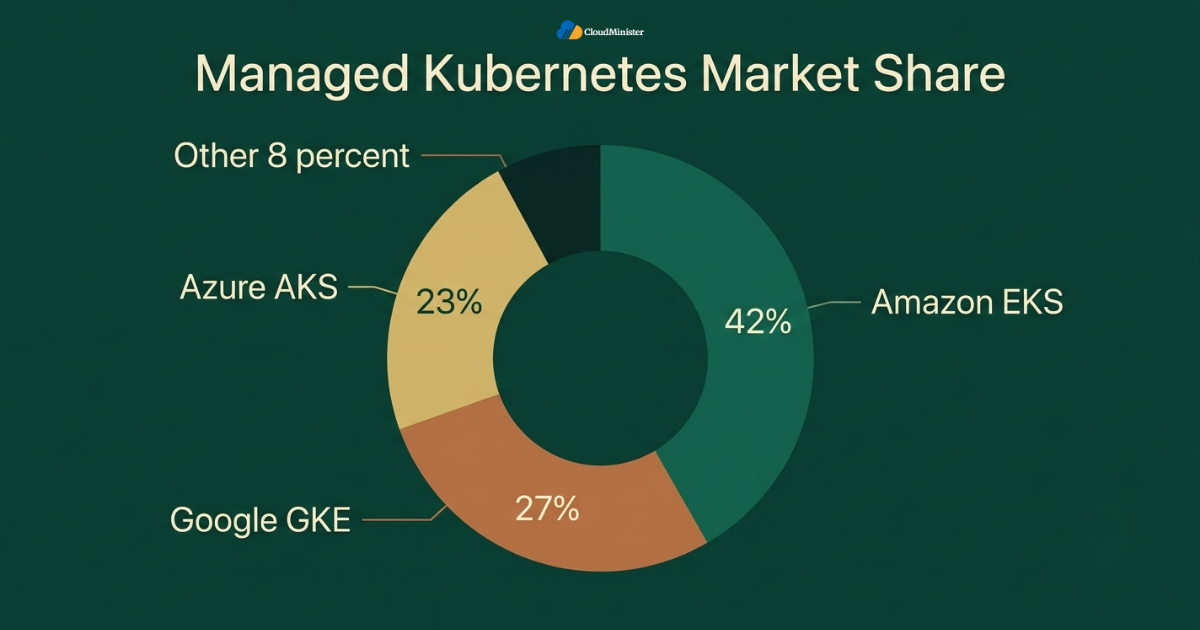
- Amazon EKS (Elastic Kubernetes Service) is AWS’s managed control plane for Kubernetes, deeply integrated with IAM, VPC networking, and the broader AWS ecosystem, and it currently holds the largest share of the managed Kubernetes market at roughly 42 percent.
- Google GKE (Google Kubernetes Engine) was built by the same team that created Kubernetes internally at Google, and it remains the most opinionated of the three, offering both a Standard mode and an Autopilot mode that abstracts away node management entirely.
- Azure AKS (Azure Kubernetes Service) is Microsoft’s managed offering, notable in the EKS vs GKE vs AKS conversation mainly because it does not charge for its Standard control plane the way EKS and GKE Standard do.
- All three platforms run upstream, conformant Kubernetes, so core application manifests and workload definitions are broadly portable between them, but this portability has limits: cloud-specific networking, storage classes, IAM/identity integration, and managed add-ons often require significant rework during a migration, which is exactly why the EKS vs GKE vs AKS decision is about cost, tooling, and ecosystem fit as much as it is about raw compatibility.
- Any Web Hosting Company in India discussion that stops at compute instances and ignores container orchestration is incomplete for teams running production workloads at meaningful scale in 2026.
Before you commit to any side of the EKS vs GKE vs AKS decision, check where the rest of your infrastructure already lives. A team already deep into AWS networking, IAM policies, and VPC peering will usually find EKS the path of least resistance, regardless of what a pricing spreadsheet says in isolation.
2. EKS vs GKE vs AKS: Control Plane Pricing Explained
Control plane pricing is the number every EKS vs GKE vs AKS comparison leads with, and it is worth getting precisely right before moving to the bigger cost drivers.
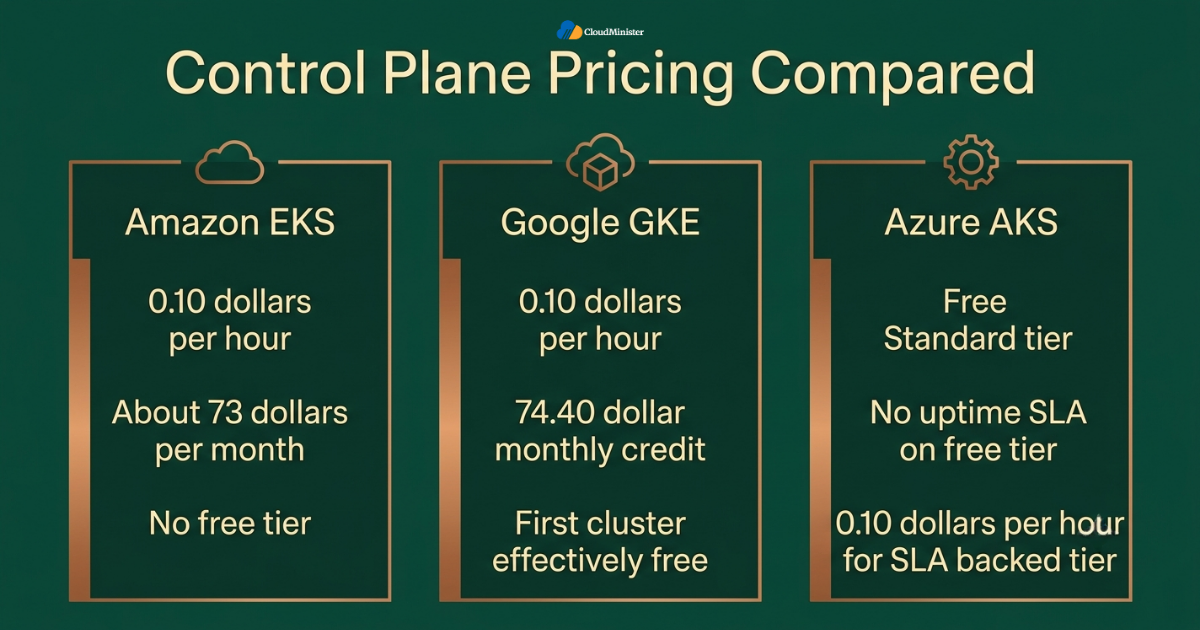
- Amazon EKS charges a flat 0.10 dollars per hour per cluster, which works out to roughly 73 dollars a month, regardless of cluster size, and there is no free tier for standard support versions.
- Google GKE charges the same 0.10 dollars per hour for both Standard and Autopilot clusters, but it applies a 74.40 dollar monthly credit per billing account that effectively makes your first cluster free.
- Azure AKS offers a free tier with no control plane charge and no uptime SLA, intended for development and testing, while its Standard tier costs 0.10 dollars per hour and adds a 99.95 percent uptime guarantee.
- This is exactly the kind of nuance a Dedicated Server Hosting in India provider or a managed Kubernetes consultant will walk you through before you commit to a platform, since the sticker price rarely tells the full story.
- At small scale, a two or three cluster setup, the EKS vs GKE vs AKS control plane pricing gap between EKS and AKS is a real but modest difference of roughly 150 to 220 dollars a month.
- At larger scale, running 40 or more clusters across dev, staging, QA, and production environments, that same gap between EKS and AKS control plane fees can exceed 2,900 dollars a month, which is where Cloud Hosting Solutions in India teams start paying close attention to platform choice.
It is worth being blunt about something most EKS vs GKE vs AKS comparisons underplay: control plane fees, on their own, are almost never the deciding factor once your cluster count grows past a handful of nodes, because compute and networking dominate the bill at that point.
3. Compute and Node Pricing Across the Three Platforms
This is where the real EKS vs GKE vs AKS cost comparison happens, since worker nodes running your actual containers make up the majority of any production Kubernetes bill.
- EKS worker nodes are billed as standard EC2 instances, meaning you get full access to Reserved Instances, Savings Plans, and Spot pricing, which can cut compute costs by 60 to 90 percent for fault-tolerant workloads.
- GKE Standard nodes run on Compute Engine VMs and automatically qualify for sustained-use discounts, which can shave roughly 20 percent off on-demand rates without any manual commitment.
- GKE Autopilot bills per pod resource request rather than per node, which removes node management overhead entirely but typically costs 10 to 20 percent more than a well-tuned GKE Standard cluster.
- AKS nodes are billed as standard Azure VMs, and AKS also supports Reserved Instances and Spot VMs. In some regions, Azure does not charge for cross-availability-zone traffic, though this varies by region and by the specific service or traffic type involved, so it’s worth confirming for your target region rather than assuming it applies universally.
- EKS Fargate, the serverless compute option for EKS, charges roughly 0.04 dollars per vCPU-hour and 0.0044 dollars per GB-hour, which suits isolated batch jobs well but becomes expensive for full, long-running cluster workloads.
- AKS has no direct equivalent to Fargate or Autopilot for full serverless scheduling, though Azure Container Instances via virtual nodes can absorb short bursts of extra capacity.
Regardless of which side of the EKS vs GKE vs AKS decision you land on, worker node IAM roles, service accounts, and node pool permissions should always follow least-privilege principles. A compromised node with overly broad cloud permissions is one of the fastest paths to a full account takeover, and this risk exists identically across EKS, GKE, and AKS.
Related Reading: A structured approach to comparing consumption-based, reserved, and hybrid billing models matters just as much for Kubernetes compute as it does for general cloud spend, and this breakdown of cloud pricing model types explained is a useful companion read before finalizing your node strategy.
Related Reading: cloud pricing model types explained
4. Networking and Storage: The Hidden Line Items
Every serious EKS vs GKE vs AKS comparison eventually has to confront networking and storage, because these costs are consistently underestimated during initial budgeting.
- NAT gateway and data egress charges can exceed compute costs on all three platforms once a cluster starts pulling large container images or pushing logs to external observability tools.
- A 100-node cluster moving roughly 500 GB of image pulls and 300 GB of outbound logging traffic can add over 130 dollars a month in NAT charges on EKS alone, even before any application traffic is counted.
- GKE persistent disk pricing ranges from about 0.17 dollars per GB per month for standard disks to 0.32 dollars per GB per month for SSD-backed persistent disks, a spread worth modeling against your actual IOPS needs.
- In certain regions, AKS can benefit from free inter-availability-zone traffic, which can favor multi-zone, high-availability deployments compared to EKS and GKE — but this is region- and service-dependent, so it should be verified against Azure’s current pricing for your specific region before it’s factored into a cost model.
- Load balancer costs, whether an AWS Network Load Balancer, a Google Cloud Load Balancer, or an Azure Load Balancer, add a recurring line item that most teams forget to include when they first model EKS vs GKE vs AKS costs.
- Any cloud hosting services in India evaluation that only compares compute list prices while ignoring egress and storage will consistently underestimate the real monthly bill by a significant margin, whether the workload runs on Kubernetes or Cloud Hosting Solutions in India.
Run a 30-day shadow estimate before committing to a platform. Deploy a representative workload on your top EKS vs GKE vs AKS candidate, let it run for a full billing cycle, and compare the invoice to your spreadsheet projection. Egress and storage almost always surprise teams the first time.
Need Reliable Infrastructure Around Your Kubernetes Cluster
Your Kubernetes platform is only as strong as the infrastructure supporting it. Get scalable, high performance cloud hosting built for the workloads that run alongside your clusters.
5. Autoscaling, Autopilot, and Operational Overhead
Autoscaling maturity is one of the most practically important dimensions of the EKS vs GKE vs AKS comparison, since it directly determines how much ongoing operational work your team carries.
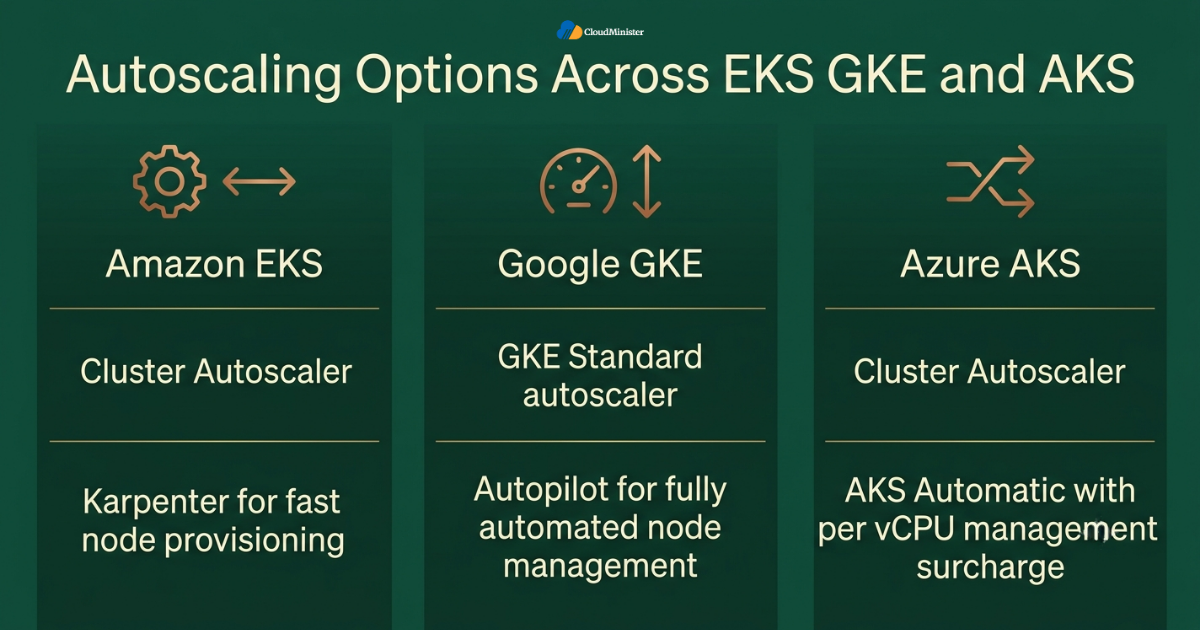
- EKS supports the Kubernetes Cluster Autoscaler and increasingly Karpenter, an AWS-built autoscaler that provisions right-sized nodes in seconds rather than minutes, which has become a meaningful differentiator for cost-sensitive teams.
- GKE Autopilot is the most hands-off option among the three, automatically managing node provisioning, sizing, and even some security defaults, which suits teams that want Kubernetes without wanting to operate Kubernetes.
- GKE Standard gives you full node pool control alongside Google’s own cluster autoscaler, striking a middle ground between Autopilot’s simplicity and EKS’s flexibility.
- AKS Automatic, Microsoft’s newer offering, adds a per-vCPU management surcharge ranging from roughly 7 dollars per vCPU per month for general-purpose nodes up to over 32 dollars per vCPU per month for GPU-accelerated compute.
- For teams without a dedicated platform engineer, GKE Autopilot or AKS Automatic typically reduce operational overhead the most, while EKS with Karpenter rewards teams willing to invest engineering time in fine-tuned cost control.
- This tradeoff mirrors a broader pattern any experienced Dedicated Server Hosting in India provider will recognize: managed simplicity costs a premium, and manual control saves money only when someone competent is actually driving it.
Related Reading: AWS vs Azure vs Google Cloud
6. Security, Compliance, and Identity
Security posture varies enough between the three platforms that it deserves its own section in any thorough EKS vs GKE vs AKS evaluation, especially for regulated industries.
- EKS integrates natively with AWS IAM, including IAM Roles for Service Accounts, which allows fine-grained, pod-level permissions without long-lived credentials sitting inside containers.
- GKE offers Workload Identity, its equivalent mechanism for binding Kubernetes service accounts to Google Cloud IAM identities, along with built-in Binary Authorization for verifying container image provenance before deployment.
- AKS integrates with Microsoft Entra ID (formerly Azure Active Directory) for identity, and AKS Premium tier adds long-term support windows for teams that cannot upgrade Kubernetes versions on the community’s faster release cadence.
- All three platforms support network policies, pod security standards, and private cluster modes that keep the API server off the public internet, though the exact configuration steps differ meaningfully across EKS, GKE, and AKS.
- Compliance certifications, including SOC 2, ISO 27001, HIPAA, and FedRAMP, are available on all three platforms, but the audit documentation and shared-responsibility boundaries differ, which matters for regulated Web Hosting Company in India customers.
Whichever platform you choose in the EKS vs GKE vs AKS decision, never store cluster credentials, kubeconfig files, or service account keys in a source repository. Use short-lived, workload-identity-based authentication wherever the platform supports it, and rotate any long-lived keys on a fixed schedule regardless of provider.
7. EKS vs GKE vs AKS: Feature Comparison Table
The table below summarizes the core EKS vs GKE vs AKS differences that matter most for a production decision in 2026.
| Category | Amazon EKS | Google GKE | Azure AKS |
| Control plane cost | $73/month flat, no free tier | $73/month, $74.40 monthly credit | Free Standard tier, no SLA |
| Serverless option | EKS Fargate (per vCPU/GB) | Autopilot (per pod resource) | No direct equivalent |
| Autoscaler | Cluster Autoscaler, Karpenter | GKE-native autoscaler | Cluster Autoscaler, AKS Automatic |
| Identity model | IAM Roles for Service Accounts | Workload Identity | Microsoft Entra ID |
| Cross-AZ traffic | Billed | Billed | Free in some regions |
| Market share (managed K8s) | ~42% | ~27% | ~23% |
Note: Availability depends on the specific Azure region and traffic/service type — confirm current pricing for your target region before budgeting.
A feature table is a starting point for the EKS vs GKE vs AKS decision, not the finish line. The right platform is the one that matches your team’s existing cloud footprint, compliance obligations, and in-house Kubernetes expertise, not simply the one with the longest checklist of capabilities.
8. Choosing Based on Team Size and Maturity
Team size and operational maturity should weigh as heavily as raw pricing in any EKS vs GKE vs AKS decision, since the cheapest platform on paper is not cheap if it burns senior engineering hours every week.
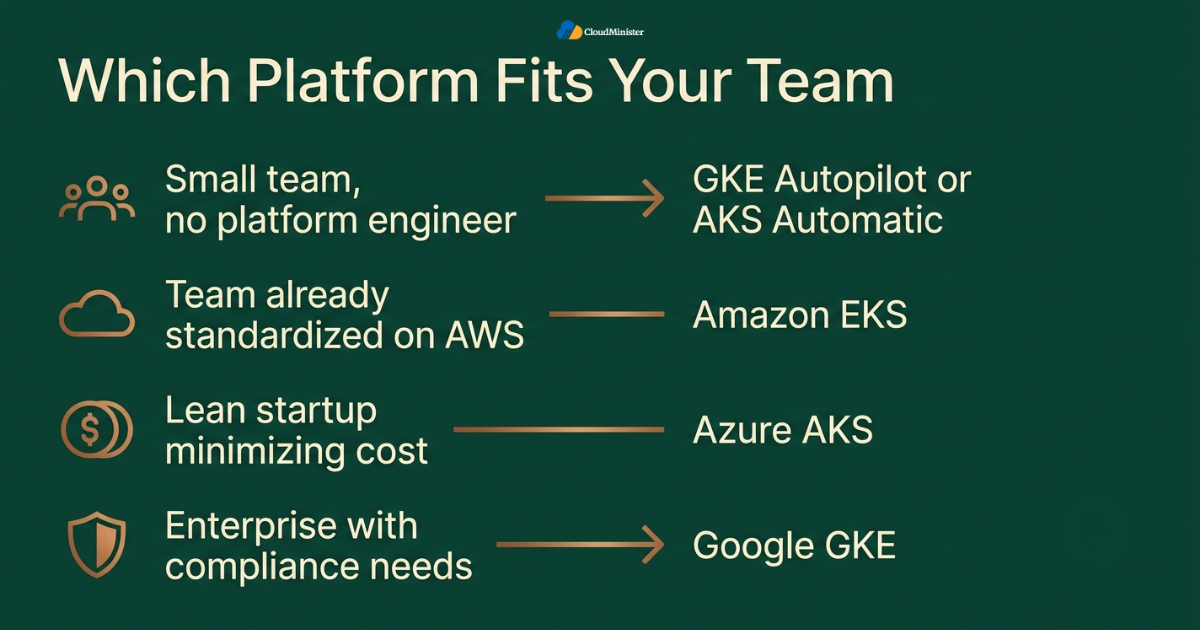
- Small teams without a dedicated platform engineer generally get the most value from GKE Autopilot or AKS Automatic, since both absorb node management and reduce the daily operational burden.
- Teams already standardized on AWS for compute, storage, and IAM will usually find EKS the path of least friction, particularly if they already rely on other AWS-native services alongside their cloud hosting services in India setup.
- Startups optimizing hard for lean infrastructure spend often favor AKS specifically because of its free Standard control plane and zero-cost cross-zone traffic, both of which compound favorably at higher cluster counts.
- Enterprises with existing multi-region compliance requirements frequently pick GKE for its mature multi-cluster fleet management tooling, including Config Management and Policy Controller, both included at no extra cost.
- Any organization already working with a Dedicated Server Hosting in India partner for its non-Kubernetes workloads should ask that partner directly how their team supports managed Kubernetes operations, since the answer often reveals whether in-house Kubernetes expertise is truly needed yet.
Related Reading: IoT and cloud integration
9. Cost Optimization Levers That Matter More Than the Platform
Whichever side of the EKS vs GKE vs AKS debate you land on, the same optimization levers apply, and most of the real savings come from how you operate the cluster, not which vendor’s logo is on the control plane.
- Right-sizing CPU and memory requests is the single highest-leverage lever available, since a large share of pods across the industry over-request resources by a wide margin.
- Spot and preemptible instances can cut compute costs dramatically for fault-tolerant, stateless workloads on any of the three platforms, provided your application handles interruption gracefully.
- Caching container image layers and dependency downloads between build and deploy stages reduces both time and network egress costs, regardless of which platform you compare in an EKS vs GKE vs AKS evaluation.
- Using ephemeral, per-branch or per-pull-request environments instead of one always-on staging cluster is a proven way to cut idle compute spend without touching production reliability.
- A formal governance process, reviewed on a fixed schedule rather than reactively, is what actually prevents Kubernetes costs from drifting upward month after month regardless of platform choice.
Related Reading: For a structured framework covering budgets, tagging discipline, and accountability across cloud spend, this guide to cloud cost governance policy is directly applicable to Kubernetes clusters as well as general infrastructure, and pairs well with any EKS vs GKE vs AKS cost model you build internally.
Related Reading: cloud cost governance policy guide
10. Common Mistakes Teams Make in the EKS vs GKE vs AKS Decision
Even well-intentioned platform teams make predictable mistakes when working through the EKS vs GKE vs AKS decision. Most of these are avoidable with a bit of upfront discipline.
- Comparing only control plane sticker prices while ignoring compute, storage, and egress, which together make up the overwhelming majority of any real Kubernetes bill.
- Choosing a platform because a competitor uses it, rather than because it fits the team’s existing cloud footprint and skill set.
- Running every cluster at production-grade high availability, including throwaway dev and test clusters that could safely run on a lower-cost, best-effort tier.
- Skipping a genuine cost-per-node comparison across cloud hosting services in India and hyperscaler options before signing a long-term commitment.
- Ignoring egress and cross-zone traffic costs, which is exactly the kind of oversight that turns a promising EKS vs GKE vs AKS pricing spreadsheet into a very different real invoice three months later.
- Treating the platform decision as permanent and never revisiting it, even after team size, workload patterns, or compliance requirements change significantly.
11. When to Bring in Outside Help
There is a clear point in most teams’ growth where a self-managed approach to any EKS vs GKE vs AKS decision stops being the most efficient use of engineering time.
- Your team is spending more hours per month debugging cluster issues than shipping product features.
- Compliance requirements, such as SOC 2 or industry-specific regulations, now demand documentation and controls your current setup was never built for.
- You are managing infrastructure across multiple regions and would benefit from a dedicated Dedicated Server Hosting in India partner rather than splitting that responsibility across generalist engineers.
- Your current Web Hosting Company in India relationship has not kept pace with growth, and staging or production reliability issues are now bleeding into your Kubernetes uptime.
- A well-scoped managed operations engagement, brought in at the right moment rather than after a painful outage, consistently produces better outcomes than continuing to patch things internally.
Before engaging any outside partner for your EKS vs GKE vs AKS rollout, document exactly which parts of your current setup work well and which parts consistently cause problems. A consultant who can see your actual pain points delivers far more value than one starting from a generic audit template.
12. A Practical Framework for Making the Final Call
Use this simple framework to cut through vendor marketing and make a grounded EKS vs GKE vs AKS decision for your specific situation.
- If your team already runs the majority of its workloads on one hyperscaler, default to that provider’s managed Kubernetes service unless there is a specific, documented reason not to.
- If your team lacks a dedicated platform engineer, prioritize GKE Autopilot or AKS Automatic over EKS with manual node management, since operational simplicity will save more than a marginal pricing difference.
- If your cluster count is high and utilization per cluster is low, weigh AKS’s free control plane and free cross-zone traffic seriously against the alternatives.
- If compliance and multi-cluster fleet governance are primary concerns, GKE’s built-in fleet tooling is worth the modest premium over the alternatives.
- If a cost, in dollars or engineering hours, cannot be tied to a specific risk it reduces, treat it as a target for elimination rather than a fixed cost of doing business.
13. How Managed Kubernetes Fits Into Your Broader Infrastructure Stack
No EKS vs GKE vs AKS decision happens in a vacuum. Kubernetes clusters sit on top of a larger stack that usually includes a Web Hosting Company in India, supporting cloud hosting services in India for adjacent workloads, and sometimes a Dedicated Server Hosting in India arrangement for legacy systems that were never containerized.
- A reliable Web Hosting Company in India handling DNS, email, and marketing sites in parallel with your Kubernetes clusters reduces the number of vendors your team has to coordinate with during an incident.
- Many teams pair their EKS vs GKE vs AKS choice with Cloud Hosting Solutions in India for surrounding services like CI runners, artifact registries, and internal tooling that does not need to live inside the cluster itself.
- A dependable cloud hosting services in India arrangement for staging and pre-production environments keeps costs predictable while the production Kubernetes cluster runs on your chosen hyperscaler.
- Some workloads, particularly legacy monoliths or compliance-locked databases, are genuinely better served by Dedicated Servers in India than by squeezing them into a Kubernetes cluster or a general-purpose Cloud Hosting Solutions in India plan for the sake of consistency.
- A Dedicated Server Hosting in India provider that already understands your non-Kubernetes footprint can often extend that same operational discipline to your managed cluster without requiring a second vendor relationship.
Map your entire stack, not just the Kubernetes layer, before finalizing an EKS vs GKE vs AKS decision. A cluster that looks cheap in isolation can still leave you paying twice for overlapping capacity if your Web Hosting Company in India and cloud hosting services in India arrangements were not planned alongside it.
14. Regional Availability and Latency Considerations
Regional footprint is an underrated factor in the EKS vs GKE vs AKS comparison, particularly for teams serving users outside North America and Western Europe.
- AWS, Google Cloud, and Azure all maintain data center regions in India, making a cloud hosting services in India strategy anchored to any of the three platforms viable for latency-sensitive Indian user bases.
- Teams already relying on a Web Hosting Company in India based in India for their web presence often find it natural to keep their Kubernetes control plane in the same region to minimize cross-region latency between the application layer and supporting services.
- A Dedicated Server Hosting in India provider with regional data center presence can offer meaningfully lower latency for hybrid architectures that split workloads between a managed cluster and dedicated hardware.
- For teams evaluating Cloud Hosting Solutions in India specifically for Indian traffic patterns, regional availability zones matter as much as raw EKS vs GKE vs AKS pricing differences, since latency directly affects user experience and, eventually, conversion rates.
- Where Dedicated Servers in India still play a role, typically for data residency or extremely predictable, steady-state workloads, pairing them with a nearby Kubernetes region keeps internal service-to-service latency low.
15. Migration Considerations When Switching Platforms
Teams that already run production workloads sometimes need to migrate between platforms mid-stream, and the EKS vs GKE vs AKS decision becomes a live migration project rather than a greenfield choice.
- Because all three platforms run conformant, upstream Kubernetes, application manifests, Helm charts, and most YAML configuration transfer relatively well between EKS, GKE, and AKS, though networking, storage, and identity configuration typically need meaningful rework rather than a straight copy-over.
- Identity and secrets management typically require the most rework during a migration, since IAM Roles for Service Accounts, Workload Identity, and Microsoft Entra ID are not directly interchangeable.
- A phased migration, moving one namespace or one service at a time behind a shared ingress, reduces risk far more effectively than a single cutover weekend for any EKS vs GKE vs AKS migration.
- Coordinating the migration with your existing Web Hosting Company in India provider ahead of time avoids DNS and certificate surprises on cutover day.
- Teams moving away from Dedicated Servers in India toward a fully managed Kubernetes footprint should budget extra time for data migration and validation, since this step is consistently underestimated in project timelines.
16. Budgeting Checklist Before You Sign a Contract
A short checklist to run through before committing to any managed Kubernetes vendor, alongside your existing Web Hosting Company in India and cloud hosting services in India relationships.
- Confirm whether your Web Hosting Company in India pricing scales predictably with traffic growth, since surprise overage charges compound quickly when paired with a growing Kubernetes bill.
- Ask any cloud hosting services in India provider directly how egress pricing changes at higher tiers, since this is the line item most teams underestimate during initial budgeting.
- If your architecture includes Dedicated Servers in India for legacy systems, confirm the network path between those servers and your cluster does not introduce unexpected cross-provider egress fees.
- Request a sample invoice from any Dedicated Server Hosting in India provider you are evaluating, not just a rate card, since real invoices reveal fees that marketing pages omit.
- Compare at least two Cloud Hosting Solutions in India options side by side against your chosen Kubernetes platform’s compute pricing before signing a multi-year commitment.
13. How Managed Kubernetes Fits Into Your Broader Infrastructure Stack
No EKS vs GKE vs AKS decision happens in a vacuum. Kubernetes clusters sit on top of a larger stack that usually includes a Web Hosting Company in India, supporting cloud hosting services in India for adjacent workloads, and sometimes a Dedicated Server Hosting in India arrangement for legacy systems that were never containerized.
- A reliable Web Hosting Company in India handling DNS, email, and marketing sites in parallel with your Kubernetes clusters reduces the number of vendors your team has to coordinate with during an incident.
- Many teams pair their EKS vs GKE vs AKS choice with Cloud Hosting Solutions in India for surrounding services like CI runners, artifact registries, and internal tooling that does not need to live inside the cluster itself.
- A dependable cloud hosting services in India arrangement for staging and pre-production environments keeps costs predictable while the production Kubernetes cluster runs on your chosen hyperscaler.
- Some workloads, particularly legacy monoliths or compliance-locked databases, are genuinely better served by Dedicated Servers in India than by squeezing them into a Kubernetes cluster or a general-purpose Cloud Hosting Solutions in India plan for the sake of consistency.
- A Dedicated Server Hosting in India provider that already understands your non-Kubernetes footprint can often extend that same operational discipline to your managed cluster without requiring a second vendor relationship.
Map your entire stack, not just the Kubernetes layer, before finalizing an EKS vs GKE vs AKS decision. A cluster that looks cheap in isolation can still leave you paying twice for overlapping capacity if your Web Hosting Company in India and cloud hosting services in India arrangements were not planned alongside it.
14. Regional Availability and Latency Considerations
Regional footprint is an underrated factor in the EKS vs GKE vs AKS comparison, particularly for teams serving users outside North America and Western Europe.
- AWS, Google Cloud, and Azure all maintain data center regions in India, making a cloud hosting services in India strategy anchored to any of the three platforms viable for latency-sensitive Indian user bases.
- Teams already relying on a Web Hosting Company in India based in India for their web presence often find it natural to keep their Kubernetes control plane in the same region to minimize cross-region latency between the application layer and supporting services.
- A Dedicated Server Hosting in India provider with regional data center presence can offer meaningfully lower latency for hybrid architectures that split workloads between a managed cluster and dedicated hardware.
- For teams evaluating Cloud Hosting Solutions in India specifically for Indian traffic patterns, regional availability zones matter as much as raw EKS vs GKE vs AKS pricing differences, since latency directly affects user experience and, eventually, conversion rates.
- Where Dedicated Servers in India still play a role, typically for data residency or extremely predictable, steady-state workloads, pairing them with a nearby Kubernetes region keeps internal service-to-service latency low.
15. Migration Considerations When Switching Platforms
Teams that already run production workloads sometimes need to migrate between platforms mid-stream, and the EKS vs GKE vs AKS decision becomes a live migration project rather than a greenfield choice.
- Because all three platforms run conformant, upstream Kubernetes, application manifests, Helm charts, and most YAML configuration transfer relatively well between EKS, GKE, and AKS, though networking, storage, and identity configuration typically need meaningful rework rather than a straight copy-over.
- Identity and secrets management typically require the most rework during a migration, since IAM Roles for Service Accounts, Workload Identity, and Microsoft Entra ID are not directly interchangeable.
- A phased migration, moving one namespace or one service at a time behind a shared ingress, reduces risk far more effectively than a single cutover weekend for any EKS vs GKE vs AKS migration.
- Coordinating the migration with your existing Web Hosting Company in India provider ahead of time avoids DNS and certificate surprises on cutover day.
- Teams moving away from Dedicated Servers in India toward a fully managed Kubernetes footprint should budget extra time for data migration and validation, since this step is consistently underestimated in project timelines.
16. Budgeting Checklist Before You Sign a Contract
A short checklist to run through before committing to any managed Kubernetes vendor, alongside your existing Web Hosting Company in India and cloud hosting services in India relationships.
- Confirm whether your Web Hosting Company in India pricing scales predictably with traffic growth, since surprise overage charges compound quickly when paired with a growing Kubernetes bill.
- Ask any cloud hosting services in India provider directly how egress pricing changes at higher tiers, since this is the line item most teams underestimate during initial budgeting.
- If your architecture includes Dedicated Servers in India for legacy systems, confirm the network path between those servers and your cluster does not introduce unexpected cross-provider egress fees.
- Request a sample invoice from any Dedicated Server Hosting in India provider you are evaluating, not just a rate card, since real invoices reveal fees that marketing pages omit.
- Compare at least two Cloud Hosting Solutions in India options side by side against your chosen Kubernetes platform’s compute pricing before signing a multi-year commitment.
- Review your dedicated hardware contract’s data transfer terms specifically, since infrastructure paired with cloud-based Kubernetes clusters can generate meaningful cross-network charges if not architected carefully.
Teams that build this checklist into a recurring quarterly review, rather than a one-time onboarding exercise, consistently catch cost drift earlier. A Web Hosting Company in India or cloud hosting services in India contract that looked competitive twelve months ago may no longer be the best fit once your Kubernetes footprint has grown.
17. Real-World Scenarios: Which Platform Fits Which Team
A few concrete scenarios illustrate how the EKS vs GKE vs AKS decision plays out once theory meets an actual team and budget.
- A five-person startup already using a Web Hosting Company in India for its marketing site and a modest cloud hosting services in India plan for staging will typically find AKS’s free control plane the least disruptive first step into Kubernetes.
- A fifty-person engineering org already deep into AWS, with existing IAM policies and VPC peering agreements, will usually save more engineering time on EKS than it would save in raw dollars switching to a competitor.
- A data-heavy enterprise running compliance-sensitive workloads across multiple regions, alongside a Dedicated Server Hosting in India arrangement for legacy databases, often finds GKE’s fleet management tooling worth the modest premium.
- A team migrating away from Dedicated Servers in India entirely, consolidating everything into containers, benefits from GKE Autopilot or AKS Automatic specifically because both reduce the operational surface area during that transition.
- A hybrid team keeping some workloads on Cloud Hosting Solutions in India and others on dedicated hardware should prioritize whichever Kubernetes platform integrates most cleanly with its existing cloud provider, rather than chasing marginal control plane savings.
18. Where Dedicated Infrastructure Still Wins
Kubernetes and managed cloud services are not the answer to every workload, and it is worth being honest about where Dedicated Servers in India and Dedicated Server Hosting in India arrangements still make more sense.
- Predictable, steady-state workloads with no scaling requirements are often cheaper on Dedicated Servers in India than on any autoscaling Kubernetes cluster, since you are not paying a premium for elasticity you never use.
- Highly regulated data that must remain on isolated, single-tenant hardware is frequently better served by Dedicated Server Hosting in India than by a shared, multi-tenant cloud environment, even a well-secured one.
- Database workloads with strict, consistent IOPS requirements sometimes perform more predictably on Dedicated Servers in India than on cloud-based persistent volumes, particularly under sustained heavy write load.
- A well-negotiated Dedicated Server Hosting in India contract, scoped correctly for your actual traffic and storage needs, remains one of the more reliable ways to control costs for workloads that do not benefit from Kubernetes-style elasticity, often outperforming a general-purpose Cloud Hosting Solutions in India plan for that specific use case.
- Teams should not feel pressured to containerize everything just because the rest of their stack runs on managed Kubernetes; Dedicated Servers in India paired selectively with your cluster is a legitimate, common architecture.
If a workload has not changed its resource footprint in six months and is not expected to, that is often a signal it belongs on Dedicated Servers in India rather than inside an autoscaling Kubernetes node pool. Elasticity you do not use is a cost, not a benefit.
19. Vendor Support and Service Level Considerations
Support quality varies meaningfully across Web Hosting Company in India, cloud hosting services in India, and Dedicated Server Hosting in India providers, and this matters just as much for Kubernetes-adjacent infrastructure as it does for the cluster itself.
- A responsive Web Hosting Company in India support team can resolve DNS or certificate issues in minutes rather than hours, which matters during a production incident that also involves your Kubernetes ingress layer, and this holds true whether that Web Hosting Company in India is a small boutique provider or a large-scale operator.
- Compare cloud hosting services in India support tiers carefully, since some providers reserve fast response times for their highest-paying customers only.
- A dedicated infrastructure provider offering proactive monitoring, rather than purely reactive ticket handling, tends to catch hardware issues before they cascade into application-level outages.
- Ask any cloud hosting services in India or Dedicated Server Hosting in India vendor directly what their guaranteed response time is during a Sev1 incident, and get that commitment in writing before signing.
- Teams running a hybrid footprint across Cloud Hosting Solutions in India and dedicated servers should confirm both vendors, or a single Dedicated Server Hosting in India partner handling both, can coordinate during a joint incident rather than pointing fingers at each other.
20. Final Notes on Building a Balanced Infrastructure Budget
A balanced infrastructure budget rarely rests on a single vendor, and the healthiest setups blend Web Hosting Company in India accounts, cloud hosting services in India plans, Cloud Hosting Solutions in India arrangements, Dedicated Server Hosting in India contracts, and Dedicated Servers in India where each genuinely fits best.
- Treat your Web Hosting Company in India spend as a fixed, predictable line item, and negotiate accordingly rather than accepting default retail pricing indefinitely.
- Revisit cloud hosting services in India usage quarterly, the same cadence recommended for reviewing your Kubernetes cost optimization levers, since both tend to drift upward without regular oversight.
- Consider Cloud Hosting Solutions in India specifically for burst capacity and CI workloads, where paying for elasticity actually earns its keep rather than sitting idle.
- Budget Dedicated Server Hosting in India spend as a known, largely fixed cost, and use it deliberately for workloads with steady, predictable resource needs.
- Reserve Dedicated Servers in India for the specific subset of workloads, typically compliance-bound or performance-critical, where dedicated hardware genuinely outperforms shared cloud infrastructure.
- A cloud hosting services in India and Cloud Hosting Solutions in India blend, paired with selective Dedicated Server Hosting in India and Dedicated Servers in India usage, generally outperforms an all-in bet on any single infrastructure model, Kubernetes included.
- Whatever mix your team lands on, document the reasoning behind each Web Hosting Company in India, cloud hosting services in India, Dedicated Server Hosting in India, Cloud Hosting Solutions in India, and Dedicated Servers in India decision so future team members understand the tradeoffs rather than inheriting an unexplained patchwork of vendors.
21. A Closing Word on Long-Term Infrastructure Strategy
Long-term infrastructure strategy rewards teams that revisit their assumptions rather than locking in a single vendor forever, whether that vendor provides Kubernetes, Cloud Hosting Solutions in India, or Dedicated Servers in India.
- As traffic grows, reassess whether your current Cloud Hosting Solutions in India tier still matches actual usage, since many teams outgrow their initial plan without noticing for months.
- If your Cloud Hosting Solutions in India provider cannot explain its pricing model in plain language within a five-minute call, that is a signal worth taking seriously before renewal.
- Teams scaling past their first few production clusters often find that a blended approach, some workloads on Kubernetes, some on Dedicated Servers in India, delivers better cost efficiency than an all-or-nothing stance.
- Dedicated Servers in India remain a sound choice for internal tools, build agents, and other steady-state services that do not need Kubernetes-grade elasticity.
- Periodically benchmark your Cloud Hosting Solutions in India costs against at least one alternative provider, even if you have no immediate plan to switch, simply to keep pricing conversations grounded in current market rates.
- The same discipline applies to Dedicated Servers in India: renew with eyes open, informed by actual utilization data rather than habit or inertia.
- A well-documented Cloud Hosting Solutions in India and Dedicated Servers in India strategy, reviewed alongside your Kubernetes platform choice, tends to age far better than infrastructure decisions made once under time pressure and never revisited.
- Ultimately, Cloud Hosting Solutions in India and Dedicated Servers in India are tools in the same toolbox as EKS, GKE, and AKS, not competitors to Kubernetes, and the strongest infrastructure strategies use each where it genuinely fits best.
Still Not Sure Which Platform Fits Your Team
Every infrastructure setup is different. Talk to our team and get a clear, practical recommendation based on your actual workload, budget, and compliance needs.
Conclusion
The honest conclusion to any EKS vs GKE vs AKS comparison is that there is no single correct answer, only a correct answer for your specific team, workload, and existing cloud footprint. EKS rewards teams already deep in the AWS ecosystem, comfortable with IAM, VPC networking, and willing to invest in Karpenter-driven cost control to get the most out of their compute spend. GKE rewards teams that want the most mature, opinionated, low-maintenance experience, particularly through Autopilot, where node management and much of the operational overhead simply disappears. AKS rewards lean teams running many small clusters who want to avoid control plane fees and can benefit from reduced cross-zone networking costs in supported regions. None of these platforms is objectively better than the others, they are simply built for different starting points and different operating priorities.
What matters more than the platform itself is the discipline behind the decision. Teams that treat the EKS vs GKE vs AKS choice as a one-time checkbox tend to end up with a platform that made sense at launch but stopped fitting the team six months or a year later. Cluster counts grow, compliance requirements shift, and the person who originally set up the cluster often moves on to a different project entirely. A platform that was the right call for a five-person startup can quietly become the wrong call for a fifty-person engineering org, not because the platform changed, but because the team and its needs did. Building in a regular review cycle, even a short one, is what keeps the original decision from quietly becoming a liability.
Whichever platform you choose, pair it with dependable underlying infrastructure, whether that means a trustworthy web hosting company in India for your surrounding services, a scalable cloud hosting services in India arrangement for everything Kubernetes does not directly manage, or a dedicated server hosting in India partner for workloads that still make more sense outside a cluster entirely. Kubernetes was never meant to be the answer to every infrastructure question, and the strongest setups treat EKS, GKE, and AKS as one part of a larger stack rather than the whole story. A well run EKS vs GKE vs AKS evaluation, revisited on a regular schedule rather than decided once and forgotten, will consistently outperform a platform chosen once under deadline pressure and never reconsidered again. The teams that get the most value out of managed Kubernetes are rarely the ones with the fanciest setup, they are the ones who keep asking whether their setup still fits.
Frequently Asked Questions
Which is cheaper overall in the EKS vs GKE vs AKS comparison?
It depends heavily on cluster count and utilization rather than having one flat answer. AKS tends to win on control plane cost since its Standard tier has no charge, which matters most for teams running many small clusters across dev, staging, and production. EKS and GKE can become more cost competitive at scale once Reserved Instances, Savings Plans, or sustained use discounts are applied to compute, since compute usually outweighs control plane fees once clusters grow. The honest answer is to model your actual workload against all three rather than trusting a single pricing page in isolation.
Can a small team manage EKS, GKE, or AKS without a dedicated Kubernetes engineer?
Yes, particularly with GKE Autopilot or AKS Automatic, both of which absorb most node management responsibilities on the team’s behalf. These options handle provisioning, sizing, and a lot of the day to day operational work that would otherwise fall on a platform engineer. EKS is manageable too, but it generally rewards teams willing to invest more hands on effort, especially around autoscaling and networking configuration. A small team without deep Kubernetes experience will usually feel less friction on the more managed options.
Does the EKS vs GKE vs AKS decision affect vendor lock in?
All three platforms run standard, upstream Kubernetes, so the application layer itself remains largely portable between them. Lock in tends to show up around identity integration, managed add ons, and networking configuration rather than the container orchestration layer itself. Moving a workload between platforms is rarely a simple copy and paste job once you factor in how IAM, Workload Identity, and Microsoft Entra ID differ. Teams should plan for some rework in those specific areas rather than assuming a clean, effortless migration.
How often should a team revisit its EKS vs GKE vs AKS choice?
A quarterly review, similar to any broader cloud cost governance cycle, is a reasonable cadence for most teams. Significant changes in team size, compliance requirements, or workload patterns are also natural triggers to revisit the decision outside the regular schedule. Waiting until a problem forces the conversation usually means making the decision under pressure rather than with a clear head. Building the review into an existing process, rather than treating it as a separate task, makes it far more likely to actually happen.
Is GKE Autopilot worth the extra cost compared to GKE Standard?
For teams without a dedicated platform engineer, the operational time saved often outweighs the ten to twenty percent premium Autopilot typically carries over a well tuned Standard cluster. Autopilot removes node management, right sizing, and a lot of the day to day tuning work that Standard clusters still require from someone on the team. Teams with strong in house Kubernetes expertise may find that a carefully managed Standard cluster delivers similar reliability at a lower cost. The right choice usually comes down to whether your team has the time and skill to actively manage node pools.
Do EKS, GKE, and AKS all support the same Kubernetes version release cadence?
All three follow the upstream Kubernetes release cycle fairly closely, though each has its own support window and deprecation policy. AKS Premium tier specifically adds longer support windows for teams that cannot upgrade on the community’s faster cadence, which matters for organizations with strict change management processes. EKS and GKE also offer extended support options, though the exact terms and pricing differ between providers. Teams with compliance driven upgrade cycles should check each platform’s current support policy directly rather than assuming they all match.
How does spot or preemptible pricing compare across EKS, GKE, and AKS?
All three platforms support discounted, interruptible compute in some form, and the savings can be substantial for fault tolerant, stateless workloads. EKS and AKS both call this Spot pricing, while GKE uses the term preemptible or Spot VMs depending on the exact configuration chosen. Savings in the range of sixty to ninety percent are achievable on any of the three platforms for workloads that can handle sudden interruption gracefully. The real differentiator tends to be how well each platform’s autoscaler responds to spot capacity being reclaimed, which is worth testing before relying on it heavily in production.
What is the biggest cost mistake teams make after choosing a platform in the EKS vs GKE vs AKS comparison?
The most common mistake is treating the initial platform decision as the end of the cost conversation rather than the beginning of an ongoing one. Teams often lock in a platform, get the cluster running, and then stop paying close attention to right sizing, egress, and storage costs as usage grows over time. Costs that looked reasonable at launch can drift significantly within a year if nobody is actively reviewing them on a fixed schedule. A recurring governance process, even a lightweight one, consistently prevents this kind of slow, unnoticed cost creep better than any one time platform choice ever could.

