Most teams read an uptime promise as one number and move on. The real story sits in the fine print: how downtime is measured, what is excluded, and how a credit is claimed. 99.9 vs 99.99 SLA Downtime comes down to a tenfold difference in allowed outage time, roughly 43 minutes a month against about 4 minutes a month, and that gap changes how you design, buy, and monitor infrastructure. This guide explains the math, the exclusions, the architecture each level needs, and a clear process for claiming credits. It also shows where a Web Hosting Company in India, Cloud Hosting Solutions in India, and Dedicated Servers in India fit when you want uptime backed by real engineering and not only by a number on a pricing page.
Every hosting plan carries an uptime figure that looks tiny and sounds precise. 99.9 percent. 99.99 percent. One extra nine seems like a rounding detail, and many buyers treat it that way. In reality, 99.9 vs 99.99 SLA Downtime is the difference between losing about 43 minutes in a month and losing about 4 minutes in the same month. For a store running a festival sale or a platform that processes payments, that gap separates a quiet night from a flooded support queue. Providers that sell Cloud Hosting Solutions in India and Dedicated Servers in India both advertise uptime figures, so this question touches every kind of hosting.
This guide explains 99.9 vs 99.99 SLA Downtime in plain language. You will see the exact minutes each level allows, how providers measure downtime, which events they usually exclude, and the step by step process for claiming a service credit when a provider misses its target. We also look at the architecture behind each promise, because a number in a contract is only as strong as the design under it. If you are comparing cloud hosting services in India for a growing application, this knowledge helps you read the contract like an engineer and not like a salesperson.
Whether you run a store, a software product, or an internal system, the goal stays the same. Understand what you were promised, measure what you actually received, and ask for what you are owed. A trusted Web Hosting Company in India will welcome that conversation, because clear 99.9 vs 99.99 SLA Downtime terms protect both sides. Along the way we also look at where Cloud Hosting Solutions in India and Dedicated Servers in India each make sense, so you can match the promise to the workload.
Table of Contents
- 1. What an SLA Percentage Really Promises
- 2. Three Nines vs Four Nines Allowed Downtime in Real Minutes
- 3. Why Downtime Costs More Than Any Service Credit
- 4. How Downtime Is Measured and Calculated
- 5. The Architecture Behind Three and Four Nines
- 6. Composite SLAs and the Math of Dependencies
- 7. The Cost of Upgrading to Four Nines Uptime
- 8. Common SLA Exclusions That Reduce Your Credit
- 9. How to Claim Service Credits Step by Step
- 10. Worked Examples: Calculating Credit Eligibility
- 11. Common Mistakes That Cost Teams Their Credits
- 12. How to Choose a Provider for the Uptime You Need
- Key Takeaways
- Conclusion
- Frequently Asked Questions
1. What an SLA Percentage Really Promises
An SLA, or service level agreement, is a contract. It states the level of service a provider commits to and what happens when the provider falls short. The headline uptime percentage is only one clause in that contract. The same logic applies whether you buy from a Web Hosting Company in India or build in house. To read 99.9 vs 99.99 SLA Downtime correctly, you first need to separate three terms that people often mix up: the SLI, the SLO, and the SLA.
- SLI, or service level indicator, is the raw measurement, such as the share of successful requests or the minutes a service was reachable.
- SLO, or service level objective, is the internal target a team sets for an SLI, for example 99.95 percent availability over a month.
- SLA is the external promise written into a contract, and it normally comes with a financial remedy such as a service credit.
- A provider usually sets its internal SLO tighter than its public SLA, which leaves a safety margin before any credit is owed.
- Uptime percentage equals available time divided by total time in the measurement window, multiplied by 100.
- The same percentage can mean different things depending on coverage, such as network only, power only, or the complete service.
- Reading 99.9 vs 99.99 SLA Downtime without reading the definitions section is like comparing two cars by top speed alone.
- A Web Hosting Company in India should be able to explain each of these terms in simple language and show where they appear in the contract.
- A plan for Dedicated Servers in India and a plan for Cloud Hosting Solutions in India may carry the same percentage but define it very differently.
PRO TIP: Before you compare plans, ask which exact components the uptime number covers. A 99.99 percent network promise is not the same as a 99.99 percent promise for your whole application. Many 99.9 vs 99.99 SLA Downtime disputes begin because the customer assumed full coverage and the contract covered only one layer.
2. 99.9 vs 99.99 SLA Downtime in Real Minutes
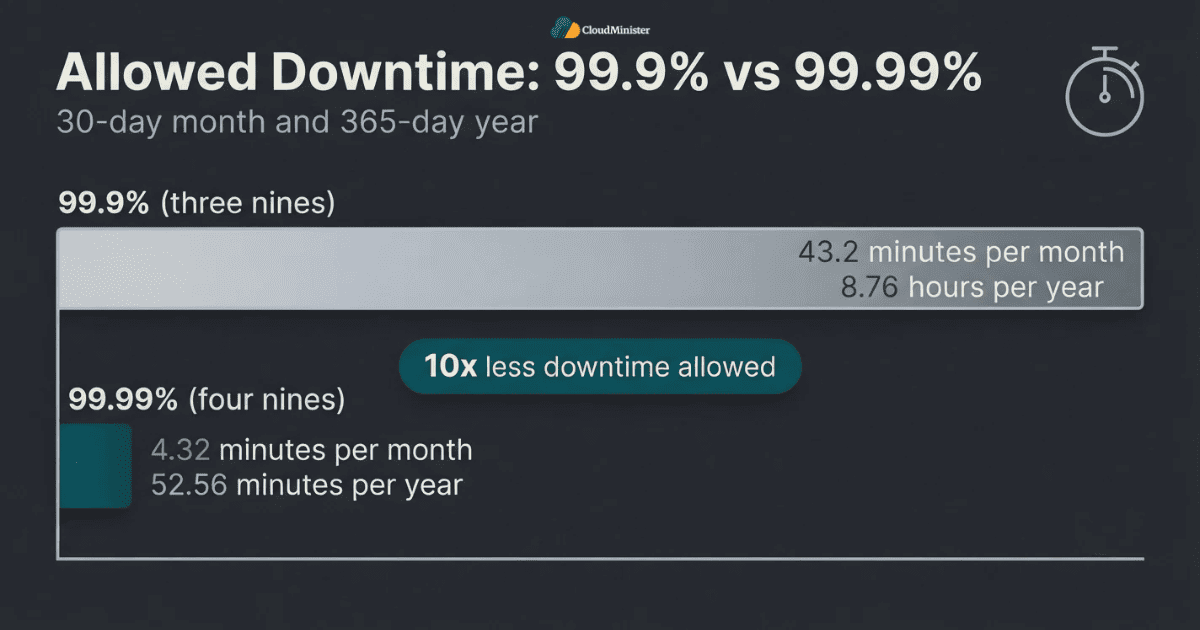
Percentages hide the real impact, so convert them into time. The table below uses a 30 day month and a 365 day year. Notice that 99.99 percent allows exactly one tenth of the downtime that 99.9 percent allows. Put simply, 99.9 vs 99.99 SLA Downtime is a tenfold gap, even though the two numbers look almost identical on a pricing page. Plans for cloud hosting services in India and for Dedicated Server Hosting in India are usually sold with one of these two figures.
| Availability | Per day | Per week | Per 30 day month | Per year |
| 99.9 percent | 1 minute 26.4 seconds | 10.08 minutes | 43.2 minutes | 8.76 hours |
| 99.99 percent | 8.64 seconds | 60.48 seconds | 4.32 minutes | 52.56 minutes |
| 99.999 percent | 0.864 seconds | 6.05 seconds | 25.92 seconds | 5.26 minutes |
- 99.9 percent, often called three nines, allows roughly 43 minutes of downtime in a 30 day month.
- 99.99 percent, often called four nines, allows roughly 4 minutes and 19 seconds in the same month.
- A single 12 minute outage keeps you inside a 99.9 percent promise but breaks a 99.99 percent promise.
- At four nines, one slow restart after a crash can use the entire monthly allowance in a single incident.
- Human response time matters. If an engineer needs 10 minutes to log in and diagnose a fault, a four nines target is already missed, which is why automated failover is essential, and Cloud Hosting Solutions in India usually provide it as a built in feature.
- Annual numbers can mislead. A provider may report a healthy yearly figure while one bad month still breaches a monthly SLA.
- Choosing between 99.9 vs 99.99 SLA Downtime options is therefore a business decision about acceptable risk, and not only a technical one.
- Ask a Web Hosting Company in India to show real measured uptime history, not just the contractual target.
- Buyers of Dedicated Servers in India should check whether the figure covers only the network or the full machine.
3. Why Downtime Costs More Than Any Service Credit
A service credit is a discount, not a cure. When a platform goes down, customers abandon carts, support queues grow, and trust drops. The scale of the problem is visible in industry research. According to the Uptime Institute Annual Outage Analysis 2026, 57 percent of respondents to its 2025 annual survey said their most recent major outage cost more than 100,000 dollars, while outage frequency per site has fallen for a fifth year in a row. In other words, outages are getting rarer but costlier, which makes every minute inside 99.9 vs 99.99 SLA Downtime worth planning for. Anyone choosing Cloud Hosting Solutions in India or Dedicated Servers in India should treat this cost as part of the decision.
- Reporting by TechRepublic on the same Uptime findings adds that one in five respondents put the cost of their latest major outage above 1 million dollars.
- Credits are usually a small percentage of one monthly fee, so they rarely cover lost sales, refunds, or overtime.
- Indirect costs include brand damage, search ranking drops after repeated errors, and customer churn.
- Downtime during peak hours costs far more than the same minutes at night, yet most SLAs treat all minutes equally.
- Regulated sectors such as payments and healthcare face compliance exposure on top of lost revenue.
- Smaller businesses feel it too. A shop that loses its biggest festival sale day may never recover that revenue. Many such shops run on cloud hosting services in India for exactly this reason.
- This is why the choice between 99.9 vs 99.99 SLA Downtime plans should be driven by your own cost per minute of downtime.
- Write down your hourly revenue at risk before picking a plan, then compare it with the extra monthly cost of higher availability. 99.9 vs 99.99 SLA Downtime should always be weighed against that number.
- Teams that move to cloud hosting services in India often do so because redundancy is built into the platform from day one. Teams on Dedicated Server Hosting in India feel the risk sharply, because one machine failing can affect everything.
4. How Downtime Is Measured and Calculated
Two providers can quote the same percentage and still measure it very differently. The formula is simple: availability equals total minutes minus downtime minutes, divided by total minutes, multiplied by 100. The inputs are where contracts differ, and understanding them is the core skill behind judging any 99.9 vs 99.99 SLA Downtime claim. This applies equally to cloud hosting services in India and to Dedicated Server Hosting in India.
- Measurement window: most SLAs measure per calendar month, though some use a quarter or a year. A longer window hides short bad spells.
- Check interval: if a provider probes your service once every five minutes, a shorter outage may never be recorded.
- Minimum outage length: some contracts count downtime only after a threshold, such as five consecutive failed checks.
- Scope of measurement: a provider may measure from inside its own network, which can miss problems your users see from outside.
- Partial outages: a service that is reachable but painfully slow may still count as available under a narrow definition.
- Time zone: record every incident in UTC and in Indian Standard Time, which is UTC plus 5 hours 30 minutes, to avoid confusion in claims.
- Rounding rules: some providers round downtime down to the nearest minute, which can erase short incidents entirely.
- Monitor independently. A neutral external monitor gives you evidence that a provider dashboard may not show.
- Always compare 99.9 vs 99.99 SLA Downtime contracts using the same measurement window, or the comparison is not fair.
Related Reading: Cloud cost governance policy guide
5. The Architecture Behind 99.9 and 99.99
A promise is only credible if the design can deliver it. Three nines can usually be reached with a well run single site and good monitoring. Four nines needs redundancy at every layer plus automated failover. This is why 99.9 vs 99.99 SLA Downtime is also a question about engineering, and why Cloud Hosting Solutions in India that spread workloads across several nodes tend to reach higher targets more naturally than one machine. Knowing which design a Web Hosting Company in India uses is the first step in judging any 99.9 vs 99.99 SLA Downtime claim.
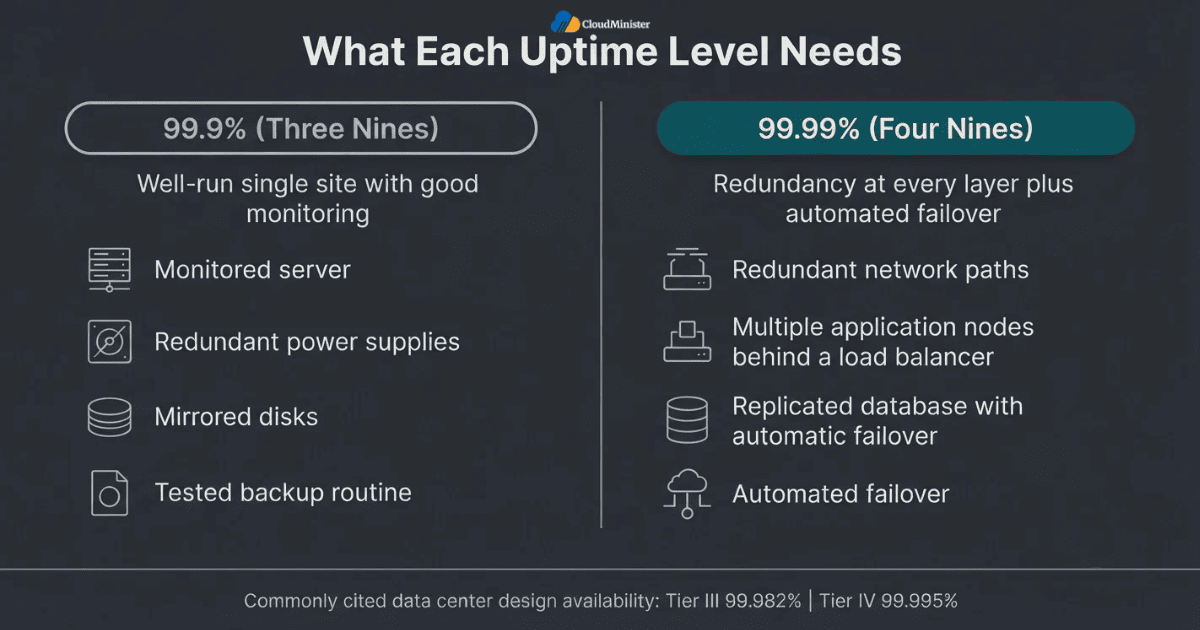
- For three nines, a monitored server with redundant power supplies, mirrored disks, and a tested backup routine is usually a reasonable base, and many plans for Dedicated Server Hosting in India start here.
- For four nines, remove every single point of failure: redundant network paths, multiple application nodes behind a load balancer, and a replicated database with automatic failover, which is how Cloud Hosting Solutions in India usually reach four nines.
- Failover must be fast. A manual switch that takes ten minutes cannot support a four nines promise on any platform, including Dedicated Servers in India.
- Data center design sets a ceiling. Commonly cited design availability is 99.982 percent for a Tier III facility and 99.995 percent for Tier IV.
- Maintenance needs rolling updates, so one node is updated while another keeps serving traffic, a routine practice in cloud hosting services in India.
- Health checks should detect a failure within seconds and remove the bad node from rotation automatically.
- Many teams choose cloud hosting services in India for web applications because load balancers, snapshots, and multi node deployment are available without buying hardware.
- A bare metal machine from Dedicated Server Hosting in India gives steady performance, but one server alone does not reach four nines unless it is paired with a second server and failover.
- Knowing which Dedicated Servers in India plans include dual power and network redundancy helps you avoid paying for promises the hardware cannot keep.
Redundancy adds more systems that need protection. Every extra node, replica, and failover tool is another place where credentials, patches, and firewall rules must stay consistent. A high availability setup that is poorly secured can turn one breach into several, so apply the same hardening to every copy.
Related Reading: How cloud rightsizing of instances works
Need Dedicated Servers Built for High Uptime?
Get dedicated server hosting in India with dual power, redundant network paths, and round-the-clock engineering support. New clients also get a free consultation to match the right server setup to their uptime target.
6. Composite SLAs and the Math of Dependencies
Real applications rarely depend on one component. A web page may need DNS, a load balancer, compute, storage, and a database, each with its own SLA. When components depend on each other in a chain, their availability multiplies, so the combined number is always lower than the weakest part. This surprises many buyers who compare 99.9 vs 99.99 SLA Downtime on a single line item and assume the whole system inherits it. The same arithmetic applies to Cloud Hosting Solutions in India and to Dedicated Servers in India, because the math does not care about the brand.
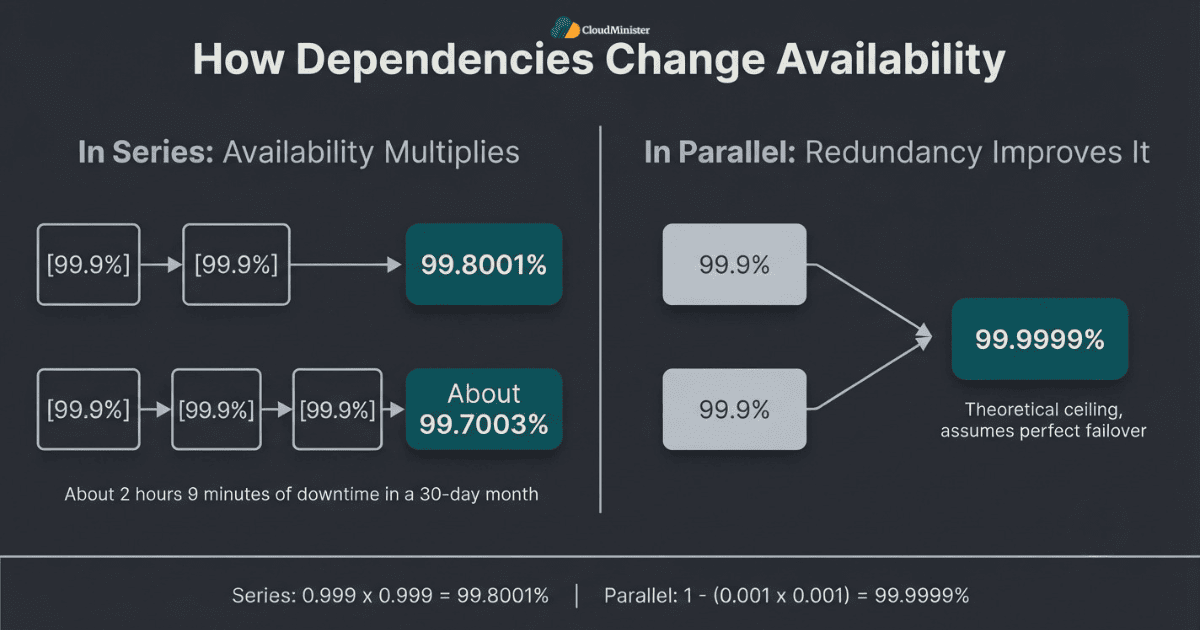
- Series dependency: two components at 99.9 percent each give 0.999 times 0.999, which is 99.8001 percent for the pair.
- Three components at 99.9 percent in series give about 99.7003 percent, which allows roughly 2 hours and 9 minutes of downtime in a 30 day month.
- Parallel redundancy improves the result. Two independent systems at 99.9 percent each, with perfect failover, give 1 minus 0.001 times 0.001, which is 99.9999 percent in theory.
- Real failover is never perfect. Switch time, shared dependencies, and correlated failures reduce the theoretical gain, so treat the parallel figure as a ceiling and not a promise.
- Shared dependencies such as the same power feed, the same DNS provider, or the same deployment pipeline can make two copies fail together, even inside cloud hosting services in India.
- To reach a 99.99 percent application target, every component in the critical path must beat 99.99 percent or be made redundant, whether the application runs on Cloud Hosting Solutions in India or on Dedicated Server Hosting in India.
- This is why a strong Web Hosting Company in India designs the full request path and does not quote only the SLA of the server layer.
- Draw your request path on paper and write the SLA next to each box. The weakest box usually tells the real story about 99.9 vs 99.99 SLA Downtime.
7. What It Costs to Move from 99.9 to 99.99
Better uptime is not free. Every extra nine usually needs more nodes, more network capacity, more monitoring, and more skilled engineering time. The right question is not whether four nines is better, but whether it is worth its price for your workload. A Web Hosting Company in India should be able to price each option clearly. When you weigh 99.9 vs 99.99 SLA Downtime, compare the extra monthly cost with the revenue you would protect.
- Redundant compute roughly doubles the cost of the protected tier, because a standby or second active node is always running, whether you choose cloud hosting services in India or Dedicated Server Hosting in India.
- Replicated databases add storage, bandwidth, and licensing costs, plus engineering time to test failover, which holds for Cloud Hosting Solutions in India and Dedicated Servers in India alike.
- Monitoring and on call coverage must run around the clock, because a four minute monthly allowance cannot wait for office hours.
- Not every system needs four nines. Internal tools, staging servers, and batch jobs often do well at 99.9 percent or lower.
- Customer facing checkout, login, and payment services are the best candidates for higher availability.
- Cloud Hosting Solutions in India often let you scale redundancy in steps, adding nodes only to the tiers that need them.
- A single powerful machine from Dedicated Servers in India can be cost efficient for steady workloads, and a second machine can be added later where the business case supports it.
- Compare total cost, including the cost of failure, and not only the monthly invoice.
- Price 99.9 vs 99.99 SLA Downtime per workload instead of applying one target to the entire estate by default.
Related Reading: Cloud pricing model types explained
8. Common SLA Exclusions That Reduce Your Credit
The most frustrating moment in any SLA discussion is discovering that the outage you suffered does not count. Exclusions are normal and often reasonable, but they must be read carefully. A contract that promises four nines while excluding most real world causes of failure is promising much less than it appears. Reading these clauses is a central part of understanding 99.9 vs 99.99 SLA Downtime. Exclusions can differ between Cloud Hosting Solutions in India and Dedicated Servers in India, so never assume one contract mirrors another.
- Scheduled maintenance is usually excluded when it is announced in advance, often with a stated notice period, a pattern seen in cloud hosting services in India agreements.
- Customer caused issues, such as misconfigured firewalls, exhausted resources, or faulty code releases, are excluded from 99.9 vs 99.99 SLA Downtime calculations.
- Force majeure events, such as natural disasters, are generally excluded, although a good provider still plans for them.
- Faults in third party networks or services outside the provider’s control are often excluded.
- Denial of service attacks may be excluded unless protection is sold as part of the plan, which a Web Hosting Company in India will usually state clearly.
- Beta features, and accounts suspended for abuse or non payment, are also outside the SLA.
- On Dedicated Server Hosting in India, hardware replacement time is often covered by a separate hardware guarantee, so check whether that clause sits inside the uptime promise or outside it.
- Ask for the exclusion list in writing before you sign. Two 99.9 vs 99.99 SLA Downtime offers with different exclusion lists are not equal offers.
- A Web Hosting Company in India that explains exclusions openly before the sale is usually the one that handles claims fairly afterward.
Related Reading: IoT cloud integration.
9. How to Claim Service Credits Step by Step
A service credit is rarely applied automatically. Most providers expect the customer to request it within a fixed period, and that deadline is often short, commonly around 30 days, although it varies by contract. The process is easier when you gather evidence while the incident is still fresh. This is the practical side of 99.9 vs 99.99 SLA Downtime, and it is where many customers lose credits they were entitled to. Plans for Dedicated Servers in India and Cloud Hosting Solutions in India follow the same pattern, and a provider of Dedicated Server Hosting in India will usually publish the claim window in its support terms. Most cloud hosting services in India plans work the same way.
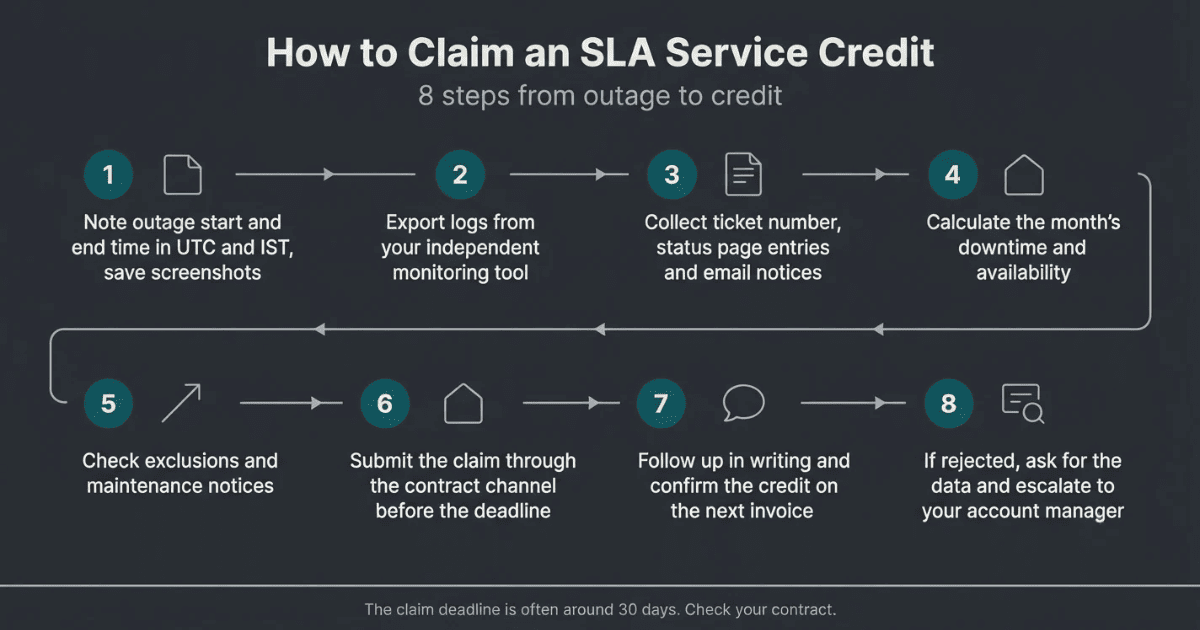
- Step 1: Note the exact start and end time of the outage in UTC and Indian Standard Time, and save screenshots of the errors.
- Step 2: Export logs from your own independent monitoring tool, since this is stronger evidence than memory.
- Step 3: Collect the provider’s incident ticket number, status page entries, and any email notices.
- Step 4: Calculate the month’s total downtime and the resulting availability using the formula in your contract, which defines how 99.9 vs 99.99 SLA Downtime is measured.
- Step 5: Check the exclusions to confirm the outage qualifies, and note any maintenance notices you received.
- Step 6: Submit the claim through the channel named in the contract, usually a support ticket, before the deadline.
- Step 7: Follow up in writing and ask for the credit to be confirmed on the next invoice.
- Step 8: If the claim is rejected, ask for the data behind the decision and escalate to your account manager at the Web Hosting Company in India.
- Many customers choose cloud hosting services in India partly because incident and ticket history sits in one dashboard, which makes claims faster.
Keep a simple claim log in a shared sheet with the date, duration, ticket number, calculated availability, and credit requested. Teams that review this log every quarter spot patterns early, and a repeated issue is a stronger reason to renegotiate 99.9 vs 99.99 SLA Downtime terms than a single incident. This habit works for Dedicated Server Hosting in India and for cloud platforms alike.
10. Worked Examples: Calculating Credit Eligibility
Numbers make the process concrete. Assume a 30 day month, which has 43,200 minutes. The examples below show how the same outage can pass one promise and fail another, which is the practical meaning of 99.9 vs 99.99 SLA Downtime. The credit tiers in the table are an illustration only, so always use the tiers written in your own contract. These calculations work the same way for cloud hosting services in India and for Dedicated Server Hosting in India.
| Plan | Measured availability | Illustrative credit |
| 99.9 percent plan | 99.9 percent or higher | No credit |
| 99.9 percent plan | 99.0 to below 99.9 percent | 10 percent of monthly fee |
| 99.9 percent plan | Below 99.0 percent | 25 percent of monthly fee |
| 99.99 percent plan | 99.99 percent or higher | No credit |
| 99.99 percent plan | 99.9 to below 99.99 percent | 10 percent of monthly fee |
| 99.99 percent plan | 99.0 to below 99.9 percent | 25 percent of monthly fee |
| 99.99 percent plan | Below 99.0 percent | 50 percent of monthly fee |
- Example A: 12 minutes of downtime. Availability is 43,188 divided by 43,200, which is about 99.972 percent.
- Under a 99.9 percent plan, Example A is within the allowance of 43.2 minutes, so no credit is due.
- Under a 99.99 percent plan, Example A exceeds the allowance of 4.32 minutes, so the 10 percent tier applies. That single comparison shows 99.9 vs 99.99 SLA Downtime in practice.
- Example B: 95 minutes of downtime. Availability is 43,105 divided by 43,200, which is about 99.78 percent.
- Under the 99.9 percent plan, Example B lands in the 99.0 to below 99.9 percent band, so the 10 percent tier applies.
- Under the 99.99 percent plan, Example B lands in the same band, so the 25 percent tier applies.
- If the monthly fee is 20,000 rupees, a 10 percent credit is 2,000 rupees and a 25 percent credit is 5,000 rupees. Compare that with the sales lost in 95 minutes to see why a credit is a courtesy and not compensation, however friendly the Web Hosting Company in India is.
- Always recalculate with the exact formula and window in your agreement, because rounding can move a result across a tier boundary.
- This is why teams comparing 99.9 vs 99.99 SLA Downtime should model a bad month, not an average month.
11. Common Mistakes That Cost Teams Their Credits
Most lost credits come from preparation gaps, not from provider bad faith. Teams that treat the SLA as a filing cabinet document discover its terms only during a crisis. A little discipline before an outage saves a lot of argument after one. Avoiding the mistakes below is one of the cheapest improvements you can make to how you manage 99.9 vs 99.99 SLA Downtime. This holds for cloud hosting services in India and for Dedicated Server Hosting in India.
- Missing the claim deadline because nobody owned the task.
- Relying only on the provider status page, which may understate the impact your users saw.
- Running no independent monitoring, so there is no evidence when the provider disputes the timeline.
- Assuming credits are automatic when the contract requires a request.
- Comparing 99.9 vs 99.99 SLA Downtime plans on the headline number and ignoring exclusions, measurement windows, and credit caps.
- Buying four nines for the hosting layer while a single database, DNS service, or payment gateway stays in the path.
- Treating a credit as the end of the matter, instead of asking for a root cause analysis and a prevention plan.
- Forgetting that a Dedicated Servers in India plan and a Cloud Hosting Solutions in India plan each carry their own SLA document, and the terms are not interchangeable.
- Skipping a yearly review of 99.9 vs 99.99 SLA Downtime terms as the business and traffic grow.
Run a failover drill once a quarter and time it. If the measured switch time is longer than the monthly allowance under 99.9 vs 99.99 SLA Downtime, the design needs work before the contract does.
12. How to Choose a Provider for the Uptime You Need
A fair SLA is a sign of an honest provider, but the number alone should never decide the purchase. Look for transparency, tested processes, and clear ownership. A provider that is comfortable discussing failures is usually better prepared to prevent them. This is how you turn 99.9 vs 99.99 SLA Downtime from a marketing line into a working agreement. A good Web Hosting Company in India will treat these questions as normal.
- Ask how many incidents the provider handled in the last year and how it communicated during each one.
- Request the full SLA document, including definitions, exclusions, credit tiers, and the claim process, whether you plan to buy Dedicated Server Hosting in India or a cloud plan.
- Confirm support hours and escalation paths, especially for nights and weekends.
- Check where the data center is located, since a nearby site can reduce latency for Indian users and simplify questions about where data is stored, which many providers of cloud hosting services in India highlight.
- Ask a Web Hosting Company in India how backups are tested, because a backup that has never been restored is only an assumption.
- For steady, performance sensitive workloads, ask about Dedicated Server Hosting in India options with dual power and network paths.
- For flexible workloads, compare Cloud Hosting Solutions in India on how quickly nodes can be added and failed over.
- Prefer providers who publish uptime history and honest post incident reports about Dedicated Servers in India and cloud plans.
- Match the plan to your own downtime budget and cost per minute, then decide between 99.9 vs 99.99 SLA Downtime options using that math.
Checklist: SLA and Service Credit Readiness Review
- Downtime budget written down in minutes per month and agreed with the business.
- Full SLA document read, including definitions, exclusions, and credit tiers.
- Measurement window, check interval, and minimum outage length confirmed.
- Independent external monitoring running from more than one location.
- Claim deadline and claim channel recorded and assigned to a named owner.
- Request path mapped with the SLA of every component written beside it.
- Failover tested recently, with the real switch time recorded.
- Backup restore tested and the restore time written in the runbook.
- Incident log kept for every outage, with times in UTC and Indian Standard Time.
- Plan type confirmed, whether Cloud Hosting Solutions in India or Dedicated Servers in India, since each carries its own SLA document.
- Hardware replacement terms for Dedicated Server Hosting in India confirmed in writing.
- Yearly review of 99.9 vs 99.99 SLA Downtime terms booked in the calendar.
Key Takeaways
- 99.9 vs 99.99 SLA Downtime is a tenfold gap: about 43.2 minutes against about 4.32 minutes in a 30 day month.
- Uptime percentages mean little until you read the definitions, measurement window, and exclusions, which is the core lesson of 99.9 vs 99.99 SLA Downtime.
- Chained components multiply, so a system is always less available than its weakest part, unless it is made redundant.
- Four nines needs redundancy and automated failover, and that is where Cloud Hosting Solutions in India often have a natural advantage.
- A single machine from Dedicated Servers in India gives steady performance, but it needs a second server to support a four nines target.
- Credits are a percentage of one monthly fee and are usually claimed by request, within a deadline, whether the plan is cloud hosting services in India or Dedicated Server Hosting in India.
- Independent monitoring and a claim log turn a disagreement into a documented case.
- A reliable Web Hosting Company in India explains its SLA openly and backs it with tested processes.
- For flexible web workloads, cloud hosting services in India and Dedicated Server Hosting in India can be combined so each layer gets the availability it actually needs.
Not Sure Whether You Need 99.9% or 99.99% Uptime?
Talk to our team about your workload, your cost per minute of downtime, and the right architecture for it. We offer a free consultation to all new clients, with no obligation.
Conclusion
One idea runs through everything above. An uptime number is a promise about time, and time can be measured, compared, and claimed. Once you convert 99.9 vs 99.99 SLA Downtime into real minutes, the decision stops being abstract. You can see what each level allows, what it costs to deliver, and what you can ask for when a provider falls short. It also gives you a fair way to compare cloud hosting services in India with Dedicated Server Hosting in India. Teams that understand 99.9 vs 99.99 SLA Downtime ask sharper questions and sign better contracts. That clarity protects your budget, your customers, and your relationship with the provider.
Start with your own numbers. Know your cost per minute of downtime, map the components in your request path, and match each tier to the availability it truly needs. Then choose a partner that explains its terms, tests its failover, and supports your claims. Whether you pick cloud hosting services in India, a pair of servers from Dedicated Server Hosting in India, or a mix of both, keep checking as the workload grows. A good Web Hosting Company in India will treat 99.9 vs 99.99 SLA Downtime as an ongoing conversation, and not as a line on an invoice.
Frequently Asked Questions
What is the practical difference in 99.9 vs 99.99 SLA Downtime each month?
At 99.9 percent a provider may be down for about 43.2 minutes in a 30 day month. At 99.99 percent the allowance is about 4.32 minutes. That tenfold gap is the heart of 99.9 vs 99.99 SLA Downtime, and it should shape your design and your budget.
Can 99.99 percent uptime be achieved on a single server?
Rarely. A single machine, even from a premium provider of Dedicated Servers in India, faces hardware faults, software updates, and maintenance events that can exceed 4.32 minutes in a month. Four nines normally needs at least two servers, load balancing, and automated failover. Many teams use Dedicated Server Hosting in India for the primary node and add a second server for resilience.
Do service credits arrive automatically under 99.9 vs 99.99 SLA Downtime plans?
Usually not. Most agreements require a written request with evidence within a stated period. Check the claim window in your contract and ask your Web Hosting Company in India to confirm the process in writing.
Can a credit cover my lost revenue?
No. Credits are typically a percentage of the monthly fee and are often the only remedy stated. That is why reliability design matters more than the credit itself in any 99.9 vs 99.99 SLA Downtime discussion.
Does scheduled maintenance count as downtime?
Normally not, if it follows the notice rules in the SLA. Ask for the notice period and the maximum maintenance time per month. A good provider of Cloud Hosting Solutions in India will use rolling updates so that maintenance stays invisible to users.
Which workloads need 99.99 percent availability?
Checkout, payments, login, and real time services are strong candidates. Internal tools and batch jobs usually are not. Many businesses mix cloud hosting services in India for flexible tiers with Dedicated Servers in India for steady performance tiers.
How can I verify the uptime my provider reports?
Run an independent monitor from outside the provider network, check from more than one location, and keep the logs. Compare your results with the report from your Web Hosting Company in India each month, and keep both with your claim log.
Is 99.999 percent worth paying for compared with 99.9 vs 99.99 SLA Downtime plans?
Five nines allows only about 5.26 minutes of downtime per year. It is expensive and usually applies to specialised systems such as telecom or critical payment infrastructure. Most businesses get better value from a well tested four nines design.
Should I always choose the provider with the highest SLA number?
Not automatically. Compare definitions, exclusions, support quality, and past performance. A trusted Web Hosting Company in India with a clear 99.9 percent promise and strong operations can serve you better than a vague 99.99 percent claim. Weigh 99.9 vs 99.99 SLA Downtime with the whole contract in mind.
Where should I start if I want better uptime?
Start by measuring your real downtime and your cost per minute. Then map your request path, remove single points of failure in the most valuable tier, and test failover. A Web Hosting Company in India can help you decide whether Cloud Hosting Solutions in India or Dedicated Servers in India suits each tier, and the numbers behind 99.9 vs 99.99 SLA Downtime will tell you how far to go.

Ajay Singh Raghav is a Senior Linux System Administrator at CloudMinister Technologies, where he has spent over 4 years installing, configuring, maintaining, and troubleshooting Linux servers for hosting and cloud environments. He specializes in AWS cloud computing alongside core Linux server administration, with hands-on expertise across server management, backup and restore systems, and cPanel-based hosting environments. His day-to-day experience keeping production servers stable and secure gives him a practical, ground-level understanding of the infrastructure he writes about.