This guide explores how AI in cloud computing is reshaping cloud infrastructure in 2026 — from intelligent auto-scaling and predictive security to AI-optimised managed servers and virtual private server environments. Whether you are a startup evaluating cloud hosting services in India for the first time or an enterprise modernising legacy infrastructure, this evidence-backed overview will help you understand what AI-driven hosting looks like in practice, why it matters for your business, and how to evaluate a provider capable of delivering it. The guide also examines VPS hosting in India with AI-driven management, alongside cost, security, scalability, and compliance dimensions.
Cloud infrastructure has always been about one thing: giving businesses the ability to run applications at whatever scale the moment demands. For years, that promise was delivered through provisioning speed, pay-as-you-go pricing, and geographic reach. In 2026, a fundamentally different layer is being added — one that does not just provision resources but actively predicts, optimises, and protects them without human intervention.
That layer is AI in cloud computing. And it is not an incremental improvement. It represents a structural shift in how cloud infrastructure is built, managed, and experienced by the businesses that depend on it.
For Indian businesses — whether they are SaaS startups in Bengaluru, fintech companies in Mumbai, or regional enterprises scaling nationally — this shift is arriving at precisely the moment when reliable, intelligent cloud infrastructure matters most. Investor scrutiny is higher, customer expectations are more demanding, and the regulatory environment is evolving with the DPDP Act 2023 adding new dimensions to data governance requirements.
This guide is written for business owners, technology directors, and decision-makers who need a clear, practical understanding of what AI-driven cloud hosting delivers — and how to evaluate whether their current provider is positioned to deliver it.
-> Related: Cloud Hosting: The Definitive Guide to Benefits, Types and Best Practices
1. What AI in Cloud Computing Actually Means for a Business Owner
AI in cloud computing means more than faster servers or elastic compute. In plain terms, it means your cloud infrastructure actively manages itself — predicting what resources are needed before you run out, identifying and eliminating wasteful spend automatically, detecting security threats before they surface as incidents, and recovering from common failures without requiring an engineer to intervene.
Traditional cloud hosting is reactive: infrastructure responds to what is happening right now. When a server reaches high CPU utilisation, more capacity is allocated. When traffic drops, resources are released. When an incident occurs, an alert is triggered and a team responds.
AI-driven cloud hosting changes the operating model from reactive to predictive. For businesses comparing cloud hosting services in India, this distinction translates directly into faster application response times, fewer service disruptions, lower infrastructure costs, and a security posture that adapts to emerging threats without manual intervention.
What AI-Driven Cloud Hosting Delivers in Practice
- Predictive auto-scaling — Infrastructure that scales up before a traffic spike hits, not after users experience degradation
- Intelligent cost optimisation — Continuous workload analysis that identifies and eliminates wasteful resource allocation automatically
- Autonomous security response — Threat detection and containment that operates in milliseconds, not hours
- Self-healing infrastructure — Systems that detect, diagnose, and resolve common infrastructure failures without engineer intervention
- Compliance monitoring — Continuous audit trails and anomaly detection that reduce the manual burden of regulatory compliance
Before evaluating any AI-enhanced cloud provider, identify the three infrastructure problems that cost your team the most time each month — unexpected downtime, unpredictable cloud bills, security review overhead, or slow deployment cycles. The capabilities that matter most are the ones that directly address your highest-cost operational pain points.
2. The State of AI in Cloud Computing in 2026: What the Data Shows
The pace of AI adoption across cloud infrastructure is not speculative — it is measurable, documented, and accelerating faster than most market forecasts anticipated. Understanding where intelligent cloud infrastructure stands today is the foundation of any sound hosting decision in 2026.
| Metric | Reported Figure | Source |
| Global AI cloud market size (2025 est.) | USD 67.4 billion | Grand View Research |
| Projected market CAGR through 2030 | Approx. 21% annually | Grand View Research |
| India cloud services market CAGR (2024-2029) | Above 20% (projected) | IDC India |
| Organisations reporting infrastructure benefits from AI | Majority of adopters surveyed | Gartner 2025 |
| Typical reduction in infrastructure incidents (AI-managed) | Up to 30% reported | IBM Institute for Business Value |
| Typical cloud cost savings via AI optimisation | 15-30% range reported | McKinsey & Company |
Two things stand out from the available research. First, the trajectory is steep and sustained — the AI cloud market is growing at a rate that makes adoption a question of when, not whether. Second, outcomes are concrete: fewer incidents, lower costs, and improved reliability are documented by independent research bodies, not just vendors. For any business evaluating cloud hosting services in India, understanding where AI delivers measurable ROI is the foundation of a sound infrastructure decision.
The cost savings and incident reduction figures above are reported ranges from third-party research — not guaranteed minimums. Early-stage AI cloud implementations typically produce more modest gains in the first quarter, with improvements compounding as AI systems accumulate operational data. Set realistic milestones and measure against your own baseline before engaging any provider.

3. Six Ways AI Is Transforming Cloud Hosting Infrastructure
The transformation driven by AI-powered infrastructure management is not happening in a single area — it is reshaping every layer of cloud infrastructure simultaneously. Understanding where the changes are most significant helps businesses evaluate which capabilities to prioritise when selecting a provider.
3.1 Predictive Auto-Scaling
Traditional auto-scaling responds to thresholds: when CPU hits 80%, add a server. When it drops to 30%, remove one. This model works adequately under predictable load but fails when traffic spikes are sudden, when growth is non-linear, or when seasonal demand creates brief but extreme peaks.
AI-driven auto-scaling analyses usage history, time-of-day patterns, campaign schedules, and external signals to predict load increases before they arrive. For e-commerce businesses running flash sales, edtech platforms experiencing exam-season surges, or fintech applications with end-of-month settlement peaks, this distinction is directly measurable in application response times and user retention rates.
Businesses using VPS hosting in India with AI-backed scaling capabilities benefit from infrastructure that behaves intelligently across unpredictable traffic conditions — without requiring manual intervention or over-provisioning as a buffer against uncertainty.
-> Related: Dedicated Server vs VPS vs Cloud Hosting: Which Is Right for You?
3.2 Intelligent Cost Optimisation
Cloud cost overruns are one of the most common and most avoidable operational problems in modern infrastructure. Unused reserved instances, over-provisioned compute resources, inefficient data transfer configurations, and forgotten development environments collectively account for significant waste in most cloud bills.
AI in cloud computing addresses this through continuous workload analysis — identifying usage patterns, recommending rightsizing actions, flagging idle resources, and in mature implementations, automatically decommissioning waste without human review. The result is cloud spend that tracks actual business value, not accumulated configuration decisions made under different circumstances.
For Indian businesses, cloud cost efficiency carries additional significance: infrastructure budgets are tighter relative to global equivalents, and cost overruns directly impact runway for startups and quarterly margins for enterprises. AI-optimised hosting is not a premium feature — it is a structural advantage for any business serious about sustainable infrastructure economics.
3.3 Autonomous Security and Threat Detection
Traditional security monitoring produces alerts. Security teams review those alerts, triage them by severity, and escalate confirmed threats. In environments with hundreds of microservices and millions of daily events, this approach creates a fundamental problem: the volume of alerts exceeds the capacity of any human team to review them meaningfully.
AI-driven security changes the model by operating at machine speed. Behavioural analysis identifies anomalies in real time — unusual access patterns, unexpected data exfiltration attempts, lateral movement between services — and contains them before they escalate into incidents. For businesses operating under GDPR, HIPAA, or India’s DPDP Act 2023, this is not just an operational advantage but a compliance requirement.
Under India’s DPDP Act 2023, organisations processing personal data of Indian citizens are required to implement technical and organisational safeguards appropriate to the risk. AI-driven security monitoring — with its documented ability to detect and contain threats faster than human-led processes — directly addresses this requirement. Businesses that cannot demonstrate adequate technical controls face both regulatory exposure and reputational risk in the event of a breach.
3.4 Self-Healing Infrastructure
Every infrastructure environment experiences failures: a server process crashes, a network partition occurs, a storage volume becomes unresponsive. In traditional environments, these failures trigger alerts, wake on-call engineers, and require manual diagnosis and remediation.
AI-managed infrastructure introduces self-healing capabilities: automated detection of common failure patterns, pre-programmed remediation playbooks executed without human intervention, and continuous validation that services have returned to healthy operating states. Mean time to recovery (MTTR) decreases significantly when remediation is automated. For businesses running VPS hosting in India for production applications, self-healing capabilities represent a fundamental improvement in service reliability where downtime carries direct revenue impact.
3.5 AI-Optimised Performance for Web Applications
Application performance is not determined solely by compute power. Network routing decisions, caching strategies, database query patterns, and content delivery configurations all contribute to the end-user experience. AI systems can optimise each of these layers continuously — adjusting CDN cache rules based on request patterns, routing traffic to the lowest-latency origin, and identifying slow database queries before they become user-facing performance issues.
For businesses running on an affordable Linux server, AI performance optimisation means getting more out of existing infrastructure — rather than defaulting to vertical scaling every time performance degrades.
3.6 Predictive Maintenance and Capacity Planning
Hardware fails. Storage drives degrade. Network equipment develops faults. In traditional data centre management, these failures are often discovered reactively — after a customer-facing incident has already occurred.
AI-driven predictive maintenance analyses hardware telemetry continuously, identifying statistical patterns that precede failures — elevated error rates, temperature fluctuations, performance degradation — and triggering replacement before the failure occurs. Combined with AI capacity planning — which models future infrastructure requirements based on business growth projections, seasonal patterns, and planned product launches — this creates a fundamentally more proactive operational posture.
4. What AI-Driven Cloud Hosting Looks Like for Indian Businesses
The practical impact of AI-driven infrastructure varies significantly depending on the type of business and its specific operational requirements. For Indian businesses, several dimensions are particularly relevant.
4.1 Startups and Growth-Stage Businesses
For startups, the most immediate benefit of AI-driven cloud hosting is eliminating the infrastructure management overhead that competes with product development for engineering time. Automated scaling, cost optimisation, and security monitoring reduce the operational burden on small teams — allowing engineers to focus on the product rather than the platform.
AI-enhanced cloud hosting services in India also address one of the most common scaling failure modes for startups: the viral growth event. When a product launch generates unexpected demand, AI-driven auto-scaling absorbs the traffic without the manual emergency provisioning that typically accompanies sudden growth.
Startups evaluating cloud providers should ask specifically about AI-driven cost alerts and automated rightsizing recommendations. These features are particularly valuable during the growth phase, when cloud spend can escalate faster than revenue — and when engineering teams rarely have dedicated capacity for infrastructure cost management.
4.2 Mid-Market and Enterprise Businesses
For larger organisations, the value of AI-driven cloud infrastructure manifests differently. Compliance automation — generating audit trails automatically, detecting policy violations before they become reportable incidents, and continuously validating data residency requirements — addresses one of the most labour-intensive aspects of regulated cloud management.
Enterprises managing multiple product teams across distributed infrastructure also benefit from AI-driven observability: monitoring systems that produce actionable signals rather than alert noise, and capacity planning tools that project infrastructure requirements at organisational scale. For businesses requiring VPS hosting in India for specific isolated workloads, AI-managed environments deliver performance guarantees that were previously only available in dedicated server tiers.
For enterprises, the most underappreciated benefit of AI-driven cloud hosting is the reduction in compliance documentation overhead. Manually maintaining audit trails across dozens of services is a significant hidden cost. AI systems that generate these trails automatically — as a byproduct of normal operations — convert a costly, error-prone manual process into a reliable automated capability.
4.3 The Indian Regulatory Dimension
India’s DPDP Act 2023 has added a new layer of complexity for businesses processing personal data of Indian citizens. Data localisation requirements, consent management obligations, and breach notification timelines create compliance demands that manual processes struggle to satisfy consistently at scale.
Automated data classification, continuous policy validation, real-time access monitoring, and instant breach detection all support the technical compliance obligations imposed by Indian regulation. Businesses evaluating cloud hosting services in India should specifically verify a provider’s ability to demonstrate DPDP Act compliance capabilities — not just general security certifications.
5. The Scalability Dimension: How AI Changes Cloud Growth Trajectories
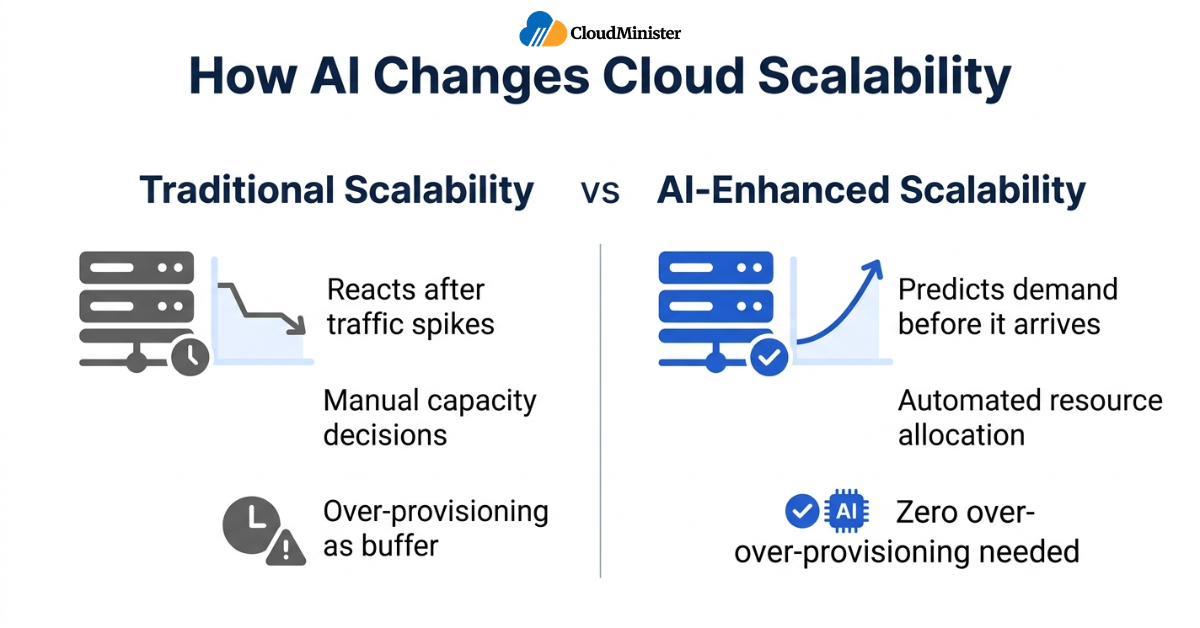
Scalability has always been a core promise of cloud infrastructure. But traditional scalability is fundamentally passive: it responds when triggered and reverts when demand drops. AI in cloud computing makes scalability active — anticipating growth, preparing for it, and optimising the transition so that users never experience the scaling event itself.
For businesses at the growth stage, this distinction is commercially significant. The infrastructure cost of over-provisioning — maintaining headroom against peak demand that may never arrive — is eliminated when AI can accurately predict and provision only what is required. For businesses experiencing sudden viral growth, the difference between reactive and predictive scaling is the difference between an outage and a successful product moment.
AI-Driven Scalability for Different Infrastructure Models
| Infrastructure Type | Traditional Scalability | AI-Enhanced Scalability |
| Shared Cloud Hosting | Threshold-based auto-scaling | Predictive scaling based on demand forecasting |
| VPS Hosting in India | Manual vertical scaling or basic automation | AI-optimised resource allocation and workload balancing |
| Affordable Linux Server | Fixed resources, manual management | AI-managed tuning and proactive performance alerts |
| Dedicated / Bare Metal | Manual provisioning cycles | AI-monitored hardware health and predictive maintenance |
| Hybrid Cloud | Siloed scaling per environment | Unified AI orchestration across public and private infrastructure |
The table above illustrates a fundamental point: AI does not change the underlying infrastructure model — it changes the intelligence layer that manages it. A well-configured AI-managed environment delivers reliability and performance characteristics that previously required significantly more expensive infrastructure.
6. What to Look for in an AI-Enhanced Cloud Hosting Provider
Selecting an AI-enhanced cloud provider is not primarily a technology decision — it is a business and operational one. Technical capability matters, but so does the provider’s ability to explain what their AI systems do in language that a non-technical business owner can evaluate, and to demonstrate verified outcomes rather than marketing claims.
Questions to Ask Before Committing
- What specific AI capabilities are included in the standard service? Many providers describe AI-enhanced features that are in practice premium add-ons. Establishing what is included — and what is not — before signing prevents contractual friction.
- How does your AI system handle compliance under the DPDP Act 2023? India-specific regulatory capability is not universal — verify it explicitly.
- Can you demonstrate AI-driven cost savings from comparable client deployments? Actual client data is significantly more reliable than benchmark projections.
- What are the incident response SLA commitments when AI systems fail to prevent an issue? AI reduces incident frequency — it does not eliminate it. Defined SLAs with escalation paths remain essential.
- How is AI system transparency maintained? Can you access dashboards that explain what the AI has done, why, and with what outcome? Opacity in AI systems is a practical operational risk.
Red Flags in Any Provider Evaluation
- Vague AI capability descriptions with no specific technical explanation — typically a sign of marketing language rather than genuine engineering capability
- No verifiable reference customers using AI-enhanced services in your industry or at your business scale
- AI capabilities offered as optional modules at significant additional cost — suggesting the core product was not designed with intelligence as a foundational layer
- Inability to explain how their AI systems interact with Indian data residency requirements and the DPDP Act 2023 compliance framework
☑ SCALABILITY CHECKLIST – BEFORE COMMITTING TO AN AI-ENHANCED PROVIDER
✓ Does the provider include AI-driven auto-scaling as a standard feature — not a premium add-on?
✓ Is cost optimisation AI-powered and continuously active, or does it require manual review cycles?
✓ Does their security AI produce actionable containment — or only alerts that require human response?
✓ Is predictive maintenance included for the infrastructure tier you are purchasing?
✓ Can you access AI system dashboards in plain language — not just raw telemetry data?
✓ Does their AI capability extend to the specific workload type you run — web applications, databases, or data processing?
Ready to Move to AI-Enhanced Cloud Hosting?
Cloudminister sets up, manages, and scales your cloud infrastructure — with India-based data centres, 99.99% uptime, and expert engineering support built for startups and enterprises alike.
-> Related: Scalability in Cloud Hosting: How It Works and Why It Matters
7. Affordable Linux Servers and AI: Democratising Intelligent Infrastructure
One of the most significant developments in AI in cloud computing is the democratisation of intelligent infrastructure capabilities across all price points. Capabilities previously available only in expensive managed cloud tiers — predictive scaling, security monitoring, intelligent cost optimisation — are increasingly available in cost-effective Linux server environments at all pricing tiers.
This matters because it removes the false choice that businesses previously faced: either invest in expensive managed cloud infrastructure with intelligent capabilities, or operate a cost-effective server environment with manual management overhead. AI management layers are now being applied to resource-efficient server deployments — bringing enterprise-grade intelligence to infrastructure that serves the budget realities of growing Indian businesses.
What AI Management Delivers on an Affordable Linux Server
- Automated performance tuning — AI continuously adjusts kernel parameters, memory allocation, and process priorities based on workload characteristics — replacing hours of manual administration
- Intelligent monitoring and alerting — Pattern-based anomaly detection that distinguishes genuine performance problems from normal variation, reducing alert noise without compromising detection sensitivity
- Automated patch management — AI-scheduled updates applied during low-traffic windows, with automatic rollback if performance degrades post-patch
- Workload-aware resource allocation — Dynamic rebalancing of CPU and memory between co-located services based on real-time demand — maximising utilisation without manual configuration
For Indian SMEs and startups, AI-managed Linux server environments represent one of the highest-ROI infrastructure decisions available in 2026. The operational overhead of Linux server management — a significant hidden cost when it falls on product engineers — is substantially reduced by AI management tooling, freeing engineering capacity for revenue-generating product work.
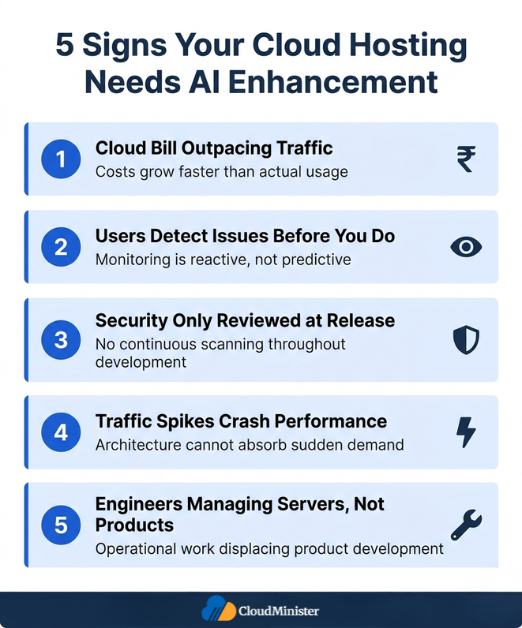
8. Five Signs Your Current Cloud Hosting Setup Needs AI Enhancement
These signals apply regardless of business size or sector. If more than two are consistently present, the current infrastructure setup is generating operational friction that compounds with every sprint cycle — and that AI-driven cloud hosting would directly address.
1. Your Cloud Bill Grows Faster Than Your Traffic
When cloud costs consistently outpace usage growth, the infrastructure lacks intelligent cost management. AI-driven optimisation would continuously identify and eliminate waste — unused instances, over-provisioned resources, inefficient data transfer — automatically and continuously.
2. Users Experience Degradation Before Your Monitoring Detects It
When customers report performance issues before internal systems detect them, the observability layer is reactive rather than predictive. AI-driven monitoring surfaces anomalies before they affect user experience — shifting from incident response to incident prevention.
3. Security Reviews Are End-of-Cycle Rather Than Continuous
When security functions as a final gate before release, security debt accumulates with every sprint. AI-driven security monitoring embedded throughout the infrastructure lifecycle eliminates this accumulation — continuously scanning, detecting, and containing threats rather than reviewing for them at the point of release.
4. Traffic Spikes Cause Service Degradation
If sudden traffic increases — from a marketing campaign, press coverage, or viral sharing — regularly cause application performance degradation, the scaling architecture is reactive. AI-driven predictive scaling absorbs these events without user impact, particularly valuable for production applications that experience variable demand patterns.
5. Infrastructure Management Competes With Product Development for Engineering Time
When developers or technical leads spend meaningful time on infrastructure management — responding to performance alerts, adjusting configurations, reviewing cloud bills — the organisation is paying product engineering salaries for operational work. AI-managed infrastructure converts this variable, high-attention demand into a largely automated background process.
Infrastructure incidents involving personal data are not just engineering problems under India’s DPDP Act 2023 — they are potentially reportable events with defined notification timelines. Organisations without AI-driven incident detection and automated response capabilities face both higher incident frequency and slower containment when breaches occur. Well-structured managed hosting with AI security reduces both dimensions of regulatory exposure simultaneously.
9. Self-Managed vs AI-Enhanced Cloud Hosting: A Practical Comparison
| Dimension | Traditional Cloud Hosting | AI-Enhanced Cloud Hosting |
| Scaling | Threshold-triggered, reactive | Predictive, proactive, demand-aware |
| Cost management | Monthly review, manual optimisation | Continuous AI analysis, automatic rightsizing |
| Security | Alert-based, human-reviewed | Behavioural AI, autonomous containment |
| Incident response | Alert – triage – remediation (human) | Detect – diagnose – remediate (automated) |
| Performance tuning | Periodic, manual configuration | Continuous AI-driven optimisation |
| Compliance reporting | Manual audit trail generation | Automated, continuous compliance evidence |
| Capacity planning | Historical averages, manual modelling | AI-modelled forecasting with business context |
| Maintenance | Scheduled windows, human-managed | Predictive, risk-ranked, automated execution |
The operational improvements in the comparison above reflect organisations with mature AI cloud implementations — not first-quarter adopters. Early-stage deployments demonstrate meaningful but incremental gains, with compound improvements as AI systems accumulate operational data. Set realistic 90-day, 6-month, and 12-month milestones and measure against your own baseline throughout the engagement.
10. Frequently Asked Questions
What is AI in cloud computing, and how is it different from standard cloud hosting?
In simple terms, it refers to the integration of machine learning into cloud infrastructure management — enabling systems to predict resource needs, detect and respond to security threats autonomously, optimise costs continuously, and self-heal from common failures without human intervention. Standard cloud hosting provides the infrastructure; AI-enhanced cloud hosting actively manages it. The practical difference is measurable: lower incident rates, reduced cloud costs, improved application performance, and less engineering time spent on operational overhead.
Is AI-driven cloud hosting affordable for small businesses and startups in India?
Yes — and increasingly so. AI management capabilities are being built into standard hosting tiers rather than premium add-ons. For startups, AI management tooling can significantly reduce the operational overhead that would otherwise require dedicated DevOps resources, making intelligent infrastructure economically accessible at early business stages. The relevant comparison is not the price of AI-enhanced hosting versus basic hosting — it is AI-enhanced hosting versus basic hosting plus the engineering time required to manage it manually.
How does AI in cloud computing help with DPDP Act 2023 compliance in India?
Intelligent cloud infrastructure supports DPDP Act 2023 compliance through automated data classification, continuous access monitoring, real-time anomaly detection that identifies potential data breaches, and automated audit trail generation. These capabilities address the technical safeguard requirements of the Act without the manual overhead that compliance processes typically impose. Businesses should verify explicitly with any provider how their AI systems interact with DPDP data residency requirements — particularly for data processed about Indian citizens.
What is the difference between AI-managed virtual hosting and standard server hosting?
Standard server hosting environments provide isolated resources with manual or basic automated management. AI-managed hosting adds an intelligence layer that continuously optimises resource allocation, predicts scaling requirements, monitors for performance anomalies, and manages security posture — without requiring manual intervention for routine operational tasks. The underlying infrastructure model is the same; the operational experience is significantly different.
How quickly do businesses see results from AI-enhanced cloud infrastructure?
For cost optimisation, initial improvements are typically observable within two to four weeks as AI systems identify and eliminate obvious waste. Security posture improvements — measured by reduced alert volume and faster threat containment — are generally measurable within the first month. Performance optimisation compounds over time as AI systems accumulate operational data. Full operational maturity, including predictive scaling accuracy and capacity planning capability, typically develops over a three to six month period.
Can I use AI-enhanced cloud hosting alongside my existing on-premise infrastructure?
Yes — hybrid cloud architectures are well-supported by AI management layers. AI systems can manage public cloud workloads, private cloud infrastructure, and on-premise systems under a unified operational model — providing consistent monitoring, security, and optimisation across all environments. For businesses with regulated data residency requirements or legacy system dependencies, hybrid AI-managed infrastructure is often the most practical path to intelligent cloud operations.
What should I look for when choosing a managed cloud provider with AI capabilities in India?
When evaluating cloud hosting services in India, prioritise: verified experience at your business stage; SLA commitments with clearly defined incident response processes; pricing transparency that does not change significantly as your infrastructure scales; and evidence of compliance framework experience relevant to your industry. A provider’s ability to explain their AI approach in plain language — without technical deflection — is consistently one of the strongest indicators of genuine operational expertise.
Key Conclusions: AI in Cloud Computing Is Not an Enhancement — It Is a New Standard
The most useful reframe when evaluating cloud infrastructure in 2026 is to stop treating intelligent cloud management as a premium feature and start treating it as the baseline expectation for any cloud environment that aspires to reliability, security, and cost efficiency. Organisations that have adopted AI-driven cloud infrastructure are not paying more for better performance — in many cases, they are paying less, because AI optimisation eliminates the waste that accumulates in manually managed environments.
KEY TAKEAWAYS
• Intelligent cloud infrastructure shifts management from reactive to predictive — reducing incidents, costs, and engineering overhead simultaneously
• The global AI cloud market is growing at approximately 21% annually, with India’s cloud sector projected to track above this average through 2030
• AI-driven capabilities are now available across all infrastructure tiers — from budget Linux server environments to enterprise multi-cloud architectures
• India’s DPDP Act 2023 creates specific compliance obligations that AI-managed cloud infrastructure directly addresses through automated monitoring, classification, and audit trail generation
• AI-managed virtual private servers deliver reliability and performance characteristics that previously required significantly more expensive infrastructure tiers
• The five signs that AI enhancement is needed — rising costs, reactive monitoring, end-stage security, traffic-driven degradation, and engineering time on operations — are present in most growing businesses that have not yet adopted AI-managed infrastructure
• Evaluate providers on demonstrated AI capabilities and verified reference outcomes — not marketing language and feature lists
Not Sure Which Cloud Hosting Plan Fits Your Business?
Talk to a Cloudminister expert — get a free infrastructure consultation tailored to your business stage, workload, and budget. No sales pitch, just answers.
To explore how Cloudminister structures managed hosting for your specific business stage, visit the cloud hosting services overview — covering service scope, plans, and engagement models for startups, enterprises, and growth-stage businesses across India.

He is the CEO and Founder with over a decade of experience in cloud infrastructure, DevOps, and server optimization. With a strong vision and hands-on leadership approach, he has built scalable, secure, and high-performance cloud solutions trusted by businesses across industries.