A regional outage can stop every availability zone inside one cloud region at the same time, so adding more servers in the same place does not protect your business. Multi-Region Architecture spreads your application, your data, and your traffic control across at least two separate regions, so the loss of one region does not mean the loss of the service. This guide explains the four main recovery patterns, how to set recovery time and recovery point targets, how to replicate data safely, how to avoid split brain, and how to test failover before you need it. It also shows where cloud hosting services in India, a Web Hosting Company in India, and Dedicated Server Hosting in India fit into a practical plan.
Every cloud team believes in redundancy until the day an entire region goes dark. A power fault, a network failure, a bad configuration push, or a faulty provider update can affect every availability zone in one region at the same moment. A system built with only multiple zones stops working in that case, even though every dashboard promised high availability. This is the exact problem that Multi-Region Architecture is meant to solve.
The idea sounds simple. Run the system in two or more regions, keep the data in step, and send users to the healthy side. In practice the hard parts are data replication, traffic control, hidden dependencies, and cost. A good Multi-Region Architecture is not a bigger copy of your current setup. It is a deliberate design with clear recovery targets, tested failover steps, and named owners. Teams that plan it early also find it much easier to explain to managers, auditors, and customers.
This guide walks through the topic in plain language. You will learn how the common patterns differ, how to replicate data, how to route traffic, and how to test the result. We also explain how Cloud Hosting Solutions in India, cloud hosting services in India, and Dedicated Servers in India can support a multi-site plan for businesses that serve Indian customers. Whether you are building your first standby region or reviewing an old one, these Multi-Region Architecture principles will help you plan with fewer surprises.
Table of Content
- 1. What a Cross-Region Cloud Setup Really Means
- 2. Why Regional Outages Happen and What They Cost
- 3. Core Patterns: Backup and Restore, Pilot Light, Warm Standby, and Active-Active
- 4. Setting RTO, RPO, and Your Downtime Budget
- 5. Traffic Routing and Failover Control
- 6. Data Replication: The Hardest Part of Cross-Region Design
- 7. Building a Stateless Application Tier
- 8. Active-Active Writes, Conflicts, and Split Brain
- 9. Hidden Single-Region Dependencies
- 10. Security, Compliance, and Data Residency in India
- 11. Cost Planning Without Overspending
- 12. Testing, Monitoring, and Failover Drills
- 13. Common Mistakes That Break Failover
- 14. Choosing the Right Infrastructure Partner in India
- 15. A Practical 30 Day Plan to Get Started
- Key Takeaways
- Conclusion
- Frequently Asked Questions
1. What Multi-Region Architecture Really Means
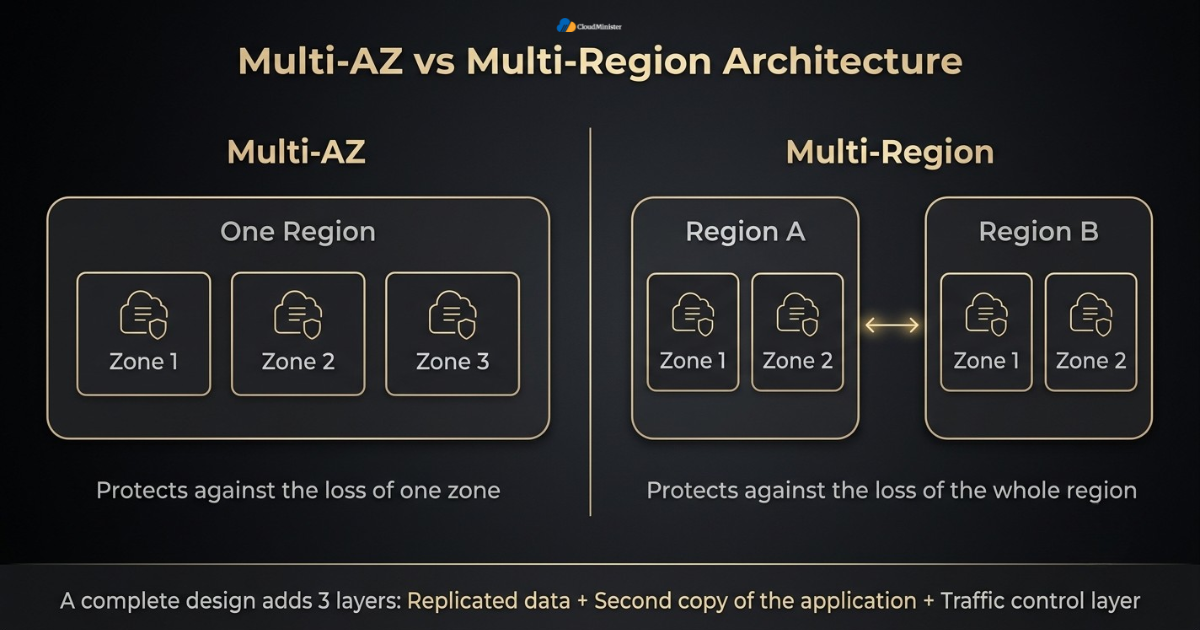
A cloud region is a geographic area that contains several isolated groups of data centres called availability zones. Multi-Region Architecture means running the same workload in more than one of these regions, with replicated data and a way to move traffic between them. Zones protect you from the loss of one data centre group. Regions protect you from a failure that is larger than that, such as a regional power event, a network split, or a faulty change in the provider’s own systems. Many businesses begin with cloud hosting services in India inside one region and add a second region as the business grows.
- A region is a separate geographic area, and an availability zone is an isolated location inside that region.
- A multi-zone design protects against losing one zone, while Multi-Region Architecture protects against losing the whole region.
- Regional outages can come from power, networking, a bad deployment, or a failure in a shared regional service.
- A complete design adds three layers: replicated data, a second copy of the application, and a traffic control layer.
- It does not protect you from your own bugs, because a faulty release can be copied to both regions at once.
- Distance matters. Light in fibre covers about 200 km per millisecond, so regions far apart always add network delay.
- A Web Hosting Company in India with sites in several cities can help you pick region pairs that are far enough apart to stay independent and close enough to keep latency reasonable.
- Cloud Hosting Solutions in India give the quickest start for a second site, while Dedicated Server Hosting in India and Dedicated Servers in India suit teams that want fixed hardware.
2. Why Regional Outages Happen and What They Cost
Regional failures are rare, but they are not imaginary, and the bill is high when one arrives. The Uptime Institute reported in its 2026 outage analysis release that 57 percent of survey respondents said their most recent major outage cost more than 100,000 dollars. The same release notes that over nine years of tracking public outages, third party IT and data center service providers, including cloud, telecom, and colocation companies, accounted for about two thirds of reported cases. Splunk research on the Global 2000 estimates that downtime costs these companies about 600 billion dollars a year, or more than 900,000 dollars per hour for each organization. These figures explain why Multi-Region Architecture is now a board level topic and not only an engineering topic.
- Common regional causes include power failures, network faults, cooling problems, failed provider updates, and bad configuration changes.
- Provider side events matter because customers cannot fix them, and Multi-Region Architecture lets you choose how quickly you move away.
- The Uptime Institute figures show outage costs edging upward, which strengthens the case for planning ahead.
- Direct revenue loss is only part of the cost. Support load, refunds, penalties, and lost trust follow.
- Availability math helps. A target of 99.9 percent allows about 8.76 hours of downtime a year, while 99.99 percent allows about 52.6 minutes.
- Two independent regions at 99.9 percent each give a theoretical combined figure near 99.9999 percent, but shared dependencies and imperfect failover keep real results lower.
- Businesses that run payments, bookings, or live orders on cloud hosting services in India feel every minute of downtime directly.
- Dedicated Server Hosting in India gives strong control, but one facility is still one failure domain. The same is true for Dedicated Servers in India that sit in a single data centre.
- A Web Hosting Company in India that runs two or more independent sites can reduce this exposure, and so can Cloud Hosting Solutions in India that span two cities.
A regional outage is also a moment when attackers and scammers look for confusion. Keep incident communication on trusted channels, and never share credentials in chat during a failover.
3. Core Patterns: Backup and Restore, Pilot Light, Warm Standby, and Active-Active
There is no single best design. Four patterns are widely used for disaster recovery in the cloud, and each one trades cost against recovery speed. Choosing the right Multi-Region Architecture starts with matching the pattern to the business need rather than copying a larger company. Teams that run Cloud Hosting Solutions in India often combine patterns, using warm standby for the main database and backup and restore for low priority tools.
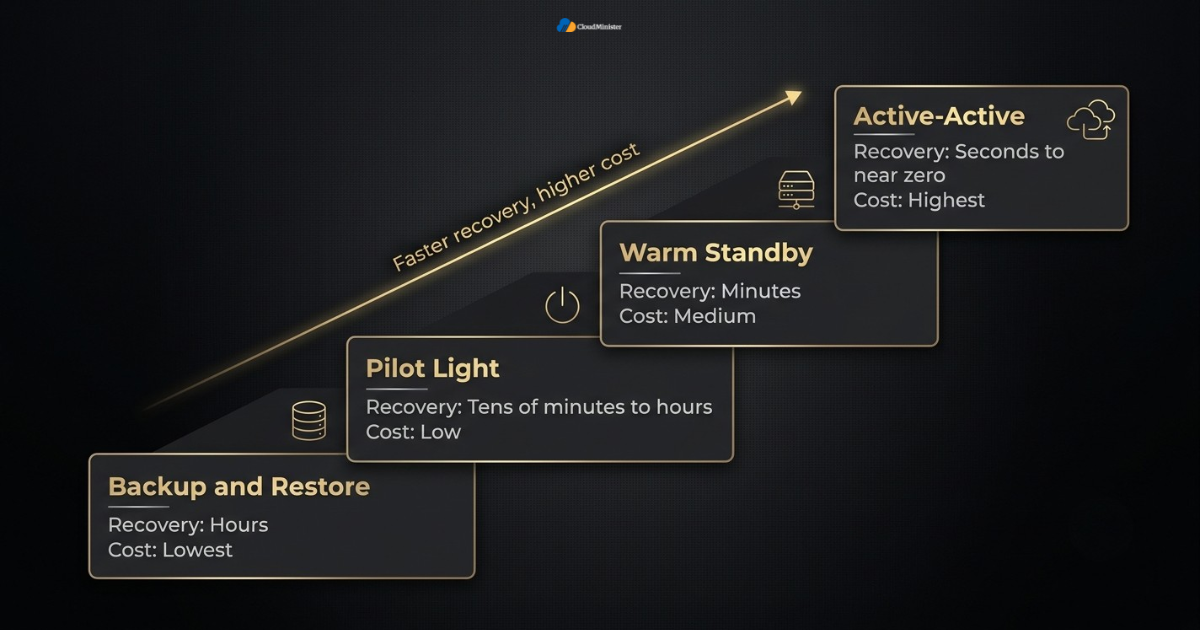
| Pattern | Recovery speed | Running cost | Best for |
| Backup and restore | Hours | Lowest | Internal tools and non critical data |
| Pilot light | Tens of minutes to hours | Low | Data always replicated, compute started on demand |
| Warm standby | Minutes | Medium | Customer facing apps with a clear recovery target |
| Active-active | Seconds to near zero | Highest | Systems that cannot accept a visible pause |
- Backup and restore copies data to another region and rebuilds everything after a disaster. It is cheap, but recovery is slow.
- Pilot light keeps data replicated and core services ready, while application servers stay off until needed.
- Warm standby runs a smaller but fully working copy in the second region, and cloud hosting services in India with autoscaling can grow it during failover.
- Active-active serves live traffic from both regions at once, which gives the fastest recovery and the hardest data design.
- Active-passive is the general name for designs where only one region serves writes in a Multi-Region Architecture, and it covers pilot light and warm standby.
- Each step up the ladder shortens recovery time but adds cost, so every Multi-Region Architecture pattern is a trade between speed and spend.
- Mix patterns by workload. A checkout service may need warm standby, while a reporting tool can use backup and restore, and a Web Hosting Company in India can help you run both under one plan.
- Dedicated Server Hosting in India can act as one leg of a hybrid design when you want predictable hardware and a stable monthly cost for the standby side.
- Dedicated Servers in India and Dedicated Server Hosting in India both suit pilot light designs, where a small always on database host waits for a failover.
Related Reading: Cloud pricing model types
Build Your Second Region on Reliable Cloud Hosting
Run warm standby or active-active without overspending. Scale capacity on demand with CloudMinister’s cloud hosting built for Indian businesses.
4. Setting RTO, RPO, and Your Downtime Budget
Before choosing any tool, define two numbers. Recovery Time Objective, or RTO, is how long the business can be without the service. Recovery Point Objective, or RPO, is how much recent data the business can afford to lose, measured in time. These two numbers decide almost every part of Multi-Region Architecture, from the replication method to the amount of standby capacity you need. Without them, teams either overspend or under protect.
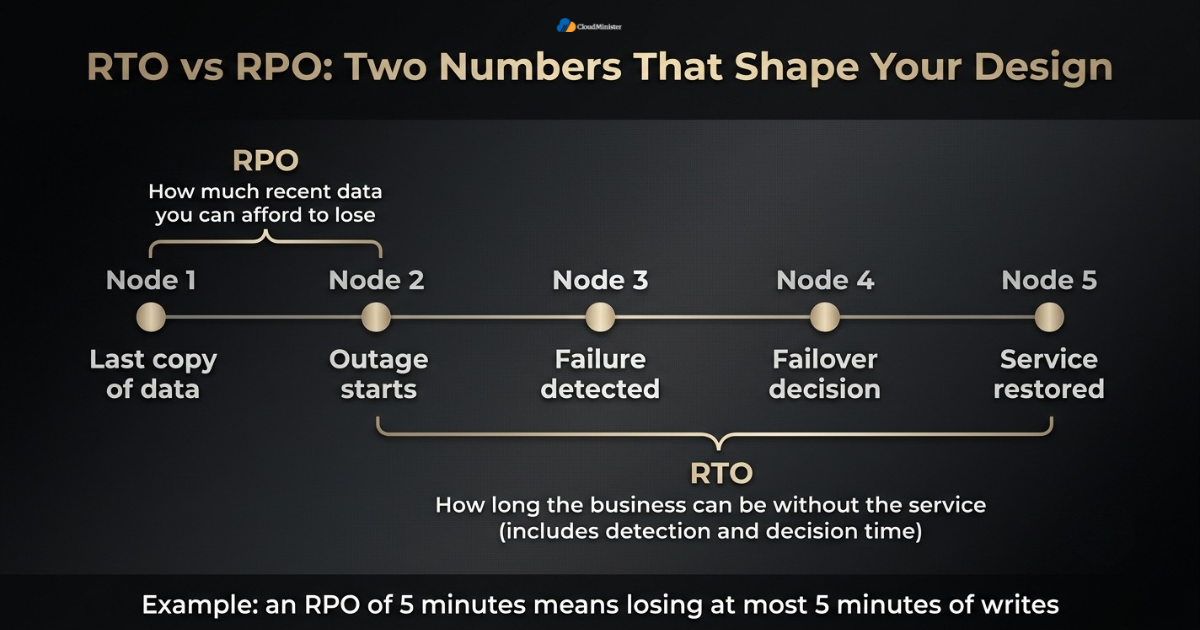
- RTO is the maximum acceptable time from the start of an outage until service is restored.
- RPO is the maximum acceptable age of the data you restore, so an RPO of 5 minutes means losing at most 5 minutes of writes.
- Asynchronous replication gives an RPO above zero, while a zero RPO needs synchronous or consensus based replication, which adds write latency across regions.
- Set separate targets for each service, because a login service and a nightly report do not need the same protection in any Multi-Region Architecture.
- Write the numbers in seconds or minutes and have the business approve them, not only engineering.
- Include the time to detect the failure and decide to fail over, because RTO covers the whole period of a Multi-Region Architecture failover.
- Standby capacity should follow the RTO. A short RTO needs enough warm capacity, and a Web Hosting Company in India can help you size it without paying for idle servers.
- Cloud hosting services in India let you scale standby capacity on demand, and Cloud Hosting Solutions in India with autoscaling serve the same purpose for a short but variable RTO.
- Dedicated Server Hosting in India suits a steady standby load at a fixed monthly cost, and Dedicated Servers in India can hold a standing database replica that meets a tight RPO.
Write your RTO and RPO at the top of the runbook. Every later design choice can then be checked against those two numbers, which stops arguments during an incident.
Related Reading: Cloud rightsizing for instances
5. Traffic Routing and Failover Control
Traffic routing decides which region a user reaches, and it is the part of Multi-Region Architecture that users actually feel. Most designs use DNS based routing, a global load balancer, or anycast. Each has strengths and limits, so it helps to understand them before an outage. Many providers of cloud hosting services in India offer health checked DNS or a managed global load balancer that removes an unhealthy region from rotation.
- DNS failover uses health checks to stop returning the address of an unhealthy region, and it works with almost any application.
- DNS answers are cached by resolvers, and some resolvers ignore low TTL values, so a few clients may keep using the old address for a while.
- Lower the TTL well before any planned event, and treat DNS in a Multi-Region Architecture as a best effort control and not an instant switch.
- A global load balancer or anycast front end can move traffic faster because clients keep the same address, and a Web Hosting Company in India can set one up in front of both sites.
- Use health checks from several locations and require agreement, and make them deep checks that test the database path, not only that a web server answers.
- Add damping, such as a minimum wait before failing back, to prevent flapping between regions.
- Decide whether failover is automatic or manual in your Multi-Region Architecture. Automatic is faster, but a wrong trigger can cause a larger incident.
- Failing over to a standby on Dedicated Server Hosting in India usually means updating DNS or a load balancer pool, so rehearse that exact step.
- Latency based or geographic routing can send users to the nearest healthy region in an active-active setup, whether the sites are built on Cloud Hosting Solutions in India or Dedicated Servers in India.
6. Data Replication: The Hardest Part of Multi-Region Architecture
Data is the hardest part of any Multi-Region Architecture, because the application tier can be rebuilt but data cannot. The core choice is between synchronous and asynchronous replication, and it is a trade between safety and speed. Synchronous replication waits for the second region to confirm each write, so no confirmed data is lost, but every write pays the round trip delay. Asynchronous replication confirms the write locally and ships it afterwards, which is fast but can lose the most recent writes in a disaster.
- Asynchronous replication keeps write latency low and is the common choice for cross region copies of relational databases.
- Synchronous cross region replication gives a zero RPO but adds the network round trip to every commit.
- Consensus based databases, including those on Cloud Hosting Solutions in India, keep copies in several sites and commit once a majority of copies agree.
- With majority quorum you need at least three sites to survive the loss of one, because two sites cannot form a majority once one is gone.
- Object storage on cloud hosting services in India can replicate across regions, but replication is typically asynchronous, so allow for delay and test it.
- Ask your Web Hosting Company in India to copy backups to a second site, keep at least one immutable copy, and test restores regularly.
- Alert on replication lag, because lag is the live RPO of your Multi-Region Architecture at any moment.
- Replication copies mistakes as well. A bad delete or corruption reaches the second region, so keep point in time recovery.
- Dedicated Servers in India can host a standby database when you want full control over storage performance, and Dedicated Server Hosting in India can do the same under a fixed monthly plan.
Track replication lag as a live metric and alert when it passes your RPO. A lag of 30 seconds against a 5 minute RPO is healthy, while a lag of 10 minutes means you are already out of target.
7. Building a Stateless Application Tier
The application tier is the easiest part to replicate if it is built to be stateless. A stateless service keeps no important data on its own disk or memory between requests, so any copy in any region can serve any user. Container images, infrastructure as code, and automated pipelines let you build the same stack in each region from one source. This is where Multi-Region Architecture rewards good engineering habits.
- Keep sessions outside the server, using signed tokens or a replicated session store, so users are not logged out at failover in a Multi-Region Architecture.
- Build both regions from the same infrastructure as code templates, whether they run on cloud hosting services in India or on dedicated hardware, to prevent configuration drift.
- Keep container images in a registry in each region, because the registry itself can be a hidden dependency.
- A Multi-Region Architecture must expect repeated requests after failover, so use queues and retries with idempotent operations that do not charge or create twice.
- Caches can start cold in the new region, so test that the database can handle the load while caches warm up.
- Replicate secrets, certificates, and feature flags securely to the second region.
- Devices and sensors that stream data need regional endpoints and reconnect logic, so ingestion continues when one region is lost.
- A Web Hosting Company in India can pre-build networks, load balancers, and base images in the second site, which shortens recovery.
- Cloud Hosting Solutions in India, Dedicated Server Hosting in India, and Dedicated Servers in India can all run the same container images when the build process is automated.
Related Reading: IoT cloud integration
8. Active-Active Writes, Conflicts, and Split Brain
Active-active is attractive because both regions serve users, but accepting writes in two places creates conflicts. Two users can change the same record in different regions at nearly the same moment, and the system must decide which change wins. The safest Multi-Region Architecture designs avoid the problem by giving each record a home region, so writes for that record always go to one place. Many teams run active-active for reads and keep a single write region, which gives most of the benefit with much less risk.
- Home region ownership routes all writes for a customer or tenant to one region, which avoids most conflicts.
- Last writer wins is simple but can silently discard a valid update, while conflict free replicated data types merge changes automatically for suitable data such as counters and sets.
- Split brain happens when two regions both believe they are the primary and both accept writes, and it can corrupt data.
- Prevent split brain in a Multi-Region Architecture with a quorum, a lease, or a fencing token, so an old primary cannot keep writing after it loses authority.
- A small witness in a third location, such as a low cost server on Dedicated Servers in India, can decide which side is healthy when the two regions cannot see each other.
- Test network partitions in every Multi-Region Architecture and not only clean region shutdowns, because partitions are where split brain appears.
- Plan failback separately. Returning to the original region needs a data resync and is risky if rushed.
- Active-active on cloud hosting services in India works best when each region has its own database cluster and clear write ownership, and a Web Hosting Company in India can help map that ownership.
- Cloud Hosting Solutions in India that offer managed multi region databases reduce the work, while Dedicated Server Hosting in India needs the team to run replication itself.
Start with active-passive and prove that failover works. Move to active-active only for services whose recovery target cannot be met any other way. Many incidents have been made worse by a design that was more complex than the team could operate.
9. Hidden Single-Region Dependencies
A system can run in two regions and still fail with one, because of dependencies nobody listed. Identity providers, DNS hosting, certificate authorities, deployment tools, monitoring, and licensing servers often sit in a single place. Finding them is the most valuable part of planning Multi-Region Architecture, because one of these quietly removes your ability to deploy, log in, or even see what is happening.
- Build a full dependency map, including third party APIs, payment gateways, email services, and internal tools, for every Multi-Region Architecture you run.
- Check where DNS is hosted and whether a Web Hosting Company in India or another provider has made it redundant.
- Make sure identity and secrets systems work in the surviving region, including on Cloud Hosting Solutions in India that host a standby.
- Keep the deployment pipeline reachable if the primary region is down, so you can ship a fix during the incident.
- Host monitoring and alerting outside the failure domain, for example on separate cloud hosting services in India, or you will be blind exactly when you need it.
- Avoid depending on control plane actions, such as creating new resources, during an outage, since control planes can be degraded. Pre-provision capacity instead.
- Check quotas and limits in the second region ahead of time, because capacity requests during a disaster may not be granted quickly.
- Verify licences, IP allow lists, and firewall rules for the second region, including on Dedicated Server Hosting in India.
- Hardware based standbys on Dedicated Servers in India need spare capacity and remote access arranged in advance, since nobody can add servers during an outage.
10. Security, Compliance, and Data Residency in India
A second region doubles your attack surface and your compliance duties. Every copy of production data must be protected as strongly as the original, including backups and replicas. For Indian businesses, residency rules also decide where the second region of a Multi-Region Architecture can sit. The Reserve Bank of India directive on payment system data generally requires that such data be stored only in India, and the Digital Personal Data Protection Act, 2023 adds duties for personal data, so review both with your legal advisers before picking a region pair. Choosing Dedicated Server Hosting in India or Cloud Hosting Solutions in India for the second site often keeps both copies inside the country.
- Encrypt data in transit between regions and at rest in both, with keys managed per region or replicated securely.
- Give replication accounts least privilege and remove temporary access after tests.
- Apply the same logging, patching, and vulnerability scanning to the standby region as to the primary.
- Keep at least one backup copy that is immutable or offline, to protect against ransomware that spreads through replication.
- Confirm where backups, logs, and replicas are stored, including copies kept with a Web Hosting Company in India, since these count as data copies for residency questions.
- Classify data so that only what is needed is replicated outside the primary region.
- Involve compliance early, because changing the region pair of a Multi-Region Architecture later is expensive.
- Dedicated Servers in India suit regulated workloads that need isolated hardware and a clear physical location.
- Cloud hosting services in India should be checked for the exact city of every replica, and Dedicated Server Hosting in Indiashould be checked for the location of backup copies.
A failover test with real data creates a second live copy of customer information. Treat the standby region as production from day one, restrict access, and delete test data and temporary credentials when the exercise ends.
11. Cost Planning Without Overspending
Cost is the main reason teams delay Multi-Region Architecture, and it is a fair concern. Active-active can approach double the infrastructure bill, and cross region data transfer adds its own charges. The answer is to spend where the business case is strongest. Rank services by revenue impact, give each a recovery target, and pay only for the pattern that meets it. Cloud hosting services in India with predictable monthly plans can make this planning simpler than complex pay per use billing.
- Warm standby costs far less than active-active in a Multi-Region Architecture because the second region runs at reduced size.
- Many providers bill for cross region data transfer, so estimate replication volume early.
- Standby storage and database replicas are usually a large part of the bill, so measure them first.
- Use autoscaling and tested scale up steps on Cloud Hosting Solutions in India so standby capacity grows only when needed.
- Tag every resource in both regions so you can see the true cost of resilience per service.
- Compare the yearly cost of resilience with the cost of one major outage, using your own revenue per hour.
- Review the Multi-Region Architecture budget every quarter, because traffic and prices change.
- A Web Hosting Company in India that offers fixed monthly plans makes the standby side easier to forecast.
- Dedicated Server Hosting in India and Dedicated Servers in India carry a fixed monthly cost, which is easier to forecast than usage based billing for a standby site.
Related Reading: Cloud cost governance policy
12. Testing, Monitoring, and Failover Drills
An untested failover is only a theory. Many teams discover during a real incident that a certificate was missing, a quota was too low, or a script still pointed to the old region. Regular drills turn Multi-Region Architecture from a diagram into a real capability. Start in staging, then move to controlled production tests during quiet hours with the business informed.
- Run game days where the team practices a full regional failover on your cloud hosting services in India, and time every step.
- Test rollback and failback steps, not only the forward path.
- Use fault injection to simulate partial failures such as high latency and packet loss, which are common in real events on any network, including links to Dedicated Server Hosting in India.
- Monitor replication lag, error rate, latency, queue depth, and health check status in both regions, including sites on Cloud Hosting Solutions in India.
- Define success in numbers, such as failover finished inside the RTO and data loss below the RPO, and ask your Web Hosting Company in India to confirm its own recovery times.
- Keep the runbook short, version controlled, and reachable from outside the primary region.
- Assign roles in advance: an incident lead, a communications lead, and the person allowed to trigger failover.
- Hold a blameless review after every drill and update the runbook.
- Drill the physical side too. For Dedicated Servers in India, check remote access, out of band management, and spare parts before the test.
Run at least one drill with the people who will actually be on call, not only the engineers who built the system. A runbook that only its author can follow will fail at 3 a.m.
13. Common Mistakes That Break Failover
Most failed failovers trace back to a short list of repeatable mistakes. Avoiding them is one of the cheapest ways to improve any Multi-Region Architecture, and most of them cost nothing to fix before an outage.
- Treating a multi-zone design as a Multi-Region Architecture and assuming zones protect against a regional event.
- Choosing two regions that share a power grid, a network path, or a provider dependency, even when both sit on cloud hosting services in India.
- Never testing restore or failover on Dedicated Servers in India or any other platform, so the first real test is the real outage.
- Forgetting that replication copies corruption and accidental deletes.
- Leaving the DNS TTL too high, so users stay on the failed region for a long time.
- Relying on the control plane during the outage instead of pre-provisioned capacity.
- Ignoring data residency rules when picking the second region, including for backups on Dedicated Server Hosting in India.
- Choosing active-active on Cloud Hosting Solutions in India without a conflict plan.
- Having no single owner with authority to call the failover, or assuming a Web Hosting Company in India will make that call for you.
14. Choosing the Right Infrastructure Partner in India
Not every provider is ready to support a careful Multi-Region Architecture. The partner you choose decides how quickly you can build, test, and recover. A capable Web Hosting Company in India should explain its network, its data centre locations, its backup practice, and how it supports customers during a real incident. Cloud Hosting Solutions in India should be assessed in the same way as any other critical supplier.
- Ask where the provider’s facilities are and whether they have independent power and network paths.
- Ask for restore times from real backups, not marketing figures, whether the plan is Cloud Hosting Solutions in India or Dedicated Servers in India.
- Check whether cloud hosting services in India include private networking, replication, and global load balancing.
- Confirm that Dedicated Server Hosting in India can serve as a hybrid standby with dedicated hardware.
- Ask for a real example of a past failover and what went wrong.
- Confirm 24×7 support, an escalation path, and who can authorise action during a night incident.
- Clarify in writing what the provider monitors and what remains your duty.
- Ask whether managed services and DevOps help are available to build runbooks and run drills for your Multi-Region Architecture.
- Be careful of anyone who promises zero risk.
15. A Practical 30 Day Plan to Get Started
Reading about Multi-Region Architecture is easy and acting on it is harder, so this plan splits the work into four weeks that most teams can follow. Each week ends with something you can show to the business.
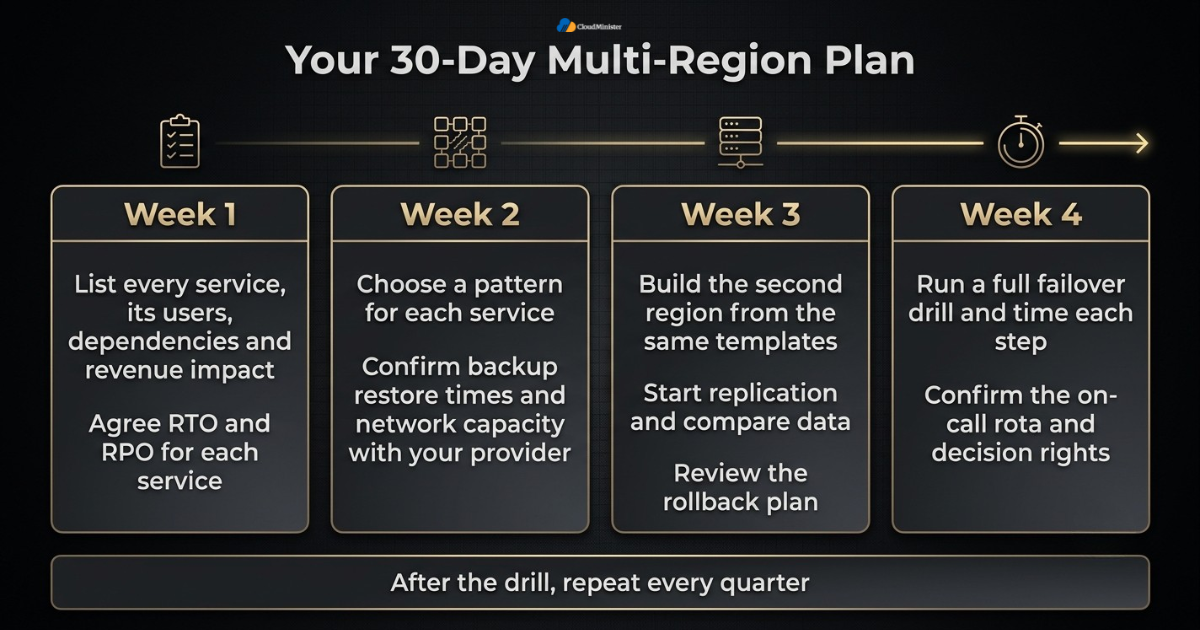
- Week one: list every service, its users, its dependencies, and its revenue impact.
- Week one: agree RTO and RPO for each service with the business and write them in the runbook of your Multi-Region Architecture.
- Week two: choose a pattern for each service and record the reason in one paragraph, whether it runs on cloud hosting services in India or elsewhere.
- Week two: ask your Web Hosting Company in India to confirm backup restore times and network capacity between sites.
- Week three: build the second region from the same templates on Cloud Hosting Solutions in India, start replication, and compare data.
- Week three: confirm remote access and spare capacity on any Dedicated Servers in India, and review the rollback plan with a colleague who did not write it.
- Week four: run a full failover drill for the Multi-Region Architecture, time each step, and fix every problem it exposes.
- Week four: confirm the on call rota and the decision rights for failover and failback.
- After the drill: schedule a repeat every quarter, and include any Dedicated Server Hosting in India nodes in the test.
After the first drill, keep improving. Data volume, traffic, and provider features change, so a plan that fit last year may not fit today. Keep a short library of what worked, what failed, and how long each step really took. Share those notes with your Web Hosting Company in India so its advice improves with every project.
Measure every drill against the same numbers, such as detection time, failover time, data loss, and failback time. Over a few quarters your Multi-Region Architecture will improve through evidence and not opinion.
Checklist: Multi-Region Readiness Review
- RTO and RPO defined for each service and approved by the business
- Dependency map complete, including DNS, identity, and deployment tools
- Pattern chosen for each workload and the reason recorded
- Replication running, with lag alerts set below the RPO
- Backups copied to a second region and a restore tested
- Health checks, DNS TTL, and routing rules tested
- Split brain protection in place for any multi-writer design
- Residency and compliance rules checked for both regions
- Failover and failback drills completed and timed
- Owners named for go, no go, and rollback decisions
Key Takeaways
- A region is a larger failure domain than a zone, so multiple zones alone do not protect you from a regional outage.
- Multi-Region Architecture needs replicated data, a second copy of the application, and a tested traffic control layer.
- RTO and RPO should be agreed first, because they decide the pattern, the replication method, and the cost.
- Warm standby suits most customer facing systems, and active-active should be kept for services that cannot pause.
- Replication lag is your live RPO, and replication also copies mistakes, so keep point in time recovery and immutable backups.
- Split brain is prevented with quorum, leases, or fencing, and a witness in a third site helps in a two site design.
- Hidden dependencies such as DNS, identity, and deployment tools are a common reason failover fails.
- Drills, clear roles, and a short runbook matter as much as any tool.
- A Web Hosting Company in India that offers cloud hosting services in India and Dedicated Server Hosting in India can give a Multi-Region Architecture both flexibility and predictable cost.
- Cloud Hosting Solutions in India and Dedicated Servers in India can be mixed in a hybrid design to balance cost and control.
Need Help Planning Your Multi-Region Setup?
Talk to our cloud experts about RTO and RPO targets, replication, failover drills, and the right hosting mix for your workload.
Conclusion
Across every cloud and company size, one pattern holds. Surviving a regional outage is the result of preparation and not of one clever tool. The best Multi-Region Architecture keeps the design as simple as the recovery target allows, proves every step with data, and gives one person the authority to decide. Map the system first, choose the pattern second, and keep testing as the workload changes. Teams that serve Indian users can add a trusted Web Hosting Company in India to that plan for network capacity, backups, and support.
A second region is never finished on the day it is built. Keep watching replication, review costs each quarter, and repeat the drill. Whether you rely on cloud hosting services in India, Cloud Hosting Solutions in India, Dedicated Servers in India, Dedicated Server Hosting in India, or a mix of them, a rehearsed failover is what turns a regional outage into a short, calm event.
Frequently Asked Questions
What is the difference between multi-AZ and Multi-Region Architecture?
Multi-AZ spreads a workload across isolated zones inside one region and protects against the loss of a zone or data centre group. Multi-Region Architecture spreads it across separate regions and protects against a failure that affects the whole region. Most serious designs use both.
Is active-active always better than warm standby?
No. Active-active gives the fastest recovery, but it needs a conflict and consistency plan and costs the most to run. Warm standby meets the recovery target of most customer facing systems at a lower cost and with less risk.
How far apart should two regions be?
Far enough that a single power, weather, or network event cannot hit both, and close enough that replication delay stays acceptable. Within India, two different metro cities are a common choice for Cloud Hosting Solutions in India and for Dedicated Servers in India alike, but residency rules and your latency needs should decide.
Can DNS failover alone protect my application?
It helps, but DNS answers are cached and some resolvers ignore low TTL values, so some users may take longer to move. Pair DNS with health checks, a low TTL set in advance, and where possible a global load balancer or anycast front end.
How do I stop split brain?
Use a quorum based system, a lease, or a fencing token so only one region can accept writes at a time. A small witness in a third location helps decide which region is healthy when the regions cannot reach each other.
Do I need a second region if I already use cloud hosting services in India with several zones?
It depends on your recovery target and the cost of an outage. Several zones protect against zone failures, but not against a regional event. If your business cannot accept a long outage, a second region is worth pricing.
Where do Dedicated Servers in India fit into a multi-region plan?
They work well as a hybrid standby or a replica site when you want dedicated hardware, stable monthly cost, and a clear physical location for regulated data. Confirm network links and failover steps with your provider.
How often should I test failover?
At least once a quarter for important services, and after any major change to the data layer, the network, or the deployment pipeline. Time every step and record the result.
What should I ask a Web Hosting Company in India before building a second site?
Ask about independent power and network paths, restore times from real backups, support hours, escalation, and what the provider monitors compared with what you must monitor yourself. Ask for a real example of a past failover.

Ajay Singh Raghav is a Senior Linux System Administrator at CloudMinister Technologies, where he has spent over 4 years installing, configuring, maintaining, and troubleshooting Linux servers for hosting and cloud environments. He specializes in AWS cloud computing alongside core Linux server administration, with hands-on expertise across server management, backup and restore systems, and cPanel-based hosting environments. His day-to-day experience keeping production servers stable and secure gives him a practical, ground-level understanding of the infrastructure he writes about.