Cloud migration in 2026 is no longer a side project handled by a couple of engineers over a weekend. It is a boardroom-level decision with a real budget attached to it. This is exactly where the 6Rs of Cloud Migration becomes useful. It is the practical decision tree that IT leaders use to decide, application by application, whether something should be moved as-is, re-platformed, rebuilt, repurchased, retained, or retired. This guide breaks down each option inside the 6Rs of Cloud Migration, explains when to use it, and shows Indian businesses how to plan a 2026 rollout that works.
Cloud migration in 2026 is no longer a side project handled by a couple of engineers over a weekend. It is a boardroom-level decision with a real budget attached to it. This is exactly where the 6Rs of Cloud Migration becomes useful. It is the practical decision tree that IT leaders use to decide, application by application, whether something should be moved as-is, re-platformed, rebuilt, repurchased, retained, or retired. This guide breaks down each option inside the 6Rs of Cloud Migration, explains when to use it, and shows Indian businesses how to plan a 2026 rollout that works.
The scale of enterprise investment in cloud migration makes the stakes of getting it right hard to ignore. The global cloud migration services market is projected to reach 330.27 billion dollars in 2026, growing at a compound annual rate of over 23 percent, as organizations across every industry accelerate their shift away from legacy infrastructure. That growth reflects genuine confidence in the cloud, but it also means more money is riding on migration decisions than ever before. A single misjudged strategy at this scale doesn’t just slow a project down; it can quietly inflate a budget line that finance teams assumed was already settled. This is precisely the environment in which a structured framework like the 6Rs of Cloud Migration earns its place at the planning table.
Investment alone does not guarantee smooth migration. Industry data shows that close to 38 percent of migration projects still exceed their original budget, and 31 percent miss their planned timeline, despite the maturity of today’s cloud tooling and hosting options. These overruns rarely come down to the technology itself; they come down to how decisions were made by application. Businesses that treat every workload the same way, without weighing its criticality, technical debt, or compliance exposure, are the ones most likely to land in that 38 percent. The 6Rs of Cloud Migration exist specifically to close this execution gap by forcing a deliberate choice for each system rather than a blanket approach.
For businesses evaluating whether to migrate at all, that debate is over. The real question in 2026 is which of the 6Rs of Cloud Migration applies to each workload, because treating every application the same way is one of the most expensive migrations mistakes a business can make. Some systems are ready for a straightforward lift-and-shift; others justify a full rebuild, and a few are better left alone for now. The sections that follow break down each of the six paths in detail, show how to evaluate applications against them, and outline what Indian businesses specifically need to plan for around cost, infrastructure, and compliance before their 2026 rollout begins.
Table of Contents
- What Is This Framework?
- Why It Matters More in 2026
- Breaking Down Each Option
- How to Choose the Right Strategy
- Cost Planning Across the Framework
- Infrastructure Readiness for Rollout
- This Framework for SMBs in India
- Common Mistakes That Undermine Migration
- Security, Compliance & DPDPA 2023
- Customized Migration Plans by Size
- Measuring Success Beyond Go-Live
- Choosing the Right Infrastructure Partner
- Infrastructure Economics & Hosting Costs
- Matching Hosting Options to Your Path
- Key Takeaways
- Conclusion
- Frequently Asked Questions
1. What Is the 6Rs of Cloud Migration Framework?
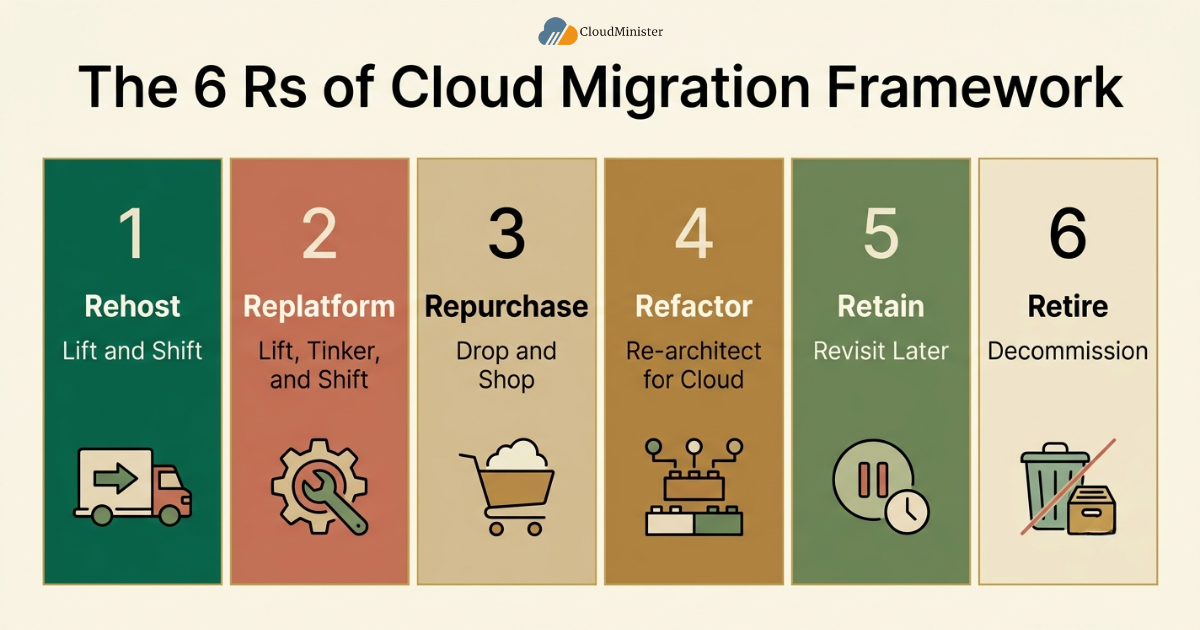
The 6Rs of Cloud Migration is a strategic model, originally popularized by AWS and now used industry-wide, that categorizes every migration decision into six distinct paths.
- It stands for Rehost, Replat form, Repurchase, Refactor, Retain, and Retire.
- Each path represents a different level of effort, cost, and long-term benefit, and no single option is universally best.
- The framework forces IT teams to evaluate applications individually rather than applying one blanket approach across the entire portfolio.
- Picking the wrong path is one of the leading causes of migrations that go over budget or miss deadlines.
- Because the model is workload-specific, a single enterprise project will typically use four or five of the six strategies at once.
Whichever path you choose, every workload carries its existing data and access permissions with it into the new environment. Run a permissions and data-classification audit before migration begins, so sensitive information does not get exposed through misconfigured storage or over-permissioned accounts. This matters directly for any business handling personal data under India’s Digital Personal Data Protection Act (DPDPA) 2023.
2. Why This Framework Matters More in 2026
Industry data shows that 94 percent of enterprises now use cloud services in some form, and a large share of workloads already run in the cloud, but usage alone does not mean those workloads were moved using the right approach.
- Enterprises that default to one method for every application routinely see cost overruns, and structured evaluation reduces this risk considerably.
- Most systems integrators and consulting firms now treat this kind of structured evaluation as a baseline planning requirement, not an optional exercise.
- AI workloads, compliance mandates, and legacy end-of-life dates are common triggers in 2026, and having a repeatable framework gives IT leaders a way to justify their approach to finance and leadership.
- Choosing incorrectly early in a project is far more expensive to correct later, once dependencies and integrations have already been built around the decision.
- A 2026-ready migration plan built around the 6Rs of Cloud Migration gives businesses a clean narrative for internal stakeholders, auditors, and regulators who want to understand how and why systems were moved.
Businesses comparing affordable cloud hosting india providers at this stage should also ask each vendor how they support workloads across different paths of the 6Rs of Cloud Migration, since not every provider is equally equipped for a refactor-heavy rollout. Before applying any strategy to your full application portfolio, run a two-to-four-week discovery and dependency-mapping exercise. Categorise every application on a spreadsheet before writing a single line of migration code, this step consistently prevents the most expensive planning mistakes.
3. Breaking Down Each Option
Not every application deserves the same treatment. Here is what each path inside the 6Rs of Cloud Migration actually means in practice.
3.1 Rehost (“Lift and Shift”)
- Moves an application to the cloud with little or no code change, making it the fastest option to execute.
- Best suited for a fixed shutdown date, legacy systems near end-of-life, or time-pressured workloads leaving a data center.
- Delivers quick wins but does not take advantage of cloud-native features like autoscaling, so savings are usually smaller than other paths.
- Commonly the starting point for businesses new to cloud hosting services in India, since it gets workloads off legacy infrastructure with minimal risk.
- Businesses comparing affordable cloud hosting India plans at this stage should confirm the provider can support a rehost without unexpected egress or bandwidth charges once the workload lands.
3.2 Replat form (“Lift, Tinker, and Shift”)
- Involves small, targeted optimizations during the move — such as switching to a managed database — without changing the application’s core architecture.
- Sits between rehost and refactor in terms of effort and is one of the most chosen paths for mid-sized businesses.
- Improves performance and reduces operational overhead compared to a straight rehost, while avoiding a full rebuild.
- A popular middle-ground choice for businesses that want measurable gains from cloud hosting services in India without committing to a full rewrite.
3.3 Repurchase (“Drop and Shop”)
- Replaces an existing application entirely with a SaaS alternative, retiring from the old system rather than migrating it.
- Frequently used for CRM, HR, and email systems, where mature SaaS products already outperform ageing in-house builds.
- Shifts a business from a capital-heavy ownership model to a predictable subscription cost structure.
- Requires careful data migration planning and user retraining, since the interface and workflows will change for end users.
3.4 Refactor / Re-architect
- Rebuilds the application to be cloud-native, often adopting microservices, containers, and serverless components.
- The most resource-intensive path in the 6Rs of Cloud Migration, but also the one that unlocks the largest long-term efficiency and scalability gains.
- Best reserved for business-critical applications where re-architecture investment will pay off through improved agility and reduced technical debt.
- Requires the deepest bench of cloud-native engineering talent and typically the longest project timeline of all six approaches.
- A refactor-level rebuild also demands a hosting partner capable of container orchestration and elastic scaling, which is why businesses should evaluate cloud hosting services in India carefully before committing to this path.
3.5 Retain (“Revisit”)
- Deliberately keeps an application on premises for now, due to compliance constraints, recent investment, or unclear migration value.
- An intentional, documented decision, not a default outcome from inaction.
- Common legacy systems tightly coupled to specialized on-premises hardware, or applications facing near-term retirement anyway.
- Should be revisited on a fixed schedule to confirm the reasoning still holds, Retain can be a valid long-term strategy for workloads where migration genuinely isn’t justified, not just a holding pattern before an eventual move.
3.6 Retire
- Decommissions applications that are no longer needed, removing them from the portfolio entirely rather than migrating them.
- A proper audit frequently uncovers 10 to 20 percent of an enterprise application portfolio as genuinely redundant.
- Directly reduces licensing costs, attack surfaces, and ongoing maintenance burden.
- Often the most overlooked path in the 6Rs of Cloud Migration, even though it can deliver some of the fastest and cleanest savings in the entire project.
Businesses that get the most value out of the 6Rs of Cloud Migration resist the temptation to pick one strategy and apply it everywhere. A real portfolio assessment typically finds a mix: some legacy tools get retired outright; some get rehosted quickly to hit a deadline, and only a small number of genuinely strategic applications justify a full refactor.
Related Reading: AI in Cloud Computing: How Intelligent Infrastructure Is Reshaping Business
4. How to Choose the Right Strategy
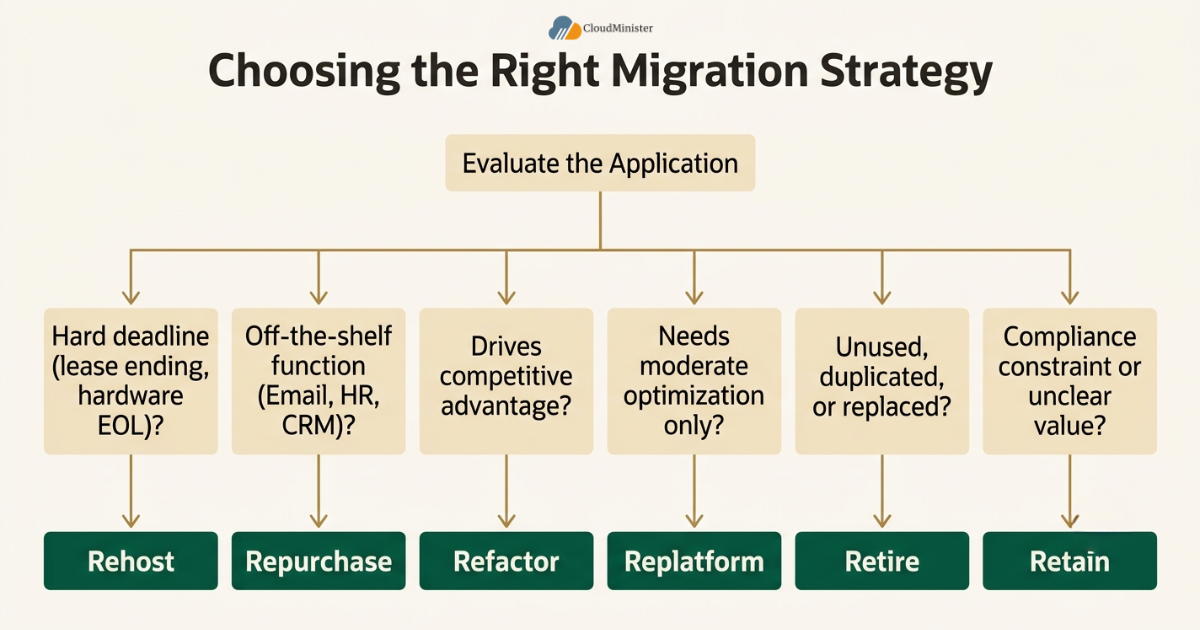
Selecting correctly from the 6Rs of Cloud Migration requires structured evaluation rather than a gut call.
- Start with a full application inventory, and score each one against business criticality, technical debt, compliance sensitivity, and remaining useful life before mapping it to a strategy.
- Applications with a hard deadline, such as a data center lease ending or hardware reaching end-of-life, usually favor rehosting, since speed matters more than optimization.
- Applications generating direct competitive advantage typically justify the investment required for a refactor.
- Off-the-shelf functions like email, HR, and CRM are strong repurchase candidates, since mature SaaS alternatives already exist.
- Anything flagged as unused, duplicated, or replaced by another system should be marked for retirement early, since this is the fastest win available across the whole 6Rs of Cloud Migration exercise.
- Where budget is tight, businesses can lean on affordable cloud hosting india options for the rehost and replat form paths first, reserving heavier spend for the applications that genuinely justify a refactor within the 6Rs of Cloud Migration.
Checklist: What To Evaluate Before Choosing a Strategy
- Business criticality and revenue impact of each application
- Technical debt and age of the current codebase
- Licensing costs of the current system versus available SaaS alternatives
- Compliance and data residency requirements under DPDPA 2023
- Remaining useful life of underlying hardware and contracts
- Internal engineering bandwidth available for a refactor-level effort
- Whether the application is still actively used by the business at all
Related Reading: Multi-Cloud Strategy for Indian SMBs: A Practical Framework
5. Cost Planning Across the Framework
Budgeting looks different depending on which strategy a business selects for a given workload, and IT decision-makers need to plan accordingly.
- Rehost projects typically carry the lowest upfront cost but may deliver smaller long-term savings without follow-up optimization work.
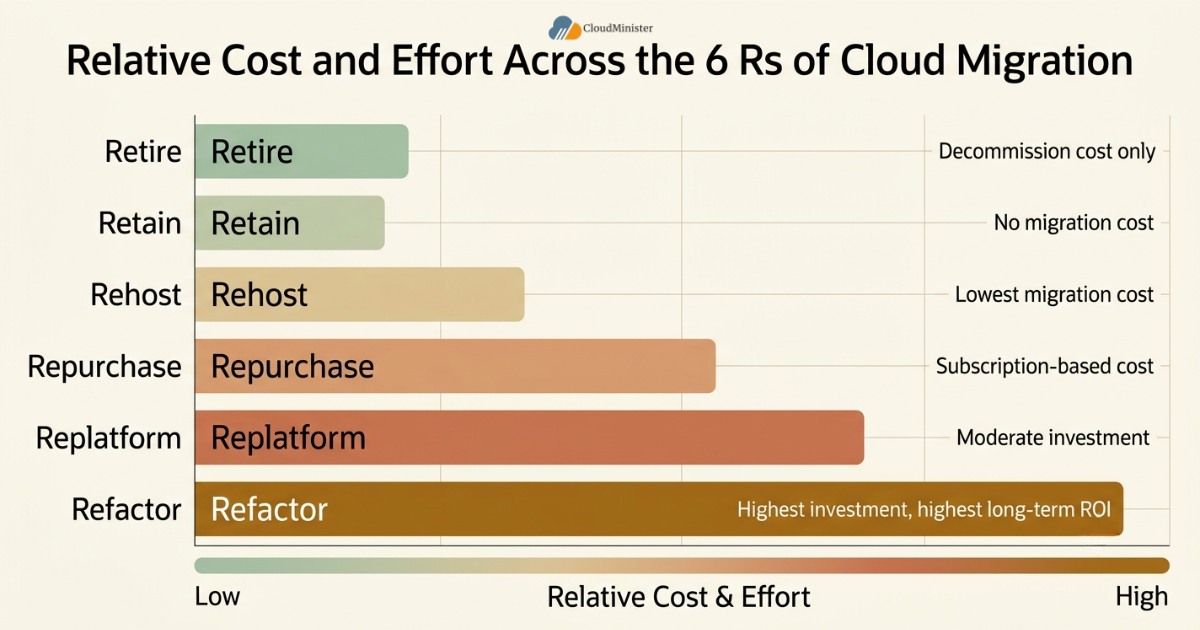
- Refactor projects require the largest upfront investment among the 6Rs of Cloud Migration but tend to produce the strongest long-term return once the application is fully cloud native.
- Enterprise migrations frequently run into the low millions of dollars in total cost, and choosing the wrong strategy is one of the most common reasons projects exceed their original budget.
- Data transfer and egress fees are often underestimated regardless of the chosen path and should be built into the budget from day one.
- Businesses evaluating affordable cloud hosting India options should factor in not just the hosting bill itself, but the migration approach chosen, since that decision drives a large share of the total project cost.
- A well-scoped cloud hosting services in India contract, negotiated alongside the migration plan rather than as an afterthought, typically produces a cleaner overall budget for the 6Rs of Cloud Migration project.
Before committing to a specific path for a business-critical application, request a fixed-scope cost estimate from at least two infrastructure or migration partners. Comparing quotes against your own internal application audit gives finance teams a far stronger basis for approving budget than a single vendor’s projection. It is also worth comparing at least one affordable cloud hosting india provider against a premium option, since price alone does not guarantee the reliability a 6Rs of Cloud Migration project needs.
Related Reading: Cloud Cost Governance Policy Guide
6. Infrastructure Readiness for a Migration Rollout
Regardless of which strategy is selected, the underlying hosting and network infrastructure a business lands on plays a major role in whether the migration delivers the expected performance improvements.
- A dependable Web Hosting Company in India that understands both legacy on-premises environments and modern cloud architectures is well positioned to advise on which of the 6Rs of Cloud Migration suits each workload.
- Businesses running hybrid environments need to confirm their target infrastructure can support the specific technical requirements tied to their chosen path, whether that is container orchestration for a refactor or simple compute parity for a rehost.
- Network latency, storage performance, and uptime guarantee matter differently depending on the path a workload follows, a refactored, distributed application is far more sensitive to network design than a simple rehosted virtual machine.
- Reliable cloud hosting services in India give IT teams the operational bandwidth to focus on the migration itself instead of firefighting basic infrastructure issues mid-project. Cloudminister’s cloud hosting services in India offering is one option worth evaluating alongside other providers.
- Organizations planning a multi-region rollout should confirm their hosting partner can support the data residency requirements relevant to each workload.
- Businesses that only need entry-level compute for early rehost work can often start with affordable cloud hosting india plans, scaling up to more specialized infrastructure as later stages of the 6Rs of Cloud Migration project demand it.
- A Web Hosting Company in India with clear escalation paths and 24×7 support reduces the operational risk during the cutover window, regardless of which of the 6Rs of Cloud Migration strategies is in play.
Any organization executing a 6Rs of Cloud Migration project should run a fresh identity and access review as part of the cutover plan for every workload, regardless of which strategy was used. Migrated systems frequently inherit old, overly broad permissions from their original environment, and cleaning this up during migration is far cheaper than discovering the gap after go-live.
Not Sure Which of the 6Rs of Cloud Migration Fits Your Workload?
Whether you’re rehosting a legacy app or refactoring for full cloud-native performance, CloudMinister’s Cloud Hosting Services give your migration the infrastructure backbone it needs, from entry-level compute to container orchestration and multi-region support.
7. This Framework for Small and Mid-Sized Businesses in India
Large enterprises were the earliest adopters of structured migration frameworks, but small and mid-sized businesses in India are increasingly applying the 6Rs of Cloud Migration as cloud pricing and hosting options expand to serve smaller teams.
- SMBs typically cannot absorb a large upfront transformation budget, so a phased approach matters even more for smaller organizations.
- Many Indian SMBs find that rehost and repurchase are the most practical starting points, since they deliver quick wins without demanding a large in-house engineering team.
- Indian SMBs often run lean IT teams without dedicated cloud architects, which makes a clear, documented decision especially important before any workload is touched.
- Choosing the right hosting partner upfront avoids the common SMB mistake of over-provisioning infrastructure that then sits underused, quietly eroding the savings a migration was meant to deliver.
- For a lean IT team, affordable cloud hosting India plans paired with a rehost-first approach under the 6Rs of Cloud Migration often deliver the fastest path to measurable savings without a large upfront commitment.
- SMBs weighing cloud hosting services in India options against building their own infrastructure almost always come out ahead choosing a managed provider, given how quickly self-managed infrastructure costs grow with scale.
- Partnering with a Web Hosting Company in India that understands both cloud infrastructure and the practical trade-offs across the 6Rs of Cloud Migration can help SMBs avoid the technical friction points that often derail early-stage projects. Many growing agencies that resell hosting to their own clients also look for affordable reseller hosting options, so infrastructure costs do not eat into the budget set aside for the migration itself.
Related Reading: Cloud Pricing Model Types Explained
8. Common Mistakes That Undermine a Migration Project
Even with a solid framework, many migrations underdeliver, not because the 6Rs of Cloud Migration model is flawed, but because of avoidable execution mistakes.
- Applying a single strategy across the entire portfolio instead of evaluating each application individually.
- Skipping the discovery and dependency-mapping phase, leading to surprises mid-project regardless of the chosen path.
- Underestimating data transfer, egress, and parallel-running costs during the transition window.
- Treating “retain” as a decision made once and never revisited, even long-term retain calls should be reviewed periodically to confirm the original reasoning still holds.
- Not tracking post-migration performance and cost data, so it becomes difficult to prove whether the chosen strategy delivered its expected value.
- Ignoring underlying infrastructure and hosting stability, which can undercut the performance gains the entire migration was meant to achieve.
Businesses that pick a cloud hosting services in India provider based on price alone, without checking support quality, often end up repeating parts of the migration once problems surface post-launch.
Consulting-sector research on large-scale migrations has repeatedly found that the gap between successful and unsuccessful projects is rarely about the technology itself. It is almost always an execution and planning gap. Businesses that apply the 6Rs of Cloud Migration with discipline, dependency mapping, and ongoing measurement consistently report smoother go-lives than organizations that rush into a single blanket approach.
9. Security, Compliance, and DPDPA 2023 Considerations
Executing a 6Rs of Cloud Migration project means moving a meaningful share of an organization’s data, applications, and access controls. For Indian businesses, this raises specific compliance questions under the DPDPA 2023 that should be addressed before any workload moves.
- Data fiduciaries remain responsible for how personal data is processed even after a workload has been migrated using any of the six strategies.
- Businesses should document which strategy was applied to each system as part of demonstrating reasonable technical safeguards under DPDPA 2023.
- Access logs and permission audits become more important during and after migration, since new environments can unintentionally expose data that was previously locked down.
- Data residency commitments should be confirmed for every workload before it moves, particularly for refactor and repurchase paths where data may end up stored differently than before.
- Businesses using a Reseller Hosting In India setup to manage client environments should apply the same permission-hygiene discipline before extending any migration project to shared or multi-tenant systems.
- Even businesses relying on affordable cloud hosting India plans for smaller workloads should not skip this compliance step, since the DPDPA 2023 applies regardless of hosting tier or budget.
- Agencies offering Reseller Hosting in India to end clients should build this same compliance checklist into every client onboarding process, not just their own internal migrations.
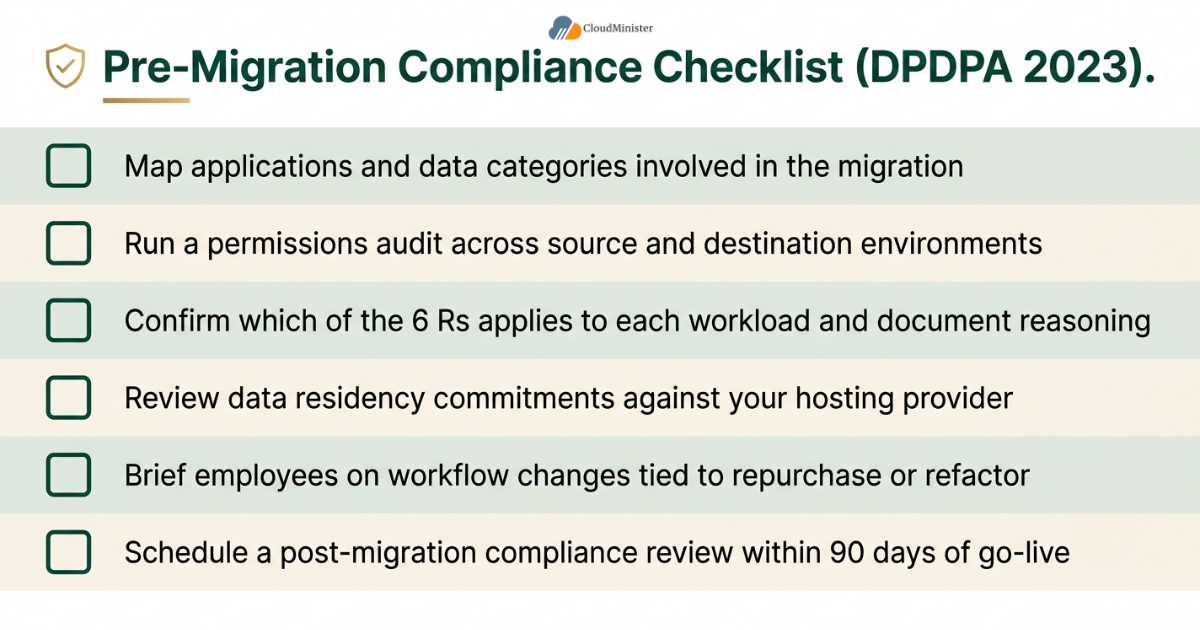
Checklist: Pre-Migration Compliance Checklist
- Map which applications and data categories are involved in the migration
- Run a permissions audit across all source and destination environments
- Confirm which of the 6Rs of Cloud Migration applies to each workload and document the reasoning
- Review data residency commitments against your chosen hosting provider
- Brief employees on any workflow changes tied to repurchase or refactor decisions
- Schedule a post-migration compliance review within 90 days of go-live
10. Customized Migration Plans by Business Size
Not every organization should apply the 6Rs of Cloud Migration the same way. A 15-person creative agency has fundamentally different needs than a 500-person financial services firm.
- Small teams often see the fastest wins from a straightforward rehost or repurchase path, since speed and simplicity matter more than deep optimization.
- Mid-sized businesses tend to benefit most from a mix of replat form and repurchase decisions, balancing cost against operational improvement.
- Large enterprises typically need a phased, department-by-department rollout that applies to all six strategies across different parts of the application portfolio.
- Every migration plan should include a feedback loop back to IT leadership, so underperforming choices can be revisited before the next wave of applications moves.
- Smaller businesses following a rehost-heavy version of the 6Rs of Cloud Migration should periodically compare their current infrastructure spend against newer affordable cloud hosting India offers, since pricing in this segment shifts frequently.
- Agencies reselling infrastructure under a Reseller Hosting in India model should apply the same customized, size-aware thinking to the migration advisory services they offer clients.
- Businesses that also manage client-facing infrastructure, such as agencies offering reseller hosting in India to their own customers, should consider how their internal decisions differ from what they recommend to downstream clients. Agencies operating on tight margins often look specifically for affordable reseller hosting plans that free up budget for the migration to work itself.
Assign a small internal “migration steering group” with representation from IT, finance, and the business unit that owns each application before finalizing decisions. Cross-functional input consistently produces better strategy choices than IT making the call in isolation.
11. Measuring Success Beyond Go-Live
Initial momentum around 6Rs of Cloud Migration project tends to fade if outcomes are not actively measured after cutover. Long-term success requires treating migration as an ongoing operational discipline rather than a one-time event.
- Set a recurring quarterly review comparing actual cost and performance outcomes against the assumptions made when each application was assigned a strategy.
- Revisit any application marked “retain” on a fixed schedule, since business conditions, compliance requirements, and technology options can shift even for workloads intended to stay on-premises long-term.
- Compare renewal-time infrastructure costs against the savings actually achieved, not against the original business case alone.
- Reassess whether the original decision still holds as application usage, headcount, and business priorities shift over time.
- Maintain close coordination between IT, finance, and department leads, so new applications entering the portfolio are evaluated from day one, rather than being added without a structured decision.
Businesses should also revisit whether their current Web Hosting Company in India relationship, or an affordable cloud hosting India plan chosen early on, still matches their scale a year or two after go-live.
As migrations scale across an organization, periodically re-run the permissions and sensitivity audit described earlier in this guide. Organizational structures change, teams get restructured, and ownership of applications shifts, outdated permissions remain one of the most common sources of unintended data exposure following any cloud migration project, regardless of which strategy was used.
12. Choosing the Right Infrastructure Partner
Strategy selection gets most of the attention during planning, but the hosting and infrastructure partner behind the migration plays an equally important role in whether it succeeds.
- A dependable Web Hosting Company in India that already understands a business’s existing environment is well positioned to advise on which of the 6Rs of Cloud Migration fits each workload.
- Businesses that choose reliable cloud hosting services in India benefit from having a single point of accountability for uptime, latency, and security during a sensitive transition window.
- Comparing cloud hosting services in India providers before finalizing a refactor path is worth the extra week it takes, given how much the wrong infrastructure choice can cost later.
- IT leaders who have not yet evaluated their hosting partner relationship should treat a migration project as a natural trigger point to do so.
- Agencies and IT consultancies that operate their own Web Hosting Company in India offering, reselling infrastructure to smaller clients, are often the first to notice how migration workloads increase baseline bandwidth and storage demands across a managed client base.
- For agencies specifically built around Reseller Hosting in India, bundling infrastructure guidance with migration advisory services has become a natural extension of the existing client relationship.
- Providers that already manage multiple client environments through a Reseller Hosting In India model are in a strong position to standardize permission-hygiene and DPDPA 2023 documentation practices across every client running a migration, rather than solving the same problem client by client.
- Businesses evaluating Reseller Hosting in India options for their own downstream customers should factor in whether the underlying infrastructure can comfortably absorb the traffic patterns that come with a large-scale migration among end clients.
- Some resellers position their entry-level tier specifically as affordable cloud hosting india, aimed at small clients running only a rehost or repurchase path within the 6Rs of Cloud Migration, while reserving premium infrastructure for refactor-heavy customers.
- Cost is always part of this conversation. Many growing resellers specifically search for affordable reseller hosting, so margins remain healthy even as they extend migration advisory services to their client base.
- Affordable reseller hosting does not have to mean a compromise on reliability, providers who combine competitive pricing with genuine round-the-clock support give resellers room to invest in the planning work that determines whether a client’s 6Rs of Cloud Migration project succeeds.
- When comparing affordable reseller hosting plans, resellers should specifically ask whether the provider can support the identity and network requirements that a refactor-heavy migration will eventually demand, rather than evaluating price in isolation.
- A reseller that builds its business around affordable reseller hosting while also understanding migration strategy nuances offers a genuinely differentiated service compared to a pure infrastructure-only provider.
The most effective IT partners in 2026 no longer treat hosting and migration strategy as separate conversations. A Web Hosting Company in India that can speak fluently about both server infrastructure and the 6Rs of Cloud Migration gives clients a single, coherent technology roadmap instead of two disconnected vendor relationships.
13. Infrastructure Economics: Balancing Migration Investment with Hosting Costs
Every rupee spent on infrastructure is a rupee that could otherwise go toward migration engineering, testing, or tooling. This makes the choice of hosting partner a direct lever on how much a business can afford to invest in getting its migration right.
- Businesses that overpay for hosting often end up trimming their migration budget instead, which is a false economy given how much a poorly funded project can cost in rework later.
- A well-priced cloud hosting services in India relationship frees up budget that can instead fund proper testing and validation during migration.
- For resellers and agencies, offering affordable reseller hosting to clients while maintaining healthy margins requires choosing an upstream Web Hosting Company in India partner with transparent, predictable pricing.
- Affordable reseller hosting plans vary widely in what is included; bandwidth caps, support response times, and backup frequency all affect whether a plan is genuinely affordable once hidden costs are factored in.
- Resellers evaluating affordable reseller hosting providers should specifically ask about scalability, since client environments running a migration project tend to grow their storage and bandwidth needs faster than a typical shared-hosting client.
- A Reseller Hosting In India business model only remains sustainable if the underlying affordable reseller hosting supply can flex with client growth without triggering unexpected overage charges.
- Providers with white-label support desks give downstream clients a smoother experience when troubleshooting issues that touch both cloud hosting services in India and migration-related configuration.
- When a Reseller Hosting In India partner also offers guidance on cloud architecture and the 6Rs of Cloud Migration, clients avoid the friction of coordinating between two unrelated vendors during a project.
- Some resellers now advertise a dedicated affordable cloud hosting India tier built specifically for clients in the early stages of a rehost or replat form path.
- Ultimately, the businesses that get the most value from a migration tend to be the same ones that have already optimized their underlying costs through a dependable Web Hosting Company in India relationship, a sensibly priced Reseller Hosting In India arrangement, or a genuinely affordable cloud hosting India plan, freeing up both budget and attention for the strategic decisions this guide has described.
If your organization currently reviews hosting costs and migration of project costs in separate budget conversations, consider merging them into a single annual technology review. A Web Hosting Company in India that understands your migration roadmap, combined with a Reseller Hosting in India or affordable reseller hosting arrangement sized correctly for your growth, consistently produces a cleaner overall technology budget than treating the two as unrelated line items.
Businesses weighing all this together should treat the hosting conversation as seriously as the strategy of conversation. A Web Hosting Company in India gives a business the operational backbone for everything from application uptime to network performance, while a Reseller Hosting in India arrangement lets agencies extend that same reliability to their own client base under their own brand. A dependable partner that also offers reseller packages, alongside a genuinely affordable reseller hosting tier for smaller resellers, gives growing IT businesses in India a single vendor relationship that scales with them instead of forcing a switch every time they outgrow their current plan. Whether a business is buying its first cloud hosting services in India contract, negotiating a fresh Reseller Hosting in India deal, or simply comparing affordable cloud hosting India quotes side by side, the underlying question is the same: does this infrastructure partner understand where the business is headed, including its plans around the 6Rs of Cloud Migration. A provider that also markets itself around affordable cloud hosting India should be able to answer that question directly, not with a generic pricing sheet.
For businesses still narrowing down options, it helps to shortlist a Web Hosting Company in India first, then compare a second cloud hosting services in India provider and confirm whether also runs a Reseller Hosting in India program suited to your growth plans, before comparing specific affordable reseller hosting packages against your budget. A partner with a strong support track record removes one more variable from an already complex migration project, and a second quote from another affordable reseller hosting provider is always worth getting before signing. A final cloud hosting services in India comparison, alongside one more Web Hosting Company in India reference check, rounds out a diligent selection process before any contract is signed.
14. Quick Comparison: Matching Hosting Options to Your Migration Path
Different stages of a project call for different infrastructure. Here is a simple way to think about it.
- Early rehost and repurchase work: entry-level affordable cloud hosting India plans are usually sufficient, since these paths do not demand advanced orchestration.
- Replat form work: mid-tier cloud hosting services in India with managed database support tends to be the sweet spot.
- Refactor work: look for a Web Hosting Company in India that explicitly supports container orchestration, autoscaling, and multi-region deployment.
- Agencies managing several client migrations at once: a Reseller Hosting in India arrangement with white-label support scales better than juggling several direct vendor relationships.
- Budget-conscious resellers: affordable reseller hosting tiers with transparent bandwidth policies to avoid the overage surprises that erode margins mid-project.
- Businesses unsure where to start: a conversation with a dependable Web Hosting Company in India partner before finalizing any strategy under the 6Rs of Cloud Migration usually clarifies which infrastructure tier fits.
- SMBs testing the waters: many begin with affordable cloud hosting India for a single non-critical application before expanding the migration further.
- Growing resellers: bundling affordable reseller hosting with basic migration advisory is now a common differentiator among Reseller Hosting in India providers competing on service rather than price alone.
- Enterprises running multiple parallel workstreams: a single cloud hosting services in India partner handling both rehost and refactor workloads simplifies vendor management considerably.
- Cost-sensitive teams: comparing at least one affordable cloud hosting India quote against a premium Web Hosting Company in India offer before signing is a simple step that consistently protects budget.
- Agencies scaling their own client base: a Reseller Hosting in India partner offering both standard and affordable reseller hosting tiers gives more flexibility when client budgets vary widely.
Teams that have not yet compared a cloud hosting services in India provider against their current setup or checked whether a Web Hosting Company in India partner offers better terms on renewal, should do so before the next migration wave begins. Resellers still deciding between a standard plan and affordable reseller hosting for smaller clients can use this same evaluation window to negotiate better long-term pricing, and any business still weighing affordable cloud hosting India against a premium tier should treat the decision as part of the broader migration budget, not a separate line item.
Key Takeaways
- The 6Rs of Cloud Migration, Rehost, Replat form, Repurchase, Refactor, Retain, and Retire remain the standard way to evaluate migration decisions in 2026.
- No single strategy is universally correct; most enterprise portfolios use a mix of four or five approaches simultaneously.
- The global cloud migration services market is projected to reach well over 300 billion dollars in 2026, reflecting sustained enterprise investment in structured migration.
- Choosing the correct path for each application avoids the common and costly mistake of applying one strategy across an entire portfolio.
- A clean permissions audit and DPDPA 2023 compliance review are essential steps before any migration project in an Indian business context.
- Underlying infrastructure quality, from dependable cloud hosting services in India to a well-managed hosting partner, directly affects how well a migration performs after go-live.
- Phased, workload-by-workload planning consistently outperforms blanket rollouts, and businesses offering reseller hosting in India should apply the same disciplined approach internally before scaling migration work for clients.
Get a Migration-Ready Infrastructure Assessment
Every application on your portfolio deserves the right strategy, and the right hosting partner behind it. Talk to CloudMinister’s team to map your workloads against the 6Rs of Cloud Migration and get a fixed-scope plan for 2026.
Conclusion
Cloud migration in 2026 has clearly moved past the “should we move” debate. With the global migration services market now measured in hundreds of billions of dollars and structured frameworks becoming standard practice across enterprises of every size, the 6Rs of Cloud Migration has established itself as the practical starting point for any serious migration conversation.
The businesses seeing the strongest results from their migrations share a common pattern: they apply the 6Rs of Cloud Migration application by application, document their reasoning, plan for compliance from day one, and pair the effort with stable underlying infrastructure, not a single strategy chosen once and applied everywhere. For Indian businesses in particular, pairing a well-planned rollout with DPDPA 2023 compliance discipline and a dependable Web Hosting Company in India for the surrounding infrastructure gives the best chance of turning the project into measurable, sustained value rather than an over-budget line item on next year’s technology review.
Before closing out the planning phase, it is worth a final sanity check: confirm your chosen cloud hosting services in India provider, your Web Hosting Company in India relationship, your Reseller Hosting in India arrangement if applicable, and your affordable cloud hosting India or affordable reseller hosting tier all align with the specific paths chosen under the 6Rs of Cloud Migration for your application portfolio.
Frequently Asked Questions
What do the 6Rs of Cloud Migration actually stand for?
The 6Rs of Cloud Migration stands for Rehost, Replat form, Repurchase, Refactor, Retain, and Retire — six distinct strategies for handling each application during a migration project.
Do I need to use all six strategies in one project?
No. Most enterprise migrations apply a mix of several strategies from the 6Rs of Cloud Migration across different applications, rather than using all six or picking just one for the entire portfolio.
Which of the 6Rs of Cloud Migration is the fastest?
Rehost is generally the fastest option since it involves minimal code changes, though it typically delivers smaller long-term efficiency gains than a refactor.
How long does a migration project usually take?
Timelines vary significantly depending on which strategy is chosen for each application, application count, and complexity, with enterprise-scale projects often taking several months from discovery through cutover.
What should Indian businesses check before starting a 6Rs of Cloud Migration project?
Indian businesses should run a permissions audit, confirm DPDPA 2023 compliance documentation, verify their hosting provider supports the technical requirements of their chosen strategy, and ensure their underlying infrastructure, ideally supported by an experienced Web Hosting Company in India, can reliably support the migrated workloads. Businesses running their own reseller operations, including reseller hosting in India, should extend this same diligence to any client environments where a 6Rs of Cloud Migration project may eventually be executed, especially those built on affordable reseller hosting plans with shared underlying infrastructure.

Ajay Singh Raghav is a Senior Linux System Administrator at CloudMinister Technologies, where he has spent over 4 years installing, configuring, maintaining, and troubleshooting Linux servers for hosting and cloud environments. He specializes in AWS cloud computing alongside core Linux server administration, with hands-on expertise across server management, backup and restore systems, and cPanel-based hosting environments. His day-to-day experience keeping production servers stable and secure gives him a practical, ground-level understanding of the infrastructure he writes about.