This guide covers what every technology team needs to know about Data Migration Risks in 2026: the seven risk categories, the real root causes of data loss, a phase-by-phase execution playbook, reconciliation methods that prove nothing was lost, and a rollback design that works under pressure.
Every organization eventually reaches the point where its data has to move: a database outgrows its server; a vendor’s contract ends, or a compliance review forces a change of region. At that moment, Data Migration Risks stopped being theoretical and became a live operational problem with a deadline.
The scale of the activity explains why this matters commercially. Market research puts the global cloud migration services market at roughly USD 27.69 billion in 2026, rising toward USD 234.28 billion by 2035 at a 26.88 percent CAGR, which means an enormous volume of production data is in motion at any given moment. Most of those transfers succeed. The ones that fail rarely fail spectacularly on day one. They fail quietly, weeks later, when someone notices that a field is empty, a currency value is off by a factor of one hundred, or an archive that was supposed to be copied was silently skipped.
Data Migration Risks are not primarily about bandwidth or tooling. They are about verification. A transfer that completes without error is not the same as a transfer that is correct, and that gap is where businesses lose records, revenue and regulatory standing.
What follows is the definition, the risk taxonomy, the execution sequence and the validation methods needed to move production data safely, whether it sits on AWS, Azure, Google Cloud, a private rack, or managed cloud hosting services in India.
Table of Contents
- 1. What Are Data Migration Risks? A Practical 2026 Definition
- 2. The Seven Categories of Migration Failure You Need to Know
- 3. Why Data Loss Actually Happens in Cloud Transfers
- 4. Risk Exposure Across Different Types of Migration
- 5. Pre-Migration Assessment: The Work That Prevents Loss
- 6. The Migration Execution Playbook
- 7. Validation and Reconciliation: Proving Nothing Was Lost
- 8. Cutover, DNS and Rollback Design
- 9. Native AWS, Azure and Google Cloud Migration Tools
- 10. Compliance Risks Unique to Indian Businesses
- 11. What Your Hosting Layer Must Support
- 12. Red Flags That Signal It’s Time to Pause and Reassess
- 13. Pre-Migration Readiness Checklist
- 14. The Real Cost of Getting a Transfer Wrong
- Key Takeaways
- Conclusion: Move the Data Once, and Prove It Arrived
- Frequently Asked Questions
1. What Are Data Migration Risks? A Practical 2026 Definition
Data Migration Risks are the technical, operational, security and commercial failure modes that can cause data to be lost, altered, exposed, delayed or made unusable while it is moved between storage systems, database engines, applications or hosting environments. They span four broad categories, each with its own failure signature and its own owner inside a migration programme.
Technical risk covers schema mismatch, character encoding loss, type coercion, truncation, referential integrity breaks and index or constraint loss. These are the defects that show up in the data itself, a field that no longer holds the value it should, a relationship between two tables that silently breaks.
Operational risk covers extended downtime, missed cutover windows, incomplete runbooks, undocumented dependencies and rollback that cannot actually be executed. These are process failures rather than data failures, but they produce the same outcome: a business that cannot trust or use its own systems on schedule.
Security risk and commercial risk sit alongside these two and are addressed in their own sections below, but the same principle applies to all four: each is created or prevented in the planning stage, long before any data actually moves.
1.1 What Data Migration Risks Are Not
It is worth being precise about the boundaries of the term, because a narrow definition leads teams to under-resource the work.
Not a one-time event, Data Migration Risks persist through hypercare, when latent defects surface under real load. A migration that passes reconciliation on cutover day is not finished; the weeks that follow, when the system absorbs genuine production traffic for the first time, are where timezone drift, rare edge cases and low-frequency batch jobs tend to expose problems that a clean test run never touched.
Not purely a technical exercise, the risk register includes commercial exposure (unbudgeted egress, dual running costs), compliance exposure (data leaving its permitted region) and reputational exposure (client-facing outages on reseller platforms), none of which show up in a database diff.
Not solved by tooling alone, a capable migration tool reduces execution risk, but it cannot substitute for discovery, profiling and a data owner’s sign-off. Automation moves bytes; it does not confirm the bytes were the right ones.
A migration is only as trustworthy as its reconciliation evidence. If you cannot produce a row count comparison, a checksum comparison and a referential integrity report for every migrated object, you have completed a copy, not a migration. Teams that treat Data Migration Risks seriously build the validation layer before the transfer layer.
2. The Seven Categories of Data Migration Risks
| Risk Category | Typical Trigger | Primary Control |
| Data loss and truncation | Field length or type narrower in target | Pre-migration profiling, row and column level reconciliation |
| Silent corruption | Encoding, timezone or precision drift | Checksum comparison on normalised values |
| Extended downtime | Serial transfer with no delta sync | Bulk load plus change data capture, staged cutover |
| Security exposure | Plaintext transfer or open staging bucket | TLS in transit, encryption at rest, scoped short-lived credentials |
| Compliance breach | Data leaving its permitted region | Region locked pipelines, documented lawful basis, audit logging |
| Cost overrun | Unbudgeted egress and dual running | Egress modelling, compression, phased decommissioning |
| Rollback failure | Source mutated or already decommissioned | Frozen source, tested reverse path, defined rollback window |

2.1 Data Loss and Truncation
This is the most literal of the seven risks: a value that existed at source and does not exist, or does not fully exist, at target. It happens when a target field is narrower than the source field, a VARCHAR(50) receiving data that was previously stored in a VARCHAR(255), or a numeric type with less precision than the original. Because the transfer job usually completes without throwing an error, truncation is discovered by a user rather than by monitoring, often long after the source system has been decommissioned.
2.2 Silent Corruption and Schema Drift
Corruption without error messages is the most dangerous of all Data Migration Risks: monitoring reports success while the business consumes wrong values. The transfer log shows a clean run, dashboards stay green, and nobody is alerted, because nothing technically failed, the wrong number was simply written where the right number should have been.
Timezone handling is the most frequent cause: a naive timestamp interpreted as UTC on one side and as IST on the other shifts every record by five and a half hours. Character encoding drift is a close second, particularly on datasets containing non-Latin scripts or special characters, where a mismatched encoding can silently mangle text without ever raising an exception.
2.3 Downtime and Cutover Risk
Downtime risk is less about how long a migration takes and more about how well the write path is controlled during the transition. A serial, single-pass transfer that copies data once and then attempts a hard cutover forces a choice between an unacceptably long freeze on writes or an unacceptably high chance that recent changes are missed. The fix is architectural: a bulk seed transfer of the bulk dataset, followed by continuous delta synchronisation that catches everything written since the seed began, so the final cutover window only has to cover the last few minutes of change rather than the entire dataset.
2.4 Security Exposure During Transfer
Data in motion is data outside its normal access controls, often sitting temporarily in a staging bucket, an export file, or a network path that was never designed to hold production data long-term. Every transfer leg must use TLS 1.2 as an absolute minimum with TLS 1.3 preferred, and every staging artefact must be encrypted at rest and deleted on a scheduled timer. Credentials used for the migration should be purpose-built, scoped narrowly to the objects involved, and revoked immediately once the transfer window closes, a shared or long-lived credential left in place is a liability that outlives the migration itself.
2.5 Compliance and Data Residency Risk
Under the Digital Personal Data Protection Act 2023, organizations acting as data fiduciaries are expected to apply reasonable security safeguards to personal data, and a migration is one of the moments when those safeguards are most likely to lapse. DPDPA 2023 does not impose a blanket India-only data residency requirement, cross-border transfer is permitted by default except to countries the government specifically restricts. However, moving personal data through an intermediate region during staging still needs to be assessed against the organization’s own security safeguard obligations and any sector-specific or contractual residency commitments that may apply. Compliance risk therefore has to be assessed at the level of every intermediate hop in the transfer path, not just the destination, not because DPDPA itself blocks the hop, but because safeguards and any applicable restrictions need to hold at each stage.
2.6 Cost Overrun and Egress Exposure
Egress charges are the most underestimated commercial Data Migration Risks, invisible until the first invoice after cutover. Cloud providers typically charge for data leaving their network, and a large migration can generate egress volumes far beyond what a team budgeted for, especially when a dry run, a failed transfer that has to be repeated, and dual running of both source and target systems are all added together. Modelling egress cost before the transfer begins, and compressing data wherever practical, turns this from a surprise into a planned line item.
2.7 Rollback Failure
A rollback plan that has never been tested is a document, not a control. Rollback failure typically has one of two causes: the source system was mutated after the migration began, so reverting to it would lose legitimate new data, or the source was decommissioned before the target was fully validated, removing the option to revert at all. Both are avoidable with the same discipline, freeze the source, keep it live and read-only for an agreed window, and rehearse the reverse path before it is ever needed for real.
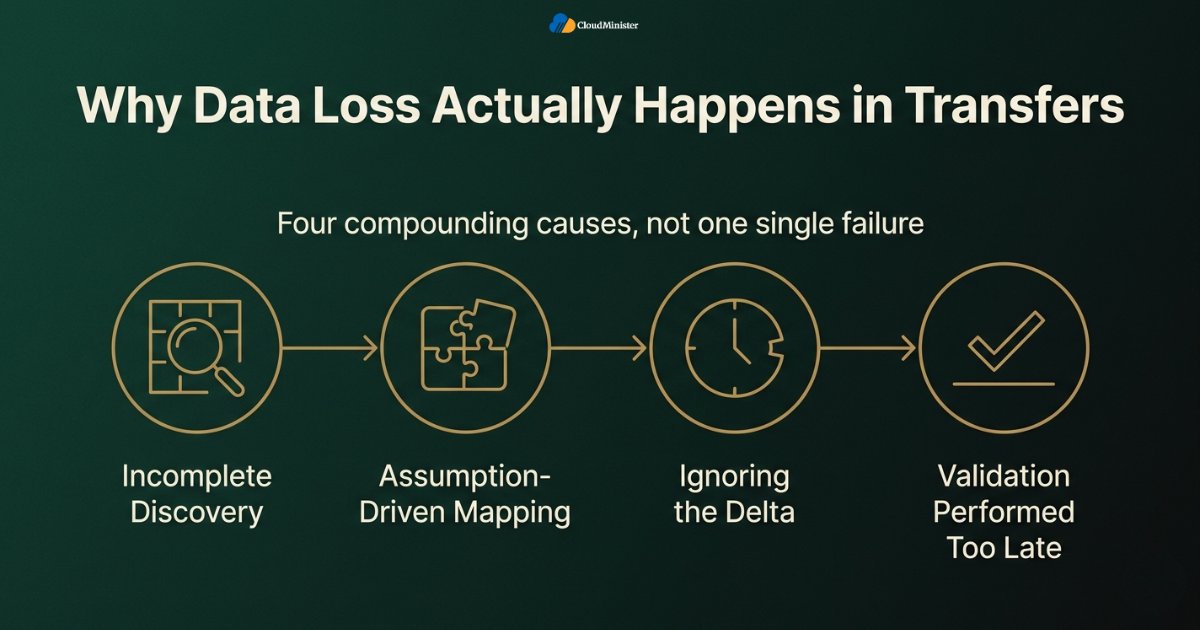
3. Why Data Loss Actually Happens in Transfers
3.1 Incomplete Discovery
Teams migrate the systems they know about and lose the ones they do not, which is why undocumented databases, cron-driven exports and departmental spreadsheets are the classic casualties. A migration scope built from an architecture diagram rather than a live audit will consistently miss the shadow systems that grew up around the primary application — the nightly export that feeds a partner’s SFTP folder, the spreadsheet a finance team treats as a system of record. None of these show up until someone asks why a downstream process broke weeks after cutover.
3.2 Assumption Driven Mapping
Field mapping is often done by inference rather than verification: a source column named status is assumed to map cleanly to a target column of the same name, without checking whether the two systems use the same set of status values, the same default, or the same null handling. Assumption-driven mapping produces migrations that pass every technical check and still deliver wrong answers, because the data moved correctly but meant something different once it arrived.
3.3 Ignoring the Delta
Production systems do not pause because a migration is running, so anything written after the extract begins is at risk of being left behind. A migration plan that treats the source as a static snapshot, rather than a live system that keeps changing throughout the transfer window, will always lose the most recent activity unless a delta synchronisation step is explicitly built in to catch it.
3.4 Validation Performed Too Late
The most common structural mistake is treating validation as the final step rather than a continuous one. When reconciliation only happens after the entire dataset has moved, teams lose the ability to isolate exactly where a defect was introduced, and they discover problems only after the cutover decision has already been made. Validation performed in parallel with each phase — profiling before extraction, checksum comparison during the seed transfer, reconciliation after each delta pass — catches defects while they are still cheap to fix.
Freeze your schema before you freeze your data. Most silent corruption traces back to a target structure that was still being modified while extraction was already running. Lock the target data definition, put it under version control, and require a change request for any alteration during the migration window.
RELATED READING:AI in Cloud Computing
4. Data Migration Risks by Migration Type
| Migration Type | Dominant Risk | Critical Control |
| Lift and shift (server to server) | Configuration drift and forgotten local state | Full file system inventory plus config baseline diff |
| Replatform to managed services | Feature parity gaps in the managed engine | Compatibility assessment before commitment |
| Database engine change | Type system and SQL dialect differences | Automated schema conversion plus manual review |
| Object and file storage | Metadata, permissions and timestamp loss | Checksum manifest and ACL mapping table |
| Email and collaboration | Folder structure, delegation and calendar loss | Staged per-mailbox migration with delta pass |
| Control panel and reseller accounts | Account, DNS zone and mail routing loss | Package level export with post-move DNS verification |
| Hybrid and multi-cloud split | Latency between coupled components | Dependency mapping and co-location of chatty pairs |
4.1 Server to Server and Lift and Shift Moves
Lift and shift migrations look simple because the application code does not change, but that simplicity is deceptive. Businesses moving to cloud hosting services in India from a legacy server routinely find the application depended on an undocumented local directory, a cron job writing logs to a path nobody remembers, a cache folder the application silently recreates if missing, or a configuration file that was hand-edited years ago and never captured in version control. A full file system inventory, diffed against a documented configuration baseline, is what surfaces these dependencies before they cause a post-cutover failure.
4.2 Database Engine Changes
Cross-engine migrations, such as Oracle to PostgreSQL, carry the highest concentration of Data Migration Risks in the category list. Every database engine has its own type system, its own handling of nulls, its own dialect of SQL for constraints, triggers and stored procedures, and none of these translate one-to-one. Automated schema conversion tools can handle the bulk of the mechanical translation, but every migration of this kind still needs a manual review pass focused specifically on precision-sensitive types, custom functions and anything that relied on engine-specific behaviour.
4.3 Reseller, Agency and Control Panel Migrations
A Reseller Hosting In India account move involves not just files and databases, but email accounts, DNS zones, cron jobs, SSL certificates and package limits for every hosted client, which makes it fundamentally an account-level operation rather than a dataset-level one. The most frequent failure in a Reseller Hosting In India transfer is mail: MX records updated before mailboxes finished syncing, so messages land on the old server and are effectively lost in transit. DNS TTL must be lowered to 300 seconds at least 48 hours before the move so that propagation does not extend the risk window once the change is made.
Agencies running Affordable Reseller Hosting plans should still stage one account fully, validate it end to end, then batch the remainder, treating the first account as a rehearsal rather than moving the entire client book in a single pass. It is also worth verifying that the destination Reseller Hosting In India platform runs the same control panel version, because a downgrade can silently drop client features that individual clients may depend on without the agency’s knowledge.
Providers of Affordable Reseller Hosting differ widely in included migration tooling, and that decides whether the move takes a weekend or a month, so this is worth confirming before a provider is chosen rather than after. It is equally important to confirm that the target Reseller Hosting In India account has inode and disk headroom for every client, since a mid-transfer quota failure leaves accounts half migrated with no clean way to pause. An Affordable Reseller Hosting plan without account-level backup and restore introduces exactly the Data Migration Risks a reseller cannot absorb, since the impact lands on clients rather than on the agency itself.
Testing one live client site end to end on the new Reseller Hosting In India environment, including contact forms and outbound mail, before batching the remainder catches integration issues that a database-only check would miss. Where an Affordable Reseller Hosting package is chosen on price, it is worth confirming upfront whether migration assistance is included or billed separately, since this materially changes the effective cost of the move. Keeping the previous Reseller Hosting In India account active for at least two weeks after the final DNS change ensures late traffic and delayed mail are not lost during propagation. Rollback should be documented at the account level for any Reseller Hosting In India transfer, because reverting one client differs entirely from reverting a whole server, and a single rollback plan written for the server level will not actually work when only one client needs to be reverted. Agencies comparing Affordable Reseller Hosting options are better served comparing restore speed, mail deliverability and support responsiveness rather than advertised storage, since these are the factors that determine how a migration actually goes wrong, not how much space is on offer.
RELATED READING: Multi-Cloud Strategy for Indian SMBs
5. Pre-Migration Assessment – The Work That Prevents Loss
The majority of Data Migration Risks are eliminated or created before any data moves. This phase is unglamorous, frequently compressed under schedule pressure, and by a wide margin the highest return activity in the entire programme.
5.1 Inventory and Discovery
Discovery is the process of building a complete, verified list of every system, database, bucket, mailbox and dependency in scope, not the list that exists on an architecture diagram, but the list confirmed by checking what is actually running in production. This includes asking every team that touches the system what they rely on, checking scheduled jobs and cron entries for undocumented data flows, and treating any system nobody can explain as a candidate for inclusion rather than exclusion until proven otherwise.
5.2 Data Profiling
Profile actual values rather than declared types, because production data routinely violates its own schema, a column declared as an integer that occasionally holds a null represented as a stray character, a “required” field that is empty in a meaningful percentage of rows. Profiling is what converts unknown Data Migration Risks into a finite, costed list of remediation tasks: instead of discovering a truncation problem after the fact, the team can see the exact rows and fields that will not fit the target schema before a single byte has moved, and decide in advance how each case will be handled.
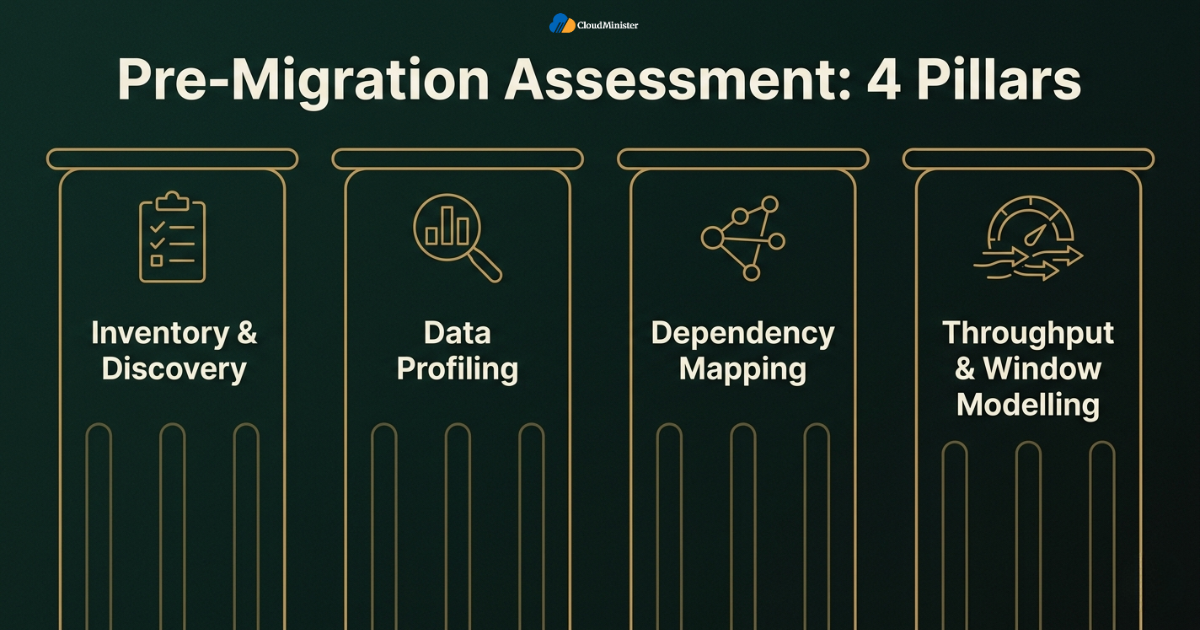
5.3 Dependency Mapping
Dependency mapping documents which systems talk to which, at what frequency, and how tightly coupled they are, information that determines both the order in which components should be migrated and which components need to move together to avoid breaking the connection between them. A dependency map built during this phase is also what makes a later hybrid or multi-cloud split viable, since it identifies which “chatty” pairs of services need to stay co-located to avoid a latency problem after the move.
5.4 Throughput and Window Modelling
Throughput modelling replaces a theoretical estimate of transfer speed with a measured one, run against the actual network path the migration will use. Organisations evaluating cloud hosting services in India should confirm whether the provider offers a dedicated migration network path or direct connect option that bypasses public internet variability, since this can materially change how long a large transfer actually takes. Providers of cloud hosting services in India differ in transfer bandwidth by tier, so it is worth confirming the ceiling on the specific plan being used rather than relying on the advertised maximum figure. It is also worth asking the existing Web Hosting Company in India for measured outbound throughput during the intended window, because shared infrastructure behaves differently at peak times than it does during a quiet test run.
Any migration that uses shared credentials, writes unencrypted dumps to shared storage, disables TLS to improve throughput, or leaves staging copies in place after cutover is operating below an acceptable 2026 baseline. Create purpose-built migration credentials, scope them to the objects in play, log every action, and revoke them the moment the window closes.
6. The Migration Execution Playbook
Phase 1: Build and Prepare the Target
The target environment needs to be fully provisioned, configured and validated before any real data touches it. Verify the target can restore from its own backup, because an unproven backup is itself one of the more consequential Data Migration Risks — a backup routine that has never been tested is a hope, not a control. Confirm with the receiving Web Hosting Company in India that the target specification absorbs peak load, not only steady state, before the seed transfer begins, since a target sized only for average load will struggle the first time real production traffic arrives.
Phase 2: Dry Run With a Representative Subset
Before moving the full dataset, migrate a full vertical slice covering the most complex tables, the widest character sets and the largest binary objects. This dry run is designed to surface the edge cases that a happy-path test would miss — the deliberately difficult subset is more informative than a random sample, because it exercises the exact conditions most likely to expose truncation, encoding or type conversion problems.
Phase 3: Bulk Seed Transfer
With the dry run validated, move the bulk of the dataset while the source remains live, using compression and parallel streams sized to available bandwidth. Record a checksum manifest at source before transfer and verify it at target after transfer for every object, so that any discrepancy between what left the source and what arrived at the target is caught immediately rather than discovered later during business validation.
Phase 4: Delta Synchronisation
Because the source keeps accepting writes throughout the seed transfer, apply changes captured since the seed began, using log-based replication, change data capture or incremental timestamps. This phase can run continuously, narrowing the gap between source and target to a matter of minutes or seconds by the time cutover is scheduled, rather than leaving a full day’s worth of changes to reconcile in one pass.
Phase 5: Cutover and Hypercare
At cutover, stop writes at source, drain in-flight transactions, allow the final delta to apply, then run the full reconciliation suite before declaring the target authoritative. Keep the source in a frozen read-only state for the agreed rollback window rather than decommissioning immediately, since hypercare — the period immediately following cutover — is when defects that survived testing tend to surface under genuine production load.
RELATED READING: IoT Cloud Integration for the architectural considerations
7. Validation and Reconciliation – Proving Nothing Was Lost
7.1 The Four Layers of Validation
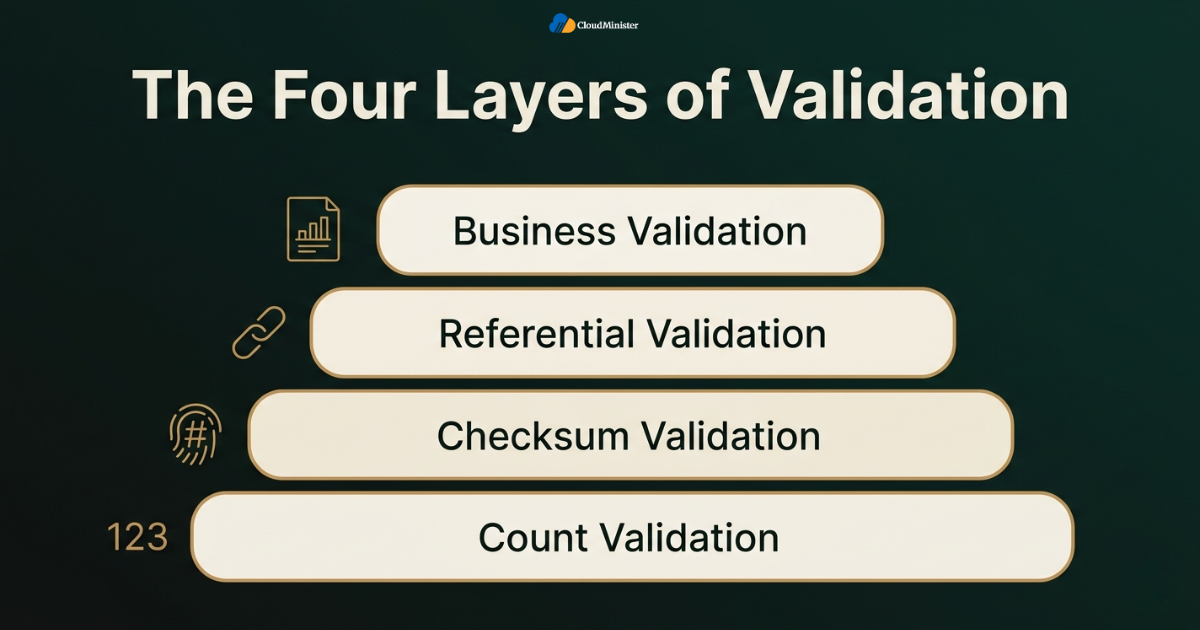
A migration is only provably correct when it has been checked at four distinct levels, each of which catches a different class of defect that the others miss.
Count validation compares row counts, object counts and file counts per table, bucket and directory between source and target, the simplest check, and the first line of defence against anything that was dropped outright during transfer.
Checksum validation compares a hash of normalised column values, which catches corruption that counting alone cannot detect, two datasets can have identical row counts while containing entirely different values, and only a checksum comparison exposes that.
Referential validation confirms that foreign keys resolve, orphan records are absent and constraints that existed at source exist at target, catching the structural damage that can occur when related tables are migrated slightly out of sync with each other.
Business validation runs known reports on both systems and compares the outputs, which is the only layer that a data owner can meaningfully sign off, because it tests the data in the form the business actually uses it rather than as raw rows and columns.
7.2 Normalisation Before Comparison
Compare like with like: trim trailing whitespace, standardise timezone to UTC, fix numeric scale and normalise character encoding before hashing. Without this step, a checksum comparison will flag thousands of false positives caused by formatting differences that have no bearing on whether the underlying data is actually correct, which quickly trains teams to ignore reconciliation failures altogether, exactly the outcome the validation step exists to prevent.
7.3 What Good Evidence Looks Like
Good reconciliation evidence is reproducible, timestamped and tied to a specific migration run: a row count report, a checksum comparison report and a referential integrity report, each generated automatically rather than compiled by hand, and each retained as part of the migration record. This evidence is what allows a data owner, an auditor or a future engineer to confirm — months later, without re-running the migration, that the transfer was verified and not merely assumed to be correct.
Planning a Migration, You Cannot Afford to Get Wrong?
Get a pre-migration audit, dependency map and rollback plan built for your workloads before a single byte moves.
8. Cutover, DNS and Rollback Design
The technical transfer is usually the easier half. Cutover is where Data Migration Risks concentrate, because it is the only moment when both systems could plausibly be authoritative at the same time.
8.1 Preventing Split Brain
Exactly one system must accept writes at any moment, enforced technically by revoking write permission at source rather than by relying on instruction. A written instruction telling teams to “stop writing to the old system” is not a control, because it depends on every person and every automated process complying at exactly the right moment. Revoking write access at the infrastructure level removes that dependency entirely and makes split-brain, where both systems accept conflicting writes — structurally impossible rather than merely discouraged.
8.2 DNS and Propagation
Agencies moving between Reseller Hosting In India platforms should stagger DNS changes across client accounts so any problem affects one site, not the whole book, turning a single mistake into an isolated incident rather than a portfolio-wide outage. For businesses moving to a new Web Hosting Company in India, DNS is frequently the single control that determines whether users experience a seamless transition or an outage, since even a technically perfect data migration will look like a failure to end users if DNS propagation is mismanaged.
8.3 Rollback That Actually Works
Define the rollback trigger in advance as a measurable condition, such as reconciliation variance above an agreed threshold or error rate above a defined ceiling. A rollback decision made in the moment, under pressure and without a pre-agreed threshold, tends to be delayed past the point where reverting is still clean, defining the trigger in advance turns a stressful judgement call into a straightforward comparison against a number that was agreed while everyone was calm.
RELATED READING: Google Cloud Hosting in India for Startups for the platform selection factors
9. Platform Native Tooling for Safer Transfers
9.1 AWS
AWS Database Migration Service supports continuous replication with change data capture, which is what makes near-zero downtime cutover achievable. Rather than a single bulk copy followed by a hard cutover, the service keeps the target continuously synchronised with the source, so the eventual cutover only needs to account for the last few seconds of change rather than an entire migration window’s worth of activity.
9.2 Azure and Google Cloud
Azure Database Migration Service and the Data Migration Assistant provide the equivalent assessment and continuous replication path for Microsoft estates, covering both the pre-migration compatibility assessment and the live replication that keeps source and target in sync during the transfer window. Google Cloud offers comparable native services for database and storage migrations, and in each case the platform-native tooling is generally the safer default over a custom-built transfer script, since it has already been tested against the specific quirks of that platform’s engines.
9.3 Open and Vendor Neutral Options
Some cloud hosting services in India providers expose managed replication endpoints, removing the need to operate replication tooling yourself. For organisations that want to avoid deep dependency on a single cloud vendor’s proprietary migration tooling, open-source and vendor-neutral replication tools offer a portable alternative, at the cost of requiring more in-house expertise to operate and monitor correctly.
10. Data Migration Risks Specific to Indian Businesses
10.1 Residency, Sovereignty and DPDPA 2023
Sovereignty concerns are reshaping infrastructure decisions globally, with analysts forecasting sovereign cloud infrastructure spending of around USD 80 billion in 2026, up more than 35 percent year over year as workloads shift toward local providers. For Indian organizations, this trend intersects with DPDPA 2023 obligations: while DPDPA does not mandate that personal data stay within India, a migration plan should still document where data ultimately resides and which regions it passes through during transfer, since intermediate staging can raise compliance considerations, around applicable transfer restrictions, contractual commitments, or sector-specific rules, even when the final destination itself is compliant.
10.2 Latency and Point of Presence
Teams comparing cloud hosting services in India should test latency from their actual user geography, not from a developer machine on a corporate link, since the two can produce meaningfully different results. A provider that looks fast from a well-connected office network may perform very differently for users accessing the application from other parts of the country, and this gap only becomes visible with a realistic test.
10.3 Commercial and Billing Considerations
Buyers evaluating Affordable Cloud Hosting India options should compare total landed cost including egress, backup, support and tax rather than headline compute price, since the advertised rate rarely reflects what a migration and its ongoing operation will actually cost. An Affordable Cloud Hosting India quotation that excludes backup storage is not comparable to one that includes it, so normalising what is actually included before comparing quotations is a necessary step, not an optional one.
10.4 Choosing Where the Data Should Land
Selecting the destination is a risk decision as much as a cost decision. The right target reduces Data Migration Risks during the move and removes the need for a second migration later.
Startups with modest, predictable workloads are well served by Affordable Cloud Hosting India tiers, provided snapshots, restores and egress terms are confirmed in advance rather than assumed. Businesses with variable traffic benefit from cloud hosting services in India that allow vertical resizing without a rebuild, avoiding a future transfer that would otherwise be needed once the business outgrows its original plan. Agencies managing many small client sites usually land on Affordable Reseller Hosting, where the deciding factor should be per-account backup, not headline storage, since that is the control that actually protects individual clients when something goes wrong.
A traditional Web Hosting Company in India suits brochure sites and small applications where simplicity outweighs elasticity, while Reseller Hosting In India suits agencies needing white-labelled control and package management across a client base rather than raw infrastructure. Compare Affordable Cloud Hosting India quotations on total landed cost — backup storage, egress allowance, support tier and GST treatment — rather than on the headline number alone. Choosing Affordable Cloud Hosting India today is sensible for a fast-growing business only if the provider offers a clear upgrade path within the same platform, so that growth does not force a repeat migration in twelve months.
Agencies scaling past roughly fifty client sites outgrow Affordable Reseller Hosting and should plan the transition deliberately rather than waiting for a capacity problem to force the decision. A shortlist of two or three cloud hosting services in India providers, tested with a real dry run, beats a long comparison table from marketing pages, because a dry run reveals operational fit in a way that a feature list cannot. Where budget is the binding constraint, Affordable Cloud Hosting India remains a legitimate destination and Affordable Reseller Hosting remains legitimate for agency workloads, provided the control checklist in this guide is satisfied first.
Run your final reconciliation against a frozen copy of the source rather than the live source. If the source is still accepting writes while you are counting rows, every variance you find will be ambiguous. A frozen source turns a judgement call into a factual one.
11. What Your Hosting Layer Must Support
Migration controls at the application and database layer are constrained by what the platform can actually do. Several of the most common Data Migration Risks are created by infrastructure limits that cannot be remediated from above.
11.1 Infrastructure Prerequisites
Snapshot and restore capability with a documented recovery time objective is the baseline requirement, since a snapshot you cannot restore quickly is not a rollback plan — it is a file sitting in storage with an unknown recovery time attached to it. A Web Hosting Company in India that cannot provide these primitives forces compensating controls at the application layer, which is slower, more expensive and less reliable than having the capability built into the platform itself.
11.2 Operational Support Expectations
Beyond the technical primitives, the human side of support matters just as much during a migration window. A capable Web Hosting Company in India will confirm in writing how long the source environment stays available after cutover, rather than leaving that as an assumption that only gets tested when something goes wrong and the source is needed for rollback.
11.3 Evaluating Providers Without Overpaying
Buyers assessing Affordable Cloud Hosting India offerings should verify snapshot frequency, restore testing and backup retention before comparing rates, since two similarly priced plans can differ enormously in what they actually protect against. Agencies comparing Affordable Reseller Hosting packages should confirm account-level export and import tooling exists, because manual recreation across dozens of clients is where Data Migration Risks compound fastest — a manual process that is manageable for one account becomes unmanageable at the scale of an agency’s full client book.
Managed cloud hosting services in India that include migration assistance shift a meaningful part of the execution risk to a team that performs these moves regularly, which is often worth the additional cost for organisations without deep in-house migration experience. An Affordable Cloud Hosting India plan that omits snapshot retention is not cheaper; it moves the cost to the recovery you will eventually need, deferring the expense rather than removing it. Teams reviewing Affordable Cloud Hosting India proposals should request the documented restore time objective in writing, not a verbal assurance, and resellers weighing Affordable Reseller Hosting quotations should insist on a written statement of how many accounts can be migrated per night, since this figure directly determines how long a full portfolio migration will take.
11.4 Questions to Put to a Prospective Provider
A Web Hosting Company in India answering the questions below in writing is far less likely to expose you to avoidable Data Migration Risks than one that answers only verbally. Any Web Hosting Company in India treating migration as a free bonus rather than a scoped engagement is signalling how much attention it will actually receive when the transfer runs into trouble.
Worth asking directly: does the provider assign a named engineer for the cutover window, because a general support queue at two in the morning is not the same as dedicated support. Which cloud hosting services in India tier includes private networking, because transfer traffic crossing the public internet changes both security posture and throughput. And do the cloud hosting services in India quotations include backup storage, which is frequently priced separately and is not optional during a migration, whatever the headline price suggests.
11.5 Matching the Provider to the Migration Type
Different migration profiles call for different platform capabilities, and matching the two correctly avoids paying for capability that will not be used, or worse, under-provisioning for a migration that needs more than the chosen platform can offer.
A single site with one database is well served by a competent Web Hosting Company in India offering standard migration support. A multi-application estate with cross-engine conversion needs managed cloud hosting services in India with dedicated migration engineering, given the complexity involved in translating between database engines correctly. An agency moving dozens of client accounts needs Reseller Hosting In India with account-level export tooling, staged batching and per-account rollback, since the unit of risk at that scale is the individual client account rather than the server as a whole.
A regulated workload needs a Web Hosting Company in India that can evidence encryption, access logging and retention policy as platform capability, not customer configuration, since compliance obligations are easier to meet when the platform enforces them by default. Cost-constrained startups often land on Affordable Cloud Hosting India tiers, which is reasonable provided snapshot and restore capability is confirmed before the move rather than assumed. Design agencies frequently begin on Affordable Reseller Hosting and later split higher-traffic clients onto dedicated resources, so it is worth planning that second migration early rather than treating it as a surprise. Growing resellers should confirm their Reseller Hosting In India platform allows migrating a single account outward without disturbing the rest, which keeps future moves low-risk regardless of how the agency’s client base evolves. Organisations already on cloud hosting services in India changing region rather than provider face a narrower set of Data Migration Risks, but residency documentation still needs updating to reflect the new region.
11.6 Migration Readiness by Hosting Tier
| Hosting Tier | Migration Strength | What to Watch For |
| Shared hosting from a Web Hosting Company in India | Simple structure, usually one site and one database | Limited access to logs and no private networking for transfer |
| Affordable Cloud Hosting India entry tier | Snapshots available, predictable INR billing | Confirm snapshot retention and restore time before relying on it |
| Managed cloud hosting services in India | Migration engineering, delta replication, staged cutover | Scope and price the engagement explicitly rather than assuming inclusion |
| Reseller Hosting In India | Account-level export preserves quotas and packages | Mail and DNS sequencing across many client accounts |
| Affordable Reseller Hosting | Low cost entry for agencies with many small clients | Verify per-account backup and outward migration flexibility |
| Self-managed VPS or dedicated | Full control over every stage of the transfer | Every control is your responsibility, including reconciliation |
11.7 Reducing Migration Exposure After the Move
The work does not end at cutover. Keep schema definitions, infrastructure configuration and migration scripts in version control so the next transfer starts from evidence rather than from memory, since institutional knowledge about how a migration was actually done tends to disappear within a year of the event. Avoid provider-specific features where a portable equivalent works, because portability keeps future Data Migration Risks manageable and avoids locking the organisation into a single vendor’s ecosystem more tightly than necessary.
Organisations on Affordable Cloud Hosting India tiers should periodically test a restore into a clean environment, effectively a rehearsal for any future move, so the recovery process is proven rather than theoretical when it is actually needed. Agencies on Affordable Reseller Hosting should maintain a current per-client inventory, the single artefact that makes the next reseller migration predictable rather than a rediscovery exercise. It is worth asking a Web Hosting Company in India for documented export procedures at the point of signing, not at the point of leaving, since a provider is far more cooperative before a contract is signed than after a client has already decided to leave.
Where a business standardises on cloud hosting services in India across multiple entities, agreeing a single reference architecture up front makes later consolidation a matter of configuration rather than a full migration. Businesses on Affordable Cloud Hosting India tiers and agencies on Affordable Reseller Hosting alike benefit from an annual restore drill, which keeps the recovery path proven rather than assumed. Recording which Web Hosting Company in India holds each DNS zone is a small piece of documentation that prevents a recurring cause of avoidable Data Migration Risks, fragmented DNS ownership, where nobody is quite sure who controls a given zone by the time it actually needs to change.
12. Migration Red Flags – When to Stop and Reassess
Certain signals reliably predict that a migration will produce data loss. Each of the following justifies pausing the schedule.
Red Flag 1: No Written Rollback Plan
A migration without a documented, rehearsed rollback is a one-way door presented as a reversible decision. If nobody can state the rollback trigger, duration and expiry date, the plan does not exist yet.
Red Flag 2: Validation Described as Spot Checks
Spot checking is sampling, and sampling cannot prove completeness. When validation is described as looking at a few records afterwards, the real acceptance criterion is that nobody complained.
Red Flag 3: The Source Is Decommissioned Immediately
Immediate decommissioning removes the only safety net available and converts every post-cutover defect into a permanent loss. Negotiate an overlap period even at additional cost.
Red Flag 4: Nobody Has Measured Actual Throughput
Plans built on theoretical link speed rather than a measured test transfer consistently overrun their window. The measurement takes hours; the overrun costs days.
Red Flag 5: The Data Owner Has Not Signed Off
Engineering can confirm that the bytes arrived. Only the data owner can confirm that the numbers are right. A migration signed off exclusively by the team that performed it has skipped the only independent check.
Red Flag 6: The Provider Will Not Commit Anything to Writing
Verbal assurances are not controls. A Web Hosting Company in India that declines to document source retention, rollback procedure or reconciliation output is asking you to accept Data Migration Risks you cannot evidence to an auditor.
13. Pre-Migration Readiness Checklist
- Complete inventory of every database, bucket, share and mailbox in scope, with owner assigned
- Field level mapping approved in writing by the data owner, including enumerated values and derived fields
- Provider selection validated against controls rather than price, whether the destination is a Web Hosting Company in India, managed cloud hosting services in India, or Reseller Hosting In India
- Snapshot retention and documented restore time confirmed in writing, particularly on Affordable Cloud Hosting India and Affordable Reseller Hosting tiers where controls vary widely
- Egress terms confirmed with outgoing and incoming providers, including any Reseller Hosting In India account level transfer limits
14. The Real Cost of Ignoring Data Migration Risks
When these risks are not managed, the costs land in a few predictable places. Reconstruction effort, rebuilding lost records from application logs, third-party systems and paper trails, consumes engineering weeks that were never budgeted, and rarely recovers data with full confidence even after the effort is spent. Repeat migration cost compounds the problem further: a move that never addressed the original constraint has to be repeated, and the second round of Data Migration Risks is paid twice, both in engineering time and in the operational disruption of going through cutover again.
Agencies on Affordable Reseller Hosting absorb the reputational cost directly, because clients experience the failure without visibility into its cause, from a client’s perspective, a missed email or a broken site is simply a broken service, regardless of where in the migration chain the fault actually occurred. Businesses on Affordable Cloud Hosting India tiers that skipped restore testing discover the gap during an attempted rollback, which is the worst possible moment to learn that a backup does not actually restore cleanly.
None of these costs are hypothetical, and all are cheaper to prevent than to remediate. The assessment and reconciliation work that eliminates most Data Migration Risks is a small fraction of total programme effort, and the fraction with the highest return.
Key Takeaways
- Data Migration Risks are verification problems more than transfer problems, a completed copy is not a correct copy
- Profiling actual production values, not declared schema types, is what surfaces truncation and precision loss before it happens
- Reconciliation needs four layers: counts, checksums on normalised values, referential integrity and business report comparison
- Choose destination on controls first, price second, whether managed cloud hosting services in India or an entry level Affordable Cloud Hosting India tier
- Reseller Hosting In India migrations are account level operations: batch them, validate one client fully, and sequence mailbox sync before any MX change
- Egress charges and dual running are the two commercial Data Migration Risks that most reliably break migration budgets
- For Indian organisations, region selection, DPDPA safeguards and INR plus GST cost treatment should be decided during planning, not after cutover.
Want a Migration Partner Who Owns the Outcome?
Talk to our migration engineers about a fixed scope transfer plan with validated cutover and guaranteed rollback.
Conclusion
Data Migration Risks are manageable, but only by teams that treat verification as a first-class deliverable rather than a closing formality. The pattern is consistent: discover thoroughly, profile honestly, map explicitly, transfer in phases, reconcile with evidence, and keep a tested route back.
Choose the destination before you choose the schedule. Whether that destination is a managed platform, a self-operated environment, or a straightforward Web Hosting Company in India plan, its controls determine how many Data Migration Risks you must compensate for elsewhere.
Whether you are consolidating onto a single platform, correcting a residency decision, or leaving a provider whose service no longer fits, the discipline is the same. Move deliberately, validate continuously, and do not decommission anything until the numbers agree. Organisations that migrate to well-managed cloud hosting services in India with this discipline in place complete the move once and spend their energy on what the new platform enables rather than on repairing what the transfer broke.
Whether the destination is a straightforward Web Hosting Company in India plan, managed cloud hosting services in India, Reseller Hosting In India for an agency book of clients, an Affordable Cloud Hosting India tier, or Affordable Reseller Hosting for a small client portfolio, the rule does not change: the platform is chosen for the controls it provides, and the migration is judged on the evidence it produces.
Frequently Asked Questions
What are the biggest Data Migration Risks for a first-time migration?
The three that cause most damage are incomplete discovery, unmeasured transfer windows and absent reconciliation. A signed inventory, a measured throughput test and a four-layer reconciliation suite address all three, and require days rather than weeks.
Do I need a specialist provider, or can my hosting company handle it?
It depends on complexity. A single application with one database moving between similar platforms is well within the capability of a competent Web Hosting Company in India. Cross-engine database conversions, multi-terabyte datasets and regulated workloads warrant a team that performs migrations regularly. Ask any prospective partner for their reconciliation methodology and their rollback procedure, the quality of those two answers tells you more than any capability list.
What should reseller and agency migrations do differently?
Reseller migrations move accounts rather than datasets, so the risk is breadth rather than depth. Use package-level exports to preserve quotas, lower DNS TTL well in advance, and complete mailbox synchronisation before touching MX records. Agencies on Reseller Hosting In India plans should stage one representative account fully, validate it end to end, then batch the remainder in controlled groups rather than moving everything in a single overnight operation.
How much does a safe migration cost in India?
A single application and database move typically runs ₹40,000 to ₹1.5 lakh. A multi-application estate with cross-engine conversion and compliance requirements commonly runs ₹4 lakh to ₹20 lakh or more, depending on dataset size and integrations. Add dual running and egress on top. Buyers evaluating Affordable Cloud Hosting India plans should treat migration as a separate line item rather than assuming it is bundled in.
How do I compare hosting providers on migration capability rather than price?
Build the technical requirement list before you look at any quotation. Snapshot frequency, restore time objective, private networking, egress pricing and named cutover support are the five criteria that matter; only then compare cost. Buyers who start with Affordable Cloud Hosting India price lists and work backwards usually discover a missing control after signing, and the same applies to Affordable Reseller Hosting comparisons.
Is a low-cost hosting plan inherently riskier for migrations?
Not inherently. An Affordable Cloud Hosting India plan from a provider that invests in automation can offer better snapshot and restore behaviour than a more expensive plan from one that does not. What matters is whether the specific controls exist and are documented. Likewise, Affordable Reseller Hosting is adequate for agency workloads provided per-account backup and export tooling are confirmed first.
What should I ask before moving to a new hosting provider?
Ask for the reconciliation methodology, the rollback procedure, the source retention period after cutover, the named engineering contact, and the egress cost from your current provider. A Web Hosting Company in India that answers all five in writing is a different proposition from one that answers in general terms. Agencies should add how many Reseller Hosting In India accounts can be migrated per night.
Do managed hosting services actually reduce Data Migration Risks?
They reduce execution risk, which is a meaningful portion of the total. Managed cloud hosting services in India typically bring rehearsed runbooks, delta replication experience and reconciliation tooling an internal team would otherwise build from scratch. What they cannot do is know your business logic, so field mapping and data owner sign-off remain your responsibility.
How does reseller hosting change the migration plan?
It changes the unit of work from a dataset to an account, and the stakeholder from your team to your clients. Reseller Hosting In India migrations should be batched, with one representative account validated first. Mail is the highest-risk element, so complete mailbox synchronisation before touching MX records and keep the old Reseller Hosting In India account live for two weeks. Agencies on Affordable Reseller Hosting should confirm outward migration of a single account is supported.
What is the single most important control to get right?
A frozen, retained source combined with a documented rollback window. Almost every other mistake is recoverable while the original data still exists in a known good state. Once the source is gone, a defect discovered in week three becomes a permanent loss.

Ajay Singh Raghav is a Senior Linux System Administrator at CloudMinister Technologies, where he has spent over 4 years installing, configuring, maintaining, and troubleshooting Linux servers for hosting and cloud environments. He specializes in AWS cloud computing alongside core Linux server administration, with hands-on expertise across server management, backup and restore systems, and cPanel-based hosting environments. His day-to-day experience keeping production servers stable and secure gives him a practical, ground-level understanding of the infrastructure he writes about.