This guide breaks down everything Indian SMBs need to know about building a multi-cloud environment in 2026. Whether you run an e-commerce platform, a SaaS product, a fintech application, or a healthcare service, understanding when and how to adopt a multi-cloud approach is critical for making a cost-effective, compliance-aligned, and operationally resilient infrastructure decision. We cover the precise definition of a multi-cloud environment, the readiness signals that tell you when to start, a 7-step implementation roadmap, DPDPA 2023 compliance implications, FinOps practices, workload mapping by industry vertical, and the common execution mistakes that undermine value delivery.
When Indian SMBs start evaluating their cloud infrastructure seriously, one question comes up repeatedly: is running on a single cloud provider still enough, or is it time to adopt a multi-cloud approach? On the surface, a single cloud provider seems simpler to manage. One vendor, one billing dashboard, one support relationship.
But the distinction between a single-cloud arrangement and a deliberate multi-cloud architecture is not cosmetic — it is architectural. In 2026, with India’s DPDPA 2023 enforcing stricter data governance, competitive pressure demanding higher uptime, and cloud costs under growing scrutiny, getting this infrastructure decision right has real business consequences.
This guide is written for technology decision-makers, IT managers, and business owners at Indian SMBs who need a technically grounded, commercially relevant answer to the question of when and how to start a multi-cloud environment — without the vendor marketing that typically surrounds it.
Related: A Comprehensive Guide to Picking the Best Cloud Hosting Provider in India
1. Defining the Terms: What Is a Multi-Cloud Strategy and What It Is Not
Before comparing approaches, the term needs a precise definition. Multi-cloud and hybrid cloud are used interchangeably and hybrid cloud are used interchangeably in vendor marketing — a conflation that creates genuine confusion when businesses are trying to make infrastructure decisions based on actual technical requirements.
What Is a Multi-Cloud Approach?
A multi-cloud strategy is the deliberate architectural decision to distribute workloads, services, or applications across two or more public cloud platforms — such as AWS, Microsoft Azure, Google Cloud Platform, or India-based providers — rather than relying on a single vendor for all infrastructure needs. The emphasis here is on the word deliberate. A multi-cloud environment is a governed approach to provider selection, workload placement, and cost management. It is not the same as having multiple SaaS subscriptions that happen to run on different clouds.
Multi-Cloud Architecture vs Hybrid Cloud: The Precise Difference
Hybrid cloud combines a private cloud or on-premise data centre with one or more public clouds. Its primary purpose is integrating legacy infrastructure with cloud services. A multi-provider cloud infrastructure, by contrast, operates entirely within the public cloud domain — distributing workloads across multiple public providers to optimise for cost, performance, compliance, or resilience. The two approaches are often used together, but they are architecturally distinct.
| Dimension | Multi-Cloud Approach | Hybrid Cloud | Relevant for Indian SMBs |
| Infrastructure scope | Multiple public clouds | Public + private / on-prem | Multi-cloud if fully migrated |
| Primary objective | Best-of-breed, no lock-in | Legacy + cloud integration | Multi-cloud for greenfield |
| Management complexity | Moderate to high | High | Start segmented; scale later |
| Cost model | OpEx across providers | CapEx + OpEx blend | Multi-cloud more predictable |
| Compliance fit | Localisation across regions | On-prem for sensitive data | Both valid under DPDPA 2023 |
Before selecting an architecture, document your team’s actual cloud operations capacity. A multi-cloud environment delivers maximum resilience and cost efficiency — but it requires governance discipline from day one. If your engineering team is primarily focused on product development, begin with a segmented two-provider approach managed by a hosting service provider in India rather than attempting fully self-managed multi-cloud operations from the outset.
2. The Market Reality: Why Multi-Cloud Architecture Matters for Indian SMBs in 2026
The conversation around this infrastructure topic in 2026 is happening against a backdrop of significant market shifts. Cloud adoption in India has accelerated sharply, driven by a combination of digital-first business models, maturing cloud infrastructure, and stricter data governance requirements under the DPDPA 2023.
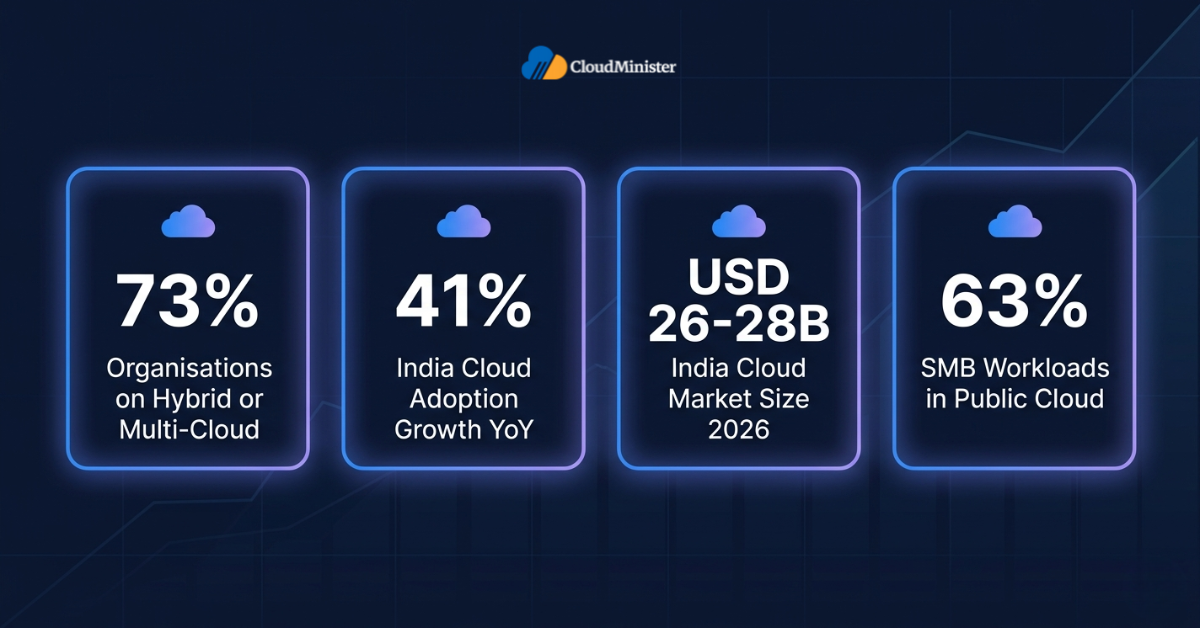
According to the Flexera 2026 State of the Cloud Report, 63% of SMB workloads globally now run in public cloud — up from 55% in 2025, and 73% of all organisations operate hybrid or multi-cloud environments. In parallel, India’s cloud market is projected to reach USD 26–28 billion by 2026 — nearly doubling its 2023 valuation — with India recording 41% year-over-year cloud adoption growth, one of the fastest rates in the Asia-Pacific region. For Indian SMBs, this is not background context — it is the competitive environment in which every infrastructure decision is being made.
| Metric | Figure | Source |
| SMBs using multi-cloud globally | 63% of SMB workloads now in public cloud (up from 55% in 2025) | Flexera, 2026 State of the Cloud |
| India cloud market size (2026) | USD 26–28 billion (estimated range across research firms) | Mordor Intelligence / Morgan Reed Insights, 2026 |
| India year-on-year cloud growth | 41% | SQ Magazine Cloud Adoption Stats |
| Enterprises using 2+ cloud providers | 78%+ | Softjourn Cloud Stats 2026 |
The market figures above are sourced from third-party research reports published in 2025 and 2026 and should be treated as directional indicators, not guaranteed projections. The decision to adopt a multi-provider deployment should always be grounded in your specific workload requirements and a total cost of ownership analysis — not market size figures alone.
3. Four Business Drivers Pushing Indian SMBs Towards Multi-Cloud Strategy
Several converging forces are making a multi-cloud approach particularly relevant particularly relevant for Indian SMBs in 2026. Understanding these drivers helps you assess whether your organisation is at the right stage to begin.
3.1 The DPDPA 2023 and Data Localisation Requirements
The Digital Personal Data Protection Act (DPDPA) 2023, now enacted and progressively being enforced, requires Indian businesses to implement technical safeguards appropriate to the risk classification of personal data they process. While the Act does not mandate on-premise storage, the breach notification obligations and data fiduciary responsibilities it establishes create strong practical pressure toward India-based storage for regulated personal data. A multi-cloud environment that routes regulated personal data to India-based cloud hosting services in India while running compute-intensive, non-regulated workloads on global cloud providers satisfies data localisation requirements architecturally — without sacrificing global performance.
Related: Why Cloud Hosting Is Critical for Data Backup and Recovery
3.2 Eliminating Single-Vendor Lock-In
Dependence on a single cloud provider introduces fragility that is often underestimated until it becomes a crisis. Service outages, unexpected price increases, feature deprecations, or contractual disputes — any of these can disrupt an SMB with no cloud redundancy. A multi-cloud architecture distributes this risk across providers. If AWS experiences downtime in the ap-south-1 Mumbai region, workloads hosted on Azure India or GCP continue to run, maintaining business continuity.
3.3 Cost Optimisation Across Workload Types
Different cloud providers price compute, storage, managed databases, and AI services differently. AWS is generally most cost-effective for general-purpose compute and mature managed services. GCP offers competitive pricing for data analytics and ML training pipelines. Microsoft Azure integrates tightly with Microsoft 365 environments, reducing licensing overhead. Indian providers accessible via cloud hosting services in India offer competitive pricing for Indian-user-facing workloads with the added benefit of contractual DPDPA compliance. By routing each workload class to the most cost-effective provider, a well-governed multi-cloud approach, with FinOps practices in place, can reduce total cloud spend by 20 to 35 percent compared to an equivalent single-provider architecture — though actual savings depend significantly on workload type, provider mix, and governance maturity — provided FinOps practices are implemented alongside it.
These are directional generalisations based on published pricing structures and common use case patterns. Actual cost-effectiveness varies significantly by workload size, region, committed use discounts, and specific service configuration. Always validate provider selection against your specific workload using official pricing calculators before committing architecturally.
3.4 Geographic Redundancy and SLA Reliability
For e-commerce, SaaS, and fintech SMBs operating in India, uptime directly equals revenue. A multi-cloud architecture with workloads spread across AWS Mumbai, Azure Central India, and a cloud web hosting India provider delivers geographic redundancy and near-zero RTO (Recovery Time Objective). This architecture significantly improves resilience and availability for mission-critical services compared to a single-provider configuration — though actual composite uptime depends on the failover model implemented and the individual SLAs of each provider in the chain — a level that a single-provider configuration cannot reliably match.
Power Your Multi-Cloud Strategy with India’s Trusted Cloud Hosting
Get high-performance, DPDPA-compliant cloud hosting built for Indian SMBs — with 99.99% uptime, India-based data centres, and plans that scale as your multi-cloud architecture grows.
4. When Should an Indian SMB Start? Five Readiness Signals
Not every SMB is ready to execute a multi-cloud strategy effectively. Starting too early — before your team has cloud operations maturity to govern multiple providers — increases costs and security exposure. Starting too late means accumulating deep technical debt with a single provider that is costly to unwind. These five signals indicate that your organisation is at the right stage to begin.
Signal 1: Cloud Spend Is Consistent and Growing
If your monthly cloud bill has crossed approximately one to two lakh rupees and is growing consistently, the scale of your infrastructure justifies the governance investment a multi-cloud environment requires. Below this threshold, the operational overhead typically outweighs the cost and resilience benefits.
Signal 2: You Are Experiencing Provider-Specific Performance Bottlenecks
Database query latency spikes, ML model training slowdowns, or CDN performance gaps that cannot be resolved within your current provider’s service catalogue are strong indicators that a different provider’s specialised infrastructure would serve those workloads better. A multi-cloud approach unlocks access to best-of-breed services across providers rather than forcing workload compromise.
Signal 3: Compliance Obligations Are Expanding
If your SMB serves banking, healthcare, or government clients, you are likely facing RBI IT Framework obligations, sector-specific data governance requirements, or DPDPA 2023 enforcement actions. A multi-cloud architecture gives you the architectural flexibility to route regulated data to compliant, India-hosted infrastructure while maintaining global delivery capabilities for non-regulated workloads.
Signal 4: Your Team Has Basic Cloud Operations Maturity
A multi-cloud environment adds operational complexity. Before starting, your team should be comfortable with Infrastructure as Code tooling, cloud cost monitoring dashboards, and basic CI/CD pipeline management. If in-house expertise is limited, partnering with a hosting service provider in India that offers managed multi-cloud services is the right starting point — not a compromise, but the higher-ROI path for most Indian SMBs.
Signal 5: You Have Three or More Distinct, Separable Application Workloads
A multi-cloud approach creates its most meaningful ROI when workloads can be meaningfully distributed across providers. If you run a single monolithic application, distributing it across multiple clouds introduces networking complexity and inter-cloud data transfer costs that rarely deliver proportionate value. Workload segmentation into distinct tiers is a prerequisite for effective effective multi-cloud execution, not an outcome of it.
The ideal window for an Indian SMB to begin a multi-cloud environment is typically when the organisation is scaling from 20 to 200 employees, monthly cloud spend is in the one to five lakh rupee range, and infrastructure is at a discernible inflection point. Below this scale, a well-managed single-cloud or managed hosting arrangement delivers better total cost of ownership. Above this scale — without a multi-cloud architecture already in place — the cost and complexity of migration from an entrenched single-provider architecture increases significantly.
Related: Why Cloud Hosting Is Critical for Data Backup and Recovery
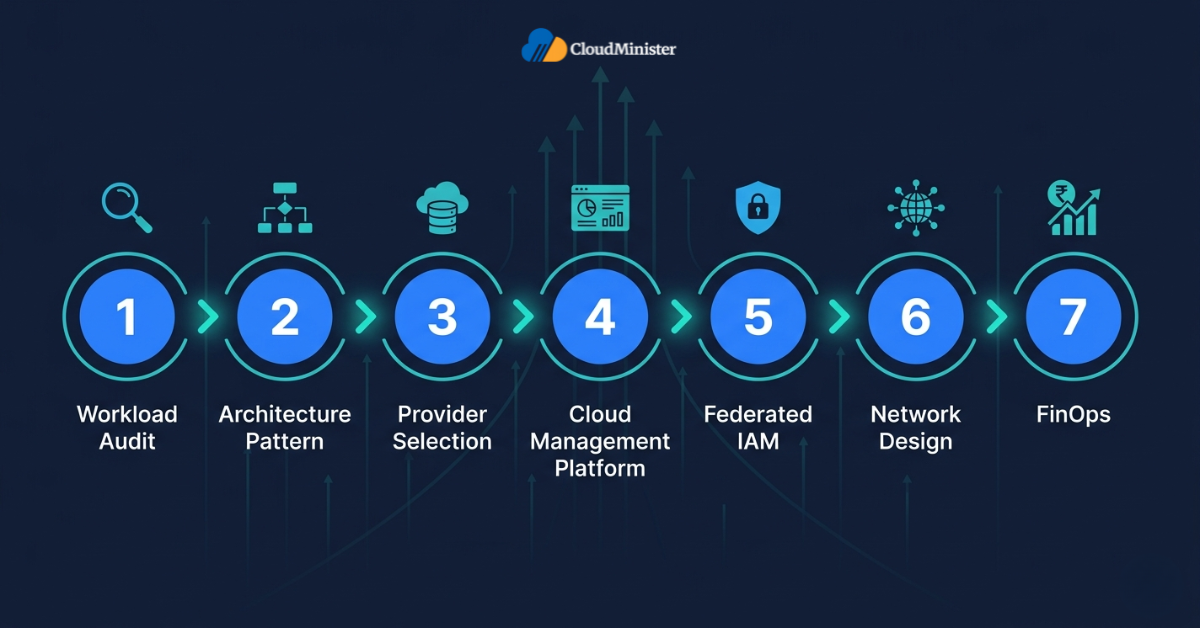
5. The 7-Step Multi-Cloud Strategy Roadmap for Indian SMBs
Here is a practical, phase-wise roadmap for building and executing a multi-cloud environment in the Indian SMB context. These steps are sequenced to build governance infrastructure before adding provider complexity — the most common error in multi-cloud execution is provisioning on additional providers before governance is in place.
Step 1: Conduct a Workload Discovery and Classification Audit
Before selecting providers, understand exactly what you are distributing. Classify all applications and infrastructure into three tiers:
- Tier 1 — Mission-critical: Core database, payment gateway, CRM, authentication services. These require the highest availability guarantees, the strictest DPDPA compliance, and the most rigorous failover architecture.
- Tier 2 — Business-important: ERP modules, analytics dashboards, internal tools, API services. Performance matters; brief disruption is tolerable.
- Tier 3 — Non-critical: Development and test environments, staging deployments, batch jobs, static content, archive storage.
This classification directly determines which workloads go to which provider in your multi-cloud environment. Tier 1 workloads serving Indian users should prioritise providers with Mumbai or Pune-region data centres to satisfy DPDPA 2023 data residency requirements and minimise latency.
Step 2: Define Your Multi-Cloud Architecture Pattern
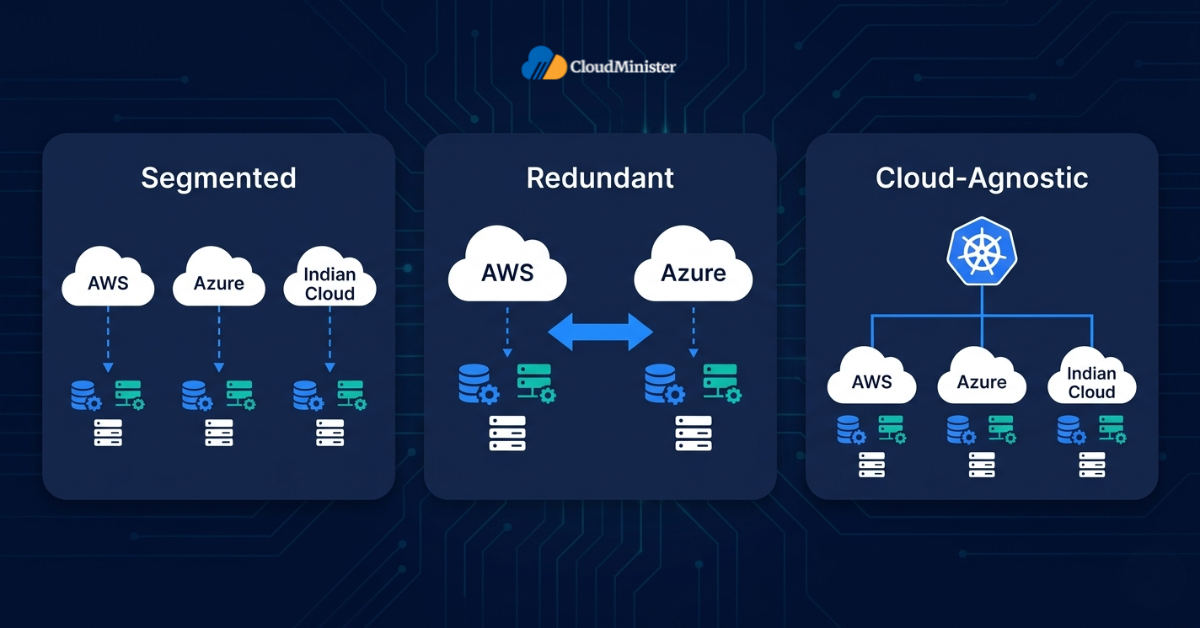
Three primary patterns are available for a multi-cloud architecture:
- Segmented Multi-Cloud: Each provider owns a distinct set of workloads. The lowest management overhead of the three patterns and the right starting point for most Indian SMBs.
- Redundant Multi-Cloud: Identical workloads run across multiple providers for failover. In an active-active configuration, both providers serve live traffic simultaneously, delivering near-zero RTO. In an active-passive configuration, the secondary provider only activates on failure, introducing an RTO lag that must be measured and documented. High availability is not automatic — it depends on which failover model is implemented. This pattern carries significant cost overhead and is appropriate for Tier 1 mission-critical services only.
- Cloud-Agnostic or Portable: Applications are containerised using Kubernetes and designed to be provider-independent. Maximum architectural flexibility; requires the highest operational maturity to manage effectively.
For Indian SMBs beginning their multi-cloud journey, the Segmented pattern is the recommended Phase 1 starting point. Cloud-agnostic architecture is a Phase 2 evolution target as team maturity grows.
Use Terraform or Pulumi as your Infrastructure as Code platform from day one. Both tools support all major cloud providers — AWS, Azure, GCP, and most cloud web hosting India providers — through a unified configuration language. This is not optional tooling in a multi-cloud environment: it is the operational foundation that prevents configuration drift and makes cross-cloud management reproducible and auditable.
Step 3: Select Your Provider Stack
For Indian SMBs, a two-to-three-provider stack is the operational sweet spot for a multi-cloud architecture. A commonly effective configuration for the Indian market:
- AWS India (ap-south-1, Mumbai): Broadest managed services ecosystem; best for general-purpose compute, object storage, and mature DevOps tooling.
- Microsoft Azure India (Central India or South India): Strong for businesses using Microsoft 365; Microsoft Entra ID integrates seamlessly with enterprise identity requirements.
- Indian cloud provider (Yotta, NxtGen, or CtrlS): Best suited for DPDPA 2023-regulated workloads requiring contractually guaranteed India-based data residency. Competitive pricing for Indian-user-facing workloads with domestic peering advantages.
Limiting your initial multi-cloud setup to two providers before adding a third is strongly advisable. Each additional provider multiplies IAM, networking, billing, and monitoring complexity in ways that scale faster than expected.
Step 4: Implement a Cloud Management Platform
Operating multiple cloud environments without unified visibility is one of the most frequently cited operational risks by teams that have attempted a multi-cloud environment without adequate tooling. A Cloud Management Platform provides consolidated cost dashboards, cross-cloud performance monitoring, and governance policy enforcement. Options suitable for Indian SMB budgets include CloudHealth by Broadcom, Spot by NetApp, and Morpheus Data. The effectiveness of your multi-cloud governance depends directly on the quality of your Cloud Management Platform implementation.
Step 5: Federate Identity and Access Management
Each cloud provider has its own IAM system — AWS IAM, Microsoft Entra ID (formerly Azure Active Directory), and Google Cloud IAM. Inconsistencies between these systems are the leading source of privilege escalation vulnerabilities in multi-cloud deployments. Implement a federated identity solution — Okta, Microsoft Entra ID, or JumpCloud — that enforces unified access policies, mandatory MFA, and least-privilege role-based access control across all cloud environments from the point your second provider is added.
Never use root or global administrator credentials for operational tasks in a multi-cloud environment. Create service accounts with the minimum privilege required for each workload, rotate credentials automatically every 90 days, and manage secrets centrally through HashiCorp Vault or equivalent with cross-cloud replication. Under the DPDPA 2023, an access control failure involving personal data is a potentially reportable incident. The credential hygiene practices above are both a security baseline and a compliance requirement.
Step 6: Design the Multi-Cloud Networking Layer
Connecting workloads across cloud providers securely requires deliberate network architecture. For Indian SMBs, three options are available by complexity tier:
- VPN-based interconnection: IPSec VPN tunnels between cloud VPCs and VNets with BGP routing. Lowest cost; suitable for low-bandwidth cross-cloud traffic between Tier 2 and Tier 3 workloads.
- SD-WAN overlay: Solutions such as Cisco Meraki or VMware SASE abstract cross-cloud networking into a managed overlay. Better performance and policy consistency than raw VPNs; suitable for SMBs without dedicated network engineers.
- Dedicated interconnect: AWS Direct Connect or Azure ExpressRoute with private peering to an Indian exchange point. Highest performance and reliability; appropriate for Tier 1 workloads with strict latency and throughput requirements.
Engaging a specialist hosting service provider in India with multi-cloud networking expertise can substantially reduce time-to-production for this phase — particularly for SMBs without in-house network engineering capacity.
Step 7: Establish FinOps Practices from Day One
Cloud cost management is the number one challenge for organisations executing a multi-cloud environment. Without Financial Operations discipline, costs across multiple providers compound rapidly and invisibly. Three non-negotiable FinOps practices for any multi-cloud environment:
- Tagging conventions: Every cloud resource — regardless of provider — tagged with environment, workload owner, cost centre, and business unit from the point of provisioning.
- Budget alerts: Automated alerts at 70%, 90%, and 100% of monthly budget thresholds per provider and per workload tier.
- Weekly cost reviews: A structured 30-minute weekly review of cloud spend anomalies, idle resources, and right-sizing opportunities across all providers.
Organisations that implement these FinOps practices alongside their multi-cloud environment consistently reduce cloud waste by 25 to 30 percent within the first six months of operation.
6. Server Management in a Multi-Cloud Environment
One of the most underestimated operational challenges of executing a multi-cloud environment is infrastructure management at scale. As workloads distribute across providers, the surface area for configuration drift, patching delays, and performance degradation expands in direct proportion to the number of environments being managed.
Professional Server Management Services India become a critical operational enabler for this reason. A Server Management Services India partner operating across your cloud environments handles:
- 24/7 cross-cloud monitoring with unified alerting across AWS, Azure, GCP, and cloud web hosting India providers
- Automated OS patching and security hardening with CIS Benchmark compliance applied consistently across all provider environments
- Configuration management using Ansible, Chef, or Puppet to detect and remediate configuration drift
- Performance optimisation through continuous instance right-sizing across provider pricing models
- Disaster recovery orchestration and regular RTO and RPO testing across multi-cloud regions
Rather than building specialist in-house teams for each cloud platform independently, leveraging expert Server Management Services India transfers accumulated operational expertise to your business at a fraction of the cost of full-time specialist hires — and allows your engineering team to remain focused on product development rather than infrastructure operations.
When selecting a Server Management Services India partner for your your multi-cloud environment, verify active certifications, across your chosen provider stack: AWS Solutions Architect Professional, Microsoft Azure Administrator AZ-104, and Google Cloud Professional Cloud Architect. Provider-specific expertise matters significantly in multi-cloud operations. Generalist IT management frequently misses cloud-native optimisation opportunities — reserved instance planning, storage tiering, spot instance arbitrage — that can reduce infrastructure costs by 15 to 25 percent independently of architecture changes.
Related: Top 10 Benefits of Cloud Hosting for Small Businesses
7. Security and Compliance: The DPDPA 2023 Context
For Indian SMBs processing personal data of Indian citizens, the security and compliance dimensions of a multi-cloud environment carry specific regulatory weight under the DPDPA 2023. Getting this right is not optional — it is a legal obligation.
The DPDPA 2023’s subordinate rules are being progressively notified. Specific data localisation obligations for different categories of personal data are subject to further regulatory guidance. Businesses should consult legal counsel to assess current compliance requirements applicable to their specific data processing activities.
7.1 Data Localisation and Provider Selection
The DPDPA 2023 requires appropriate technical safeguards for personal data of Indian citizens. In a multi-cloud environment, this means personal data context, should reside on providers whose data centres are physically located in India — with data residency guaranteed contractually, not merely as a technical possibility. A multi-cloud architecture that places personal data on India-based cloud hosting services in India satisfies this architectural requirement while allowing non-regulated workloads — analytics, model training, CI/CD pipelines, global content delivery — to run on international providers where cost or performance advantages justify it.
7.2 Incident Detection and Breach Notification
The DPDPA 2023 establishes defined breach notification timelines for data fiduciaries. Businesses executing a multi-cloud environment without centralised security monitoring across all provider environments face a material compliance risk: an incident originating in a less-monitored cloud account may not be detected until after the notification window has closed.
Under the DPDPA 2023, organisations are required to notify the Data Protection Board of India of personal data breaches within the timelines prescribed under the Act’s subordinate rules — which establish a two-part reporting obligation: an initial intimation followed by a detailed breach report. Your legal counsel should confirm the applicable timelines as enforcement guidance is progressively issued. Businesses executing a multi-cloud architecture without centralised security monitoring across all provider environments face a material compliance risk. Implement unified SIEM — AWS Security Hub combined with Microsoft Sentinel federation is a common starting configuration — as part of your multi-cloud security baseline, not as a later addition. Infrastructure incidents involving personal data are not purely engineering problems under the DPDPA 2023 — they are potentially reportable events with defined notification timelines.
7.3 Compliance Documentation Responsibility
An important clarification: DPDPA 2023 compliance is the legal responsibility of the data fiduciary — your business — not your cloud provider. Cloud providers can support compliance through contractual data residency guarantees, security certifications, and audit trail tooling. They cannot own compliance on your behalf. In a multi-cloud environment, this means compliance context, this means compliance documentation — access logs, breach response records, data processing agreements — must be generated and maintained across all providers, not assumed from any single provider’s compliance certifications.
8. Workload Fit: Multi-Cloud Strategy by Indian SMB Vertical
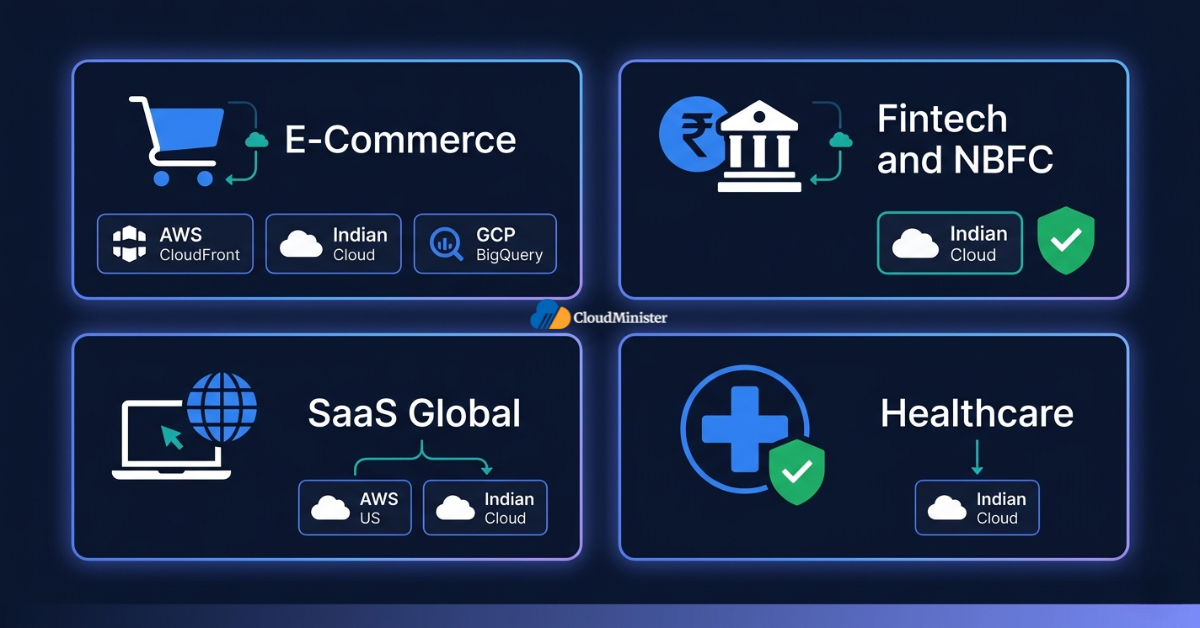
The right multi-cloud configuration is not universal — it depends on the regulatory environment, performance requirements, and user geography of your specific industry vertical.
E-Commerce SMBs
An e-commerce SMB serving Indian consumers benefits from a multi-cloud architecture that places the product that catalogue and global CDN on AWS CloudFront for performance, payment processing on a PCI-DSS-compliant Indian cloud provider for compliance, and customer analytics on GCP BigQuery and Vertex AI for data analytics and ML-powered personalisation. The separation by workload type — not by arbitrary provider preference — is the defining characteristic of an effective an effective multi-cloud approach in this vertical in this vertical.
Fintech and NBFC SMBs
RBI’s IT Framework for NBFCs and the DPDPA 2023 together require that transaction data and customer financial records reside on India-based infrastructure with documented security controls. A multi-cloud architecture that places core transaction processing on India-based infrastructure while running risk analytics, model training, and DevOps pipelines on AWS or Azure satisfies both regulatory bodies without architectural compromise. Verify explicitly with any Indian provider that data residency is contractually guaranteed — not merely technically feasible — before routing regulated financial data.
SaaS SMBs Targeting Global Markets
Indian SaaS companies serving North American and European clients need a multi-cloud approach with global delivery capability. A configuration using AWS us-east-1 and eu-west-1 for international user traffic — while maintaining staging, development, and India-region deployments on domestic cloud web hosting India — optimises both global performance and domestic cost efficiency. This separation also simplifies GDPR compliance for European user data and DPDPA 2023 compliance for Indian user data.
Healthcare and Pharma SMBs
Patient data and clinical records carry both DPDPA 2023 obligations and emerging health data sector regulations. A multi-cloud architecture routing protected health information to HIPAA-equivalent compliant, India-hosted cloud infrastructure — while using global cloud providers for AI-powered diagnostics, telemedicine platform delivery, and research compute workloads — creates an architecture that is both compliant and clinically functional.
When evaluating a multi-cloud approach for a specific vertical, run a simple test: list the three compliance requirements and three performance metrics that matter most for your application. Then map each requirement and metric to the provider most capable of satisfying it. If two or more requirements map to different providers, a multi-cloud architecture is architecturally justified. If all requirements map to a single provider, a single-cloud arrangement may deliver better total cost of ownership at your current scale.
9. Cost Economics: What Does Multi-Cloud Strategy Actually Cost an Indian SMB?
Cost is the most frequently misunderstood dimension of multi-cloud evaluation. The instinct to compare raw provider pricing leads businesses to underestimate the total cost of operating multiple environments — and to underestimate the cost of not adopting a multi-cloud approach when vendor lock-in risk materialises.
9.1 Direct Infrastructure Costs
A typical multi-cloud environment for an Indian SMB with 50 to 100 employees, running a segmented two-to-three-provider architecture:
| Cost Component | Monthly Estimate (INR) | Notes |
| AWS India — compute and storage | Rs. 40,000 – Rs. 80,000 | 2–4 EC2 instances, S3, RDS |
| Azure India — identity and integration | Rs. 15,000 – Rs. 30,000 | Entra ID, moderate VM workloads |
| Indian cloud provider — compliance tier | Rs. 8,000 – Rs. 20,000 | DPDPA-compliant data hosting |
| Cloud Management Platform | Rs. 5,000 – Rs. 15,000 | SMB-tier FinOps tools (e.g., Holori, Spot.io) |
| Server Management Services | Rs. 12,000 – Rs. 25,000 | Managed operations partner |
| Networking and inter-cloud egress | Rs. 5,000 – Rs. 14,000 | VPN tunnels, data transfer fees |
| Total indicative range | Rs. 85,000 – Rs. 1,84,000/month | Varies by workload size and region |
9.2 The Hidden Cost: Data Egress
Inter-cloud data transfer is the most common unexpected cost in a multi-cloud deployment deployment. AWS charges approximately USD 0.109 per GB for outbound data transfer to the internet from the ap-south-1 Mumbai region (for the first 10 TB/month). However, inter-cloud data transfer — moving data between AWS and another cloud provider — is priced differently and depends on the destination provider and transfer method. Always model inter-cloud egress costs separately from internet egress costs in your total cost of ownership analysis. Architectural decisions that minimise cross-cloud data movement — placing processing close to storage, caching computed results, using event-driven rather than polling-based integrations — directly reduce this cost. Always include egress cost projections in your multi-cloud total cost of ownership model before committing to a workload distribution pattern.
9.3 Total Cost of Ownership
The accurate total cost of ownership comparison for a multi-cloud environment must include internal engineering time, not just provider pricing. A single-cloud arrangement that avoids Rs. 15,000 per month in additional provider costs — but requires 15 to 20 additional engineering hours per month — is not cheaper in practice. Managed cloud hosting services in India with multi-cloud support converts variable engineering demand into predictable managed service cost, which most Indian SMBs find significantly preferable for budget planning and resource allocation.
For Indian SMBs evaluating the total cost of ownership of a multi-cloud environment, the most important variable is the cost of internal engineering capacity — not hardware pricing. Benchmark the true hourly cost of your infrastructure engineers, including employment overhead, against the managed service pricing of a hosting service provider in India. For most SMBs, the engineering cost comparison alone justifies a managed operations model for multi-cloud environments, before any resilience or compliance considerations are factored in.
10. Five Signs Your Infrastructure Needs a Multi-Cloud Strategy Now
Whether you are currently running shared cloud infrastructure, a single-provider arrangement, or an existing dedicated environment, these operational signals indicate that a multi-cloud evaluation is overdue.
1. Application performance is inconsistent under load. Variable response times under sustained traffic — particularly on a single-provider arrangement — suggest infrastructure-level constraints that workload redistribution across a multi-cloud architecture can address.
2. Cloud bills are growing faster than usage. When provider costs increase consistently faster than application traffic or user growth, single-provider pricing dynamics have likely eroded the cost efficiency of your current architecture.
3. Security reviews are manual and retrospective. Under the DPDPA 2023, continuous compliance monitoring is a legal requirement. Manual, periodic security reviews indicate an infrastructure model that cannot support it.
4. Compliance documentation requires significant manual effort. If generating evidence for DPDPA 2023 or client compliance audits requires manual data aggregation across environments, a multi-cloud environment with a centralised Cloud Management Platform with a centralised Cloud Management Platform and automated audit trail generation directly addresses this operational burden.
5. Your engineers manage infrastructure instead of building product. When senior engineers routinely respond to infrastructure alerts, manage server configurations, or review cloud bills instead of building product, the infrastructure model is consuming product development capacity that a well-managed a well-managed multi-cloud environment could return to the team could return to the team.
Infrastructure incidents involving personal data are not purely engineering problems under the DPDPA 2023 — they are potentially reportable events with defined notification timelines. Businesses without automated incident detection and response capabilities face both higher incident frequency and slower containment timelines. When evaluating whether to adopt a multi-cloud approach, explicitly include, explicitly include each configuration’s incident detection and response capability as a selection criterion alongside performance and cost.
11. Common Mistakes Indian SMBs Make When Executing Multi-Cloud Strategy
Mistake 1: Accidental Multi-Cloud Without Governance
Many SMBs end up with a multi-cloud setup because because different teams independently adopted different SaaS tools running on different clouds. This accidental multi-cloud lacks IAM federation, cost governance, and unified monitoring. A multi-cloud environment must be an intentional architectural decision — not a retrospective label applied to an ungoverned accumulation of services.
Mistake 2: Adding Providers Before Establishing Governance
The most common sequencing error in multi-cloud execution is provisioning workloads on a second or third cloud provider before implementing a Cloud Management Platform, federated IAM, and FinOps tagging conventions. Governance infrastructure must precede workload distribution, not follow it.
Mistake 3: Mismodelling Composite SLA
A critical technical error in multi-cloud architecture is mismodelling composite service availability. When two services in a dependent chain have individual SLAs of 99.95% and 99.90%, the composite SLA is calculated by multiplying the two figures: 0.9995 × 0.9990 = 0.9985005, or approximately 99.85% — meaningfully lower than either individual SLA. This multiplicative degradation compounds with each additional dependent service, making explicit SLA dependency mapping essential before committing to any multi-cloud architecture pattern. For mission-critical applications, map SLA dependencies explicitly and model composite availability before committing to architecture patterns.
Mistake 4: Underestimating Egress Costs in the TCO Model
Inter-cloud data transfer costs are consistently underestimated in multi-cloud planning. Architectural choices that appear to save on compute — splitting a workload across providers — can create egress costs that eliminate the apparent savings. Always model data transfer patterns and associated costs before finalising workload distribution decisions.
Misconfigured cloud storage — publicly accessible S3 buckets, Azure Blob containers, or GCS buckets with overly permissive IAM policies — remains the leading cause of data breaches in multi-cloud environments. Run automated CIS Benchmark compliance scans against all cloud accounts at least weekly, enable default encryption at rest and in transit for every service provisioned, and use Infrastructure as Code with security policy validation gates in CI/CD pipelines to prevent misconfigurations from reaching production.
12. What to Look for in a Multi-Cloud Partner in India
Selecting the right partner is as important as selecting the right architecture. The following criteria should guide any partner or provider evaluation for your your multi-cloud environment::
- Data centre location and DPDPA 2023 compliance: Verify that the provider’s infrastructure is physically located in India and that data residency is contractually guaranteed — not just technically feasible.
- SLA commitments with defined incident response: All environments should come with specific uptime guarantees, incident response time commitments, and clearly documented escalation paths.
- Managed service depth: Understand precisely which management responsibilities the partner assumes — and which remain with your team. This division determines the real total cost of ownership.
- Multi-cloud operational certifications: Verify active certifications across all cloud providers in your strategy — not just one.
- Network quality and domestic peering: For businesses serving Indian users, network topology and domestic peering quality directly affect end-user experience.
- Transparent and predictable pricing: Cost comparison is only meaningful if pricing is stable. Verify that cost structures do not change materially as infrastructure scales.
CHECKLIST — BEFORE LAUNCHING YOUR MULTI-CLOUD STRATEGY
- Workload discovery and three-tier classification completed
- DPDPA 2023 compliance requirements mapped per workload tier
- Cloud providers shortlisted and benchmarked against specific workload requirements
- Architecture pattern selected — Segmented, Redundant, or Cloud-Agnostic
- Infrastructure as Code tooling selected and provider modules validated
- Cloud Management Platform chosen and connected to all provider accounts
- Federated IAM solution deployed with MFA enforced across all environments
- Multi-cloud networking architecture designed and security-reviewed
- FinOps tagging conventions documented and applied to all provisioned resources
- Budget alerts configured at 70%, 90%, and 100% per provider
- CIS Benchmark automated compliance scanning active across all cloud accounts
- Disaster recovery and backup tested with documented RTO and RPO across providers
- Server Management Services India engaged with cross-cloud operational scope defined
- DPDPA 2023 data residency contractually guaranteed by cloud web hosting India provider
- Weekly cost review process scheduled with responsible team member identified
13. Frequently Asked Questions
Is a multi-cloud strategy the same as hybrid cloud?
Not precisely. A multi-cloud environment operates entirely within the public cloud domain — distributing workloads across multiple public providers. Hybrid cloud combines public cloud services with private cloud or on-premise infrastructure. The two are architecturally distinct, though they are often used in combination. An Indian SMB using AWS and an Indian cloud provider, with no on-premise infrastructure, is executing a multi-cloud approach — not a hybrid cloud architecture.
What is the minimum team size to execute a multi-cloud environment effectively?
There is no universal minimum, but the critical variable is whether you have at least one engineer with active certifications across your chosen provider stack, or whether you are engaging a hosting service provider in India to bridge that gap. Without either, operational incidents in a multi-cloud environment will consume engineering capacity disproportionate to the business value the architecture delivers.
How does the DPDPA 2023 affect multi-cloud provider selection?
The DPDPA 2023 requires appropriate technical safeguards for personal data of Indian citizens. In a multi-cloud environment, this means personal data context, this means personal data should reside on providers whose data centres are physically located in India — with data residency guaranteed contractually. Verify this explicitly with any provider before routing regulated data. The compliance obligation remains with your business regardless of where data physically resides.
Can a small Indian startup benefit from a multi-cloud approach?
Most early-stage Indian startups are better served by a well-managed single-cloud or managed cloud hosting services in India arrangement. A multi-cloud approach delivers its clearest ROI when monthly cloud spend exceeds one to two lakh rupees, workloads are sufficiently distinct to distribute meaningfully, and the team has or can access the operational capability to govern multiple environments. For startups below this threshold, the governance overhead typically outweighs the benefits.
What is the biggest risk in executing a multi-cloud approach?
The greatest operational risk is adding cloud providers before governance infrastructure — federated IAM, a Cloud Management Platform, FinOps tagging, and unified security monitoring — is in place. Without this foundation, a multi-cloud environment compounds cost, security, and operational complexity rather than resolving it. The roadmap in Section 5 of this guide is sequenced specifically to mitigate this risk.
How do I calculate the return on investment of a multi-cloud approach?
ROI calculation for a multi-cloud approach requires four inputs: reduction in cloud infrastructure costs from provider-specific pricing optimisation; reduction in internal engineering time from managed operations; estimated cost of downtime events prevented by geographic redundancy; and compliance cost reduction from automated DPDPA 2023 audit trail generation. These benefit inputs are balanced against provider fees, Cloud Management Platform licences, and managed service costs.
Conclusion: Choosing the Right Infrastructure Path for Your Business
The decision to adopt a multi-cloud approach does not have a single correct answer — it has a correct answer for each specific business context.
A multi-cloud architecture is the right choice when your workloads genuinely demand it: DPDPA 2023 compliance requirements that mandate India-based data residency for regulated data, performance bottlenecks that a single provider cannot resolve, vendor dependency risk that has become operationally unacceptable, or scale economics that justify the governance investment. If your team has or can access the operational expertise to manage and govern multiple cloud environments, a multi-cloud environment delivers resilience, cost efficiency, and compliance alignment that a single-provider architecture cannot match.
For Indian SMBs at the growth stage — particularly those scaling from 20 to 200 employees — a multi-cloud architecture with a managed operations model is the right architecture. The total cost of ownership advantage of managed multi-cloud infrastructure — when engineering time, incident response, compliance overhead, and vendor lock-in risk are properly accounted for — is substantial.
To explore how CloudMinister structures multi-cloud environments for specific workload requirements, visit the hosting service provider in India overview — covering service scope, managed capabilities, and engagement models for startups, enterprises, and growth-stage businesses across India.
Not Sure Where to Begin with Your Multi-Cloud Strategy?
Talk to CloudMinister’s infrastructure team. Get a free workload assessment and a multi-cloud recommendation tailored to your business size, compliance requirements, and budget.
KEY TAKEAWAYS
- A multi-cloud environment is the deliberate distribution is the deliberate distribution of workloads across multiple public cloud providers — not the accidental accumulation of SaaS subscriptions on different clouds.
- 63% of SMB workloads now run in public cloud as of 2026 (up from 55% in 2025), with 73% of all organisations operating hybrid or multi-cloud environments, and India’s cloud market projected to reach USD 26–28 billion by 2026.
- The five readiness signals: consistent cloud spend above one to two lakh rupees, provider-specific performance bottlenecks, expanding compliance obligations, cloud operations maturity, and three or more separable workload tiers.
- Execute the 7-step roadmap in sequence: workload audit, architecture pattern selection, provider selection, Cloud Management Platform, federated IAM, network design, and FinOps. Governance must precede workload distribution.
- DPDPA 2023 compliance requires India-based data residency for personal data — contractually guaranteed, not merely technically feasible. Compliance remains the data fiduciary’s legal responsibility regardless of provider.
- Total cost of ownership must include internal engineering time. Managed server management services consistently deliver better total cost of ownership than self-managed multi-cloud operations for most Indian SMBs.
- Model composite SLA accurately: composite availability is multiplicative, not additive. Two services at 99.95% and 99.90% in a dependent chain produce 0.9995 × 0.9990 = approximately 99.85% — lower than either individual SLA. This degradation compounds with every additional dependency in the chain.
- Egress costs between cloud providers are a leading source of unplanned expense. Include inter-cloud data transfer cost modelling in every workload distribution decision.
- Evaluate partners on demonstrated compliance capability, SLA specificity, cross-cloud operational certifications, and verifiable reference outcomes — not feature lists and pricing alone.

He is the CEO and Founder with over a decade of experience in cloud infrastructure, DevOps, and server optimization. With a strong vision and hands-on leadership approach, he has built scalable, secure, and high-performance cloud solutions trusted by businesses across industries.