Multi-Agent Systems are becoming the default architecture for production AI in 2026. This guide walks Indian businesses through deploying Multi-Agent Systems correctly: architecture planning, GPU sizing, orchestration frameworks, security, and cost control. Multi-Agent Systems coordinate several specialized agents rather than one monolithic model, and this only performs reliably when compute, memory bandwidth, and networking are engineered for it.
Multi-Agent Systems are becoming the default architecture for production AI in 2026. This guide walks Indian businesses through deploying Multi-Agent Systems correctly: architecture planning, GPU sizing, orchestration frameworks, security, and cost control. Multi-Agent Systems coordinate several specialized agents rather than one monolithic model, and this only performs reliably when compute, memory bandwidth, and networking are engineered for it. A Dedicated NVIDIA GPU Server gives you the isolated compute and predictable latency that Multi-Agent Systems demand at production scale, and this guide shows exactly how to get there.
Most teams that attempt Multi-Agent Systems on general-purpose or shared infrastructure run into the same wall: latency that is unpredictable, cost that scales faster than expected, and pipelines that work fine in testing but degrade under real concurrent load. This happens because a single user interaction with a Multi-Agent System is rarely one inference call, it is several agents calling models, tools, and each other in sequence or in parallel, and every one of those calls competes for the same GPU resources if the underlying infrastructure was not built to isolate and scale them properly.
This guide is written specifically for engineering and infrastructure teams who are past the proof-of-concept stage and need to take Multi-Agent Systems into production with confidence. Whether you are building a customer support pipeline, a document processing workflow, or a coding assistant that coordinates planning, execution, and review agents, the same underlying infrastructure decisions determine whether your deployment is stable, secure, and cost-effective at scale.
1. What Are Multi-Agent Systems and Why GPU Infrastructure Matters
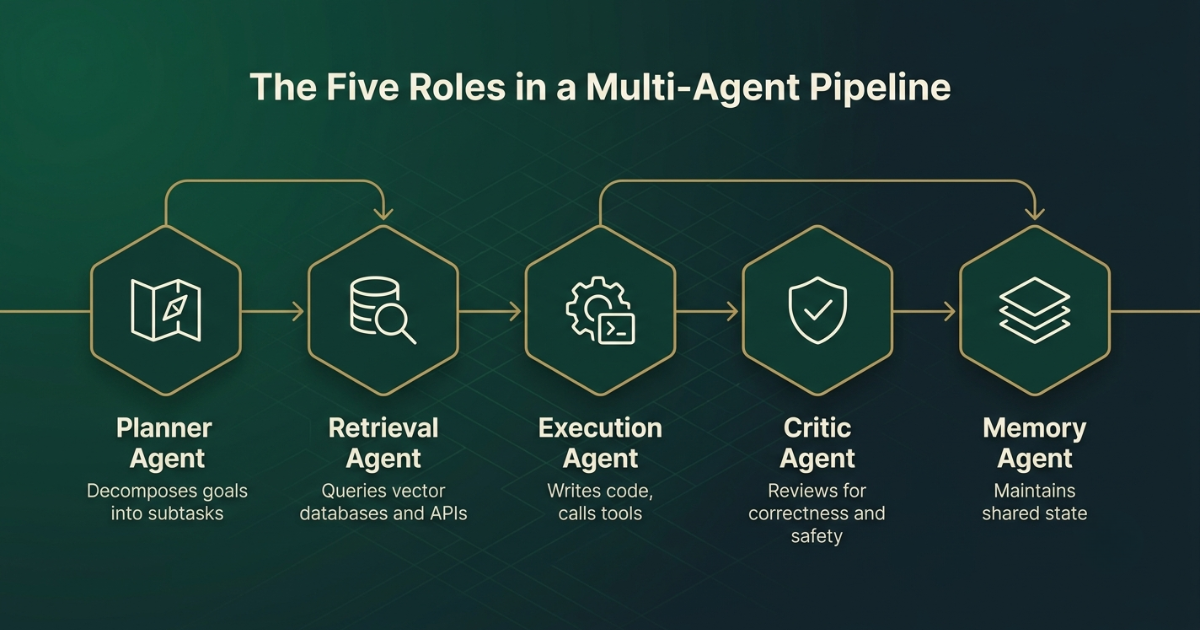
Multi-Agent Systems are software architectures in which multiple autonomous AI agents, each with a specialized role, collaborate to complete tasks that a single model handles poorly. Instead of one large model attempting research, coding, validation, and reporting in a single pass, Multi-Agent Systems split the work across agents:
- Planner agents: decompose a goal into subtasks and assign them to specialists
- Retrieval agents: query vector databases or live APIs for grounding context
- Execution agents: write code, call tools, or trigger actions in external systems
- Critic agents: review output for correctness, safety, and policy compliance
- Memory agents: maintain shared state across the whole pipeline
Why does this matter for hosting? Multi-Agent Systems are not a single inference call. A single user request can trigger five, ten, or fifty concurrent model calls as agents talk to each other, retrieve data, and validate results. This is fundamentally different from serving one chatbot, and it is why generic web hosting cannot support Multi-Agent Systems reliably in production.
Before selecting infrastructure, map how many concurrent agent calls a single user session generates at peak. A five-agent pipeline handling ten simultaneous users can mean fifty or more concurrent GPU inference requests, size infrastructure from this number, not a single-agent estimate.
According to industry data compiled through 2026, roughly one in five production AI agent deployments already coordinates three or more agents working together in what qualifies as multi-agent orchestration, with that share projected to approach half of all deployments within the next year.
2. The 2026 Case for Multi-Agent Systems
Multi-Agent Systems have moved from research demos to core enterprise infrastructure faster than almost any prior AI architecture pattern. Analyst coverage through 2026 consistently points to multi-agent coordination as the pattern replacing single monolithic agents for anything beyond simple retrieval tasks.
- Enterprises are shifting budgets from single-purpose bots toward orchestrated systems that complete end-to-end workflows
- Multi-agent orchestration is increasingly treated as core infrastructure, comparable to how container orchestration became infrastructure a decade ago
- Vertical, domain-specific agent deployments are the fastest-growing segment, and most are built as coordinated multi-agent pipelines rather than single models
- Organizations report measurably better task completion on multi-step workflows using Multi-Agent Systems than single-agent alternatives
A separate 2026 analysis of enterprise engineering workflows found that a majority of organizations already use agents for multi-stage work, with multi-agent coordination explicitly forecast to displace single-agent pipelines in more advanced environments.
This shift has direct hosting implications. Multi-Agent Systems that were pilots in 2025 are now expected to run with production uptime, which means the underlying GPU server must be dedicated, not shared, and provisioned for sustained concurrent load rather than occasional bursts.
3. Why a Dedicated GPU Server Is a Strong Fit for Multi-Agent Systems
3.1 The Concurrency Problem
Multi-Agent Systems generate bursts of parallel inference calls that shared or virtualized GPU environments cannot serve consistently. When five agents each fire a model call within the same second, queueing delay compounds across the pipeline, and the latency users feel becomes the sum of every agent’s wait time, not just one model’s response time.
- Shared GPU cloud instances multiplex multiple tenants on the same physical card, so a neighbouring workload can starve your pipeline of VRAM and compute cycles at exactly the wrong moment
- Pipelines with five or more agents in a chain are especially sensitive to tail latency, since one slow agent call delays every downstream step
- A Dedicated NVIDIA GPU Server significantly reduces this contention — the full card, its VRAM, and its compute cycles belong only to your workload, though well-provisioned managed cloud GPU platforms with guaranteed capacity can also meet production requirements for many workloads
3.2 The Memory Bandwidth Problem
Each agent in a multi-agent pipeline may load a different model, or a different fine-tuned adapter of the same base model, into GPU memory. Multi-Agent Systems that route between a large planning model and smaller specialist models need enough VRAM headroom to keep multiple models resident at once, or fast storage and PCIe bandwidth to swap models without stalling the whole pipeline.
- A single NVIDIA A100 or H100 GPU with 40GB to 80GB VRAM can typically keep two to four mid-sized specialist models resident simultaneously
- Pipelines that exceed available VRAM start swapping model weights to system RAM or disk, introducing multi-second stalls at every agent hand-off
- NVMe-backed storage materially reduces model-swap latency compared to standard SSD-backed instances
RELATED READING: NVMe vs SSD Hosting — why storage tier matters for AI and analytics workloads
3.3 The Isolation and Compliance Problem
Multi-Agent Systems built for regulated industries — finance, healthcare, legal — frequently process sensitive data across every agent hop: the retrieval agent may pull customer records, the execution agent may write to a production database, and the critic agent may log decisions for audit. Running such pipelines on shared, multi-tenant infrastructure makes this chain of custody very difficult to guarantee.
- A Dedicated NVIDIA GPU Server gives you full control over network isolation, VPC configuration, and disk encryption for every stage of the pipeline
- Dedicated infrastructure allows audit logging at the hardware and hypervisor level, which many compliance frameworks require for AI systems touching personal data
- For Indian businesses, this also supports DPDPA 2023 obligations around access logging, purpose limitation, and data protection safeguards when agents touch customer records
4. Choosing the Right GPU for Your Multi-Agent Systems Workload
Not every deployment needs the largest GPU available. Sizing depends on model count, model size, and expected concurrency.
| GPU Model | VRAM | Best Fit |
| NVIDIA A30 | 24GB | Small pipelines, 2-3 lightweight specialist agents, dev and staging environments |
| NVIDIA A100 | 40GB-80GB | Mid-size production pipelines with 3-6 agents and moderate concurrency |
| NVIDIA H100 | 80GB | Large production pipelines with 6+ agents, high concurrency, or larger base models |
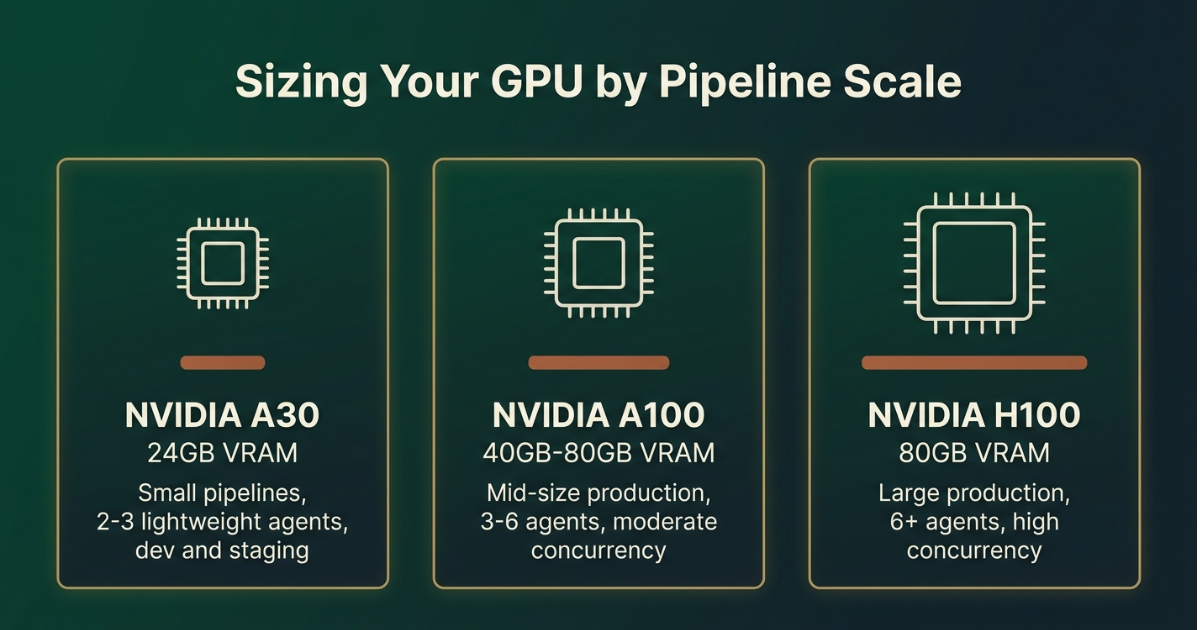
Sizing a GPU for Multi-Agent Systems is not the same as sizing for a single chatbot. Multiply your expected concurrent users by the number of agents in the pipeline, then estimate whether that many simultaneous inference calls fit inside a single GPU’s VRAM and compute budget, or whether you need multi-GPU scaling from the start.
Businesses evaluating best GPU cloud hosting options for production agent pipelines should weigh dedicated hardware against pay-per-use cloud GPU instances. Dedicated hosting wins on cost predictability and consistent latency for sustained production workloads, while best GPU cloud hosting plans billed per use can suit short-lived experimentation before an architecture is finalized. Teams comparing best GPU cloud hosting providers should also confirm India-based data centre availability if Indian user data is involved.
If your team is still comparing best GPU cloud hosting providers against dedicated hardware at this stage, it is worth running the numbers on both a monthly and an annual basis, since best GPU cloud hosting rates that look attractive per hour can exceed dedicated pricing once sustained production concurrency is factored in.
Need a GPU Sized for Your Multi-Agent Pipeline?
From A30 to H100, get dedicated NVIDIA GPU infrastructure built for concurrent agent workloads.
RELATED READING: GPU Cloud Providers in India — comparing dedicated and cloud GPU options for AI workloads
5. Orchestration Frameworks for Multi-Agent Systems
The orchestration layer is what actually turns several independent models into a coordinated pipeline. This layer manages task routing, shared memory, retries, and hand-offs between agents.
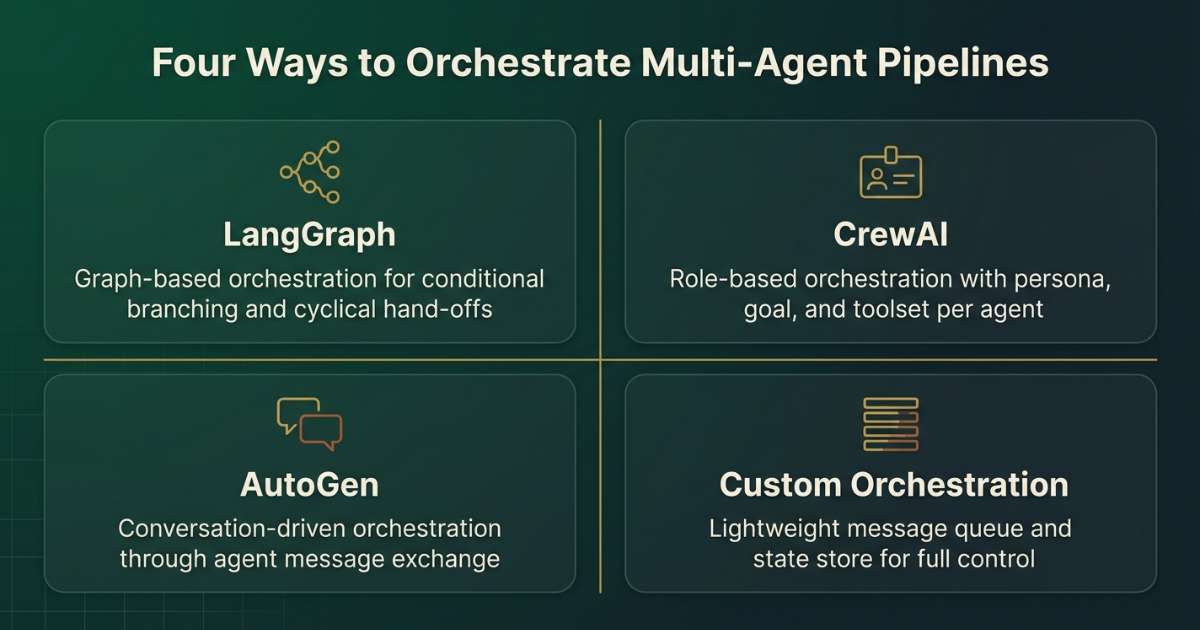
- LangGraph: graph-based orchestration well suited to pipelines with conditional branching and cyclical agent hand-offs
- CrewAI: role-based orchestration where each agent is defined with a persona, goal, and toolset
- AutoGen: conversation-driven orchestration where agents exchange messages until a task is resolved
- Custom orchestration: a lightweight message queue and state store for teams that want full control over coordination
Every orchestration setup also needs supporting infrastructure:
- Shared memory or vector store: gives every agent access to the same retrieved context, avoiding redundant retrieval calls
- Task queue: sequences work so agents do not block each other unnecessarily
- Observability layer: logs every agent call, latency, and output so a failing agent can be identified quickly
Start your build with the simplest orchestration pattern that solves the problem. A three-agent linear pipeline coordinated with a basic task queue is easier to debug and cheaper to run than a fully cyclical graph-based architecture your use case does not actually require.
6. Step-by-Step Deployment Roadmap for Multi-Agent Systems
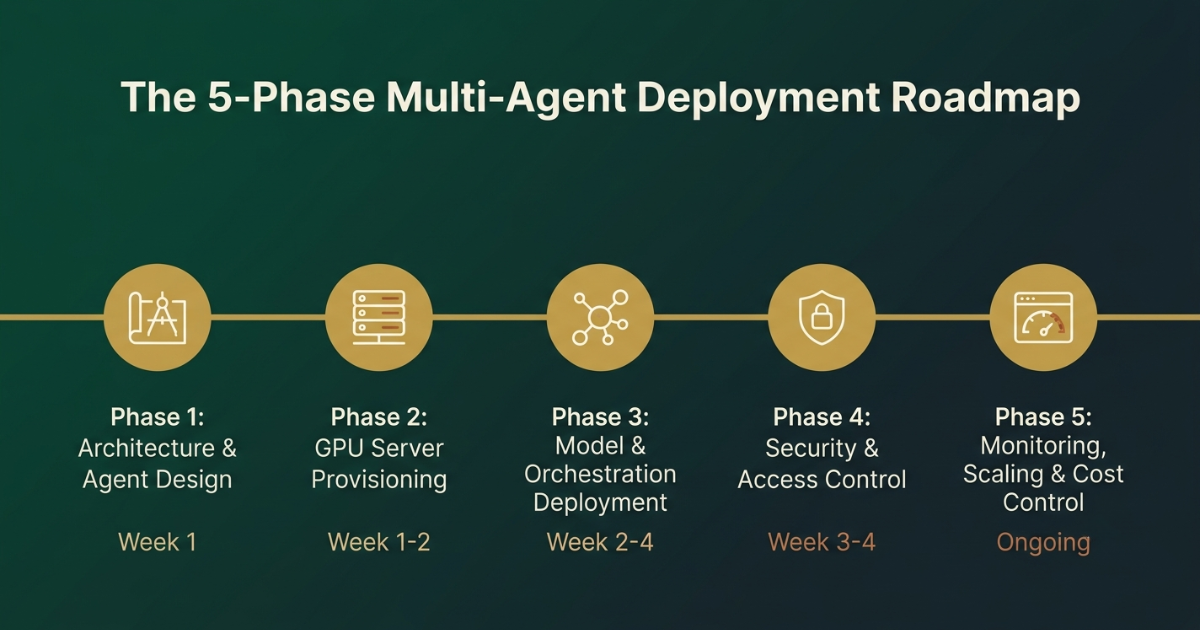
Phase 1: Architecture and Agent Design (Week 1)
- Define the specific task the pipeline solves and the exact role of each agent
- Decide which agents need a large model and which can run a smaller, faster specialist model
- Map data flow between agents so there are no unclear hand-offs
- Identify which agents touch sensitive data, so security controls are scoped correctly from day one
Phase 2: GPU Server Provisioning (Week 1-2)
- Select a Dedicated NVIDIA GPU Server sized to your concurrency and VRAM requirements from Section 4
- Confirm the provider is a genuine Web Hosting Company in India with India-based data centre locations if you are processing Indian user data
- Provision NVMe storage for fast model loading and swap performance across the pipeline
- Set up private networking so inter-agent traffic never traverses the public internet unnecessarily
Phase 3: Model and Orchestration Deployment (Week 2-4)
- Deploy each model or adapter that a specific agent requires
- Install and configure your chosen orchestration framework from Section 5
- Connect the shared memory or vector store that lets every agent access common context
- Load-test the full pipeline at expected peak concurrency before go-live, not just individual agent endpoints
Phase 4: Security and Access Control (Week 3-4)
- Assign individual, scoped credentials to every agent — never share one credential across agents
- Enable audit logging for every inference call and every tool action any agent takes
- Encrypt data at rest and in transit for every stage the pipeline touches
- Confirm network isolation between your GPU server and any other workload sharing the same data centre
Multi-Agent Systems significantly expand the attack surface compared to a single model endpoint, because every agent is a potential entry point with its own credentials and tool access. Treat each agent as a distinct identity with least-privilege access, and log every action so a compromised agent can be isolated without taking down the whole pipeline.
Phase 5: Monitoring, Scaling, and Cost Control (Ongoing)
- Track GPU utilisation, VRAM headroom, and per-agent latency continuously
- Set alerts for queue depth so a bottlenecked agent is caught before it degrades the whole workflow
- Right-size compute as usage grows, upgrading from a single dedicated GPU server to multi-GPU scaling only when concurrency data justifies it
- Review cost per completed task periodically, since Multi-Agent Systems can quietly multiply inference cost if hand-offs are not optimized
7. Infrastructure Comparison for Multi-Agent Systems
| Infrastructure Type | Suitable? | Why |
| Shared Web Hosting | No | No GPU access, no isolation, cannot serve concurrent model inference |
| VPS Hosting in India | Suitable for lightweight or staging use | Good for orchestration logic, task queues, and lightweight agents calling external inference APIs, but not for hosting large models directly |
| Shared Cloud GPU Instances | Suitable with caveats | Works well for prototyping; managed cloud GPU platforms with dedicated capacity guarantees can also support production, though noisy-neighbour risk exists on standard shared tiers |
| Dedicated NVIDIA GPU Server | Fully suitable | Dedicated VRAM, compute, and network isolation at any concurrency level |
Many teams actually run a hybrid architecture: the orchestration layer, task queue, and lightweight agents live on VPS Hosting in India, while GPU-intensive model inference for the same Multi-Agent Systems pipeline runs on a Dedicated NVIDIA GPU Server. This split keeps Fully Managed VPS Hosting handling orchestration cheaply while dedicating GPU spend only to the inference workload that actually needs it.
RELATED READING: VPS Hosting in India Pricing Breakdown — understanding cost tiers for the orchestration layer of your stack
8. Industry Use Cases for Multi-Agent Systems
8.1 E-Commerce and Retail
- Pipelines coordinating a search agent, a recommendation agent, and a fraud-check agent to process an order end to end
- Inventory forecasting pipelines combining a demand-prediction agent with a supplier-negotiation agent
8.2 Financial Services
- Loan processing pipelines where a document-extraction agent, a risk-scoring agent, and a compliance agent hand off sequentially
- Fraud detection pipelines running a monitoring agent continuously alongside an investigation agent triggered on anomalies
8.3 Healthcare
- Clinical documentation pipelines where a transcription agent, a coding agent, and a compliance-review agent collaborate
- Patient scheduling pipelines combining an availability agent with a communication agent
8.4 Software Engineering
- Pipelines where a planning agent, a coding agent, a testing agent, and a review agent complete a feature end to end
- DevOps pipelines that monitor infrastructure, triage incidents, and draft remediation steps automatically
Healthcare and financial Multi-Agent Systems deployments touching personal data must be built with DPDPA 2023 in mind for Indian users: purpose limitation on what each agent may access, reasonable security safeguards, and full audit trails covering every agent’s read and write actions.
Realated Reading: data analytics for small businesses in India.
9. Cost Considerations for Multi-Agent Systems
| Deployment Tier | Stack | Suitable For |
| Prototype | Shared cloud GPU + open-source orchestration framework | Testing a concept with 2-3 agents before committing budget |
| Production Small | Single Dedicated NVIDIA GPU Server (A30/A100) + VPS Hosting in India for orchestration | Pipelines with 3-6 agents and moderate concurrent users |
| Production Large | Multi-GPU Dedicated NVIDIA GPU Server (H100 class) + Fully Managed VPS Hosting for orchestration | Pipelines with 6+ agents, high concurrency, enterprise SLA needs |
Do not size your first deployment for peak enterprise scale on day one. Start on a single Dedicated NVIDIA GPU Server sized for your actual concurrent user estimate, validate the architecture, and scale hardware as real usage data comes in rather than provisioning for a hypothetical peak.
Market analysis through 2026 shows enterprise spending on AI agent infrastructure, including the compute behind coordinated agent pipelines, continuing to accelerate sharply as organizations move from pilots into sustained production budgets.
10. Comparing Hosting Approaches: Best GPU Cloud Hosting vs Fully Managed VPS Hosting for the Orchestration Layer
Every agent pipeline actually needs two different kinds of hosting decisions, and conflating them is a common early mistake. One decision is about where the GPU-heavy inference runs; the other is about where the lightweight orchestration logic runs.
- For the inference layer, teams comparing best GPU cloud hosting options should evaluate VRAM per dollar, sustained IOPS on model storage, and whether the provider offers dedicated (not shared) cards
- best GPU cloud hosting providers vary widely on network isolation guarantees, and this matters more for agent pipelines than for a single inference endpoint, since every agent hop is a potential exposure point
- When shortlisting best GPU cloud hosting vendors, ask specifically about queueing behaviour under concurrent load, since this is where shared-tenant plans quietly degrade agent pipelines during peak hours
- best GPU cloud hosting billed on a pay-per-second basis can be useful during the prototype phase in Section 9, before you commit to dedicated hardware
- Cost predictability is the main reason production teams move off best GPU cloud hosting marketplaces and onto dedicated hardware once concurrency is proven
- A provider offering both best GPU cloud hosting and dedicated GPU tiers under one account makes the prototype-to-production migration considerably smoother
- best GPU cloud hosting reviews and benchmarks should always be checked against your actual agent count and expected concurrency, not generic single-model benchmarks
- Some best GPU cloud hosting plans throttle sustained multi-hour workloads, which is a problem for agent pipelines that run continuously rather than in short bursts
For the orchestration layer, Fully Managed VPS Hosting is usually the more cost-effective choice, since task queues, message brokers, and lightweight agent logic do not need GPU access at all.
- Fully Managed VPS Hosting removes the operational burden of patching, monitoring, and securing the orchestration server, which matters when your team’s engineering time is better spent on agent logic
- Running your orchestration layer on Fully Managed VPS Hosting keeps that part of the stack isolated from the GPU server, so an orchestration-layer issue never risks the inference workload directly
- Fully Managed VPS Hosting typically includes managed backups, which protects your task-queue state and shared-memory configuration if the orchestration server needs to be rebuilt
- Teams running CrewAI, LangGraph, or AutoGen orchestration code generally find Fully Managed VPS Hosting more than sufficient, since these frameworks are lightweight compared to the models they coordinate
- Fully Managed VPS Hosting with private networking to your GPU server keeps inter-agent traffic off the public internet without requiring you to manage that networking configuration yourself
- Choosing Fully Managed VPS Hosting for orchestration and dedicated GPU hardware for inference is the hybrid pattern referenced earlier in Section 7, and it remains the most common cost-efficient setup for Indian small and mid-size teams
- Fully Managed VPS Hosting plans with predictable monthly billing make it easier to forecast the non-GPU portion of your agent infrastructure spend
- If your orchestration layer later needs to scale independently of your GPU capacity, Fully Managed VPS Hosting makes that a simple resize rather than a full re-architecture
Do not default to the largest best GPU cloud hosting plan available just because it is offered. Match the plan to your Section 4 sizing exercise, and keep your orchestration logic on Fully Managed VPS Hosting so you are only paying premium GPU rates for the part of the stack that actually needs a GPU.
In practice, most Indian engineering teams settle into a rhythm where best GPU cloud hosting is used only for short-lived load tests and burst capacity, while steady-state production traffic runs on dedicated hardware paired with Fully Managed VPS Hosting for everything that does not need a GPU. Revisit this split every quarter: as your agent count grows, what started as a best GPU cloud hosting experiment may justify moving to dedicated inference hardware, and what started as a single Fully Managed VPS Hosting instance may need to be split across two instances as orchestration traffic grows. Two more points are worth flagging before you finalize a vendor. First, best GPU cloud hosting contracts should specify a clear exit path so you are not locked in if pricing changes. Second, Fully Managed VPS Hosting contracts should include a documented backup and restore SLA, since orchestration-layer state is what lets you rebuild a pipeline quickly after any incident.
Host Your Orchestration Layer the Smart Way
Run your task queues and lightweight agents on Fully Managed VPS Hosting in India, without the GPU price tag.
11. Deployment Checklist for Multi-Agent Systems
- Agent roles and hand-offs mapped and documented before any infrastructure is provisioned
- GPU sized against realistic concurrent-call estimates for your specific pipeline, not a single-agent baseline
- Dedicated GPU server provisioned with NVMe storage and private networking
- Orchestration framework selected and shared memory or vector store configured
- Individual scoped credentials issued per agent, with audit logging enabled across the whole pipeline
- DPDPA 2023 compliance confirmed if any agent processes Indian personal data, including purpose limitation and audit logging
- Load testing completed at expected peak concurrency, not just individual agent endpoints
- Monitoring and cost-per-task tracking in place before go-live
- Hybrid architecture evaluated, VPS Hosting in India for orchestration versus a GPU server for inference — where it reduces cost without harming performance
- Vendor shortlist for best GPU cloud hosting reviewed against your Section 4 sizing numbers, not marketing benchmarks
- Fully Managed VPS Hosting confirmed to include backup, patching, and monitoring before it is trusted with orchestration state
- Scaling path defined in advance for when the pipeline outgrows a single GPU
Key Takeaways
- Multi-Agent Systems coordinate several specialized agents rather than one monolithic model, and this multiplies the number of concurrent inference calls a single user request generates
- A dedicated GPU server is a strong infrastructure choice for production Multi-Agent Systems because it minimizes multi-tenant contention, gives full VRAM headroom, and supports network isolation — though managed cloud GPU platforms with dedicated capacity can also be viable depending on workload and architecture
- GPU selection for Multi-Agent Systems should be based on agent count and concurrency, not just model size, an A30 suits small pipelines while an H100 suits large, high-concurrency deployments
- Orchestration frameworks like LangGraph, CrewAI, and AutoGen turn independent models into coordinated Multi-Agent Systems by managing task routing, shared memory, and hand-offs
- A hybrid stack, Fully Managed VPS Hosting for orchestration logic and a Dedicated NVIDIA GPU Server for inference, is a cost-efficient pattern for many production deployments
- DPDPA 2023 compliance requires purpose limitation, reasonable security safeguards, and per-agent audit logging for any Multi-Agent Systems pipeline that touches customer data
- Comparing best GPU cloud hosting against dedicated hardware, and pairing whichever you choose with Fully Managed VPS Hosting for orchestration, keeps cost aligned with what each layer of the stack actually needs
Conclusion
Multi-Agent Systems represent the direction enterprise AI is moving in 2026, and the businesses deploying them successfully are the ones that treated infrastructure as a first-class design decision rather than an afterthought. Getting Multi-Agent Systems right in production means matching GPU capacity to real concurrency, choosing an orchestration framework suited to your workflow, and building security and compliance in from day one rather than retrofitting it.
The teams that struggle with Multi-Agent Systems in production are rarely the ones who picked the “wrong” orchestration framework. More often, the failure traces back to infrastructure that was sized for a single model rather than a coordinated pipeline of five, ten, or more concurrent agent calls. Treating GPU capacity, memory bandwidth, and network isolation as core architectural decisions, not afterthoughts bolted on once a pipeline is already live, is what separates a Multi-Agent System that holds up under real user load from one that quietly degrades the moment traffic exceeds the prototype stage.
As Multi-Agent Systems continue to mature through 2026 and beyond, the infrastructure layer will only become more central to whether these deployments succeed. Businesses that start with a dedicated, properly isolated foundation give themselves room to scale agent count, add orchestration complexity, and expand into regulated use cases without re-architecting the stack from scratch. Getting the hosting decision right early is one of the few infrastructure choices that pays off at every later stage of a Multi-Agent System’s lifecycle.
CloudMinister provides Dedicated NVIDIA GPU Server infrastructure, VPS Hosting in India, and Fully Managed VPS Hosting built specifically to support Indian businesses deploying production-grade Multi-Agent Systems.
Not Sure Which Infrastructure Fits Your Pipeline?
Talk to our team about sizing, architecture, and compliance for your Multi-Agent System deployment.
Frequently Asked Questions
What are Multi-Agent Systems and how are they different from a single AI agent?
Multi-Agent Systems are architectures where multiple specialized AI agents collaborate on a task, each handling a distinct role such as planning, retrieval, execution, or validation, rather than one model attempting every step alone.
Why do Multi-Agent Systems need a dedicated GPU server instead of shared cloud GPU instances?
Multi-Agent Systems generate bursts of concurrent inference calls as agents communicate, and standard shared GPU instances multiplex multiple tenants on the same card, which can introduce latency and VRAM contention. A dedicated GPU server largely avoids this, though managed cloud GPU platforms offering guaranteed, non-shared capacity can also meet production requirements depending on the workload.
Which GPU is best for hosting Multi-Agent Systems?
It depends on pipeline size. Smaller pipelines with two to three lightweight agents can run on an NVIDIA A30, while larger production Multi-Agent Systems with six or more agents and high concurrency typically require an NVIDIA A100 or H100.
Can Multi-Agent Systems run partly on VPS hosting?
Yes. A common and cost-efficient pattern runs the orchestration layer and lightweight agents on VPS Hosting in India, while GPU-intensive model inference runs on a separate Dedicated NVIDIA GPU Server.
Does DPDPA 2023 apply to Multi-Agent Systems processing Indian user data?
Yes, if any agent in the pipeline processes personal data of Indian citizens, the infrastructure must support purpose limitation, reasonable security safeguards, and audit logging of every agent’s access to that data. DPDPA 2023 does not mandate India-only data storage, but businesses should still evaluate data residency based on their own risk posture and sector-specific regulations.
How long does it typically take to move a Multi-Agent System from prototype to production?
Timelines vary by pipeline complexity, but most teams following a structured rollout, architecture design, GPU provisioning, orchestration setup, and security hardening — can move a Multi-Agent System from prototype to production in three to five weeks, provided infrastructure sizing and compliance requirements are scoped correctly from the start.
What happens if a Multi-Agent System is deployed on infrastructure that is undersized?
Undersized infrastructure typically shows up as compounding latency, VRAM swapping between agent hand-offs, and unpredictable failures under concurrent load — issues that are often invisible during low-traffic testing but become production-blocking once real user concurrency hits the pipeline. This is why sizing infrastructure against realistic concurrency estimates, rather than single-agent benchmarks, is a critical step before go-live.