Choosing the right compute layer for AI training and inference starts with understanding NVIDIA GPU Architectures, since every generation, from Ampere through Blackwell and now Vera Rubin, changes the math on memory bandwidth, power draw, and cost per token. This guide breaks down each major architecture in the current NVIDIA GPU Architectures lineup, explains what actually changed under the hood, and gives engineering and procurement teams a practical framework for choosing the right generation for their workload in 2026.
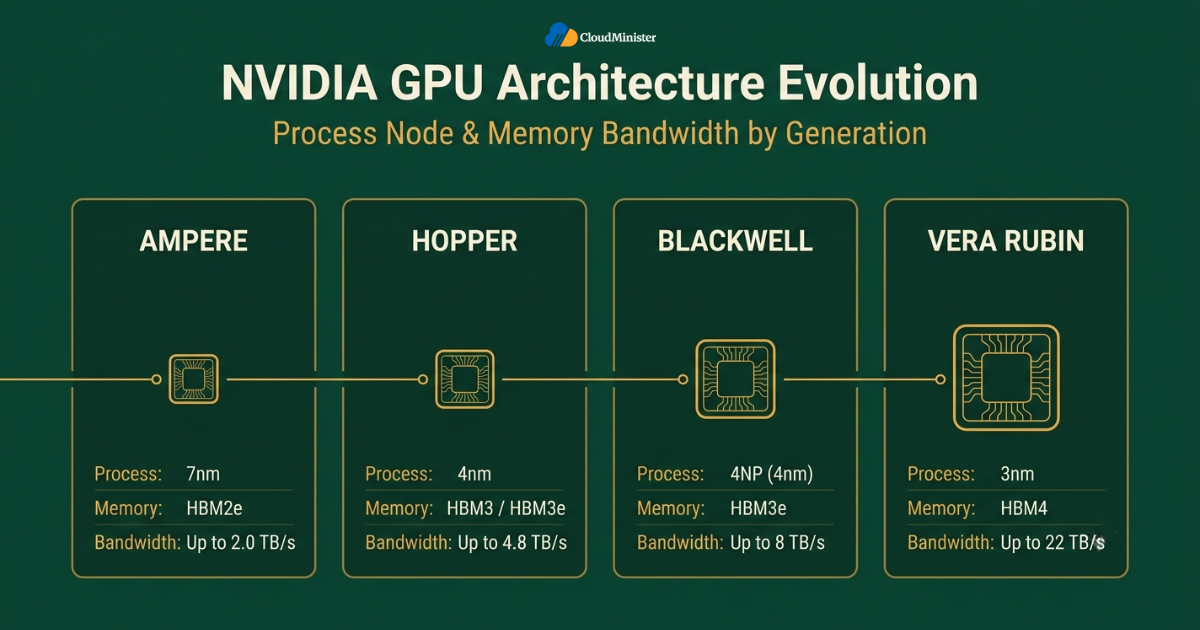
Understanding NVIDIA GPU Architectures has stopped being a niche concern for hardware engineers and has become a boardroom question. When a company commits budget to a GPU cluster, it is really committing to a specific generation of NVIDIA GPU Architectures, and that decision shapes training throughput, inference cost, and power bills for years. It sounds simple until you look at how fast the underlying silicon has moved. In under five years, NVIDIA GPU Architectures have gone from Ampere’s 7nm design to Vera Rubin’s 3nm, dual-die, HBM4-powered platform, and each jump has changed what is technically possible for large language models, computer vision pipelines, and agentic AI systems.
For a long time, many teams assumed a single GPU generation would remain relevant for three to four years without review. That assumption no longer holds. NVIDIA controls an estimated 81 percent of the AI data center chip market in 2026, and the pace of architectural change across NVIDIA GPU Architectures is now measured in months, not years. This means a training cluster purchased on last year’s architecture can already be several steps behind on memory bandwidth, interconnect speed, and energy efficiency.
The shift has been driven by scale and by the sheer size of modern AI models. Teams are no longer running small convolutional networks on a single card; they are training and serving trillion-parameter mixture-of-experts models across multi-node clusters using dedicated ai training servers, and each generation of NVIDIA GPU Architectures has been engineered specifically to solve the bottleneck the previous generation exposed. This is one of the reasons teams increasingly evaluate a best GPU cloud hosting in India provider not just on raw specifications, but on which architecture generation is actually available to rent.
This guide walks through every major architecture in the modern NVIDIA GPU Architectures family, explains how each one changed the underlying compute and memory design, and gives founders, ML engineers, and infrastructure leads a working framework for choosing the right generation for their workload, regardless of company size or industry, whether they ultimately buy hardware outright or rent it from a best GPU cloud hosting in India provider.
1. Why Understanding NVIDIA GPU Architectures Has Become a Board-Level Priority
Choosing among NVIDIA GPU Architectures used to be a task handled entirely by the infrastructure team. That is no longer the case. As companies scale their AI ambitions, architecture selection has moved from an engineering footnote to a topic discussed alongside product roadmaps and fundraising conversations.
Part of the reason this decision now sits so high on the priority list is that GPU architecture directly determines total cost of ownership. A cluster built on an outdated generation of NVIDIA GPU Architectures can quietly cost far more per training run than a newer one, simply because it needs more GPUs, more power, and more time to hit the same throughput on demanding ai training servers. This is one reason procurement teams now request architecture roadmaps directly from any Web Hosting Company in India before signing a contract for GPU Servers for AI, and it is a habit worth carrying into every conversation with a Web Hosting Company in India, regardless of how established the provider appears.
- A single outdated GPU generation can require two to three times more hardware to match the throughput of a current-generation chip.
- Every additional model family a company trains multiplies the importance of choosing the correct NVIDIA GPU Architectures generation from day one.
- Cost overruns rarely happen through one dramatic mistake; they accumulate through months of running workloads on hardware that is one or two architecture generations behind.
- Engineering teams that are not measured on compute efficiency have little incentive to reassess their NVIDIA GPU Architectures choice once a cluster is already running. .
Before committing budget to any GPU cluster, map your workload’s memory bandwidth and interconnect requirements first, then match that map to the specific NVIDIA GPU Architectures generation that satisfies it. Buying based on GPU count alone, without checking the architecture underneath, is one of the most common procurement mistakes teams make in 2026.
This is also why so many finance-conscious teams start their search with best GPU cloud hosting in India rather than committing to owned hardware outright, since renting lets them test a workload against a given NVIDIA GPU Architectures generation before signing a multi-year contract for GPU Servers for AI.
2. What NVIDIA GPU Architectures Actually Means in Practice
In the simplest terms, NVIDIA GPU Architectures refers to the underlying silicon design, transistor layout, memory system, and interconnect technology that defines a generation of NVIDIA data center GPUs. It is worth being precise here, because people often use “GPU model” and “GPU architecture” interchangeably, when they are not the same thing.
- A single architecture generation, such as Hopper or Blackwell, can power multiple GPU models (H100 and H200 both use Hopper, for example).
- The architecture determines the process node, transistor count, tensor core generation, and supported numerical precisions such as FP8 or FP4.
- Memory type and bandwidth, whether HBM3, HBM3e, or the newer HBM4, are tied directly to the architecture generation, not the individual card.
- Interconnect technology, meaning NVLink generation and bandwidth, is also fixed by the architecture and changes how well GPUs scale together in a cluster.
Getting this distinction right matters because when a team says they need “the latest GPU,” what they usually mean is they need the latest generation among current NVIDIA GPU Architectures, since that is what actually determines performance ceiling, not the marketing name printed on the card. According to NVIDIA’s own technical documentation, each architecture generation is designed around a specific compute workload profile rather than a uniform upgrade path.
This is precisely the distinction that separates a well-run fleet of GPU Servers for AI from one that simply looks impressive on a spec sheet. A provider marketing itself as best GPU cloud hosting should be able to explain this distinction clearly, and a genuine Web Hosting Company in India should document it for every instance type it lists.
Related Reading: The Ultimate Guide to GPU Servers: Use Cases, Benefits & How to Choose (2026)
3. Architecture 1: Ampere, the Foundation Generation
Ampere is where most of today’s production AI infrastructure conversations still begin, even in 2026, because so many existing deployments were built on it and because it remains a genuinely useful entry point among NVIDIA GPU Architectures for teams with moderate budgets.
- Ampere introduced third-generation Tensor Cores with support for the TF32 numerical format, which made mixed-precision training dramatically more accessible without extensive code changes.
- The A100 GPU, built on Ampere, offered up to 80GB of HBM2e memory and became the default choice for enterprise AI training for several years.
- Multi-Instance GPU (MIG) technology debuted with Ampere, allowing a single physical GPU to be partitioned into up to seven fully isolated instances, which remains relevant for teams running multiple smaller workloads.
- Structural sparsity acceleration, another Ampere-era feature, allowed certain sparse neural network computations to run roughly twice as fast without a meaningful accuracy penalty.
Among the full set of NVIDIA GPU Architectures available today, Ampere is now considered the value tier. It is still technically capable for fine-tuning smaller models, running inference for models under roughly 20 billion parameters, and handling classical machine learning and computer vision workloads that do not need frontier-scale memory bandwidth. Many teams still rely on Ampere-based ai training servers for these moderate-scale jobs.
Never assume an older Ampere-based cluster is automatically insecure. Security depends far more on patch management, network isolation, and access controls than on which generation of NVIDIA GPU Architectures the hardware belongs to. That said, older firmware on aging cards should always be kept current.
Teams that still rely on Ampere-class ai training servers for day-to-day fine-tuning often find that a reputable Web Hosting Company in India can offer this older tier at a meaningfully lower GPU-hour rate than newer NVIDIA GPU Architectures, which keeps experimentation budgets predictable.
4. Architecture 2: Hopper, the Generation That Made LLM Training Mainstream
Hopper is the architecture most directly responsible for the current generative AI boom, and it remains one of the most widely deployed NVIDIA GPU Architectures in production data centers worldwide as of 2026.
- Hopper introduced the first-generation Transformer Engine, purpose-built to accelerate the exact attention and matrix-multiplication patterns that power large language models.
- The H100 GPU brought FP8 precision support to mainstream training workloads, roughly doubling throughput compared to Ampere’s FP16 pipeline for many transformer models.
- HBM3 memory on the H100 delivered up to 3.35 TB/s of bandwidth, a substantial jump that reduced the memory-bound bottlenecks common in Ampere-era training runs.
- The H200 refresh, still built on the Hopper architecture, upgraded memory to 141GB of HBM3e, specifically targeting inference workloads for larger context windows.
- NVLink 4 on Hopper-based systems allowed for tighter multi-GPU scaling, which mattered enormously once teams began training models that no longer fit on a single card.
If you are deciding between Hopper and older NVIDIA GPU Architectures for a new deployment, our earlier breakdown of choosing a dedicated NVIDIA GPU server for AI training in 2026 walks through exactly which workloads still justify Hopper-class hardware versus when it makes sense to move straight to a newer generation. Teams sizing out GPU Servers for AI at this stage should weigh Hopper against Blackwell carefully before committing budget.
Hopper remains the workhorse behind most production ai training servers today, and it is still the generation most commonly listed by providers advertising best GPU cloud hosting in India, largely because supply is more mature than for Blackwell or Vera Rubin. A well-run Web Hosting Company in India will typically stock several Hopper-based GPU Servers for AI alongside its newer Blackwell inventory.
Related Reading: Deploying AI Models on GPU Servers: A Complete Step-by-Step Guide for 2026
5. Architecture 3: Blackwell, the Current Flagship Generation
Blackwell is, as of mid-2026, the architecture most enterprise buyers mean when they say they want “current-generation” NVIDIA GPU Architectures, though Vera Rubin is now shipping into production for the largest hyperscale deployments.
- Blackwell uses a dual-die design with 208 billion transistors, manufactured on TSMC’s custom 4NP process, a substantial increase in transistor density compared to Hopper’s monolithic die.
- The B200 GPU delivers up to 8 TB/s of HBM3e memory bandwidth across 192GB of capacity, a meaningful step up from the H200.
- Blackwell introduced the second-generation Transformer Engine, adding native support for FP4 precision, which allows trillion-parameter models to run inference at a fraction of the compute cost of FP8.
- NVLink 5 on Blackwell doubled scale-up bandwidth compared to Hopper’s NVLink 4, which is critical for the all-to-all communication patterns used in mixture-of-experts model serving.
- The GB200 NVL72 rack-scale system combines 72 Blackwell GPUs and 36 Grace CPUs into a single liquid-cooled unit, treating the entire rack as one coherent compute domain rather than 72 separate servers.
Among current NVIDIA GPU Architectures, Blackwell is the generation most teams should evaluate first for any new training or high-throughput inference deployment in 2026, unless workload requirements specifically demand Vera Rubin’s larger memory footprint. For teams comparing where to actually rent this hardware, our detailed comparison of GPU cloud providers in India explains which providers currently offer Blackwell-class instances and how pricing compares across the market, and which ones brand themselves as a genuine Web Hosting Company in India with real GPU inventory.
Demand for Blackwell-class GPU Servers for AI has climbed sharply through 2026, and it is now common to see best GPU cloud hosting in India listings advertise Blackwell availability well before Vera Rubin capacity opens up more broadly. Any Web Hosting Company in India worth evaluating should be transparent about exactly where Blackwell sits in its current NVIDIA GPU Architectures lineup.
Use a simple analogy. Frame N8N as the “central nervous system” for your apps and data, and self-hosting as building that system in your own secure, private facility instead of a shared public space
6. Architecture 4: Vera Rubin, the Next-Generation Platform
Vera Rubin is the newest entrant among NVIDIA GPU Architectures, formally detailed at GTC 2026, and it represents one of the largest generational leaps NVIDIA has shipped in years, both in raw compute and in how the platform is packaged.
- The Rubin GPU (officially the R100) is built on TSMC’s 3nm process, a full node shrink from Blackwell’s 4NP, packing 336 billion transistors across a dual-die design, a 1.6x increase over Blackwell.
- Each Rubin GPU includes 288GB of HBM4 memory delivering up to 22 TB/s of bandwidth, nearly triple Blackwell’s 8 TB/s on HBM3e, which directly targets the memory-bandwidth bottleneck of mixture-of-experts inference.
- NVLink 6 on Vera Rubin doubles per-GPU scale-up bandwidth to 3.6 TB/s compared to NVLink 5 on Blackwell, and the Vera Rubin NVL72 rack delivers 260 TB/s of aggregate all-to-all bandwidth.
- The Vera CPU, a fully custom 88-core Arm-based design, replaces the Grace CPU used alongside Blackwell and supports native FP8 precision at the CPU level for the first time.
- NVIDIA’s own figures put Vera Rubin’s FP4 inference performance at approximately 50 PFLOPS per GPU, compared to roughly 15 PFLOPS FP4 on the B300, a claimed 3.3x throughput jump at the rack level.
- The platform requires full liquid cooling, since GPU power draw on Vera Rubin reaches between 1,800W and 2,300W depending on configuration, a significant jump from Blackwell’s 1,000W envelope.
Vera Rubin is positioned specifically for teams running the largest mixture-of-experts models and long-context agentic workloads, where memory bandwidth, not raw compute, has historically been the limiting factor. For teams sizing memory requirements before choosing between Blackwell and Vera Rubin generations, our guide on how much VRAM you actually need is a useful companion read, since over-provisioning memory on the newest NVIDIA GPU Architectures can be just as wasteful as under-provisioning it.
Very few providers currently offer Vera Rubin as part of their best GPU cloud hosting lineup, since supply remains tightly allocated to the largest hyperscale ai training servers deployments. As Vera Rubin capacity broadens through late 2026, expect more mainstream best GPU cloud hosting in India options to list it alongside Blackwell-based GPU Servers for AI, and expect a growing number of Web Hosting Company in India listings to add it to their published roadmaps.
Need Blackwell-Class GPU Power Without the Capital Outlay?
Rent high-performance GPU Servers for AI training and inference, backed by predictable INR billing and India-based infrastructure built for scale.
7. Comparing the Major NVIDIA GPU Architectures Side by Side
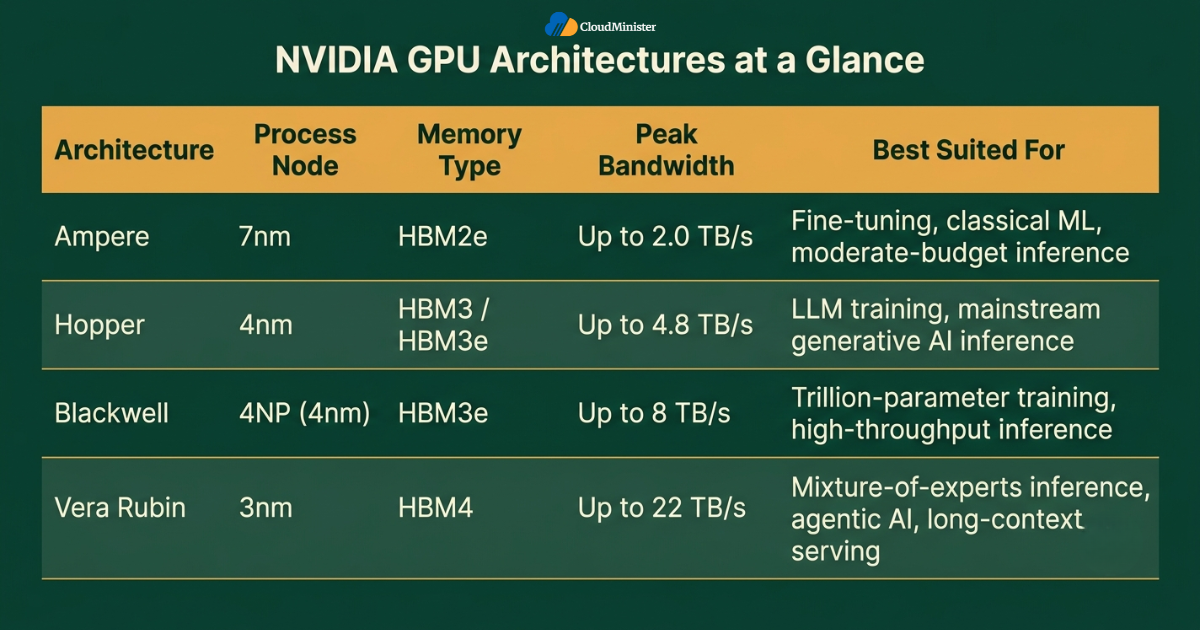
| Architecture | Process Node | Memory Type | Peak Memory Bandwidth | Best Suited For |
| Ampere | 7nm | HBM2e | Up to 2.0 TB/s | Fine-tuning, classical ML, moderate-budget inference |
| Hopper | 4nm | HBM3 / HBM3e | Up to 4.8 TB/s | LLM training, mainstream generative AI inference |
| Blackwell | 4NP (custom 4nm) | HBM3e | Up to 8 TB/s | Trillion-parameter training, high-throughput inference |
| Vera Rubin | 3nm | HBM4 | Up to 22 TB/s | Mixture-of-experts inference, agentic AI, long-context serving |
This side-by-side view of NVIDIA GPU Architectures makes the generational logic clear: each step exists to remove a specific bottleneck that the previous generation exposed once workloads scaled past it.
8. How Workload Type Should Drive Your NVIDIA GPU Architectures Choice
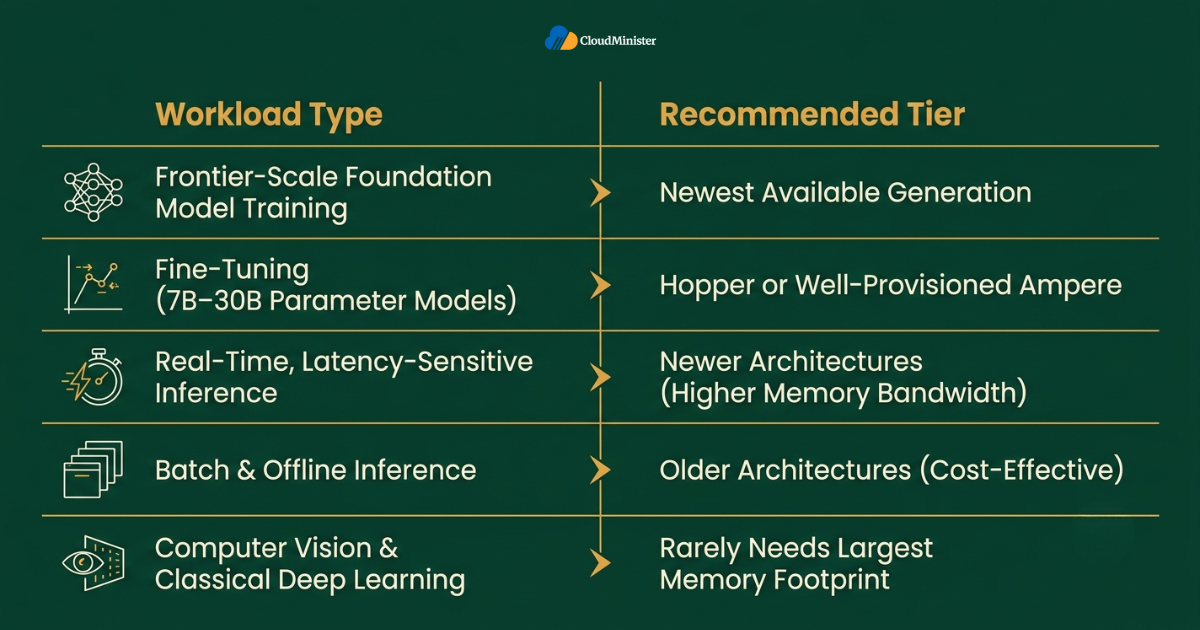
Not every workload needs the newest silicon. Matching the right generation among NVIDIA GPU Architectures to the actual job at hand is where most of the practical cost savings live.
- Training frontier-scale foundation models from scratch almost always justifies the newest available NVIDIA GPU Architectures generation, since training time compounds across weeks or months on dedicated ai training servers.
- Fine-tuning smaller open-source models, in the 7 to 30 billion parameter range, can often run efficiently on Hopper or even well-provisioned Ampere hardware.
- Real-time inference for latency-sensitive applications benefits disproportionately from newer architectures with higher memory bandwidth, since inference is frequently memory-bound rather than compute-bound.
- Batch inference and offline processing jobs, which are not latency-sensitive, can often run cost-effectively on older NVIDIA GPU Architectures without a meaningful quality trade-off.
- Computer vision and classical deep learning workloads, which are typically smaller than modern LLMs, rarely need the largest memory footprints offered by the newest generation.
Choosing among GPU Servers for AI should always start with a clear-eyed audit of what the workload actually requires, rather than defaulting to whichever NVIDIA GPU Architectures generation is newest or most talked about. Well-configured GPU Servers for AI need to be matched to workload shape, not just to the newest silicon on the market, and the same logic applies whether those GPU Servers for AI are rented or owned outright.
Teams that get this audit right typically avoid overpaying for best GPU cloud hosting in India capacity they will never fully use, and they are far better positioned to negotiate pricing with a Web Hosting Company in India once they know exactly which GPU Servers for AI their roadmap actually requires over the next few quarters of ai training servers demand.
Related Reading: GPU Server for Deep Learning: From Provisioning to First Model Training
9. The Role of Cloud Hosting in Accessing Modern NVIDIA GPU Architectures
Understanding NVIDIA GPU Architectures is only half the equation; actually accessing the right generation without a multi-year capital commitment is the other half, and this is where cloud GPU hosting becomes central to the decision.
- Renting access to current-generation NVIDIA GPU Architectures through a cloud provider avoids the multi-month lead times and large upfront capital outlay associated with direct hardware procurement.
- A cloud hosting relationship allows teams to move between architecture generations, from Hopper to Blackwell to Vera Rubin, as workload requirements evolve, without stranding capital in aging hardware.
- Providers offering a genuine mix of NVIDIA GPU Architectures generations give engineering teams the flexibility to match workload to hardware precisely, rather than settling for whatever a single-generation provider happens to stock.
- Teams evaluating providers should confirm exactly which NVIDIA GPU Architectures are actually available for rent today, rather than relying on a roadmap or “coming soon” listing.
- India-based data centres offering current NVIDIA GPU Architectures reduce latency for domestic AI teams while also addressing data residency requirements that matter for regulated industries, a key reason many teams look specifically for best GPU cloud hosting in India rather than a generic global vendor.
- A Web Hosting Company in India with a strong domestic footprint can also simplify compliance conversations for regulated sectors that need their ai training servers to stay within national borders.
For teams weighing whether to rent or own their compute layer, our detailed GPU server rental versus buying TCO analysis for India walks through the total cost of ownership math across different NVIDIA GPU Architectures generations, which is often the deciding factor for growing AI teams evaluating best GPU cloud hosting options against building out their own ai training servers in-house. Independent analysis from Uptime Institute similarly notes that capital-intensive hardware refresh cycles are one of the largest hidden costs in enterprise AI infrastructure planning.
This is exactly the calculation that drives so many growing teams toward best GPU cloud hosting in India rather than direct ownership, since a capable Web Hosting Company in India can absorb the hardware refresh risk on the customer’s behalf while still guaranteeing access to current-generation GPU Servers for AI and modern ai training servers, all while keeping a full range of ai training servers available across multiple NVIDIA GPU Architectures generations.
Related Reading: Cloud GPU Pricing vs GPU Server Pricing: The Hidden Cost
10. Choosing a Hosting Partner That Understands NVIDIA GPU Architectures
Not every hosting provider treats architecture selection with the seriousness it deserves. Many platforms advertise “GPU servers” without clearly documenting which generation of NVIDIA GPU Architectures actually powers their infrastructure, which makes real comparison difficult for buyers.
- A dependable hosting partner should be able to state clearly which NVIDIA GPU Architectures generation, Ampere, Hopper, Blackwell, or Vera Rubin, is running behind each instance type it offers, whether it markets itself primarily as best GPU cloud hosting or as a full-service Web Hosting Company in India.
- Transparent specification sheets covering memory bandwidth, interconnect generation, and precision support make it far easier to match workload requirements to the correct hardware tier.
- A provider offering a genuine range of NVIDIA GPU Architectures, rather than a single generation, gives growing teams room to scale without switching vendors entirely.
- Predictable INR billing on GPU-hour pricing removes one of the most common sources of budgeting uncertainty for Indian AI teams evaluating best GPU cloud hosting in India options, and it is often the single biggest differentiator between a mediocre and a genuinely trustworthy best GPU cloud hosting in India provider.
- Founders comparing options should shortlist a provider with a proven uptime and support track record before committing to a long-term contract around any specific NVIDIA GPU Architectures generation.
For teams evaluating this decision, CloudMinister positions itself as a Web Hosting Company in India built around access to current NVIDIA GPU Architectures, giving Indian AI teams a straightforward path to Ampere, Hopper, and Blackwell-class compute without navigating a patchwork of global providers and unpredictable dollar-denominated billing. This kind of domestic focus is exactly what teams should expect from best GPU cloud hosting in India, since local support and INR billing both matter as much as raw specifications.
- A provider that clearly documents its NVIDIA GPU Architectures roadmap helps teams plan multi-quarter capacity needs with more confidence.
- Teams negotiating a long-term GPU hosting contract should confirm upgrade paths between NVIDIA GPU Architectures generations are contractually available, not just implied.
- A hosting partner offering both dedicated and shared access tiers across different NVIDIA GPU Architectures supports teams at very different budget levels, including teams running dedicated ai training servers around the clock.
- Reviews and case studies referencing specific NVIDIA GPU Architectures generations are a useful way to validate a provider’s claims before signing, and this is equally true whether the provider markets itself as best GPU cloud hosting or simply as a broader Web Hosting Company in India, and doubly true for anyone specifically searching for best GPU cloud hosting in India.
- A Web Hosting Company in India with responsive account management reduces the operational overhead of migrating workloads between architecture generations, which matters more the larger a customer’s fleet of ai training servers becomes.
- Many mature AI teams now expect infrastructure providers to proactively flag when a newer NVIDIA GPU Architectures generation would meaningfully reduce their inference costs.
- Choosing best GPU cloud hosting in India with clear architecture documentation makes procurement audits faster and less stressful for finance teams.
- A provider that supports both training and inference-optimized configurations across NVIDIA GPU Architectures is increasingly valuable as workloads diversify, particularly for teams running large ai training servers alongside smaller inference fleets.
- Offering a clear upgrade path from Ampere or Hopper instances to Blackwell or Vera Rubin supports teams as their models and traffic scale, and is a hallmark of a serious Web Hosting Company in India that also offers well-priced GPU Servers for AI.
- Comprehensive support that bundles architecture guidance with day-to-day server management significantly simplifies procurement for teams without a dedicated infrastructure function, whether they are shopping for best GPU cloud hosting or fully managed GPU Servers for AI.
11. The Growing Scale of AI Compute Demand in 2026
The pressure behind choosing the right NVIDIA GPU Architectures is not abstract. The global data center GPU market is projected to grow from roughly 139 billion dollars in 2026 to over 624 billion dollars by 2034, a compound annual growth rate above 20 percent, driven almost entirely by AI training and inference demand.
As enforcement of internal compute budgets tightens and finance teams demand more accountability from engineering, companies that treated their GPU architecture choice as a one-time procurement decision are discovering that the landscape keeps shifting underneath them. New architecture generations, tightening HBM4 supply, and a deepening reliance on mixture-of-experts model designs all mean this is an area requiring ongoing attention rather than a single hardware audit, and it is fueling steady demand growth for both best GPU cloud hosting and dedicated ai training servers across the industry.
This growth is also visible in India specifically, where demand for best GPU cloud hosting in India and for locally hosted GPU Servers for AI has risen sharply as more domestic teams move workloads off global platforms and onto infrastructure run by a nearby Web Hosting Company in India. Analysts tracking best GPU cloud hosting in India adoption expect this trend to continue as more regulated industries localize their compute.
12. Building a Practical Framework for Choosing NVIDIA GPU Architectures
A useful way to approach NVIDIA GPU Architectures selection is to treat it as a recurring evaluation rather than a one-time hardware purchase.
- Start by profiling your actual workload’s memory bandwidth and interconnect needs before looking at any specific NVIDIA GPU Architectures generation or GPU model.
- Classify workloads by criticality and latency sensitivity, since production inference and experimental training runs justify very different hardware tiers, and often different classes of GPU Servers for AI.
- Document your architecture decisions in a form finance leaders can review without needing deep technical background on NVIDIA GPU Architectures internals.
- Review your GPU architecture posture at least twice a year, since NVIDIA’s release cadence for new NVIDIA GPU Architectures has accelerated considerably compared to just a few years ago.
- Pair architecture decisions with strong utilization monitoring, since even the most advanced NVIDIA GPU Architectures generation delivers poor value if the hardware sits idle, whether it is running on rented best GPU cloud hosting or owned ai training servers.
- Compare utilization data across quarters to decide whether it is time to renegotiate GPU Servers for AI pricing with your current best GPU cloud hosting provider or shop the broader market.
- Building internal awareness around architecture trade-offs ensures engineering teams treat hardware selection as part of everyday planning, not a separate afterthought handled only during procurement.
- Combining architecture reviews with vendor evaluation keeps both layers of decision-making working together instead of drifting apart.
- Teams that invest early in understanding NVIDIA GPU Architectures typically avoid the expensive mid-project realization that their hardware cannot support a model’s memory requirements.
Treat your NVIDIA GPU Architectures decision documentation as a living reference that your engineering and finance teams update together each quarter, not a one-time spreadsheet created during initial procurement and then forgotten.
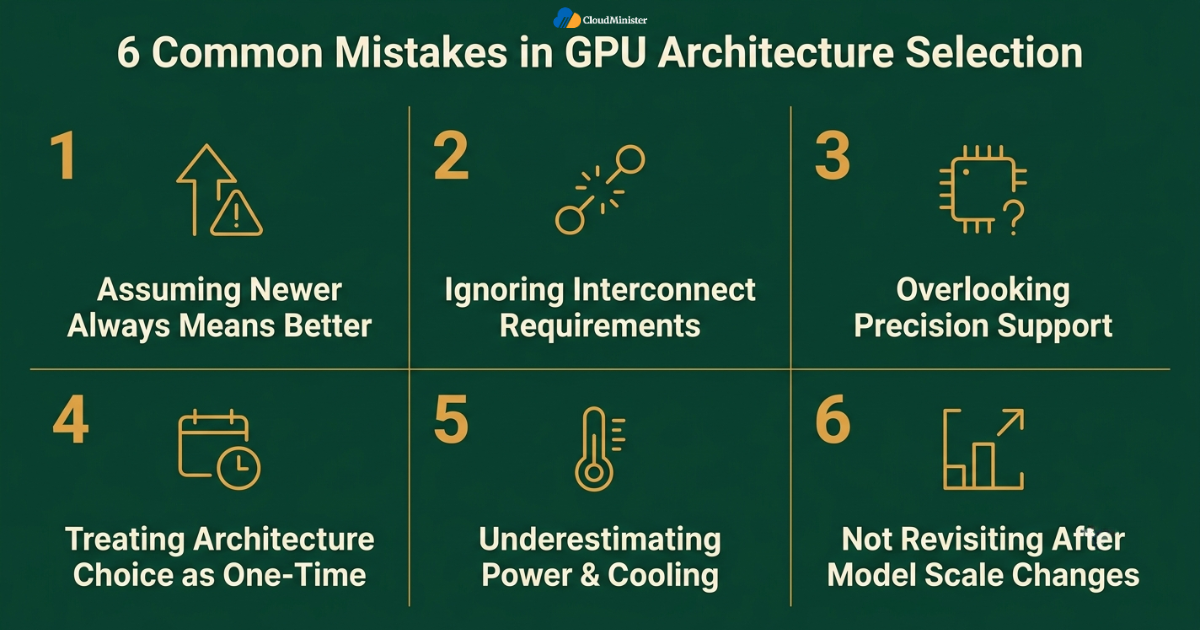
13. Common Mistakes Teams Make When Evaluating NVIDIA GPU Architectures
Mistake 1: Assuming Newer Always Means Better for Every Workload
Jumping straight to the newest NVIDIA GPU Architectures generation for every workload, including small fine-tuning jobs, often means paying a premium for memory bandwidth and compute the workload will never use.
Mistake 2: Ignoring Interconnect Requirements
Teams frequently focus on raw GPU compute specifications while overlooking NVLink generation, even though interconnect bandwidth is often the actual bottleneck once training scales across multiple nodes on shared ai training servers rented from a best GPU cloud hosting provider.
Mistake 3: Overlooking Precision Support
Running a model architecture designed for FP8 or FP4 precision on hardware that only efficiently supports FP16 is one of the most expensive mistakes teams make when selecting among NVIDIA GPU Architectures, since it silently erases much of the expected performance gain.
Mistake 4: Treating Architecture Choice as a One-Time Decision
GPU architecture selection is not a purchase made once and forgotten. Without periodic review, teams can end up running production workloads on a generation of NVIDIA GPU Architectures that no longer reflects the best available price-to-performance ratio.
Mistake 5: Underestimating Power and Cooling Requirements
Some teams select a GPU based purely on compute specifications without checking power draw and cooling requirements, only to discover that newer NVIDIA GPU Architectures generations, particularly Vera Rubin, mandate liquid cooling that their existing facility cannot support.
Mistake 6: Not Revisiting After Model Scale Changes
A hardware setup that worked well for a 7-billion-parameter model can break down entirely once a team scales to a trillion-parameter mixture-of-experts design. This is precisely the stage where a fresh review of available NVIDIA GPU Architectures becomes necessary rather than optional, often on newly provisioned ai training servers built for that larger scale, sourced either from best GPU cloud hosting in India or from dedicated GPU Servers for AI purchased outright.
Key Takeaways
Here is the GPU architecture data formatted as a structured bulleted list:
- Ampere
- Process Node: 7nm
- Memory Type: HBM2e
- Peak Memory Bandwidth: Up to 2.0 TB/s
- Best Suited For: Fine-tuning, classical ML, moderate-budget inference
- Hopper
- Process Node: 4nm
- Memory Type: HBM3 / HBM3e
- Peak Memory Bandwidth: Up to 4.8 TB/s
- Best Suited For: LLM training, mainstream generative AI inference
- Blackwell
- Process Node: 4NP (custom 4nm)
- Memory Type: HBM3e
- Peak Memory Bandwidth: Up to 8 TB/s
- Best Suited For: Trillion-parameter training, high-throughput inference
- Vera Rubin
- Process Node: 3nm
- Memory Type: HBM4
- Peak Memory Bandwidth: Up to 22 TB/s
- Best Suited For: Mixture-of-experts inference, agentic AI, long-context serving
Not Sure Which NVIDIA GPU Architecture Fits Your Workload?
Talk to our infrastructure team to map your training and inference needs to the right GPU generation, budget, and hosting plan.
Conclusion
Choosing among NVIDIA GPU Architectures is no longer a narrow technical decision left entirely to infrastructure engineers; it now directly shapes training timelines, inference economics, and overall AI product strategy. Understanding what actually changed from Ampere to Hopper to Blackwell, and now to Vera Rubin, gives engineering and finance teams the shared vocabulary needed to make hardware decisions that hold up under real production load.
What makes this topic genuinely difficult is that it sits at the intersection of hardware engineering, model architecture, and procurement, and very few companies have a single team responsible for all three. An engineering team might understand model requirements in detail but have limited visibility into which NVIDIA GPU Architectures generation actually delivers the best cost-per-token for their specific inference pattern. A finance team might control the budget but have no framework for evaluating whether a proposed GPU cluster is actually the right generation for the job. Closing that gap is what separates teams that scale AI infrastructure predictably from those that discover, mid-project, that their hardware cannot keep up with their models.
As AI adoption deepens through the rest of 2026 and into 2027, companies that pair a clear understanding of NVIDIA GPU Architectures with a reliable hosting partner will be far better positioned to control costs, plan multi-quarter capacity, and avoid the kind of expensive, last-minute hardware scramble that derails AI roadmaps. Treated seriously and revisited regularly, architecture selection becomes a genuine competitive advantage rather than a recurring source of budget anxiety, whether that means leaning on best GPU cloud hosting in India, investing in owned GPU Servers for AI, or partnering with a trusted Web Hosting Company in India for both.
Whichever route a team chooses, the underlying principle stays the same: best GPU cloud hosting and dedicated ai training servers are only as valuable as the NVIDIA GPU Architectures decision behind them, and that decision deserves the same rigor as any other major infrastructure commitment.
Ultimately, the teams that get ahead on this front are not the ones chasing whichever NVIDIA GPU Architectures generation is newest for its own sake, but the ones that build a repeatable habit around it: profiling workload requirements honestly, choosing infrastructure partners who understand the technical nuances involved, and revisiting their hardware strategy as both models and silicon continue to evolve. Approached this way, NVIDIA GPU Architectures selection stops being a source of last-minute panic and becomes simply part of how a well-run AI infrastructure strategy works.
Frequently Asked Questions
What are the main NVIDIA GPU Architectures used for AI in 2026?
The four most relevant NVIDIA GPU Architectures in active production use during 2026 are Ampere, Hopper, Blackwell, and the newly launched Vera Rubin platform, each targeting different workload scales and budget levels.
Is Vera Rubin only relevant for the largest AI companies?
No. While Vera Rubin’s largest deployments target hyperscale mixture-of-experts serving, cloud access to Vera Rubin-class instances is increasingly available to smaller teams through GPU hosting providers, without requiring direct hardware ownership.
What is the main technical difference between Blackwell and Vera Rubin?
Blackwell uses HBM3e memory at up to 8 TB/s of bandwidth on a 4NP process node, while Vera Rubin moves to HBM4 memory at up to 22 TB/s on a 3nm process, alongside a doubled NVLink generation for faster multi-GPU communication.
Does an older architecture like Ampere still make sense in 2026?
Yes, for many workloads. Ampere-based GPUs remain cost-effective for fine-tuning smaller models, classical machine learning, and inference workloads that do not require the largest available memory bandwidth.
How does cloud hosting help teams access newer NVIDIA GPU Architectures?
Cloud hosting allows teams to rent access to current-generation hardware without the capital outlay and multi-month lead times associated with direct procurement, and it allows teams to move between architecture generations as workload requirements change.
What should teams look for when comparing best GPU cloud hosting in India providers, and does best GPU cloud hosting in India differ meaningfully from global options?
Look for transparent documentation of which NVIDIA GPU Architectures generation powers each instance, predictable INR billing, and a proven track record as a Web Hosting Company in India before committing to a long-term contract.

Shivlendra Singh Jadoun is a Cloud & DevOps Engineer at CloudMinister Technologies, specializing in AWS, Azure, and GCP infrastructure. He began his career in Linux system administration, managing shared, VPS, and dedicated servers before moving into cloud and automation. He is AWS Certified and works extensively with Docker, Kubernetes, Terraform, Ansible, and Jenkins to build CI/CD pipelines and scalable, secure cloud environments. With hands-on experience across hosting, server security, and DevOps automation, he brings real-world engineering insight to every article he writes.