Data analytics is no longer an enterprise-only capability. Small businesses across India are using data analytics to reduce costs, improve retention, and make faster decisions — without enterprise budgets. This guide covers the complete starting framework for data analytics implementation: tool selection, infrastructure provisioning on reliable VPS Hosting in India, pipeline build, security compliance, and vertical-specific use cases. The global data analytics market is projected to reach USD 104.39 billion in 2026 — with India’s share reaching USD 4.76 billion. India’s data analytics market is projected at USD 21.28 billion by 2030, growing at a CAGR of 35.8%, the fastest regional growth rate globally. SSD VPS Servers in India with NVMe storage are the recommended infrastructure tier for hosting analytics workloads at this pace of growth.
Data analytics has crossed the enterprise threshold. In 2026, the tools, cloud infrastructure, and expertise required to run meaningful data analytics programmes are accessible, affordable, and cloud-delivered — relevant for a 15-person logistics firm in Surat as much as a 500-person manufacturer in Pune. Businesses that grow with precision use data analytics to drive every decision: pricing, inventory, customer acquisition, and operational efficiency.
This guide gives Indian small business owners a technically accurate starting point for data analytics in 2026 — covering what data analytics means for a small business, which tools deliver value at SME budgets, what hosting infrastructure correctly supports data analytics workloads, and how to scale from a first dashboard to a production data analytics programme delivering compounding business value.
1. What Is Data Analytics — And Why Small Businesses in India Need It in 2026
Data analytics is the systematic process of collecting, cleaning, modelling, and interpreting data to support business decisions with evidence instead of assumptions. For a small business, data analytics answers high-impact practical questions:
- Which products generate the highest margin after returns and logistics costs?
- Which customer segment churns fastest — and at which lifecycle stage?
- At what inventory level do stockouts consistently occur?
- Which marketing channel delivers the lowest cost per acquisition?
- What time of day does your website convert best — and is server response time adequate at peak load?
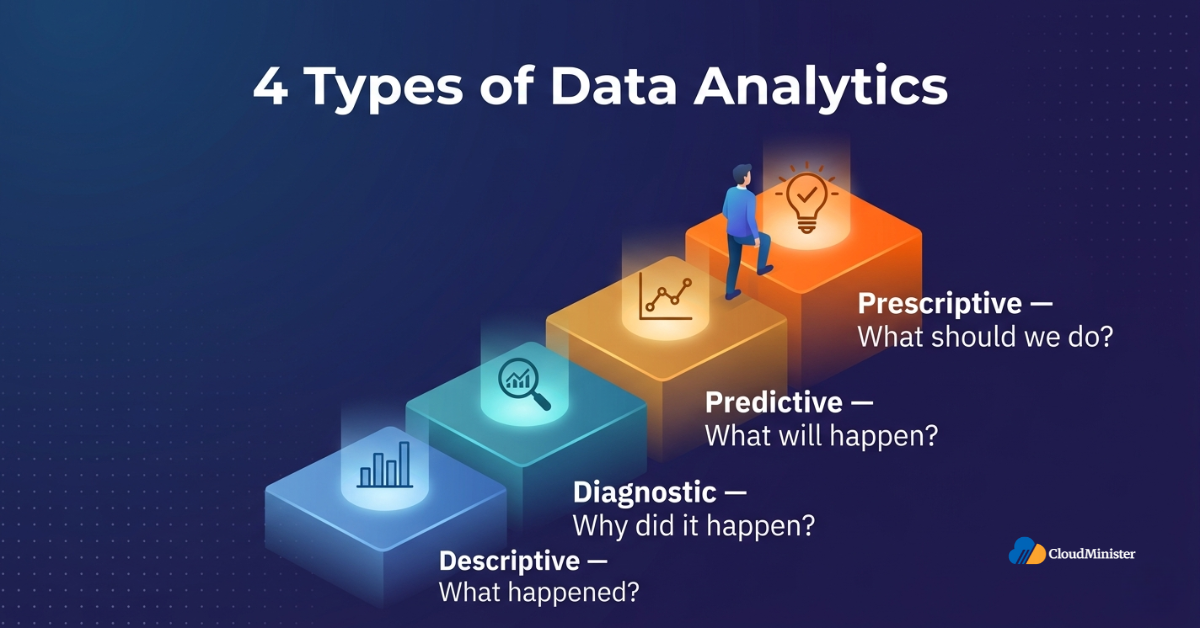
The four types of data analytics that small businesses use — in ascending order of complexity:
| Type of Data Analytics | Business Question It Answers | Indian SME Example |
| Descriptive Analytics | What happened? | Monthly sales by product and region |
| Diagnostic Analytics | Why did it happen? | Why did Q3 revenue drop 18%? |
| Predictive Analytics | What will happen? | Which customers are likely to churn next month? |
| Prescriptive Analytics | What should we do? | What discount maximises retention without losing margin? |
Most small businesses start with descriptive data analytics and progress toward predictive capabilities as data maturity grows. The infrastructure decisions you make at the start — especially your choice of web hosting provider in India — directly determine whether your analytics environment scales reliably or hits bottlenecks as datasets grow.
2. The Data Analytics Market in India — 2026 Context
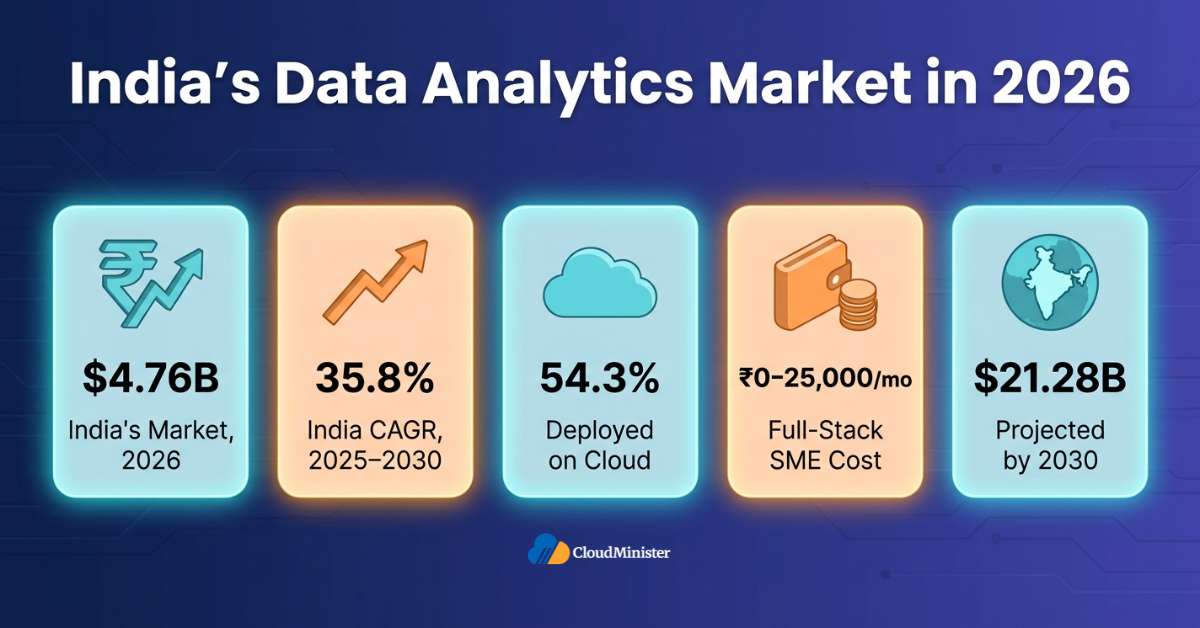
The commercial context for data analytics adoption in India in 2026 is defined by rapid growth and structural accessibility. According to Fortune Business Insights, the India data analytics market reaches USD 4.76 billion in 2026 — positioning India among the top five data analytics markets globally. Small businesses that implement structured analytics today gain measurable competitive advantage over those still relying on monthly PDF reports.
| Metric | Figure | Relevance for Indian Small Businesses |
| India market (2026) | USD 4.76 billion | Mature ecosystem; enterprise tools now at SME pricing |
| India CAGR (2025–2030) | 35.8% | Early adoption delivers compounding competitive advantage |
| Cloud deployment share | 54.3% of analytics solutions | Cloud-first removes upfront infrastructure cost |
| SME accessible stack cost | INR 0–25,000/month | Full-stack analytics within any SME budget in 2026 |
| Asia-Pacific analytics CAGR | Highest globally | India is in the fastest-growing regional market |
Choosing the right web hosting provider in India is a foundational decision for any small business starting an analytics programme — the hosting tier directly determines query performance, pipeline reliability, and data security outcomes.
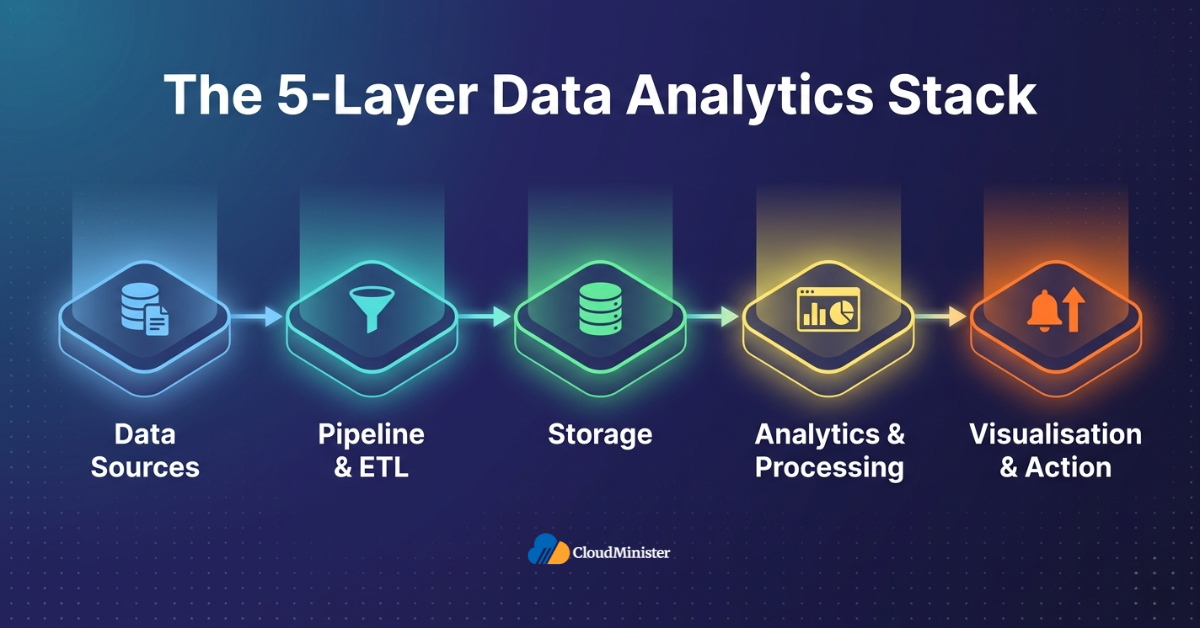
3. The Data Analytics Stack for Small Businesses — Five Core Layers
A production data analytics stack for a small business is a layered architecture — not a single tool purchase. Underinvesting in any layer, particularly the hosting infrastructure layer, creates failures that surface as slow dashboards, data gaps, and inaccurate reports.
3.1 Data Sources Layer
Every data analytics programme begins with identifying and connecting the systems generating business data:
- Transactional data: POS systems, e-commerce platforms (Shopify, WooCommerce), accounting software (Tally, Zoho Books, Vyapar)
- Behavioural data: Google Analytics 4, website session logs, mobile app event streams
- Marketing data: Meta Ads Manager, Google Ads, email platform open and click metrics
- Operational data: Inventory management, delivery tracking, warehouse management systems
- Customer data: CRM records, support tickets, NPS survey responses
Before selecting any tool, complete a data source audit. The completeness of this audit determines the accuracy of every data analytics output your business will ever produce. A missing source — such as offline POS transactions — creates analytical blind spots that produce structurally incorrect business decisions.
3.2 Data Pipeline and ETL Layer
Raw data from multiple sources must be extracted, transformed, and loaded before data analytics analysis can begin:
- SaaS ETL tools: Fivetran, Airbyte, or Stitch — 300+ connectors delivering clean tables to your warehouse with minimal engineering effort
- Python-based pipelines: Pandas and SQLAlchemy for teams with developers — cost-effective for simpler pipelines with fewer sources
- Native integrations: Zoho Analytics and Google Looker Studio pull directly from connected apps without a separate ETL layer
For ETL pipelines running on scheduled jobs, hosting environment determines reliability. A Fully managed VPS server provides dedicated isolated compute for ETL jobs — preventing resource contention from degrading pipeline performance during business-hours execution.
3.3 Storage Layer
Data analytics requires purpose-built storage optimised for analytical query patterns, not general-purpose transactional databases:
- Cloud data warehouses: Google BigQuery, Amazon Redshift, Snowflake — columnar storage purpose-built for analytical queries; BigQuery’s pay-per-query pricing suits Indian SMEs
- Self-hosted databases on VPS Hosting in India: PostgreSQL for structured analytics, ClickHouse for sub-second queries on large event datasets
SSD VPS Servers in India with NVMe block storage eliminate the I/O bottleneck causing slow data analytics query execution as datasets grow. Standard SSD throttles under concurrent analytical query workloads — SSD VPS Servers in India deliver 10x–50x higher sustained IOPS, keeping dashboards responsive under concurrent user load.
RELATED READING: NVMe vs SSD Hosting — Why storage tier matters for analytics workloads
3.4 Analytics and Processing Layer
The analytics layer converts stored data into actionable data analytics output: dashboards, cohort reports, trend charts, anomaly alerts:
- Business Intelligence tools: Metabase (open-source, self-hostable on VPS Hosting in India), Google Looker Studio (free), Power BI, Tableau, Zoho Analytics
- Python analytics: Pandas, NumPy, Matplotlib, and scikit-learn for custom analytics beyond BI-tool flexibility
- Automated ML platforms: Google AutoML, Azure ML Studio — accessible predictive analytics without a dedicated data scientist
3.5 Visualisation and Action Layer
Data analytics output must drive action to generate business value:
- Automated alerting: Threshold notifications via email or Slack when KPIs breach defined limits — stock below reorder point, conversion rate drop, page error spike
- Scheduled report distribution: Data analytics reports pushed automatically to management teams without manual effort
- API integration: Analytics outputs consumed by CRM, ERP, and pricing systems — closing the data-to-action loop automatically
4. Implementing Data Analytics — Phase-by-Phase Roadmap for Indian Small Businesses
Phase 1: Define Your Data Analytics Questions (Weeks 1–2)
Data analytics programmes that start with a technology purchase before defining business questions consistently fail. Start with questions:
- List five specific decisions your business makes monthly where better data would change the outcome
- Identify which decision would have the highest financial impact if made more accurately
- Define the precise data analytics metric that would answer each question: revenue per segment, CAC by channel, stock turnover by SKU
- Confirm the data required for your priority analytics questions is actually being captured in existing systems
For Indian small businesses starting a data analytics programme: your first dashboard should answer only one high-impact question. A single well-defined data analytics use case — customer acquisition cost by channel — generates more value than a 20-metric dashboard nobody acts on. Start narrow, prove value, then expand.
Phase 2: Audit Data Sources and Infrastructure (Weeks 2–4)
- Inventory every system generating business data — export formats, update frequency, data quality assessment
- Assess current hosting infrastructure: can it support data analytics jobs without degrading primary application performance?
- Evaluate your web hosting provider in India against analytics requirements: VPC isolation, database hosting, scheduled job execution, NVMe storage
- Identify data quality gaps: missing fields, inconsistent formats, duplicate records — source problems become analytics accuracy problems downstream
Phase 3: Select Tools and Provision Infrastructure (Weeks 3–6)
- Choose your data analytics stack based on team technical capability and data volume — not on what enterprise companies use
- Provision a dedicated analytics database — isolated from your production application database to prevent query load from degrading application response times
- SSD VPS Servers in India with dedicated compute and NVMe storage are the recommended infrastructure tier for self-hosted analytics databases — consistent query performance under concurrent dashboard load
- Configure automated backups for your analytics data store before production data flows in
RELATED READING: VPS Hosting in India Pricing Breakdown — What you actually spend on analytics infrastructure
Phase 4: Build Your First Data Analytics Pipeline (Weeks 4–10)
- Connect priority data sources to your ETL tool — validate data arriving in your warehouse matches source systems before building dashboards
- Build transformation logic converting raw transactional records into the dimensions your data analytics questions require: LTV, cohort tables, channel attribution models
- Deploy your first dashboard answering your priority business question — a single well-defined report
- Validate output against manually verified numbers before distributing to business stakeholders — one incorrect report destroys confidence in the entire programme
Analytics databases frequently contain sensitive customer PII. Indian small businesses running customer analytics must comply with DPDPA 2023: implement role-based access controls, enable audit logging, and never export raw customer data to unencrypted storage. DPDPA 2023 does not impose blanket data localisation — under Section 16’s ‘negative list’ model, cross-border transfers are permitted by default unless the government specifically restricts a destination country. That said, hosting personal data on India-based VPS Hosting in India or Dedicated Server Hosting in India infrastructure remains the lowest-risk approach and simplifies compliance, particularly where sector-specific rules (e.g., RBI for payment data) do mandate localisation.
Phase 5: Operationalise and Scale (Weeks 8–18)
- Automate pipeline refresh schedules — daily for operational dashboards, weekly for strategic reporting
- Add alert rules triggering notifications when KPIs breach defined thresholds
- Expand analytics coverage from the first use case to additional questions as data quality confidence grows
- Upgrade to Dedicated Server Hosting in India as data volumes and concurrent user counts exceed VPS capacity
5. Data Analytics Tools — Selection Guide for Indian Small Businesses
Selecting tools for your data analytics programme requires matching capability to team skill, data volume, and budget:
5.1 Business Intelligence and Dashboarding
| Tool | Best For | Monthly Cost (INR) | Technical Requirement | Analytics Strength |
| Metabase | Self-hosted SMB analytics | Free (open-source) | VPS server + database | SQL dashboards, shareable reports |
| Looker Studio | Marketing data analytics | Free | Google account | GA4, Ads, Sheets connectivity |
| Zoho Analytics | Zoho-ecosystem analytics | ₹1,200–₹4,500 | SaaS only | Native CRM + Books integration |
| Power BI | Microsoft-stack analytics | ₹670–₹1,500 | Windows or SaaS | Excel, DAX queries |
| Grafana | Operational / time-series | Free (open-source) | VPS server required | Real-time metrics dashboards |
Indian SMBs new to analytics should start with Google Looker Studio (marketing data analytics) and Metabase (operational reporting) — both are free, run on SSD VPS Servers in India, and cover 80% of analytics questions relevant to businesses under ₹10 crore revenue.
5.2 Data Warehouses
- Google BigQuery: Pay-per-query pricing (first 1TB/month free) — ideal starting data analytics warehouse for Indian SMEs
- Amazon Redshift Serverless: Consumption-based pricing for variable analytics workloads; strong AWS ecosystem integration
- PostgreSQL on VPS Hosting in India: Free relational database engine for structured analytics on moderate data volumes with SQL-capable teams
- ClickHouse on SSD VPS Servers in India: Open-source columnar database for sub-second analytics on hundreds of millions of rows; strong for high-frequency event data
RELATED READING: How to Choose the Right VPS Hosting Provider for database and analytics workloads
5.3 ETL and Data Integration Tools
- Airbyte (open-source): 300+ connectors; self-hostable on VPS Hosting in India for businesses prioritising data residency and cost predictability
- Fivetran: Fully managed ETL — higher cost but zero maintenance; suited to businesses without dedicated technical resources
- Apache Airflow on a Fully managed VPS server: Workflow orchestration for complex multi-step analytics pipelines with maximum flexibility and engineering control
- Google Sheets + Apps Script: Appropriate for early-stage analytics where data volumes are small and a managed ETL tool is not yet justified
6. Data Analytics by Industry — Indian Small Business Use Cases
6.1 E-Commerce and D2C Retail
- Customer cohort analytics: Measure retention by acquisition cohort — the most valuable data analytics insight for any e-commerce operator in India
- SKU-level margin analytics: Combine revenue, returns, logistics cost, and COGS per SKU to identify which products are actually profitable
- Cart abandonment funnel analysis: Identify at which checkout step customers exit — directly actionable for conversion rate optimisation
- Demand forecasting: Predictive models trained on historical sales data, reducing stockouts and dead inventory carrying cost
6.2 Food and Beverage
- Menu item margin analytics: Contribution margin analysis by dish — identifying which items drive profitability versus which consume kitchen capacity without adequate return
- Peak demand analysis: Time-of-day transaction data analytics optimising staff scheduling and ingredient prep quantities
- Delivery platform analytics: Net margin comparison across Swiggy, Zomato, and direct channels — critical analytics for India’s aggregator-dominated F&B market
6.3 Healthcare and Diagnostics
- Patient flow analysis: Appointment, no-show, and revenue-per-slot analytics enabling optimised scheduling and improved utilisation
- Diagnostic test trend analytics: Identifying which tests are growing in demand — informing equipment investment and specialist partnership decisions
- Revenue cycle analytics: Insurance claim submission rate, rejection analysis, and collection cycle time data analytics impacting clinical cash flow management
Healthcare analytics involves sensitive patient data governed by DPDPA 2023. Small businesses in healthcare should run their analytics on a certified web hosting provider in India with ISO 27001 certification, end-to-end encryption, and VPC isolation. DPDPA 2023 does not mandate blanket India-only residency for personal data generally, though India-based hosting is strongly advisable given the sensitivity of patient data, and any applicable sectoral or contractual residency requirements should be confirmed. Patient-level analytics should never be processed on shared hosting, regardless of location.
6.4 Manufacturing and Light Industry
- OEE analytics: Real-time tracking of availability, performance, and quality yield — replacing manual data collection with live data analytics dashboards
- Defect rate analysis: Statistical process control identifying which parameters correlate with defects — reducing rework and material waste
- Procurement analytics: Supplier lead time, price variance, and quality failure analysis enabling vendor rationalisation and input cost control
6.5 Logistics and Distribution
- Route performance analytics: Delivery time, fuel cost, and on-time rate analysis across routes and drivers
- Fleet utilisation analytics: Vehicle uptime, load factor, and cost-per-kilometre data analytics enabling more efficient fleet deployment
- Customer SLA analytics: On-time delivery rate by customer and region — the baseline measurement for logistics service level management
RELATED READING: Key Benefits of Managed VPS Server for running analytics middleware and ETL pipelines
7. Hosting Infrastructure for Data Analytics — What Indian Small Businesses Actually Need
Your analytics environment is only as reliable as the hosting infrastructure it runs on. Choosing the right web hosting provider in India for data analytics workloads — with dedicated compute, NVMe storage, and VPC network isolation — is as important as selecting the right BI tool.
7.1 Why Shared Hosting Fails for Data Analytics
- Shared CPU and RAM: Data analytics queries are compute-intensive. On shared hosting, dashboard execution competes with other tenants — producing inconsistent, slow response times
- Connection limits: Analytics tools maintain persistent database connections that shared hosting restricts, causing dashboard errors under concurrent user load
- Storage I/O throttling: Analytics workloads combine high-volume sequential writes (ETL) with random read queries (dashboards). Standard shared storage throttles under this mixed I/O profile
- No VPC isolation: Analytics databases must be isolated from public internet access — shared hosting environments cannot provide this isolation
7.2 Fully Managed VPS Server — Right Infrastructure for Analytics
A Fully managed VPS server provides the dedicated compute, isolated storage, and managed operations that data analytics workloads require, without infrastructure management overhead:
- Dedicated vCPU and RAM: Zero noisy-neighbour contention — analytics query performance is consistent regardless of other workloads on the host node
- NVMe block storage: 10x–50x higher IOPS than standard SSD — eliminating the storage bottleneck that causes slow analytics queries on large tables
- Managed OS patching: Analytics infrastructure requires continuous security patching; managed operations delivers this without consuming engineering team capacity
- Private networking: Analytics database traffic routed over private networks eliminates the latency and security exposure of public-routed connections
Power Your Data Analytics with Fully Managed VPS Hosting
Get dedicated vCPU, NVMe storage, and VPC isolation built for analytics workloads — Metabase, PostgreSQL, ClickHouse, and ETL pipelines run reliably without noisy-neighbour slowdowns.
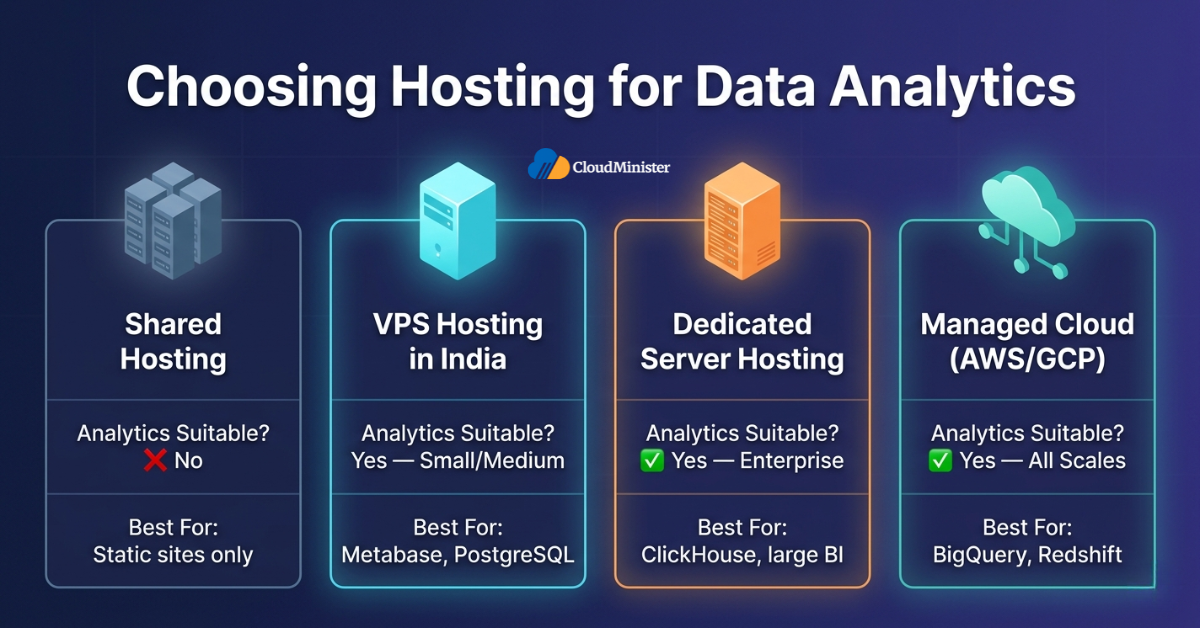
| Hosting Type | Analytics Suitable? | Storage IOPS | Network Isolation | Recommended Use |
| Shared Hosting | No | Very Low | None | Static websites only |
| VPS Hosting in India | Yes — small/medium analytics | Medium–High (NVMe) | VPC-level | Metabase, PostgreSQL, Airbyte |
| Dedicated Server Hosting in India | Yes — enterprise analytics | Very High | Full dedicated | ClickHouse, large-scale BI |
| Managed Cloud (AWS/GCP) | Yes — all scales | High (managed) | VPC-level | BigQuery, Redshift Serverless |
7.3 SSD VPS Servers in India — When This Is the Right Tier
SSD VPS Servers in India are the correct infrastructure tier when you need higher IOPS than entry-level compute, consistent analytics performance, and dedicated resources at lower cost than a full dedicated server:
- Analytics datasets between 10GB–100GB with 5–15 concurrent dashboard users
- ETL jobs running every 15–60 minutes requiring dedicated CPU allocation without affecting application performance
- Self-hosted BI tools (Metabase, Grafana) serving multiple departments with overlapping analytics workloads
- PostgreSQL or ClickHouse instances on SSD VPS Servers in India handling mixed read-write analytics requiring sustained high IOPS
7.4 When to Upgrade to Dedicated Server Hosting in India
Dedicated Server Hosting in India is the correct analytics infrastructure choice when VPS capacity is reached:
- Analytics database exceeds 100GB and query response times begin degrading under concurrent load
- More than 15 simultaneous analytics dashboard users generating concurrent queries
- ETL jobs running longer than 4 hours, competing for query processing resources on a shared VPS pool
- Multi-department analytics adoption requiring uptime SLAs for dashboard availability
Before selecting a hosting tier for your analytics environment, calculate expected query volume: users × queries-per-session × peak concurrency factor. A single analytical query on a 10M-row table without proper indexing can consume 100% of a shared vCPU for seconds. Correct analytics infrastructure sizing on VPS Hosting in India or Dedicated Server Hosting in India prevents this from degrading every concurrent user’s dashboard experience.
8. Data Analytics Security and Compliance for Indian Small Businesses
8.1 DPDPA 2023 and Analytics Obligations
The Digital Personal Data Protection Act 2023 applies directly to analytics programmes processing personal data of Indian citizens:
- Data minimisation: Collect only the fields your declared analytics purpose requires — do not centralise entire customer records when three fields suffice
- Purpose limitation: Data collected for order analytics cannot be repurposed for behavioural profiling without fresh consent
- Cross-border transfer: Under Section 16, DPDPA 2023 permits transferring personal data outside India by default, except to countries the central government specifically restricts (no such restricted list had been notified as of mid-2026). Despite this flexibility, hosting personal data on India-based infrastructure is recommended as the lower-risk practice, and is mandatory where sector-specific rules apply (e.g., RBI for payment data, IRDAI for insurance data).
- Audit logging: All access to personal data in your analytics warehouse must be logged — who queried, when, from which application
8.2 Access Control Architecture
- Role-based access: Three tiers — analytics admin (pipeline management), analyst (full read), business user (dashboard view, no raw table access)
- Individual credentials: Never share database credentials across analytics users — each account has individual credentials with revocable permissions
- Network policy: Your analytics database must be accessible only from analytics server IP ranges — confirm VPC configuration with your web hosting provider in India before going live
- Encryption at rest: All analytics storage must be encrypted — AES-256 at minimum, customer-managed keys for highest control
The most common analytics security failure in Indian small businesses is internal misconfiguration. A single over-permissive role granting raw SELECT access to your customer analytics warehouse can expose the entire dataset. Audit analytics database permissions quarterly. Your web hosting provider in India should offer managed security monitoring as a standard service on VPS Hosting in India and Dedicated Server Hosting in India environments.
9. Data Analytics Readiness Checklist for Indian Small Businesses
Verify readiness across these prerequisites before investing in analytics tools and infrastructure:
- Business questions defined: At least three high-impact decisions identified that structured data analytics would improve
- Data source inventory complete: All systems generating relevant data listed with formats and update frequencies documented
- Data quality baseline established: Source data validated for completeness before building any pipeline
- Analytics tool selected: BI tool chosen based on team capability and data volume, not marketing claims
- Infrastructure provisioned: VPS Hosting in India or cloud data warehouse provisioned with NVMe storage for analytics workloads
- Web hosting provider in India verified: India data centre confirmed, ISO 27001 or SOC 2 certification checked, managed operations available
- Database isolation confirmed: Analytics database on dedicated infrastructure, separate from production application database
- DPDPA 2023 scope assessed: Personal data in analytics pipeline identified; residency requirements mapped; legal review initiated
- Access control deployed: Role-based permissions in place before any customer data is loaded into your analytics warehouse
- Backup and recovery tested: Analytics warehouse backup active and restore procedure validated before go-live
Run this checklist before signing any analytics tool contract. The most expensive mistake Indian small businesses make with data analytics is purchasing a BI platform before the underlying infrastructure — source connectivity, ETL pipeline, analytics database on reliable SSD VPS Servers in India — is ready to correctly feed it.
10. Data Analytics Costs — What Indian Small Businesses Actually Spend
| Budget Tier | Analytics Stack | Monthly Cost (INR) | Suitable For |
| Starter | Google Looker Studio + BigQuery free tier + Sheets ETL | ₹0–₹3,000 | Businesses just beginning analytics |
| Growth | Metabase + PostgreSQL + Airbyte on VPS Hosting in India | ₹4,000–₹12,000 | 2–8 analytics users with ETL needs |
| Scale | Power BI + Redshift + Fivetran + SSD VPS Servers in India | ₹18,000–₹45,000 | 10–25 analytics users, multi-source pipelines |
| Enterprise | Tableau + Snowflake + Dedicated Server Hosting in India | ₹50,000–₹1,20,000 | 25+ users, uptime SLA requirements |
The growth tier — a Fully managed VPS server running Metabase, PostgreSQL, and Airbyte — is the optimal starting point for most Indian small businesses. It delivers production-grade data analytics capability at a predictable monthly cost, with a clear upgrade path to Dedicated Server Hosting in India as data volumes and concurrent user counts grow.
11. Scaling Tips for Indian Small Business Data Analytics
As your programme matures, these operational practices keep your data analytics environment performing at scale:
- Upgrade storage before you need it: Moving from standard SSD to SSD VPS Servers in India after data loss is far more expensive than provisioning the right tier from the start
- Separate read replicas: Run analytics queries against a read replica of your operational database — preventing analytical load from degrading application response times on your VPS Hosting in India environment
- Managed VPS service: A fully managed VPS server contract includes OS patching, monitoring, and incident response — critical for analytics infrastructure that must be available 24/7
- Right-size before migrating: Map your analytics workload to Dedicated Server Hosting in India specifications before migrating — post-migration right-sizing on dedicated hardware carries higher downtime risk
- Quarterly web hosting provider in India review: Verify that your hosting provider’s SLA, certifications, and India data residency commitments are current and contractually binding
- Index early: Create analytics-specific indexes on your most-queried dimensions before dashboard users are onboarded — retroactive indexing on large tables requires maintenance windows
The most common post-launch analytics infrastructure failure for Indian small businesses is storage exhaustion — analytics databases grow faster than expected because historical data is never purged. Implement a data retention policy defining how long each analytics dataset is kept. SSD VPS Servers in India with automated volume expansion alerts prevent unplanned service disruption from this cause.
For Indian small businesses at the growth tier, the fully managed VPS server configuration — 8 vCPU, 32GB RAM, 500GB NVMe — supports up to 10 concurrent analytics dashboard users, ETL pipelines refreshing every 30 minutes, and analytics datasets up to 80GB without performance degradation.
For businesses scaling to the enterprise tier, Dedicated Server Hosting in India with dual-processor hardware, 256GB RAM, and NVMe RAID storage supports 50+ concurrent analytics users, sub-second query response on 500M-row tables, and multi-department data analytics programmes with strict availability SLAs.
Key Takeaways
- Data analytics enables Indian small businesses to make evidence-based decisions on retention, inventory, pricing, and marketing — at INR 0–12,000/month on VPS Hosting in India.
- The India market reaches USD 4.76 billion in 2026, growing at 35.8% CAGR — early analytics adoption delivers compounding competitive advantage.
- A production analytics stack has five layers: data sources, ETL pipeline, storage, analytics/processing, and visualisation/action.
- Shared hosting is not viable for analytics — SSD VPS Servers in India with NVMe compute is the minimum viable infrastructure tier.
- DPDPA 2023 requires purpose limitation, data minimisation, and audit logging for customer analytics. India-only hosting isn’t strictly mandated by the Act itself, but it’s the recommended lower-risk approach and is required under certain sector-specific rules.
- The growth-tier stack — Metabase, PostgreSQL, Airbyte on a Fully managed VPS server — costs INR 4,000–12,000/month and covers analytics needs of most Indian small businesses.
- Upgrade to Dedicated Server Hosting in India when your analytics database exceeds 100GB or concurrent dashboard users exceed 15.
Conclusion
Data analytics in India in 2026 is an operational requirement for any small business that wants to grow with precision rather than guesswork. The implementation pathway in this guide — question definition, source audit, tool selection, infrastructure provisioning on SSD VPS Servers in India or managed cloud, pipeline build, security compliance, and operationalisation — is applicable regardless of industry, revenue size, or technical team depth.
Indian small businesses that implement structured data analytics today — on properly provisioned infrastructure from a trusted web hosting provider in India with VPC isolation, NVMe storage, and managed security operations — will be measurably more competitive than those still operating from static monthly reports. CloudMinister provides Fully managed VPS server infrastructure, Dedicated Server Hosting in India at scale, and managed operations designed specifically for Indian small business data analytics workloads.
Not Sure Which Hosting Tier Fits Your Analytics Needs?
Talk to our team to size the right infrastructure for your data volume, concurrent users, and DPDPA compliance requirements — no guesswork, no overpaying.
Frequently Asked Questions
What is data analytics and why do small businesses in India need it?
Data analytics is the process of collecting, transforming, and interpreting business data to make evidence-based decisions. Indian small businesses need data analytics in 2026 because competitive pressure and tighter margins make gut-instinct management increasingly costly. Analytics tools are now accessible at SME budgets — making structured data-driven decision-making a practical requirement.
How much does it cost to start analytics for a small business in India?
A starter analytics programme using Google Looker Studio and BigQuery costs INR 0–3,000/month. A growth-tier stack — Metabase, PostgreSQL, and Airbyte on VPS Hosting in India — costs INR 4,000–12,000/month. Enterprise-scale analytics with Dedicated Server Hosting in India and managed BI tools ranges from INR 50,000–1,20,000/month.
What hosting infrastructure is needed for data analytics?
Data analytics requires dedicated compute and high-IOPS storage. Shared hosting is not suitable. The minimum viable infrastructure is VPS Hosting in India with NVMe block storage and VPC network isolation. Confirm that your web hosting provider in India offers managed operations, ISO 27001 certification, and India-only data residency before provisioning any analytics infrastructure. SSD VPS Servers in India eliminate the I/O bottleneck causing slow analytics query performance on large datasets.
Does DPDPA 2023 apply to my analytics programme?
Yes, if your analytics pipeline processes personal data of Indian citizens. DPDPA 2023 requires that personal data be collected only for declared purposes and that access to customer-level analytics tables be logged. The Act does not impose a blanket requirement that all such infrastructure be India-based — Section 16 permits cross-border transfer by default unless the government specifically restricts a destination — though India-based hosting is recommended as the lower-risk option and is mandatory where sector-specific rules apply. Engage legal counsel before scaling customer analytics to production.
When should I upgrade from VPS to Dedicated Server Hosting in India for analytics?
Upgrade your analytics infrastructure to Dedicated Server Hosting in India when your data warehouse exceeds 100GB, concurrent analytics users exceed 15, or ETL jobs exceed 4 hours competing for query resources. A web hosting provider in India offering both VPS Hosting in India and Dedicated Server Hosting in India tiers gives you a clear upgrade path as your analytics programme grows.