VPS Hosting in India sits in a confusing pricing band in 2026 — advertised rates range from under ₹200/month to well over ₹7,000/month for what looks like similar hardware. The gap is rarely about the server itself; it is about virtualisation type, NVMe vs SATA storage, managed vs unmanaged support, OS licensing and the indirect costs nobody prints on the pricing page. This guide delivers a technically accurate, India-focused price breakdown for 2026 — covering entry, mid and premium tiers, the Linux vs Windows cost split, GST treatment and the true total cost of ownership — so you buy the right server the first time instead of after a painful migration.
Choosing the right server tier directly impacts your page-load speed, your uptime and your monthly burn. For Indian businesses, developers and growing SaaS teams evaluating VPS Hosting in India in 2026, a wrong pricing decision is rarely a small mistake — under-buy and your site crashes under traffic, over-buy and you bleed budget on idle cores for years. This guide is written for founders, IT managers, agency owners and developers who want a numbers-grounded breakdown, not a marketing brochure.
Below, we unpack the cost across every dimension that actually moves the price: per-month INR rates by tier, GST treatment at checkout, the storage-architecture premium, OS licensing for Windows servers, and the indirect costs that turn a ₹599 sticker price into a very different first-year number. For teams comparing options, CloudMinister is a Web Hosting Provider in India that supports both self-managed and fully managed deployments with Indian data-centre locations.
1. Why VPS Pricing in India Is So Hard to Compare in 2026
The single biggest problem with VPS pricing is not that it is expensive — it is that two plans with identical headline specs can differ in real-world value by 3x to 4x. Before looking at any number, it helps to understand why the landscape looks the way it does in 2026.
Key Drivers Behind VPS Pricing
- Virtualisation type: KVM-based plans provide hardware-level isolation between tenants and, on a responsibly provisioned host, far more consistent performance than container-based or heavily oversubscribed OpenVZ-style plans that advertise the same RAM at a fraction of the price and tend to degrade under load.
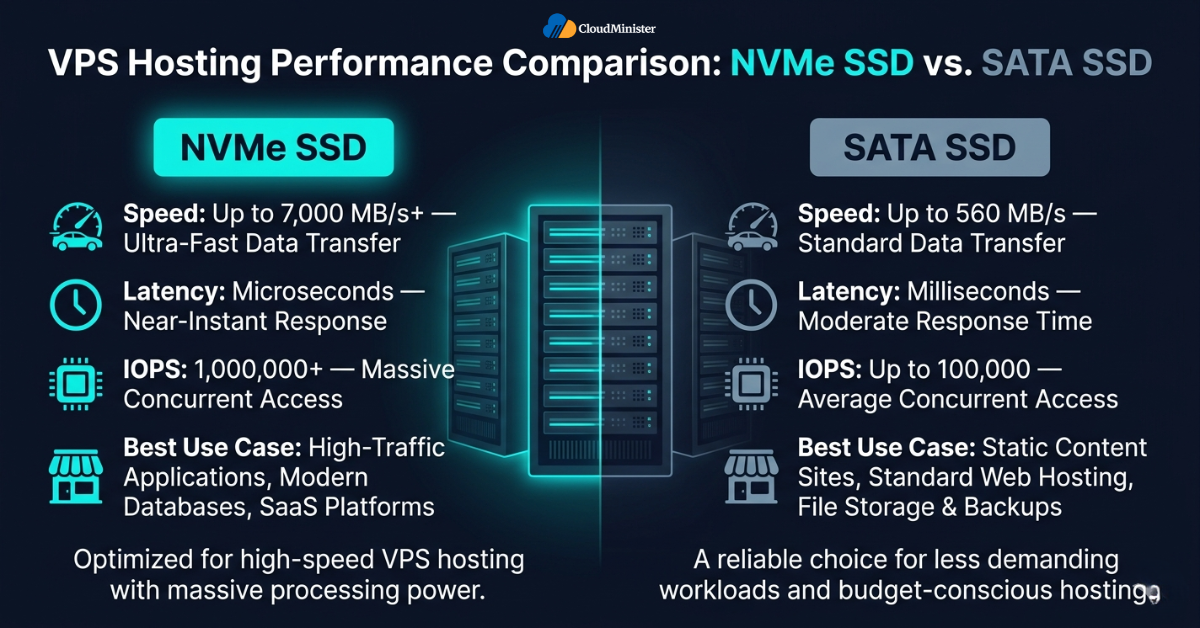
- Storage media: NVMe SSD storage is materially faster than SATA SSD or legacy HDD, and the price difference between an NVMe plan and a SATA plan at the same RAM is one of the largest single line items in VPS Hosting in India pricing.
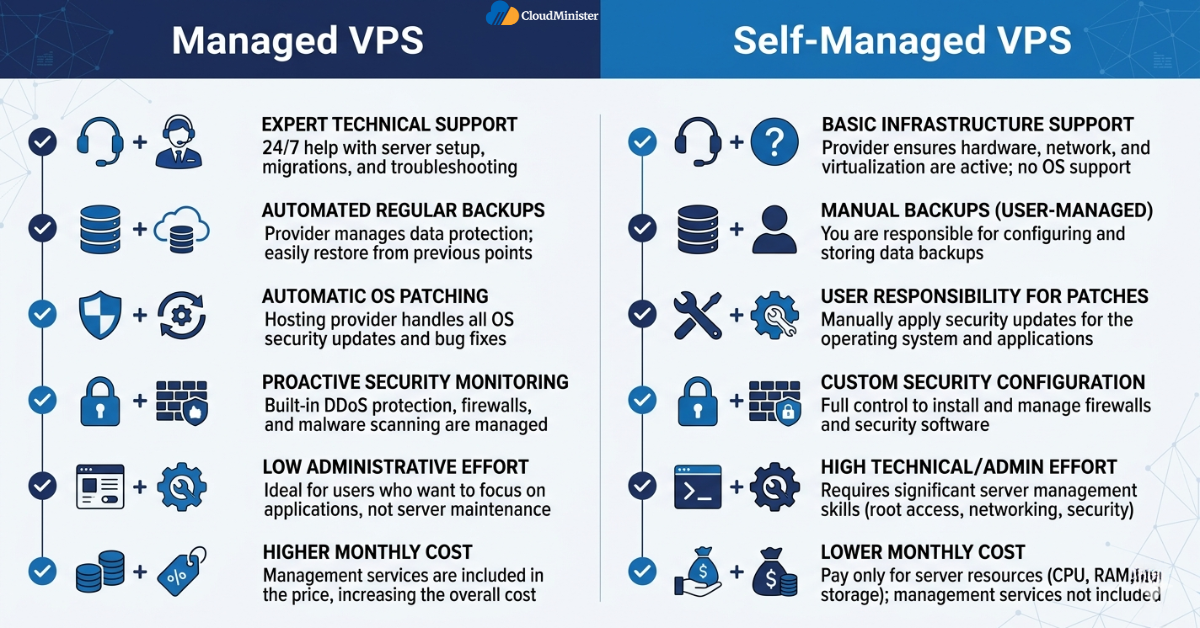
- Management model: A self-managed (unmanaged) server only bills you for infrastructure; a fully managed plan adds OS patching, security hardening, monitoring and backups — typically a 40% to 100% premium over the same hardware.
- Operating system licensing: Linux carries no licence cost; a Windows server adds a Windows Server licence fee on top of the base hardware, which is why Windows tiers always sit above comparable Linux tiers.
- Data-centre location: A server in an Indian data centre (Mumbai, Delhi NCR, Bangalore, Chennai) costs slightly more than an oversold offshore node but delivers sub-30ms latency to Indian users — a direct Core Web Vitals and SEO advantage.
Before comparing any VPS Hosting in India price, pull your last 90 days of server metrics — peak CPU, peak RAM, sustained disk I/O and concurrent connections. Right-sizing against real workload data beats buying by headline RAM every time. A correctly sized 2 GB NVMe server routinely outperforms a poorly tuned 8 GB SATA server at half the price.
2. The Three Pricing Tiers of VPS Hosting in India
The market splits cleanly into three pricing bands in 2026. Understanding which band your workload belongs in is the single most important step before you look at any provider.
2.1 Entry Tier — Self-Managed Linux (₹350 – ₹900 / month)
- Typical specs: 1–2 vCPU, 1–4 GB RAM, 20–60 GB NVMe SSD, 1–2 TB monthly transfer.
- Best for: developers, staging environments, low-traffic WordPress sites, small APIs, cron and batch jobs.
- This is where the cheapest vps hosting in india plans live, and where overselling is most aggressive — always confirm KVM virtualisation and dedicated resources before buying at this price point.
- OS is almost always Linux at this tier because adding a Windows licence would roughly double the effective price.
- If you want the cheapest linux vps that is still production-safe, the rule is simple: a verified KVM NVMe plan at the upper end of this band beats an unverified bargain at the bottom of it every time.
- The cheapest vps in india that newcomers find is usually an oversold container node — cheap on paper, expensive in downtime.
2.2 Mid Tier — Managed Linux / Production Workloads (₹1,200 – ₹3,500 / month)
- Typical specs: 2–4 vCPU, 4–8 GB RAM, 80–160 GB NVMe SSD, 3–5 TB transfer, daily backups.
- Best for: production WordPress and WooCommerce, business websites, mid-traffic SaaS, multi-site agencies.
- The managed premium here buys OS patching, security hardening, monitoring, backups and human support — for teams without a dedicated sysadmin this is usually the correct tier for VPS Hosting in India.
2.3 Premium Tier — High-Performance NVMe / Windows (₹1,400 – ₹8,500+ / month)
- Typical specs: 4–8+ vCPU, 8–32 GB RAM, 160 GB+ enterprise NVMe, 5 TB+ transfer, priority support and SLA.
- Best for: high-traffic e-commerce, transactional databases, resource-heavy applications, and any Windows-only stack.
- Windows plans almost always sit in this band because the Windows Server licence is bundled into the monthly price.
- A premium-tier windows vps server suits enterprise .NET and MSSQL stacks; teams that buy windows vps server capacity at this tier are paying for both the hardware and the bundled licence in one predictable monthly figure.
A rock-bottom price in the entry tier often signals an oversold node with no isolation — when a neighbouring tenant is compromised or saturates the host, your server degrades or goes down with it. For any production workload, the security and stability of guaranteed KVM resources is worth the price step up. Never run customer data or payment flows on the cheapest unverified plan you can find./p>
Related Reading: The Ultimate Guide to VPS Hosting: Benefits, Types & How to Choose the Best Plan
3. The 2026 INR Pricing Tables
Here are representative 2026 price bands for VPS Hosting in India, organised by management model and operating system. Figures are indicative monthly rates in INR, exclusive of 18% GST, on annual billing.
3.1 Self-Managed Linux VPS Pricing (India, 2026)
| Plan | Indicative Price (per mo) | Typical Specs | Best Use Case |
| Starter | ₹350 – ₹550 | 1 vCPU / 1–2 GB RAM / 25 GB NVMe | Dev, staging, small APIs |
| Basic | ₹600 – ₹900 | 2 vCPU / 4 GB RAM / 50 GB NVMe | Low-traffic WordPress |
| Standard | ₹1,000 – ₹1,600 | 4 vCPU / 8 GB RAM / 100 GB NVMe | Growing sites, light SaaS |
| Advanced | ₹1,800 – ₹2,800 | 6 vCPU / 16 GB RAM / 160 GB NVMe | Databases, busy apps |
Self-managed pricing only covers infrastructure — you own all OS patching, security and recovery. This is the band where the cheapest vps in india offers cluster, and where verifying KVM virtualisation matters most.
3.2 Managed Linux VPS Pricing (India, 2026)
| Plan | Indicative Price (per mo) | Typical Specs | Includes |
| Managed S | ₹1,200 – ₹1,800 | 2 vCPU / 4 GB RAM / 80 GB NVMe | Patching, backups, monitoring |
| Managed M | ₹2,000 – ₹3,000 | 4 vCPU / 8 GB RAM / 120 GB NVMe | + security hardening, support |
| Managed L | ₹3,200 – ₹4,500 | 6 vCPU / 16 GB RAM / 160 GB NVMe | + priority support, tuning |
| Managed XL | ₹5,000 – ₹7,000+ | 8+ vCPU / 32 GB RAM / 240 GB NVMe | + SLA, dedicated assistance |
The managed premium is typically 40–100% over equivalent self-managed hardware — for many teams it offsets a meaningful share of what a part-time sysadmin would otherwise cost, and is usually the right call for a production server when in-house Linux expertise is limited.
All prices above are indicative monthly rates in INR, exclusive of 18% GST, on annual billing.
3.3 Windows VPS Pricing (India, 2026)
| Plan | Indicative Price (per mo) | Typical Specs | Note |
| Windows S | ₹1,400 – ₹2,000 | 2 vCPU / 4 GB RAM / 60 GB NVMe | Windows Server licence bundled |
| Windows M | ₹2,400 – ₹3,400 | 4 vCPU / 8 GB RAM / 100 GB NVMe | RDP, .NET, MSSQL workloads |
| Windows L | ₹4,000 – ₹5,500 | 6 vCPU / 16 GB RAM / 160 GB NVMe | Heavier Windows applications |
| Windows XL | ₹6,000 – ₹8,500+ | 8+ vCPU / 32 GB RAM / 240 GB NVMe | Enterprise Windows stacks |
All prices above are indicative monthly rates in INR, exclusive of 18% GST, on annual billing.
Power Your Website with VPS Hosting
Get faster performance, better control, and scalable resources for your business with CloudMinister’s VPS Hosting in India.
A Windows box is consistently more expensive than the equivalent Linux box because of the bundled licence. If your stack is .NET, MSSQL or a Windows-only desktop tool, you can compare configured windows vps server plans with Indian data-centre locations and INR billing rather than estimating licence costs yourself. Teams that need to buy windows vps server capacity will find the licence is already priced in at every tier above.
The most common budgeting error with a Windows server is treating it as “Linux price plus a little.” In reality the Windows Server licence is a fixed monthly cost layered onto the same hardware. If your application can run on Linux, the equivalent self-managed Linux VPS at the same specs will almost always be 25–40% cheaper — switch the OS, not the hardware tier, to cut cost without losing performance.
Practical reading of the table above: a small windows vps server starts where a mid Linux plan ends, and the gap widens at every higher tier. Before you buy windows vps server resources, confirm the application genuinely needs Windows — if it can run on Linux, the cheapest linux vps at the same specs is the cheaper, equally capable choice. For Windows-bound stacks, a correctly sized windows vps server still beats an over-provisioned one, because the licence rides on top of whatever hardware you pick.
Related Reading: Managed vs Unmanaged Linux VPS: Making the Right Choice
4. The Annual Cost Comparison That Actually Matters
Sticker price per month is the wrong number to budget against. Here is the practical 12-month outlay comparison most Indian buyers care about, for a typical mid-tier production workload (4 vCPU / 8 GB RAM / 100–120 GB NVMe):
- Self-managed Linux: ₹1,300/mo × 12 = ₹15,600/year + GST — lowest infrastructure cost, but you absorb all admin labour.
- Managed Linux: ₹2,500/mo × 12 = ₹30,000/year + GST — roughly ₹13,000/year more than self-managed, which for many small teams offsets a significant portion of the part-time sysadmin work they would otherwise need to cover.
- Windows M (4 vCPU / 8 GB RAM): ₹2,900/mo × 12 = ₹34,800/year + GST — the Windows Server licence accounts for most of the gap over managed Linux.
On pure infrastructure cost, self-managed Linux VPS Hosting in India is unbeatable — but only if you have the in-house Linux skill to run it safely. For most small teams, the managed Linux tier delivers the best real-world value once the cost of admin time is honestly counted. The Windows premium is justified only when the application genuinely requires a Windows environment.
When modelling the annual cost, add a realistic figure for admin time on self-managed plans — even 2 hours a week of engineer time at Indian market rates often exceeds the entire managed premium. The “cheaper” plan is frequently the more expensive one once labour is counted.
Two phrases dominate search at this point of the decision — the cheapest vps hosting in india and the cheapest vps in india — and both are misleading on their own. The cheapest vps hosting in india headline is almost always an oversold, first-term-only price, while the lowest-ranked-by-price result is rarely the one that survives a traffic spike. Anchor on performance-per-rupee, not on the word “cheapest.”
5. The Hidden Costs Nobody Prints on the Pricing Page
The advertised monthly rate is rarely the real cost of VPS Hosting in India. These indirect line items routinely add 15–35% to the first-year total and are the single biggest reason buyers feel mis-sold.
5.1 GST and Billing Cadence
- All India-billed plans attract 18% GST at checkout — a ₹2,000/month plan is effectively ₹2,360/month after tax.
- Monthly billing typically carries a 15–25% premium over annual commitment — the headline price you saw was almost always the annual-billing rate.
5.2 Renewal and Promotional Pricing
- Many entry plans advertise a heavily discounted first-term price; the renewal can be 1.5x to 2x higher, so always confirm the renewal rate before committing.
- This is most aggressive in the cheapest vps hosting in india band — the cheapest vps in india headline is frequently a first-year-only number.
5.3 Add-Ons That Become Mandatory
- Backups, additional IPv4 addresses, control panels (cPanel/Plesk), extra bandwidth and managed-security add-ons are often priced separately.
- A cPanel licence alone can add a meaningful monthly figure — budget for it explicitly rather than discovering it at checkout.
5.4 Migration and Setup
- Migrating an existing site onto a new server has a real cost — either provider migration fees or internal engineering hours.
- Plan a migration window of several days with a pilot phase; a rushed weekend cutover is the most common source of post-migration downtime.
Skipping the backup add-on to hit a lower price is the single most expensive “saving” in VPS Hosting in India. A self-managed server with no automated, off-server backups is one bad deploy or compromise away from total data loss. Treat backups as a non-negotiable line item, never an optional extra, regardless of which pricing tier you choose.
Related Reading: Linux VPS vs Windows VPS: Which Should You Choose?
6. The 2026 Market Context — Why This Decision Compounds
The pace of cloud and infrastructure adoption among Indian businesses in 2026 is what makes a VPS pricing decision a multi-year commitment rather than a throwaway monthly expense. The architecture you pick today will compound over a 3–5 year horizon, and the migration cost of a mid-cycle change is non-trivial.
The scale of this shift is significant. According to industry projections, India’s cloud computing market is expected to cross ₹2 lakh crore (approximately USD 24 billion) by 2026 and is projected to grow at a double-digit CAGR through 2031 — with Infrastructure-as-a-Service, the category a VPS belongs to, among the fastest-growing segments. That means VPS Hosting in India is no longer a niche developer purchase; it is mainstream infrastructure whose pricing and capacity planning deserve the same rigour as any other operating cost.
Adoption at the small-business level reinforces the point. Industry research on India’s small business landscape indicates that a majority of Indian small businesses were started in the last five years and roughly 6 out of 10 now run a website, online store or e-commerce platform — every one of which sits on hosting infrastructure. As more of these businesses outgrow shared hosting, a VPS becomes the default next step, and getting the pricing decision right the first time directly protects margin.
This adoption curve reinforces a key point: choosing the wrong VPS tier or provider is no longer a low-stakes decision. The cost difference between a right-sized plan and an over-provisioned or oversold one compounds quietly across years of billing cycles.
7. Performance per Rupee — Where the Real Value Sits
The cheapest plan and the best-value plan are rarely the same plan. The single most predictive variable for real-world value in VPS Hosting in India, after correct sizing, is the storage and virtualisation combination.
7.1 NVMe vs SATA — The Performance Premium
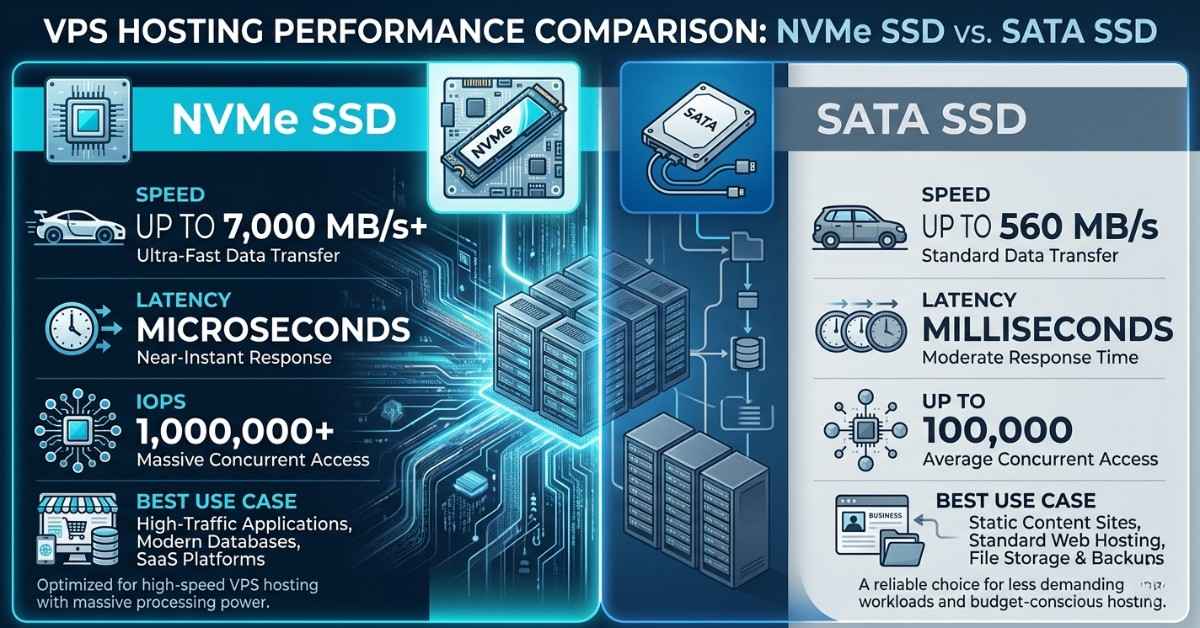
- NVMe SSD storage delivers dramatically higher IOPS and lower latency than SATA SSD — for database-driven sites this is the difference between a snappy and a sluggish application.
- The price step from a SATA plan to an NVMe plan at the same RAM is usually small relative to the performance gain — for any transactional workload, NVMe is the higher-value choice even at a slightly higher price.
- Providers offering NVMe-backed cloud VPS plans in India combine NVMe performance with cloud-style scalability — useful when traffic is uneven and you want to scale resources without a full migration. A well-tuned NVMe cloud VPS frequently outperforms a larger SATA VPS at comparable cost.
7.2 KVM Isolation — The Stability Premium
- KVM-based VPS Hosting in India provides hardware-level isolation between tenants and, when the host is not oversubscribed, delivers far more predictable vCPU and RAM performance than container-based virtualisation — the key is to confirm with the provider that the host itself is not heavily oversold, since KVM isolates tenants but does not by itself prevent a provider from oversubscribing CPU or storage at the host level.
- Oversold container plans can advertise the same specs for less, but throughput collapses when neighbouring tenants spike — the lower price buys lower reliability.
7.3 The Right-Sizing Principle
- A correctly sized 4 GB NVMe KVM server with tuned Nginx, PHP-FPM and caching routinely handles more real traffic than an untuned 8 GB SATA server at a higher price.
- Spend on architecture and tuning before spending on raw RAM — it is the highest-return optimisation available.
- Where uneven traffic makes a fixed VPS awkward, a cloud VPS with NVMe storage sits one step up — the same NVMe speed with elastic scaling, so a spike does not force a migration. For many growing Indian sites, a right-sized NVMe-backed cloud VPS plan is the natural successor to an entry VPS.
The cheapest linux vps that is oversold and untuned will cost you more in downtime and lost conversions than a slightly pricier KVM NVMe plan that is correctly sized. Evaluate VPS Hosting in India on performance-per-rupee delivered to your actual workload — never on the headline monthly figure in isolation.
Related Reading: Cloud Hosting vs VPS vs Dedicated Server in India 2026
8. Decision Framework — Which Price Tier Fits Your Profile?
There is no universal “correct price” for VPS Hosting in India, but there are clear answers for specific profiles. These are the most common archetypes we see in 2026.
Two practical reminders before the profiles: first, the cheapest linux vps that is correctly sized usually wins on value, so do not default to the cheapest linux vps that simply has the lowest sticker price. Second, if Windows is mandatory, choose a Web Hosting Provider in India that prices the windows vps server licence transparently — a hidden licence line is the most common nasty surprise when you buy windows vps server resources. The right Web Hosting Provider in India will also offer NVMe-backed cloud VPS plans as a clean upgrade path so a single windows vps server or Linux box is never a dead end.
Profile 1: Developer / Staging / Side Project
- Recommendation: Entry-tier self-managed Linux (₹350–₹900/month).
- You have the Linux skill to self-manage, traffic is low, and a verified KVM NVMe box at this price is more than sufficient — this is the legitimate home of the cheapest vps hosting in india.
Profile 2: Small Business Website / Low-Traffic WordPress
- Recommendation: Entry managed or mid-tier managed Linux (₹1,200–₹2,000/month).
- You do not have a sysadmin; the managed premium buys patching, backups and support that protect revenue. Do not chase the cheapest vps in india headline here — uptime matters more than the saving.
Profile 3: Production SaaS / E-Commerce
- Recommendation: Mid-to-premium managed NVMe Linux (₹2,500–₹5,000/month).
- Performance and reliability directly affect conversions — NVMe, KVM isolation and priority support justify the higher tier.
Profile 4: Windows-Only Application Stack
- Recommendation: Windows VPS, sized to workload (₹1,400–₹6,000+/month).
- If the stack is .NET, MSSQL or a Windows desktop tool, the licence is unavoidable — size the hardware tightly so you are not also overpaying for unused cores. Teams that must buy windows vps server capacity should right-size aggressively to offset the licence cost.
Match the pricing tier to your workload profile first, then optimise within that tier — never start from the lowest price and work upward. Starting from price almost always lands you on an oversold plan that fails at the worst possible moment; starting from profile lands you on the cheapest plan that actually works
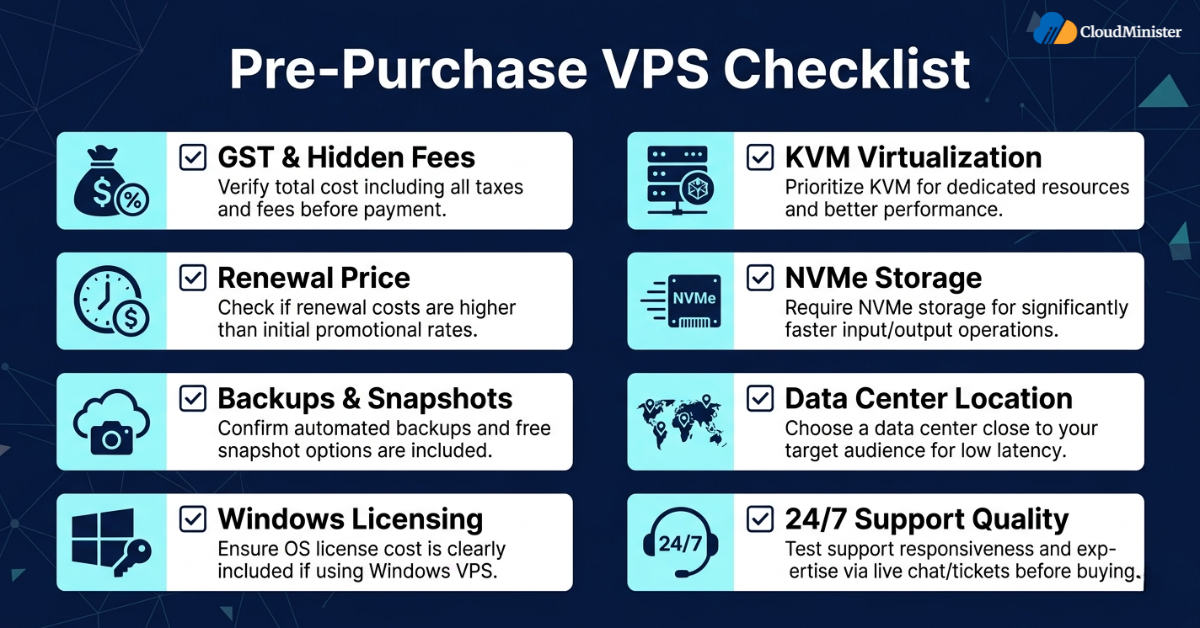
9. Final Pricing Checklist Before You Buy
Use this checklist to ensure your VPS Hosting in India evaluation is complete before committing to any annual plan.
- Workload audit: Do you know your real peak CPU, RAM and disk I/O from the last 90 days?
- Virtualisation confirmed: Is the plan genuinely KVM with dedicated, non-oversold resources?
- Storage verified: Is it true NVMe SSD, and is the IOPS/throughput documented?
- Management model: Self-managed or managed — and have you costed your own admin time honestly?
- OS licensing: If you intend to buy windows vps server capacity, is the Windows Server licence already bundled in the quoted price?
- GST and cadence: Is the price you compared the annual-billing, pre-GST or post-GST figure?
- Renewal rate: Is the headline a first-term promo, and what is the documented renewal price?
- Add-on total: Have you added backups, IPs, control panel and bandwidth into the real monthly cost?
- Data-centre location: Is it an Indian data centre for low latency to Indian users?
- Exit path: Do you understand the backup-export and migration path before you sign the entry contract?
10. Where VPS Pricing Connects to the Rest of Your Stack
A VPS never exists in isolation — its real cost is shaped by the domain, DNS and adjacent infrastructure decisions around it.
10.1 Domain, DNS and Hosting Consolidation
- Your VPS needs a domain, DNS and mail routing — splitting these across three vendors adds hidden coordination cost and failure points.
- Consolidating with a single Web Hosting Provider in India that also handles your VPS reduces operational friction and usually bundles DNS management and migration assistance into the price.
10.2 Scaling Path and Future Cost
- A VPS should have a clear upgrade path — to a larger VPS, cloud or dedicated server — without a disruptive provider change.
- Factor the cost of the next tier into today’s decision; the cheapest plan with no clean scaling path is expensive the moment you outgrow it.
10.3 The Consolidated Vendor Advantage
- A single provider handling VPS, domain, DNS and security reduces vendor-management overhead — for small IT teams this often delivers more practical value than chasing the absolute lowest price on each component.
- A full-stack Web Hosting Provider in India that also offers NVMe-backed cloud VPS and Windows options lets you scale across architectures without changing vendor — the cost of switching providers mid-growth is one of the most underestimated line items in the whole VPS Hosting in India budget.
- For Indian SMBs in particular, a consolidated Web Hosting Provider in India relationship turns a fragmented hosting bill into one predictable, GST-compliant invoice — and the cheapest vps in india is only genuinely cheap when it does not later force an expensive vendor migration.
11. Conclusion — What Your VPS Pricing Decision Should Look Like
The cost of VPS Hosting in India in 2026 is not a single number — it is a structured decision driven by workload profile, management model, operating system and the indirect costs that never appear on a pricing page. A properly conducted evaluation will point clearly to one tier for any given profile.
The Honest Summary
- Self-managed Linux wins on raw infrastructure cost — but only if you have the in-house skill to run it safely.
- Managed Linux wins on real-world value for most small and mid-sized Indian teams once admin labour is honestly counted.
- Windows VPS is justified only when the application genuinely requires Windows — otherwise the licence is pure avoidable cost.
- NVMe and KVM isolation are value multipliers, not luxuries — they routinely outperform larger, cheaper, oversold plans.
- True first-year cost runs 15–35% above the sticker price once GST, renewal, add-ons and migration are included.
The right answer for your business depends on which of those map to your operating reality. Reassess every 12 months — pricing, hardware generations and provider promotions all shift, and a plan that was optimal in 2026 may need revisiting in 2027.
Key Takeaways
• VPS Hosting in India in 2026 spans three clear bands: entry self-managed Linux (₹350–₹900), mid-tier managed Linux (₹1,200–₹3,500) and premium/Windows (₹2,500–₹7,000+).
• The India cloud computing market is estimated at roughly USD 26.43 billion in 2026, growing at about 21.10% CAGR through 2031 — VPS-class IaaS is among the fastest-growing segments.
• A Windows VPS is consistently more expensive than equivalent Linux because the Windows Server licence is bundled into the monthly price.
• True first-year cost is 15–35% higher than the listed sticker price after GST, renewal, add-ons and migration are counted.
• NVMe + KVM isolation, correctly sized, beats a larger oversold SATA plan on real-world performance per rupee.
• Match the pricing tier to your workload profile first; starting from the lowest price almost always lands you on an oversold plan that fails under load.
• Reassess your VPS Hosting in India decision every 12 months — provider pricing and hardware generations move faster than a 3-year plan assumes.
Frequently Asked Questions
Q1. How much does VPS Hosting in India cost in 2026?
It typically ranges from about ₹350–₹900/month for entry-level self-managed Linux, ₹1,200–₹3,500/month for managed Linux production plans, and ₹2,500–₹7,000+/month for premium NVMe or Windows configurations. All India-billed plans add 18% GST, and monthly billing usually carries a 15–25% premium over annual commitment. The right number depends on your workload profile, not the lowest headline rate.
Q2. Why is a Windows VPS more expensive than a Linux VPS in India?
A Windows server bundles a Windows Server licence into the monthly price, while Linux carries no licence cost. At the same hardware specs, a Windows plan is typically 25–40% more expensive than the equivalent self-managed Linux plan. If your application can run on Linux, switching the OS rather than the hardware tier is the most direct way to cut cost without losing performance.
Q3. Is the cheapest VPS Hosting in India safe for production?
Not always. The cheapest plans are frequently oversold container-style nodes with no resource isolation — they perform acceptably until a neighbouring tenant spikes or is compromised, at which point your server degrades or goes down. For any production or revenue-bearing workload, confirm genuine KVM virtualisation with dedicated resources, even if it costs a step more.
Q4. Should I choose a managed or self-managed plan?
Self-managed is cheaper on infrastructure but you absorb all OS patching, security and recovery work. Managed typically adds a 40–100% premium, and for many small teams it offsets a meaningful share of part-time sysadmin work they would otherwise have to absorb. For teams without in-house Linux expertise, managed Linux is usually the better real-world value once admin time is honestly priced. Self-managed only wins when you genuinely have the skill and time to run it safely.
Q5. Does NVMe storage actually justify the higher price?
For database-driven or transactional workloads, yes. NVMe SSD delivers far higher IOPS and lower latency than SATA SSD, and the price step at the same RAM is usually small relative to the performance gain. A correctly tuned NVMe plan frequently outperforms a larger, cheaper SATA plan — making it the higher-value choice for most production sites.
Q6. What hidden costs should I budget for?
Beyond the sticker price, budget for 18% GST, the monthly-billing premium if you do not commit annually, the renewal rate after any promotional first term, mandatory add-ons (backups, extra IPs, control panel licences, bandwidth) and migration or setup effort. Together these routinely add 15–35% to the first-year total.
Q7. How often should I review my VPS Hosting in India plan?
Reassess every 12 months. Provider pricing, hardware generations, promotional rates and your own traffic all change over that horizon. A plan that was correctly sized and competitively priced in 2026 may be over-provisioned, under-powered or simply overpriced relative to the market by 2027 — a yearly review keeps cost aligned with actual need.

He is the CEO and Founder with over a decade of experience in cloud infrastructure, DevOps, and server optimization. With a strong vision and hands-on leadership approach, he has built scalable, secure, and high-performance cloud solutions trusted by businesses across industries.