Every team scaling an AI product in 2026 eventually faces the same question, which chip should actually run the models. The Google TPU vs NVIDIA GPU decision used to be simple since NVIDIA was the only serious option for most businesses outside Google’s own infrastructure, but Google’s newer Ironwood TPU has closed that gap significantly. This guide breaks down the real technical differences, the workloads where each chip pulls ahead, the software trade-offs, and the cost realities most comparisons skip over, so the Google TPU vs NVIDIA GPU choice feels like an informed engineering decision rather than a guess based on brand familiarity.
Choosing the right AI accelerator has quietly become one of the biggest infrastructure decisions a business will make this year. The Google TPU vs NVIDIA GPU comparison sits right at the center of that decision, because the answer directly shapes training timelines, inference costs, and how easily a team can scale once a product actually starts gaining traction. A few years ago this was barely worth debating, since NVIDIA was the default choice for almost everyone outside Google’s own infrastructure. That is not the case anymore, and teams that assume the old default still holds are increasingly making decisions on outdated information.
What changed is that Google has invested heavily in closing the performance gap with its newer TPU generations, while NVIDIA has continued pushing its own hardware and software ecosystem forward at the same time. The result is that the Google TPU vs NVIDIA GPU comparison today is not a story of one clear winner and one clear loser. It is a genuine trade-off between two mature platforms, each with real strengths depending on the workload being run. Businesses that treat this as a settled question risk either overpaying for capacity they do not need or picking a platform that quietly limits their flexibility down the road.
This is exactly why the Google TPU vs NVIDIA GPU decision deserves more than a quick glance at marketing specifications. The right choice depends on the specific shape of the workload, the existing cloud relationships a business already has, the internal team’s technical comfort with each ecosystem, and the realistic budget available for both training and inference. The sections that follow walk through the architecture differences, real performance numbers, software maturity, and cost structure behind this decision, so the final call can be based on actual engineering trade-offs rather than assumptions carried over from a few years ago.
Table of Content
1. What Are We Actually Comparing in the Google TPU vs NVIDIA GPU Debate?
The Google TPU vs NVIDIA GPU comparison is not simply “chip A versus chip B.” It is a comparison between two fundamentally different design philosophies for accelerating matrix multiplication, which is the core mathematical operation behind nearly all modern AI.
- A Tensor Processing Unit, or TPU, is an application-specific integrated circuit that Google designed from the ground up specifically for neural network training and inference, with no general-purpose graphics functions attached at all.
- A GPU, or graphics processing unit, was originally built for rendering images and later adapted into the dominant AI accelerator through NVIDIA’s CUDA software platform, which is now the most mature parallel computing ecosystem in the industry.
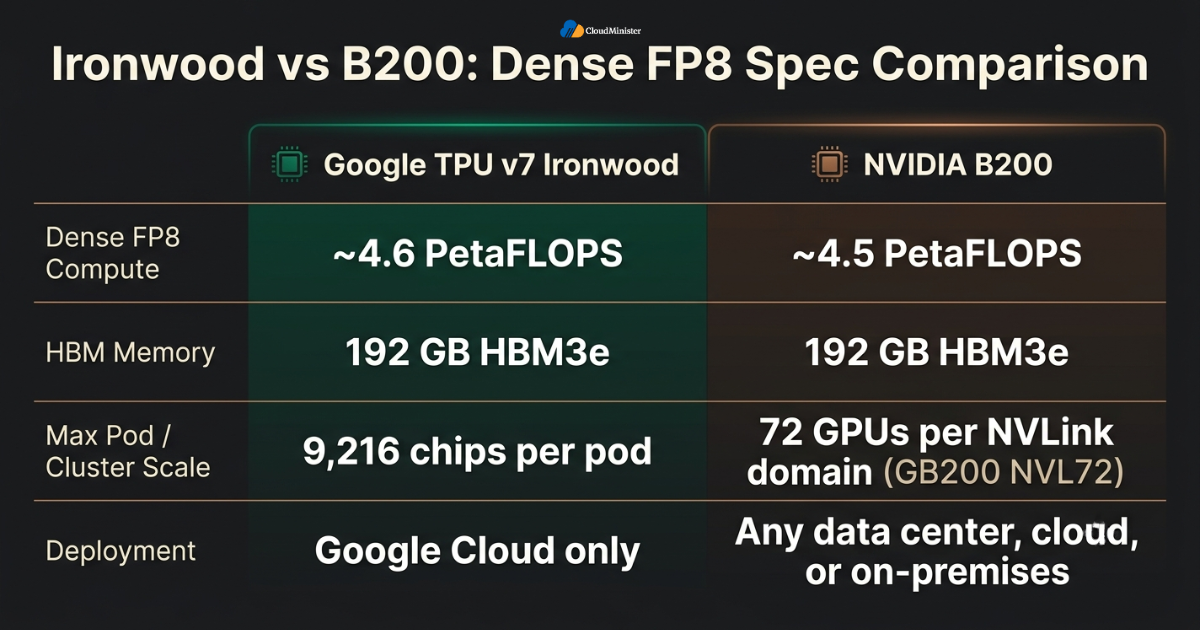
- This distinction matters most at the systems level, since TPUs are only available as a managed cloud service through Google Cloud Platform, while an NVIDIA GPU can be purchased, rented, or deployed in nearly any data center in the world.
- Google’s TPU v7, code-named Ironwood, delivers approximately 4.6 petaFLOPS of dense FP8 compute per chip, while NVIDIA’s B200 is rated at roughly 9 petaFLOPS of FP8 compute with sparsity, or approximately 4.5 petaFLOPS dense, meaning the two chips are roughly comparable only when both figures are measured on a dense (non-sparse) basis, according to hardware analysis comparing both chips’ published specifications.
- Both current-generation chips pack a comparable amount of high bandwidth memory per accelerator, which is one of the clearest signs that the performance gap has narrowed significantly compared to previous chip generations.
- Businesses researching a GPU-based alternative to TPU access will also want to understand what a properly specified cluster looks like before comparing pricing.
Teams deploying either accelerator at scale need to treat data center access and model weight security as a first-class concern. TPU pods are managed entirely within Google Cloud’s security boundary, while a self-hosted GPU cluster puts network segmentation, firmware patching, and physical access control directly in the hands of the team running it. Skipping a proper security review after standing up new AI infrastructure is one of the most common ways sensitive training data or proprietary model weights end up exposed.
2. Why the Google TPU vs NVIDIA GPU Question Matters More in 2026
The Google TPU vs NVIDIA GPU decision has moved from a niche research topic to a mainstream budgeting conversation, and the numbers explain why.
- NVIDIA is projected to keep the majority of AI accelerator revenue through the rest of the decade, with Bloomberg Intelligence forecasting GPUs will hold roughly 81 percent of total accelerator market revenue by 2033, underscoring just how dominant CUDA and NVIDIA silicon remain across training workloads specifically.
- At the same time, custom silicon including Google’s TPU line is projected to grow at a much faster compound annual rate than general-purpose GPUs through the early 2030s, narrowing the revenue gap even as GPUs keep the larger absolute share.
- The choice increasingly comes down to workload type: large-scale, steady-state inference tends to favor TPU pods, while flexible, rapidly iterating training work still leans toward a Dedicated NVIDIA GPU Server and the broader CUDA ecosystem.
- Businesses running inference at very high volume, such as recommendation engines or large consumer-facing chatbots, are the segment most actively weighing the Google TPU vs NVIDIA GPU trade-off today, since inference now consumes a majority of total AI compute cycles industry-wide.
- Enterprises that are not Google Cloud customers by default usually resolve the Google TPU vs NVIDIA GPU question in favor of GPUs simply because GPU Servers for AI are available across nearly every major cloud and hosting provider, while TPU access is tied to a single vendor.
- For businesses comparing infrastructure options before locking in a provider, understanding how GPU Servers for AI differ across regions and providers is a useful starting point, and our related article on Dedicated NVIDIA GPU Server infrastructure for AI training explains exactly what a properly specified training server looks like in 2026.
- Teams that outgrow shared or fractional GPU access typically notice performance ceilings months before they actually bottleneck a launch, which is exactly the window where a Web Hosting Company in India worth trusting will recommend a dedicated setup rather than waiting for a crisis.
- Best GPU cloud hosting in India has become considerably more competitive on pricing over the past year as more regional and global providers enter the market.
- Businesses evaluating best GPU cloud hosting providers at this stage often discover that a fractional GPU plan can no longer keep pace with production traffic, which is usually the clearest signal that a dedicated allocation is overdue.
Before making a Google TPU vs NVIDIA GPU decision, run a two-week benchmark of your actual model architecture on both platforms if at all possible, rather than relying only on published FLOPs comparisons. Real-world throughput on your specific model, batch size, and precision setting often diverges meaningfully from vendor benchmarks, and this single step consistently prevents teams from committing to the wrong accelerator for their exact workload.
3. Architecture Differences: How TPUs and GPUs Actually Work
Understanding this comparison at a technical level requires looking past the marketing slides and into how each chip actually processes a neural network.
3.1 How a TPU Processes Data
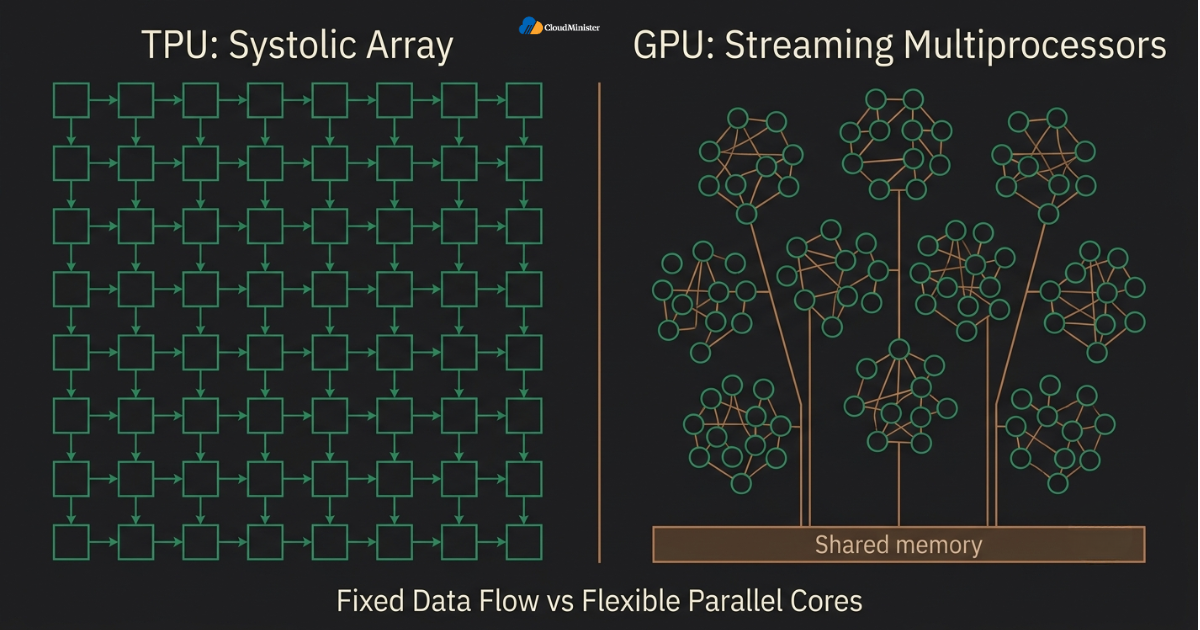
- TPUs are built around a systolic array architecture, where data flows through a tightly connected grid of arithmetic units in a fixed, predictable pattern designed specifically for matrix multiplication.
- This design removes a large amount of the instruction scheduling overhead that general-purpose processors carry, which is one reason TPUs achieve strong performance per watt on the specific operations neural networks require.
- Google’s Ironwood TPU v7 pods can scale up to 9,216 chips connected through a proprietary high-speed interconnect, which is a scale of tight coupling that no current NVIDIA system matches in a single pod.
- Businesses that need GPU Servers for AI alongside traditional web or application hosting generally find a single unified provider more convenient than splitting infrastructure across vendors.
- TPUs lack general-purpose graphics or broadly programmable compute cores, meaning workloads outside standard neural network operations often cannot run on them at all without significant re-engineering.
- Every TPU deployment runs exclusively inside Google Cloud, so there is no equivalent to renting a Dedicated NVIDIA GPU Server for a TPU, no on-premises TPU hardware, and no multi-cloud TPU deployment option.
3.2 How an NVIDIA GPU Processes Data
- An NVIDIA GPU uses thousands of smaller, more flexible cores organized into streaming multiprocessors, which handle a much wider range of workloads beyond pure matrix multiplication, including simulation, rendering, and general parallel computing.
- The GB200 NVL72 system links 72 GPUs into a single coherent unit using NVIDIA’s NVLink interconnect, which is a smaller scale-up domain than a full TPU pod but offers more flexibility in how clusters are configured and expanded.
- CUDA, NVIDIA’s parallel computing platform, has over a decade of software maturity behind it, meaning nearly every popular machine learning framework, library, and research paper assumes NVIDIA GPU compatibility as a baseline.
- A business can deploy a Dedicated NVIDIA GPU Server on-premises, through a colocation facility, or through virtually any Web Hosting Company in India that offers GPU Servers for AI, giving far more deployment flexibility than the TPU’s single-cloud model.
- This flexibility is the core reason many businesses resolve the Google TPU vs NVIDIA GPU decision in favor of a Dedicated NVIDIA GPU Server even when a TPU might technically deliver better raw throughput for a narrow inference workload.
- Reading independent reviews before signing up for best GPU cloud hosting is worthwhile on its own, and doing the same for best GPU cloud hosting aimed specifically at inference workloads is equally important, since marketing pages rarely disclose actual driver update cadence or support ticket response times.
- Providers offering best GPU cloud hosting typically pre-provision current-generation NVIDIA silicon precisely because CUDA compatibility remains the path of least resistance for most engineering teams.
The systolic array versus streaming multiprocessor distinction is the single most important architectural fact in the entire Google TPU vs NVIDIA GPU conversation. It explains why TPUs excel at predictable, repetitive matrix operations at massive scale, while GPUs remain the more general-purpose, adaptable choice for teams whose workloads change frequently or who need software flexibility beyond standard deep learning operations.
4. Google TPU vs NVIDIA GPU: Training Performance Compared
Training is where the Google TPU vs NVIDIA GPU comparison has historically favored NVIDIA, and 2026 data shows a more nuanced picture.
- Teams provisioning GPU Servers for AI for the first time should confirm which NVIDIA generation is actually installed, since older inventory is sometimes sold at current-generation prices.
- NVIDIA’s Hopper generation, specifically the H100 and H200, has historically held the fastest absolute training times at equivalent accelerator counts on established large language model benchmarks, reflecting NVIDIA’s structural speed advantage on dense training workloads.
- A responsible Web Hosting Company in India will typically walk a client through both training and inference cost projections before recommending a specific GPU tier.
- Google’s TPU v6 Trillium closed much of the training performance gap against NVIDIA’s prior generation, delivering roughly double the peak theoretical FLOPs of its own predecessor chip while staying on the same manufacturing process node.
- TPU v7 Ironwood narrows the training gap further still, coming within a few percentage points of NVIDIA’s B200 on dense FP8 compute, though general availability trailed Blackwell by roughly a year, which matters for teams needing capacity immediately.
- Multi-node training scalability remains a genuine strength for both platforms, but the comparison tips toward TPU pods for extremely large, homogeneous training runs where all 9,216 chips in a pod work on a single coordinated job.
- NVIDIA’s GB200 NVL72 architecture, by contrast, is optimized for flexible training configurations that can be resized, reconfigured, and mixed with other workloads more easily than a fixed TPU pod allocation.
- Teams running iterative research workloads, where architecture experiments change weekly, generally find a rented GPU server easier to work with than committing to a large, fixed TPU pod allocation.
- Organizations planning a large training run should factor total cost of ownership into the Google TPU vs NVIDIA GPU decision rather than looking at peak FLOPs alone, and our related article on GPU server rental versus buying: a TCO analysis for India breaks down exactly how that calculation should be approached.
- Best GPU cloud hosting plans with hourly or short-term billing are especially useful for teams still validating whether a workload needs sustained infrastructure at all.
- Teams weighing best GPU cloud hosting in India against building an in-house training cluster should note that rental flexibility usually wins during the experimentation phase, before workloads stabilize enough to justify permanent hardware.
When comparing training performance for a Google TPU vs NVIDIA GPU decision, always normalize benchmark results to the same numerical precision, whether that is FP8, FP16, or BF16. Comparing a TPU’s FP8 throughput directly against a GPU’s FP16 throughput without normalizing produces a misleading result that consistently favors whichever chip is being measured at the lower precision setting.
5. Google TPU vs NVIDIA GPU: Inference Performance Compared
Inference is arguably the more important half of this conversation in 2026, since serving models to real users now consumes the majority of total AI compute spend industry-wide.
- GPU Servers for AI configured specifically for inference workloads typically prioritize memory bandwidth and batching efficiency over raw peak FLOPs.
- Google explicitly designed Ironwood TPU v7 for what the company calls the age of inference, shifting away from the training-first focus of earlier TPU generations toward a chip optimized for serving models at very large scale.
- A dependable Web Hosting Company in India will usually recommend FP8-ready hardware by default for new inference deployments, given how quickly this precision has become standard.
- FP8 precision has become the de facto standard for high-volume, cost-efficient inference, and the near parity between Ironwood and NVIDIA’s B200 on FP8 throughput is the most consequential data point in the current comparison.
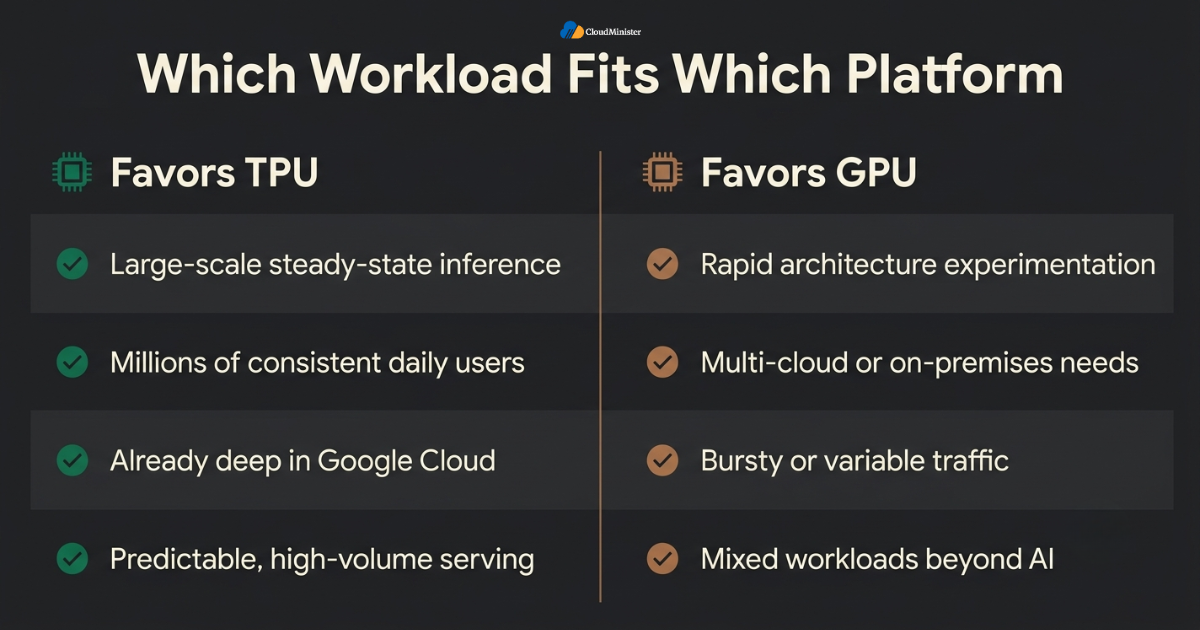
- TPU pods offer a genuine advantage for extremely high-volume, steady-state inference workloads, such as serving a single large model to millions of consistent daily users, where the fixed systolic array design can be fully utilized around the clock.
- An NVIDIA GPU running vLLM or a similar inference server tends to handle variable, bursty inference traffic more gracefully, since GPU scheduling is more flexible than a TPU pod’s more rigid allocation model.
- Businesses running multiple different models, or models that change frequently, generally find that GPU Servers for AI offer more practical inference flexibility than committing to a fixed TPU deployment optimized for a single workload shape.
- This inference decision also depends heavily on where your existing application stack lives, since teams already deep in the Google Cloud ecosystem face far less friction adopting TPU-based inference than teams running elsewhere.
- Latency-sensitive applications, including real-time chat interfaces and interactive AI agents, often benefit from the mature request batching and dynamic scheduling tools available in the NVIDIA and CUDA ecosystem, which remains more battle-tested for these patterns than TPU serving infrastructure.
- Best GPU cloud hosting that includes managed monitoring and alerting out of the box saves smaller teams from having to build that tooling themselves.
- Small and mid-sized teams evaluating best GPU cloud hosting in India for inference workloads specifically should confirm the provider supports current-generation inference servers out of the box, rather than requiring extensive manual configuration.
Any inference deployment handling user data, whether on TPU or GPU infrastructure, needs request-level logging, rate limiting, and input validation treated as mandatory rather than optional. High-throughput inference endpoints are a common target for prompt injection attempts and resource exhaustion attacks, and the Google TPU vs NVIDIA GPU choice does not change the need for this baseline security hygiene at the application layer.
6. Software Ecosystem: The Deciding Factor for Many Teams
Raw silicon performance is only part of the equation. For most engineering teams, software ecosystem maturity ends up being the deciding factor.
- Any credible Web Hosting Company in India supporting GPU workloads should be transparent about which CUDA and driver versions ship on their servers by default.
- CUDA has more than a decade of continuous development behind it, and nearly every major machine learning framework, including PyTorch and TensorFlow, treats NVIDIA GPU support as the default, most well-tested target.
- Native PyTorch support on TPU hardware has improved significantly but remains newer and less battle-tested than the equivalent GPU code paths, which matters for teams debugging obscure training issues under deadline pressure.
- The ecosystem gap shows up most clearly in third-party tooling: monitoring dashboards, profilers, debugging tools, and community troubleshooting resources are overwhelmingly written with GPU deployments in mind.
- Hiring is a practical factor too, since the pool of engineers with hands-on NVIDIA GPU and CUDA experience is considerably larger than the pool with production TPU experience, simply because GPU hardware has been broadly accessible for far longer than TPU capacity.
- Businesses already committed to a multi-cloud or on-premises strategy generally find this decision resolves itself quickly in favor of GPUs, since TPU access is fundamentally locked to Google Cloud.
- A reliable Web Hosting Company in India offering GPU Servers for AI typically bundles driver management, CUDA toolkit updates, and framework compatibility support directly into the hosting plan, removing a significant maintenance burden from the client’s engineering team.
- Providers offering best GPU cloud hosting in India increasingly pre-configure common frameworks and container images on their GPU Servers for AI, which shortens the time between provisioning a server and actually running a training job.
- Teams new to GPU infrastructure often ask a prospective Web Hosting Company in India whether best GPU cloud hosting plans include managed CUDA support, since this single feature determines how much in-house expertise the project actually requires.
Consulting engagements comparing infrastructure choices across dozens of AI teams consistently show that the software ecosystem gap, not the raw hardware gap, is what actually determines satisfaction with a Google TPU vs NVIDIA GPU decision six months later. Teams that underestimate how much day-to-day debugging, tooling, and hiring depend on ecosystem maturity are the ones most likely to regret their initial infrastructure choice.
7. Cost Comparison: What Google TPU vs NVIDIA GPU Actually Costs in 2026
Cost is where this debate gets genuinely complicated, because pricing transparency differs sharply between the two options.
- A transparent Web Hosting Company in India will publish GPU pricing openly rather than requiring a sales call for a basic quote, unlike Google’s current approach to newer TPU generations.
- Google publishes on-demand and committed-use pricing for older TPU generations, with the previous-generation Trillium chip listed at roughly 2.70 dollars per chip-hour on demand, dropping to lower rates with one-year and three-year commitments.
- As of mid-2026, Google has not published broad, self-serve pricing for the newest Ironwood TPU v7, meaning smaller businesses without a direct enterprise negotiation have limited visibility into what the newest chip actually costs at scale.
- NVIDIA GPU pricing, by contrast, is far more transparent across the market, since a Dedicated NVIDIA GPU Server can be quoted directly by nearly any GPU hosting provider without requiring a large enterprise commitment first.
- Total cost of ownership in this comparison depends heavily on utilization rate, since a TPU pod or a Dedicated NVIDIA GPU Server sitting partially idle erodes any theoretical cost advantage very quickly regardless of the underlying chip.
- Businesses evaluating best GPU cloud hosting in India options often find that renting rather than buying GPU infrastructure outright produces a better near-term total cost of ownership, particularly for teams still validating product-market fit before committing to permanent infrastructure.
- Comparing cloud GPU pricing against the cost of purchasing and operating a Dedicated NVIDIA GPU Server outright is a decision that depends heavily on usage patterns, and our related article on cloud GPU pricing versus dedicated GPU server costs in India walks through that comparison step by step.
- For most small and mid-sized businesses outside the handful of companies large enough to negotiate directly with Google, the practical cost comparison today favors GPUs simply on the basis of pricing transparency and provider choice.
- Best GPU cloud hosting is not automatically cheaper than a direct hyperscaler contract at very large scale, so the comparison should always be run on actual projected usage.
- Businesses comparing best GPU cloud hosting quotes across providers should always confirm whether bandwidth, storage, and support are bundled into the headline rate, since add-on fees can quietly erode an otherwise competitive price.
When budgeting for a Google TPU vs NVIDIA GPU decision, always model cost per successfully completed training run or per million inference requests, not cost per chip-hour in isolation. A slightly higher hourly rate on a Dedicated NVIDIA GPU Server can still produce a lower effective cost if the software ecosystem reduces debugging time and failed training runs compared to a less mature deployment path.
Ready to Run Your AI Workloads on Dedicated NVIDIA GPU Power?
Skip the pricing guesswork and the enterprise negotiation. Get a Dedicated NVIDIA GPU Server built for training and inference, backed by transparent pricing and a support team that actually knows AI infrastructure.
8. Choosing Google TPU vs NVIDIA GPU by Workload Type
There is no single universally correct answer to this question. The right choice depends heavily on the specific shape of the workload being deployed.
- Working with a single Web Hosting Company in India across multiple infrastructure tiers, rather than switching providers with every upgrade, tends to simplify billing and support relationships considerably.
- Large-scale, single-model, steady-state inference serving millions of consistent requests: TPU pods tend to offer strong efficiency here, provided the business is already comfortable operating entirely inside Google Cloud.
- Rapidly iterating research and experimentation, where model architecture changes frequently: a dedicated GPU server and the mature CUDA ecosystem generally reduce friction and speed up iteration cycles significantly.
- Multi-cloud or on-premises deployment requirements: this resolves the decision immediately in favor of GPUs, since TPUs are simply not available outside Google Cloud in any form.
- Fine-tuning existing open-source models on a moderate budget: a Dedicated NVIDIA GPU Server or fractional GPU cloud instance typically offers more accessible entry points than committing to a TPU pod allocation sized for much larger workloads.
- Mixed workloads combining AI inference with other compute tasks, such as data processing pipelines or traditional application hosting: GPU Servers for AI integrate far more naturally into a broader infrastructure stack than TPUs, which are purpose-built for neural network operations exclusively.
- Enterprises with an existing, deep negotiated relationship with Google Cloud and predictable, massive inference volume: this is genuinely the scenario where the Google TPU vs NVIDIA GPU decision can tip toward TPU, particularly once Ironwood pricing becomes broadly available.
- Startups and mid-sized businesses without a large negotiated cloud contract: best GPU cloud hosting in India and similar regional GPU hosting options typically provide a faster, more flexible path to production than pursuing a TPU allocation.
- Teams running seasonal or campaign-driven workloads, where demand spikes sharply for short windows, generally favor best GPU cloud hosting over any large fixed commitment, TPU or GPU, since elastic capacity matters more than raw peak throughput.
For businesses in India specifically weighing where to source infrastructure once the Google TPU vs NVIDIA GPU decision leans toward GPU, comparing regional providers matters, and our related article on GPU cloud providers in India covers what to look for when evaluating options beyond the global hyperscalers.
8.1 Evaluating Best GPU Cloud Hosting in India for This Decision
For businesses based in India, the Google TPU vs NVIDIA GPU decision usually resolves into a more practical question: where to actually source best GPU cloud hosting in India once the choice has landed on GPU infrastructure.
- Best GPU cloud hosting in India has expanded considerably over the past few years, with regional providers now offering current-generation NVIDIA hardware that was previously only available through global hyperscalers.
- Choosing best GPU cloud hosting in India over a global hyperscaler can meaningfully reduce latency for applications serving primarily domestic users, since data does not need to travel to a distant international region.
- Data residency requirements in regulated sectors, including finance and healthcare, often make best GPU cloud hosting in India a compliance necessity rather than simply a cost-saving preference.
- Businesses comparing best GPU cloud hosting against a direct hyperscaler contract should weigh onboarding speed, since regional providers can often provision capacity faster than a large enterprise sales cycle allows.
- Support responsiveness is another practical advantage of best GPU cloud hosting in India, since time zone alignment and local account management tend to resolve issues faster than a support queue routed through a distant global center.
- Pricing transparency remains one of the clearest advantages of best GPU cloud hosting in India, particularly compared to the more opaque, negotiation-dependent pricing that still surrounds newer TPU generations.
- Businesses that start with best GPU cloud hosting for a pilot project, then scale up once the workload is validated, generally avoid the sunk cost of over-provisioning infrastructure before actual demand is proven.
- Best GPU cloud hosting providers increasingly offer flexible commitment terms, ranging from hourly billing to multi-month reservations, giving businesses a middle ground between fully on-demand pricing and a long-term hardware purchase.
- Evaluating best GPU cloud hosting in India also means checking whether the provider supports the specific NVIDIA GPU generation a workload actually needs, since older inventory sometimes gets marketed alongside current-generation options without a clear distinction.
- A business weighing best GPU cloud hosting against building an in-house cluster should factor in depreciation, power costs, and staffing, all of which are bundled into a hosted plan but become the client’s direct responsibility with owned hardware.
- Best GPU cloud hosting in India providers that also operate broader web and application hosting services can offer a genuine advantage for businesses that want a single vendor relationship across their entire infrastructure stack.
- For teams still undecided in the Google TPU vs NVIDIA GPU debate, starting with best GPU cloud hosting in India as a low-commitment testing ground is a practical way to gather real performance data before any larger infrastructure decision.
9. Deployment Considerations: What Changes Once You Pick a Side
Making this decision is only the first step. Deployment realities differ significantly once the choice is made.
- Choosing GPU infrastructure opens up meaningfully more deployment flexibility, since a Dedicated NVIDIA GPU Server can be provisioned through a Web Hosting Company in India, a global hyperscaler, or an on-premises data center depending on the business’s specific compliance and latency requirements.
- Choosing TPU infrastructure means accepting a single-vendor dependency on Google Cloud for the lifetime of that deployment, which some businesses view as a meaningful strategic risk regardless of raw performance advantages.
- Data residency and compliance requirements, particularly relevant for regulated industries in India, often favor GPU Servers for AI hosted through a local or regional Web Hosting Company in India that can guarantee specific data center jurisdiction.
- Best GPU cloud hosting arrangements that include fully managed support consistently reduce the operational burden on teams without dedicated infrastructure staff.
- Businesses that want the option of fully managed infrastructure, where a provider’s team handles driver updates, security patching, and monitoring, generally find this more readily available through best GPU cloud hosting providers than within the more narrowly scoped TPU ecosystem.
- Network architecture also differs meaningfully: a Dedicated NVIDIA GPU Server cluster can be architected with custom interconnects and topology choices, while TPU pod networking is entirely managed and standardized by Google.
- Organizations that later want to scale from a single Dedicated NVIDIA GPU Server to a larger multi-server cluster generally find this expansion path more straightforward with GPU infrastructure than attempting to resize an existing TPU pod commitment.
- Best GPU cloud hosting evaluations should always include a direct conversation about contract flexibility, since locking into a long commitment before validating a workload can be costly if requirements change.
- Any established Web Hosting Company in India offering a Dedicated NVIDIA GPU Server option should be able to walk a prospective client through data center location, uptime history, and support response times before a contract is signed.
10. Common Mistakes When Comparing Google TPU vs NVIDIA GPU
Even technically sophisticated teams make avoidable mistakes when working through a Google TPU vs NVIDIA GPU evaluation.
- Selecting a Web Hosting Company in India without checking their actual uptime history and support responsiveness, treating headline hardware specs as the only factor that matters.
- Comparing peak theoretical FLOPs at different numerical precisions without normalizing first, which produces a misleading picture that can favor either chip depending on which precision each vendor chose to highlight in their own marketing materials.
- Ignoring software ecosystem maturity entirely and basing the Google TPU vs NVIDIA GPU decision on hardware specifications alone, without accounting for framework support, tooling, and available engineering talent.
- Assuming TPU pricing scales linearly from older, published generations to the newest Ironwood chip, when Google has historically priced newer TPU generations differently from their predecessors once broad availability arrives.
- Underestimating how much a single-vendor dependency on Google Cloud actually constrains future infrastructure decisions, particularly for businesses that may eventually need multi-cloud or on-premises deployment options.
- Provisioning GPU Servers for AI without first documenting expected peak concurrency, which leads to either chronic under-provisioning or wasted spend on unused capacity.
- Failing to benchmark actual production workloads before committing to either platform, relying instead entirely on vendor-published benchmarks that may not reflect a specific model architecture or traffic pattern.
- Overlooking the total cost of ownership difference between renting flexible GPU Servers for AI and committing to a large, fixed infrastructure allocation before actual demand has been validated.
- Choosing GPU Servers for AI sized for peak theoretical load rather than realistic sustained utilization, which inflates costs unnecessarily regardless of which side of the Google TPU vs NVIDIA GPU decision a business lands on.
- Best GPU cloud hosting decisions made purely on advertised hourly rate, without checking bundled bandwidth and storage limits, often cost more than expected once usage ramps up.
- Assuming every best GPU cloud hosting provider offers identical hardware generations and support quality, when actual specifications and driver management practices vary considerably between providers.
Across dozens of infrastructure consulting conversations, the single biggest driver of regret in a Google TPU vs NVIDIA GPU decision is not the chip choice itself but the failure to pilot the workload on real infrastructure before committing to a long-term contract. Teams that insist on a short paid pilot before signing a multi-month or multi-year commitment consistently make better decisions than teams that commit based on spec sheets alone.
11. Google TPU vs NVIDIA GPU: A Practical Decision Framework
Rather than treating the Google TPU vs NVIDIA GPU decision as a single binary choice, it helps to work through it as a structured set of questions.
- Has the business confirmed that its chosen Web Hosting Company in India can actually meet its data residency and compliance requirements before signing a contract?
- Is the business already deeply invested in the Google Cloud ecosystem for other services? If yes, TPU becomes a more natural extension; if no, the switching cost alone often outweighs any performance advantage.
- Is the primary workload training-heavy with frequently changing model architectures, or inference-heavy with a stable, high-volume serving pattern? Frequent architecture changes favor a Dedicated NVIDIA GPU Server and the mature CUDA tooling around it.
- Does the business need multi-cloud flexibility, on-premises deployment, or the ability to work with multiple hosting providers? Any yes answer here resolves the Google TPU vs NVIDIA GPU decision firmly in favor of GPU infrastructure.
- What does the internal team’s existing expertise look like? Teams with deep CUDA and NVIDIA GPU experience will move faster on GPU infrastructure, while teams already comfortable inside Google Cloud’s tooling may ramp up on TPU more smoothly.
- How predictable is the workload volume? Steady, large-scale, predictable inference volume is the strongest case for TPU; unpredictable or bursty workloads generally favor the scheduling flexibility of GPU Servers for AI.
- What does the realistic budget and commitment timeline look like? Businesses unwilling or unable to negotiate a large enterprise agreement with Google will find NVIDIA GPU pricing, including options from any established Web Hosting Company in India, considerably more accessible.
- Has the workload actually been benchmarked on both platforms, even at a small scale, before a final commitment? This single step resolves more Google TPU vs NVIDIA GPU disagreements within a team than any amount of additional research or discussion.
- Does the provider under consideration for best GPU cloud hosting offer a short-term trial or pilot period? A provider unwilling to support a small pilot before a long-term commitment is worth reconsidering regardless of listed pricing.
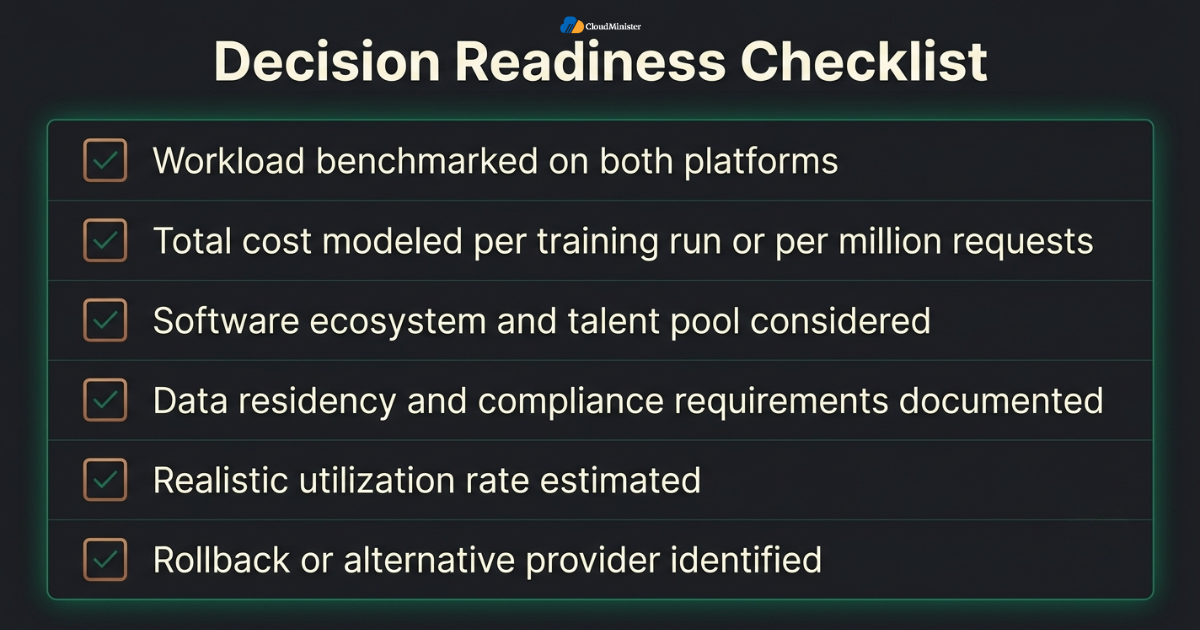
Checklist: Google TPU vs NVIDIA GPU Decision Readiness
- Actual workload benchmarked on both platforms at small scale before committing
- Total cost of ownership modeled per completed training run or per million inference requests
- Software ecosystem and available engineering talent factored into the decision, not just raw hardware specs
- Data residency, compliance, and multi-cloud requirements clearly documented
- Realistic utilization rate estimated rather than assuming peak theoretical usage
- Rollback or alternative provider option identified in case the chosen platform underdelivers
12. The Road Ahead: Where Google TPU vs NVIDIA GPU Is Headed
The Google TPU vs NVIDIA GPU competition is not a static picture, and the trend lines matter as much as the current snapshot.
- Custom AI silicon, including Google’s TPU line alongside similar efforts from other hyperscalers, is projected to grow at a substantially faster compound annual rate than general-purpose GPUs through the early 2030s, even though GPUs are expected to retain the larger share of total market revenue.
- Expect a growing number of Web Hosting Company in India providers to add current-generation NVIDIA hardware to their catalogs as demand for AI infrastructure continues rising.
- NVIDIA continues to hold a commanding position in training workloads specifically, and the CUDA ecosystem’s decade-plus head start is not the kind of advantage that closes quickly, regardless of how competitive TPU hardware becomes on paper.
- Google’s strategy of positioning Ironwood specifically for the age of inference signals that the Google TPU vs NVIDIA GPU competition will likely be fought hardest in inference serving rather than in large-scale training over the next several years.
- Broader availability and public pricing for Ironwood TPU v7 would meaningfully shift the practical Google TPU vs NVIDIA GPU calculus for smaller businesses currently priced out of direct negotiation with Google.
- Businesses that build infrastructure strategy around workload flexibility, rather than betting everything on a single chip architecture, are best positioned regardless of how the broader Google TPU vs NVIDIA GPU competition evolves over the coming years.
- Regardless of which side ultimately gains ground, GPU Servers for AI remain the more universally accessible starting point for the majority of businesses that are not operating at hyperscaler scale, simply due to how widely available they are across providers.
- Expect best GPU cloud hosting in India to keep expanding its catalog of current-generation NVIDIA silicon over the next few years, narrowing the gap between what regional providers and global hyperscalers can offer.
Key Takeaways
- The Google TPU vs NVIDIA GPU gap in raw FLOPs and memory bandwidth has narrowed significantly with Google’s Ironwood TPU v7 generation compared to previous TPU chips.
- Software ecosystem maturity, not raw hardware specifications, is the factor most likely to determine long-term satisfaction with a Google TPU vs NVIDIA GPU decision.
- TPUs remain locked to Google Cloud exclusively, while a Dedicated NVIDIA GPU Server can be deployed through nearly any Web Hosting Company in India or global provider.
- Inference, particularly large-scale and steady-state serving, is the workload category where the Google TPU vs NVIDIA GPU competition is currently closest.
- Cost comparisons should always be modeled per completed training run or per million inference requests rather than by raw hourly chip pricing alone.
- Businesses without a direct enterprise relationship with Google will generally find GPU Servers for AI, including best GPU cloud hosting in India options, a more accessible and transparent path to production.
- Benchmarking actual workloads on both platforms before committing consistently produces better outcomes than choosing based on spec sheets or brand familiarity alone.
Still Weighing Google TPU vs NVIDIA GPU for Your Business?
Every workload is different, and the right infrastructure call depends on your specific training and inference needs. Talk to our team and get a clear, no-pressure recommendation tailored to your budget and scale.
Conclusion
The Google TPU vs NVIDIA GPU debate in 2026 no longer has a single correct answer that applies to every business. It has become a genuine engineering trade-off between two capable, closely matched accelerator platforms, each suited to different workload shapes and organizational realities. Businesses with massive, steady-state inference workloads already committed to Google Cloud have a legitimate case for exploring TPU infrastructure as Ironwood availability continues to broaden through 2026. On the other hand, businesses that need deployment flexibility, mature software tooling, transparent pricing, or multi cloud independence will generally find a Dedicated NVIDIA GPU Server sourced through a trusted regional provider the more practical choice today.
The Google TPU vs NVIDIA GPU decision should always be grounded in actual workload benchmarking, realistic total cost of ownership modeling, and a clear eyed look at internal team expertise, rather than raw spec sheet comparisons alone. Teams that skip this step and choose based on headline numbers tend to discover the real cost of their decision only after infrastructure is already in production. For businesses in India specifically, working with an established Web Hosting Company in India that offers GPU Servers for AI and genuine best GPU cloud hosting in India options provides a practical, accessible path into serious AI infrastructure without requiring a direct enterprise negotiation with a hyperscaler.
Whether a business ultimately leans toward TPU, GPU, or a hybrid approach that uses both across different parts of its stack, the underlying discipline behind any sound Google TPU vs NVIDIA GPU decision stays the same. Benchmark first, model real costs, and choose the platform that actually fits the workload rather than the one with the more impressive headline specification. The businesses that get this right in 2026 will be the ones treating it as an ongoing engineering decision rather than a one time purchase, revisiting the choice as their workloads and the underlying hardware both continue to evolve.
Frequently Asked Questions
Is NVIDIA still better than Google TPU for AI training in 2026?
For most flexible, rapidly iterating training workloads, yes, primarily because of how mature the CUDA software ecosystem has become over the years. The Google TPU vs NVIDIA GPU comparison on pure training FLOPs has narrowed considerably with Ironwood closing much of the raw performance gap. However, NVIDIA’s tooling, framework support, and debugging ecosystem still give it a meaningful edge for teams that change model architectures often. Businesses running large, steady, repetitive training jobs may find TPUs increasingly competitive, but for research heavy teams NVIDIA generally remains the smoother path today.
Can I use a Google TPU outside of Google Cloud?
No, and this is one of the clearest differences in the entire Google TPU vs NVIDIA GPU comparison. Unlike a Dedicated NVIDIA GPU Server, which can be deployed through any Web Hosting Company in India, a colocation facility, or on premises hardware, Google TPUs are only available as a managed service inside Google Cloud Platform. There is no option to purchase TPU hardware directly or run it in a different cloud environment. This single vendor dependency is often the deciding factor for businesses that need multi cloud flexibility or already operate outside the Google ecosystem.
Which is cheaper, Google TPU or NVIDIA GPU?
The honest answer is that it depends heavily on utilization, workload type, and whether a business can negotiate enterprise pricing directly with Google. Google has not published broad self serve pricing for its newest Ironwood generation, which makes direct cost comparison difficult for smaller businesses. NVIDIA GPU pricing, by contrast, is far more transparent across the market since providers can quote a Dedicated NVIDIA GPU Server without requiring a large negotiated contract first. For most small and mid sized businesses, an NVIDIA GPU sourced through best GPU cloud hosting in India providers tends to be the more accessible and predictable option on cost.
Is Google TPU or NVIDIA GPU better for AI inference?
Inference is actually where the Google TPU vs NVIDIA GPU comparison is closest right now, since both platforms have been optimized heavily for serving models at scale. TPU pods can offer strong efficiency for extremely large, steady state inference workloads, particularly when a business is already operating fully inside Google Cloud. NVIDIA GPUs tend to handle variable or bursty inference traffic more gracefully, since GPU scheduling is generally more flexible than a fixed TPU pod allocation. The right choice usually comes down to how predictable the traffic pattern is and how deep the existing commitment to either cloud ecosystem already runs.
Do I need CUDA experience to work with NVIDIA GPUs?
It helps significantly if a team is doing custom optimization or squeezing out maximum performance from specific hardware, but it is not a strict requirement for most workloads. Standard training and inference workflows using popular frameworks like PyTorch generally work well out of the box on a Dedicated NVIDIA GPU Server without deep CUDA expertise. The Google TPU vs NVIDIA GPU decision often gets easier for teams once they realize how much of the CUDA ecosystem is already abstracted away by modern frameworks. That said, teams doing serious performance tuning will still benefit from having someone comfortable working closer to the hardware level.
Will the Google TPU vs NVIDIA GPU gap close further in the future?
Industry projections suggest custom silicon, including Google’s TPU line, will keep growing at a faster percentage rate than general purpose GPUs through the early 2030s. That said, GPUs are still expected to retain the larger overall share of total AI accelerator market revenue for the foreseeable future. The Google TPU vs NVIDIA GPU gap has already narrowed meaningfully with Ironwood, particularly on inference focused workloads where Google has directed much of its recent engineering effort. Businesses should expect this to remain a moving target rather than a decision that gets made once and never revisited.
What should I ask a GPU hosting provider before committing?
Start by asking which CUDA and driver versions ship by default, since outdated software stacks can quietly slow down a project before it even begins. Confirm the data center location and any relevant compliance certifications, especially if the business operates in a regulated industry with data residency requirements. Ask directly whether the provider offers a genuine Dedicated NVIDIA GPU Server or only shared fractional access, since the difference matters a great deal for performance consistency. Finally, check whether the company qualifies as a dependable Web Hosting Company in India with an actual track record supporting GPU Servers for AI, rather than one that recently added GPU offerings without proven operational experience.
How long does it typically take to switch from GPU to TPU or the other way around?
Switching direction in the Google TPU vs NVIDIA GPU decision is rarely a quick process, since it usually involves more than just swapping hardware. Teams moving from GPU to TPU often need to adjust parts of their training pipeline and validate that their framework version has solid TPU support, which can take several weeks depending on model complexity. Moving from TPU to GPU is generally more straightforward given how widely supported CUDA is across the machine learning ecosystem. Businesses considering a switch should budget real engineering time for testing and validation rather than assuming the transition will be seamless.

Shivlendra Singh Jadoun is a Cloud & DevOps Engineer at CloudMinister Technologies, specializing in AWS, Azure, and GCP infrastructure. He began his career in Linux system administration, managing shared, VPS, and dedicated servers before moving into cloud and automation. He is AWS Certified and works extensively with Docker, Kubernetes, Terraform, Ansible, and Jenkins to build CI/CD pipelines and scalable, secure cloud environments. With hands-on experience across hosting, server security, and DevOps automation, he brings real-world engineering insight to every article he writes.