


India’s AI startup ecosystem is booming — and every founder eventually faces the same high-stakes infrastructure question: should we rent GPU compute or buy our own hardware? The answer is not one-size-fits-all. It depends entirely on a rigorous TCO analysis that accounts not just for hardware price tags, but for power costs, depreciation, staffing, downtime risk, and long-term scalability. This guide delivers a technically accurate, India-focused TCO analysis covering every cost dimension — so your team can make the right capital allocation decision the first time.
When a decision directly impacts your burn rate, your model training timelines, and your ability to scale, you cannot afford to rely on anecdotal advice. Whether you buy hardware outright or partner with a hosting company in India for GPU rental, the hardware procurement question is one of the most consequential infrastructure decisions an AI startup will make in its first three years.
This guide is a technically accurate, India-specific breakdown of the GPU server rental vs buying decision — written for CTOs, infrastructure leads, founders, and finance teams who need a clear, numbers-grounded understanding of the real costs on both sides of the equation.
1. What Is TCO Analysis — and Why Does It Matter for AI Startups?
Most founders compare GPU rental rates against hardware purchase prices and call it a day. That comparison is dangerously incomplete. A proper TCO analysis — Total Cost of Ownership analysis — captures every rupee your infrastructure decision will cost your business over its full operational lifetime.
Why TCO Analysis Is the Right Framework
- A hardware purchase price is a one-time capital event; this framework converts it into an apples-to-apples annual cost comparison against recurring rental spend.
- Without this exercise, teams routinely underestimate the true cost of owning hardware by 40–70% — missing power, cooling, colocation, staffing, and replacement costs entirely.
- Total Cost of Ownership is the standard framework used by CFOs and infrastructure architects globally to evaluate build-vs-rent decisions across data center and cloud deployments.
- For Indian AI startups specifically, a proper cost model must account for India-specific cost variables: rupee-denominated power tariffs, import duties on GPU hardware, local colocation rack rates, and the availability of subsidised compute under the IndiaAI Mission.
The IndiaAI Mission, backed by the Rs 10,370 crore government initiative, has introduced subsidised GPU compute at ₹65 per GPU-hour for domestic startups and researchers — a variable that fundamentally changes the cost equation for many early-stage teams. Any framework that ignores this policy context is incomplete for the Indian market.
Before running any cost comparison, define your compute horizon clearly. A 6-month MVP validation phase has a radically different TCO profile from a 3-year production deployment. Your cost model must match your actual planning window — not an idealised scenario.
2. The Indian AI Infrastructure Context: Why This TCO Analysis Is Different
India’s GPU server market is entering a high-growth phase unlike anything seen before. India is poised to quintuple its installed GPU capacity from 38,000 to over 100,000 units by the end of 2026, driven by both the IndiaAI Mission and aggressive private investment. This supply expansion directly affects the rental side of any infrastructure cost comparison.
India-Specific Cost Drivers That Any Cost Model Must Include
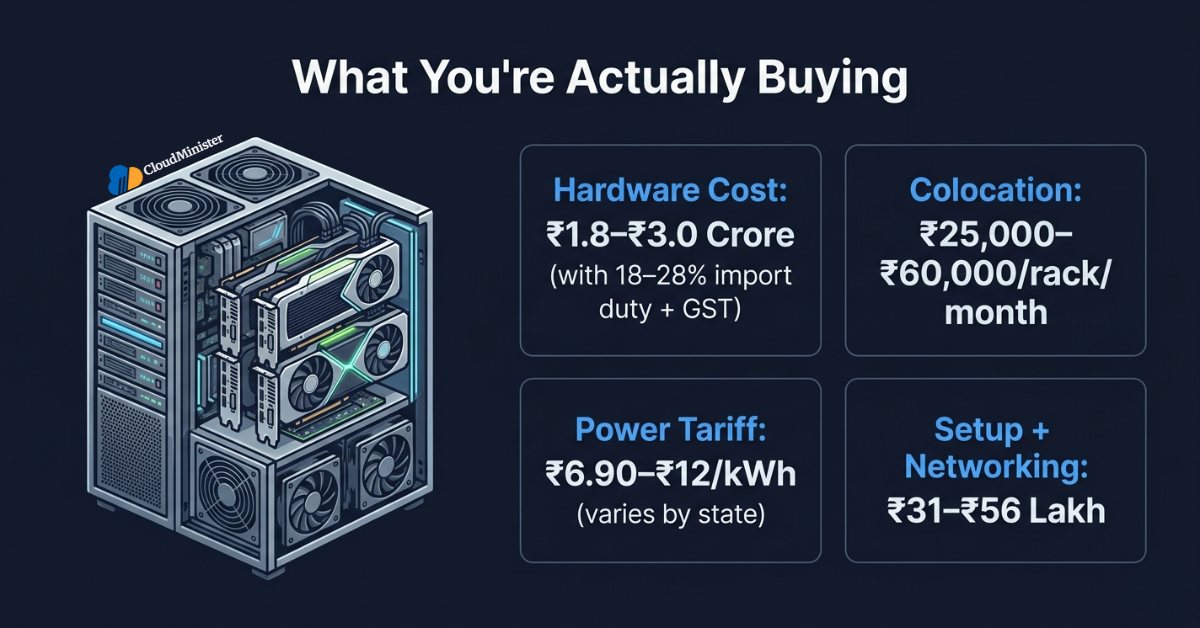
- Import duty on GPU hardware: NVIDIA H100/H200 cards imported into India attract customs duty (HSN 8471) and GST that can add 18–28% to the base hardware cost — a critical variable when costing purchased hardware.
- Power tariffs: Commercial power in major Indian metros ranges from ₹6.90 to ₹12 per kWh depending on state (Karnataka HT industrial: ₹6.90/kWh; Mumbai commercial: up to ₹10–12/kWh) — significantly impacting the operational cost side of owned hardware.
- Colocation costs: Rack space (full rack) in Tier III data centers in Bengaluru, Mumbai, Hyderabad, and Chennai ranges from ₹25,000 to ₹60,000 per full rack per month — a non-trivial cost component for on-premise deployments.
- Skilled staffing: A qualified GPU infrastructure engineer in India commands ₹20–38 LPA in 2026 — and most startups will need at least two to maintain a reliable owned fleet, which any serious cost model must account for.
- Currency risk: GPU hardware is priced in USD globally; rupee depreciation directly inflates the capital expenditure for purchased hardware over a multi-year horizon.
3. Full TCO Analysis: The True Cost of Buying GPU Servers
Let us build the complete TCO analysis for hardware ownership using a representative scenario: a mid-size Indian AI startup purchasing a 4× NVIDIA H100 server configuration. For GPU for AI training workloads specifically, this is the most common hardware decision point in 2026.
3.1 Capital Expenditure (CapEx) — The Purchase Price Is Just the Beginning
| Cost Component | Estimated Cost (INR, 2026) |
| 4× NVIDIA H100 80GB SXM5 server (imported, with duties + GST) | ₹1.8 – ₹3.0 Crore |
| Networking infrastructure (InfiniBand HDR for multi-GPU) | ₹20 – ₹50 Lakh |
| Storage (NVMe SSD arrays for training data) | ₹8 – ₹18 Lakh |
| UPS and power infrastructure (if on-premise) | ₹6 – ₹12 Lakh |
| Initial setup, racking, cabling, and configuration | ₹3 – ₹6 Lakh |
| Total CapEx (Year 0) | ₹2.17 – ₹3.86 Crore |
This CapEx figure is what most startups compare against rental costs — but the ownership cost picture is far from complete at this stage. *Depreciation figures shown are accounting entries at 33%/year; actual cash TCO uses CapEx + cumulative OpEx.
3.2 Annual Operating Expenditure (OpEx) — The Hidden Cost Iceberg
| OpEx Component | Annual Cost (INR, 2026) |
| Colocation rack space (Tier III DC, 2 full racks) | ₹6.0 – ₹14.4 Lakh |
| Power consumption (4× H100 = ~3.5-4kW total server draw, 24×7) | ₹2.6 – ₹3.5 Lakh |
| Cooling overhead (PUE 1.5 typical Indian Tier III DC) | ₹1.3 – ₹1.75 Lakh |
| Infrastructure staffing (2 GPU infra engineers) | ₹40 – ₹70 Lakh |
| Hardware maintenance and support contracts (15–20% of hardware value — get a quote from Dell India or your OEM) | ₹9 – ₹18 Lakh |
| Networking bandwidth | ₹3.6 – ₹9.6 Lakh |
| Software licensing (CUDA, monitoring tools) | ₹2.4 – ₹4.8 Lakh |
| Total Annual OpEx | ₹64.9 – ₹1.22 Crore |
3.3 Three-Year TCO Analysis for Owned Hardware
| Year | CapEx | OpEx | Depreciation (33%) | Cumulative TCO |
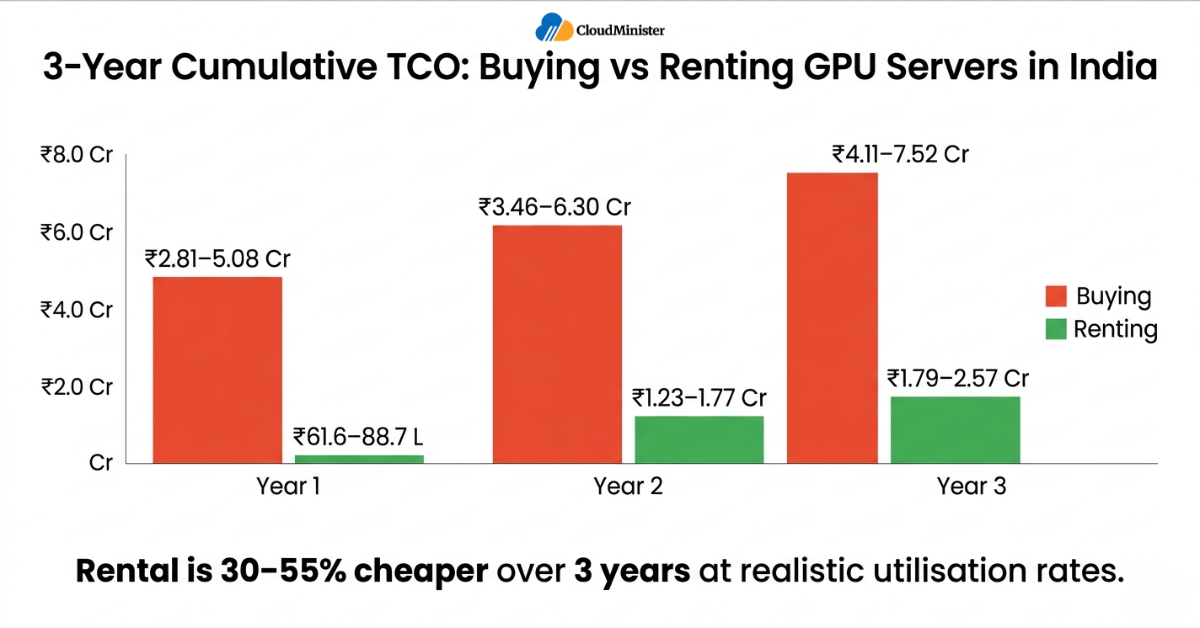
| Year 1 | ₹2.17–3.86 Cr | ₹64.9–122 L | ₹72L–1.27 Cr* | ₹2.81–5.08 Cr |
| Year 2 | ₹0 | ₹64.9–122 L | ₹72–1.27 Cr* | ₹3.46–6.30 Cr |
| Year 3 | ₹0 (hardware ~obsolete) | ₹64.9–122 L | ₹72–1.27 Cr* | ₹4.11–7.52 Cr |
This TCO analysis reveals a 3-year total ownership cost of ₹4.11 to ₹7.52 Crore for a single 4× H100 configuration — before accounting for the cost of GPU-generation obsolescence, which renders H100 hardware less competitive once H200/B200 workloads become standard.
GPU hardware depreciates fast. NVIDIA’s release cadence has compressed generational transitions to roughly 18–24 months. Any TCO analysis for purchased hardware must factor in the risk that your owned fleet becomes a performance liability within your planning window — not just a financial one.
4. Full TCO Analysis: The True Cost of Renting GPU Servers
The rental side of this cost comparison is structurally simpler — but still has variables that require careful modelling. Rental pricing in India varies significantly based on GPU tier, contract duration, and provider.
4.1 Rental Pricing Landscape in India (2026)
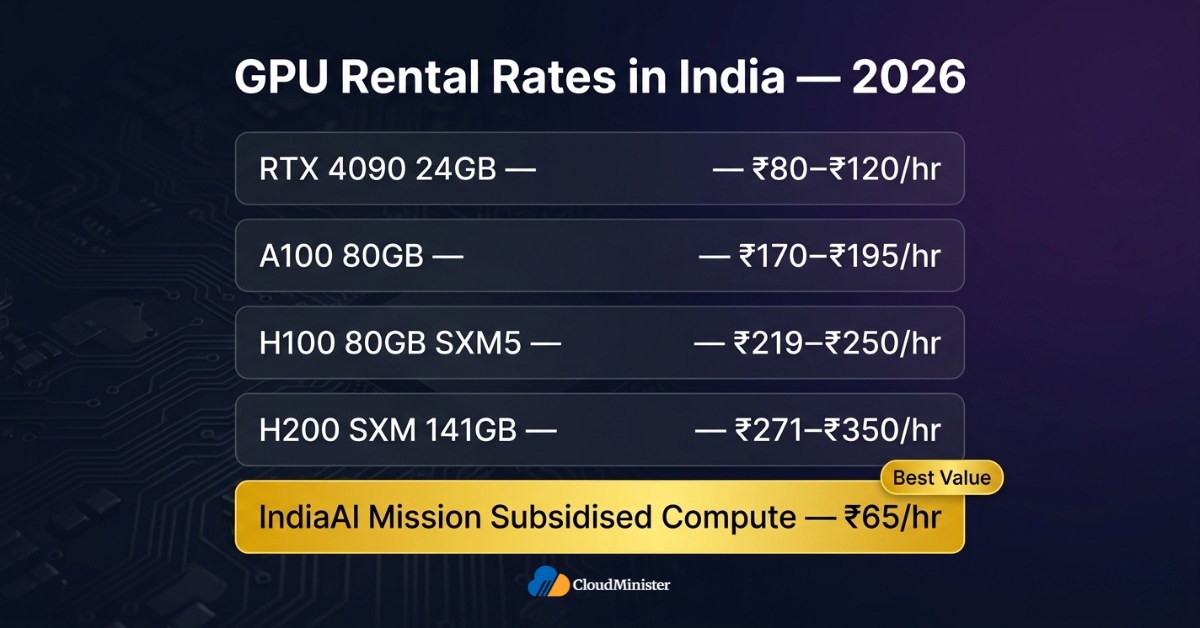
| GPU Model | Hourly Rate (Market) | Monthly (730 hrs) | Annual |
| NVIDIA RTX 4090 (24GB) | ₹80–₹120/hr (on-demand) | ₹58,400–₹87,600 | ₹7.0–₹10.5 L |
| NVIDIA A100 80GB | ₹170–₹195/hr (on-demand) | ₹1.24–₹1.42 L | ₹14.9–₹17.1 L |
| NVIDIA H100 80GB SXM5 | ₹219–₹250/hr (on-demand) | ₹1.60–₹1.83 L | ₹19.2–₹21.9 L |
| NVIDIA H200 SXM (141GB) | ₹271–₹350/hr (on-demand) | ₹1.98–₹2.56 L | ₹23.7–₹30.7 L |
| IndiaAI Mission Subsidised | ₹65/hr (subsidised) | ₹47,450 | ₹5.69 L |
Explore GPU Server Plans Built for AI Workloads
Compare H100, H200, and A100 configurations with transparent per-hour pricing — no hidden egress fees, no lock-in contracts.
4.2 What the TCO Analysis for Rental Actually Includes
- Compute cost: The GPU-hours consumed — the core variable in any rental cost model. Most AI training workloads do not require 24×7 reservation; on-demand or reserved-instance pricing can significantly reduce the effective cost figure.
- Storage: Most cloud GPU providers charge separately for persistent storage (typically ₹3–8 per GB/month for NVMe — verify current rates at your chosen provider before finalising your cost plan). This must be included in any complete cost breakdown.
- Egress bandwidth: Data transfer out of the cloud/rental environment carries per-GB charges. For startups using hyperscalers or moving data between providers, egress costs can add 8–15% to the rental cost total. Note: India-native providers like Cyfuture AI charge zero egress fees for intra-platform transfers.
- Reduced staffing overhead: Renting eliminates the need for dedicated GPU infrastructure engineers, but your team will still need internal MLOps or infra oversight — typically 0.5–1 FTE — for environment management, cost monitoring, and pipeline reliability.
- No CapEx risk: Renting carries zero hardware obsolescence risk — you always run on current-generation silicon.
Related: Choosing the Right GPU Server: NVIDIA vs AMD vs Google TPUs
4.3 Three-Year TCO Analysis for Rental (4× H100 equivalent compute)
| Year | Compute Cost | Storage/Egress | Total Annual TCO | Cumulative TCO |
| Year 1 | ₹53.6–76.7 L | ₹8–12 L | ₹61.6–88.7 L | ₹61.6–88.7 L |
| Year 2 | ₹53.6–76.7 L | ₹8–12 L | ₹61.6–88.7 L | ₹1.23–1.77 Cr |
| Year 3 | ₹48–68 L** | ₹8–12 L | ₹56–80 L** | ₹1.79–2.57 Cr |
**Year 3 reflects ~10–15% pricing reduction due to competitive market pressure in India’s expanding GPU cloud market and reserved-instance discounts. The TCO analysis for rental shows a 3-year total of ₹1.79 to ₹2.57 Crore for 4× H100-equivalent compute (reserved pricing, 24/7) — significantly lower than the ownership TCO analysis at every scenario point.
5. Head-to-Head TCO Analysis: Rental vs Buying — The Complete Comparison
| TCO Analysis Dimension | Buying (Own Hardware) | Renting (Cloud/GPU Service) |
| Year 1 Total Cost | ₹2.81–5.08 Crore | ₹61.6–88.7 Lakh |
| 3-Year Cumulative TCO | ₹4.11–7.52 Crore | ₹1.79–2.57 Crore |
| CapEx Requirement | ₹2.17–3.86 Crore upfront | Zero |
| Staffing Cost (Annual) | ₹40–70 Lakh | Zero (provider handles) |
| Hardware Obsolescence Risk | High (18–24 month GPU cycle) | None (always latest gen) |
| Scalability Speed | Weeks to months | Minutes to hours |
| GPU Utilisation Efficiency | Often 15–40% in practice | Pay only for what you use |
| DPDPA Compliance Risk | Full liability on your team | Shared with provider |
| Breakeven vs Rental | ~3.5–4 years (if >85% utilised) | N/A (no breakeven needed) |
This comparison shows that for most Indian AI startups in their first 3 years — particularly those with variable or moderate workloads — renting GPU compute typically delivers a lower total cost of ownership. The exception is sustained high-utilisation workloads over a 4+ year horizon, where ownership can become cost-competitive. Ownership only makes economic sense under very specific conditions — which we detail in Section 7.
GPU compute units often operate at only 15–30% utilisation in real-world AI startup deployments. A TCO analysis that assumes 80–100% utilisation to justify hardware purchase is modelling a scenario most teams never actually achieve — resulting in a dramatically misleading cost comparison.
6. The GPU Utilisation Problem — Why the TCO Analysis Favours Rental
The single biggest hidden variable in GPU ownership costs is utilisation rate. GPU compute units often operate at 15–30% utilisation in real-world AI workloads — and for startups, the gap between peak training runs and idle time is even wider. This fundamentally changes the economics of any ownership decision.
How Utilisation Rate Destroys the TCO Analysis Case for Ownership
- At 20% utilisation, your effective cost-per-GPU-hour on owned hardware is 5× the sticker cost — making any cost model that assumed high utilisation completely incorrect.
- AI training workloads — especially GPU for AI training at scale — are inherently bursty: weeks of idle hardware followed by intensive multi-day training runs create low average utilisation even when peak demand is high.
- Renting GPU compute eliminates the idle-cost problem entirely — you only pay for active GPU-hours consumed, making rental inherently more cost-efficient for bursty workloads.
- A rigorous cost model must use realistic utilisation curves — not theoretical maximums — to produce an accurate cost comparison.
Run your actual compute logs before committing to a purchase decision. If your training pipeline shows average GPU utilisation below 60% over a 90-day window, the numbers will almost certainly favour continued rental. Honest utilisation data is the most important input to any GPU infrastructure cost decision.
Related: How GPU Servers Enhance AI and Machine Learning Performance
7. When Does Buying Actually Win the TCO Analysis?
This cost framework is not unconditionally in favour of rental. There are specific operational profiles where ownership delivers a better long-term cost outcome. Understanding these conditions is essential before committing to either path.
7.1 Conditions Where the Numbers Favour Ownership
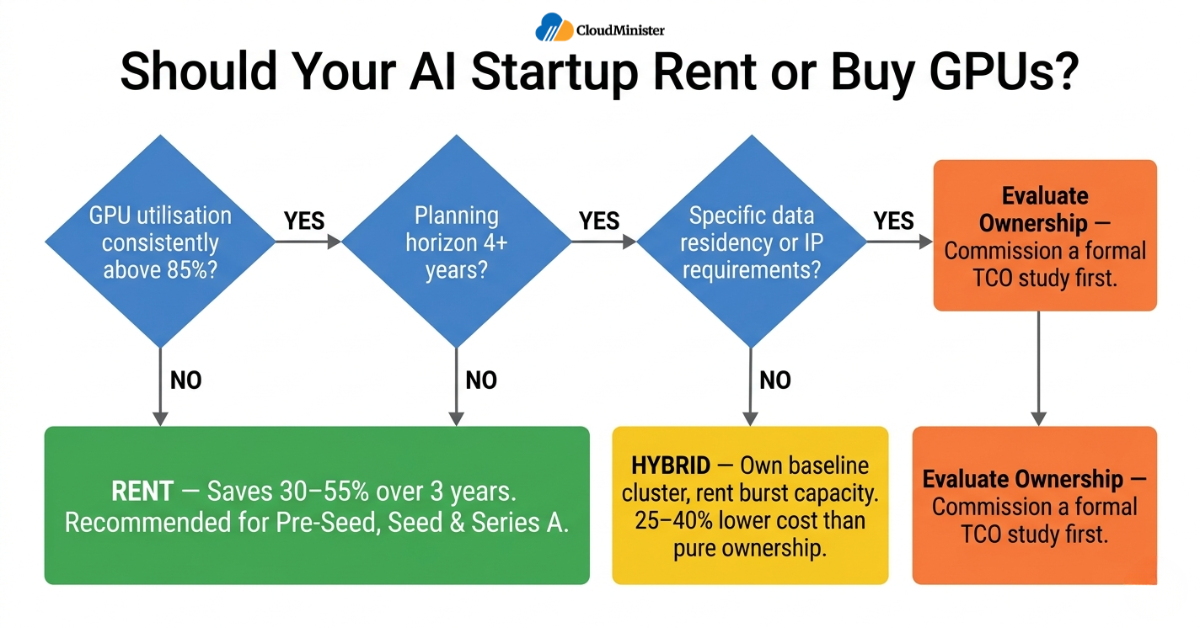
- Sustained high utilisation: If your team genuinely sustains >80% GPU utilisation across a 12+ month continuous workload — large-scale LLM training pipelines, 24×7 inference serving at scale — the ownership cost begins to approach breakeven at 3.5 to 4 years.
- Regulatory data residency requirements: India’s DPDPA 2023 does not impose blanket data localisation — cross-border transfers are generally permitted except to countries notified as restricted by the government. However, if your specific contracts or sector regulations impose additional data residency requirements, owned infrastructure in a certified Indian data centre may be the appropriate choice. owned infrastructure in a certified Indian data centre may be the appropriate choice.
- Proprietary model IP protection: Some teams have legitimate reasons to avoid training their most sensitive model weights on any shared infrastructure — a consideration that may override pure cost economics.
- Long-term commitment horizon: At 5+ years with stable, predictable workloads and a dedicated infrastructure team already on payroll, ownership costs become increasingly competitive — particularly if hardware is purchased during periods of GPU price correction.
7.2 The 85% Utilisation Threshold in This Cost Framework
The breakeven point varies significantly depending on your power tariff, staffing costs, financing structure, and negotiated rental rates — but under a representative set of India-specific assumptions, sustained utilisation above 80–85% over 3.5 to 4 years is typically required before ownership becomes cost-competitive with rental. Your actual breakeven may be earlier or later; model it with your own numbers. Below this threshold, rental wins on cost at every time horizon. Above it, ownership becomes competitive — but only if the CapEx was raised without opportunity cost and the staffing overhead was already committed for other reasons.
Many startups underestimate the opportunity cost of CapEx spent on GPU hardware. ₹2.5 Crore deployed in owned H100 servers is ₹2.5 Crore not available for product development, sales, or runway extension. A complete cost model should include this opportunity cost — not just the hardware and operating expenses.
8. GPU Server Rental: What to Look for in a Provider
Not all GPU server India rental providers are equal. The rental cost model is only valid if the provider delivers the performance, reliability, and support that your AI workloads require. Choosing the wrong provider introduces hidden costs that invalidate your original cost projections.
8.1 Technical Evaluation Criteria
- GPU generation and memory bandwidth: Verify actual GPU models available. An H100 SXM5 has fundamentally different training throughput than an H100 PCIe — your cost model must reflect actual performance, not just GPU model names.
- NVLink/InfiniBand interconnect: Multi-GPU training jobs require high-bandwidth GPU-to-GPU communication. Providers that offer NVLink-connected GPU clusters will deliver significantly better performance for large model training — a key variable in your effective cost planning.
- Storage performance: Training pipelines are often storage-bound. Verify NVMe SSD throughput and whether object storage is co-located with the GPU cluster to avoid network-bound data loading.
- Network latency to your team’s location: Providers with data centers in Bengaluru, Mumbai, or Hyderabad deliver meaningfully lower latency for Indian teams — relevant for interactive development workflows.
8.2 Commercial Evaluation Criteria
- Reserved vs on-demand pricing: Most providers offer 20–40% discounts on reserved-instance GPU rental contracts vs on-demand rates. Factor this in when modelling predictable workloads.
- Egress pricing: High egress fees can materially change your cost totals if your pipeline involves large dataset transfers. Negotiate egress caps upfront.
- SLA and uptime guarantees: Downtime during a critical training run has real cost implications that must be included in your planning. Verify SLA terms and credit structures for outages.
- Support response time: GPU infrastructure failures during training require fast support resolution. 24×7 support with sub-1-hour response time for critical issues is the standard to require.
For AI teams specifically looking for GPU for AI training use cases, evaluating the provider’s support for distributed training frameworks (PyTorch DDP, DeepSpeed, Megatron-LM) and their pre-configured environment options is critical to avoiding setup costs that add to your real-world cost total.
9. TCO Analysis for Specific Indian AI Startup Profiles
The optimal infrastructure decision varies significantly depending on your startup’s stage, workload profile, and funding situation. The following cost profiles cover the most common Indian AI startup archetypes.
Profile 1: Pre-Seed / Seed Stage (< ₹3 Crore raised)
- Recommendation: Rental, unconditionally.
- At this stage, CapEx for GPU hardware would consume 70–90% of your entire funding round — leaving nothing for product development, team, or runway.
- On-demand rental from a reliable hosting company in India for GPU compute is the only rational choice. Use on-demand H100 instances for training runs and scale to zero between experiments.
- Leverage IndiaAI Mission subsidised compute at ₹65/hr wherever your research qualifies — this dramatically improves the cost equation for compute-heavy experimentation.
Profile 2: Series A Stage (₹3–20 Crore raised)
- Recommendation: Rental with reserved instances for predictable workloads.
- For GPU for AI training workloads with predictable schedules, negotiate 6-month or 12-month reserved contracts — capturing the 20–35% discount that improves your cost position without CapEx commitment.
- Maintain on-demand burst capacity for peak training needs.
- Defer hardware purchase decision until you have 90 days of actual utilisation data — any cost model built before this point is speculative.
Profile 3: Series B+ Stage (> ₹20 Crore raised, established workloads)
- Recommendation: Hybrid — owned hardware for baseline, rental for burst.
- At this stage, your workload profile is established enough to justify a rigorous cost review for partial hardware ownership.
- Commission a formal cost study using your actual utilisation data before any hardware purchase decision. The study should cover a 3-year horizon with realistic depreciation and staffing costs included.
- A hybrid model — owning your baseline cluster via a dedicated GPU server India provider and renting burst capacity — often delivers the best combined cost outcome.
The most capital-efficient approach for Series B+ Indian AI startups is a hybrid infrastructure model: own the hardware for predictable, high-utilisation baseline workloads; rent via a reliable GPU server India provider for burst training capacity and new model experimentation. A properly constructed cost model for this hybrid approach typically shows 25–40% lower 3-year total cost than pure ownership, while maintaining the control benefits of on-premise infrastructure for production inference workloads.
10. TCO Analysis: Hidden Costs Most Teams Forget to Include
A cost study that misses cost categories is worse than no study at all — it creates false confidence in a flawed decision. These are the most commonly omitted cost elements in GPU infrastructure TCO analysis exercises.
10.1 For the Ownership Side of This Analysis
- Hardware refresh cost: A 4-year cost model must include the cost of replacing obsolete hardware. H100 hardware used for gpu for ai training purchased in 2024–2025 will be competitively disadvantaged against B200-class hardware by 2027 — and that refresh cost belongs in your cost model.
- Facility build-out: If you are placing hardware in your own office or a leased facility rather than a Tier III data center, your cost plan must include power infrastructure, cooling HVAC, fire suppression, and physical security costs.
- Insurance: Hardware at the value level of an H100 cluster requires dedicated equipment insurance — typically 1–2% of hardware value annually (verify current premiums with Bajaj Allianz or HDFC ERGO for electronic equipment cover). This belongs in every cost model for purchased servers.
- Procurement lead time cost: GPU hardware availability in India remains constrained in 2026. Your cost plan should include the opportunity cost of delayed compute access during procurement cycles that can run 3–6 months.
10.2 For the Rental Side of This Analysis
- Vendor lock-in migration cost: If you later need to switch GPU rental providers, data migration and environment re-configuration have real costs that should be factored into long-horizon cost planning.
- Training data egress: Moving large training datasets between providers or to on-premise storage can generate significant egress charges. Model this explicitly based on your actual dataset sizes.
- Environment setup time: Initial environment configuration — CUDA drivers, container images, distributed training setup — has an engineering cost that belongs in any complete rental cost breakdown.
For teams evaluating GPU Server hosting solutions, requesting a fully itemised cost breakdown from your provider — including storage, egress, support tiers, and reserved-instance discounts — is the minimum due diligence required before your cost review can be considered complete.
Not Sure Which Option Fits Your Startup?
Share your workload profile and funding stage — our infrastructure team will help you build a TCO model tailored to your setup.
11. TCO Analysis Checklist — Before Your Team Makes the Decision
Use this checklist to verify that your TCO analysis is complete before making any hardware procurement or rental commitment.
TCO Analysis Checklist — GPU Infrastructure Decision
- Define your compute horizon: 12 months, 24 months, or 36 months — your planning window must be clearly defined upfront.
- Measure your actual GPU utilisation rate over the last 90 days — do not use theoretical maximums in your cost model.
- Build the complete CapEx table for the ownership side: hardware, networking, storage, UPS, setup — not just the GPU card price.
- Include annual OpEx: colocation, power, cooling, staffing, maintenance, and software licensing.
- Model 3-year depreciation at 33% per year on the owned hardware side.
- For the rental side, model actual GPU-hours consumed based on your training schedule — not continuous 24×7 reservation.
- Include storage and egress costs in the rental cost model.
- Factor in the IndiaAI Mission subsidised compute rate (₹65/hr) if your team or research qualifies.
- Include hardware obsolescence risk — assign a probability and cost to a mid-cycle hardware refresh.
- Include opportunity cost of CapEx: what else could that capital accomplish for the business?
- Evaluate DPDPA 2023 compliance requirements — does data residency affect which option to favour?
- Get quotes from at least three GPU server India providers before finalising your rental cost model.
- Review your cost model with your CFO or a qualified financial advisor before committing to any hardware purchase.
12. Long-Term GPU Strategy: Beyond the Initial TCO Analysis
This cost framework is a point-in-time decision tool. The GPU infrastructure landscape in India is evolving too rapidly to rely on a single cost review for multi-year planning. Building a continuous infrastructure review process is essential.
12.1 Reassess Your Cost Model Every 12 Months
- GPU pricing in India’s rental market is falling competitively as more providers enter and the IndiaAI Mission expands public compute pools — your cost projections from 12 months ago may already favour a different decision today.
- Your own workload profile evolves: as your models scale and your training cadence increases, the utilisation assumptions in your original cost model may no longer reflect reality.
- New GPU generations — NVIDIA Blackwell Ultra, AMD MI400, and successors — change the performance-per-rupee equation that your cost model is built on.
12.2 Infrastructure-as-Code for Cost Accountability
- Implement GPU compute cost tagging at the experiment level — every training run should be attributed to a cost centre in your internal tracking.
- Set compute budgets per model and per team using your GPU Server hosting provider’s cost management tools.
- Monthly cost reviews against budget should be a standard part of your infrastructure team’s operating cadence.
12.3 Evaluating a Hosting company in India for Long-Term Partnership
Choosing the right hosting company in India for your GPU compute needs is not just a cost decision — it is a capability partnership decision. The right provider accelerates your team’s ability to iterate on models, while a poor choice introduces infrastructure friction that slows your product velocity in ways that do not always show up cleanly in a cost review.
- Evaluate providers on their support for the ML frameworks your team uses — PyTorch, JAX, TensorFlow — not just raw hardware specs.
- Assess the provider’s GPU server India availability guarantees for your GPU tier of choice — spot instance interruptions have a real cost that belongs in your planning.
- Verify that the provider’s India data center infrastructure meets the data residency requirements your DPDPA compliance posture requires.
Ask your GPU Server hosting provider for a reference call with an existing Indian AI startup customer at a similar scale. A 30-minute conversation with a peer who has run these numbers in the same market context is worth more than any vendor’s marketing data sheet.
13. In-House vs. Managed GPU Infrastructure: The TCO Analysis of Operational Models
| TCO Analysis Dimension | Self-Managed (Buy) | GPU Server hosting (Rent) | Managed Cloud Service |
| Capital requirement | ₹2–3 Crore+ | Zero | Zero |
| 3-Year TCO (4× H100 equiv.) | ₹4.11–7.52 Crore | ₹1.79–2.57 Crore | ₹1.5–2.3 Crore (managed) |
| Infrastructure staffing need | 2+ FTE engineers | Reduced (0.5–1 FTE MLOps) | Reduced (0.5–1 FTE MLOps) |
| Time to first GPU access | 3–6 months (procurement) | Minutes–hours | Same day |
| Hardware refresh flexibility | Major CapEx event | None needed | None needed |
| Burst capacity | Limited to owned fleet | Unlimited (as available) | Unlimited |
| GPU generation access | Fixed at purchase | Latest available | Latest available |
| TCO Analysis Verdict | Competitive only at 85%+ utilisation, 4+ year horizon | Best for most AI startups | Best for teams needing managed ML ops |
This comparison across all three operational models confirms that for the vast majority of Indian AI startups in 2026, GPU Server hosting delivers the best combination of cost efficiency, speed, and flexibility.
Conclusion: What Your TCO Analysis Should Tell You
The GPU server rental vs buying decision for Indian AI startups is not a philosophical question — it is a numbers exercise. A properly constructed cost model, one that includes every cost category on both sides of the ledger, will almost always point to the same conclusion for startups in their first 3–4 years:
- Rental wins on total cost: Renting GPU compute shows a 3-year total cost 30–55% lower than ownership for realistic utilisation scenarios.
- Rental wins on capital efficiency: Zero CapEx requirement means every rupee stays available for product, team, and runway — the true growth drivers for an early-stage startup.
- Rental wins on flexibility: The GPU generation upgrade cycle is too fast for owned hardware to remain competitive over a standard startup planning horizon.
- Ownership has a narrow but real window: Teams with proven 85%+ sustained utilisation, 4+ year planning horizons, and specific data residency requirements should commission a formal cost study before purchasing — but these conditions are the exception, not the rule.
The operational conclusions for Indian AI startups are:
1. Conduct a rigorous, fully itemised TCO analysis before any GPU hardware purchase — not just a hardware price comparison.
2. Start with rental and generate real utilisation data before making any ownership decision — your actual cost model will be built on facts, not assumptions.
3. Leverage IndiaAI Mission subsidised compute at ₹65/hr wherever eligible — this changes the rental cost equation dramatically for qualifying teams.
4. Partner with a reliable GPU server India provider whose SLAs, support quality, and data center infrastructure meet your DPDPA compliance and performance requirements — not just the cheapest rate card.
5. Reassess your cost model every 12 months as your workload profile evolves and the Indian GPU rental market continues to mature.
A simple price comparison is not a proper TCO analysis. The difference between a team that modelled GPU infrastructure correctly and one that did not is often measured in crores — and in competitive positioning that compounds over years. In 2026, that gap is entirely within your control to close with the right analytical rigour.
Key Takeaways
• A complete cost breakdown for GPU ownership must include CapEx, colocation, power, cooling, staffing, maintenance, and hardware depreciation — not just the hardware purchase price
• The 3-year cost comparison for renting GPU compute shows a total cost of ₹1.79–2.57 Crore vs ₹4.11–7.52 Crore for ownership at realistic utilisation rates
• GPU compute units operate at 15–30% average utilisation in real AI startup workloads — and any cost model built on higher assumptions is modelling a scenario most teams do not achieve
• The ownership model only wins on cost at sustained 85%+ utilisation over a 4+ year horizon — a profile that describes very few Indian AI startups in their early stages
• IndiaAI Mission subsidised compute at ₹65/hr dramatically improves the rental TCO analysis for qualifying Indian startups and researchers
• DPDPA 2023 compliance requirements must be factored into your cost model — data residency obligations can shift the decision in specific scenarios
• This cost analysis is not a one-time exercise — reassess every 12 months as your workload profile evolves and India’s GPU rental market matures
• A hosting company in India with documented SLAs, 24×7 support, and DPDPA-aligned data residency capabilities delivers cost advantages beyond the raw compute rate
Frequently Asked Questions
1. What does a full cost analysis include for GPU server ownership?
A complete ownership cost breakdown includes hardware CapEx (with import duties), networking and storage equipment, colocation rack space, power and cooling costs, staffing for infrastructure management, hardware maintenance contracts, software licensing, and depreciation. Any cost model that omits any of these categories will underestimate the true ownership cost.
2. Is the IndiaAI Mission subsidised compute available to all startups?
The IndiaAI Mission compute portal at ₹65/hr is targeted at Indian AI startups, researchers, and academic institutions. Eligibility criteria apply and capacity is allocated competitively. Check the official IndiaAI Compute portal for current eligibility requirements. Where available, this subsidised rate dramatically improves the rental cost picture.
3. How often should I review my GPU infrastructure costs?
Conduct a formal cost review every 12 months, or whenever a significant change occurs in your workload profile, team size, funding status, or the GPU rental market pricing. India’s GPU cloud market is evolving rapidly in 2026, and cost projections from 12 months ago may already point to a different optimal decision.
4. Does GPU Server hosting include support for distributed training?
Reputable GPU for AI training providers in India offer NVLink/InfiniBand-connected GPU clusters that support distributed training frameworks including PyTorch DDP, DeepSpeed, and Megatron-LM. Verify framework support and interconnect bandwidth specifications before committing any rental GPU infrastructure to your cost plan.
5. What is the cost breakeven point between renting and buying?
The breakeven point varies depending on your power tariff, staffing costs, financing structure, and negotiated rental rates. Under a representative set of India-specific assumptions, sustained utilisation above 80–85% over roughly 3.5 to 4 years is typically required before ownership becomes cost-competitive. Your actual breakeven may differ — model it using your own cost data before making any purchase decision.
6. Can I mix rented and owned GPU infrastructure?
Yes — and for Series B+ stage companies with established workloads, a hybrid model is often the optimal cost outcome. Own hardware for your predictable, high-utilisation baseline production workloads; rent via a hosting company in India for burst training capacity and new model experimentation. A properly structured hybrid cost model typically shows 25–40% lower 3-year costs than pure ownership alone.

He is the CEO and Founder with over a decade of experience in cloud infrastructure, DevOps, and server optimization. With a strong vision and hands-on leadership approach, he has built scalable, secure, and high-performance cloud solutions trusted by businesses across industries.
Related posts:
 GPU as a Service for Indian Startups: Benefits, Costs, and Why It Matters in 2026
 The Ultimate Guide to GPU Servers: Use Cases, Benefits & How to Choose (2026)
 Linux GPU Servers for VFX and Rendering: Blender, Octane, Redshift
 Best GPU Servers for AI and Machine Learning: Complete 2026 Comparison Guide