A Dedicated Server Sizing Guide exists for one simple reason: most businesses either overpay for hardware they never use or underprovision and spend the next two years firefighting performance problems. This Dedicated Server Sizing Guide breaks down exactly how to match vCPU count, RAM capacity, storage type, and network bandwidth to real workload behavior, not to a generic plan tier picked off a pricing page. Whether the workload is a WordPress site handling festival season traffic, a multi-tenant SaaS backend, a video rendering pipeline, or a database cluster processing millions of transactions a day, the sizing math changes completely, and getting it wrong in either direction has a real cost. This Dedicated Server Sizing Guide also touches on where a Web Hosting Company in India fits into that picture, since correct sizing rarely happens in isolation from the provider actually racking the hardware.
Every infrastructure team eventually runs into the same moment where a server that looked perfectly capable on paper starts struggling under real traffic. A Dedicated Server Sizing Guide exists to close that gap between what a spec sheet promises and what a workload actually demands day to day. The problem rarely comes from a lack of effort during initial setup. It comes from sizing decisions made using generic assumptions instead of real usage data, which almost always surfaces months later as either wasted spend or a performance emergency nobody planned for.
What makes this especially relevant right now is how much workload behavior has changed in the last few years. Traffic patterns are less predictable, applications hold more state in memory, and databases are growing faster than most original sizing plans accounted for. A Dedicated Server Sizing Guide built around these realities looks past the marketing language on a pricing page and focuses on core count, memory behavior, storage type, and network throughput as they actually apply to a specific workload. That distinction between generic sizing and workload specific sizing is usually what separates a server that performs well for years from one that needs an emergency upgrade within months.
This guide walks through that process from the ground up, starting with how to read CPU and memory requirements correctly and moving through storage, bandwidth, and the practical checklist teams can use before committing to a configuration. Whether the workload in question is a growing WordPress site, a multi tenant SaaS platform, or a database cluster handling serious transaction volume, the same underlying discipline applies. A Dedicated Server Sizing Guide is ultimately less about picking a bigger number and more about matching a configuration to how a workload actually behaves under real conditions.
Table of Contents
- 1. Why This Sizing Approach Matters More in 2026
- 2. How to Read CPU Core Requirements Correctly
- 3. How Much RAM Does Each Use Case Actually Need
- 4. Storage, Bandwidth, and Network Considerations
- 5. Matching Server Configurations to Common Use Cases
- 6. Building a Practical Sizing Checklist for 2026
- 7. Common Sizing Mistakes That Undermine an Otherwise Solid Plan
- 8. Choosing the Right Partner for Accurate Server Sizing
- 9. Measuring Whether Your Server Sizing Actually Worked
- Key Takeaways
- Conclusion
- 10. Frequently Asked Questions
1. Why a Dedicated Server Sizing Guide Matters More in 2026
For most infrastructure teams, the need for a proper Dedicated Server Sizing Guide usually surfaces the same way, often while comparing notes with a Web Hosting Company in India about why a server that looked fine on paper is struggling under real production load. Someone checks CPU utilization during a traffic spike, sees the numbers pinned at the ceiling, and realizes the original sizing decision was closer to a guess than a plan.
A Dedicated Server Sizing Guide matters because compute waste and compute shortfall are both expensive, just in different ways, and 2026 workloads are less predictable than they were even two years ago.
- Industry research on cloud spending found that organizations waste roughly 30 to 35 percent of their spend, amounting to $200 to $250 billion globally each year, and a meaningful share of that comes directly from resources sized for peak demand that never actually arrives.
- The same body of research also found that over-provisioned compute alone accounts for 15 to 20 percent of typical infrastructure waste, which is exactly the category a disciplined Dedicated Server Sizing Guide is built to prevent.
- A Dedicated Server Sizing Guide is not only about avoiding waste on the high end, since undersized servers create their own expensive pattern of downtime, slow response times, and emergency upgrades performed under pressure.
- Teams reviewing any Web Hosting Company in India for the first time should ask specifically how sizing recommendations are made during onboarding, rather than assuming every quote is backed by real workload analysis.
- A capable Web Hosting Company in India will usually walk through expected traffic, concurrent users, and data growth before recommending a configuration, rather than defaulting to whatever plan carries the best margin.
- Teams that have never applied a structured Dedicated Server Sizing Guide often assume their current server is correctly sized simply because nothing has broken yet, which is a different thing from actually being right-sized.
- Administrators evaluating VPS Hosting India for a smaller workload should still apply the same sizing discipline, since undersized virtual resources create the same performance ceiling as an undersized dedicated box.
- A growing number of teams evaluating Dedicated Server Hosting in India specifically ask for a documented Dedicated Server Sizing Guide before signing a contract, rather than trusting a verbal recommendation alone.
Related Reading: Reasons to choose your dedicated gaming server
Businesses researching VPS Hosting India for a lighter workload should still request a written sizing rationale, not just a list of specifications, since the reasoning behind a configuration matters as much as the configuration itself.
- A team running genuine Dedicated Servers in India for its clients should be able to explain, on request, exactly how it arrived at a specific vCPU and RAM recommendation for a given workload.
- Teams still comparing VPS Hosting India against a full dedicated box for a smaller workload should apply the same sizing logic either way, since the underlying math does not change with the hosting model.
- Businesses testing multiple providers of Affordable VPS Hosting during this comparison phase should apply the same ninety day usage review to each candidate.
- A small business testing Affordable VPS Hosting before committing to dedicated hardware should still document real usage data during that trial period, since that data becomes the foundation of the eventual sizing decision.
Dedicated Server Hosting in India providers that include a documented sizing methodology as part of onboarding are one of the more reliable ways to avoid both overpaying and underprovisioning from day one.
Before trusting any generic plan tier, pull your actual resource utilization data from the last ninety days, including peak CPU load, peak memory usage, and peak concurrent connections. A surprising number of teams following a proper Dedicated Server Sizing Guide discover their real peak usage is far lower, or occasionally far higher, than what the current server was originally sized for.
2. How to Read CPU Core Requirements Correctly
Many teams following a Dedicated Server Sizing Guide for the first time treat core count as a single number to maximize, when the more accurate approach looks at core count, clock speed, and workload type together, since these three factors interact in ways a spec sheet alone does not explain.
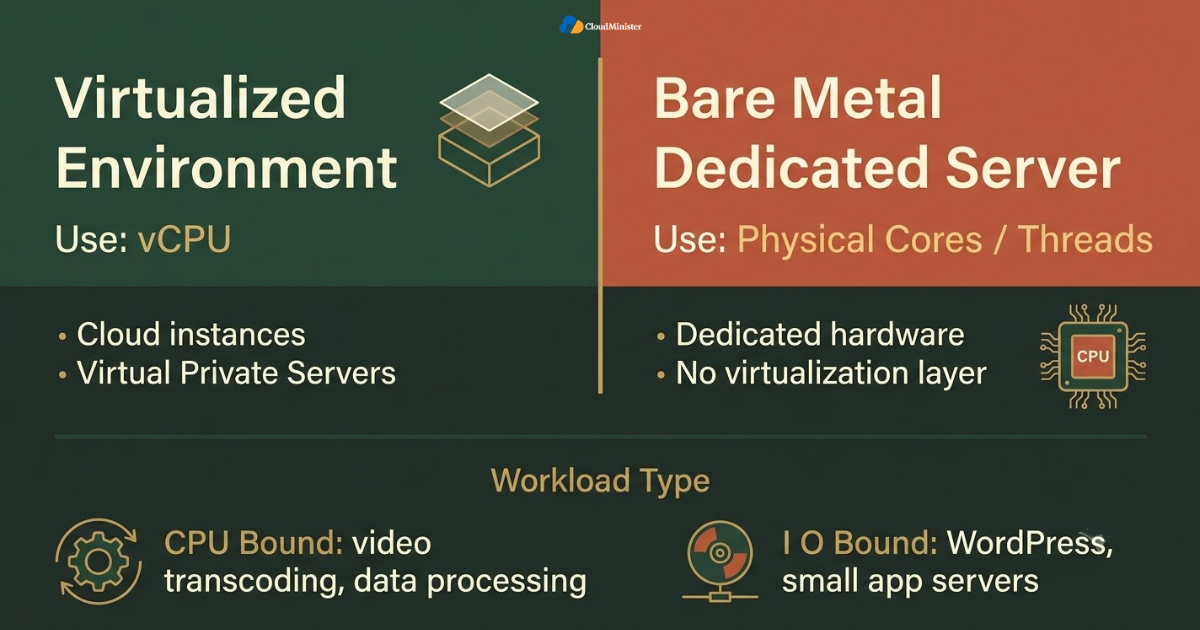
- CPU bound workloads such as video transcoding, scientific computation, and heavy data processing benefit most from a higher core count paired with strong single thread performance, since these tasks genuinely saturate available compute.
- I/O bound workloads such as a typical WordPress site or a small business application server often bottleneck on disk speed or network throughput long before CPU becomes the limiting factor, which means adding more vCPU without addressing storage rarely fixes the actual problem.
- A Dedicated Server Sizing Guide built around real workload profiling consistently outperforms a guide built purely around published benchmark numbers, since benchmarks rarely reflect an application’s actual access patterns.
- Database servers running frequent complex queries benefit from higher clock speeds more than raw core count, since query execution on many database engines is still largely single threaded per connection.
- Independent research into cloud right-sizing patterns has found that studies show thirty to sixty percent of cloud resources are over-provisioned relative to what workloads actually require, a pattern that applies just as directly to dedicated hardware sizing decisions as it does to cloud instance sizing.
- A well informed hosting partner typically maintains benchmark data across common workload types, since that data helps translate a customer’s application description into an actual vCPU recommendation.
- Teams comparing Affordable VPS Hosting against a dedicated server for a growing workload should size both options using the same methodology, rather than assuming a cheaper virtual plan automatically scales the same way.
- Applying a proper Dedicated Server Sizing Guide to a containerized environment means accounting for the orchestration layer’s own overhead, not just the sum of what individual containers report needing.
- A Web Hosting Company in India running both virtual and dedicated infrastructure can usually show real benchmark comparisons between VPS Hosting India and Dedicated Servers in India for a similar workload profile.
- Small teams comparing Affordable VPS Hosting options for a first production workload should still request concurrent user estimates before committing to a specific vCPU count. Teams outgrowing Affordable VPS Hosting within their first year should plan the eventual move to Dedicated Server Hosting in India early, since that transition is smoother when it is anticipated rather than forced by an outage.
- A Dedicated Server Sizing Guide applied to a multi-tenant SaaS platform needs to account for the busiest expected tenant, not the average tenant, since a single noisy customer can otherwise starve everyone else on the same server.
Related Reading: cloud repatriation in 2026
Undersized CPU allocation is not only a performance problem. A server running consistently near full CPU utilization has less headroom to handle a sudden traffic spike, a DDoS attempt, or a security scanning tool without dropping legitimate requests, which means correct sizing is also part of a server’s practical resilience posture.
3. How Much RAM Does Each Use Case Actually Need
RAM sizing tends to generate more disagreement than vCPU sizing, largely because memory needs scale differently depending on whether an application is caching aggressively, holding large datasets in memory, or simply running a modest number of lightweight processes.
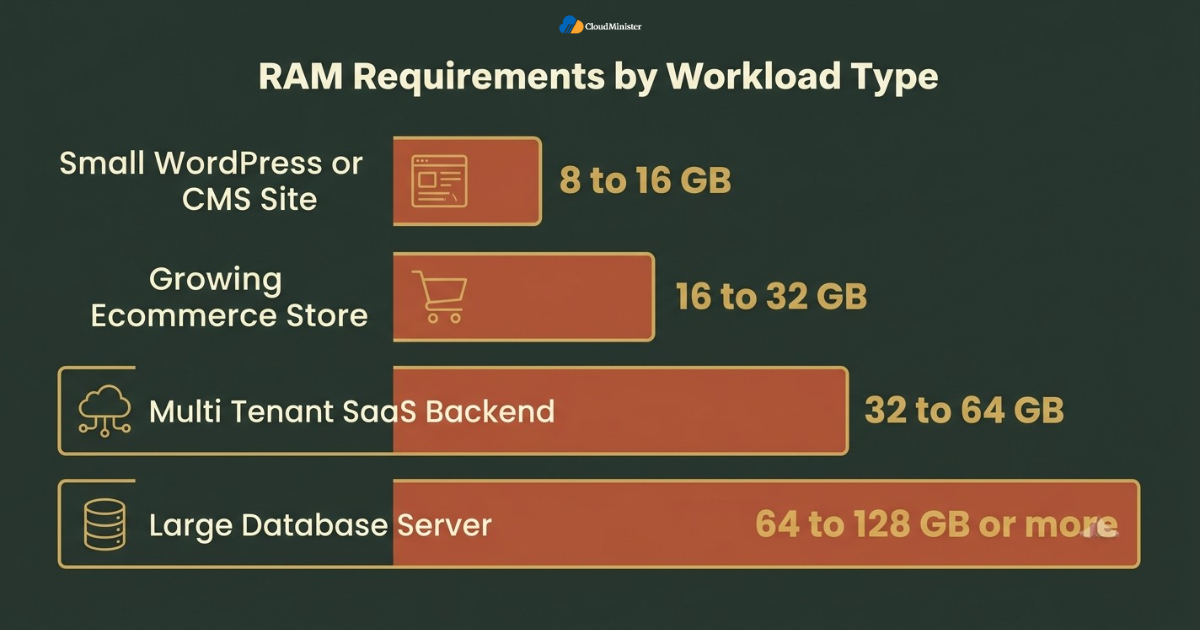
- A standard WordPress or small CMS site with moderate traffic typically runs comfortably on 8 to 16 GB of RAM, assuming a reasonable caching layer is configured and the database is not oversized relative to the site’s actual content volume.
- This is exactly the tier where Affordable VPS Hosting often makes more financial sense than jumping straight to a full dedicated box, provided the sizing exercise is done honestly rather than assumed.
- A growing WordPress network or a mid traffic ecommerce store usually needs 16 to 32 GB of RAM, since object caching, session handling, and concurrent checkout processes all consume memory simultaneously during peak hours.
- A multi-tenant SaaS backend serving dozens of active customers typically starts at 32 GB of RAM and scales upward based on concurrent session count, since every active user session holds some amount of application state in memory.
- At this scale, Affordable VPS Hosting usually stops being the right fit, and the sizing conversation shifts toward Dedicated Server Hosting in India instead.
- Relational database servers benefit disproportionately from additional RAM, since a properly sized buffer pool or cache can keep frequently accessed data in memory rather than forcing constant disk reads, which is often the single biggest performance lever available.
- A dedicated database server handling a genuinely large dataset, in the range of several hundred gigabytes to multiple terabytes, often needs 64 to 128 GB of RAM or more, depending on how much of the working set needs to stay cached.
- Datasets at this scale often push toward Dedicated Server Hosting in India, though the right choice ultimately depends on the workload’s performance requirements and cost constraints rather than dataset size alone, since modern virtualized platforms can deliver very high IOPS, memory, and storage capacity when properly configured.
- Video rendering and transcoding workloads need enough RAM to hold source files and intermediate render buffers without swapping to disk, which for professional workloads typically means 32 to 64 GB as a practical starting point.
- Rendering pipelines rarely fit within the ceiling of Affordable VPS Hosting once source file sizes grow, which is another reason to size for the workload’s actual trajectory rather than its starting point.
- A Dedicated Server Sizing Guide for a machine learning inference workload needs to account for model size directly, since a model that does not fully fit in RAM will swap constantly and destroy response latency.
- Teams running Dedicated Servers in India for compliance sensitive workloads should size RAM with enough headroom for security agents, monitoring tools, and backup processes, all of which consume memory continuously in the background.
- Compliance auditors reviewing any fleet of Dedicated Servers in India will typically ask for this same memory headroom documentation as part of a standard review.
- A Dedicated Server Sizing Guide should always reserve RAM specifically for the operating system and background services, rather than assuming one hundred percent of installed memory is available for the application itself.
- Server Management Services in India teams often flag memory sizing as the single most common misconfiguration found during a first infrastructure review, more frequently than CPU or storage misconfigurations.
Related Reading: Seven features of dedicated hosting
- A team running Dedicated Servers in India should confirm whether ECC memory is included by default, since error correcting memory matters more for workloads handling financial transactions or large scientific datasets.
- Businesses comparing Dedicated Server Hosting in India providers should ask directly whether RAM can be upgraded later without a full server migration, since flexibility here often matters as much as the initial sizing number.
- A Web Hosting Company in India that manages both VPS Hosting India accounts and Dedicated Servers in India under one dashboard makes it far easier to compare RAM headroom across both environments side by side.
If your current server frequently shows available memory near zero even outside traffic spikes, treat that as an immediate signal rather than a background concern. Applications that run out of available RAM typically fall back to swap space on disk, which is dramatically slower and often the actual root cause behind a server that “randomly” feels sluggish.
4. Storage, Bandwidth, and Network Considerations in a Dedicated Server Sizing Guide
A complete Dedicated Server Sizing Guide cannot stop at compute and memory, since storage type and network capacity frequently become the real bottleneck even when vCPU and RAM numbers look generous on paper.
- NVMe SSD storage should be the default recommendation for nearly every modern workload, since the difference in random read and write performance compared to older SATA SSD or spinning disk options directly affects database query speed and application responsiveness.
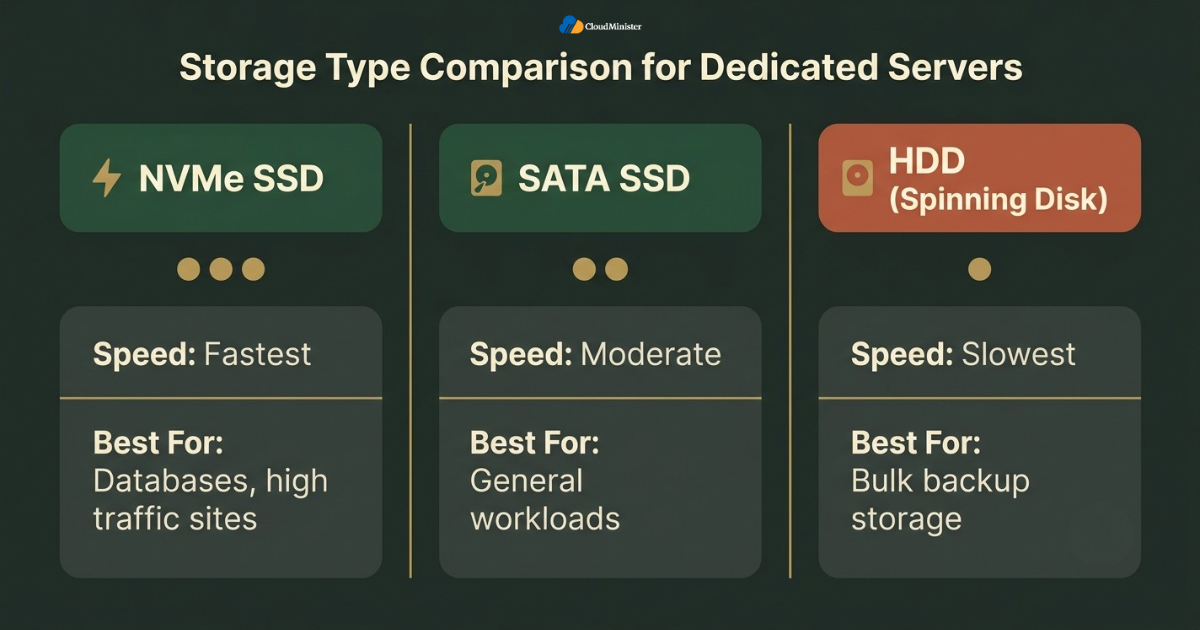
- This holds true whether the workload sits on VPS Hosting India or on dedicated hardware, since storage type affects performance regardless of the underlying hosting model.
- A Dedicated Server Sizing Guide for a database heavy workload should specifically confirm IOPS capacity, not just raw storage size, since a large but slow disk can bottleneck a server that otherwise has generous vCPU and RAM allocation.
- RAID configuration decisions belong inside any serious Dedicated Server Sizing Guide, since RAID 1 or RAID 10 setups trade some usable capacity for meaningful protection against a single drive failure taking down the entire application.
- Network bandwidth sizing should account for genuine peak concurrent traffic, not average daily traffic, since a server that looks fine on a monthly bandwidth average can still choke during a specific high traffic event.
- A Dedicated Server Sizing Guide built for a video streaming or large file distribution workload needs to size network throughput as carefully as compute, since bandwidth becomes the limiting factor well before CPU or RAM in these use cases.
- Teams evaluating Dedicated Server Hosting in India should confirm whether bandwidth is metered, unmetered, or capped at a specific port speed, since these models affect sizing decisions differently depending on traffic pattern.
- A Web Hosting Company in India offering both VPS Hosting India and dedicated infrastructure under one roof gives a growing team room to size storage and bandwidth correctly at every growth stage without switching providers mid project.
- Backup storage should be sized and budgeted separately within any Dedicated Server Sizing Guide, since treating backup capacity as an afterthought is one of the more common ways a technically correct sizing plan still runs into unexpected costs later.
Related Reading: Why dedicated hosting is the best choice for a site
- A Dedicated Server Sizing Guide applied to a hybrid environment should also account for the data transfer costs and latency introduced whenever a workload spans both dedicated hardware and a separate cloud environment.
- Teams comparing VPS Hosting India against dedicated storage options for a growing dataset should factor in migration effort now, since moving a genuinely large dataset later is considerably more disruptive than sizing storage correctly from the outset.
- Businesses that started on Affordable VPS Hosting for cost reasons should revisit storage sizing specifically once a dataset approaches the practical ceiling of a shared storage backend.
- A provider running its own fleet of Dedicated Servers in India tends to have more accurate IOPS benchmark data than one reselling third party capacity, and the same principle applies to a provider’s own fleet supporting Affordable VPS Hosting.
Teams that get the most long term value from a Dedicated Server Sizing Guide are rarely the ones that size for today’s traffic alone. They build in a defined growth buffer, typically twenty to thirty percent above current peak usage across CPU, RAM, and storage, so a normal growth curve does not force an emergency migration within the first year of deployment.
5. Matching Server Configurations to Common Use Cases
Below is a direct look at how a practical Dedicated Server Sizing Guide translates into actual configuration recommendations across the use cases most businesses actually run.
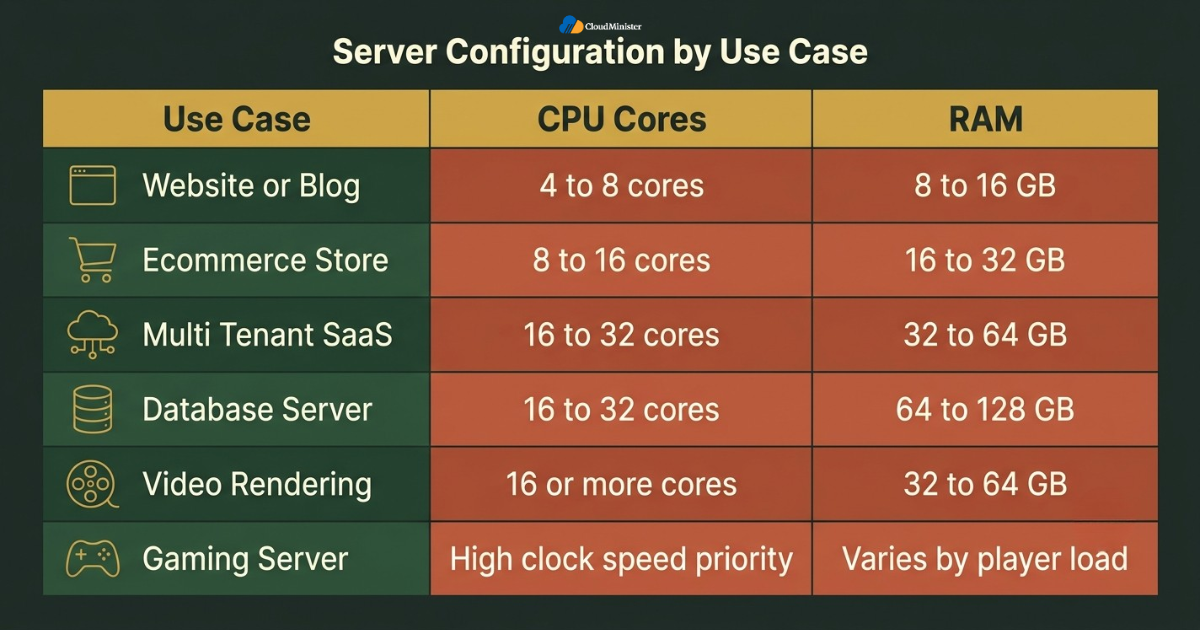
| Use Case / Workload | Recommended Core Count | Recommended RAM | Storage & Sizing Considerations | Best Hosting Model |
|---|---|---|---|---|
| SMB Website / Moderate Traffic Blog | 4 – 8 Physical Cores | 8 – 16 GB | NVMe SSD storage; requires a reasonable caching strategy. | Affordable VPS Hosting |
| Growing E-commerce Store | 8 – 16 Physical Cores | 16 – 32 GB | High-performance storage with focus on database speed during checkout/payments. | High-tier VPS or Dedicated Server |
| Multi-Tenant SaaS Application | 16 – 32 Physical Cores | 32 – 64 GB | Scalable base configuration to handle concurrent tenant activity growth. | Dedicated Server Hosting |
| Dedicated Database Server | 16 – 32 Physical Cores | 64 – 128 GB | NVMe configured specifically for high IOPS rather than max raw capacity. | Dedicated Server Hosting |
| Video Rendering / Media Processing | 16+ Cores / Hardware Threads | 32 – 64 GB | Fast local storage capable of sustaining high throughput during rendering. | Dedicated Server Hosting |
| Active Gaming Server | High Core Count + High Clock Speed | Sized for Active Base | Low network latency; prioritizes single-thread clock speed alongside cores. | Dedicated Server Hosting |
| Machine Learning (Inference / Training) | Model & Batch Driven | Model & Batch Driven | Sizing driven by model size; frequently requires dedicated GPU acceleration. | Dedicated GPU / Specialized Server |
| Development & Staging Environments | Leaner than Production | Leaner than Production | Should mirror production architecture to catch performance bottlenecks early. | VPS Hosting |
Get a Dedicated Server Sized for Your Actual Workload
Skip the guesswork and get hardware configured around your real CPU, RAM, and storage needs, not a generic plan tier.
6. Building a Practical Sizing Checklist for 2026
Even a technically sound Dedicated Server Sizing Guide underperforms without a structured process behind it, since sizing decisions made under deadline pressure tend to default to whatever configuration is fastest to provision rather than what the workload actually needs.
- Start by pulling actual historical resource usage data covering at least the last ninety days, since a Dedicated Server Sizing Guide built on assumptions alone consistently underperforms one built on real numbers.
- This step applies equally whether the current environment runs on Affordable VPS Hosting, a legacy dedicated box, or Dedicated Servers in India provisioned more recently.
- Separate baseline load from peak load explicitly, since sizing purely for average traffic leaves no headroom for the exact moments a business can least afford a slowdown.
- Confirm growth projections directly with business stakeholders rather than assuming current usage represents a stable long term baseline, since a six month growth plan changes sizing math considerably.
- Businesses without an internal platform team dedicated to sizing decisions should treat a partnership with an experienced Web Hosting Company in India as the practical foundation for a realistic Dedicated Server Sizing Guide.
- Review sizing decisions on a recurring schedule rather than treating an initial configuration as permanent, since workload patterns shift meaningfully as an application matures and its user base grows.
- A team delivering Server Management Services in India should be able to show documented utilization reporting on request, not just a general assurance that current sizing is adequate.
- Teams evaluating Dedicated Server Hosting in India should weigh migration support as heavily as raw hardware specifications, since a provider that supports smooth capacity upgrades later reduces the real cost of getting initial sizing slightly wrong.
- A dependable Web Hosting Company in India should document sizing methodology consistently across both VPS Hosting India and Dedicated Servers in India offerings, not just for the higher margin product.
Checklist: Dedicated Server Sizing Guide Readiness Review
- Ninety days of historical CPU, RAM, storage, and bandwidth utilization pulled and reviewed
- Peak load and average load separated and documented independently
- Growth projections confirmed directly with business stakeholders
- Storage type and IOPS requirements matched specifically to workload type
- Network bandwidth sized against genuine peak concurrent traffic
- Backup and disaster recovery capacity budgeted separately from primary storage
- A defined growth buffer built into the final configuration recommendation
- A Server Management Company that documents every sizing decision, including the reasoning behind it, makes future capacity planning considerably faster to execute.
- Businesses selecting VPS Hosting India for a workload that may later migrate to dedicated hardware should confirm the provider supports that migration path directly.
- Teams running production workloads under Dedicated Server Hosting in India should request a written review of current sizing at least once a year, even without an obvious performance problem prompting it.
7. Common Sizing Mistakes That Undermine an Otherwise Solid Plan
A technically accurate Dedicated Server Sizing Guide still fails in practice if a handful of common mistakes go unaddressed during actual implementation.
| Category / Focus Area | Common Mistakes & Operational Risk | Recommended Best Practice |
| Benchmarking & Baseline Metrics | Sizing strictly around published benchmark numbers rather than actual application access patterns; mirroring old server specs out of habit. | Right-size based on measured workload needs and specific access patterns rather than arbitrary rules (like simply doubling the old configuration). |
| System Overhead & Headroom | Ignoring background processes (backup jobs, security scans, monitoring agents) or container/virtualization overhead, leading to resource spikes during maintenance. | Calculate true RAM and CPU headroom by factoring in background tasks, daemon processes, and virtualization layer overhead. |
| Lifecycle & Review Process | Treating server sizing as a single, one-time exercise instead of a recurring capacity planning review as the business grows. | Re-evaluate capacity periodically to adapt to changing user bases, new features, and workload shifts over time. |
| Scaling & Upgrade Agility | Committing to a VPS or dedicated provider without knowing their upgrade capabilities, risking downtime if a workload suddenly surges. | Confirm upgrade response times in advance with VPS/Dedicated providers to ensure seamless scaling before hitting capacity limits. |
| Governance & Documentation | Relying on unverified assumptions that the current server setup is “fine” without tracking decision rationale or ownership. | Maintain a documented sizing rationale detailing historical workload metrics, configuration decisions, and approval history for every server. |
| Provider Evaluation | Choosing hosting partners that rely purely on client complaints to detect capacity mismatches or describe capacity planning in vague generalities. | Partner with management companies and hosts that maintain detailed fleet capacity records and clearly explain their capacity planning workflows. |
8. Choosing the Right Partner for Accurate Server Sizing
Not every hosting relationship is built to support a genuinely accurate Dedicated Server Sizing Guide, and this is exactly where the difference between an average Web Hosting Company in India and a genuinely prepared one becomes visible.
- A dependable Web Hosting Company in India that already manages a team’s broader infrastructure is well positioned to recommend sizing using real historical data rather than introducing unnecessary complexity into an already functioning environment.
- This holds whether the account in question runs on VPS Hosting India, a legacy virtual plan, or a full dedicated deployment.
- Teams should confirm any provider of Dedicated Servers in India actually owns and operates its own infrastructure rather than reselling capacity from a third party.
- A dependable provider of Dedicated Servers in India should be able to share a reference client that completed a similar sizing exercise for a comparable workload, and the same standard should apply to any provider marketing Affordable VPS Hosting.
- Businesses evaluating providers should specifically ask whether the provider has direct experience helping customers correctly size dedicated hardware, not just provisioning a server under a generic hosting plan.
- A Server Management Company offering transparent pricing around Dedicated Server Hosting in India makes it easier to compare true sizing accuracy against a generic hosting quote.
- A newer hosting provider may offer a competitive base rate but lack the account history needed to advise confidently on sizing for a complex, multi service environment.
- A provider offering Dedicated Server Hosting in India with a documented sizing methodology is generally a safer long term bet than one offering only a low introductory price.
- Ask any prospective provider of Affordable VPS Hosting how sizing recommendations are actually calculated, since experience with real workload analysis correlates strongly with fewer surprises after deployment.
- A provider offering Affordable VPS Hosting alongside a credible path to Dedicated Server Hosting in India gives a growing business one continuous relationship rather than a disruptive vendor switch later.
- A Web Hosting Company in India that treats every client’s sizing needs as identical is usually applying a template rather than genuinely reviewing actual workload data.
A capable partner offering both deep expertise in Server Management Services in India and broader Dedicated Server Hosting in India gives growing teams a coherent capacity roadmap instead of stitching together advice from multiple vendors.
- A genuinely capable Web Hosting Company in India will also be transparent about which parts of a sizing decision it owns directly and which parts depend on the customer’s own application architecture choices.
- Reviews and references matter more than a homepage promise when choosing a partner for a decision this consequential to long term performance and cost.
- Businesses switching their Web Hosting Company in India specifically over a persistent sizing mismatch should confirm the new partner’s sizing methodology before signing, rather than assuming it will simply be handled correctly this time.
When comparing quotes or advice from different providers on server sizing, ask each one to walk through a real configuration example using a workload profile similar to yours rather than a generic case study, since the right recommendation depends entirely on your specific application behavior and growth trajectory. A provider offering genuine Server Management Services in India that understands both the technical sizing mechanics and your organization’s actual usage pattern will consistently give more actionable guidance than a purely theoretical comparison.
9. Measuring Whether Your Server Sizing Actually Worked
Completing an initial configuration is not the finish line for any Dedicated Server Sizing Guide, whether sizing is managed internally or through an outside partner offering broader Server Management Services in India. Long term results depend on how thoroughly the decision gets verified afterward under real production conditions.
- Confirm CPU, RAM, and storage utilization sit within a healthy range, typically well below constant maximum capacity, during both average and peak traffic periods after deployment.
- Teams that sized a new environment under Dedicated Server Hosting in India should re-verify performance independently after thirty and ninety days, not just accept the provider’s word that sizing is correct.
- Ask whichever provider handles infrastructure to walk through a recent example of a sizing correction they actually made for a client, since a concrete example demonstrates real capability far better than a general description.
- Compare application response time and error rates before and after a resizing decision, since a properly executed Dedicated Server Sizing Guide should show measurable improvement rather than new, unexplained issues.
- Review resource utilization trends monthly for the first two quarters after any significant sizing change, since this is the window where an incorrect sizing decision typically becomes visible.
- Cross reference completed sizing decisions against the organization’s broader budget planning, particularly where infrastructure cost needs to be reported alongside other operational metrics.
Maintain a change log for every significant sizing decision, shared with the broader engineering team, so the reasoning and outcome behind each configuration choice remains traceable over time.
- Ask any partner providing Server Management Services in India to share their own capacity planning metrics on a recurring basis, since transparency here is one of the clearest signals of a genuinely mature partnership.
- Confirm with any provider of Dedicated Servers in India that the current environment is being monitored for both under-utilization and over-utilization, not just one direction.
- Teams that moved off Affordable VPS Hosting onto dedicated hardware should specifically re-verify that the new environment is not now oversized relative to actual measured demand.
- This verification step matters just as much for VPS Hosting India deployments as it does for a full dedicated migration, since either direction of sizing error costs money.
- Businesses still running production workloads on VPS Hosting India should apply this same verification step, rather than assuming a virtual environment is exempt from a proper sizing review.
- A Server Management Company that shares sizing verification metrics on request is demonstrating exactly the kind of transparency a completed configuration decision deserves.
Industry data on cloud right-sizing continues to show a wide gap between provisioned capacity and actual usage across most organizations, which is exactly why treating a Dedicated Server Sizing Guide as a recurring discipline, rather than a one time task, matters for long term infrastructure planning and budget control.
Key Takeaways
- A Dedicated Server Sizing Guide succeeds when it is built on real historical usage data, not on generic plan tiers or published benchmark numbers alone.
- Core sizing should account for whether a workload is CPU bound or I/O bound these two categories respond very differently to simply adding more cores.
- RAM needs vary enormously by use case, from 8 GB for a modest website to well over 100 GB for a large database server, and matching RAM to actual working set size matters more than maximizing the number.
- Storage type, IOPS capacity, and network bandwidth deserve the same sizing discipline as compute, since either one can become the real bottleneck even when vCPU and RAM look generous.
- A defined growth buffer, documented sizing rationale, and a recurring review schedule matter just as much as the initial configuration decision, whether the environment is run internally, through a Web Hosting Company in India, or through broader Server Management Services in India.
- A Web Hosting Company in India that already understands this discipline end to end, and that runs its own well maintained Dedicated Servers in India, remains one of the more reliable ways to get sizing right from the first deployment.
- Partnering with a capable provider experienced across both VPS Hosting India and Dedicated Server Hosting in India meaningfully reduces the risk of a costly sizing mistake, and this is worth raising directly in the next infrastructure planning conversation.
Talk to Our Team Before You Finalize Your Sizing
Get a second opinion on your CPU, RAM, and storage requirements from engineers who size servers for a living.
Conclusion
Throughout this Dedicated Server Sizing Guide, one pattern holds regardless of business size, industry, or whether the surrounding environment runs a single application server or a larger multi service footprint. Correct sizing is not a one time guess made during initial setup, and it is not something that stays accurate indefinitely once traffic and data volume grow. The organizations that handle this well share a consistent pattern. They confirm real usage data before making any configuration decision, they build in a genuine growth buffer rather than sizing exactly to current peak, and they treat sizing as a recurring review rather than a background task.
Getting this right also depends on separating assumptions from actual measured behavior at every stage of the process. A workload that looks CPU bound on paper may actually be limited by storage IOPS, and a server that appears to have plenty of free memory may still be one traffic spike away from swapping to disk. A Dedicated Server Sizing Guide only holds up in practice when these details are checked against real data rather than accepted at face value, which is exactly why a ninety day usage review keeps showing up as the starting point for almost every sizing decision covered here.
For teams weighing this decision alongside a broader look at their infrastructure, or comparing hosting strategies across their environment, the same underlying principle applies. Measure actual usage first, size with a deliberate growth buffer second, and verify the result thoroughly, ideally with a capable Web Hosting Company in India involved throughout, including one experienced across both VPS Hosting India and broader Dedicated Server Hosting in India. Sizing done this way stops being a one time decision made under pressure and becomes a routine part of how a growing infrastructure stays reliable and cost effective over time.
10. Frequently Asked Questions
Businesses running Dedicated Servers in India through a managed provider should ask this exact question directly during their next account review.
How many CPU cores does a typical WordPress site actually need?
A standard WordPress site with moderate traffic generally runs well on 4 physical cores, with 8 cores providing meaningful headroom for traffic spikes and future growth. A proper Dedicated Server Sizing Guide will still confirm this against actual traffic data rather than a generic recommendation.
Does more RAM always improve server performance?
Not automatically. RAM beyond what an application and its caching layer can actually use provides limited additional benefit, which is why a Dedicated Server Sizing Guide focuses on matching RAM to actual working set size rather than simply maximizing the number.
How often should server sizing be reviewed?
At minimum once a year, though any Dedicated Server Sizing Guide should also trigger a review after a significant traffic increase, a new feature launch, or a noticeable change in application performance.
Confirm with your provider of Dedicated Server Hosting in India whether upgrading CPU cores or RAM later requires downtime, since that answer directly affects how conservatively initial sizing should be approached.
What is the single most effective first step in any Dedicated Server Sizing Guide?
There is no single step that captures every requirement, but pulling ninety days of real historical utilization data consistently produces the fastest, most accurate starting point, especially when supported by a partner offering genuine Server Management Services in India and ongoing infrastructure review.
Whether the environment runs on VPS Hosting India for a lighter workload or fully Dedicated Server Hosting in India for a demanding one, the same underlying sizing discipline applies before anything else.
Can a dedicated server be undersized even if the current setup has never gone down?
Yes. A server can run without visible failures for a long time while still operating close to its practical limits, especially during traffic spikes that never quite tip it over. The absence of downtime is not the same as being correctly sized, which is why a proper Dedicated Server Sizing Guide relies on measured utilization data rather than the simple fact that nothing has broken yet.
Does the sizing process change for a business running both VPS and dedicated servers together?
The underlying methodology stays the same, but the review needs to happen for each environment individually rather than assuming one configuration validates the other. A Dedicated Server Sizing Guide applied correctly treats VPS Hosting India workloads and Dedicated Servers in India workloads as separate sizing exercises, since traffic patterns, growth rate, and resource contention rarely look identical across the two.