Choosing between Colocation vs Dedicated Server vs Cloud is mostly a question of workload shape, not brand. Colocation gives the lowest long term cost per unit of compute for large and steady workloads, but you own the hardware and the capital outlay. A dedicated server turns that hardware into a fixed monthly bill, with the provider handling replacement parts. Cloud gives the fastest start and the most flexibility, but outbound data charges and always on usage can make it the costliest option over time. This guide breaks down the real cost lines of Colocation vs Dedicated Server vs Cloud in India for 2026, explains where VPS Hosting India and Dedicated Server Hosting in India fit, and shows how a Web Hosting Company in India can help you decide with numbers instead of guesses.
Every growing business in India reaches the point where the first hosting plan no longer fits. Traffic climbs, the database gets heavier, customers expect faster pages, and the monthly bill starts to look different from what was planned. At that moment the real question appears. Should the workload stay in the cloud, move to a rented physical machine, or go into a rack that the company owns? The honest comparison of Colocation vs Dedicated Server vs Cloud is not about which model is best in general. It is about which one costs less for your own pattern of traffic, storage, and growth. Many readers reach this question while searching for Dedicated Servers in India or Affordable VPS Hosting, and both can be the right answer for the right workload. The Colocation vs Dedicated Server vs Cloud choice simply decides which one fits.
Most poor infrastructure decisions come from comparing only the headline price. A cloud instance looks cheap per hour, a colocation rack looks cheap per kilowatt, and a rented server looks cheap per month, yet none of those numbers include bandwidth, support, spare parts, staff time, or tax. A fair view of Colocation vs Dedicated Server vs Cloud counts every line that a finance team will eventually see. It also counts the cost of being wrong, such as buying too much hardware or paying for idle cloud capacity for years. A trusted Web Hosting Company in India will show all of these lines before you sign.
This guide explains each model in plain language, shows the cost lines that matter in India in 2026, and gives a simple method to decide. You will also see where VPS Hosting India is the smarter first step, where Affordable VPS Hosting saves money before a bigger move is needed, and where Dedicated Servers in India give predictable performance. Whether you are comparing Colocation vs Dedicated Server vs Cloud for the first time or reviewing a bill that has grown too large, the steps below will help you decide with confidence.
Table of Content
- 1. What Each Option Means in 2026
- 2. Why 2026 Is a Turning Point for Infrastructure Costs in India
- 3. Cost Models of All Three Options Side by Side
- 4. Colocation Cost Breakdown in India
- 5. Dedicated Server Hosting in India: Cost Breakdown
- 6. Cloud Cost Breakdown in India
- 7. Where Affordable VPS Hosting Fits in the Cost Picture
- 8. Performance, Control, and Security Compared
- 9. Compliance, Data Residency, and Location in India
- 10. Worked Examples: Which Model Fits Which Workload
- 11. Common Mistakes When Comparing Costs
- 12. Choosing the Right Partner in India
- 13. A Practical 30 Day Decision Plan
- Key Takeaways
- Conclusion
- Frequently Asked Questions
1. What Each Option Means in 2026
Before comparing prices, the three models need clear definitions, because teams often use the words loosely. In the Colocation vs Dedicated Server vs Cloud decision, each option sits at a different point on the ownership scale. Colocation means you own the hardware and rent the space around it. A dedicated server means the provider owns the hardware and you rent all of it. Cloud means you rent slices of a very large shared pool and pay for what you use. Once this scale is clear, every cost line in the rest of this guide becomes easier to read. Keep this scale in mind through the whole Colocation vs Dedicated Server vs Cloud comparison.
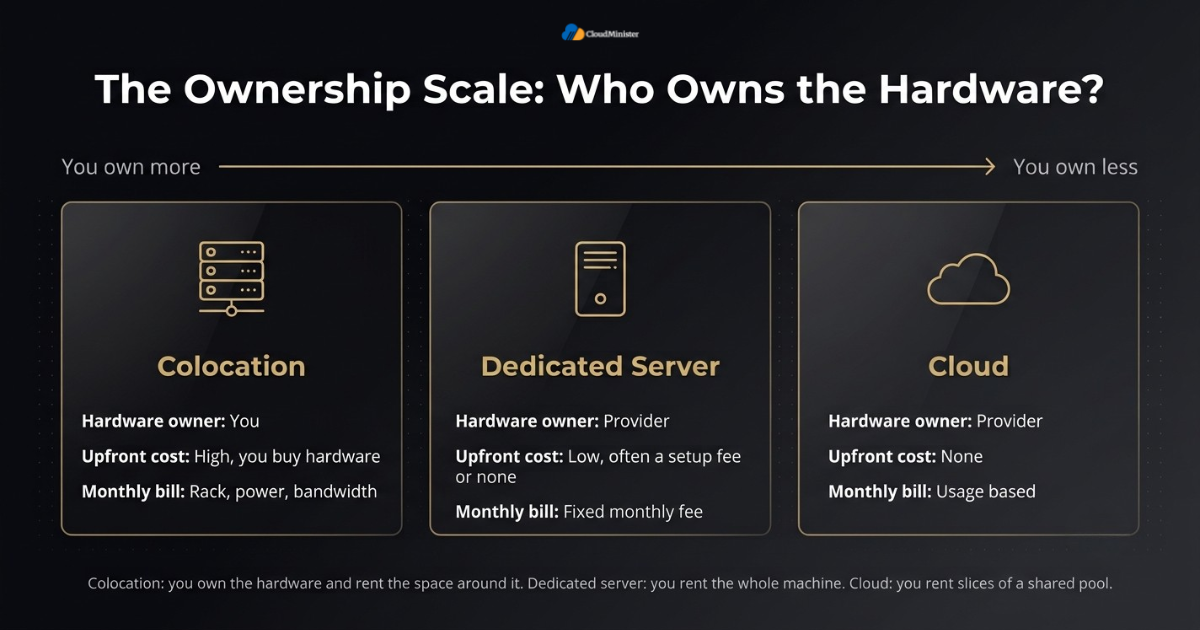
- Colocation: you buy or lease your own servers, storage, and network gear and place them in a rack inside a third party data centre that supplies power, cooling, physical security, and connectivity.
- Dedicated server: you rent one whole physical machine with no other customer on it. The provider owns the hardware, replaces failed parts, and bills a fixed monthly fee. This is what Dedicated Server Hosting in India usually means in practice. Dedicated Servers in India are sold as both managed and unmanaged plans.
- Cloud: virtual machines, containers, storage, and managed services are billed by usage, often per second or per hour, with discounts available for one year or three year commitments.
- VPS: a virtual private server is a fixed share of one physical host with guaranteed resources and a flat monthly price. A good VPS Hosting India plan sits between shared hosting and a full dedicated machine. Affordable VPS Hosting lets a young project start small and upgrade later.
- Tenancy: colocation and dedicated servers are single tenant at the hardware level, while cloud and VPS plans share physical hosts between customers.
- Hardware repair: in colocation it is your job or your remote hands contract, in dedicated hosting it is the provider’s job, and in cloud it is handled out of sight by the provider.
- Management: any of the three can be sold as managed or unmanaged, so confirm who handles patching, monitoring, and backups before you compare prices.
- Naming: providers may call the same product a dedicated server, bare metal, or a Dedicated Server Hosting in India plan, so compare specifications and not labels.
- Quotes: ask a Web Hosting Company in India to price each model on the same specification, so the three can be compared directly.
Write down your workload in three numbers before you read any quote: average CPU cores in use, peak CPU cores in use, and monthly outbound data in terabytes. These three numbers decide most of the outcome in Colocation vs Dedicated Server vs Cloud, and they stop a salesperson from choosing the answer for you.
2. Why 2026 Is a Turning Point for Infrastructure Costs in India
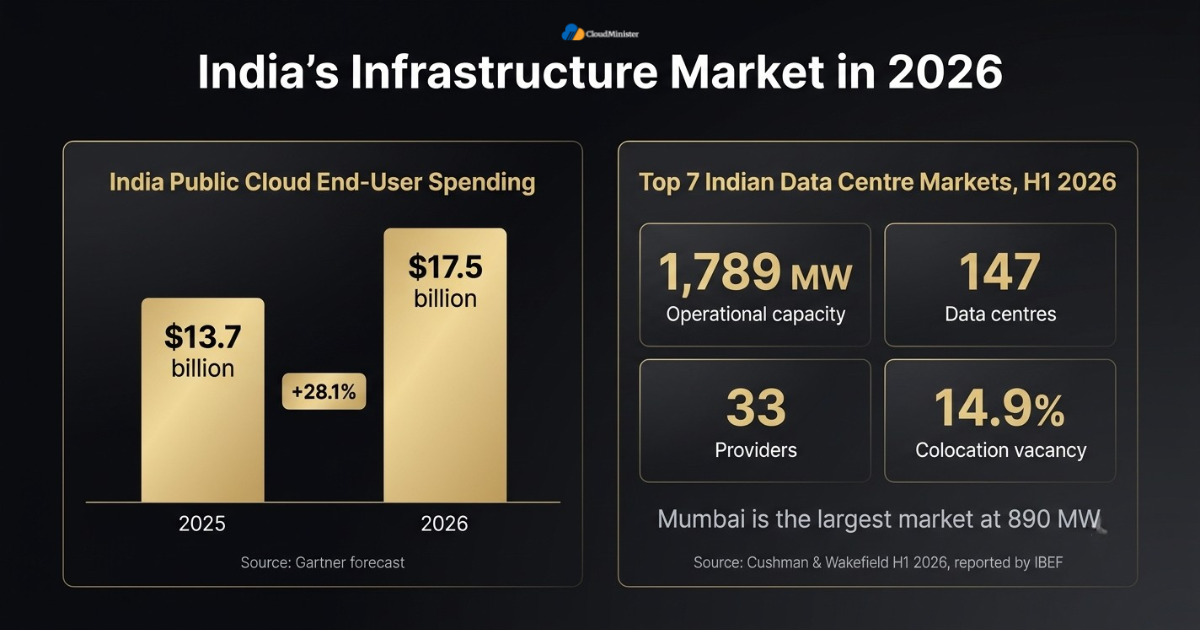
India’s infrastructure market is moving fast, and the numbers explain why the cost conversation has changed. Gartner forecasts that end user spending on public cloud services in India will grow 28.1 percent to 17.5 billion dollars in 2026, up from 13.7 billion dollars in 2025. The physical side is growing too. Cushman and Wakefield’s H1 2026 update, reported by IBEF, says that the top seven Indian data centre markets reached 1,789 MW of operational capacity, across 147 data centres run by 33 providers, with colocation vacancy at 14.9 percent. Together these figures show that both cloud demand and physical capacity are rising, so buyers now have real choices in Colocation vs Dedicated Server vs Cloud.
- Cloud spending is growing quickly, which brings more providers and more discount programs, and also more pressure on teams to control their bills. That growth shapes every Colocation vs Dedicated Server vs Cloud choice.
- Gartner analysts advise Indian technology leaders to move from simply adopting cloud to running it with discipline, which in practice means budgets, tagging, and regular reviews.
- Mumbai is the largest data centre market in the Cushman and Wakefield data at 890 MW, so a Web Hosting Company in India with a Mumbai presence can offer low latency options for users in western and central India.
- A colocation vacancy rate of 14.9 percent means space is available, but power is usually the scarce resource, so always ask for kilowatts per rack and not only rack units.
- GPU servers draw far more power per rack than traditional servers, so confirm the power density before you plan colocation or Dedicated Server Hosting in India for AI hardware.
- Check the billing currency. Services billed in US dollars carry exchange rate risk, while rupee billing makes budgeting simpler.
- GST at 18 percent is generally charged on hosting, colocation, and cloud services, and GST registered businesses can usually claim input tax credit, so compare prices before tax.
- A Web Hosting Company in India that owns its infrastructure can often quote several models together, which makes Colocation vs Dedicated Server vs Cloud easier to compare fairly.
- Smaller teams should not skip the lower end, because VPS Hosting India plans and Affordable VPS Hosting often cover the first years of growth at a fraction of the cost.
3. Colocation vs Dedicated Server vs Cloud: Cost Models Side by Side
The easiest way to compare Colocation vs Dedicated Server vs Cloud is to look at how each one charges you. Colocation is mostly a capital expense followed by a smaller monthly operating bill. A dedicated server is a fixed operating expense with no hardware purchase. Cloud is a variable operating expense that rises and falls with usage. The table below shows the main differences, and the points after it explain what a table cannot show.
| Factor | Colocation | Dedicated server | Cloud |
| Upfront cost | High, you buy hardware | Low, often a setup fee or none | None |
| Monthly bill | Rack, power, bandwidth | Fixed monthly fee | Usage based |
| Hardware owner | You | Provider | Provider |
| Scaling speed | Slow, needs new hardware | Hours to days | Minutes |
| Predictability | High | High | Low to moderate |
| Best fit | Large steady workloads | Steady workloads, small team | Variable or fast growing workloads |
- Capital versus operating cost: colocation moves spending toward capital and depreciation, while the other two are operating expenses, and your finance team may prefer one treatment over the other.
- Fixed versus variable: in Colocation vs Dedicated Server vs Cloud, fixed costs are easy to budget, while variable costs are easy to start but hard to forecast.
- Utilisation decides the winner in Colocation vs Dedicated Server vs Cloud. A server that runs at 60 to 70 percent load all year is cheap per unit of work, while cloud wins when utilisation is low or spiky.
- Time to start: cloud takes minutes, a VPS takes minutes to hours, Dedicated Servers in India take hours to a few days, and colocation takes weeks because hardware must be bought, shipped, racked, and tested.
- Exit cost: leaving cloud can involve data transfer charges and rework, leaving colocation means moving physical hardware, and leaving a rented server is usually only a data migration.
- Team skills: colocation needs hardware, network, and capacity planning skills, while cloud needs strong cost governance skills.
- Hybrid setups are common. Many Indian businesses keep steady databases on dedicated hardware and send burst traffic to cloud.
- Ask every provider for a 36 month total cost and not only a monthly figure, because it is the fairest basis for Colocation vs Dedicated Server vs Cloud.
4. Colocation Cost Breakdown in India
Colocation looks cheap per unit of compute, but its bill has more lines than most people expect. You pay once for the servers and then pay every month for the space around them. Teams studying Colocation vs Dedicated Server vs Cloud often forget that hardware also needs a refresh every four to five years, spare parts, and someone to install and repair it. A Web Hosting Company in India that offers colocation alongside rented servers can usually explain all of these lines in one quote. Some firms start with Dedicated Servers in India and move to colocation only when they run many machines.
- Hardware purchase: servers, drives, switches, firewalls, and rails are bought up front or financed, and are usually depreciated over about four to five years.
- Rack space: billed per full rack, half rack, or per rack unit. A standard rack is 42U, and one unit (1U) is 1.75 inches tall.
- Power: usually the largest recurring line after hardware. It is billed by committed kilowatts or by metered usage, and committed power is paid for even when you do not use it.
- Cooling: check whether cooling is bundled into the power price or billed separately, and compare the total price per kilowatt.
- Bandwidth and cross connects: IP transit, a committed port speed, and one time or monthly fees to connect to carriers or cloud on ramps.
- Remote hands: an hourly or monthly pack for physical tasks such as swapping a disk or rebooting a machine, which you will need even if your team is far away. A Web Hosting Company in India with on site engineers can often supply this.
- Software and licences: operating systems, hypervisors, backup tools, and monitoring are separate from the rack bill.
- Spares and support: extended vendor warranty or a stock of spare parts so one failed part does not cause a long outage.
- Tax: GST at 18 percent is normally added to colocation services.
Always ask for the power limit in kilowatts per rack and the maximum allowed, before you sign. A rack that is physically half empty can still be full on power, and this is the most common surprise in colocation contracts and in any Colocation vs Dedicated Server vs Cloud review. Dense GPU servers reach the power limit long before they fill the rack.
Related Reading: Dedicated server sizing guide
5. Dedicated Server Hosting in India: Cost Breakdown
A dedicated server is the simplest model to budget, which is why Dedicated Server Hosting in India remains popular for databases, online stores, and application back ends. One monthly fee usually covers the hardware, data centre space, power, a network port, and hardware replacement. Among the options in Colocation vs Dedicated Server vs Cloud, it gives single tenant performance without a capital purchase. Businesses that search for Dedicated Servers in India are usually looking for exactly this balance of control and predictability. Many buyers also compare it with VPS Hosting India plans before they decide.
- Base monthly fee: covers CPU, RAM, storage, and the chassis. More cores, more memory, and NVMe drives raise the price. Dedicated Servers in India are usually priced by core count, memory, and drive type.
- Bandwidth: plans usually include a fixed monthly transfer or an unmetered port at a set speed such as 1 Gbps. Read the fair use terms before assuming it is unlimited.
- Management level: unmanaged plans cost less, while managed plans add patching, monitoring, and backup help. Affordable VPS Hosting is usually cheaper still, but it uses shared resources.
- Licences: Windows Server, control panels, and commercial database licences are normally billed separately and can add a noticeable amount.
- Extras: additional IP addresses, backup storage, and DDoS protection tiers are often charged on top of the base fee.
- Contract term: longer terms often lower the monthly rate, and some plans carry a one time setup fee.
- Hardware failure: the provider replaces failed parts, so check the replacement time written in the SLA.
- Upgrades: you usually move to a bigger server through a migration, because a physical machine cannot be resized in place like a cloud instance, so plan headroom when you order Dedicated Server Hosting in India.
- Power and cooling are bundled, so there is no separate power bill to forecast, which is a clear advantage in Colocation vs Dedicated Server vs Cloud.
Related Reading: 7 features of dedicated hosting.
Need Predictable Performance at a Fixed Monthly Price?
Run your steady workloads on single-tenant hardware with no surprise bandwidth bills. Explore CloudMinister Dedicated Server Hosting in India with fast provisioning and 24/7 support.
6. Cloud Cost Breakdown in India
Cloud has the lowest barrier to entry and the highest number of billing dimensions. That is the main reason cloud bills surprise teams, even when the hourly rate looks small. In Colocation vs Dedicated Server vs Cloud, cloud is strongest when demand is uncertain, because you can start small and scale in minutes. It is weakest when a large workload runs every hour of every month, because you pay the full usage price for capacity that never switches off.
- Compute: billed per second or per hour by instance size. On demand rates are the highest, and one year or three year commitments reduce the rate in exchange for a spending or capacity promise.
- Storage: block storage, object storage, and snapshots are billed per GB per month, and old snapshots keep adding cost until someone deletes them.
- Data transfer out: inbound traffic is generally free, but outbound traffic to the internet is charged per GB. For video, downloads, and API heavy products this is often the largest hidden cost. A fixed price plan from Dedicated Server Hosting in India avoids this uncertainty.
- Managed services: databases, load balancers, NAT gateways, and monitoring each carry their own hourly and per GB charges.
- Support plans: paid support tiers are often a percentage of monthly spend, so they grow as your bill grows.
- Idle resources: a stopped instance can still bill for its attached disks and reserved IP addresses. A flat VPS Hosting India plan has no such surprise.
- Currency and tax: confirm whether invoices are in rupees or dollars and add 18 percent GST.
- Governance: budgets, tagging, and spending alerts are cheap to set up and prevent most overruns.
- Right sizing: review instance usage every month, because many instances run far below their capacity. Regular reviews belong in every Colocation vs Dedicated Server vs Cloud plan.
Related Reading: Cloud repatriation in 2026
7. Where Affordable VPS Hosting Fits in the Cost Picture
Not every business needs to choose between a full rack and a hyperscale cloud account. A VPS Hosting India plan gives a fixed slice of a powerful host for a flat monthly price, and it is often the right first step for growing websites, small applications, and test environments. When teams compare Colocation vs Dedicated Server vs Cloud, the VPS is the option they most often forget, even though it costs far less than the other three for light and medium workloads. Affordable VPS Hosting also removes the guesswork of usage billing. A Web Hosting Company in India that offers both VPS and dedicated plans lets you grow without changing provider.
- Affordable VPS Hosting means a flat monthly price with guaranteed vCPU, RAM, and SSD or NVMe storage, so the bill does not change with traffic.
- Root access on most Linux VPS Hosting India plans, so you control the full software stack.
- Fast provisioning, usually within minutes of payment.
- Easy upgrades inside the same provider by moving to a larger VPS Hosting India plan.
- Good fit for Affordable VPS Hosting: business websites, moderate online stores, internal tools, staging servers, and small databases.
- Weak fit: heavy databases with high disk activity, strict latency targets, and workloads that need a full physical CPU, where Dedicated Servers in India are the better answer.
- KVM based virtualisation gives each VPS its own kernel and stronger isolation than container based virtualisation, so check which one a VPS Hosting India plan uses.
- A VPS on an oversold host can be affected by busy neighbours, so choose Affordable VPS Hosting from a provider that states its resource guarantees clearly.
- Graduation signal: when CPU stays high for weeks or disk activity limits speed, it is time to look at Dedicated Server Hosting in India, which is the usual next step in Colocation vs Dedicated Server vs Cloud planning.
8. Performance, Control, and Security Compared
Cost is only one side of the decision. The three models also differ in how much performance you can guarantee, how much control you have, and who carries each security duty. In Colocation vs Dedicated Server vs Cloud, the lowest price is not always the lowest risk, so these differences should be priced in before you decide.
- Performance consistency: dedicated and colocated hardware give steady CPU and disk speed, while cloud performance and VPS Hosting India performance depend on the host and plan type.
- Latency: placing servers in a city close to your users and partners reduces response time, so check the data centre location.
- Hardware control: colocation lets you pick exact CPUs, GPUs, and network cards, dedicated servers offer fixed catalogue choices, and cloud offers instance families.
- Shared responsibility: in cloud the provider secures the underlying infrastructure while you secure your operating system, applications, identities, and data. This duty split is central to Colocation vs Dedicated Server vs Cloud.
- Physical security: colocation facilities offer access control, CCTV, and biometric entry, but your own equipment and cabling remain your responsibility.
- DDoS protection: ask what is included, how much attack traffic it can absorb, and where the filtering happens.
- Backups: RAID and snapshots on the same machine are not backups. Follow the 3-2-1 rule with three copies, on two media types, with one copy off site.
- Disaster recovery: a single server in any model is a single point of failure, so replicate important data to a second location.
- Compliance evidence: ask for certificates such as ISO 27001 and recent audit reports.
A rented or colocated server does not become secure just because it sits in a good data centre. Disable password based SSH login, use key based access with multi factor authentication on every management panel, keep the out of band management interface such as IPMI, iDRAC, or iLO on a private network or VPN, and update firmware regularly. Exposed management interfaces are a common way for servers to be compromised.
Related Reading: Reasons to choose a dedicated gaming server
9. Compliance, Data Residency, and Location in India
In India, where your data sits can affect both cost and risk. The Digital Personal Data Protection Act, 2023 sets duties for how personal data is processed, and some sectors have stricter rules of their own. Anyone comparing Colocation vs Dedicated Server vs Cloud should check legal requirements before price, because a cheaper option that breaks a rule is not cheaper. Choosing a Web Hosting Company in India with local data centres also makes residency questions easier to answer. This section is general information and not legal advice.
- DPDP Act 2023: businesses that handle personal data of people in India must follow its rules on consent, purpose, security safeguards, and breach reporting.
- Cross border transfer: the Act allows transfer of personal data outside India except to countries the government restricts by notification, and sector rules can be stricter. This point matters in any Colocation vs Dedicated Server vs Cloud review of regulated data.
- RBI: payment system data must be stored only in India under the 2018 directive on storage of payment system data.
- Government work: public sector buyers usually need cloud providers empanelled by MeitY.
- Regulated entities: banks, insurers, and capital market firms follow outsourcing and cloud frameworks from RBI, IRDAI, and SEBI, so involve your compliance team early.
- City choice: location affects latency, and a disaster recovery site in a different city reduces shared risk, and two Dedicated Servers in India in different cities make a simple recovery pair.
- Tier ratings: Uptime Institute Tier III targets 99.982 percent availability and Tier IV targets 99.995 percent, but confirm whether a facility is certified or only designed to that standard.
- Contracts: ask where backups and replicas are stored, and get the answer in writing from the Web Hosting Company in India you choose.
- Dedicated Servers in India hosted in local data centres can simplify audits because the physical location is known and fixed.
10. Worked Examples: Which Model Fits Which Workload
Examples make the comparison concrete, so this section applies the logic to typical workloads. These examples use traffic and utilisation patterns and not price quotes, because rates differ by city, hardware, contract term, and provider. Use the method, then replace the assumptions with real quotes. This is the practical way to compare Colocation vs Dedicated Server vs Cloud for your own situation.
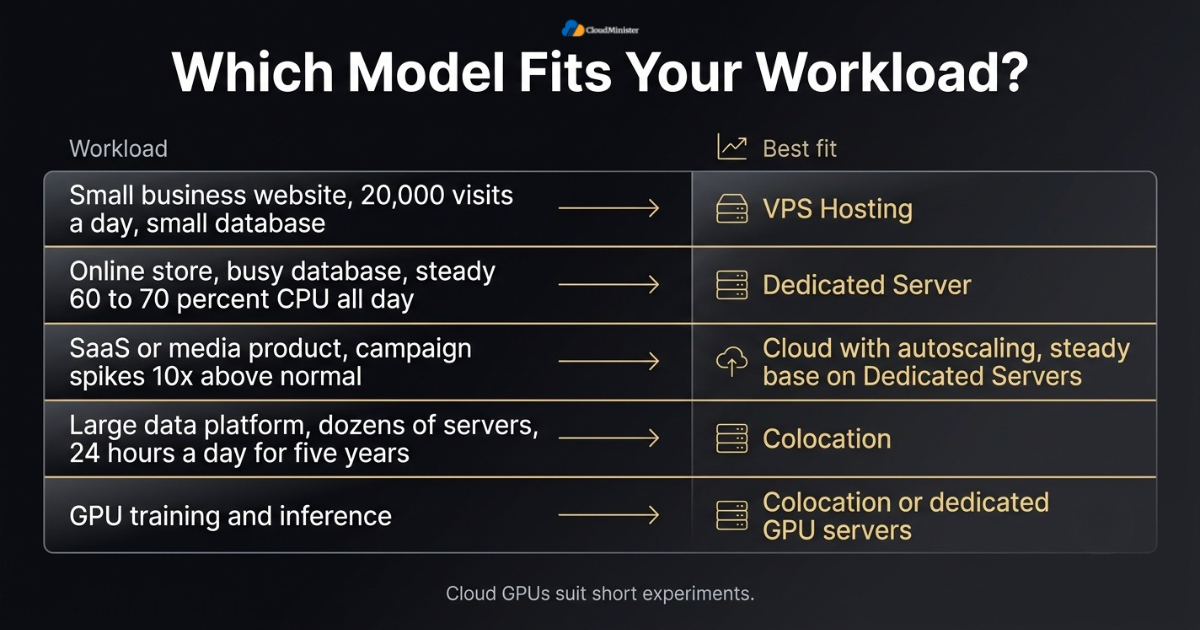
- Small business website with 20,000 visits a day and a small database: a VPS Hosting India plan or Affordable VPS Hosting is usually enough, and anything larger pays for unused capacity.
- Online store with a busy database at a steady 60 to 70 percent CPU all day: Dedicated Server Hosting in India fits well because the load never drops and the bill stays fixed.
- SaaS or media product with campaign spikes ten times above normal: cloud with autoscaling suits the spikes, often with a steady base on Dedicated Servers in India.
- Large data platform running 24 hours a day on dozens of servers for five years: colocation usually wins, because hardware cost spreads over many servers and years and an infrastructure team already exists.
- GPU training and inference: colocation or dedicated GPU servers from a Dedicated Server Hosting in India provider suit high utilisation, while cloud GPUs suit short experiments.
- Total cost formula: 36 month cost equals upfront spend plus monthly recurring cost times 36, plus staff time, support, and exit cost. Run it for 60 months as well.
- Break even signal: if the steady part of your cloud bill exceeds the cost of an equivalent Dedicated Server Hosting in India plan for many months in a row, move that steady part. This is the most practical test in Colocation vs Dedicated Server vs Cloud.
- Run a 30 day pilot and measure real utilisation before committing to any long contract.
- Add migration cost to every option, because moving data and testing applications takes engineering time. This cost applies in every Colocation vs Dedicated Server vs Cloud choice.
When you build the cost sheet, put the steady part of your workload and the spiky part in separate columns. Price the steady part on Dedicated Servers in India or colocation, smaller steady parts on VPS Hosting India plans, and the spiky part on cloud. Most real savings in Colocation vs Dedicated Server vs Cloud come from splitting the workload and not from picking one winner.
11. Common Mistakes When Comparing Costs
Most overspending in infrastructure comes from a short list of repeatable mistakes. They appear in every model, and they usually start with comparing the wrong numbers. Avoiding them is one of the cheapest ways to improve any Colocation vs Dedicated Server vs Cloud decision.
- Comparing a cloud hourly rate with a dedicated monthly rate without multiplying by about 730 hours in an average month.
- Ignoring outbound data transfer charges until the first large invoice arrives.
- Sizing for peak traffic and paying for that capacity all year. A flat VPS Hosting India plan helps with small steady loads.
- Buying colocation hardware for a three year forecast that never arrives, or leaving no budget for a refresh.
- Forgetting staff time, since running physical hardware needs engineers and on call cover.
- Treating RAID or same machine snapshots as backups.
- Skipping an exit plan and relying heavily on one provider’s proprietary services, a risk in every Colocation vs Dedicated Server vs Cloud choice.
- Reading SLA credits as compensation, when they usually cover only a small share of the lost revenue.
- Choosing on price alone without checking support hours and escalation paths.
12. Choosing the Right Partner in India
The provider matters as much as the model. A Web Hosting Company in India that can quote VPS, dedicated, and colocation side by side has no reason to push one model, which makes its advice more honest. When you study Colocation vs Dedicated Server vs Cloud, ask every provider the same questions and write the answers down.
- Does the Web Hosting Company in India own and operate its infrastructure, or resell someone else’s?
- Which data centre cities and tier ratings are offered, and can you visit the facility?
- What is the uptime SLA, what are the credit terms, and what exclusions apply?
- Does the Web Hosting Company in India offer human support 24 hours a day, and what are the response time targets?
- How fast are failed parts replaced on Dedicated Server Hosting in India plans?
- Are bandwidth, IP addresses, backups, and licences priced clearly on the quote?
- Can you move between Affordable VPS Hosting and Dedicated Servers in India under one account as you grow?
- Is migration help offered, including testing and a rollback plan?
- Which security certifications and documents can the provider share to support your Colocation vs Dedicated Server vs Cloud decision?
13. A Practical 30 Day Decision Plan
A clear plan turns this comparison into action. Four weeks is enough for most teams to move from a rough idea to a confident decision, provided each week has a single goal and a named owner. Following these steps keeps the review of Colocation vs Dedicated Server vs Cloud grounded in data and not opinion.
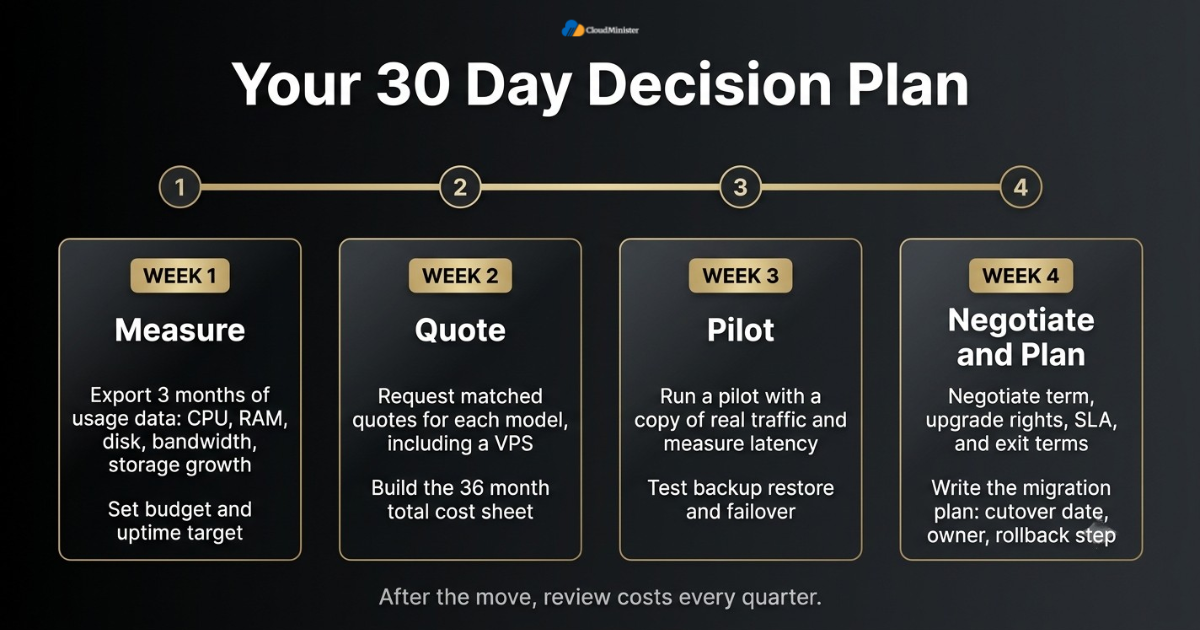
- Week one: export three months of usage data covering CPU, RAM, disk activity, bandwidth, and storage growth.
- Week one: set the budget and the uptime target as numbers that everyone has agreed.
- Week two: request quotes from a Web Hosting Company in India for at least one option in each model, matched to the same specification, including a VPS Hosting India plan for the lighter parts of the system.
- Week two: build the 36 month total cost sheet and include staff time and tax.
- Week three: run a pilot of the leading option, such as Dedicated Server Hosting in India or Affordable VPS Hosting, with a copy of real traffic and measure latency.
- Week three: test backup restore and failover before anything goes live.
- Week four: negotiate term length, upgrade rights, SLA terms, and exit terms for Dedicated Servers in India or any other model.
- Week four: write the migration plan with a cutover date, an owner, and a rollback step.
- After the move, review costs every quarter, because the answer to Colocation vs Dedicated Server vs Cloud changes as traffic and prices change.
Checklist: Infrastructure Decision Readiness Review
- Average and peak CPU, RAM, disk activity, and monthly outbound data measured
- Downtime budget and recovery targets agreed by the business
- Quotes collected for colocation, Dedicated Servers in India, and cloud on the same specification
- 36 month total cost of Colocation vs Dedicated Server vs Cloud calculated with tax, staff time, and exit cost
- Power per rack confirmed in kilowatts for any colocation plan
- Outbound data transfer charges estimated for cloud
- Data residency and sector rules confirmed with the compliance team
- Backups tested with a real restore, and a second location chosen for recovery
- Management interfaces locked down and multi factor authentication enabled
- Migration plan, owner, and rollback step written down
Key Takeaways
- Colocation vs Dedicated Server vs Cloud is a question of utilisation, growth, and team skills, and not of brand names.
- Colocation suits large and steady workloads, but it needs capital, power planning, and hardware skills.
- Dedicated Server Hosting in India gives fixed monthly pricing and single tenant performance without buying hardware.
- Cloud is the best choice for variable demand, but outbound data charges and idle resources can raise the bill quickly.
- Affordable VPS Hosting is a low cost starting point for light and medium workloads, and VPS Hosting India plans are often the option that gets overlooked.
- Always compare a 36 month total cost with tax, staff time, and exit cost included.
- Check DPDP Act duties and sector rules before choosing a location or a provider.
- Splitting steady and spiky workloads across two models often saves more than choosing a single winner in Colocation vs Dedicated Server vs Cloud.
- A provider that offers Dedicated Server Hosting in India, VPS plans, and clear support terms makes it easier to grow without a risky migration.
Not Sure Which Model Fits Your Workload?
Share your CPU, RAM, and bandwidth numbers with our team and get matching quotes for dedicated servers, VPS, and cloud. Compare real costs before you commit.
Conclusion
The fair answer to Colocation vs Dedicated Server vs Cloud in 2026 is that no model wins every time. Cloud rewards uncertainty, colocation rewards scale and discipline, and a rented server rewards teams that want predictable bills and strong performance without owning hardware, such as Dedicated Servers in India. The right choice follows from measured usage, a full cost sheet, and an honest look at the skills your team has today. Affordable VPS Hosting remains the best starting point for small projects, and a Web Hosting Company in India can supply quotes for every model. That is the lasting lesson of Colocation vs Dedicated Server vs Cloud.
If you are ready to compare real options, start with your usage numbers and ask for quotes on matching specifications. You can explore Dedicated Server Hosting in India for steady workloads, review VPS Hosting India plans for lighter systems, and speak with the Cloudminister team about the right mix. Both Dedicated Servers in India and VPS plans can be tested for a month before you commit, and a reliable Web Hosting Company in India will help you plan that test. Keep reviewing the plan every quarter, because the best answer to Colocation vs Dedicated Server vs Cloud will change as your product grows.
Frequently Asked Questions
Which is cheapest in India: colocation, a dedicated server, or cloud?
It depends on utilisation. For steady and heavy workloads, colocation and a dedicated server usually cost less per unit of compute than cloud over three years. For small, variable, or short lived workloads, cloud or Affordable VPS Hosting is usually cheaper. For steady loads, Dedicated Servers in India are often the best middle path. The only reliable method is a 36 month total cost sheet built from your own usage numbers.
When does cloud become more expensive than a dedicated server?
Cloud tends to cost more when a workload runs at high and steady utilisation every hour of the month, or when outbound data transfer is large. In those cases a fixed monthly price from Dedicated Servers in India often beats usage based billing.
Is colocation worth it for a small business?
Usually not at first. Colocation needs hardware purchase, power planning, and technical staff or a remote hands contract. A small business normally gets better value from a VPS or a rented server and can revisit colocation when it runs many servers for several years. Colocation vs Dedicated Server vs Cloud becomes easier to judge once you run more than a few servers.
How does a VPS compare with a dedicated server on cost?
A VPS has a much lower monthly price because you share a physical host, while a dedicated server gives you the whole machine. A VPS Hosting India plan suits light and medium workloads, Affordable VPS Hosting is the lower cost entry point, and Dedicated Server Hosting in India suits heavy databases and steady high load.
What hidden costs should I check in Colocation vs Dedicated Server vs Cloud?
For colocation, check power commitments, remote hands, cross connects, and hardware refresh. For a dedicated server, check licences, extra IP addresses, and backup storage. For cloud, check outbound data transfer, managed service charges, and idle resources. GST at 18 percent applies to all three.
Do I need to keep my data inside India?
Not always, but it can be required. The DPDP Act 2023 allows transfers outside India except to countries restricted by the government, and some sectors, such as payment systems under RBI rules, require data to stay in India. Confirm with your legal or compliance team.
Can I mix models?
Yes, and many teams do. A common pattern is to run the steady core on a dedicated server or colocated hardware and use cloud for bursts, tests, and disaster recovery. Mixed models need good monitoring and clear network links between sites. VPS Hosting India plans work well for the test environments in such a mix.
How long does it take to move from cloud to a dedicated server?
Provisioning Dedicated Server Hosting in India plans can take from a few hours to a few days, and the migration itself depends on data size and application complexity. Plan for testing, a final data sync, and a rollback step, which often makes a full move a matter of weeks and not days.
How do I choose a Web Hosting Company in India?
Ask who owns the infrastructure, which cities and tier ratings are offered, what the SLA covers, how fast parts are replaced, and whether support is available at all hours. A Web Hosting Company in India that answers with specific details and written terms is usually the safer choice.
Where should I start if I am unsure about Colocation vs Dedicated Server vs Cloud?
Start with measurement. Collect three months of CPU, memory, disk, and bandwidth data, then request matching quotes. If the workload is small, begin with Affordable VPS Hosting. If it is large and steady, compare Dedicated Server Hosting in India with colocation and keep cloud for spikes.
Is Affordable VPS Hosting enough for a growing business?
For many small and medium sites it is. Affordable VPS Hosting handles moderate traffic well, and you can move to Dedicated Servers in India when CPU or disk limits appear. Choose a VPS Hosting India provider that states its resource guarantees clearly.
What should a Web Hosting Company in India include in a migration plan?
A good Web Hosting Company in India includes testing, a final data sync, a rollback step, and clear ownership. This matters in every Colocation vs Dedicated Server vs Cloud move.

Ajay Singh Raghav is a Senior Linux System Administrator at CloudMinister Technologies, where he has spent over 4 years installing, configuring, maintaining, and troubleshooting Linux servers for hosting and cloud environments. He specializes in AWS cloud computing alongside core Linux server administration, with hands-on expertise across server management, backup and restore systems, and cPanel-based hosting environments. His day-to-day experience keeping production servers stable and secure gives him a practical, ground-level understanding of the infrastructure he writes about.