Cloud Repatriation in 2026 has moved from a fringe. It is talking point to a boardroom-level infrastructure strategy. Enterprises that spent the last decade migrating everything to AWS, Azure, and Google Cloud are now selectively pulling predictable, high-compute workloads back onto owned or leased infrastructure. Multiple independent surveys referenced later in this guide show that a large majority of CIOs are already planning or executing some form of this shift, driven primarily by unpredictable billing, rising egress costs, data sovereignty rules, and AI infrastructure economics. This guide breaks down exactly what the trend means in practice, why it is accelerating, what workloads make sense to move, and how Indian businesses can plan a shift toward Dedicated Server Hosting in India and other owned-infrastructure models without repeating the mistakes of the original cloud migration wave.
For IT leaders evaluating infrastructure spend in 2026, the conversation has shifted. It is no longer “should we be on the cloud,” it is “which workloads actually belong on the cloud, and which ones belong on infrastructure we control.” That is the essence of Cloud Repatriation in 2026, not a rejection of AWS or Azure, but a more disciplined, cost-aware, and compliance-aware approach to deciding where each workload should physically run. What began as isolated cost-cutting decisions inside individual engineering teams has now become a strategic conversation happening at the CIO and CFO level, backed by multi-year invoice data rather than gut instinct.
The pace at which this shift is unfolding reflects just how far cloud spending had drifted from its original promise of simplicity and predictability. Enterprises that migrated aggressively during the 2015 to 2020 wave are now sitting on years of billing history that tells a very different story than the one used to justify the original move. Egress fees, reserved capacity waste, and runaway storage costs have quietly compounded into line items that finance teams can no longer ignore. Cloud Repatriation in 2026 is the natural response to that data, a course correction built on hard numbers, not a rejection of the cloud model itself.
What makes this moment different from past infrastructure debates is the nuance behind decision-making. Nobody is arguing for a full exit from public cloud, and the organizations getting this right are not choosing sides between AWS, Azure, and owned infrastructure, they are matching each workload to the environment where it performs best financially and operationally. Cloud Repatriation in 2026 is ultimately about precision: knowing which applications genuinely need the elasticity of a hyperscale, and which ones have been quietly overpaying for flexibility they never use. The rest of this guide breaks down exactly how to make that call, workload by workload.
Table of Contents
- 1. What Is Cloud Repatriation? Understanding the Core Shift
- 2. Why the Shift Away From Public Cloud Is Accelerating
- 3. AWS and Azure Cost Realities Driving the Shift
- 4. What the Shift Actually Looks Like: Workload by Workload
- 5. Real Cost Data: What Moving Off Public Cloud Actually Saves
- 6. Choosing the Right Infrastructure Model: Dedicated Servers vs VPS vs Public Cloud
- 7. This Shift for Small and Mid-Sized Businesses in India
- 8. Common Mistakes That Undermine a Repatriation Project
- 9. Data Sovereignty, Compliance, and DPDPA 2023 Considerations
- 10. Building a Phased Roadmap for This Infrastructure Shift
- 11. Measuring Long-Term Success: Beyond the First Migration
- 12. Choosing the Right Infrastructure Partner
- 13. Infrastructure Economics: Balancing Repatriation Costs With Long-Term Value
- 14. Final Checklist Before You Commit to a Provider
- 15. A Note on Support Quality and Vendor Accountability
- Key Takeaways
- Conclusion: Making the Shift Work for Your Business
- Frequently Asked Questions
1. What Is Cloud Repatriation? Understanding the Core Shift
Cloud Repatriation in 2026 refers to the deliberate process of moving applications, workloads, databases, or storage that currently live on public cloud platforms, primarily AWS, Azure, and Google Cloud, back onto private infrastructure. This can mean on-premises data centers, colocation facilities, or third-party Dedicated Server Hosting in India providers offering owned or leased hardware.
- This trend does not mean abandoning the public cloud entirely. Most organizations pursuing it keep a hybrid footprint, moving only specific, predictable workloads off AWS or Azure.
- Unlike the original 2015 to 2020 wave of cloud-first migration, the current wave of repatriation is driven by hard financial data, actual multi-year cloud invoices, rather than a fear of missing out on cloud scalability.
- Workloads most commonly moved back include databases, storage-heavy applications, steady-state compute, AI inference, and rendering pipelines, anything with a predictable, non-spiky usage pattern.
- Businesses executing this shift typically replace the repatriated portion of their stack with Dedicated Server Hosting in India or a similar dedicated infrastructure model, rather than building an entirely new private data center from scratch.
- The end state for most enterprises is not 100 percent private or 100 percent public, it is a deliberately balanced hybrid architecture where each workload sits on the infrastructure best suited to it.
Cloud Repatriation in 2026 is frequently driven as much by data governance as by cost. Regulated industries, banking, healthcare, insurance, and government-adjacent sectors, are under growing pressure to demonstrate exactly where data physically resides. Moving workloads to owned infrastructure or a Web Hosting Company in India can make compliance audits simpler by giving businesses direct control and visibility over where and how data is processed, rather than relying solely on a hyperscaler’s own governance documentation across its global region network.
2. Why the Shift Away From Public Cloud Is Accelerating
The scale at which Cloud Repatriation in 2026 is happening is itself a signal of how badly the economics of unmanaged cloud spend have gotten out of sync with enterprise budgets. Recent survey data from multiple independent research firms paints a consistent picture.
- Independent survey data cited by industry researchers shows that a large majority of CIOs, figures ranging from roughly 80 percent to as high as 86 percent depending on the survey, now plan to move at least one workload back from public cloud to private or on-premises infrastructure, according to recent CIO survey findings compiled by cloud infrastructure researchers, which places cost, performance, and data sovereignty as the three leading drivers.
- This move away from AWS and Azure is rarely a full exit. Only a small single-digit percentage of enterprises plan to remove workloads from the cloud entirely, the overwhelming majority are repatriating selectively, workload by workload.
- Unpredictable egress fees, cross-region data transfer charges, and storage costs for rapidly growing datasets are the most commonly cited financial triggers behind Cloud Repatriation in 2026 decisions.
- AI infrastructure economics have added a new dimension to the conversation: running large, steady-state inference workloads on rented GPU capacity in the public cloud is now, for many companies, materially more expensive over a multi-year horizon than owning or leasing dedicated compute.
- A detailed breakdown of the trend notes that hybrid compute architectures for mission-critical workloads are expected to nearly quintuple in enterprise adoption between the early 2020s and the end of 2026, according to infrastructure strategy research covering the 2026 hybrid shift, underscoring that this is a structural recalibration rather than a temporary correction.
Before committing to a full Cloud Repatriation in 2026 strategy, run a 90-day workload audit. Identify which applications have flat, predictable resource consumption versus which ones have genuine burst or seasonal traffic. Predictable workloads are strong candidates for moving back; spiky, unpredictable workloads usually still belong on public cloud elasticity.
3. AWS and Azure Cost Realities Driving the Shift
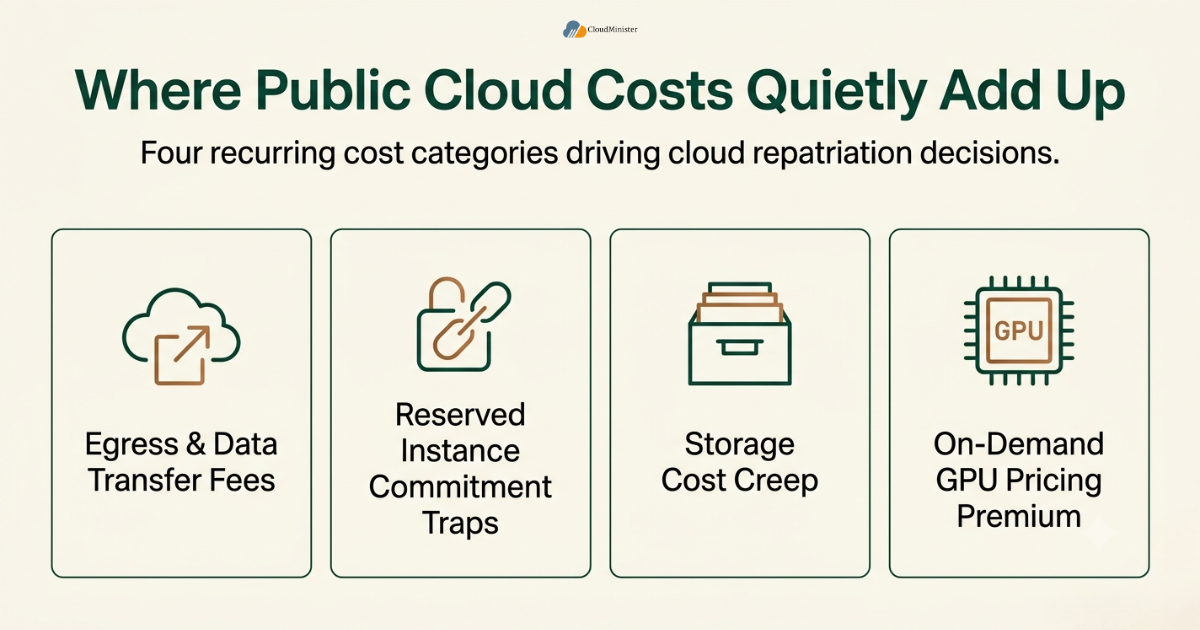
This shift is fundamentally a financial story before it is a technical one. Understanding exactly where public cloud costs spiral out of control helps explain why so many IT budgets are being restructured around Cloud Repatriation in 2026 planning.
3.1 Egress and Data Transfer Costs
- AWS and Azure charge for data leaving their network, which means the cost of simply moving your own data out is rarely visible in initial cloud cost estimates.
- Applications that move large volumes of data between regions or back to on-premises systems accumulate transfer charges that compound month over month, a core driver behind the decision to repatriate.
3.2 Reserved Instance and Commitment Traps
- Long-term reserved capacity discounts look attractive on paper but lock businesses into a fixed compute footprint even as actual usage patterns change.
- Many organizations report that their actual realized discount from reserved instances was far lower than projected because workloads shifted after the commitment was signed.
3.3 Storage Cost Creep
- Object storage and block storage costs scale linearly with data growth, and most businesses underestimate how quickly log files, backups, and media assets accumulate.
- Storage-heavy, rarely-accessed data is one of the single most common categories moved during a repatriation project, since it is cheap to store on owned hardware and expensive to keep growing indefinitely on hyperscaler storage tiers.
3.4 GPU and AI Compute Pricing
- On-demand GPU pricing on major clouds carries a significant premium over owned or leased hardware amortized across a multi-year period.
- For companies running continuous AI inference rather than occasional training jobs, this premium is one of the fastest-growing arguments for Cloud Repatriation in 2026 among technology-forward enterprises.
Related Reading: Bare Metal vs Dedicated Server: What Actually Fits Your Workload
4. What the Shift Actually Looks Like: Workload by Workload
Cloud Repatriation in 2026 does not apply uniformly across an entire technology stack. It is tuned to the specific characteristics of each workload category, similar to how migration decisions were made in reverse a decade ago.
4.1 Databases
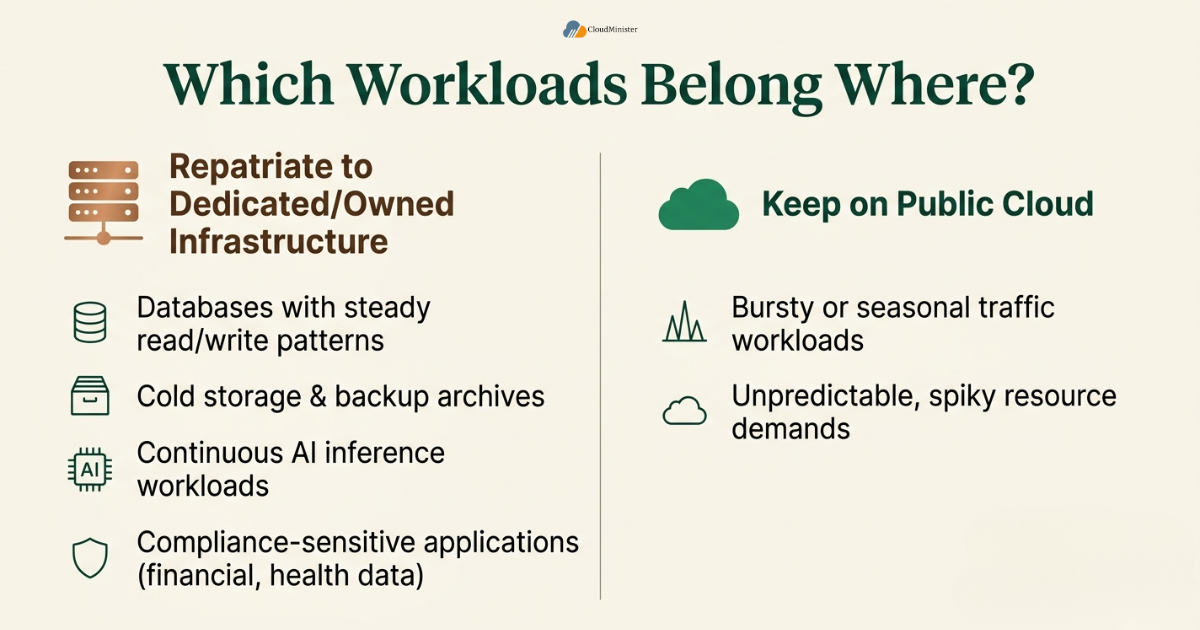
- Databases with steady, predictable read and write patterns are consistently the first candidate in most repatriation projects, since managed database services on public cloud carry a persistent premium over self-managed instances on owned hardware.
- Moving a production database to Dedicated Server Hosting in India style infrastructure typically requires careful planning around replication, failover, and backup strategy before cutover.
4.2 Storage and Backup Systems
- Cold storage, archival data, and backup repositories are ideal early candidates for Cloud Repatriation in 2026 because access patterns are infrequent and predictable.
- Businesses moving backup infrastructure off the public cloud often pair it with a Web Hosting Company in India that can guarantee redundant storage and defined data residency.
4.3 AI Inference and Rendering Pipelines
- Continuous, high-utilization AI inference workloads are increasingly repatriated onto dedicated GPU-equipped servers, since the amortized cost of owned hardware undercuts on-demand cloud GPU pricing at sustained utilization.
- This category is one of the fastest-growing drivers behind the broader move to Cloud Repatriation in 2026 among media, gaming, and applied-AI companies.
4.4 Compliance-Sensitive Applications
- Applications of processing regulated personal data, financial records, or health data are frequently repatriated to satisfy data residency and audit requirements that are difficult to demonstrate cleanly on multi-region public cloud infrastructure.
- For Indian businesses, this often means shifting workloads to a domestic Web Hosting Company in India or dedicated infrastructure provider that can provide clear visibility and documentation over data processing, supporting DPDPA 2023 accountability requirements, even though DPDPA does not mandate India-only storage in most cases
The consistent theme across every workload category driving Cloud Repatriation in 2026 is predictability. Workloads with flat, forecastable resource consumption are strong candidates for owned or dedicated infrastructure. Workloads with genuine, unpredictable spikes still benefit from the elasticity that only a hyperscaler can provide economically. The skill in 2026 is not choosing one model over the other, it is correctly classifying each workload and placing it accordingly.
5. Real Cost Data: What Moving Off Public Cloud Actually Saves
Businesses considering Cloud Repatriation in 2026 understandably want evidence, not assumptions. The available cost and performance data from 2026 gives a reasonably clear picture of what organizations are actually experiencing after making the shift.
- Enterprises that have already repatriated at least one workload commonly report multi-year total cost of ownership reductions once egress fees, reserved instance waste, and storage growth are factored in against the cost of owned or dedicated infrastructure.
- Cost, performance, and data sovereignty consistently rank as the top three drivers behind Cloud Repatriation in 2026 decisions across the surveys referenced in this guide.
- High-compute, steady-state workloads such as databases, rendering pipelines, and inference systems are reported to be significantly more likely to be repatriated than variable, bursty workloads.
- Adoption of this strategy is not evenly distributed — organizations that run a structured workload audit before moving anything report far cleaner cost outcomes than those that repatriate reactively after a cost overrun.
- The gains attributed to Cloud Repatriation in 2026 are concentrated in cost predictability and compliance simplicity — not in raw processing speed, which depends heavily on the specific hardware and network configuration chosen.
COST AUDIT CHECKLIST – WHAT TO MEASURE BEFORE REPATRIATING
- Total monthly egress and cross-region data transfer charges over the last 12 months
- Actual realized discount on any reserved instance or savings plan commitments
- Storage growth rate and cost trajectory for the next 24 months
- GPU or AI compute utilization rate versus on-demand pricing
- Compliance and data residency gaps under current cloud region configuration
- Estimated total cost of ownership for equivalent Dedicated Server Hosting in India
- Application-level dependency mapping before choosing what to move first
Related Reading: 7 Features Every Dedicated Hosting Plan Should Have
6. Choosing the Right Infrastructure Model: Dedicated Servers vs VPS vs Public Cloud
One of the most common points of confusion during Cloud Repatriation in 2026 planning is deciding exactly what to move workloads onto. The choice between dedicated infrastructure and virtualized alternatives has a direct impact on cost and performance outcomes.
- Dedicated Server Hosting in India gives a business exclusive access to physical hardware, which is the closest like-for-like replacement for high-utilization workloads being pulled off AWS or Azure during a repatriation project.
- Organizations that do not need the full capacity of a dedicated machine, or that want a staged transition, often start with VPS Hosting India as an intermediate step before committing to fully dedicated hardware.
- An Affordable VPS Hosting plan is frequently used as a low-risk pilot environment for testing a workload outside the public cloud before a full repatriation decision is finalized.
- Businesses running multiple smaller applications sometimes distribute them across several Affordable VPS Hosting instances rather than consolidating everything onto a single dedicated server, depending on isolation and redundancy requirements.
- For mission-critical, resource-intensive workloads, databases, ERP systems, AI inference, Dedicated Servers in India consistently outperform shared or virtualized alternatives once utilization is sustained and predictable.
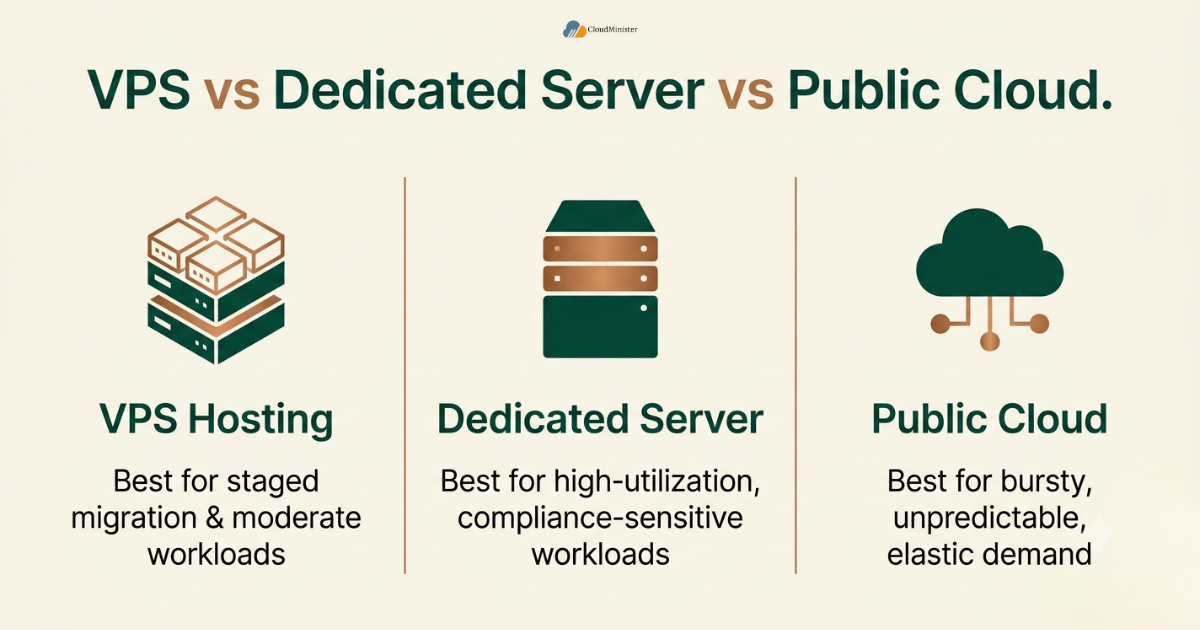
Quick comparison for Cloud Repatriation in 2026 planning:
- VPS Hosting India: best for staged migration, moderate workloads, and cost-sensitive teams testing repatriation before full commitment.
- Affordable VPS Hosting: a practical entry point for startups and SMBs beginning their move away from pure public cloud dependency.
- Dedicated Server Hosting in India: the standard target environment for high-utilization, compliance-sensitive, or performance-critical workloads being repatriated from AWS or Azure.
- Dedicated Servers in India: increasingly paired with colocation and hybrid connectivity to public cloud for workloads that still need occasional burst capacity.
Related Reading: Why Dedicated Hosting Is the Best Choice for Your Site
Ready to Move Off Unpredictable Cloud Billing?
Get exclusive access to high-performance Dedicated Servers in India built for databases, AI inference, and steady-state workloads — with predictable pricing and full control.
7. Cloud Repatriation in 2026 for Small and Mid-Sized Businesses in India
Large enterprises were the first movers on this trend, but small and mid-sized businesses in India are increasingly evaluating the same shift as dedicated and VPS pricing has become more accessible for smaller teams.
- SMBs typically cannot absorb a large upfront capital expenditure on physical hardware, which is why a phased move, starting with Affordable VPS Hosting and graduating to dedicated infrastructure — is the more realistic path for Cloud Repatriation in 2026 at the SMB level.
- Indian SMBs often run lean IT teams without a dedicated cloud cost-optimization function, which makes unpredictable AWS or Azure billing especially painful and accelerates interest in moving workloads back among smaller businesses.
- Choosing the right VPS Hosting India plan upfront avoids the common SMB mistake of over-provisioning cloud resources that then sit underused, quietly eroding the projected savings from repatriation.
- Partnering with a Web Hosting Company in India that understands both traditional hosting and modern hybrid infrastructure can help SMBs avoid the technical friction points that often derail early Cloud Repatriation in 2026 attempts.
- Growing agencies that manage infrastructure for their own clients frequently look for Affordable VPS Hosting tiers so that infrastructure costs do not eat into the budget set aside for the broader repatriation project.
SMBs approaching Cloud Repatriation in 2026 should avoid moving everything at once. Start with the single most expensive or most predictable workload, usually a database or a backup system, move it to Dedicated Server Hosting in India, measure the real-world cost and performance difference for 60 to 90 days, and only then plan the next migration wave.
8. Common Mistakes That Undermine a Repatriation Project
Even with a strong financial case, many Cloud Repatriation in 2026 initiatives underdeliver, not because the strategy is flawed, but because of avoidable planning mistakes. Recognizing these patterns early can save a business significant wasted effort and budget.
- Moving every workload back at once instead of running a focused pilot on two or three high-cost applications first.
- Underestimating the operational overhead of managing physical or dedicated infrastructure without first budgeting for monitoring, patching, and 24×7 support.
- Failing to map application dependencies before migration, which can break integrations that assume low-latency access to other cloud-native services.
- Treating Cloud Repatriation in 2026 purely as a cost-cutting exercise rather than a broader infrastructure optimization, which damages internal buy-in when short-term migration costs appear on the budget.
- Not benchmarking real-world performance after the move, so it becomes impossible to prove the shift delivered to the expected savings by renewal time.
- Ignoring network architecture and redundancy planning can degrade the reliability gains that this strategy is supposed to deliver in the first place.
Consulting-sector research on large-scale infrastructure shifts has repeatedly found that the gap between successful and unsuccessful Cloud Repatriation in 2026 projects is rarely a hardware limitation, it is a planning gap. Businesses that pair the move with clear workload classification, phased execution, and ongoing cost measurement consistently report better outcomes than organizations that repatriate reactively after a single expensive cloud invoice.
Related Reading: Dedicated Server vs VPS vs Cloud Hosting: Which Is Right for You
9. Data Sovereignty, Compliance, and DPDPA 2023 Considerations
Cloud Repatriation in 2026 involves more than a cost calculation for Indian businesses, it also intersects directly with compliance obligations under the Digital Personal Data Protection Act (DPDPA) 2023, which places clear expectations on data fiduciaries regarding where and how personal data is processed and stored.
- Data fiduciaries remain responsible for how personal data is processed even when that processing has historically happened on a multi-region public cloud footprint.
- Businesses should document which categories of personal data are processed and where, as part of any compliance review tied to Cloud Repatriation in 2026, since DPDPA 2023 places accountability on data fiduciaries regardless of where processing occurs, not because the law requires India-only residency.”
- “Access logs and processing documentation can become easier to produce and audit once workloads are consolidated with a single Web Hosting Company in India, compared to tracking data flows across a hyperscale’s global region network, though this is a governance convenience, not a DPDPA-mandated requirement.
- Access logs and data residency documentation become significantly simpler to produce once workloads are consolidated onto a domestic Web Hosting Company in India rather than spread across a hyperscaler’s global region network.
- Sensitivity classification of stored data should be reviewed before any wide rollout of this migration strategy, so that the highest-risk data categories are prioritized in the first migration wave.
- Businesses operating shared or multi-tenant environments should apply the same permission and residency discipline before extending repatriated infrastructure access to any client-facing systems.
PRE-MIGRATION COMPLIANCE CHECKLIST
- Map which data categories and workloads are processed and where”
- Confirm DPDPA 2023 accountability and cross-border transfer requirements applicable to each application
- Review sensitivity classification for all data being repatriated
- Document the audit trail for data movement during migration
- Verify chosen Dedicated Server Hosting in India provider offers required uptime SLAs
- Brief internal teams on the new data-access and support model post-migration
10. Building a Phased Roadmap for Cloud Repatriation in 2026
Not every organization should approach this shift in the same way. A 15-person startup has fundamentally different needs than a 500-person financial services firm and applying identical migration timelines to both is a common cause of underwhelming results.
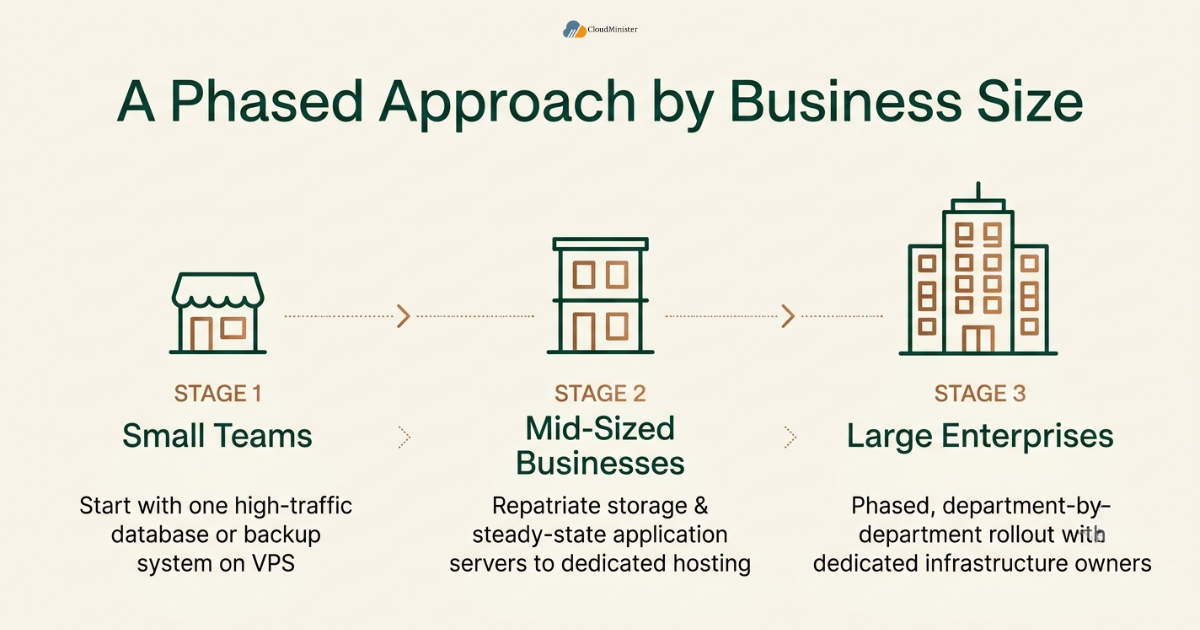
- Small teams often see the fastest, most visible savings from Cloud Repatriation in 2026 by moving a single high-traffic database or backup system to VPS Hosting India first.
- Mid-sized businesses tend to benefit most from repatriating storage and steady-state application servers onto Dedicated Server Hosting in India, where reporting and processing workloads scale faster than headcount.
- Large enterprises typically need a phased, department-by-department rollout with dedicated infrastructure owners in each business unit driving migration and collecting performance data.
- Every roadmap should include a feedback loop back to IT leadership so that underperforming migrations can be paused, and high-value workloads can be prioritized in the next wave.
- Agencies managing infrastructure on behalf of clients should apply the same disciplined evaluation internally before recommending Cloud Repatriation in 2026 to their own customer base.
Assign a small internal infrastructure working group before any wide rollout of Cloud Repatriation in 2026. A team that can evaluate workloads, benchmark Dedicated Servers in India options, and answer day-to-day questions informally reduces dependency on ad hoc decision-making and consistently accelerates a clean migration compared to an unplanned, reactive move.
11. Measuring Long-Term Success: Beyond the First Migration
Initial cost savings from Cloud Repatriation in 2026 tend to look impressive in the first quarter but need to be actively monitored to remain accurate over time. Long-term success requires treating the shift as an ongoing infrastructure strategy rather than a one-time project.
- Set a recurring quarterly review of infrastructure cost data against the original savings projections defined before migration.
- Reassess workload placement every few months, since application usage patterns change, and a workload that was a poor candidate for repatriation a year ago may become a strong one later.
- Compare renewal-time infrastructure costs against actual measured savings, not against anecdotal team sentiment alone.
- Reassess whether current Dedicated Server Hosting in India capacity still matches organizational needs as data volume and traffic grow over time.
- Maintain close coordination between IT, finance, and compliance teams so that new applications are evaluated for repatriation as part of standard architecture review, not as an afterthought.
As Cloud Repatriation in 2026 scales across an organization, periodically re-run the data residency and permissions audit described earlier in this guide. Organizational structures change, teams are restructured, and application of ownership shifts, outdated access controls are one of the most common sources of unintended exposure on any newly repatriated infrastructure, dedicated or otherwise.
12. Choosing the Right Infrastructure Partner
Migration planning gets most of the attention during Cloud Repatriation in 2026, but the infrastructure partner behind the move plays an equally important, quieter role in how well the new environment performs day to day.
- A dependable Web Hosting Company in India that already understands both traditional hosting and modern hybrid architecture is well positioned to advise on how repatriated workloads should be configured for reliability and performance.
- Businesses that consolidate infrastructure with a single Web Hosting Company in India benefit from having one point of accountability for uptime, latency, and security, three factors that directly influence whether Cloud Repatriation in 2026 delivers the expected performance gains.
- IT leaders who have not yet evaluated their hosting relationship considering repatriation plans should treat this shift as a natural trigger point to do so.
- Agencies and IT consultancies that operate their own hosting offering are often the first to notice how demand for Affordable VPS Hosting and dedicated infrastructure increases as more of their client base begins repatriating workloads.
- For providers offering both VPS Hosting India and dedicated infrastructure, bundling migration guidance with hosting has become a natural extension of the client relationship during Cloud Repatriation in 2026 projects.
- Providers that already manage multiple client environments are in a strong position to standardize data residency and DPDPA 2023 documentation practices across every client undertaking this shift, rather than solving the same problem of client by client.
The most effective IT partners in 2026 no longer treat hosting infrastructure and repatriation strategy as separate conversations. A Web Hosting Company in India that can speak fluently about both dedicated hardware and hybrid architecture, including how Cloud Repatriation in 2026 fits into the broader picture, gives clients a single, coherent infrastructure roadmap instead of two disconnected vendor relationships.
13. Infrastructure Economics: Balancing Repatriation Costs with Long-Term Value
Every rupee spent on inefficient cloud infrastructure is a rupee that could otherwise go toward a well-planned Cloud Repatriation initiative in 2026. This makes the choice of infrastructure partner a direct lever on how much a business can realistically save.
- Businesses that continue overpaying for unmanaged public cloud resources often delay their repatriation plans indefinitely, which is a false economy given the cost data discussed earlier in this guide.
- A well-priced Web Hosting Company in India relationship frees up budget that can instead fund proper migration planning, testing, and staff training during Cloud Repatriation in 2026.
- For resellers and agencies, offering Affordable VPS Hosting to clients while still maintaining healthy margins requires choosing an upstream infrastructure partner with transparent, predictable pricing.
- Plans marketed as Affordable VPS Hosting vary widely in what is actually included — bandwidth limits, support response times, and backup frequency all affect whether a plan is genuinely cost-effective once hidden costs are factored in.
- Businesses evaluating Dedicated Servers in India options should specifically ask about scalability, since repatriated environments tend to grow their storage and bandwidth needs faster than a typical shared-hosting client.
- Ultimately, the businesses that get the most value from Cloud Repatriation in 2026 tend to be the same ones that have already optimized their underlying infrastructure costs through a dependable Web Hosting Company in India relationship or a sensibly priced VPS Hosting India arrangement, freeing up both budget and attention for the migration itself.
If your organization currently reviews cloud costs and infrastructure costs in separate budget conversations, consider merging them into a single annual technology review. A Web Hosting Company in India that understands your Cloud Repatriation in 2026 roadmap, combined with Dedicated Server Hosting in India or Affordable VPS Hosting sized correctly for your growth, consistently produces a cleaner overall technology budget than treating the two as unrelated line items.
Businesses weighing all of this together should treat the infrastructure conversation as seriously as the migration conversation itself. A reliable Web Hosting Company in India gives a business the operational backbone for everything from database uptime to network latency, while a well-structured VPS Hosting India arrangement lets growing teams scale gradually instead of committing to full dedicated hardware on day one. A provider that offers both Dedicated Server Hosting in India and Affordable VPS Hosting under a single relationship gives businesses executing Cloud Repatriation in 2026 one vendor that scales with them instead of forcing a partner switch every time they outgrow their current setup, and Dedicated Servers in India remain the natural long-term home for workloads that have outgrown virtualized environments entirely.
13.1 A Closer Look at VPS as a Repatriation Steppingstone
Many IT teams treat the choice between VPS and dedicated hardware as binary, but in practice VPS Hosting India often functions as the bridge that makes the whole move away from public cloud realistic.
- A team unsure how much capacity it truly needs can provision VPS Hosting India first, observe real usage for a full billing cycle, and only then size a dedicated order accurately instead of guessing.
- Because VPS Hosting India plans can usually be resized with far less friction than physical hardware, they absorb the uncertainty of an early-stage migration while the team collects real performance data.
- Development, staging, and QA environments almost never need dedicated hardware, so keeping them on VPS Hosting India while production moves to Dedicated Servers in India keeps the overall infrastructure bill sensible.
- Agencies piloting a client’s migration frequently spin up Affordable VPS Hosting for the test phase, then graduate the client to Dedicated Servers in India once the workload profile is confirmed.
- Even after a full migration, keeping a small VPS Hosting India instance as a failover or staging node alongside the primary Dedicated Servers in India setup is a common, low-cost resilience practice.
- Teams comparing quotes should ask providers directly whether their VPS Hosting India tier and their Dedicated Servers in India tier run on the same underlying network, since mixed-network setups can introduce latency that undermines the whole point of leaving the public cloud.
- Affordable VPS Hosting is not just an SMB entry point — many enterprises deliberately keep secondary and burst-capacity workloads on Affordable VPS Hosting even after their core systems sit on Dedicated Servers in India, because not every workload justifies dedicated hardware.
- The most cost-disciplined organizations treat Affordable VPS Hosting and Dedicated Servers in India as two ends of the same spectrum rather than competing products, moving individual workloads left or right on that spectrum as usage patterns change.
- Reviewing whether a workload has outgrown Affordable VPS Hosting and now needs Dedicated Servers in India should be a standing item in the quarterly infrastructure review described earlier in this guide.
- When in doubt, a short conversation with your hosting partner about current VPS Hosting India utilization versus projected growth is usually enough to settle whether the next step should be a resize or a move to Dedicated Servers in India.
14. Final Checklist Before You Commit to a Provider
Before signing a contract for new infrastructure, run through a short final checklist so the transition away from AWS or Azure goes smoothly and the numbers hold up after go-live.
- Confirm whether Dedicated Server Hosting in India or VPS Hosting India better matches your current workload intensity, and revisit that decision every time traffic grows meaningfully.
- Ask any prospective Web Hosting Company in India for real uptime history, not just an SLA number on a sales page, since that gap is where most post-migration disappointment comes from.
- Confirm that an Affordable VPS Hosting tier can be upgraded to full Dedicated Servers in India without a painful re-platforming step later, so today’s cost-saving choice does not become tomorrow’s migration project.
- Get a written breakdown of what is and is not included in support response times, since this is the detail most often glossed over when comparing hosting quotes.
- Revisit the business case one final time: does the projected saving from this move justify the migration effort, or would a smaller pilot on Affordable VPS Hosting first reduce the risk without materially delaying the benefit?
Owned or leased hardware, whether framed simply as Dedicated Servers in India or as a formal managed contract, remains the practical anchor for the entire strategy discussed in this guide.
15. A Note on Support Quality and Vendor Accountability
Infrastructure decisions rarely fail because of the hardware itself. They fail because of weak support, unclear escalation paths, or a vendor relationship that was never tested before the first real incident.
- Ask any Web Hosting Company in India for their actual mean time to resolution on past incidents, not just an advertised response-time promise, before signing a long-term contract for Dedicated Server Hosting in India.
- A Web Hosting Company in India that also runs its own network backbone can usually diagnose latency issues faster than one that resells capacity from a third party, which matters once Dedicated Server Hosting in India becomes business critical.
- Businesses running both VPS Hosting India and dedicated infrastructure with the same Web Hosting Company in India get a single support queue and a single escalation contact, which shortens incident resolution time considerably.
- Before finalizing any Dedicated Server Hosting in India agreement, request a sample incident report from the provider to see how clearly, they document root cause and remediation steps.
- A Web Hosting Company in India willing to share reference clients running comparable workloads on Dedicated Servers in India is generally a stronger long-term partner than one that avoids the question.
Finally, confirm exit terms before signing: a trustworthy Web Hosting Company in India will make it straightforward to migrate data off VPS Hosting India or Dedicated Servers in India if your needs change, rather than locking you into proprietary tooling
Not Sure Which Workloads to Repatriate?
Talk to our infrastructure experts and get a tailored roadmap for your Cloud Repatriation in 2026 strategy, from workload audit to migration.
KEY TAKEAWAYS
- Cloud Repatriation in 2026 is a selective, workload-by-workload shift, not a wholesale exit from AWS or Azure.
- Most enterprises retain a hybrid footprint even after moving workloads back to owned or dedicated infrastructure.
- Cost, performance, and data sovereignty are the three most cited drivers behind this decision across independent surveys.
- Predictable, steady-state workloads, such as databases, storage, and continuous AI inference, are the strongest candidates for repatriation.
- Bursty or seasonal workloads generally remain better suited to public cloud elasticity and should not be moved back.
- Choosing between Dedicated Server Hosting in India and VPS Hosting India depends on workload intensity and long-term usage patterns.
- VPS often serves as a practical staging step before committing to full dedicated hardware.
- DPDPA 2023 accountability obligations make data governance and processing documentation a core part of any repatriation project for Indian businesses.
- Phased pilots consistently outperform blankets; reactive migrations triggered by a single expensive cloud invoice.
- Long-term success depends on treating repatriation as an ongoing infrastructure strategy, with quarterly reviews and workload reassessment, rather than a one-time project.
Conclusion
Cloud Repatriation in 2026 has clearly moved past the experimental phase. With a large and growing share of enterprises reporting active or planned workload repatriation, and consistent survey data pointing to cost, performance, and data sovereignty as the primary drivers, this shift has established itself as a legitimate infrastructure discipline rather than a passing reaction to a single expensive cloud bill.
The businesses seeing the strongest results from Cloud Repatriation in 2026 share a common pattern: they treat it as a structured, phased project requiring workload classification, a clear cost baseline, the right dedicated or VPS infrastructure, and ongoing measurement, not a one-time migration they execute once and forget about. For Indian businesses, pairing a well-planned roadmap with DPDPA 2023 compliance discipline and a dependable Web Hosting Company in India for the surrounding infrastructure gives the best chance of turning this shift into measurable, sustained cost and performance gains.
Frequently Asked Questions
Does Cloud Repatriation in 2026 mean leaving AWS or Azure completely?
No. For most organizations, this shift means selectively moving specific, predictable workloads back to dedicated or private infrastructure while keeping variable or burst-heavy workloads on public cloud. A full exit from AWS or Azure remains uncommon.
Which workloads are the best candidates for repatriation?
Databases, backup and archival storage, steady-state compute, and continuous AI inference workloads are generally the strongest candidates, since their predictable usage patterns make owned or dedicated infrastructure more cost-effective than on-demand public cloud pricing.
Is Cloud Repatriation in 2026 suitable for small businesses, or only large enterprises?
It is increasingly viable for small and mid-sized businesses as dedicated and VPS pricing has become more accessible. SMBs typically start with an Affordable VPS Hosting plan for a single high-cost workload before scaling into full dedicated infrastructure.
What should Indian businesses check before starting a repatriation project?
Indian businesses should run a data governance and cost audit, review DPDPA 2023 accountability obligations, confirm SLA terms with their chosen Dedicated Server Hosting in India provider, and ensure their infrastructure partner can support both current and future capacity needs. Businesses managing infrastructure for their own clients should extend this same diligence across every client environment considering Cloud Repatriation in 2026.
Should a business start with VPS or go straight to dedicated hardware?
Most teams are better served starting with VPS Hosting India for staging and lower-traffic workloads, then moving production systems to Dedicated Servers in India once usage patterns are confirmed. Jumping straight to Dedicated Servers in India without a pilot phase on Affordable VPS Hosting or a similar tier can lead to over-provisioning and wasted spend. A Web Hosting Company in India that offers both VPS Hosting India and Dedicated Server Hosting in India under one account makes this staged approach considerably easier to manage, and it remains one of the more reliable ways to de-risk Cloud Repatriation in 2026 for teams that have never managed owned infrastructure before. Affordable VPS Hosting in particular gives smaller teams room to test Dedicated Servers in India economics without a large upfront commitment.