
Inference Cost Optimization is now the single most important GPU spending decision for any company running AI models in production. This guide covers the complete framework for Inference Cost Optimization in 2026: request batching, response caching, right-sizing GPU instances, and choosing the correct hosting tier. Inference now accounts for the majority of AI infrastructure spend industry-wide, and per-token costs have fallen sharply even as total inference bills keep climbing because usage grows faster than unit cost drops. Getting Inference Cost Optimization right on a Dedicated NVIDIA GPU Server determines whether your AI product scales profitably or burns through budget within months of launch.
Training a model is a one-time expense. Serving it is a permanent one. Every prompt a user sends, every API call your application makes, every background job that touches a language model adds to a bill that never stops growing on its own. This is why Inference Cost Optimization has become a board-level conversation rather than an engineering afterthought, discussed in the same breath as revenue and margin targets. Finance teams are now asking engineering leaders to justify GPU spend the same way they justify any other recurring cost centre, which means the practice needs clear metrics and a repeatable process rather than ad hoc fixes.
Companies that treat Inference Cost Optimization as continuous, not a one-time audit, are the ones that keep gross margins healthy as usage scales. A single round of tuning might deliver an initial drop in cost per request, but traffic patterns, model versions, and context lengths all shift over time, and yesterday’s optimal configuration quietly becomes today’s waste if nobody is watching. The teams that stay ahead are the ones that build monitoring and review into their workflow from the start, rather than rediscovering the problem months later when the bill has already crept back up.
This guide walks through the three pillars that deliver the largest and most durable savings: batching, caching, and right-sizing GPU instances, along with the hosting decisions that make all three possible. Each pillar targets a different source of waste, idle compute, redundant computation, and mismatched hardware, and the biggest gains come from tuning them together rather than treating any one in isolation. We also cover when a Dedicated NVIDIA GPU Server is the right foundation to build on, since infrastructure choice directly shapes how much control a team has over the rest of the Inference Cost Optimization process.
1. Why Inference Cost Optimization Matters More Than Ever in 2026
Inference workloads have overtaken training as the dominant driver of AI infrastructure spend. According to Deloitte’s 2026 technology predictions, inference workloads are expected to account for roughly two-thirds of all AI compute in 2026, up from about a third in 2023. This shift changes what Inference Cost Optimization means in practice, it is no longer about shaving a few dollars off a training run, it is about controlling a cost that scales directly with every user interaction.
For a small AI team running on rented capacity from a best GPU cloud hosting provider, this reality translates into unpredictable monthly bills. For an enterprise operating its own ai training servers alongside inference infrastructure, it translates into spend that can quietly overtake the entire AI budget within a single quarter. Inference Cost Optimization is the answer to both problems, and it rests on three pillars:
- Batching: grouping multiple inference requests together so GPU compute is used efficiently instead of sitting idle between single requests
- Caching: storing and reusing previously computed results so the GPU never repeats work it has already done
- Right-sizing: matching GPU instance type, memory, and count to the actual workload instead of over-provisioning “just in case”
This is not a single technique you apply once. It is an operating discipline. Teams that treat it as a continuous practice — reviewing utilization, cache hit rates, and batch efficiency every month — consistently spend less per request than teams that optimize once and move on.
2. Understanding the Inference Cost Problem Before Optimizing
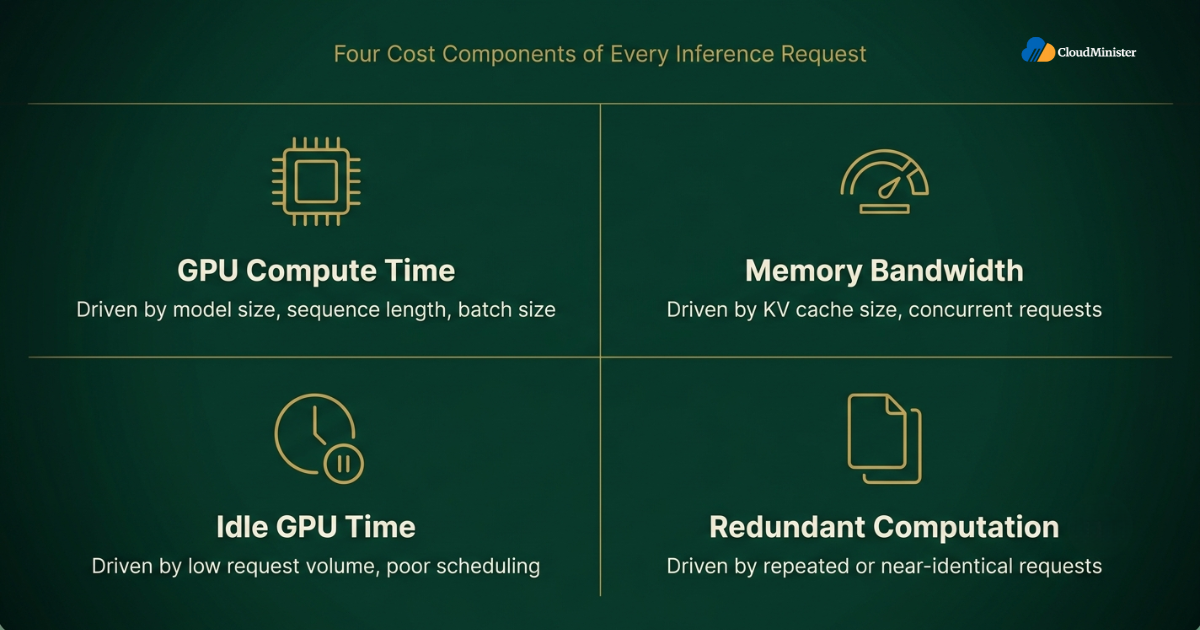
Before any optimization work begins, it helps to understand exactly where inference dollars go. Every inference request has four cost components:
| Cost Component | What Drives It | Inference Cost Optimization Lever |
| GPU compute time | Model size, sequence length, batch size | Batching, right-sizing |
| Memory bandwidth | KV cache size, concurrent requests | Right-sizing, caching |
| Idle GPU time | Low request volume, poor scheduling | Batching, autoscaling |
| Redundant computation | Repeated or near-identical requests | Caching |
Most teams new to this process assume the GPU itself is the biggest lever. In practice, idle time and redundant computation are often larger contributors to a bloated inference bill than the choice of GPU model itself. A GPU running at low utilization can cost several times more per completed request than the same GPU running at high utilization, simply because the fixed hourly cost is spread across far fewer completed inferences. This holds true whether the underlying hardware is a Dedicated NVIDIA GPU Server billed monthly, a Web Hosting Company in India offering hourly GPU rental, or a hyperscaler’s best GPU cloud hosting product billed per second.
3. Batching: The First Pillar of Inference Cost Optimization
3.1 What Batching Actually Does
Batching is the practice of grouping multiple inference requests so the GPU processes them together in a single forward pass instead of one request at a time. GPUs are massively parallel processors; running one request at a time wastes almost all of that parallelism. Inference Cost Optimization through batching directly targets this waste.
- Static batching: Requests are collected for a fixed window and processed together, simple to implement but adds latency for the first requests in the batch
- Dynamic batching: The inference server continuously adds new requests to an in-flight batch as GPU capacity frees up — used by modern serving frameworks
- Continuous batching: An advanced form of dynamic batching where completed sequences are evicted from a batch and replaced immediately with new requests, keeping GPU utilization consistently high
For most production teams, continuous batching delivers the largest single improvement in GPU utilization. Serving frameworks such as vLLM and TensorRT-LLM implement this by default, and enabling it is usually the fastest win available to a team that has never tuned their inference stack, whether that stack runs on ai training servers repurposed for serving or on infrastructure built specifically for inference.
3.2 Batching Trade-Offs to Manage
- Latency versus throughput: Larger batches improve throughput and lower cost per request but increase the time any single request waits before its turn is processed
- Sequence length variance: Requests with very different output lengths inside the same batch reduce the efficiency gains, since the batch only finishes when the longest sequence finishes
- Memory ceiling: Larger batches require more GPU memory for the KV cache, which places a hard limit on how large a batch can grow before it competes with model weights for VRAM
When batching requests from multiple customers or tenants on shared infrastructure, ensure strict memory isolation between requests. A misconfigured batching layer can leak partial outputs or context between tenants if isolation is not enforced at the serving-framework level. This is a critical checkpoint in any Inference Cost Optimization plan that involves multi-tenant workloads.
4. Caching: The Second Pillar of Inference Cost Optimization
4.1 Why Caching Is Often the Fastest Win
Caching avoids recomputation entirely, which makes it one of the highest-leverage techniques available. If a GPU never has to process a request in the first place, that request costs nothing beyond a cache lookup. Recent industry analysis has found that response caching for repeated queries can deliver several-fold cost reductions on workloads with meaningful query overlap, making it one of the first techniques any Inference Cost Optimization initiative should evaluate.
- Exact-match caching: Identical prompts return the previously computed response instantly, highly effective for FAQ bots, support deflection, and repeated batch jobs
- Semantic caching: Prompts that are worded differently but mean the same thing are matched using embedding similarity, catching a much larger share of repeat traffic than exact-match caching alone
- KV cache reuse (prefix caching): The key-value cache from a shared prompt prefix, such as a long system prompt or document context, is reused across multiple requests instead of being recomputed every time
RELATED READING: How Much VRAM Do You Need — understanding the memory math behind KV cache reuse and Inference Cost Optimization
4.2 Where Caching Delivers the Most Value
- Customer support and FAQ-style applications with high query overlap
- RAG pipelines where the same document context is reused across many user questions
- Agentic workflows that repeatedly call a model with the same system prompt and tool definitions
- High-traffic public APIs where a small number of prompts account for a large share of total volume
Prefix caching is one of the most underused techniques available today. Any application with a long, static system prompt, which describes most production RAG and agent deployments, is a strong candidate for KV cache reuse, and the savings compound with every additional request that shares the same prefix.
4.3 Caching Trade-Offs to Manage
- Cache invalidation: Stale cached responses can serve outdated information if underlying data changes, a clear invalidation policy is mandatory, regardless of whether the cache layer runs on a Dedicated NVIDIA GPU Server or a shared best GPU cloud hosting instance
- Memory cost of caching: KV cache reuse consumes GPU memory that would otherwise be available for larger batches, so caching and batching decisions must be tuned together, not in isolation
- Semantic caching risk: Overly aggressive similarity thresholds can return a cached answer for a question that actually needed a fresh response, a subtle failure mode that erodes trust in the system
5. Right-Sizing GPU Instances – The Third Pillar of Inference Cost Optimization
5.1 Why Right-Sizing Is Different From Batching and Caching
Batching and caching optimize how requests are processed. Right-sizing optimizes what hardware processes them. This is where infrastructure choice becomes central to the overall strategy, and where the hosting provider you choose, whether it is a Web Hosting Company in India or a specialist best GPU cloud hosting provider, has a direct, measurable impact on your monthly bill.
- Model size versus GPU memory: A 7B parameter model does not need the same GPU as a 70B parameter model, provisioning an oversized GPU for a small model is one of the most common Inference Cost Optimization mistakes
- Concurrency requirements: The number of simultaneous users determines how much VRAM headroom is needed for the KV cache across all active requests
- Latency requirements: Real-time chat applications need lower-latency GPU tiers than batch or asynchronous workloads such as embedding generation or nightly report summarization
RELATED READING: Dedicated NVIDIA GPU Server for AI Training 2026 — matching GPU generation to workload for better Inference Cost Optimization outcomes
5.2 Matching GPU Tiers to Inference Workloads
| GPU Tier | Typical VRAM | Best Suited For | Notes |
| Entry-level inference GPU | 16GB–24GB | Small models (up to ~13B), low concurrency | Lowest cost per hour; ideal starting tier on any best GPU cloud hosting plan |
| Mid-range inference GPU | 48GB | Medium models (13B–34B), moderate concurrency | Best balance of cost and headroom for most teams |
| High-memory inference GPU | 80GB+ | Large models (70B+), high concurrency, long context | Needed when KV cache size becomes the bottleneck, similar to the memory needs of many ai training servers |
| Multi-GPU inference node | 160GB+ combined | Very large models split across GPUs, enterprise concurrency | Highest cost tier; requires careful batching to justify |
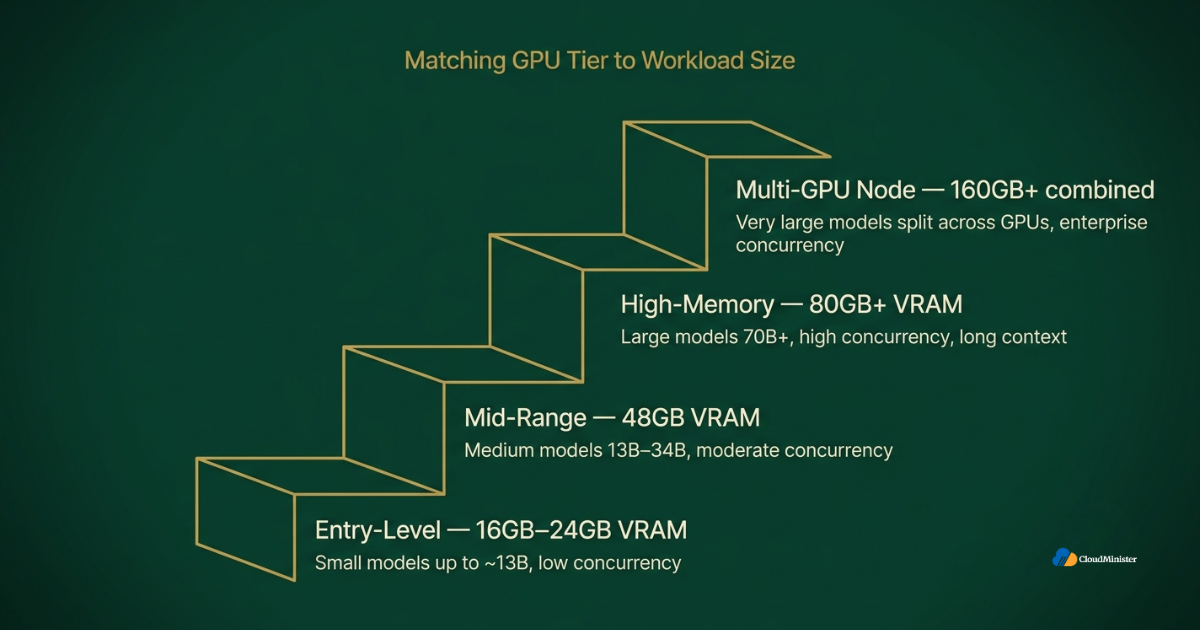
A Dedicated NVIDIA GPU Server gives full control over exactly which GPU tier a workload runs on, without the noisy-neighbour contention of shared multi-tenant instances. This control is what makes precise cost control possible in the first place, shared, unpredictable infrastructure makes accurate right-sizing decisions almost impossible because available capacity varies from hour to hour.
Stop Overpaying for GPU Capacity You Don’t Fully Use
Get guaranteed GPU allocation, full driver control, and predictable monthly billing with a Dedicated NVIDIA GPU Server built for inference workloads.
5.3 Utilization Is the Metric That Ties Everything Together
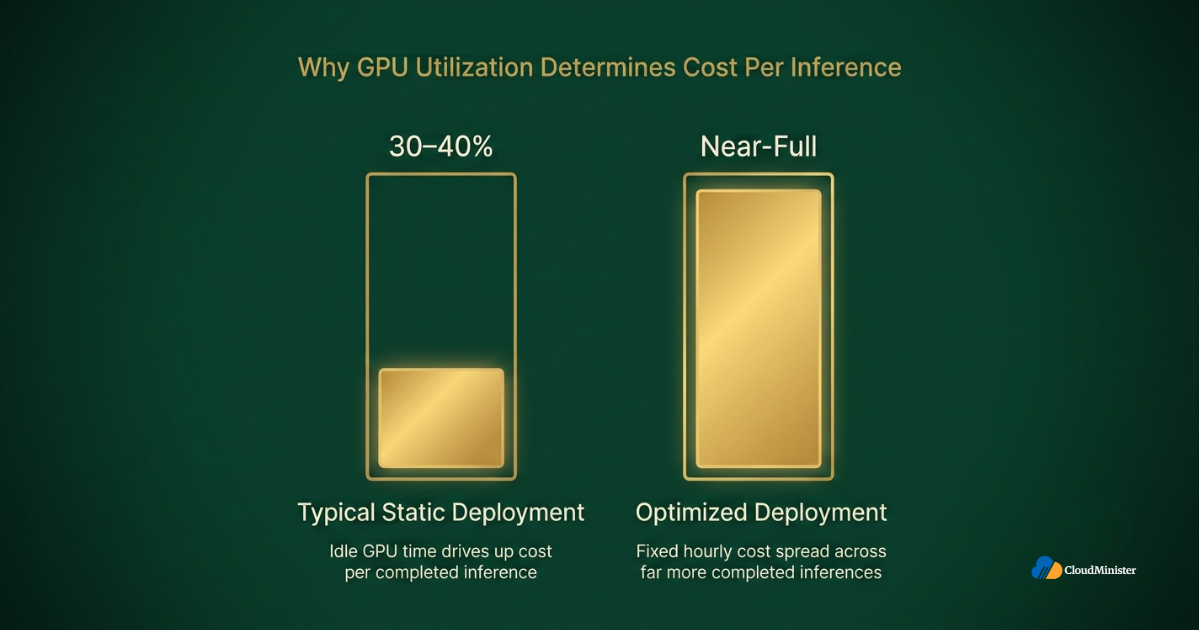
Industry analysis on machine learning cloud costs consistently finds that static GPU deployments frequently run at only 30 to 40 percent utilization, meaning idle accelerators are one of the single biggest sources of waste in production AI infrastructure. Every pillar of Inference Cost Optimization ultimately serves one goal: raising GPU utilization without breaching latency requirements, the same goal that applies whether the fleet in question consists of ai training servers or dedicated inference nodes.
- A GPU running at low utilization costs far more per completed inference than the same GPU running near capacity, because the fixed hourly rate is spread across fewer useful outputs
- Batching raises utilization by keeping the GPU fed with work
- Caching raises effective utilization by ensuring the GPU only does new work, not repeated work
- Right-sizing ensures the GPU’s capacity actually matches the workload, so utilization is a meaningful number rather than an artifact of an oversized instance
6. Hosting Infrastructure Decisions Behind Inference Cost Optimization
6.1 Why Shared and Consumer-Grade Infrastructure Undermines This Effort
- Noisy-neighbour contention: Shared GPU instances can experience unpredictable slowdowns when other tenants spike, making batching and right-sizing calculations unreliable
- No control over driver and framework versions: techniques like continuous batching depend on specific serving-framework versions that shared environments may not support
- Inconsistent network throughput: KV cache reuse and multi-GPU inference both depend on fast interconnects that budget shared hosting rarely guarantees
- Unclear data residency: Applications processing regulated or customer data need infrastructure with clear data-residency guarantees, which is difficult to verify on anonymous shared GPU marketplaces
6.2 Dedicated NVIDIA GPU Server: The Right Foundation for Cost-Efficient Inference
A Dedicated NVIDIA GPU Server removes the variables that make Inference Cost Optimization unreliable on shared infrastructure, and it pairs well with any best GPU cloud hosting strategy that also relies on burst capacity during traffic spikes:
- Guaranteed GPU allocation: No contention from other tenants, so batching and utilization measurements are accurate and repeatable
- Full driver and framework control: Teams can run the exact version of vLLM, TensorRT-LLM, or Triton Inference Server their strategy depends on
- Predictable monthly cost: Dedicated infrastructure converts a variable, usage-based bill into a predictable line item, which makes planning far more accurate
- High-speed local NVMe storage: Faster model checkpoint loading and KV cache offloading when GPU memory is under pressure
RELATED READING: GPU Cloud Providers in India — comparing dedicated and shared options for Inference Cost Optimization
6.3 GPU Servers for AI: Matching Infrastructure to Workload Type
Not every AI workload needs the same infrastructure. GPU Servers for AI come in different configurations depending on whether the workload is training, fine-tuning, or serving inference at scale. Businesses shopping across best GPU cloud hosting options should request separate quotes for GPU Servers for AI aimed at training versus those aimed purely at serving traffic, since the two are frequently priced and configured very differently:
- Inference-optimized configurations prioritize memory bandwidth and consistent latency over raw training throughput, a distinction worth confirming directly with any provider of GPU Servers for AI before signing a contract
- GPU Servers for AI built for high-concurrency serving typically pair mid-range or high-memory GPUs with fast networking and NVMe caching for the KV cache and model weights
- Teams running both training and inference workloads often split infrastructure. training on higher-throughput GPU Servers for AI, and inference on latency-tuned Dedicated NVIDIA GPU Server instances
- Choosing GPU Servers for AI with the correct generation of GPU avoids the common mistake of paying training-tier prices for a serving-only workload
- Businesses evaluating this infrastructure for the first time should request separate benchmarks for training throughput and inference latency, since a single number rarely tells the full story
- GPU Servers for AI marketed under a single generic tier often bundle together workloads that would benefit from being split across separate instance classes, a distinction that also matters when comparing ai training servers against dedicated inference nodes on a best GPU cloud hosting shortlist
This is comparable to how best GPU cloud hosting decisions are made for ai training servers versus inference-only deployments, the workload type should always determine the infrastructure tier, not the other way around. A team running ai training servers for occasional fine-tuning jobs has a very different cost profile than a team running always-on inference for a live product. Providers offering both GPU Servers for AI and dedicated inference tiers typically publish separate pricing for ai training servers versus serving instances, which makes an apples-to-apples comparison across best GPU cloud hosting options far easier to run.
6.4 Choosing a Web Hosting Company in India for AI Infrastructure
Indian businesses running AI inference workloads have specific reasons to choose infrastructure hosted domestically. A Web Hosting Company in India offering dedicated GPU infrastructure removes latency to Indian end users, supports a more straightforward compliance posture under Indian regulation, and provides support in familiar business hours, all of which support a more effective cost programme over the long run.
- Lower latency to Indian users compared to routing every inference request through an overseas region, a benefit any established Web Hosting Company in India can typically confirm with a simple traceroute test
- Simpler compliance posture for applications processing personal data of Indian citizens, since a Web Hosting Company in India operating domestic data centres can offer contractual assurances and reduced cross-border transfer complexity that support DPDPA compliance obligations, even though DPDPA itself does not mandate India-only data storage
- INR-denominated billing removes currency volatility from budget planning, which matters for a Web Hosting Company in India serving SME customers on fixed monthly budgets
- Local support teams who understand India-specific compliance and hosting requirements, something an overseas best GPU cloud hosting provider often cannot match
- A Web Hosting Company in India that also offers ai training servers alongside dedicated inference tiers gives growing businesses a single vendor relationship instead of splitting infrastructure across multiple overseas providers
RELATED READING: GPU Server Rental vs Buying — TCO Analysis for India — a deeper look at how rental economics factor into long-term Inference Cost Optimization
7. A Step-by-Step Inference Cost Optimization Framework
Phase 1: Measure Before Optimizing (Week 1)
- Instrument your inference stack to log GPU utilization, batch size, cache hit rate, and cost per request
- Identify your current cost per million tokens or cost per request as a baseline for every future Inference Cost Optimization decision
- Segment traffic by workload type: real-time chat, batch jobs, RAG queries, agentic tool calls — each has a different cost profile, and each may sit on a different tier of GPU Servers for AI within your current Web Hosting Company in India account
Phase 2: Apply Batching (Weeks 2–3)
- Switch to a serving framework that supports continuous batching if the current stack does not already use one
- Tune maximum batch size against your latency requirements, this is the single highest-leverage Inference Cost Optimization lever for high-traffic applications
- Monitor the trade-off between batch size and tail latency continuously, not just at launch
Phase 3: Apply Caching (Weeks 3–5)
- Implement exact-match caching first, it is the simplest and lowest-risk technique to deploy, whether the serving layer sits on ai training servers repurposed for inference or on purpose-built inference nodes
- Add semantic caching for applications with high query overlap but varied phrasing
- Enable prefix caching for any application using a long, static system prompt or repeated document context
Phase 4: Right-Size Infrastructure (Weeks 4–6)
- Match GPU tier to actual model size and concurrency, not to whichever GPU tier was easiest to provision initially, and confirm whether workloads are still sitting on ai training servers left over from an earlier fine-tuning phase
- Move workloads off shared or general-purpose instances onto a Dedicated NVIDIA GPU Server where utilization can be measured and trusted
- Reassess GPU tier whenever the underlying model, context length, or traffic pattern changes materially
Phase 5: Review and Repeat (Ongoing)
- Revisit cost per request monthly and compare it against the baseline established in Phase 1, checking whether your Web Hosting Company in India has adjusted best GPU cloud hosting rates since the last review
- Treat this work as a standing item in infrastructure review meetings, not a project with an end date
- Re-run the batching and caching tuning steps whenever a new model version is deployed, since optimal settings often shift with model architecture, whether that model is served from ai training servers or dedicated inference nodes
The teams that get the most out of Inference Cost Optimization treat it the same way they treat application performance monitoring, as continuous observability, not a quarterly checklist. Set up dashboards for utilization, cache hit rate, and cost per request from day one.
8. Inference Cost Optimization by Workload Type
8.1 Real-Time Chat and Conversational AI
- Latency is the primary constraint, so batching must be tuned carefully to avoid degrading response time, a constraint that applies equally on a Dedicated NVIDIA GPU Server and on shared best GPU cloud hosting capacity
- Semantic caching helps significantly for FAQ-style questions embedded within open conversation
- Right-sizing should prioritize a GPU tier with headroom for concurrent users during peak hours, since chat traffic is highly time-of-day dependent, a pattern any experienced Web Hosting Company in India will recognize from its own customer base
8.2 Retrieval-Augmented Generation (RAG) Pipelines
- Prefix caching delivers outsized value here because the retrieved document context is often reused across multiple follow-up questions from the same user
- Batching is more effective than in pure chat applications because RAG requests often arrive in larger, less latency-sensitive volumes, which is one reason many teams run RAG pipelines on dedicated GPU Servers for AI rather than general best GPU cloud hosting instances
- RAG-specific tuning should track cache hit rate on document context separately from cache hit rate on final answers, since these workloads often run on the same GPU Servers for AI used for other retrieval tasks
8.3 Batch and Asynchronous Jobs
- Latency constraints are relaxed, which makes large-batch, high-throughput configurations the correct choice, and these jobs are often scheduled on the same ai training servers used earlier in the week for fine-tuning
- Spot or off-peak scheduling on dedicated infrastructure can further reduce cost for jobs without strict deadlines, and Web Hosting Company in India providers offering off-peak GPU discounts make this even more effective
- Right-sizing for batch jobs should prioritize throughput per rupee over per-request latency
8.4 Agentic and Multi-Step Workflows
- Repeated system prompts and tool definitions across steps make these workloads strong candidates for prefix caching
- Cost tracking here must account for the total token cost across an entire multi-step task, not just a single model call, regardless of whether the agent runs on ai training servers or on inference-tuned GPU Servers for AI
- Right-sizing should account for peak concurrent agent sessions, which can spike unpredictably during automated workflows, making a Web Hosting Company in India with fast provisioning valuable for burst capacity
9. Common Mistakes That Undermine Inference Cost Optimization
- Optimizing only one pillar: Batching, caching, and right-sizing are interdependent, tuning only one without the others leaves significant savings on the table
- Ignoring tail latency: Chasing throughput through aggressive batching without monitoring p95 and p99 latency can silently degrade user experience while the average metrics look fine
- Over-provisioning “for safety”: Provisioning a larger GPU tier than the workload needs, often sized for a much bigger model than what is actually being served, is one of the most expensive and most common mistakes teams make
- Treating caching as fire-and-forget: Cache invalidation policies need ongoing maintenance, or caching gains quietly turn into a data-freshness problem
- Never revisiting infrastructure decisions: Model versions and traffic patterns change; decisions made a year ago on a best GPU cloud hosting plan are rarely still optimal today
10. Readiness Checklist for Inference Cost Optimization
- Baseline established: Cost per request, GPU utilization, and cache hit rate measured before any changes are made
- Serving framework supports continuous batching: vLLM, TensorRT-LLM, or an equivalent modern inference server is in place, whether deployed on ai training servers repurposed for serving or on dedicated GPU Servers for AI
- Caching layers implemented: Exact-match, semantic, and prefix caching evaluated for applicability to your workload, with support confirmed from your Web Hosting Company in India where self-hosted caching infrastructure is involved
- GPU tier matched to workload: Right-sizing reviewed against current model size, concurrency, and latency requirements as part of ongoing Inference Cost Optimization work
- Infrastructure control confirmed: Workloads run on a Dedicated NVIDIA GPU Server or equivalent infrastructure where utilization is measurable and consistent, rather than on unpredictable ai training servers shared with unrelated jobs
- Hosting provider verified: Your Web Hosting Company in India or global provider offers the driver control, networking, and storage performance your plan depends on, and can clearly explain whether its GPU Servers for AI are tuned for training or for inference
- Monitoring in place: Dashboards track utilization, cache hit rate, and cost per request on an ongoing basis, not just at launch
- Review cadence set: A recurring monthly or quarterly review of the metrics above is scheduled, not left informal, and includes checking whether current best GPU cloud hosting rates still match what your Web Hosting Company in India quoted at signup
Key Takeaways
- Inference Cost Optimization rests on three interdependent pillars: batching, caching, and right-sizing GPU instances
- Inference now represents the majority of AI infrastructure spend, and per-token costs keep falling even as total inference bills keep rising because usage grows faster than unit costs decline, according to Deloitte’s 2026 analysis
- Continuous batching is typically the fastest win available to teams that have not yet tuned their inference stack
- Prefix and semantic caching can meaningfully cut cost on workloads with repeated or overlapping queries, based on recent industry research
- Static, unmonitored GPU deployments frequently run at only 30 to 40 percent utilization — the single largest source of avoidable waste, whether the fleet runs on a Dedicated NVIDIA GPU Server or on rented ai training servers
- A Dedicated NVIDIA GPU Server provides the guaranteed allocation and driver control that make accurate Inference Cost Optimization possible
- Choosing the right GPU Servers for AI configuration for training versus inference prevents paying training-tier prices for serving-only workloads, a distinction every serious best GPU cloud hosting comparison should surface clearly
- This work is a continuous discipline, not a one-time project — review utilization, cache performance, and GPU tier on a recurring basis with input from your Web Hosting Company in India account team
Not Sure Which GPU Tier Fits Your Workload?
Talk to our team for a free consultation on right-sizing your infrastructure and building a cost-efficient inference stack tailored to your traffic.
Conclusion
Inference Cost Optimization is no longer optional for any business running AI models in production. As inference spend continues to overtake training spend across the industry, the companies that build batching, caching, and right-sizing into their standard operating rhythm will run leaner, more predictable AI infrastructure than those still treating inference as an afterthought. The gap between teams that optimize continuously and teams that don’t will only widen as usage scales, making early investment in this discipline increasingly valuable. Every additional month spent on unmonitored, over-provisioned infrastructure is a month of avoidable cost compounding against the bottom line.
The path is straightforward even if the execution requires discipline: measure utilization honestly, batch requests wherever latency allows, cache aggressively wherever queries repeat, and match GPU tier to actual workload rather than convenience. None of these steps demand a complete infrastructure overhaul on day one; most teams see meaningful results simply by enabling continuous batching and exact-match caching before touching anything else. Inference Cost Optimization rewards teams that start small, measure results, and expand the effort based on what the data actually shows, rather than teams that chase every technique at once without a baseline to compare against.
This applies whether that workload runs on a Dedicated NVIDIA GPU Server, on general-purpose GPU Servers for AI, or on ai training servers being repurposed for serving. CloudMinister provides Dedicated NVIDIA GPU Server infrastructure and GPU Servers for AI purpose-built for teams that take this discipline seriously, backed by the reliability and support of a trusted Web Hosting Company in India that understands both best GPU cloud hosting economics and India-specific compliance needs. Whether you’re just starting to measure GPU utilization or already deep into tuning cache hit rates, treating Inference Cost Optimization as an ongoing practice rather than a checklist item is what separates teams that scale profitably from those that don’t.
Frequently Asked Questions
What is Inference Cost Optimization?
Inference Cost Optimization is the practice of reducing the cost of running AI model predictions in production through techniques such as request batching, response caching, and matching GPU instance size to actual workload requirements, whether that infrastructure is a Dedicated NVIDIA GPU Server, general GPU Servers for AI, or capacity rented from a best GPU cloud hosting provider. Unlike training cost optimization, which is a one-time expense, Inference Cost Optimization addresses an ongoing cost that scales with every user request.
Why has Inference Cost Optimization become more important in 2026?
Inference workloads now account for the majority of AI compute demand industry-wide, up sharply from just a few years ago according to Deloitte’s technology predictions for 2026. As inference spend has overtaken training spend for most production applications, Inference Cost Optimization has shifted from a nice-to-have to a core part of running AI infrastructure responsibly, a shift every Web Hosting Company in India offering GPU capacity now has to plan around.
Which pillar of Inference Cost Optimization should a team start with?
Most teams see the fastest results from continuous batching, since modern serving frameworks like vLLM support it natively and it requires no changes to the underlying model. Caching is typically the second step, followed by right-sizing GPU instances once utilization data reveals whether the current GPU tier — whether on a Dedicated NVIDIA GPU Server, shared GPU Servers for AI, or a best GPU cloud hosting plan — actually matches the workload.
Does Inference Cost Optimization require a Dedicated NVIDIA GPU Server?
It is not strictly required, but a Dedicated NVIDIA GPU Server makes Inference Cost Optimization far more reliable because it removes noisy-neighbour contention and gives teams full control over driver and serving-framework versions. Shared infrastructure can make batching and right-sizing calculations inconsistent from hour to hour.
How often should Inference Cost Optimization be reviewed?
Inference Cost Optimization should be reviewed on an ongoing basis, ideally monthly, and whenever a new model version, traffic pattern, or context-length requirement changes materially, and whenever your Web Hosting Company in India announces new pricing for ai training servers or inference-tuned instances. Treating it as a one-time project rather than a continuous discipline is one of the most common mistakes teams make, whether they operate their own ai training servers or rent capacity month to month.

Shivlendra Singh Jadoun is a Cloud & DevOps Engineer at CloudMinister Technologies, specializing in AWS, Azure, and GCP infrastructure. He began his career in Linux system administration, managing shared, VPS, and dedicated servers before moving into cloud and automation. He is AWS Certified and works extensively with Docker, Kubernetes, Terraform, Ansible, and Jenkins to build CI/CD pipelines and scalable, secure cloud environments. With hands-on experience across hosting, server security, and DevOps automation, he brings real-world engineering insight to every article he writes.