Most security incidents in 2026 do not start with a careless password or a fake email. They start with a zero-day vulnerability, a flaw the vendor does not yet know exists, so no patch is available on the day attackers first use it. There is no signature to catch it and no update to block it, which is why traditional defenses miss it every time. This guide breaks down what a zero-day vulnerability actually is, how it differs from a regular disclosed bug, and why recent attacks turned it into a boardroom topic and not just a technical one. It also covers what a layered defense looks like in practice for a growing business, and how dedicated security support fits into a realistic prevention plan.
Every business owner eventually runs into the term zero-day vulnerability, usually right after reading about a breach that seemingly came out of nowhere. The confusion is understandable because this is not the kind of security problem that shows up on a routine checklist. A zero-day vulnerability exists in a gap where nobody, not the vendor, not the security team, not even the most experienced engineer, knows the flaw is there. That gap is exactly what makes it so dangerous, and why it deserves a different kind of attention than a regular software bug.
What makes 2026 different is not that this risk is new, it has existed for decades, but that the scale and targets have shifted. A zero-day vulnerability used to be associated mostly with nation state espionage and high profile enterprise breaches. That is no longer the full picture. Commercial exploit brokers now sell access to a wider range of buyers, and enterprise infrastructure like firewalls, VPN gateways and control panels has become just as attractive a target as browsers or mobile devices once were. This means a mid sized business running everyday infrastructure is no longer outside the blast radius simply because it is not a household name.
This guide exists to make that risk practical rather than abstract. Instead of treating a zero-day vulnerability as an unavoidable disaster, the goal here is to show what a realistic, layered response actually looks like, from behavior based detection and network segmentation to the kind of ongoing patch discipline that a dedicated hosting or security partner can bring to the table. By the end, the aim is not to eliminate the risk entirely, since that is not realistic for any organization, but to reduce exposure and cut down how much damage a single incident can do.
Table of Contents
- What Is a Zero-Day Vulnerability and Why Does It Matter
- Why Every Business Needs to Understand This Threat, Not Just Enterprise Security Teams
- How This Unknown Flaw Differs From a Regular Software Bug
- Recent Zero-Day Attacks Every Business Should Know About
- How This Kind of Flaw Typically Gets Exploited
- Building a Layered Defense Strategy Against This Risk
- Practical Steps to Reduce Your Exposure
- Governance and Operational Considerations Around This Risk
- Measuring Whether Your Defenses Are Actually Working
- Choosing the Right Partner for Zero-Day Vulnerability Defense
- Conclusion: Making This Defense Work for Your Organization
- Key Takeaways
- Frequently Asked Questions
1. What is a Zero-day Vulnerability and Why Does It Matter
For most business owners, this conversation usually starts the same way, often while comparing notes with a Web Hosting Company in India about why a firewall alone did not stop a breach nobody saw coming. Someone reads a headline about a new Zero-Day Vulnerability affecting a widely used piece of software, and asks whether their own environment is exposed to the same category of risk.
A Zero-Day Vulnerability is a security flaw in an application, operating system, or piece of hardware that is unknown to the vendor responsible for fixing it. The term zero-day refers to the fact that the vendor has had zero days to build and release a patch once the flaw becomes known, whether it was found by a researcher, a criminal group, or a state-sponsored actor. Unlike a disclosed vulnerability that already has a CVE identifier and a documented fix, this kind of flaw exists in a gap where detection tools, patch routines, and even experienced engineers have nothing published to check against.
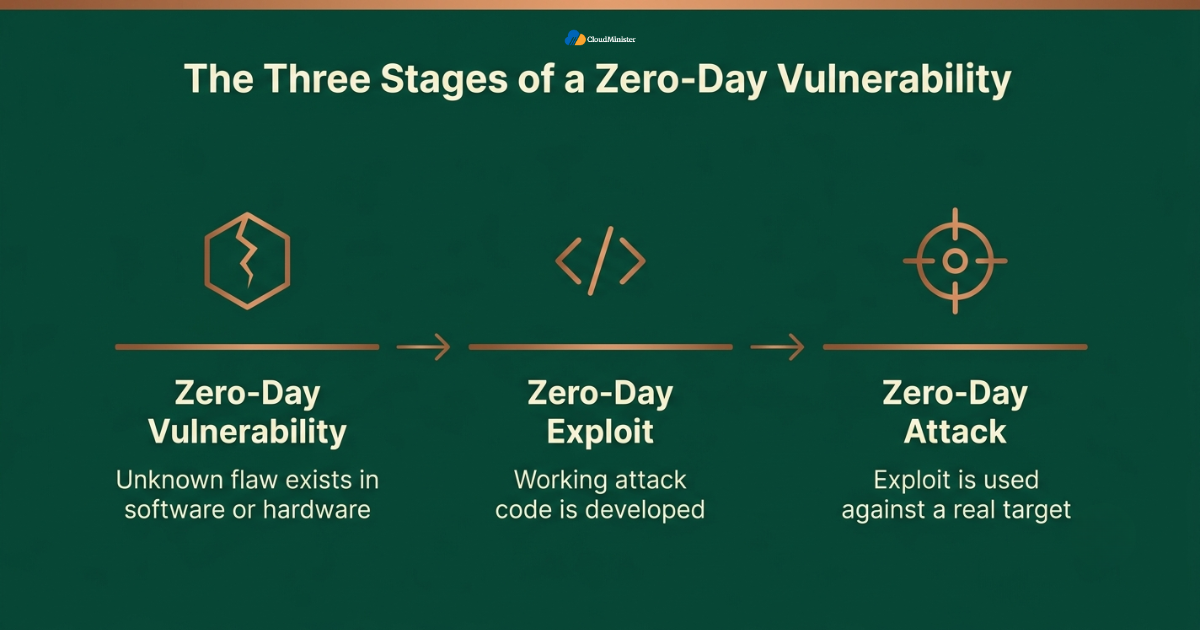
- A Zero-Day Vulnerability becomes a zero-day exploit the moment an attacker writes working code that takes advantage of the flaw, and it becomes a zero-day attack the moment that exploit is actually used against a real target, so the three terms describe different stages of the same underlying problem.
- Because no patch exists yet, the flaw cannot be closed through routine update cycles alone, which is exactly why Server Management Services that include proactive monitoring matter as much as the patching schedule itself.
- Many businesses only realize how much they were relying on informal, ad hoc patching once they compare it against what dedicated Server Management Services actually cover on a recurring basis.
- This category of risk can exist for months or even years before anyone notices it, sitting quietly in production code until a researcher or an attacker stumbles onto it during testing or reconnaissance.
- Organizations that already work with a provider of Cyber Security services tend to shorten this discovery window, since ongoing monitoring is far more likely to catch unusual behavior than an internal team checking logs occasionally.
- The window between when such a flaw is first exploited and when the vendor ships a fix is often called the vulnerability window, and this is the period where an organization is most exposed and least likely to know it.
- Even well-funded cybersecurity solutions cannot guarantee prevention of every new flaw, which is why detection and containment matter as much as prevention itself.
- Not every newly discovered flaw of this kind gets exploited before the vendor or a researcher finds it first, but the ones that do tend to cause the most damage precisely because defenders had no warning at all.
- A capable Web Hosting Company in India will usually treat this category of risk as a standing agenda item rather than a one-time briefing, since new instances surface every year across different vendors and product lines.
- Businesses that have never formally discussed this risk with their Web Hosting Company in India often assume the topic is covered by default, when in practice it usually needs to be raised directly during a planning or renewal conversation.
Server Management Services that include configuration review as a standard offering are one of the more effective ways to catch this exact kind of exposure before an outside attacker does.
This kind of flaw changes how a system can be entered from the outside, not how trusted systems behave once an attacker is already inside, so an organization that only invests in perimeter defense while ignoring internal segmentation is still exposed even after the original issue is patched. A misconfigured environment that gets compromised through a Zero-Day Vulnerability and then allows lateral movement across every connected server is exactly the kind of gap Cyber Security services are built to catch during a proper security audit, and it deserves the same review discipline as any other production access control decision.
2. Why Every Business Needs to Understand Zero-day Risk, Not Just Enterprise Security Teams
Many business owners first encounter this topic while already researching a Web Hosting Company in India for their broader production needs, and a capable partner will usually raise the subject early in that conversation, since a good partner rarely separates hosting advice from security advice. For teams without a dedicated security function, understanding what this unknown flaw actually is often the fastest way to avoid a category of breach that looks sophisticated from the outside but is frequently the result of a basic gap in monitoring.
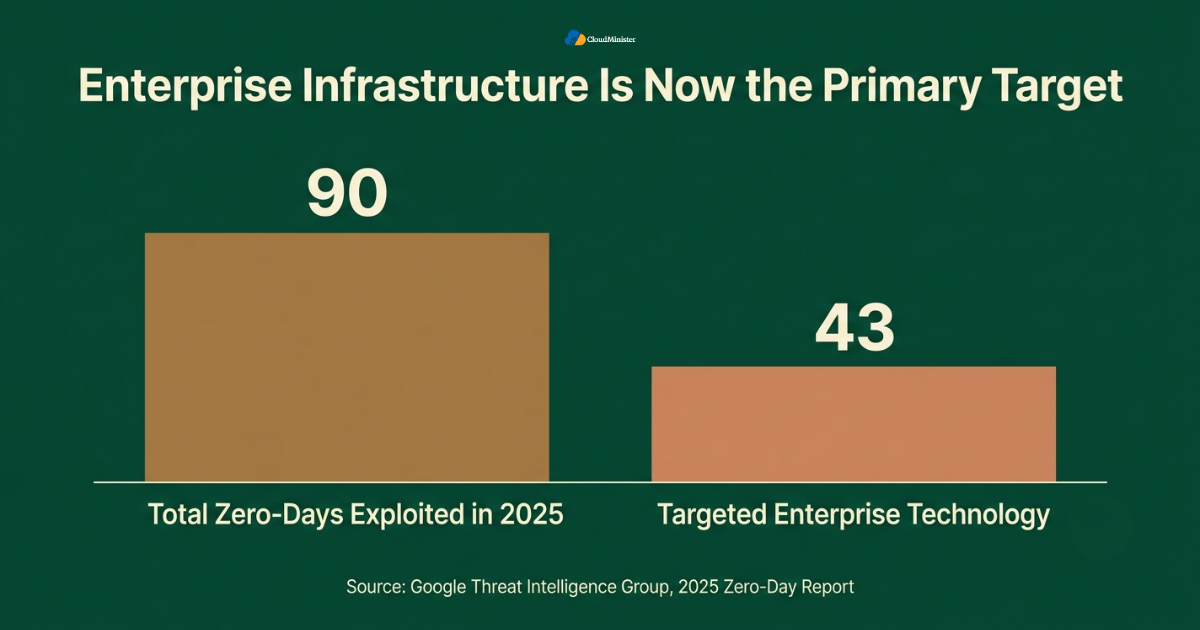
- Zero-day exploitation has settled into an elevated pattern rather than fading away, with Google’s Threat Intelligence Group tracking 90 zero-day vulnerabilities actively exploited in the wild during 2025, a figure that stayed within the 60 to 100 range the industry has observed over the past four years, according to reporting from BleepingComputer on Google’s annual findings.
- Nearly half of all tracked exploitation in 2025 targeted enterprise technology rather than consumer software, meaning a Zero-Day Vulnerability is no longer mostly a problem for browser vendors and phone manufacturers, it is now squarely a problem for the servers, firewalls, and business applications that a Web Hosting Company in India helps organizations run every day.
- Without a structured approach to patching and monitoring, different departments inside the same company commonly assume someone else is watching for this kind of flaw, producing gaps that only surface after an incident has already happened.
- Businesses that have moved their infrastructure oversight to a team offering Server Management Services in India often report faster turnaround on routine patching alone, before any advanced monitoring is even factored in.
- A disciplined approach centralizes vulnerability monitoring at the platform or security team level, often in partnership with a provider offering dedicated Cyber Security services, rather than leaving detection to whichever employee happens to notice unusual behavior first.
- Businesses without any formal arrangement for Cyber Security services often discover an active incident only after a customer or partner reports something suspicious, which is far later than ideal.
- The most effective cybersecurity solutions on the market today combine automated detection with a human team that can interpret ambiguous signals, since automation alone still misses context a trained analyst would catch.
- Businesses that outsource day-to-day infrastructure oversight to a team running mature Server Management Services in India tend to catch early indicators of the underlying flaw being exploited faster than teams relying on occasional internal check-ins.
Related Reading: cPanel and WHM CVE-2026-41940 authentication bypass
Before assuming this category of risk only threatens large enterprises with household-name software, review which third-party plugins, control panels, and libraries your own stack depends on, and involve a Web Hosting Company in India early if one already manages part of the environment. Businesses that map their actual software dependencies before an incident consistently respond faster than those who only discover the dependency list while already under attack.
3. How a Zero-day Vulnerability is Different From a Regular Software Bug
Before working through the detailed prevention strategy in this guide, it helps to understand that not every software flaw carries the same risk profile. A regular disclosed vulnerability already has a CVE identifier, a vendor advisory, and usually a patch available on day one of public knowledge. A Zero-Day Vulnerability has none of that structure in place when it is first exploited.
- A disclosed vulnerability gives defenders a documented fix, a known severity score, and time to schedule remediation, while a Zero-Day Vulnerability gives defenders none of that until the vendor catches up, which is the core reason it remains one of the most feared categories in the entire field.
- A well-informed Web Hosting Company in India typically keeps a running list of which products in a customer’s stack have historically been targeted by this kind of exploit, since past exposure is often a useful indicator of future risk.
- Antivirus and intrusion detection tools that rely on known signatures are largely blind to this kind of flaw by definition, since there is no existing signature to match against a flaw nobody has documented yet.
- This is precisely the gap that dedicated Cyber Security services are designed to close, since behavior-based monitoring does not depend on a threat already being catalogued somewhere.
- Modern cybersecurity solutions increasingly treat network appliances and edge devices as a priority category, reflecting exactly this shift toward enterprise-focused exploitation.
- This category of flaw can affect operating systems, browsers, mobile devices, network appliances, or business applications equally, and recent trends show attackers increasingly favoring enterprise infrastructure over consumer software specifically because patching cycles there tend to be slower.
- The financial and reputational cost of this category of risk tends to be higher than a routine breach because the incident often runs for weeks before detection, giving an attacker far more time to move laterally, exfiltrate data, or establish persistence.
- Where an organization sits between these risk categories often depends on how quickly a team delivering genuine Server Management Services in India can detect anomalous behavior even without a known signature to search for, since behavioral monitoring is frequently the only realistic early warning available.
- Businesses evaluating cybersecurity solutions for the first time are often surprised to learn how much of the modern toolkit exists specifically to catch this exact category of unknown-threat exploitation rather than known, previously catalogued malware.
- Growing companies weighing whether to build an internal operations team or work with a partner delivering Server Management Services in India should factor in how quickly either option can realistically respond to an emergency patch.
Related Reading: zero trust security guide for Indian businesses
4. Recent Zero-day Attacks Every Business Should Know About
Below is a breakdown of how recent this category of risk incidents actually unfolded, and why the pattern behind them matters more than any single vendor name.
4.1 Enterprise Infrastructure Has Become the Primary Target
- Security researchers found that 43 of the 90 zero-day vulnerabilities exploited in 2025 specifically targeted enterprise technologies such as networking devices, security appliances, and virtualization platforms, according to coverage of Google’s findings published by SecurityAffairs.
- Security and networking appliances accounted for roughly half of that enterprise-focused activity, meaning this kind of flaw in a firewall or VPN gateway is now just as likely, if not more likely, than one in a browser.
- Operating systems remained the single most exploited category overall, which means a flaw at the OS level can affect every application running on top of it regardless of how well those individual applications were coded.
- Mobile devices saw a rising share of zero-day exploitation as well, a trend that matters for any business whose employees access company systems from personal devices without consistent patching discipline.
- Any Web Hosting Company in India managing shared control panel infrastructure needs a clear plan for this exact scenario, since a single unpatched instance can expose every account on that server.
- Providers delivering structured Server Management Services in India were among the first to push emergency mitigations for this exact issue once it became public, well ahead of businesses managing their own control panels without dedicated support.
- A hosting-layer example of this shift is the recent cPanel and WHM authentication bypass tracked as CVE-2026-41940, which showed how a Zero-Day Vulnerability in widely used control panel software can expose thousands of hosting accounts at once, a pattern documented in detail in our dedicated write-up on the incident, one of the clearer real-world case studies of the year for anyone assessing cybersecurity solutions built around control-panel level access.
4.2 Commercial Surveillance Vendors Have Changed Who Uses This Kind of Exploit
- For the first time since tracking began, commercial surveillance vendors were responsible for more attributed zero-day exploitation than traditional state-sponsored espionage groups, meaning the buyers and sellers of the flaw are no longer limited to a handful of national intelligence agencies.
- Evaluating cybersecurity solutions purely on price rather than actual detection capability becomes a much riskier decision once a wider range of buyers can access working exploits.
- This shift matters for ordinary businesses because commercial exploit brokers sell access to a working flaw to a wider range of paying customers, expanding who can realistically use one against a mid-sized company rather than only a handful of nation-state targets.
- The flaw purchased through these commercial channels is often used first against high-value targets before eventually being reused against a broader set of victims once its existence becomes known within criminal circles.
- Businesses relying on outdated assumptions about who would realistically target them are increasingly finding that this category of risk does not require a nation-state adversary to become a real and present threat.
- A layered defense that does not depend on knowing the attacker’s identity in advance is the only realistic response, which is precisely why cybersecurity solutions built around behavior rather than attacker profiling have become the industry standard, and why serious Cyber Security services now assume any customer could plausibly be targeted regardless of size.
- Businesses that previously assumed Cyber Security services were only relevant for large enterprises are increasingly reconsidering that assumption given how broadly commercial exploit brokers now sell access.
4.3 Detection Speed Has Improved But Still Lags Real-world Exploitation
- Research from VulnCheck found that roughly 23 percent of the vulnerabilities added to its known exploited vulnerabilities dataset during the first half of 2026 already showed evidence of exploitation on or before the date their CVE record was published, underscoring how often a Zero-Day Vulnerability is actively used before the security community even has a name for it.
- The median time between a CVE being published and confirmed evidence of exploitation has been falling in recent measurements, which is a genuinely positive trend for defenders, but it still means a meaningful window of unmanaged risk exists around every newly disclosed flaw.
- Any set of cybersecurity solutions that still relies primarily on manual review for triage will struggle to keep pace once an exploit is weaponized this quickly.
- This unknown flaw that gets weaponized quickly leaves almost no time for a manual patch review process to catch up, which is exactly the gap that automated Server Management Services are designed to close.
- Faster detection does not eliminate the underlying problem, since a Zero-Day Vulnerability by definition existed and was potentially exploitable long before anyone started the clock on measuring detection speed.
- This is also where the practical value of Server Management Services becomes clearest, since a team already monitoring server health around the clock is positioned to notice an anomaly well before a formal advisory is published.
- A responsive Web Hosting Company in India shortens this window further by applying vendor patches to shared infrastructure almost as soon as they are released, rather than waiting for a scheduled maintenance cycle.
- Organizations already working with a partner offering structured Server Management Services in India report noticeably shorter gaps between a patch becoming available and that patch actually being deployed across production systems.
Related Reading: guide to data residency requirements in India
5. How a Zero-day Vulnerability Typically Gets Exploited
Understanding the mechanics behind this kind of threat helps explain why prevention has to happen at multiple layers rather than relying on a single control.
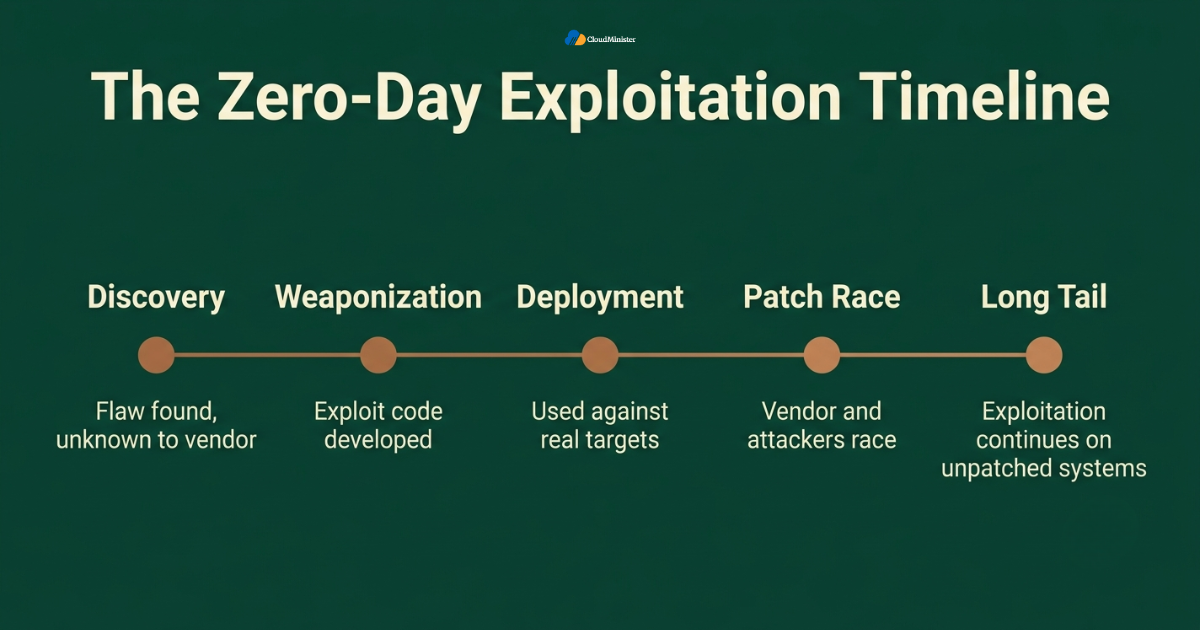
- Discovery: A researcher, a criminal group, or a state-sponsored team finds a flaw in code that has not yet been reported to the vendor, at which point a Zero-Day Vulnerability effectively exists even though nobody responsible for fixing it knows about it yet.
- Weaponization: Working exploit code is developed that reliably triggers the flaw, turning a theoretical weakness into a usable tool against real targets.
- Deployment: The exploit is used against one or more targets, often quietly at first against high-value victims, since using this unknown flaw too broadly increases the chance the vendor notices unusual activity and issues a fix sooner.
- Discovery by defenders: Eventually the vendor, a security researcher, or an affected organization notices the exploitation, at which point the flaw becomes publicly known and typically receives a CVE identifier.
- Patch and race condition: The vendor races to release a fix while attackers who still have working exploit code race to use it against as many unpatched systems as possible before that fix is widely applied, which is exactly the period where Server Management Services in India focused on rapid patch deployment make the most measurable difference.
- Ongoing Server Management Services that track exactly which patches have and have not been applied across an entire fleet of servers remove much of the guesswork from this stage.
- A consistent theme among businesses working with structured Server Management Services in India is a measurably shorter gap between a vendor patch shipping and that patch actually being live on production systems.
- Long tail exploitation: Even after a patch exists, a Zero-Day Vulnerability often continues to be exploited against organizations that have not yet applied the fix, sometimes for months or years afterward, which is why patch management has to be an ongoing discipline rather than a one-time reaction to news headlines, and why many businesses eventually formalize this discipline through outside Cyber Security services rather than leaving it to an internal team stretched across other priorities.
Teams supported by Server Management Services in India that include after-hours coverage are in a noticeably better position here, since emergency patches rarely arrive on a convenient schedule.
The organizations that handle a Zero-Day Vulnerability well are rarely the ones with the single best piece of security software. They are the ones with the fastest, most disciplined process for detecting unusual behavior, applying emergency patches, and isolating affected systems before the flaw can spread further across the network. Process and ownership consistently matter more than any individual tool.
6. Building a Layered Defense Strategy Against Zero-day Vulnerability Risk
Even a well-funded security budget can underperform if it sits inside an environment with no supporting structure around it. Building a layered approach across an organization’s entire security posture matters as much as buying the right individual tool.
- Prioritize cybersecurity solutions that flag unusual behavior rather than only matching against a list of known bad indicators, since the latter approach is structurally incapable of catching something nobody has seen before.
- Use behavior-based detection as the default layer for catching this kind of flaw in action, since signature-based tools alone will almost never catch a flaw that has never been documented before.
- Combine internal patch policy with an outside team providing Server Management Services wherever internal bandwidth is limited, since a gap in coverage is often the actual root cause behind a delayed patch rather than a lack of awareness that the patch exists.
- Reserve strict network segmentation for any system handling sensitive data, so that even if a Zero-Day Vulnerability is successfully exploited on one server, the resulting access does not automatically extend across the entire environment.
- Businesses without an internal security operations function should treat a partnership offering genuine Server Management Services in India as the foundation of this plan rather than an optional add-on.
- Introduce a formal incident response plan specifically written around the assumption that this kind of unknown flaw will eventually be used against the organization, rather than treating that scenario as unlikely enough to skip planning for it.
- Reassess the security stack on a recurring schedule, ideally as part of routine infrastructure reviews, since a set of cybersecurity solutions that comfortably handled last year’s threat landscape may not be sufficient against how the underlying flaw is being weaponized this year.
- Treat encryption as a non-negotiable baseline within any set of cybersecurity solutions under consideration, not an optional upgrade reserved for larger budgets.
- Encrypt sensitive data both at rest and in transit as a baseline control, since even a successful exploit against a Zero-Day Vulnerability yields far less value to an attacker when the data it exposes is unreadable without a separate key, a concept covered in detail in our guide on encryption in transit.
- Partner with a provider of Cyber Security services that already monitors threat intelligence feeds for early indicators of this category of risk being actively exploited in the wild, since most individual businesses do not have the resources to run that kind of monitoring internally.
- Combine internal policy with outside expertise wherever possible, since a hybrid model built around dependable Server Management Services in India consistently closes gaps that neither an internal team nor an external vendor would catch entirely alone.
Do not wait for an unknown flaw to find your business first
Behavior based detection, network segmentation and round the clock monitoring are the difference between catching a zero-day vulnerability early and discovering it after the damage is done. Our Cyber Security team builds that layered defense around your actual infrastructure.
7. Practical Steps to Reduce Zero-day Vulnerability Exposure
Preventing every possible instance of this kind of flaw is not realistic for any organization, but meaningfully reducing exposure and limiting damage absolutely is.
- Rely on Server Management Services to track version numbers across every server automatically, since manually auditing software versions across a growing fleet of machines becomes unreliable at scale.
- Keep every piece of software, from the operating system down to individual plugins, on the latest supported version, since vendors frequently patch flaws quietly before they are ever formally classified as a Zero-Day Vulnerability that was actively exploited.
- Confirm that whichever team is providing Server Management Services also reviews account privileges on a recurring basis, not only at initial setup.
- Apply the principle of least privilege across every account and service, so that even if a Zero-Day Vulnerability grants initial access, the compromised account cannot immediately reach sensitive systems elsewhere in the network.
- Confirm whether firewall tuning is included as part of Server Management Services or billed separately, since this detail affects how quickly rules actually get updated after a new threat emerges.
- Confirm that any provider of Server Management Services in India you engage can actually push emergency firewall rule changes outside normal business hours, since a threat rarely waits for the next working day.
- Deploy a web application firewall in front of internet-facing applications, since a properly tuned WAF can sometimes block the specific request pattern used by the flaw exploit even before a formal patch exists.
- Run regular penetration testing and red team exercises that specifically simulate unknown-threat scenarios, rather than only testing against previously disclosed vulnerabilities that already have public fixes, a service most established Cyber Security services now include as standard.
- Ask any prospective provider of Cyber Security services exactly how often these simulated exercises are run, since an annual test is far less useful than a recurring one built into an ongoing engagement.
- Insist that Server Management Services cover log retention explicitly in any service agreement, rather than assuming it is included by default.
- Maintain detailed logging and retain those logs long enough to support a forensic investigation, since identifying how far such a flaw spread after the fact depends entirely on having a usable record of what actually happened.
- Confirm that whoever handles Server Management Services for your environment already subscribes to these same advisories, so notification does not depend entirely on your own team catching the news first.
- Subscribe to vendor security advisories and threat intelligence feeds directly, so that when a flaw affecting a tool in your stack is disclosed, the organization hears about it within hours rather than days.
- Work with Server Management Services that include proactive patch deployment, since the gap between a patch being released and being applied is exactly where most damage from a Zero-Day Vulnerability actually occurs.
- Treat a documented vendor and dependency inventory as a living asset rather than a one-time exercise, since new components get added to most technology stacks constantly, and each new component potentially introduces its own future Zero-Day Vulnerability.
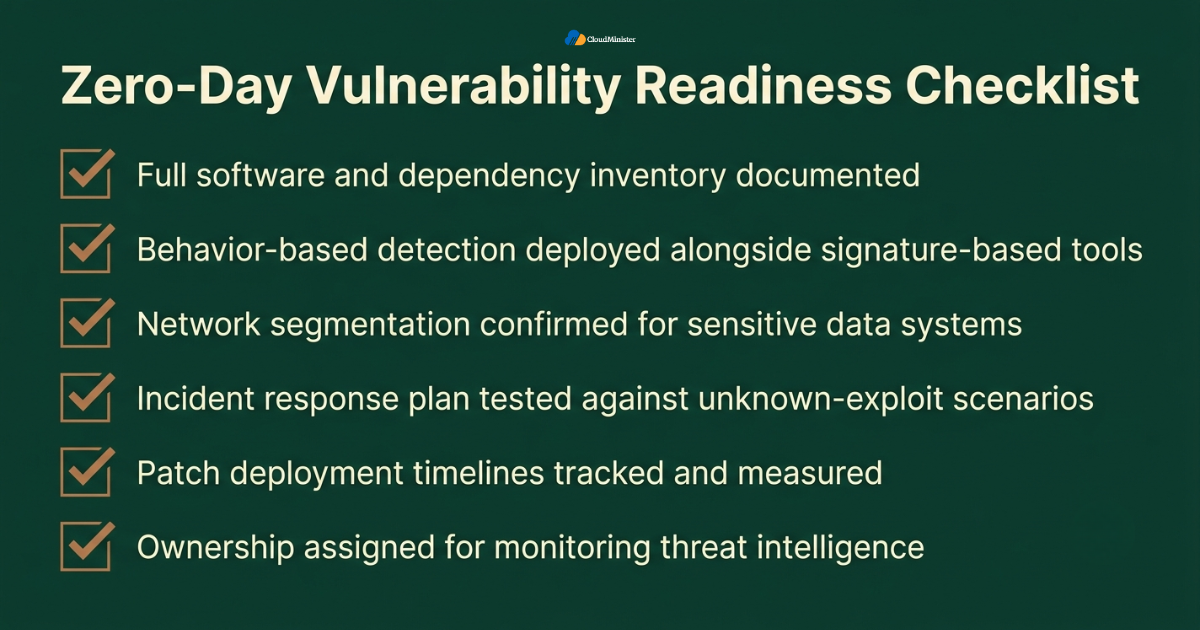
Checklist: Zero-Day Vulnerability Readiness Review
- Full software and dependency inventory documented across every internet-facing service
- Behavior-based detection deployed alongside traditional signature-based tools
- Network segmentation confirmed for every system holding sensitive or regulated data
- Incident response plan tested specifically against an unknown-exploit scenario
- Patch deployment timelines tracked and measured, not just assumed to be fast
- Ownership assigned for monitoring vendor advisories and emerging threat intelligence
8. Governance and Operational Considerations Around Zero-day Vulnerability Risk
Standardizing a mature response to this category of risk introduces a specific governance layer on top of the standard technical considerations that come with running internet-facing systems.
- Vulnerability response decisions should route through the same review process as any other production security change, ideally with input from a team experienced in both infrastructure management and dedicated Cyber Security services.
- Smaller organizations without an internal security function often find that outsourcing this entire review process to a provider of Cyber Security services is more practical than trying to build the capability internally.
- A single point of accountability, whether that is an internal team or an external provider of Server Management Services in India, prevents the kind of finger-pointing that slows down remediation during an actual incident.
- Centralized patch and monitoring standards, coordinated with a single operations partner rather than allowing individual teams to define their own update schedules independently, prevent the kind of inconsistent exposure that a Zero-Day Vulnerability exploits most easily.
- Server Management Services that include a formal vendor review cadence catch this kind of drift far more reliably than an informal, whenever-someone-remembers approach.
- Third-party software and vendor risk should be reviewed on a recurring basis, ideally with support from a partner that already tracks emerging threat intelligence, so that a flaw affecting a supplier gets flagged before it becomes a genuine incident inside your own environment.
- Confirm with any team delivering Server Management Services exactly how long access logs are retained, since a short retention window can quietly erase the evidence needed for a proper post-incident review.
- Access logs and authentication records should be tracked explicitly, since knowing exactly which systems were reachable at the time the underlying flaw was disclosed is far more useful during an incident than reconstructing that picture while already responding to one.
- Confirm that your chosen cybersecurity solutions actually cover every system in this inventory, since a single unmonitored server is often exactly where an incident eventually starts.
- A documented security inventory, tracking which systems sit behind a web application firewall, which are segmented, and which rely on Server Management Services in India for patch discipline, gives a security team the audit trail needed to demonstrate due diligence after any such incident.
- Larger organizations running a mix of on-premise and cloud infrastructure should confirm that their chosen cybersecurity solutions cover both environments consistently, since a gap between the two is a common place for the underlying flaw to go unnoticed for longer than it should.
9. Measuring Whether Your Zero-day Vulnerability Defenses are Actually Working
Standardizing a good response pattern here is not the finish line of a security effort, whether the workload sits on a self-managed environment or with an outside partner offering broader cybersecurity solutions. Long-term resilience depends entirely on how the setup is monitored and adjusted afterward.
- Track the average time between a patch being released and being applied across the organization’s full software inventory, since a slow patch cycle quietly extends the window during which a known Zero-Day Vulnerability remains exploitable inside the environment.
- Ask whichever provider handles Server Management Services to walk through a recent anomaly they actually caught, since a concrete example says more than a general description of their monitoring capability.
- Compare actual detected anomalies against what the monitoring rules assume, a discipline that matters equally for teams focused on overall infrastructure spend, since real-world exposure often turns out broader than the security diagram suggests once unused access paths are audited.
- Ask any partner offering Server Management Services in India how they track dependency risk across the specific vendors your business relies on, rather than accepting a generic answer about patching in general.
- Review third-party and vendor dependencies quarterly, flagging any component that has quietly become business-critical without a corresponding increase in monitoring attention, a review many teams now delegate to a Web Hosting Company in India.
- Cross-reference the organization’s security posture against its broader compliance obligations, particularly where an incident tied to a Zero-Day Vulnerability would trigger mandatory disclosure requirements under applicable regulations.
- Maintain a change log for every emergency patch applied in response to a newly disclosed Zero-Day Vulnerability, shared with the broader operations team, so a team can trace exactly why a given decision was made and whether the assumptions behind it still hold.
- Ask any external partner providing Server Management Services in India to share their own patch deployment metrics on a recurring basis, since transparency here is one of the clearest signals of a mature operational partner.
Network layer attacks and exploitation attempts have continued climbing industry-wide heading into 2026, underscoring why structured vulnerability review matters just as much as the initial patch, and why a dependable partner offering ongoing Cyber Security services earns its keep long after any single such incident is resolved.
10. Choosing the Right Partner for Zero-day Vulnerability Defense
Not every hosting relationship is built to support disciplined vulnerability management, and this is exactly where the difference between an average Web Hosting Company in India and a genuinely security-focused one becomes visible, so matching a provider’s capability to actual business needs matters more than brand recognition alone, whether that provider delivers Server Management Services, broader cybersecurity solutions, or both.
- A dependable Web Hosting Company in India that already manages a team’s broader infrastructure is well positioned to advise on the vulnerability exposure without introducing unnecessary complexity into an already functioning environment.
- Businesses evaluating providers should specifically ask whether the provider has direct experience helping customers respond to a genuine incident of this kind, not just provisioning individual virtual machines under a generic hosting plan.
- A track record of handling real incidents is a far better signal of genuine Cyber Security services capability than a marketing page listing every tool a vendor happens to support.
- A genuinely experienced Web Hosting Company in India will be able to describe, in specific terms, how a past incident of this kind was detected and contained for another client.
- Teams that want to move quickly without designing every layer of their vulnerability response themselves often gravitate toward a Web Hosting Company in India that comes with clear documentation on how a Zero-Day Vulnerability is detected, contained, and remediated from day one.
- Business leaders who have not yet reviewed their hosting partner relationship specifically in the context of the flaw readiness should treat this guide as a natural trigger point to do so, and to ask their provider directly about patch turnaround times.
- A capable partner offering both deep expertise in Cyber Security services and broader Server Management Services gives growing businesses a coherent roadmap for reducing Zero-Day Vulnerability exposure instead of stitching together advice from multiple vendors.
- Businesses researching a hosting plan specifically for internet-facing workloads should confirm that a prospective partner understands both the mechanics of a Zero-Day Vulnerability and the surrounding infrastructure needed to contain one, since the two concerns are closely linked in practice.
- A provider that bundles Server Management Services with genuine security monitoring, rather than treating patching as a purely mechanical task, is generally better positioned to catch an emerging issue early.
- A genuinely capable Web Hosting Company in India will also be transparent about which parts of a defense strategy it owns directly and which parts depend on the customer’s own internal discipline, since no set of cybersecurity solutions works well without cooperation on both sides.
- Businesses switching providers specifically because of a prior security incident should ask any new Web Hosting Company in India for references from customers who experienced something similar.
When comparing quotes or advice from different partners on this unknown flaw preparedness, ask each one to walk through a real incident response scenario from a past client engagement rather than a generic case study, since the right recommendation depends entirely on how quickly a provider can actually detect and contain an active exploit. A provider offering genuine Server Management Services in India that understands both the technical mechanics and an organization’s actual risk profile will consistently give more actionable guidance than a purely theoretical comparison.
Conclusion: Making Zero-day Vulnerability Defense Work for Your Organization
Throughout this guide, one pattern holds regardless of company size, industry, or whether the surrounding environment runs on a single managed server or a larger multi-region footprint. This unpatched flaw cannot be entirely prevented, since by definition it is unknown until someone finds it, but its impact absolutely can be reduced through layered detection, disciplined patch management, and a response plan built before an incident rather than during one. Treating this category of risk as a combined, ongoing strategy rather than a single tool purchase has become close to standard practice for any organization managing meaningful internet-facing infrastructure in 2026, often guided by a trusted Web Hosting Company in India along the way.
The organizations that get the most value from this approach share a consistent pattern. They assume a Zero-Day Vulnerability will eventually target them, they invest in behavior-based detection rather than relying solely on known signatures, and they treat vulnerability management as one part of a broader security practice rather than a one-time configuration step. For teams weighing this decision alongside a broader look at their infrastructure, or comparing available cybersecurity solutions, the same underlying principle applies. Assume the unknown threat is coming, layer defenses deliberately, revisit the plan as the environment changes, and the underlying flaw becomes a managed risk rather than an existential one, ideally with a capable Web Hosting Company in India involved throughout, including one experienced across both Cyber Security services and Server Management Services in India.
Not sure how exposed your current setup really is
Talk to our team about patch turnaround times, monitoring coverage and where a zero-day vulnerability could realistically slip through in your environment. We will walk you through it in plain terms.
Key Takeaways
- A Zero-Day Vulnerability is a flaw unknown to the vendor responsible for fixing it, which means no patch exists on the day it is first exploited, making signature-based detection largely ineffective against it.
- Recent data shows this category of threat increasingly targets enterprise infrastructure such as firewalls, VPN gateways, and control panels rather than only consumer software, a baseline any competent partner supporting Server Management Services should already be planning around.
- Detection speed for a newly disclosed flaw has improved industry-wide, but a meaningful window of exposure still exists between initial exploitation and a widely applied patch.
- Layered defense, including behavior-based monitoring, network segmentation, encryption, and a tested incident response plan, consistently outperforms relying on any single set of cybersecurity solutions to catch a Zero-Day Vulnerability.
- Governance, vendor risk monitoring, and a documented ownership structure matter just as much as the initial security tooling decision, and this holds whether the environment is run internally, through a Web Hosting Company in India, or through broader Cyber Security services.
- Partnering with a capable provider experienced in both Cyber Security services and Server Management Services in India meaningfully reduces the risk of an unmanaged, prolonged Zero-Day Vulnerability incident, and this is worth raising directly in the next planning conversation with that partner.
Frequently Asked Questions
Can this kind of flaw ever be fully prevented?
No single control can guarantee prevention of a Zero-Day Vulnerability, since by definition it is unknown to the vendor before it is exploited. What an organization can control is exposure and impact, through layered defenses, fast patch deployment once a fix is available, and an incident response plan built in advance rather than improvised during an active event.
How is a Zero-Day Vulnerability different from a zero-day exploit and a zero-day attack?
A Zero-Day Vulnerability is the underlying flaw itself. A zero-day exploit is the working code an attacker builds to take advantage of that flaw. A zero-day attack is the actual use of that exploit against a real target. All three terms describe different stages of the same underlying problem, and understanding the distinction helps clarify exactly where in the timeline an organization’s defenses need to intervene.
Why do traditional antivirus tools often fail to catch this kind of flaw being exploited?
Most traditional antivirus and intrusion detection tools rely on known signatures, meaning they compare incoming activity against a database of previously identified threats. Because this category of risk has never been documented before it is exploited, no signature exists yet for these tools to match against, which is exactly why behavior-based detection has become a necessary complement rather than an optional add-on within modern cybersecurity solutions.
Should a small or mid-sized business really worry about a Zero-Day Vulnerability?
Yes. Recent trends show commercial exploit brokers selling access to this kind of flaw to a wider range of paying customers, not only nation-state actors targeting high-profile organizations. A mid-sized business running unpatched or poorly monitored infrastructure can absolutely become a target, particularly if it is reachable through a supplier or partner with weaker security controls of its own.
What is the single most effective step a business can take against Zero-Day Vulnerability risk?
There is no single step that eliminates the risk entirely, but working with a partner that provides continuous monitoring, rapid patch deployment, and documented incident response, the kind of coverage typically bundled into serious Cyber Security services and Server Management Services in India, consistently produces the fastest containment times when the flaw is eventually used against a real environment.
Does having cyber insurance reduce the risk from a zero-day vulnerability?
Cyber insurance can help cover the financial fallout after an incident, but it does not reduce the actual risk of a zero-day vulnerability being exploited in the first place. Insurers increasingly expect organizations to show evidence of basic controls like patch management, monitoring and an incident response plan before extending or renewing coverage, so insurance works best as a financial backstop alongside real technical defenses, not as a substitute for them.
How quickly should a business apply a patch once a zero-day vulnerability is disclosed?
As fast as the environment allows, ideally within hours rather than days once a vendor patch is available. The period between a patch being released and actually applied across production systems is one of the most exploited windows in the entire attack lifecycle, since attackers with working exploit code specifically target organizations that have not yet updated. This is exactly why many businesses rely on Server Management Services to track and apply patches automatically instead of waiting for a scheduled maintenance cycle.