


This guide covers everything cloud businesses need to know about zero trust security in 2026 — from its core principles and architecture pillars to a step-by-step implementation roadmap, vertical-specific considerations, and the questions that separate a genuine programme from a perimeter-security rebrand. Whether you are a startup evaluating your first identity-centric access strategy or an enterprise hardening a multi-cloud environment, the technical benchmarks and decision framework here give you the commercial and operational grounding to make the right call.
The shift to a zero trust security model has moved from a niche architectural debate to a board-level infrastructure mandate. The global zero trust market is valued at USD 48.43 billion in 2026, growing at a CAGR of 16.07% toward USD 102.01 billion by 2031 — driven by the permanent collapse of the traditional network perimeter and the accelerating sophistication of credential-based attacks.
61% of organisations worldwide have already launched a zero trust initiative as of 2026, up from just 24% in 2021, and organisations that deploy a mature architecture save an average of USD 1.76 million per breach compared to those that have not. The question is no longer whether to adopt zero trust security — it is how to implement it correctly so that it delivers production-grade protection from day one.
This guide provides the precise definition, architectural principles, implementation sequence, and operational detail required to build a mature posture — whether your workloads run on AWS, Azure, GCP, or a hybrid environment supported by your web hosting provider in India.
1. What Is Zero Trust Security? The Definitive 2026 Definition
Zero trust security is a cybersecurity framework built on one foundational principle: never trust, always verify. Unlike traditional perimeter-based models — where anything inside the network boundary was implicitly trusted — this architecture treats every user, device, application, and network packet as potentially hostile, regardless of origin or location.
The term was coined by John Kindervag at Forrester Research in 2010, but the architecture has evolved dramatically since then. In 2026, this model encompasses identity verification, device health validation, least-privilege access enforcement, micro-segmentation, continuous monitoring, and encrypted communications — applied consistently across cloud, on-premises, and hybrid environments.
What Zero Trust Security Is NOT
Before going deeper, the most critical misconception to clear up: zero trust security is not a product you buy. It is not a firewall upgrade, a VPN replacement, or a single-vendor solution. It is an architecture and an operational philosophy — requiring deliberate implementation across identity, network, data, application, and monitoring layers.
- Not a perimeter firewall with extra steps — the approach eliminates implicit trust entirely
- Not synonymous with VPN or ZTNA alone — ZTNA is one component of the broader architecture
- Not a checkbox compliance exercise — it is a continuous operational posture
- Not vendor-specific — it spans multiple tools and platforms across your entire infrastructure
A zero trust security posture is only as strong as its weakest verification layer. Organisations that deploy identity-centric access controls without addressing device health validation, or that segment the network without enforcing data-layer encryption, have a partial implementation — not a production-grade posture. Every pillar must be addressed to reach operational maturity.
2. The Five Core Principles of Zero Trust Security
The framework is built on five interconnected principles. Each maps to a specific technical control set that cloud businesses must implement to build a defensible posture.
2.1 Verify Explicitly — Every Time
- Every access request — from every user, device, and application — must be authenticated and authorised before access is granted, every time, regardless of location
- Authentication must validate identity, device health, location, and behaviour — not just a password or static token
- Multi-factor authentication (MFA) is the minimum acceptable control; adaptive risk-based MFA is the production standard for any mature implementation
- Session tokens must be short-lived; persistent sessions are a structural violation of verify-explicitly principles
2.2 Use Least-Privilege Access
- Every identity — human user, service account, or machine — is granted the minimum permissions required for its specific task and nothing more
- Just-in-time (JIT) access provisioning grants elevated permissions for a defined time window, then revokes them automatically
- Role-based access control (RBAC) and attribute-based access control (ABAC) are the standard enforcement mechanisms at cloud scale
- Privilege creep — where accounts accumulate permissions over time without audit — is the most common failure mode in programmes lacking automated access review cycles
2.3 Assume Breach
- Design systems on the assumption that a breach has already occurred or will occur. This assumption drives segmentation, blast-radius isolation, and detection speed decisions
- Micro-segmentation limits lateral movement after initial compromise — a compromised credential in one workload cannot propagate to adjacent systems
- Continuous monitoring and behavioural analytics surface anomalous access patterns that indicate active compromise — which traditional perimeter models only detect after significant lateral movement
2.4 Microsegment Everything
- Network segmentation operates at the workload level, not the VLAN level — each application, service, or data store lives in its own security zone with explicit allow-list policies
- East-west traffic (server-to-server) is inspected and authenticated identically to north-south traffic (user-to-server) — internal implicit trust is a structural policy violation
- In cloud environments, security groups, VPC peering policies, and service mesh configurations (Istio, Linkerd) are the primary micro-segmentation mechanisms
2.5 Inspect and Log All Traffic
- Full visibility into all traffic — encrypted or not — is required: SSL/TLS inspection, DNS query logging, API call auditing, and identity event logging
- SIEM (Security Information and Event Management) and UEBA (User and Entity Behaviour Analytics) form the monitoring backbone of a mature posture
- For Indian businesses, audit logging and access monitoring can support the kind of technical safeguards referenced under DPDPA 2023 — specific obligations should be verified with qualified legal counsel.
Strengthen Your Cloud Security Posture
Get a comprehensive audit and roadmap to implement zero trust security across your AWS, Azure, or hybrid environment.
3. Zero Trust Security Architecture — The Seven Pillars
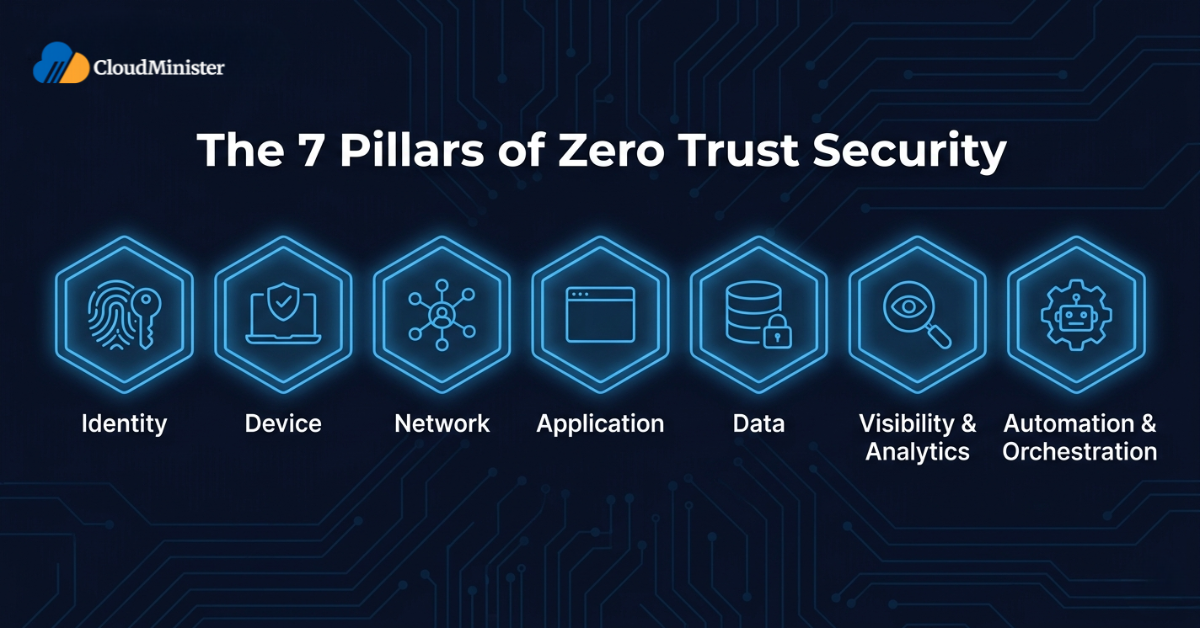
The CISA Zero Trust Maturity Model (2023, updated 2025) defines five official pillars of this architecture. Cloud businesses in India should operationalise all five, supplemented by two additional pillars — automation/orchestration and governance — that are essential for production-grade zero trust security at enterprise scale.
| Pillar | Core Function | Primary Controls |
| Identity | Verify every user and service | MFA, conditional access, PAM, SSO |
| Device | Validate endpoint health before access | MDM, EDR, device compliance policies |
| Network | Restrict lateral movement | ZTNA, micro-segmentation, DNS filtering |
| Application | Secure app-layer access and API calls | WAF, API gateway, RBAC, SAML/OIDC |
| Data | Protect data at rest and in transit | Encryption, DLP, data classification |
| Visibility & Analytics | Detect anomalies and support response | SIEM, UEBA, XDR, log aggregation |
| Automation & Orchestration | Enforce policy consistently at scale | SOAR, IaC-driven policy, CI/CD gates |
3.1 Identity Pillar — The Foundation of the Model
Identity is the new perimeter. When there is no network boundary to defend, verified identity becomes the primary access control mechanism — and the most critical pillar to implement correctly.
- Identity provider (IdP) centralisation: all identities managed through a single authoritative source — Okta, Azure AD, AWS IAM Identity Center — with no orphaned accounts
- MFA enforcement: TOTP or FIDO2/WebAuthn hardware keys are the production standard — SMS OTP is not acceptable due to SIM-swap vulnerability
- Privileged access management (PAM): administrative credentials must be vaulted, session-recorded, and subject to JIT approval workflows — not stored in shared spreadsheets
- Service account governance: machine identities require the same lifecycle management as human identities — creation justification, periodic rotation, and automatic deprovisioning
3.2 Device Pillar — Endpoint Validation Before Access
A valid identity credential from an unmanaged or compromised device is not sufficient for access in this model. Device health must be evaluated as a condition of every access request.
- MDM or Unified Endpoint Management (UEM) enrollment for all corporate devices — unmanaged devices cannot access production resources
- Endpoint Detection and Response (EDR) agent deployment — device compliance checks must verify active EDR, OS patch level, disk encryption, and firewall status
- BYOD environments require a separate conditional access policy — typically app-level containerisation rather than full device management
- Device health signals are evaluated in real-time at each access request — not just at initial authentication
3.3 Network Pillar — ZTNA Replaces VPN
Traditional VPN grants broad network access once the user authenticates. Zero Trust Network Access (ZTNA) is the correct network-layer replacement — it grants access only to specific applications, not to the underlying network segment.
- ZTNA solutions: Zscaler Private Access, Cloudflare Access, AWS Verified Access — session-based, application-specific access tunnels with no network-level trust granted
- Micro-segmentation: AWS Security Groups, Azure NSGs, or SDN overlays enforce east-west traffic restriction at the workload level
- DNS-layer filtering: malicious domain resolution blocking (Cisco Umbrella, Cloudflare Gateway) as an early detection control at the network layer
- Software-Defined Perimeter (SDP): cloaks infrastructure so it is not discoverable without authenticated access — eliminates internet-exposed attack surface
3.4 Application Pillar — Securing the App Layer
Applications are the primary interface between users and data. Every application access event must be verified under the zero trust security model — authentication, authorisation, and session management are all active control points.
- Single Sign-On (SSO) with SAML 2.0 or OIDC for all SaaS and internal applications — eliminates application-specific password sprawl entirely
- Web Application Firewall (WAF) deployment with OWASP Top 10 rule sets active for all internet-facing applications
- API gateway authentication: every API endpoint must require a valid, short-lived JWT or OAuth 2.0 token — unauthenticated API calls are a policy violation
- Application-level RBAC: access to sensitive functions within an application must be controlled by role, not just by application-level authentication
3.5 Data Pillar — Encryption and Classification
Data is the ultimate target. The zero trust security model requires treating data protection as an active control layer — not a passive storage policy.
- Data classification: categorise all data by sensitivity (public, internal, confidential, regulated) — access policies reference classification labels directly
- Encryption at rest: AES-256 for all stored data; key management via AWS KMS, Azure Key Vault, or equivalent — keys must not be co-located with the data they protect
- Encryption in transit: TLS 1.2 minimum, TLS 1.3 preferred — TLS 1.0 and 1.1 are not acceptable in any production deployment
- Data Loss Prevention (DLP): monitor and block exfiltration of sensitive data across email, cloud storage, and endpoint transfer channels
- DPDPA 2023 requires organisations to implement appropriate technical safeguards for personal data, without prescribing specific technologies — encryption and access controls are widely considered good-practice measures that can help support these obligations.
4. Zero Trust Model vs. Traditional Perimeter Security
The shift from perimeter-based defences to a zero trust security architecture has direct commercial implications for breach cost, compliance exposure, and engineering overhead across cloud businesses.
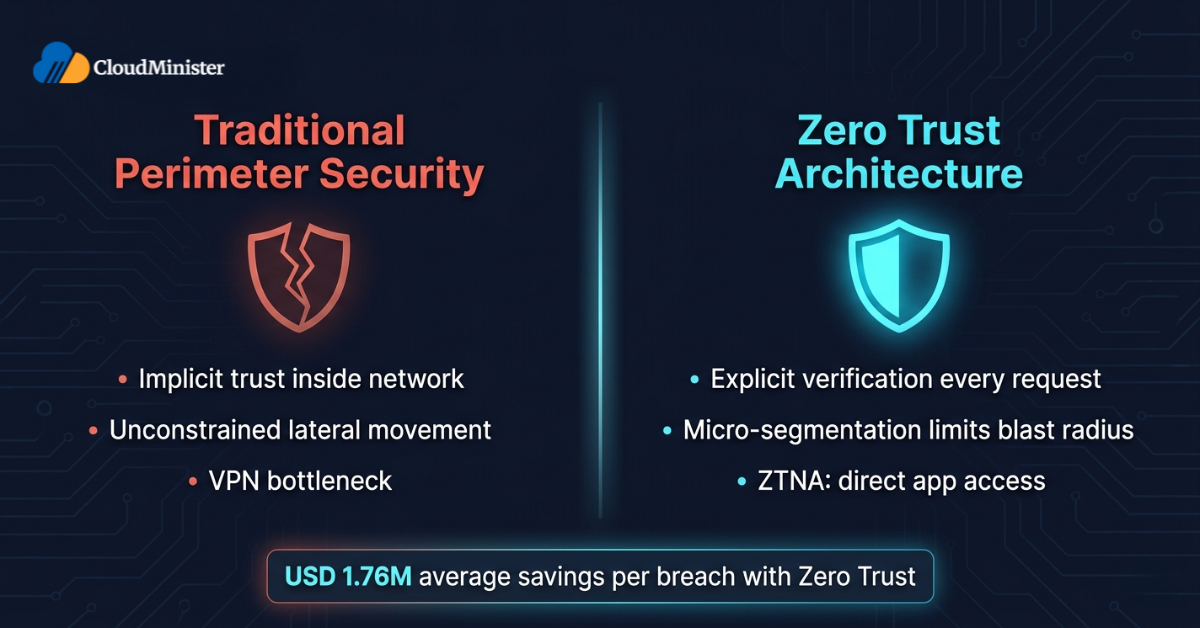
| Dimension | Traditional Perimeter Security | Zero Trust Architecture |
| Access model | Implicit trust inside network | Explicit verification for every request |
| Breach containment | Lateral movement unconstrained | Micro-segmentation limits blast radius |
| Remote work support | VPN bottleneck; performance degradation | ZTNA: direct app access, optimised path |
| Cloud compatibility | Requires hairpinning through perimeter | Natively cloud-compatible architecture |
| Insider threat defence | Poor — trusted users have broad access | Strong — least-privilege limits damage |
| Compliance alignment | Limited audit trail, may not align well with DPDPA | Comprehensive audit trail supporting DPDPA/RBI alignment |
| Breach cost impact | Higher — lateral movement amplifies damage | USD 1.76M average saving per breach |
| Visibility | North-south traffic only | Full east-west and north-south telemetry |
RELATED READING: What Is Data Leakage?
5. How Cloud Businesses Implement the Zero Trust Model — A Step-by-Step Roadmap
Implementing zero trust security is not a single sprint. For cloud businesses, this is an 18–24 month programme structured across four phases. Each phase maps to specific technical deliverables and commercial milestones.
Before beginning any implementation, document every identity, device, application, and data store in your environment. Access policy cannot be written for assets that are not inventoried. Asset discovery is the mandatory pre-requisite that most organisations skip — and the gap surfaces as policy bypass six months into the programme.
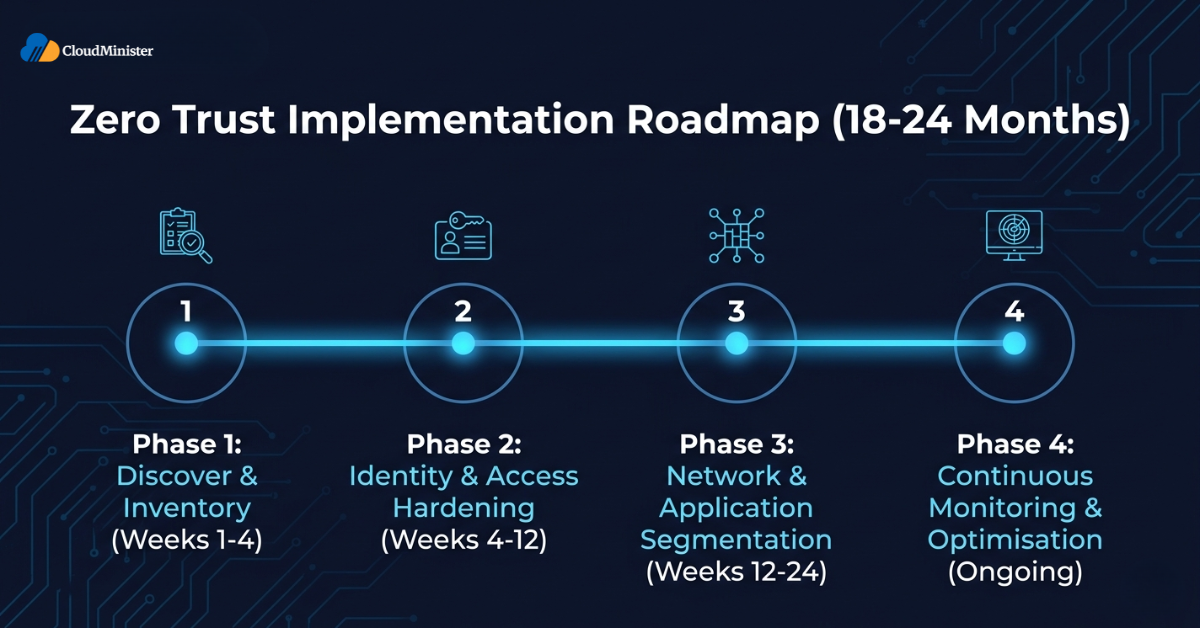
Phase 1: Discover and Inventory (Weeks 1–4)
- Identity inventory: enumerate all human users, service accounts, and machine identities across every system — including dormant and orphaned accounts
- Device inventory: catalogue all corporate-managed and BYOD devices that access company resources
- Application and API inventory: map every application, API endpoint, and data flow — including shadow IT outside the known asset register
- Data classification: categorise all data stores by sensitivity — this classification drives access policy in every subsequent phase
- Dependency mapping: document which identities access which applications, and which applications communicate with which data stores — this becomes the policy baseline
Phase 2: Identity and Access Hardening (Weeks 4–12)
- Deploy or consolidate identity provider: Azure AD, Okta, or AWS IAM Identity Center — all identities managed centrally with no orphaned accounts
- Enforce MFA organisation-wide: no user or service account is exempt — exceptions create exactly the implicit trust this model eliminates
- Implement SSO for all applications: eliminate application-specific credentials across the entire environment
- Right-size permissions: audit all RBAC assignments and remove excess privileges — least-privilege is the operating principle of the model
- Deploy PAM solution: vault all privileged credentials; enforce JIT access approval for all administrative operations
- Implement conditional access policies: access decisions evaluate device health, location, and risk score — not just valid credentials
Phase 3: Network and Application Segmentation (Weeks 12–24)
- Replace VPN with ZTNA: eliminate network-level trust — access is application-specific and session-based under a proper zero trust security network policy
- Implement micro-segmentation: apply workload-level security groups and network policies — no implicit east-west trust anywhere in the environment
- Deploy WAF and API gateway: enforce application-layer authentication and OWASP protection on all internet-facing endpoints
- Enable DNS-layer security: block malicious domain resolution as a network-layer early detection control
- Implement software-defined perimeter where applicable: cloak infrastructure from unauthenticated discovery
RELATED READING: Cybersecurity: How to Be Safe Today
Phase 4: Continuous Monitoring and Optimisation (Ongoing)
- Deploy SIEM: centralise log aggregation across identity, network, application, and data layers — this architecture generates significantly more telemetry than perimeter models
- Enable UEBA: surface anomalous access patterns indicative of compromise or insider threat in near-real-time
- Implement automated response (SOAR): playbooks that auto-revoke sessions, quarantine devices, or escalate alerts based on policy violations
- Quarterly access reviews: automated certification workflows ensure privilege creep does not erode the posture over time
- Red team exercises: simulate credential compromise, device bypass, and lateral movement attempts quarterly to validate controls
6. Zero Trust Security on AWS — Cloud-Native Implementation
AWS provides native services and architectural patterns to implement a full zero trust security posture across identity, network, application, and data layers. The sequence below reflects production-grade implementation as deployed by CloudMinister’s engineering team in 2026.
6.1 Identity Layer — AWS IAM and Identity Center
- AWS IAM Identity Center (SSO): centralise workforce access across all AWS accounts and SAML-compatible SaaS — eliminates IAM user credential sprawl
- IAM roles over IAM users: service access must use scoped IAM roles — long-lived IAM user access keys are a policy violation in this model
- AWS IAM Conditions: enforce MFA, IP restriction, and time-based access conditions on all sensitive IAM actions
- AWS Secrets Manager: rotate all credentials and API keys automatically — no hardcoded secrets in application code or CI/CD pipelines
6.2 Network Layer — AWS Verified Access and VPC Segmentation
- AWS Verified Access: application-layer ZTNA for internal tools — validates identity and device posture before granting application access, without VPN tunnels
- VPC segmentation: separate VPCs per environment (production, staging, development) with no implicit cross-VPC trust
- Security Group policy: least-privilege ingress/egress rules at the resource level — no 0.0.0.0/0 inbound rules in any production environment
- AWS Network Firewall: stateful, application-aware traffic inspection between VPC segments
- VPC Flow Logs: full network telemetry for SIEM ingestion and anomaly detection across all traffic flows
6.3 Application and Data Layer
- AWS WAF: OWASP Top 10 rule sets, rate limiting, and bot management on all CloudFront distributions and Application Load Balancers
- Amazon API Gateway with Cognito or Lambda authorisers: JWT-based authentication on every endpoint — unauthenticated API calls are blocked at the gateway layer
- AWS KMS: envelope encryption for all data at rest — S3, RDS, DynamoDB, EBS — with separate KMS keys per data classification tier
- Amazon Macie: automated sensitive data discovery in S3 — identifies PII and compliance-relevant data to inform policy and DPDPA compliance planning
6.4 Monitoring and Response
- AWS CloudTrail: immutable audit log of all API calls across all accounts — the foundational telemetry layer for monitoring on AWS
- Amazon GuardDuty: ML-based threat detection across CloudTrail, VPC Flow Logs, and DNS logs — surfaces credential compromise and anomalous API activity
- AWS Security Hub: aggregates findings from GuardDuty, Inspector, Macie, and third-party tools into a unified security dashboard
- Amazon Detective: graph-based investigation tool for tracing the blast radius of a detected policy violation or active incident
Any AWS deployment using root account credentials for routine operations, long-lived IAM user access keys, security groups with 0.0.0.0/0 inbound rules, or unencrypted S3 buckets is operating below the minimum viable baseline for zero trust security in 2026. These are baseline violations that invalidate the model from the first layer. Effective cybersecurity solutions must address these fundamentals before higher-order controls are layered on top.
7. Vertical-Specific Considerations for Cloud Businesses in India
The regulatory environment and threat model of your industry determines which controls require the most stringent implementation. Below are the vertical-specific considerations relevant to Indian cloud businesses deploying a zero trust security architecture.
7.1 Fintech and NBFC
- Every production deployment must be traceable to an approved change record — access control and change management must be integrated workflows, not parallel ones
- RBI IT Framework: privileged access to production systems must be MFA-authenticated, session-recorded, and subject to dual-approval workflows
- API security is critical: fintech platforms expose high-value endpoints that are primary attack targets — API gateway authentication is non-negotiable
- Lateral movement in a compromised fintech environment carries both regulatory consequence (reporting obligations) and financial consequence (transaction fraud) — micro-segmentation delivers the highest ROI in this vertical
- Engaging professional Cyber Security services for fintech engagements requires RBI-aligned approval workflow configuration and audit evidence generation — these are specialisations, not general competencies
7.2 Healthcare and Life Sciences
- DPDPA 2023 treats health-related data with heightened sensitivity. While the Act does not mandate specific technical measures, access controls, audit trails, and encryption are commonly used to help meet data fiduciary obligations around protecting such data.
- NDHM framework guidelines recommend access monitoring and audit logging for systems handling patient records — telemetry generated by this architecture satisfies these controls
- Clinical application environments often include legacy Windows systems — AWS CodeDeploy hybrid targets allow policy enforcement across both cloud-native and on-premises systems without platform migration
- File integrity monitoring on deployments to patient-record systems is a required control in mature healthcare implementations
7.3 SaaS Businesses Targeting Global Markets
- Multi-region architecture requires consistent policy enforcement across all deployment regions — not just the primary AWS region
- SOC 2 Type II compliance — required by most enterprise SaaS customers — maps directly to controls across access management, encryption, monitoring, and incident response
- Contractual 99.9%+ SLA obligations require automated rollback and incident response — manual verification is not compatible with these uptime requirements
- Machine-to-machine API traffic requires the same authentication standards as user traffic — service mesh mTLS (Istio, Linkerd) is the production standard
7.4 E-Commerce
- Platform integrity depends on securing the payment flow: every API call in the checkout and payment flow must be authenticated at the gateway layer
- DDoS attack prevention is a prerequisite for network-layer protection — volumetric attacks designed to exhaust resources can bypass application-layer controls
RELATED READING: Top 10 DDoS Attack Prevention Strategies
- PCI DSS compliance — required for any business processing card payments — has significant overlap with this model: network segmentation, access control, encryption, and audit logging
- DPDPA 2023 requires that personal data be protected through appropriate safeguards. Logging, access control, and auditability are practical measures that can support compliance with this broader obligation.
8. What Your Hosting Layer Must Support
Application and identity controls are only as effective as the infrastructure they run on. Cloud businesses deploying a zero trust security architecture require a hosting and server management layer that is operationally aligned with the same principles.
8.1 Infrastructure Prerequisites
- NVMe cloud hosting: storage I/O performance directly affects the speed of security log processing and SIEM ingestion — high-latency storage creates telemetry gaps in the monitoring layer
- Network isolation: the web hosting provider in India supporting your workloads must support VPC-equivalent network isolation and private connectivity options — public-only hosting architectures are incompatible with micro-segmentation requirements
- Patch management: OS and middleware patching must be automated and auditable — unpatched servers are a device-layer policy violation even if identity and network controls are in place
- Encryption at rest: the hosting layer must support encrypted block storage and encrypted database snapshots — data-layer controls are negated by unencrypted storage at the infrastructure level
8.2 Server Management and Zero Trust Principles
Reputable Server Management Services India providers who operate within a zero trust security framework apply the same verification and least-privilege principles to infrastructure access that application teams apply to user access.
- SSH access to production servers must be MFA-authenticated and routed through a bastion or PAM solution — direct SSH from developer workstations is a policy violation
- Server configuration must be managed via Infrastructure as Code — ad-hoc SSH changes create configuration drift that policy cannot account for
- Patch windows must be documented and auditable — compliance reviews require evidence that server infrastructure is maintained to defined patch standards
- Choosing Server Management Services India providers who operate under this framework delivers better DPDPA alignment because access logging and change management are built into the operational process
Before engaging a web hosting provider in India for cloud workloads covered by this programme, verify that the provider supports: private VPC connectivity, encrypted block storage, MFA-authenticated management access, and SOC 2 or ISO 27001 audit certification. A provider without these capabilities creates a structural gap that cannot be patched at the application layer.
9. Zero Trust Security Red Flags — What to Watch For
The consulting market for this model includes providers across a wide spectrum of capability. These warning signs indicate an implementation partner — or an internal programme — that will not deliver a production-grade zero trust security result.
Red Flag 1: Zero Trust Security Defined as a Product Purchase
Any partner presenting this architecture as a single-vendor product purchase does not understand the model. This approach spans identity, device, network, application, and data layers across multiple tool categories. No single product delivers a complete zero trust security posture.
Red Flag 2: MFA Optional or Excluded
Any implementation that makes MFA optional for any user class — including executives or service accounts — has a structural policy gap. MFA is the non-negotiable foundation of verify-explicitly. Exceptions create exactly the implicit trust this model is designed to eliminate.
Red Flag 3: VPN Retained as Primary Remote Access
Retaining VPN as the primary remote access mechanism while claiming zero trust security implementation is a direct contradiction. VPN grants network-level access; this model requires application-level, session-specific access. ZTNA must replace VPN for the network pillar to be genuinely addressed.
Red Flag 4: No East-West Traffic Policy
A programme that only addresses north-south traffic without micro-segmentation for east-west traffic leaves the most dangerous lateral movement path uncontrolled. This is where attackers move after initial credential compromise.
Red Flag 5: Monitoring as an Afterthought
An implementation without a SIEM and behavioural analytics layer is enforcement without visibility. Organisations that deploy access controls but do not instrument them for continuous monitoring cannot detect when policies are bypassed. Robust cybersecurity solutions require continuous monitoring as a core deliverable, not an optional enhancement.
RELATED READING: How to Make a Website Secure from Hackers and Malware Attacks
10. Zero Trust Security Readiness Checklist
Before committing to a full zero trust security programme, verify that your internal readiness covers these prerequisites. Missing items do not block the programme — but they create scope expansion risk that must be planned into the implementation timeline.
- Identity inventory complete: all human users, service accounts, and machine identities documented and assigned to an authoritative identity provider
- MFA status: MFA enforcement rate and list of exemptions documented — the programme must close all exemptions in Phase 1
- Device inventory: all corporate-managed devices catalogued; MDM/UEM enrollment rate documented; BYOD policy defined
- Application inventory: all SaaS, internal, and legacy applications mapped; authentication mechanism for each documented
- Data classification: all data stores classified by sensitivity — access policy cannot be written without this classification foundation
- Network topology: current VLAN, security group, and VPC architecture documented; east-west traffic flows mapped
- SIEM/logging: current log coverage assessed — monitoring requires identity, network, and application telemetry in a centralised platform
- Compliance scope: DPDPA applicability assessed; RBI IT Framework requirements documented; legal counsel engaged on specific obligations
- Executive sponsorship: this programme requires board-level commitment — it cannot be run as a shadow IT project
- Budget authority: Phase 1 tooling and consulting spend approved; change order process agreed for scope adjustments
11. The True Cost of Not Implementing This Model
The cost of underinvesting in a zero trust security posture rarely appears on a budget spreadsheet — it surfaces in breach remediation costs, regulatory fines, engineering opportunity cost, and compounding reputational damage.
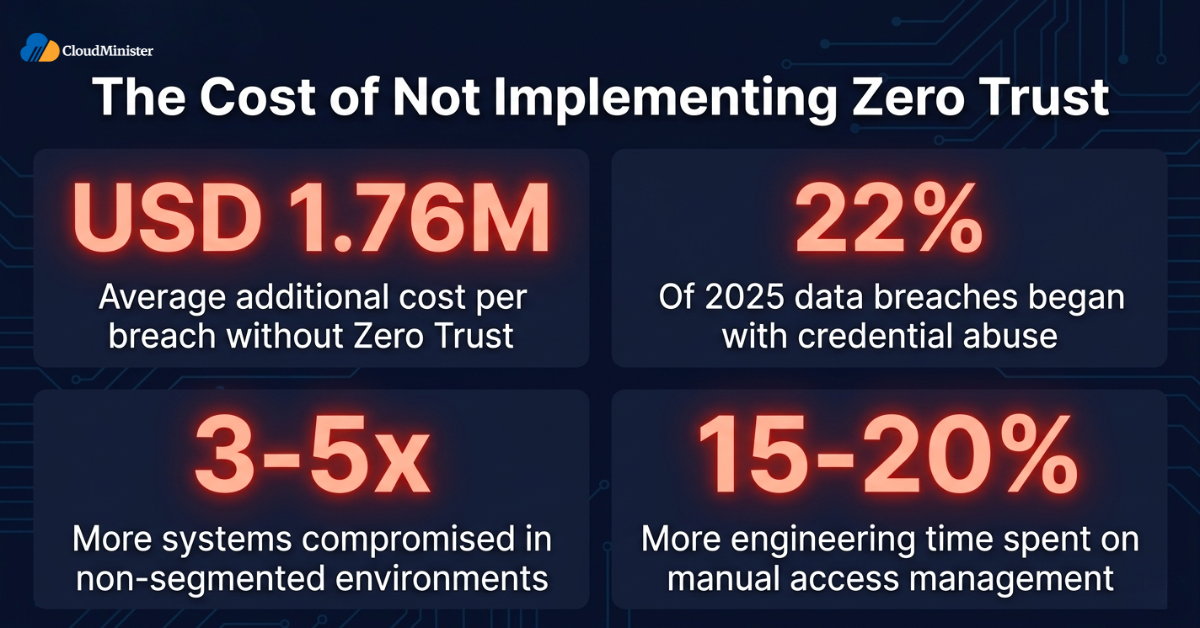
- Breach cost: organisations without this architecture pay an average of USD 1.76 million more per breach — across investigation, remediation, regulatory response, and customer notification
- Credential attack exposure: 22% of all data breaches in 2025 began with credential abuse — the exact attack vector this model defeats through MFA, conditional access, and least-privilege enforcement
- Lateral movement amplification: breaches in non-segmented environments result in 3–5x more systems compromised per incident because implicit east-west trust allows attackers to pivot freely after initial access
- DPDPA regulatory exposure: for Indian businesses processing personal data, a breach resulting from inadequate technical safeguards carries reporting obligations and potential fines under DPDPA 2023
- Engineering productivity: developers in organisations without these controls spend 15–20% more time on manual access management, credential rotation, and incident investigation
- Talent retention: security engineers with zero trust security architecture experience are among the most actively recruited professionals in the Indian tech market — legacy environments accelerate their departure
The hosting infrastructure that supports your workloads is the foundation on which this architecture builds. If your web hosting provider in India does not support VPC isolation, encrypted storage, and MFA-authenticated management access, higher-order controls at the application and identity layer will be partially offset by infrastructure gaps that cannot be remediated from above.
Indian cloud businesses scaling toward enterprise deployments will find that a properly implemented zero trust security programme pays back within the first year through breach cost avoidance, compliance readiness, and the engineering productivity gains that come from replacing manual access management with policy-driven automation. Organisations that also require Server Management Services India alongside this programme benefit from consolidating both with a single provider — ensuring the server layer is managed to the same standards as the application and identity layers above it.
Conclusion
Zero trust security in India in 2026 is not a discretionary architectural choice — it is the operational baseline for any cloud business that processes personal data, operates under regulatory oversight, or competes in a market where breach cost and customer trust are existential variables.
The implementation roadmap in this guide — discover and inventory, identity hardening, network and application segmentation, continuous monitoring — is the production sequence that CloudMinister’s engineering team applies across cloud environments of every size and vertical, from early-stage SaaS businesses on AWS to regulated fintech and healthcare platforms operating under DPDPA 2023 and RBI IT Framework requirements.
Each phase delivers measurable security improvement. The organisations that begin the transition today will be measurably more resilient, more compliant, and more competitive than those that defer it to the next budget cycle.
CloudMinister’s Cyber Security services team provides architecture, implementation, and managed operations structured around your specific infrastructure profile, regulatory requirements, and deployment scale. Whether your environment runs on cloud-native ECS, serverless Lambda, containerised microservices, or traditional servers managed under Server Management Services India — the principles in this guide apply consistently. The configuration details differ by platform; the operational and compliance standards do not.
Ready to Start Your Zero Trust Journey?
Talk to our team about a tailored implementation roadmap aligned to your infrastructure, compliance, and timeline.
Key Takeaways
• The zero trust model is an architecture, not a product — it spans identity, device, network, application, and data layers
• Never trust, always verify — every access request requires explicit authentication and authorisation regardless of origin or location
• The global market for this model is valued at USD 48.43 billion in 2026, growing at 16.07% CAGR — adoption is accelerating across every industry segment
• Organisations with a mature zero trust architecture save an average of USD 1.76 million per breach compared to those without
• MFA, least-privilege access, micro-segmentation, and continuous monitoring are the four non-negotiable controls in any production posture
• ZTNA replaces VPN — application-specific, session-based access instead of network-level implicit trust
• DPDPA 2023 technical safeguard requirements are directly addressed by the access logging, encryption, and audit trails this model provides
• AWS-native implementation stack: IAM Identity Center, Verified Access, WAF, GuardDuty, Security Hub, KMS, CloudTrail — all five pillars covered natively
• This is an 18–24 month programme — begin with identity hardening, then network segmentation, then data and application controls, then continuous monitoring optimisation
Frequently Asked Questions
What is zero trust security in simple terms?
Zero trust security is a cybersecurity model built on the principle of never trust, always verify. No user, device, or application is automatically trusted — even inside the corporate network. Every access request must be explicitly authenticated, authorised, and continuously validated. It replaces the outdated assumption that everything inside the firewall is safe.
How is zero trust security different from a VPN?
A VPN grants a user access to the entire network once they authenticate. The zero trust model — specifically Zero Trust Network Access (ZTNA) — grants access only to specific applications, for specific sessions, after validating both identity and device health. A compromised VPN credential gives an attacker network-wide access; a compromised ZTNA session gives access only to one application. That difference in blast radius is the commercial case for the transition.
Does zero trust security satisfy DPDPA 2023 requirements?
A properly implemented architecture — covering access control, audit logging, data encryption, and continuous monitoring — can help address some of the technical safeguard expectations associated with DPDPA 2023. for businesses processing personal data. However, this is one component of DPDPA compliance. Data residency, breach notification, data minimisation, and consent management must also be addressed. Deploying appropriate cybersecurity solutions across all these dimensions is the full scope of DPDPA technical compliance. Verify specific obligations with qualified legal counsel.
What is the cost of implementation for Indian businesses?
Implementation cost varies by scope. Identity hardening for a 50-person organisation runs ₹3L–₹8L as a project. A full architecture covering all five pillars runs ₹15L–₹50L+ depending on stack complexity, number of applications, and compliance scope. Ongoing managed services — monitoring, access reviews, policy updates — run ₹1.5L–₹5L per month. The right Cyber Security services partner scopes the engagement to your exact requirements, reducing both upfront cost and the risk of mid-engagement scope disputes.
Can this model work for businesses using traditional server infrastructure?
Yes. The principles apply to traditional server infrastructure, hybrid environments, and cloud-native deployments equally. On traditional servers, controls focus on MFA-authenticated SSH via bastion hosts, PAM for privileged account management, network segmentation via firewall policy, file integrity monitoring, and comprehensive audit logging. Server Management Services India providers who operate within this framework apply these controls consistently across both cloud and on-premises infrastructure layers.
How do I choose the right provider for this implementation?
Before signing any implementation contract, request three references from clients in your vertical who went live in the last 12 months. Ask specifically about post-go-live support quality, how scope changes were handled commercially, and whether security and compliance deliverables were production-grade on day one. The right web hosting provider in India and implementation partner combination — one whose infrastructure natively supports the prerequisites and whose services team understands the model — compresses implementation timelines by 20–30% compared to working with misaligned providers.
What cybersecurity solutions are essential for zero trust implementation?
The core cybersecurity solutions required include: an identity provider with MFA and conditional access, a PAM solution for privileged credential management, ZTNA or equivalent for network access, a WAF and API gateway for application-layer protection, a SIEM for centralised log aggregation, and EDR on all managed endpoints. These components together form the technical foundation of the model. Organisations that also need ongoing Cyber Security services support should look for providers who manage all five pillars under a single SLA — not piecemeal tooling without operational ownership.
Where does server management fit in the zero trust model?
Server management is the infrastructure layer beneath the application and identity controls. Engaging Server Management Services India providers with a zero trust-aligned operating model ensures that patch management, access logging, and configuration change records meet the same standards as the application layer. This alignment is particularly important for businesses operating under DPDPA 2023 or RBI IT Framework requirements, where the server layer must demonstrate the same access control and audit trail discipline as the application and identity layers above it.

He is the CEO and Founder with over a decade of experience in cloud infrastructure, DevOps, and server optimization. With a strong vision and hands-on leadership approach, he has built scalable, secure, and high-performance cloud solutions trusted by businesses across industries.
Related posts:
 Server Security Best Practices for GDPR, HIPAA, ISO, and DPDPA 2023: A Complete 2026 Guide
 How to Make a Website Secure from Hackers and Malware Attacks: Website Security Checklist for 2026
 Top 10 DDoS Attack Prevention Strategies for 2026: Protect Your Business Now
 24×7 Server Monitoring: What It Actually Includes and Why It Matters