An Incident Response Plan is the difference between a data breach that costs a weekend and one that costs a business. Most small and mid sized companies believe cyber attacks only happen to large enterprises, and that assumption is exactly why so many of them have no formal plan sitting ready when an attacker actually gets in. This guide breaks down what an Incident Response Plan needs to contain, how a data breach response plan differs for a small business versus a mid sized one, and how Cyber Security services, Server Management Services, and a reliable Web Hosting Company in India all fit into a realistic breach response strategy for 2026.
Most small and mid sized business owners picture a cyber attack as something dramatic that happens to a bank or a global brand. The reality is much quieter. An attacker gets in through a stolen password, an unpatched plugin, or a convincing email, and by the time anyone notices, customer records are already gone. A well prepared Incident response plan is what turns that moment from a panic into a process that people already know how to follow.
The trouble is that many SMBs treat security as a tools problem. They buy a firewall, switch on backups, and assume the job is finished. Tools matter, but they do not tell your team who makes the call, who speaks to customers, or who contacts the regulator. An Incident response plan answers those questions before the pressure starts, which is exactly when clear thinking is hardest to find. In India, strict reporting timelines make this even more important, because there is very little room to figure things out on the fly.
This guide is written for business owners, IT managers, and operations heads who want a practical starting point rather than a theory lesson. We cover what a solid Incident response plan should contain, how to build a data breach response plan step by step, who should own each role, and how hosting, server management, and security partners fit into the picture. Whether you run a five person company or a growing mid sized team, you will find clear actions you can start on this week and a realistic way to keep your plan alive over time.
Table of Contents
- Why Every SMB Needs a Security Incident Playbook in 2026
- What a Cyber Incident Playbook Must Actually Contain
- Building a Data Breach Response Plan Step by Step
- Breach Response Team Roles: Who Does What
- Regulatory and Compliance Considerations for Indian SMBs
- Technical Safeguards That Strengthen Your Breach Readiness
- Common Mistakes That Make a Security Playbook Fail
- Testing and Maintaining Your Security Playbook
- Why Infrastructure Choice Shapes Response Speed
- Choosing the Right Partners to Support Your Cyber Incident Readiness
- What to Look for When Comparing Vendors
- A Practical First 90 Days Roadmap to Build Your Breach Readiness Program
- Conclusion
- Key Takeaways
- Frequently Asked Questions
Why Every SMB Needs an Incident Response Plan in 2026
An Incident Response Plan is not a document you write once and forget. It is the operational backbone that decides whether a security incident stays contained within hours or spirals into a multi week crisis. It describes exactly who does what the moment a breach is suspected, so no one is improvising decisions while data is actively leaking out the door. Small businesses often assume attackers only target large enterprises, but a tested Incident Response Plan is one of the few controls that directly reduces breach cost, regardless of company size.
According to IBM’s Cost of a Data Breach Report 2026, the global average cost of a data breach climbed to a record high this year, driven largely by detection, escalation, and lost business costs, which together made up the majority of total breach spend. This is exactly the gap a well built response plan is designed to close, since faster, better coordinated detection is the one variable a business can actually control. A strong plan does not just describe technical steps. It also defines who talks to customers, who talks to regulators, and who makes the call to shut down a system, since confusion in the first hour is often more damaging than the breach itself. Every SMB running customer data, payment information, or employee records needs an Incident Response Plan, not because a breach is guaranteed, but because the cost of not having one when a breach happens is measured in both money and trust.
- A capable Web Hosting Company in India will usually ask what your incident response process looks like during any serious infrastructure conversation, because backup design, access control, and recovery timelines only matter if there is a plan tying them together during a real event.
- Businesses that pair a documented Incident Response Plan with professional Cyber Security services tend to detect and contain incidents far faster than those relying purely on internal staff, since dedicated Cyber Security services bring monitoring coverage a small internal team usually cannot maintain around the clock.
- An SMB that outsources its infrastructure to Server Management Services should still own its plan directly, since a provider can help execute recovery steps but cannot make business decisions about disclosure, communication, or regulatory reporting on the company’s behalf.
Before writing a single technical step, get three decisions agreed by leadership in writing: how many hours of downtime the business can absorb, who has final authority to declare an incident, and who is responsible for confirming which legal, regulatory, and contractual notification obligations apply. Notification requirements are set by applicable laws, regulations, and contracts, and by the nature of the incident, not by an internally chosen level of acceptable exposure, so the plan should record those requirements rather than invent its own. Without these decisions, an Incident Response Plan tends to stall in committee during the exact moment speed matters most.
Businesses shortlisting a Web Hosting Company in India for the first time should treat incident response support as a core evaluation criterion, not an afterthought discussed only after signing a contract. A growing number of Indian SMBs are bundling Cyber Security services directly with their hosting agreement, since a single accountable partner tends to respond faster than coordinating multiple vendors mid incident. Pairing hosting with Server Management Services in India gives a business one throat to choke for patching, monitoring, and recovery, which noticeably speeds up containment during a live event, and investing early in practical cybersecurity solutions, rather than waiting until after a first incident, is consistently the cheaper path for a resource constrained SMB.
What an Incident Response Plan Actually Needs to Contain
A real Incident Response Plan is not a single page of contact numbers. It needs distinct components that work together under pressure.
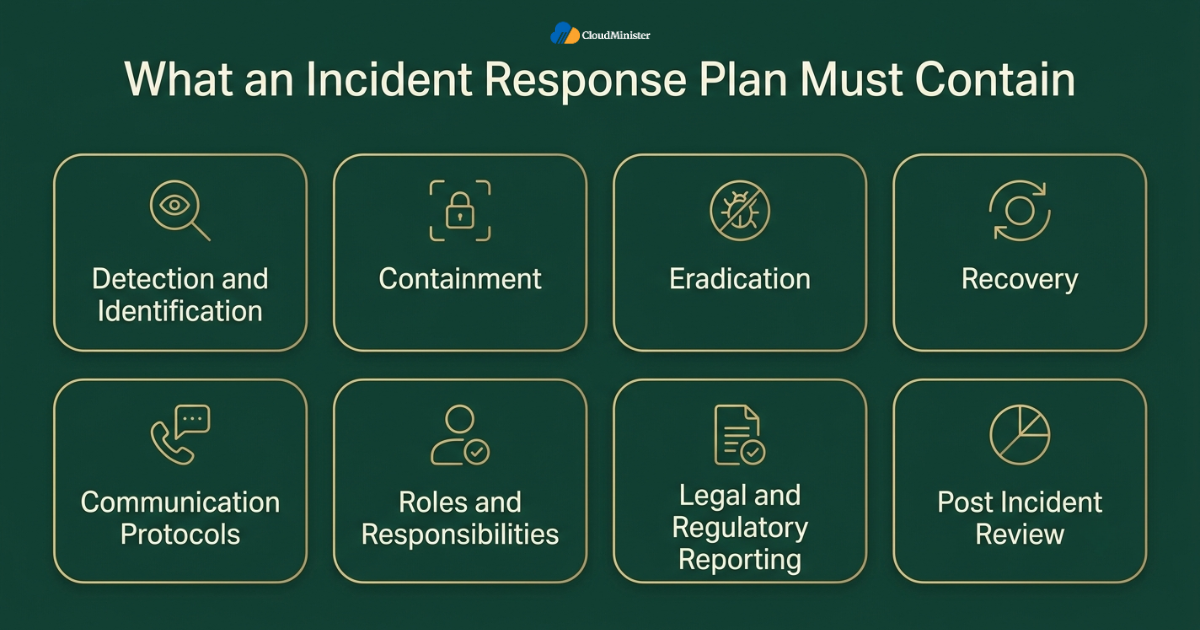
- Detection and identification procedures: The plan should define exactly what counts as an incident, what monitoring tools flag it, and who is authorized to confirm that a suspected event is real rather than a false alarm.
- Containment steps: This part should separate short term containment, such as isolating an affected server, from long term containment, such as rebuilding a compromised system on clean infrastructure.
- Eradication procedures: Every Incident Response Plan needs a documented process for removing the actual cause of the breach, whether that is malware, a compromised credential, or an unpatched vulnerability, before recovery begins.
- Recovery steps. It should describe how systems are restored to normal operation, including how backups are verified clean before they are trusted again.
- Communication protocols: A data breach response plan is only useful if it tells the team exactly who informs customers, who informs regulators, and who handles media inquiries, since silence or mixed messaging often causes more reputational damage than the breach itself.
- Roles and responsibilities: A plan without named owners for each task is not really a workable plan, since a generic instruction with no accountable person tends to go unexecuted during a real event.
- Legal and regulatory reporting requirements: In India, this section should reference the CERT-In reporting timeline, which requires certain categories of cyber incidents to be reported within six hours of detection, a much tighter window than most global frameworks require.
- Post incident review: A mature Incident Response Plan treats every real incident, and every drill, as a source of lessons that get folded back into the next revision.
Every response plan should assume that the attacker may already have access to internal communication tools such as email or chat by the time the breach is discovered. Build an out of band communication channel into the plan in advance, whether that is a separate messaging app or a phone tree, so the response team can coordinate without tipping off an attacker who is still inside the network.
Building a Data Breach Response Plan Step by Step
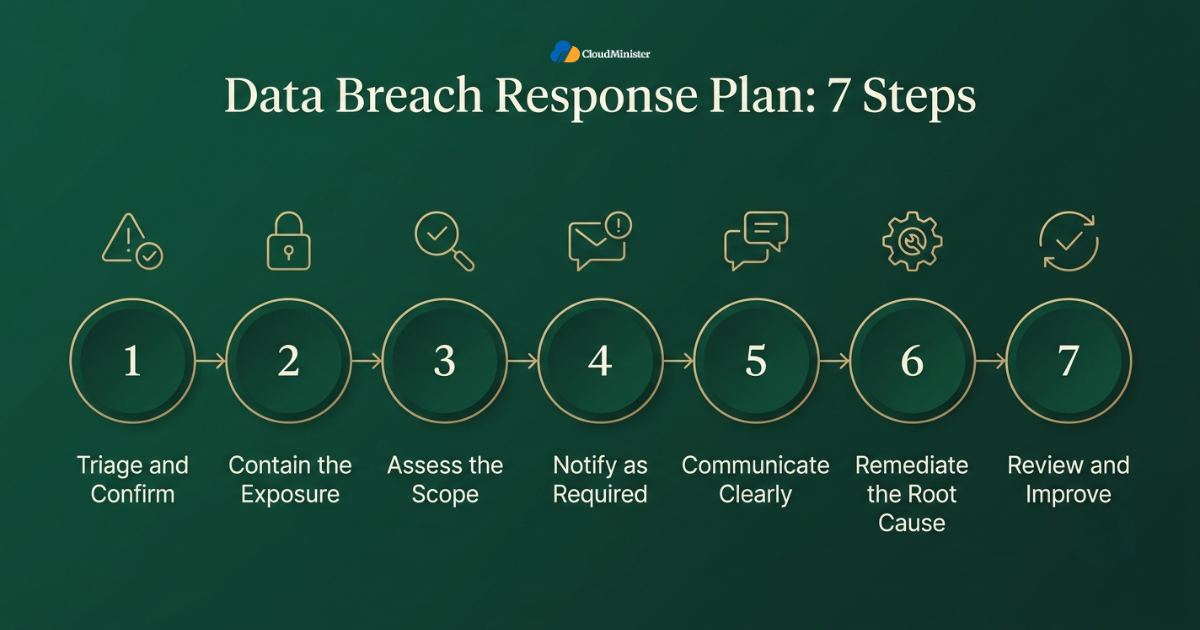
A data breach response plan is the specific subset of an Incident Response Plan that activates the moment personal or sensitive data exposure is suspected, and it deserves its own structured sequence.
- Step one, triage and confirm the incident. Before anything else, a data breach response plan should require a quick, structured assessment of whether data may have been accessed or exfiltrated, not just whether a system showed unusual activity, so false positives are filtered out without wasting time. Confirmation should never delay mandatory reporting, though. Some obligations, including CERT-In’s six hour window for applicable incidents, run from detection and may require an initial report before a full forensic investigation has established the complete scope. The plan should therefore allow an initial notification with the information available, to be updated as the investigation progresses.
- Step two, contain the exposure. Isolate affected systems, revoke compromised credentials, and cut off the attacker’s access path, all while preserving logs and evidence for later investigation rather than wiping systems immediately.
- Step three, assess the scope. A thorough plan requires identifying exactly which records, systems, and individuals were affected, since regulatory notification requirements usually scale with the scope and sensitivity of exposed data.
- Step four, notify as required. Depending on the data involved and the jurisdiction, a data breach response plan must trigger notification to regulators, affected individuals, and sometimes payment processors or partners, within legally defined timeframes.
- Step five, communicate clearly. Customers and stakeholders respond far better to a business that is transparent early than one that appears to be hiding the scope of a breach, so this stage should be drafted and approved in advance, not improvised under pressure.
- Step six, remediate the root cause. Closing the specific vulnerability, credential, or misconfiguration that allowed the breach is the step that actually prevents a repeat incident, and it should never be skipped in favor of simply restoring service.
- Step seven, review and improve. Every data breach response plan should be updated based on what the actual incident revealed, since a plan that is never revised after a real event will make the same gaps visible again next time.
- Businesses running critical workloads should confirm with their Server Management Services provider exactly what logs, snapshots, and access records are retained by default, since these become essential evidence the moment a data breach response plan is activated.
- Confirming this retention policy with a Server Management Services in India specialist, rather than assuming default settings are sufficient, is a small step that pays off significantly during an actual investigation.
Related Reading: cPanel and WHM CVE-2026-41940 authentication bypass
Incident Response Plan Roles: Who Does What
A plan fails most often not because the technical steps are wrong, but because no one is clearly accountable for executing them under pressure.
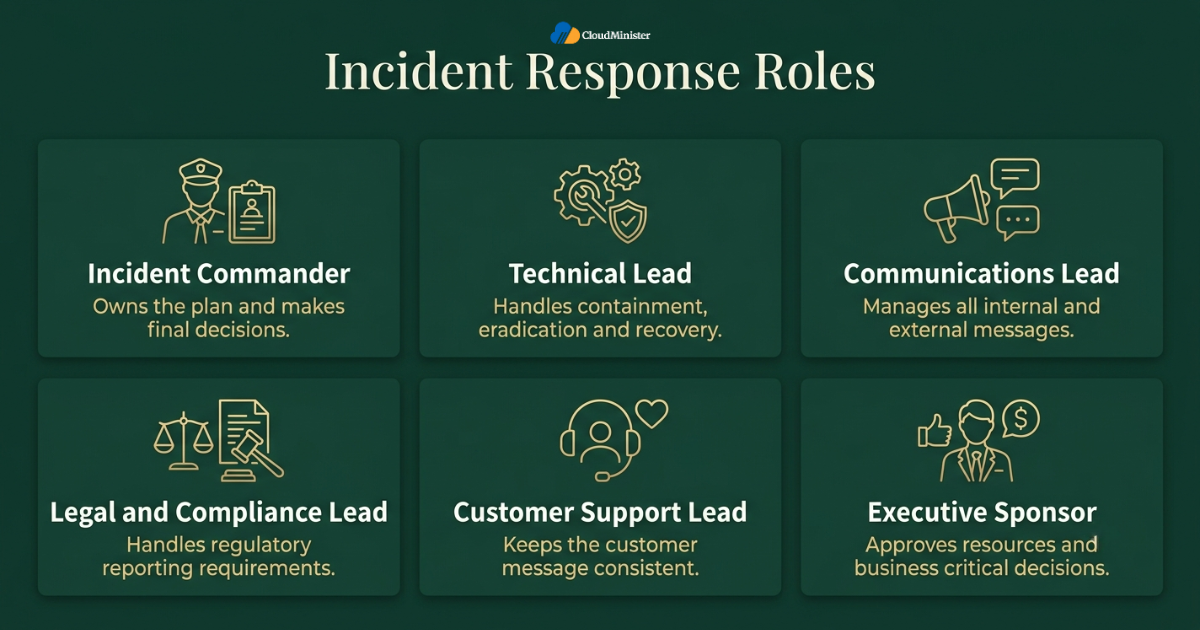
- Incident Commander: This person owns the overall Incident Response Plan during an active event, makes the final call on major decisions, and is the single point of coordination across every other role.
- Technical Lead: Responsible for containment, eradication, and recovery, the technical lead executes the hands on work described in the plan and reports status back to the incident commander continuously.
- Communications Lead: This role manages every external and internal message tied to the incident, ensuring the plan’s communication protocols are followed exactly rather than improvised in the moment.
- Legal and Compliance Lead: Responsible for interpreting regulatory notification requirements, this role ensures the Incident Response Plan satisfies obligations such as CERT-In reporting timelines and any sector specific data protection rules.
- Customer Support Lead: As affected customers begin reaching out, this role keeps the customer facing message consistent and prevents front line staff from speculating beyond approved talking points.
- Executive Sponsor: Leadership involvement ensures that resourcing, budget, and business critical decisions such as whether to pay a ransom are made quickly rather than escalated through multiple layers during a live event.
Small businesses without the headcount to staff every role separately should still name a backup for each function inside the Incident Response Plan, since a single point of failure in the response team is just as dangerous as one in the infrastructure. Businesses that rely on outsourced Cyber Security services should clarify in advance exactly which roles the provider fills during an incident, and which roles remain the business’s own responsibility.
Related Reading: zero trust security guide for India
Regulatory and Compliance Considerations for Indian SMBs
A plan built for an Indian SMB needs to reflect local regulatory timelines, not just generic global best practice.
- CERT-In’s directions require certain categories of cyber security incidents to be reported within six hours of detection, which is far stricter than many international frameworks, making early detection inside an Incident Response Plan a genuine compliance requirement rather than just good practice.
- Businesses handling sensitive personal data need to understand how India’s data protection framework affects notification obligations, and this understanding should be written directly into the plan rather than left to memory during an actual event.
- The plan should specify exactly where breach related data, logs, and evidence are stored during an investigation, since data residency requirements can affect which systems and vendors are permitted to process that evidence.
- SMBs working with international customers should build a data breach response plan flexible enough to satisfy both Indian regulatory timelines and any additional obligations under frameworks such as GDPR, since a breach involving European customer data can trigger overlapping notification clocks.
- Documenting every step taken during an incident, including timestamps, is not optional inside a compliant Incident Response Plan, since regulators increasingly expect a clear audit trail rather than a verbal summary after the fact.
- Businesses evaluating a Web Hosting Company in India for regulated workloads should specifically ask how the provider supports compliance driven incident documentation, since this directly affects how fast a data breach response plan can be executed and proven compliant.
Related Reading: data residency requirements in India
Technical Safeguards That Strengthen an Incident Response Plan
A plan works best when it sits on top of solid technical controls, rather than trying to compensate for their absence during an actual event.
- Encryption in transit and at rest: Data encrypted properly is far less useful to an attacker even after exfiltration, which directly changes the severity assessment inside the plan and can sometimes reduce mandatory notification obligations.
- Multi factor authentication: Since credential abuse remains one of the leading causes of unauthorized access, requiring multi factor authentication across every privileged account meaningfully reduces how often that plan actually needs to be activated.
- Centralized logging: The plan is only as fast as the evidence available to the technical lead, and centralized, tamper resistant logs are what actually let a team reconstruct what happened during the first hours of a breach.
- Network segmentation: Properly segmented networks contain the blast radius of a breach automatically, which gives the team executing the plan more time and fewer systems to isolate during containment.
- Regular patching cadence: A large share of real world breaches trace back to a known, unpatched vulnerability, which means keeping systems current is one of the cheapest ways to reduce how often it is triggered in the first place.
- Endpoint detection and response tooling: Modern cybersecurity solutions that flag unusual endpoint behavior in real time give the team executing the plan a meaningful head start over relying on manual log review alone.
Need Expert Help Building Your Incident Response Plan
A plan is only as strong as the monitoring and security support behind it. Our Cyber Security team helps businesses detect threats early, contain incidents quickly and keep their response plan ready for the real thing.
Businesses partnering with professional Cyber Security services generally gain access to threat intelligence and monitoring depth that would be extremely expensive to replicate internally, which strengthens every stage of the Incident Response Plan from detection through recovery. A provider offering strong Server Management Services in India can meaningfully shorten recovery time during an incident, since dedicated infrastructure support removes much of the operational guesswork that slows down manual recovery steps. Businesses hosted with a modern Web Hosting Company in India generally find it easier to layer these technical safeguards on top of already hardened infrastructure, rather than retrofitting security after the fact, and a provider delivering genuine Server Management Services in India typically bundles patch management, firewall tuning, and intrusion monitoring into one predictable service, which removes a major source of configuration drift. Modern cybersecurity solutions increasingly rely on behavioral analytics rather than static signatures, which helps catch novel attack techniques that older tools would miss entirely, so SMBs comparing vendors should ask directly whether the Cyber Security services on offer include proactive threat hunting or only passive alerting, since the two produce very different outcomes during a real event.
Related Reading: Encryption in transit explained
Common Mistakes That Make an Incident Response Plan Fail
Most failed breach responses trace back to a short, repeatable list of mistakes that are cheap to fix well before an incident occurs.
- Writing the plan once during onboarding and never revisiting it as staff, vendors, and infrastructure change over time.
- Assuming that a Web Hosting Company in India or an infrastructure vendor will automatically detect and respond to a breach, when in most contracts the provider secures infrastructure while the business itself remains responsible for its own Incident Response Plan.
- Failing to test the plan through a tabletop exercise, so the first time it is actually used is during a real, high pressure event instead of a rehearsal.
- Relying on a single technically skilled employee who understands the Incident Response Plan, leaving the business exposed the moment that person is unavailable or has left the company.
- Skipping communication planning entirely, so a plan looks complete on paper but nobody actually knows what to tell customers, partners, or regulators during a live breach.
- Underestimating regulatory timelines, particularly the CERT-In six hour reporting window, which an unprepared plan can easily miss if detection and internal escalation are slow.
- Treating cybersecurity solutions purely as a technology purchase rather than an operational capability that needs people, process, and a documented plan tying it all together.
- Forgetting to update contact lists, escalation paths, and vendor details inside the plan after a company grows, merges, or changes its Server Management Services provider.
According to Verizon’s 2026 Data Breach Investigations Report, the human element remains involved in roughly sixty percent of breaches, whether through error, social engineering, or misuse, which is a direct argument for why an Incident Response Plan must train people, not only configure tools.
The most dangerous assumption a business can make is that because it has never had a breach, its response plan does not need to be tested. Attackers do not announce themselves in advance, and a plan that has never been rehearsed tends to fail at exactly the moment clear thinking matters most.
Testing and Maintaining Your Incident Response Plan
A plan that is never tested is closer to a wish list than an operational capability, and testing it does not require enterprise scale resources to be effective. Tabletop exercises walk the response team through a realistic breach scenario verbally, without touching live systems, to confirm everyone understands their role inside the Incident Response Plan. Simulated phishing tests run periodically test both technical detection and the human judgment that so often determines whether the plan is triggered early enough to matter, while technical drills that actually isolate a test system and walk through containment steps validate that the plan’s technical instructions are current and actually executable, not just theoretically correct.
At minimum once a year, and immediately after any major infrastructure change, it should be reviewed line by line against how the business actually operates today, and every review should confirm that contact information for Cyber Security services partners, legal counsel, and regulators is still accurate.
- Small businesses can build a sustainable testing calendar around one tabletop exercise every six months and one technical drill annually, which is realistic without a large dedicated budget for plan maintenance.
- Mid sized businesses should aim for a quarterly review rhythm, rotating between tabletop discussions and more hands on technical drills, so the Incident Response Plan stays current as the business scales.
- A business considering a new Web Hosting Company in India, or an upgrade in Server Management Services, should treat that transition as a mandatory trigger to re-test the entire plan, since infrastructure changes are one of the most common causes of an outdated response process.
Why Infrastructure Choice Shapes Response Speed
The technology stack underneath a business has a direct, measurable effect on how quickly a real incident can be contained. Businesses running on shared, unmanaged infrastructure without any Server Management Services in India often discover during a real incident that nobody has current visibility into what changed on the server recently. Standardizing on Server Management Services in India across every environment, production, staging, and backup, means the same monitoring and escalation rules apply everywhere, which removes a common blind spot during containment. Cybersecurity solutions purchased in isolation, without any Server Management Services in India wrapped around them, tend to generate alerts nobody reviews, which defeats the purpose of buying the tooling in the first place.
A Web Hosting Company in India offering built in Server Management Services in India as part of its hosting plans gives smaller businesses access to enterprise grade operational discipline without hiring a full internal team. Cybersecurity solutions such as web application firewalls and intrusion prevention systems work best when a provider’s Server Management Services in India team is actively tuning them, rather than leaving default configurations untouched for years, and SMBs evaluating cybersecurity solutions for the first time should prioritize tools that integrate with their existing Server Management Services in India provider, since fragmented tooling slows down every stage of detection and response.
- A well chosen Web Hosting Company in India can also recommend which cybersecurity solutions genuinely fit a small team’s risk profile, rather than upselling enterprise grade tools a five person company will never fully configure.
- Cybersecurity solutions evaluated purely on price rather than on integration with Server Management Services in India often end up underused, since nobody on a small team has time to run a disconnected security console manually.
- Businesses that bundle Cyber Security services with Server Management Services in India from the same Web Hosting Company in India generally report faster mean time to containment, simply because fewer handoffs are required during an active incident.
- A Web Hosting Company in India with a track record of publishing its own security advisories is usually more transparent about the cybersecurity solutions it runs internally, which is a good signal when evaluating a long term partner.
Choosing the Right Partners to Support Your Incident Response Plan
The infrastructure and vendors underneath a plan directly affect how fast and how effectively it can actually be executed during a live incident. A dependable Web Hosting Company in India can isolate compromised environments quickly and provide clean infrastructure for recovery, both of which are essential steps inside any well built Incident Response Plan. Reliable Server Management Services remain the foundation this recovery step depends on, since clean infrastructure is only useful if it is actually maintained and monitored before the incident occurs, and SMBs that skip Server Management Services entirely and self manage infrastructure often lack the same recovery speed, since ad hoc administration rarely matches the discipline of dedicated Server Management Services in India teams.
Professional Cyber Security services bring monitoring, threat intelligence, and forensic expertise that most SMBs cannot economically build in house, which is often the difference between a plan that contains a breach in hours versus one that takes weeks. Reliable Server Management Services ensure that patching, backup verification, and access control, the preventative foundation the plan depends on, are maintained consistently rather than only reviewed after something goes wrong. Server Management Services of this kind also reduce the manual workload on a small internal team during recovery.
- Businesses should ask any potential Cyber Security services partner exactly how they support breach detection, containment, and post incident forensics, since a provider that only sells monitoring dashboards is very different from one that actively supports execution of your Incident Response Plan.
- A provider offering Server Management Services in India with strong regional data centre presence can also simplify compliance, since local infrastructure often aligns more directly with Indian regulatory expectations referenced throughout the plan.
- When comparing a Web Hosting Company in India, ask specifically about its own documented breach history and response process, since a provider that has clearly rehearsed its own incident response is generally a stronger long term infrastructure partner.
- Combining strong cybersecurity solutions with a documented, regularly tested Incident Response Plan gives an SMB a realistic chance of containing a breach quickly rather than discovering the gaps in real time during an actual event.
A Web Hosting Company in India that publishes clear uptime and security documentation is usually easier to vet during procurement than one that only markets price and storage limits. SMBs weighing an internal security hire against outsourced Cyber Security services should factor in that a single internal analyst cannot realistically cover round the clock monitoring, while most Cyber Security services providers already staff for that coverage. Server Management Services in India that include regular vulnerability scanning as a standard feature, rather than a paid add on, tend to catch exploitable gaps earlier in the patch cycle. A vendor offering both hosting and Server Management Services under one contract often simplifies the escalation path during an incident, since there is no finger pointing between separate infrastructure and support teams, and choosing cybersecurity solutions that integrate directly with existing logging and alerting tools avoids the blind spots that come from running disconnected security products side by side.
What to Look for When Comparing Vendors
Not every provider markets itself honestly around incident support, so a structured comparison helps avoid surprises later.
- Ask any Web Hosting Company in India for a written SLA covering incident detection and initial response time, not just general uptime guarantees.
- Confirm whether the Server Management Services included in a plan cover proactive patching, or only reactive ticket based support after something breaks.
- Request a sample report from a Cyber Security services provider to see whether findings are actionable or just raw scanner output with no prioritization.
- Compare how each cybersecurity solutions vendor prices scaling, since some cybersecurity solutions become disproportionately expensive as data volume or endpoint count grows.
- Ask whether Server Management Services in India includes after hours coverage, since many incidents are discovered outside standard business hours.
- A Web Hosting Company in India that offers a documented escalation path, including named contacts, is generally more reliable during a live incident than one relying on a generic support ticket queue.
- Server Management Services in India that include regular tabletop participation as part of the contract help keep a business’s own plan realistic and current.
- Verify that any cybersecurity solutions under consideration produce logs compatible with what your Server Management Services team already monitors, since incompatible formats slow down investigation.
A Practical First 90 Days Plan to Build Your Incident Response Plan
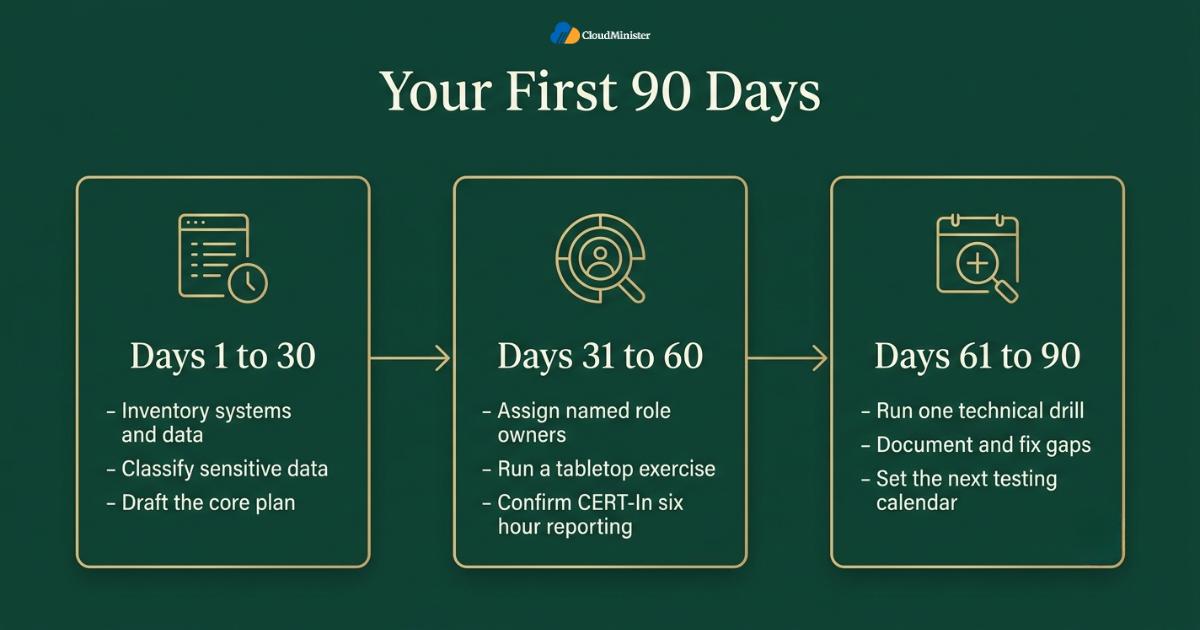
Businesses without an existing plan do not need to build a perfect version overnight. A focused ninety day approach is usually enough to get a working plan in place.
- Days one to thirty are for inventorying every system and data type, classifying what is most sensitive, and drafting the core structure of the plan, including detection, containment, and communication sections. This is also when the business should confirm current backup, logging, and access control status with its Server Management Services provider, since these directly determine how realistic the plan’s recovery timelines actually are.
- Days thirty one to sixty are for assigning named owners to every role in the Incident Response Plan, and running a tabletop exercise to surface obvious gaps before they matter in a real event, while also confirming regulatory notification requirements with legal counsel, including CERT-In’s six hour reporting window, and building those timelines explicitly into the data breach response plan.
- Days sixty one to ninety are for running one technical drill on a non production system, ideally in coordination with a Cyber Security services partner, so the plan is validated under realistic conditions, and then documenting every gap found, fixing what can be fixed immediately, and setting the next quarter’s testing calendar based on what the first cycle actually revealed. After the first ninety days, most businesses find their Incident Response Plan needs far less rewriting going forward and far more consistent testing, which is a much healthier position than discovering the whole plan was outdated during a real breach.
Growing SMBs comparing a Web Hosting Company in India should also weigh how easily its Server Management Services scale, since a provider that works fine at ten servers can struggle to deliver consistent Server Management Services in India at fifty. Reviewing security tooling annually alongside the plan itself, rather than treating it as a one time purchase, keeps both the technology and the process aligned as the business and its Server Management Services in India needs grow.
Checklist: Incident Response Plan Readiness Review
- Detection, containment, eradication, and recovery procedures documented for the plan
- Named owner and backup assigned for every role in the Incident Response Plan
- CERT-In six hour reporting window and other regulatory timelines built into the data breach response plan
- Communication protocols drafted and pre approved for customers, regulators, and media
- At least one tabletop exercise completed in the last twelve months
- At least one technical drill completed in the last twelve months
- Logging, backup, and access control status confirmed with Server Management Services
- Contact details for Cyber Security services partners and legal counsel kept current
- Documented audit trail requirement built into every stage of the plan
Conclusion
A plan only has value once it moves from a document in a shared drive to a capability the whole team has actually rehearsed. Writing it is the easy part. Proving it works under realistic pressure, with clear ownership and regulatory timelines built in, is what separates a business that recovers quickly from one that makes headlines for the wrong reasons. Small businesses can start with a light but consistent cadence. Mid sized businesses need a tighter quarterly rhythm with cross department involvement built into their Incident Response Plan. In every case, the underlying partners matter. A dependable Web Hosting Company in India, paired with strong Cyber Security services and reliable Server Management Services, gives an SMB a realistic chance of containing a breach quickly instead of discovering every gap in real time.
It also helps to remember that a good Incident response plan is never really finished. Your team changes, your vendors change, and your systems grow in ways nobody predicted a year ago. Each time something shifts, take a few minutes to ask whether the plan still matches reality. Update the contact list, confirm who covers for whom, and check that the reporting steps still make sense. Small, regular updates are far easier than a full rewrite after a bad day.
The best time to find a weak spot in your Incident response plan is during a calm tabletop session, not in the middle of a live breach. Treat every drill as a chance to learn, and share what you find with the whole team so nobody feels blamed for gaps that were always there. Businesses that build this habit tend to respond with confidence instead of fear. Start small, stay consistent, and let your plan grow with your business.
Ready to Put Your Incident Response Plan in Place
Not sure where to start or how to test the plan you already have. Talk to our team and we will help you review your current setup and build a practical plan around your business.
Key Takeaways
- An Incident Response Plan is only proven through testing, and every SMB, regardless of size, needs one built around its actual infrastructure and regulatory obligations.
- A data breach response plan should cover triage, containment, scope assessment, notification, communication, remediation, and review, with regulatory reporting starting early where required and updated as the investigation progresses.
- CERT-In’s six hour reporting window makes fast detection a compliance requirement for Indian SMBs, not just an operational best practice.
- Technical safeguards such as encryption, multi factor authentication, and centralized logging make every stage of a response plan faster and more effective.
- The right partners, offering Cyber Security services, Server Management Services, and dependable hosting from a trusted Web Hosting Company in India, make consistent testing realistic instead of disruptive.
Frequently Asked Questions
What role do cybersecurity solutions play if we already have a plan?
Cybersecurity solutions provide the detection and enforcement layer, while the plan provides the decision making structure; cybersecurity solutions without a documented plan often generate alerts with no clear owner, and a plan without adequate cybersecurity solutions has no reliable way to detect an incident early. Pairing Server Management Services with Server Management Services in India level regional support and a short list of well integrated cybersecurity solutions tends to work best for most SMBs.
What is the difference between an Incident Response Plan and a data breach response plan?
An Incident Response Plan is the broader framework covering any security incident, while a data breach response plan is the specific subset of that plan focused on confirmed or suspected exposure of personal or sensitive data, including the regulatory notification steps that follow.
How quickly must Indian businesses report a cyber incident under CERT-In rules?
Certain categories of cyber security incidents must be reported to CERT-In within six hours of detection, which makes early detection capability inside an Incident Response Plan a direct compliance requirement rather than only good practice.
Do small businesses really need a formal Incident Response Plan?
Yes. Verified 2026 industry research shows that a tested incident response plan meaningfully reduces the average cost of a breach compared to businesses with no plan at all, which makes it one of the most cost effective controls a small business can put in place.
Can outsourced Cyber Security services replace an internal Incident Response Plan?
No. Outsourced Cyber Security services can execute monitoring, detection, and technical response, but a business still needs its own documented plan to define decision rights, communication protocols, and regulatory responsibilities that a vendor cannot own on the business’s behalf.
How does Server Management Services support incident response?
Server Management Services maintain the patching, backup, and access control foundation the plan depends on, and during an actual incident, the provider often executes containment and recovery steps defined in the plan alongside the business’s own response team.
What should we ask a Web Hosting Company in India about incident response support?
Ask how quickly the provider can isolate a compromised environment, what logging and evidence retention is standard, and whether the provider has a documented Incident Response Plan of its own, since that directly affects how fast a shared incident can actually be contained.