Kubernetes Ingress vs Gateway API is now one of the most important routing decisions for platform teams, because the community ingress-nginx controller was retired in March 2026 and Gateway API is the long term direction for Kubernetes traffic management. Ingress still works and has not been removed from Kubernetes, but it is frozen, while Gateway API adds role based resources, richer routing, and portable features that no longer depend on annotations. This guide explains Kubernetes Ingress vs Gateway API in plain language, shows what changes in the model, and gives a safe step by step path to migrate. It also explains where a Web Hosting Company in India, a Server Management Company, and DevOps Services & Solutions fit into the plan, since routing never moves well without the infrastructure around it.
Every team that runs applications on Kubernetes eventually has to decide how outside traffic reaches its services. For years the answer was Ingress, a simple resource that maps hostnames and paths to Services. Today the same question has a second answer, and the Kubernetes Ingress vs Gateway API discussion has moved from conference talks into real migration tickets. The goal is not to push one tool. The goal is to move routing to a better model while customers keep using the product without noticing anything at all.
Most routing trouble does not come from Kubernetes itself. It comes from annotations that only one controller understands, shared load balancers that nobody owns, and cutovers that were never rehearsed. A careful look at Kubernetes Ingress vs Gateway API deals with these risks early, because Gateway API replaces hidden controller behavior with explicit and typed fields. Teams also find it easier to explain the plan to managers, security reviewers, and partners who depend on the platform.
This guide walks through the topic in plain language. You will learn what Ingress does, how Gateway API is structured, how Kubernetes Ingress vs Gateway API compares feature by feature, and how to migrate in small and reversible steps. We also cover TLS, testing, rollback, ownership, and a thirty day plan. Whether you run one cluster or fifty, this view of Kubernetes Ingress vs Gateway API will help you plan with more confidence and far fewer surprises.
Table of Contents
- 1. Why the Ingress and Gateway API Choice Matters in 2026
- 2. How Kubernetes Ingress Works and Where It Falls Short
- 3. What Gateway API Is and How It Is Structured
- 4. Feature by Feature Comparison of Ingress and Gateway API
- 5. Traffic Management: What Changes in Daily Routing
- 6. Security and TLS: Safer Defaults in the Gateway Model
- 7. Choosing a Gateway API Implementation
- 8. Preparing for Migration: Inventory and Audit
- 9. How to Migrate Ingress to Gateway API Step by Step
- 10. Mapping Common Ingress Annotations to Gateway API
- 11. Testing, Cutover, and Rollback
- 12. Operating Gateway API: Observability, CI/CD, and CI/CD Cost Optimization
- 13. Common Mistakes in an Ingress to Gateway API Migration
- 14. Choosing the Right Partner for the Migration
- 15. A Practical 30 Day Plan to Get Started
- Key Takeaways
- Conclusion
- Frequently Asked Questions
1. Why Kubernetes Ingress vs Gateway API Matters in 2026
The comparison matters now because the timeline is no longer theoretical. The Kubernetes project announced that the community ingress-nginx controller would stop receiving releases, bug fixes, and security updates after March 2026. Existing deployments keep running, but a retired controller at the edge of your cluster is a growing risk. At the same time, Kubernetes is everywhere. The CNCF annual cloud native survey released in January 2026 reports that 82 percent of container users now run Kubernetes in production, so the routing layer affects a very large number of businesses. A Server Management Company often spots exposed edge services during this first review.
- Ingress is the original Kubernetes API for HTTP and HTTPS routing, and the first step in any Kubernetes Ingress vs Gateway API review is to understand that it is frozen, not removed.
- Gateway API is a separate set of custom resources maintained by the Kubernetes SIG Network community, and it is where new routing features are being added.
- The retirement affects the community ingress-nginx controller only. Other Ingress controllers from vendors and projects are separate products with their own support plans.
- You can check whether a cluster runs the community controller by listing pods across all namespaces with the label app.kubernetes.io/name set to ingress-nginx.
- A controller without security fixes is a risk at the edge of your network, so a clear Kubernetes Ingress vs Gateway API plan is also a security task.
- Platform teams that wait for a forced deadline usually pay more, because an urgent migration leaves no time for rehearsal. A late move also wastes CI/CD cost optimization effort.
- Good planning treats the move as a series of small deployments, each one easy to roll back in minutes. DevOps Services & Solutions can support this approach.
- Teams that already use Server Management Services in India often finish the inventory step faster, because an outside team brings a repeatable review habit.
- A capable Web Hosting Company in India will usually raise this topic during infrastructure reviews, since load balancers, IP addresses, and DNS decide how safe a cutover can be.
Before choosing any tool, write down your real downtime budget in seconds and the list of clusters that still use ingress-nginx. These two items decide most of the Kubernetes Ingress vs Gateway API plan, and guessing them is the most common reason teams over plan or under plan.
2. How Kubernetes Ingress Works and Where It Falls Short
Ingress is a single resource that describes host and path rules for HTTP and HTTPS traffic, and an Ingress controller running in the cluster turns those rules into real proxy configuration. This simple design made it popular, but the same simplicity creates limits as clusters grow. Knowing these limits makes the Kubernetes Ingress vs Gateway API discussion much clearer, because each limit explains one reason Gateway API exists. A Web Hosting Company in India that manages clusters sees these limits on many client environments. Teams that use DevOps Services & Solutions often catch these annotation problems in code review. With Server Management Services in India, teams get a regular review of such settings.
- In Kubernetes Ingress vs Gateway API, the first limit is protocol scope. Ingress covers HTTP and HTTPS only, so other protocols fall outside the core API and need controller specific workarounds.
- Advanced behavior such as rewrites, timeouts, canary releases, and body size limits is configured through annotations, which differ from one controller to another.
- Annotations are plain strings, so a typo is often found only at runtime, and the same manifest can behave differently on a different controller. This is a key point in Kubernetes Ingress vs Gateway API.
- One Ingress object mixes infrastructure choices, such as the entry point, with application choices, such as paths, so ownership becomes blurred.
- Sharing one controller between many teams needs naming rules and manual review, because the API has no built in way to say which team may use which hostname.
- Backends must live in the same namespace as the Ingress object, which pushes teams toward duplicated objects.
- The ingressClassName field selects a controller, yet it says nothing about which features that controller supports.
- Moving from one controller to another often means rewriting annotations by hand, which is slow and easy to get wrong.
- A Server Management Company reviewing a busy cluster often finds dozens of annotations that nobody remembers adding.
3. What Gateway API Is and How It Is Structured
Gateway API is a family of Kubernetes resources, installed as custom resource definitions, that models traffic routing in separate layers. It is developed by the Kubernetes SIG Network community and is not bundled inside the Kubernetes core, so you install the CRDs and choose an implementation. Seen from the Kubernetes Ingress vs Gateway API angle, the biggest change is that one overloaded object becomes several focused objects, each owned by the right team. A Web Hosting Company in India can install and pin these CRDs as part of a managed Kubernetes setup. A Server Management Company usually keeps these CRD versions pinned across clusters. Providers of DevOps Services & Solutions can automate this installation.
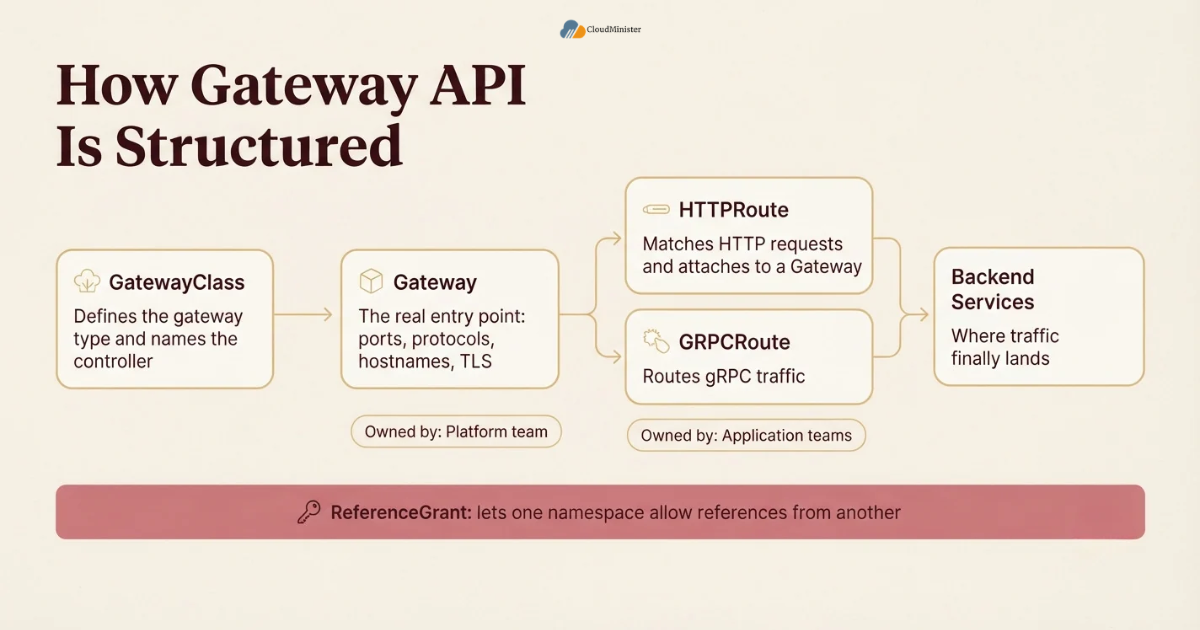
- GatewayClass defines a type of gateway and names the controller that implements it, in the same way a StorageClass does for volumes.
- Gateway describes a real entry point, including listeners for ports, protocols, hostnames, and TLS settings.
- HTTPRoute describes how HTTP requests are matched and sent to backend Services, and it attaches to a Gateway.
- GRPCRoute gives gRPC traffic its own route type, and it is available in the standard channel.
- GatewayClass, Gateway, and HTTPRoute are generally available under the v1 API version, so production plans can rely on them.
- Route types for TLS, TCP, and UDP have followed a slower maturity path, so read the release notes of the version you plan to use.
- ReferenceGrant lets the owner of one namespace allow references from another namespace, which makes cross namespace routing explicit.
- Status conditions such as Accepted, Programmed, and ResolvedRefs show clearly why a Gateway or Route is not working, which is a clear gain in Kubernetes Ingress vs Gateway API debugging.
- In every Kubernetes Ingress vs Gateway API rollout, the CRD version and the implementation version must be compatible, so pin the version and test upgrades like any other dependency. Providers of Server Management Services in India can track those versions.
4. Kubernetes Ingress vs Gateway API: A Feature by Feature Comparison
A table is the fastest way to see the differences, so the comparison below places the two APIs side by side. The point is not that one is bad. Ingress remains a valid and simple choice for small setups, while Gateway API is built for clusters where several teams, protocols, and policies meet. This honest Kubernetes Ingress vs Gateway API view keeps the decision practical. A Server Management Company can give an outside view of which option fits. Good CI/CD cost optimization also depends on the choice.
| Area | Ingress | Gateway API |
| API group | networking.k8s.io/v1 | gateway.networking.k8s.io, with v1 for the core resources |
| Main resources | Ingress and IngressClass | GatewayClass, Gateway, HTTPRoute, GRPCRoute, and more |
| Protocols | HTTP and HTTPS | HTTP, HTTPS, and gRPC, with other route types maturing |
| Advanced features | Controller specific annotations | Typed fields, filters, and policy objects |
| Ownership | One object for every team | Separate resources for platform and application teams |
| Cross namespace use | Backends in the same namespace only | Allowed through ReferenceGrant |
| Status feedback | Limited | Detailed conditions on Gateways and routes |
| Project direction | Frozen, no new features | Active development |
- In Kubernetes Ingress vs Gateway API, Ingress is frozen, which means it will not gain new features or grow to meet new needs.
- Gateway API expresses traffic splitting, header matching, redirects, and rewrites in typed fields, so the same file behaves the same way on any implementation that supports those features.
- For Kubernetes Ingress vs Gateway API decisions, the project publishes conformance tests, so implementations can show which features they support.
- Gateway API adds more objects to manage, which is a real cost for a very small cluster with a single application. A Web Hosting Company in India can absorb part of that workload.
- Ingress has a huge installed base with many tutorials and tools, so teams should not migrate only to follow fashion. A sensible view of Kubernetes Ingress vs Gateway API always weighs this.
- Gateway API is the better fit when you need multi team ownership, weighted routing, or one model that also serves service mesh use cases. Server Management Services in India can ease the extra work.
- Both APIs can run in the same cluster at the same time, and this is what makes a gradual move possible. A partner with DevOps Services & Solutions experience can plan that overlap.
- A written reason for the final choice is very useful later, so record why your Kubernetes Ingress vs Gateway API decision went the way it did.
5. Traffic Management: What Changes in Daily Routing
The day to day routing work changes the most. Features that once hid inside annotations become fields in the route, and the specification defines how rules are ordered, so the winning rule is predictable. This section shows the parts of Kubernetes Ingress vs Gateway API that engineers will notice first when they write their first HTTPRoute. A Web Hosting Company in India with strong network links also helps by keeping latency low on the new routes. DevOps Services & Solutions pipelines can test these rules before release.
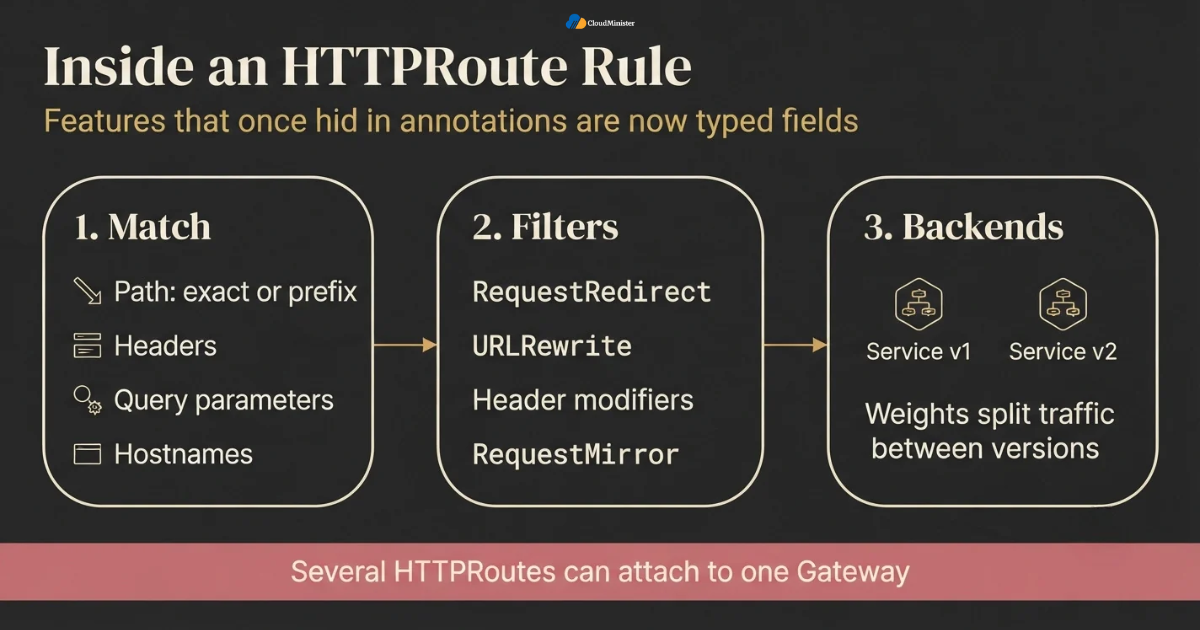
- In Kubernetes Ingress vs Gateway API routing, path matching supports exact and prefix types, and regular expression matching is available where the implementation supports it.
- Header and query parameter matching are part of the route rule, so no annotation is needed for them.
- Weights on backend references split traffic between versions of a service, which covers canary and blue green releases. This is a clear gain in Kubernetes Ingress vs Gateway API.
- The RequestRedirect filter handles HTTP to HTTPS redirects and hostname changes.
- The URLRewrite filter changes the path or host before the request reaches the backend, replacing most rewrite annotations.
- Header modifier filters add, set, or remove request and response headers.
- The RequestMirror filter copies live traffic to a second backend for testing, where the implementation supports it. Use it carefully for CI/CD cost optimization, since it doubles backend load.
- Several HTTPRoute objects can attach to the same Gateway, so each team manages its own rules without touching the shared entry point. A Server Management Company can watch these routes after the cutover.
- A Server Management Services in India partner can watch latency and error rates on the new routes while the rules are being tested.
Related Reading: How Docker bridge networks connect containers
6. Security and TLS: Safer Defaults in the Gateway Model
Security is one of the strongest reasons to study Kubernetes Ingress vs Gateway API carefully. In the Gateway model the platform team owns the listener and its certificates, while application teams own only their routes. This separation reduces the chance that one wrong manifest exposes the wrong hostname.
- TLS terminates on a Gateway listener, and the certificate is referenced from a Kubernetes Secret through certificateRefs.
- A Secret in another namespace needs a ReferenceGrant, so nobody can borrow a certificate by accident.
- The allowedRoutes setting on a listener limits which namespaces and route kinds may attach to it.
- Hostname restrictions on listeners stop one team from claiming the hostname of another team. This is a security gain when comparing Kubernetes Ingress vs Gateway API.
- Use Kubernetes RBAC so application teams can edit HTTPRoute objects but only platform engineers can edit Gateway objects. DevOps Services & Solutions teams can define these roles as code.
- cert-manager can issue certificates for Gateway listeners, and its documentation explains how to enable Gateway API support.
- Run separate Gateways for public and internal traffic, so an internal service is never exposed by a simple mistake. A Web Hosting Company in India can also keep internal and public networks apart at the infrastructure level.
- Patch your chosen implementation regularly, because the data plane that handles traffic is still software that needs updates. A Server Management Company usually tracks these updates.
- A provider of Server Management Services in India can handle patching, backups, and alert review, so engineers stay focused on the routing logic.
A migration creates a second set of entry points, often with new IP addresses, new certificates, and new firewall rules. Treat the new Gateway as production from day one, restrict who can edit Gateway objects, and remove temporary test access and unused listeners as soon as the cutover is confirmed.
7. Choosing a Gateway API Implementation
Gateway API is a specification, so you still need a controller that implements it. Several projects and cloud platforms provide one, including Envoy Gateway, Istio, Cilium, NGINX Gateway Fabric, Traefik, and Kong. The right choice for Kubernetes Ingress vs Gateway API depends on your existing data plane, the features you need, and the skills of your team. A provider of DevOps Services & Solutions can run a short proof of concept for each candidate.
- Start from what you already run when weighing Kubernetes Ingress vs Gateway API. A team that uses Cilium or Istio often gets the simplest path by using the Gateway API support of that tool.
- Check the support level of every feature you need, because the specification separates core, extended, and implementation specific features.
- Confirm which Gateway API version the implementation supports, and read its conformance report on the project website.
- Ask how it handles settings that used to be annotations, since most implementations use their own policy objects for limits, timeouts, and authentication.
- Managed cloud gateways integrate well with cloud load balancers, but they can tie a design to one provider. Ask your Web Hosting Company in India which options it supports.
- Consider the skills of your team, because debugging a proxy you do not understand is slow under pressure. Server Management Services in India can fill skill gaps.
- Load test the implementation with your real traffic shape before you commit. Limit test runs to keep CI/CD cost optimization under control.
- Choose one implementation per environment at first, since mixing several controllers multiplies the work of every Kubernetes Ingress vs Gateway API review.
- A Server Management Company with experience across many client environments can usually say which option fits a given workload.
Related Reading: How SRE and DevOps responsibilities differ
8. Preparing for Migration: Inventory and Audit
A calm migration starts with a complete list of what exists today. Teams that skip this step find hidden dependencies only after the cutover. The audit also shows which parts of Kubernetes Ingress vs Gateway API will be easy and which will need real design work. A Server Management Company can run this audit alongside your team.
- List every cluster, the Ingress controller it uses, and the version of that controller.
- Export all Ingress objects and sort them by namespace, hostname, and annotation set.
- Collect the distinct annotations in use and mark which ones have a standard Gateway API equivalent.
- Note special features such as configuration snippets, external authentication, rate limits, and web application firewall rules.
- Record traffic volume, certificate expiry dates, DNS records, and current TTL values for every hostname.
- Find dependent systems such as external DNS tools, monitoring, firewall rules, and CDN settings. Providers of Server Management Services in India often hold this information.
- Name one owner for each application, so questions during the move have a clear answer. Many providers of DevOps Services & Solutions help assign these roles.
- Run the ingress2gateway tool from the Kubernetes SIG Network community for a first draft of the converted routes in your Kubernetes Ingress vs Gateway API project.
- Ask your Web Hosting Company in India for current capacity, load balancer limits, and backup details at the same time.
The annotation audit is where most surprises hide. Custom configuration snippets rarely have a direct Gateway API equivalent, so find them first and plan extra time for those routes. The converter gives a useful draft, but complex setups always need a human review.
9. How to Migrate Ingress to Gateway API Step by Step
The safest way to apply Kubernetes Ingress vs Gateway API knowledge is to build the new path next to the old one and move traffic slowly. Nothing is removed until the new path has proven itself. Each step below is small, reviewable, and easy to undo. A Web Hosting Company in India can prepare the load balancer addresses before this work starts.
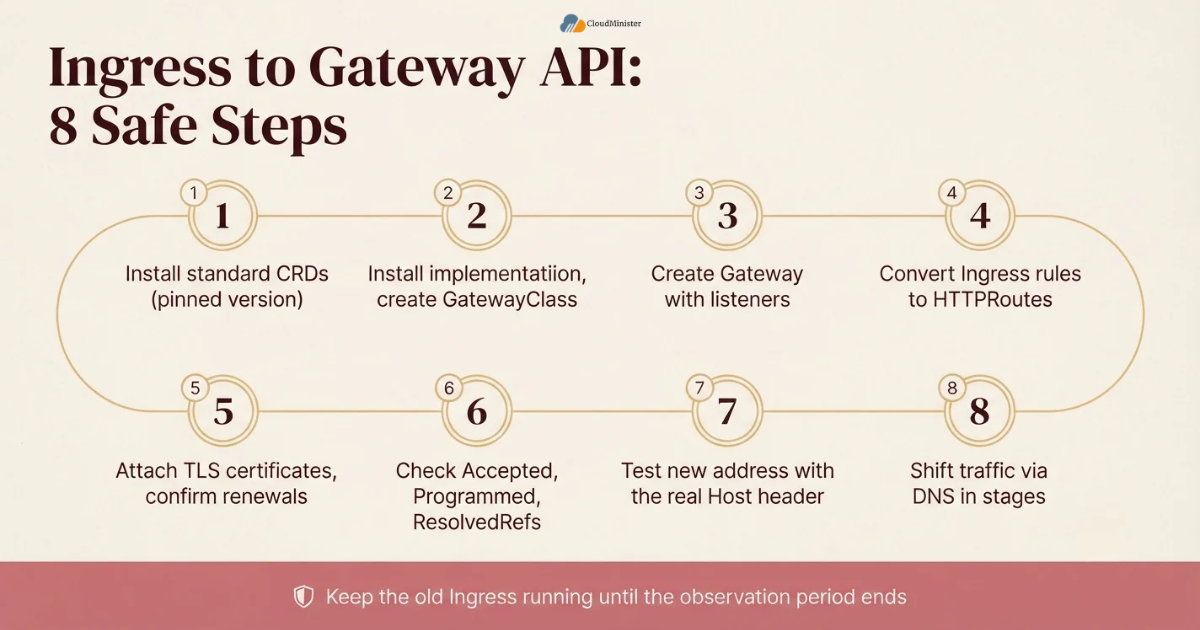
- Step one: install the standard channel Gateway API CRDs at a pinned version, and avoid experimental channel resources in production. Pinning versions supports CI/CD cost optimization because it avoids repeat debugging.
- Step two: install the chosen implementation and create a GatewayClass that points to it.
- Step three: create a Gateway with the listeners you need. It will receive its own load balancer address, separate from the old Ingress. Here Kubernetes Ingress vs Gateway API becomes concrete.
- Step four: convert each Ingress rule into an HTTPRoute, using the converter tool for a draft and then reviewing every field by hand.
- Step five: attach TLS certificates to the listeners and confirm that renewals work. A Server Management Company can monitor certificate expiry.
- Step six: check the status conditions Accepted, Programmed, and ResolvedRefs on the Gateway and on every route. Server Management Services in India partners can alert on these conditions.
- Step seven: test directly against the new address by sending the real Host header, for example with curl and its resolve option.
- Step eight: move a small share of traffic through DNS, watch the dashboards, increase it in stages, and keep the old Ingress running until the observation period ends.
- Teams that use DevOps Services & Solutions can turn each step into its own pull request, so every change is reviewed and deployed on its own.
Related Reading: A simple pipeline built for small teams
Need Help Migrating from Ingress to Gateway API?
Our DevOps engineers plan, test, and roll out Kubernetes routing changes with a rehearsed cutover and a tested rollback, so your applications stay online throughout. New clients get a free consultation to review their current Ingress setup and map out the safest migration path.
10. Mapping Common Ingress Annotations to Gateway API
Most migration effort goes into translating annotations. The table below shows how common ingress-nginx behavior maps to Gateway API. Treat it as a starting point, because every implementation handles policy features in its own way, and this is the part of Kubernetes Ingress vs Gateway API where careful reading of documentation pays off. A Server Management Company familiar with proxies can speed up this review. Teams that use Server Management Services in India often get a second review of these settings. Mapping rules once also helps CI/CD cost optimization.
| Common ingress-nginx behavior | Gateway API approach |
| Host and path rules | hostnames and matches in an HTTPRoute |
| rewrite-target annotation | URLRewrite filter on the route rule |
| ssl-redirect annotation | RequestRedirect filter with the https scheme |
| Canary weight annotations | weight values on backend references |
| Custom response headers | Header modifier filters |
| Body size, timeouts, rate limits | Policy objects defined by the chosen implementation |
| Authentication annotations | Implementation specific policy or a separate auth layer |
| Configuration snippets | No standard equivalent, so redesign the behavior |
- Host and path rules map to hostnames and matches in an HTTPRoute, and this is the easiest part of Kubernetes Ingress vs Gateway API to migrate.
- Rewrite annotations map to the URLRewrite filter, but test regular expression behavior, because matching rules differ between controllers.
- Canary annotations map to weights on backend references, which are simpler to read and review. DevOps Services & Solutions pipelines can promote weights in stages.
- Body size, timeouts, and rate limits usually need a policy object defined by the implementation, so read its documentation before you plan the work.
- Default values differ between proxies, so compare timeouts, buffer sizes, and header limits instead of assuming they match.
- Authentication annotations often need an implementation specific extension, and some setups are better moved to a dedicated auth layer.
- Configuration snippets have no standard equivalent, so redesign them as filters, policies, or application changes.
- A Server Management Company that has handled many cutovers can usually point to the annotation that caused trouble in earlier projects.
11. Testing, Cutover, and Rollback
The cutover is the shortest part of the project and the riskiest. Good planning for Kubernetes Ingress vs Gateway API makes it so short and so rehearsed that it feels routine. A rollback that has never been tested is only a hope, so test the way back as carefully as the way forward. A Server Management Company on call during the window adds a safety net.
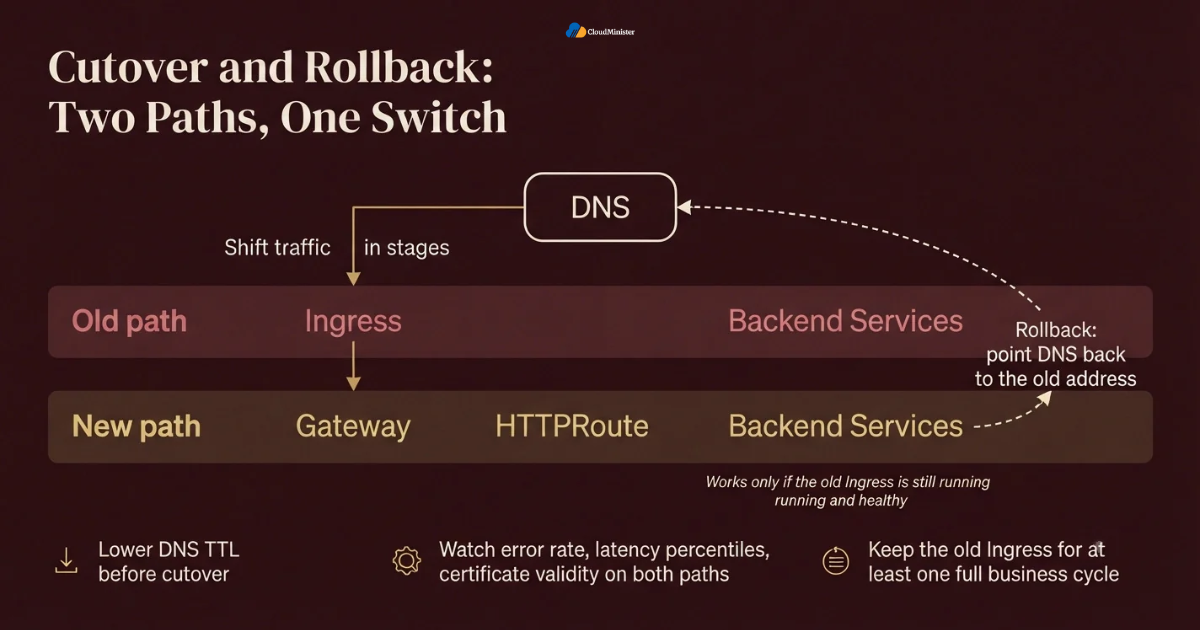
- Compare status codes, headers, and response bodies between the old and the new path for a sample of real requests. Treat this as part of any Kubernetes Ingress vs Gateway API test.
- Load test the new Gateway with realistic traffic, including long connections and peak hours. Short and targeted tests help CI/CD cost optimization.
- Lower the DNS TTL well before the cutover, so clients pick up the change quickly. Your Web Hosting Company in India can often help with DNS changes.
- Agree the rollback trigger before the day begins, such as an exact error rate or latency that means the team switches back.
- Rollback means pointing DNS back to the old address, which works only if the old Ingress is still running and healthy.
- Watch error rate, latency percentiles, and certificate validity on both paths during the whole window.
- Freeze unrelated releases during the cutover, so only one risky change happens at a time. Release control is a core part of DevOps Services & Solutions.
- Keep the old Ingress in place for at least one full business cycle before removing it.
- Ask a Server Management Services in India provider to confirm who is on call during the window and who may approve a rollback.
Run a full dress rehearsal in a staging cluster at least a week before the real cutover. The rehearsal almost always finds something small, such as a monitoring check that still points to the old address, that would otherwise appear during the real event.
12. Operating Gateway API: Observability, CI/CD, and CI/CD cost optimization
After the move, routing should be treated as code. The CNCF data reported by The New Stack shows that 91 percent of mature organizations use CI/CD tools in production, and the same discipline applies to Gateway and HTTPRoute manifests. This section links Kubernetes Ingress vs Gateway API with daily operations and with CI/CD cost optimization, since shared entry points can reduce both effort and spend. A Web Hosting Company in India can also host the monitoring stack.
- Store Gateway and HTTPRoute manifests in version control and review every change through a pull request. This is a standard habit in DevOps Services & Solutions.
- Validate manifests in the pipeline with a dry run and a schema check before they reach the cluster.
- Good CI/CD cost optimization starts with fewer load balancers, and a shared Gateway can serve many routes from one entry point.
- Run migration tests only for the manifests that changed, which is a simple CI/CD cost optimization habit that saves build minutes.
- Cache dependencies and reuse test clusters, because repeated setup work is a hidden part of CI/CD cost optimization.
- Collect metrics, access logs, and traces from the Gateway, and alert on error rate, latency, and certificate expiry. Many Server Management Services in India plans include this monitoring.
- Review unused routes and listeners each quarter, because old rules add risk without adding value. A Server Management Company can flag them automatically.
- A Server Management Company can run the dashboards and alerts while your engineers focus on application work.
- Teams that use DevOps Services & Solutions often include CI/CD cost optimization in every pipeline review, since automation and cost go together.
Related Reading: How teams cut pipeline spend for AI training
13. Common Mistakes in an Ingress to Gateway API Migration
Most failed migrations trace back to a short list of repeatable mistakes. Avoiding them is one of the cheapest improvements you can make to your Kubernetes Ingress vs Gateway API plan, and none of them needs special tools to fix. A Web Hosting Company in India should also be questioned on rollback cover.
- Migrating every application at once instead of moving one low risk service first. Teams new to Kubernetes Ingress vs Gateway API make this mistake most often.
- Assuming annotation defaults match the new proxy, then finding different timeouts or body size limits in production.
- Forgetting ReferenceGrant objects, so routes or certificates in other namespaces are rejected, which shows up in the status conditions.
- Installing experimental channel CRDs on a production cluster without reading the support notes. Rework from such choices hurts CI/CD cost optimization.
- Letting two systems claim the same hostname, for example an old external DNS record and a new one.
- Lowering the DNS TTL too late, so clients keep using the old address after the switch.
- Removing the old Ingress on the same day as the cutover, which removes the safety net.
- Having no single owner for the final go or no go decision.
- Choosing DevOps Services & Solutions or Server Management Services in India only on price, without checking whether rollback cover is included.
14. Choosing the Right Partner for the Migration
Not every hosting relationship is built to support a careful routing migration. The difference between an average provider and a capable one becomes clear when load balancers, DNS, certificates, and monitoring all have to change in the same week. Ask direct questions before signing, and treat Kubernetes Ingress vs Gateway API as a qualifying topic in the conversation.
- Ask any prospective Web Hosting Company in India how many routing or Kubernetes migrations it has completed and how it verified each rollback.
- Confirm that Server Management Services in India include monitoring, backups, and tested restores.
- Look for a provider that offers DevOps Services & Solutions, so manifests, pipelines, and infrastructure are reviewed together.
- A Server Management Company that runs its own automation practice tends to give more consistent advice across the cluster, the pipeline, and the network.
- Ask for a real example of a past migration, including what went wrong and how it was fixed.
- Check how the provider documents decisions, because a migration that nobody wrote down is hard to audit or repeat. Good records help CI/CD cost optimization later.
- Be careful with any provider that promises zero risk. Honest plans always include a rollback and a stated downtime budget.
- A Web Hosting Company in India with local data centres can reduce network delay for Indian users and simplify data residency questions.
- Agree in writing what the provider monitors and what remains the duty of your own team.
15. A Practical 30 Day Plan to Get Started
Reading about Kubernetes Ingress vs Gateway API is easy and acting on it is harder, so this plan splits the work into four weeks that most teams can follow. Adjust the dates to your release calendar, and keep the order of the steps. Ask your Web Hosting Company in India to join the planning from week one. Planning ahead also supports CI/CD cost optimization.
- Week one: inventory every cluster, Ingress object, annotation, certificate, and DNS record. Server Management Services in India partners can help build the inventory.
- Week one: agree the downtime budget with the business in seconds and write it at the top of the runbook.
- Week two: choose the implementation for your Kubernetes Ingress vs Gateway API plan and record the reason. Ask your Server Management Company to confirm monitoring and backups before any change.
- Week two: install the CRDs, the implementation, and a test Gateway in a staging cluster.
- Week three: convert one low risk application, test it, and review the rollback plan with a senior colleague or with DevOps Services & Solutions support.
- Week three: run real read traffic against the new path and compare the results. A Server Management Company can compare the results.
- Week four: run the full dress rehearsal, fix every issue it exposes, and schedule the cutover with clear owners.
- Week four: confirm that Server Management Services in India cover the migration window, including who is on call.
- After the cutover, keep the old Ingress for the agreed period, then retire it and update the documentation.
Checklist: Ingress to Gateway API Migration Readiness
- Downtime budget defined in seconds and agreed by the business
- All Ingress objects, annotations, and certificates inventoried
- Gateway API standard channel CRDs installed at a pinned version
- Implementation chosen, with its supported features checked against your needs
- HTTPRoute objects reviewed, with Accepted and ResolvedRefs conditions confirmed
- TLS certificates attached to listeners and renewal tested
- DNS TTL lowered ahead of the switch
- Rollback tested in staging, with a written trigger
- Alerts, owners, and go or no go criteria agreed in advance
- Old Ingress kept running until the observation period ends
Key Takeaways
- Kubernetes Ingress vs Gateway API comes down to one idea: Ingress is simple and frozen, while Gateway API is structured and actively developed.
- The community ingress-nginx controller was retired in March 2026, so every cluster that uses it needs a plan.
- Gateway API separates infrastructure, platform, and application concerns through GatewayClass, Gateway, and route objects.
- Annotations are the hardest part to migrate, so audit them first and expect policy objects that depend on the implementation.
- Build the new path next to the old one, move traffic in stages, and keep the old Ingress for a full business cycle. This also helps CI/CD cost optimization.
- Every step needs a tested rollback and a named owner.
- A Web Hosting Company in India that offers Server Management Services in India gives a migration team monitoring, backups, and on call cover without extra hiring.
- Providers of DevOps Services & Solutions help turn routing changes into versioned and repeatable deployments, which supports CI/CD cost optimization.
- A partner experienced as a Server Management Company reduces the risk of a missed step, and it is worth raising in your next planning conversation.
Book Your Free Consultation Today
Not sure where to start with Kubernetes Ingress vs Gateway API? Talk to the CloudMinister team about your clusters, annotations, and downtime budget. We offer a free consultation to all new clients, with no obligation.
Conclusion
Throughout this guide one pattern holds, whatever the size of the cluster. A good decision on Kubernetes Ingress vs Gateway API is the result of preparation, not of a single clever tool. The best plans split the work into small reversible steps, keep the old path ready as a fallback, and prove every step with data before moving to the next. For teams weighing this alongside a wider infrastructure choice, the same principle applies. Map the system first, choose the approach second, and keep checking as the workload changes, ideally with a capable Web Hosting Company in India that offers both Server Management Services in India and DevOps Services & Solutions.
A migration is also never finished on the day of the switch. The days that follow are when hidden problems tend to appear, so keep watching error rates, latency, and certificate health until the observation period ends. Write down what went well and what did not, and keep those notes close to your runbook. Over time they turn your approach to Kubernetes Ingress vs Gateway API into a trusted library that makes every future change faster, calmer, and easier to defend.
Frequently Asked Questions
What is the main difference in Kubernetes Ingress vs Gateway API?
Ingress is a single, frozen resource for HTTP and HTTPS routing that depends on controller specific annotations. Gateway API splits routing into GatewayClass, Gateway, and route resources with typed fields, so the main change is clearer ownership and more portable configuration.
Is Ingress being removed from Kubernetes?
No. The Ingress API is frozen, which means it gets no new features, but it has not been removed. What was retired in March 2026 is the community ingress-nginx controller, not the Ingress API itself.
Can Ingress and Gateway API run in the same cluster?
Yes. They are separate APIs, so you can build the Gateway path next to the Ingress path and move traffic in stages. This is the safest way to approach Kubernetes Ingress vs Gateway API in a live cluster.
Is Gateway API always better for a small cluster?
Not always. A small cluster with one team and simple rules may be fine on a supported Ingress controller. Gateway API pays off when several teams, protocols, or policies share the same entry point.
How do I convert existing Ingress resources?
The ingress2gateway tool from the Kubernetes SIG Network community converts many Ingress resources into Gateway API resources. Treat its output as a draft, because annotation heavy setups still need manual review and testing.
Do we need outside help for this migration?
Not always, but a Server Management Company or a partner that provides DevOps Services & Solutions can add rehearsal experience, monitoring, and a second pair of eyes on the rollback plan. That is especially useful for a first large migration.
How does CI/CD cost optimization relate to a routing migration?
A shared Gateway can reduce the number of load balancers, and automated checks reduce wasted pipeline minutes. Good CI/CD cost optimization also means running only the tests that the changed manifests need.
How do I choose between a Web Hosting Company in India and building in house?
Build in house only if you have engineers who can run monitoring, backups, and on call support for the migration window. Otherwise a Web Hosting Company in India that offers Server Management Services in India gives you that coverage without hiring.
Can Server Management Services in India include migration support?
Many providers include monitoring, backups, patching, and incident response, and some also help with migrations. Confirm in writing what is included, and check that rollback support during the cutover window is covered.

Pritam Kumar is a DevOps Engineer at CloudMinister Technologies, where he manages a multi-datacenter fleet of 100+ servers and architects end-to-end CI/CD pipelines and infrastructure automation using Kubernetes, Terraform, and Ansible. He holds an AWS Certified DevOps Engineer Professional certification and has served as a Google Cloud Mentor, reflecting both hands-on cloud expertise and a track record of mentoring others in the field. His work spans disaster recovery architecture, security incident response, and hosting infrastructure across Proxmox, cPanel/WHM, and Linux systems. Notably, Pritam led the design of Cloud Kavach, a self-hosted DC/DR SaaS portal, and directed remediation efforts for large-scale hosting security incidents involving webshells and command-and-control malware. He brings this depth of real-world infrastructure and security experience to the technical content he writes.