Choosing between Google Workspace vs Microsoft 365 is one of the most important software decisions an Indian business will make this year. The platform you pick shapes email, file storage, video calls, and how your whole team collaborates every day. Google Workspace vs Microsoft 365 is not a question with one universal answer, since it depends on team size, existing device habits, budget in rupees, and whether your business leans on real time collaboration or on deep desktop level document formatting. This guide compares Google Workspace vs Microsoft 365 point by point on pricing, storage, security, AI features, collaboration tools, and support in India, so you can make a confident, technically sound choice for 2026.
Picking between Google Workspace vs Microsoft 365 is not something most Indian business owners get excited about, and honestly, that is fair. It feels like the kind of decision that should take five minutes but somehow ends up eating an entire afternoon, with browser tabs full of pricing pages, comparison charts, and vague marketing claims that all start to sound the same after a while. If you are reading this because your team is growing, your current setup feels clunky, or someone in a meeting casually asked why you are still juggling three different tools for email and file sharing, you are exactly who this guide is written for.
The truth is that Google Workspace vs Microsoft 365 is not a debate with a single correct winner, no matter how many blog posts online try to convince you otherwise. Both platforms have matured a lot over the last few years. Both now include generative AI baked into everyday tools. Both take security seriously enough to satisfy most compliance conversations. So the real question is not which one is objectively better in some abstract sense, it is which one actually fits how your specific team works, day in and day out.
That is where a lot of Indian businesses get stuck. Pricing pages are confusing because they change often and rarely show real rupee costs upfront. Feature lists look identical on paper even when the actual day to day experience feels completely different once your team is using the tool for real work. And then there are the India specific questions that most generic comparison articles completely ignore, like how local support actually holds up when something breaks on a Monday morning, or what data residency really means for your business under DPDPA 2023.
This guide is our attempt to cut through that noise. We are going to walk through Google Workspace vs Microsoft 365 across the things that genuinely matter for a business operating in India in 2026, including pricing, storage architecture, security and compliance, collaboration tools, AI features through Gemini and Copilot, and what the actual migration process looks like if you decide to switch. Whether you are a five person startup trying to move fast, or an established company with legacy systems and a few hundred employees to think about, our goal is simple. By the end of this guide, you should feel confident about your decision, not more confused than when you started.
1. What Are We Actually Comparing Google Workspace vs Microsoft 365?
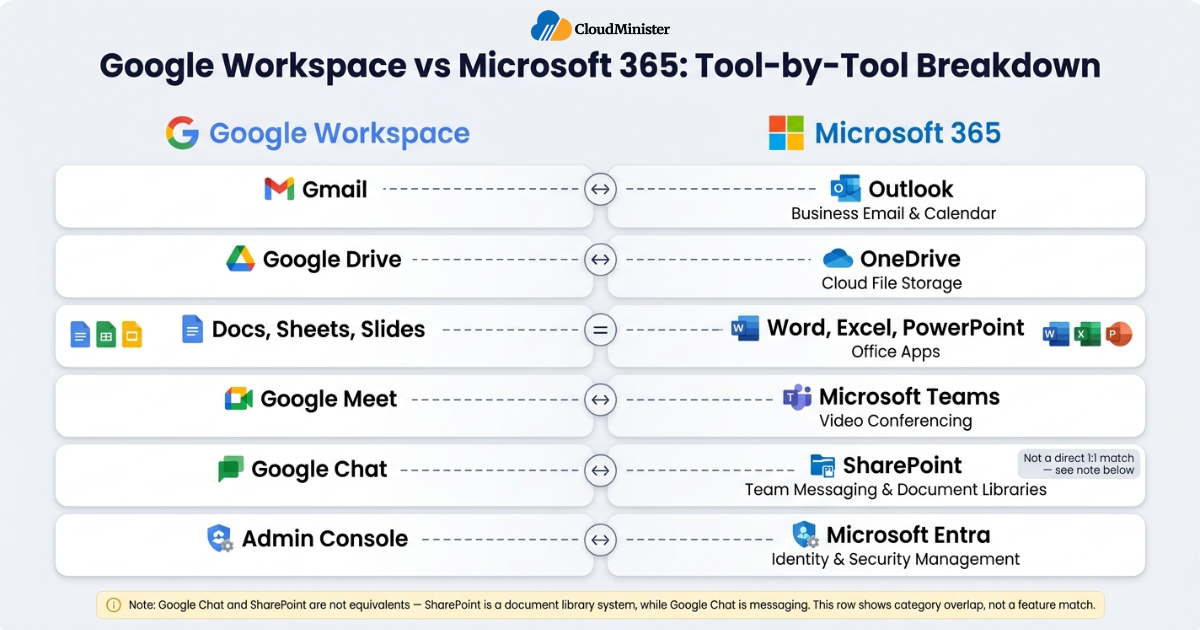
Before going deeper into Google Workspace vs Microsoft 365, it helps to understand what each suite includes, because the two platforms are structured differently under the hood.
Google Workspace includes:
- Gmail for business email on your own domain
- Google Drive for cloud file storage
- Google Docs, Sheets, and Slides for real time collaborative editing
- Google Meet for video conferencing
- Google Chat for team messaging
- Google Calendar for scheduling
- Admin console for user and security management
Microsoft 365 includes:
- Outlook for business email and calendar
- OneDrive for cloud file storage
- Word, Excel, and PowerPoint, both as desktop applications and as web apps
- Microsoft Teams for video calls and chat
- SharePoint for intranet and document libraries
- Microsoft Entra (formerly Azure AD) for identity and security management
When evaluating Google Workspace vs Microsoft 365, a comparison that keeps evolving each year as both vendors ship new features, do not just compare app names side by side, compare workflows instead. If your team already thinks in terms of shared folders and browser based editing, the comparison will likely tilt toward Google. If your team relies on complex Excel macros, pivot tables, and offline desktop editing, Microsoft 365 usually wins that specific workflow, even though both suites offer spreadsheet tools on paper.
RELATED READING: Zoho Workplace vs Google Workspace
2. Google Workspace vs Microsoft 365 Pricing for Indian Businesses in 2026
Pricing is usually the first filter Indian businesses apply when evaluating Google Workspace vs Microsoft 365, since cost per user per month multiplies quickly once headcount grows. A clear grasp of Google Workspace Plans in India pricing alongside Microsoft 365 Plans in India pricing at the outset avoids budget surprises later.
Here is how the core Google Workspace Plans in India typically compare against Microsoft 365 Plans in India, in general terms without locking to volatile exact figures:
- Entry level tier: Both entry plans in Google Workspace Plans in India and Microsoft 365 Plans in India sit in a similar price band, generally offering business email, a fixed amount of cloud storage per user, and access to core office apps through a browser.
- Mid tier: Mid tier options across Google Workspace Plans in India and Microsoft 365 Plans in India usually add more storage, enhanced video meeting capacity, and basic security controls like two step verification and mobile device management.
- Business tier: At this level, both platforms introduce advanced security, eDiscovery, and admin controls suited to growing companies with compliance obligations. Many Indian businesses at this stage also engage a partner offering Microsoft 365 Services or Google WorkSpace Solutions to handle tier selection and configuration correctly the first time.
- Enterprise tier: Custom pricing kicks in for large organizations, and enterprise tiers on both sides include unlimited or very high storage pools, advanced data loss prevention, and dedicated support channels.
For a small or mid sized Indian company weighing the two suites purely on rupee cost, the difference per user per month is often small, but it compounds across fifty, one hundred, or five hundred employees over a full year, so annual billing versus monthly billing terms matter as much as the sticker price itself, whether you are reviewing Google Workspace Plans in India or Microsoft 365 Plans in India. Providers offering Microsoft 365 Services or Google WorkSpace Solutions in India can usually advise on which billing cycle suits a given headcount trajectory.
Whichever way you lean in this pricing decision, always confirm whether two factor authentication, data loss prevention, and admin audit logs are included in your chosen tier, or whether they sit behind a higher priced plan. Indian businesses handling customer financial data under DPDPA 2023 obligations cannot treat these as optional extras.
3. Google Workspace vs Microsoft 365 Storage and File Management
Cloud storage is another area where Google Workspace vs Microsoft 365 diverge in philosophy rather than just numbers.
- Google Drive, part of Google Workspace, uses a flat per user storage pool that can often be pooled across an organization on business and enterprise tiers, which suits teams with uneven storage needs across departments.
- OneDrive, part of Microsoft 365, allocates storage per user as well, but SharePoint adds a separate, larger pool for team and departmental document libraries, which some Indian businesses prefer for structured, permission heavy document sets.
- File versioning exists on both platforms, so recovering earlier versions of a document after accidental edits works similarly either way.
- Offline access differs meaningfully. Microsoft 365 desktop apps offer stronger native offline editing for large, complex files, while Google’s offline mode is functional but better suited to lighter documents.
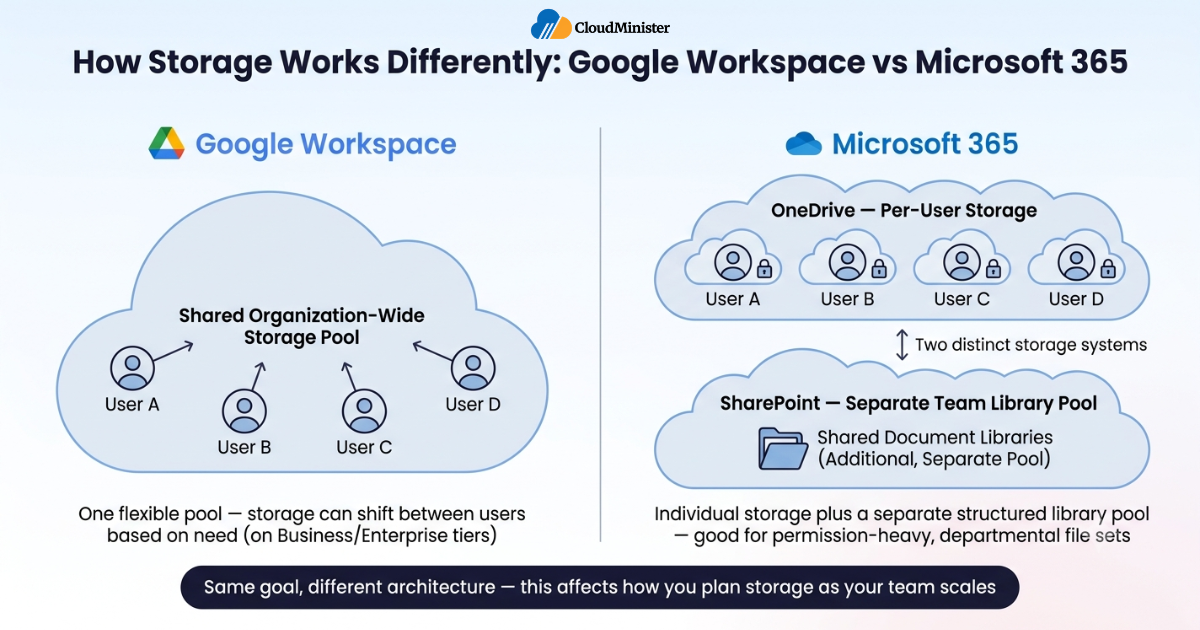
For businesses that generate large volumes of design files, video assets, or engineering drawings, this storage architecture question is not academic in the Google Workspace vs Microsoft 365 comparison. It directly affects how much you will spend on add on storage as your company scales, and whether you also need a separate Affordable Cloud Hosting India provider to hold archival data outside your productivity suite entirely. Businesses already using Affordable Cloud Hosting India for backups often extend the same vendor relationship to cover Microsoft 365 Services or Google WorkSpace Solutions as well, simplifying billing and support into a single point of contact.
RELATED READING: IoT Cloud Integration
4. Collaboration and Real Time Editing
Real time collaboration is where the Google Workspace vs Microsoft 365 comparison becomes genuinely close, because both companies have invested heavily here. In fact, the Google Workspace vs Microsoft 365 real time editing gap has narrowed considerably since 2023.
- Google Docs, Sheets, and Slides were built browser first, so multiple people editing the same file at once with visible cursors and instant syncing feels native, which is why many startups favor Google when browser speed is the priority.
- Word, Excel, and PowerPoint added real time co-authoring later, layered onto desktop first applications, so the experience is strong but occasionally shows sync delays on very large files compared to browser native equivalents.
- Commenting, suggestion mode, and version history are mature on both platforms, so day to day document review workflows feel broadly similar to end users on either suite.
- Microsoft Teams integrates collaborative document editing directly inside chat channels, while Google Chat links out to Docs, Sheets, and Slides, a small but noticeable workflow difference between the two. Teams unsure which experience fits better often trial both through a provider’s Microsoft 365 Services and Google WorkSpace Solutions offerings before committing to one.
Teams that collaborate primarily through short lived documents, quick edits, and browser tabs tend to report a smoother day to day experience with Google Workspace, while teams producing long, heavily formatted, print ready documents such as legal contracts or financial reports often still prefer Microsoft 365’s layout precision. This single distinction resolves a large share of Google Workspace vs Microsoft 365 debates inside Indian companies.
5. Video Conferencing and Communication
Video calling became a permanent fixture of Indian workplaces after 2020, and it remains a core battleground in the Google Workspace vs Microsoft 365 comparison for 2026.
- Google Meet, included across Google Workspace Plans in India, offers browser based joining without a mandatory desktop app, which some IT teams prefer for simplicity, and this convenience is highlighted across most such marketing pages.
- Microsoft Teams, included across Microsoft 365 Plans in India, bundles chat, video, and file collaboration into one heavier application, which suits companies that want a single hub rather than several separate tools, a positioning that Microsoft 365 Plans in India documentation emphasizes heavily.
- Meeting participant caps, recording storage limits, and background noise suppression features exist on both platforms, though exact limits vary by pricing tier, so businesses hosting large webinars or town halls should verify capacity before committing. This is precisely the kind of detail that makes reading the fine print on Google Workspace Plans in India and Microsoft 365 Plans in India worthwhile before signing up.
- Breakout rooms, live captions, and meeting transcription are supported on both platforms, narrowing what used to be a clearer gap between the two. Video conferencing quality also depends on the network layer underneath, which is one reason many Indian companies pair their productivity suite with a reliable Affordable Cloud Hosting India provider for internal infrastructure.
If your Indian business runs frequent large scale webinars, sales demos, or all hands meetings with external clients, check the maximum participant count and recording retention period on your specific plan before finalizing your choice. These limits differ across the entry, business, and enterprise tiers of both platforms.
6. Google Workspace vs Microsoft 365 Security, Compliance, and Admin Controls
Security is a non negotiable part of any serious Google Workspace vs Microsoft 365 evaluation, particularly for Indian businesses handling customer data under DPDPA 2023, and this is one area where reading the fine print on Microsoft 365 Plans in India and Google Workspace Plans in India pays off.
- Both platforms offer two factor authentication, single sign on, and mobile device management as standard features on business tiers and above, and these controls are usually listed clearly within both Google Workspace Plans in India and Microsoft 365 Plans in India documentation.
- Google Workspace uses a centralized Admin console with context aware access policies, while Microsoft 365 relies on Microsoft Entra and Microsoft Purview for identity and compliance management, and the admin experience differs meaningfully in how granular these controls feel to IT administrators.
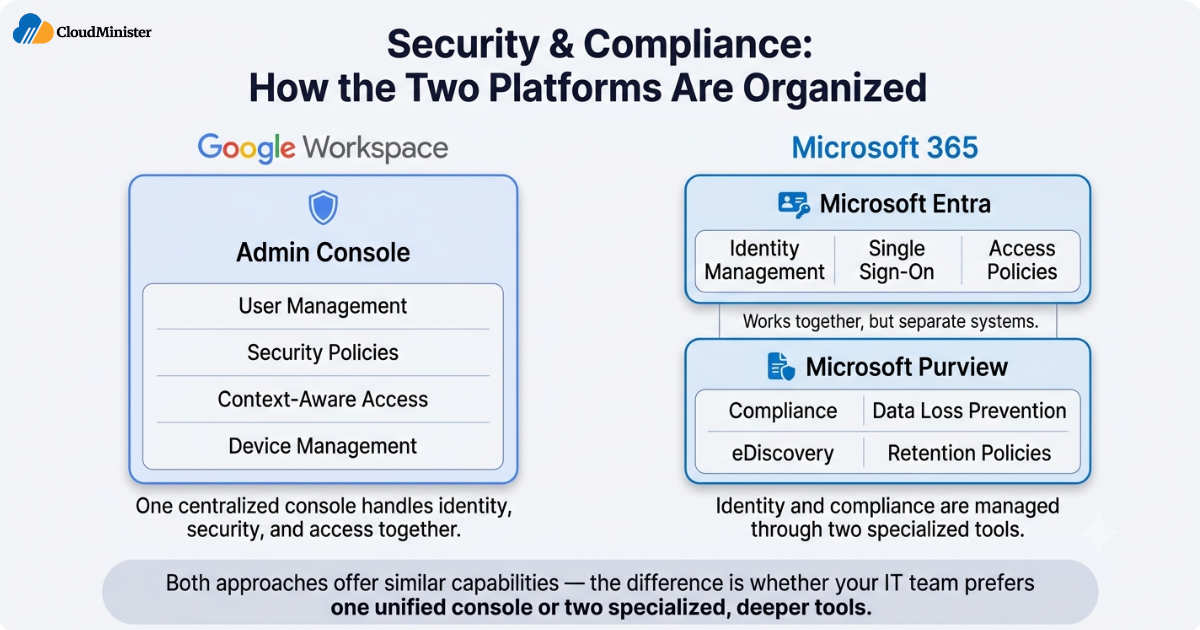
- Data loss prevention, retention policies, and eDiscovery tools exist on both platforms at higher tiers, letting Indian businesses respond to legal holds or regulatory audits without a separate compliance product. These features are typically reserved for the higher rungs of Google Workspace Plans in India and Microsoft 365 Plans in India, not the entry level tiers.
- Encryption in transit and at rest is standard on both offerings, meeting baseline expectations for handling sensitive business and customer information. Businesses handling regulated data sometimes house additional backups on Affordable Cloud Hosting India infrastructure as a second layer of protection beyond the productivity suite’s native encryption.
For Indian businesses in regulated sectors such as BFSI, healthcare, or fintech, it’s still worth confirming where your provider’s default data residency sits, and whether your specific plan supports region locked data storage. DPDPA 2023 itself does not mandate that personal data be stored strictly within India, but sector-specific regulators, such as RBI for payment data – may impose their own localization rules, and the Act does allow the government to restrict transfers to certain countries by notification. Get a clear, written answer on data residency from your provider so you’re prepared either way, rather than assuming it from marketing pages.
7. AI Features in 2026
Every major software category added generative AI in the last two years, and the Google Workspace vs Microsoft 365 comparison for 2026 is incomplete without covering it, since AI features now factor into how businesses shortlist Google Workspace Plans in India against Microsoft 365 Plans in India.
- Google Workspace includes Gemini, integrated directly into Docs, Sheets, Slides, Gmail, and Meet, for drafting text, summarizing long email threads, and generating first draft presentations.
- Microsoft 365 includes Copilot, integrated into Word, Excel, PowerPoint, Outlook, and Teams, for similar drafting, summarizing, and data analysis tasks, often with deeper integration into complex Excel formulas and pivot tables.
- Both AI assistants are usually offered as a paid add on above the base subscription price, rather than bundled for free at every tier, so Indian businesses should budget separately for AI features. A provider delivering Microsoft 365 Services or Google WorkSpace Solutions can often bundle AI licensing into a single predictable monthly invoice.
More than 80 percent of companies are expected to have AI enabled applications deployed by the end of 2026, up sharply from just 5 percent in 2023, a trend that Gartner’s research on enterprise AI adoption highlights as one of the fastest shifts in enterprise software adoption on record. This signals that the AI layer inside modern productivity suites is quickly becoming a default expectation rather than a novelty add on.
Do not choose between the two platforms purely based on which AI assistant produces flashier demo output. Test both AI features on your team’s actual, everyday documents and spreadsheets for at least two weeks before committing budget, since real world usefulness varies significantly by industry and by how structured your existing data already is.
RELATED READING: Productivity with Google Workspace Apps
8. Which Is Better for Startups?
Startups evaluating Google Workspace vs Microsoft 365 usually optimize for speed, low upfront cost, and minimal IT overhead rather than deep enterprise features.
- Google Workspace tends to suit startups that operate primarily through browsers, hire remotely, and prioritize fast onboarding without installing desktop software on every laptop.
- Microsoft 365 tends to suit startups whose founders or early hires come from corporate backgrounds where Excel modeling, Word based legal documents, or PowerPoint heavy investor decks are already deeply embedded habits.
- Since most Indian startups run lean, the decision at this stage often comes down to founder familiarity more than any single technical feature. Many founders simply start with whichever of the Google Workspace Plans in India or Microsoft 365 Plans in India their previous employer used. Many early stage teams start with whichever Google WorkSpace Solutions or Microsoft 365 Services package their first hire already knew from a previous job.
- As the startup scales past fifty or one hundred employees, revisiting the Google Workspace vs Microsoft 365 decision is worthwhile, since needs around compliance, structured document libraries, and formal IT governance typically increase, which usually means moving up a tier within either Google Workspace Plans in India or Microsoft 365 Plans in India.
Ready to Move to Google Workspace?
Get your business email, Drive storage, and Meet set up correctly from day one — with local onboarding support and migration handled for you.
9. Which Is Better for Established Enterprises?
Established Indian enterprises weighing Google Workspace vs Microsoft 365 usually have existing infrastructure, legacy systems, and departmental habits that constrain the decision more than a fresh startup would face, which is another reason enterprises rely on a Web Hosting Company in India for an unbiased assessment.
- Enterprises already running Windows Server, Active Directory, and on premises Exchange often find Microsoft 365 integrates with less disruption, since Microsoft Entra can bridge on premises identity systems with the cloud suite.
- Enterprises that have already standardized on Google Cloud Platform for infrastructure sometimes prefer outcomes that keep identity and billing consolidated under one vendor relationship, which naturally points them toward higher tier Google Workspace Plans in India rather than a competing suite.
- Large enterprises frequently run structured pilot programs, testing both platforms with a single department for one or two quarters before a company wide rollout, which is a sound practice regardless of which platform looks stronger on paper. Enterprises running such pilots often engage a specialist Web Hosting Company in India to manage both Microsoft 365 Services and Google WorkSpace Solutions in parallel during the trial window.
- Migration complexity, not monthly pricing, is usually the deciding factor for large enterprises in the Google Workspace vs Microsoft 365 decision, since moving thousands of mailboxes and shared drives carries real project risk and cost.
RELATED READING: Microsoft 365 Business Plans Comparison
Set Up Microsoft 365 the Right Way
From Excel-heavy workflows to Teams and SharePoint, get a smooth migration and configuration handled by a team that knows Indian business needs.
10. Google Workspace vs Microsoft 365 Support and Reliability in India
Local support quality is an underrated factor in the Google Workspace vs Microsoft 365 decision for Indian businesses that cannot afford extended downtime during business hours, and a responsive Web Hosting Company in India is often the difference between a minor hiccup and a lost business day.
- Both platforms publish uptime service level agreements, typically around 99.9 percent, though real world experience depends heavily on your internet connectivity and your organization’s own IT setup, not just the vendor’s data center reliability. These SLA terms are published within the official Google Workspace Plans in India and Microsoft 365 Plans in India pages and are worth revisiting annually.
- Enterprise tiers of both platforms include phone and priority ticket support, while entry tiers often rely more heavily on community forums and email based support queues.
- Indian businesses report that having a knowledgeable local implementation partner meaningfully improves the experience with either platform, since support tickets raised directly with a vendor can sometimes take longer to resolve for smaller accounts. A dependable Web Hosting Company in India bridges that gap by offering direct, faster local support for both Microsoft 365 Services and Google WorkSpace Solutions customers.
- Working with a Web Hosting Company in India that also offers managed onboarding, migration, and troubleshooting support for both platforms can meaningfully reduce the operational burden on an internal IT team, particularly during the first ninety days after switching.
Enterprise organizations globally now spend tens of millions of dollars a year on average across their SaaS tools, including productivity suites, and a large majority of organizations reported increased SaaS spending in recent industry research, underscoring how central platforms in the Google Workspace vs Microsoft 365 category have become to normal operating budgets rather than optional convenience purchases.
11. Google Workspace vs Microsoft 365 Migration Considerations
Switching between the two platforms, in either direction, involves more than just changing a login screen, so plan the Google Workspace vs Microsoft 365 migration carefully. This is also true when moving associated data to or from Affordable Cloud Hosting India as part of the same project.
- Email migration tools exist on both platforms to import mailboxes, contacts, and calendar entries, but large attachments and old folder structures sometimes need manual cleanup after an automated migration completes.
- Shared drives and SharePoint document libraries do not map one to one, so businesses moving between suites should expect to rebuild some folder permission structures rather than expecting an exact mirror.
- Employee retraining time is often underestimated. Even a straightforward switch benefits from a short internal training session, since muscle memory around keyboard shortcuts and menu locations differs between the two suites. A Web Hosting Company in India offering both Microsoft 365 Services and Google WorkSpace Solutions can typically run this training as part of the onboarding package.
- Running both platforms in parallel for a short transition window, rather than a hard cutover, reduces business disruption for companies serious about a clean migration. This parallel run is easier to manage when a single Web Hosting Company in India is already handling Microsoft 365 Services or Google WorkSpace Solutions support on your behalf.
Before migrating in either direction, export a full backup of your existing mailboxes, shared drives, and admin configuration settings independently of the migration tool itself. Migration tools are reliable in the vast majority of cases, but an independent backup protects your business against the rare edge case where a migration job fails partway through.
12. Which Should Your Indian Business Choose in 2026?
There is no single universal winner in the Google Workspace vs Microsoft 365 debate, because the right choice depends on your team’s existing habits, your growth stage, and your compliance requirements. Revisiting the Google Workspace vs Microsoft 365 comparison every couple of years as your team grows is a healthy practice rather than a one time decision made and forgotten.
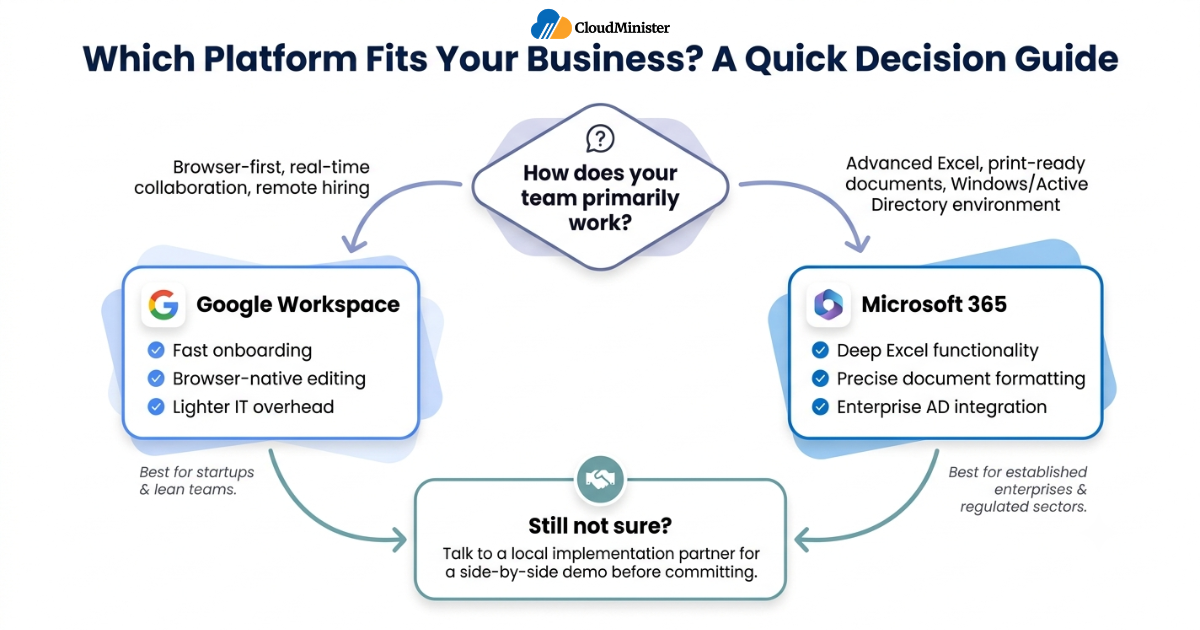
- Choose Google Workspace if your team is browser first, values fast real time collaboration, hires remote talent frequently, and does not depend heavily on complex desktop grade Excel modeling, and consider Affordable Cloud Hosting India for any website or application infrastructure running alongside it.
- Choose Microsoft 365 if your team relies on advanced Excel functionality, produces heavily formatted print ready documents, or already operates inside a Windows and Active Directory environment, and pair either choice with Affordable Cloud Hosting India if you need extra storage capacity.
- Consider your AI feature budget separately, since both Gemini and Copilot are usually priced as add ons rather than included at every tier. Ask any prospective Web Hosting Company in India whether their Microsoft 365 Services or Google WorkSpace Solutions packages include AI licensing or bill it separately, and whether Affordable Cloud Hosting India can be added to the same invoice.
- Consider working with an experienced Web Hosting Company in India for setup, migration, and ongoing support, regardless of which side of the Google Workspace vs Microsoft 365 decision your business lands on.
CloudMinister offers dedicated Google WorkSpace Solutions as well as Microsoft 365 Services for Indian businesses evaluating this decision, alongside Affordable Cloud Hosting India options for companies that need archival storage or infrastructure beyond either productivity suite. As a Web Hosting Company in India, CloudMinister’s support team helps businesses compare Google Workspace vs Microsoft 365 against their specific workflows, migrate existing mailboxes and files without data loss, and configure security settings correctly from day one, so the decision becomes a confident business choice rather than a guessing game.
Businesses that choose Google WorkSpace Solutions through CloudMinister benefit from local onboarding support, while businesses that choose Microsoft 365 Services get the same dedicated attention during setup and migration. Either Google WorkSpace Solutions or Microsoft 365 Services can also be paired with Affordable Cloud Hosting India for teams that need extra storage beyond their productivity suite’s built in limits. Whether your final choice in the Google Workspace vs Microsoft 365 comparison leans toward Google WorkSpace Solutions or Microsoft 365 Services, pairing it with Affordable Cloud Hosting India for backup and archival storage is a sensible way to keep your total infrastructure cost predictable. As an established Web Hosting Company in India, CloudMinister also supports businesses that want to run Affordable Cloud Hosting India alongside their chosen productivity suite for websites, internal tools, or customer facing applications, all billed and supported through a single Web Hosting Company in India relationship rather than juggling multiple vendors.
For businesses still undecided, requesting a side by side demo of Google WorkSpace Solutions and Microsoft 365 Services from the same Web Hosting Company in India is often the fastest way to reach a confident decision, since a neutral implementation partner has no incentive to favor one suite over the other and can also advise on complementary Affordable Cloud Hosting India needs at the same time.
Still Not Sure Which One Fits Your Business?
Talk to our team for a side-by-side demo of Google Workspace and Microsoft 365, tailored to your team size, budget, and compliance needs.
13. Choosing a Local Partner for Setup and Support
Many Indian businesses underestimate how much a good local partner changes the day to day experience of either suite, regardless of which side of the Google Workspace vs Microsoft 365 comparison they land on.
- A Web Hosting Company in India that specializes in Google WorkSpace Solutions can typically complete a domain verification and mailbox migration within a single business day for small teams, which is one reason Google WorkSpace Solutions remains popular with fast moving startups.
- A Web Hosting Company in India offering Microsoft 365 Services usually bundles basic user training into the onboarding package, which reduces support tickets in the first month significantly, a pattern seen across most well run Microsoft 365 Services engagements.
- When comparing Google Workspace Plans in India against Microsoft 365 Plans in India, ask your prospective Web Hosting Company in India for a written breakdown of what is included at each tier, rather than relying on generic marketing pages alone.
- Businesses running Affordable Cloud Hosting India for their website or internal applications often prefer to add Google WorkSpace Solutions or Microsoft 365 Services through the same Web Hosting Company in India, since it consolidates billing, support tickets, and renewal dates into one calendar instead of several.
- A Web Hosting Company in India managing both Affordable Cloud Hosting India and your chosen productivity suite can also coordinate DNS, mail routing, and domain settings more smoothly than splitting these across unrelated vendors, since Affordable Cloud Hosting India and email routing settings often overlap technically.
Before signing an annual contract for Google Workspace Plans in India or Microsoft 365 Plans in India, ask your Web Hosting Company in India whether Affordable Cloud Hosting India services can be added later without a separate onboarding fee, and whether Microsoft 365 Services or Google WorkSpace Solutions renewals can be aligned to the same billing date. Bundling early, where it makes sense for your business, is often cheaper than adding Affordable Cloud Hosting India as an afterthought six months into your subscription.
Key Takeaways
1. Google Workspace vs Microsoft 365 is no longer decided by email interface alone. Storage architecture, AI features, and security controls now weigh equally in the decision.
2. Google Workspace Plans in India and Microsoft 365 Plans in India sit in a similar price band at the entry level, but the gap widens or narrows depending on storage and security add ons at higher tiers.
3. Google Workspace tends to suit browser first, real time collaborative teams, while Microsoft 365 tends to suit teams dependent on advanced Excel modeling and print ready document formatting.
4. AI features, Gemini for Google Workspace and Copilot for Microsoft 365, are usually paid add ons and should be tested on real business documents before committing budget.
5. DPDPA 2023 compliance and data residency should be confirmed in writing for either platform before signing a contract, not assumed from marketing pages.
6. Migration in the Google Workspace vs Microsoft 365 direction of your choice requires planning for folder permission rebuilding and staff retraining, not just an automated import tool.
7. A trusted Web Hosting Company in India can meaningfully reduce onboarding friction for either platform, particularly for growing Indian businesses without a large internal IT team.
Conclusion
By now it should be clear that there’s no “winner” in the Google Workspace vs Microsoft 365 debate — just a better fit for how your team actually works. That’s not a cop-out answer. It’s the honest one.
If you strip away the marketing pages and feature checklists, the decision really comes down to a handful of practical questions: Does your team live in the browser, or does it live in Excel? Are you hiring remote talent who’ll pick up any tool in a day, or onboarding people who’ve spent a decade inside the Microsoft ecosystem? Do you need airtight, print-ready formatting for client-facing documents, or is speed and real-time collaboration the bigger priority? Your honest answers to these questions will tell you more than any comparison chart.
It’s also worth remembering that this isn’t a decision you make once and forget. A five-person startup and a two-hundred-person company have very different needs, even if they’re technically running the same suite. What worked when you were scrappy and browser-first might start to feel limiting once compliance, structured document libraries, and formal IT governance enter the picture. Revisiting this choice every couple of years — rather than treating it as permanent — is just good practice.
A few things deserve extra attention before you sign anything:
- Budget for AI separately. Gemini and Copilot are genuinely useful, but they’re usually paid add-ons rather than something bundled in by default. Test them on your own team’s real documents and spreadsheets before assuming they’ll pay for themselves.
- Get your DPDPA 2023 compliance commitments in writing. Note that DPDPA 2023 doesn’t currently require personal data to stay within India, but if your business handles customer data, it’s still worth a direct conversation with your provider about data residency, audit logs, and how they support compliance — rather than assuming details from a pricing page.
- Plan for the human side of migration. Automated tools can move mailboxes and files reasonably well, but folder permissions rarely map one-to-one, and your team will need time to unlearn old habits and build new ones. Underestimating this is one of the most common mistakes businesses make when switching.
At the end of the day, either platform can serve an Indian business well in 2026. The suite itself matters less than how thoughtfully you implement it — how well you configure security from day one, how smoothly you migrate without losing data, and how much support your team gets in the weeks after the switch. Get those fundamentals right, and Google Workspace vs Microsoft 365 stops being a stressful, high-stakes decision and becomes what it should be: a fairly straightforward operational choice that fits your business as it is today, with room to grow into.
Frequently Asked Questions
1. Which is cheaper for Indian businesses, Google Workspace or Microsoft 365?
Entry-level pricing for both platforms sits in a similar rupee range, so cost alone rarely decides the choice. The real gap appears at mid and business tiers, where storage limits, security add-ons, and AI licensing for Gemini or Copilot can push one platform’s total cost noticeably higher than the other.
2. Is Gemini or Copilot better for everyday business use?
Neither is universally better. Copilot has an edge in Excel-heavy work like formulas, pivot tables, and data analysis, while Gemini tends to be smoother for drafting and summarizing inside Docs, Sheets, and Gmail. The better fit depends on which tasks your team repeats most often.
3. Do I need to pay extra for AI features in Google Workspace or Microsoft 365?
Yes, in most cases. Both Gemini and Copilot are typically sold as paid add-ons on top of the base subscription rather than included free at every tier. Budget for AI access separately when comparing total costs between the two platforms.
4. Is Google Workspace or Microsoft 365 better suited for small teams and startups in India?
Startups that operate primarily through browsers and hire remote talent often find Google Workspace faster to onboard. Founders with corporate backgrounds who rely on advanced Excel modeling or heavily formatted Word documents typically find Microsoft 365 a better fit for existing habits.
5. Which platform offers better data security and compliance for Indian businesses under DPDPA 2023?
Both platforms offer two-factor authentication, encryption, and data loss prevention at higher tiers, so neither has a clear built-in advantage. DPDPA 2023 doesn’t currently require data to be stored within India, but confirming audit-log availability — and data residency if your sector has its own rules — in writing is still good practice before signing a contract.
6. How difficult is it to migrate from Google Workspace to Microsoft 365, or vice versa?
Migration tools handle mailboxes, contacts, and calendars reasonably well, but shared drives and SharePoint libraries rarely map one-to-one, so plan to rebuild folder permissions manually. Running both platforms in parallel briefly, alongside an independent backup, reduces the risk of disruption.

He is the CEO and Founder with over a decade of experience in cloud infrastructure, DevOps, and server optimization. With a strong vision and hands-on leadership approach, he has built scalable, secure, and high-performance cloud solutions trusted by businesses across industries.