Indian small and medium businesses (SMBs) face a recurring infrastructure decision: should they standardise on Zoho Workplace or Google Workspace for email, collaboration, storage and productivity? The zoho workplace vs google workspace debate is not a one-size-fits-all question — it depends on team size, budget, compliance requirements, integration needs and long-term scalability. This guide delivers a technically accurate, India-focused breakdown of the zoho workplace vs google workspace decision covering pricing, features, security, data residency and real-world fit — so your team can make the right call the first time.
Choosing the right productivity suite directly impacts your operating costs, your team’s collaboration velocity and your compliance posture. For Indian SMBs evaluating zoho workplace vs google workspace in 2026, the decision can mean the difference between a fully optimised digital workplace and a costly mid-cycle migration. This guide is written for founders, IT managers, finance leads and operations heads who need a clear, numbers-grounded comparison — not a vendor sales pitch.
Below, we unpack the zoho workplace vs google workspace decision across every dimension that actually matters in the Indian market: per-user pricing in INR, GST treatment, storage limits, AI capabilities, integration with Indian compliance frameworks like DPDPA 2023, and how each suite handles the realities of mixed connectivity, regional language support and reseller ecosystems. For SMBs evaluating Zoho Email Solutions for Business alongside the full productivity comparison, we also cover the email-only Mail Lite and Mail Premium tiers.
1. Why the Zoho Workplace vs Google Workspace Question Matters in 2026
Indian SMBs are no longer asking whether to move to a cloud-based productivity suite — that decision is largely settled. The new question is which suite, and the zoho workplace vs google workspace comparison sits at the top of every IT procurement shortlist in 2026. Comparing Google Workspace Plans against Zoho Workplace tiers is now a board-level discussion at most Indian SMBs.
Key Drivers Behind This Decision
- Cost pressure: Indian SMBs operate on tighter margins than their global counterparts, and per-user productivity suite costs compound rapidly across teams of 20, 50 or 200 employees.
- DPDPA 2023 compliance: India’s Digital Personal Data Protection Act has reshaped how SMBs evaluate cloud providers, particularly around data residency, breach notification and consent management.
- AI feature parity: Both Zoho and Google have aggressively pushed generative AI into their suites in 2025–2026, making the zoho workplace vs google workspace AI comparison a real differentiator for productivity-focused teams.
- Regional language support: Indian teams increasingly need Hindi, Tamil, Telugu, Marathi and Bengali support — not as a nice-to-have but as a baseline requirement for tier-2/tier-3 city operations.
- Integration ecosystem: The right suite depends heavily on what other tools your business already uses — CRM, accounting, HR, marketing — and how cleanly the productivity layer integrates with them.
Before evaluating the zoho workplace vs google workspace question, map your team’s actual workflow over the last 90 days. Count the integrations, the storage consumed per user, the meeting hours and the regional language usage. A productivity suite chosen on feature brochures alone almost always under-delivers compared to one chosen on real workload data.
2. Suite Composition: What You Actually Get in Each Platform
The first technical layer of the zoho workplace vs google workspace comparison is what is actually inside the box. Both platforms bundle email, file storage, document editing, video conferencing and chat — but the underlying apps and their depth of functionality differ in meaningful ways.
2.1 Zoho Workplace — Core Applications
Zoho Email Solutions for Business sit at the centre of the Zoho Workplace suite, with the broader productivity layer built around the Zoho Mail core:
- Zoho Mail: Business email hosting with custom domain support, advanced spam filtering, e-discovery and DMARC/SPF/DKIM controls — the backbone of Zoho Email Hosting for Indian SMBs.
- Core email features include unlimited domains on higher plans, mail aliases, group mailboxes, IMAP/POP/ActiveSync support and webmail with offline mode.
- Zoho Writer, Sheet and Show: Document, spreadsheet and presentation editors with real-time co-authoring.
- Zoho Cliq: Team chat with channels, threads and direct messaging.
- Zoho Meeting: Video conferencing and webinar hosting integrated into the suite.
- Zoho WorkDrive: Team file storage with permission controls and version history.
- Zoho Connect: Internal team intranet and announcement boards.
- Zia AI: Zoho’s built-in AI assistant for writing, summarisation and data insights.
2.2 Google Workspace — Core Applications
- Gmail: Business email with custom domain, advanced threat protection, eDiscovery via Vault on higher tiers, and one of the strongest sender reputations in the global email ecosystem.
- Google Docs, Sheets and Slides: The industry-standard cloud document, spreadsheet and presentation editors.
- Google Chat: Team messaging integrated with Gmail and Spaces.
- Google Meet: Video conferencing with noise cancellation, recording and live streaming on higher tiers.
- Google Drive: Cloud storage with pooled-storage architecture across the organisation.
- Google Calendar: The widely-adopted calendar layer that integrates with Meet, Tasks and Gmail.
- Gemini AI: Google’s generative AI assistant embedded across Gmail, Docs, Sheets, Slides and Meet, available across Google Workspace Plans in India in 2026.
At first glance the suites look near-identical in scope. The differences emerge in the depth of each application, the AI capabilities at each price tier and — most importantly for Indian SMBs — the pricing structure.
3. The Pricing Reality — Zoho Workplace vs Google Workspace in INR
Pricing is where the zoho workplace vs google workspace gap is most visible for Indian SMBs. Both platforms publish per-user-per-month pricing in INR with 18% GST applied at checkout, but the actual rupee outlay over a 12-month horizon can differ by 2× to 4× depending on which tier and plan you select.
3.1 Zoho Workplace Pricing (India 2026)
| Plan | Price (per user/mo) | Storage | Key Inclusions |
| Mail Lite | ₹59 | 10 GB / user | Email-only, custom domain |
| Mail Premium | ₹118 | 50 GB / user | Email + e-discovery + larger attachments |
| Workplace Standard | ₹99 | 30 GB Mail + 30 GB WorkDrive | Full suite — Mail, Writer, Sheet, Show, Cliq, Meeting, WorkDrive |
| Workplace Professional | ₹399 | 100 GB Mail + 100 GB WorkDrive | Full suite + advanced security + admin controls |
Pricing is annual-billing per user per month, excluding 18% GST. Monthly billing carries a 15–20% premium. Zoho Email Hosting is included at every Workplace tier, with the Mail Lite plan available as a standalone email-only option. Indian SMBs evaluating Zoho Email Hosting separately from the full Workplace suite can also opt for Mail Lite or Mail Premium without losing access to custom domain features.
Get Started with Zoho Email Solutions.
From Mail Lite to Workplace Professional — find the right Zoho plan with Indian SMB pricing and dedicated onboarding support.
3.2 Google Workspace Pricing (India 2026)
Google Workspace Plans for Indian businesses are organised across four tiers — Business Starter, Business Standard, Business Plus and Enterprise — with introductory pricing available to new customers for the first 20 users in the first 12 months.
| Plan | Price (per user/mo) | Storage | Key Inclusions |
| Business Starter | ₹136 – ₹165 | 30 GB pooled / user | Custom email, 100-participant Meet, basic admin |
| Business Standard | ₹736 – ₹864 | 2 TB pooled / user | Meet recording, 150-participant Meet, Gemini features |
| Business Plus | ₹1,500 – ₹1,700 | 5 TB pooled / user | Vault, eDiscovery, endpoint management, 500-participant Meet |
| Enterprise | Custom | 5 TB+ pooled / user | Advanced security, DLP, S/MIME, data regions |
Prices reflect promotional and reseller rates for the first 12 months; standard pricing applies after the introductory window. All Google Workspace Plans in India exclude 18% GST and are billed per user per month on annual commitment. Monthly billing is typically 20% higher. The Google Workspace Plans in India pricing structure has remained largely stable through 2025–2026, with minor adjustments driven by reseller discounting.
Explore Google Workspace Plans for Your Team.
Get reseller pricing, GST-compliant invoicing and free migration support for Indian SMBs
3.3 The Annual INR Comparison That Matters
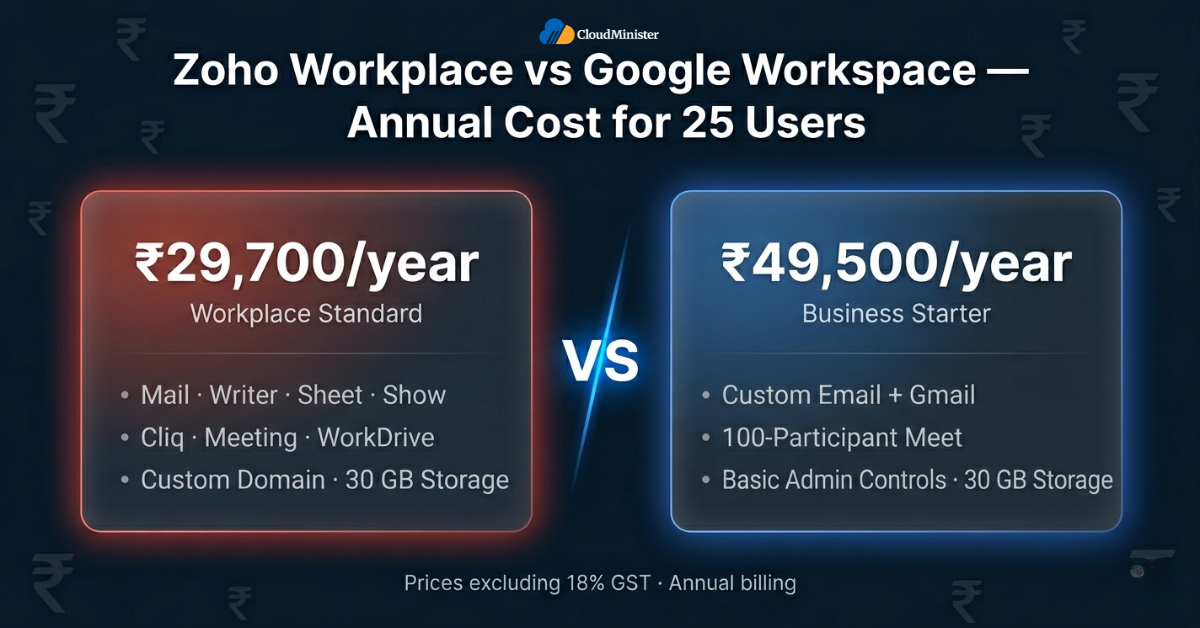
Here is the practical zoho workplace vs google workspace comparison most Indian SMBs care about — the actual annual outlay for a 25-user team:
- Zoho Workplace Standard (25 users): ₹99 × 25 × 12 = ₹29,700/year + GST
- Google Workspace Business Starter (25 users): ₹165 × 25 × 12 = ₹49,500/year + GST
- Google Workspace Business Standard (25 users, at maximum reseller rate): ₹864 × 25 × 12 = ₹2,59,200/year + GST. At the base rate of ₹736/user/month, the same team costs ₹2,20,800/year + GST.
On pure entry-level pricing, Zoho Workplace Standard delivers the full collaboration suite at roughly 60% the cost of Google Workspace Business Starter — and Google Workspace Business Starter does not include meeting recording, advanced storage or the higher-tier AI features. The pricing gap widens further at the Standard/Professional tier where Zoho Workplace Professional at ₹399 sits well below Google Workspace Business Standard at ₹864.
Related Reading: Zoho Mail pricing in India: plans, features and best deals
Sticker price is only part of the zoho workplace vs google workspace cost comparison. Indirect costs — migration, training, integration rework and admin overhead — can add 10–25% to the first-year total. Any procurement decision built on listed per-user price alone is modelling an incomplete scenario. Always request an itemised quote from an authorised reseller before committing.
4. Storage Architecture — The Hidden Differentiator
Storage is one of the most underrated dimensions of the zoho workplace vs google workspace decision. Both suites allocate storage per user, but the architecture and effective usable capacity differ in ways that materially affect Indian SMBs.
4.1 Google Workspace Pooled Storage
- Google Workspace uses pooled storage — all user allocations combine into a single organisation-wide pool that any user can consume as needed.
- Business Starter: 30 GB × users (e.g. 25 users = 750 GB pooled).
- Business Standard: 2 TB × users (e.g. 25 users = 50 TB pooled) — usually more than most Indian SMBs will exhaust in 3+ years.
- Business Plus: 5 TB × users (e.g. 25 users = 125 TB pooled).
- Pooling is efficient when usage is uneven — heavy users can consume from light users’ shares without admin reallocation.
4.2 Zoho Workplace Per-User Storage
- Zoho Workplace allocates storage on a per-user basis rather than pooled — Mail storage and WorkDrive storage are separate buckets.
- Workplace Standard: 30 GB Mail + 30 GB WorkDrive per user — totalling 60 GB in combined allocation, split across two separate storage buckets that cannot be used interchangeably.
- Workplace Professional: 100 GB Mail + 100 GB WorkDrive per user (200 GB effective per user).
- Additional WorkDrive storage can be purchased as add-ons at predictable per-GB INR rates.
- The per-user model is more cost-predictable but less flexible than Google’s pooled approach.
For most Indian SMBs in the 10–50 employee range, Zoho Workplace Standard delivers more usable per-user storage than Google Workspace Business Starter — 60 GB effective per user vs 30 GB pooled. The Google Workspace storage advantage only materialises at the Business Standard tier and above, where pricing is significantly higher. Storage limits are a key differentiator and should be modelled against your team’s actual 3-year storage projection.
4.3 The Indian SMB Adoption Context
The pace of cloud productivity adoption among Indian SMBs in 2026 makes this storage and pricing comparison particularly relevant. SMBs globally are projected to allocate a majority of their technology budgets to cloud services in 2026, and India sits at the higher end of this curve.
According to a 2026 cloud computing market analysis, 48% of SMBs plan to increase their cloud spending in 2026, with email and productivity tools accounting for 91% of all cloud services used by SMBs — making the zoho workplace vs google workspace decision one of the most consequential infrastructure choices for an Indian SMB in 2026.
This adoption curve reinforces a key point: choosing the wrong productivity suite is no longer a low-stakes decision. Email and storage architectures chosen today will compound over a 3–5 year horizon, and the migration cost of a mid-cycle change is non-trivial.
5. AI Capabilities — Gemini vs Zia in 2026
The 2025–2026 generative AI race has fundamentally reshaped the zoho workplace vs google workspace comparison. Both vendors have embedded AI deeply across their suites, but the access tiers, capabilities and cost overheads differ meaningfully.
5.1 Gemini in Google Workspace
- Gemini is integrated across Gmail, Docs, Sheets, Slides, Meet and Drive.
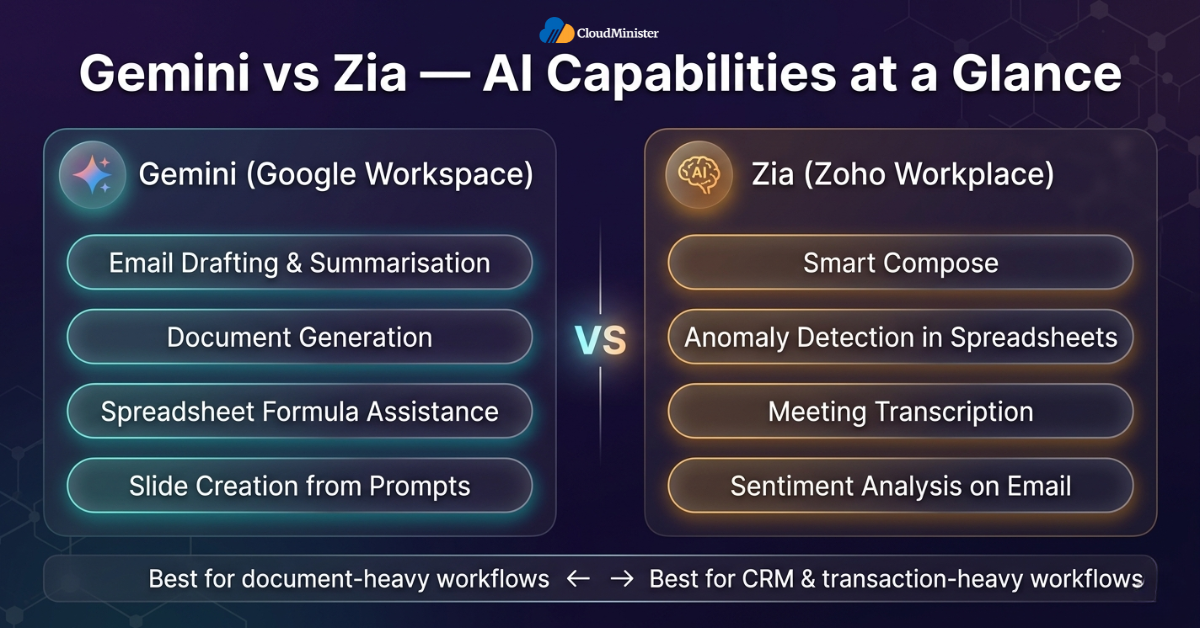
- Capabilities include email drafting and summarisation, document generation, spreadsheet formula assistance, slide creation from prompts, real-time Meet translation and noise cancellation.
- Access tiers vary across Google Workspace Plans in India — Business Standard and above unlock the broader Gemini feature set, while Business Starter has limited AI access.
- Gemini’s strengths lie in document generation quality, large-context understanding and tight integration with Google Search.
5.2 Zia in Zoho Workplace
- Zia is Zoho’s AI layer embedded across Mail, Writer, Sheet, Show, Cliq and Meeting.
- Capabilities include smart compose, anomaly detection in spreadsheets, meeting transcription, sentiment analysis on email and conversational data queries.
- Zia is included across Workplace plans without the steep tier-jump that Gemini access requires in Google Workspace.
- Zia’s strengths lie in contextual integration across the broader Zoho ecosystem (CRM, Books, People) — a meaningful advantage for SMBs already on Zoho stack.
For pure AI capability and document generation quality at the top tier, Gemini in Google Workspace currently leads. For AI integrated across a broader business workflow at lower price points, Zia in Zoho Workplace offers better value. The right zoho workplace vs google workspace choice on AI depends heavily on whether your business workflow is document-heavy (favouring Gemini) or transaction-heavy across CRM/accounting/HR (favouring Zia).
Related Reading: how to boost productivity using Google Workspace
Do not let AI feature lists alone decide your zoho workplace vs google workspace question. Run a 30-day pilot with 3–5 users on each platform using your actual workload — real emails, real spreadsheets, real meetings. Pilot data beats vendor demo videos every time.
6. Security, Compliance and DPDPA 2023 Readiness
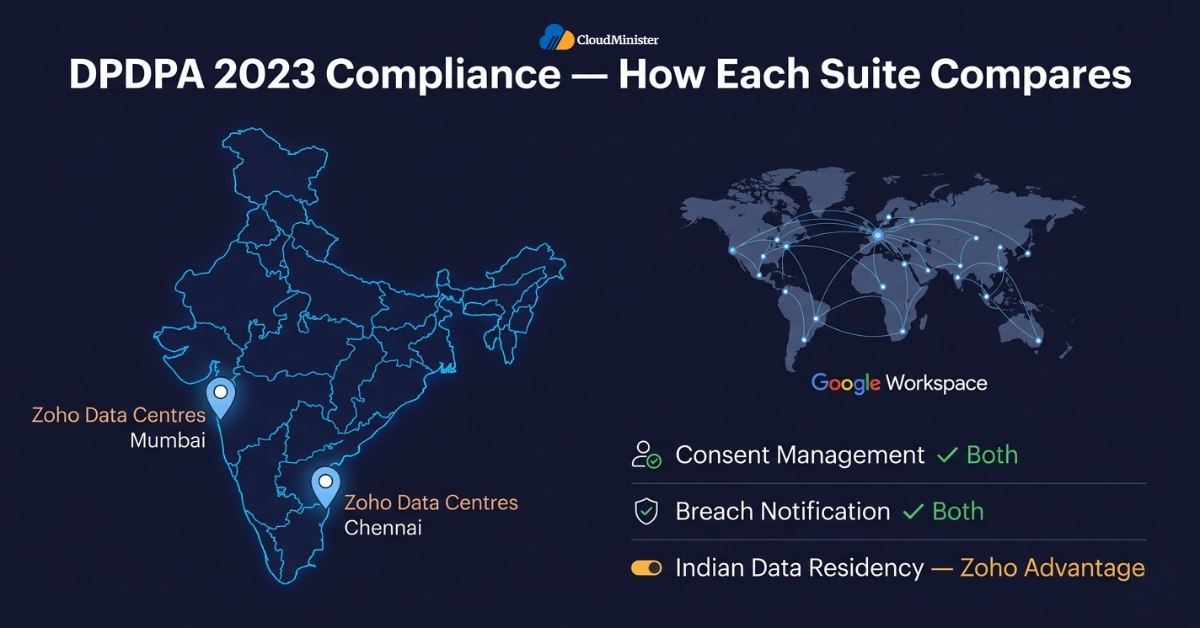
Security and regulatory compliance are increasingly central to the zoho workplace vs google workspace decision for Indian SMBs. The Digital Personal Data Protection Act 2023 (DPDPA) does not impose blanket data localisation — cross-border data transfers are generally permitted except to countries notified as restricted by the central government — but it does require robust consent management, breach notification within prescribed timelines and clear data fiduciary accountability.
6.1 Google Workspace Security Posture
- Industry-leading anti-phishing, anti-malware and spam filtering across Gmail.
- Two-factor authentication and security key enforcement on all paid plans.
- Vault: legal hold, eDiscovery and retention controls — included by default on Business Plus and Enterprise plans, and available as a paid add-on for Business Starter and Business Standard.
- Data Loss Prevention (DLP) policies on Business Plus and Enterprise tiers.
- Data regions feature on Enterprise plans allows specifying data storage geography. Across the lower Google Workspace Plans, data regions are not configurable.
- SOC 2, ISO 27001, ISO 27017 and ISO 27018 certifications.
6.2 Zoho Workplace Security Posture
- Zoho operates data centres in India (Mumbai and Chennai), and Indian business customers can configure their accounts to store and process data within these regional facilities, providing clearer jurisdictional alignment under DPDPA 2023.
- Two-factor authentication, S/MIME, IP restrictions and session controls available on Workplace Professional.
- Zoho explicitly states it does not run advertising on its business email products — a privacy posture distinct from ad-supported consumer email.
- ISO 27001, SOC 2 Type II and GDPR alignment.
- Zoho Vault and admin audit logs available for compliance-heavy use cases.
- Indian data centre availability is a meaningful operational advantage for SMBs that prefer regional data processing, though DPDPA 2023 does not mandate strict in-country data residency as a compliance baseline.
On security feature depth at the top tier, both platforms are competitive. On native Indian data residency — increasingly relevant for SMBs in financial services, healthcare and government-adjacent sectors — Zoho Workplace has a structural advantage. On global compliance certifications and breadth of admin tooling, Google Workspace Plans in India still lead in 2026.
6.3 Market Share and Enterprise Trust
Market share data offers a useful proxy for enterprise trust and ecosystem maturity in the zoho workplace vs google workspace debate.
According to data published in 2026, Google Workspace holds approximately 50.34% of the global productivity software market share, with more than 8 million paying business customers worldwide. Google’s broader ecosystem — including free Gmail accounts — reaches over 3 billion users globally, underpinning the deep third-party integration ecosystem of 5,000+ apps in the Workspace Marketplace. This commanding market position contributes to a deep third-party integration ecosystem — over 5,000 apps in the Google Workspace Marketplace — that is a meaningful factor for Indian SMBs already using complementary SaaS tools.
Zoho’s installed base in India is structurally larger than its global market share suggests — Zoho is an Indian company, headquartered in Chennai, and its Indian SMB penetration in segments like accounting, CRM and HR is significantly higher than its global productivity-suite numbers indicate.
Related Reading: how SMEs are reducing email costs using Zoho Mail
7. Integration Ecosystem and Indian Business Stack Fit
A productivity suite is only as useful as the rest of your business stack lets it be. The zoho workplace vs google workspace decision must account for how each platform integrates with the CRM, accounting, HR, marketing and payment tools your business already uses or plans to adopt.
7.1 Google Workspace Integration Strengths
- Native integration with Salesforce, HubSpot, Slack, Trello, Asana and 5,000+ third-party tools via Google Workspace Marketplace.
- Deep integration with Android and iOS ecosystems for mobile-first teams.
- Strong support for Zapier, Make and other no-code automation platforms.
- Calendar and Meet integrations are widely supported across third-party scheduling and CRM tools.
- Drive APIs are mature, well-documented and used extensively by Indian SaaS builders.
7.2 Zoho Workplace Integration Strengths
- Native integration with the broader Zoho ecosystem — Zoho CRM, Zoho Books, Zoho People, Zoho Desk, Zoho Projects — at no incremental licensing cost for many connectors.
- If your business already uses 2+ Zoho apps, Zoho Workplace integrates more cleanly than any third-party productivity suite.
- Zoho Flow connects to 900+ third-party apps.
- Zoho Email Solutions for Business integrates natively with Zoho CRM contact and lead workflows — a meaningful productivity win for sales-led Indian SMBs.
- Integration with Indian payment gateways (Razorpay, PayU, Instamojo) is more mature in Zoho’s ecosystem than in Google’s.
If your stack is global-first and built around Salesforce, HubSpot, Slack or similar tools, Google Workspace integrates more cleanly. If your stack is India-first and built around Zoho apps, Tally, Razorpay and Indian-market SaaS, Zoho Workplace integrates more cleanly. This is the single most predictive variable in the zoho workplace vs google workspace decision after pricing. Indian SMBs already running Zoho CRM or Zoho Books should default to evaluating the Zoho productivity layer as the natural next step.
Related Reading: how to migrate your business email to Google Workspace in easy steps
The most common mistake Indian SMBs make in the zoho workplace vs google workspace decision is evaluating the suite in isolation. The right approach is integration-first: list every business-critical tool your team uses today, map the integrations available on each platform, and weight the score by integration depth — not by raw feature count.
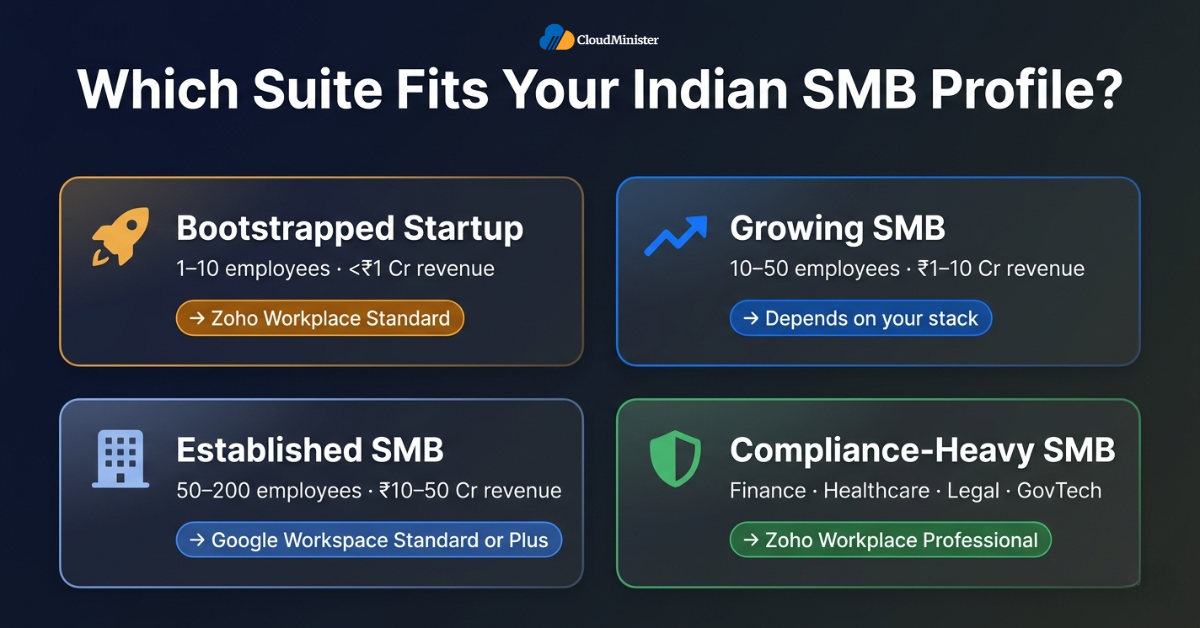
8. Decision Framework — Which Suite Fits Your SMB Profile?
There is no universal answer to the zoho workplace vs google workspace question, but there are clear answers for specific Indian SMB profiles. The following decision framework covers the most common archetypes we see in 2026 — and the right tier varies sharply by profile.
Profile 1: Bootstrapped Startup (1–10 employees, <₹1 Cr revenue)
- Recommendation: Zoho Workplace Standard.
- At ₹99/user/month, you get the full suite for the equivalent cost of a single coffee per user per month.
- Zoho Email Solutions for Business at this tier delivers everything a 10-person team needs — custom domain, calendar, chat, video, document collaboration.
- Reserve Google Workspace evaluation for when revenue and headcount cross meaningful thresholds.
Profile 2: Growing SMB (10–50 employees, ₹1–10 Cr revenue)
- Recommendation: Either suite — the zoho workplace vs google workspace decision tips on integration ecosystem.
- If your CRM/accounting/HR is on Zoho, choose Zoho Workplace.
- If your stack is Salesforce/HubSpot/global SaaS, choose Google Workspace Business Starter or Standard.
- Run a parallel 30-day pilot before committing to a 12-month annual plan.
Profile 3: Established SMB (50–200 employees, ₹10–50 Cr revenue)
- Recommendation: Likely Google Workspace Business Standard or Plus.
- At this scale, the Gemini AI advantage and the 5,000+ integration marketplace deliver meaningful productivity ROI.
- Storage flexibility (pooled architecture) becomes more valuable as usage patterns diversify.
- Vault and DLP on Business Plus address the compliance posture larger SMBs typically need.
Profile 4: Compliance-Heavy SMB (Finance, Healthcare, Legal, GovTech)
- Recommendation: Zoho Workplace Professional — primarily for the native Indian data residency advantage.
- Zoho’s Mumbai and Chennai data centres provide the strongest jurisdictional clarity for DPDPA 2023 compliance.
- Combine with a reliable Web Hosting Provider in India for any additional infrastructure components your business needs.
- Document your data flow architecture clearly for compliance audits — a step your suite vendor cannot do for you.
9. Common Mistakes Indian SMBs Make in the Zoho Workplace vs Google Workspace Decision
After advising hundreds of Indian SMBs on productivity suite procurement, certain mistakes show up repeatedly. Avoiding them is often more valuable than choosing the right suite in the first place.
9.1 Mistake: Choosing on Sticker Price Alone
- Per-user-per-month listed price is roughly 65–75% of true first-year cost.
- Add 18% GST, migration cost, training time, integration rework and admin overhead to get to the true total.
- Always model 12-month total outlay before committing to any zoho workplace vs google workspace decision.
9.2 Mistake: Ignoring the Reseller Channel
- Authorised resellers for both Zoho and Google offer GST-compliant invoicing, free migration support and dedicated technical assistance.
- Reseller pricing is identical to direct vendor pricing in most cases — and the included value (migration, support, training) is meaningful.
- For Indian SMBs with limited in-house IT, a reseller relationship is often the better procurement path.
9.3 Mistake: Underestimating Migration Complexity
- Email migration with full fidelity (folders, labels, calendar invites, contact groups) typically takes 3–6 weeks for a 50-user team, including pilot phase, DNS preparation and full team rollout.
- DNS configuration (MX, SPF, DKIM, DMARC) must be planned 24–48 hours in advance to minimise downtime.
- Pilot migration with a small group first — never cut over the entire team in one weekend.
9.4 Mistake: Not Accounting for AI Tier Access
- Gemini access in Google Workspace Plans in India is tier-gated — Business Starter has limited AI; full Gemini access requires Business Standard or above.
- Compare Gemini availability across Google Workspace Plans before assuming AI features come bundled at every tier — they do not.
- Zoho’s Zia is more uniformly distributed across Workplace tiers.
- If AI is a deciding factor in your zoho workplace vs google workspace evaluation, model the actual tier you will be on — not the marketing-page feature list.
Ask any prospective reseller or vendor for a reference call with an existing Indian SMB customer at a similar scale and in a similar industry. A 30-minute conversation with a peer who has actually run the zoho workplace vs google workspace comparison in the same market context is worth more than any vendor’s marketing collateral.
10. Beyond Productivity — The Wider Infrastructure Stack
The zoho workplace vs google workspace decision sits within a wider infrastructure stack that Indian SMBs need to plan together. Email and collaboration are foundational, but they are rarely the only cloud spend on the P&L.
10.1 Web Hosting and Domain Infrastructure
Every productivity suite deployment touches the wider hosting relationship — domain, DNS, MX records and outbound mail routing all sit at this boundary.
- Your productivity suite needs a domain — and that domain’s DNS, web hosting and email routing should be planned together.
- Working with a single Web Hosting Provider in India that supports both Zoho and Google Workspace setups reduces operational friction.
- Avoid splitting domain, web hosting and email across three different vendors — each handoff is a potential failure point.
- A consolidated relationship with a quality hosting partner typically includes free DNS management, SPF/DKIM/DMARC setup and migration assistance.
10.2 Compute and AI Infrastructure
AI features in both Zoho and Google Workspace cover only the productivity layer — any custom model training, vector database hosting or large-scale inference requires separate compute infrastructure, typically a GPU server India provider.
- Indian SMBs increasingly need GPU compute for AI workloads — model fine-tuning, vector embeddings, image generation, analytics.
- A reliable GPU server India provider becomes an essential adjacent partner alongside your productivity suite vendor.
- If you are using Gemini or Zia AI features heavily, your team will likely need additional GPU server India capacity for custom model work.
- A managed compute offering with Indian data centre locations addresses both performance and DPDPA 2023 considerations in a single decision.
- The right GPU server India partner offers transparent INR pricing, DPDPA-aligned data residency and clear SLAs.
10.3 The Consolidated Vendor Advantage
- A single Web Hosting Provider in India that also offers Zoho and Google Workspace reseller services, domain management, GPU server India provisioning and security infrastructure reduces vendor management overhead substantially.
- For SMBs operating with limited IT teams, this consolidation often delivers more practical value than chasing the absolute lowest price on each component.
For Indian SMBs evaluating their full infrastructure stack alongside the zoho workplace vs google workspace decision, the following Cloudminister resources may help:
- Google Workspace Plans — full breakdown of every Google Workspace tier and reseller pricing for Indian SMBs.
- Zoho Email Solutions for Business — every Zoho Mail and Workplace plan, with migration support and Indian SMB pricing.
- Web Hosting Provider in India — managed hosting, domain management and infrastructure for Indian businesses.
- GPU server India — GPU compute provisioning for AI workloads with transparent INR pricing.
11. Final Decision Checklist for Indian SMBs
Use this checklist to ensure your zoho workplace vs google workspace evaluation is complete before committing to any 12-month annual plan.
- Headcount and growth horizon: How many users today, and how many in 12 / 24 / 36 months?
- Existing stack audit: List every business-critical SaaS tool and its native integration support on each platform. Include current Zoho Email Hosting usage or Google Workspace usage by individual team members.
- Storage projection: Model 3-year storage growth — for documents, email, attachments, recordings.
- Compliance footprint: What DPDPA 2023 obligations apply to your data? Does sector-specific regulation require Indian data residency?
- AI usage forecast: Will your team use AI features daily, weekly, or rarely? Match the tier accordingly — Gemini availability varies across Google Workspace Plans, and Zia is more uniformly distributed across Zoho Workplace tiers.
- Migration readiness: Plan a 4–6 week migration window with a pilot phase, never a single weekend cutover.
- Total cost of ownership: Listed price + GST + migration + training + integration rework = true year-1 cost.
- Reseller evaluation: Get quotes from at least 2 authorised resellers for each platform before deciding. A Web Hosting Provider in India offering both Zoho and Google reseller services is often the most efficient route.
- Pilot data: Run a 30-day side-by-side pilot with 3–5 real users on each platform.
- Exit clause review: Read the contract — understand the data export path before signing the entry contract.
Ready to Choose? We’ll Make It Simple
Whether it’s Google Workspace or Zoho Email Solutions, our team handles the entire setup — from domain DNS to full team migration
12. Conclusion — What Your Zoho Workplace vs Google Workspace Decision Should Look Like
The zoho workplace vs google workspace question for Indian SMBs in 2026 is not a philosophical debate — it is a structured procurement decision driven by team size, existing stack, compliance posture and growth horizon. A properly conducted evaluation will almost always point clearly to one suite for any given Indian SMB profile.
The Honest Summary
- Zoho Workplace wins on price for bootstrapped and early-stage Indian SMBs — the ₹99/user/month Workplace Standard tier is unmatched on raw value. Even the standalone Zoho Email Hosting tier (Mail Lite) at ₹59/user/month is below most market alternatives.
- Zoho Workplace wins on data residency — Indian data centres offer a regional processing advantage for SMBs that prefer keeping data within Indian jurisdiction.
- Zoho Workplace wins for SMBs already invested in the broader Zoho ecosystem — CRM, Books, People, Desk. Zoho Email Solutions for Business is the natural starting point for these teams.
- Google Workspace wins on AI capability depth at the top tier — Gemini remains class-leading for document and meeting AI in 2026.
- Google Workspace wins on integration ecosystem breadth — 5,000+ marketplace apps and the broadest third-party SaaS support.
- Google Workspace wins on enterprise compliance breadth — Vault, DLP, S/MIME and data regions on higher tiers.
- Storage architecture favours Zoho at entry tiers and Google at mid-to-upper tiers.
The right zoho workplace vs google workspace answer for your Indian SMB depends on which of those wins map to your specific operating reality. Reassess every 12 months — both suites evolve quickly, and a decision that was optimal in 2026 may need revisiting in 2027 as pricing, AI capabilities and integration ecosystems continue to mature.
Key Takeaways
• Zoho Workplace Standard delivers the full collaboration suite at ₹99/user/month — roughly 60% the cost of Google Workspace Business Starter for a more feature-rich offering at the entry tier.
• Google Workspace holds approximately 50.34% of global productivity software market share in 2026, backed by 3+ billion active users and 5,000+ marketplace integrations.
• Zoho’s Indian data centres give it a regional processing advantage for compliance-sensitive SMBs in finance, healthcare and legal sectors — though both platforms satisfy core DPDPA 2023 requirements.
• AI feature access is tier-gated in Google Workspace — full Gemini access requires Business Standard or above.
• True first-year total cost is 25–35% higher than listed sticker price after GST, migration and training are included.
• Integration-first evaluation — mapping each platform against your existing stack — is the single most predictive variable in the zoho workplace vs google workspace decision.
• Reassess the zoho workplace vs google workspace fit every 12 months — both suites evolve faster than your 3-year procurement plan assumes.
Frequently Asked Questions
Q1. Which is cheaper for Indian SMBs — Zoho Workplace or Google Workspace?
Zoho Workplace is significantly cheaper at entry and mid-tier pricing. Workplace Standard at ₹99/user/month delivers the full collaboration suite, while Google Workspace Business Starter at ₹136–₹165/user/month offers a more limited feature set. The pricing gap widens further at higher tiers. However, total cost depends on your team’s actual feature usage, integration needs and storage requirements — sticker price alone is not the right metric for the zoho workplace vs google workspace decision.
Q2. Does Google Workspace or Zoho Workplace offer better AI features in 2026?
Google Workspace’s Gemini AI leads on raw document generation quality and large-context understanding. Zoho’s Zia AI offers better integration across the broader business workflow (CRM, accounting, HR) and is more uniformly available across Workplace tiers. The right AI choice depends on whether your workflow is document-heavy (favouring Gemini) or transaction-heavy (favouring Zia).
Q3. Which suite is better for DPDPA 2023 compliance?
Zoho Workplace has a structural advantage on DPDPA 2023 compliance due to its native Indian data centres in Mumbai and Chennai. Email traffic for Indian customers is processed within these regional data centres, simplifying the DPDPA 2023 audit trail. Google Workspace offers strong global compliance certifications (SOC 2, ISO 27001) but does not provide native Indian data residency on standard plans — data regions configuration is available only on Enterprise tier. For compliance-heavy Indian SMBs in finance, healthcare or legal sectors that prefer regional data processing, Zoho’s Indian data centre availability is a practical advantage — though both platforms meet the core DPDPA 2023 requirements around consent management, breach notification and data fiduciary accountability.
Q4. Can I migrate from Google Workspace to Zoho Workplace (or vice versa)?
Yes — both vendors and authorised resellers offer free migration tools and assistance. A typical 50-user migration takes 3–6 weeks with a properly planned pilot phase, DNS preparation and full team rollout. Email, calendar, contacts and documents migrate with high fidelity in both directions. The bigger challenge is integration rework — third-party apps connected to your old suite must be re-configured for the new one.
Q5. Does Zoho Workplace work as well as Google Workspace for video meetings?
Google Meet leads on video meeting maturity — particularly noise cancellation, recording quality at scale and integration with calendar workflows. Zoho Meeting is competitive for SMB use cases (up to 100 participants) but is less feature-rich at the top end. For meeting-heavy organisations, Google Workspace’s edge is meaningful; for chat-and-document heavy workflows, Zoho Workplace’s meeting features are sufficient.
Q6. Should I work with a reseller for either Zoho Workplace or Google Workspace?
Yes — for Indian SMBs, working with an authorised reseller typically delivers more value than buying direct. Reseller pricing matches vendor pricing in most cases, and the included migration support, GST-compliant invoicing, technical assistance and training meaningfully reduce the total adoption cost. A Web Hosting Provider in India that also offers Zoho and Google Workspace reseller services is often the cleanest single-vendor relationship — consolidating your domain, hosting, email and productivity suite into one billing relationship.
Q7. How often should I review my zoho workplace vs google workspace decision?
Reassess every 12 months. Both vendors update pricing, AI capabilities and feature tiers at least annually, and your business workflow evolves over the same horizon. A productivity suite decision made in 2024 may no longer be optimal in 2026 — particularly given the rapid pace of AI feature rollout across both platforms.

He is the CEO and Founder with over a decade of experience in cloud infrastructure, DevOps, and server optimization. With a strong vision and hands-on leadership approach, he has built scalable, secure, and high-performance cloud solutions trusted by businesses across industries.