


Choosing between GKE Autopilot vs Standard is one of the first real architecture decisions a team makes once it commits to running Kubernetes on Google Cloud. Both modes give you the same Google-managed control plane, but the billing model underneath is completely different, and that gap can swing up a monthly cloud bill by a wide margin depending on how a workload actually behaves. This guide breaks down GKE Autopilot vs Standard pricing line by line, explains exactly what you are paying for in each mode, and gives Indian businesses running on Google Cloud Platform a practical framework for choosing the right mode for their workloads instead of guessing and finding out at renewal time.
Choosing between GKE Autopilot vs Standard is one of the first real architecture decisions a team makes once it commits to running Kubernetes on Google Cloud. Both modes give you the same Google-managed control plane, but the billing model underneath is completely different, and that gap can swing up a monthly cloud bill by a wide margin depending on how a workload actually behaves. This guide breaks down GKE Autopilot vs Standard pricing line by line, explains exactly what you are paying for in each mode, and gives Indian businesses running on Google Cloud Platform a practical framework for choosing the right mode for their workloads instead of guessing and finding out at renewal time.
When teams begin their Kubernetes journey on Google Cloud, one of the earliest and most impactful decisions is choosing between GKE Autopilot vs Standard. While both modes share the same Google-managed control plane, the way costs are calculated, and infrastructure is managed differs significantly. This choice not only influences monthly cloud bills but also shapes how much operational responsibility falls on your DevOps team.
Understanding the nuances of GKE Autopilot vs Standard is crucial because the wrong choice can lead to wasted resources, inflated costs, and unnecessary engineering overhead. Autopilot simplifies operations by billing based on pod resource requests, while Standard provides flexibility but requires careful node management. For businesses in India, where lean teams often balance cost efficiency with scalability, this decision can directly affect growth and sustainability.
Rather than treating this as a purely technical decision, organizations should view GKE Autopilot vs Standard as a strategic business choice. It impacts financial forecasting, workload performance, and long-term infrastructure planning. By analyzing workload patterns, utilization rates, and team capacity, businesses can align Kubernetes’ operations with both technical and financial goals, ensuring that cloud adoption becomes a competitive advantage rather than a budgetary burden.
Table of Contents
- Understanding Autopilot and Standard
- Why this decision matters for cost control
- How the billing models actually work
- Real cost comparison: When Autopilot saves money
- Workload patterns: Matching the right mode
- Hidden costs and common mistakes
- Autopilot vs Standard for SMBs in India
- Infrastructure readiness: Why the stack matters
- Measuring long‑term cost: Beyond the first invoice
- Choosing the right infrastructure partner
- Conclusion
- Key Takeaways
- Frequently Asked Questions
1. What are GKE Autopilot and Standard? Understanding the Core Difference
Google Kubernetes Engine offers two operating modes, and understanding GKE Autopilot vs Standard starts with understanding who manages what underneath the Kubernetes API.
- Both modes run on the same Google-managed Kubernetes control plane, so cluster upgrades, API server availability, and etcd management are identical between them.
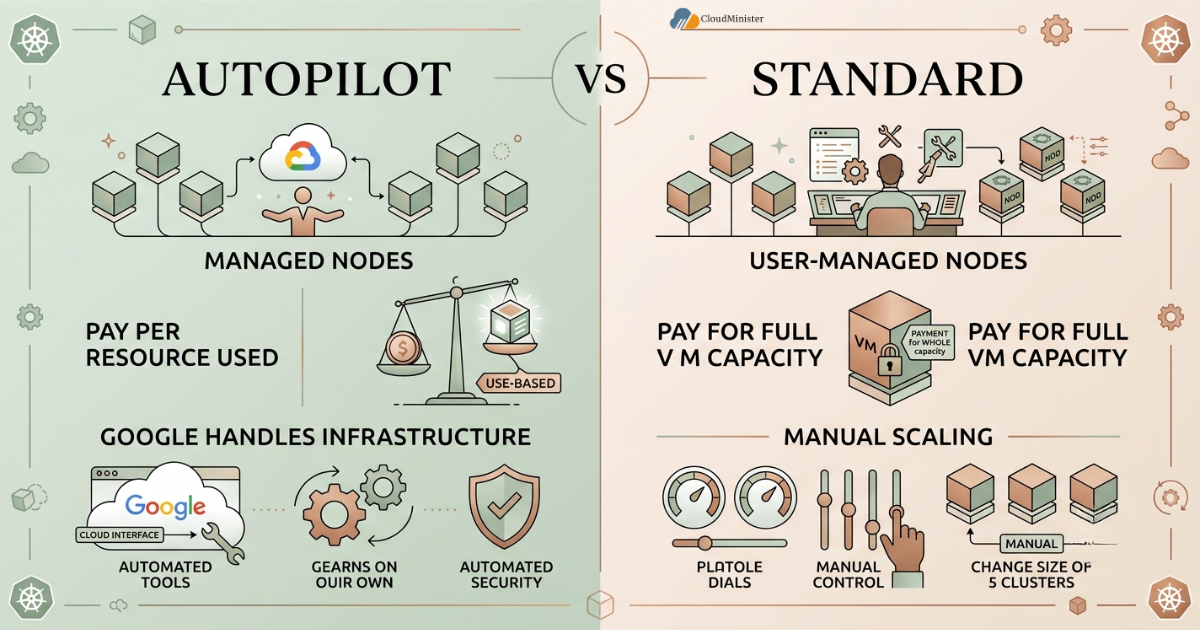
- In Standard mode, you provision and manage your own node pools, choose machine types, and are billed for the virtual machines that back those nodes whether your workloads use the full capacity or not.
- In Autopilot mode, Google provisions and manages the underlying node infrastructure automatically, and billing shifts to what your pods actually request in CPU, memory, and ephemeral storage.
- This single distinction is the reason the GKE Autopilot vs Standard pricing conversation exists at all: one model bills for infrastructure you own, the other bills for resources you consume.
- Deciding GKE Autopilot vs Standard is not just a pricing question either, since it also determines how much day-to-day node management your platform team is expected to carry.
Both modes inherit the same Google Cloud IAM and network security boundaries, so choosing GKE Autopilot vs Standard does not change your identity and access management posture. Autopilot does add hardened default settings, including restrictions on privileged containers and direct node SSH access, which reduces the attack surface without any extra configuration from your team. Businesses that already trust a Web Hosting Company in India for their broader IAM and network hygiene will find this consistency reassuring when they extend that same trust into Google Cloud Hosting in India for Kubernetes workloads.
2. Why this decision matters for business cost control
Kubernetes has moved from a niche orchestration tool to the default way modern enterprises run containerized workloads on Google Cloud Platform and other clouds, and that scale is exactly why the GKE Autopilot vs Standard decision now carries real financial weight. A CNCF-adjacent industry survey covering more than five hundred enterprise infrastructure professionals found that container orchestration has become close to universal among enterprises actively modernizing their stack, with a large share expecting most new applications to run on Kubernetes within the next five years, which means finance teams are asking pointed questions about why the Kubernetes line item on the cloud bill keeps growing quarter over quarter, according to the Portworx Voice of Kubernetes Report 2026.
- A meaningful share of enterprise cloud infrastructure spend is estimated to go toward idle or overprovisioned resources, and node-based billing in Standard mode is one of the most common places this waste hides.
- Choosing correctly between GKE Autopilot vs Standard from day one avoids the painful mid-year discovery that a cluster has been running at low utilization while being billed for full node capacity.
- Because GKE Autopilot vs Standard changes who absorbs the cost of unused capacity, it directly affects whether a platform team’s cost forecasts hold up against the actual invoice.
- For businesses running lean DevOps teams, this decision also has an operational cost dimension: node patching, scaling, and security hardening take engineering hours that Autopilot largely removes.
- Getting the call right early is far cheaper than migrating a live production workload between modes later, since that migration typically requires standing up a parallel cluster.
Before committing to either mode across a full environment, run a 30-day pilot with one representative workload in both GKE Autopilot vs Standard configurations and compare the actual invoice, not the theoretical rate card. Real utilization patterns almost always look different on paper than they do in production. A trustworthy Web Hosting Company in India can often help run this pilot alongside your existing cloud hosting services in India footprint, so the comparison reflects real network conditions rather than a lab test.
3. GKE Autopilot vs Standard: How the billing models actually work
This is where GKE Autopilot vs Standard pricing gets specific, and where most of the confusion in cost planning comes from. The two models charge for fundamentally different units.
Businesses running on Google Cloud Platform should note that this billing distinction sits entirely within Kubernetes itself, not the broader Google Cloud Platform account structure.
3.1 Standard Mode Billing
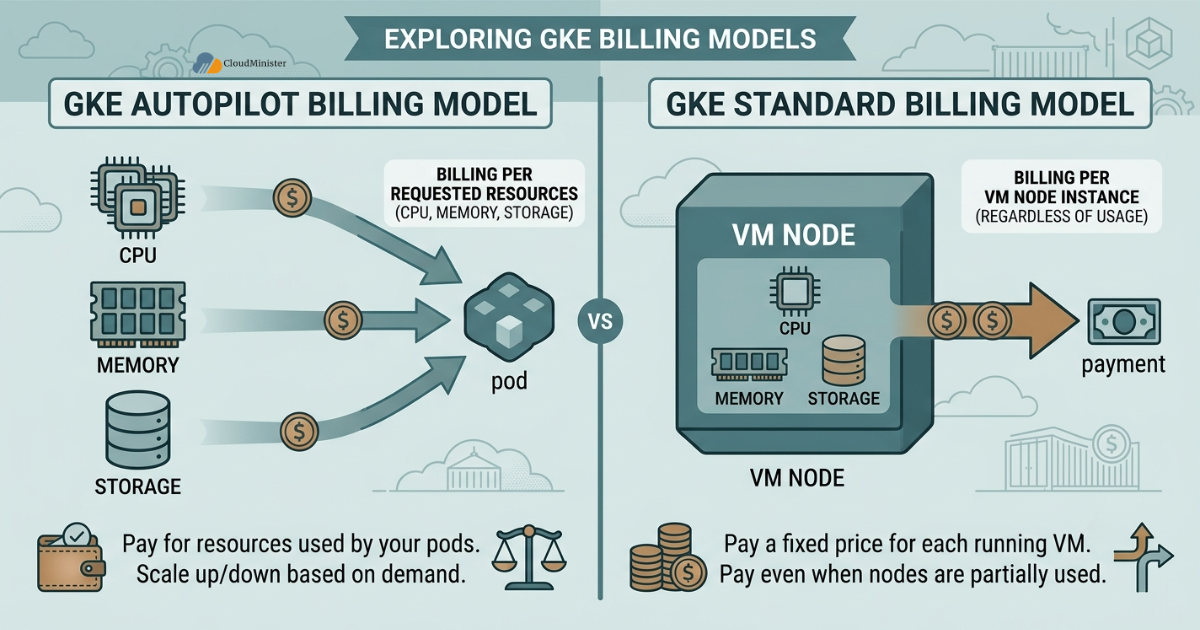
- You choose the machine type, node count, and node pool configuration, and Google Compute Engine bills you for those VM instances continuously, regardless of how much CPU or memory your pods are actually consuming.
- A flat cluster management fee applies per cluster per hour, charged on top of the underlying VM costs for every node in every pool.
- Sustained use discounts and Committed Use Discounts are available on the VM layer, and Standard mode is the only mode eligible for resource-based Committed Use Discounts tied to specific machine families.
- Spot VMs can be used for fault-tolerant workloads in Standard mode at a steep discount compared to on-demand pricing, but they can be reclaimed by Google with short notice.
- Any node capacity that sits idle between traffic spikes is capacity you are still paying for, which is the single biggest driver of unexpected cost when Standard mode is chosen for a bursty workload.
3.2 Autopilot Mode Billing
- Google bills for the vCPU, memory, and ephemeral storage that each pod requests, not for the size of the underlying node that pod happens to land on.
- The cluster management fee is effectively folded into the per-pod pricing rather than charged as a separate flat line item the way it typically is in Standard mode.
- Because billing tracks pod requests directly, a workload that scales down to zero or near-zero replicas during off-peak hours also scales its bill down automatically, with no idle node sitting in the background.
- Spot Pods are available in Autopilot for workloads that can tolerate interruption, offering meaningful savings similar in spirit to Spot VMs on the Standard side.
- Flex Committed Use Discounts are available across both modes, giving Autopilot workloads a path to lower rates without switching to Standard mode.
The core technical reason GKE Autopilot vs Standard produces such different bills for the same workload comes down to what is actually metered. Standard meters infrastructure that exists. Autopilot meters resources that are requested. A workload with steady, well-tuned, high utilization tends to favor Standard, while a workload with unpredictable or bursty demand tends to favor Autopilot, because the billing unit itself changes what gets penalized.
Related Reading: GCP cost optimization strategies
4. Real cost comparison: When Autopilot actually saves money
Numbers make the GKE Autopilot vs Standard conversation concrete, so here is how the comparison plays out across common utilization patterns on Google Cloud Platform.
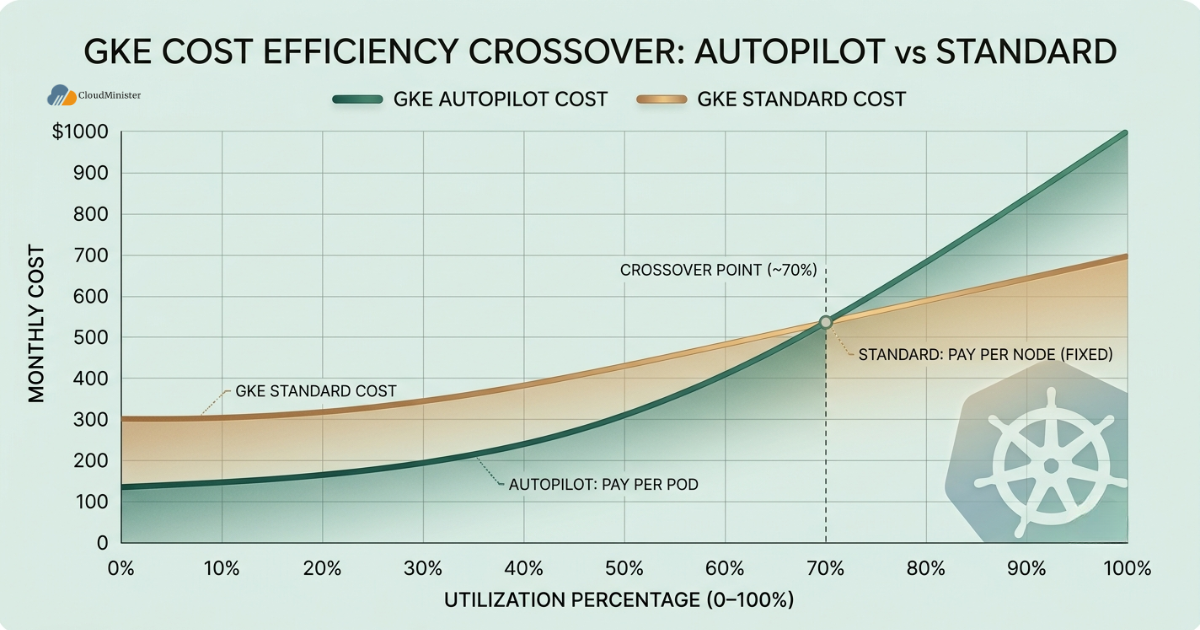
- At high, consistent utilization above roughly 75 percent of provisioned node capacity, Standard mode with properly sized nodes and Committed Use Discounts typically comes out cheaper than Autopilot for the same workload.
- At low or highly variable utilization, Autopilot typically wins because it never charges for the gap between what a node can hold and what the pods running on it actually use.
- According to a 2026 GKE pricing analysis, current Autopilot rates run at approximately 0.0445 US dollars per vCPU-hour and 0.0049 US dollars per GiB-hour for memory in standard configurations, figures that are directly useful when modeling GKE Autopilot vs Standard costs for a specific workload footprint, based on published 2026 GKE pricing analysis.
- A dense fleet of many small microservices packed tightly onto well-tuned Standard nodes running on Spot VMs can beat Autopilot on raw cost, since Spot VM discounts on Standard mode can run significantly deeper than Autopilot’s own Spot Pod pricing in some regions.
- Teams that lack the engineering time to continuously rightsize node pools tend to see Autopilot come out ahead in practice, even in scenarios where a perfectly tuned Standard cluster would technically have been cheaper on paper.
Cost comparison checklist – What to measure before choosing a mode
- Average CPU and memory utilization of existing nodes over a rolling 30-day window
- How bursty or predictable the workload’s traffic pattern actually is
- Whether the team has the bandwidth to continuously rightsize Standard node pools
- Current eligibility for resource-based Committed Use Discounts in Standard mode
- Whether the workload can tolerate interruption for Spot VM or Spot Pod pricing
- Total cost of engineering time spent on node management under Standard mode
Related Reading: AWS vs Azure vs Google Cloud
5. Workload patterns: Matching the right mode to your use case
Not every workload should be evaluated against GKE Autopilot vs Standard pricing the same way on Google Cloud Platform. The right mode depends heavily on the shape of the workload itself.
- Bursty, unpredictable workloads such as marketing campaign backends, event-driven APIs, or seasonal e-commerce traffic tend to favor Autopilot, since idle capacity between spikes costs nothing.
- Steady-state, high-throughput workloads such as always-on data pipelines or continuously busy backend services tend to favor Standard mode once node sizing has been properly tuned.
- Workloads that need elevated node access, custom DaemonSets, privileged containers, or a custom node operating system are only supported in Standard mode, which removes the GKE Autopilot vs Standard choice entirely for that category.
- GPU and TPU workloads are now supported in both modes as of recent Autopilot updates, narrowing one of the historical gaps that used to push AI and machine learning teams automatically toward Standard.
- Multi-tenant platforms serving many small internal teams often prefer Autopilot for the cleaner per-pod cost attribution it provides, since each team’s namespace maps directly to what they are billed for rather than a shared node pool.
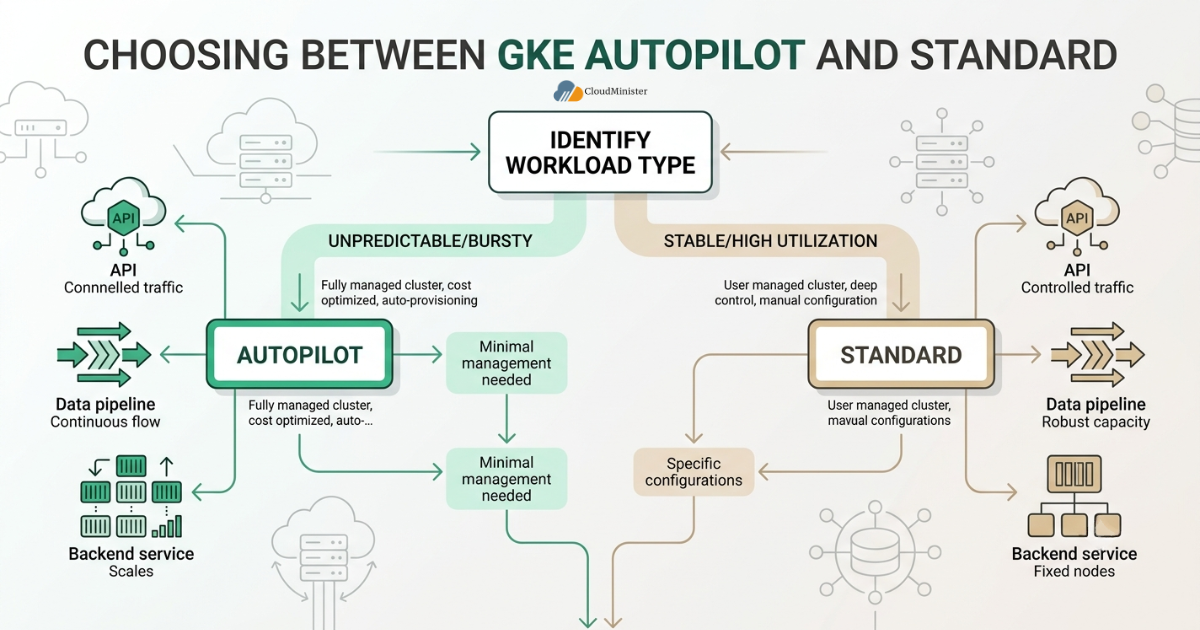
If your organization runs a mix of workload types, it is entirely reasonable to run separate clusters on different modes rather than forcing a single answer across the whole environment for the GKE Autopilot vs Standard question. A steady backend on Standard and a bursty API layer on Autopilot is a common and sensible split, and a capable Web Hosting Company in India can help you structure cloud hosting services in India around exactly this kind of mixed setup.
Related Reading: Google Cloud hosting is often the best choice for Indian enterprises
6. Hidden costs and common mistakes in the GKE Autopilot vs Standard decision
Even with a clear rate card on Google Cloud Platform, businesses frequently misjudge costs because of factors that do not show up on the first invoice.
- Oversized pod resource requests in Autopilot lead to paying for capacity the pod never actually uses, which is functionally the same mistake as overprovisioning nodes in Standard mode.
- Underprovisioned node pools in Standard mode that trigger frequent autoscaling events can generate unexpected VM churn and networking costs that are easy to miss when comparing rate cards alone.
- Networking and cross-region egress costs apply identically in both modes and are frequently left out of comparisons that focus purely on compute pricing.
- Persistent storage, load balancer costs, and logging or monitoring costs sit outside the core billing model entirely and should be budgeted separately in either mode.
- Teams that migrate from Standard to Autopilot without first rightsizing their pod resource requests often see little to no savings, since the same inefficiency simply moves from the node layer to the pod layer.
Regardless of which mode you choose, review workload identity and namespace-level access controls before scaling either type of cluster. Cost efficiency and security posture are separate concerns, and a cheaper cluster that is poorly secured is not actually a win for the business. A dependable Web Hosting Company in India offering cloud hosting services in India can support this audit alongside your Kubernetes rollout.
7. GKE Autopilot vs Standard for small and mid‑sized businesses in India
Large enterprises were the earliest adopters of GKE, but small and mid-sized businesses in India are increasingly running production Kubernetes workloads on Google Cloud Hosting in India as container tooling has matured and managed services have lowered the operational bar to entry.
- Indian SMBs typically run lean DevOps teams without a dedicated Kubernetes specialist, which makes the operational simplicity of Autopilot a meaningful factor in this decision, separate from pricing alone.
- Startups with unpredictable early-stage traffic patterns are frequently better served by Autopilot, since the cost differences between modes are most pronounced exactly when usage is volatile and hard to forecast.
- Growing businesses that eventually reach stable, high-volume traffic on core services often revisit the GKE Autopilot vs Standard question and migrate specific workloads to Standard once their usage patterns become predictable enough to tune properly.
- Working with a Web Hosting Company in India that already understands both Kubernetes and the surrounding Google Cloud Platform ecosystem helps Indian businesses avoid the common mistake of picking a mode based on price alone without accounting for team capacity.
- Businesses evaluating Google Cloud Hosting in India as their broader infrastructure foundation should factor the GKE Autopilot vs Standard decision into that same conversation, since network configuration and regional latency affect both modes similarly, and this is another area where a Web Hosting Company in India adds real value.
Related Reading: how to set up your website on Google Cloud hosting in India
8. Infrastructure readiness: Why the surrounding stack matters as much as the mode
A GKE Autopilot vs Standard decision does not happen in isolation. The surrounding cloud and networking stack that a cluster sits inside, whether delivered through Google Cloud Hosting in India or a broader multi-region setup, affects real-world performance regardless of which mode is chosen.
- Network latency, VPC configuration, and regional proximity to end users all matter equally in both Autopilot and Standard, since neither mode changes the underlying Google Cloud Platform networking layer.
- Businesses hosting client-facing applications on GKE should evaluate their broader cloud hosting services in India setup to confirm the surrounding infrastructure can support the traffic patterns the cluster is expected to handle.
- Persistent volume performance, load balancer configuration, and DNS setup sit outside the core billing model but directly affect whether the cost savings from either mode actually translate into a good end-user experience.
- A dependable partner offering cloud hosting services in India that also understands Kubernetes-specific networking gives IT teams the operational bandwidth to focus on application performance instead of firefighting infrastructure basics, and this holds true whether the underlying environment is a premium Google Cloud Hosting in India tier or a more Affordable Cloud Hosting India plan.
- Teams weighing Google Cloud Hosting in India against a generic Affordable Cloud Hosting India offering should specifically confirm that Kubernetes networking, regional latency, and VPC peering are handled competently, not just advertised as a checkbox feature.
- Organizations that already rely on a Web Hosting Company in India for their broader web and application infrastructure often find it far simpler to extend that same relationship into their Kubernetes rollout, rather than managing a separate vendor purely for the GKE Autopilot vs Standard question.
Industry data indicates that Kubernetes adoption in production environments reached 82 percent among container users surveyed in the CNCF’s most recent annual survey, up from 80 percent the year before, underscoring how mainstream this technology has become across enterprise infrastructure teams worldwide, as reported in this 2026 Kubernetes adoption statistics roundup. That scale of adoption means the GKE Autopilot vs Standard question is no longer a niche architecture question, it is a mainstream cost and operations decision that most growing businesses will eventually face.
9. Measuring long‑term cost: Beyond the first invoice
Initial mode decisions tend to drift out of alignment with actual usage if they are not revisited regularly.
- Set a recurring quarterly review of actual node or pod utilization against the assumptions that originally drove the GKE Autopilot vs Standard choice for each cluster.
- Compare renewal-time or Committed Use Discount decisions against measured usage data rather than the original estimate made before the workload went live.
- Reassess whether a workload’s traffic pattern has changed enough to justify revisiting the decision, since workloads that were bursty at launch often stabilize as a product matures.
- Maintain close coordination between finance and platform engineering teams so that cost data from the GKE Autopilot vs Standard split is reviewed alongside the rest of the cloud budget, not in isolation.
- Track cost per request or cost per transaction as a normalized metric, since raw cluster spend alone does not tell you whether a chosen mode is actually efficient relative to business growth on Google Cloud Platform.
- Compare your current cloud hosting services in India arrangement against usage trends each quarter, since a plan that looked like Affordable Cloud Hosting India at launch can quietly become undersized as Kubernetes workloads grow.
As GKE clusters scale under either mode, periodically re-run permission and namespace audits across the cluster. Organizational structures change, teams get restructured, and workload ownership shifts, and outdated access permissions are one of the more common sources of avoidable risk in any actively growing Kubernetes environment, independent of the GKE Autopilot vs Standard billing question. Businesses using Google Cloud Hosting in India for these workloads should fold this audit into their existing infrastructure review cadence.
10. Choosing the right infrastructure partner alongside your GKE Autopilot vs Standard decision
Billing model decisions get most of the attention during a rollout, but the hosting and infrastructure partner behind a business’s broader technology stack, whether built on Google Cloud Hosting in India or another Google Cloud Platform region, plays an equally important role in how well either mode performs day to day.
- A dependable Web Hosting Company in India that already manages a business’s websites, applications, and networking infrastructure is well positioned to advise on how the surrounding environment should be configured to support a Kubernetes rollout under either billing model.
- Businesses that rely on a Web Hosting Company in India for the rest of their infrastructure benefit from a single point of accountability for uptime, latency, and security, three factors that directly influence how efficient either Autopilot or Standard actually feels in production.
- IT leaders evaluating cloud hosting services in India alongside a GKE Autopilot vs Standard rollout should treat the two conversations as connected rather than separate purchasing decisions.
- Agencies and IT consultancies that already offer cloud hosting services in India to their own clients are well positioned to guide those clients through the same GKE Autopilot vs Standard evaluation this guide describes.
- Businesses evaluating Google Cloud Hosting in India specifically for a Kubernetes-heavy roadmap should confirm that their hosting partner understands the operational differences between the two modes, not just the base pricing of Google Cloud Platform itself.
Merge hosting and Kubernetes costs into a single quarterly review instead of treating them separately. A Web Hosting Company in India that understands your Kubernetes roadmap, paired with dependable cloud hosting services, ensures a cleaner budget and better scalability. This Affordable Cloud Hosting India approach helps businesses turn savings from the GKE Autopilot vs Standard decision into product growth rather than infrastructure overhead.
Businesses weighing all of this together should treat the hosting conversation as seriously as the mode of conversation. A Web Hosting Company in India gives a business the operational backbone for everything from email deliverability to server uptime, while cloud hosting services in India let growing teams extend that same reliability across every application they run, including anything built on Google Cloud Hosting in India infrastructure or a leaner Affordable Cloud Hosting India plan for smaller workloads. A second cloud hosting services in India quote, benchmarked against a genuine Affordable Cloud Hosting India offer, is always worth getting before signing a long-term contract tied to your Google Cloud Platform roadmap. Comparing a first Google Cloud Hosting in India provider against a second Google Cloud Hosting in India shortlist and weighing both against a straightforward Affordable Cloud Hosting India quote, gives finance teams a clean basis for the final decision, whether or not it ultimately touches the GKE Autopilot vs Standard question at all. Growing agencies that resell infrastructure to their own clients under a Google Cloud Hosting in India brand should apply this same rigor to their own internal Affordable Cloud Hosting India choices before extending advice downstream. A Web Hosting Company in India that also offers genuine cloud hosting services in India, alongside a fairly priced Affordable Cloud Hosting India tier for smaller teams, gives growing IT businesses in India a single vendor relationship that scales with them instead of forcing a vendor switch every time they outgrow their current plan and revisit their GKE Autopilot vs Standard assumptions. Whether a business is buying its first Web Hosting Company in India contract, negotiating a fresh cloud hosting services in India deal, or simply comparing Affordable Cloud Hosting India quotes side by side, the underlying question is the same: does this infrastructure partner understand where the business is headed on Google Cloud Platform, including its plans around Kubernetes and the GKE Autopilot vs Standard decisions that come with it.
Power Your Business with Google Cloud
Discover scalable, secure, and cost‑efficient hosting solutions tailored for modern workloads. Explore how Google Cloud can transform your Kubernetes journey.
Conclusion
The debate around GKE Autopilot vs Standard ultimately comes down to workload behavior and organizational priorities. Autopilot shines for bursty, unpredictable workloads where idle capacity would otherwise drive-up costs, while Standard is better suited for steady, high-utilization environments where careful tuning can unlock discounts and efficiency. Neither mode is universally superior; the right choice depends on how your applications run in production.
For Indian businesses, the decision is further shaped by operational realities. Startups and SMBs often benefit from Autopilot’s simplicity, while enterprises with predictable traffic may prefer Standard for its cost advantages. Importantly, the surrounding infrastructure, from networking to hosting partners, plays a critical role in ensuring that whichever mode is chosen delivers consistent performance and security.
In the end, the smartest approach to GKE Autopilot vs Standard is not to guess but to measure. Running pilot workloads, revisiting decisions as traffic stabilizes, and pairing Kubernetes with a dependable infrastructure partner ensures that cloud investments remain efficient and scalable. By treating this choice as part of a broader technology roadmap, businesses can transform Kubernetes from a cost center into a driver of innovation and growth.
Key Takeaways
- The GKE Autopilot vs Standard question comes down to what gets billed: node infrastructure in Standard mode versus pod resource requests in Autopilot mode.
- Standard mode tends to win at high, consistently tuned utilization, while Autopilot tends to win bursty, unpredictable, or lower-utilization workloads.
- Recent 2026 pricing data puts Autopilot at roughly 0.0445 US dollars per vCPU-hour and 0.0049 US dollars per GiB-hour for memory, useful benchmarks for any GKE Autopilot vs Standard cost model.
- Kubernetes adoption has grown sharply across enterprises through 2026, making this a mainstream operational question rather than a niche one.
- Workloads needing privileged containers, custom node operating systems, or elevated node access remain Standard-only, removing the GKE Autopilot vs Standard choice for that category entirely.
- Surrounding infrastructure quality, from a dependable Web Hosting Company in India to well-configured cloud hosting services in India, directly affects how well either mode performs in production.
- Running a short pilot before committing consistently produces a better GKE Autopilot vs Standard decision than choosing based on the rate card alone.
Frequently Asked Questions
1. What is the main difference between GKE Autopilot vs Standard?
The core difference lies in billing and management. In Standard mode, you manage node pools and pay for the full VM capacity, whether used or idle. In Autopilot, Google manages the nodes and bills only for the CPU, memory, and storage your pods request. This makes GKE Autopilot vs Standard a choice between infrastructure ownership and resource consumption.
2. Which workloads benefit most from Autopilot mode?
Autopilot is ideal for bursty, unpredictable workloads such as seasonal e-commerce traffic, event-driven APIs, or marketing campaign backends. Since billing is tied to pod requests, idle capacity costs nothing. In the GKE Autopilot vs Standard comparison, Autopilot consistently saves money when utilization is low or highly variable.
3. When does Standard mode become more cost-effective?
Standard mode generally wins when workloads run at high, steady utilization above 70–75%. With properly tuned nodes and Committed Use Discounts, Standard can deliver lower costs than Autopilot. In the GKE Autopilot vs Standard debate, Standard is the better fit for predictable, always-on workloads like data pipelines or backend services.
4. Can I switch between Autopilot and Standard later?
Yes, but there is no direct conversion. Moving from one mode to the other requires creating a new cluster and migrating workloads. This makes it important to evaluate GKE Autopilot vs Standard carefully before launch, since switching midstream can add operational overhead and migration costs.
5. How does security differ between Autopilot and Standard?
Both modes inherit Google Cloud IAM and networking boundaries, but Autopilot enforces stricter defaults. It restricts privileged containers and disables direct node SSH access, reducing attack surface automatically. In GKE Autopilot vs Standard, security posture is consistent, but Autopilot adds hardened defaults without extra configuration.
6. What factors should Indian SMBs consider when choosing a mode?
Small and mid-sized businesses in India often run lean DevOps teams, making Autopilot’s simplicity attractive. Startups with unpredictable traffic patterns benefit from its cost flexibility, while growing firms may later migrate stable workloads to Standard. For Indian businesses, the GKE Autopilot vs Standard choice should balance cost, team capacity, and long-term scalability.
Need Expert Guidance?
Our team is here to help you choose the right mode between GKE Autopilot vs Standard and optimize your cloud infrastructure for growth.

Related posts:
 Google Cloud Hosting Management Tools: Features and Benefits for Indian Users
 Top Features of Google Cloud Hosting: Are they Worth the Price for Indian Users?
 How to Set Up your website on Google Cloud Hosting in India: A step-by-step Guide
 GCP Cost Optimization Guide for Google Cloud Platform Billing