This DPDP Compliance Checklist shows Indian businesses what to fix across servers, hosting and cloud before the next DPDP milestone on 13 November 2026, when consent manager registration opens under Rule 4. Core duties under the DPDP Rules 2025, including Rule 6 security safeguards and Rule 7 breach reporting, apply from 13 May 2027. The guide covers data mapping, encryption, access control, one year log retention, the 72 hour breach report, vendor contracts and cross border transfers. It also explains where a Web Hosting Company in India, Server Management Services in India and layered cybersecurity solutions fit into your plan. Cyber Security services and Server Management Services support the testing and patching work, so use this DPDP Compliance Checklist with your IT, security and legal teams.
India’s data protection law is no longer a distant topic for IT teams. The Digital Personal Data Protection Act, 2023 received assent on 11 August 2023, and the DPDP Rules 2025 were notified on 13 November 2025. Every business that stores or processes digital personal data on a server, a hosting plan or a cloud account now needs a practical DPDP Compliance Checklist that the technical team can actually follow. A clear DPDP Compliance Checklist also helps managers see what the IT team is doing and why.
The rollout is phased. The Data Protection Board provisions applied from notification, consent manager registration under Rule 4 opens on 13 November 2026, and the main duties, including notice, consent, security safeguards and breach reporting, apply from 13 May 2027. That gives teams a short window to prepare, and a Web Hosting Company in India is often the first partner asked to confirm where data sits and how it is protected. Many firms also use Server Management Services in India for daily operations, so the same team can help prepare.
This guide turns the law into a working DPDP Compliance Checklist for infrastructure teams. You will see what to map, encrypt, log, monitor and contract, and how Cyber Security services, Server Management Services and wider cybersecurity solutions support each step. Whether you run a single VPS or a multi cloud estate, this DPDP Compliance Checklist will help you plan with fewer surprises.
Table of Contents
- 1. Why Every Server Owner Needs a DPDP Readiness Plan
- 2. The DPDP Readiness Timeline: What Applies in November 2026 and May 2027
- 3. Step One: Map Personal Data Across Servers and Cloud
- 4. Encryption, Masking and Tokenisation Under DPDP (Rule 6)
- 5. Access Control and Zero Trust for DPDP Readiness
- 6. Logging, Monitoring and One Year Log Retention Under DPDP
- 7. Backups, Continuity and Patch Management for DPDP Readiness
- 8. Breach Response and the 72 Hour Reporting Clock
- 9. Vendors, Data Processors and Hosting Contracts Under DPDP
- 10. Cross Border Transfers, Data Residency and Retention
- 11. Consent, Notice and Rights Under the DPDP Act
- 12. Roles and Penalties Under the DPDP Act
- 13. Choosing Hosting and Managed Support for DPDP Readiness
- Key Takeaways
- Conclusion
1. Why Every Server Owner Needs a DPDP Compliance Checklist
The DPDP Act applies to digital personal data processed in India, and to processing outside India when it relates to offering goods or services to people in India. Three roles matter. The Data Fiduciary decides why and how data is processed, the Data Processor handles it on the fiduciary’s behalf, and the Data Principal is the person the data belongs to. Your hosting or cloud provider is usually a processor, but responsibility for compliance stays with you. A practical DPDP Compliance Checklist makes that shared model visible.
- Penalties are heavy. Failing to maintain reasonable security safeguards can attract a penalty of up to INR 250 crore under the Schedule to the Act.
- The cost of a breach is rising. IBM’s Cost of a Data Breach 2026 report puts the average data breach in India at INR 25.5 crore, up 15.9 percent from INR 22 crore in 2025.
- Servers hold the data. Databases, backups, mail servers, log files and object storage all contain personal data, so each one belongs on your DPDP Compliance Checklist.
- The law is technology neutral. It asks for reasonable security safeguards and does not name products, so you must document why your controls are reasonable.
- Size is not a shield. The Act does not set a minimum company size for most duties, so small online businesses also need to prepare.
- Hosting choices become compliance choices. Server location, backup region, patching speed and support hours all affect how easily you can meet Rule 6 and Rule 7.
- Evidence matters. The Data Protection Board can ask what you did to protect data, so keep records of configurations, reviews and tests.
- Partners share the load. A Web Hosting Company in India and a team offering Server Management Services in India can run many controls, though you remain accountable.
- Security testing proves the controls. Cyber Security services and wider cybersecurity solutions show whether your safeguards work under real attack.
Start with the Rule 6 safeguards and the Rule 7 breach process. These two carry the highest financial exposure, so a DPDP Compliance Checklist that begins here delivers the most risk reduction in the least time.
2. The DPDP Compliance Checklist Timeline: What Applies in November 2026 and May 2027
The DPDP Rules 2025 commence in three stages, and knowing which stage applies to you prevents wasted effort. The first stage began on 13 November 2025 and covers the Data Protection Board. The second stage begins on 13 November 2026 and activates the consent manager registration framework under Rule 4. The third stage, on 13 May 2027, brings in the duties that affect most businesses. Treat November 2026 as a checkpoint for your DPDP Compliance Checklist, not as the final deadline.
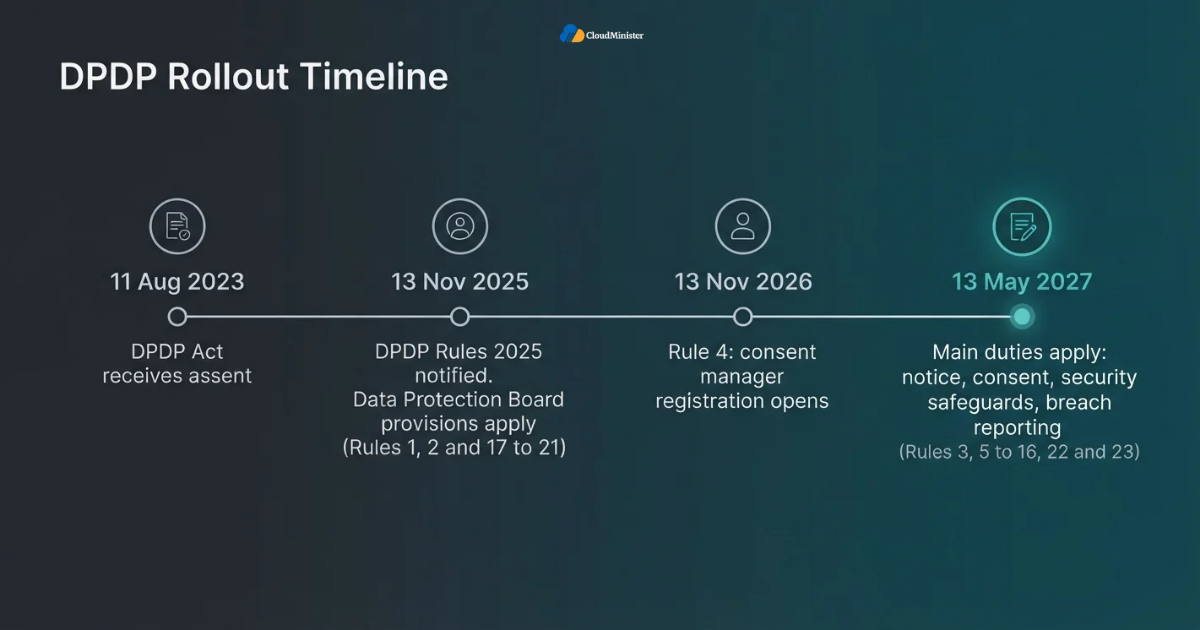
| Date | What starts | What it means for IT teams |
| 13 November 2025 | Rules 1, 2 and 17 to 21: definitions and the Data Protection Board | The Board framework is in place, so complaints and inquiries can follow once duties apply |
| 13 November 2026 | Rule 4: registration of consent managers | Design consent records that can connect with registered consent managers |
| 13 May 2027 | Rules 3, 5 to 16, 22 and 23: notice, consent, security, breach reporting, rights, children, cross border transfer | Servers, logs, backups and vendor contracts must meet the Rules |
- Plan backwards from 13 May 2027. Changes such as log retention and encryption need budget, testing and change windows, so start early.
- Understand Rule 4 correctly. It is about consent managers registering with the Board. Ordinary businesses do not register, but they should expect users to manage consent through these platforms.
- Do not wait for the final date. Logging and retention settings take time to design, so begin now to have them working from the first day the Rules apply.
- Check sector rules too. RBI, SEBI, IRDAI and telecom regulations may require stricter controls, and the DPDP Rules do not replace them.
- Track official notices. Dates, notifications and guidance can change, so give one owner the job of watching MeitY announcements.
- Document decisions. Each item in your DPDP Compliance Checklist should record the owner, the date and the reason for the choice.
- Ask your Web Hosting Company in India and your Server Management Services provider for their own readiness plans, since they run part of your stack.
- Book cybersecurity solutions reviews and Cyber Security services tests early, because specialist calendars fill up before deadlines.
Many teams read the twelve month and eighteen month dates as two deadlines for the same duties. They are not. The November 2026 stage concerns consent managers, while the main duties of a Data Fiduciary follow in May 2027.
3. Step One in Your DPDP Compliance Checklist: Map Personal Data Across Servers and Cloud
You cannot protect what you cannot find. Data mapping is the base of every DPDP Compliance Checklist because encryption, retention, breach response and rights handling all depend on knowing where personal data sits. Start with a simple inventory of systems and grow it into a record that shows data types, purposes, owners and flows. Include shadow copies, since forgotten exports and test databases cause many incidents. A DPDP Compliance Checklist without a data map is only a guess.
- List every system that stores or touches personal data: web servers, application databases, mail servers, file shares, object storage, CRM tools, analytics platforms and support desks.
- Record the data types in each system, such as names, phone numbers, email addresses, postal addresses, payment details and government identifiers.
- Note the purpose and the consent or other lawful ground for each dataset. The Act allows processing based on consent and on the limited legitimate uses listed in Section 7.
- Trace data flows between systems, including APIs, scheduled exports, third party scripts and processors outside your own network.
- Find shadow data in backups, old snapshots, developer laptops, test databases and shared drives, then decide whether each copy is still needed. Discovery tools used by Cyber Security services teams can speed this up.
- Tag cloud resources with owner, environment and data sensitivity so reports can be produced in minutes rather than days.
- Record the country and region where each system is hosted, since this feeds your cross border and residency review. Ask your Web Hosting Company in India for exact data centre details.
- Refresh the map every quarter and after every major release or vendor change, using reports from Server Management Services where available.
- Share the finished map with your Server Management Services in India partner so monitoring covers every system listed.
Run a discovery scan for patterns such as email addresses and phone numbers across file servers and databases. You will almost always find personal data in places the team forgot, and every one of them belongs in your DPDP Compliance Checklist.
4. Encryption, Masking and Tokenisation in Your DPDP Compliance Checklist (Rule 6)
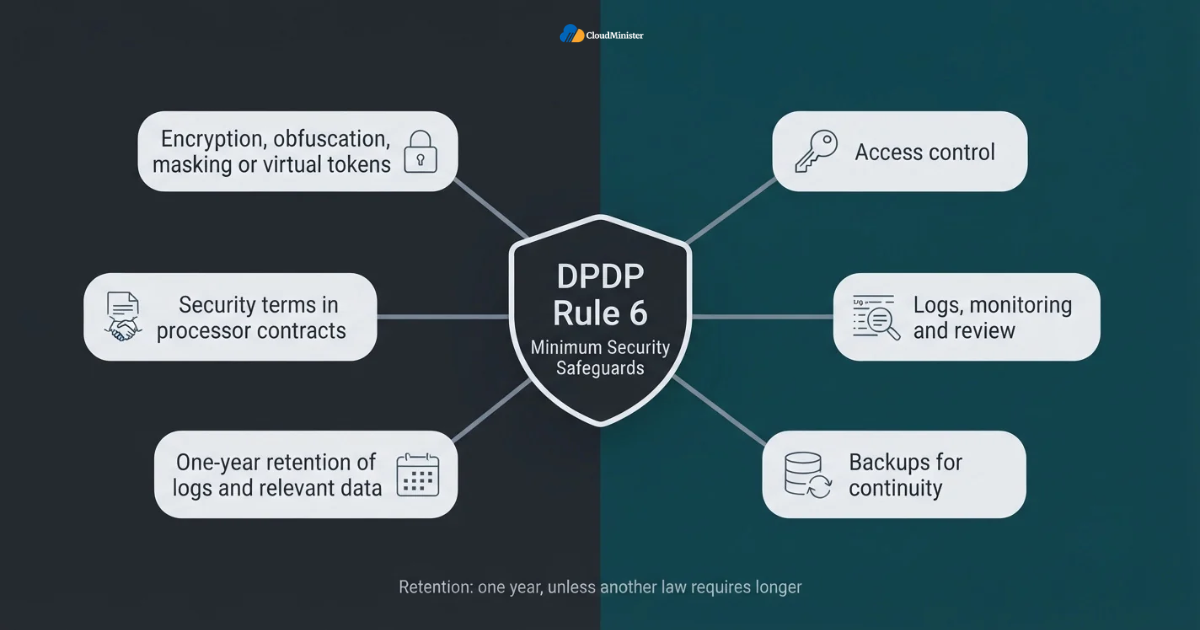
Rule 6 of the DPDP Rules 2025 sets the minimum reasonable security safeguards. The first item is securing personal data through encryption, obfuscation, masking or virtual tokens mapped to that data. The Rules do not name an algorithm, so choose widely accepted standards and write down why they suit your risk. A provider of Cyber Security services can test whether these controls work in practice, and layered cybersecurity solutions keep them working over time. Server Management Services can apply the same settings across every server.
- Encrypt data in transit with TLS 1.2 at minimum, and prefer TLS 1.3 for public sites, APIs, admin panels and database connections.
- Encrypt data at rest on disks, databases, object storage and backups. AES-256 is the common standard and major platforms support it.
- Keep encryption keys apart from the data. Use a managed key service or a hardware security module, restrict who can use keys and rotate them on a schedule.
- Mask personal data in non production environments so developers and testers never see real customer details.
- Use tokenisation for payment and identity numbers, so the live system stores a token and the real value sits in a tightly controlled vault.
- Disable outdated protocols and weak ciphers, and monitor certificate expiry so a lapsed certificate does not cause an outage or a downgrade. Server Management Services can automate this check.
- Never store secrets, keys or passwords in code repositories, chat tools or plain text configuration files. Secret scanning is a useful part of cybersecurity solutions.
- Ask your Web Hosting Company in India whether disk and backup encryption is on by default or must be switched on by you.
Encryption protects data only when the keys are protected too. If an attacker who reaches your server can also read the key file sitting beside the database, the encryption adds little. Treat key storage as a separate security zone with its own access rules and logging. Teams offering Server Management Services in India should include key handling in their runbooks.
5. Access Control and Zero Trust in Your DPDP Compliance Checklist
Rule 6 also requires appropriate measures to control access to the computer resources used by the fiduciary or its processor. In server terms, this means only the right people and systems can reach personal data, and only for as long as they need it. Zero trust design supports this because it verifies every request instead of trusting anyone inside the network. Teams that use Server Management Services in India often get this baseline built and reviewed faster.
- Enable multi factor authentication for SSH, control panels, cloud consoles, VPNs and database administration tools.
- Disable direct root login and password based SSH, and use key based access through a bastion host or VPN.
- Apply least privilege with role based access, so staff see only the datasets their work needs.
- Give every administrator a named account. Shared logins break the audit trail that Rule 6 expects from your logs.
- Review access every quarter and remove accounts for staff, contractors and vendors within one working day of their leaving.
- Segment networks and use default deny firewall rules, so database ports are never open to the public internet. Server Management Services usually manage these firewall rules.
- Rotate service account credentials and API keys, and limit each one to a single purpose. Strong cybersecurity solutions include secrets management for this.
- Record privileged sessions so administrator actions on personal data can be reviewed later.
- Ask Cyber Security services providers to test your admin access paths, since weak panels are a favourite target.
Related Reading: Zero trust security guide for India
6. Logging, Monitoring and One Year Log Retention in Your DPDP Compliance Checklist
Rule 6 asks for visibility on access to personal data through logs, monitoring and review, so unauthorised access can be detected, investigated and prevented from recurring. It also requires logs and the relevant personal data to be retained for one year, unless another law requires longer. The threat level makes this practical, since Check Point’s 2026 Cyber Security Report found that organisations in India faced an average of 3,195 cyberattacks per week in 2025, a 2 percent rise on 2024.
- Collect logs centrally from web servers, operating systems, databases, firewalls, applications and cloud audit trails. Server Management Services can run this collection for you.
- Log successful and failed logins, privilege changes, data exports and administrator commands.
- Synchronise server clocks with NTP, because inconsistent timestamps make investigations slow and unreliable.
- Store logs in write once or access restricted storage, so an intruder cannot erase the evidence.
- Retain logs for at least one year. The CERT-In directions of 2022 require ICT system logs for a rolling 180 days within India, so a one year policy covers both.
- Test retrieval by pulling a log entry from twelve months ago, so you know retention works in practice.
- Set alerts for unusual access, mass downloads, new admin accounts and logins from unexpected locations. Alerting is a core part of modern cybersecurity solutions.
- Assign a named person to review alerts daily. Logs that nobody reads do not meet the purpose of review. Many teams hand round the clock review to Server Management Services in India providers.
Do not confuse log retention with keeping personal data forever. Logs should hold only what is needed for security, and they should avoid storing full personal records, passwords or card numbers. A log that leaks personal data creates a new risk for your DPDP Compliance Checklist.
7. Backups, Continuity and Patch Management for Your DPDP Compliance Checklist
Rule 6 further expects measures that keep processing going if confidentiality, integrity or availability is compromised, including data backups. Backups are your recovery path after ransomware, deletion or hardware failure. Patching is not listed as a separate item, but it sits under the requirement for appropriate technical and organisational measures, since unpatched software is a leading entry point for attackers. Managed Server Management Services can keep both routines running on a fixed schedule.
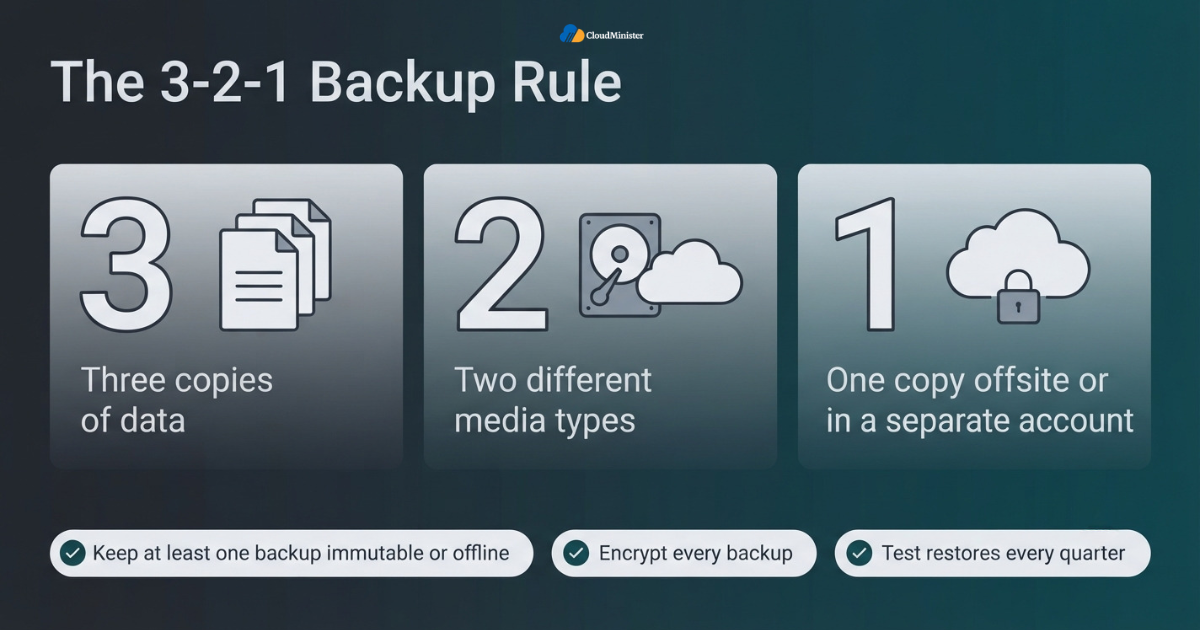
- Follow the 3-2-1 rule: three copies of data, two different media types and one copy stored offsite or in a separate account.
- Keep at least one backup immutable or offline, so ransomware cannot encrypt or delete it. Ask your Web Hosting Company in India about immutable storage options.
- Encrypt every backup and apply the same access controls as production data.
- Define recovery time and recovery point objectives for each system that holds personal data.
- Test restores every quarter and record the real recovery time and recovery point.
- Patch operating systems, control panels, web applications and mail software on a defined schedule, with faster handling for critical flaws. Server Management Services in India providers often publish fixed patch windows.
- Retire unsupported software, since vendors no longer fix its vulnerabilities. Cyber Security services audits often find such leftovers.
- Scan regularly for vulnerabilities with trusted cybersecurity solutions and track each fix to closure with an owner and a date.
Related Reading: cPanel and WHM CVE-2026-41940 authentication bypass
Restore one backup into an isolated environment and time it. The real figure is usually longer than the estimate, and that number belongs in your incident plan and your DPDP Compliance Checklist.
8. Breach Response and the 72 Hour Reporting Clock in Your DPDP Compliance Checklist
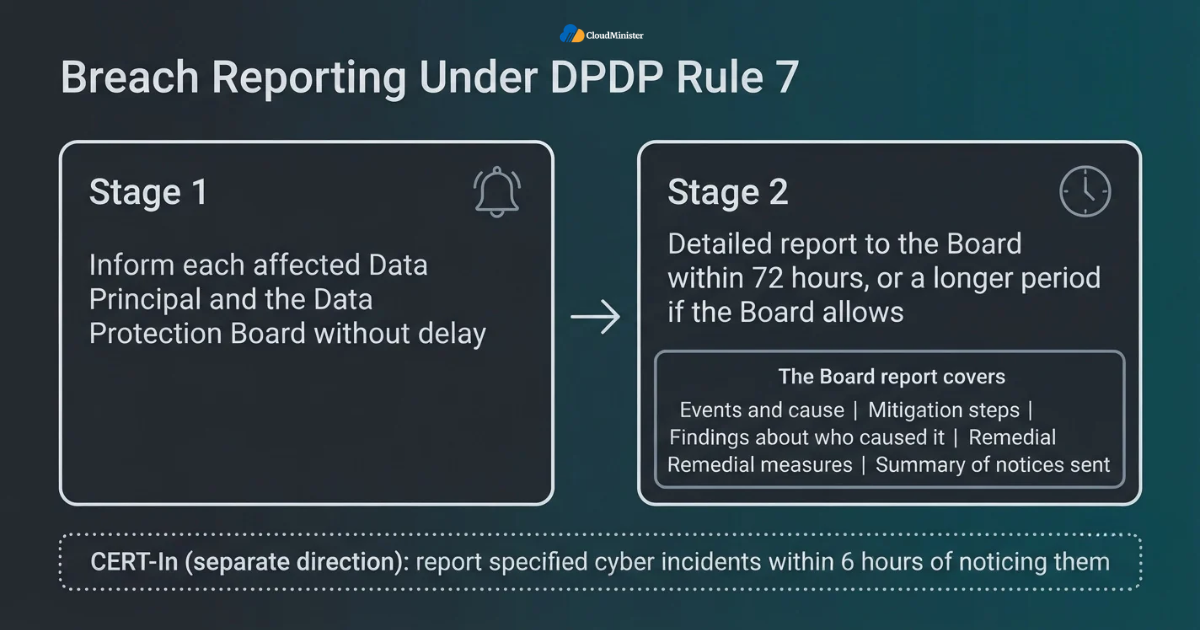
Rule 7 sets a two stage breach process. The fiduciary must inform each affected Data Principal and the Data Protection Board without delay. A detailed report to the Board must follow within 72 hours, or a longer period if the Board allows. The framework does not set a harm threshold before notification applies, so plan to treat every personal data breach as reportable. A tested runbook is the heart of any DPDP Compliance Checklist. Detection tools within cybersecurity solutions shorten the time taken to notice an incident.
- Name an incident lead, a technical lead, a legal contact and a communications contact, with a backup for each. Add the contact for your Server Management Services in India partner.
- Define a personal data breach as the Act does: unauthorised processing, or accidental disclosure, alteration, destruction or loss of access that compromises confidentiality, integrity or availability.
- Prepare plain language notices for Data Principals covering what happened, when, the likely impact, the steps taken and who to contact.
- Prepare the Board report covering the events, the cause, mitigation steps, findings about who caused it, remedial measures and a summary of notices sent.
- Preserve evidence early by snapshotting affected servers and securing logs before any cleanup begins. Server Management Services teams can take these snapshots quickly.
- Align with CERT-In, which requires reporting of specified cyber incidents within six hours of noticing them.
- Run a tabletop exercise twice a year and measure how long each notice takes to prepare. Include your Web Hosting Company in India so the vendor side is tested too.
- Remember the cost of getting it wrong, since failing to notify a breach can attract a penalty of up to INR 200 crore.
- Keep a Cyber Security services contact on call for forensic help, since internal teams rarely have the tools.
Related Reading: Roundcube CVE-2026-48842 SQL injection patch
Contain first, but never wipe first. Reimaging a compromised server before you capture logs and disk evidence destroys the facts you need for the 72 hour report.
9. Vendors, Data Processors and Hosting Contracts in Your DPDP Compliance Checklist
A fiduciary may engage a processor only under a valid contract, and Rule 6 expects that contract to include reasonable security safeguards. Every cloud platform, hosting provider, email service, payment gateway and analytics tool that handles personal data is part of this chain. A trustworthy Web Hosting Company in India will explain its responsibilities in writing, and a skilled team providing Server Management Services in India will map them to your controls.
- Build a vendor register that lists every processor, the data it handles, its location and the contract owner.
- Add data processing terms covering security safeguards, breach notification, sub processors, deletion and cooperation with audits.
- Set a short breach notice window for vendors, such as 24 hours, so you can still meet your own 72 hour clock. The law does not fix this number, so it is a practical choice.
- Create a shared responsibility matrix that shows who manages patching, backups, encryption keys, logs and monitoring. Mark the rows owned by Server Management Services.
- Ask for evidence rather than promises, such as audit reports, certifications, penetration test summaries and backup restore results.
- Confirm what happens to your data and backups at contract end, including deletion timelines and written confirmation.
- Review vendors every year, and sooner after any incident or ownership change.
- Ask your Web Hosting Company in India to name every sub processor, including the backup and monitoring tools it uses.
- Check that Cyber Security services and cybersecurity solutions vendors also sign data processing terms, because they see your logs and traffic.
Ask each vendor one simple question: if you had a breach tonight, how fast would you tell us and what would you send? A clear and specific answer usually predicts a calm response. Record the answer in your DPDP Compliance Checklist.
10. Cross Border Transfers, Data Residency and Retention in Your DPDP Compliance Checklist
Section 16 of the DPDP Act permits transfer of personal data outside India, except to countries or territories the Central Government restricts by notification. It does not impose blanket localisation, but other laws can, and the Rules allow stricter requirements for Significant Data Fiduciaries on specified data. Retention matters too, because data must be erased once its purpose is served unless a law requires you to keep it. Hosting location choices therefore belong on every DPDP Compliance Checklist.
- Record the country and region for every server, database, backup and logging service.
- Check the list of restricted countries whenever the Government issues or updates a notification.
- Check sector rules. For example, RBI requires payment system data to be stored only in India, and other regulators set their own limits. Cyber Security services reviewers can map these limits to your systems.
- Keep Indian user data with a Web Hosting Company in India where this simplifies your position, even when the law does not demand it. It also reduces latency for Indian users.
- Erase personal data when the purpose is served and consent is withdrawn, unless a law requires retention. Server Management Services in India teams can schedule these deletions.
- Large e-commerce, online gaming and social media platforms face a fixed rule: erase after three years without user activity, with a notice at least 48 hours before erasure.
- Keep logs and related data for one year where the Rules require it, and keep only what is needed for that security purpose.
- Ask Server Management Services providers to enforce region locks, so new servers and backups cannot be created abroad by mistake.
- Use cybersecurity solutions that discover personal data in storage, so no region holds a forgotten copy.
Related Reading: Data residency requirements in India
11. Consent, Notice and Rights in Your DPDP Compliance Checklist
Legal teams write the notice, but servers and applications must carry it out. Consent must be free, specific, informed, unconditional and unambiguous, given by a clear affirmative action. The notice must use clear, plain language and describe the data, the purpose and how to withdraw consent. Systems that cannot record or withdraw consent properly will fail the DPDP Compliance Checklist even when the policy reads well.
- Store consent records with the Data Principal’s identifier, a timestamp, the notice version, the purpose and the exact choice made. Ask your Web Hosting Company in India to keep this database in an Indian region.
- Make withdrawal as easy as giving consent, and pass the change quickly to every processor and system that holds the data. Server Management Services should monitor the queue for failures.
- Build a rights workflow for access, correction, completion, updating and erasure requests, plus a grievance channel. Strong cybersecurity solutions protect these portals from fraud.
- Verify the identity of the requester before sharing or changing data, and log each action. Cyber Security services reviews can test this process for abuse.
- Track grievance and request response times, because the Rules cap the response period at 90 days. Add these timers to your DPDP Compliance Checklist.
- Publish the contact details of a person who can answer questions about processing, as Section 8(9) requires.
- Prepare for verifiable parental consent before processing data of anyone under 18, and avoid tracking or targeted advertising aimed at children.
- Design consent records so they can connect with registered consent managers once they begin operating. Server Management Services in India partners can help run the integration.
12. Roles and Penalties in Your DPDP Compliance Checklist
Ownership turns a plan into action. Every fiduciary should name someone to answer data questions, and Significant Data Fiduciaries carry extra duties. The Central Government designates them based on factors such as the volume and sensitivity of data and the risk to individuals. The table below shows why leadership attention is justified. Each figure is a maximum, and the Data Protection Board decides actual penalties after an inquiry. Every DPDP Compliance Checklist should name an owner for each duty.
| Violation | Maximum penalty |
| Failure to take reasonable security safeguards | INR 250 crore |
| Failure to notify a personal data breach | INR 200 crore |
| Breach of obligations relating to children | INR 200 crore |
| Breach of Significant Data Fiduciary obligations | INR 150 crore |
| Any other breach of the Act or Rules | INR 50 crore |
- Business owner: accepts risk, funds the plan and approves the DPDP Compliance Checklist.
- Application team: owns consent flows, rights workflows and deletion logic.
- Infrastructure owner: manages servers, network, backups, logs and monitoring, often with Server Management Services.
- Security owner: handles access control, vulnerability management and incident response, often with Cyber Security services and cybersecurity solutions.
- Legal and privacy owner: manages notices, contracts and communication with the Board.
- Significant Data Fiduciaries must appoint a Data Protection Officer based in India and an independent data auditor, and complete a Data Protection Impact Assessment and audit every 12 months.
- Decide in advance who approves a breach notice and who can trigger a rollback or shutdown, so decisions are never delayed.
- Vendor owner: manages the relationship with the Web Hosting Company in India and other processors, including contract reviews.
- Escalation path: write down who calls the Server Management Services in India team first when an alert fires.
13. Choosing Hosting and Managed Support for Your DPDP Compliance Checklist
Infrastructure partners can make or break your timeline. A capable Web Hosting Company in India provides stable, documented infrastructure, while managed Server Management Services handle monitoring, patching and backups around the clock. Providers of Server Management Services in India also supply the on call cover that a 72 hour breach window needs. Add Cyber Security services for testing and monitoring, and your internal staff can focus on the application and legal work.
- Ask the Web Hosting Company in India to confirm server locations, backup locations and the exact data centres used.
- Check that Server Management Services in India include monitoring, patching, backup testing and incident escalation, and get this in writing.
- Look for managed Server Management Services that publish response times and name who is on call at night and on weekends.
- Prefer providers that can keep logs for one year and export them for your own review.
- Ask whether the Cyber Security services team can run vulnerability scans, penetration tests and configuration reviews before the deadline.
- Choose cybersecurity solutions that cover endpoints, networks, web applications and cloud accounts, not just one layer.
- Request contract terms for breach notification, support during the 72 hour window and cooperation with audits.
- Be wary of any provider that claims to make you compliant on its own. No official DPDP certificate exists for infrastructure, and compliance depends on how you use it.
Final DPDP Compliance Checklist for Servers, Hosting and Cloud
Use this DPDP Compliance Checklist as a quick readiness review before November 2026 and again before May 2027. Each line should have an owner and a date.
- Personal data map completed for servers, databases, backups, mail and cloud services
- Encryption in transit and at rest confirmed, with keys stored and rotated separately
- Multi factor authentication and least privilege access in place for all admin routes
- Central logging active with one year retention, alert rules from cybersecurity solutions and a successful retrieval test
- Backups encrypted, one copy immutable, and a restore tested in the last quarter and confirmed by Server Management Services in India
- Patch and vulnerability scan routine run by Server Management Services with named owners
- Breach runbook ready for Data Principal notices, the 72 hour Board report and CERT-In reporting, with Cyber Security services on call
- Contracts with the Web Hosting Company in India and other processors updated with security, breach and deletion terms
- Server and backup locations recorded, with sector and cross border rules reviewed
- Consent records, rights workflow and grievance channel tested end to end
Key Takeaways
- A working DPDP Compliance Checklist starts with a data map and then follows the Rule 6 safeguards one by one.
- November 2026 is the consent manager checkpoint, while the main duties apply from 13 May 2027.
- Rule 6 covers encryption, access control, logs, backups, one year retention and processor contracts.
- Rule 7 needs notice to affected people and the Board without delay, and a detailed report within 72 hours.
- A Web Hosting Company in India that documents locations, backups and support gives you stronger evidence for any audit.
- Server Management Services in India keep patching, monitoring and backup testing consistent through the year.
- Independent Cyber Security services reveal gaps before an attacker or the Board does, and Server Management Services help close them.
- Layered cybersecurity solutions and clear ownership matter as much as any single tool.
- A DPDP Compliance Checklist is a living document, so review it every quarter.
Conclusion
Compliance with the DPDP framework is a technical project as much as a legal one. The DPDP Compliance Checklist in this guide asks you to know where data lives, protect it with proven controls, watch it through logs, recover it from backups and report any breach quickly. None of these steps is exotic, and most teams already do part of them. What changes is the need for evidence, ownership and regular review, and independent Cyber Security services can help you test that evidence before it matters. Server Management Services in India, a reliable Web Hosting Company in India and well chosen cybersecurity solutions keep the technical side stable while your team focuses on the application.
Start with the items that carry the highest penalties, and then work through the rest with named owners, dates and help from Server Management Services where needed. Treat 13 November 2026 as your checkpoint and 13 May 2027 as the date by which everything must be working. If you want help reviewing servers, hosting and cloud against this DPDP Compliance Checklist, the Cloudminister team can support you. This guide is for general information based on the DPDP Act 2023 and the DPDP Rules 2025, and it is not legal advice, so confirm your final position with qualified counsel.
Frequently Asked Questions
When do the DPDP Rules apply fully?
The Rules commence in stages. Board provisions applied from 13 November 2025, consent manager registration under Rule 4 begins on 13 November 2026, and the main duties for Data Fiduciaries apply from 13 May 2027. A DPDP Compliance Checklist should therefore target May 2027 for completion.
What does Rule 6 require from my servers?
Rule 6 sets minimum security safeguards. These are encryption, obfuscation, masking or virtual tokens, access control, logs with monitoring and review, backups for continuity, one year retention of logs and relevant data, and security terms in processor contracts. Server Management Services in India can help operate these controls daily.
How long must logs be kept?
Rule 6 requires logs and the relevant personal data to be kept for one year, unless another law requires longer. CERT-In directions separately require a rolling 180 days of ICT logs within India, so a one year policy kept in India covers both. Add this to your DPDP Compliance Checklist.
How fast must a breach be reported?
Affected Data Principals and the Data Protection Board must be told without delay. A detailed report must follow within 72 hours, unless the Board allows more time. CERT-In has its own six hour reporting direction for specified incidents, so your runbook should cover both. Add both timers to your DPDP Compliance Checklist.
Does the DPDP Act force me to store all data in India?
No. Section 16 allows transfers abroad except to countries the Government restricts. However, sector laws such as RBI payment data rules may require local storage, and Significant Data Fiduciaries may face limits on specified data. A Web Hosting Company in India with clear location records makes this review easier.
Does a small business need a Data Protection Officer?
A Data Protection Officer is required only for Significant Data Fiduciaries. Every fiduciary, however, must publish contact details of a person who can answer questions about processing. Small teams can meet that duty without a dedicated officer, and the DPDP Compliance Checklist should record who that person is.
What are the maximum penalties?
The Schedule sets up to INR 250 crore for failing to take reasonable security safeguards, INR 200 crore for failing to notify a breach and INR 200 crore for breaching children’s data obligations. Significant Data Fiduciary failures can reach INR 150 crore, and other breaches INR 50 crore. Penalty exposure is a strong reason to keep your DPDP Compliance Checklist current.
How can hosting and security partners help?
They supply the controls and evidence that Rule 6 expects. Server Management Services handle patching, backups and monitoring, Cyber Security services test your defences, and cybersecurity solutions add detection and response. Responsibility for compliance still stays with the Data Fiduciary, so keep your own records.
Do I need managed support to meet the Rules?
Managed support is not mandatory, but Server Management Services in India and a trusted Web Hosting Company in India can run patching, backups and monitoring, while Cyber Security services and cybersecurity solutions test and defend the stack. Accountability stays with you, so keep your DPDP Compliance Checklist updated.
Is there an official DPDP certificate for hosting providers?
No official certificate exists for infrastructure providers. Be careful with claims of instant compliance. Ask for contracts, audit reports, location details and incident procedures, and build them into your DPDP Compliance Checklist.

Pritam Kumar is a DevOps Engineer at CloudMinister Technologies, where he manages a multi-datacenter fleet of 100+ servers and architects end-to-end CI/CD pipelines and infrastructure automation using Kubernetes, Terraform, and Ansible. He holds an AWS Certified DevOps Engineer Professional certification and has served as a Google Cloud Mentor, reflecting both hands-on cloud expertise and a track record of mentoring others in the field. His work spans disaster recovery architecture, security incident response, and hosting infrastructure across Proxmox, cPanel/WHM, and Linux systems. Notably, Pritam led the design of Cloud Kavach, a self-hosted DC/DR SaaS portal, and directed remediation efforts for large-scale hosting security incidents involving webshells and command-and-control malware. He brings this depth of real-world infrastructure and security experience to the technical content he writes.