Most teams guess their Cost Per Million Tokens from a GPU rental price and a vendor benchmark, then feel surprised when the monthly bill does not match. The true number depends on four things: the full monthly cost of the server, the tokens it really serves, how busy the GPU actually is, and how many requests meet your latency target. This guide shows how to calculate Cost Per Million Tokens step by step, how to separate input and output tokens, how to measure usage with GPU Monitoring, and how to lower your LLM inference cost per token without hurting answer quality. It also explains where best GPU cloud hosting, GPU Servers for AI, and a trusted Web Hosting Company in India fit into the decision.
Every team that moves from a hosted API to its own hardware asks the same question sooner or later: what does each token really cost us? The answer is rarely the number on an invoice divided by a guess. A single high end GPU server can look cheap per hour and still be expensive per token if it sits half idle. That is why Cost Per Million Tokens has become the standard unit for comparing self hosted models, rented GPUs, and managed APIs on equal terms. Teams looking at the best GPU cloud hosting often start with this number, because it shows whether a rented server or a bought one gives a lower LLM inference cost per token.
Most mistakes in this calculation come from leaving costs out, using peak throughput instead of real throughput, and ignoring idle time. Careful Cost Per Million Tokens accounting fixes this by tying every rupee or dollar to tokens that were actually served. Once you track your LLM inference cost per token every week, decisions about model size, batching, and hardware become much easier to explain to finance and product teams. The same figure also helps when you talk to a Web Hosting Company in India, since you can ask for a quote in terms of Cost Per Million Tokens instead of a bare monthly price.
This guide explains the formula, the hidden costs, the metrics worth measuring, and a simple thirty day plan. Whether you buy servers, lease them from a Web Hosting Company in India, or compare them with the best GPU cloud hosting in India, the method stays the same. The worked examples are illustrative, so replace each number with your own measurements before you make a decision. Accurate GPU Monitoring and a clear view of GPU Servers for AI pricing make the rest of the work simple.
Table of Content
- 1. What Million-Token Pricing Actually Measures
- 2. Why the LLM Inference Cost Per Token Matters in 2026
- 3. The Core Formula for Calculating Token Pricing
- 4. Hidden Costs That Change Your LLM Inference Cost Per Token
- 5. Throughput, Latency, and Token Metrics You Must Measure
- 6. How GPU Memory Shapes Your Per-Million-Token Price
- 7. Utilization: The Biggest Lever on Your Token Spend
- 8. Measuring Real Usage with GPU Monitoring
- 9. Proven Ways to Reduce Your Unit Token Cost
- 10. Self Hosting, Rented GPUs, or API: Finding the Break Even Point
- 11. Choosing the Right Infrastructure Partner for Predictable Costs
- 12. Common Mistakes in Token Cost Calculation
- 13. A Practical 30 Day Plan to Track Your Token Costs
- Key Takeaways
- Conclusion
- Frequently Asked Questions
1. What Cost Per Million Tokens Actually Measures
Cost Per Million Tokens is the total money spent to serve one million tokens, counting every cost that keeps the server running. A token is a small chunk of text, often a word or part of a word. Providers price per million because a single token costs a tiny fraction of a cent. For a self hosted model this number is not printed anywhere, so you have to build it yourself, and that is exactly what makes your own LLM inference cost per token more honest than any public price list. Teams that shop for the best GPU cloud hosting in India should therefore ask every provider to quote a monthly price they can turn into Cost Per Million Tokens.
- A token is the unit a model reads and writes. Different models use different tokenizers, so the same sentence can produce different token counts on different models. Keep this in mind when you compare the best GPU cloud hosting offers.
- As a rough guide, one token is about three quarters of an English word, so one million tokens is close to 750,000 words. Treat this as an estimate and count with your own tokenizer.
- Input tokens are the prompt you send. Output tokens are what the model generates. They load the GPU in different ways, so they should be tracked separately. The cost will differ for each.
- Cost Per Million Tokens is a ratio, not a price. It changes whenever your traffic, model, or hardware changes.
- A blended figure mixes input and output tokens. A split figure shows each one on its own, and it is the better choice when your prompts are long. The same split helps when you compare a local hosting provider against a hosted API.
- Compare like with like. A number for a small model at light load says nothing about a large model at peak load.
- Always write the model name, precision, context length, and traffic pattern next to the number, so a reader can judge it. Good monitoring data makes that note easy to write.
2. Why the LLM Inference Cost Per Token Matters in 2026
Inference has become the main running cost of AI products, because every user request triggers fresh computation. One market research estimate values the global AI inference market at about 117.80 billion US dollars in 2026, up from 103.73 billion in 2025, which shows how quickly this spending is growing. When spending grows this fast, a small error in Cost Per Million Tokens turns into a large error in the yearly budget. Teams that know their number early can price features, set usage limits, and negotiate infrastructure with confidence. A clear Cost Per Million Tokens also helps you judge whether the best GPU cloud hosting in India is worth its price for your workload.
- Training is an occasional cost, but inference repeats with every request, so it dominates long term spending for most products. Good monitoring shows how large that repeating share really is.
- Output tokens are generated one after another, so long answers keep a GPU busy for a long time. The best GPU cloud hosting plans price this time clearly.
- Product teams need a unit cost to decide which features can be free and which must be paid. A reliable unit cost makes that call easy.
- Finance teams need a forecast. A stable Cost Per Million Tokens lets them multiply expected usage by a known rate.
- Agent and reasoning workflows produce many more tokens per task than a simple chat reply, which multiplies the bill. Your Cost Per Million Tokens decides how painful that growth will be.
- GPUs are expensive to leave idle, so the LLM inference cost per token rises sharply when traffic is low.
- Procurement teams use the number to compare a purchase, a lease, and an API on equal terms. This is where GPU Servers for AI with fixed pricing help most.
- Data residency rules in India and elsewhere can make self hosting attractive, which makes accurate costing even more important. A local Web Hosting Company in India can keep data inside the country and still give a fixed monthly price.
3. The Core Formula for Cost Per Million Tokens
The formula is simple, and its power comes from honest inputs. Take the full monthly cost of the server, divide it by the number of tokens served in that month, and multiply by one million. The hard part is the denominator, because tokens served depends on throughput and on how busy the GPU really is. Every later section of this guide improves one input of this formula. Use it the same way for the best GPU cloud hosting you rent and for the machines you own, so the comparison stays fair.
- Step one: add all monthly costs, including hardware, power, hosting, network, software, and people. Do this for the best GPU cloud hosting you rent as well.
- Step two: measure average output tokens per second over a full day or week, not a short burst.
- Step three: multiply by the seconds in the month. A 730 hour month has 2,628,000 seconds.
- Step four: divide total monthly cost by total monthly tokens, then multiply by 1,000,000. This is your blended figure.
- In one line, Cost Per Million Tokens equals monthly cost divided by monthly tokens, times one million.
- Include input tokens in the count for a blended figure, or run the formula twice for a split figure. Doing so makes the result much clearer.
- If you plan to rent instead of buy, ask a provider of GPU Servers for AI for the fixed monthly price and use it as the numerator.
- Recalculate whenever the model, quantization, or traffic changes, since each one changes the denominator. Keep GPU Monitoring data for each version so you can prove it.
- Ask a Web Hosting Company in India for the full price list, since power and network are often included in the fixed fee.
| Input | Where to get it | Common mistake |
| Monthly cost | Invoices, depreciation schedule, power bill | Counting only the GPU price |
| Tokens per second | Engine metrics over a full day | Using a short peak benchmark |
| Seconds in month | 730 hours x 3,600 seconds | Using working hours only |
| Token mix | Request logs with input and output counts | Mixing input and output silently |
| Latency target | Product requirement, p95 time to first token | Ignoring slow requests |
4. Hidden Costs That Change Your LLM Inference Cost Per Token
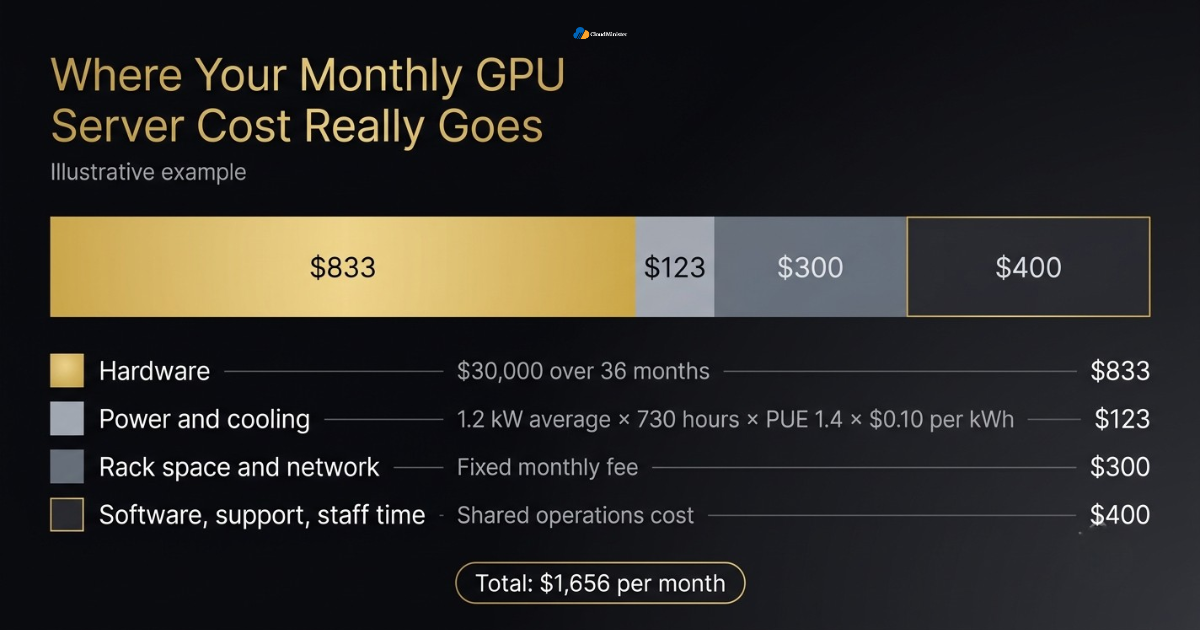
A GPU price alone never gives the full picture. A real Cost Per Million Tokens includes the cost of owning, powering, housing, connecting, and operating the machine. Teams that skip these items usually under estimate their number by a wide margin. In the example below, the hardware is only about half of the monthly total once the other items are added, and the table shows each part. Whether you run the best GPU cloud hosting in India or your own rack, the same Cost Per Million Tokens method applies.
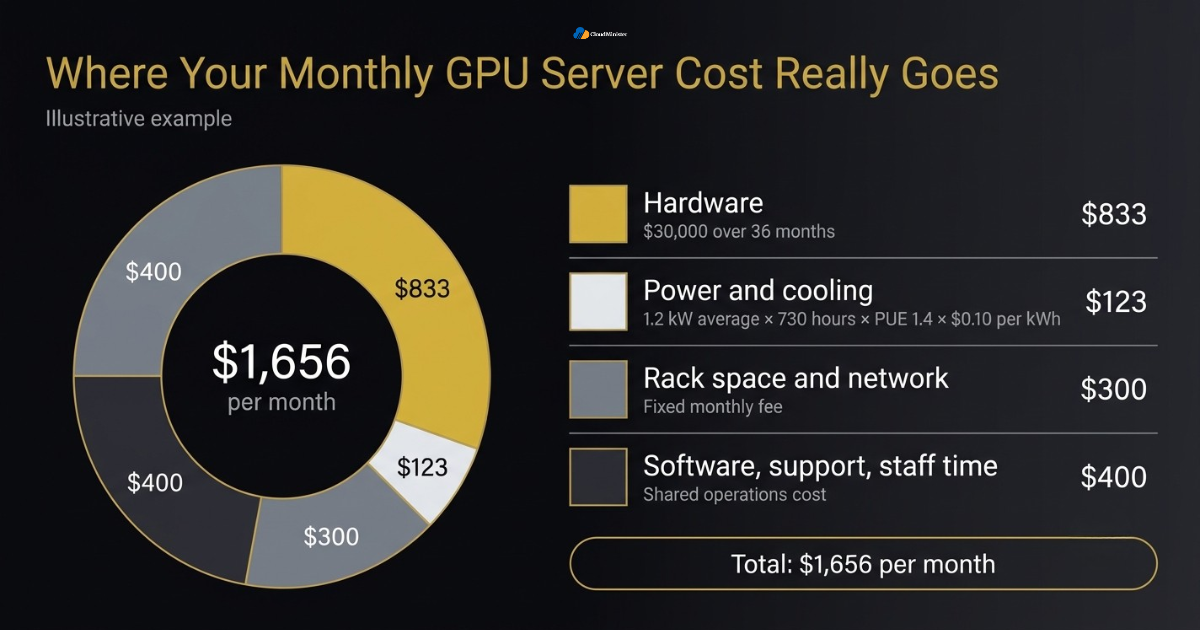
- Hardware: spread the purchase price over its useful life. A 30,000 dollar server over 36 months adds about 833 dollars each month. Lease prices for GPU Servers for AI include this cost already.
- Power: multiply average draw in kilowatts by hours and by your electricity rate. Data centre GPUs can draw several hundred watts each, and an H100 SXM module is rated up to 700 watts.
- Cooling and facility overhead: PUE is total facility energy divided by IT equipment energy, so a PUE of 1.4 adds 40 percent on top of server power.
- Hosting: rack space, bandwidth, and IP addresses have a monthly price even when the servers are your own. A Web Hosting Company in India usually bundles these into one fixed fee.
- Software and licences: operating system support, monitoring, and container tooling can add recurring cost. Strong monitoring tools often add a small recurring fee.
- People: engineers who patch, upgrade, and respond to incidents have a real cost, even if it is shared across projects. Compare this with the managed support offered by the best GPU cloud hosting providers.
- Redundancy: a second server for failover doubles hardware cost unless it also serves live traffic. Count it in your monthly total.
- Leasing: when you compare buying with leasing, check the monthly price from the best GPU cloud hosting in India against your own total, because a lease bundles power, space, and hardware support.
| Monthly cost item | Assumption | Amount |
| Hardware | $30,000 over 36 months | $833 |
| Power and cooling | 1.2 kW average x 730 hours x PUE 1.4 x $0.10 per kWh | $123 |
| Rack space and network | Fixed monthly fee | $300 |
| Software, support, staff time | Shared operations cost | $400 |
| Total | Illustrative example | $1,656 |
Never let the GPU price stand in for the whole bill. In most cost reviews the card is only about half of the monthly total, so a quote that ignores power, hosting, and staff time makes self hosting look cheaper than it is. An honest Cost Per Million Tokens always starts from the full monthly figure.
5. Throughput, Latency, and Token Metrics You Must Measure
A cheap token that arrives too late is not useful. The Cost Per Million Tokens you calculate should be tied to a latency target, because a server can be pushed to very high throughput by queuing requests, and that makes users wait. Measure throughput and latency together under a realistic load pattern, using the benchmark tools that ship with your inference engine. Run the same test on any best GPU cloud hosting plan you are thinking about, so the Cost Per Million Tokens you compare comes from equal conditions.
- Output tokens per second across all requests is the main throughput figure for the denominator. Your GPU Monitoring dashboard should show it live.
- Time to first token, often shortened to TTFT, is the delay before the first output token appears. It grows with prompt length and queue length. Ask the best GPU cloud hosting in India providers for TTFT numbers on your model.
- Inter token latency, also called time per output token, is the gap between tokens after the first. It decides how smooth streaming feels.
- Prefill processes the whole prompt in parallel and is mostly limited by compute. Decode generates one token per step for each request and is mostly limited by memory bandwidth.
- Goodput counts only the requests that met your latency targets. Use goodput, not raw throughput, in your cost formula. This keeps your LLM inference cost per token honest.
- Test with your real prompt and output length distribution. Synthetic tests with short, equal length prompts hide long request problems.
- Test at several concurrency levels, such as 1, 8, 32, and 128, to find the point where latency breaks your target. Run it on GPU Servers for AI with the same driver and engine version each time.
- Record p50, p95, and p99 latency, since averages hide slow requests. A Web Hosting Company in India that shares latency data from its own network helps you here.
Related Reading: comparison of vLLM, Ollama, and TGI inference engines
Report your LLM inference cost per token at the highest load where your p95 latency target is still met. That single number is more honest than a peak benchmark, and it is the one your finance team can rely on. Re run it every time you change the model or the quantization level.
6. How GPU Memory Shapes Your Cost Per Million Tokens
Memory decides how many requests a GPU can serve at once, and concurrency is what pushes cost down. Model weights take a fixed block of memory, and each active request adds a key value cache that grows with its context length. Whatever memory is left after the weights decides your batch size, so a smaller memory footprint usually means a lower Cost Per Million Tokens. This is why the best GPU cloud hosting plans list memory size before anything else.
- Weight memory is roughly parameters times bytes per parameter. An 8 billion parameter model needs about 16 GB in FP16 or BF16, about 8 GB in 8 bit, and about 4 GB in 4 bit, before overhead. Smaller weights directly lower your Cost Per Million Tokens.
- A 70 billion parameter model needs about 140 GB in FP16. That does not fit on a single 80 GB GPU, so it needs several GPUs or quantization. Plans from the best GPU cloud hosting in India often list multi GPU options.
- KV cache per token equals 2 x layers x KV heads x head dimension x bytes per value.
- For a Llama 3 8B style model with 32 layers, 8 KV heads, a head dimension of 128, and FP16 values, that is 131,072 bytes, or 128 KiB per token.
- At 8,192 tokens of context, one request therefore holds about 1 GiB of KV cache. Monitoring shows how much of that memory is really in use.
- Grouped query attention reduces the number of KV heads and so shrinks the cache, which is why newer models fit more requests per GPU. More requests per GPU means a lower LLM inference cost per token.
- Paged KV cache management, as used by vLLM, reduces wasted memory and allows more concurrent requests. Choose the best GPU cloud hosting in India with enough memory to use it fully.
- Reserve memory for activations and the runtime, so never plan to use every last gigabyte. A Web Hosting Company in India that lists memory per card clearly saves you guesswork.
- When memory is the limit, GPU Servers for AI with larger memory per card can serve more requests per card and lower your cost.
Related Reading: Google TPU versus NVIDIA GPU comparison for 2026.
7. Utilization: The Biggest Lever on Your Cost Per Million Tokens
Utilization decides whether a fast GPU is cheap or expensive. A 2026 Kubernetes optimisation report from Cast AI, covered by HPCwire, found average GPU utilisation of only about 5 percent across tens of thousands of clusters, and noted that optimised environments can reach around 50 percent. Even if your server does better than that average, every idle hour still adds cost without adding tokens, so Cost Per Million Tokens rises as utilization falls. Many teams find that the best GPU cloud hosting plan is the one that lets them keep the GPU busy, not the one with the lowest hourly price.
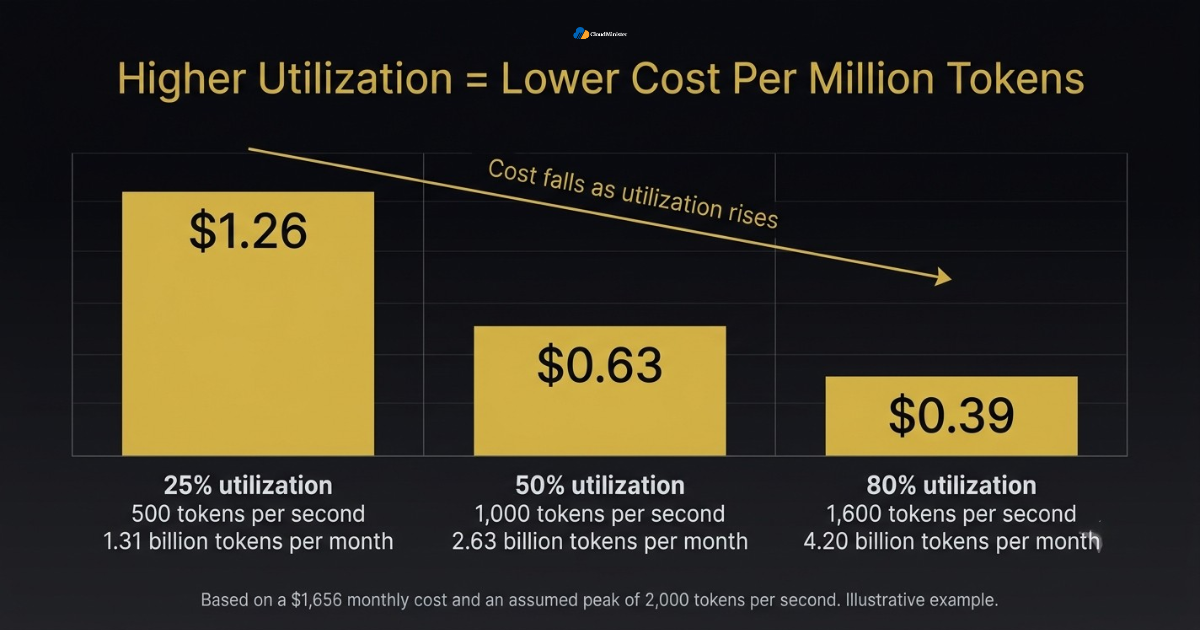
- Cost per token is inversely proportional to utilization. Doubling busy time halves the cost, as long as latency stays within target. In other words, your Cost Per Million Tokens falls as utilization rises.
- Here, utilization means the share of peak token capacity you actually serve, not only the number a driver tool prints.
- Night and weekend traffic is often low. Move batch jobs such as summarization or embedding generation into those hours. Moving that work lowers your unit cost.
- Run several models on one GPU only when memory and latency allow it, otherwise they compete for the same resources.
- Autoscale or schedule capacity if you rent by the hour, and remember that loading a large model takes time. Ask your Web Hosting Company in India whether hourly or monthly billing suits your traffic.
- Use request queues and priority classes so batch work fills gaps without hurting interactive users. The best GPU cloud hosting in India plans let you run both on one server.
- Set a target band, such as 50 to 70 percent of peak throughput in business hours, and alert on both sides of it. Use it for every set of GPU Servers for AI that you run.
- Review utilization by hour of day, since a good daily average can hide long idle stretches. A good dashboard makes this view easy to build.
| Utilization of 2,000 tokens per second peak | Tokens per month | Cost Per Million Tokens |
| 25 percent (500 tokens per second) | 1.31 billion | $1.26 |
| 50 percent (1,000 tokens per second) | 2.63 billion | $0.63 |
| 80 percent (1,600 tokens per second) | 4.20 billion | $0.39 |
The table uses the 1,656 dollar monthly cost from section 4. The peak throughput of 2,000 tokens per second is an assumption for illustration, so measure your own. Compare any best GPU cloud hosting in India plan against these numbers before you decide.
8. Measuring Real Usage with GPU Monitoring
You cannot lower a number you do not measure. Good GPU Monitoring turns guesses into data by recording utilization, memory, power, temperature, and token counts over time. The goal is to connect hardware signals with serving signals, so you can see how many tokens each watt and each rupee produce. Without GPU Monitoring, a latency spike and a quiet night can look exactly the same. Good monitoring also supports honest reporting of Cost Per Million Tokens to finance.
- Use nvidia-smi for quick checks. The command nvidia-smi –query-gpu=utilization.gpu,memory.used,power.draw –format=csv -l 5 prints those values every five seconds. Many GPU Servers for AI ship with it installed.
- The utilization.gpu value shows the share of time in the sample period when at least one kernel was running. It does not show how much of the chip was busy, so a high value can still hide poor efficiency.
- For continuous collection, NVIDIA DCGM and its exporter publish metrics such as DCGM_FI_DEV_GPU_UTIL, DCGM_FI_DEV_FB_USED, and DCGM_FI_DEV_POWER_USAGE to Prometheus. This is the core of production GPU Monitoring.
- Most inference engines, including vLLM, expose Prometheus metrics on a metrics endpoint with request counts, queue length, and token counters. Names vary by version, so check the documentation.
- Build one dashboard that shows tokens per second, queue length, p95 latency, GPU memory, and power draw together. Every serious monitoring setup should include these five views.
- Compute tokens per kilowatt hour and tokens per dollar every day. They show efficiency trends before the monthly bill does. They are a direct signal for your unit cost.
- Alert on sustained low utilization as well as high temperature, because idle cost is silent. A Web Hosting Company in India with a monitoring team can watch this for you.
- Keep data for at least a quarter so you can compare before and after each optimization. The best GPU cloud hosting providers can export this data on request.
Related Reading: developer guide to tracking GPU health and usage
GPU Monitoring endpoints and metrics ports reveal details about your workloads, such as request rates and model names. Keep them on a private network, require authentication, and never expose them to the open internet.
9. Proven Ways to Lower Your Cost Per Million Tokens
Once you can measure, you can improve. Most savings come from serving more tokens on the same hardware, not from buying cheaper hardware. Try one change at a time and record its effect on both Cost Per Million Tokens and answer quality, so you know exactly what each change is worth. Savings found this way lower your LLM inference cost per token on any server, including the best GPU cloud hosting in India.
- Continuous batching: the engine adds new requests to a running batch at every step, which keeps the GPU busy and raises throughput. Keep the dashboard open to see the effect.
- Quantization: 8 bit or 4 bit weights reduce memory and often raise throughput. Test quality on your own evaluation set before rollout. Lower precision often cuts Cost Per Million Tokens by freeing memory for more requests.
- Prefix caching: reuse the computed state of repeated system prompts and shared documents, so repeated prefill work is skipped. Ask the best GPU cloud hosting in India providers whether their engines support it.
- Speculative decoding: a small draft model proposes tokens and the large model verifies them. With proper verification the output distribution is preserved, but the gain depends on how often the draft is right.
- Right sizing the model: a smaller or distilled model that meets your quality bar can cut cost far more than any kernel tweak. Pick the model, then check that your GPU Servers for AI have memory for it.
- Shorter prompts and outputs: trim system prompts, cap output length, and avoid sending unused context. A Web Hosting Company in India can also reduce network delay for Indian users.
- Tensor parallelism only when needed: splitting a model across GPUs adds communication overhead, so use it when the model does not fit or latency demands it. The best GPU cloud hosting plans with fast interconnect make this cheaper.
- Chunked prefill and careful scheduling: mixing prefill and decode more evenly smooths latency under load.
- Response caching: store answers to repeated questions where the correct answer does not change. Cached answers cost almost nothing, which lowers your blended Cost Per Million Tokens.
Related Reading: inference cost optimization.
10. Self Hosting, Rented GPUs, or API: Finding the Break Even Point
The right choice depends on volume. An API charges per token and costs nothing when idle, while a server charges per hour and is cheapest per token when busy. The break even point is where your monthly token volume makes the server cheaper than the API. A Web Hosting Company in India that offers dedicated GPU machines can give a fixed monthly price, which makes this comparison easy to run and keeps Cost Per Million Tokens predictable. The best GPU cloud hosting in India plans often fit the middle ground, with a fixed price and room to scale.
- Break even volume, in millions of tokens, equals monthly server cost divided by the API price per million tokens. Low volume favours an API, and high volume favours GPU Servers for AI.
- Example with a placeholder price: at 1,656 dollars a month and a hypothetical API price of 1.00 dollar per million tokens, break even is 1,656 million tokens, or about 1.66 billion tokens a month.
- In the earlier example the server can produce 5.256 billion tokens a month at full load, so break even needs about 31.5 percent of that capacity.
- Use the current published price of the model class you would replace, because API prices change often. Do not reuse the placeholder. Compare it with your LLM inference cost per token, not with the monthly bill.
- Add the cost of any quality gap, since a self hosted open model may not match a larger hosted model on every task.
- Add engineering time to build and run the stack, and add the cost of being wrong about future demand. Monthly plans for GPU Servers for AI reduce that risk.
- Data residency, privacy, and latency can justify self hosting even when the pure token cost is similar. A Web Hosting Company in India with local data centres supports this.
- A hybrid design sends steady traffic to your own server and sends bursts to an API. Track the blended Cost Per Million Tokens of both paths with GPU Monitoring.
Ready to Run Your Own LLM Inference on GPU Servers?
Once you know your Cost Per Million Tokens, the next step is hardware that keeps it low. Explore CloudMinister GPU Servers for AI built for high-throughput inference, with the memory and performance your models need.
11. Choosing the Right Infrastructure Partner for Predictable Costs
Your cost number is only as good as the infrastructure behind it. A capable partner shows real prices, real network speeds, and real support hours, so your Cost Per Million Tokens stays predictable from one month to the next. Compare options on the same terms, and ask for written answers on anything that affects uptime or performance. Providers of the best GPU cloud hosting in India should welcome these questions.
- Ask for fixed monthly pricing with power, bandwidth, and support included, so no surprise item changes your LLM inference cost per token.
- Check the GPU model, memory size, and interconnect, because they set your batch size and throughput. The best GPU cloud hosting providers list these details openly.
- Look for best GPU cloud hosting plans that allow flexible upgrades, so you can move to larger memory when your model grows.
- Compare GPU Servers for AI on memory per card and not only on card count.
- Confirm that data centres are in India if you need local residency and low latency for Indian users. Ask each Web Hosting Company in India for these numbers in writing.
- Ask whether GPU Monitoring access and metrics export are included, so you can track utilization yourself.
- Ask what the support team handles at night and on weekends, and who is called when a GPU fails. A team that knows GPU Servers for AI well will answer clearly.
- Ask for a trial or benchmark period so you can measure real throughput before signing a long contract. Use the trial to measure your own Cost Per Million Tokens.
- Prefer the best GPU cloud hosting in India providers that are open about limits, because honesty before signing predicts honesty during an incident.
12. Common Mistakes When Calculating Cost Per Million Tokens
Most wrong numbers come from a short list of habits. Avoiding them is the cheapest way to improve your LLM inference cost per token estimates without touching any hardware, and it builds trust in the figure when you share it with other teams. A mistake in Cost Per Million Tokens can send a whole hardware plan in the wrong direction.
- Using peak benchmark throughput instead of average real throughput.
- Ignoring idle hours, weekends, and failover capacity in the denominator. GPU Monitoring data shows these gaps clearly.
- Counting only the GPU price and leaving out power, hosting, and staff time. Even a best GPU cloud hosting quote must be read in full.
- Mixing input and output tokens without saying so, then comparing against a split API price.
- Measuring with short prompts and applying the result to long context traffic.
- Comparing a quantized model on your server with a full precision model on an API without checking quality. The same applies when you compare a local provider with an overseas provider.
- Forgetting that tokenizers differ, so token counts from two models are not directly comparable. This matters when you compare quotes from the best GPU cloud hosting in India.
- Measuring once and never again, even after the model or traffic changes. Your unit cost changes with each release.
- Trusting the utilization number from a driver tool as proof of efficiency. Cross check it with token counts on your GPU Servers for AI.
13. A Practical 30 Day Plan to Track Your Cost Per Million Tokens
Reading about the method is easy, and acting on it is harder, so this plan splits the work into four weeks that most teams can follow. After the first month, repeat the review once a quarter, because models, traffic, and prices keep changing and a number that was right last year may be wrong today. Treat Cost Per Million Tokens as a metric you own, just like uptime.
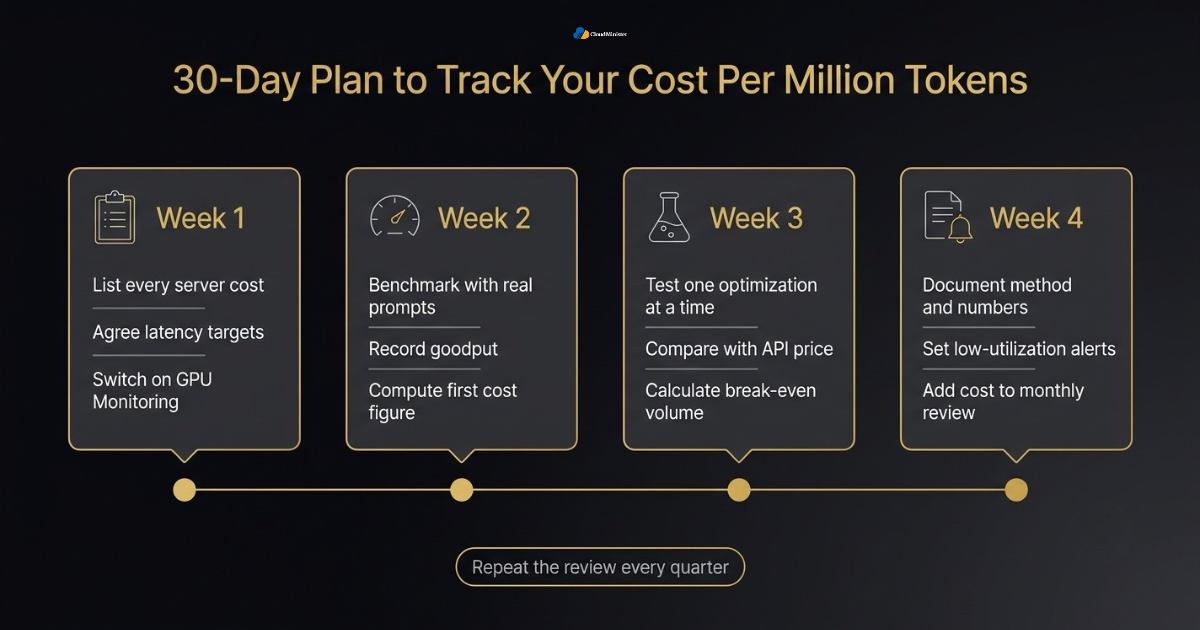
- Week one: list every cost of the server, from hardware to staff time, and agree the latency targets with the product team. Include any best GPU cloud hosting in India fees you pay.
- Week one: switch on GPU Monitoring and engine metrics, and store them for later analysis.
- Week two: run benchmarks with real prompts at several concurrency levels, and record goodput at your latency target.
- Week two: compute your first Cost Per Million Tokens, blended and split into input and output.
- Week three: test one optimization at a time, such as quantization or prefix caching, and measure cost and quality together. Use GPU Servers for AI test machines for safe experiments.
- Week three: compare your number with the current price of a managed API and calculate the break even volume. Include a Web Hosting Company in India quote for dedicated servers.
- Week four: write the method and the numbers into a short document so others can repeat it. Include screenshots from GPU Monitoring.
- Week four: set alerts for low utilization and add the cost figure to your monthly engineering review. Name it LLM inference cost per token on the dashboard.
Checklist: Cost Calculation Readiness Review
- Full monthly cost listed, including power, hosting, software, and people
- Average output tokens per second measured over at least one full week
- Input and output tokens counted separately
- Latency targets defined and goodput measured against them
- Memory budget checked for weights and KV cache at real context lengths
- GPU Monitoring and engine metrics running with alerts in place
- One optimization tested at a time, with quality checked
- Break even volume compared with a current API price
- Method and results written down for the next review
Key Takeaways
- Cost Per Million Tokens equals total monthly cost divided by total monthly tokens, times one million.
- The honest numerator includes hardware, power, cooling, hosting, software, and people.
- The honest denominator uses average real throughput that meets your latency target.
- Utilization is the biggest lever, because cost falls in direct proportion as busy time rises.
- GPU memory sets batch size, and batch size sets throughput, so measure weights and KV cache early.
- Track input and output tokens separately, since prefill and decode load the GPU differently.
- GPU Monitoring and engine metrics show where idle cost hides and prove that each optimization worked.
- Compare your number with a current API price to find the break even volume before you buy hardware.
- A partner offering GPU Servers for AI with fixed pricing and clear support makes your LLM inference cost per token easier to forecast.
- A Web Hosting Company in India that offers the best GPU cloud hosting makes the full monthly cost easier to predict.
Need Help Calculating Your True LLM Inference Cost?
Share your model, traffic pattern, and latency target with our team. We will help you choose the right GPU infrastructure and plan a predictable monthly cost for your AI workload.
Conclusion
One pattern holds across every model and every team: Cost Per Million Tokens is the result of measurement, not of a single clever tool. The best results come from counting every cost, serving real traffic, watching utilization, and changing one thing at a time. When the method is written down and repeated, your LLM inference cost per token becomes a number the whole company can trust. Teams that follow it keep their unit cost low and honest.
For teams weighing this alongside a wider infrastructure decision, the same principle applies. Map the workload first, compare options on equal terms, and keep measuring as traffic grows. A capable Web Hosting Company in India that offers the best GPU cloud hosting in India, along with GPU Servers for AI and clear GPU Monitoring support, can turn this method into a steady, predictable monthly figure.
Frequently Asked Questions
What is the simplest way to calculate Cost Per Million Tokens?
Add up the full monthly cost of the server, divide it by the number of tokens served in that month, and multiply by one million. Use the average tokens per second you measured over a full week, not a short peak test, so the Cost Per Million Tokens reflects real life.
Why is my LLM inference cost per token higher than the vendor benchmark suggests?
Vendor numbers usually assume full load, short prompts, and no idle time. Real traffic has quiet hours, long prompts, and latency limits, so your LLM inference cost per token will be higher until utilization improves. Track it with GPU Monitoring every week.
Should input and output tokens be counted together?
You can report a blended figure, but a split figure is more useful. Input tokens are processed in parallel during prefill, while output tokens are generated one step at a time during decode, so they cost the GPU different amounts of time. Track both when you calculate Cost Per Million Tokens. Providers of the best GPU cloud hosting in India can often supply these counts.
How does GPU memory affect cost?
Memory limits how many requests can run at once. After the model weights are loaded, the remaining memory holds the KV cache for each active request. More concurrent requests mean more tokens per second, which lowers Cost Per Million Tokens. The best GPU cloud hosting plans list memory per card for this reason.
Is a high GPU utilization number always good?
Not always. The utilization value from nvidia-smi only shows how much of the time a kernel was running, not how efficiently the chip was used. Pair it with tokens per second and latency data from GPU Monitoring before you judge efficiency.
When is self hosting cheaper than an API?
When your monthly token volume is above the break even point, which is the monthly server cost divided by the API price per million tokens. Below that volume, an API is usually cheaper, and a hybrid setup can cover both cases. Ask a Web Hosting Company in India for a fixed quote to test the numbers.
Do I need a Web Hosting Company in India for GPU servers?
Not always, but a Web Hosting Company in India can help when you need local data residency, low latency for Indian users, fixed monthly pricing, and support in your time zone. Compare plans using the same cost method described above. The best GPU cloud hosting in India providers will also share their GPU Servers for AI specifications.
What should I look for in the best GPU cloud hosting?
Look for clear GPU and memory specifications, fixed pricing, metrics access, and written support terms. The best GPU cloud hosting plans also allow upgrades and a benchmark period, so you can measure your own Cost Per Million Tokens before committing.
How often should I recalculate my numbers?
Recalculate after any change to the model, quantization, engine version, or traffic pattern, and review the figure at least once a quarter. Treat Cost Per Million Tokens as a live metric, and keep GPU Monitoring running so the data is always fresh.
Which GPU servers suit LLM inference?
Choose by memory per card first, then by memory bandwidth and interconnect. GPU Servers for AI with enough memory for your weights and KV cache will usually give a lower cost than a faster card that is forced to run small batches. The best GPU cloud hosting plans make this easy to compare.

Shivlendra Singh Jadoun is a Cloud & DevOps Engineer at CloudMinister Technologies, specializing in AWS, Azure, and GCP infrastructure. He began his career in Linux system administration, managing shared, VPS, and dedicated servers before moving into cloud and automation. He is AWS Certified and works extensively with Docker, Kubernetes, Terraform, Ansible, and Jenkins to build CI/CD pipelines and scalable, secure cloud environments. With hands-on experience across hosting, server security, and DevOps automation, he brings real-world engineering insight to every article he writes.