
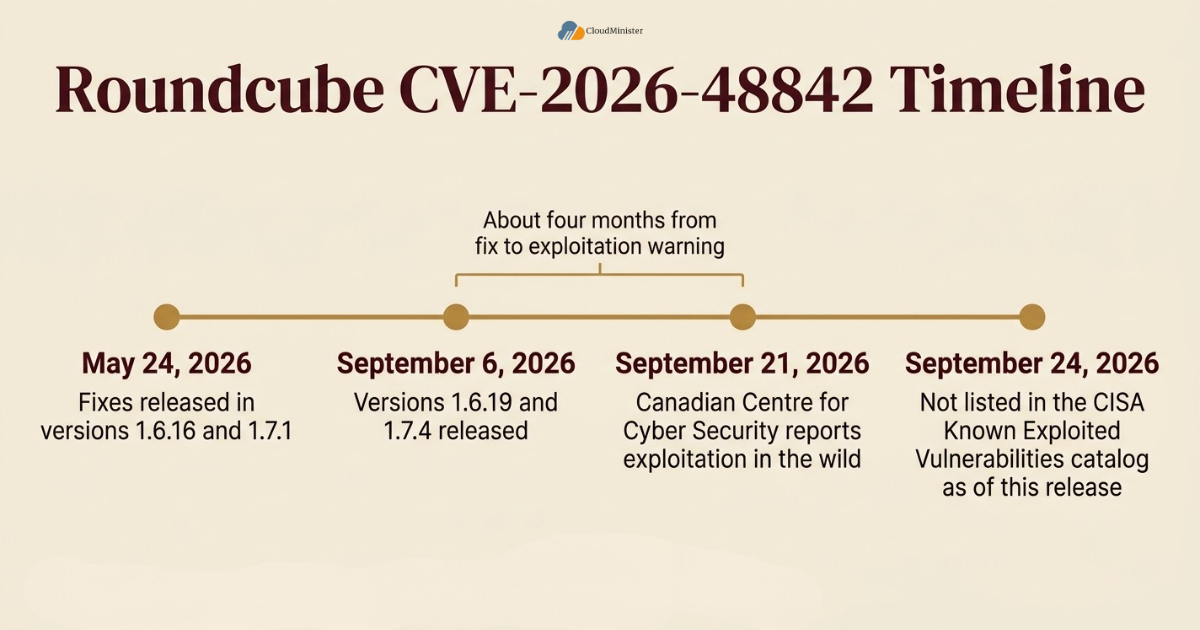
Roundcube CVE-2026-48842 is a pre-authentication SQL injection flaw in the virtuser_query plugin of Roundcube Webmail. It affects versions 1.6.x before 1.6.16 and 1.7.x before 1.7.1, and it can only be reached when that optional plugin is enabled and set up with SQL queries. Roundcube released fixes on May 24, 2026, and in September 2026 the Canadian Centre for Cyber Security reported exploitation in the wild. This guide explains what Roundcube CVE-2026-48842 is, how to check your exposure in minutes, how to patch safely, and what to do when patching must wait. It also shows where a Web Hosting Company in India, Server Management Services in India, and Cyber Security services fit into a webmail security plan. Teams that need practical cybersecurity solutions and reliable Server Management Services will find the steps below easy to follow.
Webmail rarely gets the attention it deserves until something goes wrong. Roundcube CVE-2026-48842 is a good example of why that habit is risky. The flaw sits in an optional plugin called virtuser_query, and it can be reached by anyone who can open the login page. No account is needed, no password is needed, and no one has to click a bad link. That makes it a very different kind of problem from the usual phishing story.
The fix was not a secret. Roundcube shipped patched builds on May 24, 2026, and for a while the matter looked closed. Then in September 2026 the Canadian Centre for Cyber Security reported that exploitation was happening in the wild. In other words, Roundcube CVE-2026-48842 turned into a live problem for any server that simply stayed unpatched through the summer. Four months is a long time to leave a public login page exposed.
It is also worth saying what this issue is not. Not every Roundcube server is at risk, because a default install does not load the plugin, and it only matters when queries have been configured. Many administrators never chose to enable it, and some do not even know it is there. Hosting stacks and control panels often bundle Roundcube, so the real state of a server can be different from what people assume. Roundcube CVE-2026-48842 rewards the teams that check instead of guess.
This guide is written for system administrators, hosting teams, and business owners who want clear answers without the noise. You will learn what the flaw is, how the bypass works, and how to check your own exposure in a few minutes. We then cover safe patching, short term fixes when you cannot upgrade today, and how to look for signs of misuse. By the end, you will have a practical plan to deal with Roundcube CVE-2026-48842 and a record you can show to auditors and customers.
Table of Content
- 1. Why This Webmail Flaw Matters to Every Mail Administrator
- 2. What the 2026 Data Says About Roundcube Exposure
- 3. What This SQL Injection Flaw Actually Is
- 4. How the Backslash Bypass Works in virtuser_query
- 5. Who Is Affected by This Vulnerability
- 6. How to Check Whether Your Server Is Exposed
- 7. How to Patch This Flaw Safely
- 8. What to Do If You Cannot Patch Today
- 9. Checking for Signs of Compromise
- 10. Hardening Roundcube Beyond the Patch
- 11. Compliance and Regulatory Angle in India
- 12. Choosing the Right Partner for Webmail Security
- 13. A Practical 14 Day Plan for Roundcube Patching
- Key Takeaways
- Conclusion
- Frequently Asked Questions
1. Why Roundcube CVE-2026-48842 Matters to Every Mail Administrator
Webmail is one of the few services that organizations expose directly to the internet, and it holds some of the most sensitive data they own. That is why Roundcube CVE-2026-48842 deserves more urgency than its severity score alone suggests. The fix has been available since May, yet an attacker only needs one forgotten server to get a foothold. If you run mail for a company, a school, or hundreds of hosting customers, a flaw like this can turn a routine maintenance window into an emergency. A reliable Web Hosting Company in India will normally track advisories like this for you, but you should still know how to verify the answer yourself. Good cybersecurity solutions begin with this kind of visibility.
- Roundcube CVE-2026-48842 is rated 8.1 (High) and needs no login, so anyone who can reach the login page can attempt it.
- The flaw sits in virtuser_query, a plugin that ships with Roundcube but stays switched off until an administrator enables it.
- Attack complexity is rated High, which means exploitation depends on specific conditions and is not a simple one click attack.
- Roundcube released fixed builds on May 24, 2026, so every day of delay after that date is avoidable risk.
- On September 21, 2026, the Canadian Centre for Cyber Security updated advisory AV26-503 to say that exploitation of Roundcube CVE-2026-48842 is happening in the wild.
- A webmail database holds contacts, identities, and session records, so one leak on one server can touch every mailbox on it.
- Many administrators never installed Roundcube themselves, because control panels and hosting stacks often bundle it, and Server Management Services can confirm what is really running.
- Providers of Cyber Security services and cybersecurity solutions treat webmail as a high value target because it is public, it is trusted, and it holds credentials and correspondence.
- Server Management Services in India can watch versions, plugins, and patch dates on every mail server, so a Web Hosting Company in India can answer customer questions with facts.
2. What the 2026 Data Says About Roundcube Exposure
Numbers help explain why this issue is drawing attention months after the fix. Roundcube is popular, easy to self host, and often bundled into hosting stacks, which gives attackers a large and predictable list of targets. The figures below come from 2026 reporting and are best read as context, not as a victim count. Exposure data tells you how many doors exist, not how many are unlocked. Even so, it shows how a patched flaw such as Roundcube CVE-2026-48842 can become an active problem long after the vendor has done its part. Providers of Server Management Services track such figures for every client, and a Web Hosting Company in India can turn them into a simple patch list.
- Shadowserver, a threat monitoring non-profit, tracks more than 523,000 Roundcube instances exposed on the internet, according to BleepingComputer’s September 2026 report.
- That figure does not say how many of those servers are patched, and it may include honeypots, so it is not a count of vulnerable systems.
- Only servers running an affected version with virtuser_query enabled are exposed to Roundcube CVE-2026-48842, so the truly at-risk group is much smaller than the headline number.
- The gap between patch and warning was about four months: fixed on May 24, 2026, and flagged as exploited on September 21, 2026.
- As of the September 24, 2026 catalog release, CISA’s Known Exploited Vulnerabilities list already held 11 Roundcube flaws, and three later Roundcube releases have fixed 29 more issues since May.
- Roundcube CVE-2026-48842 was not on the CISA list as of that release, so no federal patch deadline exists yet, but that should never set your own deadline.
- Public reporting names no attacker and publishes no indicators of compromise, so defenders must rely on their own logs and version checks.
- Server Management Services in India often keep a live inventory of every webmail instance, which is the first thing you need when a number like this appears.
- Cyber Security services teams use exposure data like this to rank which servers to patch first.
Treat exposure statistics as a reason to build an inventory, not a reason to panic. List every Roundcube instance you run or host, its version, and whether virtuser_query is enabled. That one list answers most questions about Roundcube CVE-2026-48842 in a few minutes. That list is also the base of any set of cybersecurity solutions.
3. What Roundcube CVE-2026-48842 Actually Is
Roundcube CVE-2026-48842 is a SQL injection flaw, classified as CWE-89, in the virtuser_query plugin. SQL injection happens when an application builds a database query from text supplied by a visitor and fails to keep that text separate from the query itself. This plugin maps login names to email addresses and identities by running queries that the administrator writes. Here, the protection around that mapping could be bypassed, so an unauthenticated visitor could shape the query. The table below gives the key facts. It also helps to say clearly what the flaw is not: it is a database issue, and it is not proof that the whole server can be taken over, a point that every provider of cybersecurity solutions should state clearly.
| Item | Detail |
| CVE identifier | CVE-2026-48842 |
| Product | Roundcube Webmail |
| Component | virtuser_query plugin (optional, off by default) |
| Weakness type | SQL injection (CWE-89) |
| Login required | No |
| Severity | CVSS 8.1 High, attack complexity High |
| Affected versions | 1.6.x before 1.6.16 and 1.7.x before 1.7.1 |
| Fixed in | 1.6.16 and 1.7.1, released May 24, 2026 |
| Latest releases at time of writing | 1.6.19 and 1.7.4, released September 6, 2026 |
| Exploitation | Reported in the wild by the Canadian Centre for Cyber Security on September 21, 2026 |
- SQL injection lets an attacker change the meaning of a database query, usually to read or alter data that the query was never meant to expose.
- Roundcube CVE-2026-48842 is reached through login handling, so it works before any user session exists.
- Because it needs no account, controls that protect logged in users do not stop it.
- The CVSS vector is AV:N/AC:H/PR:N/UI:N/S:U/C:H/I:H/A:H, which reads as network reachable, high complexity, no privileges, no user interaction, and high impact on confidentiality, integrity, and availability.
- Public reporting describes SQL injection only. It does not establish remote code execution on the operating system, so do not label Roundcube CVE-2026-48842 that way in tickets or reports.
- What an attacker can do next depends on database privileges, server configuration, and what the database stores.
- Roundcube’s database holds user records, sessions, contacts, collected addresses, and sender identities, which cybersecurity solutions must protect because it is useful material for phishing and impersonation.
- Good Cyber Security services classify this as a data exposure risk first and a server compromise risk only if evidence points there.
- Server Management Services can compare the table above with the versions on your servers in a single pass.
4. How the Backslash Bypass Works in virtuser_query
To understand the fix, it helps to see the mistake. The virtuser_query plugin lets an administrator write SQL with placeholders such as %u and %m, which stand for values typed at login. Before the patch, the plugin escaped that value and then inserted it into the query using PHP’s preg_replace() function. That function treats backslashes in its replacement text as meaningful instead of copying them as they are. A crafted run of backslashes could therefore undo the escaping and let a quote character reach the query. It is a small coding detail, but it makes Roundcube CVE-2026-48842 a useful lesson in safe query building.
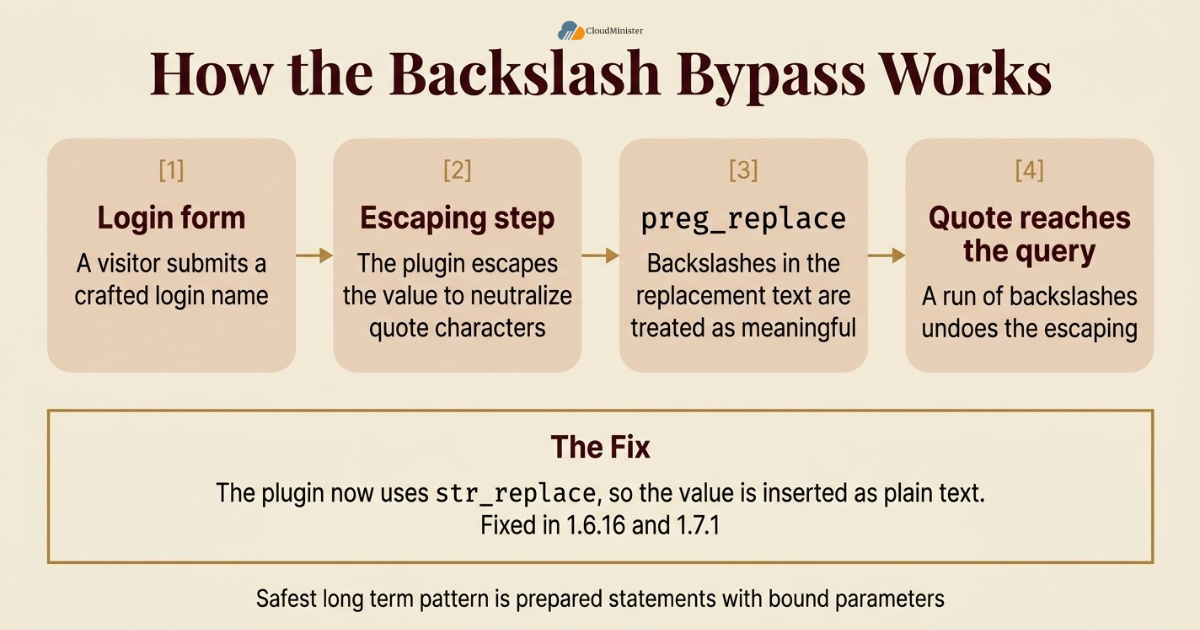
- The plugin reads SQL templates from its configuration and swaps the placeholders for values supplied by the visitor.
- The escaping step was meant to neutralize quote characters, which attackers use to break out of a SQL string.
- Because preg_replace() interprets backslash sequences in the replacement text, the escaped value did not always arrive intact.
- The vendor’s fix replaces preg_replace() with str_replace() inside the plugin, so the value is inserted as plain text.
- Public analysis notes that some of the plugin’s lookups run from the authentication hook, which fires when the login form is submitted, and that is why no account is needed.
- The safest long term pattern is prepared statements with bound parameters, which keep data and query logic apart by design and form a basic rule of cybersecurity solutions.
- Manual escaping followed by string substitution is fragile, and this case shows how a small change in joining text can undo it.
- Roundcube CVE-2026-48842 sits in an optional plugin and not in Roundcube’s core login code, which is why a default install is not exposed.
- Server Management Services should include a review of enabled plugins whenever a plugin flaw like this is announced.
Roundcube’s release notes call this a preg_replace backslash escape bypass and credit a researcher known as skull. The lesson for developers is to use parameter binding and never build SQL by substituting escaped text, and the lesson for administrators is that Roundcube CVE-2026-48842 hides in a plugin many teams forget they enabled.
5. Who Is Affected by Roundcube CVE-2026-48842
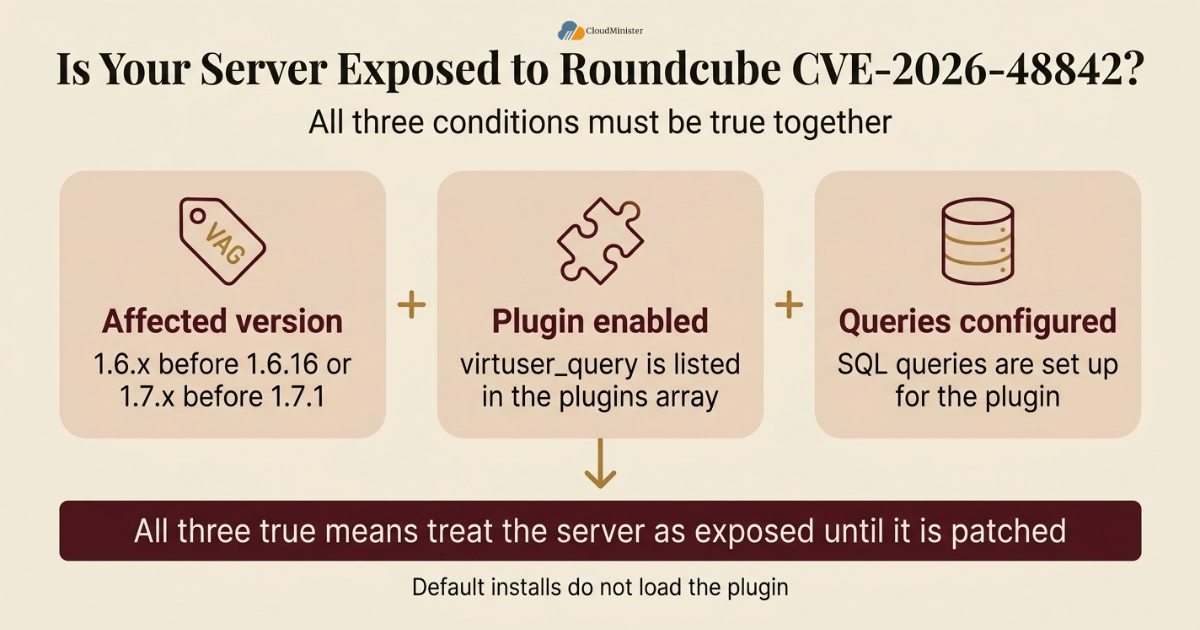
Not every Roundcube server is vulnerable, and saying so plainly saves teams from wasted panic. A server is exposed only when three things are true together: it runs an affected version, the virtuser_query plugin is enabled, and the plugin has SQL queries configured. The operators most likely to meet all three run virtual mail hosting, where mailbox users live in database tables instead of system accounts. If Roundcube arrived inside a control panel, the panel vendor decides the version, so you must check the build that was actually deployed. A Web Hosting Company in India that manages your mail stack can answer this quickly. Server Management Services in India often hold that answer in an asset record.
| Branch | Status for this flaw | Recommended action |
| 1.6.x before 1.6.16 | Affected when the plugin is enabled | Upgrade to 1.6.19 or newer |
| 1.6.16 to 1.6.18 | Fixed for this flaw | Upgrade to 1.6.19 for later fixes |
| 1.7.x before 1.7.1 | Affected when the plugin is enabled | Upgrade to 1.7.4 or newer |
| 1.7.1 to 1.7.3 | Fixed for this flaw | Upgrade to 1.7.4 for later fixes |
- Affected versions are 1.6.x before 1.6.16 and 1.7.x before 1.7.1, as listed in the CVE record for Roundcube CVE-2026-48842.
- Public reporting does not name the 1.5 branch as affected, but any old branch should still be moved to a maintained release as part of sound cybersecurity solutions.
- Roundcube’s default plugin list is empty, so a fresh default install does not load virtuser_query.
- Even when the plugin is listed, it registers no lookups unless at least one query is configured.
- Virtual hosting setups that map database users to mailboxes are the most likely to have enabled it, so a Web Hosting Company in India should check those servers first.
- Reporting notes that Roundcube ships preinstalled with cPanel, but neither Roundcube nor the Canadian Centre states whether any panel enables this plugin, so check each server.
- A separate database named in the plugin’s virtuser_query_dsn setting may also be in scope, so include it in your review.
- Server Management Services can run the same check across a whole fleet with one script instead of one server at a time.
Related Reading: CPanel and WHM CVE-2026-41940 authentication bypass
6. How to Check Whether Your Server Is Exposed
The check takes minutes and needs only read access. You are answering two questions: which Roundcube version is running, and is virtuser_query switched on with queries defined. Do both on every server, including staging and forgotten test machines, because attackers scan by version and do not care whether a box is labeled test. Replace the example paths below with your own install path. On packaged installs, such as those from a Linux distribution or a control panel, the paths differ, so locate the real directory first. Teams that use Server Management Services in India usually run this as a scripted audit and keep the output as evidence. A Web Hosting Company in India that hosts mail for many customers should run them across every account.
- Find the installed version with grep -n “RCMAIL_VERSION” /path/to/roundcube/program/include/iniset.php, replacing the path with your own install directory.
- Any 1.6 build below 1.6.16, or 1.7 build below 1.7.1, is affected by Roundcube CVE-2026-48842 if the plugin is active.
- Search for the plugin with grep -rn “virtuser_query” /path/to/roundcube/config/ /path/to/roundcube/plugins/virtuser_query/ to see where it is referenced.
- If virtuser_query appears in the plugins array in config.inc.php, the plugin is enabled on that server.
- Then check whether a virtuser_query setting holding SQL exists, either in the main configuration or in the plugin’s own config.inc.php file.
- If both conditions are true and the version is old, treat the server as exposed until it is patched.
- On control panel or Linux package installs, check the build that the panel or package actually deployed, because it can differ from the latest upstream release, and Server Management Services can confirm this from package or panel records.
- Remember standby, disaster recovery, and staging servers, which often hold copies of the same configuration.
- Some vulnerability scanners already include checks for this CVE, and Cyber Security services teams can add an outside view of your exposure.
Save the output of each check with the server name, the date, and your name. A one page record of Roundcube CVE-2026-48842 results is exactly what auditors and customers ask for later. Server Management Services in India can keep these records in one place.
7. How to Patch Roundcube CVE-2026-48842 Safely
Patching is simple, but it should still be done in a sensible order. Upgrade to the newest release in your branch rather than the first fixed one, because later versions carry further security fixes. Roundcube published 1.6.19 and 1.7.4 on September 6, 2026, and those are the safest targets at the time of writing. Take a backup first, test on a copy, and keep a rollback path. This upgrade is the real answer to Roundcube CVE-2026-48842, and Server Management Services in India can schedule it without disturbing mail delivery. Add this task to your regular Server Management Services calendar so it never depends on one person.
- Back up the Roundcube files, the configuration folder, and the database before you change anything.
- Download the complete release package for your branch from the official Roundcube release page or its official GitHub releases page.
- Test the upgrade on a staging copy with a real login, a mail list, message compose, and an address book search.
- Use the upgrade script in the package, bin/installto.sh /path/to/roundcube, and follow the UPGRADING file in the package for database schema and configuration changes.
- Update Linux package installs through the package manager, and remember that distributions sometimes backport a fix without changing the version number, so check the distribution security tracker or package changelog and not only the version string.
- Update control panel installs through the panel’s own update process, not by copying files over the panel’s copy by hand, and ask your Web Hosting Company in India for the patched build number.
- Restart PHP-FPM or the web server after the upgrade so cached PHP code from the old files is not served.
- Check the version again, then log in as a mapped mailbox user to confirm that address lookups still work, a check that Server Management Services in India can script.
- Keep the old install and backup for several days, and record the patch date, the version, and the person who did the work, since Cyber Security services reviewers and auditors ask for this later.
Only download Roundcube from the official project channels. A tampered package or an unofficial fork is a bigger problem than the flaw you are fixing. Never overwrite a live install without a tested backup, especially on servers that handle Roundcube CVE-2026-48842 fixes for many customers at once.
8. What to Do If You Cannot Patch Today
Sometimes a change freeze, a custom plugin, or a customer contract delays an upgrade. In that case you need controls that reduce risk immediately, and you need a firm date for the real fix. The strongest short term step is to switch the plugin off, because it removes the vulnerable code path completely. Filtering and network limits come second. None of these replaces the upgrade, and none should be described as a permanent answer to Roundcube CVE-2026-48842. Treat them as a bridge that lasts days and not months. Both Cyber Security services and cybersecurity solutions can help during this window, but only for a short time.
- Remove virtuser_query from the plugins array in config/config.inc.php. This closes the vulnerable code path, but it also stops the lookups the plugin performs, so test logins before rolling it out.
- If your users sign in with names that only the plugin can map, plan a short maintenance window for that change with your Server Management Services team.
- Put Roundcube behind a web application firewall and enable SQL injection rules, and ask your Cyber Security services team to tune them for backslash and quote sequences in the login fields.
- Restrict the webmail address to known IP ranges or a VPN where your users allow it, which follows the same least privilege thinking as a zero trust design, and a Web Hosting Company in India can apply it at the network edge.
- Rate limit the login endpoint and raise alerts on bursts of failed logins, a step that Server Management Services in India can automate.
- Limit the Roundcube database account to its own database, with no administrative rights and no file access, because this cannot fix Roundcube CVE-2026-48842 but it can reduce the damage.
- Do not count on multi factor authentication here, because the flaw is reached while the login is still being processed.
- Set a written deadline for the upgrade and name one owner, so a temporary fix does not become permanent, and ask Server Management Services to track that date.
Related Reading: Zero trust security guide for India
A firewall rule is a speed bump, and a patch is a wall. Rules can be bypassed with new encodings, which is exactly what a backslash bypass is about. Use the rule to buy time for Roundcube CVE-2026-48842 patching, then stop relying on it.
9. Checking for Signs of Compromise
Finding out whether someone already used the flaw is harder than patching it. No public indicators of compromise have been released for Roundcube CVE-2026-48842, and the Canadian Centre for Cyber Security has not named an attacker or a target. That means you have to hunt using what is known about the bug: it arrives through the login request and depends on unusual backslash and quote patterns. One practical detail matters a lot. Login details travel in the request body, so ordinary web access logs will not show the username field. You need a source that records request bodies or database queries, and Server Management Services in India can help set that up. Cyber Security services teams often do this kind of log work during incident response.
- Standard access logs record the URL but not POST data, so they cannot show what was typed into the username field during Roundcube CVE-2026-48842 attempts.
- If you run a WAF or ModSecurity with audit logging, which many cybersecurity solutions include, search those logs for login requests that carry runs of backslashes or stray quotes in the username.
- Check Roundcube’s own logs folder, especially errors.log, for SQL errors around login times, since failed injection attempts may leave database errors.
- Review database logs, or switch on a short query log, for unusual SELECT statements against the mapping tables, remembering that full query logging adds load, so ask Server Management Services to schedule it.
- Look at the users and identities tables for unexpected changes, and at the session table for entries you do not recognize.
- Compare plugin files, configuration files, and PHP files against a clean copy of the same release to catch tampering.
- If anything looks wrong, rotate the database credentials Roundcube uses, and the credentials in the plugin’s own database connection if a separate database is used.
- Ask users of affected mailboxes to reset passwords if credential exposure is possible, and watch for replies to messages they never sent.
- Preserve logs before you reboot, rotate, or clean up, because they are your only evidence, and a Web Hosting Company in India can help keep copies.
A clean result means nothing was found, not that nothing happened. Without published indicators and without request body logging, some attempts may leave no trace. Preserve all logs before changing anything, and involve your Cyber Security services team if you see signs of misuse.
Not Sure Whether Your Webmail Has Been Targeted?
Our security team reviews your mail servers, checks plugin status, and looks through logs for signs of misuse. Get clear answers and a practical fix plan from experts who handle these cases every day.
10. Hardening Roundcube Beyond the Patch
Closing one hole does not make a mail server safe. Roundcube has been a repeat target for years, and the same conditions that made this flaw dangerous, a public login page, a database behind it, and slow patching, will appear again. Good hardening makes the next flaw less harmful and easier to spot. Most of the steps below are cheap, and together they change how much damage a future bug can do. This is where cybersecurity solutions work best, when they are built into daily operations and not added after an incident, and it is also where Roundcube CVE-2026-48842 offers a clear lesson. Server Management Services in India can turn these steps into a routine.
- Subscribe to Roundcube’s release announcements and hold a monthly patch review, because three more security releases followed the May 2026 fix, and Server Management Services can track them for you.
- Enable only the plugins you truly need, and remove the rest from the plugins array.
- Use TLS for browser access and for Roundcube’s connections to the IMAP and SMTP servers, using ssl:// or tls:// in the host settings.
- Remember that TLS protects data in transit but does not stop injection, so it complements patching and never replaces it.
- Give the database account only the privileges it needs on its own database, and keep the database server reachable only from the application host, and ask your Server Management Services team to review both.
- Set file permissions so the web server user cannot write to program, plugin, or configuration folders, since Roundcube needs write access only to folders such as logs and temp.
- Send Roundcube and web server logs to a central log system, so evidence survives if the host is altered.
- Choose cybersecurity solutions that combine vulnerability scanning, log review, and patch tracking, not only a perimeter firewall.
Related Reading: Encryption in transit explained.
Pick one fixed day each month as webmail patch day. A calendar slot beats an emergency call, and it keeps surprises like Roundcube CVE-2026-48842 small. Server Management Services in India can run that day for you.
11. Compliance and Regulatory Angle in India
A mail database breach is rarely only a technical matter. In India it can also trigger legal duties, because webmail stores personal data and business correspondence. Two frameworks matter most for Indian organizations: the CERT-In directions of April 2022 and the Digital Personal Data Protection Act, 2023. Neither names Roundcube CVE-2026-48842, but both expect you to detect, log, and report incidents properly. Knowing this in advance saves time when a security review lands on your desk. This is also where a Web Hosting Company in India with local infrastructure helps, since logs and backups can stay under Indian jurisdiction. Cyber Security services and Server Management Services in India both feed the evidence you will need.
- CERT-In’s 2022 directions ask organizations to report specified cyber incidents, including unauthorized access to systems and data breaches, within 6 hours of noticing them.
- The same directions require organizations to keep ICT system logs for a rolling 180 days within Indian jurisdiction, so log retention belongs in your Server Management Services scope.
- The DPDP Act, 2023 expects data fiduciaries to take reasonable security safeguards to prevent personal data breaches, and delaying a patch for a flaw known to be exploited is hard to defend as reasonable.
- Hosting providers and their customers share duties, so contracts with any Web Hosting Company in India should say who patches webmail and how fast.
- Auditors usually ask for version records, patch dates, plugin status, and log samples, all of which come from the checks in this guide and from cybersecurity solutions such as scanners and log tools.
- Data location matters, so confirm where mail data, backups, and logs are stored if they must stay in India.
- Server Management Services in India can supply patch records and log retention evidence when a reviewer asks.
- Cyber Security services teams can map an event like Roundcube CVE-2026-48842 to your incident response plan and reporting steps.
Related Reading: Data residency requirements in India
Legal duties differ by sector and by the kind of data you hold, so ask your legal or compliance lead which obligations apply to you. This guide is technical guidance and not legal advice.
12. Choosing the Right Partner for Webmail Security
Webmail security touches the operating system, the web server, the database, and the network, so it rarely belongs to one person. Many teams lack the spare capacity to watch every advisory, test every patch, and run every server. An experienced partner can carry part of that load, provided you ask the right questions before you sign. The goal is a provider that finds problems like Roundcube CVE-2026-48842 early, fixes them in writing, and tells you plainly what stays your responsibility. A Web Hosting Company in India that also offers Server Management Services in India and Cyber Security services can align these tasks in one team.
- Ask how the provider learns about Roundcube and control panel advisories, and how quickly it acts after one appears, whether it offers cybersecurity solutions or only hosting.
- Ask for written patch timelines by severity, so a high rated flaw is never left waiting for the next quarterly window.
- Ask whether the provider keeps a record of which plugins are enabled on each server.
- Confirm that Server Management Services cover nights and weekends, since exploitation does not follow office hours.
- Ask to see a sample incident report and a sample patch record before you commit, and ask whether Server Management Services in India include this reporting.
- Check that Cyber Security services include log review, firewall tuning, and vulnerability scanning, not only firewall setup.
- Confirm where servers and backups are located, since a Web Hosting Company in India with local data centres can simplify residency questions.
- Give any partner only the access the job requires, and remove that access when the work ends.
- Be careful with any provider that promises zero risk, because honest partners state their limits and offer cybersecurity solutions with a clear scope.
Temporary credentials, shared keys, and forgotten accounts are a common source of incidents after a project ends. Keep a written list of who has access to your mail servers, including your Web Hosting Company in India, and review it every quarter.
13. A Practical 14 Day Plan for Roundcube Patching
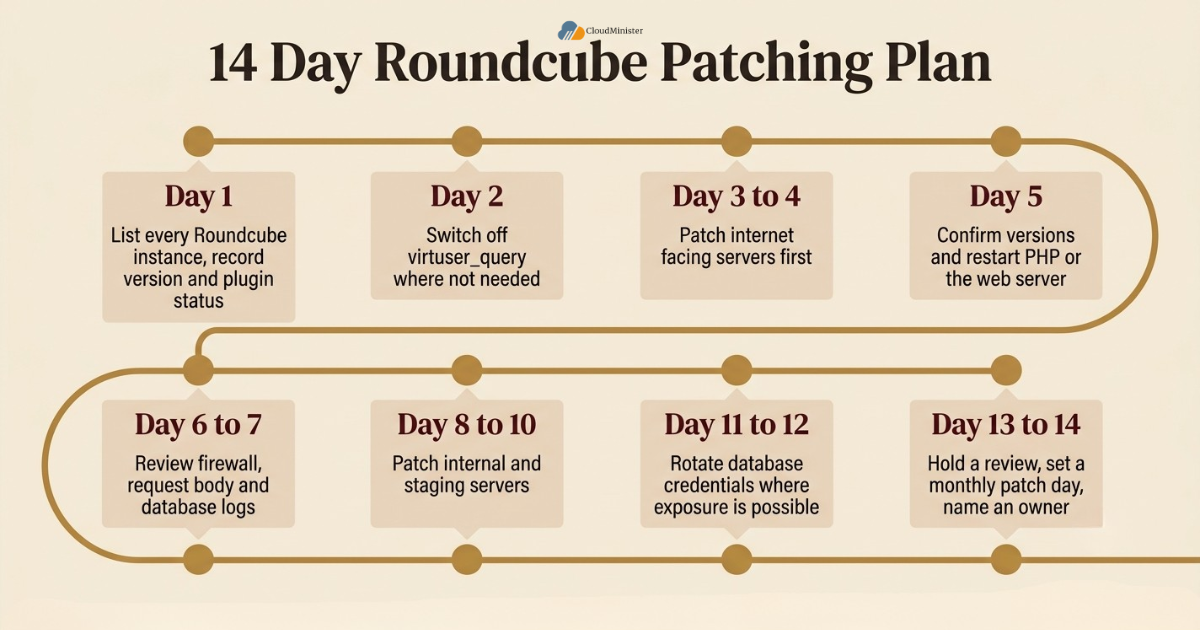
Knowing the theory is easy, and acting on it is harder. This two week plan breaks the work into steps that most teams can follow without stopping normal delivery. It keeps every decision tied to your own records, and it leaves room to escalate quickly if a check shows real exposure to Roundcube CVE-2026-48842. Server Management Services in India and Cyber Security services teams can share the workload. Adjust the dates to your change process, but keep the order, because inventory and checks must come before the upgrade.
| Day / Schedule | Action Items |
| Day 1 | List every Roundcube instance you run or host, including staging, standby, and panel bundled copies. |
| Day 1 | Record the version and the plugin status of each instance for Roundcube CVE-2026-48842 using the checks in section 6. |
| Day 2 | Switch off virtuser_query wherever it is enabled but not needed, and test logins afterward. |
| Days 3–4 | Patch internet-facing servers first, using the newest release in your branch, with Server Management Services on call. |
| Day 5 | Confirm versions again and restart PHP or the web server so old code is not cached. |
| Days 6–7 | Review web application firewall, request body, and database logs for the suspicious patterns described in section 9. |
| Days 8–10 | Patch the remaining internal and staging servers and update your asset records with your Web Hosting Company in India if it manages the servers. |
| Days 11–12 | Rotate database credentials where exposure is possible and review database privileges. |
| Days 13–14 | Hold a short review with your Server Management Services team, set a monthly patch day, and write down the owner for Roundcube updates and for cybersecurity solutions coverage. |
Checklist: Roundcube Patch Readiness Review
- Inventory of all Roundcube instances is complete, including staging and standby servers
- Version recorded for each instance and compared with 1.6.16, 1.7.1, and the latest releases
- Plugin status for virtuser_query confirmed and recorded on every server
- Servers upgraded to 1.6.19 or 1.7.4, or to a later release, and verified after restart
- Distribution and control panel builds checked against their own security notices
- Web application firewall and login rate limits active on the webmail address as part of your cybersecurity solutions
- Roundcube database account limited to its own database with no administrative rights
- Request body, application, and database logs reviewed and preserved
- Reporting duties under CERT-In directions and the DPDP Act, 2023 reviewed by the responsible team
- Monthly patch day and a named owner for Roundcube updates agreed with your Web Hosting Company in India or in house team
Key Takeaways
- Roundcube CVE-2026-48842 is a pre-authentication SQL injection in the virtuser_query plugin, rated CVSS 8.1 High.
- It affects Roundcube 1.6.x before 1.6.16 and 1.7.x before 1.7.1, and only where the optional plugin is enabled with SQL queries defined.
- Roundcube released fixes on May 24, 2026, and the Canadian Centre for Cyber Security reported exploitation in the wild on September 21, 2026.
- Public reporting describes SQL injection, not proven remote code execution, so describe Roundcube CVE-2026-48842 accurately in reports.
- Check the version and the plugin status for Roundcube CVE-2026-48842 on every server, then upgrade to 1.6.19 or 1.7.4 or a later release.
- If you cannot patch today, disable virtuser_query, filter login traffic, restrict access, and limit database privileges as a short bridge, ideally with Cyber Security services support.
- Multi factor authentication does not block Roundcube CVE-2026-48842 because it is reached while login is being processed.
- Ordinary access logs miss login form data, so use firewall, application, and database logs when hunting for misuse, with help from Server Management Services in India.
- Server Management Services can audit plugin status, patch levels, and logs across a whole fleet.
- A Web Hosting Company in India that offers cybersecurity solutions and Cyber Security services gives your team local support and clear records.
Need Help Patching Roundcube on Your Servers?
Share your setup with our team and we will help you check versions, upgrade safely, and set up a monthly patch routine. Reach out today and get your webmail secured without disrupting mail delivery.
Conclusion
The story of Roundcube CVE-2026-48842 is short and useful. A flaw in an optional plugin was fixed in May 2026, and four months later it was reported as exploited because some servers were still waiting. The fix is a routine upgrade, the check is a two line search, and the difference between the two outcomes is a habit of inventory, patching, and log review. Teams that lack the time can rely on a Web Hosting Company in India that also provides Server Management Services in India and Cyber Security services, so that advisories turn into completed work. Whichever route you choose, write down the version, the date, and the owner. Strong cybersecurity solutions and dependable Server Management Services turn a patched flaw into a closed case, and a record of Roundcube CVE-2026-48842 handling is worth keeping for audits.
If there is one lesson to take away, it is that the patch was never the hard part. The hard part is knowing what you run, where you run it, and who is responsible for keeping it current. Roundcube CVE-2026-48842 hit hardest where nobody had a clear list of instances, plugins, and versions. A simple inventory, reviewed every month, would have turned this from a late night scramble into a quiet routine task.
Please also do not stop at the upgrade itself. Once you have moved to 1.6.19 or 1.7.4 or newer, take a little time to review your logs, trim unused plugins, and tighten database permissions. Write down who owns webmail updates and agree on a fixed monthly patch day. These small habits cost very little, and they make the next advisory easier to handle. Handled this way, Roundcube CVE-2026-48842 becomes a closed case with proof, not an open worry.
Frequently Asked Questions
What is Roundcube CVE-2026-48842?
Roundcube CVE-2026-48842 is a pre-authentication SQL injection vulnerability, classified as CWE-89, in the virtuser_query plugin of Roundcube Webmail, with a CVSS score of 8.1 (High) that Cyber Security services teams treat as a patch priority. An attacker does not need an account to reach it, but the plugin must be enabled and configured with SQL queries for a server to be exposed.
Which versions does Roundcube CVE-2026-48842 affect?
It affects Roundcube 1.6.x before 1.6.16 and 1.7.x before 1.7.1. Fixed builds were released on May 24, 2026, and newer releases, 1.6.19 and 1.7.4, followed on September 6, 2026.
Is Roundcube CVE-2026-48842 being exploited in the wild?
The Canadian Centre for Cyber Security updated advisory AV26-503 on September 21, 2026, to say that open-source reporting indicates exploitation. No actor, target, or indicators of compromise have been published, and the flaw was not on the CISA Known Exploited Vulnerabilities list as of the September 24, 2026 release, so check current status before you report.
Does Roundcube CVE-2026-48842 allow remote code execution?
Public reporting establishes SQL injection only. Any further impact depends on database privileges, configuration, and surrounding systems, so do not describe it as operating system level code execution without evidence.
How do I know whether virtuser_query is enabled on my server?
Search your Roundcube configuration and the plugin folder for the plugin name, then check whether it appears in the plugins array and whether a virtuser_query setting with SQL exists. Section 6 shows the exact commands, and Server Management Services can run them across all servers.
Does multi factor authentication protect against this flaw?
No. The vulnerable lookups can run while the login form is still being processed, before any session exists, so a second factor does not block Roundcube CVE-2026-48842. Patching or disabling the plugin does.
Do I need outside help to patch and monitor Roundcube?
Not always, but a provider of Server Management Services in India adds patch tracking, monitoring, and evidence for audits, which is especially useful when you host mail for many users or customers.
Can a Web Hosting Company in India handle this for me?
Yes, if patching and monitoring are part of the agreement. Ask for written patch timelines, plugin records, and log retention, and confirm that the provider’s Cyber Security services and cybersecurity solutions cover webmail as well as the operating system.