Cyber Insurance in India has moved from a niche add on to a boardroom line item that most growing businesses can no longer treat as optional in 2026. A single ransomware incident or a leaked customer database can now cost an Indian organization tens of millions of rupees, and a traditional general liability policy was never built to absorb that kind of digital risk. This guide breaks down what Cyber Insurance in India actually covers, where the coverage quietly stops, and how premiums and claims work in practice. It also looks at how a business should decide whether Cyber Insurance in India belongs in its risk management plan for 2026. Along the way, it touches on where security support and infrastructure management fit into the picture, since no insurer prices a policy in a vacuum.
Most business owners and IT heads never think seriously about Cyber Insurance in India until something goes wrong close to home. A phishing email nearly gets through, a vendor mentions a breach at a similar sized company, or a customer asks pointed questions about data protection during a contract renewal. That is usually the moment someone finally asks whether the business is financially covered if a real incident happened tomorrow, and for most Indian companies the honest answer is no. Cyber Insurance in India exists precisely to close that gap between assumed protection and actual financial exposure.
The scale of the problem is what makes this conversation urgent rather than optional. Breach costs in India have climbed sharply over the past year, attack volumes keep rising, and a growing share of incidents now involve automated or AI assisted techniques that make attacks faster and harder to catch early. A general business insurance policy was designed for physical assets and traditional liability, not for a ransomware demand or a leaked database, which is exactly why so many businesses discover the exclusion only after filing a claim. Cyber Insurance in India was built specifically to fill that space, covering the financial fallout of a digital incident in ways a standard policy simply does not.
At the same time, this coverage only works well when a business understands it properly before buying it. Cyber Insurance in India is not a single uniform product, and coverage limits, exclusions, and pricing vary significantly between insurers and even between tiers from the same insurer. A business that walks into this decision without a clear picture of its own infrastructure, its actual risk exposure, and the fine print of a policy is far more likely to end up underinsured or to face a contested claim later. This guide is meant to walk through exactly that process, so the decision around Cyber Insurance in India is made with real clarity rather than guesswork.
Table of Contents
- Why the Conversation Is Happening Now
- What This Coverage Actually Includes
- What This Coverage Typically Excludes
- Where Claims Actually Get Contested
- How Premiums Actually Get Calculated
- Building a Practical Strategy for 2026
- Practical Steps to Take Before Buying
- Choosing the Right Partners to Support You
- Does Your Business Actually Need This
- Key Takeaways
- Conclusion
- Frequently Asked Questions
1. Cyber Insurance in India: Why the Conversation Is Happening Now
For most founders and IT heads, the conversation about Cyber Insurance in India usually starts only after a scare, often while comparing notes with a security partner about what would have happened financially if a recent phishing attempt had actually succeeded. Someone reads about a competitor’s breach in the news and suddenly asks whether their own organization is financially covered if the same thing happened tomorrow.
This coverage is gaining urgency because the financial scale of a breach has changed dramatically in a short window.
- The average total cost of a data breach in India reached an all-time high of INR 25.5 crore in 2026, a 15.9 percent jump over the previous year, according to IBM’s 2026 Cost of a Data Breach Report, which is exactly the kind of number that turns Cyber Insurance in India from a theoretical purchase into an operational necessity.
- Cyber Insurance in India is projected to be one of the fastest growing specialty insurance lines in the country, with market research firms placing the segment’s compound annual growth rate above 25 percent through the rest of the decade.
- Demand for this coverage is rising alongside genuine attack volume, not just headline anxiety, since Indian organizations reported an average of 39,500 compromised records per breach in 2026, up from 38,200 the year before.
- A rising share of breaches behind this surge in interest are now AI assisted, with roughly one in four malicious Indian breaches in 2026 involving AI generated attack techniques.
- Businesses evaluating any Web Hosting Company in India for the first time increasingly ask whether the provider’s own security posture would even qualify them for a favorable Cyber Insurance in India quote.
- A capable Web Hosting Company in India will usually flag basic security gaps proactively, rather than waiting for an insurer’s questionnaire to surface them during a renewal.
- Teams that have never had a direct conversation with their broker about this coverage often assume a general business policy already covers cyber incidents, when in most cases it explicitly excludes them.
Related Reading: cPanel and WHM CVE-2026-41940 authentication bypass
- A growing number of teams evaluating Server Management Services specifically ask how a provider’s patching cadence would be documented for an insurer, rather than assuming a policy alone solves the underlying exposure.
- Teams researching Server Management Services in India for the first time often discover that basic patch documentation is exactly what an insurer requests during underwriting.
- Businesses that already lean on strong Cyber Security services tend to walk into this conversation with far fewer unknowns, since most of the underwriting questions overlap directly with routine security hygiene.
Businesses researching Cyber Insurance in India for the first time should treat the underwriting questionnaire itself as a genuinely useful security exercise, since insurers now ask far more technical questions than they did even two years ago.
Before assuming this kind of policy is only relevant for large enterprises, run a simple exercise across your own organization and estimate what a single week of downtime plus a regulatory notification obligation would actually cost. A surprising number of small and mid sized Indian businesses discover that this number alone justifies the premium several times over.
2. What Cyber Insurance in India Actually Covers
Understanding the real scope of this insurance matters more than the marketing language on an insurer’s website, since coverage details vary meaningfully between providers and even between tiers from the same provider.
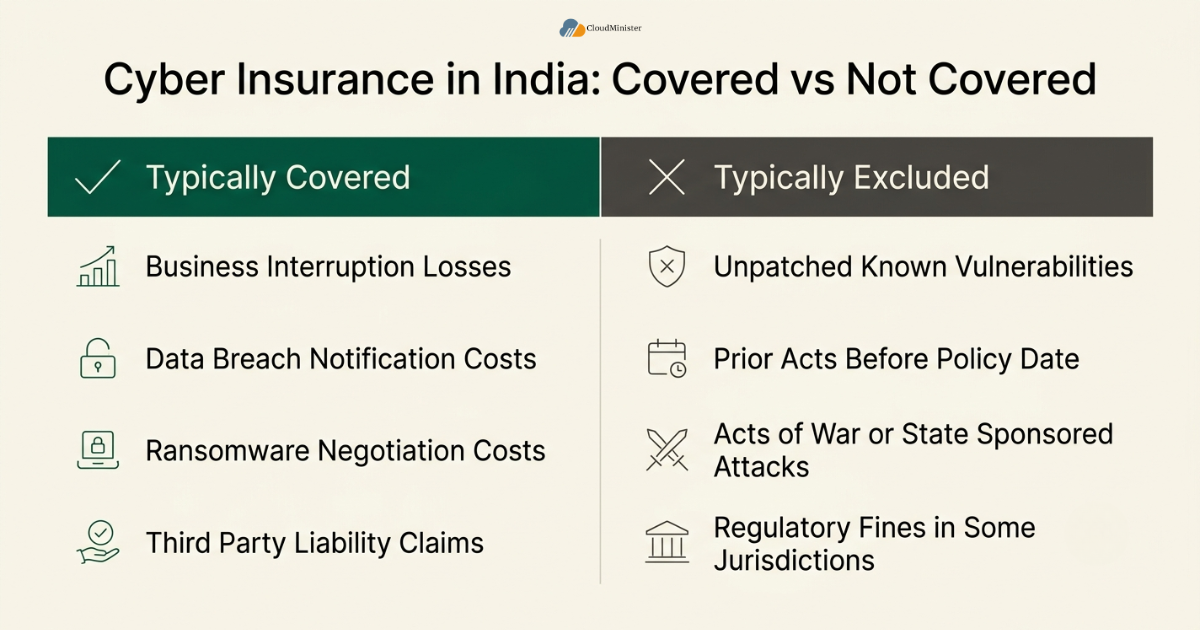
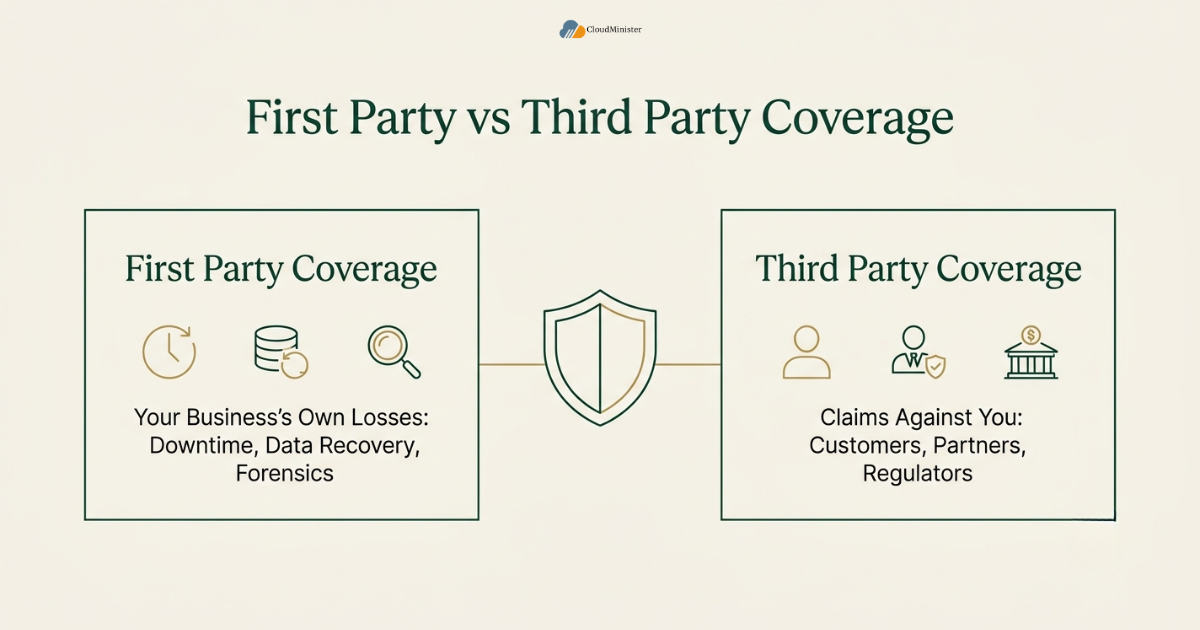
- Cyber Insurance in India policies typically cover first party losses, meaning the direct financial damage a business suffers itself, including business interruption, data recovery costs, and the expense of forensic investigation after an incident.
- Such a policy also generally covers third party liability, which addresses claims made by customers, partners, or regulators when a breach exposes their personal or financial data.
- Ransomware payment and negotiation costs are often included under Cyber Insurance in India, though many insurers now attach specific conditions around law enforcement notification before any payment is authorized.
- Business email compromise, one of the costliest attack categories in India, is frequently covered as a named peril rather than a general exclusion.
- Data breach notification costs, including the expense of informing affected customers and regulators within mandated timelines, are a core inclusion in most policies sold today.
- This coverage commonly extends to legal defense costs when a business faces litigation or regulatory action following a breach, which can quickly outpace the direct technical remediation cost.
- Some policies include public relations and crisis communication support, helping a business manage reputational fallout in the days immediately following disclosure.
- A Web Hosting Company in India that already understands these coverage categories is better positioned to advise a client on which technical safeguards actually move the needle during underwriting.
- Businesses that pair this kind of policy with active support from the right security vendor tend to negotiate meaningfully lower premiums, since insurers price risk based partly on demonstrated security maturity.
Related Reading: zero trust security guide for India
- Coverage rarely stops at technology alone, and many policies also include the cost of hiring a public relations firm or a dedicated call centre during a large scale customer notification event.
- Teams comparing Cyber Insurance in India quotes should confirm whether cyber extortion coverage extends to double extortion scenarios, where attackers both encrypt data and threaten to leak it publicly.
- A provider offering broad Cyber Security services alongside standard hosting is generally better placed to document the exact controls an insurer wants to see before issuing a favorable quote.
- Organizations layering strong cybersecurity solutions on top of routine hosting tend to see fewer underwriting questions overall, since most red flags disappear once monitoring and patching are already in place.
Cyber Insurance in India is not a replacement for actual security controls, and no policy pays out if an insurer later determines that basic, contractually required safeguards were never actually implemented. Reading the fine print on minimum security requirements before a claim is filed, not after, is one of the most overlooked steps in the entire process.
3. What Cyber Insurance in India Typically Does Not Cover
Before assuming a policy protects against every possible scenario, it helps to understand exactly where the coverage tends to stop, since these gaps are where businesses most often get an unpleasant surprise.
- Cyber Insurance in India policies often exclude losses from known, unpatched vulnerabilities that a business failed to remediate within a reasonable window after disclosure, though the exact scope depends on the specific policy wording, any related warranties, and how the exclusion is drafted.
- Prior acts, meaning any breach that began before the policy’s effective date, are typically excluded, though the actual cutoff depends on the policy’s retroactive date and prior-acts wording, and coverage details can vary between insurers.
- Cyber Insurance in India generally does not cover reputational harm itself as a standalone, quantifiable loss, even though crisis communication costs related to reputation may be separately covered.
- Regulatory fines in some jurisdictions are explicitly excluded from this kind of policy on public policy grounds, since insuring against a statutory penalty is treated differently from insuring against a financial loss.
- This type of policy typically excludes losses arising from acts of war or state sponsored attacks, a carve out that has become increasingly contentious as nation state actors are linked to a growing share of major incidents.
- Insider threats involving a genuinely malicious employee are sometimes only partially covered, depending heavily on the specific policy wording and any fraud sub limits.
- Cryptocurrency theft is frequently subject to very low sub limits under the policy, reflecting how insurers view digital asset risk differently from traditional fraud.
- Most policies will generally not pay a claim if the underwriting application contained material misstatements about the organization’s actual security posture at the time of purchase.
- A business relying on outdated software with no active support contract is one of the fastest ways to void this coverage entirely, since insurers increasingly treat unsupported systems as an uninsurable, self created risk.
Related Reading: data residency requirements in India
- Cyber Insurance in India policies frequently carry a waiting period before certain coverages activate, meaning a business cannot purchase a policy the same week a suspicious email is discovered and expect a valid claim.
- A Server Management Services provider that documents uptime and patch history consistently gives a business far stronger evidence to support a claim if a dispute ever arises.
- Businesses working with a Web Hosting Company in India that cannot produce basic security logs on request may find themselves unable to satisfy a claims investigation, regardless of how comprehensive the original policy appeared.
- A Server Management Services in India provider that also offers layered cybersecurity solutions gives a business one less vendor relationship to coordinate during an underwriting cycle.
The businesses that get the most value out of this kind of policy are rarely the ones that bought the cheapest option available. They are the ones that read every exclusion clause carefully, matched their actual infrastructure and cybersecurity solutions against the underwriting requirements honestly, and treated the policy as one layer of a broader defense rather than a substitute for one.
4. Where Cyber Insurance in India Claims Actually Get Contested
Cyber Insurance in India does not fail businesses randomly, and understanding where claims disputes concentrate is central to buying a policy that will actually pay out when it matters.
- Claims under such a policy are most often contested when a business cannot clearly demonstrate the actual root cause of an incident, which is why proper forensic logging matters as much as the policy itself.
- A gap between what an underwriting questionnaire stated and what a post incident forensic review actually finds is the single most common reason a claim gets delayed or reduced.
- Disputes around this type of policy frequently center on whether an organization met its contractual obligation to apply security patches within a defined timeframe after a vendor disclosed a vulnerability.
- Container images and legacy operating systems still circulating in production quietly undermine a business’s position during a claims review, since an unsupported base image is treated as a known, avoidable risk.
- Claims tied to business email compromise are often contested over whether an organization had basic multi factor authentication in place, since its absence is now considered a baseline control by most underwriters.
- A common mistake businesses make is assuming a policy automatically covers every system in their environment, when in practice many policies only cover explicitly scheduled assets listed at the time of purchase.
- Server Management Services that monitor infrastructure on a recurring basis are well positioned to catch the kind of configuration drift that later becomes a claims dispute.
Related Reading: Encryption in transit
- A Server Management Services in India provider monitoring infrastructure on a recurring basis is well placed to catch a lapsed certificate or an outdated image before it becomes another disputed line item during a claim.
- Teams running production workloads through a managed provider should confirm which specific systems are actually named on their Cyber Insurance in India schedule, since an unnamed asset is effectively uninsured.
- Businesses relying on genuine cybersecurity solutions rather than a single antivirus tool tend to pass underwriting reviews with fewer follow up questions.
- A Server Management Services in India team that separates critical and non critical assets in its own documentation makes this same categorization far easier for an insurer to accept.
If your organization has never mapped exactly which servers, databases, and cloud accounts are named on your policy schedule, treat that gap itself as the first finding. Businesses frequently assume every system they operate is automatically covered, and just as frequently discover a forgotten asset sits completely outside the policy once a proper review is completed.
5. How Cyber Insurance in India Premiums Actually Get Calculated
Below is a direct look at how insurers actually price this insurance, since most of the confusion businesses feel comes from not understanding which factors genuinely move the number. India’s cyber insurance market itself reflects this urgency, with independent research placing its projected value in the multi hundred million dollar range for 2026 and a compound annual growth rate exceeding 28 percent through 2034, according to IMARC Group’s market analysis.
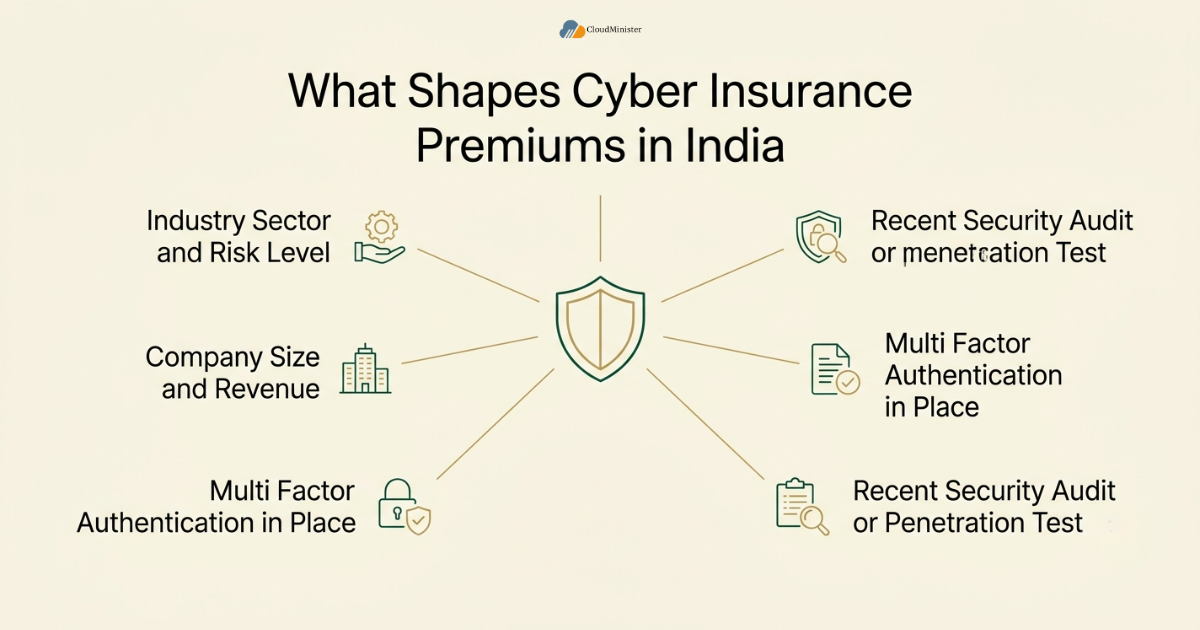
- Premiums for this coverage are shaped heavily by industry sector, with financial services, healthcare, and e-commerce typically paying more than manufacturing or professional services for comparable coverage limits.
- Company size and revenue directly influence pricing, since a larger digital footprint generally means a larger potential loss for the insurer to underwrite.
- Underwriters increasingly request evidence of active cybersecurity solutions, including endpoint detection, email filtering, and backup verification, before finalizing a quote.
- A documented incident response plan can meaningfully lower premiums for this type of policy, since insurers view a rehearsed plan as a direct reduction in expected breach duration and cost.
- Multi factor authentication across critical systems is now treated as close to a baseline requirement for reasonable pricing, rather than an optional enhancement.
- A business using a Web Hosting Company in India with a strong, verifiable security track record often finds this reflected favorably during underwriting conversations.
- Insurers frequently offer premium discounts to businesses that can show regular penetration testing or a third party security audit within the past twelve months.
- Organizations partnering with providers of genuine cybersecurity solutions rather than relying solely on internal effort tend to present a more favorable risk profile during renewal.
Related Reading: cPanel and WHM CVE-2026-41940 authentication bypass
- Retention amounts, similar to a deductible, are typically set higher for organizations with weaker demonstrated security maturity, shifting more of the early loss burden back onto the business itself.
- A Cyber Security services engagement that includes continuous monitoring, not just a one time assessment, tends to produce stronger evidence during underwriting than a static compliance checklist.
- Teams comparing Cyber Insurance in India quotes across multiple insurers should request a clear breakdown of which specific controls influenced the final premium, rather than accepting a single blended number.
- Server Management Services in India that document backup frequency and recovery testing give underwriters concrete evidence during an application, often translating directly into a lower quoted premium.
Insurers increasingly favor businesses that can show a layered set of cybersecurity solutions rather than a single control, since layered defenses reduce the odds of a single point of failure triggering a claim. A Web Hosting Company in India that documents its own uptime and patching cadence gives underwriters a cleaner picture of the environment a policy is actually protecting.
A mature approach to this kind of policy treats the underwriting conversation as an ongoing relationship with the insurer, not a once a year form filling exercise squeezed between other priorities.
6. Building a Practical Cyber Insurance in India Strategy for 2026
Even a well chosen policy underperforms if it is not supported by an organized internal readiness plan, since the growing breach cost trend in India creates urgency that many businesses still have not converted into an actual project timeline.
- Start with a full inventory of every server, application, and cloud account that should realistically sit inside the scope of Cyber Insurance in India, since a business cannot insure what it has not actually identified.
- Separate assets into critical, standard, and low priority categories before finalizing coverage limits, since treating every system identically wastes budget protecting low risk assets while critical ones remain underinsured.
- Confirm every customer facing service carries adequate protection first, given that a public facing breach is the fastest path to the kind of regulatory and reputational exposure this coverage is specifically designed to address.
- Size the coverage limit to genuine business risk, so a payment processing system gets protected well ahead of an internal reporting tool nobody outside the finance team ever touches.
- Businesses without an internal security team dedicated to this process should treat a partnership with a dedicated security partner as the foundation of a realistic strategy rather than an optional add-on.
- Review Cyber Insurance in India coverage on a recurring schedule rather than treating it as a single purchase with no follow up, since new systems and cloud accounts can quietly fall outside the policy scope as infrastructure grows.
- A team delivering Cyber Security services should be able to show a documented asset inventory on request, not just a verbal summary of what is currently protected.
- Businesses comparing providers of Server Management Services should weigh how thoroughly a provider documents infrastructure changes, since that documentation becomes essential evidence during any future claim.
- A hosting relationship marketed around a Web Hosting Company in India but with no visible security documentation is usually optimizing cost rather than the actual delivered risk posture that insurers evaluate.
- A provider offering both Cyber Security services and Server Management Services under one roof tends to catch a coverage gap before the customer even notices it during a renewal cycle.
- Track SSL certificate coverage as a specific checkpoint during any readiness review, since an expired or misconfigured certificate is exactly the kind of basic gap an insurer flags during underwriting.
- Confirm that every publicly reachable service has a valid SSL certificate before finalizing an application, not after a claim has already been filed.
- SSL certificate renewal should be automated from day one, since a manually tracked expiration date is one of the more avoidable ways to undermine an otherwise strong position.
- A Server Management Services in India provider that proactively flags a certificate nearing expiration, rather than waiting for a browser warning, is a strong signal of the kind of operational maturity insurers reward.
- Many businesses discover just how many coverage gaps they actually had only after switching to a new Cyber Security services provider and receiving a first infrastructure audit, which is a strong argument for requesting that audit before renewal.
- Teams evaluating a new Web Hosting Company in India for the first time should ask how quickly a security finding gets escalated once discovered, since a slow response undermines the entire purpose of a Cyber Insurance in India readiness strategy.
- Migrating to a new Web Hosting Company in India without first mapping existing security gaps is a common reason coverage ends up narrower than expected once a policy is underwritten.
- Small businesses evaluating this kind of policy for the first time should ask directly whether their existing Server Management Services are bundled tightly enough with security monitoring to satisfy a typical underwriting checklist.
- An experienced security provider that documents every infrastructure change made during a readiness project makes the eventual claims process far faster to complete.
- Businesses selecting cybersecurity solutions for the long term should confirm the tools chosen are refreshed regularly enough to keep pace with the same evolving threats that shape underwriting standards for Cyber Insurance in India.
- A Server Management Services in India provider that maintains a documented cybersecurity solutions stack, rather than ad hoc tooling, tends to shorten the entire underwriting timeline.
- Businesses that already work with a dependable Web Hosting Company in India often find the asset inventory step significantly faster, since much of the infrastructure documentation already exists.
Checklist: Cyber Insurance in India Readiness Review
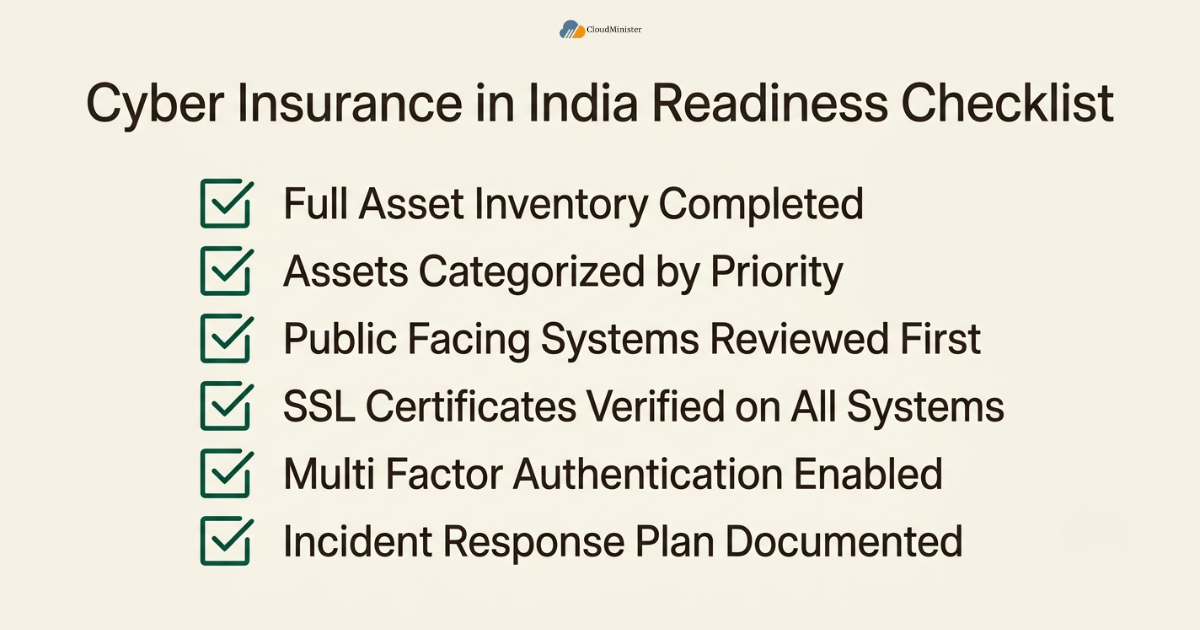
- Full inventory of every server, application, and cloud account that should be named on the policy
- Every asset categorized as critical, standard, or low priority for coverage prioritization
- Public facing and payment adjacent systems reviewed and protected first
- SSL certificate validity confirmed on every system before finalizing an application
- Multi factor authentication enabled across all critical systems and administrator accounts
- Incident response plan documented, rehearsed, and ready to share with an underwriter on request
7. Practical Steps to Take Before Buying Cyber Insurance in India
Achieving genuine readiness for this kind of policy is not about a single sweeping purchase decision. It comes from a series of specific, repeatable actions applied consistently across the environment before a policy is ever signed.
- Businesses running mixed environments should confirm that Server Management Services cover both the operating system layer and the application layer, since gaps between the two are a common source of denied claims.
- Confirm with any provider of Server Management Services exactly which systems are currently patched and monitored, since an outdated inventory regularly misrepresents actual readiness for the policy.
- Pull a current asset inventory before requesting any quote, since a short or outdated inventory consistently produces an inaccurate premium estimate.
- Identify every service currently running with known, unpatched vulnerabilities, since these are usually the fastest way to have a future claim denied outright.
- A provider delivering Server Management Services and layered cybersecurity solutions together tends to close documentation gaps faster than two vendors working independently.
- Confirm that any system managed under Server Management Services in India tied to a customer facing workload is explicitly named on the policy schedule, rather than assumed to be automatically included.
- Right size the coverage limit to actual workload value rather than simply mirroring what a competitor purchased, since accurate sizing is what makes Cyber Insurance in India genuinely useful rather than a false sense of security.
- Use a documented incident response plan as a starting point for underwriting conversations, then validate the plan against a real tabletop exercise rather than assuming a written document alone satisfies an insurer.
- Set a recurring reminder to review coverage against current infrastructure, since new cloud accounts and applications can silently sit outside the policy scope well after the original purchase.
- Confirm that any provider delivering Cyber Security services as part of a managed offering explicitly documents findings in a format an insurer can review, since this detail affects how quickly a future claim actually gets processed.
- Audit idle and unused systems separately from the main readiness effort, since decommissioning a genuinely unneeded server is often more valuable than insuring it.
- Apply security improvements incrementally rather than all at once, starting with the most critical, customer facing services and expanding coverage only after confirming initial improvements are stable.
- Maintain a documented record of every security control implemented, including who owns each system and when it was last reviewed, so a claim never stalls over missing evidence.
- Treat readiness for Cyber Insurance in India as a natural companion to broader Cyber Security services work, not a separate initiative that competes for the same internal attention.
- A Server Management Services provider that walks through its own incident escalation procedure in detail, rather than describing it only in general terms, is signaling genuine operational readiness relevant to any application.
- Businesses evaluating such a policy specifically for a growing digital footprint should ask for a sample claims scenario before committing to a policy term.
- A Server Management Services in India provider with a strong cybersecurity solutions track record can usually produce the evidence an insurer wants within days rather than weeks.
A provider claiming strong security support without ever discussing specific documentation practices is likely offering only generic hosting, not the operational depth a genuine strategy for Cyber Insurance in India requires.
8. Choosing the Right Partners to Support Cyber Insurance in India
Not every hosting or security relationship is built to support a policy strategy at this level of detail, and this is exactly where the difference between an average vendor and a genuinely prepared one becomes visible.
- A dependable Web Hosting Company in India that already manages a team’s broader infrastructure is well positioned to advise on readiness without introducing unnecessary complexity into an already functioning environment.
- Teams should confirm any provider of Cyber Security services actually owns and operates its own security tooling rather than reselling capacity from a third party with no direct accountability.
- A dependable Cyber Security services provider should be able to share a reference client who successfully supported a claim from start to finish.
- Businesses evaluating providers should specifically ask whether the provider has direct experience helping customers prepare for this kind of underwriting, not just offering generic security consulting.
- A provider offering transparent pricing around Server Management Services makes it easier to compare true readiness cost against a generic insurance broker quote.
- A provider combining Server Management Services with dedicated cybersecurity solutions typically gives underwriters a single point of contact for evidence requests, which shortens claims review time.
- A newer Web Hosting Company in India may offer a competitive base rate but lack the documented track record needed to advise confidently on readiness for a complex, multi system environment.
- A provider offering Server Management Services in India with a documented security track record is generally a safer long term bet than one offering only a low introductory hosting price.
- Ask any prospective Cyber Security services provider how many clients they have actively supported through a real claims process, since experience with this exact process correlates strongly with fewer surprises during a dispute.
- A Web Hosting Company in India that treats every client’s risk profile as identical is usually applying a generic template rather than genuinely reviewing the actual infrastructure involved.
- A track record of correcting real security gaps before an insurer finds them is a far better signal of genuine capability than a marketing page listing every cybersecurity solutions buzzword a vendor happens to mention.
- A genuinely experienced Cyber Security services provider will be able to describe, in specific terms, how a past client’s claim under this insurance was supported with clear documentation and minimal dispute.
- A Server Management Services provider that publishes a clear, documented patching and monitoring methodology tends to deliver more predictable outcomes than one relying purely on ad hoc engineering judgment.
- Businesses comparing Server Management Services in India providers for this specific purpose should weigh documented process over a generic promise of experience.
Teams that want to move quickly without designing every layer of their readiness themselves often gravitate toward a provider offering clear documentation on how infrastructure is secured, monitored, and verified from day one.
- Business leaders who have not yet reviewed their hosting and security partner relationships specifically around Cyber Insurance in India should treat this guide as a natural trigger point to do so, and to ask their providers directly about readiness gaps.
- A capable partner offering both deep expertise in Cyber Security services and broader Server Management Services gives growing businesses a coherent roadmap instead of stitching together advice from multiple vendors.
- Businesses researching hosting options for internet facing workloads should confirm that a prospective partner understands both the mechanics of Cyber Insurance in India underwriting and the surrounding SSL certificate and access control needs that go with it.
- A provider that also runs Server Management Services in India under one roof tends to catch a mismatched control or a stalled patch cycle faster than two separate vendors handling hosting and security in isolation.
A provider that bundles Cyber Security services with genuine documentation oversight, rather than treating this as a purely mechanical checkbox, is generally better positioned to help a business succeed with its Cyber Insurance in India policy.
- A genuinely capable Web Hosting Company in India will also be transparent about which parts of readiness it owns directly and which parts depend on the customer’s own internal decisions.
- Reviews and references matter more than a homepage promise when choosing a partner for something as consequential as Cyber Insurance in India.
- Businesses switching their Web Hosting Company in India specifically to strengthen their position should confirm the new partner’s documentation approach before signing, rather than assuming it will simply be handled.
- Businesses should ask any candidate Cyber Security services provider for a specific example of a client they helped through a tight claims timeline.
- A Server Management Services in India provider that treats cybersecurity solutions as a core offering, not an upsell, tends to be the more dependable long term partner for this kind of readiness work.
The right Server Management Services partner treats security documentation as a baseline expectation, not a premium feature reserved for enterprise accounts, and that baseline is exactly what makes a Cyber Insurance in India policy work the way it is supposed to.
Not Sure Your Infrastructure Would Pass Underwriting?
Get a clear picture of your actual security gaps before an insurer finds them for you. CloudMinister’s Cyber Security services help you document controls, close basic gaps, and walk into underwriting with confidence.
When comparing quotes or advice from different insurance brokers or technology partners on this topic, ask each one to walk through a real claims example using a business profile similar to yours rather than a generic case study, since the right recommendation depends entirely on your specific infrastructure and risk tolerance. A provider offering genuine Cyber Security services that understands both the underwriting mechanics and your organization’s actual infrastructure profile will consistently give more actionable guidance than a purely theoretical comparison.
9. Does Your Business Actually Need Cyber Insurance in India
Answering whether this coverage is necessary for a specific business depends less on company size alone and more on how much genuine digital exposure that business actually carries.
- A business that already relies on strong cybersecurity solutions and consistent Server Management Services generally finds the underwriting process far less stressful than one starting from zero.
- Any business storing customer personal data, payment information, or health records should treat this coverage as close to mandatory, given the regulatory notification obligations attached to a breach involving this kind of data.
- E-commerce businesses processing online payments carry some of the highest exposure profiles in the country, making it a particularly high value purchase relative to premium cost.
- Businesses that would struggle to survive even a short period of downtime should weigh this coverage heavily, since business interruption coverage often represents the single most financially significant part of a policy.
- Startups handling investor or partner data under strict confidentiality agreements often find that Cyber Insurance in India is now a contractual requirement rather than a discretionary purchase.
- Organizations with a strong existing relationship with a dedicated security partner and Server Management Services in India providers often find premiums meaningfully more affordable than businesses starting from scratch.
- Businesses running critical workloads on Server Management Services in India infrastructure with documented cybersecurity solutions typically clear underwriting reviews with minimal back and forth.
- Reliable Server Management Services remain one of the clearest signals of infrastructure maturity that an insurer looks for.
- A provider delivering Server Management Services in India as a core offering, not a side service, tends to maintain the kind of documentation an insurer expects to see.
- Even smaller businesses with limited digital footprints should evaluate Cyber Insurance in India, since attackers increasingly target smaller organizations specifically because their defenses are assumed to be weaker.
- A business already investing seriously in cybersecurity solutions is generally well positioned to secure favorable terms, since demonstrated maturity directly reduces perceived insurer risk.
Businesses that already invest in comprehensive cybersecurity solutions and rely on a dependable Server Management Services in India partner typically find the entire policy renewal process considerably smoother.
Key Takeaways
- Cyber Insurance in India has become a genuine financial necessity for most digitally active businesses, not an optional extra reserved for large enterprises.
- The gap between what such a policy covers and what it excludes is often where businesses get an unpleasant surprise, making a careful reading of exclusions essential before purchase.
- Strong cybersecurity solutions and documented infrastructure practices directly influence both the cost and the eventual payout reliability of Cyber Insurance in India.
- Public facing systems, payment processing, and customer data are among the highest priority areas any Cyber Insurance in India strategy should address first.
- Governance, a documented asset inventory, and recurring readiness reviews matter just as much as the initial purchase decision, and this holds whether the environment is run internally, through a Web Hosting Company in India, or through broader Server Management Services in India.
- A Web Hosting Company in India that already understands this landscape end to end, and that offers genuine Cyber Security services, remains one of the more reliable ways to strengthen a Cyber Insurance in India position properly.
- Partnering with a capable provider experienced in both a dedicated security team and Server Management Services meaningfully reduces the risk of a denied claim, and this is worth raising directly in the next risk management planning conversation.
Ready to Build a Real Cyber Insurance Readiness Plan?
Talk to our team about mapping your infrastructure, closing security gaps, and preparing your business for a smoother underwriting and claims process.
Conclusion
Throughout this guide, one pattern holds regardless of business size, industry, or how large the surrounding digital footprint actually is. Cyber Insurance in India is not a purchase that replaces good security practice, and it is not a decision that should be made without first understanding exactly what a policy will and will not cover. The businesses that get real value from this coverage are the ones that read every exclusion carefully, match their actual infrastructure against what an insurer expects to see, and treat the policy as one part of a larger security strategy rather than a stand in for one.
The organizations that handle this decision well tend to follow a similar pattern. They confirm exactly how much genuine exposure they carry before ever requesting a quote, they prioritize customer facing and compliance sensitive systems first, and they build Cyber Insurance in India into a documented, ongoing security process rather than treating it as a once a year form filling exercise. This kind of preparation does more than improve pricing during underwriting. It also means that if an incident does happen, the business already has the documentation, the asset inventory, and the evidence an insurer needs to process a claim quickly and fairly.
For businesses weighing this decision alongside a broader look at their infrastructure, the same underlying principle applies every time. Understand the actual exposure first, document the controls second, and only then choose a policy that genuinely matches the risk rather than one that simply looks comprehensive on paper. Working with a capable partner throughout this process makes a real difference, particularly one experienced across both cybersecurity services and broader server management, since that combination is often what separates a smooth claims experience from a disputed one. Approached this way, Cyber Insurance in India stops being a compliance checkbox and becomes what it was always meant to be, a genuine financial safety net for a business operating in an increasingly digital environment.
Frequently Asked Questions
Is Cyber Insurance in India actually necessary for a small business?
In most cases, yes. Cyber Insurance in India is not reserved for large enterprises, and small businesses are frequently targeted specifically because attackers assume their defenses and financial reserves are weaker. Given India’s rising average breach cost, even a modest policy can be the difference between a manageable incident and a business ending event.
Does Cyber Insurance in India cover ransomware payments?
Often, yes, though most policies attach specific conditions, including mandatory law enforcement notification and, in some cases, restrictions tied to sanctions compliance. It is essential to read the ransomware clause carefully rather than assume blanket coverage.
What is the difference between first party and third party coverage under such a policy?
First party coverage addresses a business’s own direct losses, such as downtime and data recovery. Third party coverage addresses claims made against the business by customers, partners, or regulators after a breach exposes their data. Confirm with your provider of Cyber Security services whether their documentation practices would actually satisfy an underwriter before finalizing a policy.
What is the single most effective first step toward buying Cyber Insurance in India?
There is no single step that captures every requirement, but running a complete asset and security control inventory to confirm exactly what needs protection consistently produces the fastest, most accurate starting point, especially when supported by a partner offering genuine Cyber Security services and ongoing Server Management Services. A Server Management Services in India provider that already tracks cybersecurity solutions performance on a recurring basis can usually answer this question immediately. Whether the environment runs through a third party Web Hosting Company in India or on infrastructure owned entirely in house, the same underlying inventory work applies before requesting a quote. A provider offering both Web Hosting Company in India services and dedicated Server Management Services in India support typically speeds up this entire step.
How much does Cyber Insurance in India typically cost for a small or mid sized business?
Pricing varies widely based on industry, revenue, existing security controls, and coverage limits, so there is no single standard premium. Businesses in sectors like financial services, healthcare, and e-commerce generally pay more than manufacturing or professional services firms for comparable coverage, and companies that can demonstrate strong security practices such as multi factor authentication and regular patching often qualify for meaningfully lower premiums.
Can a business buy Cyber Insurance in India right after discovering a security incident?
Generally no. Most policies include a waiting period before certain coverages activate, and insurers specifically exclude prior acts, meaning incidents that began before the policy’s effective date. Buying coverage reactively after a suspicious email or early warning sign is unlikely to result in a valid claim, which is why readiness needs to happen well before an incident occurs rather than in response to one.