


Every AI team in India eventually asks the same question once a training budget lands on the table: rent capacity from a hyperscaler, or provision a dedicated GPU server and run the workload directly. Cloud GPU pricing from AWS, Azure, and GCP looks simple on a pricing page, but the real cost of a training run is shaped by egress fees, region availability, reservation discounts, and idle time. This guide breaks down Cloud GPU pricing across the three major hyperscalers, compares it against dedicated GPU server pricing, and gives Indian founders, ML engineers, and CTOs a practical framework for choosing the more cost-effective path for AI training in 2026.
Cloud GPU pricing has become one of the most consequential infrastructure decisions an Indian AI team makes, because it shapes not just this quarter’s bill but the entire pace at which a product can experiment, iterate, and ship. A few years ago, most teams simply picked whichever hyperscaler they were already using for web hosting and moved on, treating GPU compute as just another line item. That approach no longer holds up. Training a modern model can burn through thousands of GPU-hours in a matter of weeks, and the gap between the cheapest and most expensive way to buy that compute has widened rather than narrowed.
What makes this decision harder in India specifically is that the calculus is not purely technical. A team based in Bengaluru or Gurugram is weighing currency exposure, data residency obligations under the DPDPA, and the practical reality that support tickets raised at 2 a.m. IST often sit in a queue until a US-based shift begins. Meanwhile, a new generation of India-hosted dedicated GPU providers has matured enough to offer NVMe-backed hardware, INR billing, and local support that genuinely competes with the hyperscalers on more than just price.
This guide walks through how AWS, Azure, and GCP actually structure their Cloud GPU pricing, where dedicated GPU servers change the underlying cost model entirely, and which workload patterns tend to favor one approach over the other. The goal is not to declare one universal winner, but to leave you equipped to run the comparison yourself, with your own numbers, whenever your training workload or budget changes.
1. Why Cloud GPU Pricing Is Now a Boardroom Conversation
AI training budgets in India have grown quickly, and Cloud GPU pricing is now a line item finance teams scrutinize as closely as payroll. What used to be a quick decision made by whichever engineer spun up the first instance has turned into a recurring conversation between engineering and finance, because a single miscalculated pricing assumption, such as forgetting to account for storage or egress, can turn a promising fine-tuning project into a budget overrun that gets flagged in the next board meeting.
Understanding Cloud GPU pricing structures across AWS, Azure, and GCP is now considered a core skill for ML infrastructure leads, not just DevOps engineers buried in a billing dashboard. Indian startups need to treat this pricing analysis as a recurring exercise rather than a one-time decision made at project kickoff, since GPU generations, discount programs, and regional capacity all shift within a single funding cycle.
Before committing to any Cloud GPU pricing plan, run a two-week pilot training job on the smallest viable instance. This gives you real GPU-hour consumption data instead of guesswork.
2. What Actually Drives Cloud GPU Pricing on AWS, Azure, and GCP
Cloud GPU pricing is not a single number. It is a stack of charges that compounds across a training run, and most of the surprises in a monthly bill come from components that never appear on the headline pricing page. The base instance rate is billed per GPU-hour, but attached storage such as persistent disks and checkpoint storage adds to your effective cost even though it rarely appears in the sticker price.
Data egress is one of the most underestimated cost components in Cloud GPU pricing: moving trained model weights or datasets out of the cloud can quietly add hundreds of dollars to a project that looked cheap on paper. Multi-GPU and multi-node training jobs bring their own cost layer too, since inter-node networking bandwidth charges push real costs well above the advertised per-hour rate. Layered on top of all this is the reservation model you choose — on-demand, spot, or committed-use — along with the region you deploy in, since GPU capacity in Indian regions is often tighter than in US or European regions.
2.1 On-Demand Pricing
On-demand pricing offers the most flexibility, since you pay only for hours actually used. This model suits exploratory work and short fine-tuning jobs where flexibility matters more than predictability, though it is almost always the most expensive per-hour rate a hyperscaler publishes.
2.2 Spot and Preemptible Pricing
Spot and preemptible instances lower costs by roughly 40 to 70 percent compared to on-demand rates, in exchange for interruption risk. Checkpoint-friendly jobs benefit the most; teams without automatic checkpointing should avoid relying on it for long training runs.
2.3 Reserved and Committed-Use Pricing
One-year and three-year commitments typically reduce costs by 30 to 40 percent over on-demand rates, but committed-use pricing only makes financial sense when demand is predictable and sustained across many months. Locking into a long-term contract before validating your workload is a common and expensive mistake.
According to independent cloud-cost research, on-demand H100 rental rates across the three major hyperscalers ranged from roughly three dollars to just under seven dollars per GPU per hour as of April 2026, while spot and preemptible options brought that down to under two and a half dollars per GPU per hour on some providers, illustrating how wide the spread in published hyperscaler GPU rates really is.
Don’t compare reservation discounts in isolation. A 30–40 percent discount on a committed-use plan looks attractive on paper, but if your actual monthly utilization sits well below what the commitment assumes, the “discount” can end up costing more than staying on-demand. Model the commitment against your worst realistic month, not your best one.
3. AWS Cloud Hosting and Cloud GPU Pricing for AI Training
AWS remains the most widely used hyperscaler among Indian AI teams, and its Cloud GPU pricing structure reflects that scale. Pricing for H100-class instances is billed per GPU-hour, with steep discounts available through Savings Plans for teams willing to commit to a duration, though teams should account for EBS-backed storage costs, which sit separate from the compute rate and are easy to overlook when budgeting a run.
Regional differences matter here too: rates in the Mumbai and Hyderabad regions can differ from US regions due to local capacity constraints, and spot-tier pricing, while attractive for fault-tolerant jobs, requires real engineering effort to handle interruptions gracefully. Teams already invested in AWS Cloud Hosting often keep their data pipelines, IAM policies, and S3 buckets there even after moving GPU training elsewhere, particularly where SageMaker integration or mature networking primitives like VPC peering simplify hybrid architectures involving external GPU servers.
For Indian fintech and SaaS companies specifically, this often produces a split architecture: backend services, CI/CD pipelines, and document storage stay on AWS Cloud Hosting for its documentation depth and broad managed database catalogue, while GPU compute for training is sourced from a dedicated provider once utilization justifies the shift. This pattern lets teams keep the parts of AWS Cloud Hosting that genuinely add value — mature IAM, multi-region disaster recovery, marketplace access to MLOps tooling — without paying hyperscaler GPU rates for workloads that would run more predictably on dedicated hardware.
Teams weighing this trade-off for their own workload can compare current instance types and rates directly through AWS Cloud Hosting before deciding how much of their pipeline to keep on the hyperscaler.
4. Azure Cloud Hosting and Cloud GPU Pricing for AI Training
Microsoft Azure has invested heavily in AI infrastructure, and its Cloud GPU pricing reflects a premium positioning in several GPU tiers. The ND-series and NC-series pricing is generally among the higher end of the three hyperscalers for equivalent H100 capacity, though enterprises with existing Microsoft agreements sometimes receive negotiated rates meaningfully lower than published on-demand figures.
Premium storage tiers are frequently underestimated when budgeting a training run on Azure Cloud Hosting, and even for teams already standardized on Microsoft’s broader ecosystem, comparing Azure’s rate against a dedicated GPU server is still worth doing before signing a multi-month commitment. Azure Cloud Hosting Solutions appeal less on GPU pricing and more on the surrounding enterprise services: tight Active Directory integration, established BFSI and government-adjacent relationships, hybrid connectivity for on-premises data centres, and compliance certifications relevant to Indian regulated industries.
This is why Azure Cloud Hosting Solutions often show up as the default starting point for large Indian enterprises and BFSI clients evaluating AI infrastructure, even when the GPU-hour rate itself is not the most competitive of the three. Organizations already running Power BI dashboards, enterprise resource planning systems, or Active Directory-based identity management find that keeping the non-GPU portion of their stack on Azure reduces integration overhead, even as the GPU training workload itself moves to a lower-cost or dedicated alternative.
Enterprises evaluating Microsoft-standardized options can review current tiers on Azure Cloud Hosting before deciding whether GPU training should stay in-ecosystem or move to dedicated infrastructure.
5. Google Cloud Hosting in India and Cloud GPU Pricing for AI Training
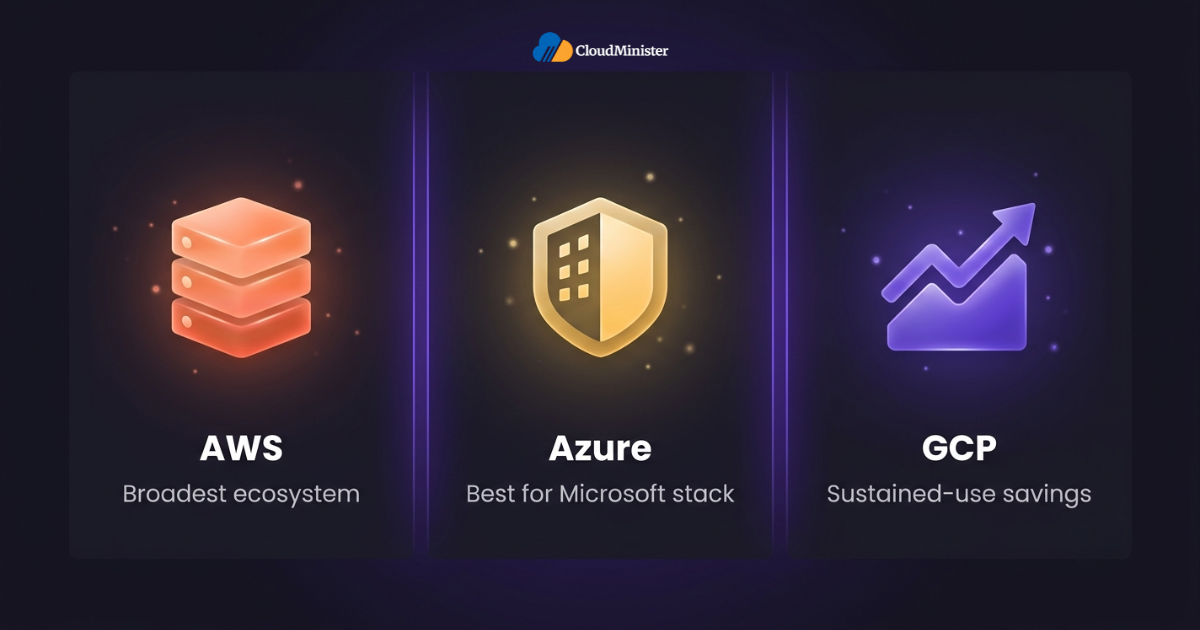
Google Cloud Platform is often cited as the most cost-competitive of the three hyperscalers for sustained AI workloads, largely because it benefits from automatic sustained-use discounts that apply without requiring a formal commitment upfront. A3 and A3-Mega instances carry Cloud GPU pricing that is frequently lower than AWS and Azure equivalents for comparable H100 throughput, and spot pricing on A100 hardware has, at times, dropped below one dollar per GPU-hour, though availability fluctuates enough that it should not be treated as guaranteed.
For teams running long, uninterrupted jobs, Google Cloud for Hosting tends to feel more forgiving than its rivals, since the sustained-use discount applies automatically rather than requiring the upfront reservation planning that AWS and Azure demand. Google Cloud Hosting in India‘s broader appeal often extends to its analytics and data ecosystem — BigQuery, Firebase, and Vertex AI notebooks are common starting points before scaling training onto dedicated infrastructure.
Data engineering teams building recommendation systems or real-time pipelines frequently pair Google Cloud for Hosting analytics with a dedicated GPU provider for the heaviest training jobs, keeping the ETL and inference layers on Google’s infrastructure while routing sustained training elsewhere. Google Cloud Hosting in India‘s expanding regional footprint, including added capacity around Delhi-NCR alongside Mumbai, has also narrowed the latency gap that once made domestic alternatives more attractive by default.
Teams currently evaluating this option can check current GPU instance availability through Google Cloud Hosting in India before comparing it against a dedicated, India-hosted alternative.
Related Reading: Not sure how much VRAM your model actually needs before comparing rates across providers? Read: How Much VRAM Do You Need
6. Hyperscaler Cloud GPU Pricing at a Glance
| Provider | Typical On-Demand H100 Rate | Typical Spot Rate | Key Consideration |
| AWS | High, region-dependent | Meaningfully lower with Savings Plans | Strong ecosystem, complex multi-service billing |
| Azure | Often the highest of the three | Limited spot availability for top-tier GPUs | Best for Microsoft-standardized enterprises |
| GCP | Competitive, sustained-use friendly | Occasionally the cheapest spot tier | Automatic discounts reward long-running jobs |
Regardless of which hyperscaler you choose, never leave a training instance with an open, unauthenticated Jupyter or SSH port reachable from the public internet. GPU instances are a high-value target for cryptomining hijacks, and a compromised node can silently erase any Cloud GPU pricing advantage you gained.
Not Ready to Leave the Hyperscaler Ecosystem Yet?
Explore flexible AWS, Azure, and GCP-integrated Cloud Hosting plans in India with transparent pricing, high-speed infrastructure, and 24×7 expert support
7. Dedicated GPU Server Pricing: The Alternative to Hyperscaler Cloud GPU Pricing
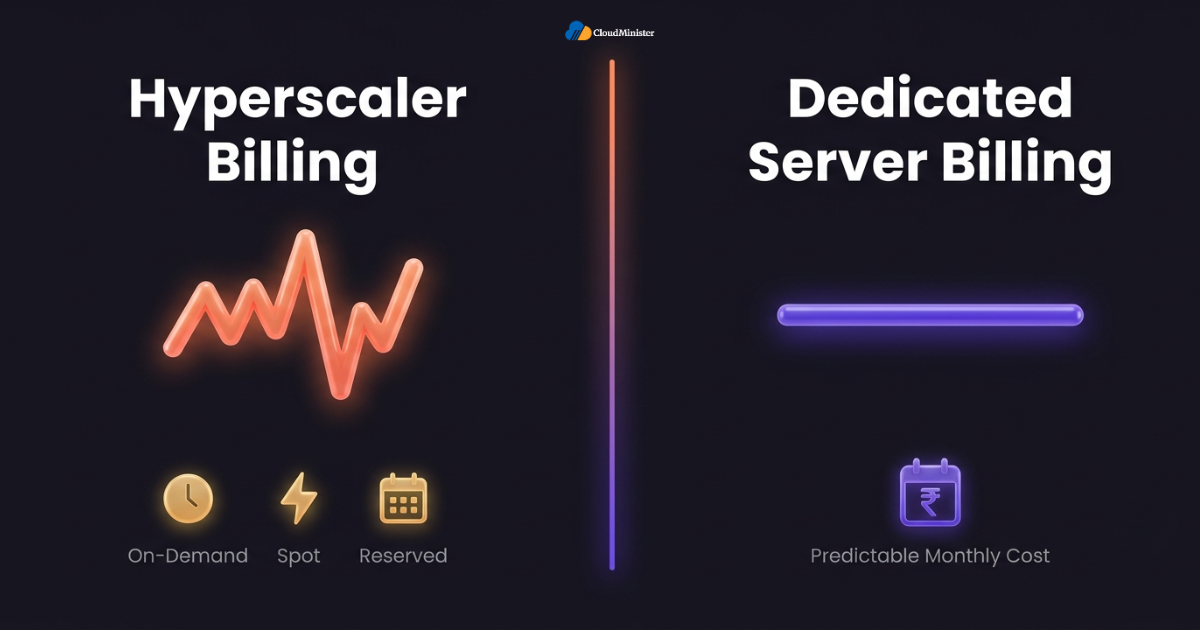
A dedicated GPU server, whether rented monthly or purchased outright, works on a fundamentally different cost model than hyperscaler Cloud GPU pricing. It is typically billed as a flat monthly or hourly rate, with no separate egress or storage-tier charges layered on top, and because it is not shared across a large multi-tenant billing system, dedicated pricing tends to be far more predictable than variable hyperscaler rates that shift with instance type and region.
Indian-hosted dedicated GPU servers also avoid the cross-border data transfer costs that often appear in international pricing calculations, which makes them particularly well suited to teams running near-continuous training or fine-tuning workloads, where utilization is high enough that hourly hyperscaler pricing would quietly add up to more over the course of a month.
7.1 When a Dedicated GPU Server Wins
- Sustained, high utilization through the month tends to favor a dedicated server over on-demand rates, though the exact break-even point depends on the specific workload, infrastructure costs, and pricing model in play — it’s a useful general guideline rather than a fixed threshold.
- Teams needing consistent, predictable monthly costs for financial planning often prefer a dedicated server to hyperscaler variability.
- Organizations with DPDPA data residency requirements find that an India-hosted dedicated GPU server simplifies conversations that hyperscaler cross-border data flow tends to complicate.
7.2 When Hyperscaler Cloud GPU Pricing Still Wins
- Short, bursty, exploratory workloads are usually cheaper under on-demand or spot pricing than under a dedicated commitment.
- Teams needing instant access to the newest GPU generation, before it is widely available on dedicated hosting, may accept a premium in the short term.
- Global teams needing multi-region presence may find hyperscaler pricing easier to manage than coordinating dedicated servers across countries.
A dedicated GPU server removes hyperscaler-managed security tooling (IAM, automatic patching, managed firewalls) from the equation, which means the operational burden shifts to your team. Before committing to dedicated infrastructure, confirm the provider offers isolated tenancy and clarify who is responsible for OS-level patching — an unpatched dedicated box is just as exploitable as an exposed cloud instance, without a hyperscaler’s automated guardrails to fall back on.
Related Reading: Trying to decide between renting a dedicated GPU server and buying one outright? Read: GPU Server Rental vs Buying: TCO Analysis for India
8. Cloud GPU Pricing vs Dedicated Server: A Side-by-Side Breakdown
Laid side by side, the two models pull apart in ways that only become obvious once you look past the headline rate. Hyperscaler Cloud GPU pricing requires no upfront hardware investment, while a dedicated server may involve onboarding costs depending on the provider. Hyperscaler rates fluctuate with instance type, region, and reservation model, whereas dedicated server pricing is usually fixed for the entire billing period, and many dedicated GPU providers in India bundle generous or unmetered bandwidth into the base price rather than charging separately for egress.
Currency and support add another layer to the comparison. Hyperscaler billing is frequently denominated in USD, exposing Indian businesses to currency fluctuation, while India-hosted dedicated servers are billed in INR and sidestep that risk entirely. Global hyperscaler support is often slow unless you pay for a premium plan, while a dedicated GPU server from a local provider typically includes faster, India-timezone support. The one place hyperscalers still pull ahead decisively is scaling flexibility — near-instant scaling to dozens of GPUs is something a single dedicated server cannot match without provisioning additional hardware in advance.
Model your Cloud GPU pricing and dedicated server costs over a full quarter, not a single week. Short-term comparisons almost always favor hyperscaler rates, while quarter-long comparisons often reveal the dedicated server as the more cost-effective option for sustained training workloads.
9. Real-World Cost Scenarios for AI Training in India
9.1 Short Fine-Tuning Project
A two-week fine-tuning job on a 7B parameter model is a strong candidate for on-demand or spot Cloud GPU pricing, since total GPU-hour count is low and flexibility matters more than predictability. Hyperscaler pricing usually wins here, because a fixed monthly dedicated plan would sit mostly idle.
9.2 Continuous Model Training and Retraining
A team running weekly retraining cycles on a production recommendation model benefits from moving away from variable hyperscaler rates toward a dedicated GPU server, since utilization stays consistently high. Over a six-month horizon, the gap widens significantly in favor of the dedicated server.
9.3 Compliance-Sensitive BFSI Workload
Financial services teams bound by DPDPA-aligned data residency requirements often find that India-hosted dedicated infrastructure resolves compliance questions that hyperscaler multi-region architecture can complicate. Even when the hyperscaler Cloud GPU pricing looks cheaper on paper, compliance overhead frequently tips the decision toward a dedicated, India-based GPU server.
Related Reading: Looking for a broader comparison of GPU providers operating in the Indian market before locking in a decision? Read: GPU Cloud Providers in India
10. Hidden Costs That Distort Cloud GPU Pricing Comparisons
Several of the costs that distort a Cloud GPU pricing comparison never show up until the invoice arrives. Idle time is the most common culprit: a reserved instance sitting idle between training runs quietly erodes the savings that reserved pricing was supposed to deliver. Moving datasets between storage, compute, and logging services within the same hyperscaler can also add hidden charges, even though it feels like an internal transfer rather than a billable event.
Teams comparing rates across AWS, Azure, and GCP simultaneously often underestimate the engineering overhead of maintaining pipelines across all three, and premium support plans, practically required for production-grade pipelines, are rarely included in the headline rate anyone quotes. International pricing billed in USD can also carry GST and currency conversion costs that are easy to overlook during initial budgeting but add up meaningfully across a year.
Most Cloud GPU pricing comparisons published online use US-region, on-demand rates as the baseline. Indian teams should always re-run the comparison using their actual region, reservation model, and expected utilization before making a final infrastructure decision.
11. Choosing Between Cloud GPU Pricing and a Dedicated GPU Server: A Decision Framework
A practical decision framework helps turn this comparison from a debate into a process. Start by estimating your expected monthly GPU-hour usage and comparing it against the break-even utilization point where a dedicated server becomes cheaper than variable hyperscaler rates, then map your data residency and compliance requirements, since these can outweigh a small Cloud GPU pricing advantage in either direction.
From there, factor in engineering time, since managing spot-tier interruptions and multi-cloud pipelines has a real cost even when the sticker price looks attractive on its own. Pilot both options for two to four weeks before committing to a long-term contract, and build a habit of revisiting your Cloud GPU pricing assumptions quarterly, since hyperscaler rates and dedicated server offerings both shift as new GPU generations arrive.
Don’t compare reservation discounts in isolation. A 30–40 percent discount on a committed-use plan looks attractive on paper, but if your actual monthly utilization sits well below what the commitment assumes, the “discount” can end up costing more than staying on-demand. Model the commitment against your worst realistic month, not your best one.
12. Why Indian Teams Are Rethinking Cloud GPU Pricing in 2026
India’s cloud infrastructure market has grown fast enough that domestic alternatives to hyperscaler Cloud GPU pricing are now genuinely competitive rather than a compromise. According to Mordor Intelligence, the India cloud computing market is estimated at USD 26.43 billion in 2026, growing from USD 21.82 billion in 2025, giving Indian AI teams a much deeper pool of local infrastructure to evaluate against traditional hyperscaler rates.
Rising domestic capacity means Indian dedicated GPU providers can now offer hardware generations that were previously available only through hyperscaler plans, and improved fiber connectivity and data centre build-out across Mumbai, Hyderabad, and other hubs have narrowed the latency gap that once favored hyperscaler regions. DPDPA enforcement is also pushing more compliance-sensitive workloads toward India-hosted infrastructure, independent of whether the hyperscaler rate looks marginally cheaper.
Related Reading: If your AI training roadmap is moving toward dedicated infrastructure, read: Dedicated NVIDIA GPU Server for AI Training in 2026
13. The Role of a Reliable Hosting Partner in This Decision
A capable hosting partner does not simply undercut hyperscaler Cloud GPU pricing on sticker rate; it changes the entire cost structure around a training workload, from currency exposure to how quickly a support ticket gets answered at 2 a.m.
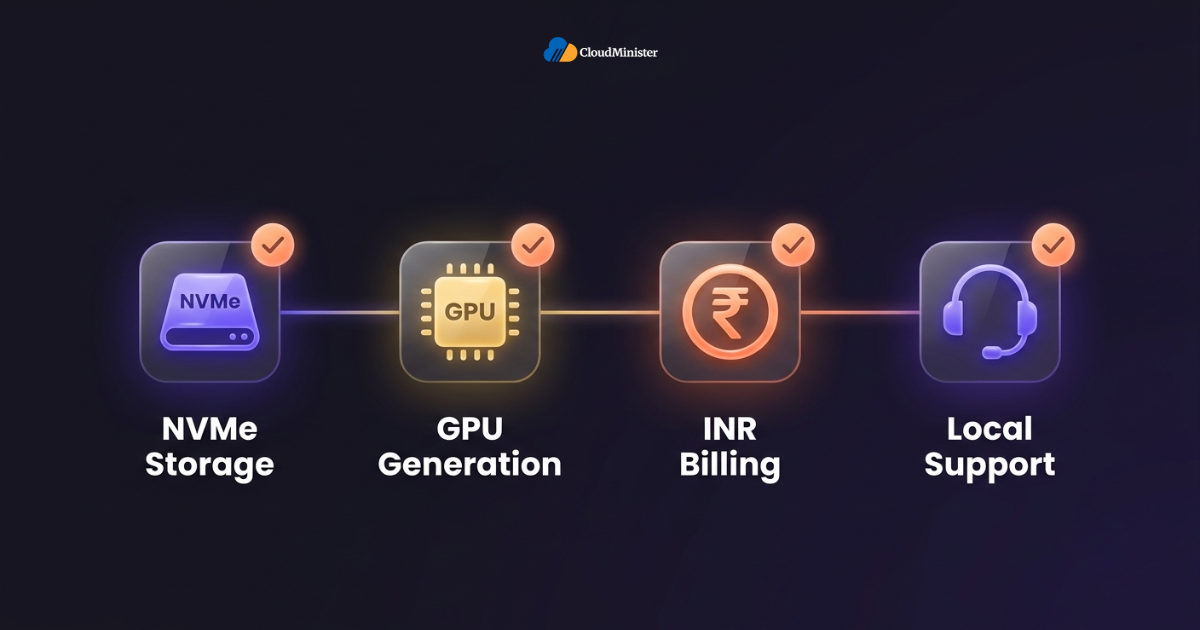
A dependable Web Hosting Company in India gives AI teams a single point of contact across VPS, dedicated servers, and GPU infrastructure — NVMe-backed storage improves training data read speed, INR billing removes currency conversion overhead, and 24×7 local support reduces downtime risk during a critical training job. A Web Hosting Company in India with DPDPA-aligned data handling policies also simplifies compliance conversations with legal teams, which is why comparing at least one domestic provider against the hyperscalers has become a standard part of any serious AI infrastructure decision in India.
Founders evaluating infrastructure for the first time often shortlist a Web Hosting Company in India with a proven uptime record, transparent pricing tiers, and a clear upgrade path from VPS to GPU infrastructure as they scale — comparing quotes from more than one provider before committing budget remains standard practice among experienced CTOs. BFSI and healthcare teams in particular benefit from a provider with clear audit trails and compliance documentation, since these sectors face the most scrutiny around data residency and cross-border transfer.
Teams shortlisting candidates can start by reviewing what a full-stack Web Hosting Company in India offers across VPS, dedicated servers, and managed hosting under a single invoice.
14. Finding the Right Dedicated GPU Infrastructure for Your Workload
For teams ready to compare a dedicated alternative against hyperscaler Cloud GPU pricing, CloudMinister’s GPU server offering provides NVMe-backed, India-hosted infrastructure sized for real AI training workloads, not just pilot experiments. Finding the best GPU cloud hosting in India usually starts with comparing NVMe storage, GPU generation, network throughput, and INR billing side by side — not just the advertised per-hour rate.
For compliance-sensitive AI workloads, the clearest DPDPA documentation and reliability track record matter as much as raw specifications when identifying the best GPU cloud hosting in India for production use. Predictable monthly pricing, a straightforward path from a single GPU instance to a multi-GPU cluster, and India-timezone support are the clearest signals of the best GPU cloud hosting for teams still measuring demand.
A trial period before committing budget is a smart way to confirm the best GPU cloud hosting actually fits your workload, and independent reviews remain a useful supplementary source when validating any provider’s claims. Ultimately, the best GPU cloud hosting is rarely the cheapest sticker price — it’s the option that keeps training jobs fast and reliable, matched to your team’s specific compliance and utilization profile.
Teams ready to compare NVMe-backed, India-hosted GPU infrastructure directly can review best GPU cloud hosting in India for specs, GPU generations, and INR pricing before making a final call.
Ready to Move Your AI Training to Dedicated GPU Infrastructure?
Get started with our NVMe-backed, India-hosted GPU Servers built for sustained AI training workloads, with predictable INR billing and DPDPA-aligned data security
15. Optimizing Whichever Path You Choose
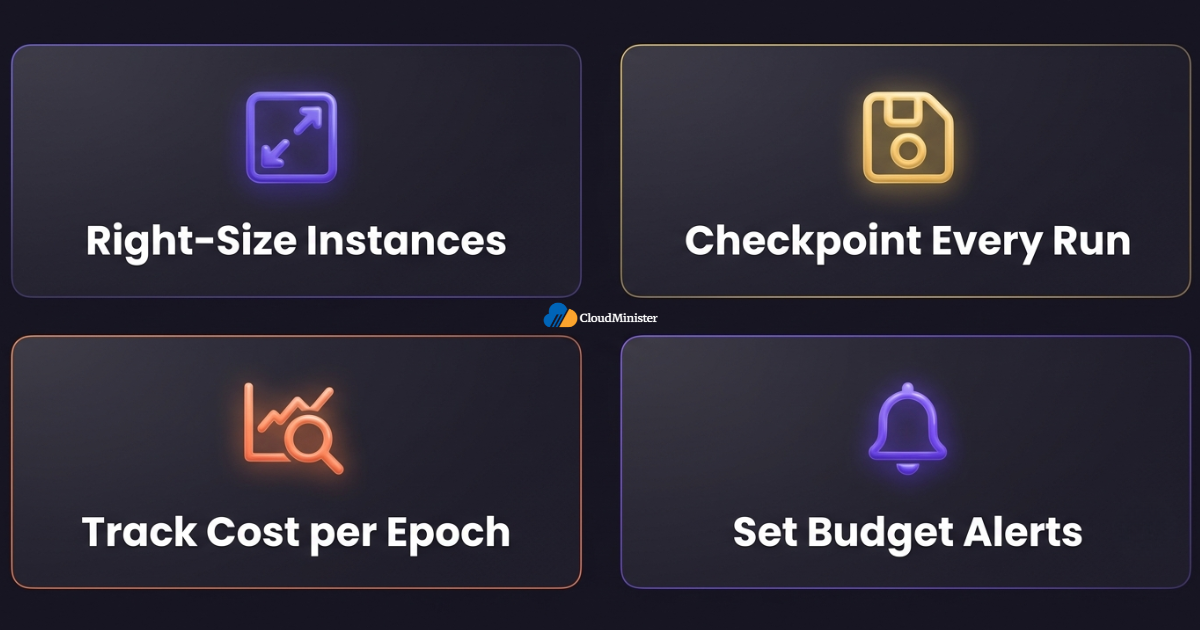
Whether you land on hyperscaler Cloud GPU pricing or a dedicated GPU server, a few practices keep costs under control. Right-sizing your instance before every training run matters more than most teams expect, since over-provisioned GPU memory is one of the most common ways budgets get wasted without anyone noticing. Implementing checkpointing on every long training job is equally important, because hardware failures happen on both spot instances and dedicated servers, and losing hours of progress to an unplanned restart erases whatever pricing advantage you fought hard to secure.
It also helps to track cost per training epoch rather than cost per GPU-hour alone, since raw pricing numbers can hide inefficient training loops that quietly inflate the real cost of a project. Setting budget alerts on every hyperscaler account catches unattended overruns before they become a surprise on next month’s invoice, and revisiting your provider choice at least twice a year keeps you honest, since Cloud GPU pricing and GPU generations both shift meaningfully within a twelve-month window.
16. Where Hyperscalers Still Fit: A Hybrid Approach
Even teams that move their core training workload to a dedicated GPU server often keep parts of their stack on a hyperscaler for the surrounding ecosystem, and that choice usually comes down to which parts of the pipeline benefit most from tooling maturity rather than raw compute price.
Optimized AWS Cloud Hosting configurations can meaningfully reduce the non-GPU portion of an AI team’s monthly cloud bill. Right-sizing instances, tagging resources for accurate cost attribution, using auto-scaling groups, consolidating storage tiers, and auditing unused Elastic IPs and orphaned volumes are all part of Optimized AWS Cloud Hosting practice — savings that pair well with a dedicated GPU server strategy, since each layer is tuned for its actual workload. Teams pursuing Optimized AWS Cloud Hosting typically run a quarterly review to keep waste from compounding as usage patterns shift.
For teams standardized on Microsoft, Azure Cloud Hosting Solutions offer value less through GPU rates and more through how tightly everything else fits together: built-in compliance tooling relevant to Indian BFSI, tight Active Directory integration, hybrid connectivity for on-premises hardware, and disaster recovery tooling that many regulated industries require. Azure Cloud Hosting Solutions also integrate cleanly with Power BI and enterprise resource planning systems already common across Indian conglomerates.
Similarly, teams anchored in Google’s data and analytics ecosystem often keep that layer on Google Cloud for Hosting even after the heaviest training workloads have moved to a dedicated server elsewhere. Google Cloud for Hosting BigQuery, Firebase, managed Kubernetes, and streaming pipelines benefits from sustained-use discounts that apply automatically on long-running, non-GPU workloads, which is why analytics-heavy Indian teams frequently anchor their data warehouse on Google Cloud Hosting in India well before any GPU training decision enters the picture.
17. Common Mistakes When Comparing Cloud GPU Pricing Options
Mistake 1: Comparing Only the Headline Rate
Many teams compare Cloud GPU pricing using only the per-GPU-hour figure on a page, ignoring storage, egress, and support costs that materially change the total.
Mistake 2: Ignoring Utilization Patterns
A team with bursty workloads that locks into a long-term dedicated server, or a team with sustained workloads that stays on expensive on-demand pricing, both end up overpaying relative to actual usage.
Mistake 3: Overlooking Currency and Compliance Costs
USD-denominated pricing carries currency risk, and cross-border data flow can create compliance friction that is easy to miss during an initial comparison.
Mistake 4: Skipping the Pilot Phase
Committing to either a long-term hyperscaler reservation or a dedicated server contract without piloting the workload first is one of the most expensive mistakes an Indian AI team can make.
Mistake 5: Not Revisiting the Decision
Cloud GPU pricing and dedicated server offerings both evolve quickly; a comparison accurate a year ago may no longer reflect current market rates.
When piloting multiple providers side by side , a practice this guide recommends, it’s easy to leave test instances running with default credentials or temporary access keys that never get rotated out. Treat every pilot environment with the same access hygiene as production, since forgotten pilot instances are a common, quiet source of both wasted spend and exposed attack surface.
18. The Growing Scale of AI Infrastructure Spend in India
The broader economics behind this decision are not abstract. As per industry data cited by IBEF, cloud technology is expected to contribute 8 percent to India’s GDP by 2026 — a scale of adoption pulling AI training budgets, and by extension Cloud GPU pricing decisions, into mainstream financial planning rather than a niche engineering concern. As more Indian enterprises move core workloads onto cloud-native infrastructure, the pressure to get the Cloud GPU pricing and dedicated server decision right the first time only grows.
This shift is visible beyond the numbers, too. Five years ago, GPU infrastructure conversations in India were largely confined to a handful of well-funded AI-first startups and research labs with the budget to experiment freely. Today, the same conversation happens inside mid-sized SaaS companies, D2C brands adding recommendation engines, and BFSI teams piloting internal copilots, none of whom have the luxury of treating Cloud GPU pricing as an afterthought. A miscalculated infrastructure decision now shows up in board decks and investor updates just as quickly as a miscalculated customer acquisition cost, which is part of why finance and engineering are increasingly making this call together rather than in isolation.
The maturing of India-hosted dedicated GPU providers alongside this growth is not a coincidence — it is a direct response to demand that hyperscalers alone were not built to serve efficiently for every use case. As GPU-hour consumption scales across more of the Indian tech ecosystem, the market has room for both models to coexist: hyperscaler Cloud GPU pricing for teams that need elastic, global-scale infrastructure, and dedicated, India-hosted alternatives for teams whose workloads are steady, compliance-bound, or cost-sensitive enough that predictability matters more than elasticity. Teams that treat this as a live, recurring decision rather than a one-time setup step are the ones best positioned to capture that flexibility as the market keeps evolving through 2026 and beyond.
Key Takeaways
- Cloud GPU pricing from AWS, Azure, and GCP is not a single number; it is a stack of compute, storage, egress, and support costs that compounds quickly.
- Dedicated GPU server pricing tends to be more predictable and, as a general guideline, more cost-effective for sustained, high-utilization AI training workloads in India — though the exact break-even point varies by workload and infrastructure costs.
- On-demand and spot-tier pricing still make sense for short, exploratory, or bursty training jobs.
- DPDPA-aligned compliance and INR billing often tip the decision toward India-hosted dedicated infrastructure.
- A hybrid approach, combining hyperscaler services for data and orchestration with a dedicated GPU server for training, is increasingly the pragmatic choice for Indian AI teams.
- Revisiting your Cloud GPU pricing comparison every few months keeps infrastructure spend aligned with actual usage rather than outdated assumptions.
Still Weighing Cloud GPU Pricing vs a Dedicated GPU Server?
Talk to our infrastructure team for a free workload assessment and get a clear, no-obligation recommendation tailored to your training budget and compliance needs
Conclusion
There is no universal answer to whether hyperscaler Cloud GPU pricing or a dedicated GPU server is more cost-effective for AI training in India; it depends on utilization pattern, compliance requirements, and how much engineering time a team can dedicate to multi-cloud complexity. Short, bursty, exploratory workloads generally favor the flexibility of on-demand or spot pricing from AWS Cloud Hosting, Azure Cloud Hosting, or Google Cloud Hosting in India. Sustained, production-grade training and retraining workloads generally favor a dedicated, India-hosted GPU server, both on raw cost and compliance grounds.
What separates teams that get this decision right from those that don’t is rarely access to better pricing data — most of the numbers in this guide are publicly available to anyone willing to dig through a pricing calculator. The real difference is discipline: running an actual pilot before committing budget, tracking utilization honestly instead of assuming it, and revisiting the Cloud GPU pricing comparison on a schedule rather than defaulting to whatever was decided at project kickoff. Infrastructure decisions made under deadline pressure, without that discipline, are where most avoidable spend in Indian AI teams quietly accumulates.
The most cost-conscious Indian AI teams in 2026 are not choosing one path exclusively; they are pairing hyperscaler services where the ecosystem adds real value with dedicated GPU infrastructure where sustained training makes hyperscaler Cloud GPU pricing the more expensive option over time. As GPU generations turn over faster and India’s own dedicated infrastructure options keep improving, that hybrid mindset — rather than a fixed allegiance to any single provider — is likely to remain the more durable strategy for any team serious about controlling its AI training costs over the long run.
Frequently Asked Questions
Is Cloud GPU pricing from AWS, Azure, or GCP cheaper than a dedicated GPU server in India?
It depends on utilization. For short, bursty workloads, on-demand or spot pricing is usually cheaper. For sustained, high-utilization training workloads, a dedicated GPU server in India is often more cost-effective once egress, storage, and currency costs are factored into the hyperscaler’s Cloud GPU pricing.
Which hyperscaler offers the most competitive Cloud GPU pricing for AI training?
GCP is frequently cited as the most cost-competitive for sustained workloads due to automatic sustained-use discounts, while AWS offers the broadest ecosystem and Azure suits enterprises already standardized on Microsoft tooling. Actual Cloud GPU pricing varies by region, GPU generation, and reservation model.
Why do Indian teams increasingly prefer dedicated GPU servers over hyperscaler Cloud GPU pricing?
INR billing, DPDPA-aligned data residency, unmetered or generous bandwidth, and predictable monthly costs make dedicated GPU servers attractive compared to variable, USD-denominated hyperscaler Cloud GPU pricing.
Can I mix hyperscaler services with a dedicated GPU server?
Yes. Many Indian AI teams keep data pipelines, analytics, or orchestration on AWS, Azure, or GCP while routing the heaviest GPU training workloads to a dedicated, India-hosted GPU server, balancing ecosystem convenience against Cloud GPU pricing.
How often should I re-evaluate my Cloud GPU pricing strategy?
At least twice a year. GPU generations, hyperscaler discount structures, and dedicated server offerings all shift meaningfully within a twelve-month window, and an outdated Cloud GPU pricing comparison can leave real savings on the table.

Shivlendra Singh Jadoun is a Cloud & DevOps Engineer at CloudMinister Technologies, specializing in AWS, Azure, and GCP infrastructure. He began his career in Linux system administration, managing shared, VPS, and dedicated servers before moving into cloud and automation. He is AWS Certified and works extensively with Docker, Kubernetes, Terraform, Ansible, and Jenkins to build CI/CD pipelines and scalable, secure cloud environments. With hands-on experience across hosting, server security, and DevOps automation, he brings real-world engineering insight to every article he writes.
Related posts:
 Future of Cloud Computing: Azure Innovations, Trends & Strategy Guide for 2026
 Top Features of Google Cloud Hosting: Are they Worth the Price for Indian Users?
 AWS Cloud Hosting for SaaS Companies: The Ultimate Solution!
 How to Set Up your website on Google Cloud Hosting in India: A step-by-step Guide
