This guide breaks down the core differences between bare metal and dedicated server hosting for businesses evaluating infrastructure in 2026. Whether you run AI/ML workloads, eCommerce platforms, or high-traffic SaaS products, understanding which server model fits your requirements is critical for making a cost-effective, performance-aligned decision. We cover hardware control, performance benchmarks, cost structures, India’s DPDP Act 2023 compliance angle, and the specific workloads where each model delivers the best return.
When businesses start evaluating server infrastructure seriously, one question comes up repeatedly: what exactly separates a bare metal server from a dedicated server? On the surface, both involve physical hardware allocated exclusively to a single tenant. Both eliminate the noisy-neighbour problem common in shared environments. And both offer performance levels that virtualised infrastructure simply cannot match for certain workloads.
But the distinction between the two is not cosmetic — it is architectural. In 2026, with AI/ML workloads demanding raw compute, India’s DPDP Act 2023 enforcing stricter data governance, and infrastructure costs under growing scrutiny, getting this decision right has real business consequences.
This guide is written for technology decision-makers, infrastructure leads, and business owners who need a technically grounded, commercially relevant comparison — without the marketing noise that typically surrounds it.
1. Defining the Terms: What Is Bare Metal and What Is a Dedicated Server?
Before comparing the two models, both terms need precise definitions. They are frequently used interchangeably in vendor marketing — a conflation that creates genuine confusion when businesses are trying to make infrastructure decisions based on actual technical requirements.
What Is a Bare Metal Server?
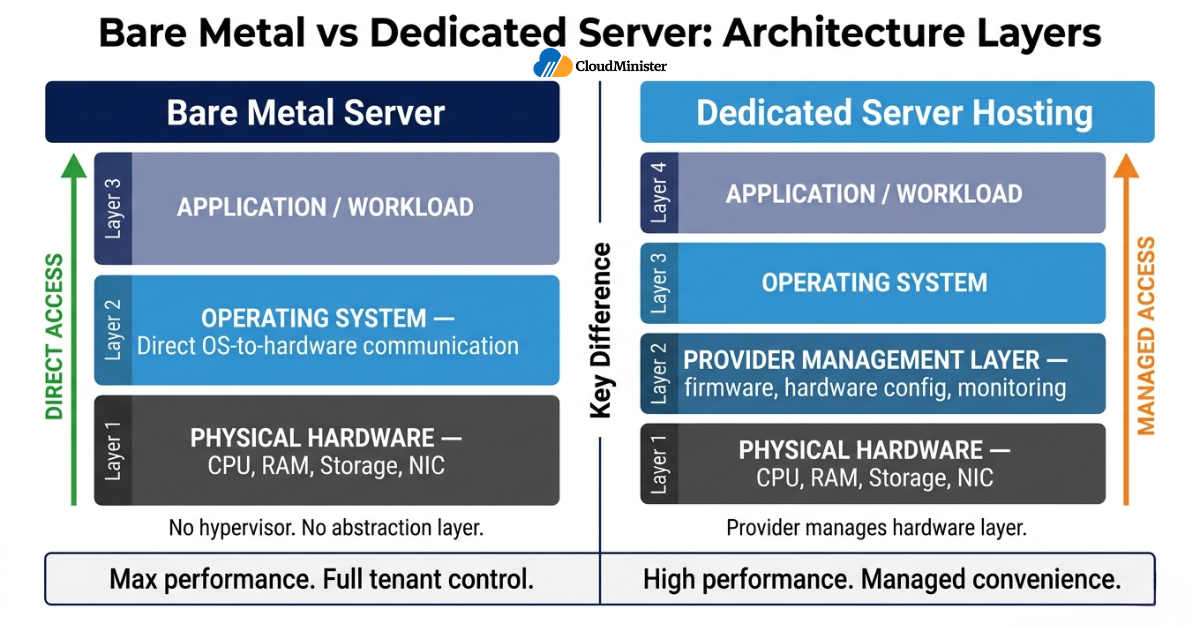
A bare metal server is a physical server in which a single tenant has exclusive access to the underlying hardware — typically with no hypervisor or virtualisation layer imposed by the provider, giving the tenant direct control over the physical resources. Unlike shared or virtualised environments, the tenant can choose whether to run a hypervisor themselves, or run workloads directly on bare hardware. The term “bare metal” refers to exactly that: the server stripped of any virtualisation overhead, delivering raw compute, memory, and storage directly to the operating system and applications running on it.
In a bare metal environment, the tenant typically controls BIOS or UEFI settings, firmware configurations, operating system selection, kernel parameters, and every layer of the software stack above the hardware itself. This degree of control makes bare metal the architecture of choice for workloads where performance consistency and hardware-level optimisation are non-negotiable.
What Is a Dedicated Server?
A dedicated server is also a physical server allocated exclusively to a single tenant — but the relationship between the tenant and the hardware is typically mediated by a provider management layer. In most Dedicated Server Hosting arrangements, the provider manages hardware selection, data centre operations, network configuration, and, in managed tiers, OS maintenance, security patching, and monitoring.
The distinction between the two models therefore comes down primarily to the level of hardware abstraction and the division of management responsibility. Bare metal maximises tenant control. Dedicated servers balance control with managed convenience.
Before selecting between bare metal and Dedicated Server Hosting, document your team’s actual infrastructure management capacity. Bare metal delivers maximum performance but requires significant internal expertise. If your engineering team is primarily focused on product development, a managed dedicated server arrangement is likely to deliver better total cost of ownership — even if the per-unit hardware cost appears lower with self-managed bare metal.
2. The State of Physical Server Infrastructure in 2026: What the Data Shows
The conversation around these two server models in 2026 is happening against a backdrop of significant market evolution. Cloud infrastructure has matured, but so has the demand for dedicated physical compute — driven largely by AI and machine learning workloads that virtualised environments cannot serve efficiently.
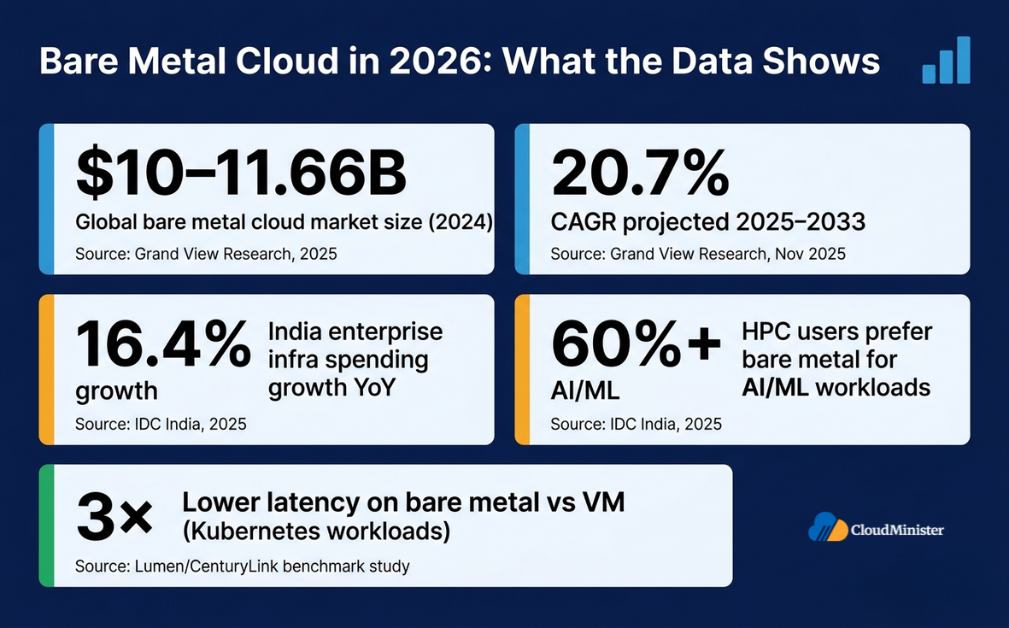
According to Grand View Research’s Bare Metal Cloud Market Report, the global bare metal cloud market was valued at approximately USD 10–11.66 billion in 2024 and is projected to grow at a compound annual growth rate of approximately 21% from 2025 to 2033 — driven primarily by demand from AI/ML workloads, high-performance computing, and regulated industry verticals requiring data isolation.
India’s trajectory mirrors this trend. IDC’s 2025 India Cloud Infrastructure Report indicates that over 60% of surveyed HPC users prefer bare metal for AI/ML workloads, and enterprise infrastructure spending in India is increasingly weighted toward high-performance dedicated environments as businesses scale AI-driven applications, comply with DPDP Act 2023 data residency provisions, and move latency-sensitive workloads off shared cloud infrastructure.
| Metric | Figure | Source |
| Global bare metal cloud market (2024) | USD 10–11.66 billion | Grand View Research |
| Bare metal market CAGR (2024–2030) | ~20.7% annually | Grand View Research |
| India enterprise infra spending growth | 16.4% YoY | IDC India, 2025 |
| Organisations preferring bare metal for AI/ML | Over 60% of surveyed HPC users | IDC 2025 (paid research — contact IDC for access) |
| Avg. latency improvement: bare metal vs VM | Kubernetes shows 3x lower latency on bare metal vs VM (Lumen/CenturyLink study) | IBM Institute for Business Value |
The market figures above are sourced from third-party research reports and should be treated as directional indicators, not guaranteed projections. The decision between a bare metal server and a dedicated server should be grounded in your specific workload requirements and a total cost of ownership analysis — not market size figures alone.
3. Core Technical Differences: Bare Metal vs Dedicated Server
The distinction between these two server types is most clearly understood at the architectural level. Both models use physical hardware and both eliminate multi-tenancy — but the technical characteristics diverge significantly across several dimensions that directly affect workload performance, management overhead, and total cost.
3.1 Hardware Control and Virtualisation
The most fundamental technical difference is the presence or absence of a virtualisation layer. Bare metal servers operate with no hypervisor — the operating system communicates directly with physical hardware. This eliminates the compute overhead introduced by virtualisation.
To be precise: under a Type 1 hypervisor such as KVM or VMware ESXi, CPU-bound workloads can see 3–10% overhead in modern implementations — though I/O-intensive workloads, depending on storage stack configuration, may experience higher overhead. The exact figure varies by workload type, hypervisor version, and hardware configuration; older claims of 15%+ overhead are less representative of current hypervisor technology.
Dedicated Server Hosting environments may also operate without a hypervisor in practice, but the provider management layer introduces operational abstraction. Hardware configuration, firmware updates, and BIOS-level settings are typically handled by the provider, which simplifies operations but limits granular low-level control.
3.2 Performance Characteristics
For workloads where performance consistency matters — database engines, AI training pipelines, financial transaction processing, real-time rendering — the performance difference between the two is measurable. Bare metal delivers deterministic compute: CPU cycles, memory bandwidth, and storage I/O are not subject to hypervisor scheduling or management layer overhead. Latency is lower, throughput is higher, and performance under sustained load is more consistent.
Dedicated Server Hosting delivers excellent performance for the majority of enterprise workloads — web applications, application servers, eCommerce platforms, and content delivery. The performance gap versus bare metal becomes significant only at the extremes of compute intensity, where management layer overhead creates meaningful bottlenecks.
For Indian businesses running AI-powered applications, the performance question has a clear answer at scale: AI training workloads, particularly those using GPU clusters, benefit substantially from bare metal’s direct hardware access. Inference workloads — serving trained models to end users — are often well-served by Dedicated Server Hosting, which offers a more practical operational model for teams without dedicated infrastructure engineering resources.
3.3 Customisation and Control
Bare metal environments give tenants complete control over the full software stack — from firmware and kernel configuration to network driver selection and CPU governor settings. This is essential for workloads requiring OS hardening beyond standard configurations, custom kernel modules, or hardware-specific optimisations such as NUMA topology tuning for multi-socket servers.
Dedicated Server Hosting typically provides OS-level and application-level customisation. Businesses can choose operating systems, install custom software, configure firewalls and security policies, and adapt the environment to their application’s requirements — but hardware-level configuration remains with the provider. For the vast majority of business workloads, this is the right trade-off between control and managed convenience.
3.4 Provisioning and Deployment Speed
One area where dedicated environments have a clear advantage is provisioning speed. Bare metal servers require physical configuration, hardware verification, and OS installation — a process that can take anywhere from several hours to multiple business days depending on the provider and configuration complexity.
Managed Dedicated Server Hosting providers with standardised server configurations and automated deployment tooling can provision environments significantly faster. For businesses with variable capacity needs or time-sensitive project requirements, this difference is operationally significant.
Related: When Do You Need a Dedicated Server?
4. Head-to-Head Comparison: Bare Metal vs Dedicated Server
The table below summarises the primary dimensions of the comparison for business decision-makers. These distinctions are not always binary — managed dedicated offerings are increasingly closing the gap in several areas, and bare metal providers are improving provisioning speeds — but the core architectural differences remain.
| Dimension | Bare Metal Server | Dedicated Server Hosting |
| Hardware Access | Direct, exclusive physical access; no hypervisor layer | Exclusive physical hardware, provider-managed |
| Virtualisation | None — raw hardware performance | Typically none; provider may abstract some layers |
| Performance | Maximum; no VM overhead | High performance with minor management overhead |
| Customisation | Full BIOS/UEFI, firmware, OS control | OS and software customisation; hardware config is provider-managed |
| Provisioning Time | Slower (hours to days) | Faster in managed environments |
| Use Case Fit | HPC, AI/ML, databases, rendering | Business apps, web hosting, eCommerce |
| Management | Full responsibility on tenant | Managed options widely available |
| Cost | Higher entry; justified by performance | Competitive; managed tiers cost more but save engineering time |
| Scaling | Manual hardware changes required | More flexible upgrade paths in managed environments |
5. Cost Economics: Bare Metal vs Dedicated Server in 2026
Cost is one of the most frequently misunderstood dimensions of this infrastructure decision. The instinct to compare raw server pricing leads many businesses to underestimate the total cost of ownership for bare metal environments — and to overestimate the cost premium of well-structured Dedicated Server Hosting.
5.1 Direct Infrastructure Costs
Bare metal servers command higher base costs than standard dedicated servers of comparable hardware specifications. The pricing premium reflects the level of hardware access provided, the physical provisioning overhead, and the degree of isolation the configuration delivers. Providers offering bare metal as a cloud service — on-demand, metered bare metal — add a further premium for provisioning flexibility.
Dedicated Server Hosting, particularly in managed tiers, carries a cost above raw hardware pricing — but this premium reflects services that bare metal tenants must typically source internally: 24/7 monitoring, OS management, security patching, hardware replacement, and technical support.
5.2 Total Cost of Ownership
For the total cost of ownership calculation, the critical variable is internal engineering capacity. Bare metal environments require infrastructure engineers who can manage hardware configuration, kernel tuning, network configuration, and incident response. For startups and growth-stage businesses — particularly those accessing dedicated hosting in India — the hidden cost of infrastructure management on bare metal can substantially erode the apparent hardware cost advantage.
For Indian startups and SMEs, the cost comparison is most accurately evaluated by factoring in the engineering time required to manage each environment. A bare metal environment that saves INR 15,000 per month on hardware — but requires 20 additional engineering hours per month to manage — is not cheaper in practice. It is more expensive, and it introduces performance risk during those management cycles. Managed dedicated hosting in India closes this gap effectively for most business workloads.
5.3 Scaling Cost Dynamics
Scaling a bare metal environment means adding physical hardware — a process involving procurement lead times, physical installation, and configuration cycles. For businesses with predictable, steady-state compute requirements, this is manageable. For businesses experiencing variable demand — seasonal peaks, campaign-driven traffic, or rapid growth — the inability to scale bare metal elastically creates either over-provisioning costs or capacity risk.
Dedicated Server Hosting, particularly cloud-adjacent dedicated offerings, typically provides more flexible upgrade paths. Combining a dedicated server environment with a Linux VPS server layer for burst capacity is a common hybrid architecture that delivers the performance consistency of dedicated physical infrastructure with the elasticity of virtualised capacity during peak demand periods.
Explore Dedicated Server Hosting Plans
View Cloudminister’s managed dedicated server configurations — built for Indian businesses that need production-grade performance without the overhead of self-managed infrastructure.
6. Security and Compliance: The DPDP Act 2023 Context
For Indian businesses processing personal data of Indian citizens, the security and compliance dimensions carry specific regulatory weight under the DPDP Act 2023. Both models offer inherent security advantages over shared environments, but the compliance implications differ in important ways.
6.1 Data Isolation and Breach Risk
Both bare metal and Dedicated Server Hosting environments eliminate the multi-tenancy risk associated with shared cloud infrastructure. In bare metal environments, hypervisor-layer attack vectors are eliminated where no hypervisor is present — removing one class of vulnerability. However, bare metal introduces its own security considerations, including firmware, BIOS/UEFI, and physical-layer risks that must be actively managed. Dedicated physical hardware in either model removes cross-tenant data leakage risk, which is a meaningful security advantage over shared environments. For regulated industries — fintech, healthcare, legal services — this physical isolation is often a compliance requirement, not merely a preference.
Under India’s DPDP Act 2023, organisations processing personal data of Indian citizens are required to implement appropriate technical and organisational safeguards. While the Act does not currently impose a blanket data localisation mandate, cross-border data transfers will be subject to restrictions based on government-notified countries. Businesses should nonetheless verify with their provider whether infrastructure is India-based, as this simplifies compliance posture and reduces regulatory uncertainty — particularly for sensitive data categories.
6.2 Security Management Responsibilities
The security management division follows the control model directly. In bare metal environments, security configuration, patching, monitoring, and incident response are predominantly the tenant’s responsibility. This creates maximum flexibility — and maximum operational burden.
Managed Dedicated Server Hosting redistributes security responsibilities. Provider-managed security layers — continuous monitoring, automated patching, intrusion detection, and 24/7 incident response — address the compliance monitoring requirements of the DPDP Act 2023 without requiring businesses to maintain the same depth of internal security operations capability.
For businesses using cloud web hosting India for front-end delivery alongside dedicated backend environments, ensuring consistent security policy application across both layers is a critical architectural consideration — one where managed dedicated environments with centralised security operations have a practical advantage.
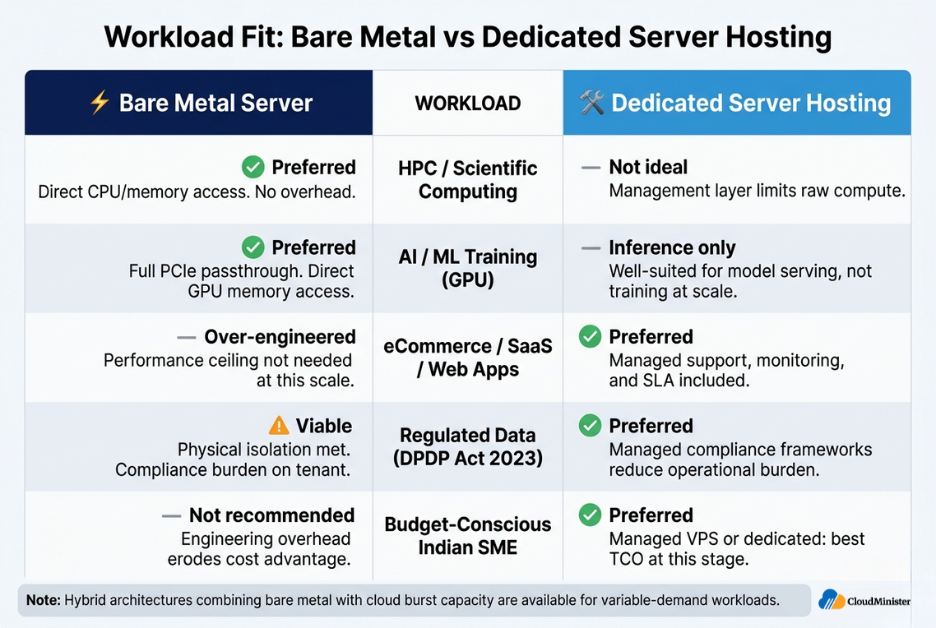
7. Workload Fit: When to Choose Bare Metal, When to Choose Dedicated Server Hosting
This decision is ultimately a workload fit question. There is no universally correct answer — only the answer that best matches your infrastructure requirements to the technical characteristics of each model.
7.1 Workloads That Favour Bare Metal
High-Performance Computing (HPC)
Scientific simulation, genomics, financial modelling, and computational fluid dynamics applications demand every CPU cycle available. Bare metal’s direct hardware access eliminates the overhead that would compromise the consistency of HPC results.
AI and Machine Learning Training
Large-scale model training — particularly using GPU clusters — benefits from bare metal’s ability to allocate the full compute capacity of GPU hardware. PCIe passthrough and direct GPU memory access are significantly more efficient on bare metal than in virtualised environments. For Indian AI startups and research institutions, bare metal is often the only architecture capable of meeting training pipeline performance requirements at scale.
Database Engines at Extreme Scale
OLTP databases handling millions of transactions per second, or OLAP systems processing petabyte-scale analytical queries, benefit from the I/O consistency and memory bandwidth that bare metal provides. Resource contention at the hardware level introduces latency variability that production database environments cannot tolerate.
Latency-Critical Financial Applications
Algorithmic trading, payment settlement systems, and real-time risk engines require sub-millisecond latency consistency. The deterministic performance of bare metal — with no hypervisor scheduling overhead — is a technical requirement in these environments, not a preference.
7.2 Workloads That Favour Dedicated Server Hosting
Enterprise Web Applications
Business applications, corporate portals, and web services handling predictable, moderate-to-high traffic volumes are well-served by Dedicated Server Hosting. The performance is sufficient, the management overhead is reduced, and managed security and monitoring are available without significant internal investment.
eCommerce Platforms
Indian eCommerce businesses serving regional and national markets benefit from the combination of dedicated performance and managed infrastructure support. Seasonal scaling requirements can be addressed through hybrid architectures combining dedicated backend infrastructure with cloud web hosting India for front-end delivery layers.
SaaS Products
Most SaaS applications do not require the extreme performance consistency of bare metal. Dedicated Server Hosting with managed support provides the reliability SaaS products require — consistent uptime, security monitoring, and infrastructure management — at a cost structure that accommodates SaaS economics.
Regulated Data Workloads
For businesses processing sensitive data under the DPDP Act 2023 or industry-specific regulations, managed Dedicated Server Hosting with provider-level compliance capabilities is often more practical than bare metal environments where compliance responsibilities fall entirely on the tenant.
Note: DPDP Act 2023 compliance remains the legal responsibility of the data fiduciary — providers can support but cannot own compliance on your behalf.
When evaluating this decision for a specific workload, run a simple test: list the three performance metrics that matter most for your application — latency, throughput, I/O consistency, or memory bandwidth. Then determine whether your current or projected workload would consistently saturate a dedicated server environment across those dimensions. If the answer is yes, bare metal warrants serious evaluation. If the answer is no — as it is for the majority of business applications — managed Dedicated Server Hosting is the higher-ROI choice.
| Infrastructure Type | Recommended Model | Who Should Use It |
| Gaming / Rendering | Bare metal preferred for raw latency and throughput | Gaming studios, animation companies |
| Enterprise Web Apps | Dedicated Server Hosting with managed layer | SaaS, eCommerce, corporate portals |
| AI / ML Training | Bare metal for full GPU access and training pipelines | Data science teams, AI startups |
| Regulated Data (DPDP) | Dedicated with managed compliance preferred | Fintech, healthtech, legal platforms |
| Budget-Conscious SME | Managed dedicated or VPS for cost efficiency | Startups, growing Indian SMEs |
8. Specific Considerations for Indian Businesses in 2026
This infrastructure question carries dimensions specific to the Indian market that global infrastructure guides do not address adequately. Indian businesses face a combination of infrastructure maturity, regulatory requirements, cost constraints, and growth dynamics that shape how this decision should be evaluated.
8.1 The Indian Infrastructure Landscape in 2026
India’s cloud and dedicated hosting market has matured significantly. Hyperscaler data centres now sit alongside domestic managed hosting providers with India-based infrastructure. For businesses requiring dedicated hosting in India with verifiable data residency, both categories can satisfy the technical requirement — but domestic providers typically offer more responsive support, better cost structures for Indian market needs, and clearer contractual alignment with DPDP Act 2023 requirements.
8.2 Cost Sensitivity and Engineering Capacity
Indian technology businesses — particularly startups and growth-stage companies — operate under cost and resource constraints that differ from equivalents in mature Western markets. Infrastructure budgets are tighter relative to engineering team size, and dedicated infrastructure engineers represent a significant payroll investment.
This cost reality directly affects the server choice. The management overhead of bare metal environments requires skilled infrastructure engineers to operate safely and efficiently — a cost that many Indian businesses cannot absorb without it competing directly with product development investment. Managed Dedicated Server Hosting addresses this by transferring infrastructure management responsibility to the provider.
For businesses that have outgrown shared infrastructure but are not yet ready for the operational demands of bare metal, a managed Linux VPS server environment can serve as a cost-effective intermediate step — providing dedicated-grade performance for specific workloads within a managed operational model.
8.3 Regulatory Compliance Under DPDP Act 2023
India’s DPDP Act 2023 creates specific requirements that affect the server evaluation for businesses processing personal data of Indian citizens. Data localisation provisions mean that the physical location of servers is a compliance variable, not just a performance consideration. Breach notification obligations mean that incident detection and response capabilities directly affect regulatory exposure.
Managed Dedicated Server Hosting providers with India-based infrastructure and documented DPDP Act 2023 compliance frameworks address both requirements in a single engagement. Bare metal environments can satisfy the same requirements, but the compliance monitoring and documentation burden falls on the tenant — a significant operational investment that is often underestimated during the infrastructure evaluation phase.
9. Five Signs You Need to Re-Evaluate Your Current Infrastructure
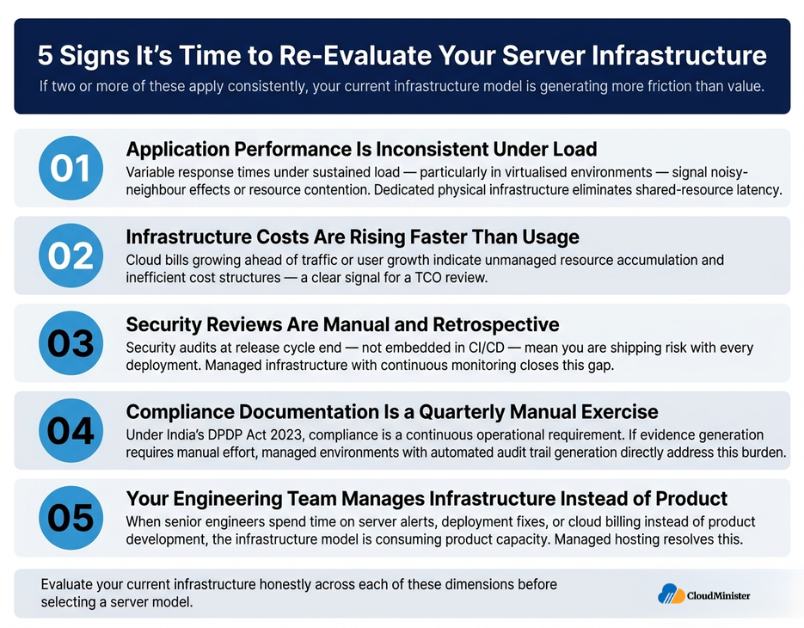
Whether you are currently running shared cloud infrastructure, a VPS environment, or an existing dedicated environment, certain operational signals indicate that a more rigorous evaluation of your server infrastructure is warranted.
1. Application Performance Is Inconsistent Under Load
If your application delivers variable response times — particularly under sustained load or during peak traffic periods — the infrastructure beneath it may be introducing performance variability. For workloads in virtualised environments experiencing noisy-neighbour effects, evaluating dedicated physical infrastructure is the next logical step.
2. Infrastructure Costs Are Rising Faster Than Usage
When cloud bills grow consistently faster than application traffic or user growth, the infrastructure model lacks efficient cost management. A total cost of ownership analysis — accounting for current provider fees, internal management time, and the cost of performance-driven incidents — is overdue.
3. Security Reviews Are Manual and Retrospective
If security audits happen at the end of release cycles rather than continuously, and if security incidents require manual triage before containment, the infrastructure’s security model is reactive. Managed Dedicated Server Hosting with embedded security monitoring converts this from a periodic overhead into a continuous, automated capability.
4. Compliance Documentation Is a Quarterly Manual Exercise
Under the DPDP Act 2023, ongoing compliance is a continuous operational requirement — not a quarterly exercise. If generating compliance evidence requires significant manual effort, a managed dedicated environment with automated audit trail generation directly addresses this operational burden.
5. Your Engineering Team Manages Infrastructure Instead of Product
When developers or senior engineers spend meaningful time responding to infrastructure alerts, managing server configurations, or reviewing cloud bills, the infrastructure model is consuming product development capacity. Managed Dedicated Server Hosting — or a managed bare metal service if workload requirements justify it — converts this variable demand into a managed service responsibility.
Infrastructure incidents involving personal data are not purely engineering problems under India’s DPDP Act 2023 — they are potentially reportable events with defined notification timelines. Businesses without automated incident detection and response capabilities face both higher incident frequency and slower containment. When evaluating server options, explicitly include each option’s incident detection and response capability as a selection criterion.
10. What to Look for in a Bare Metal or Dedicated Server Provider in India
Selecting the right provider is as important as selecting the right server model. The following criteria should guide any provider evaluation:
- Data centre location and DPDP Act 2023 compliance: Verify that the provider’s infrastructure is physically located in India and that data residency is contractually guaranteed — not just technically feasible.
- SLA commitments with defined incident response: Both server types should come with specific uptime guarantees, incident response time commitments, and escalation paths.
- Managed service depth: For Dedicated Server Hosting, understand precisely which management responsibilities the provider assumes — and which remain with your team. This division determines the real total cost of ownership.
- Hardware refresh policy: Dedicated environments should include documented hardware refresh cycles. Bare metal providers should specify hardware failure replacement timelines.
- Network quality and domestic peering: For businesses serving Indian users, network topology and domestic peering quality directly affect end-user experience. Validate provider network specifications against your latency requirements.
- Transparent and predictable pricing: Cost comparison between the two server models is only meaningful if pricing is stable. Verify that cost structures do not change materially as infrastructure scales.
CHECKLIST — BEFORE COMMITTING TO A PROVIDER
- Is the provider’s data centre physically in India with DPDP Act 2023 compliance verified?
- Are SLA commitments specific — uptime %, incident response time, escalation path?
- Is the Dedicated Server Hosting management scope clearly defined in the contract?
- Does the provider offer hybrid options — dedicated physical servers combined with cloud hosting for burst workloads?
- Can the provider demonstrate verifiable reference customers at your business stage and industry?
- Is pricing transparent and stable as infrastructure scales — no hidden bandwidth or support fees?
11. Self-Managed vs Managed: A Practical Comparison
| Dimension | Self-Managed Bare Metal | Managed Dedicated Server Hosting |
| Hardware control | Full — BIOS, firmware, kernel | Provider-managed hardware layer |
| OS management | Tenant responsibility | Managed; OS updates automated |
| Security | Tenant-configured and monitored | Provider-embedded monitoring and response |
| Incident response | Internal team required | Provider SLA with defined response time |
| Scaling | Physical hardware addition | Managed upgrade path; hybrid cloud options |
| Compliance documentation | Tenant-generated manually | Automated audit trail generation |
| Engineering overhead | High — infrastructure-first team needed | Low — product teams focus on product |
| Ideal for | HPC, AI/ML, extreme performance workloads | Enterprise apps, eCommerce, SaaS, regulated data |
The operational distinctions above reflect environments with clearly defined management boundaries. Hybrid arrangements — where bare metal hardware is delivered under a managed service model — exist and are offered by a growing number of Indian providers. The decision does not have to be binary: businesses should ask providers explicitly whether managed bare metal services are available as an intermediate option.
Not sure which setup is right for you?
Talk to Cloudminister’s infrastructure team. Get a workload assessment and a recommendation tailored to your business stage, team capacity, and compliance requirements.
12. Conclusion: Choosing the Right Infrastructure for Your Business
The decision between a bare metal server and a dedicated server does not have a single correct answer — it has a correct answer for each specific business context.
Bare metal is the right choice when your workloads genuinely demand it: AI/ML training pipelines that saturate GPU resources, HPC applications that require deterministic CPU and memory performance, latency-critical financial systems operating at sub-millisecond thresholds, or database engines processing at extreme transaction volumes. If your engineering team has the infrastructure expertise to manage and optimise a bare metal environment, and your workload requirements consistently push against the limits of virtualised infrastructure, bare metal delivers a performance and control advantage that justifies its operational demands.
Dedicated Server Hosting is the right choice for the majority of enterprise workloads — and for most Indian businesses at startup and growth stage. Web applications, eCommerce platforms, SaaS products, and regulated data workloads are well-served by the performance, managed security, compliance support, and operational convenience that Dedicated Server Hosting provides. The total cost of ownership advantage of managed dedicated infrastructure — when engineering time, incident response, and compliance overhead are properly accounted for — is substantial.
For Indian businesses specifically, the DPDP Act 2023 compliance dimension reinforces this analysis. Managed Dedicated Server Hosting providers with India-based data centres and documented compliance frameworks reduce the regulatory burden significantly. To explore how Cloudminister structures dedicated server environments for specific workload requirements, visit the dedicated hosting in India overview — covering service scope, managed capabilities, and engagement models for startups, enterprises, and growth-stage businesses across India.
13. Frequently Asked Questions
Is bare metal the same as a dedicated server?
Not precisely. All bare metal servers are, in a technical sense, dedicated — the hardware is allocated exclusively to a single tenant. But not all dedicated servers are bare metal in the strict sense. The distinction turns on the presence or absence of a virtualisation layer and the degree of hardware control provided to the tenant. Bare metal maximises both; standard Dedicated Server Hosting typically adds a provider management layer that reduces hardware-level access in exchange for managed convenience.
Which is faster: bare metal or dedicated server?
For the majority of workloads, the performance difference between a well-configured dedicated server and a bare metal environment is not practically significant. The performance gap becomes measurable and meaningful only at the extremes of compute intensity — AI training pipelines, HPC workloads, high-frequency financial applications, and latency-critical database systems. For web applications, eCommerce platforms, and SaaS products, Dedicated Server Hosting delivers more than sufficient performance at lower management overhead.
Is dedicated hosting in India available with managed services?
Yes. A growing number of providers offering dedicated hosting in India include managed service tiers — covering OS management, security monitoring, patching, and 24/7 support — as part of their offerings. The availability of managed dedicated hosting in India has expanded significantly with India’s data centre build-out, making enterprise-grade managed infrastructure accessible at price points that suit Indian market economics.
Can I combine bare metal with cloud infrastructure?
Yes — and this hybrid architecture is increasingly common. Businesses use bare metal for compute-intensive, latency-critical workloads and combine it with cloud web hosting India for front-end delivery, burst capacity, or geographically distributed serving. The operational model requires careful management of the interface between environments, but for businesses with the engineering capacity to support it, hybrid architectures deliver both performance and flexibility.
How does the DPDP Act 2023 affect this infrastructure decision?
The DPDP Act 2023 does not prescribe specific infrastructure models — it requires technical safeguards appropriate to the risk of the data being processed. Both server types can satisfy these requirements. The practical difference is in compliance management overhead: managed Dedicated Server Hosting providers with documented DPDP compliance frameworks reduce the burden of ongoing compliance documentation. Bare metal environments can satisfy the same requirements but require the tenant to manage compliance monitoring and documentation internally.
What is the right choice for a startup in India?
For most Indian startups, managed Dedicated Server Hosting — or a managed Linux VPS server for earlier-stage businesses — is the right architecture. Engineering team capacity is typically limited, infrastructure management competes directly with product development for engineering time, and the performance characteristics of Dedicated Server Hosting are more than adequate for most application workloads at startup scale. Bare metal becomes the right conversation when compute intensity or latency requirements consistently exceed what dedicated environments can deliver.
Key Takeaways
- The distinction is architectural: bare metal eliminates the virtualisation layer; Dedicated Server Hosting adds a provider management layer that trades hardware control for operational convenience.
- Bare metal delivers maximum performance for HPC, AI/ML training, and latency-critical financial workloads — but requires internal infrastructure engineering capacity to operate safely.
- Dedicated Server Hosting is the right choice for the majority of enterprise workloads — web applications, eCommerce, SaaS, regulated data processing — where managed support and compliance capabilities reduce operational overhead.
- For Indian businesses, dedicated hosting in India with documented DPDP Act 2023 compliance is available from both domestic and global providers — but domestic providers typically offer stronger data residency guarantees.
- Total cost of ownership must account for internal engineering time, not just hardware pricing — a bare metal environment that saves on hardware but adds management overhead is often more expensive in practice.
- Hybrid architectures — combining Dedicated Server Hosting with VPS or cloud burst capacity — address scalability limitations for businesses with variable demand patterns.
- Evaluate providers on demonstrated compliance capability, SLA specificity, and verifiable reference outcomes — not hardware specifications and feature lists alone.

He is the CEO and Founder with over a decade of experience in cloud infrastructure, DevOps, and server optimization. With a strong vision and hands-on leadership approach, he has built scalable, secure, and high-performance cloud solutions trusted by businesses across industries.