


Rising cloud egress fees are quietly eating into hosting budgets across every industry, and Indian businesses running multi-region or high-traffic workloads feel this the most. Akamai Cloud Wrapper is a caching layer purpose-built to sit between your cloud origin and Akamai’s edge network, absorbing repeat requests before they ever reach your origin infrastructure and generate egress charges. This guide breaks down what it actually is, how it works technically, when it makes sense for your architecture, and how pairing it with a reliable Web Hosting Company in India helps you cut cloud costs without sacrificing the end-user performance your business depends on.
Cloud hosting bills rarely spike because of compute. They spike because of data leaving the network. Every video stream, every product image, every API response served from a public cloud origin carries a per-gigabyte egress charge, and at scale those charges compound into one of the largest and most unpredictable line items on a hosting invoice. Akamai Cloud Wrapper was built specifically to address this problem. It functions as a dedicated caching layer positioned between your cloud origin and Akamai’s globally distributed edge network, absorbing the bulk of repeat content requests so your origin server is contacted far less often.
For businesses evaluating Akamai Cloud Wrapper in 2026, the value proposition is straightforward: fewer requests reaching origin means lower egress fees, more predictable monthly hosting costs, and better performance during traffic spikes, without re-architecting your entire infrastructure. This is not a theoretical benefit. A 2026 industry report on cloud spending found that global cloud infrastructure spend crossed $675 billion with roughly 27 percent of that spend classified as avoidable waste, and data transfer and egress charges are consistently flagged as one of the least visible, most compounding categories inside that waste.
This guide is written for Indian businesses, agencies, and IT teams already running workloads on cloud infrastructure who are searching for a technically sound way to control egress costs without compromising delivery speed. We will cover what it is, how it is architected, when it should be added to your stack, how it compares with other cost-control approaches, and how to plan an implementation alongside Akamai Cloud Hosting and cloud hosting in India infrastructure choices.
1. What Is Akamai Cloud Wrapper?
Akamai Cloud Wrapper is a managed caching service from Akamai that sits between your cloud origin infrastructure, whether that is AWS, Azure, Google Cloud, or a private cloud deployment, and Akamai’s Intelligent Edge network. Instead of every cache miss at the edge travelling directly to your origin, it intercepts those requests at a dedicated regional caching layer first.
In plain terms: when content is not already cached at the edge, Akamai Cloud Wrapper checks its own footprint of regional caching servers before ever contacting your origin. Only a true cache miss inside this dedicated layer results in a request to your origin server. This two-tier approach dramatically reduces how often your cloud origin is contacted, which is precisely where egress charges are generated.
- Acts as a shielding layer around your cloud infrastructure, reducing direct origin contact
- Increases the percentage of requests served entirely from Akamai’s network
- Reduces cloud egress fees by cutting down on the volume of data your origin needs to serve
- Maintains consistent, high-quality performance during traffic spikes and large-scale events
- Integrates with Akamai’s existing content delivery products rather than requiring a separate platform
Businesses often assume Akamai Cloud Wrapper is only relevant for media and streaming companies. In reality, it was expanded to support small web objects such as HTML fragments, JSON responses, and API payloads, which makes it equally relevant for e-commerce catalogues, SaaS platforms, and general websites hosted through a Web Hosting Company in India that serves a nationally or globally distributed user base.
Businesses often assume Akamai Cloud Wrapper is only relevant for media and streaming companies. In reality, it was expanded to support small web objects such as HTML fragments, JSON responses, and API payloads, which makes it equally relevant for e-commerce catalogues, SaaS platforms, and general websites hosted through a Web Hosting Company in India that serves a nationally or globally distributed user base.
2. How Akamai Cloud Wrapper Works – Technical Breakdown
Understanding how this caching layer functions technically helps you evaluate whether it fits your architecture. The mechanism is not a simple proxy cache. It is a structured, multi-region caching layer with built-in redundancy and traffic-shaping logic.
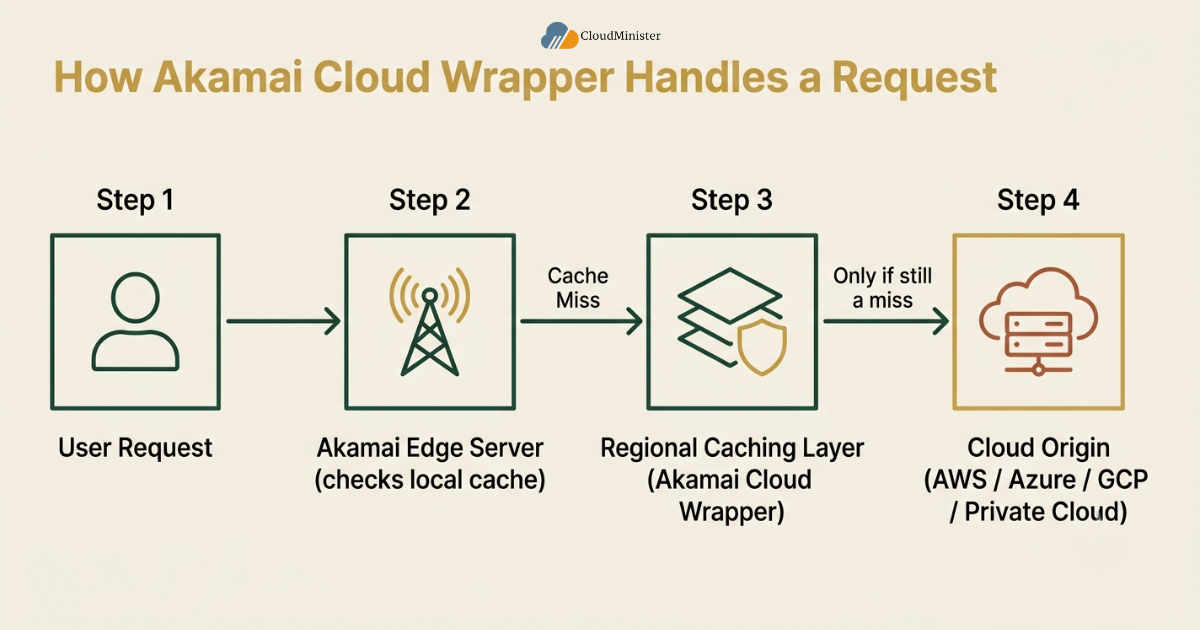
2.1 Request Flow
- A user requests content that is not already cached at the Akamai edge server nearest them
- Instead of routing that cache miss straight to your cloud origin, the request is routed to your assigned regional caching layer
- If the content exists in that cache, it is served from there, and your origin is never contacted for that request
- Only if the content is missing from both the edge and that caching layer does the request finally reach your origin
2.2 Footprint and Capacity
Every deployment is sized around a footprint analysis, a pre-onboarding assessment of your content patterns that determines how much cache space and how many regional locations your configuration needs. This is not a fixed, one-size-fits-all allocation. Capacity is matched to your actual traffic footprint, so smaller Indian businesses are not paying for infrastructure scaled for global media giants.
2.3 High Availability and Redundancy
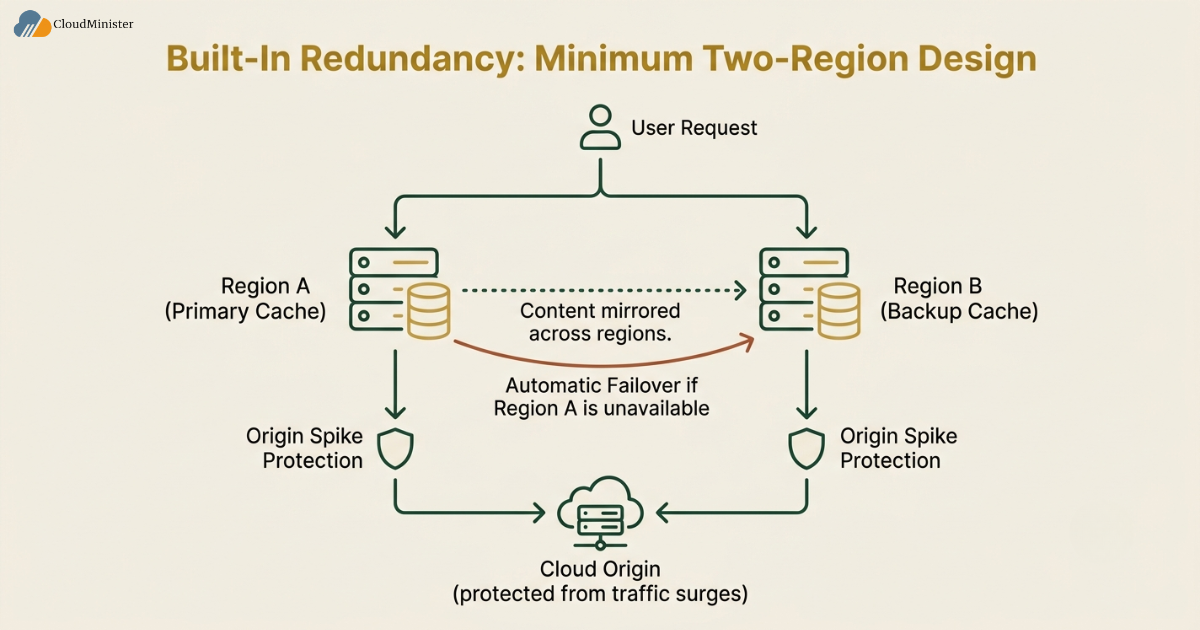
- Content is stored in a minimum of two independent regions by design
- If one region becomes unavailable, requests are automatically rerouted to a backup region before falling back to origin
- Origin spike protection prevents sudden traffic surges from overwhelming your cloud origin, which can otherwise resemble a denial-of-service event
- Request collapsing reduces redundant simultaneous requests to origin during high-demand events such as product launches or live streams
2.4 Small Object and Web Asset Support
Early implementations of this service were optimised primarily for large media files. Akamai has since re-architected the caching layer to handle small objects such as web assets, API responses, and product images at much higher volume, with a separate deployment tier tuned specifically for high-object-count, low-file-size workloads. This matters directly for e-commerce and SaaS businesses running Affordable Cloud Hosting India deployments with thousands of small, frequently requested assets.
EXPERT NOTE
Cache eviction inside the caching layer is governed by idle time to live settings that vary by traffic preference. Content optimised for low latency, such as live streaming assets, is treated differently from redundant static content like website images or downloadable files. Understanding this distinction is essential when configuring cache retention for your specific workload.
3. Why Cloud Egress Costs Are Rising in 2026
Before evaluating this solution, it helps to understand why egress costs have become such a persistent problem for businesses hosting on public cloud infrastructure. Per-gigabyte egress pricing from major hyperscalers has stayed largely flat for years, but the volume of data leaving cloud origins has grown substantially faster than most infrastructure budgets anticipated.
- Real-time features, API-driven applications, and microservices architectures generate far more outbound traffic per user session than traditional websites
- Global user bases mean content is requested from regions far from a centralised cloud origin, increasing both latency and data transfer volume
- Media-rich content, high-resolution product imagery, and video are now standard even for small and mid-sized business websites
- Without an intermediary caching layer, every one of these requests can result in a direct, billable trip to your cloud origin
A separate 2026 analysis of enterprise cloud environments found that data transfer and egress waste alone can represent 15 to 20 percent of total cloud spend, much of it originating from cache misses, inefficient cross-region replication, and monitoring pipelines that were never optimised after initial deployment. This is exactly the category of spend that Akamai Cloud Wrapper is designed to reduce, by maximising the share of requests served from Akamai’s network instead of your billable origin.
Related Reading: Akamai Cloud Services Explained
4. Key Benefits of Akamai Cloud Wrapper for Businesses
4.1 Reduced Cloud Egress Costs
- Fewer requests reaching your cloud origin directly translates into lower per-gigabyte egress billing
- Offload rates in well-configured Akamai Cloud Wrapper deployments can exceed 99 percent for cacheable content, according to Akamai’s own product documentation
- Predictable monthly hosting costs, since traffic spikes are absorbed by the caching layer rather than passed through to origin billing
4.2 Performance Consistency Under Load
- Origin spike protection prevents traffic surges from degrading application performance during high-demand events
- Multi-region redundancy ensures content remains available even if one caching region experiences an outage
- Request collapsing reduces duplicate origin calls, keeping response times consistent for every user
4.3 Compatibility With Existing Cloud Infrastructure
Akamai Cloud Wrapper connects to both private and public cloud platforms without requiring a migration away from your existing provider. Businesses already running Akamai Cloud Hosting or a hybrid setup involving a can add this caching layer on top of their current archite Web Hosting Company in India cture rather than rebuilding it.
4.4 Multi-CDN Flexibility
- Supports configurations where third-party CDNs can access the same shared cache space
- Useful for businesses running multi-CDN strategies for redundancy or regional performance optimisation
- Reduces the need to duplicate cached content across multiple delivery networks separately
Data cached through this service is stored across multiple independent regions with authenticated access controls for multi-CDN configurations. Businesses handling regulated customer data should still confirm data residency requirements with their account team, and review how DPDPA 2023 obligations around consent, purpose limitation, and data processing apply to cached personal data.
Ready to Reduce Your Cloud Egress Costs?
Pair Akamai Cloud Wrapper with high-performance Akamai Cloud Hosting from CloudMinister to cut origin costs while keeping your applications fast and reliable.
5. When Should You Implement Akamai Cloud Wrapper?
Akamai Cloud Wrapper is not the correct fit for every workload. It delivers the strongest return for businesses with specific traffic characteristics. Use this section to assess whether your infrastructure is ready for it.
5.1 Good Fit Scenarios
- High-traffic websites or applications with a large volume of repeat content requests, such as e-commerce catalogues or media libraries
- Businesses experiencing unpredictable or rapidly rising egress charges on their current cloud hosting invoice
- Live streaming, video-on-demand, or large file download services where origin spikes are a recurring operational risk
- Organisations already using Akamai’s Adaptive Media Delivery, Ion, Download Delivery, or Object Delivery products
- Businesses running a multi-region or multi-cloud setup where origin consolidation is not practical
5.2 Scenarios Where It May Not Be Necessary
- Very low-traffic websites where origin requests are already infrequent and inexpensive
- Static sites with minimal dynamic content that are already served efficiently by a standard CDN
- Early-stage projects still validating product-market fit before optimising infrastructure spend
Related Reading: what a Linode server is and why it works for growing businesses
6. Implementation Roadmap – Adding Akamai Cloud Wrapper to Your Stack
Phase 1: Traffic and Cost Audit (Week 1)
- Pull your last 90 days of cloud billing data and isolate the data transfer and egress line items specifically
- Identify which applications, regions, or content types are generating the highest egress volume
- Confirm your current cache hit ratio at the edge to establish a baseline before adding Akamai Cloud Wrapper
Phase 2: Footprint Analysis (Week 2)
- Work with your Akamai account team to complete a footprint analysis based on your actual content and traffic patterns
- Determine the appropriate cache capacity and number of regional locations for your Akamai Cloud Wrapper configuration
- Decide whether your workload is primarily media-based, web-asset based, or a mix of both, since deployment tiers differ
Phase 3: Configuration and Property Setup (Weeks 3–4)
- Create or update your delivery configuration to include the origin behaviour Akamai Cloud Wrapper relies on to move content from origin to its caching layer
- Add the Akamai Cloud Wrapper behaviour to your property using Akamai’s Property Manager
- Confirm compatibility, since properties using SureRoute or SiteShield behaviours cannot run Akamai Cloud Wrapper simultaneously
Phase 4: Testing and Validation (Weeks 4–6)
- Validate cache hit rates within the Akamai Cloud Wrapper layer before routing full production traffic through it
- Run a controlled traffic spike test to confirm origin spike protection is functioning as expected
- Compare egress billing before and after activation to quantify the actual cost reduction
Phase 5: Monitoring and Optimisation (Ongoing)
- Track offload percentage regularly, since Akamai reports well-configured deployments can exceed 99 percent offload for cacheable content
- Adjust idle time to live settings if content is being evicted from cache more aggressively than expected
- Review your Akamai Cloud Wrapper configuration quarterly alongside your broader Affordable Cloud Hosting India strategy to ensure capacity still matches traffic growth
PRO TIP
Businesses migrating an existing website onto Akamai infrastructure should sequence this work carefully. Complete your origin migration first, validate stability, and only then layer Akamai Cloud Wrapper on top. Our step-by-step guide on migrating a website to Akamai Cloud Hosting covers the migration groundwork this caching layer depends on.
Related Reading: Migrating Your Website to Akamai Cloud Hosting.
7. Cost Impact – What Businesses Actually Save
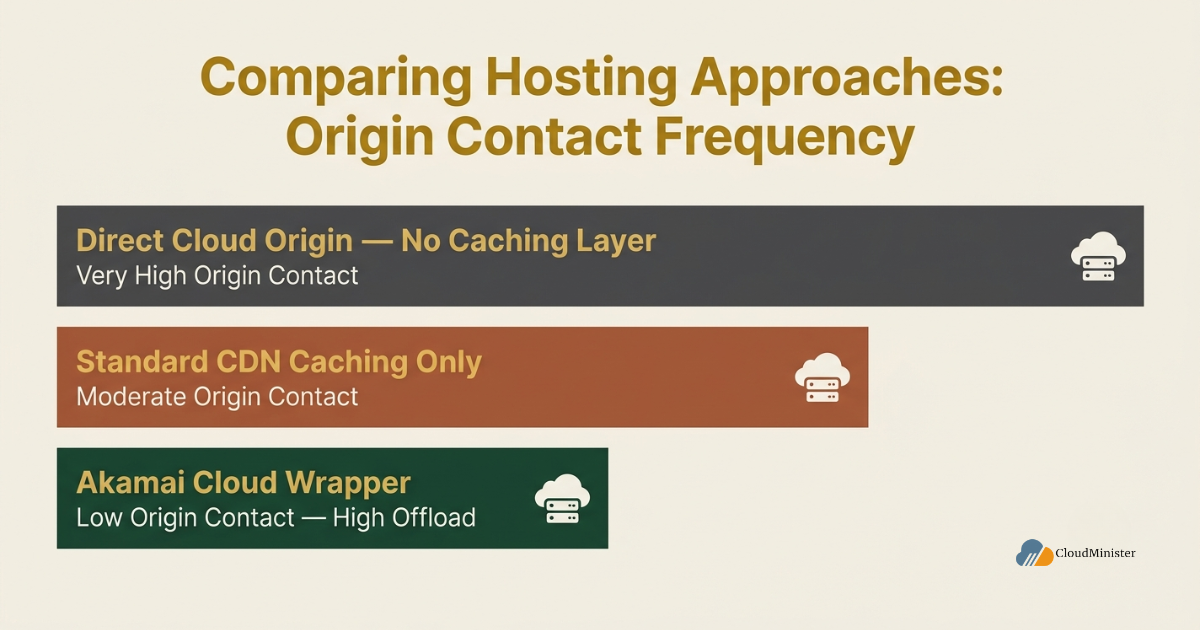
The financial case for Akamai Cloud Wrapper comes down to how much of your traffic is currently generating direct, billable origin requests versus how much could be served from a caching layer instead. The table below illustrates the general cost structure businesses evaluate when comparing hosting approaches.
| Hosting Approach | Origin Contact Frequency | Egress Cost Exposure | Best Suited For |
| Direct cloud origin, no caching layer | Very high | High and unpredictable | Low-traffic static sites only |
| Standard CDN caching only | Moderate | Moderate | General websites with steady traffic |
| Akamai Cloud Wrapper | Low (offload can exceed 99%) | Significantly reduced | High-traffic, media-heavy, or e-commerce workloads |
| Multi-CDN with Akamai Cloud Wrapper shared cache | Very low | Lowest, with redundancy | Large-scale streaming and download services |
These savings compound with scale. A business serving a large product catalogue or media library across a distributed user base sees a proportionally larger benefit from Akamai Cloud Wrapper than a small brochure website with minimal repeat traffic. This is consistent with wider 2026 industry data showing that cloud waste, much of it tied to data transfer and inefficient caching, remains one of the largest recoverable cost categories across enterprise cloud environments.
8. Akamai Cloud Wrapper for Indian Businesses – Regional Considerations
Indian businesses face a specific version of the egress cost problem. A large share of Indian internet users are outside major metro data centre regions, which means content served from a centralised origin has to travel further, generating both latency and additional data transfer cost. Pairing Akamai Cloud Wrapper with infrastructure from a Web Hosting Company in India that already has strong domestic peering and edge presence closes that distance gap efficiently.
- Reduced latency for users outside metro regions, since cached content is served closer to the request origin
- Lower dependency on a single centralised cloud region for every request across the country
- Better resilience during high-demand periods such as festival sales, exam result days, or ticket launches, which regularly produce traffic spikes on Indian platforms
- Cost predictability that supports INR-denominated budgeting instead of exposure to USD-based egress billing volatility
Related Reading: multi-cloud strategy for Indian SMBs
SECURITY NOTE
Indian businesses processing customer personal data through cached content must still map their Akamai Cloud Wrapper configuration against DPDPA 2023 obligations. Confirm with your Akamai account team and your Web Hosting Company in India partner which regions your cache footprint spans, and ensure customer-identifiable data is not being cached beyond what your privacy policy discloses.
9. Akamai Cloud Wrapper vs Standard CDN Caching vs No Caching Layer
It helps to place Akamai Cloud Wrapper next to the two most common alternatives businesses are already running, so the decision is grounded in a direct comparison rather than marketing claims.
9.1 No Caching Layer
- Every cache miss and every dynamic request travels directly to your cloud origin
- Egress costs scale linearly, and sometimes faster, with traffic growth
- Traffic spikes carry real risk of origin overload, resembling a denial-of-service scenario
9.2 Standard CDN Caching Only
- Reduces some origin contact, but cache misses at the edge still go straight to origin
- No intermediary shielding layer to absorb the volume of misses during high-demand events
- Offload rates are typically lower than a dedicated caching layer purpose-built for this problem
9.3 Akamai Cloud Wrapper
- Adds a dedicated regional caching layer between the edge and your origin
- Captures a large share of cache misses before they ever reach origin, which is where the cost and performance gains come from
- Includes built-in redundancy, origin spike protection, and request collapsing as standard architecture, not optional add-ons
For businesses already committed to Akamai Cloud Hosting as their delivery platform, adding Akamai Cloud Wrapper is a natural next step rather than a separate infrastructure decision. It builds directly on top of properties you have likely already configured for content delivery.
10. Readiness Checklist Before You Implement Akamai Cloud Wrapper
- Egress and data transfer costs identified as a specific, isolated line item in your current cloud billing
- Traffic patterns reviewed to confirm a meaningful share of requests are repeat or cacheable content
- Existing Akamai delivery configuration in place, or a plan to set one up as part of this project
- Confirmation that your properties do not rely on SureRoute or SiteShield behaviours that conflict with Akamai Cloud Wrapper
- Footprint analysis scheduled with your Akamai account team to size cache capacity correctly
- DPDPA 2023 compliance obligations reviewed if customer personal data is part of cached content
- Monitoring plan in place to track offload percentage and egress cost reduction after go-live
PRO TIP
Run this checklist before signing any contract extension or capacity commitment for Akamai Cloud Wrapper. The most common mistake businesses make is provisioning cache capacity based on projected traffic rather than a validated footprint analysis, which either underuses the investment or creates capacity gaps during real traffic spikes.
11. Common Mistakes Businesses Make With Akamai Cloud Wrapper
- Treating Akamai Cloud Wrapper as a plug-and-play switch instead of a configuration that depends on an accurate footprint analysis
- Skipping the traffic audit step and provisioning cache capacity based on guesswork rather than actual data
- Leaving SureRoute or SiteShield behaviours active on a property, which prevents Akamai Cloud Wrapper from functioning correctly
- Failing to monitor offload percentage after go-live, which makes it difficult to prove the cost reduction to stakeholders
- Overlooking DPDPA 2023 compliance obligations when customer personal data flows through cached content
Avoiding these mistakes is largely a matter of sequencing the rollout correctly and treating Akamai Cloud Wrapper as an ongoing configuration rather than a one-time setup. Businesses that pair this discipline with dependable cloud hosting in India infrastructure tend to see the most consistent, long-term cost reduction.
12. Choosing the Right Partner for Akamai Cloud Wrapper Implementation
Implementing Akamai Cloud Wrapper correctly requires coordination between your Akamai account team, your internal engineering team, and whichever Web Hosting Company in India is hosting your origin infrastructure. Misalignment between these three parties is the most common reason implementations underperform their projected savings.
- Confirm your hosting partner understands how to configure origin behaviour for Akamai Cloud Wrapper
- Ask whether your provider has direct experience with Akamai Cloud Hosting configurations, not just general CDN setup
- Verify your provider can support Affordable Cloud Hosting India alongside advanced caching without compromising India data residency
- Request a clear rollout timeline that separates footprint analysis, configuration, testing, and monitoring as distinct phases
A hosting partner that already understands cloud hosting in India nuances, including regional peering, DPDPA 2023 compliance, and INR-based cost predictability, will implement Akamai Cloud Wrapper faster and with fewer configuration errors than a generalist provider unfamiliar with the Indian market.
Key Takeaways
- Akamai Cloud Wrapper reduces cloud egress costs by absorbing cache misses at a dedicated regional layer before they reach your cloud origin
- Offload rates in well-configured deployments can exceed 99 percent, directly lowering billable origin traffic
- Built-in redundancy, origin spike protection, and request collapsing protect performance during high-traffic events
- It works across private and public cloud origins, making it compatible with multi-cloud strategies common among Indian businesses
- Pairing it with a reliable Web Hosting Company in India and Affordable Cloud Hosting India infrastructure closes the latency gap for users outside metro regions
- Implementation should follow a structured roadmap: audit, footprint analysis, configuration, testing, and ongoing monitoring
Conclusion
Akamai Cloud Wrapper addresses a cost problem that most businesses only notice after their cloud bill has already grown uncomfortably large. By introducing a dedicated caching layer between your origin and Akamai’s edge network, it reduces the volume of billable requests reaching your cloud infrastructure while simultaneously improving performance consistency during traffic spikes. For Indian businesses balancing global-standard performance expectations against real budget constraints, this combination of cost control and reliability is exactly what a modern hosting strategy needs.
If your business is evaluating Akamai Cloud Wrapper alongside a broader infrastructure upgrade, CloudMinister works with businesses across India to plan and implement Akamai Cloud Hosting Services alongside dependable, India-based hosting infrastructure. As a Web Hosting Company in India with direct experience configuring Akamai Cloud Hosting delivery products, we help you move from a reactive cloud bill to a predictable, performance-first hosting strategy.
13. Building a Long-Term Cost Strategy Around Akamai Cloud Wrapper
Cost optimisation is not a one-time project. Businesses that treat Akamai Cloud Wrapper as part of an ongoing infrastructure strategy, rather than a single configuration change, see compounding benefits as their traffic grows. This means revisiting your footprint analysis periodically, tracking offload trends, and keeping your broader hosting relationship aligned with your caching strategy.
- Review your Akamai Cloud Hosting Services agreement annually to confirm capacity still matches your current traffic profile
- Keep your Web Hosting Company in India partner informed of major traffic events so origin infrastructure and Akamai Cloud Wrapper capacity scale together
- Reassess whether Affordable Cloud Hosting India tiers still meet your compute needs as your analytics and caching workloads mature
- Benchmark your Akamai Cloud Hosting configuration against evolving traffic patterns at least twice a year
- Track how cloud hosting in India infrastructure choices affect your overall latency and cost profile as your user base expands regionally
Businesses that combine Akamai Cloud Wrapper with a long-term relationship with a capable Web Hosting Company in India consistently report more predictable budgeting than those treating hosting and caching as separate, disconnected purchases. A unified strategy across Akamai Cloud Hosting Services, Affordable Cloud Hosting India, Akamai Cloud Hosting, and cloud hosting in India decisions produces measurably better outcomes than optimising each in isolation.
For most Indian businesses, the practical starting point is a combination of Affordable Cloud Hosting India for origin infrastructure, Akamai Cloud Hosting Services for delivery and caching, and a documented cloud hosting in India data residency plan that satisfies DPDPA 2023 requirements. Akamai Cloud Wrapper then sits on top of this foundation as the layer that keeps egress costs under control as traffic scales.
Teams that get this sequencing right typically see Akamai Cloud Hosting and Akamai Cloud Wrapper working together smoothly within the first billing cycle, with Web Hosting Company in India support handling the operational details that would otherwise slow down a self-managed rollout.
In summary, Affordable Cloud Hosting India gives you the origin foundation, Akamai Cloud Hosting Services gives you delivery and edge presence, and cloud hosting in India awareness keeps you compliant, while Akamai Cloud Wrapper ties all three together into a single cost-efficient, performance-consistent hosting strategy.
14. Infrastructure Glossary – Terms Used in This Guide
The following quick-reference glossary explains the recurring infrastructure terms used throughout this guide, useful if you are sharing this document with a non-technical stakeholder or procurement team.
- Akamai Cloud Hosting Services refers to the delivery, caching, and edge configuration Akamai provides on top of your origin infrastructure
- Web Hosting Company in India refers to a provider offering domestic data centre presence, peering, and support for Indian businesses
- Affordable Cloud Hosting India refers to origin hosting priced for SME and growth-stage budgets, typically on VPS or dedicated tiers
- Akamai Cloud Hosting is used interchangeably with delivery and caching services configured through Akamai’s platform
- cloud hosting in India refers broadly to hosting infrastructure with data centres or edge presence located within India
When teams discuss Akamai Cloud Hosting Services, they are usually referring to the combination of edge delivery, caching behaviours, and origin shielding that Akamai configures on a property. Web Hosting Company in India decisions, by contrast, are about where your origin server itself physically sits and who manages it. Affordable Cloud Hosting India is the budget-conscious version of that origin decision, suited to SMEs that do not yet need enterprise-scale compute.
It helps to keep these terms distinct during planning conversations. Akamai Cloud Hosting configurations sit on top of your origin, while cloud hosting in India decisions determine where that origin physically lives. Confusing the two often leads to budgeting for the wrong line item when a Web Hosting Company in India partner proposes a hosting upgrade.
A typical Indian SME procurement conversation touches all five terms in sequence: starting with Affordable Cloud Hosting India for baseline origin cost, moving to Akamai Cloud Hosting Services for performance and caching, referencing Akamai Cloud Hosting as the umbrella term for that delivery layer, confirming cloud hosting in India for compliance and latency reasons, and finally evaluating Web Hosting Company in India options that can support all of the above under one contract.
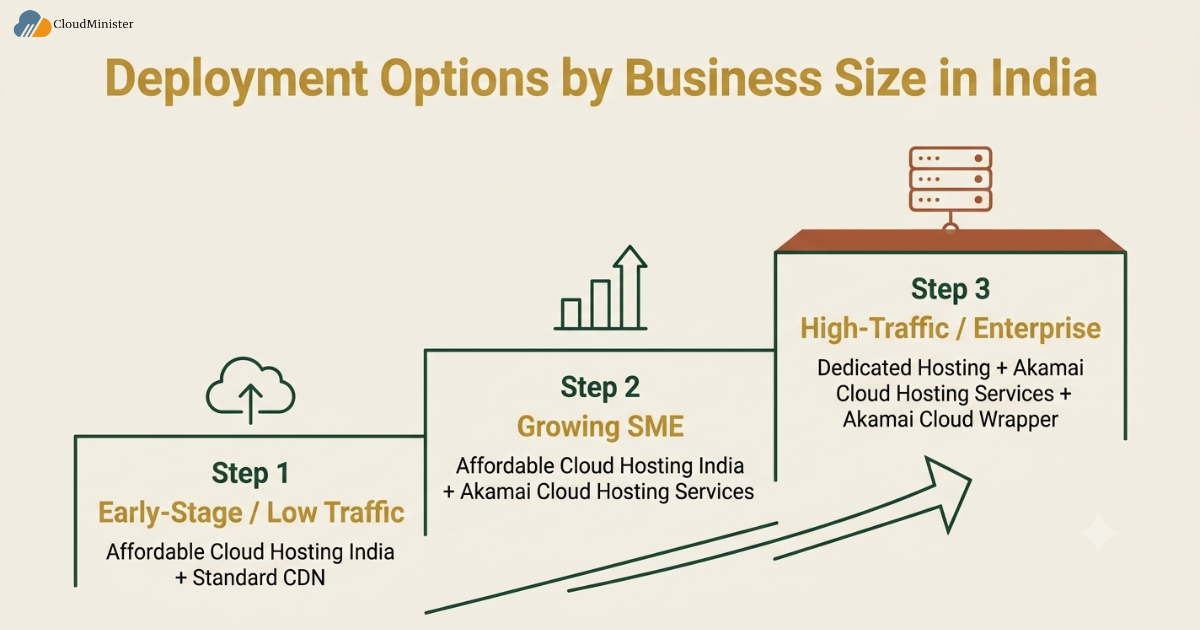
15. Deployment Options by Business Size in India
Different stages of business growth call for different combinations of origin hosting, delivery, and caching. The matrix below outlines a general pattern seen across Indian businesses adopting Akamai Cloud Hosting Services alongside their existing infrastructure.
| Business Stage | Origin Hosting | Delivery Layer | Data Residency Focus |
| Early-stage / low traffic | Affordable Cloud Hosting India | Standard CDN only | cloud hosting in India |
| Growing SME | Affordable Cloud Hosting India | Akamai Cloud Hosting Services | cloud hosting in India |
| High-traffic / enterprise | Web Hosting Company in India (dedicated) | Akamai Cloud Hosting Services + Akamai Cloud Wrapper | cloud hosting in India |
Early-stage businesses typically start with Affordable Cloud Hosting India and a standard CDN, which keeps costs low while traffic is still building. As traffic grows, most teams add Akamai Cloud Hosting Services for better delivery and caching performance. At the high-traffic stage, Akamai Cloud Wrapper becomes the differentiator, sitting on top of Akamai Cloud Hosting Services to control egress costs that would otherwise scale unpredictably.
Throughout every stage, cloud hosting in India considerations remain constant: businesses need confirmation that their Web Hosting Company in India partner supports DPDPA 2023 obligations regardless of which delivery layer sits on top of the origin. This is true whether you are running Affordable Cloud Hosting India for a small catalogue site or a full Akamai Cloud Hosting Services deployment for a national e-commerce platform.
A useful way to think about this progression: Affordable Cloud Hosting India answers where your data lives, Akamai Cloud Hosting Services answers how fast it reaches users, and Akamai Cloud Wrapper answers how much that speed costs you at scale. cloud hosting in India ties the first two together from a compliance standpoint, while Akamai Cloud Hosting is simply the broader term covering the delivery and caching work Akamai performs on your behalf.
Businesses working with a Web Hosting Company in India that offers both Affordable Cloud Hosting India and Akamai Cloud Hosting Services under one relationship typically move through these stages with fewer migration headaches than those juggling separate vendors for origin, delivery, and cloud hosting in India compliance.
Not Sure If Akamai Cloud Wrapper Fits Your Stack?
Talk to our team for a free consultation on your egress costs, footprint analysis, and implementation roadmap.
16. Final Notes Before You Start
Before finalising any contract, confirm three things with your provider: whether your Web Hosting Company in India plan includes support for Akamai Cloud Hosting Services, whether your Affordable Cloud Hosting India tier has enough headroom for growth, and whether your cloud hosting in India residency plan is documented in writing. These three checks prevent most of the implementation delays businesses run into.
- Confirm hosting support for Akamai property configuration
- Validate Affordable Cloud Hosting India capacity against 12-month traffic projections
- Document cloud hosting in India residency commitments in your service agreement
- Request a written SLA covering Akamai Cloud Hosting Services uptime and support response times
- Ask for a sample Akamai Cloud Hosting configuration report from a comparable existing client
- Confirm your Affordable Cloud Hosting India plan scales without a forced migration mid-contract
- Verify cloud hosting in India support extends to backup and disaster recovery regions
Businesses that complete this final checklist before signing tend to have smoother onboarding and fewer surprises once Akamai Cloud Hosting Services and cloud hosting in India configurations go live in production. It is a small amount of upfront diligence that pays for itself many times over across the lifetime of the hosting relationship.
As a final summary, Akamai Cloud Hosting Services and Akamai Cloud Hosting configurations work best when they are planned alongside your origin decisions rather than bolted on afterward. Whether you choose Akamai Cloud Hosting Services through a full-service partner or configure Akamai Cloud Hosting independently with your own engineering team, the underlying principle stays the same: caching decisions and origin decisions should be planned together, not separately. This holds true whether your origin runs on Affordable Cloud Hosting India or a larger dedicated tier, and whether your cloud hosting in India plan covers one region or several.
Ultimately, businesses evaluating cloud hosting in India options alongside Akamai Cloud Hosting and Akamai Cloud Hosting Services should treat all three as interconnected parts of one hosting strategy, not three separate procurement decisions made in isolation. A dependable cloud hosting in India foundation paired with a well-tuned Akamai Cloud Hosting configuration is what ultimately keeps both performance and cost predictable over time.
Frequently Asked Questions
What is Akamai Cloud Wrapper used for?
Akamai Cloud Wrapper is used to reduce cloud egress costs and improve origin performance by caching content in a dedicated regional layer between Akamai’s edge network and your cloud origin, cutting down how often your origin infrastructure is directly contacted.
Does Akamai Cloud Wrapper work with any cloud provider?
Yes. Akamai Cloud Wrapper connects to both private and public cloud platforms, which means it can be configured alongside AWS, Azure, Google Cloud, or a private cloud deployment without requiring a migration to a single provider.
How much can businesses save with Akamai Cloud Wrapper?
Savings depend on your traffic profile and how much of your content is cacheable, but Akamai reports offload rates exceeding 99 percent in well-configured deployments, which translates directly into reduced origin egress billing. Businesses with high-traffic, media-heavy, or e-commerce workloads typically see the largest impact from Akamai Cloud Wrapper.
Is Akamai Cloud Wrapper suitable for small businesses in India?
It is most cost-effective for businesses with meaningful traffic volume and a real egress cost problem. Very early-stage or low-traffic websites may be better served by standard Affordable Cloud Hosting India and CDN caching until traffic grows to a point where Akamai Cloud Wrapper delivers a clear return on the investment.
How does Akamai Cloud Wrapper differ from a standard CDN?
A standard CDN caches content at the edge, close to end users, but cache misses still travel directly to your origin. Akamai Cloud Wrapper adds an additional dedicated caching layer that intercepts those misses first, meaning far fewer requests actually reach your billable cloud origin.
Does Akamai Cloud Wrapper support Indian data residency requirements?
Cache regions and footprint mapping are configured with your Akamai account team, and Indian businesses should confirm this mapping against DPDPA 2023 obligations. Working with a Web Hosting Company in India that understands both Akamai Cloud Hosting and Indian compliance requirements makes this significantly easier to get right the first time.

Pritam Kumar is a DevOps Engineer at CloudMinister Technologies, where he manages a multi-datacenter fleet of 100+ servers and architects end-to-end CI/CD pipelines and infrastructure automation using Kubernetes, Terraform, and Ansible. He holds an AWS Certified DevOps Engineer Professional certification and has served as a Google Cloud Mentor, reflecting both hands-on cloud expertise and a track record of mentoring others in the field. His work spans disaster recovery architecture, security incident response, and hosting infrastructure across Proxmox, cPanel/WHM, and Linux systems. Notably, Pritam led the design of Cloud Kavach, a self-hosted DC/DR SaaS portal, and directed remediation efforts for large-scale hosting security incidents involving webshells and command-and-control malware. He brings this depth of real-world infrastructure and security experience to the technical content he writes.
Related posts:
 Pay-As-You-Go Cloud Hosting with Akamai: A Complete 2026 Guide
 The Role of CDN in Akamai Cloud Hosting for Faster Website Loading: A Complete 2026 Guide
 What Is Linode (Now Akamai Cloud)? Why It is Still Perfect for Business Applications in 2026
 Akamai Inference Cloud: A New Era for AI Acceleration at the Edge (2026)
