If you’ve been researching Linode — now rebranded as Akamai Cloud Computing — you’re looking at one of the most developer-friendly and cost-effective cloud platforms available today. Having managed Akamai Cloud (formerly Linode) servers for clients across industries, the CloudMinister team has hands-on experience with its capabilities and limitations. In this guide, we break down exactly what this platform offers, how it compares to alternatives, and whether it’s the right fit for your business in 2026.
Originally launched as Linode in 2003, the platform is now known as Akamai Cloud Computing — a major player in cloud infrastructure that offers Linux-powered machines capable of handling all types of business applications.
Since its inception in 2003, it has grown in popularity and active users. It serves millions of customers worldwide through 41 core compute regions across 36 cities globally, including locations in the US, Europe, Asia, India, South America, and Australia — making it one of the most distributed cloud platforms available today.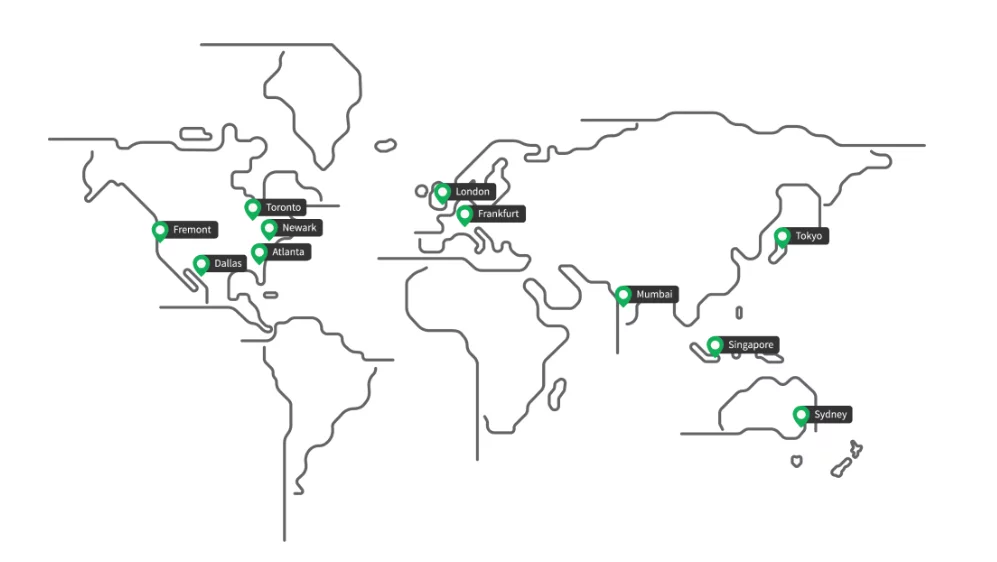
Source: www.linode.com
So, what makes Linode stand out? Or why should businesses should even consider it?
The primary benefits of using it are its great networking and easy-to-use control panel. This means you can set up and manage your server without needing to be a tech genius.
The other best thing about Linode is that it gives you full control over your server. You can customize things to fit exactly what your business needs. Hence, businesses of any size can use these servers as per their requirement.
With all these features, it’s no wonder Linode has become one of the biggest cloud service providers out there.
Whether you’re running a small website or a big business application, Linode has options that can work for you.
Some Background of Linode Server
Linode has an interesting history that shows how it’s grown over the years. Christopher Aker founded the company in 2003 at a time when cloud computing was still an emerging concept.
In 2008, they set up their headquarters in Galloway, New Jersey. But they didn’t stay there forever. In 2018, they moved again, this time to Philadelphia, Pennsylvania.
Linode hasn’t just changed locations, it’s also changed how it works under the hood. When it started, it used a system called UML. But in March 2008, they switched to Xen Virtualization.
This was a big step up from what they were already doing. Then, in 2015, they made another big change and started using KVM-based virtualization. Each of these changes helped Linode offer better service to its customers.
A defining moment came in 2022, when Akamai Technologies acquired the platform for approximately $900 million. Then in February 2023, Akamai completed the full rebrand, renaming it Akamai Cloud Computing (Akamai Connected Cloud) — integrating cloud compute, CDN, and security under one roof.
All these changes over the years have helped Linode grow from a small startup to the major cloud provider it is today. They’ve always tried to keep up with new technology to give their users the best service possible.
What’s New — Akamai Cloud Computing in 2026
Since the rebrand in 2023, Akamai Cloud has expanded significantly. Here’s what’s changed and why it matters for your business:
• Massive global expansion: The platform has grown from 11 original Linode data centres to 41 core compute regions across 36 cities globally, including new locations in India, Brazil, Indonesia, Japan, the Netherlands, Italy, and more.
• CDN + Cloud integration: Akamai’s world-class CDN is now natively integrated with cloud compute, meaning your applications benefit from faster content delivery and lower latency — something standalone Linode never offered.
• Enterprise-grade compliance: ISO, SOC2, and HIPAA compliance standards are now available on the platform, opening it up to regulated industries.
• More affordable egress: Akamai has introduced CDN-like economics for cloud data transfer, significantly reducing egress costs compared to AWS, Azure, or Google Cloud.
Features That Help Boost Business Applications
Security
Security is the most concerning thing a business application can have. Linode understandably offers strong security measures and helps to keep the data intact and safe.
Linode’s security features are great for users who might not know a lot about setting up Linux servers. They make it easy to keep your applications secure without needing to be a tech genius.
One important security feature is two-factor authentication. This is something big cloud providers like AWS use, and Linode offers it too thereby adding one extra layer of protection to your account.
It has additional security that can stop people from misusing login information. This helps secure the account even if someone has the password.
Akamai Cloud Computing supports IPv6, ensuring your infrastructure is future-ready and compatible with modern networking standards across its globally distributed regions.
Akamai Technologies fully owns and operates the platform — from the physical infrastructure to the software layer — providing enterprise-grade security for both compute and storage. This means they can offer really good security for both the computers and the data storage.
They’ve teamed up with a company called HackerOne to find and fix security problems. They even pay security experts who find weak spots in their systems. This helps keep Linode secure now and makes them future readily available.
User-Friendly Interface
Whether you’re an expert or just starting, you’ll find it simple to manage your resources.
It lets you create, manage, and scale virtual machines without any hassle. This means you can focus on running your business instead of wrestling with complicated controls.
Gives you different ways to interact with your account. You can use the Cloud Manager, which is a graphical interface that’s easy to understand. If you prefer typing commands, there’s also a Command Line Interface (CLI). For developers who want to automate tasks, Linode offers an API too.
A handy new feature is mobile access. If you have member access, you can now check your dashboard right from your smartphone. This is great for keeping an eye on things when you’re away from your desktop.
Performance & Uptime
Linode shines in both these areas, with the use of advanced technology to keep its services running smoothly.
They have backup systems in place, which means if one part fails, another takes over. This helps ensure that your applications stay up and running.
The performance Linode offers has made it a favourite among businesses. Your applications can run fast and efficiently, which is important for keeping customers happy.
One of the platform’s standout features is the NodeBalancer — Akamai Cloud’s built-in load balancer that lets you manage and distribute traffic across multiple server instances, ensuring everything runs smoothly even during peak demand. And thus making sure everything flows smoothly even when a lot is going on.
Perhaps most impressively, Linode gets you a 99.99% uptime. This means your applications are almost always available.
For businesses, this reliability is crucial, any loss in uptime is a heavy loss of business. However, with Linode, rest assured that your customers can access your services whenever they need to.
With these advantages, if you are going to pick a Linode server for your business you are on the right path. However, as a business owner, you cannot refrain from only looking at one server.
In the next section, we have compared Linode with some of the other players in the market.
How Does Akamai Cloud (Formerly Linode) Compare to Google Cloud in 2026?
The competitive landscape has shifted since Akamai’s acquisition. Here is a current breakdown of how Akamai Cloud stacks up against Google Cloud for business users in 2026:
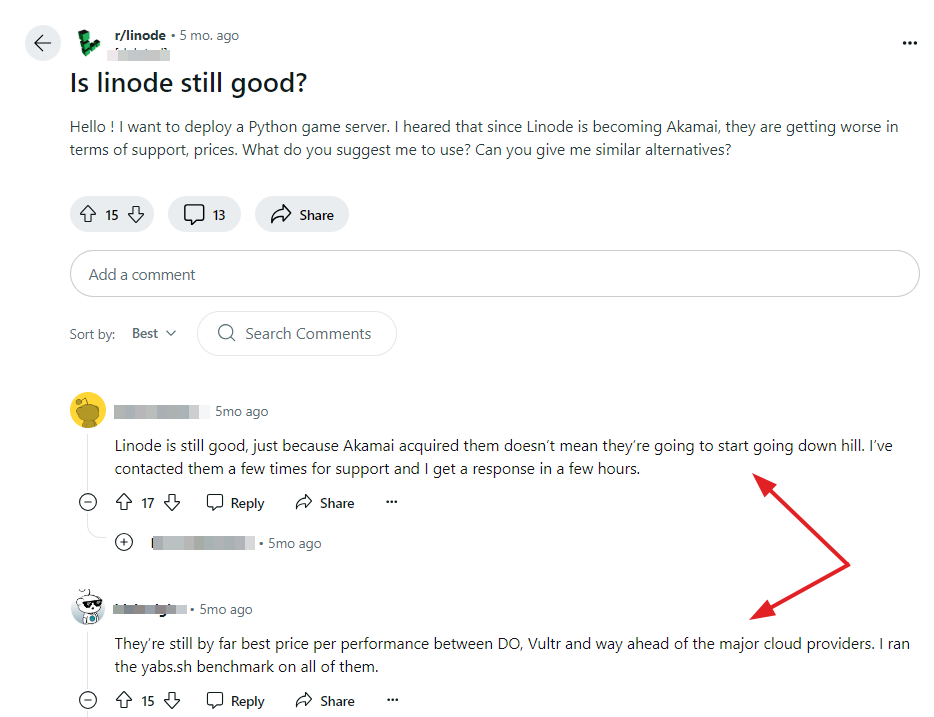
(A Reddit Thread on Linode Performance)
When choosing a cloud provider, it’s important to understand how different options stack up. Let’s compare Linode with Google Cloud, one of the major players in the industry.
Technology: Today, most major cloud services, including both Linode and Google Cloud, use KVM technology for virtualization. However, each provider has its way of managing these systems, which can affect how you interact with their services.
Backup and Recovery: One advantage Linode offers is daily backups. This means you can restore your system to a previous state if anything goes wrong.
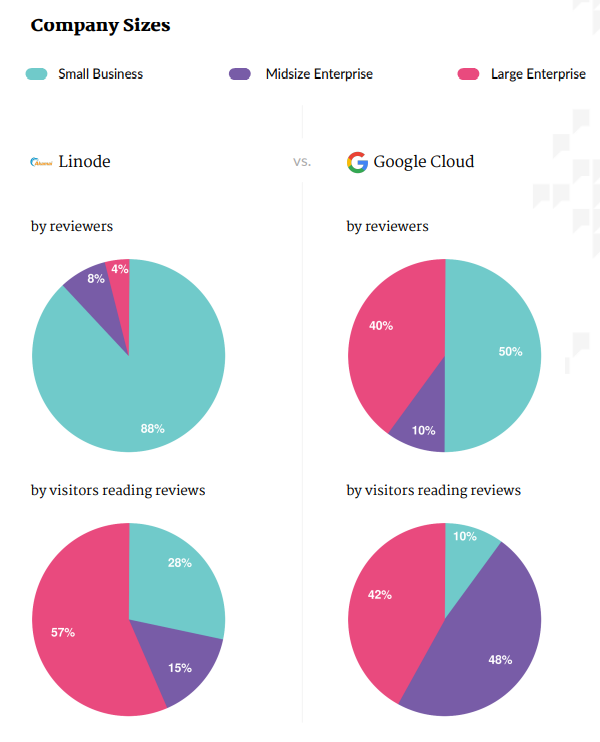
Target Market: Linode is often chosen by small to medium-sized businesses due to its cost-effectiveness. If you’re running a small business or a startup, Linode could be a great fit. It offers the power you need without the complexity or cost of some larger providers.
Peerspot conducted a study wherein they found that small to mid-size enterprises use more of the Linode servers compared to large enterprises.
Performance and Cost: Linode is known for offering good performance at competitive prices. This balance of power and affordability makes it attractive to businesses that need reliable service but also need to watch their budget.
Scalability: While Google Cloud might offer more options for very large businesses, Linode provides plenty of room for growth. Its features, like the NodeBalancer, allow you to manage multiple servers as your needs increase.
Why Do You Need A Hosting Partner to Manage Your Linode Server?
While Linode offers powerful and flexible cloud hosting, managing a Linux server can be challenging, even for tech-savvy users.
Partnering with a hosting expert can be beneficial for several reasons. Linux isn’t always user-friendly, and even if you’re proficient with it, updating or patching software requires extra caution to avoid server issues.
When installing applications like WordPress, careful checking is necessary to ensure server software matches app requirements, preventing performance problems.
Server management tasks are often tedious and time-consuming, especially if it’s not your daily job.
This can take valuable time away from other important business activities. Security is another crucial concern. Users must handle important tasks like virus detection and DDOS defence, which require specialized knowledge and constant attention.
These responsibilities can be overwhelming, particularly for those not well-versed in server security practices.
Moreover, business founders and CTOs typically have numerous responsibilities. They often can’t dedicate the necessary time to server management without sacrificing attention to core business operations. By partnering with a hosting expert, you can ensure your Linode server is well-maintained and secure, allowing you to focus on growing your business and strategic decision-making.
Frequently Asked Questions
1: Is Linode still available in 2026?
Linode no longer exists as a standalone brand. In February 2023, it was officially rebranded as Akamai Cloud Computing (also referred to as Akamai Connected Cloud) following its acquisition by Akamai Technologies in 2022. All of Linode’s original services — virtual machines, object storage, managed Kubernetes, and NodeBalancers — continue to operate under the Akamai Cloud platform. If you were a Linode customer, your account, servers, and data have migrated seamlessly to Akamai Cloud.
2: What is the difference between Linode and Akamai Cloud?
They refer to the same platform. Akamai Technologies acquired Linode in 2022 for approximately $900 million and completed the full rebrand to Akamai Cloud Computing in February 2023. The key difference today is that Akamai Cloud offers everything Linode originally offered — Linux VPS, storage, databases, load balancers — plus Akamai’s enterprise-grade CDN, DDoS protection, and security infrastructure, all integrated into a single platform across 41+ global regions.
3: How does Akamai Cloud (Linode) compare to AWS for small businesses?
For small businesses, Akamai Cloud is generally more affordable and simpler than AWS. Akamai Cloud plans start at $5/month with flat, predictable pricing — CPU, RAM, storage, and transfer are all bundled. AWS uses a complex pay-as-you-go model where costs can be difficult to predict. Akamai Cloud also offers free 24/7 phone support at no additional cost, while AWS charges extra for premium support tiers. However, AWS offers a much broader range of managed services (serverless, AI/ML, analytics) which may be needed by larger enterprises.
4: Is Akamai Cloud good for small businesses?
Yes, Akamai Cloud (formerly Linode) is well-suited for small to medium-sized businesses. It offers transparent flat-rate pricing starting from $5/month, a developer-friendly control panel, and 24/7 award-winning support without additional cost. Studies by Peerspot show that small and mid-sized enterprises make up the majority of Akamai Cloud’s user base. Its NodeBalancer, managed Kubernetes, and object storage features also provide room to scale without the complexity or cost of hyperscalers like AWS or Google Cloud.
5 What is Akamai Cloud pricing in 2026?
Akamai Cloud uses straightforward, predictable pricing with no hidden fees. As of 2026, plans start at $5/month for a shared CPU Nanode instance (1 vCPU, 1GB RAM, 25GB SSD). Dedicated CPU plans start at approximately $36/month, and GPU instances are available from $350/month for workloads like machine learning or video processing. One of its biggest advantages is low egress fees — Akamai applies CDN-like economics to data transfer, making it significantly cheaper to move data than on AWS, Azure, or Google Cloud. All compute plans bundle CPU, RAM, storage, and transfer into a single monthly price.
6: How many data centres does Akamai Cloud have in 2026?
As of 2026, Akamai Cloud operates 41 core compute regions across 36 cities globally. This is a major expansion from the original 11 Linode data centres at the time of acquisition in 2022. Regions span North America, Europe, Asia-Pacific, South America, and India — including locations in cities such as Mumbai, Singapore, Tokyo, Sydney, Frankfurt, London, São Paulo, Jakarta, and more. Additionally, Akamai’s CDN network covers over 4,100 points of presence in 135 countries, providing low-latency content delivery on top of its cloud compute infrastructure.
7: Why should I use a managed service provider for Akamai Cloud?
While Akamai Cloud is developer-friendly, managing a Linux cloud server still requires expertise in areas like security patching, software updates, DDoS defence, performance monitoring, and server migrations. For business owners and CTOs who need to focus on core operations, a managed service provider handles all of this on your behalf. This prevents costly downtime, security vulnerabilities, and configuration errors. A certified Akamai Cloud partner like CloudMinister provides 24/7 monitoring, expert support, and seamless migration assistance — so your team can focus on growing the business rather than managing infrastructure.
8: Does CloudMinister support Akamai Cloud (formerly Linode) servers?
Yes. CloudMinister is a certified Akamai Cloud partner offering comprehensive 24/7 server management, monitoring, and migration services for Akamai Cloud (formerly Linode) infrastructure. Whether you need help setting up a new Akamai Cloud server, migrating from another provider, or ongoing management of existing servers, the CloudMinister team provides expert assistance via live chat, email, and phone. You can visit cloudminister.com/linode-support/ to learn more or reach out directly for a free consultation.
How CloudMinister Can Help
CloudMinister offers a complete solution for businesses that need expert management of their Akamai Cloud (formerly Linode) infrastructure — whether you’re migrating, scaling, or need ongoing support.
- Expert Support: We provide 24/7 Linode support for all your cloud needs, including server migration.
- Certified Partnership: As certified Akamai Cloud partners, we bring professional-grade expertise to every engagement.
- Accessible Help: Our support is available via live chat and email, ensuring you can get help when you need it.
- Migration Help: Our team can help you migrate your servers without any hassle or time consumption for your team.
Still have questions?
You can reach out to us at [email protected] to enquire more about your concerns. Guess what, we are happy to answer all your questions for free!

He is the CEO and Founder with over a decade of experience in cloud infrastructure, DevOps, and server optimization. With a strong vision and hands-on leadership approach, he has built scalable, secure, and high-performance cloud solutions trusted by businesses across industries.