Most startups do not fail at AI because the model is bad. They fail because the underlying environment was never built to support real experimentation in the first place. A data scientist waits three days for a GPU to get provisioned; a notebook environment breaks because a teammate changed a library version, and a promising prototype never makes it past someone’s laptop. An AI Lab on Cloud exists to solve this problem. It is a governed, shared, cloud-hosted environment where a team can spin up compute, run experiments, version their work, and move a model from notebook to production without rebuilding the entire stack every time. This guide walks through what an AI Lab on Cloud actually is, why startups and growing teams need one earlier than most expect, how to architect one step by step, and how Indian businesses in particular can set one up without drifting into unmanaged cost and security sprawl.
For teams still weighing whether the upfront setup work of a proper lab environment is worth it compared to letting engineers provision resources ad hoc, the numbers make a direct case. AI-related cloud spending now makes up close to a fifth of total cloud spending in 2026, up sharply from just 8 percent in 2023, according to independently compiled cloud computing industry statistics. An AI Lab on Cloud is, in many ways, the structural answer to that shift, giving a startup a single governed place to capture that spend productively instead of watching it leak across a dozen untracked instances.
Table of Contents
- 1. Understanding the Core Concept
- 2. Why It Matters for Startups and Growing Teams in 2026
- 3. Design Areas: The Core Pillars of a Working Setup
- 4. Choosing the Right Deployment Model
- 5. Infrastructure Readiness: Why the Hosting Layer Matters
- 6. Building Your First One: A Step-by-Step Setup Walkthrough
- 7. Common Setup Mistakes
- 8. Compliance and DPDPA 2023 Considerations for Indian Startups
- 9. Cost Governance: Keeping Spend Predictable
- 10. Measuring Success: Beyond the Initial Setup
- 11. Choosing the Right Infrastructure Partner
- Conclusion
- Key Takeaways
- Frequently Asked Questions
1. What Is an AI Lab on Cloud? Understanding the Core Concept
For Indian founders, this conversation often starts with a call to their existing Web Hosting Company in India rather than a cold search for a new vendor. At the center of nearly every lab environment sits a pool of GPU Servers for AI, since compute is what turns a data pipeline into an actual trained model. Some providers market this exact setup as AI Lab as a Service, though the underlying components stay consistent regardless of branding.
An AI Lab on Cloud is a pre-configured, cloud-hosted environment purpose-built for machine learning and AI experimentation, combining compute, storage, notebook access, version control, and access governance into one workspace that a whole team can share. It is not a single virtual machine that one engineer happens to use for training jobs, nor is it just a rack of GPU servers for deep learning sitting behind a login page. It is an operating model, and it is meaningfully different from simply renting raw servers without a lab layer on top of them.
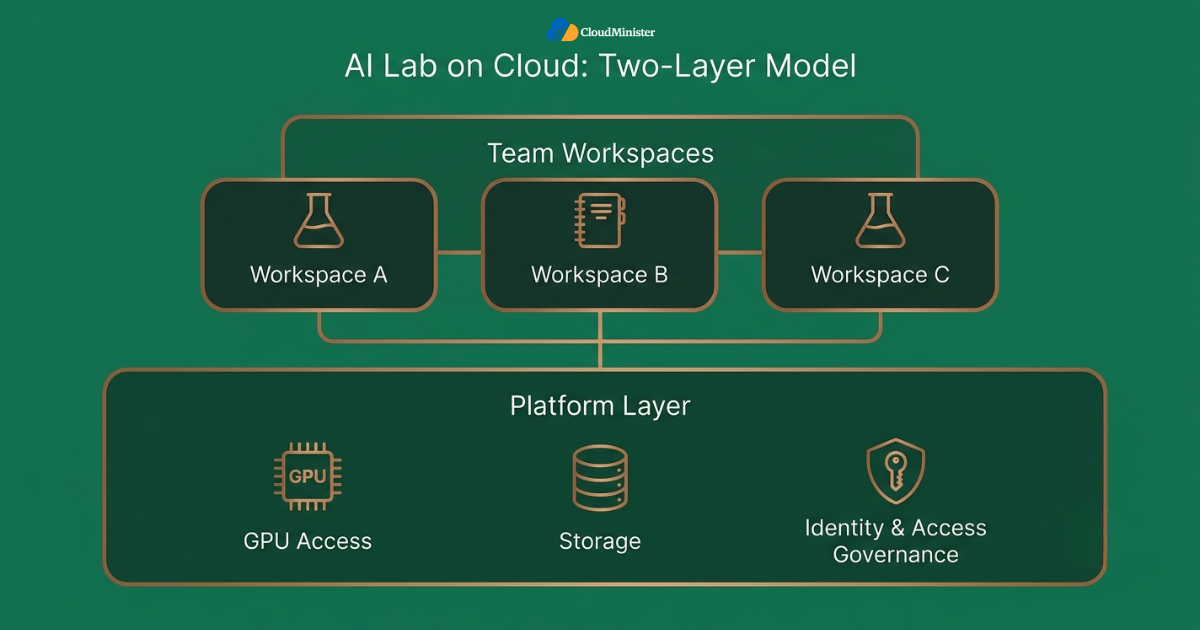
- Such a setup typically consists of two working layers: a shared platform layer that centralizes GPU access, storage, and identity, and individual or team-level workspaces where actual experiments run inside the guardrails in the platform layer sets.
- Every well-built lab environment is anchored around GPU servers for deep learning, since most large-scale training and fine-tuning workloads in 2026 benefit significantly from GPU acceleration, though smaller-scale ML workloads and lightweight fine-tuning jobs can still run effectively on general-purpose CPU compute.
- This kind of AI Lab as a Service enforces consistency primarily through standardized environment images and access policies, which prevent the classic “it worked on my machine” failure that quietly wastes days of a data science team’s time.
- Because the model is designed around reusable, versioned environments, this kind of setup inherits a repeatable structure rather than being rebuilt from scratch by every team independently.
- This kind of environment is deliberately workload-agnostic. The same lab environment can support a computer vision project, a large language model for fine-tuning jobs, and a tabular data pipeline, each inside its own isolated workspace. Teams that want the lab delivered as a managed offering rather than self-assembled infrastructure increasingly look toward an Cloud-Based AI Lab instead of stitching one together internally.
An AI Lab on Cloud is not a one-time setup that can be left alone after the first few experiments succeed. Access permissions, storage buckets holding training data, and API keys tied to notebook environments all need periodic review, because team members rotate, datasets accumulate sensitive fields over time, and a lab that started as a small internal sandbox often becomes the backbone of production model training without anyone revisiting the original security assumptions. This matters directly for Indian businesses that need to demonstrate documented technical safeguards under the Digital Personal Data Protection Act (DPDPA) 2023.
Ready to Build Your AI Lab Cloud?
Get a governed, GPU-ready environment for your team, compute, storage, and access control, set up right from day one.
2. Why an AI Lab on Cloud Matters for Startups and Growing Teams in 2026
Many startups first encounter this decision while already evaluating a Web Hosting Company in India for their broader infrastructure needs. For teams without dedicated infrastructure staff, AI Lab as a Service is often the fastest route to a working environment. The growing market for GPU Servers for AI is itself a signal of how central dedicated compute has become to any serious machine learning effort. The case for this kind of environment is not abstract. It shows up directly in how enterprises are actually spending on AI infrastructure right now.
- AI workloads now account for close to a quarter of all public cloud compute spending, a sharp rise from just 8 percent a few years earlier, which tells you compute for AI is no longer a side project inside most technology budgets.
- Without a proper GPU Servers for AI setup, startups commonly report that individual engineers spin up their own GPU instances independently, each configured differently, which produces duplicated cost and inconsistent results within months of unstructured growth.
- An AI Lab on Cloud is designed specifically to stop this pattern before it starts by centralizing GPU allocation, environment standardization, and cost visibility at the team level, not per engineer.
- For startups still deciding how much to invest in dedicated AI infrastructure versus general-purpose cloud accounts, understanding how a properly structured lab compares with ad hoc provisioning is a useful reference point before committing budget.
- Teams that want a starting point instead of designing this from a blank page often begin with a Cloud-Based AI Lab built specifically around GPU-heavy workloads and pre-configured collaboration tooling.
Before rolling a Cloud-Based AI Lab out to every team in the company, pilot it with two or three representative projects first, such as one computer vision workload, one language model fine-tuning workload, and one traditional machine learning pipeline. Teams that validate the lab design against real workload patterns before a full rollout consistently surface GPU allocation gaps and storage bottlenecks that a purely theoretical design review would miss.
3. AI Lab on Cloud Design Areas: The Core Pillars of a Working Setup
A capable Web Hosting Company in India can often advise on several of these design areas even before a formal lab project begins. An AI Lab on Cloud is not a single configuration decision. A working setup has to address several distinct areas deliberately, and each one has to be addressed on its own rather than left to default settings.
3.1 Compute and GPU Allocation
- Demand for GPU Servers for AI has outpaced general-purpose compute demand in most cloud provider reports over the last two years, and startups planning a lab should budget accordingly.
- Teams evaluating AI Lab as a Service option should compare GPU availability guarantees as closely as they compare price.
- Sourcing reliable GPU servers for deep learning is usually the first practical decision a startup makes when standing up its lab, since compute availability directly gates how quickly a team can run its first real experiment.
- Every serious lab environment relies on GPU servers for deep learning as its compute backbone for large-scale training and fine-tuning, since those workloads scale poorly on CPU-only infrastructure — though smaller models and lighter fine-tuning jobs remain a reasonable fit for CPU compute.
- Access to shared GPU capacity should follow a scheduling or queueing model, so multiple team members can share expensive GPU servers for deep learning fairly, without idle instances quietly running up the bill.
- Startups that do not want to manage physical GPU procurement themselves increasingly turn to AI Lab as a Service offering, where the compute, environment, and scaling are handled by a provider rather than an in-house infrastructure team.
- Autoscaling policies matter here too. A well-tuned AI Lab as a Service that scales GPU capacity up during active training runs and back down during idle periods keeps spending predictable instead of paying for peak capacity around the clock.
3.2 Data Storage and Versioning
- Storage throughput needs to scale in step with whatever GPU Servers for AI a team adds, since a fast GPU with a slow storage feed underdelivers on both counts.
- Even the fastest GPU servers for deep learning sit idle if the storage layer feeding them cannot keep pace, which is why storage design deserves as much planning attention as compute selection.
- Training data, model checkpoints, and experiment logs all need a consistent storage layer inside an AI Lab on Cloud, typically object storage paired with a fast-access tier for active training jobs.
- Dataset versioning should be treated as seriously as code versioning. A lab environment without dataset version control makes it nearly impossible to reproduce a model result three months earlier.
- Model registries are a standard component of a mature lab environment, giving teams a single place to track which model version is deployed, which is still experimental, and which has been retired.
- Backup and disaster recovery policies for training data deserve the same attention inside a Cloud-Based AI Lab that they would get in any production database, since losing a labeled dataset can cost weeks of rework.
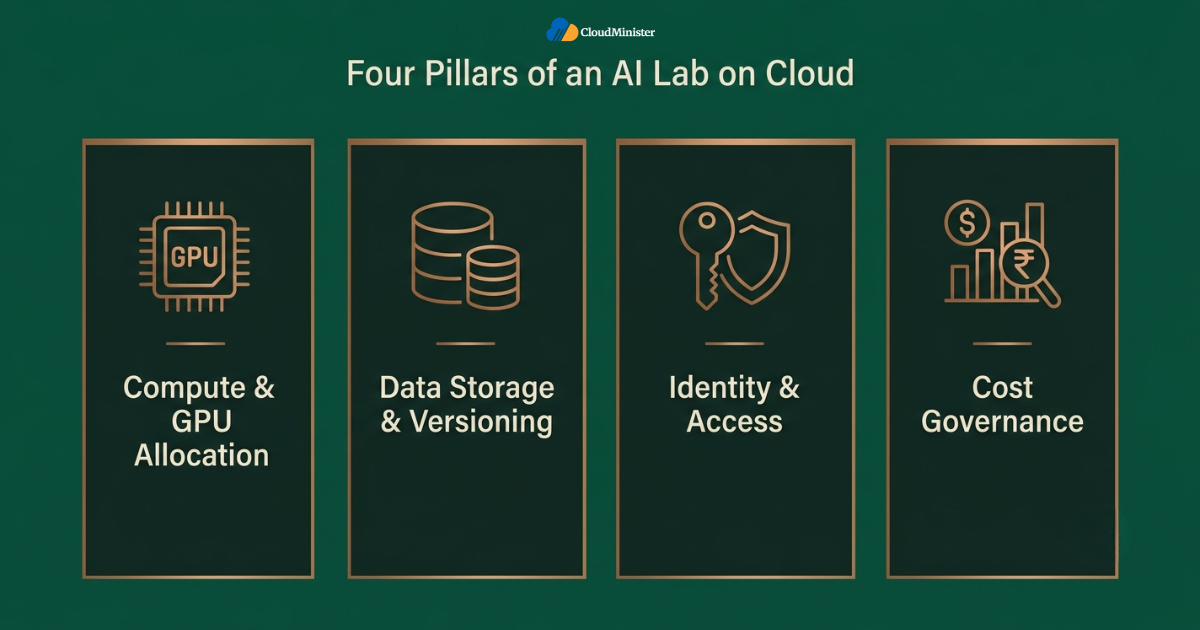
3.3 Identity, Access, and Collaboration
- Access to any pool of GPU Servers for AI should be logged in the same way access to production databases is logged, since compute misuse is just as costly as data misuse.
- Access control matters as much for GPU servers for deep learning as it does for any production database, since an unrestricted launch permission can turn one experiment into an unexpectedly large bill.
- Role-based access control should govern who inside the lab can launch GPU servers for deep learning, who can access raw training data, and who can push a model to a shared registry.
- Shared notebook environments are one of the defining features of a genuine Cloud-Based AI Lab, letting multiple team members collaborate on the same experiment without emailing notebook files back and forth.
- Audit logging across an AI Lab on Cloud gives a startup a documented trail of who trained what, when, and using which dataset version, which becomes important now a model needs to be explained to a customer or regulator.
- Onboarding a new team member to a Cloud-Based AI Lab should take minutes, not days, since environment standardization removes most of the manual setup that traditionally slows a new hire down.
3.4 Cost Governance
- Cost dashboards inside a Cloud-Based AI Lab give finance teams visibility that a collection of separately billed instances never quite provides.
- Pricing for GPU Servers for AI varies significantly by GPU class and region, so cost governance must be tuned to the specific tier of GPU Servers for AI a team is running.
- Because GPU servers for deep learning are typically the single largest line item in a lab budget, cost governance around them deserves more scrutiny than any other part of the environment.
- Budgets and spending alerts should be configured from day one inside an AI Lab on Cloud rather than added after GPU costs have already grown unpredictably.
- Tagging every workspace and job inside the environment by project or team allows cost allocation reports to map spend directly back to what produced business value.
- Auto-shutdown policies for idle notebook sessions are one of the simplest and most effective cost controls available inside a Cloud-Based AI Lab, since a forgotten running GPU instance is one of the most common sources of unexpected billing.
- Reserved capacity or committed-use options become worth negotiating once workload patterns become predictable enough to commit to a baseline level of usage.
The pattern that separates a genuinely useful setup from a loosely connected pile of GPU instances is consistency across compute, storage, identity, and cost governance all at once. A startup that gets GPU access right but leaves dataset versioning ad hoc, or that enforces access control but skips cost visibility, has not actually built a lab in the full sense of the term. It has built a partially governed sandbox that will still drift into sprawl over time.
Related Reading: GPU servers for developers, startups, and businesses
4. Choosing the Right Deployment Model for Your AI Lab on Cloud
Some teams simply ask their existing Web Hosting Company in India whether they offer a lab-ready deployment model before evaluating outside vendors. Most deployment models ultimately differ in how they source and manage GPU Servers for AI, more than in any other single component. Most founders weigh AI Lab as a Service against a custom build start by estimating how much internal engineering time, they can realistically spare. Startups do not need to build a lab environment entirely from scratch. There are several starting points, and choosing the right one affects both setup speed and long-term maintainability.
- A fully managed AI Lab as a Service model hands out the platform layer, GPU orchestration, and baseline security configuration to a provider, letting a small startup team focus entirely on experimentation rather than infrastructure maintenance.
- Startups with existing DevOps maturity sometimes build their environment using infrastructure-as-code tooling, giving full version control and repeatability over every component.
- A custom-built AI Lab on Cloud setup, developed internally, gives a team maximum flexibility but requires significantly more engineering time upfront compared to adopting a managed AI Lab as a Service starting point.
- Hybrid approaches, where a startup adopts a managed platform as the base layer and layers custom tooling or internal policies on top, have become one of the more common ways growing teams deploy an AI Lab on Cloud in 2026 without reinventing the entire stack.
- Regardless of the deployment model chosen, every setup should go through a design review against the team’s specific data sensitivity, budget, and workload requirements before it becomes the default environment for real projects.
Ask any provider of a managed lab environment for a written breakdown of exactly which components they manage versus which remain the team’s responsibility, since ambiguity here is one of the most common sources of gaps discovered only after a training job fails or a bill comes in higher than expected.
Checklist: AI Lab on Cloud Readiness Before Your First Real Project
- Compute tier selected and the right class of GPU servers for deep learning provisioned or reserved
- Storage layer configured with versioning for datasets and model checkpoints
- Role-based access control mapped to team structure and data sensitivity
- Notebook environment standardized and tested with a non-critical workload first
- Cost budgets and alerts configured at the project or team level
- Model registry in place for tracking experimental versus production models
- Backup and recovery policy defined for training data and checkpoints
- A rollback plan exists in case an environment update breaks an active experiment
5. Infrastructure Readiness: Why the Hosting Layer Matters
The right Web Hosting Company in India brings more than raw compute to the table; it brings operational experience with exactly this kind of build-out. AI Lab as a Service provider differs meaningfully in how much of this infrastructure planning; they handle on a team’s behalf. The hosting partners a startup chooses ultimately determines how quickly it can add more GPU Servers for AI when a project outgrows its initial allocation. Choosing where to source GPU servers for deep learning is not purely a pricing decision; it also shapes latency, support quality, and how quickly a team can scale up capacity when a project succeeds. An AI Lab on Cloud defines the workflow and governance, but its real-world performance still depends on the underlying infrastructure decisions a startup makes around it, particularly for teams handling large training datasets.
- A well-planned setup assumes reliable, high-throughput connectivity between where data is stored and where the GPU servers for deep learning run, since a bottleneck in data loading can leave expensive GPU capacity sitting idle mid-training.
- Startups evaluating a hosting partner for their AI Lab on Cloud should confirm the provider can support region-specific storage where a startup’s own policy or a customer contract requires it and should not assume DPDPA 2023 itself mandates India-only storage, the Act permits cross-border data transfer except to countries the government specifically restricts.
- A dependable Web Hosting Company in India that understands both GPU infrastructure and broader lab architecture can meaningfully reduce the operational friction of getting a new AI Lab on Cloud from pilot to production use.
- Latency between where a team of engineers work and the region hosting their environment should be measured and validated before the lab goes into daily use, not discovered afterward through frustrated data scientists waiting on slow notebook responses.
- Startups comparing GPU pricing and configuration options as part of setting up their AI Lab on Cloud often find it useful to review a dedicated cost comparison first, and our guide on cloud GPU servers in India breaks down exactly what cost-effective options look like for growing teams.
When evaluating GPU servers for deep learning as part of a lab build-out and comparing them against other GPU servers for deep learning offered by competing providers, request a benchmark of actual training throughput on a representative model before signing any long-term commitment, not just a quoted GPU specification sheet. A lab that looks correct on paper can still underperform in production if real-world data loading and network throughput were never actually tested.
6. Building Your First AI Lab on Cloud: A Step-by-Step Setup Walkthrough
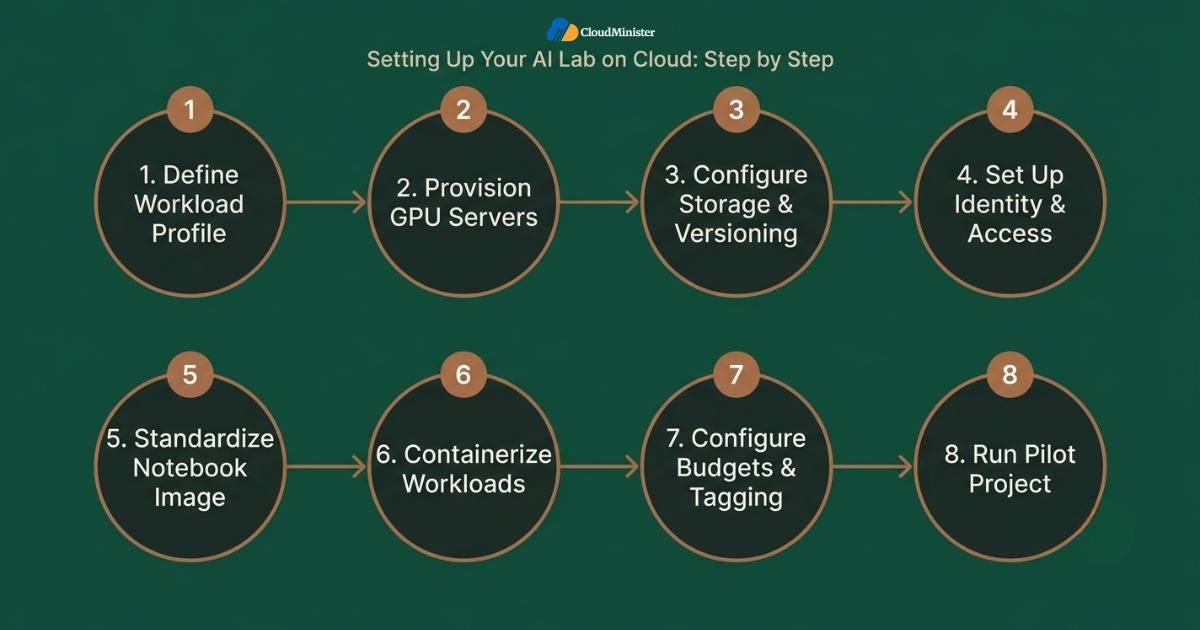
Working with an experienced Web Hosting Company in India from the outset can shorten several of the steps outlined below. If a team has already selected an AI Lab as a Service provider, several of the steps below arrive pre-configured. Teams that start from a pre-built Cloud-Based AI Lab can typically skip several of the earlier setup steps entirely. Every step below assumes the team has already settled on which GPU Servers for AI they intend to standardize for the first phase of the rollout. Setting up an AI Lab on Cloud for the first time is a sequence of deliberate decisions rather than a single deployment click.
- Start by defining the team’s actual workload profile: whether the lab primarily needs to support fine-tuning large language models, training computer vision models from scratch, or running lighter-weight classical machine learning experiments, since this decision drives every GPU sizing choice that follows.
- Select and provision the specific GPU servers for deep learning that matches that workload profile, keeping in mind that a startup fine-tuning smaller models rarely needs the same GPU class as a team pretraining a foundation model from scratch.
- Choosing between GPU tiers is one of the more consequential technical decisions inside a lab build-out, and our detailed comparison of A30 vs A100 vs H100 walks through exactly which GPU class fits which workload profile.
- Configure the shared storage layer with dataset versioning enabled from the very first project, since retrofitting versioning after a team has already accumulated months of undersigned data is far more disruptive than building it in from day one.
- Set up identity and access control before any real training data enters the AI Lab on Cloud, mapping roles to who can launch the GPU servers for deep learning, who can view raw data, and who can promote a model to a shared registry.
- Standardize the notebook environment with a base image that every team member starts from, so an AI Lab on Cloud does not slowly fragment into a dozen slightly different environments that each behave differently.
- Teams running larger, multi-workload environments increasingly containerize their training jobs, and our practical walkthrough on building a Kubernetes cluster with Linux GPU nodes for MLOps covers exactly how to structure that layer for production-grade orchestration.
- Configure budgets, tagging, and auto-shutdown policies before onboarding the first real project into the AI Lab on Cloud, rather than treating cost governance as an afterthought once spend has already grown.
- Run a pilot project through the full workflow end to end, from raw data through a registered model, before declaring the AI Lab on Cloud ready for company-wide use.
7. Common Setup Mistakes
A Web Hosting Company in India that has supported similar rollouts before can often flag these mistakes before they happen. Even teams using an AI Lab as a Service provider can fall into these mistakes if they treat the platform as fully self-managing. A surprising number of these mistakes stem from selecting GPU Servers for AI without first defining the workload profile they are meant to support. Many of the mistakes below trace back to how GPU servers for deep learning were originally sourced and configured, rather than anything wrong with the machine learning code itself. Even technically sound designs fail to deliver value when certain avoidable mistakes are made during the initial build-out of an AI Lab on Cloud.
- Treating the lab as a one-time project instead of an ongoing operational capability that needs regular access reviews and environment updates.
- Provisioning GPU servers for deep learning without a scheduling or queueing model across the team, which leads to expensive idle capacity or, conversely, engineers competing for the same limited GPU resources.
- Skipping dataset versioning early on, assuming it can be added later, which rarely happens cleanly once a team is already relying on an undersigned dataset in production experiments.
- Failing to document which team members have access to which parts of the AI Lab on Cloud, leaving new hires confused about what they can and cannot launch.
- Underestimating storage throughput requirements, particularly for teams running large-scale computer vision or language model training where data loading speed directly affects GPU utilization inside the environment.
- Not assigning clear ownership for the platform itself, leaving day-to-day maintenance to whichever engineer happens to notice a problem first, which is a mistake startups make just as often with general cloud infrastructure as they do with a dedicated AI Lab on Cloud.
Across real startup deployments, the gap between an AI Lab on Cloud that performs well and one that quietly degrades into cost sprawl is rarely a difference in the underlying cloud platform. It is a difference in operational discipline. Teams that assign a dedicated owner and schedule recurring cost and access reviews report far fewer instances of the kind of unmanaged drift that an ungoverned lab environment eventually produces.
8. Compliance and DPDPA 2023 Considerations for Indian Startups
A Web Hosting Company in India with direct DPDPA 2023 experience can meaningfully shorten the compliance documentation process described below. Any AI Lab as a Service provider serving Indian customers should be asked directly how they handle these compliance obligations.
Choosing a Cloud-Based AI Lab with clear documentation on where data is processed simplifies the compliance record-keeping described below. DPDPA 2023 does not require Indian startups to store all personal data exclusively within India, it restricts transfers only to countries the government notifies as restricted, so regional availability of GPU Servers for AI is a documentation and risk consideration rather than a fixed legal requirement. Indian startups building an AI Lab on Cloud face a specific compliance layer on top of the standard technical design considerations, driven by the Digital Personal Data Protection Act (DPDPA) 2023.
- Data fiduciaries remain accountable for how personal data is processed even when that data moves through training pipelines inside the lab environment, whether the underlying compute was self-managed or purchased through a managed provider.
- Documentation should record which regions host which categories of training data, giving a startup’s compliance function a clear reference point for cross-border transfer conversations under DPDPA 2023, since the Act’s default position permits transfer outside India except to notified restricted countries.
- Access policies inside an AI Lab on Cloud can be configured to restrict where training data is stored and processed, which is useful for enforcing a startup’s own risk policy or customer contractual requirements at the infrastructure level, even though DPDPA 2023 itself does not impose a blanket India-only storage mandate.
- Access logs generated across the environment give Indian startups a documented audit trail that supports the reasonable technical safeguard requirements referenced under DPDPA 2023, which matters increasingly as more startups deploy models that touch customer-level data.
- Startups that rely on a Web Hosting Company in India for parts of their infrastructure alongside their AI Lab on Cloud should confirm that the same data residency and access-logging standards extend consistently across both environments.
Checklist: DPDPA 2023 Considerations for Your AI Lab on Cloud
- Data transfer paths mapped by region for every training dataset, with confirmation that no destination falls under a government-restricted country list
- Access policies enforce the startup’s chosen regions at the storage and compute level (a policy choice, not a DPDPA-mandated one)
- Access logs retained per documented compliance requirements
- Sensitivity labels applied to datasets containing any personal data
- Data processing agreements reviewed for any third-party service connected to the lab
- Incident response plan documented and tested at least once for the lab environment specifically
9. Cost Governance: Keeping Spend Predictable
A transparent Web Hosting Company in India will typically provide itemized usage reports that make this kind of governance far easier to enforce. AI Lab as a Service pricing structures vary enough between providers that a side-by-side cost comparison is worth doing before committing. A transparent Cloud-Based AI Lab billing model makes this kind of governance considerably easier to enforce from month one. A startup running multiple classes of GPU Servers for AI side by side should track utilization per class, since one tier of GPU Servers for AI often ends up underused while another is consistently overbooked. Because GPU servers for deep learning rarely come cheap, even small inefficiencies in scheduling or shutdown policy compound quickly across a busy lab. One of the most underestimated benefits of a properly designed AI Lab on Cloud is cost predictability, which becomes increasingly difficult to achieve once a startup has multiple teams running GPU workloads independently.
- The average enterprise now spends well into seven figures annually on AI cloud services, with GPU-as-a-Service alone having grown into a multi-billion-dollar market, according to compiled cloud computing industry data, which underlines why cost governance inside this kind of environment cannot be an afterthought.
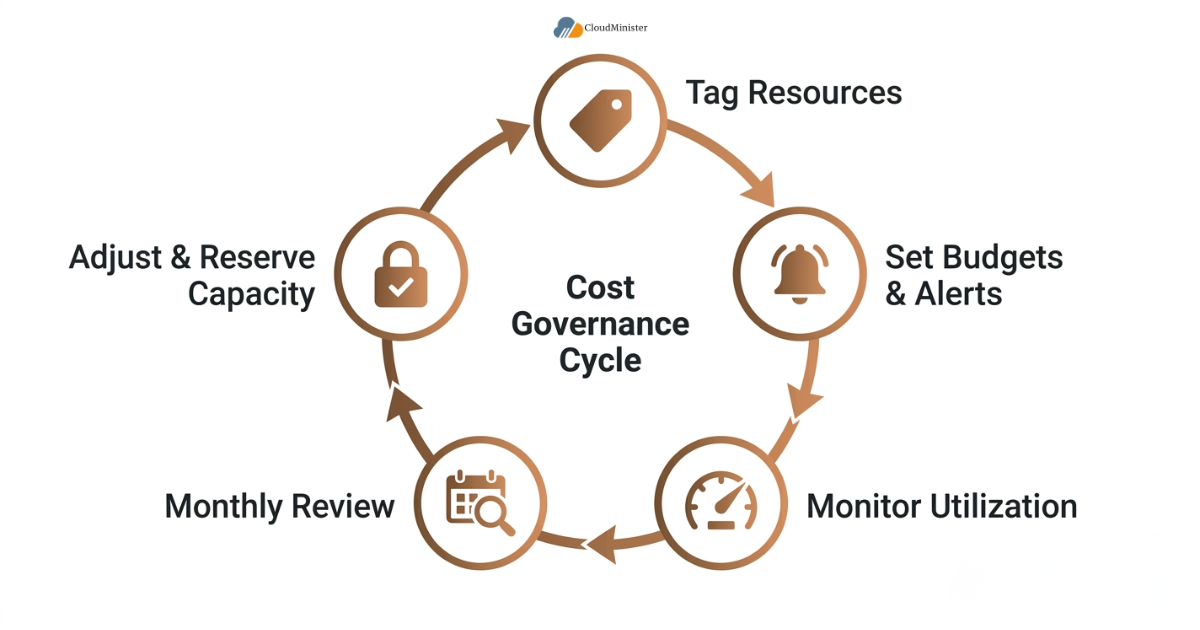
- Budgets and alerts should be configured at the project or team level inside an AI Lab on Cloud, giving finance visibility before spending exceeds expectations rather than after.
- Committed use or reserved GPU capacity is typically negotiated once workload patterns inside the lab become predictable enough to commit to a baseline, often after the first two or three real projects have run through it.
- Resource tagging enforced consistently across every workspace inside an AI Lab on Cloud allows cost allocation reports to map spend directly back to specific teams or projects rather than showing up as one undifferentiated cloud bill.
- Startups that skip cost governance during their initial setup frequently end up retrofitting these controls later, which is considerably more disruptive than building them in from the start.
Run a cost governance review of your AI Lab on Cloud every month during the first year, not just at renewal time. GPU utilization, idle notebook sessions, and storage growth all drift naturally as new projects onboard, and a monthly review catches this drift long before it shows up as an unexpected line item on the annual budget.
10. Measuring Success: Beyond the Initial Setup
Sharing utilization and cost data with your Web Hosting Company in India periodically keeps both sides accountable for the lab’s performance. Even with AI Lab as a Service handling the infrastructure layer, the team still owns responsibility for measuring whether the lab is delivering value. Most dashboards built into a Cloud-Based AI Lab already expose the utilization metrics a startup needs to track here. Tracking utilization separately for each class of GPU Servers for AI in use gives a far more actionable picture than a single blended utilization number. Utilization data on GPU servers for deep learning is one of the clearest signals of whether a lab environment is earning its keep or quiet running cost. An AI Lab on Cloud is not complete once the platform deploys successfully. Long-term success depends on how the environment is measured and maintained afterward.
- Track the number of active projects running inside the governed environment against the number of GPU instances still running outside its boundary, since any workload sitting outside represents unmanaged risk and untracked cost.
- Measure GPU utilization rates on a recurring basis rather than assuming that provisioned capacity is being used efficiently by default.
- Review access logs and permission assignments monthly, since a growing team without a corresponding access review often accumulates stale permissions inside an otherwise well-governed AI Lab on Cloud.
- Reassess compute sizing as the organization takes on larger or more varied projects, particularly when a startup that has only fine-tuned smaller models begins experimenting with pretraining or larger foundation models.
- Maintain a change log for every significant environment or policy modification inside the lab, so the team can trace exactly when and why a given configuration changed.
As an AI Lab on Cloud matures, periodically re-run a full access review across every workspace and data store. Team members change roles, contractors’ complete engagements, and interns finish programs without their elevated access being revoked, and stale permissions inside an otherwise well-governed environment remain one of the most common sources of unnecessary risk.
11. Choosing the Right Infrastructure Partner
Not every AI Lab as a Service provider is built for the same scale of workload, so matching provider’s capability to actual team needs matters more than brand recognition. When comparing providers, ask directly whether their Cloud-Based AI Lab offering has been battle-tested with startups running production-grade training workloads, not just small pilot projects. Architecture decisions get most of the attention during a lab build-out, but the infrastructure partner supporting the broader AI Lab on Cloud plays an equally important role in how reliably it performs over time.
- A dependable Web Hosting Company in India that already manages a startup of broader infrastructure is well positioned to advise on how the lab environment should connect into existing systems without introducing unnecessary latency or complexity.
- Startups evaluating providers of AI Lab as a Service should specifically ask whether the provider has direct experience supporting teams running GPU Servers for AI at a meaningful scale, not just provisioning individual virtual machines.
- Teams that want to move quickly without assembling every component themselves often gravitate toward a managed Cloud-Based AI Lab that bundles compute, storage, and governance into a single offering from day one.
- IT leaders who have not yet evaluated their hosting partner relationship specifically in the context of an AI Lab on Cloud rollout should treat the setup as a natural trigger point to do so.
- A Web Hosting Company in India that combines GPU infrastructure expertise with broader lab architecture experience gives growing startups a single, coherent infrastructure roadmap instead of stitching together advice from multiple vendors.
Conclusion
Throughout this process, a dependable Web Hosting Company in India remains one of the most consistent multipliers on how smoothly the rollout goes. Whether built in-house or adopted as a ready-made Cloud-Based AI Lab, the underlying principles in this guide hold either way. Getting the choice of GPU Servers for AI right early on tends to pay off across every stage of a startup machine learning roadmap that follows. An AI Lab on Cloud has moved well past being an optional convenience for startups experimenting with machine learning. By 2026, it is close to the expected starting point for any team planning to run more than a handful of serious AI projects, and the spending data around AI infrastructure makes clear why that shift happened so quickly.
The startups that get the most value from this approach share a consistent pattern: they treat their lab environment as a structured, ongoing capability spanning compute, storage, identity, and cost controls, supported by clean documentation and a dedicated owner, rather than a one-time deployment project. For Indian startups specifically, pairing a well-designed setup with DPDPA 2023 compliance discipline and a dependable Web Hosting Company in India for the surrounding infrastructure gives the strongest foundation for scaling AI work without the sprawl, drift, and unpredictable costs that an ungoverned environment eventually produces.
Not Sure Where to Start?
Talk to our team about designing an AI Lab Cloud that fits your workload, budget, and compliance needs.
Key Takeaways
- A trustworthy Web Hosting Company in India can meaningfully shorten the time it takes to get a lab environment production ready.
- AI Lab as a Service remains the fastest path to a working lab for teams without dedicated infrastructure staff.
- A managed Cloud-Based AI Lab can compress a multi-week setup process into a matter of days for teams that do not want to build every layer themselves.
- An AI Lab on Cloud is a pre-configured, shared environment combining GPU computing, storage, identity, and cost governance for machine learning experimentation.
- AI-related cloud spending has grown sharply as a share of total cloud spending, which is exactly the shift a properly governed lab environment is designed to capture productively.
- A working setup spans compute and GPU allocation, data storage and versioning, identity and access, and cost governance, and all of them need to be addressed together.
- Managed AI Lab as a Service offerings, infrastructure-as-code builds, and custom-built approaches each offer a different balance of speed and flexibility for startups starting their setup.
- Indian startups need to map data residency, restrict approved regions for training data, and maintain documented access logs to satisfy DPDPA 2023 requirements.
- Cost governance built in from the start, including budgets, tagging, and auto-shutdown policies, prevents the unpredictable spend growth that unmanaged GPU sprawl typically produces.
- A dependable infrastructure partner offering GPU Servers for AI and broader lab architecture experience meaningfully affects how reliably a lab environment performs once it is supporting real production work.
Frequently Asked Questions
Is an AI Lab on Cloud only necessary for large, well-funded startups?
No, and a lightweight Cloud-Based AI Lab subscription is often accessible even to very early-stage teams. While the concept is closely associated with well-resourced teams, even small startups planning to run more than a handful of real machine learning experiments benefit from setting one up, since the coordination problems it solves show up earlier than most teams expect, often the moment a second engineer joins the project.
How long does it take to set up an AI Lab on Cloud?
Working with an established Web Hosting Company in India from the start tends to compress this timeline considerably. A managed Cloud-Based AI Lab typically shortens this timeline considerably compared with a fully custom build. Timelines vary significantly depending on whether a team adopts a managed AI Lab as a Service starting point or builds a fully custom setup and depend heavily on how many existing scripts and ad hoc GPU instances need to be brought into the governed environment. Teams starting from a managed offering generally get a working lab running in days rather than weeks.
Does an AI Lab on Cloud replace the need for a dedicated MLOps engineer?
A good Web Hosting Company in India can support the infrastructure side, but the workflow ownership still belongs to the team. No. This kind of setup establishes the shared environment and default guardrails, but ongoing monitoring, environment maintenance, and workflow optimization still benefit from a dedicated owner. It reduces the volume of avoidable setup problems rather than eliminating the need for someone to own the platform.
Can an AI Lab on Cloud support both experimentation and production model deployment?
Many Cloud-Based AI Lab platforms are explicitly designed to support this dual purpose out of the box. Yes. A well-designed lab environment typically separates experimental workspaces from production-facing deployment paths, but both can run inside the same governed setup, sharing the same identity, storage, and cost governance layers while keeping experimental and production workloads clearly distinct.
What should Indian startups check before setting up an AI Lab on Cloud?
Beyond compliance, it is worth confirming whether the chosen Cloud-Based AI Lab provider has a track record specifically with Indian data residency requirements. Indian startups should understand that DPDPA 2023 does not require India-only data storage, it restricts transfers only to specifically notified countries, configure access policies and logging that support documented accountability, and confirm that their chosen provider of GPU Servers for AI or Web Hosting Company in India partner has direct experience supporting teams running this kind of lab rather than only individual GPU instance rentals.

Shivlendra Singh Jadoun is a Cloud & DevOps Engineer at CloudMinister Technologies, specializing in AWS, Azure, and GCP infrastructure. He began his career in Linux system administration, managing shared, VPS, and dedicated servers before moving into cloud and automation. He is AWS Certified and works extensively with Docker, Kubernetes, Terraform, Ansible, and Jenkins to build CI/CD pipelines and scalable, secure cloud environments. With hands-on experience across hosting, server security, and DevOps automation, he brings real-world engineering insight to every article he writes.