Over the last decade, conversational technology has transformed how businesses interact with customers. From website support to sales automation, organisations have increasingly relied on chatbots to streamline communication and reduce operational workloads. But chatbots, rule-based, scripted, and limited in contextual awareness, are now giving way to a far more capable generation of technology: AI agents. In 2026, AI agents represent the most significant shift in business automation since the introduction of cloud computing itself.
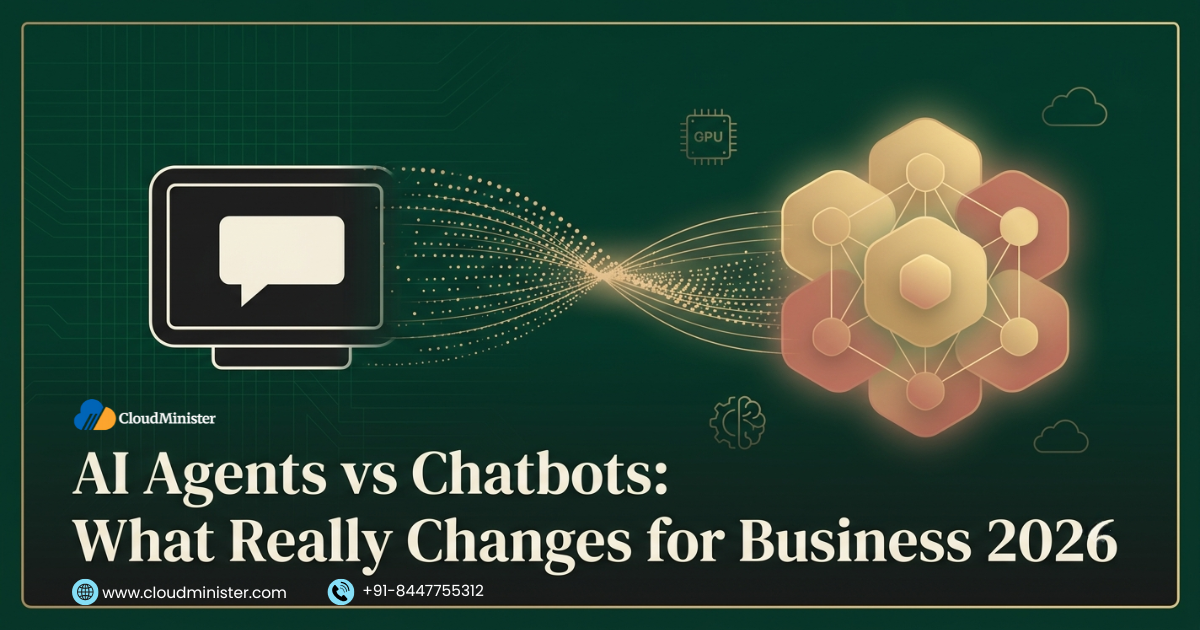
Traditional chatbots were designed to handle simple queries using predefined scripts and rule-based logic. While these systems improved response times and automated basic support tasks, they were limited in their ability to understand context, reason through complex problems, or adapt to dynamic conversations. AI agents change this entirely. They can understand intent, analyse information, access external tools, complete multi-step tasks autonomously, and learn from each interaction, making them fundamentally more capable than any scripted chatbot system.
As organisations modernise their infrastructure to support AI-powered applications, many rely on scalable enterprise cloud hosting solutions and high-performance GPU server infrastructure to provide the compute capacity that intelligent automation requires. This guide explores how AI agents are transforming conversational technology, the key technologies enabling this shift, the infrastructure requirements, real-world applications, challenges, and the future of AI agents in 2026 and beyond.
Understanding the First Generation: Traditional Chatbots
Before exploring how AI agents have evolved beyond chatbots, it helps to understand what traditional chatbots were designed to do, and why their limitations are now a significant business problem.
What Are Chatbots?
A chatbot is a software application designed to simulate conversation with users through text or voice interfaces. Early chatbots relied heavily on decision trees and keyword recognition to generate responses. When a user asked a question, the chatbot would match the query to a predefined response stored in its database. These systems became popular across industries because they could automate repetitive interactions and provide instant responses at a lower cost than human agents.
Common chatbot use cases in traditional deployments:
- Answering frequently asked questions about products and services
- Providing basic product or service information to website visitors
- Collecting customer contact details and qualification information
- Booking appointments and scheduling meetings
- Routing support tickets to the appropriate human team member
Limitations of Scripted Chatbots
Despite their usefulness for simple, repetitive tasks, traditional chatbots frequently struggled, and the limitations became more apparent as customer expectations evolved. The emergence of AI agents directly addresses each of these limitations:
- Limited Context Awareness: Rule-based chatbots respond to keywords rather than understanding the meaning or intent behind a question. A question phrased differently than expected produces a wrong or irrelevant response
- Rigid Conversations: Users are often restricted to predefined options or structured inputs, creating frustrating, unnatural experiences compared to speaking with a human agent
- Lack of Learning Capabilities: Chatbots cannot learn from previous interactions unless developers manually update their scripts, creating a static system in a dynamic world
- Poor Problem-Solving Ability: When a query falls outside programmed scenarios, chatbots typically fail to provide useful responses, often responding with “I don’t understand” or looping back to a menu
- No Task Execution: Traditional chatbots can only provide information, they cannot take actions like updating a record, processing a transaction, or retrieving real-time data from an external system
These limitations are precisely what AI agents were designed to overcome. The shift from chatbots to AI agents is not an incremental improvement, it is a fundamental rethinking of what conversational automation can accomplish.
The Emergence of AI Agents – What Makes Them Different
AI agents are advanced software systems powered by artificial intelligence that can understand natural language, reason through complex problems, and perform tasks autonomously. Unlike traditional chatbots, AI agents do not rely solely on scripted responses. Instead, they use large language models and contextual analysis to generate meaningful answers and take action based on user requests, making them genuinely intelligent digital assistants rather than sophisticated menu systems.
Core Capabilities That Define AI Agents in 2026
- Natural Language Understanding (NLU): AI agents can interpret human language more effectively by analysing context, tone, and intent rather than focusing only on keywords, enabling natural, free-form conversations
- Contextual Memory: AI agents can remember previous interactions and maintain context across multiple conversation steps, so users never have to repeat information from earlier in the same conversation
- Multi-Step Reasoning: AI agents can break down complex problems into smaller steps, reason through them logically, and synthesise a coherent response that addresses the full complexity of the user’s request
- Task Automation: Unlike chatbots that only provide information, AI agents can perform actions, updating records, generating reports, retrieving live data, executing workflows, sending notifications, and interacting with external APIs and services
- Tool Use: Modern AI agents (GPT-4o, Claude 3.5 Sonnet, Gemini 1.5 Pro) can use external tools, web search, calculators, code execution, database queries, to gather information and complete tasks that go beyond their training data
- Continuous Learning: AI agents improve over time through feedback, additional training, and RAG (Retrieval-Augmented Generation) updates, unlike static chatbot scripts that only change when developers manually update them
The most important distinction between a chatbot and AI agents is task execution capability. A chatbot tells a customer “your order is processing” by matching a keyword. An AI agent retrieves the live order status from your ERP system, checks the estimated delivery date, cross-references it with current carrier API data, and provides a precise, personalised update, autonomously.
AI Agents vs Chatbots – Key Differences in 2026
Understanding the specific differences between AI agents and traditional chatbots helps organisations identify where to invest and what migration from chatbot to AI agent architecture requires:
| Dimension | Chatbot | AI Agent |
| Intelligence Model | Rule-based decision trees | LLM-powered reasoning |
| Conversation Style | Scripted, predefined flows | Contextual, adaptive, natural |
| Memory | Stateless (no conversation history) | Persistent context across interactions |
| Learning Ability | Static until manually updated | Continuous improvement via feedback and RAG |
| Task Execution | Informational only | Action-oriented — can complete tasks in external systems |
| Tool Use | None | Web search, API calls, database queries, code execution |
| Integration | Basic (single-system) | Multi-system (CRM, ERP, databases, external APIs) |
| Error Recovery | Falls back to menu or “I don’t understand” | Reformulates, asks clarifying questions, tries alternative approaches |
| Infrastructure Requirement | Standard CPU server | GPU server or cloud GPU for LLM inference |
The Technology Behind AI Agents
Several technological innovations working together make AI agents possible. Understanding these components helps organisations make informed infrastructure and vendor decisions when deploying AI agents:
1. Large Language Models (LLMs) – The Intelligence Layer of AI Agents
Large Language Models are the intelligence foundation of modern AI agents. LLMs like GPT-4o, Claude 3.5 Sonnet, Gemini 1.5 Pro, Llama 3, and Mistral are trained on vast datasets of human language, enabling them to understand context, generate human-quality responses, reason through complex problems, and use tools. These models are what give AI agents their conversational sophistication and reasoning capability far beyond anything a rule-based chatbot can achieve.
In 2026, Indian businesses are increasingly deploying open-source LLMs (Llama 3, Mistral, Phi-3) on their own GPU servers, maintaining full data control under DPDPA 2023 while achieving the performance of cloud-hosted LLM APIs at lower long-term cost.
2. High-Performance GPU Infrastructure for AI Agents
Running modern AI agents requires powerful computing resources capable of processing large language models for inference at production speed. Many organisations rely on GPU cloud for AI workloads to accelerate tasks such as model inference, real-time response generation, and data analysis. Graphics Processing Units are particularly well suited for AI agent workloads because they can handle the matrix operations at the heart of LLM inference simultaneously across thousands of cores.
CloudMinister GPU server infrastructure for AI agents:
- Linux GPU Server: CUDA-enabled, NVMe SSD, India-based data centres (Mumbai and Delhi) — ideal for Python-based AI agent frameworks (LangChain, CrewAI, AutoGen)
- Windows GPU Server: Windows Server 2022 with RDP, GPU-accelerated, ideal for Windows-native AI agent deployments
- Amazon Cloud GPU (AWS): P/G instance families for elastic GPU capacity for AI agent inference
- Google Cloud GPU: T4, L4, A100 nodes for AI agent training and serving
- Microsoft Azure GPU: NC/ND series for AI agent workloads; Azure AI Studio integration
DPDPA 2023 note for AI agents: Indian businesses deploying AI agents that process personal data of Indian users (chat histories, customer records, conversation logs) must ensure this data is processed within India. CloudMinister’s India-based GPU servers in Mumbai and Delhi satisfy DPDPA 2023 data localisation requirements — US or Singapore-based GPU instances may create compliance exposure for AI agent deployments.
3. Knowledge Retrieval Systems for AI Agents
AI agents are most accurate and reliable when they can retrieve up-to-date, organisation-specific information from trusted sources rather than relying solely on their training data. Technologies enabling this capability:
- Vector databases (Pinecone, Weaviate, Chroma, pgvector): store documents as semantic embeddings that AI agents can search by meaning rather than keyword, enabling accurate retrieval from large knowledge bases
- RAG (Retrieval-Augmented Generation): AI agents retrieve relevant documents from your knowledge base before generating a response, grounding answers in your organisation’s actual data rather than generic LLM knowledge
- Semantic search: finds relevant information based on meaning and context rather than exact keyword matches, allowing AI agents to answer questions even when phrased differently than the source material
4. Workflow Automation – How AI Agents Connect to Business Systems
AI agents are most powerful when integrated with business workflows and external systems. Automation platforms enable organisations to connect AI agents to CRM software, analytics platforms, internal databases, and customer systems.
Many businesses implement automation using a self-hosted n8n automation environment, which allows them to design custom AI agent workflows while maintaining full control over infrastructure and data. With n8n, AI agents can perform tasks such as:
- Sending automated notifications to customers or team members based on AI agent decisions
- Updating CRM records when an AI agent qualifies a lead or resolves a support ticket
- Processing support tickets and routing them based on AI agent intent classification
- Generating reports by querying databases and formatting results automatically
- Triggering downstream workflows in response to AI agent-detected events
5. Cloud Infrastructure and Scalability for AI Agents
Scalable cloud environments play a critical role in deploying AI agents at production scale. Cloud platforms allow businesses to scale resources dynamically based on conversational demand, ensuring AI agents maintain response speed even during peak usage periods. Cloud infrastructure also simplifies integration with APIs, enterprise software, and external data sources that AI agents need to perform task execution.
For development and prototyping of AI agent systems, startups and developers often begin using budget VPS hosting solutions that provide dedicated computing resources at lower cost, testing AI agent frameworks, hosting APIs, and deploying lightweight AI agent applications before scaling to GPU-enabled infrastructure.
6. DevOps for AI Agent Deployment
Deploying AI agents in production requires continuous updates, monitoring, and improvements. Development teams rely on CI/CD pipelines and infrastructure automation to streamline AI agent deployment. CI/CD pipelines for AI agents automate: model versioning and deployment, API endpoint updates, prompt engineering iterations, knowledge base refreshes, automated testing of AI agent responses, and infrastructure scaling. This approach allows organisations to improve AI agents continuously while maintaining system stability.
Real-World Applications of AI Agents Across Industries
AI agents are being adopted across multiple industries in 2026, replacing scripted chatbot systems with intelligent automation that delivers genuine business value. Here are the most important real-world AI agent applications:
1. Customer Support AI Agents
AI agents in customer support can analyse support requests, retrieve information from knowledge bases and live systems, provide accurate responses, escalate to human agents when appropriate, and follow up with resolution confirmation, all without human intervention for the majority of tickets. This moves support from reactive to proactive, with AI agents monitoring for issues and reaching out before customers need to ask.
Example: An AI agent for a SaaS business handles 73% of tier-1 support tickets autonomously, retrieves real-time account data from the CRM, processes refund requests through the billing API, and escalates only the genuinely complex cases to human agents, reducing support cost by 40% while improving response time from hours to seconds.
2. Sales and Lead Qualification AI Agents
AI agents interact with website visitors, qualify leads through natural conversation, gather requirements, answer product questions using real-time catalogue data, and schedule meetings directly in sales team calendars, all without human involvement. For Indian B2B businesses with high lead volumes, AI agents provide the responsiveness and consistency that converts more leads than any manually managed process.
3. IT Operations AI Agents
AI agents monitor infrastructure logs in real time, detect anomalies and potential failures before they escalate, automatically execute remediation scripts for known issue patterns, and page human engineers only for novel problems. For businesses running Linux GPU servers, VPS hosting, or cloud infrastructure, AI agents represent a significant upgrade over passive monitoring alerting systems.
4. Marketing Automation AI Agents
Marketing AI agents analyse campaign performance across channels, identify segments with highest engagement, generate personalised content variations, test subject lines and creatives autonomously, and report insights in natural language to marketing teams, compressing analysis cycles from days to minutes.
5. Financial Services AI Agents
AI agents in BFSI conduct real-time fraud detection, answer customer queries about account balances and transactions, process simple transactions, flag compliance risks in communications, and assist relationship managers with client briefings before meetings, all with the speed and consistency that human agents cannot match at scale.
6. Healthcare AI Agents
Healthcare AI agents assist with appointment scheduling, patient triage, medication reminders, symptom assessment, and post-discharge follow-up, freeing clinical staff for higher-value interactions. For Indian healthcare organisations, DPDPA 2023 compliance requires that AI agents handling health-related personal data process that data on India-region infrastructure, making CloudMinister’s India-based GPU server plans the appropriate infrastructure for healthcare AI agent deployments.
Challenges and Considerations for AI Agents in 2026
Despite their transformative potential, AI agents introduce challenges that organisations must plan for proactively:
1. Data Security and Privacy for AI Agents
AI agents handle sensitive customer data in real time, conversation logs, account details, transaction histories. Organisations must implement strong data governance: encryption at rest and in transit, role-based access to AI agent conversation logs, and clear data retention policies. For Indian businesses under DPDPA 2023, AI agents processing personal data must maintain audit trails and ensure data residency within India.
2. AI Agent Accuracy and Hallucination Risk
Large language models powering AI agents can occasionally generate incorrect, outdated, or fabricated responses, a phenomenon called “hallucination.” For business AI agents, this creates risk: a customer service AI agent that provides wrong product information, incorrect pricing, or inaccurate policy details creates real business and legal exposure. Mitigation requires RAG (grounding AI agents in authoritative knowledge sources), output validation, confidence scoring, and human escalation protocols for low-confidence responses.
3. Human Oversight Requirements for AI Agents
Even the most capable AI agents require human oversight for high-stakes decisions, financial transactions above thresholds, medical advice, legal interpretations, and customer complaints about serious service failures. Designing effective human-in-the-loop escalation protocols is a critical part of deploying AI agents responsibly, not an admission of system weakness.
4. Ethical and Transparency Considerations for AI Agents
Customers interacting with AI agents have a reasonable expectation of knowing they are not talking to a human. Transparency about AI agent identity, limitations, and the ability to request a human agent at any time are ethical requirements, and in some regulatory frameworks, legal requirements. AI agents should never attempt to deceive users about their nature.
5. Integration Complexity for AI Agents
Connecting AI agents to existing enterprise systems — CRM, ERP, HRMS, ticketing platforms, databases, requires careful API design, data mapping, and security review. Integration complexity is often underestimated during AI agent deployment planning. Working with experienced DevOps services teams that understand both AI agent frameworks and enterprise integration patterns reduces deployment risk significantly.
Infrastructure Requirements for AI Agents in India – 2026
Deploying production AI agents requires careful infrastructure planning. The computational demands of LLM inference, real-time conversation handling, and multi-system tool use create specific infrastructure requirements:
GPU Server Infrastructure for AI Agent LLM Inference
If your organisation runs its own LLM for AI agents (rather than using a paid API like OpenAI or Anthropic), you need GPU server infrastructure capable of running inference at low latency. General guidelines for 2026:
- Small/fast AI agents (7B parameter models, Mistral 7B, Llama 3 8B): 16 GB VRAM minimum, single mid-range GPU server (NVIDIA RTX 4090 or A10G)
- Medium AI agents (13B parameter models): 24–28 GB VRAM, single high-end GPU server
- Large AI agents (70B parameter models, Llama 3 70B): 140 GB+ VRAM, multi-GPU server configuration required
Cloud GPU Options for AI Agents
For variable AI agent workloads or teams not yet ready for dedicated GPU hardware:
- AWS Cloud Hosting: EC2 G5/P4 instances with NVIDIA A10G and A100 GPUs; ap-south-1 (Mumbai) region for India DPDPA compliance
- Google Cloud Hosting: T4, L4, A100 GPU nodes; asia-south1 (Mumbai) for India-region AI agent hosting
- Microsoft Azure Cloud: NC/ND series; Azure AI Studio integration for enterprise AI agent development
- Akamai Cloud: edge GPU inference for AI agents requiring ultra-low latency response in India regions
VPS and Standard Hosting for AI Agent Components
Not every component of an AI agent system requires a GPU server. Standard VPS hosting is appropriate for: API gateway and request routing, vector database hosting (Chroma, pgvector), n8n workflow automation server, conversation logging and analytics, and lightweight AI agent components that delegate LLM calls to an external GPU server or API. This architecture reduces overall infrastructure cost while maintaining performance where it matters most.
The Future of AI Agents in 2026 and Beyond
The evolution from chatbots to AI agents represents only the beginning of a larger transformation in how businesses operate and interact with customers. Key developments to watch:
- Multi-agent systems: networks of specialised AI agents collaborating autonomously, one AI agent handles research, another handles communication, another handles execution, completing complex workflows that no single AI agent could handle alone
- Voice-enabled AI agents: real-time voice conversation with AI agents using models like ElevenLabs, OpenAI Voice, and Google Gemini Live, moving AI agents from text-based interfaces to natural spoken conversation
- AI business copilots: AI agents embedded in business applications (CRM, ERP, HRMS) as always-available assistants that answer questions, complete tasks, and surface insights without switching context
- Proactive AI agents: rather than waiting to be asked, AI agents will proactively identify opportunities, flag risks, and initiate workflows based on monitoring business data continuously
- India-specific AI agents: AI agents fluent in Indian languages (Hindi, Tamil, Telugu, Kannada, Bengali) are emerging — opening AI agent deployment to the full diversity of Indian users and enabling vernacular customer support at scale
Organisations building AI agent capabilities today are accumulating irreplaceable advantages: training data from real customer interactions, team expertise in AI agent architecture, and operational processes tuned around AI agent workflows. The barrier to deploying AI agents is lower in 2026 than it has ever been, but the competitive advantage of starting now compounds significantly over the next 2–3 years.
Conclusion
Conversational technology has evolved significantly over the past decade. While traditional chatbots introduced basic automation to customer interactions, their limitations have become increasingly apparent as business needs grow more complex and customers expect more intelligent, personalised experiences. AI agents represent the next generation of conversational systems, combining natural language understanding, intelligent multi-step reasoning, and autonomous task execution into a capability that chatbots cannot approach.
With the right infrastructure, scalable cloud environments, GPU server capacity for LLM inference, workflow automation platforms, and robust DevOps practices, organisations can deploy AI agents that genuinely improve operational efficiency, enhance customer experience, and unlock automation opportunities that were not possible with traditional chatbot technology.
For Indian businesses in 2026, building AI agent capabilities alongside DPDPA 2023-compliant India-based infrastructure positions your organisation at the frontier of the most significant productivity shift in a generation. CloudMinister provides the GPU server infrastructure, cloud hosting, DevOps services, and n8n hosting that underpin effective AI agent deployments, all with India-based data centres, INR billing, and 24/7 India-local support.
Frequently Asked Questions
What are AI agents and how are they different from chatbots?
AI agents are advanced software systems powered by large language models that can understand natural language, reason through complex problems, and perform tasks autonomously across multiple systems. Unlike chatbots, which rely on predefined scripts and respond to keyword matches, AI agents understand intent and context, remember conversation history, execute multi-step tasks, use external tools (web search, API calls, database queries), and learn from interactions over time. The key difference is task execution: chatbots answer questions, AI agents complete work.
Why is GPU cloud important for deploying AI agents?
AI agents powered by large language models require GPU computing for efficient inference — generating responses at the speed required for real-time conversation. A CPU server generating a response from a 7B parameter LLM may take 5–30 seconds, unacceptably slow for customer-facing AI agents. A GPU server with an NVIDIA A100 or H100 generates the same response in under 1 second. For organisations deploying their own LLMs for AI agents, GPU server infrastructure is not optional, it is a functional requirement for acceptable response latency.
What are CI/CD pipelines and why do AI agents need them?
CI/CD (Continuous Integration/Continuous Deployment) pipelines automate the process of updating, testing, and deploying AI agent components, including LLM version updates, prompt engineering changes, knowledge base refreshes, and API endpoint updates. AI agents in production require continuous improvement as user behaviour evolves, new products are added, and business policies change. CloudMinister’s DevOps Services team can set up and manage CI/CD pipelines for AI agent deployments, ensuring updates are released reliably without manual downtime.
What is a self-hosted n8n automation environment and why does it matter for AI agents?
A self-hosted n8n automation environment allows businesses to run the n8n workflow automation platform on their own servers — giving full control over data privacy and workflow customisation for AI agent integrations. For Indian businesses deploying AI agents under DPDPA 2023, self-hosted n8n keeps workflow data (including customer interaction data processed by AI agents) within India-based infrastructure rather than flowing through third-party SaaS platforms. CloudMinister provides managed n8n hosting with India-based servers.
Can small businesses in India adopt AI agents?
Yes — AI agent adoption is now accessible to businesses of all sizes. For small businesses, the most cost-effective starting point is using hosted LLM APIs (OpenAI, Anthropic, Google Gemini) rather than self-hosted models — eliminating the need for GPU server infrastructure initially. As AI agent usage grows and volume makes dedicated GPU server inference more economical, businesses can migrate to self-hosted models on CloudMinister’s Linux GPU Server infrastructure. VPS hosting provides a cost-effective starting point for hosting AI agent orchestration layers, knowledge bases, and automation workflows during the early phases.
How do AI agents handle data security and DPDPA 2023 compliance in India?
AI agents handling personal data of Indian citizens must comply with DPDPA 2023 requirements. The most important compliance consideration is data residency: conversation logs, customer data accessed during AI agent tool use, and LLM training data involving personal information must be processed and stored within India. CloudMinister’s India-based GPU servers (Mumbai and Delhi), n8n hosting, and cloud GPU options via AWS Mumbai (ap-south-1) and Google Cloud Mumbai (asia-south1) all provide India-region infrastructure for DPDPA 2023-compliant AI agent deployments. Additional measures include: encrypted conversation storage, role-based access to AI agent logs, data retention policies, and breach notification procedures.
What is the difference between AI agents and autonomous AI?
AI agents in 2026 are primarily task-bounded autonomous systems, they operate within defined scopes (customer support, IT monitoring, sales qualification) and execute specific workflows. Fully autonomous AI (sometimes called AGI-adjacent systems) that can independently set goals and operate across any domain without human oversight remains largely in research in 2026. The AI agents organisations are deploying in 2026 are powerful and transformative, but they operate within human-defined boundaries with human escalation protocols for edge cases, which is appropriate given current AI reliability levels.

Shivlendra Singh Jadoun is a Cloud & DevOps Engineer at CloudMinister Technologies, specializing in AWS, Azure, and GCP infrastructure. He began his career in Linux system administration, managing shared, VPS, and dedicated servers before moving into cloud and automation. He is AWS Certified and works extensively with Docker, Kubernetes, Terraform, Ansible, and Jenkins to build CI/CD pipelines and scalable, secure cloud environments. With hands-on experience across hosting, server security, and DevOps automation, he brings real-world engineering insight to every article he writes.