Understanding the different Types of AI Agents is now a board-level priority for any business planning its 2026 AI roadmap. This guide breaks down every major category of Types of AI Agents businesses are deploying today, from simple reflex systems to fully autonomous multi-agent workflows, and matches each one to the right business workload and infrastructure. Knowing the Types of AI Agents available, and where each one fits, determines whether an AI investment scales profitably or ends up as an abandoned pilot.
Every business leader exploring AI automation today runs into the same wall almost immediately: the term “AI agent” gets used as if it describes one single thing, when in reality it covers a spectrum of architectures with wildly different capabilities, costs, and risks. A chatbot that answers three predefined questions and a multi-agent system that plans, codes, tests, and deploys software are both technically “AI agents,” yet treating them as interchangeable is where most agentic AI initiatives quietly go wrong. Before any business can build a realistic 2026 AI roadmap, it needs a clear map of what these categories actually are and how they differ under the hood.
This guide exists to provide exactly that map. Rather than presenting agentic AI as a single trend to adopt, it breaks the landscape down into six distinct categories, from simple reflex agents that follow fixed rules to sophisticated multi-agent systems that coordinate several specialized agents toward a shared goal. Each category is explained in terms of how it perceives input, reasons through decisions, retains memory, and takes action, since these four components are what actually separate one type of agent from another, not marketing language or hype cycles.
Beyond the technical breakdown, this guide also connects each agent category to the real-world business decisions that follow from choosing it, including which workloads it fits best and what infrastructure it needs to run reliably. Because an agent’s architecture and its underlying compute requirements are deeply linked, understanding both together is what ultimately determines whether an AI investment scales into a dependable production system or stalls out as another abandoned pilot. The sections ahead walk through this decision-making process step by step, starting with the foundational components every AI agent shares.
Table of Contents
- 1. Why Understanding the Types of AI Agents Matters More Than Ever in 2026
- 2. Understanding the Agent Landscape Before Choosing
- 3. Simple Reflex Agents
- 4. Model-Based Reflex Agents
- 5. Goal-Based Agents
- 6. Utility-Based Agents
- 7. Learning Agents
- 8. Multi-Agent Systems
- 9. Matching Types of AI Agents to Business Workloads
- 10. Infrastructure Decisions Behind Running the Types of AI Agents at Scale
- 11. A Step-by-Step Framework for Adopting the Right Types of AI Agents
- 12. Common Mistakes When Choosing Among the Types of AI Agents
- 13. Readiness Checklist for Deploying the Types of AI Agents
- Key Takeaways
- Conclusion
- Frequently Asked Questions
1. Why Understanding the Types of AI Agents Matters More Than Ever in 2026
The AI agents market has moved firmly past the demo stage, and understanding the Types of AI Agents available today has become essential groundwork for any serious AI strategy. According to Gartner, 80 percent of enterprise applications shipped or updated in the first quarter of 2026 embed at least one AI agent, up sharply from just 33 percent in 2024, and this shift makes learning the different Types of AI Agents essential for any business planning its next AI investment. Gartner also forecasts that 40 percent of enterprise applications will embed task-specific AI agents by the end of 2026, up from under 5 percent in 2025, underlining how quickly agentic systems have moved from research demos into everyday business software. This pace of adoption means businesses no longer have the luxury of treating agent selection as an afterthought; it has become a genuine competitive differentiator.
For a small business exploring agentic automation for the first time, learning the Types of AI Agents means knowing which architecture matches a simple, well-defined task versus a complex, multi-step workflow. A narrowly scoped reflex agent might be all that is needed to automate a repetitive support ticket, while a multi-step research or coding workflow calls for something far more capable of planning and coordination. Getting this choice right early avoids the common trap of over-engineering a simple task or under-provisioning a genuinely complex one, both of which waste budget and slow down delivery. For an enterprise already running dozens of automations, understanding these agent categories becomes less about picking a single winner and more a question of governance, cost control, and infrastructure planning across an entire portfolio of use cases.
Picking the wrong category among the Types of AI Agents for a given job is one of the most common reasons agentic AI projects stall or get cancelled before they ever reach production. Teams frequently default to the most sophisticated architecture available, assuming more autonomy automatically means more value, when in fact a simpler agent completing the same task reliably would have delivered a faster, cheaper return. This guide exists to prevent exactly that mistake. It walks through every major agent category, how each one works, where it delivers the most value, and the infrastructure decisions, including a Web Hosting Company in India and best GPU cloud hosting in India, that make running these agents reliably at scale possible.
This guide organizes these agent categories into five broad categories:
- Simple reflex agents that react to current input using fixed rules
- Model-based reflex agents that maintain an internal model of the world
- Goal-based agents that plan actions toward a defined objective
- Utility-based agents that weigh multiple outcomes and choose the best one
- Learning agents and multi-agent systems that improve over time and collaborate with other agents
Do not pick an agent category based on what sounds most advanced. The right choice depends entirely on task complexity, latency tolerance, and how much autonomy the business is comfortable granting the system. A simple reflex agent handling a repetitive task will often outperform an overengineered autonomous agent on both cost and reliability.
2. Understanding the Agent Landscape Before Choosing
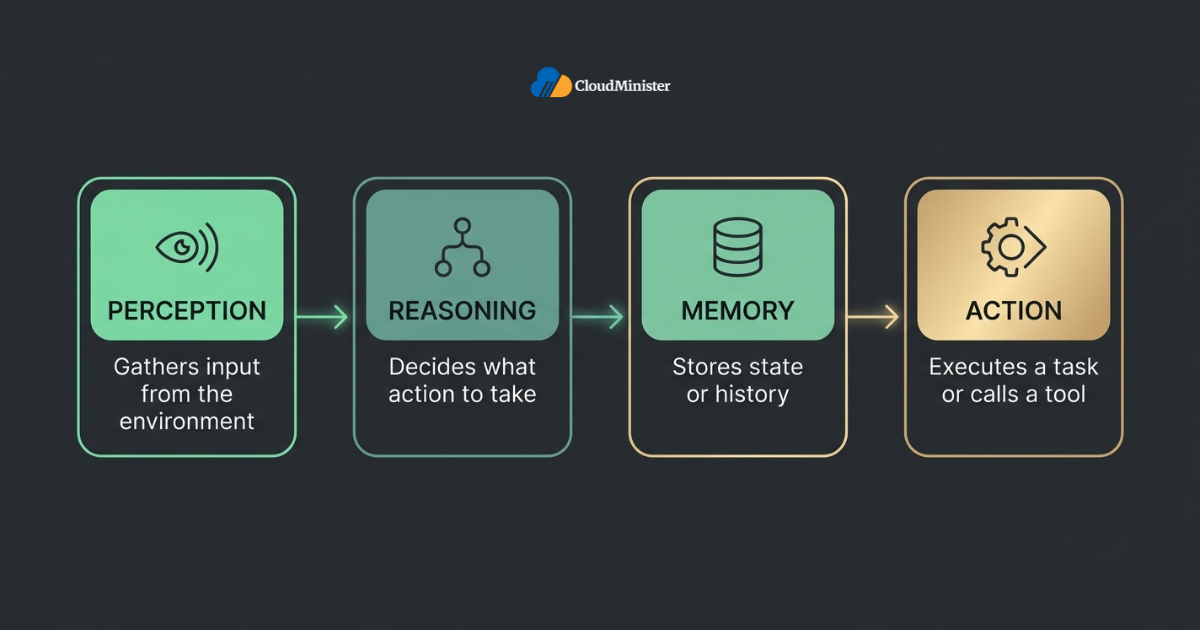
Before comparing these categories in detail, it helps to understand what actually separates one type from another. Every AI agent, regardless of category, is built from the same four functional components, but how each component is implemented is what defines each category.
| Component | What It Does | How It Differs Across Agent Categories |
| Perception | Gathers input from the environment or user | Reflex agents react to raw input; learning agents interpret input using a trained model |
| Reasoning | Decides what action to take | Ranges from fixed if-then rules to complex multi-step planning |
| Memory | Stores state or history | Absent in simple reflex agents, central to model-based and learning agents |
| Action | Executes a task or calls a tool | Ranges from a single output to orchestrating multiple tools and sub-agents |
Most businesses new to agentic AI assume that more autonomy always means more value. In practice, the simplest agent category that reliably completes a well-scoped task usually delivers a faster return than a highly autonomous system that requires constant supervision. This holds true whether the underlying agent is deployed on a company’s own infrastructure, rented from a best GPU cloud hosting in India provider, or run through an AI Lab on Cloud environment built specifically for experimentation.
3. Simple Reflex Agents
3.1 What Simple Reflex Agents Actually Do
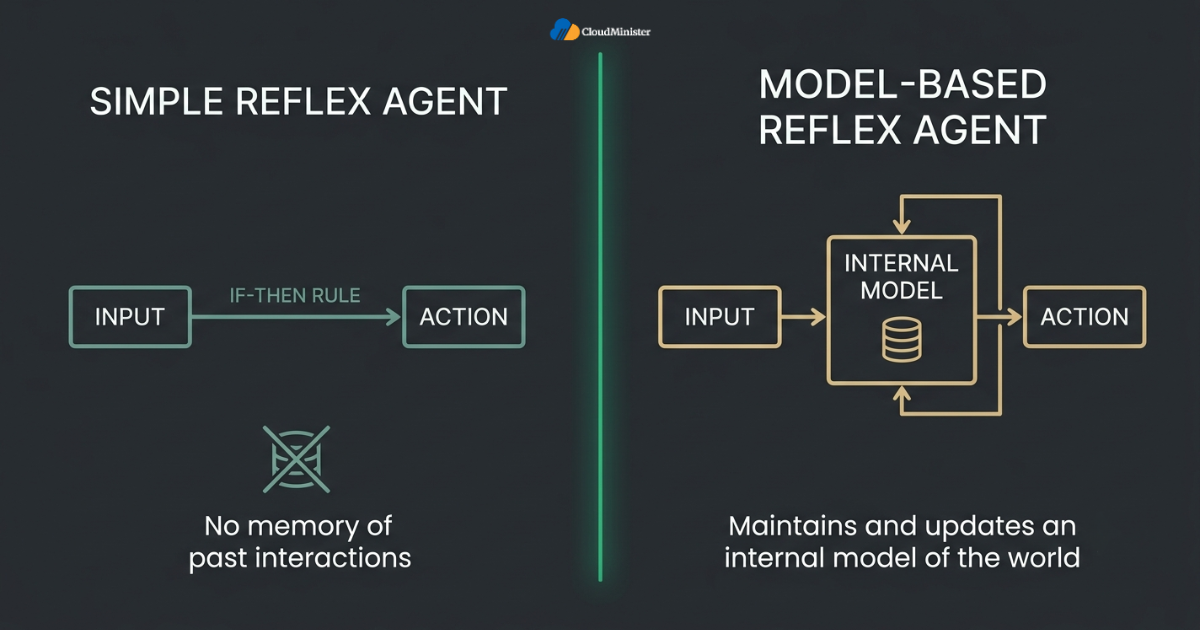
Simple reflex agents are the most basic among the Types of AI Agents. They operate on a straightforward condition-action rule: if a specific condition is detected, a fixed action is triggered. There is no memory of past interactions and no model of the wider environment.
- Rule-based chatbots that respond to specific keywords with a predefined answer
- Automated email filters that sort messages based on sender or subject line patterns
- Basic monitoring scripts that trigger an alert when a metric crosses a fixed threshold
- Simple customer support deflection bots that answer only a narrow, predefined set of questions
Because simple reflex agents lack memory and context, they can be manipulated more easily through adversarial input if not carefully scoped. When deploying any reflex-style agent that fall into this reflex category for customer-facing tasks, strict input validation is essential to prevent the agent from being tricked into unintended behavior.
3.2 When Simple Reflex Agents Are the Right Choice
- Tasks that are highly repetitive and rarely change
- Situations where predictable, auditable behavior matters more than flexibility
- Low-latency requirements where a full reasoning pipeline would add unnecessary delay
- Budget-constrained deployments where running a large model for every request is not justified
- Deployments running on modest, cost-conscious infrastructure such as an entry-level best GPU cloud hosting in India plan
Among all the categories covered here, this category is also the cheapest to run, since it typically does not require a large language model at all, and can often run on modest, right-sized infrastructure rather than a full GPU Server for AI.
4. Model-Based Reflex Agents
4.1 What Sets Model-Based Reflex Agents Apart
Model-based reflex agents are a step up in sophistication among the Types of AI Agents. Unlike simple reflex agents, they maintain an internal model of the world that is updated as new information arrives, which allows them to handle situations where the current input alone is not enough to decide on an action.
- Maintains an internal state that tracks relevant history, not just the current input
- Updates that internal state continuously as new observations come in
- Uses the internal model, combined with current perception, to choose an action
- Handles partially observable environments better than simple reflex agents can
Model-based reflex agents are a strong fit for applications like inventory management bots or fraud detection systems, where the agent needs to remember recent transaction patterns rather than evaluating each event in total isolation. Among the categories available today, this category strikes a useful balance between simplicity and context-awareness.
4.2 Common Business Applications
- Fraud detection systems that track transaction patterns over a rolling time window
- Inventory management agents that factor in recent demand trends before reordering stock
- Network monitoring agents that maintain a baseline of normal behavior to detect anomalies
- Customer service agents that remember earlier turns within a single conversation session
Related reading: How AI Agents Are Evolving Beyond Chatbots
5. Goal-Based Agents
5.1 How Goal-Based Agents Reason Differently
Goal-based agents represent a meaningful jump among the Types of AI Agents because they do not just react to input, they plan. Given a defined objective, a goal-based agent evaluates possible sequences of actions and selects the path most likely to achieve that objective.
- Defines a clear target state or outcome before taking any action
- Searches or plans across multiple possible action sequences
- Selects the sequence most likely to reach the goal, not just the next best single step
- Can adjust its plan mid-execution if the environment changes
5.2 Where Goal-Based Agents Deliver Value
- Route planning and logistics optimization agents
- Automated coding agents that plan a sequence of edits to reach a working implementation
- Task-planning assistants that break a broad request into an ordered set of sub-tasks
- Supply chain agents that plan procurement steps toward a target inventory level
Goal-based agents typically require more compute than simple or model-based reflex agents, since planning across multiple possible action paths is computationally expensive. This is one of the reasons that among these categories, goal-based systems are frequently deployed on a dedicated GPU Server for AI rather than shared, unpredictable infrastructure, where planning latency needs to stay consistent.
Test Every Agent Type Before You Commit to Infrastructure
Not sure which Types of AI Agents fit your workload? CloudMinister’s AI Lab on Cloud gives you a fully managed sandbox with pre-configured GPU servers, TensorFlow, PyTorch, and Jupyter to prototype reflex, goal-based, or multi-agent systems, before you scale onto dedicated production infrastructure.
6. Utility-Based Agents
6.1 What Makes Utility-Based Agents Different
Utility-based agents extend the goal-based approach by weighing multiple possible outcomes against each other rather than pursuing a single fixed goal. Among the Types of AI Agents, this category is built for situations where several valid outcomes exist and the agent must choose the one that maximizes overall value.
- Assigns a utility score to each possible outcome based on defined criteria
- Balances competing objectives, such as cost versus speed versus accuracy
- Selects the action that produces the highest expected utility, not just any path to a goal
- Handles trade-offs explicitly, rather than treating every goal as equally important
Utility-based agents are especially useful in financial and pricing applications, where a single “correct” answer rarely exists and the agent instead needs to balance multiple weighted factors. Businesses evaluating agent options for dynamic pricing or portfolio management should look closely at this category first.
6.2 Business Use Cases for Utility-Based Agents
- Dynamic pricing agents that balance revenue, inventory levels, and competitor pricing
- Portfolio management agents that weigh risk against expected return
- Resource allocation agents that balance cost, performance, and reliability across a cloud footprint
- Ad bidding agents that balance budget constraints against expected conversion value
Among the Types of AI Agents, utility-based systems tend to be the most compute-intensive at inference time, since they must evaluate and score multiple candidate actions before selecting one, which makes right-sized, dedicated infrastructure like a Dedicated NVIDIA GPU Server available through Cloudminister’s best GPU cloud hosting in India offering a practical foundation to build on.
7. Learning Agents
7.1 How Learning Agents Improve Over Time
Learning agents are among the most advanced of the Types of AI Agents because they are designed to improve their own performance based on feedback, rather than relying on a fixed rule set or a static model. A learning agent typically has four internal elements working together.
- A performance element that decides which action to take, similar to other agent categories
- A critic that evaluates how well the chosen action performed against a defined standard
- A learning element that adjusts the agent’s behavior based on that feedback
- A problem generator that suggests new actions to explore, improving performance over time
Learning agents that continuously update their own behavior need careful monitoring in production. Among these categories, this category carries the highest risk of behavioral drift if feedback signals are noisy, biased, or manipulated, so human oversight and periodic evaluation against a fixed benchmark are non-negotiable.
7.2 Where Learning Agents Are Already in Production
- Recommendation engines that refine suggestions based on ongoing user interaction
- Personalized customer support agents that improve response quality based on satisfaction signals
- Automated trading agents that adjust strategy based on realized outcomes
- Content moderation agents that improve accuracy as they process more edge cases
Related reading: How GPU Servers Enhance AI and Machine Learning
8. Multi-Agent Systems
8.1 Why Multi-Agent Systems Are Their Own Category
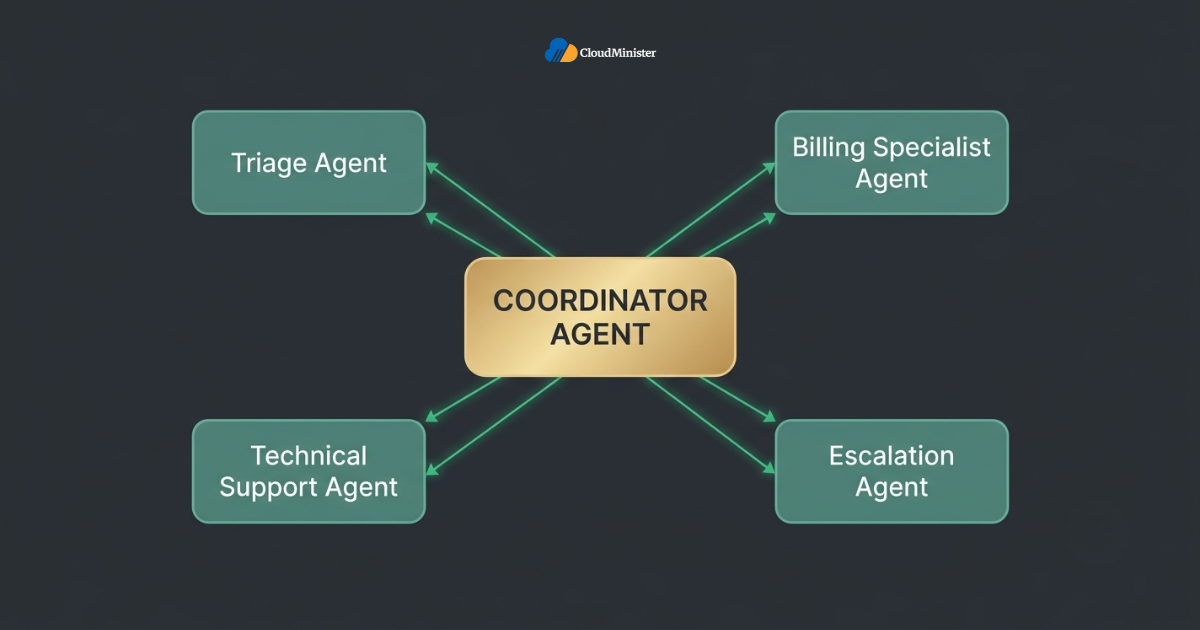
Multi-agent systems are not a single agent architecture but a coordination layer across several agent categories working together, each handling a distinct sub-task. This category has grown rapidly in 2026 as businesses move beyond single-purpose bots toward orchestrated workflows.
- Multiple specialized agents, each built as one of the earlier Types of AI Agents, collaborate on a shared objective
- A coordinator or orchestrator agent routes tasks to the appropriate specialist agent
- Agents communicate through shared memory, message passing, or a shared tool environment
- The system as a whole can handle far more complex workflows than any single agent could alone
When designing a multi-agent system, resist the temptation to make every sub-agent a fully autonomous learning agent. Mixing agent categories deliberately, using simple reflex agents for narrow sub-tasks and goal-based or learning agents only where genuinely needed, keeps the system easier to debug, cheaper to run, and more predictable overall.
8.2 Business Applications of Multi-Agent Systems
- Agentic customer service pipelines where a triage agent routes to specialist agents for billing, technical support, or escalation
- Software development pipelines where separate agents handle planning, coding, testing, and deployment
- Research and analysis pipelines where one agent gathers data and another synthesizes findings
- Automated marketing pipelines where agents handle content generation, scheduling, and performance analysis separately
Related reading: AI in DevOps — How Machine Learning Is Changing CI/CD
Running multi-agent systems reliably at scale is where infrastructure choice becomes critical. Because several agents may be active simultaneously, each consuming GPU memory and compute, businesses evaluating agent options for multi-agent deployment need infrastructure that can handle concurrent, unpredictable load without noisy-neighbour contention, which is precisely the gap that a Dedicated NVIDIA GPU Server or a well-configured AI Lab on Cloud environment is built to close.
9. Matching Types of AI Agents to Business Workloads
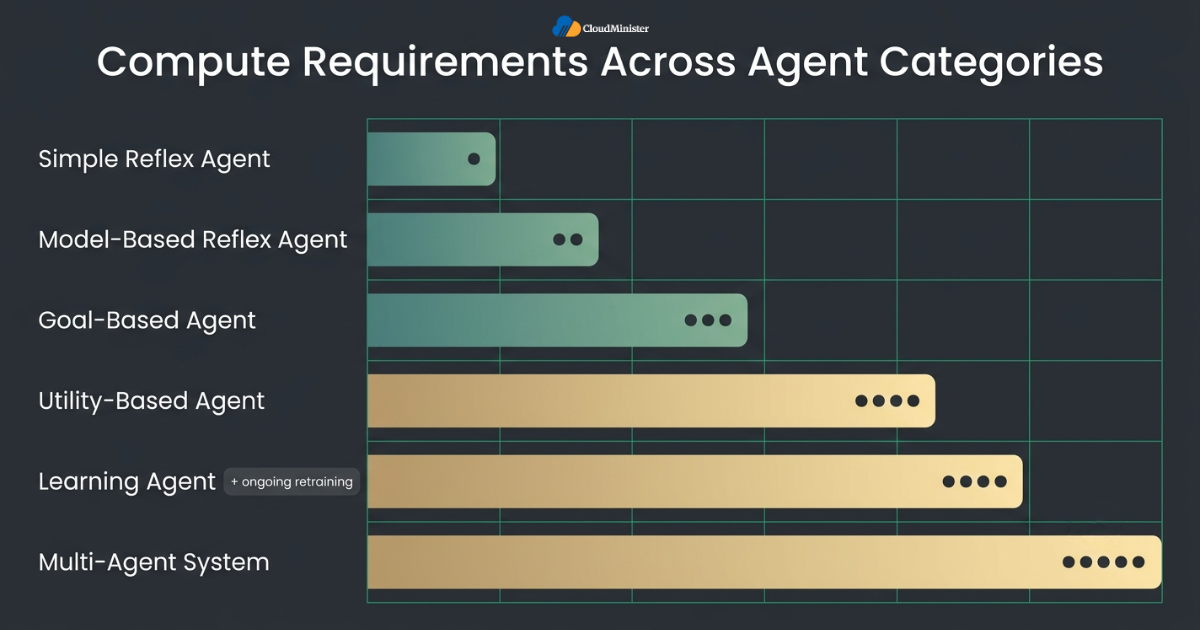
Choosing correctly among the Types of AI Agents requires mapping agent category to actual business need, rather than defaulting to whichever architecture is currently trending. The table below summarizes how each of the Types of AI Agents lines up against common workload characteristics.
| Type of Agent | Compute Need | Latency Sensitivity | Best Fit Workload |
| Simple reflex agent | Low | Very low latency required | Repetitive, narrowly scoped tasks |
| Model-based reflex agent | Low to moderate | Low latency required | Tasks needing short-term context |
| Goal-based agent | Moderate to high | Moderate latency tolerance | Planning and multi-step workflows |
| Utility-based agent | High | Moderate latency tolerance | Trade-off heavy decision-making |
| Learning agent | High, plus ongoing retraining | Varies by task | Systems that must improve over time |
| Multi-agent system | Highest, concurrent load | Varies by orchestration design | Complex, multi-step business processes |
A common mistake businesses make when evaluating the Types of AI Agents is choosing the most sophisticated option available rather than the most appropriate one. A goal-based agent applied to a task a simple reflex agent could handle wastes compute budget and adds unnecessary latency, while a simple reflex agent applied to a task that genuinely needs planning will underperform and frustrate users.
10. Infrastructure Decisions Behind Running the Types of AI Agents at Scale
10.1 Why Shared, Consumer-Grade Infrastructure Undermines Agentic Workloads
- Noisy-neighbour contention: Shared GPU instances can slow down unpredictably when other tenants spike, which is especially disruptive for latency-sensitive agents such as real-time customer service bots
- Limited control over framework versions: Many agent categories depend on specific orchestration frameworks and tool-calling libraries that shared, generic hosting environments may not support cleanly
- Inconsistent networking: Multi-agent systems rely on fast communication between agents and tools, something budget shared hosting rarely guarantees consistently
- Unclear data residency: Businesses running any agent category on regulated customer data need clear residency guarantees, which are difficult to verify on anonymous shared marketplaces
10.2 Dedicated Infrastructure as the Foundation for Reliable Agent Deployment
A Dedicated NVIDIA GPU Server, available through Cloudminister’s best GPU cloud hosting in India offering, removes the variability that makes running the Types of AI Agents unreliable on shared infrastructure.
- Guaranteed GPU allocation so multi-agent workloads and learning agents get consistent, measurable performance
- Full control over the exact framework and orchestration versions each category depends on
- Predictable monthly costs, which matters more with agentic workloads than with simple inference, since agent chains can call a model multiple times per task
- High-speed local storage for faster checkpoint loading when learning agents need to retrain or fine-tune
RELATED READING: Akamai Cloud Inference for AI Acceleration at the Edge
10.3 AI Lab on Cloud – A Sandbox for Testing Different Types of AI Agents
Before committing to a specific architecture in production, most teams benefit from testing multiple Types of AI Agents in a controlled environment first. An AI Lab on Cloud gives teams exactly that, a pre-configured environment for experimenting with different agent frameworks without provisioning permanent infrastructure for every test.
- Rapid experimentation across several agent categories without long procurement cycles
- Pre-installed frameworks and tooling so teams can prototype goal-based, utility-based, or multi-agent systems quickly
- A cost-effective way to validate which category actually fits a workload before scaling it onto dedicated infrastructure
- A practical middle step between a laptop prototype and a full production deployment, functioning much like an AI Lab as a Service for teams that do not want to manage infrastructure directly
Cloudminister’s AI Lab on Cloud is built specifically for this kind of exploratory work, giving teams a cloud ai lab environment where different agent categories can be trialed side by side before any long-term infrastructure commitment is made.
10.4 Choosing a Web Hosting Company in India for Agentic AI Infrastructure
Indian businesses evaluating the Types of AI Agents for their own operations have specific reasons to choose infrastructure hosted domestically rather than routing every request overseas.
- Lower latency to Indian end users compared to routing agent requests through an overseas region, which matters most for latency-sensitive agent deployments
- Simpler alignment with India’s Digital Personal Data Protection Act (DPDPA) requirements for agents processing personal data of Indian citizens, since a Web Hosting Company in India operating domestic data centres can support in-country data residency as part of a broader compliance approach, though DPDPA compliance also depends on the business’s own data handling practices, consent mechanisms, and processing agreements
- INR-denominated billing removes currency volatility from budget planning for growing businesses experimenting with several agent categories at once, a benefit any established Web Hosting Company in India in the market can typically confirm
- Local support teams from a Web Hosting Company in India who understand India-specific compliance and hosting requirements that an overseas provider often cannot match
- A Web Hosting Company in India billing everything in rupees also simplifies procurement approvals for growing businesses, and a Web Hosting Company in India with local data centres shortens support response times too
- A Web Hosting Company in India that also offers an AI Lab on Cloud and dedicated GPU Servers for AI gives growing businesses a single vendor relationship instead of splitting infrastructure across multiple overseas providers
Cloudminister, as a Web Hosting Company in India, provides exactly this combination of domestic hosting, dedicated GPU infrastructure, and a ready-to-use AI Lab on Cloud for businesses evaluating which category fits their operations. Businesses that switch to a domestic Web Hosting Company in India for these workloads often see the compliance and latency benefits within the first billing cycle, well before any deeper AI Lab on Cloud evaluation begins.
10.5 GPU Server for AI, AI Lab as a Service, and Cloud AI Lab Options Compared
Businesses researching infrastructure for the Types of AI Agents will encounter several closely related terms, and it helps to know how each one fits into the picture.
- A GPU Server for AI is dedicated hardware, sized to a specific workload, whether that workload is a lightweight reflex agent or a compute-heavy multi-agent pipeline
- An AI Lab as a Service model gives teams a managed, ready-to-use environment for experimentation without owning or provisioning a GPU Server for AI outright
- A cloud ai lab is the practical expression of AI Lab as a Service, a hosted workspace where multiple agent architectures can be tested side by side before any GPU Server for AI is committed to production
- Choosing between a dedicated GPU Server for AI and an AI Lab as a Service model usually comes down to how far along a project is: early experimentation favors a cloud ai lab, while production workloads favor a dedicated GPU Server for AI
Teams that skip the AI Lab as a Service stage and jump straight to provisioning a dedicated GPU Server for AI often over-provision, since they have not yet measured real usage. Running early tests inside a cloud ai lab first, then scaling proven architectures onto a GPU Server for AI, keeps both cost and risk lower.
- A GPU Server for AI purchased or rented too early, before workload patterns are known, is one of the most common budget mistakes businesses make when scaling agentic AI
- An AI Lab as a Service subscription is typically billed on a much shorter cycle than a GPU Server for AI lease, making it the lower-risk starting point
- Once a business has validated an architecture inside a cloud ai lab, migrating to a dedicated GPU Server for AI is usually a straightforward infrastructure decision rather than a research question
- Some providers bundle an AI Lab as a Service offering directly with their dedicated infrastructure lineup, so teams can move from experimentation to production without changing vendors
- A cloud ai lab environment paired with the right GPU Server for AI tier gives a business the full spectrum, from cheap experimentation to guaranteed, dedicated production capacity
Cloudminister’s own AI Lab on Cloud functions as this kind of AI Lab as a Service, giving Indian businesses a cloud ai lab environment backed by the same infrastructure team that operates its GPU Server for AI lineup and its broader best GPU cloud hosting in India offering, all under a single Web Hosting Company in India relationship.
Businesses evaluating a Web Hosting Company in India for agentic workloads should confirm that both the AI Lab as a Service tier and the best GPU cloud hosting in India lineup are operated by the same infrastructure team. A disjointed setup, where the cloud ai lab and the production best GPU cloud hosting in India plans sit with different vendors, tends to slow down the transition from prototype to production and complicates support when something goes wrong.
11. A Step-by-Step Framework for Adopting the Right Types of AI Agents
Phase 1: Map the Workload Before Choosing (Week 1)
- List every candidate task and classify it by complexity, latency tolerance, and required autonomy
- Match each task against the agent category table in Section 9 before writing any code
- Segment tasks by risk level, since regulated or high-stakes tasks generally call for more conservative agent categories with strong human-in-the-loop controls
Phase 2: Prototype in a Sandbox (Weeks 2–3)
- Use an AI Lab on Cloud environment to test two or three candidate architectures against the same task before committing
- Measure latency, accuracy, and cost per completed task for each candidate architecture
- Involve the actual end users of the agent early, since real usage patterns often reveal which category genuinely fits the workflow
Phase 3: Right-Size Infrastructure (Weeks 3–5)
- Move the selected architecture off shared or general-purpose infrastructure onto a Dedicated NVIDIA GPU Server where performance can be measured and trusted
- Choose a GPU Server for AI configuration matched to the specific agent category being deployed, since simple reflex agents and multi-agent systems have very different compute footprints
- Confirm the hosting provider offers the driver and framework control that more advanced agent categories depend on
Phase 4: Deploy With Monitoring (Weeks 5–6)
- Set up dashboards tracking task success rate, latency, and cost per completed task from day one
- For learning agents, monitor for behavioral drift on a recurring schedule, not just at launch
- For multi-agent systems, track handoffs between agents separately from overall task completion
Phase 5: Review and Repeat (Ongoing)
- Revisit which Types of AI Agents are deployed against which workloads on a quarterly basis, since models and frameworks evolve quickly
- Reassess whether a workload has outgrown its current agent category, for example a task that started with a simple reflex agent but now needs planning capability
- Treat this as a standing infrastructure review item rather than a one-time decision
Teams that get the most value from adopting agentic systems treat the decision the same way they treat any other infrastructure choice, as something to be measured, reviewed, and adjusted continuously rather than locked in permanently at the start of a project.
12. Common Mistakes When Choosing Among the Types of AI Agents
A Web Hosting Company in India that cannot clearly separate its AI Lab on Cloud tier from its production best GPU cloud hosting in India lineup often creates confusion for teams trying to plan a migration path.
- Defaulting to the most autonomous option: Businesses often assume a highly autonomous learning agent is always better than a simpler reflex or goal-based agent, when the simpler option would complete the task just as well at a fraction of the cost
- Ignoring latency requirements: Deploying a heavyweight, planning-intensive agent for a real-time chat interface can silently degrade user experience even when accuracy metrics look strong
- Underestimating multi-agent coordination overhead: Orchestrating several agent categories together introduces failure points at every handoff, which teams frequently underestimate during initial planning
- Skipping the sandbox stage: Committing directly to production infrastructure without first testing multiple agent categories in an AI Lab on Cloud environment often leads to costly rework later
- Ignoring vendor continuity: Splitting the AI Lab on Cloud experimentation phase and the eventual best GPU cloud hosting in India production phase across two different providers adds unnecessary migration friction
- Treating agent selection as permanent: Workloads change, and the Types of AI Agents chosen a year ago on a given best GPU cloud hosting in India plan are rarely still the optimal choice today
13. Readiness Checklist for Deploying the Types of AI Agents
- Workload mapped: Every candidate task classified by complexity, latency tolerance, and required autonomy before any architecture is chosen
- Sandbox testing completed: Multiple Types of AI Agents trialed in an AI Lab on Cloud or equivalent sandbox environment before committing to production infrastructure
- Infrastructure right-sized: Compute matched to the specific agent category being deployed, whether that means a GPU Server for AI tuned for lightweight reflex agents or a Dedicated NVIDIA GPU Server for compute-heavy multi-agent systems
- Governance in place: Human-in-the-loop controls defined for any agent category operating with meaningful autonomy, especially learning agents and multi-agent systems
- Monitoring configured: Dashboards tracking task success rate, latency, and cost per completed task active from day one
- Hosting provider verified: Confirmed that the chosen Web Hosting Company in India or global provider offers the driver control, networking, and AI Lab on Cloud access the deployment plan depends on
- Sandbox access confirmed: The business has hands-on access to an AI Lab on Cloud or equivalent cloud ai lab before committing to dedicated production infrastructure
- Vendor consistency checked: The same Web Hosting Company in India operates both the AI Lab on Cloud tier and the best GPU cloud hosting in India plan the business plans to scale onto
- Review cadence set: A recurring quarterly review scheduled to reassess whether the current mix of agent categories still matches actual business workloads
Key Takeaways
- The Types of AI Agents span a spectrum from simple reflex agents to fully autonomous multi-agent systems, and matching the right category to the right task is the single biggest factor in agentic AI project success
- Enterprise adoption of the Types of AI Agents has accelerated sharply, with Gartner reporting that 80 percent of enterprise applications updated in the first quarter of 2026 now embed at least one AI agent
- Simple reflex and model-based reflex agents remain the right choice for repetitive, low-latency tasks, despite being the least sophisticated among these categories
- Goal-based and utility-based agents suit planning-heavy and trade-off-heavy decisions but require significantly more compute than reflex-based agents
- Learning agents and multi-agent systems represent the most advanced Types of AI Agents available today, but they also carry the highest infrastructure and governance requirements
- Multi-agent systems introduce coordination overhead at every handoff between agents, a cost businesses frequently underestimate when they first move beyond a single-agent setup
- An AI Lab on Cloud environment gives teams a low-risk way to prototype different agent categories before committing to production infrastructure
- A Dedicated NVIDIA GPU Server, paired with a trusted best GPU cloud hosting in India provider, gives the guaranteed allocation and driver control that reliable deployment of the more advanced Types of AI Agents requires
- A cloud ai lab or AI Lab as a Service subscription is the lowest-risk way to prototype before scaling onto a dedicated best GPU cloud hosting in India plan
- Governance and human-in-the-loop controls are non-negotiable for learning agents and multi-agent systems, since both categories carry the highest risk of unpredictable or drifting behavior
- Infrastructure decisions, not just model choice, determine whether the more advanced Types of AI Agents perform consistently once they move from prototype into daily production use
- This is a continuous evaluation process, not a one-time architecture decision, and businesses that revisit their agent mix regularly consistently outperform those that do not
Not Sure Which AI Agent Infrastructure Fits Your Business?
Every agent category comes with different compute, latency, and hosting needs. Talk to CloudMinister’s infrastructure experts to map your workload to the right GPU server, AI Lab, or hosting plan, backed by 24/7 support and India-based data centers.
Conclusion
Understanding the Types of AI Agents is no longer optional for any business planning its AI roadmap in 2026. As enterprise adoption accelerates and agentic systems move from pilot projects into core business workflows, the companies that correctly match each of the Types of AI Agents to the right task, backed by the right infrastructure, will scale faster and more reliably than those still treating every agent as interchangeable. Businesses that skip this evaluation step and simply deploy whichever architecture is trending tend to discover the mismatch only after the project has already consumed significant budget and engineering time. A clear-eyed assessment of task complexity, latency tolerance, and required autonomy at the very start of a project saves far more time and money than any amount of optimization applied after the fact.
The path forward is clear even if the execution takes discipline. Map the workload honestly before writing a single line of code, prototype across the relevant Types of AI Agents in a proper sandbox rather than guessing, right-size infrastructure once real usage patterns are known rather than provisioning for a worst case that may never arrive, and revisit the decision regularly as models, frameworks, and business needs evolve. Businesses that build this review cycle into their standard operating rhythm, the same way they already review application performance or cloud spend, consistently get more value out of every agent they deploy. Treating agent selection as a living decision rather than a one-time architecture choice is what separates teams that scale agentic AI successfully from those still stuck reworking failed pilots a year later.
Cloudminister supports this entire journey with a Web Hosting Company in India, dedicated best GPU cloud hosting in India, and a purpose-built AI Lab on Cloud for businesses that want to evaluate the Types of AI Agents properly before scaling. Whether a business needs a cloud ai lab for early experimentation, an AI Lab as a Service subscription for ongoing prototyping, or a fully dedicated GPU Server for AI for production, working with a single Web Hosting Company in India for all three keeps the transition simple and the billing predictable. As the Types of AI Agents continue to mature through 2026 and beyond, businesses that pair the right architecture with the right infrastructure partner will be the ones turning agentic AI from an experiment into a durable competitive advantage.
Frequently Asked Questions
What are the main Types of AI Agents businesses should know about?
The main Types of AI Agents are simple reflex agents, model-based reflex agents, goal-based agents, utility-based agents, learning agents, and multi-agent systems. Each category differs in how much memory, planning, and autonomy it uses, and each is suited to a different range of business tasks, from narrow repetitive automation to complex, multi-step workflows.
Why has understanding the Types of AI Agents become more important in 2026?
Agentic AI has moved from experimentation into core enterprise workflows, with Gartner reporting that 80 percent of enterprise applications updated in the first quarter of 2026 embed at least one AI agent. As adoption accelerates, choosing the right category has a direct impact on cost, reliability, and whether an AI initiative delivers measurable business value.
Which of the Types of AI Agents should a business start with?
Most businesses see the fastest, lowest-risk results starting with simple reflex or model-based reflex agents for well-defined, repetitive tasks, since these categories are the cheapest to run and easiest to govern. More advanced categories, such as goal-based, utility-based, learning, and multi-agent systems, are best introduced once a business has validated value with simpler architectures first.
Does deploying advanced Types of AI Agents require dedicated GPU infrastructure?
It is not strictly required for every category, but compute-intensive agents, such as utility-based agents, learning agents, and multi-agent systems, benefit significantly from a Dedicated NVIDIA GPU Server, since it removes noisy-neighbour contention and gives teams full control over the frameworks these agents depend on.
How often should a business reassess its chosen Types of AI Agents?
Businesses should reassess their mix of Types of AI Agents on a quarterly basis, and whenever a workload’s complexity, volume, or latency requirements change materially. Treating agent selection as a one-time decision rather than a continuous evaluation process is one of the most common mistakes businesses make when scaling agentic AI.
Should a business start with an AI Lab as a Service or go straight to dedicated infrastructure?
Most businesses should start with an AI Lab as a Service subscription or a cloud ai lab, since it allows testing multiple agent architectures without committing to a dedicated GPU Server for AI upfront. A Web Hosting Company in India that offers both an AI Lab on Cloud tier and a best GPU cloud hosting in India lineup makes this transition from prototype to production far simpler, since the AI Lab as a Service environment and the eventual GPU Server for AI sit with the same provider.

Shivlendra Singh Jadoun is a Cloud & DevOps Engineer at CloudMinister Technologies, specializing in AWS, Azure, and GCP infrastructure. He began his career in Linux system administration, managing shared, VPS, and dedicated servers before moving into cloud and automation. He is AWS Certified and works extensively with Docker, Kubernetes, Terraform, Ansible, and Jenkins to build CI/CD pipelines and scalable, secure cloud environments. With hands-on experience across hosting, server security, and DevOps automation, he brings real-world engineering insight to every article he writes.