


NVIDIA Rubin is now in full production, but cloud access in India is still thin, and early capacity usually goes to the largest buyers first. For most Indian AI teams the safest plan is to rent H100 or Blackwell capacity on short terms today, keep workloads portable, and move to Rubin when supply and pricing settle. This guide explains NVIDIA Rubin vs Blackwell vs H100 in plain language, covering memory, bandwidth, LLM inference cost per token, 2026 rental trends, IndiaAI subsidies, and GPU Monitoring. It also shows where a Web Hosting Company in India and the best GPU cloud hosting providers fit into your decision.
Every AI team in India is asking the same thing this quarter. NVIDIA has put Rubin into full production, Blackwell racks are going live in data centres around the world, and the H100 is still the card most people can actually get. So should you wait for the newest chip or rent what is available today? The honest answer on NVIDIA Rubin vs Blackwell is that it depends on your workload, your budget, and how long you can afford to stand still.
Waiting feels safe, but it has a cost. Models you could be training or serving today stay on the shelf, and the rental market has not been getting cheaper in 2026. This guide breaks down NVIDIA Rubin vs Blackwell vs H100 using published specifications, current rental prices, and the practical needs of Indian teams, from IndiaAI subsidies to data residency. It also explains why the best GPU cloud hosting in India is not always the one with the newest chip.
You will learn what each generation really offers, how to think about LLM inference cost per token, how GPU Monitoring protects your budget, and how to compare providers of GPU Servers for AI. Whether you run a startup, a research lab, or an enterprise AI unit, the goal is a decision you can defend in front of your finance team. Every point below is written so you can scan the NVIDIA Rubin vs Blackwell facts quickly and act on them with a trusted Web Hosting Company in India.
Table of Contents
- Why the Latest NVIDIA GPU Choice Matters for Indian AI Teams Right Now
- NVIDIA H100 in 2026: What It Still Does Well
- NVIDIA Blackwell: B200 and B300 Explained
- NVIDIA Rubin: What Is Confirmed and What Is Still a Claim
- Spec Comparison: H100, B200, B300 and Rubin
- Memory, Bandwidth, and Model Fit: The Specs That Decide Speed
- LLM Inference Cost Per Token: Where New Hardware Really Helps
- The Real Price of Waiting: What the 2026 Rental Market Shows
- GPU Monitoring: Protect Your Budget Whichever Chip You Pick
- India Specific Factors: Subsidies, Data Rules, and Power
- When Renting Blackwell or H100 Now Makes Sense
- When Waiting for Rubin Makes Sense
- Choosing the Best GPU Cloud Hosting in India
- A Practical 30 Day Plan
- Key Takeaways
- Conclusion
- Frequently Asked Questions
1. Why NVIDIA Rubin vs Blackwell Matters for Indian AI Teams Right Now
NVIDIA now ships a new data centre platform almost every year, which means something faster is always around the corner. For an Indian team that budgets in rupees and often depends on a Web Hosting Company in India for infrastructure, guessing wrong is expensive. The debate around NVIDIA Rubin vs Blackwell is really a question about timing and risk, not only about speed, and the choice of the best GPU cloud hosting in India depends on it.
- NVIDIA Rubin is the newest platform, built on TSMC 3nm with HBM4 memory, and NVIDIA has said it is in full production.
- Blackwell is the current volume platform, with the B200 and the higher memory B300 (Blackwell Ultra) offered by cloud providers. Providers of GPU Servers for AI list both today.
- The H100 is a Hopper generation GPU from 2022, and it is still the most widely rented card for training and serving. Most best GPU cloud hosting plans include it.
- Being first to a new chip rarely wins a product race. Shipping a model that users can try usually matters more than NVIDIA Rubin vs Blackwell debates.
- New architectures reach large buyers first, so Indian teams should expect a gap between launch and local availability.
- Software takes time to catch up. Drivers, kernels, and inference engines need tuning before a new chip reaches its rated speed.
- Rental contracts are flexible, so picking the best GPU cloud hosting in India today does not stop you from moving to a newer chip later, so NVIDIA Rubin vs Blackwell stays a choice you can revisit.
- A good decision compares cost per useful result, not the biggest number on a datasheet. That is the lens we use for NVIDIA Rubin vs Blackwell throughout this guide.
2. NVIDIA H100 in 2026: What It Still Does Well
The H100 is built on the Hopper architecture and carries 80 GB of HBM3 memory with about 3.35 TB/s of bandwidth. It introduced FP8 support through the Transformer Engine, which made large model training and serving much faster than the A100 generation. Years of software tuning have made it the most predictable card in the market. That is why many teams that shop for GPU Servers for AI still start with H100 nodes, since tools, drivers, and tutorials are mature. Any fair view of NVIDIA Rubin vs Blackwell vs H100 has to start with this baseline.
- 80 GB of HBM3 memory and about 3.35 TB/s of memory bandwidth per GPU.
- Fourth generation NVLink at 900 GB/s per GPU for multi GPU training.
- Supports FP8, FP16, and BF16. It has no native FP4, which arrived with Blackwell. Many providers of GPU Servers for AI therefore still sell it in large numbers.
- SXM versions are rated up to 700 W, while PCIe versions draw less power. Your Web Hosting Company in India should confirm the exact form factor.
- A strong fit for serving 7B to 70B class models, using quantization or several GPUs for the larger ones. It is a common choice at the best GPU cloud hosting in India.
- Mature support in PyTorch, vLLM, TensorRT-LLM, and most other frameworks, which keeps LLM inference cost per token predictable.
- Widely available from specialist clouds, so setup is often a matter of hours, not months. Many best GPU cloud hosting plans still lead with H100 nodes. Most NVIDIA Rubin vs Blackwell comparisons still use it as the baseline.
- In October 2026, public listings show roughly 2 to 4 dollars per GPU hour on specialist clouds and marketplaces, and about 7 to 12 dollars at the large hyperscalers.
Before you rent anything, write down your model size, context length, and target requests per second. A card that looks cheap per hour can be expensive per result if it cannot hold your model in memory. This one habit helps you find the best GPU cloud hosting plan for your real workload.
3. NVIDIA Blackwell: B200 and B300 Explained
Blackwell is the architecture behind the B200 and the B300, which NVIDIA calls Blackwell Ultra. Both use a dual die design on TSMC 4NP with 208 billion transistors. The B200 carries 192 GB of HBM3e at about 8 TB/s, while the B300 raises capacity to 288 GB. Blackwell also added native FP4 support, which can lift inference throughput when a model tolerates 4 bit precision. When teams compare NVIDIA Rubin vs Blackwell, this is the generation they can rent today, and a Web Hosting Company in India with Blackwell nodes is where many of them will begin.
- B200: 192 GB of HBM3e memory with about 8 TB/s of bandwidth.
- B300: up to 288 GB of HBM3e, with bandwidth in the same 8 TB/s class. Many best GPU cloud hosting plans now list it.
- Fifth generation NVLink at 1.8 TB/s per GPU, which is double the H100.
- Supports FP4 (NVFP4) and FP6 alongside FP8, which suits modern low precision inference. The best GPU cloud hosting in India will list which precisions it supports.
- Power draw is far higher than the H100, with modules at around 1,000 W or more. Ask your Web Hosting Company in India about power and cooling.
- GB200 and GB300 NVL72 racks link 72 GPUs in one NVLink domain and need liquid cooling.
- Most clouds rent Blackwell as 8 GPU HGX nodes, not as full racks. Many GPU Servers for AI plans follow this layout.
- Blackwell nodes usually cost more per hour than the H100, but the LLM inference cost per token can still be lower.
- Good fit for large context serving, reasoning models, and training runs that are limited by memory. It is often the best GPU cloud hosting upgrade from the H100. Blackwell is the practical side of NVIDIA Rubin vs Blackwell for 2026 projects.
4. NVIDIA Rubin: What Is Confirmed and What Is Still a Claim
Rubin is NVIDIA’s next data centre platform, paired with the Vera CPU, which has 88 custom Arm cores. NVIDIA has described a dual die Rubin GPU with 336 billion transistors on TSMC 3nm, 288 GB of HBM4 memory, and about 22 TB/s of bandwidth. The company also quotes roughly 50 petaflops of FP4 inference per GPU and NVLink 6 at 3.6 TB/s per GPU. These are NVIDIA’s own figures, so treat them as vendor claims until independent tests appear. Any serious look at NVIDIA Rubin vs Blackwell should separate what is confirmed from what is only promised.
- Memory: 288 GB of HBM4 per GPU. HBM4 doubles the interface from 1024 to 2048 bits per stack. Ask the best GPU cloud hosting provider when it expects supply.
- Compute: NVIDIA quotes about 50 PFLOPS of FP4 inference per GPU, which is a low precision figure and not a general speed multiplier. Treat every NVIDIA Rubin vs Blackwell speed claim as a ceiling.
- Interconnect: NVLink 6 at 3.6 TB/s per GPU, double the Blackwell generation. Check that your GPU Servers for AI provider has a clear Rubin plan.
- Status: NVIDIA says Rubin is in full production, with first systems going to hyperscalers and large neoclouds in late 2026.
- Rubin Ultra is planned for 2027, so in the NVIDIA Rubin vs Blackwell story there will always be another chip on the roadmap.
- Rack scale Rubin systems need liquid cooling and heavy power, so data centre readiness will limit how fast supply grows. A Web Hosting Company in India must prove its cooling before it sells Rubin.
- Early capacity is likely to carry a price premium and tight allocation, even at the best GPU cloud hosting providers.
- Real gains will depend on software. Model, batch size, and framework support all change the result. Read NVIDIA Rubin vs Blackwell reviews only when precision and model match, and check LLM inference cost per token.
Related Reading: Comparison of Google TPU and NVIDIA GPU in 2026
5. NVIDIA Rubin vs Blackwell vs H100: Specification Comparison
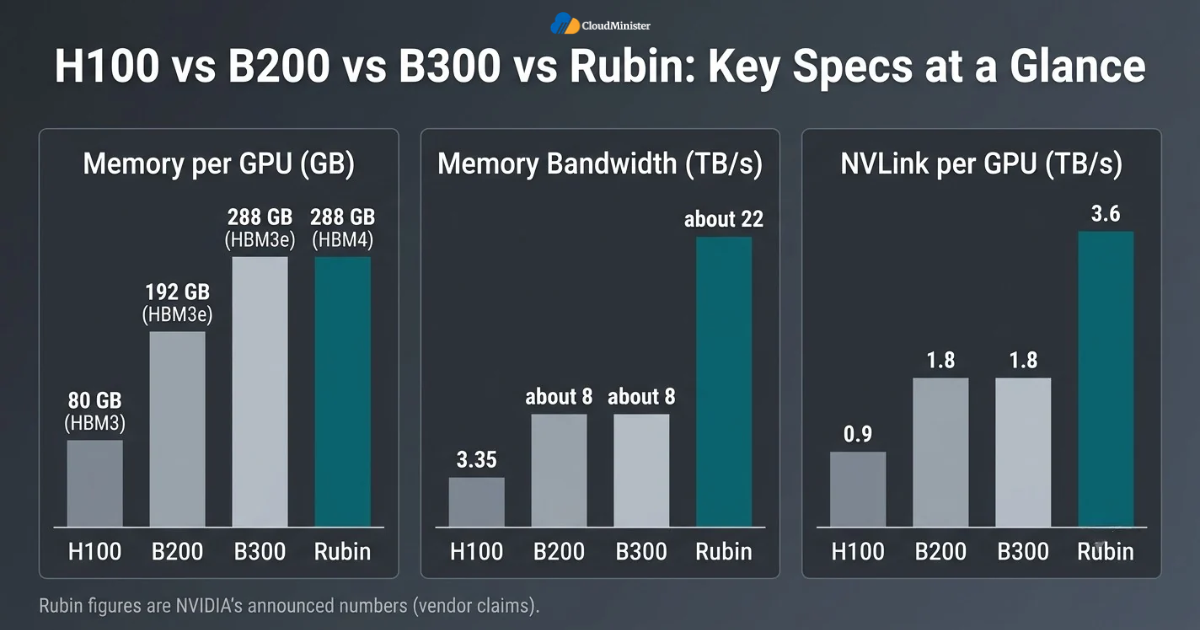
The table below puts the four chips side by side. Rubin figures are NVIDIA’s announced numbers, so they may change as final products and independent tests arrive. The comparison of NVIDIA Rubin vs Blackwell vs H100 shows the biggest jumps in memory bandwidth and interconnect speed, more than in memory capacity alone. Use it as a starting point when you ask a best GPU cloud hosting provider for quotes.
| Specification | H100 | B200 | B300 | Rubin |
| Architecture | Hopper | Blackwell | Blackwell Ultra | Rubin |
| Memory | 80 GB HBM3 | 192 GB HBM3e | 288 GB HBM3e | 288 GB HBM4 |
| Memory bandwidth | 3.35 TB/s | About 8 TB/s | About 8 TB/s | About 22 TB/s (NVIDIA figure) |
| NVLink per GPU | 900 GB/s | 1.8 TB/s | 1.8 TB/s | 3.6 TB/s |
| Lowest native precision | FP8 | FP4 | FP4 | FP4 |
| Process | TSMC 4N | TSMC 4NP | TSMC 4NP | TSMC 3nm |
| Status in October 2026 | Widely available | Available | Available | Full production, early rollout |
- The B200 has 2.4 times the H100’s memory, while the B300 and Rubin have 3.6 times.
- In NVIDIA Rubin vs Blackwell terms, Rubin’s bandwidth is about 2.75 times Blackwell’s and about 6.6 times the H100’s, based on NVIDIA’s numbers.
- NVLink bandwidth doubles with each step after the H100, from 900 GB/s to 1.8 TB/s to 3.6 TB/s.
- The H100 has no FP4 support, so FP4 comparisons only apply to Blackwell and Rubin. Ask your Web Hosting Company in India which of these four chips it can supply.
- Rubin and the B300 share the same 288 GB capacity, so Rubin’s edge is bandwidth, interconnect, and compute, not size. The best GPU cloud hosting providers will quote each one separately.
- Peak figures assume ideal conditions. Sustained throughput in production is lower. That matters when you read NVIDIA Rubin vs Blackwell charts.
- Compare nodes and racks as well as single GPUs, because networking decides multi GPU speed.
- Check every GPU Servers for AI listing for SXM or PCIe form factor, since the two perform differently. Use the NVIDIA Rubin vs Blackwell numbers above only for planning.
6. Memory, Bandwidth, and Model Fit: The Specs That Decide Speed
Memory decides whether a model fits, and bandwidth decides how fast tokens come out. Weights alone take the parameter count multiplied by bytes per parameter. A 70 billion parameter model needs about 140 GB at 16 bit precision, about 70 GB at 8 bit, and about 35 GB at 4 bit, before adding the KV cache that grows with context length and users. This is why memory matters more than any headline number when you weigh NVIDIA Rubin vs Blackwell.
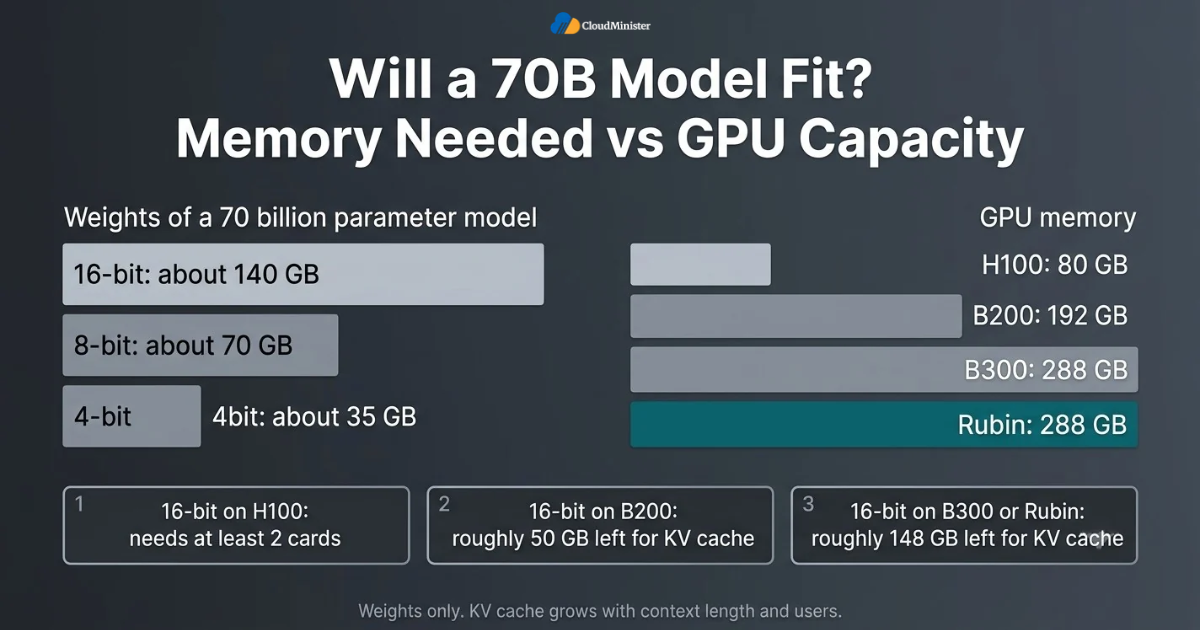
- At 16 bit, a 70B model needs about 140 GB for weights, so it needs at least two H100 cards, which leaves little room for the KV cache.
- On a single B200 with 192 GB, the same weights fit with roughly 50 GB left for the KV cache. Check the best GPU cloud hosting plans for B200 nodes.
- On 288 GB parts such as the B300 and Rubin, the same model leaves roughly 148 GB for context and concurrent users.
- At 8 bit, the 70B weights take about 70 GB, which barely fits on one 80 GB H100 with almost no space for long contexts.
- Decoding at small batch sizes is limited by memory bandwidth, so higher bandwidth raises tokens per second for single streams.
- Prefill, which processes the prompt, is limited by compute, so more compute helps long prompts.
- Splitting a model across GPUs adds communication cost, and faster NVLink reduces that cost. NVIDIA Rubin vs Blackwell gains in NVLink matter most here.
- The KV cache can grow to rival the weights in size at long context lengths and high concurrency. The best GPU cloud hosting providers will help you size this.
- Plan memory as weights plus KV cache plus working overhead, then test GPU Servers for AI with your own traffic. That test is the real NVIDIA Rubin vs Blackwell comparison for your team.
7. LLM Inference Cost Per Token: Where New Hardware Really Helps
For production AI, the number that matters is the LLM inference cost per token, not the hourly price of the card. You get it by dividing the hourly price by the tokens the GPU generates in an hour. As an illustration, a GPU rented at 3.70 dollars per hour that sustains 2,000 tokens per second produces 7.2 million tokens an hour, which is about 0.51 dollars per million tokens. A faster card with a higher hourly price can still win if its throughput rises by more than its price. This is where NVIDIA Rubin vs Blackwell turns into a money question. A Web Hosting Company in India that shares benchmark data makes this easy to check.
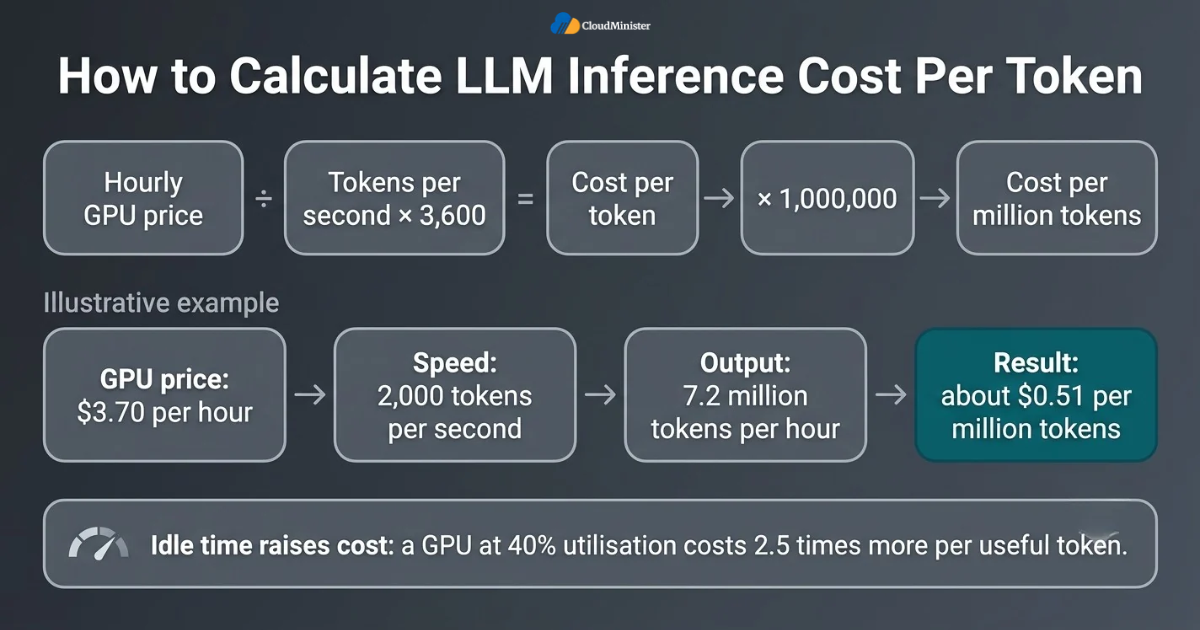
- Formula: hourly price divided by (tokens per second multiplied by 3,600) gives cost per token. Multiply by one million for cost per million tokens.
- Throughput depends on batch size, context length, quantization, and the serving engine, such as vLLM or TensorRT-LLM. Providers of GPU Servers for AI should share these settings.
- FP4 on Blackwell and Rubin can lower LLM inference cost per token when accuracy stays acceptable after testing.
- Higher bandwidth helps decoding, so in NVIDIA Rubin vs Blackwell terms Rubin is expected to improve LLM inference cost per token most for very large models and long contexts. Ask your Web Hosting Company in India for test runs.
- Measure on your own prompts. Vendor benchmark slides rarely match real traffic. Your own data decides NVIDIA Rubin vs Blackwell on cost.
- Track input and output tokens separately, because prefill and decode have different costs.
- Idle time raises the effective price. A GPU at 40 percent utilisation costs 2.5 times more per useful token. The best GPU cloud hosting providers make idle time easy to see.
- Compare providers on LLM inference cost per token and not on hourly price alone when you shortlist the best GPU cloud hosting.
Related Reading: Breakdown of cost per million tokens on a GPU server
8. The Real Price of Waiting: What the 2026 Rental Market Shows
Many teams assume that a new chip launch will push older GPU prices down. The 2026 data does not clearly show that. SemiAnalysis reported that one year H100 rental contract prices rose about 40 percent, from 1.70 dollars per GPU hour in October 2025 to 2.35 dollars by March 2026, as inference demand absorbed supply. Waiting for Rubin to make the H100 cheaper could cost you months with no model in production, and NVIDIA Rubin vs Blackwell headlines will not change that.
- On demand H100 listings in October 2026 range from about 2 to 12 dollars per GPU hour, depending on provider type. Track GPU Monitoring data to avoid paying for idle hours.
- Specialist clouds sit around 4 dollars per GPU hour, while large hyperscalers often list above 7 dollars.
- Some specialist providers raised H100 rates during 2026, so a falling price is not guaranteed. Check the best GPU cloud hosting in India for local rates in INR.
- Renting an H100 around the clock at 3 dollars per hour costs about 26,280 dollars a year.
- Buying an H100 is estimated at roughly 25,000 to 40,000 dollars per card, before servers, networking, power, cooling, and staff. Providers of GPU Servers for AI take on that cost for you.
- Rental suits uneven workloads, while owning only pays off when utilisation stays high for years. The best GPU cloud hosting in India offers hourly and monthly billing.
- Short contracts keep your option to move to Rubin when pricing settles. NVIDIA Rubin vs Blackwell supply will settle slowly.
- Early Rubin capacity is likely to cost more per hour, so check the LLM inference cost per token before you celebrate a faster chip.
- Prices change monthly, so always confirm a live quote from a best GPU cloud hosting provider.
Do not compare an on demand price with a one year commitment price as if they were the same product. Commitments lower the hourly rate but remove the freedom that makes waiting for Rubin easy to undo. Match the contract length to how sure you are about the workload, and ask any best GPU cloud hosting provider how early exit works.
9. GPU Monitoring: Protect Your Budget Whichever Chip You Pick
Whichever chip you choose, GPU Monitoring decides whether you get the performance you paid for. Teams often rent a powerful node and then run it at low utilisation because of slow data loading, small batches, or idle notebooks. Good GPU Monitoring shows utilisation, memory use, temperature, power draw, and error counts in one place, so you can fix waste before it shows up on a bill. Ask every provider of GPU Servers for AI what they expose. It also lets you check NVIDIA Rubin vs Blackwell claims on your own workload.
- Track utilisation and memory use per card. The NVIDIA tools nvidia-smi and DCGM both expose these.
- Export DCGM metrics to Prometheus and chart them in Grafana for shared dashboards. This is basic GPU Monitoring that every team can run.
- Watch temperature and power draw, since thermal throttling quietly cuts throughput. The best GPU cloud hosting in India includes thermal alerts.
- Track XID errors and ECC memory errors, because repeated errors point to a failing card. Good GPU Monitoring catches these early.
- Alert when utilisation stays low for a long period, so idle nodes get shut down. Your Web Hosting Company in India can set these alerts up for you.
- Log tokens per second and time to first token next to hardware metrics, so you can work out LLM inference cost per token for each model.
- Monitor NVLink and network throughput in multi node training to find communication bottlenecks. Providers of GPU Servers for AI should show these graphs.
- Review GPU Monitoring data every week, because small leaks add up over a month.
- The best GPU cloud hosting providers expose these metrics or let you install your own agents.
Related Reading: Practical guide on tracking GPU health for developers
10. India Specific Factors: Subsidies, Data Rules, and Power
Indian teams have options that teams elsewhere do not. A PIB government document from February 2026 states that the IndiaAI Mission had made more than 38,000 GPUs available at INR 65 per hour for startups, researchers, and students. That subsidy changes the maths for early stage work, and it is worth checking before you pay full market rates for the best GPU cloud hosting in India.
- Check IndiaAI Mission eligibility first, because subsidised hours can cover early experiments and training. Subsidised pools help you test before NVIDIA Rubin vs Blackwell decisions.
- Subsidised pools are shared and limited, so large or long running jobs may still need paid capacity.
- Data residency matters. Review your duties under the Digital Personal Data Protection Act 2023 before personal data leaves India.
- India based inference servers cut network delay for Indian users, which matters for chat and voice products. GPU Monitoring helps you track latency.
- INR billing with GST invoices makes accounting simpler than dollar billing from overseas. The best GPU cloud hosting in India can supply them.
- Rubin class racks need liquid cooling and high power, so local rollout depends on data centre readiness, which shapes NVIDIA Rubin vs Blackwell timing in India.
- Indic scripts often need more tokens per word with English focused tokenizers, so test LLM inference cost per token on your own language data. Use GPU Monitoring to log real token counts.
- A Web Hosting Company in India with local data centres can offer support in your time zone.
Treat model weights, training data, and API keys as production secrets on rented GPUs. Use private networking, encrypted storage, and role based access. Delete datasets and snapshots when a rental ends, and never keep unencrypted customer data on shared nodes.
11. When Renting Blackwell or H100 Now Makes Sense
Renting now is the better choice when you have a model to ship, a launch date, or paying users. The cost of waiting is certain, while the benefit of Rubin is uncertain and later. In the NVIDIA Rubin vs Blackwell decision, teams in this position get the most from a flexible plan with a trusted Web Hosting Company in India that also provides GPU Servers for AI.
- You have a product deadline within the next two quarters. In that case NVIDIA Rubin vs Blackwell should not block you.
- Your models already fit in H100 or B200 memory.
- You need India based hosting for latency or compliance. A Web Hosting Company in India can solve both.
- Your workloads are bursty, so hourly or monthly billing suits you better than a long commitment. Ask the best GPU cloud hosting in India for hourly plans.
- You are still testing product fit, and a heavy commitment would be a risk. Basic GPU Monitoring will show how much you really use.
- You use standard CUDA, PyTorch, and vLLM stacks, so containers can move to new hardware later. That keeps GPU Servers for AI easy to swap.
- Your LLM inference cost per token already fits what your pricing model supports.
- Use H100 for steady fine tuning and smaller models, and B200 or B300 for large context, high throughput serving. That split is the best GPU cloud hosting setup for many teams.
Related Reading: Guide to inference cost optimization.
12. When Waiting for Rubin Makes Sense
Waiting can be right, but only for a narrow group. If your project is large enough that Rubin’s bandwidth and rack scale design change what is possible, and your timeline gives you a long runway, it is worth planning for it. Even then, most teams should rent in the meantime rather than sit idle. A fair look at NVIDIA Rubin vs Blackwell should end with a plan for both. The best GPU cloud hosting providers will help you plan each step.
- You plan to train or serve models that need hundreds of GPUs in one NVLink domain next year. Few GPU Servers for AI plans can offer this today.
- Your product launch is more than 9 to 12 months away.
- Your demand is dominated by very large models where memory bandwidth is the bottleneck. GPU Monitoring will show if bandwidth is the real limit.
- You have a provider relationship that offers early access and clear pricing. The best GPU cloud hosting in India will give you a written plan.
- Your data centre partner can supply liquid cooling and the required power.
- You can prototype on current GPUs while waiting, so no time is lost. Re-run the NVIDIA Rubin vs Blackwell test before you switch.
- You accept that Rubin Ultra is planned for 2027, so waiting for the next chip never ends.
- You set a decision date and judge NVIDIA Rubin vs Blackwell against real availability and price, not announcements.
Put a quarterly review on the calendar. Ask your provider for a written quote on Rubin class capacity, and compare it with your current LLM inference cost per token before you decide to move.
13. Choosing the Best GPU Cloud Hosting in India
Not every GPU provider is built for serious AI work. When you look for the best GPU cloud hosting in India, judge the whole service, including networking, storage, support, and how openly the provider talks about availability. A Web Hosting Company in India with its own data centres and a dedicated GPU line can be a safer partner than a reseller with no local presence.
- Ask which exact GPUs are offered, how many per node, SXM or PCIe, and what network fabric connects them.
- Confirm storage type and speed, since slow storage starves expensive GPUs. Providers of GPU Servers for AI often list this on the plan page.
- Ask about billing options, such as hourly, monthly, or committed, and whether INR invoices with GST are available.
- Check support hours and the escalation path for node failures. Pick the best GPU cloud hosting in India that answers at night.
- Ask how NVIDIA Rubin vs Blackwell upgrades will be handled and on what terms.
- Confirm access to GPU Monitoring data, logs, and alerting.
- Verify data centre location, backup policy, and security practices. A good Web Hosting Company in India explains this clearly.
- Request a short trial using your own model, and measure LLM inference cost per token yourself.
- Ask for a real customer example. The best GPU cloud hosting providers can share one. Also ask how GPU Monitoring alerts reach your team.
14. A Practical 30 Day Plan
A plan beats a debate. Use the next thirty days to measure, test, and decide, so you are not guessing about NVIDIA Rubin vs Blackwell when a quote lands in your inbox. Pair the plan with one of the GPU Servers for AI providers that can scale up or down.
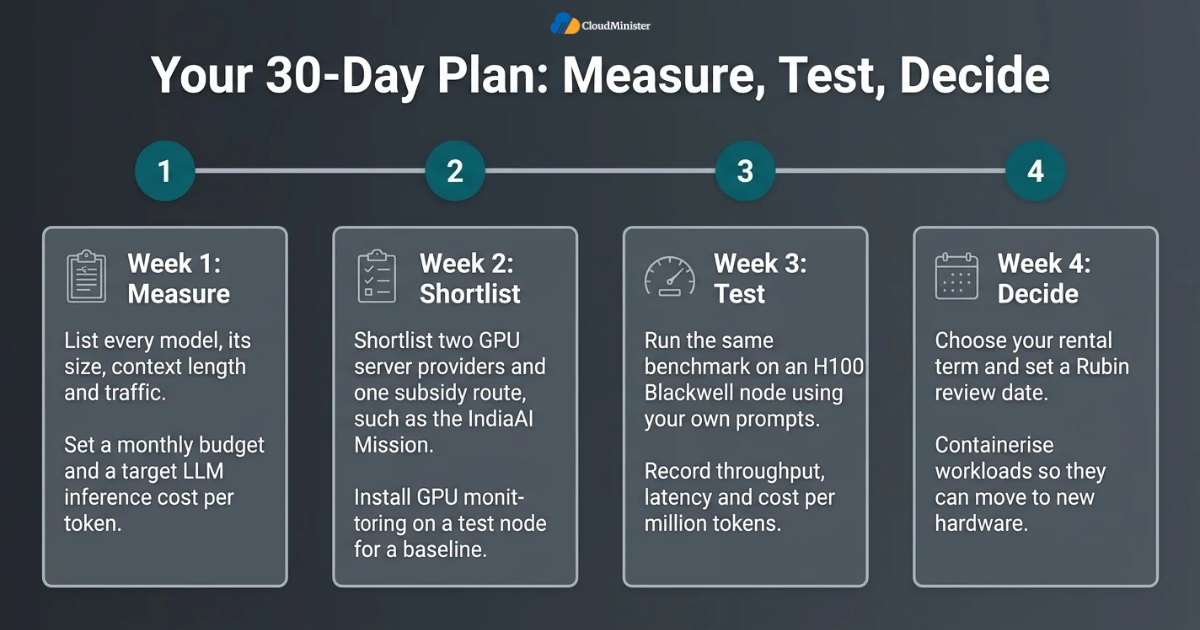
- Week one: list every model you run, its size, context length, and traffic.
- Week one: set a monthly budget and a target LLM inference cost per token.
- Week two: shortlist two providers of GPU Servers for AI and one subsidy route, such as the IndiaAI Mission.
- Week two: install GPU Monitoring on a test node so you have a baseline.
- Week three: run the same benchmark on an H100 and a Blackwell node using your own prompts. This is your own NVIDIA Rubin vs Blackwell test.
- Week three: record throughput, latency, and cost per million tokens for each. Use GPU Monitoring to capture it.
- Week four: choose your rental term and write down a review date for Rubin availability. Compare the best GPU cloud hosting in India and keep notes.
- Week four: package workloads in containers so they can move to new hardware without a rewrite.
Checklist: Rent or Wait Readiness Review
- Model size, context length, and traffic are written down.
- Budget and target LLM inference cost per token are agreed.
- IndiaAI Mission eligibility has been checked.
- Data residency duties under the DPDP Act have been reviewed.
- At least two providers have given written quotes.
- The best GPU cloud hosting in India has been compared with a Web Hosting Company in India.
- A benchmark has been run on your own prompts.
- GPU Monitoring is running and alerts are set.
- Contract length matches how sure you are about the workload.
- Workloads are containerised and portable.
- A review date for Rubin availability is on the calendar.
- A written view on NVIDIA Rubin vs Blackwell exists for the next quarter.
Ready to Rent GPU Servers for AI in India?
Deploy H100 and Blackwell-class GPU servers on flexible hourly or monthly terms, with INR billing and India-based data centres. Keep your workloads portable and move to newer hardware when it makes sense.
Key Takeaways
- NVIDIA Rubin vs Blackwell is a timing decision. Rubin is in full production, but Indian availability and pricing are still unclear.
- H100 remains the best understood card, Blackwell adds FP4 and far more memory, and Rubin promises a big jump in bandwidth.
- Rubin’s numbers are vendor claims until independent tests confirm them.
- GPU Servers for AI from the best GPU cloud hosting in India let you move to Rubin later without a rewrite.
- Memory capacity decides whether your model fits, and bandwidth decides how fast it runs.
- LLM inference cost per token is a better yardstick than hourly price.
- The 2026 rental market shows rising prices for committed H100 capacity, so waiting may not make older cards cheaper.
- GPU Monitoring prevents waste on every chip you rent.
- Most Indian teams should rent flexibly now from a trusted Web Hosting Company in India and review NVIDIA Rubin vs Blackwell each quarter.
Conclusion
The choice between NVIDIA Rubin vs Blackwell vs H100 is not about finding the single best chip. It is about matching hardware to a real workload, a real budget, and a real deadline. Rubin looks powerful on paper, Blackwell is available now with large memory, and the H100 is still a dependable workhorse. Teams that rent on flexible terms keep every option open, and NVIDIA Rubin vs Blackwell will keep changing as supply grows.
The safest path is simple. Measure your own workload, shortlist providers of GPU Servers for AI, keep your stack portable, and revisit the Rubin question every quarter with live quotes in hand. If you are comparing the best GPU cloud hosting in India, ask your Web Hosting Company in India for a short trial first, and let your own numbers decide.
Not Sure Whether to Rent or Wait? Get Free Consultancy
We offer free consultancy to all new clients. Our GPU experts will review your model size, budget, and timeline, then recommend the right GPU setup for your workload, with no obligation.
Frequently Asked Questions
Is NVIDIA Rubin available to rent in India today?
NVIDIA says Rubin is in full production, and first systems are reaching hyperscalers and large neoclouds in late 2026. Wide availability in India is likely to come later, so ask providers for written timelines before you plan around it.
What is the main difference in NVIDIA Rubin vs Blackwell?
Based on NVIDIA’s announced figures, Rubin uses HBM4 memory at about 22 TB/s of bandwidth and NVLink 6 at 3.6 TB/s, compared with about 8 TB/s and 1.8 TB/s on Blackwell. Capacity is the same 288 GB as the B300, so the gains are in bandwidth, interconnect, and compute.
Should a startup wait for Rubin or rent H100 now, given NVIDIA Rubin vs Blackwell?
Most startups should rent now, and treat NVIDIA Rubin vs Blackwell as a later upgrade. A product in the market earns feedback and revenue, while waiting adds delay with no guaranteed price drop. Use short contracts so you can move later.
Will H100 prices fall after Rubin arrives?
Not necessarily. In 2026, one year H100 contract prices rose, and some providers raised on demand rates. Prices depend on supply and demand for inference, not only on new launches.
How do I compare providers on LLM inference cost per token?
Run the same prompts on each provider, record tokens per second, and divide the hourly price by tokens generated per hour. Then multiply by one million to get cost per million tokens.
Is Blackwell worth the higher hourly price over the H100?
It can be. The B200 and B300 offer more memory and FP4 support, so large models or long contexts may run faster per dollar. Test with your own workload before you commit.
What should I monitor on a rented GPU?
At minimum, track utilisation, memory use, temperature, power draw, and error counts, plus tokens per second. Good GPU Monitoring helps you cut idle spend and spot failing hardware early.
Can I use IndiaAI Mission GPUs for production serving?
The subsidised pool is aimed at startups, researchers, and students, and capacity is shared. Check the current eligibility rules, and plan paid capacity for steady production traffic.
How do I choose the best GPU cloud hosting in India?
Look at the exact GPU models, networking, storage, support hours, INR billing, data centre location, and trial options. A Web Hosting Company in India with local data centres and clear GPU documentation is often easier to work with.

Shivlendra Singh Jadoun is a Cloud & DevOps Engineer at CloudMinister Technologies, specializing in AWS, Azure, and GCP infrastructure. He began his career in Linux system administration, managing shared, VPS, and dedicated servers before moving into cloud and automation. He is AWS Certified and works extensively with Docker, Kubernetes, Terraform, Ansible, and Jenkins to build CI/CD pipelines and scalable, secure cloud environments. With hands-on experience across hosting, server security, and DevOps automation, he brings real-world engineering insight to every article he writes.
Related posts:
 Types of NVIDIA GPU Architectures in 2026: From Ampere to Blackwell and Vera Rubin
 How to Deploy Multi-Agent Systems on a Dedicated GPU Server
 Inference Cost Optimization: Batching, Caching, and Right-Sizing GPU Instances
 Cost Per Million Tokens: How to Calculate the True LLM Inference Cost Per Token on Your Own GPU Server
