The true cost of downtime is rarely the number that appears in the first internal email after an outage. Most teams count only the sales lost during the outage window, but the real figure also includes support overtime, missed SLA penalties, lost customers, and engineering hours spent fixing problems instead of building new things. This guide shows how to calculate the true cost of downtime for a business of any size, and why the real number is usually higher than the first guess. It also explains what a practical prevention plan looks like in 2026.
Every business depends on its website or application being available when customers need it. When that stops working, even for a short time, the damage goes well beyond the minutes on the clock. Orders stop, support tickets pile up, and the team drops everything to find the cause. Understanding the true cost of downtime is the first step toward protecting your revenue and your reputation.
The problem is that most businesses only measure the obvious loss. They look at the sales that did not happen during the outage and treat that as the full price. The true cost of downtime is much wider than that. It includes refunds, contract penalties, staff time, customers who quietly leave, and the slow recovery of search visibility that follows a long outage.
This is why a clear method matters. A business that knows its true cost of downtime can decide how much to spend on prevention, which risks to fix first, and what level of support it really needs. A reliable Web Hosting Company in India can also help by sharing incident history, uptime records, and recovery timelines, which make the calculation far more accurate.
In the sections below, we walk through the direct and hidden costs, show how the numbers change by industry and company size, and give you a simple formula you can use right away. By the end, you will be able to put a realistic figure on your own true cost of downtime and plan with confidence.
Table of Contents
- Why Downtime Costs More Than Most Teams Assume
- The Direct Costs Inside Any Downtime Cost Calculation
- The Hidden and Indirect Costs Most Businesses Underestimate
- How Downtime Costs Vary by Industry and Business Size
- Building a Practical Formula to Calculate Your Real Downtime Cost
- Common Mistakes That Undermine an Accurate Downtime Cost Estimate
- Choosing the Right Partner to Reduce Your Downtime Costs
- Measuring Whether Your Prevention Investment Reduced Downtime Costs
- Key Takeaways
- Conclusion
- Frequently Asked Questions
1. Why the True Cost of Downtime Is Bigger Than Most Teams Assume
For most infrastructure and finance teams, the real number usually surfaces the hard way, during a post incident review where someone finally adds up support tickets, refunds, and missed deadlines next to the obvious revenue loss. The total that comes out the other side is almost always higher than anyone expected walking in.
This exposure matters more in 2026 than it did even two years ago, because digital revenue now represents a larger share of total revenue for most businesses, which means every minute of unavailability touches more of the business than it used to.
- Recent industry research from Splunk and Cisco puts the average cost of downtime for the world’s largest companies (the Global 2000) at roughly nine thousand dollars per minute. This figure is based on very large enterprises, not businesses of every size, so smaller organizations should treat it as an upper reference point and calculate their own number from actual revenue per minute (see Section 5), rather than adopting it directly.
- The same body of research shows the aggregate True Cost of Downtime across the world’s largest companies has reached roughly six hundred billion dollars a year, a fifty percent jump in just two years, signalling the trend is accelerating rather than leveling off.
- This impact is not evenly distributed. Enterprises with one thousand or more employees report a median cost far higher than mid-market companies, while startups under fifty employees typically see a lower but still meaningful per minute figure.
- Teams reviewing any Web Hosting Company in India for the first time should ask specifically how the provider helps quantify downtime exposure before a contract is signed, rather than discovering the number during an actual incident.
- A capable Web Hosting Company in India will usually walk through expected traffic patterns, revenue per hour, and contractual SLA exposure before recommending an uptime architecture, rather than selling a generic plan.
- Teams that have never formally calculated the True Cost of Downtime often assume a recent outage was cheap simply because nothing catastrophic happened afterward, which is a different thing from actually measuring the impact.
Related Reading: Our article on automated failover and health checks
- Businesses relying on Server Management Services in India for ongoing operations should confirm the provider tracks incident history in a way that makes calculating the True Cost of Downtime straightforward after the fact.
- A growing number of teams evaluating Server Management Services in India specifically ask for documented mean time to recovery numbers before signing, since recovery speed is one of the clearest levers on this exposure.
- Businesses researching DevOps Services & Solutions for a growing platform should still request a written explanation of how faster deployment pipelines reduce outage related losses, not just a list of tools.
- A team offering genuine DevOps Services & Solutions should be able to explain, on request, exactly how continuous integration and automated rollback reduce the True Cost of Downtime for a specific workload.
- Teams still comparing a Server Management Company against an in house operations team should apply the same cost logic either way, since the underlying exposure does not change with who is managing it.
- Businesses testing multiple candidates for DevOps Consulting Services during a vendor comparison should ask each one to walk through a real downtime scenario and its associated cost.
- A small business testing a new provider before committing to a long term contract should still document real incident data during that trial period, since that data becomes the foundation of an accurate estimate.
Before assuming a recent outage was inexpensive, pull your actual incident timeline from the last twelve months, including detection time, time to acknowledge, time to resolve, and every downstream ticket or refund tied to it. A surprising number of businesses following a proper True Cost of Downtime calculation discover their real exposure is far higher than what leadership originally assumed.
2. The Direct Costs Inside Any True Cost of Downtime Calculation
Many teams calculating this figure for the first time treat lost sales as the entire number, when a more accurate calculation looks at several direct cost categories together, since these factors compound in ways a simple revenue estimate does not capture.
- Lost transaction revenue is the most visible piece of the True Cost of Downtime, calculated as average revenue per minute during the affected period multiplied by total outage duration, adjusted for whether the outage hit peak or off peak hours.
- Refunds, credits, and service level agreement penalties owed to customers add a second direct layer to this exposure, and these obligations are often contractually defined well before an outage ever happens.
- Employee productivity loss belongs inside any serious calculation, since staff who cannot access core systems are still being paid while producing little or no output during the affected window.
- Emergency response costs, including overtime pay for engineers, after hours vendor callouts, and rush shipping for replacement hardware, are a direct and often underestimated slice of the total.
- A Web Hosting Company in India running both shared and dedicated infrastructure can usually show a client how each of these direct categories maps onto a real historical incident from a comparable workload.
- Recovery and remediation costs, including the engineering hours spent restoring service and confirming data integrity, belong in the same bucket as the outage itself.
- Independent research into enterprise outage costs has found that unplanned outages across the world’s largest companies collectively cost roughly six hundred billion dollars annually, a figure that has grown fifty percent in just two years, according to Splunk and Cisco’s downtime resilience research.
- Teams comparing a self managed environment against Server Management Services in India for a growing workload should size both options against the same direct cost categories, rather than assuming self management is automatically cheaper.
- Applying a proper cost framework to a containerized or microservices environment means accounting for cascading failures, since one failed dependency can take down several otherwise healthy services at once.
- A Web Hosting Company in India offering transparent SLA terms makes it considerably easier to estimate the penalty portion of this exposure before an incident occurs, rather than during one.
- Small teams comparing a Server Management Company against handling operations internally should still request a documented breakdown of how each option affects direct downtime exposure.
- Teams outgrowing a purely reactive support model within their first year should plan the move toward proactive DevOps Services & Solutions early, since that transition meaningfully reduces the direct portion of the True Cost of Downtime.
- A calculation applied to a multi-tenant SaaS platform needs to account for the busiest expected tenant’s contractual terms, not the average tenant, since enterprise customers often carry the steepest penalty clauses.
Related Reading: Our guide on reading Linux log files
A portion of the True Cost of Downtime is frequently tied to security incidents rather than routine hardware or software failure. An outage caused by a breach, a ransomware event, or a distributed denial of service attack typically carries additional forensic investigation costs, regulatory notification obligations, and reputational exposure on top of the standard downtime math, which means security posture and cost calculation are closely linked rather than separate conversations.
3. The Hidden and Indirect Costs Most Businesses Underestimate
Disagreements about the total figure tend to run deep, largely because indirect costs scale differently depending on customer trust, brand exposure, and how publicly the outage played out.
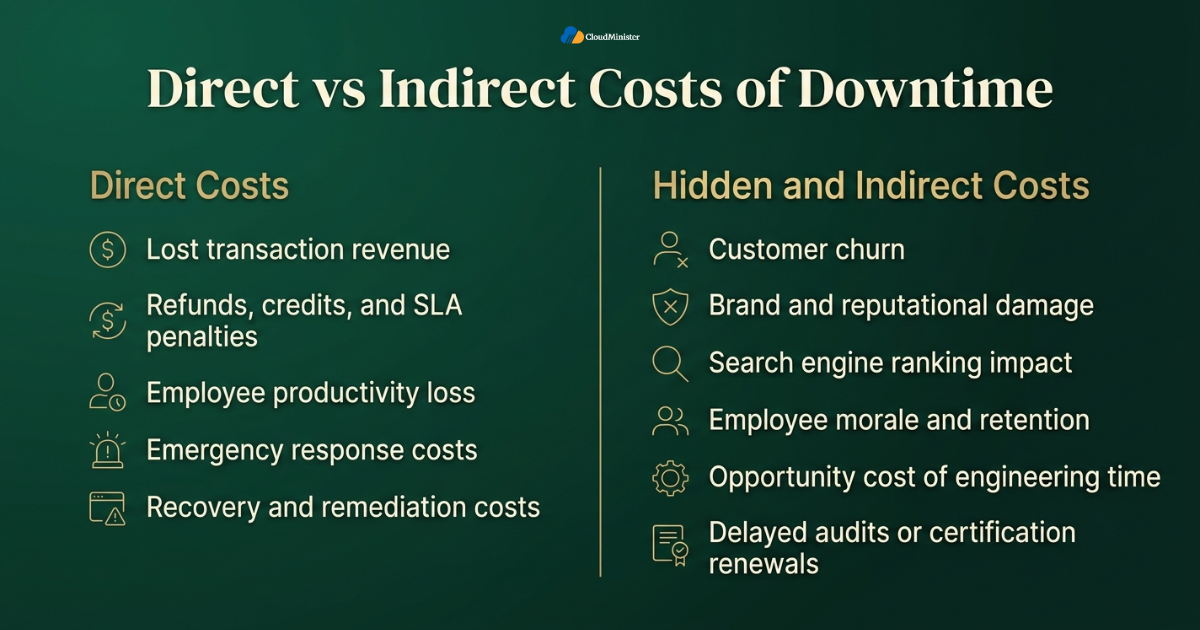
- Customer churn following a significant outage is one of the largest hidden contributors to the True Cost of Downtime, since customers who experience a service interruption during a critical moment often quietly move to a competitor rather than filing a complaint.
- This is exactly the category where Server Management Services in India often prove their value, since proactive monitoring and faster incident response directly reduce the churn driven portion of this exposure.
- Brand and reputational damage following a public outage adds a genuinely difficult to quantify layer to the total, particularly when the incident trends on social media or gets picked up by trade press.
- A multi-tenant SaaS backend serving dozens of active customers typically sees indirect costs scale with account size, since every enterprise customer affected carries a disproportionate amount of future revenue risk.
- At this scale, a purely reactive support model usually stops being sufficient, and the conversation shifts toward dedicated DevOps Consulting Services instead.
- Search engine ranking impact belongs inside a modern True Cost of Downtime calculation, since extended unavailability can affect crawl behavior, indexing, and user experience signals that search engines weigh when ranking a site.
- A site that suffers a lengthy or repeated outage often needs several weeks to fully recover its previous search visibility, which is a real and measurable component of this exposure even though it rarely appears on a finance team’s spreadsheet.
- Employee morale and retention represent a quieter but persistent piece of the True Cost of Downtime, since engineering teams that experience frequent firefighting under pressure report higher burnout and higher turnover over time.
- A calculation for a machine learning inference or recommendation platform needs to account for model retraining delays, since a prolonged outage can push back an entire release schedule.
- Teams running infrastructure through DevOps Services & Solutions for compliance sensitive workloads should factor in the indirect cost of a delayed audit or certification renewal caused by an availability gap.
- Compliance auditors reviewing any organization’s uptime history will typically flag repeated outages as a documentation risk, adding an indirect layer to the True Cost of Downtime that shows up during the next certification cycle.
- A calculation should always include the opportunity cost of engineering time diverted from planned feature work toward incident response, rather than treating that diverted time as free.
- Server Management Company partnerships that include proactive capacity planning tend to reduce this specific indirect cost, since fewer emergency interventions mean more predictable engineering roadmaps.
Related Reading: Our guide on fully managed hosting
- A team running Dedicated Servers under a Server Management Company arrangement should confirm whether the provider tracks indirect metrics like support ticket volume and customer sentiment following an incident, since financial exposure often extends well past the moment service is restored.
- Businesses comparing DevOps Consulting Services providers should ask directly whether the engagement includes post incident retrospectives, since a documented retrospective process is one of the more reliable ways to reduce the True Cost of Downtime on the next incident.
If your business has never surveyed customers after a significant outage, start there. Applications and services that go dark during a moment a customer actually needed them create a disproportionate amount of quiet churn that never shows up as a formal complaint, and that silent attrition is often the single largest piece of this exposure that leadership never sees on a dashboard.
Stop Outages Before They Cost You Money
Our server management team monitors your servers around the clock, fixes problems early, and keeps your website available when customers need it. Tell us about your setup and we will show you how to lower your downtime risk.
4. How the True Cost of Downtime Varies by Industry and Business Size
A complete framework cannot treat every business the same way, since industry, transaction volume, and customer expectations all shift the calculation meaningfully.
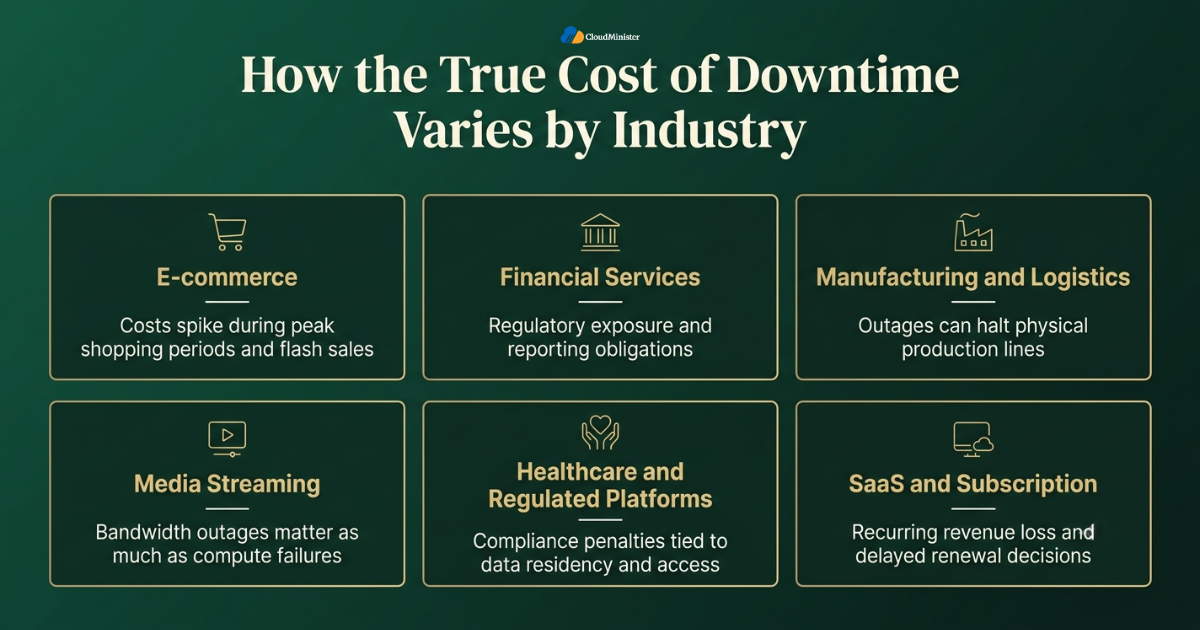
- E-commerce businesses generally see this figure spike hardest during peak shopping periods, since an outage during a festival sale or a flash promotion can wipe out weeks of planned revenue in a single afternoon.
- This holds true whether the storefront runs on shared infrastructure or a fully dedicated environment, since customer expectations around availability do not change with the hosting model underneath.
- A calculation for a financial services or brokerage platform should specifically confirm regulatory exposure, not just lost transaction revenue, since availability failures in this sector routinely trigger reporting obligations.
- Manufacturing and logistics operations calculate this exposure differently, since unplanned downtime on the operational technology side can halt physical production lines rather than just a digital storefront.
- Network bandwidth and infrastructure sizing decisions should account for genuine peak concurrent traffic when estimating downtime exposure, since a business that looks fine on a monthly average can still face a steep True Cost of Downtime during a single high traffic event.
- A framework built for a media streaming or large file distribution business needs to weigh bandwidth related outages as heavily as compute failures, since both interrupt the same customer experience.
- Teams evaluating Server Management Services in India should confirm whether the provider has direct experience with their specific industry, since regulatory and traffic pattern differences meaningfully change how the True Cost of Downtime is calculated.
- A Web Hosting Company in India offering both VPS and dedicated infrastructure under one roof gives a growing team room to reduce this exposure at every stage of growth without switching providers mid project.
- Healthcare and other regulated platforms carry a distinct version of this cost, since availability failures can trigger compliance penalties tied to data residency and access requirements on top of standard business losses.
Related Reading: Our guide on data residency requirements in India
- Startups and early stage companies should still calculate this exposure deliberately, since an outage during a critical funding conversation or a high visibility launch can cost far more than the raw revenue number suggests.
- Businesses comparing infrastructure providers for a workload that may outgrow its current environment within a year should factor future True Cost of Downtime exposure into that decision now, rather than revisiting the math after an incident forces the conversation.
- A provider offering genuine Server Management Services in India should be able to point to a comparable client incident and walk through exactly how the total was calculated and later reduced.
- Subscription and SaaS businesses should weigh recurring revenue loss differently than a one time transaction business, since a single outage can affect renewal decisions made weeks or months later, extending the effective True Cost of Downtime well past the incident window.
- A Web Hosting Company in India that already understands a client’s industry specific risk profile is better positioned to recommend an uptime architecture that actually matches the real exposure the business carries.
- A Web Hosting Company in India handling multiple regulated clients typically maintains separate playbooks for healthcare, finance, and e-commerce, since each vertical weighs availability risk differently.
- Retail brands running seasonal promotions often lean on a Web Hosting Company in India to pre-scale infrastructure ahead of a known traffic surge rather than reacting after the fact.
- Server Management Services in India covering a multi-region deployment should include documented failover testing, since regional outages carry a different risk profile than a single data center failure.
- A business evaluating Server Management Services in India for the first time should ask how quickly the team can scale resources during an unplanned traffic spike, since elasticity directly limits exposure.
- DevOps Services & Solutions focused on continuous deployment pipelines reduce the blast radius of a bad release, since smaller, more frequent deployments are easier to roll back than large infrequent ones.
- A platform relying on DevOps Services & Solutions for infrastructure as code can rebuild a failed environment in minutes rather than hours, which meaningfully shrinks recovery time during an incident.
- DevOps Consulting Services focused on chaos engineering help a team discover hidden failure points before a real outage exposes them to customers.
- A Server Management Company handling a fast-growing platform should demonstrate experience scaling infrastructure ahead of demand rather than only reacting to capacity alerts.
5. Building a Practical Formula to Calculate Your True Cost of Downtime
Even a technically sound understanding of downtime cost underperforms without a structured formula behind it, since a rough mental estimate made after an incident tends to undercount several categories at once.
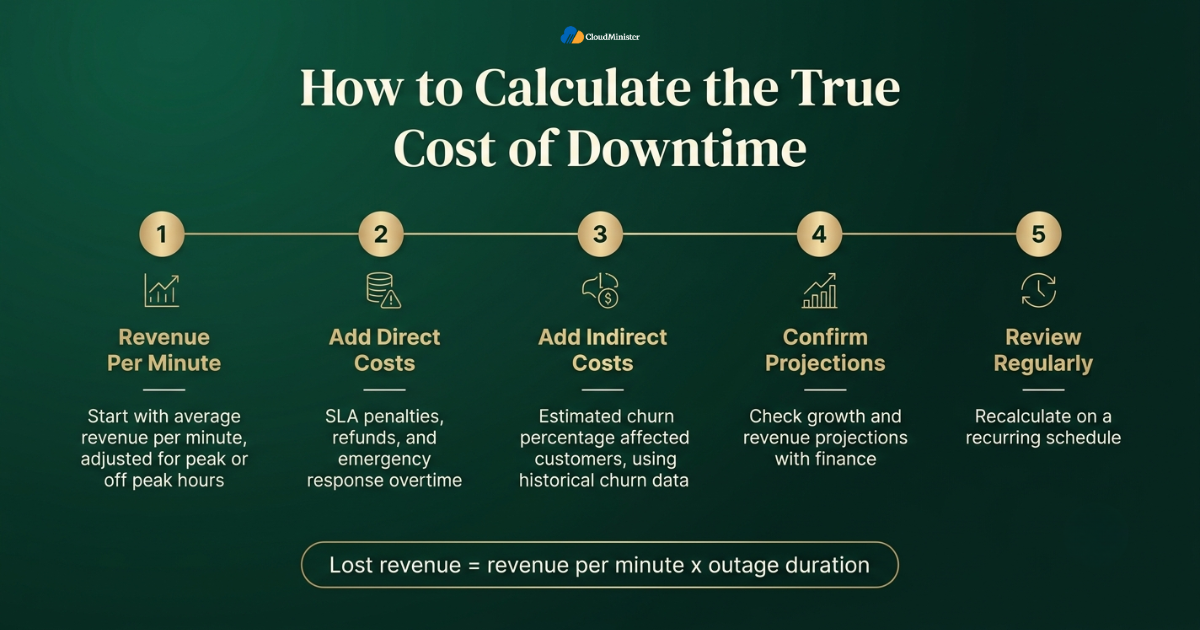
- Start with average revenue per minute during normal operating hours, then adjust that figure upward or downward depending on whether the specific outage window fell during peak or off peak traffic.
- Add direct costs including SLA penalties, refunds, and emergency response overtime, since a formula built purely on lost revenue consistently underestimates the real True Cost of Downtime.
- Add indirect costs including an estimated churn percentage applied to affected customers, using historical churn data from prior incidents wherever it is available rather than a guess.
- Confirm growth and revenue projections directly with finance stakeholders rather than relying on last year’s figures, since a business growing quickly can see its True Cost of Downtime rise considerably even without any change in outage frequency.
- Businesses without an internal team dedicated to incident cost tracking should treat a partnership with an experienced Server Management Company as the practical foundation for a realistic estimate.
- Review the calculation on a recurring schedule rather than treating a single estimate as permanent, since revenue mix, customer base, and regulatory exposure all shift as a business matures.
- A team delivering Server Management Services in India should be able to show documented incident cost reporting on request, not just a general assurance that uptime is being handled.
- Teams evaluating DevOps Consulting Services should weigh how much a faster deployment and recovery pipeline actually reduces the total figure, since prevention investment should be sized against the real number, not a rough guess.
- A Web Hosting Company in India that publishes historical uptime figures publicly gives prospective customers a way to verify claims before signing a contract.
- Businesses relocating from an overseas host to a Web Hosting Company in India often see latency improvements for their India-based customer base, which indirectly supports availability perception.
- Server Management Services in India bundled with proactive patching reduce the number of emergency maintenance windows a business has to schedule around.
- Growing teams comparing Server Management Services in India providers should request a sample incident response timeline from a past client engagement.
- DevOps Services & Solutions built around automated testing catch configuration errors before they reach production, cutting off a common outage source early.
- A platform adopting DevOps Services & Solutions for blue-green deployments can switch traffic away from a failing release almost instantly.
- DevOps Services & Solutions covering infrastructure monitoring and alerting shorten the detection phase of an incident, which is usually the largest single delay in the recovery timeline.
- Businesses new to DevOps Services & Solutions should start with deployment automation before layering on more advanced practices like chaos testing.
- A Server Management Company offering managed backups as part of its core service reduces the recovery time needed after a data related incident.
- DevOps Consulting Services engagements that include documented runbooks make it easier for any engineer on call to follow a consistent recovery process.
- Businesses new to DevOps Consulting Services should clarify upfront whether the engagement covers only initial setup or ongoing tuning as the platform scales.
- A well structured DevOps Consulting Services relationship treats reliability as a continuous practice rather than a one-time project deliverable.
Checklist: True Cost of Downtime Calculation Readiness Review
- Twelve months of incident history pulled, including detection time, acknowledgment time, and resolution time
- Average revenue per minute confirmed for both peak and off peak hours
- SLA penalty terms and contractual obligations documented for every affected customer segment
- Historical churn data applied to the affected customer base from prior incidents
- Employee productivity loss estimated using actual headcount and average hourly cost
- Brand and reputational exposure discussed directly with the marketing and customer success teams
- A defined prevention budget compared directly against the calculated total
- A Server Management Company that documents every incident, including the reasoning behind the final cost estimate, makes future prevention budgeting considerably easier to justify.
- Businesses selecting a provider for a workload that may later need dedicated infrastructure should confirm the provider supports that migration path directly, since switching providers mid crisis adds its own cost to the overall figure.
- Teams running production workloads should request a written review of downtime exposure at least once a year, even without a recent incident prompting it.
Teams that get the most long term value from a True Cost of Downtime calculation are rarely the ones that estimate it once and file the number away. They revisit the calculation after every significant incident, compare the actual cost against the original estimate, and use the gap between the two numbers to refine the formula for next time, which is exactly the discipline a mature Server Management Company should help institutionalize.
6. Common Mistakes That Undermine an Accurate True Cost of Downtime Estimate
A technically sound formula still produces a misleading number if a handful of common mistakes go unaddressed during the actual calculation.
- Counting only lost sales while ignoring SLA penalties, refunds, and emergency labor costs is one of the most frequent mistakes teams make when first calculating this exposure.
- Ignoring the compounding effect of customer churn, since a single outage rarely loses a customer immediately but instead nudges them toward evaluating a competitor over the following weeks.
- Treating the calculation as a one time exercise rather than a recurring review misses the reality that revenue mix and customer expectations change considerably as a business grows.
- Confirm with any provider of Server Management Services in India exactly how incident data is tracked and reported, since incomplete incident logs make an accurate True Cost of Downtime calculation nearly impossible after the fact.
- Teams relying on DevOps Services & Solutions should ask the same tracking question early, since a provider without clear incident reporting can leave a business unable to calculate its real exposure.
- Averaging downtime cost across the entire year rather than separating peak and off peak windows regularly produces a number that understates the real risk during the highest traffic periods.
- Confirm that any team managing production infrastructure has a documented incident cost rationale on file, rather than sitting on a general assumption that recent outages were not that expensive.
- Underestimating the ongoing cost of employee overtime and vendor callouts during an extended incident is a mistake that regularly undermines an otherwise carefully built estimate of the True Cost of Downtime.
- Confirm that a new infrastructure configuration is actually sized to reduce future downtime risk rather than simply mirroring an old setup’s specifications out of habit.
- Maintain a documented record of every incident and its estimated cost, including who approved the final figure, so nothing gets underestimated without a deliberate, informed review.
- A Server Management Company that walks through its own incident cost tracking process in specific detail, rather than describing it only in general terms, is signaling genuine operational readiness.
- A Server Management Company with documented change management processes reduces the odds that a routine update itself becomes the cause of an outage.
- DevOps Services & Solutions covering rollback automation give a team confidence to ship more frequently without proportionally raising outage risk.
- Platforms scaling internationally often extend their DevOps Services & Solutions to cover multi-region deployment pipelines, not just a single primary environment.
- DevOps Consulting Services focused specifically on incident response readiness are worth a look for any team that has never run a tabletop exercise.
- A DevOps Consulting Services provider who can point to measurable MTTR improvements at past clients is demonstrating real impact rather than theoretical value.
- Businesses evaluating DevOps Consulting Services specifically for an unpredictable traffic pattern should ask how quickly the team can detect and respond before committing to a specific engagement.
- A Web Hosting Company in India that maintains detailed incident records across its client base can usually spot a downtime cost pattern faster than one relying purely on customer complaints.
7. Choosing the Right Partner to Reduce Your True Cost of Downtime
Not every infrastructure relationship is built to genuinely reduce this exposure, and this is exactly where the difference between an average provider and a genuinely prepared one becomes visible.
- A dependable Web Hosting Company in India that already manages a team’s broader infrastructure is well positioned to recommend a prevention strategy using real historical incident data rather than introducing unnecessary complexity into an already functioning environment.
- This holds whether the account in question runs on shared infrastructure, a virtual plan, or a full dedicated deployment.
- Teams should confirm any provider of Server Management Services in India actually owns and operates its own infrastructure rather than reselling capacity from a third party, since that directly affects how quickly an incident can be resolved.
- A dependable provider should be able to share a reference client that reduced its own True Cost of Downtime through a documented prevention program, and the same standard should apply to any provider marketing DevOps Consulting Services.
- Businesses evaluating providers should specifically ask whether the provider has direct experience helping customers calculate and reduce downtime exposure, not just provisioning infrastructure under a generic hosting plan.
- A Server Management Company offering transparent pricing around proactive monitoring makes it easier to compare true prevention value against a generic hosting quote.
- A newer provider may offer a competitive base rate but lack the account history needed to advise confidently on downtime prevention for a complex, multi service environment.
- A provider offering DevOps Services & Solutions with a documented incident response methodology is generally a safer long term bet than one offering only a low introductory price.
- A Web Hosting Company in India offering multiple data center locations gives a business more options for geographic redundancy as it grows.
- Businesses evaluating a new Web Hosting Company in India should ask specifically how escalations are handled outside normal business hours.
- DevOps Services & Solutions paired with proactive capacity forecasting help a growing platform avoid resource exhaustion before it becomes an outage.
- A Server Management Company that documents its escalation matrix clearly gives a client confidence during a genuine emergency rather than confusion.
- Teams weighing a Server Management Company against building an internal SRE function should factor in hiring timelines, since a mature provider is often faster to stand up.
- DevOps Consulting Services that include a knowledge transfer component leave an internal team more capable of handling minor incidents independently over time.
- Ask any prospective DevOps Consulting Services provider how they measure success, since experience reducing a client’s actual True Cost of Downtime correlates strongly with fewer surprises after deployment.
- A provider offering both proactive monitoring and a credible path to fully managed operations gives a growing business one continuous relationship rather than a disruptive vendor switch later.
- A Web Hosting Company in India that treats every client’s downtime exposure as identical is usually applying a template rather than genuinely reviewing actual incident history.
A capable partner offering both deep expertise in Server Management Services in India and broader DevOps Services & Solutions gives growing teams a coherent resilience roadmap instead of stitching together advice from multiple vendors.
- A genuinely capable Web Hosting Company in India will also be transparent about which parts of downtime prevention it owns directly and which parts depend on the customer’s own application architecture choices.
- Reviews and references matter more than a homepage promise when choosing a partner for a decision this consequential to long term revenue and reputation.
- Businesses switching providers specifically over a persistent pattern of costly outages should confirm the new partner’s incident response methodology before signing, rather than assuming it will simply be handled correctly this time.
When comparing quotes or proposals from different providers on downtime prevention, ask each one to walk through a real incident example using a scenario similar to your own business rather than a generic case study, since the right recommendation depends entirely on your specific revenue pattern, customer base, and risk tolerance. A provider offering genuine DevOps Consulting Services that understands both the technical prevention mechanics and your organization’s actual exposure will consistently give more actionable guidance than a purely theoretical comparison.
8. Measuring Whether Your Prevention Investment Actually Reduced the True Cost of Downtime
Calculating an initial number is not the finish line for this framework, whether the work is managed internally or through an outside partner offering broader Server Management Services in India. Long term results depend on how thoroughly the investment gets verified afterward against real incidents.
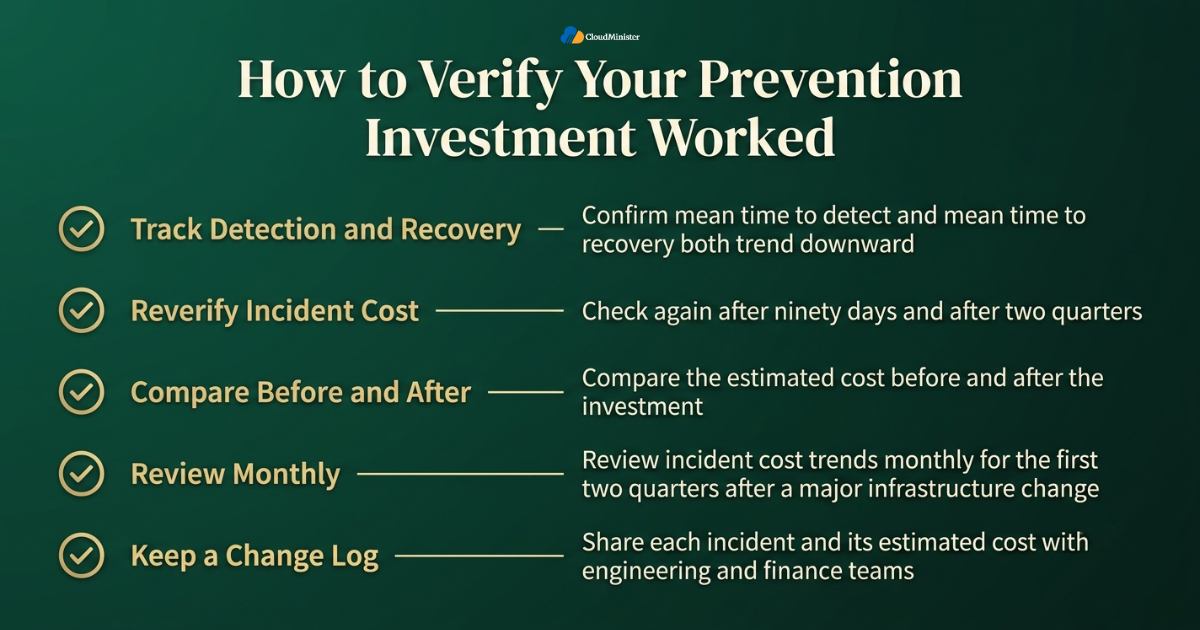
- Confirm mean time to detect and mean time to recovery both trend downward after any significant investment in monitoring or automation, since these two metrics drive most of the direct portion of the True Cost of Downtime.
- Teams that invested in DevOps Services & Solutions should reverify incident cost independently after ninety days and again after two quarters, not just accept a provider’s word that resilience has improved.
- Ask whichever team handles infrastructure to walk through a recent example of an incident they actually prevented or shortened, since a concrete example demonstrates real capability far better than a general description.
- Compare the estimated True Cost of Downtime before and after a prevention investment, since a properly executed resilience program should show measurable improvement rather than new, unexplained issues.
- Review incident cost trends monthly for the first two quarters after any significant infrastructure change, since this is the window where an ineffective prevention investment typically becomes visible.
- Cross reference downtime cost trends against the organization’s broader budget planning, particularly where infrastructure spend needs to be reported alongside other operational metrics.
Maintain a change log for every significant incident and its estimated cost, shared with the broader engineering and finance teams, so the reasoning and outcome behind each prevention decision remains traceable over time.
- Ask any partner providing DevOps Consulting Services to share their own incident reduction metrics on a recurring basis, since transparency here is one of the clearest signals of a genuinely mature partnership.
- Confirm with any provider of Server Management Services in India that the current environment is being monitored for both availability and performance, not just one direction.
- Teams that moved from a reactive support model onto proactive monitoring should specifically reverify that the new environment is actually producing a lower True Cost of Downtime relative to actual measured incidents.
- This verification step matters just as much for a smaller workload as it does for a full enterprise deployment, since either direction of underinvestment costs money over time.
- A Server Management Company that shares downtime cost verification metrics on request is demonstrating exactly the kind of transparency a completed prevention program deserves.
- A Server Management Company reviewing quarterly uptime reports with a client builds the kind of trust that a one-off audit never fully replicates.
- Businesses that outgrow a single Server Management Company relationship should still document what worked before switching, since that history informs the next provider’s onboarding.
- A DevOps Consulting Services engagement that ends after initial setup, without ongoing tuning, rarely delivers lasting resilience gains.
- Teams should ask a DevOps Consulting Services provider for a sample post-incident report before signing, since the quality of that report signals how seriously the team treats reliability.
- A DevOps Consulting Services partner familiar with infrastructure as code can usually shorten recovery time considerably compared with manual rebuild processes.
- Server Management Company reviews conducted quarterly, rather than only after an incident, tend to catch capacity issues before they become outages.
- Choosing a Server Management Company with round the clock monitoring coverage removes a common gap where overnight incidents go undetected for hours.
- A Server Management Company that proactively patches and hardens servers reduces the security related share of downtime risk discussed earlier in this guide.
- DevOps Consulting Services engagements built around observability tooling give a team visibility into failures long before customers notice anything.
Industry data on enterprise outage costs continues to show a wide gap between what businesses estimate their exposure to be and what an outage actually costs once every category is included, which is exactly why treating the True Cost of Downtime as a recurring discipline, rather than a one time task, matters for long term financial planning and infrastructure budget control.
Key Takeaways
- The True Cost of Downtime succeeds as a planning tool when it is built on real incident history, not on a rough guess made after the fact.
- Direct costs like lost revenue and SLA penalties are only part of the picture, since indirect costs like churn and reputational damage often make up the larger share.
- Industry, business size, and whether an outage hits peak or off peak hours all change the True Cost of Downtime substantially, so a generic industry average should never replace a business specific calculation.
- A defined prevention budget, documented incident history, and a recurring review schedule matter just as much as the initial calculation, whether the environment is run internally, through a Web Hosting Company in India, or through broader Server Management Services in India.
- A Web Hosting Company in India that already understands this discipline end to end, and that offers genuine DevOps Services & Solutions, remains one of the more reliable ways to reduce downtime exposure from day one.
- Partnering with a capable provider experienced across both Server Management Services in India and broader DevOps Services & Solutions meaningfully reduces the risk of a costly outage, and this is worth raising directly in the next infrastructure planning conversation.
Ready to Calculate and Reduce Your Downtime Cost?
Talk to our team about your current setup, your uptime goals, and the risks that worry you most. We will help you plan a practical way to protect your revenue and keep your business online.
Conclusion
Throughout this discussion of the True Cost of Downtime, one pattern holds regardless of business size, industry, or whether the surrounding environment runs a single application server or a larger multi service footprint. Correct calculation is not a one time guess made after a single bad incident, and it is not something that stays accurate indefinitely once revenue and customer base grow. The organizations that handle this well share a consistent pattern. They confirm real incident data before estimating exposure, they include indirect and hidden costs rather than stopping at lost revenue, and they treat the calculation as a recurring review rather than a background task. For teams weighing this decision alongside a broader look at their infrastructure, or comparing prevention strategies across their environment, the same underlying principle applies. Measure actual incident history first, calculate the full True Cost of Downtime second, and invest in prevention proportionally, ideally with a capable Web Hosting Company in India involved throughout, including one experienced across both Server Management Services in India and broader DevOps Services & Solutions.
Once you have a number, the real work begins. The true cost of downtime is most useful when it guides decisions, such as how much to invest in monitoring, backups, automated recovery, and skilled support. A prevention budget that looks expensive on its own often looks very reasonable when it is compared with the true cost of downtime for even one serious outage. Review the figure after every major incident, compare it with your earlier estimate, and adjust your plan. Over time, this habit turns downtime from a painful surprise into a risk you understand and control.
Frequently Asked Questions
Businesses running production infrastructure through a managed provider should ask this exact question directly during their next account review.
What is the True Cost of Downtime for a typical small business?
Figures vary considerably by industry and by study, and most published benchmarks are based on large enterprises rather than small businesses. Smaller organizations generally face a much lower absolute cost per minute, which is best estimated from their own revenue per minute and the cost categories covered in this guide, while large enterprises can see costs in the thousands to tens of thousands of dollars per minute during peak periods.
Does the True Cost of Downtime only apply to large enterprises?
No. Smaller businesses face a lower absolute number but often a higher relative impact, since a single significant outage can represent a much larger share of total monthly revenue for a smaller operation than for a large enterprise with diversified revenue streams.
How often should a business recalculate its True Cost of Downtime?
At minimum once a year, though any serious framework should also trigger a recalculation after a significant revenue increase, a major product launch, or a noticeable change in customer base size.
Confirm with your provider whether upgrading monitoring or automation later requires downtime itself, since that answer directly affects how conservatively an initial prevention investment should be approached.
What is the single most effective first step in calculating the True Cost of Downtime?
There is no single step that captures every category, but pulling twelve months of real incident history consistently produces the fastest, most accurate starting point, especially when supported by a partner offering genuine Server Management Services in India and ongoing infrastructure review.
Whether the environment runs on shared infrastructure for a lighter workload or fully dedicated hosting for a demanding one, the same underlying calculation discipline applies before anything else.
Which cost do businesses miss most often when calculating the true cost of downtime?
Most businesses miss customer churn and the time their engineers lose to incident response. Lost sales are easy to see, but customers who quietly move to a competitor after a bad experience rarely show up in any report. Engineering hours spent on recovery are also often treated as free, even though that time could have gone into planned work. Including both gives a much more honest view of the true cost of downtime.
Can a hosting or server management provider help reduce the true cost of downtime?
Yes, in several ways. A good provider offers round the clock monitoring, faster incident response, regular backups, and clear incident records. These things shorten the time it takes to detect and fix a problem, and that directly lowers the true cost of downtime. The impact still depends on how your own application is built, so it is worth asking any provider which parts of the prevention work they handle and which parts remain with your team.

Ajay Singh Raghav is a Senior Linux System Administrator at CloudMinister Technologies, where he has spent over 4 years installing, configuring, maintaining, and troubleshooting Linux servers for hosting and cloud environments. He specializes in AWS cloud computing alongside core Linux server administration, with hands-on expertise across server management, backup and restore systems, and cPanel-based hosting environments. His day-to-day experience keeping production servers stable and secure gives him a practical, ground-level understanding of the infrastructure he writes about.