


Automated AI forex trading now runs around the clock, and that constant uptime is exactly why you need to secure your trading VPS before any algorithm touches live capital. Attackers specifically target trading infrastructure because it holds broker credentials, API keys, and direct access to funded accounts. This guide walks through why that risk has grown, what it actually takes to secure your trading VPS against credential attacks and AI driven intrusion attempts, and how the right infrastructure partner makes the difference. It also touches on where proper Forex VPS Hosting fits in, since generic hosting was never built for the latency and uptime that algorithmic trading demands.
Most traders spend months refining an entry strategy, backtesting indicators, and tuning risk parameters, but very few spend even an afternoon thinking about the server that strategy actually runs on. That gap is a problem, because once an expert advisor goes live and starts trading unattended, the VPS it runs on becomes just as important as the strategy itself. If that server is compromised, it does not matter how good the strategy was. This is the core reason every serious trader eventually has to secure your trading VPS rather than treat it as a background detail.
The shift toward automated AI forex trading has changed what attackers look for. A trading VPS is no longer just another virtual machine, it is a server that holds live broker logins, saved API keys, and often a funded account, running continuously and unattended for hours or days at a stretch. That combination makes it a far more attractive target than a typical website or app server, and it explains why credential attacks, bot hijacking attempts, and automated scanning against trading servers have all increased. Choosing to secure your trading VPS early is less about paranoia and more about recognizing what kind of target this infrastructure has become.
This guide is built around that reality. It covers why trading VPS environments draw so much attention, the specific hardening steps that actually close common gaps, where most security failures tend to happen, and how AI has changed the pace and scale of these attacks. It also looks at how to evaluate a hosting partner properly, since infrastructure choice and security discipline are really one decision, not two. By the end, the goal is a clear, practical checklist you can use immediately to secure your trading VPS, rather than a list of abstract best practices you have to translate yourself.
1. Why You Need to Secure Your Trading VPS in 2026
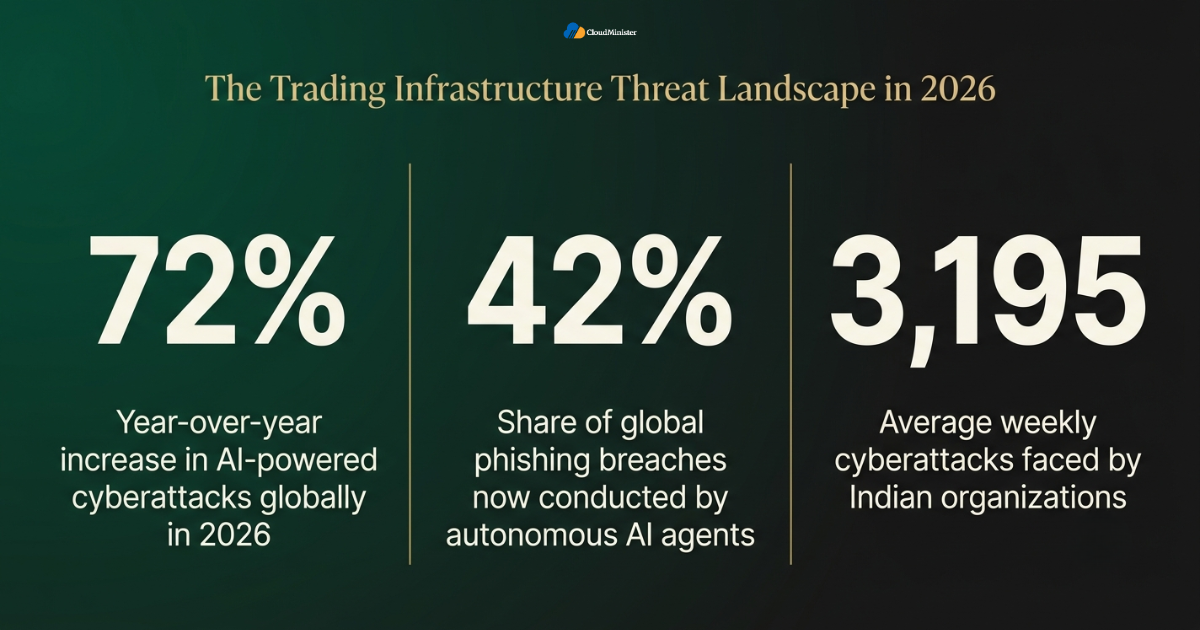
For most retail and semi professional traders, the decision to Secure Your Trading VPS usually happens only after something goes wrong, often after reading about a trading bot that got hijacked mid session or an expert advisor that started placing rogue trades because a server was compromised overnight. The urgency behind this conversation is not hype. It is a direct response to how attack volume and attacker sophistication have both changed in a short window. AI powered cyberattacks increased 72 percent year over year globally in 2026, which is exactly the kind of trend that makes the decision to Secure Your Trading VPS an operational necessity rather than an afterthought, according to AI Business Weekly’s 2026 cybersecurity data. Autonomous AI agents now conduct roughly 42 percent of global phishing breaches, meaning the credential theft attempts aimed at a trading account are increasingly automated rather than manually operated, and Indian organizations now face an average of around 3,195 weekly cyberattacks, a figure that sits meaningfully above the global average and one more reason traders running capital through Indian infrastructure need to Secure Your Trading VPS as a baseline, not an upgrade.
A trading VPS is a higher value target than an ordinary web server because it sits directly between an algorithm and real money, which is precisely why attackers now prioritize this category of asset. Choosing VPS For Forex Trading over a generic hosting plan is often the first real signal that a trader is treating the operation with the seriousness it deserves rather than as a casual hobby project, and this is where the choice of provider starts to matter just as much as the choice of strategy.
- A Web Hosting Company in India that already understands trading workloads can advise on which specific ports, services, and protocols genuinely need to stay open versus which ones exist only as unnecessary attack surface during onboarding.
- Traders evaluating any Web Hosting Company in India for the first time increasingly ask whether the provider actually understands algorithmic trading workloads, not just generic virtual machines.
- A capable Web Hosting Company in India will flag risky remote access configurations proactively, rather than waiting for a trader to discover a breach after a string of unauthorized trades.
- Comparing a budget shared plan against genuine VPS For Forex Trading infrastructure quickly reveals how much of the difference in price actually comes down to security depth, not just raw compute specs.
- A trader who genuinely wants to Secure Your Trading VPS should treat provider selection as the first security decision, not an afterthought made purely on price.
Many traders assume a VPS is automatically secure because it is hosted by a reputable provider, when in most cases baseline hosting security still leaves the operating system, the trading terminal, and the API keys entirely the trader’s own responsibility. A proper VPS For Forex Trading environment separates administrative access from the trading terminal itself wherever possible, reducing how much damage a single compromised credential can actually cause.
Related Reading: How to choose the right Forex VPS specs
- A growing number of traders evaluating a Forex VPS Hosting service specifically ask how the provider isolates trading accounts from each other on shared infrastructure, rather than assuming isolation is automatic.
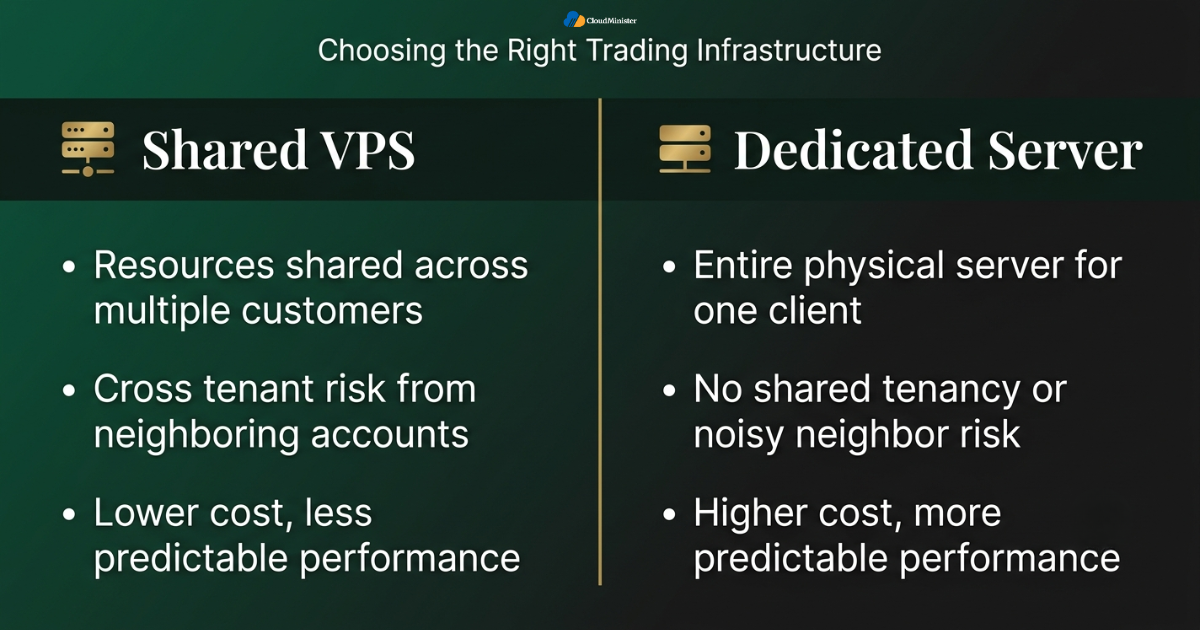
- Traders researching Dedicated Server Hosting in India for the first time often discover that dedicated resources remove an entire category of noisy neighbor and cross tenant risk that a budget VPS cannot fully eliminate.
- Purpose built VPS For Forex Trading plans differ from generic virtual machine offerings specifically because they are tuned for continuous uptime, low latency broker connectivity, and the kind of monitoring an unattended trading algorithm actually needs.
- Traders who compare Dedicated Servers in India against shared hosting quickly notice that isolated resources remove an entire category of risk tied to unrelated tenants on the same physical machine.
Traders who already lean on strong cybersecurity practices tend to walk into automated trading with far fewer unknowns, since most of the hardening steps overlap directly with routine operational hygiene, and traders comparing Dedicated Servers in India for the first time should specifically ask how quickly a support team can respond if a trading strategy suddenly stops executing overnight. Choosing between a shared VPS and Dedicated Servers in India often comes down to how much unattended, real money risk a trader is willing to accept on infrastructure they do not fully control, and none of this infrastructure discussion matters if a trader never actually gets around to the practical work needed to Secure Your Trading VPS, which is why the checklists throughout this guide are written as concrete action items rather than abstract advice.
Before assuming your current setup is safe enough, run a simple exercise and estimate what a single day of unauthorized access to your trading terminal would actually cost if an attacker opened a handful of leveraged positions before you noticed. A surprising number of traders discover that this number alone justifies every hour spent working to Secure Your Trading VPS properly, and it is often the moment a trader decides to Secure Your Trading VPS formally rather than relying on default settings.
2. What Makes a Trading VPS a High Value Target
Understanding why automated AI forex trading environments attract attention matters more than assuming your account is too small to matter, since bots do not discriminate by account size. A trading VPS typically holds live broker credentials, API keys, and often a funded trading account, which makes it fundamentally more attractive to an attacker than a general purpose virtual machine. Expert advisors and trading bots run continuously and unattended for long stretches, which means a compromise can go unnoticed for hours or days while unauthorized trades quietly drain an account. Remote Desktop Protocol access, the standard way most traders connect to a Windows based trading VPS, is one of the most heavily targeted services on the internet, and a honeypot research project by GoSecure recorded 3.4 million RDP login attempts against a single exposed server in just three months.
- Attackers increasingly use AI generated password variants and high speed credential spraying specifically to defeat weak lockout policies, which is exactly why traditional password only protection is no longer enough to Secure Your Trading VPS on its own.
- A compromised trading VPS can be used for far more than direct theft, since attackers frequently repurpose hijacked servers for cryptomining, botnet activity, or as a launch point for further attacks while the original owner remains unaware.
- Because algorithmic trading runs continuously, any downtime caused by an attack directly translates into missed trades and real financial loss, unlike a typical business website where downtime is mainly reputational.
- A provider offering a genuine Forex VPS Hosting service understands this continuous uptime requirement and builds monitoring around it, rather than treating a trading VPS like any other generic workload.
- VPS For Forex Trading environments specifically need low latency proximity to broker servers, and that same network positioning also means these servers sit on well known, frequently scanned IP ranges that attackers actively probe.
- The combination of continuous execution and direct financial access is exactly what separates a VPS For Forex Trading workload from an ordinary hosting account, and that distinction should shape every security decision made around it.
Related Reading: Cloud repatriation in 2026
- Dedicated Servers in India used specifically for trading workloads reduce shared tenancy risk, though they still require the same disciplined hardening as any internet facing system running unattended software.
- Choosing Dedicated Servers in India over a shared plan also simplifies compliance and audit conversations later, since resource usage, access logs, and configuration history all belong to a single account rather than a shared pool.
- A Web Hosting Company in India that understands the trading use case can advise on which specific ports, services, and protocols genuinely need to stay open versus which ones exist only as unnecessary attack surface.
- Choosing a proper VPS For Forex Trading plan over a generic shared hosting account is one of the clearest early decisions that determines how much manual hardening work a trader will need to do later.
- Working with a genuine Web Hosting Company in India that already understands trading specific compliance and latency needs saves a trader from re-explaining basic requirements to a generic support desk during a live incident.
- Businesses and individual traders pairing strong Server Management Services with active monitoring tend to catch anomalous login attempts long before an account is actually drained.
- A genuinely dedicated VPS For Forex Trading environment gives a trader consistent resource allocation, which matters directly for how reliably security monitoring tools can run alongside a live strategy.
A trading VPS is not simply another server that happens to run software, it is financial infrastructure, and it should be treated with the same seriousness a business applies to a payment system. Choosing to Secure Your Trading VPS properly means accepting that convenience features like default remote access ports and shared passwords across accounts are exactly the kind of shortcuts attackers count on. Traders who postpone the decision to Secure Your Trading VPS until after an incident rarely get a second chance to prevent the first one.
3. Core Steps to Secure Your Trading VPS Before Going Live
Before connecting any automated strategy to real capital, a specific sequence of hardening steps should be completed, since skipping any one of them quietly reopens the exact gap the others were meant to close. The single most practical way to begin is to Secure Your Trading VPS in layers, starting with access controls before moving on to monitoring and backup discipline.
- Change the default Remote Desktop Protocol port away from 3389 to a non standard port, which does not stop a determined attacker but does eliminate the enormous volume of automated scans that specifically target the default port around the clock.
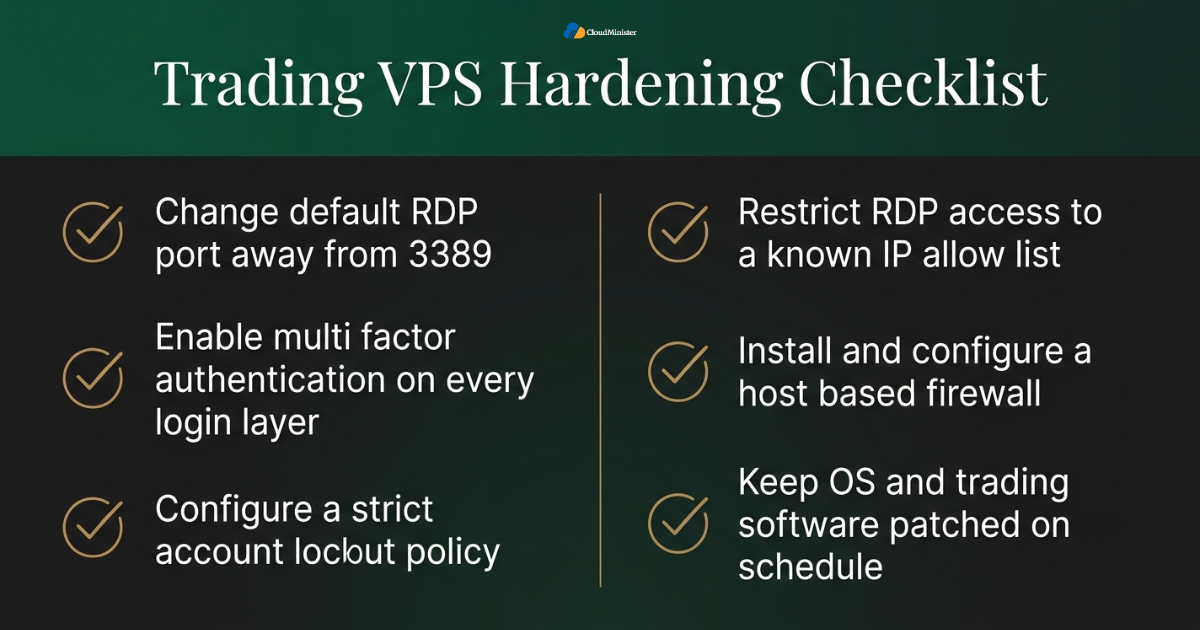
- Enable multi factor authentication on every layer that supports it, including the VPS login itself, the broker platform, and any trading terminal that stores saved credentials, since password only access is now considered a baseline vulnerability by most security researchers.
- Configure a strict account lockout policy so that repeated failed login attempts trigger an automatic, time limited lockout, directly countering the high speed credential spraying campaigns that now target exposed remote access services.
- Restrict Remote Desktop Protocol access to a specific allow list of IP addresses wherever your daily location is predictable, since this single control removes the trading VPS from the pool of servers a random internet wide scan would even discover.
- Install and properly configure a host based firewall, closing every port that is not explicitly required by the trading terminal, the broker connection, or approved remote management tools.
- Keep the operating system and every piece of trading software patched on a defined schedule, since a meaningful share of successful intrusions in 2026 trace back to a known vulnerability that had already been publicly disclosed and simply never remediated.
Ready to Secure Your Trading VPS the Right Way
Get a Forex VPS built for low latency broker connections, continuous uptime, and security that goes beyond the basics.
Use a unique, high entropy password for the VPS login that is never reused anywhere else, since credential reuse remains one of the most common ways an unrelated data breach elsewhere ends up compromising a trading account. A properly configured VPS For Forex Trading account should also separate read only monitoring access from full administrative access, so a third party analytics tool never needs full control of the server. Encrypt saved broker credentials and API keys rather than storing them in plain text configuration files, since a script that can read a plain text file can just as easily be written to exfiltrate it, and disable unnecessary background services and remove any pre installed software that is not directly required for the trading workflow, since every additional running service is one more potential entry point.
Related Reading: Bare metal versus dedicated server infrastructure
- A genuine VPS For Forex Trading setup should include automated snapshot backups taken before and after any significant configuration change, so a compromised or corrupted environment can be rolled back in minutes rather than rebuilt from scratch.
- Traders who genuinely understand what a proper VPS For Forex Trading configuration looks like are far less likely to accept vague reassurances from a provider instead of specific, verifiable answers.
- Traders working with a Forex VPS Hosting service should confirm exactly which of these hardening steps the provider handles by default versus which ones remain the trader’s own responsibility.
- A Web Hosting Company in India offering managed trading infrastructure should be able to walk through this exact checklist during onboarding, rather than leaving a trader to discover gaps after the fact.
Treat this checklist as a one time setup task that still needs a recurring review, since new expert advisors, plugins, and remote access tools installed later in the year can quietly reopen ports or add services that were deliberately closed during the original hardening pass. Every new tool added to the environment is a fresh reason to Secure Your Trading VPS again rather than assuming the original setup still holds.
4. Where Trading VPS Security Actually Breaks Down
Trading environments rarely get compromised through some exotic, unpredictable attack. Understanding where real incidents concentrate is central to building a defense that actually holds up under pressure. The single most common failure point remains an exposed Remote Desktop Protocol service using a weak or reused password, still the entry point behind a large share of automated intrusions against Windows based servers. A gap between what a trader assumes is patched and what is actually running an outdated version is one of the most common reasons a known vulnerability ends up exploited months after a fix was already publicly available, and traders frequently install third party expert advisors or indicators from unverified sources, where a malicious script bundled inside one of these files can quietly exfiltrate saved credentials without any visible symptoms.
- Disputes and losses often trace back to a trader assuming their hosting provider automatically handles operating system level security, when in most cases a standard VPS plan only guarantees the underlying infrastructure, not the software running on top of it.
- Container images and legacy operating system versions still circulating on older trading VPS instances quietly undermine security, since an unpatched, unsupported base image is treated as a known and avoidable risk by any serious security review.
- Weak or absent firewall rules mean a trading VPS with every port left open is functionally advertising itself to automated internet wide scanning tools that specifically hunt for exposed remote access services.
- A common mistake traders make is assuming a single antivirus tool is sufficient protection, when a layered approach combining firewall rules, access restrictions, monitoring, and patching is what actually stops most real world intrusion attempts.
- Server Management Services that monitor infrastructure on a recurring basis are well positioned to catch the kind of configuration drift, an accidentally reopened port or a disabled firewall rule, that later becomes a serious incident.
Related Reading: Reasons to choose a dedicated gaming server
- A Server Management Services in India provider monitoring infrastructure on a recurring basis is well placed to catch a lapsed patch cycle or a misconfigured firewall rule before it becomes an actual incident rather than a near miss.
- Traders running multiple trading accounts through a single Dedicated Server Hosting in India instance should confirm exactly how account isolation is configured, since a shared environment with weak separation between accounts is a common and avoidable source of cross account exposure.
- Dedicated Servers in India also make forensic review far simpler after any suspicious event, since every log and configuration change belongs exclusively to one account rather than being mixed with unrelated tenants.
- Traders relying on genuine cybersecurity practices rather than a single control tend to catch anomalies faster, since layered monitoring surfaces unusual login times or geographic access patterns almost immediately.
The traders who consistently Secure Your Trading VPS over the long run are rarely the ones who bought the cheapest available plan and hoped for the best. They are the ones who treated infrastructure security as an ongoing discipline, reviewed their configuration on a recurring schedule, and matched their actual setup against a real hardening checklist rather than assuming default settings were good enough.
5. How AI Is Changing the Threat Landscape for Automated Trading
Below is a direct look at how the threat picture has shifted specifically because of AI, since most traders still assume the attacks they face today look the same as they did even two years ago.
- Generative and agentic AI driven phishing is now cited as one of the biggest concerns by cybersecurity leaders, and a well crafted phishing message targeting a trader’s broker login can be generated, personalized, and sent entirely by an automated pipeline with no human involvement.
- Organizations reported that AI related security incidents cost meaningfully more on average than traditional breaches, reinforcing why the decision to Secure Your Trading VPS now needs to account for automated rather than purely manual attack methods.
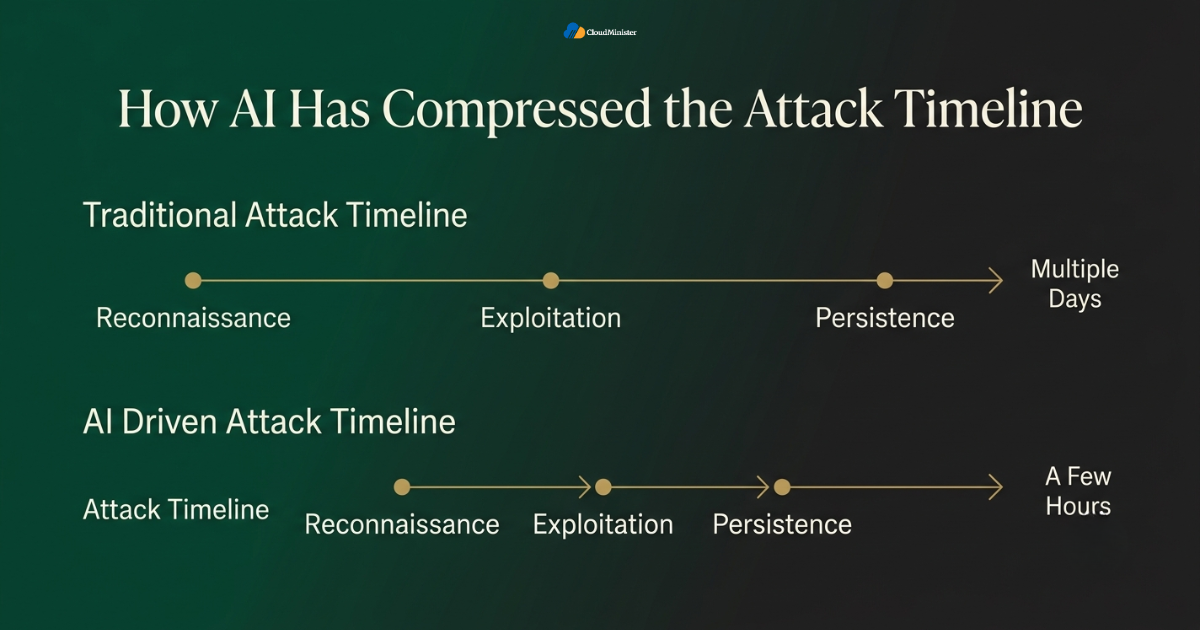
- Threat actors increasingly deploy AI agents to perform reconnaissance and can identify an exposed, poorly configured server within minutes rather than the hours or days a manual scan would have taken previously.
- AI generated password variants now specifically probe the boundaries of common lockout policies, testing just below the threshold that would trigger an automatic block, which is exactly why a properly tuned lockout policy matters more than ever to Secure Your Trading VPS effectively.
- Deepfake audio and video are increasingly used in social engineering attempts aimed at extracting credentials or authorization from a trader, extending the attack surface well beyond the server itself and into the human layer of the operation.
- A rising share of malicious activity now involves AI assisted tooling that can chain together reconnaissance, exploitation, and persistence with minimal human decision making at each step, compressing what used to be a multi day intrusion into a matter of hours.
- Organizations using AI driven security tooling of their own detect threats significantly faster than those relying purely on traditional methods, which is exactly the kind of asymmetry a properly monitored trading setup should be designed to exploit in the trader’s favor.
- A Web Hosting Company in India investing in AI aware detection capabilities is better positioned to flag the kind of subtle, automated intrusion attempts that a purely manual review would likely miss entirely.
- Traders wanting a deeper technical grounding in how infrastructure choices affect resilience should revisit their compute headroom planning, since adequate resources are also what allow monitoring and security tooling to run continuously without degrading trading performance.
- VPS For Forex Trading setups that pair adequate hardware resources with active security monitoring are far better positioned to absorb the compute overhead of real time threat detection without impacting execution speed.
- Dedicated Servers in India running trading workloads benefit specifically from this shift, since dedicated resources leave clear headroom for monitoring tools that a resource constrained shared VPS simply cannot support alongside a live trading terminal.
A Server Management Services provider that documents its own detection methodology in specific terms gives a trader far more confidence than a vague promise of general security coverage, and running trading strategies on Dedicated Servers in India also means a trader has direct visibility into resource usage patterns, making it easier to notice when an unexpected process is quietly consuming CPU or bandwidth.
AI has not replaced the fundamentals of trading VPS security, it has simply made every fundamental gap easier and faster for an attacker to find. A trader who properly patches, restricts access, and monitors continuously is defending against both the old manual threats and the new automated ones at the same time, which is precisely what it means to Secure Your Trading VPS against the current threat landscape rather than the one from a few years ago.
6. Building a Practical Strategy to Secure Your Trading VPS in 2026
Even a well configured server underperforms without an organized ongoing routine, since the fast moving threat trend around automated AI forex trading creates urgency that many traders still have not converted into an actual weekly habit. Start with a full inventory of every piece of software, plugin, and remote access tool running on the server, since a trader cannot properly Secure Your Trading VPS without first knowing exactly what is actually installed and running. Traders who want to Secure Your Trading VPS efficiently should prioritize the steps that close the widest, most commonly exploited gaps first, rather than spreading limited time evenly across every possible control at once.
- Separate access credentials by purpose, using distinct logins for VPS administration, broker platform access, and any third party monitoring tools, rather than a single shared password across every layer of the setup.
- Confirm that the trading terminal itself, along with every connected expert advisor, is downloaded only from a verified, official source before installation, given how frequently malicious scripts are bundled inside pirated or unofficial trading tools.
- Size the server resources to genuine workload requirements, since an underpowered VPS struggling to run both a trading strategy and basic security monitoring simultaneously is far more likely to experience the exact kind of instability an attacker can exploit.
- Traders without deep infrastructure experience should treat a partnership with a dedicated Forex VPS Hosting service as the foundation of a realistic security strategy rather than an optional add on.
- Review server configuration on a recurring schedule rather than treating hardening as a single setup task, since new plugins and remote access tools installed later in the year can quietly reopen previously closed attack surface.
- A team delivering genuine Server Management Services should be able to show a documented patching and monitoring history on request, not just a verbal summary of what is currently protected.
- Traders comparing providers of Dedicated Server Hosting in India should weigh how thoroughly a provider documents infrastructure changes, since that documentation becomes essential if a dispute or incident investigation ever arises.
- A hosting relationship marketed purely around price with no visible security documentation is usually optimizing cost rather than the actual delivered protection a trader actually needs.
- A provider offering both a genuine Forex VPS Hosting service and dedicated Server Management Services under one roof tends to catch a configuration gap before the trader even notices it during routine use.
- Track remote access logs as a specific weekly checkpoint, since an unfamiliar login time or an unexpected geographic location is exactly the kind of basic anomaly a proper review is designed to catch early.
- Confirm that automated backups are actually running and genuinely restorable before assuming they exist, not after a corrupted environment forces an emergency rebuild during active trading hours.
- Traders running on Dedicated Servers in India should confirm backup storage is physically or logically separated from the primary server, so a single incident cannot compromise the production environment and the backup at the same time.
- Backup restoration should be tested periodically rather than assumed to work, since a backup nobody has actually restored is one of the more common and avoidable ways traders discover a gap at the worst possible time.
- A Web Hosting Company in India that proactively flags an unusual pattern in access logs, rather than waiting for the trader to notice, is a strong signal of the kind of operational maturity a serious trading setup requires.
- Many traders discover just how many security gaps they actually had only after switching to a new Forex VPS Hosting service and receiving a first infrastructure review, which is a strong argument for requesting that review proactively rather than waiting for an incident.
- Teams running production trading strategies through a managed provider should confirm which specific safeguards are actually active by default on their plan, since assumptions about included protection are a common and preventable source of exposure.
- Migrating to a new Web Hosting Company in India without first mapping existing configuration gaps is a common reason security ends up narrower than expected once a new environment is actually live.
- Traders evaluating a new provider for the first time should ask directly how quickly a suspicious login attempt gets escalated once detected, since a slow response undermines the entire purpose of an otherwise solid setup.
Ultimately, the discipline required to Secure Your Trading VPS is less about a single dramatic upgrade and more about consistent, boring, repeatable habits applied every single week.
Checklist: Trading VPS Security Readiness Review
- Default remote access port changed and access restricted to a known IP allow list
- Multi factor authentication enabled on the VPS, broker platform, and trading terminal
- Account lockout policy configured against high speed credential spraying attempts
- Operating system and trading software patched on a defined, recurring schedule
- Automated backups verified as genuinely restorable, not simply scheduled
7. Practical Steps to Take Before You Fully Automate Trading
Genuine readiness for automated AI forex trading is not about a single sweeping setup session. It comes from a series of specific, repeatable actions applied consistently before a strategy ever runs unattended with real capital. Confirm with any provider of a Forex VPS Hosting service exactly which systems are currently patched and monitored by default, since an outdated understanding of what is actually covered regularly misrepresents real readiness. Pull a current inventory of every credential, API key, and connected service tied to the trading account before assuming everything is properly secured, since a short or outdated inventory consistently produces false confidence, and identify every piece of software currently running with a known, unpatched vulnerability, since these remain one of the fastest and most common ways a trading account gets compromised.
- A provider delivering both Server Management Services and genuine security monitoring together tends to close configuration gaps faster than two separate vendors working independently on the same server.
- Confirm that any workload running on Dedicated Server Hosting in India tied to live trading capital has documented, current patch status rather than an assumption that everything is automatically covered.
- Traders who have moved critical strategies to Dedicated Servers in India specifically to gain more control should actually exercise that control through regular audits, rather than letting the extra isolation create a false sense of security.
- Right size the VPS resources to actual workload value rather than simply copying what worked for someone else’s strategy, since accurate sizing is what allows security monitoring to run continuously without degrading execution speed.
- Traders weighing whether their current plan still fits should periodically revisit Dedicated Server Hosting in India options, since workload needs and risk exposure both tend to grow well beyond what the original setup was sized for.
- Use a documented incident response plan as a starting point, covering exactly what happens the moment unauthorized access is suspected, then actually rehearse it rather than assuming a written plan alone is sufficient.
- Set a recurring reminder to review server configuration against the current software inventory, since new plugins and remote tools installed over time can silently reopen previously closed access.
- Confirm that any provider delivering a Forex VPS Hosting service documents security findings in a format that is easy to review, since this directly affects how quickly a real issue actually gets addressed.
- Audit unused remote access tools and unnecessary background services separately from the main hardening effort, since removing a genuinely unneeded service is often more valuable than trying to secure one that should not be running at all.
- Apply security improvements incrementally, starting with remote access controls and credential hygiene, then expanding coverage only after confirming the initial changes are stable and have not disrupted the trading strategy.
- Maintain a documented record of every security control implemented, including when it was last reviewed, so a future audit or incident investigation never stalls over missing information.
- Treat the effort to Secure Your Trading VPS as a natural companion to the trading strategy itself, not a separate initiative that competes for the same limited attention.
- Traders who genuinely Secure Your Trading VPS before scaling capital tend to avoid the painful, expensive lesson of learning security the hard way after an incident has already occurred.
- A Server Management Services provider that walks through its own incident escalation procedure in specific detail, rather than describing it only in general terms, is signaling genuine operational readiness relevant to any serious trading setup.
- Traders evaluating infrastructure specifically for a growing, increasingly automated trading operation should ask for a sample incident response scenario before committing to a hosting provider long term.
A provider claiming strong trading infrastructure support without ever discussing specific patching, monitoring, or access control practices is likely offering only generic hosting, not the operational depth a genuine strategy to Secure Your Trading VPS actually requires.
8. Choosing the Right Infrastructure Partner for Automated AI Forex Trading
Not every hosting relationship is built to support a serious trading operation, and this is exactly where the difference between an average provider and a genuinely capable one becomes visible. A dependable Web Hosting Company in India that already understands trading workloads is well positioned to advise on hardening without introducing unnecessary complexity into an already functioning setup. Traders should confirm any provider of a Forex VPS Hosting service actually operates its own infrastructure rather than reselling capacity from a third party with no direct accountability for performance or security, and a dependable provider should be able to share a reference client who has successfully run automated AI forex trading on their infrastructure without a significant security incident.
- Traders evaluating providers should specifically ask whether the provider has direct experience supporting algorithmic trading workloads, not just offering generic virtual machine hosting.
- A provider offering transparent pricing around Dedicated Server Hosting in India makes it easier to compare true infrastructure cost against a generic budget VPS quote that omits critical security features.
- Traders considering the jump to Dedicated Server Hosting in India for the first time should ask specifically how migration is handled, since a poorly managed transition can itself introduce temporary security gaps.
- A provider combining Server Management Services with dedicated monitoring typically gives traders a single point of contact for incident response, which shortens the time between detection and resolution.
- A newer Web Hosting Company in India may offer a competitive base rate but lack the documented track record needed to advise confidently on a complex, continuously running trading environment.
- A provider offering Dedicated Server Hosting in India with a documented security track record is generally a safer long term choice than one offering only a low introductory price with no visible support structure.
- Traders should confirm whether their Dedicated Server Hosting in India plan includes proactive alerting for unusual login patterns, or whether that monitoring needs to be configured separately.
- Ask any prospective Forex VPS Hosting service provider how many trading clients they have actively supported through a real incident, since experience with this exact scenario correlates strongly with fewer surprises during a crisis.
- A Web Hosting Company in India that treats every trader’s setup as identical is usually applying a generic template rather than genuinely reviewing the actual workload and risk profile involved.
- A track record of catching real security gaps before they become incidents is a far better signal of genuine capability than a marketing page listing every security buzzword a provider happens to mention.
- A genuinely experienced provider will describe, in specific terms, how a past client’s trading environment was hardened and monitored with clear documentation and minimal disruption to live strategies.
- Dedicated Servers in India offered with transparent, documented security practices tend to deliver more predictable outcomes than infrastructure relying purely on ad hoc configuration with no consistent standard applied.
- A provider offering both budget VPS plans and Dedicated Servers in India can guide a trader toward the right tier based on actual capital and risk exposure rather than pushing a one size fits all package.
- Traders comparing Dedicated Server Hosting in India providers for this specific purpose should weigh documented process over a generic promise of general hosting experience.
- A well chosen VPS For Forex Trading plan, paired with disciplined patching and monitoring, closes the majority of gaps that a determined attacker would otherwise try to exploit first.
- Traders who want to move quickly without designing every layer of protection themselves often gravitate toward a provider offering clear documentation on how trading infrastructure is secured, monitored, and verified from day one, since that clarity is ultimately what it takes to genuinely Secure Your Trading VPS for the long run.
- Traders who have not yet reviewed their hosting relationship specifically around automated trading security should treat this guide as a natural trigger point to do so, and to ask their provider directly about any readiness gaps.
- A capable partner offering both deep expertise in Server Management Services and a genuine Forex VPS Hosting service gives serious traders a coherent infrastructure roadmap instead of stitching together advice from multiple vendors.
- Traders researching hosting options for continuously running algorithmic strategies should confirm that a prospective partner understands both trading specific latency requirements and the surrounding access control needs that go with them.
- A provider that also runs Dedicated Server Hosting in India under one roof tends to catch a mismatched configuration or a stalled patch cycle faster than two separate vendors handling hosting and security in isolation.
A provider that bundles a genuine Forex VPS Hosting service with real documentation oversight, rather than treating security as a purely mechanical checkbox, is generally better positioned to help a trader succeed with a long term automated strategy.
- A genuinely capable Web Hosting Company in India will also be transparent about which parts of security it owns directly and which parts depend on the trader’s own configuration decisions.
- Reviews and verifiable references matter more than a homepage promise when choosing a partner for something as consequential as infrastructure that directly touches live trading capital.
- A genuinely experienced Web Hosting Company in India will proactively suggest the right tier, whether that means a standard VPS For Forex Trading plan or a move toward Dedicated Servers in India, rather than defaulting every client to the same package.
- Traders switching their infrastructure provider specifically to strengthen security should confirm the new partner’s documentation approach before migrating, rather than assuming it will simply be handled automatically.
- Traders should ask any candidate provider for a specific example of a client they helped through a tight incident response timeline involving a trading environment.
- A provider that treats trading focused security as a core offering, not an upsell, tends to be the more dependable long term partner for anyone serious about automated AI forex trading.
- Traders evaluating any Web Hosting Company in India should ask directly whether the team has specific, hands on experience supporting VPS For Forex Trading clients, rather than generic web hosting customers.
The right partner treats infrastructure security documentation as a baseline expectation, not a premium feature reserved for large accounts, and that baseline is exactly what it takes to genuinely Secure Your Trading VPS the way a serious trading operation actually requires. Traders comparing hosting relationships broadly should remember that a competent Web Hosting Company in India is the foundation every other layer of trading security is built on top of, and even the best security checklist is only as good as the VPS For Forex Trading plan it is applied to, which is why infrastructure choice and security discipline should always be treated as one combined decision rather than two separate ones.
When comparing quotes or advice from different hosting providers on this topic, ask each one to walk through a real incident response example using a trading setup similar to yours rather than a generic case study, since the right recommendation depends entirely on your specific strategy, broker, and risk tolerance. A provider that genuinely understands both the infrastructure mechanics and the trading use case will consistently give more actionable guidance than a purely theoretical comparison.
9. Does Your Trading Setup Actually Need Dedicated Infrastructure
Answering whether dedicated infrastructure is necessary depends less on account size alone and more on how much genuine exposure a specific trading operation actually carries. A trader who already relies on strong Server Management Services and consistent monitoring generally finds ongoing operations far less stressful than one starting from a completely unmanaged setup. Whether a trader ultimately chooses a standard VPS For Forex Trading plan or scales up to Dedicated Servers in India, the underlying security discipline required to Secure Your Trading VPS does not change, only the amount of infrastructure that discipline needs to cover.
- Any trader running multiple strategies simultaneously or managing capital on behalf of others should treat robust infrastructure security as close to mandatory, given the direct financial exposure involved, and the extra step required to Secure Your Trading VPS thoroughly becomes even more important once a trader starts managing capital for other people, since a breach at that point affects more than just one account.
- Traders running high frequency or latency sensitive strategies carry some of the highest exposure profiles, making genuinely hardened infrastructure a particularly high value choice relative to its cost.
- Traders who would struggle to recover from even a short period of unauthorized access should weigh dedicated infrastructure heavily, since account isolation often represents the single most financially significant part of a hosting decision.
- Traders scaling from a single strategy to several simultaneous automated systems often find that Dedicated Server Hosting in India becomes a practical requirement rather than a discretionary upgrade.
- The step up to Dedicated Servers in India is often less about raw performance and more about the additional operational control it hands back to a trader who wants to directly enforce their own security standards.
- Traders with a strong existing relationship with a dedicated Forex VPS Hosting service and Server Management Services provider often find operational overhead meaningfully lower than traders starting entirely from scratch.
- Traders running critical strategies on Dedicated Servers in India with documented monitoring typically experience fewer disruptive incidents with minimal ongoing intervention required.
- The added control that comes with Dedicated Servers in India is only valuable if a trader actually uses it to enforce stricter security policies rather than leaving default settings untouched.
- Reliable Server Management Services remain one of the clearest signals of infrastructure maturity that a serious trader should look for in any provider.
- A provider delivering Dedicated Server Hosting in India as a core offering, not a side service, tends to maintain the kind of documentation and support depth a serious trading operation actually needs.
- Traders who already invest in solid security practices consistently report that moving to Dedicated Servers in India simplifies rather than complicates their ongoing maintenance routine.
- Even smaller traders with modest account sizes should evaluate dedicated infrastructure, since automated attacks increasingly target smaller, less protected accounts specifically because defenses are assumed to be weaker.
Regardless of account size, the basic decision to Secure Your Trading VPS should never be postponed until the account grows large enough to feel like an obvious target, since attackers do not wait for that threshold either. A trader already investing seriously in security practices is generally well positioned to run automated strategies with confidence, since demonstrated operational discipline directly reduces real world risk exposure, and traders who Secure Your Trading VPS early, before scaling to multiple strategies or larger capital, consistently report a smoother, less stressful growth path than those who retrofit security after the fact.
Traders who already invest in genuine security practices and rely on a dependable Dedicated Server Hosting in India partner typically find the entire process of running automated AI forex trading considerably smoother and far less stressful over time.
Key Takeaways
- The decision to Secure Your Trading VPS has become a genuine financial necessity for anyone running automated AI forex trading, not an optional extra reserved for large accounts.
- Traders at every stage, from a first demo account graduating to live capital through to an established multi strategy operation, should treat the decision to Secure Your Trading VPS as a permanent part of how they operate, not a one time task to check off.
- The gap between what a standard VPS plan covers and what it leaves entirely to the trader is often where accounts get an unpleasant surprise, making a careful read of what is actually included essential before going live.
- Strong security practices and documented infrastructure directly influence both the likelihood of an incident and how quickly a trader can recover if one does occur.
- Remote access controls, credential hygiene, and continuous monitoring are among the highest priority areas any strategy to Secure Your Trading VPS should address first.
- Recurring reviews and a documented configuration history matter just as much as the initial setup, and this holds whether the environment runs on a standard VPS, through Dedicated Server Hosting in India, or through a broader Forex VPS Hosting service.
- A Web Hosting Company in India that already understands algorithmic trading end to end, and that offers a genuine Forex VPS Hosting service, remains one of the more reliable ways to strengthen a trader’s overall security position.
- Whether a trader is comparing a first VPS For Forex Trading plan or evaluating a move to Dedicated Servers in India, the same underlying questions about patching, monitoring, and documented support should guide the final decision.
- Partnering with a capable provider experienced in both dedicated trading infrastructure and Server Management Services meaningfully reduces the risk of a costly incident, and this is worth raising directly the next time a trading infrastructure review comes up.
- Ultimately, whether a trader operates on a standard VPS For Forex Trading plan or a fully Dedicated Server Hosting in India setup, choosing a capable Web Hosting Company in India remains the single decision that shapes every other security outcome that follows.
Not Sure If Your Current Setup Is Secure Enough
Talk to our team for a straightforward review of your trading infrastructure and find out exactly where the gaps are.
Conclusion
Across every section of this guide, one idea keeps repeating in different forms, and it is worth stating plainly here. The decision to secure your trading VPS is not a one time purchase or a box you check before going live. It is an ongoing habit that has to survive every new plugin you install, every expert advisor you add, and every year the threat landscape shifts further toward automated, AI driven attacks. Traders who treat it this way tend to avoid the kind of incident that forces a much harder lesson later.
The traders who handle this well tend to follow the same basic pattern regardless of account size. They start by honestly confirming how much real exposure their current setup carries, rather than assuming a reputable hosting provider already covers everything. They prioritize credential hygiene and access restriction before anything else, since weak or reused passwords and open remote access remain the most common way trading accounts get compromised. And they treat infrastructure security as one layer inside a broader trading discipline, sitting alongside risk management and strategy review, not as a separate project competing for attention.
If you are weighing this decision right now, the same three steps apply no matter where you are starting from. Understand your actual exposure first, document the specific controls you put in place second, and then choose a hosting partner that genuinely matches what your trading operation needs. A capable Web Hosting Company in India that understands both a genuine Forex VPS Hosting service and broader Dedicated Server Hosting in India removes most of the guesswork from that last step, and gives you one place to turn when something needs a fast answer. Whatever path you choose, the underlying goal stays the same, which is to secure your trading VPS before it ever has to prove itself during an actual incident.
Frequently Asked Questions
Is it actually necessary to Secure Your Trading VPS for a small retail account?
In most cases, yes. Automated attacks do not discriminate by account size, and smaller accounts are frequently targeted specifically because attackers assume the defenses around them are weaker. Given how much unattended time a trading VPS spends connected to a live broker account, even basic hardening can be the difference between a manageable inconvenience and a genuinely damaging incident. This is precisely why the advice to Secure Your Trading VPS applies just as strongly to a first small account as it does to an established fund.
Does a standard VPS plan already include security by default?
Often only partially. Most standard plans secure the underlying physical infrastructure, but operating system hardening, firewall configuration, and application level protection typically remain the trader’s own responsibility unless the provider explicitly offers managed security as part of a Forex VPS Hosting service.
What is the difference between a shared VPS and Dedicated Server Hosting in India for trading purposes?
A shared VPS splits physical hardware resources across multiple customers, while Dedicated Server Hosting in India provides an entire physical server exclusively to one client. For traders running multiple accounts or latency sensitive strategies, dedicated resources remove shared tenancy risk and generally offer more predictable performance, and this is exactly why many serious traders eventually move from a shared VPS For Forex Trading plan toward Dedicated Servers in India as their capital and strategy count grow. Confirm with your provider of Server Management Services whether their default monitoring practices would actually catch an unauthorized login attempt before finalizing any hosting decision.
What is the single most effective first step toward automated trading security?
There is no single step that captures every requirement, but running a complete inventory of every credential, plugin, and remote access tool tied to the trading environment consistently produces the fastest, most accurate starting point, especially when supported by a partner offering genuine Server Management Services and an active Forex VPS Hosting service. A Dedicated Server Hosting in India provider that already tracks security performance on a recurring basis can usually answer this question immediately. Whether the environment runs through a third party Web Hosting Company in India or on infrastructure managed entirely in house, the same underlying inventory work applies before going live. A provider offering both a Forex VPS Hosting service and dedicated Server Management Services support typically speeds up this entire process considerably.
How often should trading VPS security be reviewed once the initial setup is complete?
A full review at least once a quarter is a reasonable baseline, though any time you add a new expert advisor, plugin, or remote access tool is also a good trigger for a quick check. New software is one of the most common ways a previously closed port or disabled firewall rule gets reopened without anyone noticing, so reviewing configuration on a recurring schedule matters just as much as the original hardening pass.
Can antivirus software alone secure your trading VPS?
No, antivirus is only one piece of a much larger picture. A trading VPS needs a layered approach that combines a properly configured firewall, restricted and monitored remote access, multi factor authentication, regular patching, and tested backups. Relying on antivirus alone leaves gaps around credential attacks, misconfigured access, and unpatched vulnerabilities, which are the areas most real incidents actually come from.

Pritam Kumar is a DevOps Engineer at CloudMinister Technologies, where he manages a multi-datacenter fleet of 100+ servers and architects end-to-end CI/CD pipelines and infrastructure automation using Kubernetes, Terraform, and Ansible. He holds an AWS Certified DevOps Engineer Professional certification and has served as a Google Cloud Mentor, reflecting both hands-on cloud expertise and a track record of mentoring others in the field. His work spans disaster recovery architecture, security incident response, and hosting infrastructure across Proxmox, cPanel/WHM, and Linux systems. Notably, Pritam led the design of Cloud Kavach, a self-hosted DC/DR SaaS portal, and directed remediation efforts for large-scale hosting security incidents involving webshells and command-and-control malware. He brings this depth of real-world infrastructure and security experience to the technical content he writes.
