Picking the right Forex VPS is no longer a side decision for algorithmic traders, it is the decision that determines whether a trading bot executes on time or bleeds pips to slippage. This guide breaks down exactly which specifications matter for low-latency algorithmic trading, from CPU clock speed and RAM to network routing and broker proximity, and explains how to size this kind of server correctly for MT4, MT5, cTrader, or custom bot frameworks. Whether you are running a single Expert Advisor or a multi-strategy bot farm, understanding what this infrastructure actually needs to deliver under load is the difference between a profitable automated strategy and one quietly losing money to latency.
Every algorithmic trader eventually hits the same wall: a strategy that performs beautifully in backtesting but bleeds money in live execution. More often than not, the culprit isn’t the strategy logic at all, it’s the Forex VPS it’s running on. A trading bot is only as fast, stable, and reliable as the server executing its instructions, and most traders discover this the hard way, after slippage, missed ticks, or a mid-session freeze has already cost them real money on an open position.
Choosing a Forex VPS is not the same exercise as picking a general-purpose hosting plan, and treating it that way is where most sizing mistakes begin. Algorithmic trading places a very specific kind of load on a server: single-thread CPU speed matters more than core count, RAM needs to be sized for volatility spikes rather than idle averages, and physical proximity to your broker’s matching engine can matter more than any other spec on the page. Get these wrong, and even flawless trading logic will underperform its own backtest.
This guide walks through exactly what to look for in a Forex VPS built for low-latency algorithmic trading, covering CPU, RAM, network, storage, and location requirements in detail, along with how to match specification tiers to your actual trading style. Whether you’re running a single Expert Advisor or managing a multi-strategy bot farm across several brokers, the goal is the same: infrastructure that keeps up with your strategy instead of quietly working against it.
Table of Contents
- 1. Why Specs Matter More in 2026 Than Ever Before
- 2. Understanding What This Infrastructure Actually Does for Algorithmic Bots
- 3. CPU Specifications: The Real Bottleneck
- 4. RAM Requirements for Reliable Infrastructure
- 5. Network and Latency Specifications
- 6. Storage Specifications for Trading Bots
- 7. Operating System and Platform Compatibility
- 8. Uptime and Reliability Specifications
- 9. Matching Specs to Trading Style
- 10. Managed vs Self-Managed: Which Fits Algorithmic Trading
- 11. Infrastructure Decisions Behind Reliable Deployment
- 12. A Step-by-Step Framework for Selecting the Right Setup
- 13. Common Mistakes When Choosing This Infrastructure
- 14. Readiness Checklist for Deploying This Infrastructure
- 14b. Frequently Compared: VPS Hosting in India Against Purpose-Built Trading Plans
- Key Takeaways
- Conclusion
- Frequently Asked Questions
1. Why Specs Matter More in 2026 Than Ever Before
Algorithmic trading has moved from a niche practice to the default execution method for serious retail and semi-professional traders, and a Forex VPS Hosting service sits at the center of that shift. Professional and algorithmic traders using colocated, low-latency servers now operate in the 1ms to 5ms range, a level of execution speed that simply is not possible from a home internet connection or an undersized shared server. This is precisely the gap a properly specified trading server is built to close.
The global algorithmic trading market itself reflects this shift in seriousness. Market analysts estimate the global algorithmic trading industry was worth roughly USD 21 billion in 2024, with continued double-digit annual growth projected through 2030, and that growth curve has only steepened through 2026 as more retail traders adopt Expert Advisors and custom bot frameworks that depend entirely on a stable, low-latency environment to function correctly.
For a trader running a single Expert Advisor on a single pair, the temptation is to treat this kind of server as a commodity, any cheap virtual server will do. This is one of the most expensive assumptions in algorithmic trading. A poorly specified Forex VPS introduces latency, missed ticks, and execution slippage that a backtest will never reveal, because backtests do not account for real-world network jitter, CPU contention from noisy neighbours, or a server location that sits hundreds of milliseconds away from the broker’s matching engine.
For a trader running a portfolio of bots across multiple currency pairs and multiple brokers, the stakes are higher still. Every additional Expert Advisor running on the same server adds CPU load, memory pressure, and potential I/O contention, all of which can quietly degrade execution quality across the entire portfolio if the underlying server was not sized with headroom in mind.
Do not choose a Forex VPS plan based on price alone. The right specification depends entirely on how many Expert Advisors you plan to run simultaneously, how latency-sensitive your strategy is, and how close your chosen server location sits to your broker’s trading servers. An underpowered Forex VPS running multiple scalping bots will often underperform a correctly sized single-bot setup on both execution quality and reliability.
2. Understanding What This Infrastructure Actually Does for Algorithmic Bots
Before comparing specifications in detail, it helps to understand what this kind of server is actually doing behind the scenes when it hosts an algorithmic trading bot. Every such server, regardless of provider or price tier, is built from the same core resource categories, but how each one is provisioned is what separates a reliable trading environment from an unreliable one.
| Component | What It Does for a Trading Bot | Why It Matters |
| CPU | Processes incoming price ticks and executes trading logic | Single-thread clock speed determines how fast an Expert Advisor reacts to a tick |
| RAM | Holds the trading platform, indicators, and bot memory in active use | Insufficient RAM causes platform freezes during high-volatility events |
| Network | Carries order requests to the broker’s matching engine | Determines the round-trip latency between signal and execution |
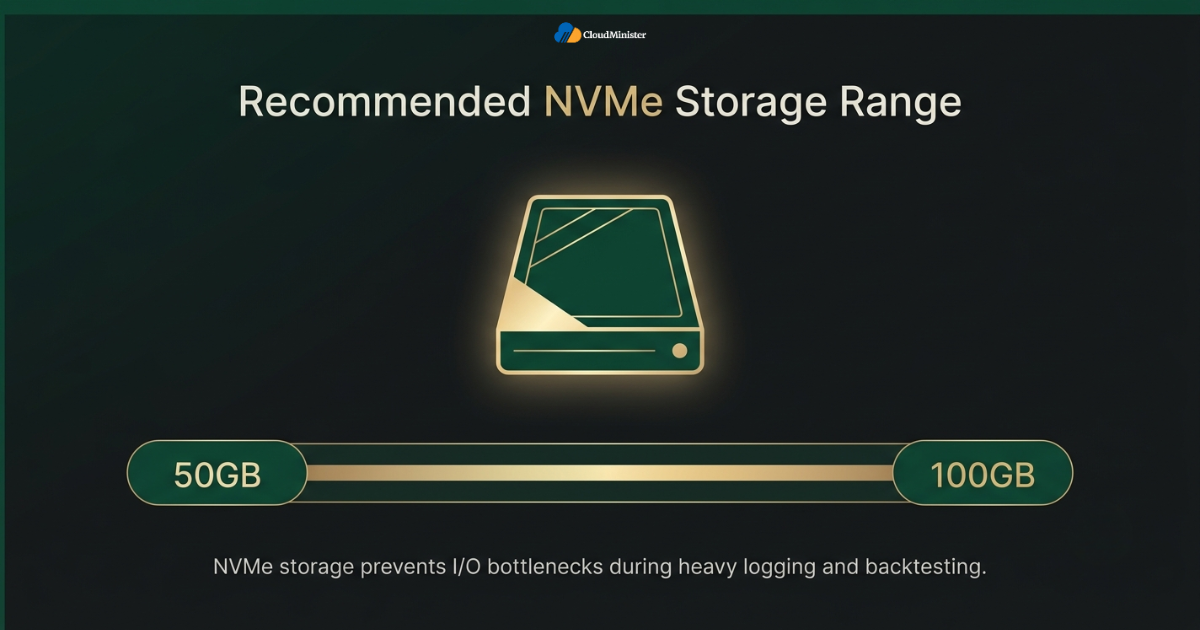
| Storage | Stores the operating system, platform, and trade logs | NVMe storage prevents I/O bottlenecks during heavy logging or backtesting |
| Location | Physical placement relative to the broker | The single biggest lever for reducing network latency |
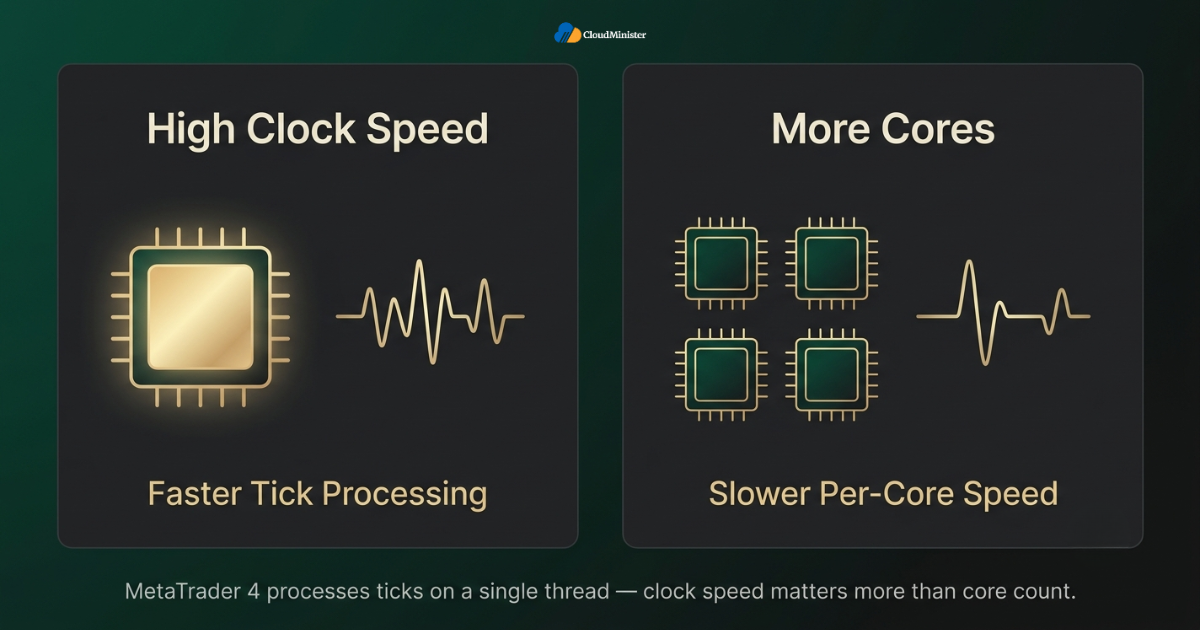
Most traders new to automated trading assume that more CPU cores always mean better performance from this kind of server. In practice, a Forex VPS Hosting service built for algorithmic trading needs to prioritize single-thread performance over raw core count, because MetaTrader 4 processes ticks on a single thread and MetaTrader 5 allocates one thread per Expert Advisor, so clock speed per core, not total core count, is what determines how quickly the server can react to market movement. This is also why serious traders searching for a reliable VPS For Forex Trading tend to filter providers by benchmark scores rather than marketing labels alone.
Related Reading: how Forex VPS hosting works and how to choose the right plan
3. CPU Specifications: The Real Bottleneck
3.1 Why Clock Speed Beats Core Count
A VPS For Forex Trading running algorithmic trading software lives or dies on how quickly a single CPU core can process an incoming tick, run the strategy logic, and submit an order. This is fundamentally different from most general-purpose hosting workloads, where more cores usually means more throughput.
- A Forex VPS with a high single-thread clock speed processes each tick faster, reducing the internal delay between price change and order submission
- MetaTrader 4 is single-threaded for tick processing, so a faster single core will outperform more, slower cores on a comparable plan
- MetaTrader 5 allocates one thread per running Expert Advisor, so a server running multiple EAs benefits from both clock speed and a reasonable core count
- Modern high single-thread PassMark scores are a useful proxy when comparing plans, since raw GHz numbers alone do not account for architecture differences
When evaluating a provider’s advertised CPU specifications, ask specifically which processor SKU is used on the plan you are purchasing, not just the processor family. Some providers list a general chip family across several tiers while the entry-level plan actually ships an older or lower-clocked variant, which can silently undercut the low-latency performance you are paying for.
3.2 Recommended CPU Specs by Trading Style
- Single EA, low-frequency strategy: 2 dedicated vCPU cores at 3.5 GHz or higher is typically sufficient for a setup running one Expert Advisor on one or two pairs
- Multiple EAs, moderate frequency: 4 dedicated vCPU cores at 4.0 GHz or higher gives a Forex VPS enough headroom to run several EAs without CPU contention
- Scalping or high-frequency strategies: The highest available single-thread clock speed, ideally 4.3 GHz or above, since every microsecond of processing delay compounds over hundreds of trades — a non-negotiable spec for any dedicated VPS For Forex Trading
- Multi-strategy bot farms: 6 to 8 dedicated vCPU cores, prioritizing dedicated, not shared or oversubscribed, allocation to avoid noisy-neighbour CPU contention
- Traders comparing plans built specifically as a VPS For Forex Trading should confirm the CPU tier scales with the number of concurrent EAs rather than staying fixed across every pricing bracket
3.3 What Makes a Setup Count as a Genuine VPS For Forex Trading
Not every virtual server marketed to traders qualifies as a purpose-built VPS For Forex Trading. A genuine VPS For Forex Trading is distinguished by a few concrete things.
- Hardware selected specifically for single-thread performance, not repurposed general-purpose cloud instances rebranded as a VPS For Forex Trading
- Network routing tested and optimized toward major broker data centers, rather than generic best-effort internet routing
- Support staff trained on MetaTrader-specific issues, since a VPS For Forex Trading that only offers generic server troubleshooting misses the point of the specialization
4. RAM Requirements for Reliable Infrastructure
4.1 Why Undersizing RAM Is a Common Mistake
RAM is the specification traders most frequently underprovision when selecting this kind of server, largely because MetaTrader itself looks lightweight when idle. The real memory pressure shows up during high-volatility events, when tick volume spikes and multiple Expert Advisors are all processing data simultaneously.
- A Forex VPS running a single EA on a single chart can often function on 2GB of RAM, but this leaves almost no headroom for volatility spikes
- 4GB of RAM is a reasonable baseline for a server running two to three Expert Advisors across a handful of charts
- 8GB or more is recommended for any serious VPS For Forex Trading running a multi-strategy portfolio, since each additional chart, indicator, and EA instance consumes additional memory
- Windows Server itself consumes a meaningful portion of available RAM before the trading platform even loads, which is often overlooked when sizing a Forex VPS
A trading server that appears to run smoothly during quiet market hours can still freeze during a Non-Farm Payroll release or a central bank announcement if RAM was sized only for average conditions. Always size for peak tick volume, not average tick volume, since that is precisely when execution quality matters most.
4.2 The News-Event RAM Problem
Reputable providers address this directly. Some plans build in automatic resource bursting specifically for high-volatility windows, temporarily allocating additional CPU and RAM during major news releases to prevent the trading platform from freezing exactly when execution speed matters most. When comparing a Forex VPS Hosting service, ask whether burst capacity is included or whether you are locked to a fixed resource ceiling regardless of market conditions. This is one area where Fully Managed VPS Hosting tends to outperform a self-managed budget plan, since a managed provider actively tunes resource allocation ahead of known high-impact news windows.
5. Network and Latency Specifications
5.1 Why Location Is the Single Biggest Latency Lever
No amount of CPU or RAM can compensate for a Forex VPS that is physically located far from your broker’s trading servers. Network latency is fundamentally a function of physical distance and routing efficiency, and this is where location selection becomes the most impactful decision in the entire setup process.
- A Forex VPS located in the same data center or metro area as the broker’s matching engine can achieve latency in the 1ms range under correct conditions
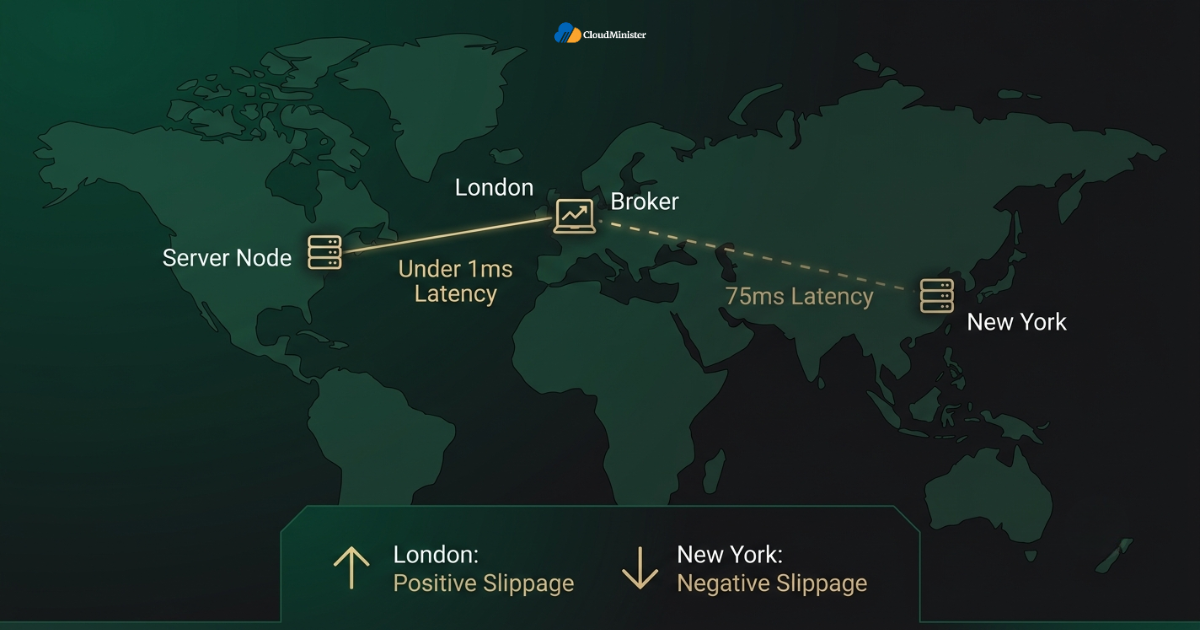
- A server placed in a different region from the broker can see latency climb to 75ms or more, which is a meaningful execution disadvantage for any time-sensitive strategy
- London remains the dominant hub for most global forex brokers, making a Forex VPS located near London financial data centers a strong default for European and global liquidity
- New York area data centers matter most for USD-denominated pairs and US-based liquidity providers, making location choice directly dependent on your broker’s server location
One controlled experiment makes this concrete. A published latency study ran an identical Expert Advisor on two virtual servers, one located near London with under 1ms ping to the broker and one located in New York with 75ms ping, executing 120 trades on GBP/JPY against a London-based broker. The London-based server accumulated positive cumulative slippage while the New York-based server accumulated meaningfully negative slippage, a real, measurable difference driven purely by physical location.
5.2 Network Specs That Matter Beyond Location
- Bandwidth: A Forex VPS should offer at least 1 Gbps network capacity, even though algorithmic trading itself uses relatively little bandwidth, since burst capacity prevents contention during high-volume periods
- Network stability: A provider with a Tier 3 or higher data center and redundant network paths, whether an international host or VPS Hosting in India, reduces the risk of dropped connections mid-trade
- Routing quality: Some providers publish real measured latency figures between their facilities and major broker hubs rather than generic marketing ranges, which is a useful signal of transparency when comparing a Web Hosting Company in India
- Packet loss: Even minimal packet loss on the network can cause an Expert Advisor to miss a tick entirely, so consistent, low packet-loss routing matters as much as raw latency numbers
- Traders comparing VPS Hosting in India against an international VPS For Forex Trading alternative should specifically request measured packet-loss data during peak trading hours, not just an advertised average
Related Reading: Forex VPS hosting for MT4 and MT5
6. Storage Specifications for Trading Bots
6.1 Why NVMe SSD Storage Is Non-Negotiable
Storage speed on a Forex VPS is often overlooked because algorithmic trading does not appear to be storage-intensive at first glance. In reality, trade logs, tick history, backtesting data, and the platform’s own database writes all place continuous, small, random I/O load on the underlying disk.
- NVMe SSD storage on a Fully Managed VPS Hosting plan delivers dramatically faster read and write speeds than traditional SATA SSD or spinning disk storage
- A server logging every tick and every trade decision benefits from NVMe’s low-latency random I/O performance, especially for multi-EA setups writing logs simultaneously
- Backtesting and strategy optimization on a VPS For Forex Trading is significantly faster on NVMe storage, since historical data loading is I/O-bound
- 50GB to 100GB of NVMe storage is typically sufficient, whether on an international plan or VPS Hosting in India, for running MetaTrader with a handful of EAs and reasonable log retention
6.2 RAID Configuration Considerations
- A Forex VPS or VPS Hosting in India plan backed by RAID 10 NVMe storage offers both speed and redundancy, protecting against a single drive failure disrupting live trading
- For a server running a single strategy with modest storage needs, RAID configuration matters less than for a multi-strategy bot farm generating heavy log volume
- Always confirm whether a provider’s advertised storage is genuinely dedicated NVMe or a shared storage pool, since shared storage introduces unpredictable I/O contention on any VPS For Forex Trading
- A properly specified VPS For Forex Trading should list the exact NVMe drive class in its plan documentation rather than the generic term SSD, since the two are not interchangeable for performance purposes
Ready for Sub-5ms Execution?
Stop losing pips to slippage. Get a Forex VPS built for low-latency algorithmic trading, with NVMe storage, dedicated CPU cores, and broker-proximate locations.
7. Operating System and Platform Compatibility
7.1 Windows vs Linux for Algorithmic Trading
- MetaTrader 4, MetaTrader 5, cTrader, and NinjaTrader are Windows-native platforms in practical production use, making a Windows-based Forex VPS the default choice for most retail algorithmic traders
- A Linux-based server is suitable for headless Python or C++ trading bots, REST or WebSocket API-based strategies, and certain crypto trading setups that do not depend on a Windows-native terminal
- A Fully Managed VPS Hosting plan running Windows Server 2019 or 2022 ensures better long-term compatibility with the latest MetaTrader builds and broker-side API updates
- Traders running custom bot frameworks outside MetaTrader should confirm their chosen Forex VPS supports the specific language runtime, whether Python, C++, or a broker-specific SDK, before committing to a plan
Do not assume every plan includes a current Windows Server version by default. Some budget tiers ship an older Windows Server release and reserve the latest version for a higher-priced Forex VPS Hosting service. Always confirm the exact operating system version available at checkout rather than assuming it matches the marketing page.
7.2 Remote Desktop Performance
- A Fully Managed VPS Hosting plan should provide low-latency RDP (Remote Desktop Protocol) access so you can monitor and adjust your Expert Advisors without the management connection itself introducing delay
- Multi-monitor RDP support is useful for traders running several charts or platforms simultaneously on a single Forex VPS
- RDP session stability matters as much as raw specs, since a server that disconnects RDP sessions frequently makes bot monitoring unnecessarily difficult
8. Uptime and Reliability Specifications
An algorithmic trading bot is only as reliable as the Forex VPS it runs on. A bot with a flawless strategy is worthless if the underlying server goes down during a critical market move.
- Look for a provider offering at minimum a 99.9% uptime SLA on any Forex VPS, with 99.99% considered the standard for serious algorithmic trading infrastructure
- A Fully Managed VPS Hosting plan backed by redundant power, redundant network paths, and a Tier 3 or higher data center reduces the statistical likelihood of unplanned downtime
- Confirm whether the provider’s SLA includes meaningful compensation for downtime, not just a vague uptime promise with no enforcement mechanism.
- Algorithmic execution now dominates currency markets broadly, with around 92 percent of trading volume in the forex market carried out by trading algorithms rather than human traders, which is exactly why uptime below 99.9% is generally treated as a meaningful risk to consistent execution for any automated system running multiple Expert Advisors.
- A Web Hosting Company in India with its own data center relationships can often quote a more precise uptime history than a reseller, which is worth asking about when comparing a VPS For Forex Trading on paper specs alone
A Web Hosting Company in India hosting live trading credentials and broker API keys should never be treated purely as a performance purchase. Confirm the provider offers DDoS protection, regular security patching, and isolated resource allocation so that another tenant’s workload cannot affect stability or expose your trading environment to unnecessary risk.
9. Matching Specs to Trading Style
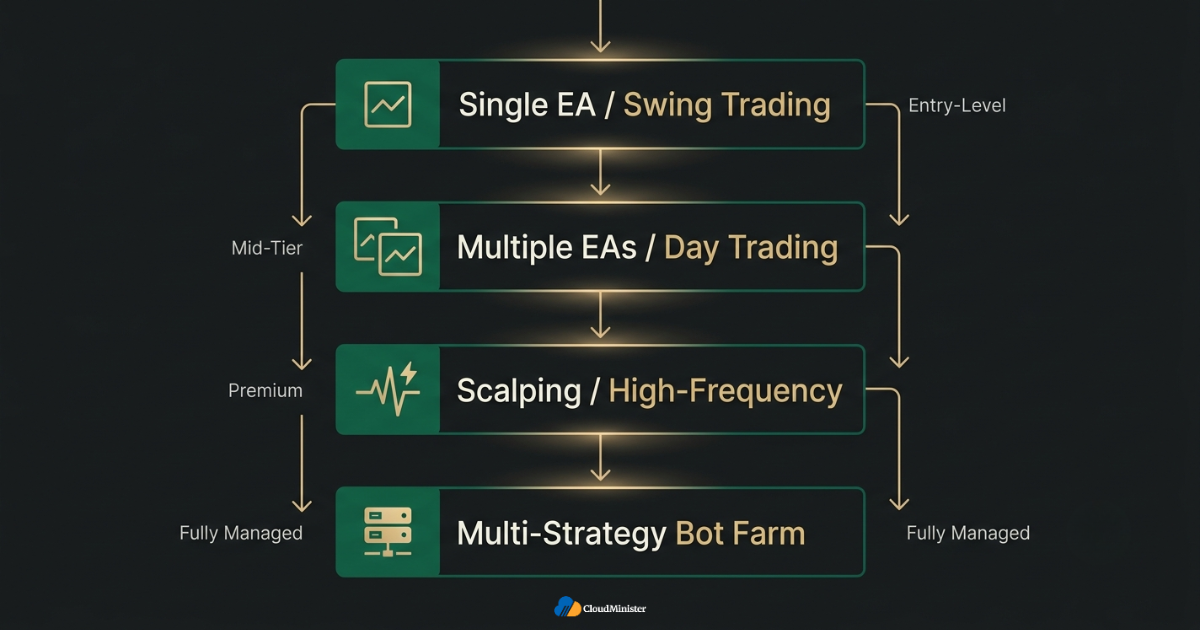
Choosing correctly requires mapping specification tier to actual trading behavior rather than defaulting to whichever plan is most heavily marketed, whether the option under consideration is an international host or a domestic Indian provider. The table below summarizes how specs should scale with strategy type.
| Trading Style | CPU Priority | RAM Needed | Network Priority | Best Fit Tier |
| Single EA, swing trading | Moderate clock speed | 2GB to 4GB | Standard latency acceptable | Entry-level Forex VPS |
| Multiple EAs, day trading | High clock speed | 4GB to 8GB | Low latency required | Mid-tier Forex VPS |
| Scalping, high-frequency | Highest available clock speed | 8GB or more | Sub-5ms latency required | Premium VPS For Forex Trading |
| Multi-strategy bot farm | High clock speed, more cores | 16GB or more | Sub-5ms, high bandwidth | Fully Managed VPS Hosting tier |
A common mistake traders make when selecting a Forex VPS is over-provisioning for a strategy that does not need it, or under-provisioning for a strategy that genuinely requires premium specs. A scalping strategy running on an entry-level plan will underperform regardless of how well the strategy itself is coded, while a single, low-frequency EA running on a premium multi-core setup is simply paying for headroom it will never use.
Related Reading: Model Context Protocol and VPS hosting in India
10. Managed vs Self-Managed: Which Fits Algorithmic Trading
10.1 The Case for a Fully Managed Approach
Running a trading bot around the clock means the underlying server also needs to be maintained around the clock. Fully Managed VPS Hosting shifts this operational burden away from the trader.
- Fully Managed VPS Hosting includes proactive monitoring, so issues with a Forex VPS are caught before they affect live trading
- Security patching and Windows updates are handled by the provider under Fully Managed VPS Hosting, reducing the risk of a delayed update causing a compatibility issue mid-session
- Traders without a technical background benefit most from Fully Managed VPS Hosting, since diagnosing a performance issue during a live trading session requires expertise many retail traders simply do not have
- Fully Managed VPS Hosting typically includes faster support response times, which matters significantly when an infrastructure issue is actively affecting an open position
- Many traders searching specifically for a VPS For Forex Trading gravitate toward managed plans once they realize how much operational overhead a self-managed setup adds during live trading hours
- A Web Hosting Company in India running its own support desk, rather than outsourcing to a third party, tends to resolve managed-hosting tickets faster during volatile trading sessions
10.2 When Self-Managed Makes Sense
- Traders running custom bot frameworks with specific software dependencies may prefer a self-managed Forex VPS for full root or administrator control
- Self-managed setups require the trader to handle their own security patching, monitoring, and troubleshooting
- A hybrid approach, where the base Forex VPS is self-managed but critical monitoring is outsourced, is increasingly common among semi-professional algorithmic traders searching for a dependable VPS For Forex Trading
- Traders based in India weighing VPS Hosting in India against a hybrid overseas setup should factor in support-hour overlap with their own trading schedule, not just latency numbers
11. Infrastructure Decisions Behind Reliable Deployment
11.1 Why Shared, Consumer-Grade Hosting Undermines Trading Bots
- Noisy-neighbour contention: Shared instances can slow down unpredictably when other tenants spike usage, which is especially disruptive for a Forex VPS running latency-sensitive strategies
- Inconsistent CPU allocation: Budget shared hosting frequently oversubscribes CPU resources, meaning the advertised clock speed on a given plan is rarely delivered consistently under load
- Unclear data residency: Traders running strategies involving personal or financial data need clarity on where their server is physically hosted and under what jurisdiction
- Limited platform support: Many generic hosting environments do not properly support Windows Server configurations that MetaTrader and other trading platforms depend on
11.2 Dedicated Infrastructure as the Foundation
A dedicated resource allocation, available through Cloudminister’s Forex VPS Hosting service, removes the variability that makes running algorithmic trading bots unreliable on shared infrastructure.
- Guaranteed CPU and RAM allocation so a Fully Managed VPS Hosting or self-managed Forex VPS Hosting service delivers consistent, measurable performance regardless of other tenants
- Full control over Windows Server version and platform configuration for every plan offered by the Web Hosting Company in India behind it
- Predictable monthly costs from a trusted Web Hosting Company in India, which matters more for algorithmic trading than for general-purpose hosting, since running multiple bots needs stable, forecastable infrastructure spend
- NVMe storage and Tier 3 or higher data center placement as standard on production-grade tiers of any VPS For Forex Trading
11.2b What a Quality Provider Includes as Standard
A dependable Fully Managed VPS Hosting provider or Forex VPS Hosting service should bundle several things by default rather than charging extra for basics.
- Pre-configured Windows Server images ready for MetaTrader installation, saving setup time on day one of a new Forex VPS Hosting service subscription
- 24/7 technical support familiar with trading-specific issues, not just generic server troubleshooting, as part of the standard Forex VPS Hosting service
- Clear documentation on data center location and measured latency to major broker hubs, published directly by the Forex VPS Hosting service rather than buried in a support ticket
- A straightforward upgrade path within the same Forex VPS Hosting service as a trader’s strategy portfolio grows, avoiding a full migration every time specs need to increase
- Transparent pricing with no hidden bandwidth overage charges, since a Forex VPS Hosting service built for continuous algorithmic trading should assume steady, predictable usage
- Compatibility confirmed in writing for the specific trading platform in use before signup, whether that is MetaTrader, cTrader, or a custom framework running through a Forex VPS Hosting service
- A trial or short-term option so traders can validate real-world latency from the Forex VPS Hosting service to their specific broker before committing to an annual contract
11.3 Choosing a Domestic Hosting Partner
Indian traders and businesses evaluating options have specific reasons to consider a domestic Web Hosting Company in India alongside international providers.
- INR-denominated billing removes currency volatility from budget planning for traders running a Forex VPS on an ongoing monthly basis, a benefit any established Web Hosting Company in India can typically confirm
- Local support teams from a Web Hosting Company in India understand India-specific compliance requirements and can respond faster than an overseas provider during a trading-hours emergency
- A Web Hosting Company in India offering both a dedicated Forex VPS Hosting service and broader hosting options gives traders a single vendor relationship instead of juggling multiple international providers
- Simpler procurement and billing cycles matter for traders scaling from a single server to a multi-account, multi-strategy setup over time
- A Web Hosting Company in India that also sells VPS Hosting in India as a standard catalogue item makes it easier to test both a trading-optimized plan and a general-purpose server side by side before committing
- Traders who already rely on VPS Hosting in India for other business systems often find it convenient to add a trading-specific plan under the same account rather than opening a relationship with a separate overseas host
Cloudminister, as a Web Hosting Company in India, provides exactly this combination of domestic support, transparent billing, and dedicated infrastructure for traders evaluating which specification fits their strategy.
A Web Hosting Company in India evaluated purely on price alone misses the operational value that comes from working with a single, accountable vendor. A Web Hosting Company in India that has run production trading infrastructure for other clients typically understands uptime expectations differently than a generic hosting reseller. When comparing a Web Hosting Company in India shortlist, ask each provider directly how many trading-related support tickets they handle monthly, since this is a reasonable proxy for how seriously that Web Hosting Company in India takes latency-sensitive workloads. A Web Hosting Company in India willing to share real client latency data, even anonymized, is generally more trustworthy than one offering only generic marketing language.
11.4 India-Based Hosting vs International Providers
- VPS Hosting in India paired with a properly configured network route can still deliver competitive latency to major financial hubs like London and New York, depending on the routing infrastructure in place
- Traders whose brokers are based in Asia-Pacific regions may find domestic hosting delivers a genuine latency advantage over routing through Europe or North America
- Evaluating VPS Hosting in India alongside international options ultimately comes down to where your specific broker’s matching engine is physically located
- A provider offering both general-purpose and specialized options under one roof simplifies comparison and migration between regions if your broker relationship changes
- Businesses that already use VPS Hosting in India for internal tools sometimes extend the same account to a trading-optimized plan once they confirm the latency numbers work for their broker
- Comparing VPS Hosting in India pricing against international trading-specific plans usually reveals a meaningful cost advantage for INR-billed traders, even before factoring in support responsiveness
- A VPS Hosting in India plan billed monthly in rupees also simplifies tax and expense reporting for traders operating as a registered business rather than an individual
Related Reading: data analytics for small businesses in India
12. A Step-by-Step Framework for Selecting the Right Setup
Phase 1: Map Your Strategy Before Choosing (Day 1)
- List every Expert Advisor or bot you plan to run and classify each by tick frequency and CPU sensitivity
- Identify your broker’s server location so you can match your Forex VPS location accordingly
- Estimate peak concurrent load, not average load, when sizing your server
Phase 2: Test Before Committing to a Long-Term Plan (Days 2 to 7)
- Use a trial period, where available, to measure real latency from the candidate Forex VPS to your specific broker
- Run your Expert Advisor under simulated high-volatility conditions to confirm the server handles peak load without freezing
- Compare measured latency figures against the provider’s advertised numbers rather than assuming marketing claims hold under real conditions
Phase 3: Right-Size the Specification (Week 2)
- Match CPU, RAM, and storage tier to the actual strategy profile mapped in Phase 1, not a generic recommendation
- Choose a location matched specifically to your broker’s data center region
- Confirm whether Fully Managed VPS Hosting or self-managed access better fits your technical comfort level
Phase 4: Deploy With Monitoring (Week 2 onward)
- Set up alerts for CPU usage, RAM usage, and network latency on your live Forex VPS
- Track execution slippage over time to confirm the setup is delivering the latency improvement expected
- Review performance monthly, adjusting specification tier as your strategy portfolio grows
Phase 5: Review and Scale (Ongoing)
- Revisit your Forex VPS specification quarterly as you add or remove Expert Advisors
- Reassess location if you switch brokers or add accounts with a different broker’s server region
- Treat sizing as a living decision tied to your actual trading activity, not a one-time setup task
Traders who get the most consistent execution results treat their Forex VPS specification the same way they treat their trading strategy itself, something to be measured, reviewed, and adjusted as conditions change, rather than configured once and forgotten.
13. Common Mistakes When Choosing This Infrastructure
- Prioritizing price over location: A cheap Forex VPS located far from your broker will underperform a slightly pricier one placed correctly, regardless of raw specs
- Ignoring peak-load RAM requirements: Sizing a Fully Managed VPS Hosting plan for average conditions rather than high-volatility news events is one of the most common causes of mid-session platform freezes
- Assuming more cores always means better performance: For MetaTrader-based strategies, single-thread clock speed matters more than total core count on a Forex VPS
- Skipping the trial period: Committing to a long-term contract without testing real latency to your specific broker often leads to costly migration later
- Overlooking security basics: Treating a VPS For Forex Trading purely as a performance purchase while ignoring DDoS protection and patching practices exposes live trading credentials to unnecessary risk
- Treating selection as permanent: A strategy portfolio that has grown since initial setup often needs a specification upgrade that traders frequently delay far too long
14. Readiness Checklist for Deploying This Infrastructure
- Strategy mapped: Every Expert Advisor or bot classified by tick frequency, CPU sensitivity, and expected peak load before choosing a Forex VPS
- Location matched: Server location confirmed against your specific broker’s data center region, not a generic financial hub assumption
- CPU sized correctly: Single-thread clock speed prioritized over core count for MetaTrader-based deployments
- RAM sized for peak load: Allocation tested under simulated high-volatility conditions, not just idle performance
- Storage confirmed as NVMe: Dedicated NVMe storage verified on any Fully Managed VPS Hosting plan, not a shared storage pool marketed as SSD
- Uptime SLA verified: A minimum 99.9% uptime SLA confirmed in writing from the provider of your Forex VPS
- Security reviewed: DDoS protection, patching cadence, and resource isolation confirmed with the Web Hosting Company in India before deploying live trading credentials
- Management model decided: Fully Managed VPS Hosting or self-managed access chosen based on realistic technical comfort level, with Fully Managed VPS Hosting being the safer default for traders newer to running always-on infrastructure
- Monitoring configured: CPU, RAM, and latency alerts active on the live Forex VPS from day one
- Review cadence set: A recurring quarterly review scheduled to reassess whether the current specification still matches actual trading activity
- Domestic option evaluated: VPS Hosting in India compared against international plans on latency, pricing, and support responsiveness before final selection
14b. Frequently Compared: VPS Hosting in India Against Purpose-Built Trading Plans
Traders new to this decision often want a direct side-by-side rather than scattered mentions throughout a guide.
- Latency: VPS Hosting in India can match a specialized plan for Asia-Pacific brokers but generally trails for London or New York liquidity unless routing is specifically optimized
- Pricing: VPS Hosting in India is typically priced in rupees with no currency conversion risk, while specialized overseas plans bill in USD or EUR
- Support: VPS Hosting in India support teams based in India offer faster local response, though may need trading-specific escalation paths confirmed in advance
- Flexibility: VPS Hosting in India combined with a broader hosting catalogue makes it easier to resize or migrate as a trader’s strategy portfolio changes
- Best fit: Forex VPS suits traders prioritizing cost predictability and India-based support, while a specialized plan suits traders chasing the absolute lowest latency to a specific overseas broker
- Ultimately, the right choice between Forex VPS and a specialized alternative comes down to testing both against your actual broker connection rather than relying on generic comparisons
Key Takeaways
- A Forex VPS is the infrastructure foundation for any serious algorithmic trading strategy, and matching specification tier to actual trading behavior is the single biggest factor in consistent execution quality
- Professional and algorithmic traders using properly located, low-latency infrastructure now routinely operate in the 1ms to 5ms latency range, a benchmark any serious deployment should be measured against
- CPU single-thread clock speed matters more than core count for MetaTrader-based strategies
- RAM should be sized for peak volatility events, not average conditions, since this is precisely when stability matters most
- NVMe storage is effectively non-negotiable for handling continuous trade logging and backtesting workloads
- Location relative to the broker’s matching engine is the single biggest lever for reducing network latency
- Fully Managed VPS Hosting removes significant operational burden for traders without deep technical infrastructure experience
- A Web Hosting Company in India offering both specialized and general-purpose hosting gives traders a simplified, single-vendor path from experimentation to production
- This is a continuous evaluation process, not a one-time setup decision, and traders who revisit their Forex VPS specification regularly consistently see more stable execution than those who do not
Not Sure Which Specs You Need?
Talk to our team about your trading style, broker location, and EA count, and we’ll help you right-size your Forex VPS before you commit.
Conclusion
Choosing the right specifications for a Forex VPS Hosting service is not a technical afterthought bolted onto a trading strategy, it is a core part of the strategy itself. A brilliant Expert Advisor running on an undersized, poorly located server will consistently underperform its backtested results, while even a modest strategy running on a correctly specified Forex VPS can capture the execution quality its logic was designed to achieve. The gap between these two outcomes is rarely about the trading logic at all, it is almost always about the underlying infrastructure.
The path forward is straightforward even if it requires discipline. Map your strategy’s actual CPU, RAM, and latency needs honestly before selecting a plan, test real latency to your specific broker rather than trusting marketing claims, right-size your Forex VPS to peak load rather than average conditions, and revisit the decision on a recurring basis as your strategy portfolio evolves. Traders who treat this as a living infrastructure decision, reviewed with the same discipline as the strategy running on it, consistently achieve more reliable execution than those who set it up once and never look back.
Before finalizing any provider, request a short trial of the Forex VPS Hosting service itself so real-world latency and platform stability can be confirmed against your specific broker.
Cloudminister supports this entire journey with a dedicated Forex VPS Hosting service, broader hosting options across India, and the reliability of an established Web Hosting Company in India behind every plan. Whether you are deploying your first Expert Advisor or scaling a multi-strategy bot farm, working with a provider that understands the specific demands of algorithmic trading infrastructure keeps execution consistent and support responsive when it matters most.
Frequently Asked Questions
What specifications should I look for in a Forex VPS for algorithmic trading?
A Forex VPS built for algorithmic trading should prioritize high single-thread CPU clock speed, sufficient RAM to handle peak volatility events, NVMe SSD storage, a location close to your broker’s matching engine, and a minimum 99.9% uptime SLA. The exact tier depends on how many Expert Advisors you plan to run simultaneously.
Do I need a Windows setup or is Linux acceptable for trading bots?
MetaTrader 4, MetaTrader 5, cTrader, and NinjaTrader all run natively on Windows, so a Windows-based Forex VPS is the standard choice for most retail algorithmic traders. A Linux-based server is suitable for headless Python or C++ bots and API-based strategies that do not depend on a Windows-native trading terminal.
How much RAM does a Forex VPS need for running multiple Expert Advisors?
A server running two to three Expert Advisors typically needs at least 4GB of RAM, while a multi-strategy bot farm running six or more EAs should target 8GB to 16GB to comfortably handle peak tick volume during high-volatility news events without freezing.
Why does location matter more than raw specs sometimes?
Network latency is fundamentally a function of physical distance between your Forex VPS and your broker’s matching engine. A server with excellent CPU and RAM specs but poor location can still deliver worse execution than a modest Forex VPS placed correctly near the broker’s servers.
Is a fully managed approach worth it for algorithmic trading?
Fully Managed VPS Hosting is worth it for traders who lack the technical background to troubleshoot an infrastructure issue during a live trading session. It shifts monitoring, patching, and issue resolution to the provider, which reduces downtime risk for traders who would otherwise be diagnosing problems manually during active market hours.
Should Indian traders choose domestic hosting or an international provider?
It depends primarily on where your broker’s matching engine is physically located. Traders working with Asia-Pacific brokers may see a genuine latency advantage from VPS Hosting in India, while traders connected to London or New York-based brokers generally benefit more from a Forex VPS located in or near those specific financial hubs.

Ajay Singh Raghav is a Senior Linux System Administrator at CloudMinister Technologies, where he has spent over 4 years installing, configuring, maintaining, and troubleshooting Linux servers for hosting and cloud environments. He specializes in AWS cloud computing alongside core Linux server administration, with hands-on expertise across server management, backup and restore systems, and cPanel-based hosting environments. His day-to-day experience keeping production servers stable and secure gives him a practical, ground-level understanding of the infrastructure he writes about.