This pricing guide covers everything Indian businesses need to know about DevOps consulting costs in 2026 — from hourly rates and retainer models to project-based fees, vertical-specific price signals, and the questions that separate a well-scoped engagement from a budget surprise. Whether you are a startup evaluating your first DevOps Consulting Services partner or an enterprise renegotiating an existing contract, the benchmarks and decision framework in this guide give you the commercial grounding to make the right call.
DevOps consulting in India has moved from a discretionary investment to a board-level infrastructure priority. The global DevOps market is valued at USD 19.57 billion in 2026 and is growing at a CAGR of 21.33% toward USD 51.43 billion by 2031 — and consulting services represent a disproportionately large share of that spend as businesses race to close the gap between their deployment ambitions and their in-house engineering capacity. The right web hosting provider in India ensures the underlying compute is DevOps-compatible before pipeline automation is layered on top.
For Indian businesses, the pricing calculus is fundamentally different from what Western benchmarks suggest. India-based DevOps consulting providers offer senior-level expertise at rates that are 60–75% lower than equivalent US or UK engagements — but the cost range within the Indian market itself is wide enough that a poorly scoped engagement can cost as much as a poorly negotiated global one — particularly when the web hosting provider in India supporting your infrastructure is not aligned with your DevOps toolchain. Deploying on NVMe cloud hosting India reduces one of the most common hidden variables in pipeline cost: storage I/O bottlenecks during artefact builds.
This guide gives you the exact pricing benchmarks, the factors that move rates in either direction, the engagement models available to you, and the operational questions that determine whether a DevOps consulting engagement actually delivers what it costs.
1. What Does DevOps Consulting Actually Cover?
Before pricing makes sense, scope must be clear. DevOps Consulting Services are not a single offering — they span a spectrum of engagements that range from a one-day pipeline audit to a multi-year managed operations contract. The scope you choose determines the cost range you are working within.
A DevOps consulting engagement can include any combination of the following:
- Assessment and strategy: Current-state pipeline audit, toolchain evaluation, DevOps maturity scoring, and a prioritised roadmap for automation, containerisation, and CI/CD adoption.
- Pipeline design and implementation: Building CI/CD pipelines on AWS, Azure, or GCP — covering source control, build automation, security scanning, artefact management, and deployment automation.
- Infrastructure as Code (IaC): Writing and managing Terraform, CloudFormation, or Pulumi configurations that provision and version-control your entire infrastructure stack.
- Container and Kubernetes consulting: Designing containerisation strategies, configuring ECS or EKS clusters, and setting up Helm charts and deployment manifests.
- Security integration (DevSecOps): Embedding SAST, dependency scanning, container image scanning, and secrets management into existing pipelines as hard quality gates — not advisory warnings.
- Monitoring and observability: Configuring CloudWatch, Prometheus, Grafana, or Datadog dashboards with alerting pipelines, SLO tracking, and post-deployment canary checks.
- Compliance and audit trail configuration: Setting up CloudTrail, audit logging, and deployment approval workflows that support alignment with DPDPA 2023, RBI IT Framework, or NDHM guidelines — verify specific obligations with qualified legal counsel.
- Managed DevOps operations: Ongoing pipeline management, incident response, Server Management Services India, cost optimisation reviews, and platform engineering under a monthly SLA.
The scope clarity exercise is not optional. A DevOps consulting engagement scoped as ‘help us with our pipeline’ will produce a different cost estimate from ‘implement a multi-environment CI/CD pipeline on AWS with blue/green deployments, ECR image scanning, and DPDPA-aligned audit trails for a fintech application with 99.9% SLA requirements.’ The second scope produces a fixed and defensible price. The first produces a T&M contract with an open ceiling.
Before requesting a DevOps consulting quote, document your current deployment process — every manual step, every tool currently in use, every environment, and every compliance requirement. This documentation reduces quote variance by 40–60% and eliminates the most common source of mid-engagement scope disputes.
2. DevOps Consulting Pricing Models in India — How Engagements Are Structured
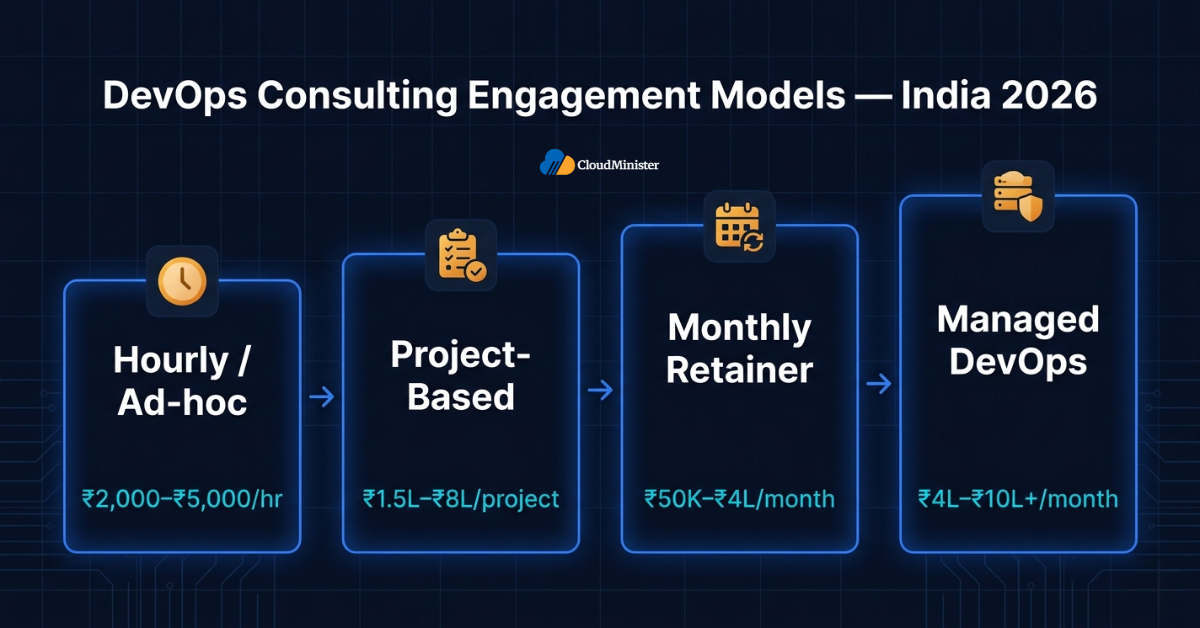
DevOps consulting providers in India use four primary commercial models. Each model has a different risk profile for the buyer, and the right choice depends on the maturity of the scope and the urgency of the delivery requirement.
2.1 Hourly / Ad-Hoc Consulting
- Rate range: ₹2,000–₹5,000 per hour ($25–$60/hr) for India-based providers in 2026
- Best for: Specific technical problems, pipeline audits, architecture reviews, incident post-mortems
- Risk: Scope creep on unstructured engagements; senior architects billed at premium rates for tasks that could be delegated
- When to use: When you have a defined problem and a clear deliverable — not when you need ongoing DevOps services capacity
2.2 Project-Based Fixed-Price Consulting
- Rate range: ₹1.5L–₹8L per project for well-defined deliverables (CI/CD pipeline implementation, cloud migration, container rollout)
- Best for: Teams with a defined scope and a hard budget ceiling
- Risk: Fixed-price requires well-specified scope; under-specified requirements lead to change order disputes
- When to use: CI/CD pipeline build, Kubernetes cluster setup, IaC migration — any engagement where the deliverable is a discrete, measurable outcome
2.3 Monthly Retainer
- Rate range: ₹50K–₹4L per month depending on scope, team size, and coverage hours
- Best for: Businesses that need ongoing DevOps consulting capacity without the overhead of full-time DevOps engineering hires
- Risk: Retainer value degrades if the engagement lacks defined SLAs and measurable outputs — always specify deliverables, not hours
- When to use: Post-implementation support, continuous pipeline improvement, monitoring management, cost optimisation
2.4 Fully Managed DevOps Services
- Rate range: ₹4L–₹10L+ per month for end-to-end managed operations, including Server Management Services India
- Best for: Scale-ups and enterprises that want to fully outsource DevOps operations under a defined SLA
- Risk: Higher cost; requires clear SLA definition, escalation paths, and quarterly review cadence to maintain commercial discipline
- When to use: When internal DevOps capacity is not strategically differentiated and the team needs to focus on product engineering instead.
Related Reading: Managed DevOps Services for Startups vs Enterprises
2026 DevOps Consulting Pricing Benchmark — India Market
| Engagement Model | Typical Scope | Est. Monthly Cost (INR) | Best For |
| Hourly / Ad-hoc | Troubleshooting, audits, one-off tasks | ₹2,000–₹5,000/hr | Startups with specific problems |
| Project-Based | Full CI/CD setup, cloud migration, container rollout | ₹1.5L–₹8L (per project) | Businesses with defined scope |
| Monthly Retainer (Basic) | Pipeline management, monitoring, on-call support | ₹50K–₹1.5L/month | Growing SaaS, e-commerce |
| Monthly Retainer (Advanced) | Multi-cloud, security hardening, compliance, DevSecOps | ₹1.5L–₹4L/month | Enterprise, fintech, regulated industries |
| Managed DevOps (Full Stack) | End-to-end DevOps ownership — 24×7 ops, scaling, incident response | ₹4L–₹10L+/month | Scale-ups and large enterprises |
3. Factors That Determine DevOps Consulting Rates in India
The headline rate a DevOps consulting provider quotes is rarely the final cost driver. Six factors move rates significantly within the Indian market, and understanding each one allows you to target the right tier of provider for your specific requirements — and avoid paying senior architect rates for junior execution work.
| Pricing Factor | Low End | High End | What Drives the Difference |
| Experience Level | Junior (1–3 yrs) | Architect (8+ yrs) | Certifications (AWS/GCP/CKA), track record, specialisations |
| Engagement Type | Ad-hoc / hourly | Managed retainer | Predictability, SLA coverage, team size committed |
| Cloud Stack Complexity | Single-cloud, basic CI/CD | Multi-cloud, multi-region | Number of services managed, compliance requirements |
| Geography (Provider) | Tier-2 cities | Bengaluru / Mumbai / Delhi | Talent concentration, office infrastructure overhead |
| Compliance Scope | No regulatory requirements | DPDPA, RBI IT, HIPAA-equivalent | Audit trail setup, documentation overhead, legal alignment |
| Support Coverage | Business hours only | 24×7 with < 15-min SLA | On-call rotation, incident response tooling |
3.1 Experience and Certification Premium
- A junior DevOps engineer (1–3 years) with basic CI/CD exposure charges ₹700–₹900/hr. A senior DevOps architect with 8+ years, AWS DevOps Professional certification, CKA (Certified Kubernetes Administrator), and a track record of production multi-region deployments charges ₹3,000–₹5,000/hr.
- AWS certifications (DevOps Engineer Professional, Solutions Architect Professional) carry a 20–35% rate premium over uncertified equivalents in the Indian market.
- Vertical-specific experience — fintech with RBI compliance alignment, healthcare with DPDPA and NDHM mapping — adds a further 15–25% premium over generalist DevOps consulting rates.
3.2 Stack Complexity and Cloud Depth
- Single-cloud (AWS only), single-region, basic CI/CD: lower rate band. Multi-cloud (AWS + Azure + GCP), multi-region, with GitOps, platform engineering, and FinOps: upper rate band.
- Kubernetes-heavy engagements (EKS, GKE, or self-managed k8s with Helm, ArgoCD, and service mesh) carry a specialisation premium because the talent pool for production-grade k8s operations in India is thinner than for standard container deployments.
- DevSecOps scope — where the DevOps consulting partner owns security gate configuration, SAST toolchain, CVE remediation workflows, and compliance reporting — commands the highest rate tier within any given experience bracket.
3.3 Engagement Duration and Commitment
- Short ad-hoc engagements command hourly premium rates because the provider takes on scheduling risk and context-switching overhead.
- Six-month and twelve-month retainer commitments typically attract 15–25% rate discounts versus equivalent hourly billing because they give the provider predictable revenue.
- Multi-year managed DevOps contracts — common at enterprise scale — often include committed SLAs with financial penalties for breach, which providers price into the contract to cover the risk exposure.
Avoid evaluating DevOps consulting quotes purely on day rate. A ₹3,000/hr senior architect who solves a pipeline architecture problem in 4 hours costs ₹12,000. A ₹1,500/hr junior consultant who spends 20 hours getting to the same outcome costs ₹30,000 — and introduces configuration debt that adds cost downstream. The correct unit of value is outcome per rupee, not hours per rupee.
4. In-House vs. DevOps Consulting — The 2026 Commercial Comparison
The build-vs-buy calculation for DevOps capability in India has shifted significantly in 2026. The fully-loaded cost of an in-house DevOps engineer — including salary, PF, gratuity, tooling, training, and management overhead — is now comparable to or higher than a mid-tier managed DevOps retainer for most SMB and growth-stage companies.
4.1 In-House DevOps Engineering Costs in India (2026 Benchmarks)
- Junior DevOps Engineer (1–3 years): ₹6L–₹12L CTC per year
- Mid-level DevOps Engineer (3–6 years): ₹12L–₹22L CTC per year
- Senior DevOps Engineer (6–10 years): ₹22L–₹40L CTC per year
- DevOps Architect / Lead (10+ years): ₹40L–₹70L+ CTC per year
- Add 25–35% fully-loaded overhead to each figure: PF contribution, gratuity accrual, health insurance, annual leave, training budget, laptop, and SaaS tooling licenses
A production-grade DevOps capability typically requires a minimum of two engineers — one senior for architecture and one mid-level for execution. That floor is ₹50L–₹80L/year fully loaded before you account for tooling, cloud compute, and the reality that DevOps engineers at this level are among the most actively recruited professionals in the Indian tech market.
4.2 What DevOps Consulting Delivers at Each Budget Level
- At ₹50K/month retainer: One part-time mid-level DevOps engineer, reactive support, pipeline monitoring, Server Management Services India, and basic CI/CD management
- At ₹1.5L/month retainer: Dedicated senior engineer allocation, proactive optimisation, monthly reporting, security scanning management
- At ₹4L/month managed services: Full team allocation (1 architect + 1–2 engineers), 24×7 SLA, incident response, quarterly infrastructure reviews, DPDPA compliance reporting
- At ₹8L+/month enterprise managed services: Multi-team allocation, platform engineering capability, dedicated security and compliance function, Server Management Services India, and custom SLA with financial penalties
Related Reading: how to choose the right DevOps service provider
In-House vs. DevOps Consulting — Key Dimensions
| Dimension | In-House Team | DevOps Consulting / Managed DevOps |
| Setup time to production | 4–12 weeks (first pipeline) | 1–3 weeks with experienced partner |
| Engineering cost (2026) | ₹1.5L–₹3L/month (1–2 engineers, fully loaded) | ₹50K–₹4L/month depending on scope |
| Depth of expertise | Limited to internal hires; gaps in niche areas | Cross-client operational experience across stacks |
| Security configuration | Requires dedicated internal DevSecOps focus | Partner handles DevSecOps gates and audit trail |
| Scalability | Requires headcount growth ahead of infrastructure | Scales with workload on existing engagement |
| 24×7 coverage | Requires on-call rotation — expensive at SMB scale | Included in managed engagement SLA |
| DPDPA alignment | Requires specialist compliance knowledge | Partner handles compliance tooling and documentation |
5. What You Should Get for Your DevOps Consulting Budget
The budget range tells you what tier of DevOps consulting you can access. The deliverable checklist tells you whether you are actually getting production value from that spend.
5.1 ₹50K–₹1.5L/Month — Starter DevOps Consulting
At this budget level, you should expect:
- CI/CD pipeline implementation on a single cloud platform (AWS, Azure, or GCP) — best paired with NVMe cloud hosting India for optimal pipeline execution speed
- Basic build, test, and deploy stages with automated rollback on failure
- Dependency vulnerability scanning and basic secrets detection in the pipeline
- CloudWatch or equivalent monitoring setup with email and Slack alerting
- Monthly pipeline health report
What you should NOT accept at this budget level:
- No security scanning in the pipeline — in 2026, security gates are not advanced features; they are the baseline for any production pipeline
- No documented rollback procedure — rollback by manual re-run or SSH into servers is not an acceptable delivery standard
- No environment separation — a pipeline that deploys to production directly from the build stage is not production-grade DevOps consulting output
5.2 ₹1.5L–₹4L/Month — Standard DevOps Consulting
At this budget level, you should expect:
- Multi-environment pipeline (development → staging → UAT → production) with defined promotion gates
- Blue/green or canary deployment strategy for production with CloudWatch alarm-triggered automatic rollback
- Container strategy — ECR image scanning, Docker layer caching, ECS or EKS cluster configuration
- IaC coverage — Terraform or CloudFormation managing infrastructure declaratively with version-controlled state
- Audit trail configuration — CloudTrail, deployment approval records, and pipeline execution history retained, relevant to DPDPA 2023 technical safeguard considerations
- Weekly monitoring reviews and quarterly infrastructure cost optimisation reports
Explore CloudMinister’s DevOps Consulting Services
From CI/CD pipeline implementation to fully managed DevOps operations — built for Indian businesses, production-grade from Day 1.
5.3 ₹4L+/Month — Advanced or Managed DevOps Services
At this budget level, you should expect full DevOps services ownership:
- Multi-region and/or multi-account pipeline architecture with blast radius isolation
- Platform engineering capability — internal developer platform, self-service deployment tooling, golden path templates
- Full DevSecOps integration — automated remediation workflows, CVE tracking, compliance reporting mapped to regulatory frameworks
- 24×7 incident response under defined SLA (MTTR, MTTD metrics contractually committed)
- Dedicated FinOps function — cloud spend monitoring, reserved instance planning, rightsizing recommendations
- Quarterly executive review with benchmark comparisons against industry deployment frequency and change failure rate metrics
Any DevOps consulting engagement for production workloads that does not include security scanning in the pipeline scope should be treated with caution. SAST, dependency vulnerability scanning, ECR container image scanning, and secrets detection are strongly recommended baseline controls for pipelines processing production workloads — the configuration model (hard gate vs. advisory) should be determined based on risk assessment and team maturity. For Indian businesses, these controls are also directly relevant to DPDPA 2023 technical safeguard obligations for systems processing personal data — verify specific requirements with qualified legal counsel.
6. CI/CD Pipeline DevOps Consulting: What the Build Stage Actually Costs
The most common entry point for DevOps consulting engagements in India is CI/CD pipeline implementation — and it is also the segment where pricing varies most widely for apparently similar scopes. The difference is almost always in what is included in the security, testing, and rollback layers, not in the basic source-build-deploy mechanics.
For a technically precise walkthrough of what a production-grade CI/CD pipeline on AWS requires and how to configure each stage correctly, refer to the detailed guide at:
From a DevOps consulting cost perspective, a CI/CD implementation engagement should be priced against the following scope elements:
6.1 Basic CI/CD Pipeline (₹1.5L–₹3L, 2–4 weeks)
- Source repository setup (CodeCommit or GitHub App integration) with branch protection
- CodeBuild project with buildspec.yml, managed image, Docker layer caching, and test report publishing
- Basic deployment to single environment (ECS, EC2, or Lambda)
- S3 artefact bucket with versioning and SSE-S3 encryption
- EventBridge notifications on pipeline failure
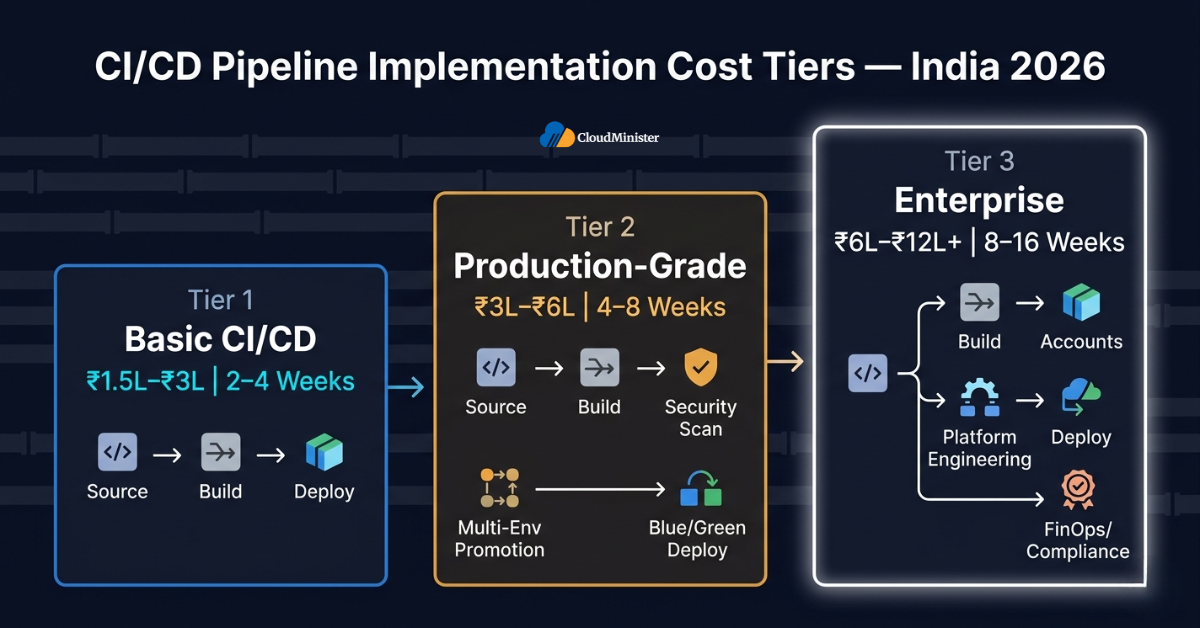
6.2 Production-Grade CI/CD Pipeline (₹3L–₹6L, 4–8 weeks)
- Multi-environment promotion (dev → staging → production) with approval gates
- Blue/green deployment via CodeDeploy with CloudWatch alarm-triggered automatic rollback
- Security scanning: SAST, dependency vulnerability scanning, ECR image scanning with hard failure gates (not advisory warnings)
- Secrets management integration: AWS Secrets Manager or Parameter Store — no credentials in buildspec.yml or pipeline definition
- IaC pipeline layer: CloudFormation or CDK for infrastructure provisioning
- CloudTrail logging and deployment audit trail to support DPDPA compliance readiness — specific obligations should be verified with qualified legal counsel
6.3 Enterprise CI/CD Pipeline (₹6L–₹12L+, 8–16 weeks)
- Multi-account pipeline architecture with separate AWS accounts per environment and blast radius isolation
- Multi-region deployment with ECR cross-region replication and S3 Cross-Region Replication
- Platform engineering layer: golden path templates, self-service pipeline provisioning for development teams
- Compliance pipeline: cfn-nag or Checkov scanning of IaC output, audit evidence generation for regulatory frameworks
- SLA-backed post-go-live DevOps services support with defined incident response metrics
7. Vertical-Specific DevOps Consulting Cost Considerations
The regulatory environment of your industry is the single most important vertical-specific cost driver in DevOps consulting engagements. A provider with proven fintech DevOps consulting experience will cost more per hour than a generalist — but the alternative is a pipeline that fails its first regulatory audit.
7.1 E-Commerce
- Cost driver: Zero-downtime deployment requirements. Blue/green strategy is non-negotiable; any DevOps consulting partner that recommends rolling deployments to production during peak traffic windows is not qualified for this vertical.
- Additional scope: Performance regression testing (k6 or Gatling) as a CodeBuild phase before production promotion; CloudWatch Synthetics canaries on checkout and payment flows with automatic rollback on failure
- DPDPA relevance: Pipeline audit trails are a recommended control for systems processing customer PII and payment data — verify specific obligations with qualified legal counsel
- Typical DevOps consulting cost: ₹2L–₹5L/month retainer for a standard e-commerce platform scale; ₹5L–₹10L/month for high-traffic marketplace operations
7.2 Fintech and NBFC
- Cost driver: Change management traceability and RBI IT Framework alignment. Every production deployment must be traceable to an approved change record via pipeline approval metadata.
- Additional scope: Container image scanning must be configured as a hard gate — not advisory. Custom CodeBuild evaluation steps that read ECR scan findings and fail the build on critical CVEs are mandatory.
- DevOps services requirement: DevOps consulting providers for fintech must have experience configuring RBI-aligned approval workflows and audit evidence generation — this is a specialisation, not a general DevOps competency
- Typical DevOps consulting cost: ₹3L–₹6L/month for NBFC-scale operations with compliance scope included
7.3 Healthcare and Pharma
- Cost driver: DPDPA 2023 governs personal health data processing in India. Pipeline audit trails and access controls are recommended controls to support DPDPA data fiduciary obligations and NDHM framework guidelines.
- Additional scope: File integrity monitoring for deployments to systems handling patient records; MFA-authenticated production deployment approvals in CodePipeline’s manual approval action settings
- DevOps consulting specialisation: Providers with NDHM compliance mapping experience command a 20–30% premium over generalist DevOps consulting rates in this vertical
- Typical DevOps consulting cost: ₹2.5L–₹5L/month; Windows-based clinical application environments can be connected to CodeDeploy as hybrid targets without platform migration
7.4 SaaS Businesses Targeting Global Markets
- Cost driver: Multi-region pipeline coverage and 99.9%+ SLA contractual obligations require automated canary deployments with health check-triggered rollback — manual deployment verification is not a viable strategy at this uptime tier.
- Additional scope: Docker image layer optimisation and S3 artefact replication cost management across regions; unified monitoring spanning Indian-hosted front-ends and global AWS deployments
- Typical DevOps consulting cost: ₹4L–₹8L/month for SaaS at growth stage; ₹8L–₹15L/month for enterprise SaaS with multi-region and multi-account architecture
Related Reading: Kubernetes vs Docker — Which One Do You Need
8. Red Flags in DevOps Consulting Quotes
The DevOps consulting market in India includes providers across a wide spectrum of capability and commercial integrity. These warning signs indicate a quote that is likely to generate budget overruns, configuration debt, or operational risk post-delivery.
Red Flag 1: No Security Scanning in the Scope
Any DevOps consulting proposal for production workloads that does not include SAST, dependency vulnerability scanning, and container image scanning as standard pipeline components warrants careful scrutiny. These controls are strongly recommended for pipelines processing production workloads — whether they are configured as hard failure gates or advisory warnings should reflect the organisation’s risk posture and pipeline maturity, but omitting them entirely is a significant gap. A provider that omits them is either inexperienced or is deliberately reducing scope to win on price.
Red Flag 2: Fixed Price Without a Scope Document
A fixed-price DevOps consulting quote without a corresponding scope document (specifying environments, tools, integrations, testing layers, approval gates, and compliance requirements) is not a fixed-price engagement — it is a floor price. The change order mechanism activates as soon as any unstated assumption proves incorrect, which is always.
Red Flag 3: T&M with No Velocity Baseline
Time-and-materials engagements without defined velocity metrics (story points per sprint, deployment frequency targets, mean time to recovery benchmarks) have no commercial anchor. You are paying for effort, not outcomes. Any serious DevOps consulting provider should be able to commit to measurable delivery milestones against which spend can be tracked.
Red Flag 4: Rollback as an Afterthought
A DevOps consulting proposal that mentions rollback in a single sentence — ‘we will configure rollback capability’ — without specifying the mechanism (CodeDeploy alarm-triggered rollback, ECS blue/green task set retention, Lambda weighted alias configuration) is underspecified. Rollback configuration is one of the highest-value components of a DevOps services engagement, and providers who treat it as a line item rather than a design decision are not operating at production maturity.
Red Flag 5: No Post-Delivery Support Included
A DevOps consulting engagement that ends at go-live with no handover period, no documentation, and no support window is a professional services engagement, not a DevOps services partnership. The first 30–90 days after a pipeline goes live are when configuration gaps and environment-specific edge cases surface. A provider who is not contractually available during this period is not delivering production-grade DevOps consulting.
Before signing any DevOps consulting contract, request three references from clients in your vertical who went live in the last 12 months. Ask each reference specifically about: (1) post-go-live support quality, (2) how scope changes were handled commercially, (3) whether the security and compliance deliverables were production-grade on day one. These three questions surface more due diligence signal than any RFP response.
9. How to Evaluate DevOps Consulting Providers — The Right Questions
The market size numbers illustrate the scale of the opportunity and the competition. According to Mordor Intelligence, Asia-Pacific will post the highest regional CAGR of 25.4% through 2031 for DevOps, with India recording that 65% of organisations report high-impact outages — directly increasing urgency for resilient DevOps practices and qualified consulting partners. Separating capable providers from well-marketed ones requires asking the right questions at the evaluation stage.
Technical Evaluation Questions
- What deployment strategy do you use for production workloads — rolling, blue/green, or canary? What drives the decision?
- How do you handle secrets management in the CI/CD pipeline? Can you show us an example buildspec.yml that references Parameter Store values?
- What security scanning tools do you integrate, and are they configured as hard failure gates or advisory warnings?
- How do you configure automated rollback — and can you demonstrate a scenario where a CloudWatch alarm triggers automatic rollback on a CodeDeploy deployment group?
- What is your approach to IaC — do you use Terraform, CloudFormation, or CDK, and how do you manage state and drift detection?
Commercial Evaluation Questions
- Is your pricing model hourly, fixed-price, or retainer — and if fixed-price, what is your change order process?
- What deliverables are committed in the first 30, 60, and 90 days of the engagement?
- What does your post-go-live support window include, and how long is it covered under the base engagement price?
- How do you handle DPDPA 2023 compliance requirements in your DevOps consulting scope — what specific controls do you configure?
- What is your SLA for incident response during the managed DevOps phase, and is it contractually enforceable with financial consequences?
Not Sure Which DevOps Engagement Model Fits Your Business?
Tell us your stack, your compliance requirements, and your deployment goals — and we’ll scope the right engagement for you, with no obligation.
10. The True Cost of Not Investing in DevOps Consulting
The cost of underinvesting in DevOps consulting is rarely visible on a budget spreadsheet — it shows up in deployment frequency, incident rate, engineering opportunity cost, and the compounding effect of configuration debt on infrastructure costs.
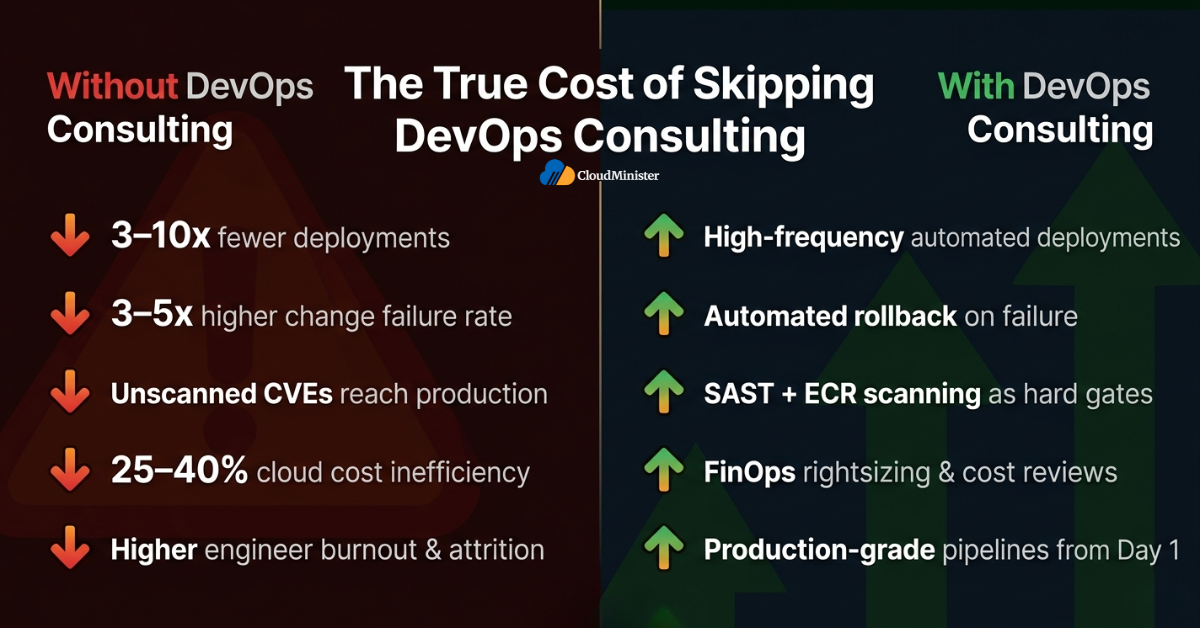
- Deployment frequency: Teams without production-grade DevOps Consulting Services infrastructure deploy 3–10 times less frequently than DevOps-mature teams, delaying feature releases and competitive response cycles. Build speed is directly affected by compute — NVMe cloud hosting India delivers the I/O performance that CI/CD pipelines require to hit peak deployment frequency.
- Incident rate and MTTR: Manual deployment processes have 3–5x higher change failure rates than automated pipelines with rollback capability. Each production incident at a 50-engineer company costs 4–8 engineering days of investigation and remediation.
- Security incident exposure: Pipelines without security scanning are the primary attack surface for supply chain vulnerabilities. A single undetected critical CVE in a container image reaching production can trigger a DPDPA-reportable breach with regulatory and reputational consequences.
- Infrastructure cost overruns: Teams without IaC and FinOps coverage average 25–40% cloud cost inefficiency versus DevOps-mature organisations with managed DevOps services performing regular rightsizing and cost optimisation reviews.
- Engineering talent retention: DevOps engineers with production-grade AWS pipeline experience are among the most recruited professionals in the Indian tech market. Engineers operating manual deployment processes at sub-mature DevOps organisations report higher burnout and lower retention than those working with automated pipelines.
Hosting infrastructure is the foundation that DevOps consulting builds on. If your cloud hosting is not optimised before you overlay DevOps services automation, pipeline efficiency improvements will be partially offset by underlying infrastructure inefficiencies. For Indian businesses evaluating cloud hosting options, CloudMinister offers NVMe cloud hosting India with the performance baseline that production-grade DevOps pipelines require. When selecting a web hosting provider in India for DevOps workloads, NVMe storage and low-latency networking are the infrastructure variables most directly linked to pipeline execution speed.
11. DevOps Consulting Cost Readiness Checklist
Before engaging a DevOps consulting provider, verify that your internal readiness covers these prerequisites. Missing items do not block engagement — but they create scope expansion risk that should be priced and agreed in the contract.
- AWS account: Billing alerts configured, IAM users and roles defined, root account credentials locked
- Source control: Repository in CodeCommit, GitHub, or Bitbucket; branch strategy defined (main/staging/develop); branch protection rules on production branches
- Target environment: EC2 instances, ECS cluster, or Lambda functions provisioned; S3 artefact bucket created with versioning enabled; ECR repository created for containerised workloads
- Secrets hygiene: No credentials in source code; existing secrets identified and ready for migration to Secrets Manager or Parameter Store
- Compliance scope: DPDPA applicability assessed; RBI IT Framework or NDHM requirements documented if applicable; legal counsel engaged on compliance obligations
- Deployment documentation: Current deployment process mapped on paper including all manual steps, environments, approval gates, and rollback procedures
- Budget authority: Monthly AWS service costs and DevOps consulting retainer approved by appropriate authority; change order process agreed
- DR and rollback expectations: Recovery time objective (RTO) and recovery point objective (RPO) defined for production systems; quarterly game day requirement acknowledged
Conclusion
DevOps consulting in India in 2026 is not a commodity purchase — it is an infrastructure investment with a five-year compounding return on deployment frequency, incident reduction, engineering leverage, and regulatory defensibility. The pricing benchmarks in this guide give you the commercial grounding to scope engagements correctly, evaluate providers objectively, and avoid the configuration debt that accumulates when DevOps Consulting Services are procured on price rather than on outcome quality. Infrastructure quality matters equally — NVMe cloud hosting India provides the high-performance compute layer that prevents the hosting tier from becoming a bottleneck in pipeline execution.
The critical decision is not between in-house and DevOps consulting — it is between a DevOps consulting engagement that delivers production-grade infrastructure on day one and one that delivers a development prototype that requires six months of reactive fixes before it operates at production standards.
For Indian businesses at growth stage — particularly those scaling toward enterprise AWS deployments — the investment in a properly scoped DevOps consulting engagement pays back within the first quarter through deployment frequency improvement, incident rate reduction, and DPDPA compliance readiness.
Organisations that also require Server Management Services India alongside their DevOps engagement benefit from consolidating both with a single provider — reducing handover overhead and ensuring the server layer is managed to the same production standards as the deployment pipeline.
CloudMinister’s DevOps engineering team provides DevOps Consulting Services structured around your specific infrastructure profile, compliance requirements, and deployment scale. Whether your infrastructure runs on cloud-native ECS, serverless Lambda, or traditional servers — the architectural principles in this guide apply consistently. The configuration details differ by compute platform; the operational and commercial standards do not.
As a trusted web hosting provider in India with deep AWS infrastructure experience, CloudMinister approaches DevOps consulting with the same principle that governs all infrastructure work: production-grade on day one, not after six months of reactive fixes.
Key Takeaways
• DevOps consulting in India ranges from ₹2,000/hr for ad-hoc work to ₹10L+/month for full managed DevOps services — the right model depends on scope maturity and operational requirement
• India-based DevOps consulting providers deliver senior-level expertise at 60–75% lower rates than equivalent US or UK engagements
• The correct unit of commercial evaluation is outcome per rupee, not hours per rupee — rate arbitrage without scope clarity generates budget overruns
• Security scanning (SAST, dependency scanning, ECR image scanning) is strongly recommended for every production pipeline — whether configured as a hard gate or advisory control should be based on organisational risk posture, but omitting it entirely is a significant gap
• DPDPA 2023 considerations are relevant to DevOps consulting scope for systems processing personal data — CloudTrail, CodePipeline execution history, and IAM audit trails are practical supporting controls, but specific obligations should be verified with qualified legal counsel
• Multi-account pipeline architecture (separate AWS accounts per environment) is the correct model for enterprise and regulated industry deployments
• The in-house DevOps engineering floor for a two-person team in India is ₹50L–₹80L/year fully loaded — comparable to or higher than mid-tier managed DevOps retainers for most SMBs
• Always request three client references in your vertical from the last 12 months before signing any DevOps consulting contract
Frequently Asked Questions
What is the average hourly rate for DevOps consulting in India in 2026?
India-based DevOps consulting providers charge ₹2,000–₹5,000 per hour ($25–$60/hr) in 2026 depending on experience level, certification depth, and specialisation. Junior engineers charge at the lower end; senior architects and DevSecOps specialists with vertical-specific compliance experience charge at the upper end. Metro-based providers in Bengaluru, Mumbai, and Hyderabad charge 10–20% higher than Tier-2 city equivalents. Infrastructure context also matters: engineers working against NVMe cloud hosting India benefit from faster build feedback loops, which can reduce consulting hours required for pipeline tuning by 15–25%.
How much does a full CI/CD pipeline implementation cost as a DevOps consulting project in India?
A basic three-stage CI/CD pipeline (source, build, deploy) implemented by a DevOps consulting provider costs ₹1.5L–₹3L as a fixed-price project. A production-grade pipeline with multi-environment promotion, blue/green deployment, security scanning, IaC, and DPDPA-aligned audit trails costs ₹3L–₹6L. An enterprise pipeline with multi-account architecture, multi-region deployment, and platform engineering costs ₹6L–₹12L+. Businesses that choose a web hosting provider in India with DevOps-optimised infrastructure typically reduce integration overhead by 15–20%.
Is a monthly retainer or a project-based engagement better for DevOps consulting?
Project-based engagements are appropriate when the scope is well-defined and the deliverable is a discrete infrastructure outcome — a CI/CD pipeline build, a Kubernetes migration, an IaC refactor. Monthly retainers are appropriate when ongoing DevOps Consulting Services capacity is needed — pipeline monitoring, cost optimisation, security gate management, incident response, and Server Management Services India. Most businesses benefit from a project-based engagement to establish the foundation, followed by a retainer for ongoing managed DevOps operations.
Does a DevOps consulting engagement satisfy DPDPA 2023 technical safeguard requirements?
A properly scoped DevOps consulting engagement — with CloudTrail logging, CodePipeline execution history, CodeDeploy deployment records, IAM access controls, and ECR security scanning — provides audit trail and access monitoring infrastructure that may support DPDPA 2023 technical safeguard obligations for systems processing personal data — but pipeline automation addresses only one dimension of compliance. However, pipeline automation is one component of DPDPA compliance. Data residency, encryption, breach notification procedures, and access control policies must also be addressed. Verify specific obligations with qualified legal counsel.
How long does a production-grade DevOps consulting engagement take to deliver results?
For a team with an experienced DevOps consulting partner, a basic pipeline is operational in 2–4 days. A production-grade pipeline with security scanning, multi-environment promotion, blue/green deployments, IaC, and monitoring takes 2–4 weeks for the first application. Subsequent applications on the same pipeline architecture are significantly faster — most DevOps consulting providers template the configuration after the first production deployment, reducing time-to-delivery for additional applications by 60–70%. Partnering with a web hosting provider in India that provides DevOps-compatible infrastructure from the outset compresses these timelines further.

He is the CEO and Founder with over a decade of experience in cloud infrastructure, DevOps, and server optimization. With a strong vision and hands-on leadership approach, he has built scalable, secure, and high-performance cloud solutions trusted by businesses across industries.